




Abstract
Background:
Insulin pump therapy improves glycemic control in children with type 1 diabetes but is associated with technical and dermatological complications that can impact adherence. Research on these adverse effects in pediatric populations is limited.
Objectives:
This study aimed to evaluate short- and long-term complications of insulin pump therapy in pediatric patients in Saudi Arabia, focusing on technical malfunctions, dermatological issues, and patient satisfaction.
Design:
A cross-sectional survey-based study conducted in multiple centers in Taif, Saudi Arabia.
Methods:
Fifty-nine parents of children with type 1 diabetes who used insulin pumps provided data for the study. Participants reported technical issues, skin-related complications, and overall satisfaction. IBM SPSS Statistics version 27.0.1 was used to conduct the statistical analysis.
Results:
Technical complications were frequent, with 64.4% experiencing tube blockages, 39.0% reporting needle dislodgment, and 39.0% observing air bubbles in the tubing. Dermatological issues included discomfort at the infusion site (54.2%), skin pigmentation (45.8%), and scarring (55.9%), with lipohypertrophy (22.0%) posing a concern for insulin absorption. Longer pump use was significantly associated with increased complications, particularly tube blockages and skin pigmentation. Despite these challenges, 84.7% of participants recommended insulin pumps over multiple daily injections.
Conclusion:
Technical and dermatological complications were common, increasing with longer pump use. Proper infusion site rotation, infusion set management, and improved patient education are key to reducing adverse effects. To improve safety and efficacy, future studies should concentrate on infusion set change patterns, newer pump technologies, and standardized guidelines.
Plain language summary
Insulin pumps are increasingly used to manage type 1 diabetes in children, but there is limited knowledge about their complications in Saudi Arabia. This study investigated the challenges associated with insulin pump use among children and adolescents in Taif. Conducted over a year, the study included participants aged 18 or younger who used insulin pumps and excluded those who did not meet these criteria. Findings revealed that technical issues were common. Users who preferred pumps over injections frequently reported login problems (71.4%), and Medtronic MiniMed 670G users faced difficulties with data downloading and login (42.9%). Longer pump use (over one year) was linked to higher rates of occlusion (66.7%). Females experienced more synchronization issues, while males reported increased water damage. Abdominal pain at injection sites was a prevalent skin issue. Complications such as login errors, data download challenges, and catheter kinking were associated with lower satisfaction scores. The results underscore the importance of improved support and design for insulin pumps to enhance user experience and outcomes for young patients managing type 1 diabetes.
Keywords
Introduction
The autoimmune death of pancreatic beta cells causes type 1 diabetes mellitus (T1DM), which leads to insulin insufficiency and requires lifelong insulin therapy. 1 Maintaining appropriate growth and pubertal development in children while preventing long-term microvascular and macrovascular problems requires achieving adequate glycemic control.1,2 Continuous subcutaneous insulin infusion, provided by insulin pump therapy (IPT), has become a viable substitute for several daily injections due to its increased flexibility, better glucose control, and more physiological method of delivering insulin.3,4
Despite its benefits, there are still worries about problems related to insulin pumps, especially in young patients. Dermatological responses, pump issues, and therapy cessation because of discomfort or discontent are a few of them.5–7 According to studies, dermatological problems affect 43%–90% of kids who use insulin pumps, with younger kids being more vulnerable. 7 Common side effects, such as lipohypertrophy, eczema, scars, and nodules, have been documented; these are frequently linked to irritation from adhesives and extended insulin infusion at the same location. 8 In addition, despite the technological advances provided by IPT and continuous glucose monitoring (CGM), little is known about how these interventions affect health-related quality of life, especially in children and adolescents.9,10
Saudi Arabia has one of the highest rates of T1DM prevalence, and more and more kids and teenagers are using IPT.11,12 Long-term insulin pump use, insufficient infusion site rotation, and catheter replacement practices were identified as independent risk factors for skin-related problems in a 2018 study at Prince Sultan Military Medical City, especially in females. 12 The range of acute, intermediate, and long-term problems in pediatric patients is still poorly understood, despite the increasing use of insulin pumps. By evaluating insulin pump-associated side effects during and after implantation in children and adolescents in Taif, Saudi Arabia, this study seeks to fill this knowledge gap and offer important insights into the difficulties this population faces.
Methods
Study design and setting
A minimum sample size of 54 participants was determined based on data from Al Hayek et al. 12 who reported skin-related complications in 81% of insulin pump users. Using an estimated effect size of 0.2, with 80% statistical power and a 5% alpha error, the required sample size was calculated.
Study population
Children and adolescents aged ⩽18 years with T1DM using the Medtronic 780G insulin pump and receiving regular follow-up were included.
Exclusion criteria
Individuals above 18 years old
Patients not using the 780G insulin pump
Those switched to multiple daily injections
Participants unwilling to participate
Data collection
Data were collected through telephone interviews and during insulin pump clinic visits using a validated, predesigned questionnaire. The questionnaire covered demographics, T1DM and IPT duration, insulin dosage, insertion details, complications at insertion, catheter/infusion site reactions, and pump-related post-insertion complications. The items were adapted from previous international and national studies.
Statistical analysis
Statistical analyses were conducted using IBM SPSS Statistics 27.0.1. Descriptive statistics summarized continuous variables as mean and standard deviation (SD) or median and interquartile range, depending on data distribution, while categorical variables were presented as frequencies and percentages. Normality was assessed using the Shapiro–Wilk test (p < 0.05). Since the data were not normally distributed, nonparametric tests were employed, including the Kruskal–Wallis test for comparisons of ordinal variables across multiple groups and the Fisher-Freeman-Halton exact test for categorical variables. A p-value <0.05 was considered statistically significant.
Ethical considerations
Ethical approval was obtained from the Research & Ethical Committee of Taif Armed Forces Hospitals, Taif, Saudi Arabia. Written informed consent was obtained from parents or legal guardians, and verbal assent was secured from children aged ⩾7 years who could comprehend the study procedures.
Results
Characteristics of pediatric participants and insulin pump usage
The survey included 59 respondents: 24 (40.7%) mothers, 16 (27.1%) fathers, and 19 (32.2%) both parents. The children with diabetes had an average age of 11.46 years (SD = 3.51), with 31 (52.5%) being female. Heights ranged from 31 to 170 cm, with the most common range being 151–160 cm (33.9%). Weight distribution varied, with 35.6% weighing 41–50 kg. The mean duration of diabetes was 6.05 years (SD = 3.34), and 31 (52.5%) were diagnosed with diabetic ketoacidosis (DKA).
Before transitioning to insulin pumps, 54 (91.5%) used multiple daily insulin injections, and 74.5% rated the pump as significantly better (score of 5). The abdomen was the most common injection site (49.2%). A total of 24 (40.7%) had prior pump experience, with the Medtronic 640G being the most used model (54.1%). The primary reasons for switching pumps included upgrading (45.8%) and technical issues (37.5%). The mean prior pump use duration was 2.54 years (SD = 1.20). Currently, all participants use the Medtronic 780G pump, with 52.5% using it for over a year (Table 1).
Characteristics of pediatric participants and insulin pump usage.

Technical adverse effects of insulin pump usage
Participants reported an average of 3.56 technical issues (SD = 2.28). Common problems included difficulties uploading (27.1%) or linking data (32.2%) to the application, as well as mechanical issues such as tube blockages (64.4%) and needle displacement (39.0%). Other concerns included insulin leakage (11.9%), air bubbles (39.0%), tube twisting (28.8%), and pump screen (13.6%) or keyboard failures (8.5%). Battery issues (5.1%), accidental breakage (10.2%), and damage from exposure to liquids (11.9%) were also noted (Table 2).
Technical adverse effects of insulin pump usage.

Skin and general adverse effects of insulin pump usage
On average, participants experienced 4.37 skin or general adverse effects (SD = 2.49). Discomfort at the needle insertion site was the most reported (54.2%), followed by skin pigmentation (45.8%) and scarring (55.9%). Other effects included adipose tissue atrophy (10.2%), tissue enlargement (22.0%), local pain (67.8%), bleeding (33.9%), and irritation (35.6%). Hypoglycemia affected 78.0% of participants, while 30.5% experienced DKA episodes (Table 3).
Skin and general adverse effects of insulin pump usage.

Satisfaction and perception of insulin pump usage
Most participants (67.8%) were introduced to insulin pumps by their physicians, while others learned through social media (15.3%) or diabetic relatives (13.6%). The primary pre-installation concerns were unfamiliarity with the device (45.8%) and its handling (28.8%). Satisfaction was high, with 83.1% highly satisfied (score of 5) with consultant guidance, 74.6% with educator explanations, and 76.3% reporting all concerns addressed. In addition, 81.4% believed the pump improved family life, and 84.7% strongly recommended it over injections. The overall satisfaction score averaged 33.02 (SD = 3.47; Table 4 and Figure 1).
Satisfaction and perception of insulin pump usage.


Perceptions and satisfaction levels regarding insulin pump use and education.
Comparison of adverse effects and satisfaction based on insulin pump duration
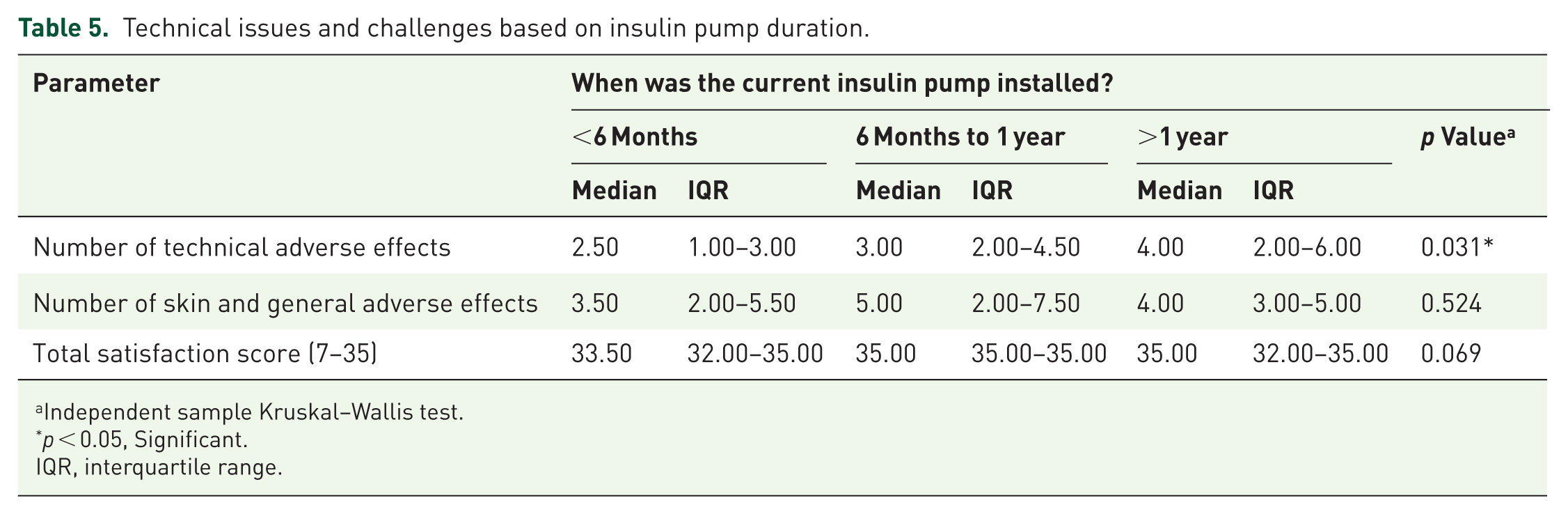
Longer pump use correlated with increased technical issues (62.5% vs 37.5%, p = 0.031) and tube blockages (71.4% vs 42.9%, p = 0.025). Skin pigmentation at the insertion site was significantly associated with pump duration (57.1% vs. 32.1%, p = 0.026). Other skin-related and general adverse effects, including discomfort at the needle site, scarring, infections, adipose tissue changes, irritation, local pain, bleeding, hypoglycemia, and DKA, did not show statistically significant differences across the duration groups, though some variables indicated trends. Satisfaction scores did not differ significantly across usage groups (p = 0.069) but trended higher with longer duration (Table 5 and Figure 2).
Technical issues and challenges based on insulin pump duration.
Independent sample Kruskal–Wallis test.
p < 0.05, Significant.
IQR, interquartile range.

Prevalence of insulin pump tube blockage and skin pigmentation by duration of use.
Comparison of adverse effects and satisfaction based on insulin injection site
Accidental pump breakage was more common in users injecting at non-traditional sites (17.4% vs 5.3%, p = 0.045). Discomfort (69.6% vs 47.4%, p = 0.030), scarring (65.2% vs 42.1%, p = 0.045), and local pain (78.3% vs 57.9%, p = 0.007) were significantly more frequent at alternative sites. The total number of adverse effects showed a trend toward higher values at non-traditional sites (p = 0.061). Satisfaction levels remained high across all injection site groups, with no significant differences (p = 0.327; Table 6 and Figure 3).
Technical issues and adverse effects based on insulin injection site.

Independent sample Kruskal–Wallis test.
p < 0.05, Significant.
IQR, interquartile range.
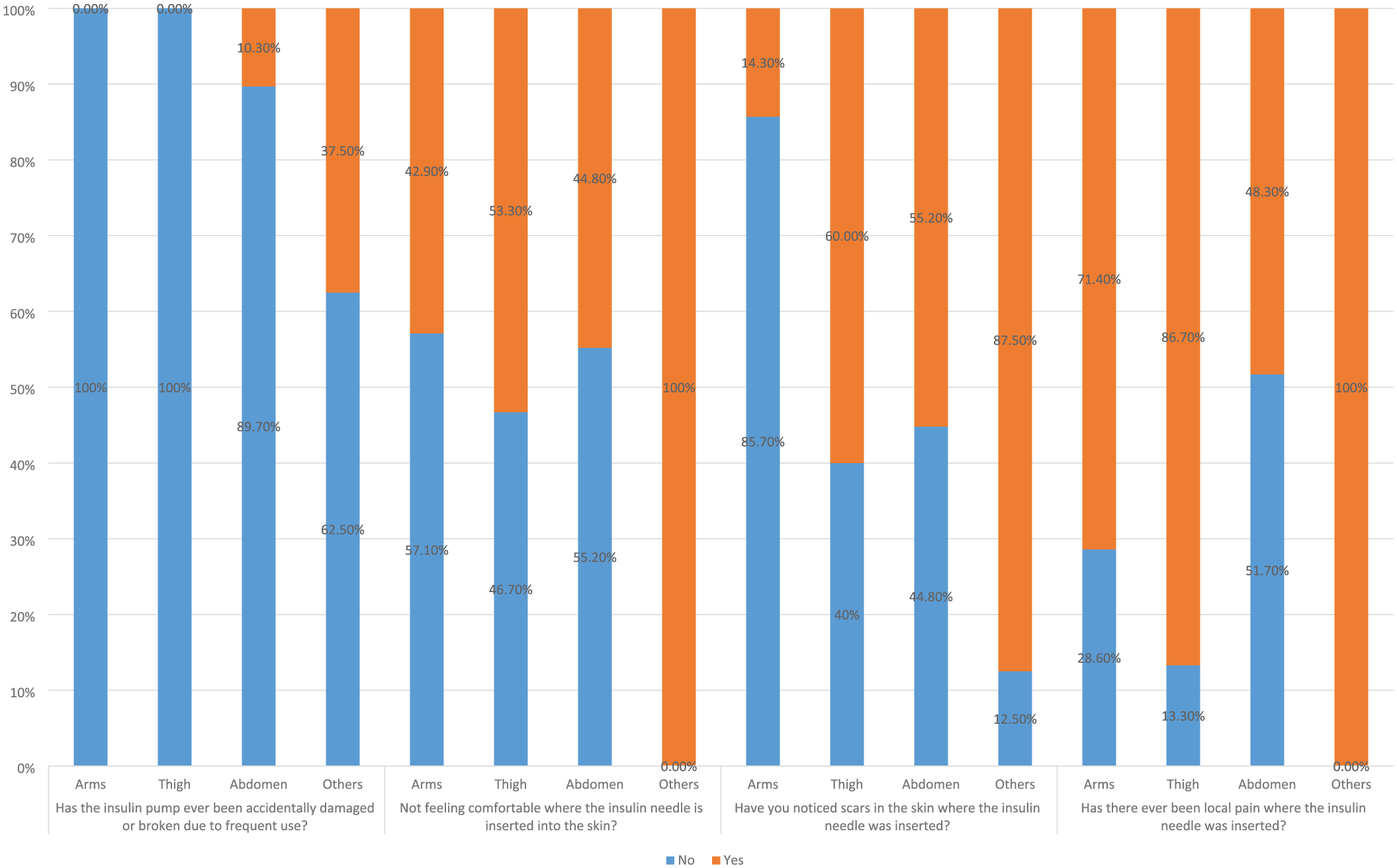
Adverse effects and discomfort related to insulin pump use by injection site.
Discussion
This study offers a thorough evaluation of the immediate and long-term side effects of IPT in Saudi Arabian children and adolescents with type 1 diabetes. Our research reveals a high prevalence of dermatological and technical issues, many of which directly affect patient adherence and glycemic management. Overall, patient satisfaction with IPT remained high despite these difficulties, highlighting the treatment’s alleged advantages in the management of diabetes.
There were many different types of technical issues, including air bubbles in insulin tubing, needle dislodgment, and insulin pump tube obstructions, which affected 64.4% of individuals. These results are in line with earlier research that shows that tube problems and pump occlusions are the main reasons why children experience inexplicable hyperglycemia and pump failures.13,14 According to our research, the longer a pump was used, the greater the chance of tube obstructions, which is also the case in previous studies. 15 Furthermore, 13.6% of participants had screen faults, and 8.5% and 5.1% of participants reported keyboard and battery failures, respectively. Regular maintenance and patient education on resolving common pump issues are essential since these technological malfunctions can interfere with insulin administration and raise the risk of glycemic instability.16,17 Compared to international findings, our study’s complication rates align with those reported by Klonoff et al., 13 who examined hyperglycemia and ketonemia following insulin pump occlusion in a larger cohort. Similarly, von Kobyletzki et al. 18 provided systematic evidence of skin-related adverse reactions associated with insulin pump use, with frequencies comparable to our dermatological findings. Although their studies involved broader populations, our research contributes localized insight from a Middle Eastern pediatric cohort, highlighting potential regional variations in device-related complications and user experiences. In our study, hypoglycemia and DKA were reported in 78.0% and 30.5% of participants, respectively. In contrast, Uslu et al. 19 reported no such events, likely due to reliance on clinical records and CareLink™ reports that captured only confirmed episodes. Our caregiver-reported data may have identified additional events managed at home and thus not documented in medical records.
Recent large-scale investigations, including the SKIN-PEDIC study and evaluations of the MiniMed 780G automated insulin delivery systems, have consistently demonstrated reductions in time below range and overall hypoglycemia rates.20,21 While our study did not include CGM metrics, which limit comparison with glycemia-focused parameters, it is possible that the observed rates of hypoglycemia (78%) and DKA (30.5%) reflect over-reporting, as data were based on parental reports rather than CGM or chart-reviewed clinical records. Future studies should include CGM-derived metrics to ensure accurate assessment of glycemic variability and adverse event frequencies. Integrating insights from the SKIN-PEDIC and MiniMed 780G studies also underscores the need for more region-specific pediatric research to contextualize pump performance across diverse populations.
Insulin pump users frequently experienced skin-related side effects, with 55.9% developing scarring, 45.8% seeing skin pigmentation, and 54.2% reporting discomfort at the infusion site in this study. These findings are consistent with earlier studies that found up to 60% of pediatric insulin pump users experience dermatological problems, with younger children being especially at risk. 18 Lipohypertrophy (22.0%) was one of the most clinically important dermatological problems seen. This condition can affect insulin absorption, resulting in glycemic unpredictability and a higher need for insulin. Site discomfort and possible adherence problems were further exacerbated by the frequent reports of local bleeding (33.9%) and site irritation (35.6%). The absence of information on the frequency of infusion set changes in this study is a significant gap that needs to be filled because site rotation and infusion set changes are essential in preventing these problems.
The use of parental accounts, sometimes augmented by medical data, was a significant drawback in the evaluation of dermatological issues. However, there may have been reporting bias because no standardized dermatological examinations were conducted. This restriction is in line with earlier studies that found subjective evaluations to be a frequent problem in insulin pump research.9,10 To increase the precision and dependability of upcoming research, standardized skin examination procedures are required, including the use of established dermatological scales.
The substantial correlation between insulin pump length and specific side effects was one of the study’s main focuses. In particular, patients who used the pump for longer periods of time experienced more technical issues, such as tube obstructions. In a similar vein, skin pigmentation at the infusion site was most common in those who had been using the pump for 6–12 months, and it was substantially correlated with pump duration. According to this pattern, there may be a higher chance of skin-related issues if there is recurrent insulin infusion in the same location, extended exposure to adhesive materials, or possible neglect of site rotation. The lack of a statistically significant correlation between pump length and other skin-related issues, such as scarring, inflammation, and lipohypertrophy, suggests that infusion site management techniques and individual skin sensitivity may be more important factors than time alone.22,23
Limitations and implications of study findings
The study used parents’ self-reported data, which could lead to subjective variability and recall bias when evaluating problems. The frequency of infusion set changes (a critical factor determining both technical and dermatological complications) was not tracked in the study, despite the fact that it documented the total amount of time spent using an insulin pump. This omission is a significant drawback because research has indicated that using infusion sets for longer than the suggested three-day period is linked to increased risks of lipohypertrophy, problems with insulin absorption, and local site infections. It is possible that underreporting or incorrect classification of skin-related issues resulted from the absence of systematic dermatological evaluations. Physician-conducted skin exams should be a part of future research to guarantee a more impartial assessment of dermatological conditions.
The majority of individuals reported high levels of satisfaction with IPT, indicating that its advantages exceed its drawbacks despite the high frequency of problems. To reduce problems, our results highlight the necessity of improved patient education and organized treatment techniques. Training in infusion set rotation, technical failure debugging, and early detection of dermatological problems should be given top priority by healthcare providers. Future studies should also concentrate on determining the best practices for site rotation, analyzing how various adhesive types affect skin sensitivities, and analyzing more recent insulin pump technology with improved safety features. Standardized recommendations on infusion site maintenance and complication prevention should be created in light of Saudi Arabia’s growing use of IPT to enhance patient outcomes.
Conclusion
Tube blockages, needle dislodgment, air bubbles, and screen malfunctions were common technical issues, while lipohypertrophy, skin pigmentation, and scarring were frequent dermatological concerns. Longer pump use was significantly associated with increased complications, underscoring the need for optimal infusion site rotation and device maintenance. Despite these challenges, patient satisfaction remained high, reflecting the perceived benefits of IPT. Enhanced patient education, standardized complication assessment, and improved management protocols are essential to minimize adverse effects and optimize IPT outcomes in pediatric populations. Future research should focus on systematically tracking infusion set change frequency, evaluating newer pump technologies, and developing standardized guidelines to improve safety and efficacy.
