



Abstract
Background:
Effective novel therapies for multiple myeloma (MM) patients who are unresponsive to conventional treatments (triple-class refractory) are an urgent need. Bispecific antibodies (BsAbs) offer a promising new approach to stimulate T cells and induce tumor cell death by targeting molecules on the surface of malignant plasma cells and CD3 on the surface of T cells.
Objectives:
Addressing the issue of improving the prognosis of triple-class refractory MM patients has become a significant clinical challenge.
Design:
This is a brief report.
Methods:
This article summarizes the latest updates of BsAbs treatment of MM from the 2022 ASH annual meeting.
Results:
BsAbs that target B-cell maturation antigen and G protein-coupled receptor family C group 5 memberD have demonstrated remarkable clinical activity and favorable safety profiles. Many potential targets for myeloma cells are currently undergoing phase I/II clinical trials, and these off-the-shelf bispecific molecules are likely to become a critical part of the MM treatment landscape.
Conclusion:
This article provides an overview of the latest advances in BsAbs immunotherapy for refractory and relapsed MM and highlights significant findings from the 2022 ASH annual meeting.
To the editor
Due to the introduction of proteasome inhibitors, immunomodulatory drugs and anti-CD38 monoclonal antibodies, the survival rate of multiple myeloma (MM) patients has been significantly improved. However, patients who are refractory to these drugs (triple-class refractory), have very poor clinical outcomes, with an overall response rate (ORR) of only 25% and a median overall survival of 11.1 months (95% CI: 8.8–14.2). Therefore, there is a critical need for effective novel therapies. Bispecific antibodies (BsAb) represent a promising new approach to activate T cells and induce tumor cell death by targeting molecules on the surface of malignant plasma cells and CD3 on the surface of T cells. Many potential myeloma cell targets are undergoing phase I/II clinical trials, and this new immunotherapy has the potential to revolutionize the treatment of refractory and relapsed MM (RRMM) in the near future. This article provides an overview of the latest progress in BsAb immunotherapy for RRMM and highlights key findings from the 2022 ASH annual meeting.
Bcma × Cd3
Teclistamab, a BsAb targeting B-cell maturation antigen (BCMA)/CD3, is currently the most advanced in clinical development, having been approved by the FDA and European Medicines Agency (EMA) in 2022 for the treatment of heavily pretreated MM patients. In a phase I–II study, 1 17 patients (88% triple-class refractory) received teclistamab at dose of 1500 µg/kg every weekly (QW) (n = 15) or every 2 weeks (Q2W) (n = 2) (Abstract 158801). At data cutoff, 15 patients were evaluable, and the ORR was 60%, with 53% achieving very good partial response (VGPR) or better. The median time to first response was 1 month (range 0.4–1.8). Nine patients (53%) experienced cytokine release syndrome (CRS) (all grade 1/2), all of which were easily manageable. In the phase Ib MajesTEC-2 study, 2 two different recommended doses of teclistamab in combination with lenalidomide and daratumumab in MM patients receiving 1–3 prior lines of therapy were well tolerated, with a safety profile consistent with teclistamab or dara-len individually (Abstract 159711). The ORR was 13/13 evaluable patients at 0.72 mg/kg and 13/16 evaluable patients at 1.5 mg/kg. VGPR or better was achieved in 12 patients at the 0.72 mg/kg dose and it was not mature for the 1.5 mg/kg group. Median time to first response was 1.0 month (range 0.7–2.0). The treatment was generally well tolerated, with CRS (81.3%, all low grade) as the most frequent adverse event (AE). Other common AEs included fatigue (43.8%), neutropenia (75%), diarrhea (37.5%), insomnia (31.3%), cough (28.1%), hypophosphatemia (25%) and infections (75%). Currently, a phase III trial 3 is ongoing to study teclistamab in combination with lenalidomide versus lenalidomide alone in patients with newly diagnosed MM as maintenance therapy following autologous stem cell transplantation (ASCT) (Abstract 159756).
Elranatamab, another anti-BCMA × CD3 BsAb, showed high efficacy in 55RRMM (91% triple-class refractory) treated with doses from 80 to 1000 µg/kg either weekly or every 2 weeks in the MagnetisMM-1 study (Abstract 166494). 4 The ORR was 64%, with 56% reaching ⩾VGPR, 38% reaching ⩾CR, and 100% evaluable patients achieving minimal residual disease (MRD) negativity. Notably, among patients with prior BCMA-directed therapy, the ORR was 54%, with 46% reaching ⩾VGPR. 67% of patients experienced CRS (all grade 1/2). A phase II MagnetisMM-3 study (Abstract 162440), 5 enrolling 123 RRMM (96.7% triple-class refractory) with subcutaneous 76 mg QW elranatamab, showed an ORR of 61%, median time to response was 1.2 months (range 0.9−6.9), and the maintain response after 6 months was 90.4% (range 79.8–95.6). A total of 56.3% and 3.4% of patients experienced CRS (all grade 1/2) and immune effector cell-associated neurotoxicity syndrome (ICANS) (all grade 1/2), respectively. The MagnetisMM-5 phase III trial was designed to evaluate efficacy and safety of elranatamab in combination with daratumumab (Abstract 162738). 6 A total of 28 RRMM (18% triple-class refractory; 71% prior ASCT) were enrolled. A promising early responses to elranatamab + daratumumab, including VGPR and sCR were observed. Median time to response was 1 (1–3) month. The most common AEs were CRS (50%; grade 1–2), fever (21%; all grade 1), and neutropenia (29%; grade 3 14%, grade 4 14%). No ICANS occurred. Furthermore, in order to reduce the risk of CRS observed during dose escalation, a study pooled and analyzed CRS of several initiation dosing regimens in four clinical studies (Abstract 169971). 7 It showed that the optimal initiation regimen for elranatamab was two intensive initiation regimens, 12 mg on day 1, 32 mg on day 4, and 76 mg on day 8. This schedule enables prediction and management of CRS.
REGN5458 is a promising anti-BCMA × CD3 bispecific antibody that has shown great efficacy and an acceptable safety profile in heavily pretreated RRMM patients. A phase I/II First-in-Human Study (Abstract 159969), 8 enrolling 167 RRMM (90% triple-class refractory), two doses of REGN5458 were administered, and an ORR of 75% and 40.8%, respectively, was observed in stage one patients with ⩾200 mg dose levels and those with <200 mg dose levels. Additionally, 37.5% patients achieving ⩾CR. The median duration of response (DOR) has not been reached. The treatment-emergent AEs were CRS (47.9%; 36.5% grade 1, 10.8% grade 2, 0.6% grade 3), fatigue (34.1%), anemia (36.5%), neutropenia (28.7%), thrombocytopenia (21%). A phase II study is currently underway to evaluate the preliminary efficacy and safety of REGN5458 monotherapy in newly diagnosed MM (NDMM) with or without high-dose therapy and ASCT eligibility (Abstract 158396). 9 Furthermore, a phase Ib multi-cohort study of the tolerability, safety and efficacy of REGN5458 in combination with other cancer treatments in RRMM patients is ongoing (Abstract 157713). 10 This study includes four cohorts, REGN5458 is combined with daratumumab plus dexamethasone (cohort 1); carfilzomib plus dexamethasone (cohort 2); lenalidomide plus dexamethasone (cohort 3); and bortezomib plus dexamethasone (cohort 4).
ABBV-383 (TNB-383B) is a bispecific antibody that targets BCMA and CD3, featuring two BCMA-binding domains and one CD3-binding domain with low affinity. This antibody holds the potential to reduce the incidence of CRS and eliminate the need for step-up increased doses. In a phase 1 first-in-human trial, two different doses of ABBV-38 were administered to the triple-class refractory MM. The ORR was 75% and 54%, with 50% and 29% reaching ⩾CR, 75% and 40% reaching ⩾VGPR, respectively, in 40 mg aggregate dose-escalation (ESC) dose levels and 60 mg ESC and expansion (ESC + EXP) dose levels (Abstract 167008). 11 The median follow-up was 17.4 and 8.4 months, respectively, in 40 mg ESC and 60 mg ESC + EXP subgroups. The median DOR and progression-free survival (PFS) were not reached in any cohort. In 40 mg ESC and 60 mg ESC + EXP subgroups, the incidence of CRS was 83% (0% grade ⩾3) and 72% (2% grade ⩾3), anemia was 33% (17% grade ⩾3) and 32% (12% grade ⩾3), neutropenia was 67% (67% grade ⩾3) and 40% (35% grade ⩾3), and thrombocytopenia was 33% (0% grade ⩾3) and 25% (12% grade ⩾3), respectively. A phase Ib multi-center study is currently enrolling 270 patients with RRMM to evaluate the preliminary efficacy, tolerability and safety of the recommended phase II dose of ABBV-383 in combination with nirogacestat (Niro), lenalidomide-dexamethasone (Rd), pomalidomide-dexamethasone (Pd), or daratumumab-dexamethasone (Dd) (Abstract 157977). 12
Gprc5d × Cd3
RG6234 is a novel bispecific antibody with a 2:1 structured G protein-coupled receptor family C group 5 member D (GPRC5D) × CD3 T-cell binding design that has demonstrated high activity in RRMM. When administered intravenously (IV), RG6234 has a safety profile consistent with its mechanisms of action (MOA) and target distribution. A phase I study enrolled 105 RRMM (the IV cohorts: n = 51, 63.3% triple-class refractory; the subcutaneous (SC) cohorts: n = 54; 73.1% triple-class refractory) to access the updated IV and first SC results of step-up dosing of RG6234 (Abstract 157988). 13 The ORR were 71.4% and 60.4% in the IV and SC cohorts, respectively. Notably, patients who had previously received BCMA-directed therapy and those with high-risk cytogenetics, the ORR was 55.6% and 64.2%, respectively. The safety of IV or SC administration of RG6234 was consistent with its MOA and target distribution, with CRS (IV: 82.4%; grade ⩾3: 2%; SC: 77.8%; grade ⩾3: 1.9%), anemia (IV 13.7%, SC 5.2%), thrombocytopenia (IV 13.8%, SC 18.5%), neutropenia (IV 11.8%, SC 16.7%), infections (IV: 56.9%; grade ⩾3: 19.6%; SC: 37.0%; grade ⩾3: 24.1%) occurring, respectively. Eckmann, Jan et al. evaluated the initial efficacy of RG6234 in combination with daratumumab, pomalidomide, or lenalidomide via relevant models in vitro and in vivo (Abstract 157485). 14 The results showed that the antitumor response of RG6234 was significantly improved when used in combination with other cancer therapeutics.
Talquetamab, a GPRC5D × CD3 BsAb, showed manageable safety and robust efficacy in 143 RRMM (74% triple-class refractory) treated 0.4 mg/kg QW in the phase I/II MonumenTAL-1 study (Abstract 159707). 15 The ORR was 73%, with 58% reaching ⩾VGPR, 29% reaching ⩾CR. The median follow-up and median DOR were 11.0 months (range 0.5+ to 26.1) and 9.3 months (95% CI: 6.6–20.2; range 1–23+), respectively. The most common AEs were CRS (79%; grade 3: 2%; grade 4: 0%), dysgeusia (48%), anemia (45%; grade 3: 31%; grade 4: 0%); infections (50%; grade ⩾3: 19%, grade 4: NA). The efficacy of 0.8 mg/kg Q2W will be presented at the meeting. In addition, the phase II MonumenTAL-1 trial defined patient-reported outcomes data on health-related quality, symptoms, and functioning of life in RRMM patients treated with 0.4 mg/kg SC QW administration of talquetamab (Abstract 162555). 16 The results showed that treatment with talquetamab administered with 0.4 mg/kg SC QW improved overall health-related quality of life and role function, as well as physical function by reducing pain and fatigue in RRMM patients.
Cd38 × Cd3
In a phase I study, the dose-escalation portion of ISB 1342, a novel CD38 × CD3 BsAb, is ongoing to determine recommended phase II dose (RP2D) and/or the maximum tolerated dose (MTD) for RRMM patients (Abstract 157525). 17 A total of 24 patients (88% grade III refractory) with RRMM were given intravenous ISB 1342 QW at a doses ranging from 0.2/0.3 to 1.0/4.0 mg/kg and were divided into six dose-increasing groups, which were well tolerated. Most AEs were grade 1–2, including CRS (17%), infection-related reactions (42%), thrombocytopenia (17%), diarrhea (13%), and anemia (21%).
Igm-2644, another CD38 × CD3 BsAb with 10 CD38-binding domains and a single CD3-binding domain, which can irreversibly target cell binding even at low CD38 levels to overcome resistance to daratumumab and achieve lower levels of cytokine release. Li et al. 18 evaluated the safety and efficacy of IGM-2644 via in vitro immunoassays and in vivo models (Abstract 159205). It showed that compared with daratumumab and isatuximab, the complement-dependent cytotoxicity (CDC) activity of IGM-2644 against MM cell lines increased by more than 30-fold. It has a better preclinical safety profile compared to other CD38 × CD3 BsAb as it has lower cytokine release and less T cell cannibalism.
Tri-specific antibody
ISB 1442 is a tri-specific antibody (TsAb) that targets CD38/CD47 × CD3 and has a distinct CD38 epitope from daratumumab, which binds to target cells even at low CD38 levels. It can enhance antibody-dependent cytophagy, antibody-dependent cytotoxicity and complement dependent cytotoxicity activities. In preclinical studies, ISB 1442 showed higher killing capacity than daratumumab against both high and low CD38 expression tumors. Currently, a first-in-human phase I/II trial (NCT05427812) is evaluating the tolerability, safety, pharmacokinetics (PK), pharmacodynamics (PD), and efficacy of ISB 1442 in RRMM (Abstract 157585). 19
ISB 2001, another CD38/BCM × CD3 TsAb, is promising for RRMM who experience tumor escape due to target down-regulation mechanisms. Pihlgren, Maria et al. defined that ISB 2001 have potent anti-tumor activity and low on-target off-tumor activity in vitro and in vivo relevant models, including plasma cell leukemia and MM (Abstract 159353). 20 Preparations are underway to initiate a phase I clinical trial of ISB 2001 in RRMM. In a related study by Keller et al., RRMM patients previously treated with anti-CD38 and anti-BCMA responded well to CD38/CD28 × CD3 TsAb in vitro (Abstract 169072). 21
Conclusion
Highlights in the treatment of RRMM, especially triple-class refractory, in the 2022 ASH annual meeting mainly focused on the use of BsAb to improve rescue regimen. The selected studies, including all the most relevant and advanced studies on BsAb for RRMM, are listed in Table 1.
Selected studies on bispecific antibody-based treatment for MM from 2022 ASH annual meeting.
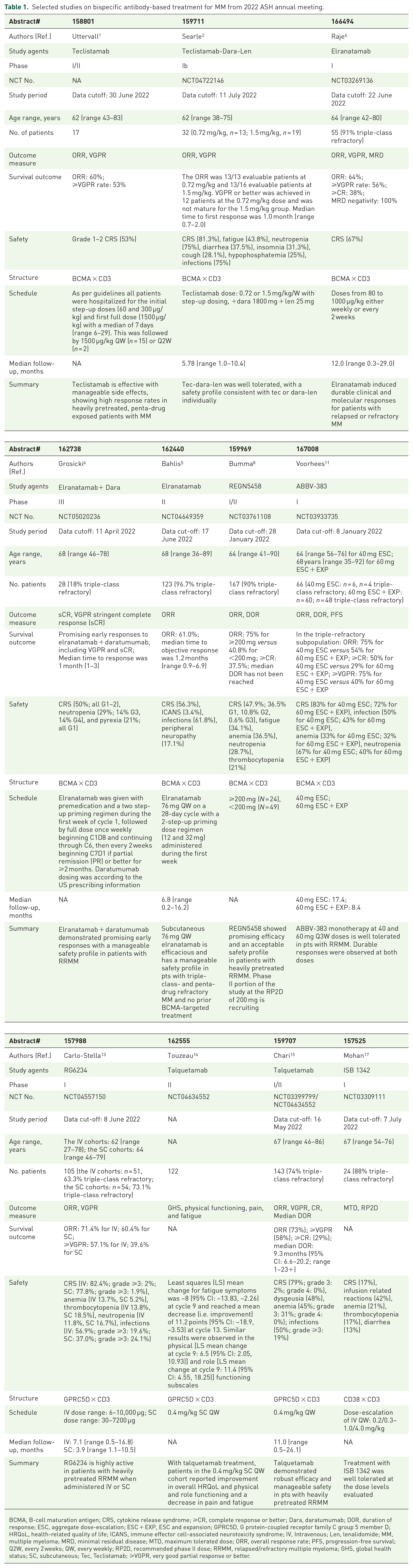
BCMA, B-cell maturation antigen; CRS, cytokine release syndrome; ⩾CR, complete response or better; Dara, daratumumab; DOR, duration of response; ESC, aggregate dose-escalation; ESC + EXP, ESC and expansion; GPRC5D, G protein-coupled receptor family C group 5 member D; HRQoL, health-related quality of life; ICANS, immune effector cell-associated neurotoxicity syndrome; IV, Intravenous; Len, lenalidomide; MM, multiple myeloma; MRD, minimal residual disease; MTD, maximum tolerated dose; ORR, overall response rate; PFS, progression-free survival; Q2W, every 2 weeks; QW, every weekly; RP2D, recommended phase II dose; RRMM, relapsed/refractory multiple myeloma; GHS, global health status; SC, subcutaneous; Tec, Teclistamab; ⩾VGPR, very good partial response or better.
