




Abstract
The outstanding therapeutic progress achieved with modern pediatric regimens in childhood acute lymphoblastic leukemia (ALL) led efforts to explore whether a similar treatment approach could be equally effective and safe in older patients, starting initially with older adolescents and young adults (AYA), variably defined in different studies by an age between 15–18 and 25–39 years. Several comparative and noncomparative trials of this type have been carried out during the last two decades, enrolling thousands of patients. Almost without exception, the new strategy improved patients’ outcomes compared with traditional adult treatments in B-lineage and T-lineage Philadelphia (Ph) chromosome-negative B-ALL, while the use of tyrosine kinase inhibitors (TKI) led to comparative progress in Ph+ ALL, a former high-risk subset more typically observed in older age groups. At present, highly effective pediatric-based regimens warrant 5-year survival rates of 60–70% in AYA patients. In view of these data, the same approach was progressively extended to older patients, improving the results up to 55 years of age. Issues of treatment compliance and drug-related toxicity have thus far prevented a comparable therapeutic advancement in patients aged >55 years. This critical review updates and summarizes with pertinent examples this global, positive therapeutic change, and examines how to promote further progress with new targeted therapies that include novel immuno-therapeutics and other agents developed against the many molecular dysfunctions detectable in various ALL subsets. Substantial progress is expected to occur soon, bringing AYA survival figures very close to that of children, and also to improve the outcome of ALL at all ages.
Introduction
There are few survival graphs of comparable visual impact as those presented by Pui, 1 and by Hunger and Mullighan, 2 in their reviews illustrating the outstanding therapeutic progress achieved in childhood acute lymphoblastic leukemia (ALL) over the past 50 years. These impressive data documented how 5-year survival rates of 2628 and 39,697 patients, registered in six consecutive trials of St. Jude’s Hospital (SJH) and the Children’s Cancer Group/Children’s Oncology Group (CCG/COG) between 1962 and 2009 were improved from less than 10% to about 90%.1,2 Since we have no evidence that patient-related or disease-related risk factors varied significantly over this timespan, we can argue that this huge prognostic improvement was due primarily to improved treatment methods, namely upfront chemotherapy as first treatment, and, to some extent, allogeneic hematopoietic cell transplantation (HCT), as well as other salvage therapies applied to selected risk subsets and to the minority of children who fail frontline therapy, respectively. As the evidence became increasingly sound and widespread, modern pediatric regimens were successfully considered for ALL patients older than 15–18 years, that is older adolescents and young adults up to the age of 40 years (AYA). These patients were previously treated in adult centers with traditional, less intensive (and less effective) adult programs, yielding survival rates around 40%. The use of pediatric-based programs brought survival of AYAs close to 70%, resulting in a growing number of clinical studies, and eventually led to critical reviews and position papers by experts in favor of this new approach.3–5 In addition, these improved programs were used in older age groups, although with less encouraging results and greater toxicity reported beyond age 45–55 years.6,7 Here, we review the evidence and the most recent data supporting this epochal change, focusing on specific treatment elements for distinct ALL and risk subsets, the main toxicity issues related to the use of pediatric-based programs and drugs in AYAs and adults with ALL, and finally discussing the ongoing treatment modifications that will likely result in further therapeutic benefit.
A concise review of evidence
An excellent review by Siegel and colleagues summarized the results of 18 comparative and 9 noncomparative trials totaling 3154 and 1700 patients with Philadelphia-negative (Ph–) ALL, respectively. 3 Of the 27 studies, 21 included AYA patients with a maximum age of 40 years, while older adults were included in the remaining 6 reports. Data analysis clearly favored pediatric-type rather than adult regimens in all but two comparisons, one from Finland and another from the M.D. Anderson Cancer Center (MDACC). 8 The monocentric MDACC study reported on 106 AYA patients treated with an augmented Berlin-Frankfurt-Münster (BFM) pediatric regimen, whose outcome was similar to that of 102 patients receiving MDACC’s standard Hyper-CVAD regimen [cyclophosphamide (C)-vincristine (V)-doxorubicin-dexamethasone (Dex)] alternating with [methotrexate (MTX)-high dose (HD) cytarabine], which was also patterned after an older pediatric SJH regimen by adding the VAD combination to the original backbone in 1992. 9 In this study, neither complete remission (CR) nor overall survival (OS) rates were affected by regimen choice, while the most significant prognostic factor was postinduction minimal (or measurable) residual disease (MRD) response (see below). The place of the Hyper-CVAD regimen in AYAs was extensively examined in a paper by Siegel and colleagues, 10 in comparison with other pediatric-type COG and Dana Farber Cancer Institute (DFCI) regimens. This survey added rather strong evidence in favor of the pediatric schedules, also because the monocentric MDACC results with Hyper-CVAD were poorly reproducible elsewhere and in multi-institutional studies. Beside clinical trials, another valuable source of information is the analysis of unselected patient populations. In the United States (US), a large population-based survey (n = 1473 cases) demonstrated a significant survival advantage for AYAs receiving pediatric-based regimens at pediatric sites or National Cancer Institute/COG-designated centers compared with similar cases treated at community adult centers with either pediatric- or adult-type programs (hazard ratio = 0.53 and 0.51 for OS and leukemia-specific survival, respectively). 11 Similar results, albeit on a smaller numerical scale, were provided by a Canadian survey. 12 In agreement with these observations, the importance of participation into clinical trials was further stressed by Bleyer and colleagues on reviewing the effects of trial participation for the US AYA patient population. 13 This analysis showed a clear and significant correlation between the sharp decrease in trial accrual rate registered between age 16 and 24 years (the so-called AYA ‘cliff’) and the corresponding 5-year leukemia-specific survival, with a loss of about 20% compared with trial patients in this age group. Similar conclusions were independently reached by an observational study from United Kingdom (UK), 14 in which Hough and colleagues documented how 2-year survival estimate of younger AYAs (age 15–24 years, n = 511) was 17.9% better for UKALL2003 trial patients compared with nontrial patients (p < 0.0001).
Evidence-based considerations
Based on the evidence examined so far, the results of early pivotal trials,15–17 and many subsequent confirmatory studies (reviewed in the literaure3–5), AYAs aged 18–40 years with Ph– ALL are optimally treated with modern pediatric-based programs rather than traditional adult protocols. However, this choice requires careful application of the treatment protocol, which is usually more intensive and potentially more toxic in some parts than the less effective, but apparently less demanding, adult protocols. The main differences are listed in Table 1. As demonstrated over time, treatment adherence and expertise of the management team plays a pivotal role, and often represents an underestimated prognostic factor.18,19 This issue can, in part, explain the intercenter variability of therapeutic results, and may be of critical importance when applying highly intensive modern pediatric regimens, with particular regard to the prevention and management of toxic complications and the delivery of chemotherapy without undue dose reductions and delay. This concept was recently highlighted in a large US analysis, 11 although it may not concern single centers of excellence for acute leukemia therapy such as the MDACC, contributing to explain the superior monocentric results obtained with standard adult therapy. 20 Whatever the treatment setting, the issue of AYA therapy is further compounded by host- and disease-related characteristics, globally worse in AYAs compared with children. This implies the adoption of a different risk stratification system, and, according to protocol design, a more frequent therapy intensification with allogeneic HCT in CR patients expressing risk factors associated with high risk (HR) of relapse following intensive pediatric-type chemotherapy.
Main differences between pediatric-based and adult-type programs for Ph– ALL in AYA patients.

ALL, acute lymphoblastic leukemia; AYA, adolescents and young adults; BMI, body mass index; CNS, central nervous system; CR, complete remission; HCT, hematopoietic cell transplantation; IT, intrathecal; MRD, minimal residual disease; MTX, methotrexate; Peg-ASP, pegylated asparaginase; Ph–, Philadelphia chromosome-negative B-ALL.
Risk stratification for risk-oriented therapy
The HR AYA group consists of the few patients who are refractory to induction chemotherapy and of those who exhibit risk factors predictive of treatment failure, which is relapse subsequent to the achievement of CR. The patients with no obvious risk factors are defined standard risk (SR) and are usually excluded from treatment intensification with allogeneic HCT in first CR. This latter procedure is reserved to cases belonging to HR group, according to the risk definition adopted by each treatment protocol and study group (see below, Table 2), 21 to overcome the high likelihood of relapse associated with chemotherapy alone. However, depending on exact protocol design, selected AYA patients with intermediate/HR features can be treated with intensive chemotherapy plus maintenance regimens without allogeneic HCT in first CR. As reported in Table 2, the criteria identifying HR and SR ALL vary slightly among clinical protocols, often combining patient’s age (acting as continuous rather than dichotomous prognostic factor), presenting white blood cell (WBC) count, disease genetics/cytogenetics,22,23 and, above all, status of MRD after induction and early consolidation steps (Figure 1).
Risk stratification criteria adopted for allogeneic HCT in European trials for CR1 patients with Ph– ALL in an age range between 15/25 and 55/65 years (all studies including AYAs).

Modified after Giebel and colleagues. 21
ALL, acute lymphoblastic leukemia; AYA, adolescents and young adults; BM, bone marrow; CNS, central nervous system; D, day; EOI, end of induction; HCT, hematopoietic cell transplantation; KMT2Ar, KMT2A-rearranged; Ph–, Philadelphia chromosome-negative B-ALL; POS, positive; WBC, white blood cell count (×109/l).

Prognosis to treatment relationships in AYA Ph– ALL. Different patient characteristics and clinicobiologic ALL subsets concur to determine the individual risk profile. Postinduction MRD analysis reflects patterns of chemosensitivity and refines the prognostic index, which is used to orientate postremission therapy reserving an allogeneic HCT to HR patients (see also Table 2 and Figure 2). MRD itself can be targeted with novel immunotherapeutics and other experimental agents (i.e. blinatumomab in CD19+ ALL, CAR-T cells, etc.). Regardless of risk class definition and transplantation policy (a decision related to specific protocol design), overall patient outcome is improved using pediatric-based rather than traditional adult chemotherapy protocols.
ALL cytogenetics and genetics
Patterns of ALL cytogenetics and genetics in AYAs have been reported in large cohorts of 7113 patients with B-precursor ALL, 24 5202 unselected ALL patients, 23 and 542 adult patients with Ph– ALL. 25 Both studies assessing the frequency of Ph+ ALL demonstrated an almost linear correlation with age, with an incidence <10% at age 15–19 years that increased to 15–20% and 25–35% at 18–25 years and 25–40 years, respectively.23,24 With regard to another very HR subset, t(4;11)+/KMT2A-rearranged ALL, incidence was 11.8% at age 15–24 years and 19.8% at 25–44 years. 25 Other HR abnormalities reported in AYAs were iAMP21 (relatively rare), 14q32/IGH rearrangements (3–5%), low hypodiploidy/near triplody (altogether 10% or less), and complex or monosomal karyotypes (5% and 8–10%). Conversely, the frequency of the favorable prognosis t(12;21)/ETV6-RUNX1+ ALL and high hyperdiploid ALL in AYAs decreased from about 35–40% each in children to <10% in teens (<5% at 20+ years) and to 20–25% (10–15% >25 years), respectively. The remainder of cases within the B-precursor subset constituted an intermediate risk category, which included t(1;19)/TCF3-PBX1+ ALL and all other cases (‘B-other’) that express secondary lesions known as copy alterations (CNA), such as deletions of IKZF1 and other lymphoid development genes, and a relatively frequent overexpression of CLRF2. In children and young adults (age <25 years), different CNA profiles were confirmed to exert a significant effect on the risk of relapse. 26 The newly recognized HR entity known as Ph–like (or BCR-ABL1-like) ALL falls into the ‘B-other’ group, and can be identified through molecular screening. The estimated incidence of Ph–like ALL in AYAs aged 16–39 years with B-precursor ALL is 19–27%, a figure higher than that reported in younger and older patient groups, respectively. 27
Postinduction MRD analysis
The MRD assay is of extreme prognostic relevance, being the sole or most significant risk factor for relapse confirmed in many studies by multivariable prognostic analysis.28–31 This is not entirely unexpected because MRD represents the disease itself and reflects disease sensitivity to early chemotherapy. Altogether, despite a partial lack of predictive power (some MRD-negative patients relapse), MRD represents the major prognostic information and decisional support for the allocation to allogeneic HCT or other targeted therapy, a view uniformly endorsed by both European and US experts.32,33 In a recent European survey, MRD positivity was the only risk factor supporting the decision to allograft shared by 11 national study Groups on adult ALL (including AYAs: lower age limit 15–18 years) (Table 2). 21 In prospective therapy-oriented MRD studies that employed sensitive molecular markers for MRD detection, 37–48% of CR patients tested MRD positive at weeks 4–6 after an induction course, (any positivity or ⩾10−4), a proportion decreasing to 16–30% at weeks 10–12 after early consolidation.34–36 Corresponding MRD positivity rates in AYAs only are not known precisely. An operational limit of an MRD-based risk stratification is the lack of MRD data due to either a defective ALL cell collection for molecular probe generation, the lack of a specific and sensitive (⩾10−4) molecular probe, or an insufficient marrow sampling at MRD time-points critical for treatment decisions. While this issue may be of lesser concern using multiparameter flow cytometry assays, in molecular MRD-based trials, it caused the exclusion from study and optimal risk stratification of a high proportion of patients, between 23% and 31%.36,37
Combined genetic and MRD risk stratification
The prognostic significance of MRD was recently shown to vary in relation to the genetic/oncogenetic risk subset, in both adults35,38 and children.39,40 These studies documented that risk of relapse related to persistent or recurrent MRD varied significantly as a function of associated genetic/oncogenetic abnormalities. The first evidence in adult/AYA patients came from a Group for Research on Adult ALL (GRAALL) study, 35 documenting the MRD-independent prognostic effect of a four-gene adverse classifier (B-precursor ALL: KMT2A rearrangements or IKZF1 deletion; T-ALL: unmutated NOTCH1/FWBX7 or abnormal RAS/PTEN expression). The recent large UKALL14 trial, enrolling patients with Ph– ALL aged 25–65 years, validated a robust prognostic index (PIUKALL) integrating WBC count, genetic risk class, and postinduction MRD. This allowed to predefine different PIUKALL groups with highly variable response to the planned risk-oriented treatment, ranging from an excellent relapse-free survival (RFS) of 90% on chemotherapy only to a relapse risk after myeloablative HCT as high as 42%. 38 Moreover, as demonstrated in childhood ALL, current genetic/cytogenetic risk classifications can be further improved through the analysis of associated CNA profiles in patients who do not express a clear genetic risk marker, particularly in the ‘B-other’ intermediate risk group. 26 A new combined risk model based on postinduction MRD and disease genetics incorporating a detailed CNA expression analysis, validated in a large UKALL pediatric cohort, 26 is being prospectively assessed in the ALLTogether Consortium project, a very large International collaborative effort among several ALL study Groups, in which children and AYAs with Ph– ALL aged up to 25 years (UKALL) or 45 years Nordic Society of Pediatric Hematology and Oncology (NOPHO) are risk-stratified in this fashion for risk-adapted therapy. 41 These emerging concepts need to be considered and will likely affect the risk-oriented design of new AYA and adult trials (Figure 2).

Recent example of combined risk stratification by genetics and MRD in Ph– ALL (patterned after UKALL study 25 and as adopted in ALLTogether study. 41 The present risk classification is used within the international ALLTogether project by the NOPHO group for AYAs aged up to 45 years. In this study T-ALL is considered a uniform genetic risk group. In B-lineage ALL (B-ALL), genetics/cytogenetics defines good, intermediate risk and HR groups (with the notable absence of Ph–like ALL; see text for details), and the intermediate risk class is subdivided according to CNA (involved genes are indicated). By study design, final risk classification allows patients to be allocated to intensive chemotherapy and maintenance (standard/low and low/intermediate risk group, experimental interventions with new agents (HR/intermediate risk group) and allogeneic HCT or chimeric antigen receptor T cell (HR group).
Practicalities of treatment regimens for Ph– ALL in AYA patients
Although current pediatric-based regimens are preferable to standard adult programs, useful guidance for AYA treatment must consider some relevant examples from prospective clinical trials. Because patient age maintains a primary prognostic role, the current selection of recent study results in Ph– ALL (Tables 3 and 4) separates the typical AYA patient population (age ⩽40 years) from older patients treated in the same way or with similar age-adapted regimens, up to an age of 55–65 years.6–8,36,42–52 This analysis aims to address the following questions: is there a better regimen or drug combination? Which are the essentials of a pediatric-based regimen? Is there an upper age limit for a safe and effective use of this treatment scheme? How can we prevent and manage main drug-related toxicities? What is the perception and applicability of a risk-/MRD-based post-induction strategy in AYAs? Finally, which new therapeutic elements and strategies will allow further progress?
Results from recent, representative trials for Ph– ALL in AYA and adult patients (pediatric-based chemotherapy, risk/MRD-oriented consolidation and allogeneic HCT, >100 patients, outcome estimates a 3+ years). Trial order according to increasing patient age (median and range; upper age limit in each trial is indicated).

ALL, acute lymphoblastic leukemia; allo-HCT, allogeneic hematopoietic cell transplantation; AYA, adolescents and young adults; CR, complete remission; CRD, CR duration; Cy, cyclophosphamide; Dex, dexamethazone; DFS, disease-free survival; DFCI, Dana Farber Cancer Institute; EFS, event-free survival; FUP, follow up; GRAALL, Group for Research on Adult ALL; GroupGMALL, German Multicenter Group for Adult ALL; HD, high dose; HD dose consolidation (with MTX and cytarabine in GMALL trial); HR, high risk; JALSG, Japan Adult Leukemia Study Group;
Results of prognostic analysis from recent, representative trials for Ph– ALL in AYA and adult patients (pediatric-based chemotherapy, MRD/risk-oriented consolidation and allogeneic HCT, >100 patients). Trial order according to increasing patient age. Selection of studies presented in Table 3, reporting detailed prognostic factor analysis.

ALL, acute lymphoblastic leukemia; allo-HCT; allogeneic hematopoietic cell transplantation; AYA, adolescent and young adult patients; B, B-ALL; BMI, body mass index; CR, complete remission; CRD, CR duration; DFCI, Dana Farber Cancer Institute; DFS, disease-free survival; EFS, event-free survival; GMALL, German Multicenter Group for Adult ALL; GRAALL, Group for Research on Adult ALL; HCT, hematopoietic cell transplantation; HR, high-risk; IR, intermediate risk; JALSG, Japan Adult Leukemia Study Group; MDACC, M.D. Anderson Cancer Center; MRD, minimal residual disease; NILG, Northern Italy Leukemia Group; NOPHO, Nordic Society of Pediatric Haematology and Oncology; OS, overall survival; Ph, Philadelphia chromosome; RAALL, Russian Adult ALL Group; SR, standard risk; T, T-ALL; UKALL, United Kingdom ALL Study Group.
CR induction results
The examples of pediatric-based or fully pediatric therapy reported in Table 3 documented CR rates close to 100% in patients younger than 25 years, decreasing to about 90% in patients aged up to 40 years and to 85–90% in those aged up to 55–65 years. Some of these induction schedules have been already modified to include immunotherapy with anti-CD20 antibody rituximab for CD20+ ALL. This was the case with recent MDACC, German Multicenter ALL study Group (GMALL) and GRAALL trials,49,53–55 and must be taken into account when discussing improved treatment results. Details of induction failures were not always available, though, in general, incidence of both induction resistance and death were distributed equally and correlated with an increasing age. While it does not seem possible to claim the superiority of any induction schedule over another, some studies reported very low resistance rates after two or more induction courses, as in the NOPHO 46 and GRAALL trials, this latter employing a HD cytarabine plus idarubicin combination in course-1-resistant patients.6,7
Survival results
Long-term outcome measures indicated (not in all studies) 5-year OS rates slightly above 60–70% in AYAs aged up to 35–40 years. The MDACC study using the BFM regimen gave a slightly inferior result (OS 53%), which was therefore superimposable to the Hyper-CVAD group. 8 Disease-free survival (DFS) and event-free survival (EFS) data were close to OS ranges. The US Intergroup study adopted a reference COG regimen previously tested in patients aged 1–30 years, confirming its feasibility in patients aged 17–39 years, with good EFS and OS results at 3 years, and a significant improvement in prognosis over an historical data set. 45
Outcomes by patient age and other prognostic factors
Results from each study were comparatively better in younger patients and in patients with more favorable risk profile, such as MRD-negative post-induction response (Table 4). In studies including older patients, up to 60 or 65 years (median patient age between 30 and 41 years), the general results were improved compared with historical data, but were not as good as in AYA studies. OS, DFS and EFS rates were between 55% and 60% (GRAALL; Programa Español de Tratamientos en Hematología, PETHEMA), with a significant reduction in therapeutic benefit above 45–55 years of age [GRAALL, Northern Italy Leukemia Group (NILG) and Russian ALL study Group (RALL)].6,7,36,50 In the large GRAALL experience, the application of the pediatric French ALL programs was more difficult in patients aged >45 and >55 years, causing significantly more induction and consolidation deaths than in younger patients receiving the same therapy.6,7 Among the most notable examples given the large patient number, the more favorable age range (up to 45 and 55 years, respectively) and length of follow up (5-year outcomes available) are the NOPHO and the GMALL data, with an EFS of 73% (87% in SR patients) in the NOPHO trial, 46 and OS and CR duration rates of 84% and 74% for SR patients treated in the intensive Pegylated-Asparaginase (Peg-ASP) cohort in the GMALL trial, 49 respectively. Outcome was improved in T-ALL patients in some studies (DFCI, NILG, RALL).36,47,48,50
Improved drug regimens
The general lay-out of modern pediatric-type regimens for AYAs consists of a four or five-drug CR induction phase [V-corticosteroids (CS)-anthracycline-
Peg-ASP in pediatric-based regimens
As shown above, treatment results were significantly improved in GMALL trials in SR patients treated with a Peg-ASP-containing protocol,44,49 as well as in DFCI studies,47,48 reporting OS rates of greater than 70% with programs based again on an intensive use of
Peg-ASP related toxicity: prevention and management
Despite its central role in the management of ALL in AYAs and more in general in adult ALL, Peg-ASP can cause severe toxicity in the form of allergic reactions (less frequently than with the native form), coagulopathy (antithrombin III or fibrinogen deficiency), thrombosis, hyperglycemia, hypertriglyceridemia, pancreatitis, and severe liver toxicity, this latter more frequent and more severe in adults and obese patients than in children.47–49,58–60 Therefore, drug toxicity should be carefully monitored, while to avoid excess toxicity drug schedule and dosing should take into account patient’s age (higher risk >45–55 years), body mass index (BMI, higher toxicity with BMI >30), and liver steatosis (higher risk of hepatotoxicity if detected on ultrasound scan).
49
Coagulopathy and thrombosis can be prevented by the periodic infusion of antithrombin III and fibrinogen concentrates as needed, and by subcutaneous low molecular weight heparin, at least until the platelet count remains >30 × 109/L. This kind of antithrombotic prophylaxis is recommended in some treatment protocols and is likely to represent a sensible choice (without contraindications) in intensive Peg-ASP regimens, though no general consensus exists as yet. The use of
Operative algorithm based on patient age, BMI, and toxicities related to prior drug exposure used for the administration of Peg-ASP during chemotherapy courses no. 1, 2, 5, and 6 in GIMEMA trial LAL 2317 for adult Ph– ALL (age range 18–65 years; ClinicalTrials.gov identifier: NCT03367299). G denotes grade of toxicity according to the Common Toxicity Criteria scale.

Pretreatment risk factors for Peg-ASP-related toxicity: hepatosteatosis (ultrasound scan), BMI >30.
Hepatic, pancreatic, coagulation/thrombosis.
Must be reduced to less than G2 before next Peg-ASP dosing; G4 pancreatitis causes permanent Peg-ASP discontinuation.
In subsequent cycle Peg-ASP will be restarted at a dose of 500 IU/m2; if G3-4 toxicity occurs again, PEG-ASP will be permanently discontinued.
ALL, acute lymphoblastic leukemia; BMI, body mass index; Peg-ASP, pegylated asparaginase; Ph–, Philadelphia chromosome-negative B-ALL.
Methotrexate in pediatric-based regimens
The antimetabolite MTX is another essential drug of ALL therapy that is usually administered as HD infusion, typically at intermediate dosage of 1–1.5 g/m2 over 24 h (followed by folinic acid rescue), either alone or together with either cytarabine at 1–3 g/m2 or Peg-ASP, for three to six blocks or more. Higher MTX doses between 3 and 5 g/m2 have been used in HR patients and T-ALL (Table 4), and may have contributed to above average results in some series. 36 A randomized trial demonstrated an improved outcome for patients treated with MTX 3 versus 0.5 g/m2; however, the lower dose is nonstandard for adult ALL. 52 The US Intergroup trial in AYAs used a lower MTX dose (100 mg/m2) with weekly dose adaptions (Capizzi style). 45 This approach was previously tested in two phase III COG trials including AYAs (patient age 1–30), proving superior to HD MTX 5 g/m2 in T-ALL, while, on the contrary, HD MTX was better than Capizzi MTX in B-ALL.67,68 Of note, patients in the Capizzi MTX arm received two more Peg-ASP doses compared with the HD MTX arm. HD MTX 5 g/m2 was used for the first time in adult T-ALL in a NILG trial, 69 with very good results and low toxicity score. Altogether, the use of MTX at doses higher than 1.5 g/m2 may be preferable in B-ALL, while the place of the lower Capizzi MTX schedule should be further investigated in T-ALL.
Corticosteroids in pediatric-based regimens
CS represent another highly effective ALL drug class, administered during prephase (when they allow to classify patients according to their prednisone sensitivity, in either ‘good or poor prednisone responder’ patients), induction chemotherapy, and, most of the times in a pulsed fashion, during consolidation courses. Apart from a strong antileukemic activity, CS may exert considerable short- and long-term toxicity (metabolism and diabetes, fluid retention/hypertension, gastritis/peptic ulcer, insomnia, osteoporosis/osteonecrosis) as well as mask the clinical signs of early infectious complications during induction chemotherapy and favor the spread invasive fungal infections. Among the different compounds available, Dex seems more active as an antileukemic agent than prednisone/prednisolone, at both the systemic and CNS levels, as indicated by the results of a large European pediatric randomized trial. 70 In this study, Dex-treated patients had significantly less relapses, particularly in extramedullary sites, in CNS (p < 0.0001), and in the cohort of T-ALL, but suffered from higher incidence of induction death (2.5% versus 0.9%, p = 0.00013) often ascribable to infections, with higher incidence of fungal infections. Selecting a more appropriate Dex schedule is therefore necessary, along with the administration of an effective antimicrobial and antifungal prophylaxis. A GMALL induction study on 843 adult patients reported a lower early infectious rate, from 30% and 33% to 14% (p < 0.0001), with an associated early death rate varying from 16% to 8% and 5%, respectively, lowering Dex from 40 mg/m2 days 1–3 and 10 mg/m2 days 4–17 (cumulative dose 260 mg/m2) to 10 mg/m2 days 1–6 and 11–16 (cumulative dose 120 mg/m2) and 10 mg/m2 days 1–5 and 11–14 (cumulative dose 90 mg/m2), respectively, together with the addition of granulocyte colony-stimulating factor from as early as day 4 of the intensive induction schedule to shorten the duration of absolute severe granulocytopenia. 71
Risk- and MRD-oriented therapy
Many of the studies detailed in Tables 3 and 4 and others had a risk-oriented design, which meant, above all, the assessment of MRD for final risk stratification and the allogeneic HCT choice for patients with HR/MRD-positive ALL. All these trials reporting MRD-based results confirmed the leading prognostic significance of this parameter (UKALL, GMALL, MDACC, US Intergroup, GRAALL, PETHEMA, NILG) and the benefit provided by an allogeneic HCT to these patients (GMALL, MDACC, NOPHO, GRAALL, PETHEMA, NILG), despite the outcome of MRD positive patients being globally poor in intention-to-treat- and meta-analyses.28–31 However, on analyzing trial details, this finding can be seen in relation to the combined effects of pretransplantation relapse (rating 40% or higher in some studies), nonrelapse mortality and post-transplantation relapse, which is more frequent in MRD-positive patients. Nevertheless, when feasible, allogeneic HCT is preferable to standard intensive, pediatric-based chemotherapy in MRD-positive patients (usually defined HR, Table 2), to reduce the risk of relapse and thereby increasing their survival from ⩽25% without HCT to approximately 45–55% (GMALL, NILG, GRAALL trials, reviewed by Bassan and colleagues 29 ; plus several other studies totaling 1299 HCT patients with known MRD status, reviewed by Bassan and Spinelli 72 ). Most notably, adopting the Simon-Makuch statistics to eliminate the time-dependent bias of pretransplantation relapse, the GRAALL study demonstrated a significant prognostic improvement with allogeneic HCT for the patients with postinduction MRD levels ⩾10−4 (p = 0.04) 73 or 10−3 (p = 0.002). 74 The most difficult category to treat consists of the patients who still harbor MRD ⩾ 10−3 following intensive induction-consolidation. 75 Here too, a reduction of MRD prior to allogeneic HCT would be highly desirable to enhance the likelihood of a successful HCT, as demonstrated in MRD-directed phase II studies with blinatumomab, a bispecific CD3 × CD19 product engaging cytotoxic normal T cells against CD19+ B-precursor ALL cells.76,77 This type of immunotherapy acted as successful bridge to allogeneic HCT, and improved the outcome of study patients compared with the historical MRD positive cohort. A companion study with the T-targeting agent nelarabine is being conducted by the GMALL in MRD positive T-ALL patients. 37 An open question is represented by the clinical management of patients who, despite achieving MRD negativity, had other HR features at diagnosis; in this respect there is not yet a clear consensus, although individual trial recommendations should usually be used (see Table 2 and related sections).
Management of specific ALL subsets: Ph+ ALL, Ph–like ALL and early thymic precursor ALL
Ph+ ALL
The BCR/ABL1 rearrangement, derived from the t(9;22) translocation, alias Ph chromosome, can be detected in about 20–30% of adult cases with ALL; its incidence increases with age, representing the most frequent of ALL in the elderly population, and is therefore a relatively rare event in AYAs (<20%).22,23 The outcome of Ph+ ALL patients, historically poor, has changed drastically since the introduction of tyrosine-kinase inhibitors (TKIs) of first-, second-, and, more recently, third-generation TKIs. TKIs are administered alone or in combination with chemotherapy, followed by consolidation and allogeneic HCT. With these strategies, survival rates are very close to those documented in Ph– ALL (Table 6, inclusive of extensive study references), and can reach an outstanding rate close to 80% using the more effective TKI ponatinib in conjunction with chemotherapy. 78
Front-line treatments including TKI used in adult/AYA Ph+ ALL (study reference indicated).
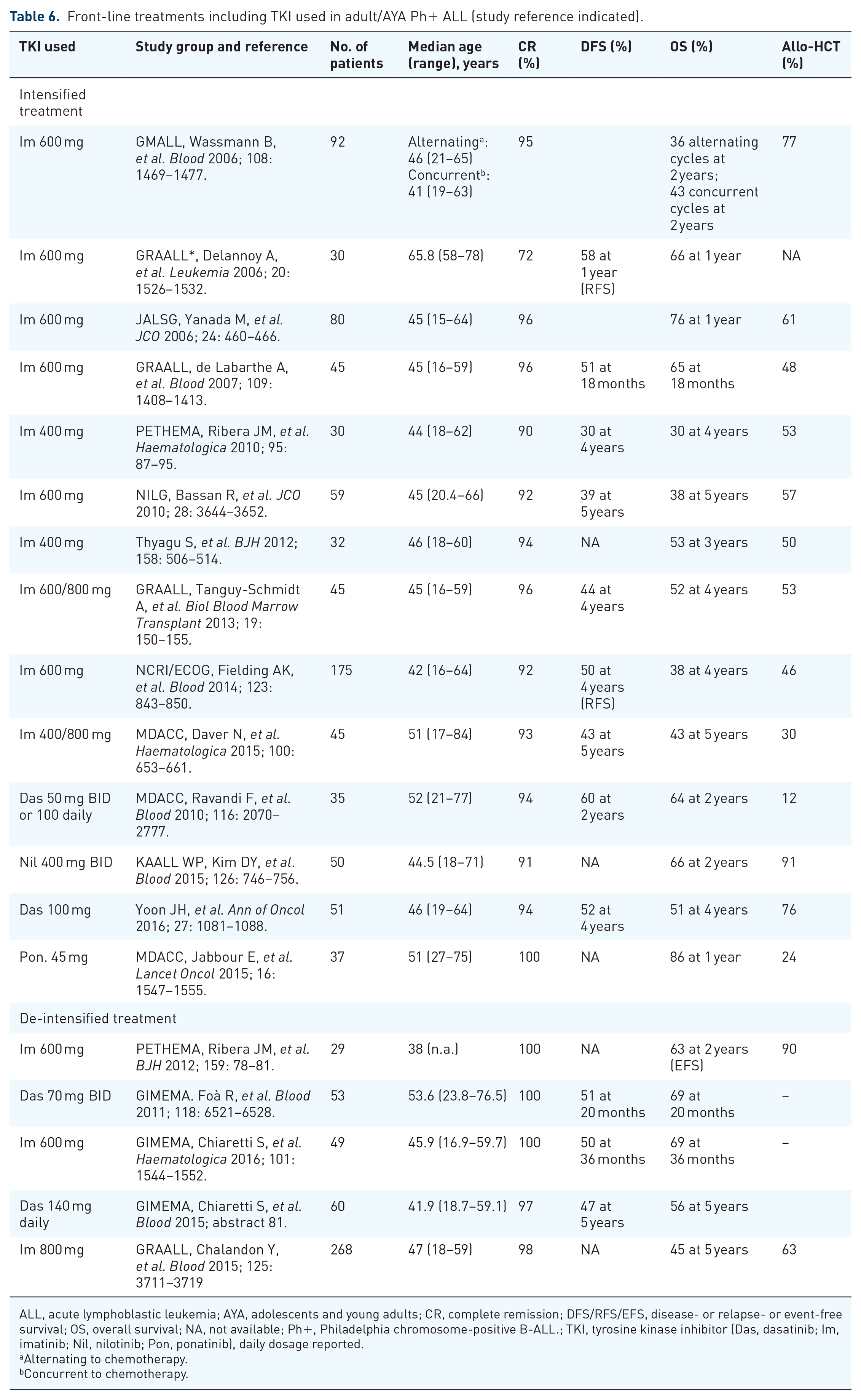
ALL, acute lymphoblastic leukemia; AYA, adolescents and young adults; CR, complete remission; DFS/RFS/EFS, disease- or relapse- or event-free survival; OS, overall survival; NA, not available; Ph+, Philadelphia chromosome-positive B-ALL.; TKI, tyrosine kinase inhibitor (Das, dasatinib; Im, imatinib; Nil, nilotinib; Pon, ponatinib), daily dosage reported.
Alternating to chemotherapy.
Concurrent to chemotherapy.
As a general principle, induction treatment must be based on TKI, and the burden of chemotherapy can be reduced drastically to minimize toxicity: in this respect, Chalandon and colleagues clearly showed in the phase III GRAALL trial how chemotherapy deintensification led to higher CR and slightly higher survival rates. The GIMEMA has, for several years, carried out trials based on a chemotherapy-free induction with TKI, corticosteroids, and IT CNS prophylaxis, achieving CR rates of 97–100% without induction deaths.
Consolidation is usually based on chemotherapy including high-dose chemotherapy. With novel drugs available, namely monoclonal antibodies, chemotherapy might be abrogated also in this phase. Indeed, although data are preliminary because of the short follow up, the GIMEMA experience indicated that postinduction blinatumomab along with dasatinib is highly effective, with remarkably high 1-year OS and DFS rates (94.8% and 87.8%, respectively) 79 : in this trial, final treatment after blinatumomab was according to investigator’s choice, consisting of either dasatinib maintenance or allogeneic HCT. The results of similar chemotherapy-free, and possibly transplant-free, programs such as the MDACC’s ponatinib-blinatumomab study are awaited with interest.
At present, also in light of the smaller incidence of Ph+ ALL in AYAs, treatment does not differ between older adults and AYAs. 80 Despite the improvement described above, there are still open issues. In fact, it is becoming clear that Ph+ ALL patients can be further stratified at diagnosis on the basis of additional genomic lesions. The cases harboring additional genomic lesions, particularly IKZF1 and CDKN2A/B and PAX5 deletions have a poorer outcome, which is not greatly improved by HCT: for these patients, alternative strategies are required.81,82 Furthermore, during follow up, a set of patients can acquire deleterious TK domain mutations (see exhaustive reviews by Soverini and colleagues83,84) or show MRD persistence. Thus, it is ever more frequently debated whether all Ph+ ALL patients should be allocated to HCT, or if HCT should be reserved for HR patients on the basis of the biological features described above. Moreover, in a recent chemotherapy-dasatinib combination COG trial including AYAs (age range 1–30 years), outcome was comparable among nontransplant and transplant patients, the latter identified through expression of HR features or availability of a related HCT donor. 80
Ph–like ALL
As mentioned above, the outcome of AYA patients is poorer than children because of intrinsic biological features. One adverse subset is represented by the Ph–like (or BCR-ABL1-like) subgroup, which accounts for about 20% of B-ALL overall and is detected exclusively in cases lacking BCR-ABL1, KMT2A-based, and TCF3-PBX1 rearrangements.27,85–88 This subset was initially recognized by means of gene expression profile, revealing a transcriptional profile similar to that of BCR-ABL1+ patients. Later, with the integration of CNA, and DNA- and RNA-sequencing, the genetic basis of this subset, as well as its heterogeneity, were unraveled. Overall, the genetic scenario of Ph–like ALL is characterized by cytokine receptor deregulation or TK mutations and rearrangements. The first lesion to be described was CRLF2 deregulation. CRLF2 encodes a member of the type I cytokine receptor family involved in B-cell development. CRLF2 overexpression is sustained by a cryptic chromosomal translocation that juxtaposes CRLF2 to the immunoglobulin heavy chain locus (IGH), 89 interstitial deletion of the PAR1 region centromeric to CRLF2, 90 and, rarely, elevated CRLF2 expression is sustained by F232C mutation. 91 In AYAs, CRLF2 overexpression is detected in 50–60% of Ph–like cases,85–88,92 with P2RY8/CRLF2 prevailing in children and IGH/CRLF2 more frequent in AYAs and adults.85,86,92,93 CRLF2 overexpression is usually coupled with other mutations, the most frequent affecting JAK/STAT pathway members (JAK2, JAK1, IL7R, and CRLF2).85–87,92–95 More rarely, another cytokine receptor rearranged in Ph–like ALL is the erythropoietin receptor (EPOR, 4%).85,92,94 Regarding TKs, the most frequent classes involved are ABL-class and JAK/STAT genes. ABL-class genes are relatively often detected (10% of AYA group) and include rearrangements of ABL1, ABL2, CSF1R, and PDGFRB with multiple partner genes. Similarly, JAK2 rearrangements can recognize several partner genes, comprising EBF1, ETV6, PAX5, and BCR (7–8% overall).85,92,94
From a clinical standpoint, Ph–like patients are often young male adults presenting with hyperleukocytosis, who display an inferior response to induction therapy, higher incidence of relapse and lower survival than other B-precursor Ph– ALL patients.45,85–87,95–97 Only a SJH report showed that pediatric patients treated with intensive therapies including HCT had a survival similar to non-Ph–like patients. 92
Given their dismal outcome, these patients should be recognized promptly at diagnosis, for targeted treatment including TKIs and other agents. However, because of the plethora of associated genetic lesions, the optimal therapeutic approach to Ph–like ALL is not yet defined, and different alternative approaches have been proposed97–100: the first is on the basis of the underlying lesion, including dasatinib for cases with ABL class genes, and with JAK2 inhibitors, particularly ruxolitinib, for cases with JAK/STAT pathway lesions. However, this approach is not applicable in all treatment centers. Several clinical trials are ongoing to test the efficacy and safety of these approaches. Furthermore, regarding ruxolitinib, preliminary results from MDACC on nine R/R Ph–like patients did not show significant responses, and the study was prematurely closed (E. Jabbour, personal communication, 2019). A second approach could be the use of the pan-TKI ponatinib, as suggested by Chiaretti and colleagues, 88 and tested in a French patient. 101 Third, the role of antibody constructs, namely blinatumomab and inotuzumab, must be assessed. Presently, the best therapeutic approach is to treat such difficult cases upfront with a combination of intensified therapy and a targeted therapy, followed, also according to disease response, by allogeneic HCT.
ETP ALL
While B-lineage subsets are predominant in ALL, about 20–25% of AYA patients have T-ALL, which in children is no longer considered a HR subset due to the progress obtained with modern intensive regimens.1,2 Within T-ALL, about 15% of the cases share the peculiar diagnostic features of early T-cell precursor (ETP) ALL, consisting of a mixed early T-cell/myeloid immunophenotype lacking the pan T-cell antigen CD5 (weakly expressed on <75% of blast cell in the ‘near-ETP’ subset), co-expressing early myeloid antigens, and displaying higher genomic instability and different gene expression profile, closer to myeloid stem cells, compared with classical T-ALL. 102 These patients fared significantly less well than standard T-ALL patients. However, a more recent COG trial documented and improved outcome for ETP ALL, not significantly inferior to non-ETP ALL patients. 103 The topic of ETP ALL is less well known in adult and AYA patients. A review of MDACC results using Hyper-CVAD chemotherapy confirmed the inferior outcome of this subset (3-year OS about 30%, p = 0.037). 104 Instead, the GRAALL, using pediatric-inspired therapy with risk/MRD-based stratification for HCT allocation, reported an improved outcome (5-year OS 59.6% versus 66.5% in non-ETP ALL patients, p = 0.33). In this study, 105 ETP ALL patients were more likely to express high levels of postinduction MRD at the two study time-points (p < 0.001 and p = 0.005) and were more frequently offered an allogeneic HCT than non-ETP ALL patients (48.9% versus 28.3%, p = 0.008), which conferred a survival advantage.
Allogeneic HCT in AYA patients
Allogeneic HCT is still the most effective consolidation treatment for HR patients in whom the relapse risk is significantly higher than after chemotherapy, despite the risk of transplant-related mortality (TRM, ranging from 10 to 30%).106–110 Taking into consideration advances in chemotherapy (pediatric-style protocols) as well as new immunotherapy approaches, the advantage of one approach over the other is becoming less clear and defining the exact indications of HCT in AYA ALL in CR1 is increasingly difficult and should be regarded as matter for prospective clinical studies.
Critical issues of allogeneic HCT versus modern intensive AYA chemotherapy
In the pre-MRD era, the large prospective UKALL XII/ECOG E2993 study, 111 together with the meta-analysis by Gupta and colleagues summarizing several HCT-based trials, 112 evidenced that the benefit of transplantation over chemotherapy was restricted to AYAs <35 years with Ph– ALL (5-year OS 62% versus 52%; RFS 55% versus 45%, respectively). The main limitation of all these studies was the heterogeneous definition of HR ALL, which did not include MRD and the new genetic characterization, and considered only adult-type chemotherapy. The improved results of chemotherapy in AYA patients using pediatric-inspired protocols, combined with an MRD/risk-oriented treatment strategy, re-opened the debate on the value of HCT. In a retrospective comparative analysis from the DFCI Consortium and the Center for International Blood and Marrow Transplant Research, 113 4-year OS was significantly improved in nontransplant Ph–negative AYA patients treated with the DFCI pediatric protocol (73% versus 45%, p < 0.001), essentially due to lower treatment mortality (6% versus 37%, p < 0.0001), while 4-year relapse incidence was almost identical (23% versus 24%). Age >30 years was confirmed to be an independent risk factor for TRM. Of note, the two patients cohorts were not fully comparable for the prevalence of HR features in HCT group, and, in addition, the TRM rate was higher than the figure currently expected in this age group, perhaps in relation to the limited use of antithymocyte globulin for the prevention of graft-versus-host disease, aggravating the risk of TRM.
Current place of allogeneic HCT in AYAs
Several studies demonstrated postinduction MRD and ALL genetics to represent the most important prognostic markers, as discussed above. With the limit of patient selection because not originally intended as a MRD-oriented trial, the GRAALL experience with 522 Ph– HR patients (aged 15–55 years, hence including a large proportion of AYA patients) showed no differences in RFS/OS between donor (HCT) and no-donor (no HCT) patient cohorts. 74 However, HR patients expressing MRD positivity (>10−3) after 6 weeks of chemotherapy and KMT2A-rearranged or IKZF1-deleted ALL benefited from allogeneic HCT (5-year OS 70% versus 35%; p < 0.002).25,74 Other studies focused exclusively on AYA populations,106,108,109 although mostly retrospective and heterogeneous concerning the status at transplantation (CR1 and CR2), the definition of HR (with or without new genetic markers), and MRD evaluation, indirectly highlighted the advantage of HCT (OS ranging from 40% to 70%) over no transplant approaches in suboptimal responders (MRD positive, adverse genetic subsets). In view of these uncertainties, it is preferable to adhere to the transplantation policy of specific treatment protocols, which usually reserve this treatment modality in first CR to very HR patients with high postinduction MRD or highly adverse genetic ALL variants (see section Risk stratification). For refractory and relapsed ALL patients, an allogeneic HCT still represents the main curative option, with up to 40% of long survivors.
Improving HCT results
Because of its adverse impact on post-transplantation outcome, achieving MRD negativity with new targeted therapies before HCT may be crucial to bring survival above 50%, compared with less when the transplant is performed in molecular failure.28–34,37,72–77 In new AYA trials employing inotuzumab ozogamicin (such as the ongoing US Intergroup AYA trial 041501; ClinicalTrials.gov identifier: NCT03150693), dual alkylator HCT conditioning must be avoided due to the associated risk of hepatic veno-occlusive disease. 114
Allogeneic HCT in Ph+ ALL
As for Ph– ALL, the role of HCT in Ph+ ALL patients is changing in relation to the efficacy of TKI associations with low-dose chemotherapy and new immunotherapeutic approaches. 83 MRD status and genomic characterization at diagnosis are key factors in this decision-making process,78,83,115,116 especially with the most effective combinations tested upfront to date, such as ponatinib-chemotherapy 78 and dasatinib-blinatumomab, 79 which are providing excellent early results without HCT in MRD negative patients. However, apart from these very recent examples, most studies evidenced a better outcome for transplanted patients (3–5 year EFS 50–69%), in comparison with TKI-based regimens without transplantation (3–5 year EFS 30–46%), 83 although the younger the patient, the better the outcome, even with transplant-free regimens in patients lacking HR features.80,83
Concluding remarks and future directions
The most useful approach to the frontline management of AYA ALL is summarized in Figure 3. It must be emphasized that any effort should be devoted to curing the disease upfront, since survival is still largely unsatisfactory with any new treatment so far tested in patients who display primary resistance or develop a recurrence, unless they belong to the minority of younger patients that suffer from an isolated late marrow relapse >24 months from the date of initial CR.32,117 Based on a large body of evidence, the initial diagnostic work up should aim to identify the ALL subsets that have clear prognostic and therapeutic relevance (i.e. Ph+ ALL, Ph–like ALL, KMT2A-rearranged ALL, ETP ALL, etc.) and include the generation of patient-specific molecular probes (or corresponding leukemia-specific immunophenotypes) for MRD analysis. The patients should be enrolled into pediatric-inspired national or institutional trials of modern design, including a postremission strategy orientated by clinical risk class, genetics, and MRD. In Ph+ ALL, the concurrent use of TKI therapy is, of course, mandatory. It is also essential to develop new trials with specific therapeutic elements for discrete ALL entities, and test new risk stratification systems integrating MRD with the most important genetic abnormalities to identify more precisely the patient subsets that benefit (or not) from any given therapeutic intervention. As reviewed extensively elsewhere, trials with new agents targeting different ALL subsets and molecular variants were performed successfully in advanced ALL, and are flourishing in frontline studies.118–120 Among them, it is worth mentioning several North-American and European immunotherapy studies with rituximab (targeting CD20 antigen),53–55 blinatumomab (bispecific CD19 × CD3 T-cell engager antibody), and inotuzumab ozogamicin (anti-CD22 drug-antibody conjugate) for CD20, CD19, and CD22-positive, Ph+, and Ph– ALL, respectively; a variety of TKI-based trials for Ph-like ALL 83 ; and the evaluation of several other small molecules (such as BCL2 inhibitors in KMT2A-rearranged ALL, ETP ALL, etc.) and of CAR T cells, at present mainly in relapsed/refractory states and MRD+ ALL.121,122 These new approaches, once confirmed safe and effective, would be transferred upfront, leading to significant improvements not only in AYAs, but also in highly difficult conditions, as demonstrated for the first time in elderly ALL and Ph+ ALL, even employing low-dose chemotherapy or without any chemotherapy.83,123,124 The reduction of severe toxicity due to intensive chemotherapy or allogeneic HCT, that causes both therapy-related deaths and significant short- and long-term morbidity, is a major concern in AYA’s therapy, and is evaluated in new targeted agent trials. This progressive therapeutic shift could be facilitated and strengthened by molecular and drug response screening programs for the identification of actionable targets, and the confirmation of expected or unexpected drug vulnerabilities. These new assays have already led to optimal therapeutic choices in patients refractory to standard treatments,125,126 and deserve to be tested in chemotherapy-naïve patients. This global challenge could enlarge our therapeutic horizon, and increase the curability of AYA patients with ALL.

Current and future status of ALL therapy in AYA patients. The essential steps are a correct risk stratification (genetics, MRD), the use of an institutional/national pediatric-based protocol containing Peg-ASP among other elements, enriched whenever possible with targeting agents (Ph+ ALL: additional TKI therapy; B-ALL: monoclonal antibodies if CD20+, CD19+, CD22+), and with a prospective risk-oriented allogeneic HCT policy according to study protocol. Further improvements, under evaluation in ongoing trials, may be possible with the intensification of immunotherapy, the introduction of other targeting agents (as suggested by molecular profiling data), and the optimization of drug therapy (as suggested by drug sensitivity screening). New trials will have to evaluate novel drug combinations and sequences, demonstrating therapeutic progress with manageable toxicity, finally allowing depotentiation of intensive chemotherapy and reducing the need for allogeneic HCT.
Footnotes
Funding
The author(s) received no financial support for the research, authorship, and publication of this article.
Conflict of interest statement
F. Carobolante, C. Skert: none; R. Bassan: fees, travel and accommodation expenses from Amgen, Pfizer, Shire, Servier, Incyte for consultancies and participation into boards and symposia; S. Chiaretti: fees, travel and accommodation expenses from Amgen, Pfizer, Shire, Incyte for consultancies and participation into boards and symposia.
