



Abstract
Salivary duct carcinoma is a relatively rare salivary cancer, and most cases are androgen receptor -positive. Salivary duct carcinoma growth is suggested to be androgen dependent, which can reportedly be controlled by androgen deprivation therapy. However, the effectiveness and underlying molecular mechanisms of androgen deprivation therapy for salivary duct carcinoma remain unknown. We report a salivary duct carcinoma case (65-year-old man) arising from the parotid gland with metastasis to the neck lymph nodes and lungs. Androgen deprivation therapy was performed according to the same protocol for prostate cancer treatment. Expression levels of androgen receptor and FOXA1 (forkhead box A1) were immunohistochemically analyzed before and after androgen deprivation therapy. Although the tumor volume was partially diminished during the first 3 months, acquired resistance to androgen deprivation therapy occurred. FOXA1 was not detected in parotid gland after androgen deprivation therapy, whereas androgen receptor expression was positive. FOXA1 expression might be related to acquired androgen deprivation therapy resistance in salivary duct carcinoma.
Keywords
Introduction
Salivary duct carcinoma (SDC), an adenocarcinoma mostly arising from the parotid gland,1,2 is a relatively rare cancer characterized by aggressive clinical behaviors of invasion and metastasis. 3 While standard treatment for SDC without distant metastasis (M0) is surgical resection followed by postoperative radiation, its prognosis is poor. 3 Moreover, there is no established standard therapy for SDC with distant metastasis (M1). Therefore, it is important to develop a treatment plan other than surgical resection. One of the featured characteristics of most SDC cases is androgen receptor (AR) expression. 4 It is well known that after AR binds to androgen, a hormone produced by the testes and adrenal glands, it acts as a nuclear transcriptional factor that regulates the transcription of several genes, including prostate-specific antigen (PSA). 5 Although inhibition of AR or the AR-related pathway, known as androgen deprivation therapy (ADT) for prostate cancer, 6 is suggested to be effective in SDC,7–9 we report a case of SDC that acquired resistance to ADT. In addition, the expression of forkhead box A1 (FOXA1), an AR cofactor,10–12 was evaluated by immunohistochemical staining before and after ADT, though the organs where the specimen resected were different. This is a first report showing ADT resistance and analyzed by immunohistochemical staining in SDC.
Case
This study was approved by the Ethics Committee for Clinical Studies of Fujita Health University, Aichi, Japan (#HM15-538) and Japanese Red Cross Shizuoka Hospital, Shizuoka, Japan.
A 65-year-old man presented to our hospital in February 2013 with a 1-year history of a right-side neck mass and 1-month history of right-side incomplete facial palsy (House–Brackmann grade III). He had no past medical history of any benign and malignant tumors. A computed tomography scan revealed a tumor of the parotid gland, multiple swollen neck lymph nodes, and tumors in the bilateral lungs (Figure 1). By fine needle aspiration cytology, the parotid tumor and swollen neck lymph nodes were diagnosed as poorly differentiated adenocarcinoma, although a detailed pathological classification was not determined. In addition, the lung tumor was diagnosed as metastasis by transbronchial lung biopsy. As neck lymph nodes adhered to themselves and surrounding tissue firmly, we considered lymph node biopsy involved danger of dissemination. Therefore, selective neck lymph node dissection (II–V) was performed to confirm the pathological classification. In consideration of lung metastasis, a definitive local resection could not lead to radical cure; therefore, the tumor in the parotid gland was not resected to avoid complete facial nerve paralysis. Histological analysis showed an intraductal growth pattern with comedo-type necrosis as well as invasive growth pattern. The tumor cells were large polygonal and contained granular eosinophilic cytoplasm, swollen and hyperchromatic nuclei, and abnormal mitosis (Figure 2, H & E, pre-ADT). AR expression was immunohistochemically positive in the nuclei of tumor cells in the lungs and neck lymph nodes (Figure 2, immunohistochemistry (IHC), AR, pre-ADT). Based on these histological and immunohistochemical features, the patient was diagnosed with SDC of the parotid gland with metastasis to the lungs and neck lymph nodes. The expression of FOXA1, a pioneering factor of AR,10–12 was also observed in serial sections (Figure 2, IHC, FOXA1, pre-ADT).
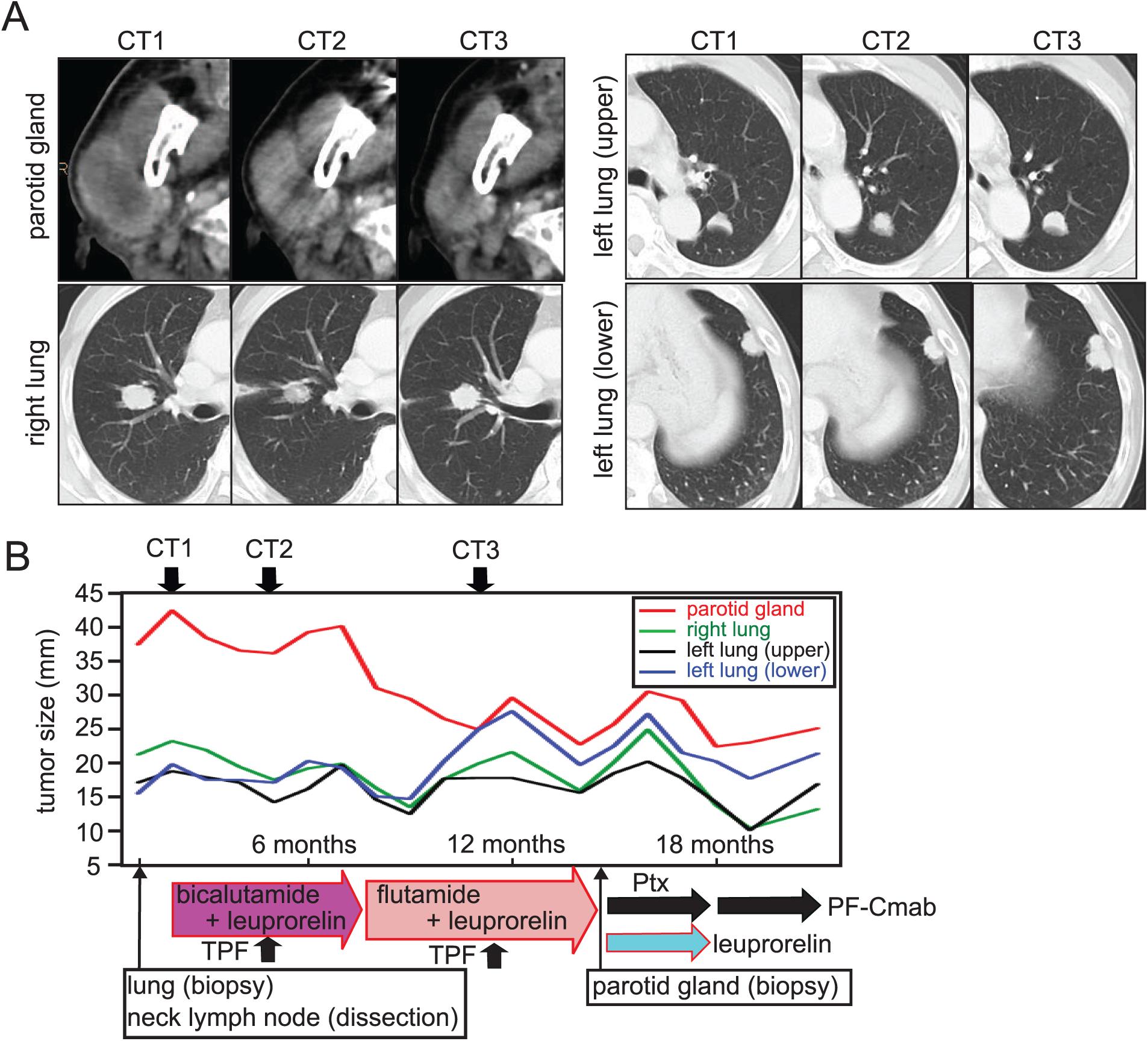
Androgen deprivation therapy (ADT) and chemotherapy for a case of salivary duct carcinoma (SDC).

The expression of FOXA1 is not detected after ADT in SDC case.
After obtaining approval from the Institutional Review Board of the Japanese Red Cross Shizuoka Hospital and written informed consent from the patient, ADT was initiated in April 2013. According to typical protocol of ADT, daily oral bicalutamide (80 mg/day), an AR antagonist, and subcutaneous injection of leuprorelin (3.75 mg), a luteinizing hormone–releasing hormone analog, were administrated once every 4 weeks. Total serum PSA level was measured before initiation of ADT (1.047 ng/ml) and at 2 (0.607 ng/ml), 3 (0.982 ng/ml), and 4 (0.127 ng/ml) months after initiation of ADT to confirm the inhibition of AR activity. Although the basal level of PSA was low, unlike with prostate cancer, which typically show high level of PSA, 5 a reduction of about 10-fold was observed (from 1.047 ng/ml to 0.127 ng/ml), indicating successful inhibition of AR. The tumor volumes of the parotid gland and lungs were reduced in the first 3 months after the initiation of ADT, as shown in Figures 1(a) and (b) (from CT1 to CT2). Because of regrowth of the tumors at 4 months after initiation (Figures 1(a) and (b)), docetaxel, cisplatin, and fluorouracil (TPF) chemotherapy was initiated in month 5 (Figures 1(a) and (b)). In month 8, bicalutamide was changed to flutamide because of an apparent increase in tumor size. Nevertheless, tumor sizes (lung tumors in particular) continued to increase, thus a second round of TPF chemotherapy was initiated in month 11. In month 14, weekly paclitaxel chemotherapy was initiated and administration of flutamide was terminated. Biopsy of the parotid gland was conducted in order to decide his therapeutic strategy with evaluating the expression of AR. As shown in Figure 2, no apparent histological changes of the tumor cells were observed in specimens from the lungs and neck lymph nodes before ADT or from the parotid gland after ADT. In addition, AR expression in the parotid gland tumor was positive (Figure 2, IHC, AR, post-ADT). However, FOXA1 expression was not detected in the tumor cells after the tumor showed ADT resistance in comparison with before ADT initiation (Figure 2, IHC, FOXA1, and post-ADT). Administration of leuprorelin in combination with paclitaxel was continued because of unchanged AR expression (Figure 2). In month 17, metastasis to the brain was found in the examination for headache and we diagnosed as progressive disease (PD), thus administration of leuprorelin with weekly paclitaxel was terminated. In month 18, cisplatin, fluorouracil, and cetuximab were initiated. Because of the occurrence of severe neutropenia and febrile neutropenia, he and his family decided to stop further chemotherapy and his therapy was changed to supportive care. Finally, he died of multiple metastases to the sphenoid bone, liver, and mediastinal lymph nodes in month 29.
Discussion and conclusion
Given that AR is expressed in most SDC cases and tumor growth is suggested to be androgen dependent, AR could be an actionable target for treatment of SDC.13,14 Some groups have reported the effectiveness of ADT against AR-expressing salivary cancers, including SDC.7–9 This case, however, acquired resistance to ADT. The situation is similar to that of prostate cancer treatment. 6 In many prostate cancer patients, after an average of 2 years, AR is found to be hyperactivated, with prostate cancer cells acquiring androgen independence. 5 This change allows for tumor growth even with a low amount of androgen, a condition called a castration-resistant state, and leads to tumor recurrence. Although ADT might be a promising strategy for SDC treatment, we emphasize that some SDC case might acquire resistance to ADT, as with castration-resistant prostate cancer.
AR co-localizes with other transcriptional factors and chromatin remodeling factors to regulate expression of downstream genes. Among these, FOXA1, a member of the forkhead DNA-binding protein family, is known to be a major AR co-factor.10–12 FOXA1 recruits and associates with hormone receptors, including AR, to regulate the expression of downstream genes.10,12 Several studies have reported that overexpression of FOXA1 acts as a co-factor of AR and is involved in the acquisition of castration resistance.15,16 However, as reported by Jin et al., 11 down-regulation of FOXA1 globally shifts AR-chromatin binding in the genome and induces the acquisition of castration resistance. Furthermore, we previously reported that FOXA1 expression was decreased in castration-resistant prostate cancer cell lines. 17 These controversial results indicate the dual functions of FOXA1 (oncogenic and tumor suppressive) depending on the situation and the cancer cell type.
As shown in Figure 2, FOXA1 expression was not immunohistochemically detected in parotid gland after ADT, despite AR expression in this case. We did not quantitate FOXA1 mRNA levels in the tumors because no sample was frozen for future assay. Therefore, it is unknown whether the change in FOXA1 expression was caused at the transcriptional or post-transcriptional level. Hence, further large-scale studies with larger numbers of SDC cases are needed to reveal the molecular mechanisms underlying aberrant FOXA1 expression and the mutation status of the FOXA1 gene. 18 Dalin et al. 14 recently reported that the expression levels of AR and FOXA1 are well correlated in SDC specimens, and SDC has a similar gene expression signature with apocrine carcinoma, an AR-positive breast cancer. Therefore, features of SDC shared with other AR-expressing malignancies would be expected to reveal novel clinicopathogenesis of SDC.
As a limitation to this report, AR and FOXA1 expression levels were analyzed in specimens from the lungs and neck lymph nodes before ADT and from the parotid gland after ADT. Ideally, these expression patterns should have been analyzed in the same organs both before and after ADT. However, we did not obtain a specimen of the parotid gland tumor before ADT, as mentioned in Case section.
We experienced a case of SDC case that acquired resistance to ADT and compared the tumor expression patterns of AR and FOXA1 before and after acquisition of ADT resistance. Down-regulation of FOXA1 expression might be a molecular mechanism of acquiring ADT resistance. This is the first pathological comparison between pre-ADT and post-ADT in a case of SDC.
Footnotes
Acknowledgements
The authors thank the lab technicians at Fujita Health University and Japanese Red Cross Shizuoka Hospital for helpful advice of immunohistochemical staining. Contributorship: K.W. wrote the first draft of the manuscript. All authors reviewed and edited the manuscript and approved the final version of the manuscript.
Conflict of interest
The author(s) declared no potential conflicts of interest with respect to the research, authorship, and/or publication of this article.
Ethical approval
This study was approved by the Ethics Committee for Clinical Studies of Fujita Health University, Aichi, Japan (#HM15-538) and Japanese Red Cross Shizuoka Hospital, Shizuoka, Japan.
Funding
The author(s) disclosed receipt of the following financial support for the research, authorship, and/or publication of this article: This work was supported by “16K19090 and 18K09545 from Japan Society for the Promotion of Science (JSPS) KAKENHI” and “Aichi Cancer Research Foundation” to Kouhei Sakurai.
Informed consent
We obtained written informed consent from the patient for their anonymized information to be published in this article.
