



Abstract
In the case of cross-border employment, the applicable law is determined mainly according to habitual place of work. If this factor cannot be clarified, the engaging place of business of the employer determines the applicable law. Both factors can be set aside if the relationship is more closely connected to some other country.
Telework is performed outside the employers’ premises, and the determination of the exact workplace can be difficult. This again complicates the determination of the applicable law in cross-border cases. This article analyses how, in the case of cross-border telework, the applicable law should be determined.
It is argued that the exact system depends on the type of telework. If telework is performed in one country abroad, the habitual place of work determines the applicable law. If teleworker has at least two offices or manages his own working time, the second connecting factor applies. As the determination of the applicable law according to the engaging place of business is not considered to be sufficiently employee-protective, escape clause should be emphasised in the second case to guarantee the best employment protection to the employee.
Keywords
Introduction
Different concepts have been developed to denote the work performed outside the premises of the employer using information and communication technology (ICT). In European Union (EU), the most prevalent term used is telework. The Framework Agreement on Telework (Framework Agreement), concluded by the social parties at the EU level in 2002, 1 defines telework as ‘a form of organising and/or performing work using information technology, in the context of an employment contract/relationship, where work, which could also be performed at the employer's premises, is carried out away from those premises on a regular basis.’ 2
Four dimensions characterise telework:
1)Technology: The stage of the development of the ICT determines the characteristics of the telework. For example, while personal computers and telephones enabled stationary home-based telework, laptops and mobile phones enable mobile telework, and smartphones and tablet computers act as a virtual office; 2)Working time flexibility: In the case of telework, workers have more flexibility in organising their own working time; 3)Regularity: As a rule, telework is performed on regular basis, but can also be performed occasionally; 4)Unconventional work place: Telework can be performed at home or in other places outside of the employer’s premises (hubs, co-working places, libraries, internet cafés). New ICT (for example, smartphones and tablet computers) also enables teleworkers to change workplaces. A teleworker can spend certain hours or days working from his or her home and other hours working from a café or a library.
3
Before the outbreak of COVID-19 in 2019, 11% of the employees in the EU were performing telework. 4 After the start of the pandemic, the percentage of employees who were teleworking increased to 19% in 2020 and 22% in 2021. 5 EU-wide surveys from 2020 and 2021 show that two-thirds of the employees are willing to continue teleworking after the pandemic, at least on a partial basis. 6 The prevalence of telework is dependent on the share of teleworkable jobs available, i.e. jobs that can be performed remotely. It has been estimated that in 2020, 38.5% of all occupations were teleworkable, and there is potential for the share of telework to increase even further. 7
Although telework has many advantages both for employers (increased productivity, expanding possibilities to work organisation), and employees (flexibility, autonomy, work-life-balance), 8 certain concerns are expressed as regards the (broader) use of telework arrangements. Potential drawbacks include extended availability of workers and increased workloads, blurred boundaries between work and private life, isolation and informal overtime, 9 as well as inequality between the workers with access to telework and those without such access. 10
Most of the concerns connected to telework have been addressed by general labour law provisions. As a rule, EU law and the labour law provisions of the Member States (MS) are applied normally to teleworkers. Teleworkers benefit from the same rights, guaranteed by applicable legislation and collective agreements, as comparable workers at the employers’ premises. 11 Telework and its synonyms are not legal concepts, but describe the method of organising work and the working environment, and performing telework does not influence the legal status of the worker. 12 However, the special characteristics of telework can hinder the application of the general provisions in practice. For example, the fact that telework is performed outside the premises of the employer or on the move reduces or even exempts the employer’s access to the workplace, which again reduces its possibilities to monitor and take care of the occupational health and safety and working time protection of the employee.
Telework does not necessarily need to be performed in a country where the employer is situated, but it can be performed abroad. In the EU, the share of cross-border workers working from home increased from 2% before Covid to 12% in 2021. 13 In the case of cross-border telework, in addition to the problems connected to the application of domestic labour law provisions, choice-of-law questions arise. According to the Rome I Regulation on the law applicable to contractual obligations (Rome I), in cross-border cases the agreement is governed by the law chosen by the parties. However, in the case of employment contracts, parties’ choice cannot deprive the employee of the protection afforded to him by law that would have been applicable in the absence of choice (objectively applicable law). In the absence of choice, the law of the country in which or from which the work is performed should be applied. If the applicable law cannot be determined on this basis, the contract is governed by the law of the country where the place of business that engaged the employee is situated. Finally, where it appears from the circumstances as a whole that the contract is more closely connected to a country other than indicated above, the law of that other country shall apply. 14
The determination of applicable law in the case of cross-border employment can be complicated. The content and the hierarchy of the connecting factors is not straightforward. Moreover, the two connecting factors, habitual place of work and the engaging place of business, can be set aside by the closest connection principle. Finally, the overriding mandatory provisions 15 or the public policy of the forum 16 can replace the otherwise applicable law.
The situation is even more complicated in the case of cross-border telework. The unusual work place may make the determination of the applicable law even more difficult. The teleworker can work from different countries, which makes the determination of the habitual place of work problematic. If the habitual place of work cannot be determined, we need to resort to the second connecting factor, which to date has been given little relevance in the case law of the Court of Justice of the EU (CJEU). 17 This again can affect the balance of these two factors and create a need for the further interpretation of the engaging place of business. Finally, the escape clause i.e., the closest connection principle can obtain a different role in the context of cross-border telework.
The aim of the article is to analyse how the applicable labour law should be determined in the case of cross-border telework. The issue is approached from legal dogmatic perspective. Choice-of-law rules concerning the applicable law in the case of employment relationships and the relevant case law of the CJEU will be analysed. The provisions on the regulation of working place and telework are examined and the application of choice-of-law provisions in the context of cross-border telework are discussed.
The article concentrates on the role of different connecting factors in determining the applicable law in the case of telework. The social security aspects of cross-border telework 18 and situations in which the employee is only posted to another country temporarily are not covered. 19 It must be noted that the applicable law determined according to the connecting factors can be refused to be applied on the basis of overridden by the mandatory provisions or public policy of the forum, but this aspect is left for further research. The article proceeds as follows. First, the general system for choosing the applicable law in the case of cross-border employment is discussed. Second, the variety of workplaces in the case of telework and the possibilities of determining the applicable law on the basis of habitual place of work are analysed. Third, the cases in which the applicable law can be determined based on engaging place of business are discussed. Finally, the role of the escape clause is analysed.
Determination of the law applicable to cross-border telework: general considerations
If the parties have agreed on the performance of cross-border telework, the question of the applicable law arises. As already mentioned, telework is not a special category of employment and therefore, the general rules regulating choice of law in the case of individual employment contracts apply to telework. Pursuant to Article 3 Rome I, a contract is governed by the law chosen by the parties. The parties do not have to choose the laws of the countries to which they are connected, but they can choose to have the law of a non-interest third country law to be applied to the contract. However, if the contract is not truly international or is only linked to the MS of the EU, the parties’ autonomy is somewhat restricted. 20 According to Article 3(3), if all other elements relevant to the situation are located in a country other than the country whose law has been chosen, the parties’ choice does not prejudice the application of provisions of the law of that other country which cannot be derogated from by agreement. Article 3(4) provides that if all other elements relevant to the situation are located in one or more MS, the parties’ choice do not prejudice the application of mandatory provisions of Community law.
Hence, as a starting point, the parties of an individual employment contract can choose the law applicable to the contract. Nevertheless, Rome I foresees specific restrictions to the parties’ autonomy for the protection of the employee as a weaker party to the contract. A specific protection technique is used to ensure that the employee can only profit from a choice of law. Article 8(1) Rome I provides that the employee cannot lose the protection afforded to him by provisions that cannot be derogated from by agreement under the law that would otherwise be applicable in the absence of choice (objectively applicable law). 21 Therefore, the chosen law cannot guarantee the employee less protection than he would have received if the law would not have been chosen.
The phrase ‘provisions that cannot be derogated from by agreement’ has to be distinguished from the narrower category of ‘overriding mandatory provisions’. The former only refers to provisions from which the parties cannot derogate in the domestic situation. The aim of Rome I, as well as the wording of Article 8(1), suggest that not all mandatory provisions, but only the provisions that have an employee-protecting nature, need to be upheld. 22 Mandatory provisions set out in labour legislation or collective agreements apply only if they are more favorable for the employee than those chosen by the parties. Conversely, if the mandatory provisions of the objectively applicable law are less favourable, the provisions of the chosen law apply. The employee cannot cumulate the benefits of the different connected countries, but the law of the country giving better protection is applied. 23
The decision on which law is more favourable should not be made by comparing the whole labour legislation of the two countries or by comparing the specific provisions, but by comparing severable issues. For example, protection against dismissal could be compared. 24 It has been argued that comparing the whole labour legislation is arbitrary, because it cannot be determined that the legislation of one country in general provides better protection than the law of another. Some aspects can be more favourable to the employee in the law of one country and other aspects more favourable in the law of the other. 25 Provision-by-provision comparison, again, can give the employee better protection than envisaged under the law of either countries. The idea of the choice-of-law rules is not, however, to give the cross-border employee better protection compared to domestic employees, and this system can lead to logical inconsistencies. 26
The application of Article 8(1) can lead to different outcomes. First, it is possible that the law chosen by the parties fully applies to the relationship if it guarantees the employee the same or better protection than the objectively applicable law. Second, it is possible that part of the chosen law is applied if it provides better protection, and for the rest, the objectively applicable law is applied. Finally, if the chosen law does not provide for any beneficial protection to the employee compared to the objectively applicable law, the latter could be fully applied.
Conducting the comparison between the chosen law and the objectively applicable law is not an easy task. However, before this process can be started, the objectively applicable law has to be ascertained. This can be done by the choice-of-law rules included in Article 8(2) - Article 8(4) Rome I, which are also applied in the absence of choice. Article 8 Rome I has two purposes. In addition to restricting the parties’ autonomy, it determines the applicable law in the absence of choice. While Article 8(1) has a protective function by preventing the employer from contracting out from better protection, 27 rules determining the applicable law in the absence of choice do not necessarily provide the best level protection among the possibly relevant laws. 28 If the parties have chosen the applicable law, the court needs to apply objectively applicable law only if it gives better protection to the employee. However, if the applicable law is not chosen, the objectively applicable law will be applied even if the application of the law of some other connected country would be more favourable to the employee.
Article 8 Rome I uses habitual place of work as a primary connecting factor, and engaging place of business as a secondary connecting factor. Habitual place of work is a key factor in determining the objectively applicable law. The CJEU has confirmed that even if the work is performed in more than one country, the habitual place of work needs to be given broad interpretation. 29 The broad interpretation of the first connecting factor leaves less scope for the application of the second connecting factor i.e., the engaging place of business that has been regarded as leaning too much to the employer’s favour. 30 The choice of law process does not end with the determination of the objectively applicable law. The supposedly applicable law can be displaced if it appears, from the circumstances as a whole, that the contract is more closely connected with a different country. Additionally, the possible application of overriding or mandatory statutory rules needs to be considered. 31
Habitual place of work as the primary connecting factor
Variety of workplaces in the case of telework
One of the essential aspects of an employment relationship is the place where work is performed. In the beginning of the relationship the employer needs to provide the employee with written information about the essential conditions of the relationship according to the Directive 2019/1152. Among others, Article 4.2 of the Directive provides that the employee needs to be informed about the place of work, and where there is no fixed or main place of work, of the fact that he or she is employed at various places or is free to determine his or her place of work. 32 It appears that the place of work can be agreed in several ways. The parties can agree on one fixed or main place of work, they can agree that the employee works in various places or that the employee can freely determine his or her place of work.
In the case of telework, the parties have agreed on the performance of work, which could be otherwise performed at the employer’s premises, outside these premises. It has been argued that the fact that work could be equally done at the employer’s premises means that telework only covers arrangements in a specific place, and excludes jobs in which the mobility is required by the labour process (for example, mobile sales persons or mobile health workers). 33 This is not fully correct. The signatory parties of the Framework Agreement have aimed to define telework broadly to include different forms of work. In the Interpretation Guide of the Framework Agreement, it has been explained that the definition covers alternating telework, where a part of the working time is spent at home and another part at the employer's premises; telework at home; work at telecentres (shared office facilities, often for employers of several companies); remote office telework (a location physically distant from the main office, where one or more workers work); and nomadic, peripatetic or mobile telework. 34 It is true that the possibility to perform work at the employer’s premises and the use of ICT facilities excludes workers, whose profession and work pattern involves physical mobility (i.e., sales managers, transport workers), from the scope of the Framework Agreement. However, it does not mean that telework needs to be performed in or from one specific place.
When combining different forms of telework with different agreements on the workplace, a complex setting of the possible telework places will be reached. Depending on the actual form of telework, the determination of the exact workplace can be more or less complicated. The easiest is to determine the workplace if telework is performed fully at the employee’s home, telecentre, remote office or other (single) fixed place. The situation is more complicated if the parties have agreed on working in various places. The employee can work in different places outside the premises of the employer, or partly at agreed place(s) outside the employer’s premises, and partly at the employer’s premises (hybrid model). Another option is that the parties agree to give the employee full freedom to decide where he or she works. In this case, the employee can work in one or a few main places or he or she can act as a mobile worker by frequently changing places of work. It is also possible that the employee uses the premises of the employer from time to time, according to his or her own consideration. Finally, a combined model can be used. It can be agreed that the employee works only partly at the employer’s premises or another fixed place and decides where he or she performs the remainder of the work. The different models of workplaces in the case of telework are illustrated in Table 1.
Variety of workplaces in the case of telework.
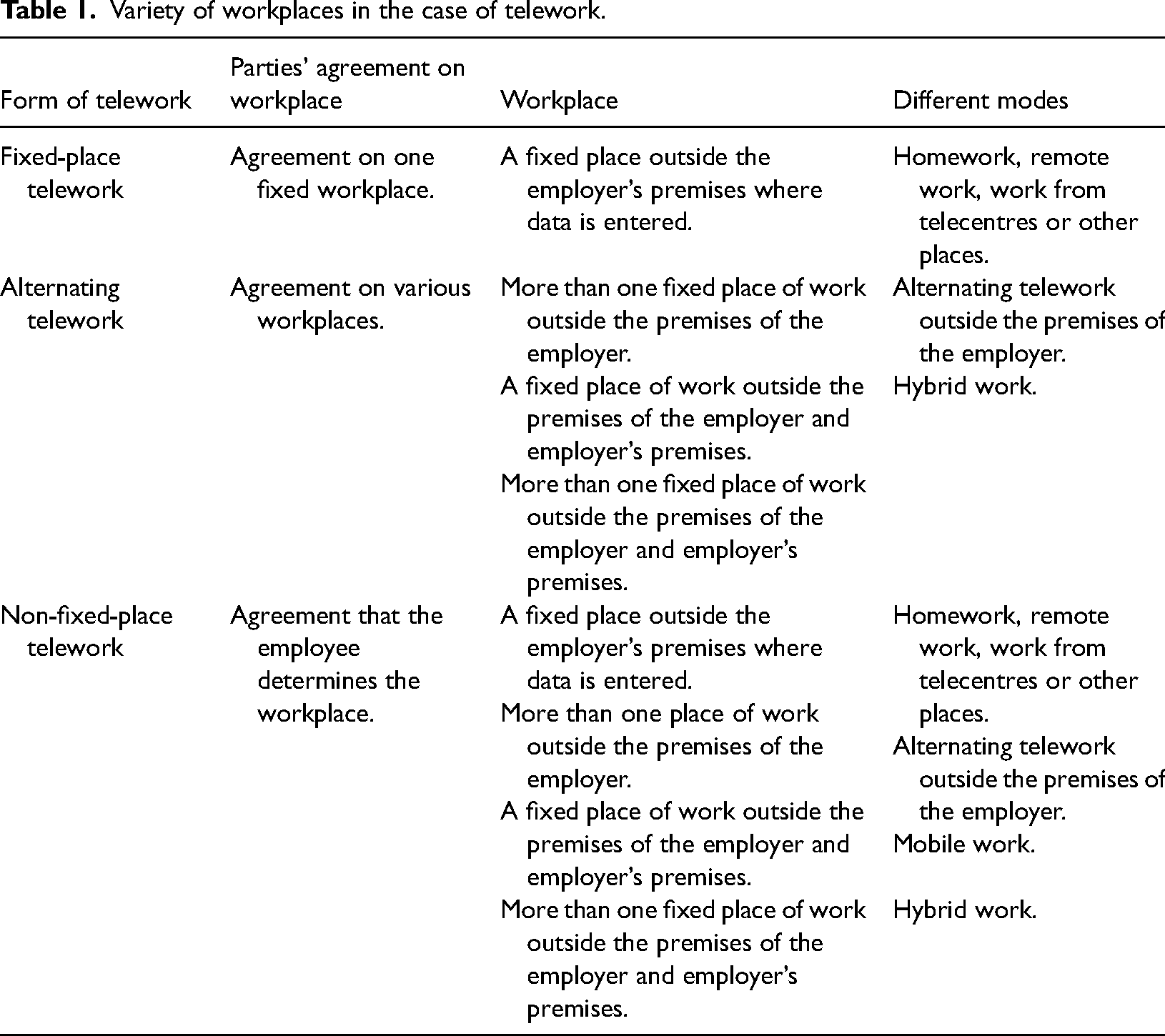
Variety of workplaces in the case of telework.
The complexity of possible telework places influences the consequences of the choice of law process in the case of cross-border telework, as it can make the determination of the habitual place of work difficult. The habitual place of work is the most important factor in determining the objectively applicable law. If its determination becomes impossible, the second connecting factor, i.e the engaging place of business, plays a more important role. Additionally, the application of escape clause needs to be considered. It is therefore important to analyse how broadly we can apply the first connecting factor in the case of cross-border telework.
Although there is no case law on the interpretation of Article 8 Rome I, similar rules have been used in the Brussels I Regulation 35 regulating the matters of jurisdiction and enforcement, and in the Rome Convention 36 that preceded Rome I. The CJEU has on several occasions stressed the importance of the continuity between the different instruments and the transposability of the concepts having similar wording and function. 37 Therefore, the case law concerning the Brussels I Regulation and the Rome Convention can be used to interpret concepts included in Rome I.
In a situation where the employee performs work in the territory of one country, the determination of the habitual place of work is rather simple (including in the case of telework). If the employer and employee have agreed that telework is performed in a country other than that where the employer is situated, the law of the country where the work is actually performed will be applied. The habitual place of work is the country of the habitual place of data entry. 38 From the choice of law perspective, the fact that the work is performed as a fixed-place telework, alternative telework or non-fixed-place telework has no relevance until the work is performed only in a country other than that where the employer is situated.
The issue becomes more complicated if the work is done in more than one country. This can happen in the case of alternating telework and non-fixed-place telework. When considering alternating telework, the parties to an employment contract may have agreed that the employee will work in several other countries than that of the country of the employer. The teleworker may have few fixed places of work or he or she can regularly change the places and countries where the work is performed. The work can also be done partly in a country/countries other than the country of the employer, and partly at the employer’s premises. If the parties have given the employee the flexibility to decide on his or her workplace all earlier mentioned forms of telework can occur.
There is no CJEU case law concerning the habitual place of work in the case of telework. However, we can try to apply the case law concerning mobile workers to telework. In Mulox 39 and Rutten 40 the CJEU dealt with the habitual place of work in the case of commercial representatives. In Mulox, an employee, who resided in France, worked as an international marketing director for a company registered in the UK. His office was situated in France and he sold Mulox products initially in Germany, Belgium, the Netherlands and the Scandinavian countries, to which he travelled frequently. Later he worked only in France. The CJEU drew attention to the fact that the work was carried out from an office in a contracting state, where the employee had established his residence, from which he performed his work and to which he returned after each business trip. The CJEU found that the habitual place of work was ‘the place where or from which the employee principally discharges his obligations towards his employer’. 41
In Rutten, an employee, who resided in Netherlands, first worked for a subsidiary of a UK company registered in the Netherlands. The employment contract between the subsidiary and Mr. Rutten was terminated and he was employed by the parent company in the UK. Mr. Rutten carried out his duties on behalf of his employers in the Netherlands, and for approximately one third of his working hours in the UK, Belgium, Germany and the United States of America. His office was established in his home in the Netherlands, to which he returned after each business trip. The CJEU found that the habitual place of work was ‘the place where the employee has established the effective centre of his working activities and where, or from which, he in fact performs the essential part of his duties vis-à-vis his employer’. 42
In Mulox and Rutten, the effective centre of the working activities has been regarded as a decisive factor determining the habitual place of work. The place of the employee’s office played a central role in this consideration. 43
In Weber, 44 the factual background of the case was not clear. However, it could be identified that Mr. Weber worked for his employer, UOS, as a cook on board a floating crane in Danish territorial waters, and afterwards in the Netherlands continental shelf area on mining vessels or installations. Mr.Weber worked in two countries, but he did not have an office in a contracting state that would have constituted the effective centre of his working activities or from which he performed the essential part of his duties vis-à-vis his employer. The CJEU found that in this case the habitual place of work was ‘the place where he spends most of his working time engaged on his employer’s business.’ 45
The application of the judgments In Mulox, Rutten and Weber to telework is not straightforward. The main question is whether the habitual place of telework should be determined according to the effective centre of activities or on a temporal basis and how exactly this should be done. In Weber, the CJEU argued that the temporal criterion can be used only if there is no office and the effective centre of activities cannot be determined. 46 Hence, first and foremost, we need to try to ascertain whether one of the workplaces forms an office (effective centre of activities) i.e., the place where the employee performs the essential part of his or her obligations and to which he or she returns after working in other locations. If the duties of the employee vary, the essential part of the obligations should be determined according to the nature and importance of work carried out in different countries. 47 It is therefore possible that similar to Mulox and Rutten, a teleworker spends more working hours in a country other than that where his or her office is situated. For example, the parties may have agreed that work is performed at the premises of the employer at least two days a week, during which the employee participates in important meetings, reports on his or her work to the employer, meets clients etc, and on telework days, the employee prepares for these meetings in one or more fixed location outside the premises of the employer or several non-fixed locations. It can be argued that the teleworker carries out the most important duties at the premises of the employer, and not in other places where the preparatory work is done. It is, of course, possible that the effective centre of activities is in a country where the teleworker spends most of his or her working hours. We can again take the example of hybrid model. The employer and the employee may have agreed that the teleworker works mainly at his or her home, but if needed, the employer can call to meet him or her at the employer’s premises. If these meetings are rare and occasional, the employer’s premises cannot be regarded as the place where the essential part of the obligations is performed. As the habitual place of work is determined on factual basis, it is not possible to draft a general rule as how the essential centre of activities should be determined. It can only be concluded that it may or may not correspond to the country where teleworker spends most of his or her working time.
If the essential centre of activities cannot be determined, i.e. if the employee has several equally important offices to which he or she periodically returns and where equally important obligations are fulfilled, the temporal factor needs to be considered. Although the determination of the habitual place of work on a temporal basis may appear clearer, the special characteristics of telework can make the process problematic. The untraditional workplace can complicate the application of working time regulation to teleworkers. That is why the Framework Agreement provides for more flexibility for the teleworker in organising his or her working time. According to the agreement, within the framework of applicable legislation, collective agreements and company rules, the teleworker manages the organisation of his or her working time. 48 When a teleworker is responsible for the organisation of his or her working time, the employer does not necessarily have knowledge of how many hours the teleworker has spent working in different locations. Therefore, it can be difficult to determine the place where most of the working time is spent. 49
As already mentioned, the determination of the applicable law based on the habitual place of work requires a factual assessment. In academic literature it has been argued that the factual assessment may lead to three unwanted outcomes: it raises procedural issues such as the question of burden of proof; it reduces legal certainty by enabling courts to assess similar facts differently and to reach different conclusions; and the individual assessment reduces the collective power of the work entity by enabling different workers of the same company to be covered by different laws. 50 It is true that the court has an extensive role in assessing the factual circumstances of telework to determine the habitual place of work. The determination of the applicable law on the basis of habitual place of work ex ante can be sufficiently accurate mainly in the case of fixed-place telework. In other cases, it can be difficult to determine the habitual place of work beforehand. In the case of non-fixed-place telework, the determination of the habitual place of work can become difficult both ex ante as well as ex post.
The arguments around the collective power of the work entity and equal treatment are also important. Collective rights are the most important rights enabling the employees to protect their employment rights. If employees with the same employer are covered by the laws of different countries, collective action is hampered. It is also questionable whether the performance of work in different countries is an objective justification for treating the employees with the same employer differently as regards their working conditions. Hence, to provide some legal certainty to teleworkers as regards the applicable law, as well as to face these employment law problems, other bases for the determination of the applicable law need to be considered. Next, it will be analysed whether the second connecting factor, i.e., the engaging place of business or escape clause, provides the necessary solutions.
Engaging place of business
The CJEU dealt with the hierarchy between the first and second connecting factors more profoundly in Koelzsch 51 and Voogsgeerd. 52 In Koelzsch, 53 a lorry driver, domiciled in Germany, worked under an employment contract for a Luxembourg company. Mr. Koelzsch transported goods from Denmark to destinations mostly in Germany and occasionally in other European countries. The company-owned lorry was permanently parked in Germany. Mr. Koelzsch was also an alternate member in Germany of the works council of the employer. The CJEU found that in order to determine the habitual place of work, the relevant court should ‘determine, in which State is situated the place from which the employee carries out his transport tasks, receives instructions concerning his tasks and organises his work, and the place where his work tools are situated. It must also determine the places where the transport is principally carried out, where the goods are unloaded and the place to which the employee returns after completion of his tasks.’ 54 The CJEU referred to its earlier case law and reaffirmed that ‘the criterion of the country in which the work is habitually carried out must be given a broad interpretation and be understood as referring to the place in which or from which the employee actually carries out his working activities and, in the absence of a centre of activities, to the place where he carries out the majority of his activities.’ 55
The Court explained that as the objective of then-applicable Article 6 of the Rome Convention (corresponding to Article 8 Rome I) was to guarantee adequate protection for the employee, that provision must be understood ‘as guaranteeing the applicability of the law of the State in which he carries out his working activities rather than that of the State in which the employer is established. It is in the former State that the employee performs his economic and social duties and, …, it is there that the business and political environment affects employment activities’. 56 It added that the country in which the employee ‘habitually carries out his work’ must be given a broad interpretation, while the criterion of ‘the place of business through which [the employee] was engaged’, should apply only in cases where the court cannot determine the first connecting factor. 57
In Voogsgeerd, 58 a seaman concluded an employment contract with a Luxembourg company (Navimer) at the headquarters of the employer’s Belgian subsidiary (Naviglobe). The contract was expressly subject to the law of Luxembourg. Mr. Voogsgeerd worked on board ships belonging to Navimer and received his salary from Navimer. However, he reported to, and received briefings and instructions from, Naviglobe in Belgium. All of his voyages also commenced and terminated in Belgium. Even though the CJEU was asked to interpret the second connecting factor, it explained both connecting factors and the hierarchy between them.
The CJEU confirmed the earlier case law and the broad interpretation of the habitual place of work. The CJEU found that the ‘national court… must first establish whether the employee, in the performance of his contract, habitually carries out his work in any one country, which is that in which or from which, in the light of all the aspects haracterizing that activity, the employee performs the main part of his duties to his employer.’ 59 The CJEU explained that the aspects haracterizing the employment relationship, including ‘the place of actual employment, the place where the employee receives instructions or where he must report before discharging his tasks’, are relevant for the determination of the applicable law. 60 The Court found that if the place from which the employee carries out his transport tasks and receives the instructions is always the same, that place must be considered the place where he habitually carries out his work. 61 The CJEU continued with interpreting the second connecting factor i.e., the place of business through which the employee was engaged. The Court found that ‘term “engaged” …, … refers purely to the conclusion of the contract or, in the case of a de facto employment relationship, to the creation of the employment relationship and not to the way in which the employee's actual employment is carried out.’ 62 The CJEU argued that the second connecting factor should be interpreted restrictively and only the matters relating to the procedure for concluding the contract (i.e., the place of business which published the recruitment notice and carried out the recruitment interview) should be considered. 63
In light of the case law of the CJEU and especially in the light of Koelzsch and Voogsgeerd, academics have asked whether there are any cases in which the habitual place of work is inapplicable. 64 Employees with a permanent office abroad, transport workers with a permanent base, and employees who change their place of work have a habitual place of work. Consequently, the second connecting factor can become relevant only in very rare cases. It can be the case that the work is not carried out from a permanent base, and a habitual place of work cannot be established based on the distribution of working time spent in various places and the parties’ intentions. The second connecting factor can also be used if the employee has two or more permanent bases of equal importance. Finally, workers who do not work in the territory of any country can access legal protection on the basis of second connecting factor. 65
In the case of telework, the first two options are possible. If the parties have agreed on the performance of non-fixed-place telework, the employer may not know where the actual workplace is. The employee can act like a nomad or a cosmopolitan worker that does not bind her/himself to a certain country and frequently changes the country in which the work is performed. In this case, a permanent base or office is not created. Moreover, the work pattern of telework does not even require the existence of a permanent base, bases or office(s) differently from, for example, transport workers. Therefore, using the second connecting factor can be an alternative way to determine the applicable law if the determination of the work place is fully at the discretion of the employee.
Another option is to use determine the applicable law according to the country of engaging place of business in the case of alternating telework. As mentioned above, the determination of the habitual place of work can be problematic if the employee performs tasks of equal importance in different locations, or the same work tasks in different locations, and spends the same amount of working time in each location. It is also possible that because of the employee’s flexibility to determine his or her working time, the actual division of working time between these places cannot be followed, but the parties have agreed on more than one place of telework with equal importance. In these cases it may be unavoidable to determine the applicable law according to the second connecting factor.
Although the use of the engaging place of business in the case of cross-border telework appears to solve some problems, it is not without its flaws. For a start, the engaging place of business is still a second connecting factor and the possibilities for using the primary connecting factor need to be thoroughly considered. Hence, even if the employment agreement provides that the employee has full discretion to decide where to work, but based on factual circumstances it is possible to determine the office or the place where most of the work is performed, the second connecting factor cannot be used. Similarly, if the parties have agreed on equal alternating work places, but the facts show that the most important work tasks are carried out or most of the working hours are spent in one location, the habitual place of work should be used as a connecting factor. Therefore, the factual assessment forms an integral part of the application of the second connecting factor and as such, the problems connected to this assessment do not disappear. This again means that the applicable law cannot be determined ex ante based on the second connecting factor. However, if the CJEU would give more leeway to the application of the engaging place of business rule by restricting the application of the primary connecting factor, it could reduce the importance of the factual circumstances and contribute to achieving legal certainty. Moreover, if in the case of telework the CJEU preferred the second connecting factor, the employees of the same employer would be treated equally as regards the applicable law, which again would contribute to their equal treatment in the company and collective power.
Nevertheless, there are reasons why the CJEU has prioritised the habitual place of work over the second connecting factor. As the CJEU explained in Koelzsch, 66 the aim of the application of the first connecting factor is to protect the employee in the country in which he or she performs his or her economic and social duties because it is in this country that the business and political environment affects employment activities. It has been argued that the application of the law of the habitual place of work focuses on the equal protection of the workers in the same country. 67 The CJEU has therefore prioritised the equal treatment of the workers in the same country over the equal treatment of the employees with the same employer. While the aim of the CJEU has been to protect the weaker party, the application of the law of the habitual place of work does not necessarily mean the application of the law that is most beneficial to the employee. If the law of the habitual place of work is less beneficial than that of the law of the country of engaging place of business, the strict application of the primary connecting factor does not play the necessary protective role. Moreover, it is questionable whether it is justified to treat the employees with the same employer differently as regards their working conditions, depending on the place where the work is performed. However, the use of the second connecting factor also has its drawbacks. Since the engagement is within the employer’s sphere of control, the broad(er) use of the second connecting factor can lead to the determination of the applicable law on behalf of the employer. 68 This again counteracts the whole idea of the Article 8 Rome I.
The third issue that has been raised in connection with the use of the engaging place of business is the question of legal uncertainty and unforeseeability. It has been argued that the CJEU’s decision in Voogsgeerd 69 leaves the content of the terms ‘engaged’ and ‘place of business’ ambiguous. Although the CJEU has explained that the term ‘engaged’ refers to the creation of the employment relationship, and not to the way that the employment is carried out, it is not clear whether the CJEU refers to the conclusion of the employment contract by or at a particular place of business. Also, the term ‘place of business’ is not clear. Whilst the Advocate General equated this term to the term ‘branch, agency or other establishment’ used in Article 5(5) of the Brussels Convention, the CJEU was not that clear. 70
The problems relating to the second connecting factor, i.e., the engaging place of business, have led academics to propose getting rid of it. It has been argued that the second connecting factor does not support the objectives of Rome I, including legal certainty, foreseeability and employee protection, nor does it point to the law that is sufficiently closely connected with the employment contract. The broader use of escape clause in addition to the primary connection factor has been proposed instead. 71 The use of the second connecting factor in the context of cross-border telework appears to have some advantages. Nevertheless, it is worth looking at whether the application of the escape clause would work even better in this context.
Closest connection requirement
Even if the applicable law can be determined on the basis of one of the connecting factors, pursuant to Article 8(4) Rome I both of these factors can be set aside if it appears from the circumstances as a whole that the contract is more closely connected with other country (escape clause).
The CJEU has dealt with the application of the escape clause in Schlecker. 72 In this case a German resident, Ms. Boedeker, worked for a German employer (the Schlecker company) first in Germany from 1 December 1979 until 1 January 1994, and later in the Netherlands from 1 January 1994 to 30 June 2006. During the last 12 years, Ms. Boedeker worked solely in the Netherlands. The employer aimed to change her place of work to Germany from the beginning of 1 July 2006. Ms. Boedeker lodged a complaint against the employer’s unilateral decision. She relied on the application of Dutch law, which offered her better protection than German law. Schlecker, however, claimed that the contract was more closely connected to Germany and therefore German law should be applied. The CJEU found that ‘even where an employee carries out the work in performance of the contract habitually, for a lengthy period and without interruption in the same country, the national court may, …, disregard the law of the country where the work is habitually carried out, if it appears from the circumstances as a whole that the contract is more closely connected with another country.’
In Schlecker, the CJEU considered the relationship between the connecting factors of habitual place of work and engaging place of business and the escape clause. The CJEU argued that the objective of the Article 8 is not only ‘to guarantee adequate protection for the employee, but that provision must ensure that the law applied to the employment contract is the law of the country with which that contract is most closely connected.’ That interpretation must not always result in the application of the law most favourable to the worker. 73 Therefore, if the contract is more closely connected to the other country than that of the habitual place of work, even the fact that the application of latter would be more beneficial to the employee does not exclude the application of the escape clause.
In determining whether the contract is more closely connected to the other country, the court needs to consider all significant factors relating to the contract, including the country in which the employee pays income taxes, the country in which he or she is covered by a social security scheme and pension, sickness insurance and invalidity schemes, the parameters relating to salary determination, and other working conditions. However, numerical dominance of other relevant circumstances – apart from the actual place of work – does not automatically mean the application of the escape clause. 74
It follows from Schlecker that differently from the habitual place of work taking over the place of the engaging place of business because of the protective character of Article 8, no such hierarchy exists between the habitual place of work and the escape clause. While Article 8(2) aims to protect employees in the levels of their socio-economic environment, Article 8 as a whole appears to be based on a closest connection rule. 75 Van Hoek argues that with the decision in Schlecker, the CJEU has abandoned the ‘protection principle’ and adopted a classic home country control rule, according to which the choice-of-law rules are created to protect outgoing expatriates from the lower level protection abroad. As such, the law that is most familiar to the employee should be applied, i.e., the law of the country of domicile or origin rather than the law of the country where work is performed. 76 On the contrary, Grušić finds that the removal of the second connecting factor and the direct application of the escape clause would advance the objective of employment protection and proximity by giving the trial court the discretion required. 77
When analysing the arguments of the CJEU in Schlecker, it can be observed that the factors the CJEU has suggested be considered in determining the country to which the contract has the closest connection are not objective or fully under the control of the employee. In many countries, the employer is responsible for the withholding of income taxes and payment of social security and pension contributions. It can be difficult for the employee to influence the employer in respect of these issues. The employee also has limited possibilities to control in which currency the payments are made. The CJEU does not limit the scrutiny of the factual circumstances with these factors, but other working conditions, including the habitual place of work can also be considered. However, if the habitual place of work alone can be determined rather objectively, the other factors may be more under the control of the employer. In this way, the application of the escape clause may have the same deficiencies as the application of the second connecting factor. While it is true that because more factors are considered than only the engaging place of business it is more likely that the applicable law is determined more objectively, the escape clause replacing the law of the habitual place of work can reduce the protective nature of Article 8.
Grušić also argues that the removal of the second connecting factor and the direct application of the closest connection rule would advance the objectives of legal certainty and foreseeability, because if the habitual place of work cannot be determined, the parties will be at odds both over the application of the second connecting factor as well as the escape clause. 78 While the removal of the second connecting factor makes the process of the determination of the applicable law clearer, the discretion given to trial courts in deciding which factors to consider in the application of the escape clause does not necessarily advance the objectives of legal certainty and foreseeability.
Even though the determination of the applicable law on the basis of the habitual place of work is less complicated if telework is performed in one country, the CJEU’s decision in Schlecker also makes these relationships problematic. It is possible that even if the teleworker works in a country other than that where the employer is situated, the law of the country where the work is habitually performed will not be applied. For example, if the employer withholds income tax, pays social contributions in a country in which it is situated, and pays the wage in a local currency, the relationship may be more closely connected to this country and the country of the employer may be applied. The question is how much relevance the court gives to other factors than habitual place of work in determining the country with which the contract has the closest connection.
The decision on the applicable law can be also revised if alternating or non-fixed-place telework is performed in several countries. In these cases, the application of the escape clause can be better justified, because the relationship is with more than two countries and the determination of the habitual place of work can be complicated. Compared to the application of the second connecting factor, use of the escape clause reduces employer control over the circumstances determining applicable law and enables the court to take a more employee-protective approach.
Conclusions
In the case of cross-border employment, the applicable law is determined mainly on the basis of the habitual place of work. Therefore, the decision as to where the employee actually performs work is crucial from the viewpoint of choice-of-law rules. It is only if the habitual place of work cannot be clarified that the applicable law can be determined according to the second connecting factor i.e., pursuant to the engaging place of business of the employer. Finally, the applicable law determined according to one of these factors can be set aside if the relationship is more closely connected to some other country (escape clause).
One of the main characteristics of telework is that the work is performed on a regular basis outside the premises of the employer. Telework is performed by using ICT facilities that have been developed, from PCs and telephones to laptops, tablets and mobile phones. The development of ICT facilities enables more mobile performance of telework as well as frequent changes of workplace. The variety of workplaces is the most important reason why the determination of the habitual place of work in the case of cross-border telework becomes difficult, and the engaging place of business and escape clause become more relevant in clarifying the applicable law.
The determination of the habitual place of work can become problematic if the work is performed in more than one country, and the effective centre of the activities or the country in which most of the working hours are spent cannot be determined. This can happen if the teleworker performs equally important duties in different locations, or spends an equal number of working hours in different countries. Additionally, if the teleworker manages his or her own working hours, the number of hours spent in different locations may not be known to the employer and the habitual place of work cannot be determined according to the working hours.
Use of the second connecting factor can solve these problems. However, the CJEU has avoided the application of the engaging place of business criterion because this factor has been regarded as being less protective to the employee. As the engagement is mostly under the control of the employer, the use of this factor would bring the determination of the applicable law under the control of the employer. Additionally, the exact content of the second factor is unclear.
Finally, the applicable law determined according to the first or second factor can be set aside by the application of the escape clause. Then the law of the country with which the contract is more closely connected to is applied. The closest connection is determined pursuant to a range of factors, some of which (social security, taxation, currency of payment) are under the control of the employer. As the escape clause can be used to set aside the law of the habitual place of work, it can be detrimental to the employees who otherwise would be covered by the law determined according to the first factor. In the case of cross-border telework, this would affect teleworkers who regularly perform work in one foreign country. However, it can be beneficial to cross-border teleworkers who would be otherwise covered by the law of the country in which the engaging place of business of the employer is situated. Cross-border teleworkers who have two or more equal offices or perform the same number of working hours in different countries, and teleworkers who manage their own working time, could benefit from the application of the escape clause.
In summary, the determination of the applicable law in the case of cross-border telework is not straightforward. The application of different factors and the escape clause depends on the type of telework and the multiplicity of workplaces.
Footnotes
Declaration of conflicting interests
The author declared no potential conflicts of interest with respect to the research, authorship, and/or publication of this article.
Funding
The author disclosed receipt of the following financial support for the research, authorship, and/or publication of this article: This research has been supported by Academy of Finland (research grant number 348531/2022).
