




Abstract
Dutch employers’ liability for workplace accidents is a very interesting topic, not only from a legal perspective, but also from a law and economics one. It is one of the few systems in Europe where liability is still based on the fault of the employer, whereas most countries apply a form of strict/no-fault liability or a system of no-fault insurance. It is interesting because the Dutch Civil Code explicitly refers to prevention of work-related losses. Law and economics focuses exactly on the behavioural incentives that are provided by tort liability, instead of on the compensation aspect. In this article, I provide an answer to the question of how Dutch employers’ liability compares to the law and economics desiderata. At first glance, the design of this type of liability (fault liability) is contrary to what law and economics would advocate (strict liability). In addition, the level of care that courts require from the employer seems to be excessively high. Interestingly, both characteristics together result in a situation which, from a law and economics perspective, is almost indistinguishable from the desired strict liability. So, two wrongs may make a right: the ‘wrong’ choice for fault liability combined with the ‘wrong’ level of due care results in the ‘right’ application of (quasi) strict liability. Therefore, at least in theory, employers receive the correct behavioural incentives, which induce them to take the optimal level of care and activity. However, when we subsequently turn our attention to employees, things look less perfect. Law and economics scholars argue that in situations where not only the tortfeasor but also the victim can influence accident probability, both parties should receive behavioural incentives. This implies that a rule of strict liability should be accompanied by a defence of contributory or comparative negligence. The Dutch employer liability regime contains a defence of intent or wilful recklessness on the part of the employee. From a law and economics perspective, this defence provides inadequate incentives to the employee, which is a third wrong. An often-heard response to this line of reasoning is that tort victims will receive behavioural incentives for fear of being involved in an accident in the first place, so the lack of a full defence of contributory or comparative negligence is not problematic. If this is true, then the damages the victims receive do not make them ‘whole’, which introduces a fourth wrong: uncompensated losses. This second set of two wrongs does not make a right, because if victims receive incomplete compensation, tortfeasors do not fully pay for the losses they have caused. This may reduce the behavioural incentives the tortfeasors receive, who may hence not choose optimal levels of care and activity after all.
Keywords
Introduction
Dutch employers’ liability for workplace accidents and occupational diseases is a very interesting topic, not only from a legal perspective, but also from a law and economics one. From the legal point of view, it is interesting because it is one of the few systems in Europe where liability is still based on a fault of the employer, whereas most countries apply a form of strict or no-fault liability or a system of no-fault insurance. From the law and economics point of view, it is interesting because Article 658 of Book 7 of the Dutch Civil Code (Article 7:658), which provides for employers’ liability, explicitly refers to the prevention of work-related losses. Law and economics focuses exactly on the behavioural incentives that are provided by tort liability, instead of on the compensation aspect. The first two paragraphs of Article 7:658 read:
The employer must arrange and maintain the spaces, rooms, machines and tools in which or with which work is performed under his responsibility and give instructions and take safety measures as is reasonably necessary to prevent the employee suffering damage during the performance of his work. The employer is liable towards the employee for damage which the employee has suffered from activities performed in the course of his work, unless he shows that he has complied with the obligations mentioned in paragraph 1 or that the damage results, to a substantial degree, from an intentional act or omission or from wilful recklessness on the part of the employee.
It is noteworthy that paragraph 1 explicitly refers to the prevention of damage, and not to compensation for losses that have already occurred. This fits well in a law and economics approach to tort liability, where prevention is paramount. If compensation was the main objective, then law and economics would advocate a system of insurance, which is quicker and less expensive than tort law.
1
In this article, I provide an answer to the question of how Dutch employers’ liability compares to the law and economics desiderata. It is a relevant question, because law and economics focuses on the preventive function of tort law, and avoiding workplace accidents is a socially desirable aim. 2 It is therefore important to investigate whether the way in which employers’ liability is shaped is—at least theoretically—able to provide desirable incentives to avoid accidents from happening.
At first glance, the design of Dutch employers’ liability (fault liability, albeit with a reversed burden of proof) is contrary to what law and economics would advocate (strict liability). In addition, when analysing case law, the level of care that courts require from the employer seems to be excessively high, at least when compared to fault liability in many other areas. In those other areas, due care is determined by weighing the costs of care measures, on the one hand, against the expected accident losses (consisting of the accident probability multiplied by the losses if an accident happens), on the other. 3
Hence, in principle the wrong type of liability is applied (fault liability instead of strict liability) and furthermore, the duty of care is assessed in an incorrect way, at least when compared to the law and economics ideal. Interestingly, both characteristics together result in a situation which, from a law and economics perspective, is almost indistinguishable from strict liability. One could call this result quasi strict liability. So, two wrongs may make a right: the ‘wrong’ choice for fault liability combined with the ‘wrong’ level of due care results in the ‘right’ application of (quasi) strict liability. 4 Therefore, at least in theory, employers receive the correct behavioural incentives, which induce them to take the optimal level of care and activity. This implies that Dutch employers’ liability can in theory provide the desirable incentives to avoid workplace accidents after all.
However, when we subsequently turn our attention to employees, things look less perfect. Law and economics scholars argue that in situations where not only the tortfeasor but also the victim can influence accident probability (so-called bilateral accidents), both parties should receive behavioural incentives. This implies that a rule of strict liability should be accompanied by a defence of contributory or comparative negligence. The Dutch regime of employers’ liability indeed has a defence, but this is a defence of intent or wilful recklessness on the part of the employee. From a law and economics perspective, this defence provides inadequate incentives to the employee, which is a third ‘wrong’. Victim protection ex post (by lowering the level of due care for the employee), from an economic perspective, may result in more accidents happening, so that it does not constitute victim protection ex ante. In the desire to avoid workplace accidents, this is an important aspect which is often overlooked: if legal protection of a so-called weak party changes the behavioural incentives in an undesirable way, the protected party may become worse off. 5
An often-heard response to this line of reasoning is that tort victims will receive behavioural incentives for fear of being involved in an accident in the first place, so the lack of a full defence of contributory or comparative negligence is not problematic. If this is true, then the damages the victims receive do not make them ‘whole’, which introduces a fourth ‘wrong’: uncompensated losses. Unfortunately, this second set of two wrongs, in my view, does not make a right, because if victims receive incomplete compensation, tortfeasors do not fully pay for the losses they have caused. This may reduce the behavioural incentives the tortfeasors receive, who may hence not choose optimal levels of care and activity after all.
It is important to clarify, from the outset, that this article provides a theoretical analysis of employers’ liability, not an empirical one. I therefore do not analyse the question of whether tort law indeed prevents workplace accidents. This does not mean, however, that such a theoretical analysis cannot provide valuable insights. First, the analysis shows that it is not fruitful to focus on the different aspects in isolation, because it is the combination of characteristics that ultimately determines how a system operates. A discussion about the pros and cons of strict liability versus negligence remains incomplete as long as it is not clear how the duty of care under negligence is formulated, who bears the burden of proof, how a possible defence of contributory or comparative negligence is shaped and how (in)complete tort damages are in the first place. Second, an analysis where all these aspects are combined enables a better comparison of tort liability vis-à-vis no-fault insurance as a system for dealing with workplace accidents, irrespective of whether the goal is prevention or compensation. In empirical research, institutional details of the system under investigation matter. 6 It is therefore important to—also theoretically—provide a good account of the system of employers’ liability. The empirical question of whether tort law actually deters is not easily answered, among others due to a lack of data and because it is difficult to disentangle the effect of liability and of insurance. 7 I also do not investigate whether tort law is the best instrument to reach the goal of prevention, or whether, for example, safety regulation is better suited for this, 8 although I will refer, in the conclusion, to the need of a smart mix of regulation and tort liability.
The article is organised as follows. First, in Section II I will outline the approach of law and economics to tort liability, which contains a discussion of differences between fault liability and strict liability. Subsequently, I discuss the four abovementioned ‘wrongs’ in Sections III and IV. In Section V, I conclude. Throughout the analysis I make use of graphs, which are intended to provide a graphical reflection of how the aspects that are discussed influence the incentives of the parties involved.
Fault liability and strict liability in law and economics
Tort liability in general
Law and economics applies an ex ante perspective to law, so it is forward looking. The aspect that is of primary interest therefore is not the compensation function of tort law, because that is an ex post, backward-looking perspective on losses that have already occurred. 9 For this compensation function, law and economics scholars prefer insurance, because it works much more quickly and is cheaper than tort law. 10 It is instead the deterrent function of tort law that plays a central role. The basic idea is simple: the prospect of having to pay damages provides potential tortfeasors with incentives to take care, either to avoid liability (if fault liability is in place) or to reduce the probability of causing losses for which they are strictly liable. On the other hand, the prospect of having to bear (part of) their own losses provides potential victims with behavioural incentives as well.
The goal here is not to avoid losses against all cost, because that would be too expensive. Instead, the aim is the ‘minimization of total accident losses.’ These consist of the costs of the care measures that are taken, plus the accident losses that are still expected to happen at this level of care. 11 These expected accident losses are determined by multiplying the accident probability by the extent of the losses if an accident happens. For example, if there is a 1% probability of an accident in which the losses would be EUR100,000, the expected accident losses are EUR1,000. These expected accident losses can be decreased by taking measures which reduce the accident probability, the size of the losses, or both.
The costs and benefits of taking additional care must be weighed against each other. It is desirable to spend, for example, another EUR1,000 on care measures if this results in a reduction in the expected accident losses of EUR1,500. After all, the total accident costs then decrease by EUR500. It is not desirable to take this measure if the decrease in expected accident losses is, for example, only EUR600, because then the total accident costs increase by EUR400. Taking extra care is therefore desirable as long as the increase in care costs (the ‘marginal costs’ of care) is smaller than the decrease in expected accident losses (the ‘marginal benefits’ of care). As soon as the marginal costs of care become larger than the marginal benefits, taking extra care is no longer desirable. The ‘optimal care level’ lies in the tipping point, where the marginal costs of care equal exactly the marginal benefits.
This idea is graphically shown in Figure 1. Figure 1a shows that care costs increase if the care level increases. So, the more care is taken, the higher the care costs. For simplicity it is assumed that each additional ‘step of care’ costs the same, so that the care costs are depicted by a straight line. 12 Figure 1b reflects that the expected accident losses decrease if more care is taken. Here it is assumed that the decrease in expected accident losses becomes smaller, the more care is already taken. The first care measures hence have more impact than subsequent measures. In practical terms, actors first take the measures which are likely to have the greatest impact on the expected accident losses, and only then measures with smaller impact. In Figure 1c, the care costs (from 1a) and the expected accident losses (from 1b) are added together. They form the ‘total accident costs.’ They are minimised at the optimal care level. 13 It is clear that it is too expensive to avoid all accident losses: in the far right of Figure 1c the expected accident losses are minimised, but because the care costs are very high here, the total accident costs are also high.
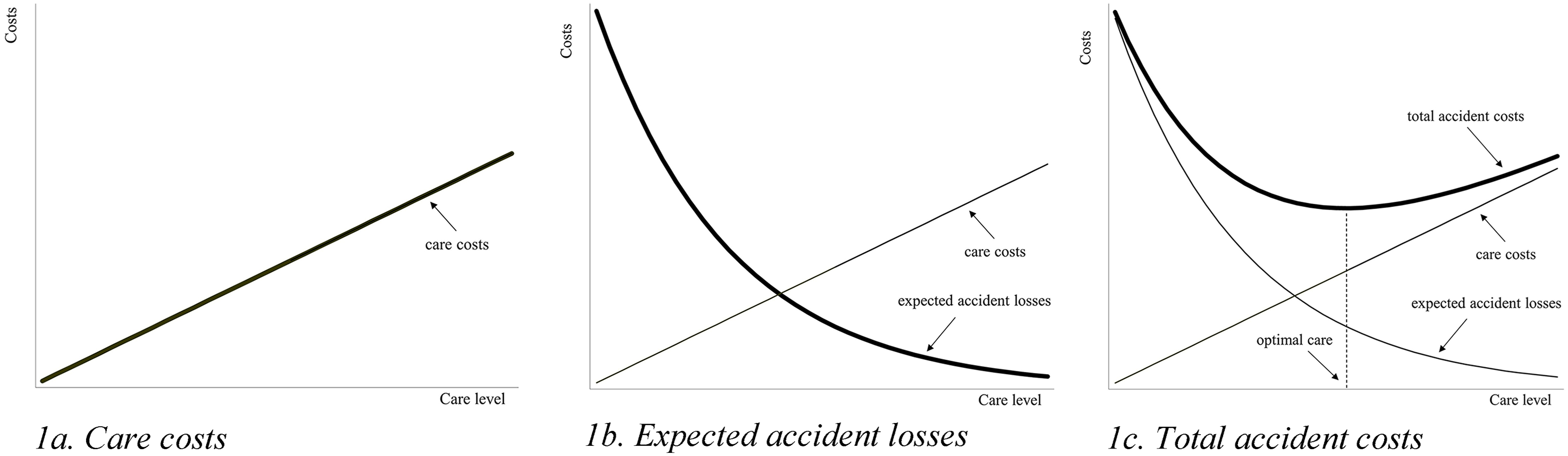
Care costs, expected accident losses and total accident costs.
Figure 1c forms the basis for a series of figures which graphically show the topics I will discuss in this article. In the current subsection, I will analyse the way in which fault liability (e.g., negligence or breach of a statutory duty) and strict liability provide care incentives to the injurer. An essential difference between fault liability and strict liability is that under the former, injurers are only liable if they violate a written or unwritten norm. Under the latter, they are liable irrespective of the level of care applied. Figure 2 shows this difference.
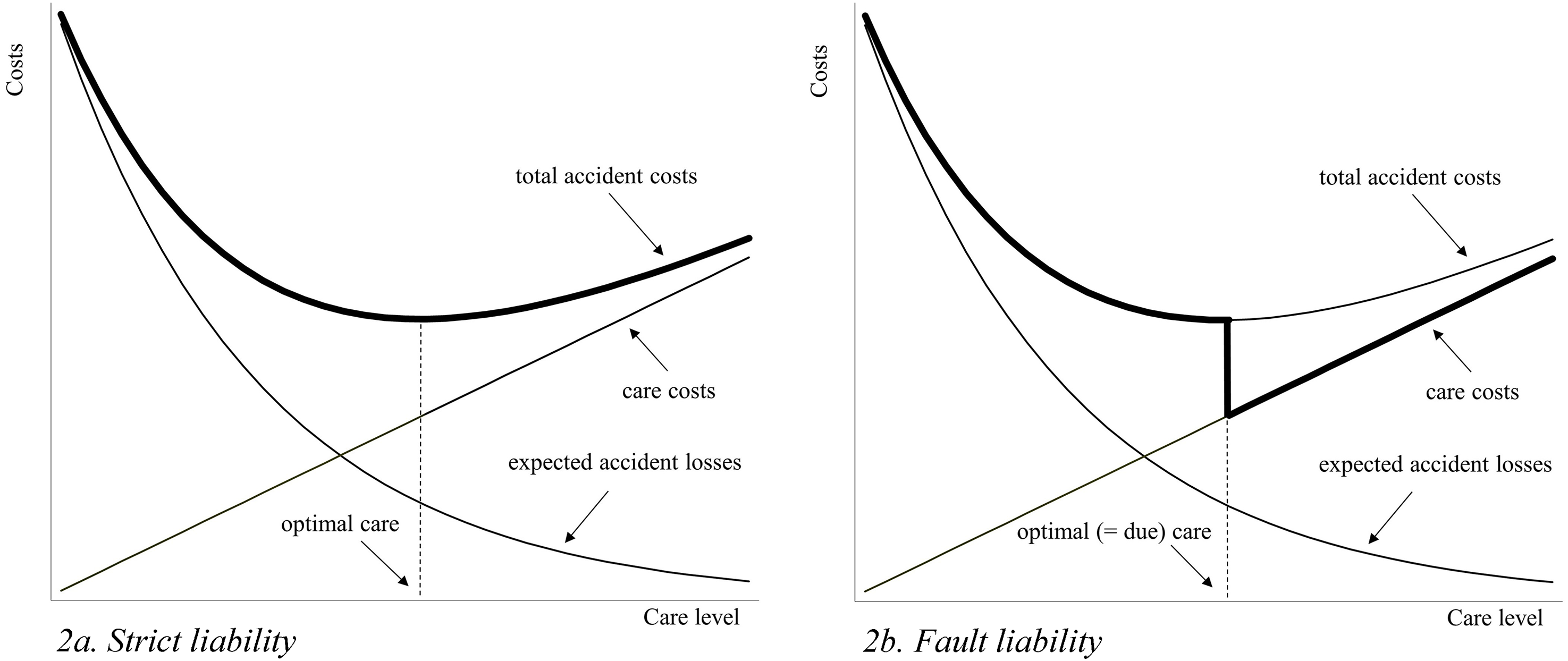
Fault liability and strict liability both provide optimal care incentives.
Figure 2a shows the situation of strict liability. Because injurers are liable at all levels of care, they always bear the care costs plus the expected accident losses. This implies that the expected costs for injurers coincide with the total accident costs. Injurers who want to minimise their expected costs will hence take the optimal level of care.
Figure 2b shows the situation of fault liability, as it is generally depicted in the law and economics literature. Here, injurers are only liable if they do not take the legally required level of care. If the legislator or the court has based the due care level on a correct weighing of the marginal costs and marginal benefits of care, as is reflected in the famous Learned Hand formula, injurers are incentivised to take optimal care. 14 In this formula, the due care level is assessed by weighing the burden of adequate precautions (denoted by B) against the probability of an accident (denoted by p) and the gravity of the resulting losses (denoted by L). If B < pL, yet injurers do not take the care measure, they are liable for not taking enough care. If injurers take due care or more, they are not liable and only bear their care costs. If they take too little care, they are liable and bear the (too low) care costs plus the expected accident losses. Hence, to the left of due care, the expected costs of injurers equal the total accident costs, while from optimal care onwards they only consist of the care costs. Injurers who want to minimise their expected costs therefore will not take less than due care (because liability is expensive) but also not more (because due care is already enough). The discontinuity in the graph reflects this tipping point: at due care or higher injurers only bear the care costs, but at a lower care level the expected accident losses are added. In Section III.C I will focus on the argument of Mark Grady and Marcel Kahan that if causation between the fault and the loss is required, the discontinuity disappears. 15
Figure 2 shows that both fault liability and strict liability can induce the injurer to take optimal care, provided that the due care level is set correctly. 16 This is to be expected, because the weighing of costs and benefits of care is exactly the same between both rules. The only difference is the actor doing the weighing. Under strict liability this is the injurer, and under fault liability it is the legislator (breach of a statutory duty) or the court (negligence). If all actors weigh the costs and benefits correctly, they all reach the optimal care level exactly. Therefore, in principle fault liability and strict liability (can) provide the same care incentives to the injurer. 17 There are, however, several important differences between both rules, which should be included in the analysis. They are discussed in section II.C.
In Section II.B we saw that in principle, both strict liability and fault liability provide optimal care incentives to the tortfeasor, and that the main difference is the actor who decides on the care level to be taken. This results in important differences in the way in which the rules provide the incentives. These differences may result in a preference for one rule over the other, depending on the type of accident. I will discuss these differences in this section.
18
Besides these differences, the accident losses are obviously distributed differently: if the injurer takes the desired level of care, under fault liability the victim will have to bear the accident losses, whereas under strict liability the injurer still is liable for these losses.
Differences in information. To weigh the costs and benefits of care measures, one needs information about which measures are possible, what they cost, how they affect the expected accident losses, etc.
19
In a world of complete information, the tortfeasor, legislator, and courts would all weigh them correctly. But in a world of incomplete information, one actor might have more or better information than another, which enables a better assessment of the optimal care level. If the injurer has the best information, strict liability is to be preferred because the injurer decides how much care to take. If the legislator has the best information, fault liability based on a breach of a statutory duty is to be preferred, because the legislator then determines the optimal care level and incorporates this in the regulation. If the courts have the best information, a negligence rule is the best option. So, the actor with the best information should weigh the costs and benefits of care to decide which care level will be chosen. Information of the victim. Under a rule of fault liability, a victim must prove that the injurer has violated a behavioural norm and that this has resulted in the victim’s losses. If the victim cannot prove this, they may lose the case, even if they were right. In situations where victims have limited information, fault liability hence does not provide adequate care incentives to tortfeasors, because the latter expect not to be liable in all cases where they have caused losses. Under a rule of strict liability, victims do not have to prove wrongdoing or a causal link between the violation of a norm and the losses, so the problem is not present here. Hence, the less information victims have, the more attractive strict liability becomes. Of course, a reversal of the burden of proof and other procedural methods can help victims who have incomplete information.
20
However, it is possible that victims may claim that injurers should have taken a higher than optimal level of care. If the injurers cannot successfully defend themselves, they are induced to take excessive care. Under strict liability they could have simply chosen to take optimal care. Activity level. Accidents cannot only be avoided by taking more care, but also by limiting the activity level. The optimal activity level is found where the ‘net benefits’ of the activity - after subtracting all costs of the activity (including losses for third parties) – are the largest. Only actors who receive all benefits and bear all costs will choose this optimal activity level. Therefore, only the actor who ultimately bears the accident losses chooses the correct activity level.
21
Under strict liability this is the injurer, and under fault liability, it is the victim. Tort law cannot induce optimal activity levels from both actors simultaneously.
22
If it is more important to control the activity level of the injurer, strict liability is to be preferred. If the activity level of the victim is more important, fault liability is better. Loss spreading. If one person must bear a substantial financial loss, this can have a severe impact. If the same loss is spread over a larger group, every individual only bears a smaller loss, which has less impact. Economists assume that wealth has a decreasing marginal utility, because people spend their disposable income on their most important needs. If there is money left, it is spent on the needs that are less important. So, if one loses money, this first goes at the expense of the less important needs, but the larger the loss, the more important the needs that can no longer be met. If a loss of a certain magnitude is spread over many people, it only goes at the expense of the least important needs. A concentrated loss, on the contrary, also jeopardises more important needs. Therefore, spread losses cost less than a concentrated loss of the same magnitude. If the tortfeasor is better able to spread the losses than the victim, strict liability is better. This is, for example, the case if the tortfeasor is a firm, because the expected liability can be spread over all customers via an increase in the price of the product or service. Insurance also result in loss spreading. If it is easier for tortfeasors to take out liability insurance than it is for victims to take out loss insurance, strict liability is better (because there the tortfeasors indeed buy liability insurance). In the opposite situation, fault liability is better. Dimensions of care. Expected accident losses can often be reduced in more than one way. Some care measures are clearly visible to others, and it is possible to monitor whether these measures are indeed taken. Examples are the speed at which someone drives a car, getting the required diplomas before starting a certain activity, and not being drunk while driving. Other care measures are much more difficult or even impossible to observe and monitor, such as how tired someone is before operating a machine, how much this person is concentrating during the activity, and how often a car driver looks in the mirrors. If care measures are impossible to observe, they cannot be included in a legal norm, because it is not possible to establish whether this norm is violated. Legal norms therefore can only provide behavioural incentives in respect of the observable dimensions of care. The more important unobservable dimensions of the injurer are, the more attractive strict liability becomes. After all, because it is irrelevant here whether a norm is violated, the injurer receives incentives in all care dimensions, observable and unobservable. If, on the other hand, the unobservable care dimensions of the victims are more important, fault liability is better. A rational injurer takes due care and therefore the victims must bear their own losses, so that they receive incentives in all care dimensions. Insolvency. Tort law provides its incentives through the threat of having to bear the accident losses. If there is insolvency so that injurers cannot pay the full damages, they do not weigh the costs of care against the full reduction in the expected accident losses, because their assets form an upper boundary of their expected liability. According to much law and economics literature, insolvency creates more problems under strict liability than under fault liability. The reason is that under strict liability, as soon as injurers do not expect to bear the full costs, their weighing of costs and benefits will result in too low a level of care. Under fault liability, however, they would still receive the correct incentives as long as taking due care (and not being liable) is cheaper than taking less care (and being liable). This difference is caused by the discontinuity which is shown in Figure 2b. Insolvency shifts the left part of the bold curve downwards, which makes the discontinuity smaller. But as long as there remains a discontinuity, the injurer still prefers to take due care. I will return to this topic in Section III.C, because this alleged difference between strict liability and fault liability may be smaller than suggested here. Costs of the legal system. Tort law is expensive and cases take a long time. The system costs of fault liability are expected to be higher than those of strict liability. Under fault liability, the legal norm has to be established, as well as violation of that norm and a causal relationship between the breach and the losses. Strict liability does not address these issues and is therefore quicker and cheaper. On the other hand, there may be more lawsuits under strict liability because victims have lower costs and a better chance of prevailing. However, because the outcome of the case is more predictable under strict liability, more cases are expected to be settled, and because settlements are much cheaper than litigation, the total system costs are likely lower under strict liability.
23
Dutch employers’ liability: do two wrongs make a right?
Many arguments in favour of strict liability
Many of the above-discussed differences between strict liability and fault liability argue in favour of strict employers’ liability. 24 First, it is likely that employers have relatively good information about the possible precautionary measures they can take. In situations which concern complicated technological production processes in particular, ‘the industry’ probably has better information than the courts. A due care level formulated by courts therefore can easily be set at a sub- or supra-optimal level, while strict liability incentivises employers to use their superior information. Of course, this argument may not hold for small and medium enterprises, where the employers may not have enough information simply because they have not had work-related accidents to date and do not have access to information from other firms either. Then it may be desirable for the government to undertakes large-scale research on the costs and benefits of various safety measures. The acquired information can then be used for safety regulation. Employers then do not have to do their own weighing of costs and benefits, but can simply be required to at least take the care measures described in the regulation. In such cases, fault liability based on the breach of a statutory duty may work better than strict liability. However, regulatory compliance should not be a full defence against liability, because employers who know that even better care measures exist should be incentivised to take those measures. 25 If regulation poses excessively high demands, an advantage of strict liability is exactly that employers (if they have better information about the optimal care measures) can ignore the legislation and decide for themselves which measures to take. After all, they are liable irrespective of their care level and hence can choose to take less care than the (excessively high) regulatory requirements.
Second, it will often be difficult for the employee to prove which measures the employer has taken, which measures the employer should have taken, and that not taking these measures has caused the losses. With a rule of strict liability, the employee does not have to prove these issues. Because the burden of proof is reversed in Article 7:658, this argument does not play a big role. 26
The activity level argument is more complicated in cases of employers’ liability than in cases where injurer and victim do not have a pre-existing relationship. The employee performs the tasks on the employer’s instruction. A reduced activity level on the part of the employer (e.g., producing less) therefore also reduces the activity level of the employee. It is this joint activity level of both parties that affects the expected accident losses. It is likely that the employer determines this activity level and that the employee follows. Incentives to reduce the activity level therefore should be aimed at the employer, which is an argument in favour of strict liability. Under this rule, the employer is always liable, and the expected liability will be included in the price of the product or service. Due to the higher price, demand will decrease. This results in a lower production level and therefore also in lower expected accident losses.
This latter aspect is connected to the argument of loss-spreading. By making the employer strictly liable, the expected losses are included in the price, and hence spread over the customers. So, strict liability for employers automatically results in loss-spreading. The employer will often be insured, so that the incentives are provided via the insurance premium. This premium will also be included in the price of the product or service, so that spreading is still achieved via the customers. With fault liability, the losses are spread via the first party insurance of the employees.
The topic of care dimensions does not result in a clear preference for strict liability or fault liability, because there will be unobservable care dimensions both for the employer and the employee. Examples on the side of employees are how seriously they take warnings, how well-rested they are when they arrive at work, whether they get distracted by conversations while operating machines, etc. There are also several occasions where the employee is left unsupervised, so that it is up to the employee to behave carefully (e.g., while working at home). Also, on the side of the employer there may be some difficult-to-control care dimensions, such as whether it is accepted practice that safety rules are generally obeyed in the workplace and that violations are addressed. Even though unobservable care dimensions play a role for both employers and employees, the fact that measures taken by the employer can affect the safety of all employees makes the care dimensions on the side of the employer particularly important. Therefore, the argument around unobservable care dimensions will not quickly result in a preference for fault liability.
As we saw above, insolvency is, according to the standard literature, an argument in favour of fault liability. The strength of this argument in the context of employers’ liability depends on several issues, such as the size of the firm and the magnitude of the risk. It is likely that insolvency is a bigger problem for small and medium enterprises than for multinationals. It is also likely that insolvency is a bigger problem in situations where many employees are affected by the risk, such as large-scale occupational diseases due to working with dangerous substances, because then the total loss can be significant. For workplace accidents this factor may be less relevant, because they are more often isolated events. In any case, as mentioned before, in Section III.C I will argue that this difference between strict liability and fault liability may be less pronounced than often suggested. Still, as long as fault liability creates a discontinuity in expected losses at the due care level, insolvency will indeed be less of a problem with fault liability than with strict liability.
Besides all these differences in incentives, the legal rule also determines who is the residual loss bearer. Under strict liability this is the employer, and under fault liability, it is the employee. Both may be insured, but in so far as the insurance does not cover the losses fully, part of the losses remain with that party. And, obviously, the relevant party also must bear the insurance premium. In choosing between strict liability and fault liability, a preference for who ultimately bears the expected accidents losses can also play a role.
Notwithstanding fault liability still a desirable outcome?
As illustrated above, from a law and economics perspective, there are many arguments for strict liability. Article 7:658, however, applies fault liability, because employers who show that they have complied with the obligations are not liable. 27 This choice in favour of fault liability hence departs from what the law and economics perspective would advocate. Granted, the burden of proof is reversed, but it is still possible for employers to escape liability if they show that they took enough care. As was shown in Figure 2b, there is still a tipping point in the expected costs of employers. To the left of this point, they are liable and bear the care costs plus the expected accident losses, whereas to the right, they are not liable and only bear the care costs.
This choice in favour of fault liability in theory has certain disadvantages: the system costs are higher than with strict liability, the activity level of the employer is too high, loss-spreading does not take place via the customers but via the insurance of the employees, and it is questionable whether the courts and legislator have enough information to set a correct behavioural norm. Figure 3 shows what happens if this norm is set incorrectly. If the norm requires too little care, the tipping point lies to the left of the optimal care level. Figure 3a shows that it is attractive for the tortfeasor to indeed adhere to this too low care level, because this is enough to escape liability. If, on the other hand, too much care is required, the tipping point lies to the right of the optimal care level. Figure 3b shows that in this situation also, the tortfeasor will follow this incorrect norm. It is more attractive to take this excessive care level and not be liable, than to take optimal care and be liable. Figure 3 therefore shows that a tortfeasor who aims at minimising its expected costs will follow the incorrectly set behavioural norm, because this is more attractive than applying the optimal care level.
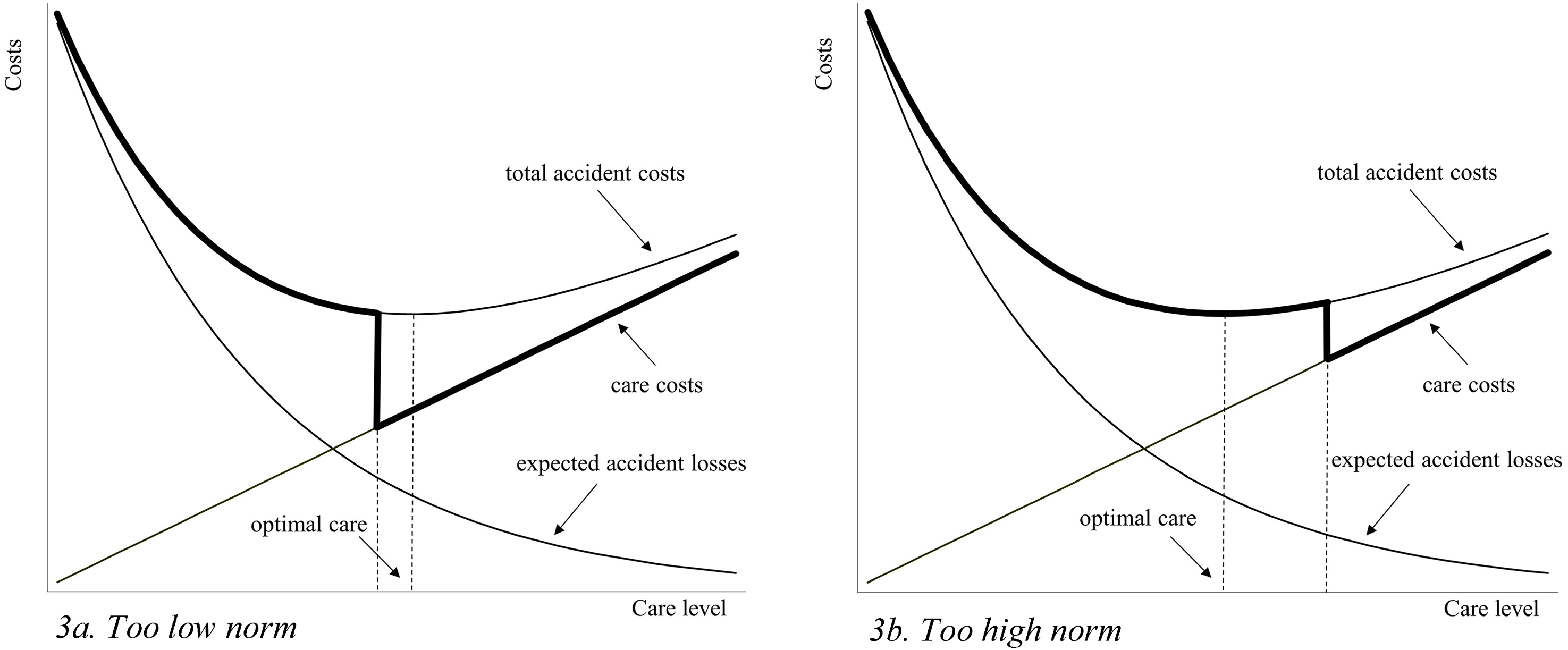
Fault liability with an incorrectly set behavioural norm.
An intriguing aspect of Article 7:658, however, is that the ‘wrong’ choice for fault liability instead of strict liability can be corrected by a ‘wrong’ behavioural norm. Looking at the text of Article 7:658, the norm should be set by weighing the costs and benefits of care measures, because the employer has to take the measures which are ‘reasonably necessary’. However, in practice the norm is much stricter.
This, of course, creates the risk which is depicted in Figure 3b, namely, that the employer follows this excessively high norm. But there is a way in which the court can avoid this risk, and simultaneously correct the ‘wrong’ choice for fault liability. If the behavioural norm is set so high that it is more attractive for the employer to take optimal care and hence be liable than to obey the norm, then the situation depicted in Figure 4 occurs.
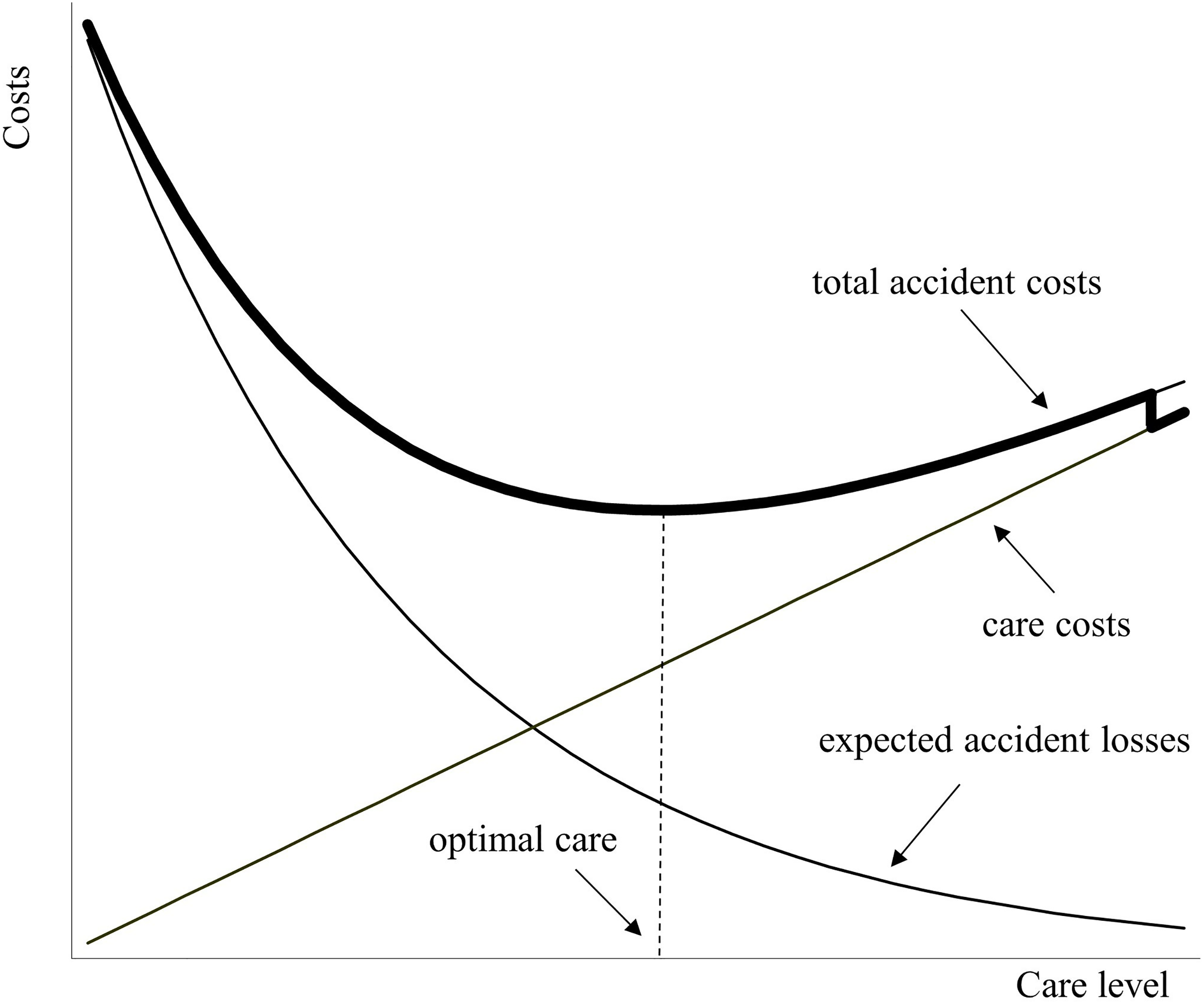
Fault liability with an excessively high behavioural norm (quasi strict liability).
The depicted situation is still a rule of fault liability, because there is a tipping point above which the tortfeasor is not liable. However, the required care level is so high that it is more attractive for tortfeasors to neglect the norm and do their own weighing of the costs and benefits of care. They will then choose the level of care of which they that it minimises the total accident costs. If tortfeasors have enough information, this will be the optimal level of care, which they also would have taken under strict liability. Figure 4, hence, is almost identical to Figure 2a, which depicts strict liability. The only difference is the discontinuity in the far right of Figure 4, but because the costs of the required level of care are so high that the employer chooses not to obey this norm, this difference is irrelevant.
We can call this situation quasi strict liability. To reach it, the court must set the required level of care so high that no employer will try to reach it. After all, if employers tried to reach it, the undesirable situation of Figure 3b would occur, with the employer taking excessive care.
Quasi strict liability provides the same behavioural incentives to the employer as strict liability. Due to the reversed burden of proof, employers must show that they have taken enough care to escape liability, which they will not do because that care level is too expensive too reach. The employer will therefore always be liable, and there will be no litigation surrounding the question on whether the employer has taken enough care. The above-discussed advantages of strict liability will therefore all be reached. So, by demanding excessive care the courts can achieve the same outcome as under strict liability, even though the legislator has introduced faut liability. 28 Two wrongs make a right!
An additional advantage of the design of Article 7:658 is that it enables to exclude liability for losses as a result of ‘generally known facts.’ In the Dutch case of Laudy vs Fair Play, 29 for example, an employee who was making sandwiches cut herself with a sharp knife. The court did not hold the employer liable, because ‘it is generally known that knives which are used to cut soft bread rolls are so sharp that the user runs the risk of cutting themself.’ With strict liability the employer could be held liable for such accidents, with all system costs that are involved. But because Article 7:658 concerns fault liability, one can reject liability in such cases of generally known facts, without going through the entire procedure. In cases where it is clearly the employee and not the employer who should have taken (more) measures to avoid the loss, liability can be rejected. 30 This is cheaper than making the employer strictly liable and applying a defence of comparative or contributory negligence to ultimately make the employee bear the losses. Of course, this only is an advantage un the clearcut cases. In less clear situations, a debate may ensue as to whether this truly is a generally known fact, which again involves costs.
The discontinuity in the graph of fault liability is caused by the following line of reasoning: if tortfeasors take enough care, they are not liable and only bear their care costs. If they do not take enough care, they are liable and bear their care costs plus the expected accident losses. In the graph, this is reflected by a ‘jump’ from the care cost line to the total accident costs curve.
Marcel Kahan argues that this view neglects the fact that the fault must be a necessary cause of the losses. He writes: ‘(…) in these models, once an injurer exercises slightly less than due care and becomes negligent, he finds that his liability increases discontinuously—from no liability to liability for the harm done in all accidents in which he is involved.’ 31 In other words, according to the graph, an injurer who has acted negligently becomes liable for all expected accident losses at that care level, including the losses that would have occurred even if the injurer had taken due care. But this line of reasoning may be wrong. Kahan provides a clear example: if, according to the law, a fence around a cricket field should be ten feet high so as to avoid balls being hit out of the field and causing losses, the owner of a field with a fence of only nine feet high is not liable for losses caused by balls which fly over the fence at a height of ten feet or higher. After all, such losses would not have been avoided by a fence of the correct height, so the fault is not a necessary cause of the losses: without the fault, the same losses would have occurred.
The discontinuity in the graph is caused by neglecting this causal requirement. In the graph, as soon as tortfeasors become a little bit negligent, their expected costs jump to the curve of the total accident costs. In terms of the cricket example: as soon as the fence is a little bit too low, the field owner becomes liable for losses caused by all balls that fly over the fence, even those that fly over at more than ten feet. This is not correct. A small fault should only result in a small increase in the expected costs of the tortfeasor, because that small fault only results in a small increase in expected accident losses.
The graph depicts the expected accident losses, so from an ex ante perspective. If we want to correctly express the expected costs for an injurer under fault liability, these costs should not include the expected accident losses that also occur if due care (or more) is taken. Again, in terms of the cricket example, these expected costs should not include the losses caused by balls which fly over the - too low - fence at a height of more than ten feet. This implies that the left side of the graph should be shifted down by the amount of the expected accident losses at the due care level, because from an ex ante perspective, potential injurers do not expect to be liable for losses which are not caused by their fault. The result is shown in Figure 5. 32
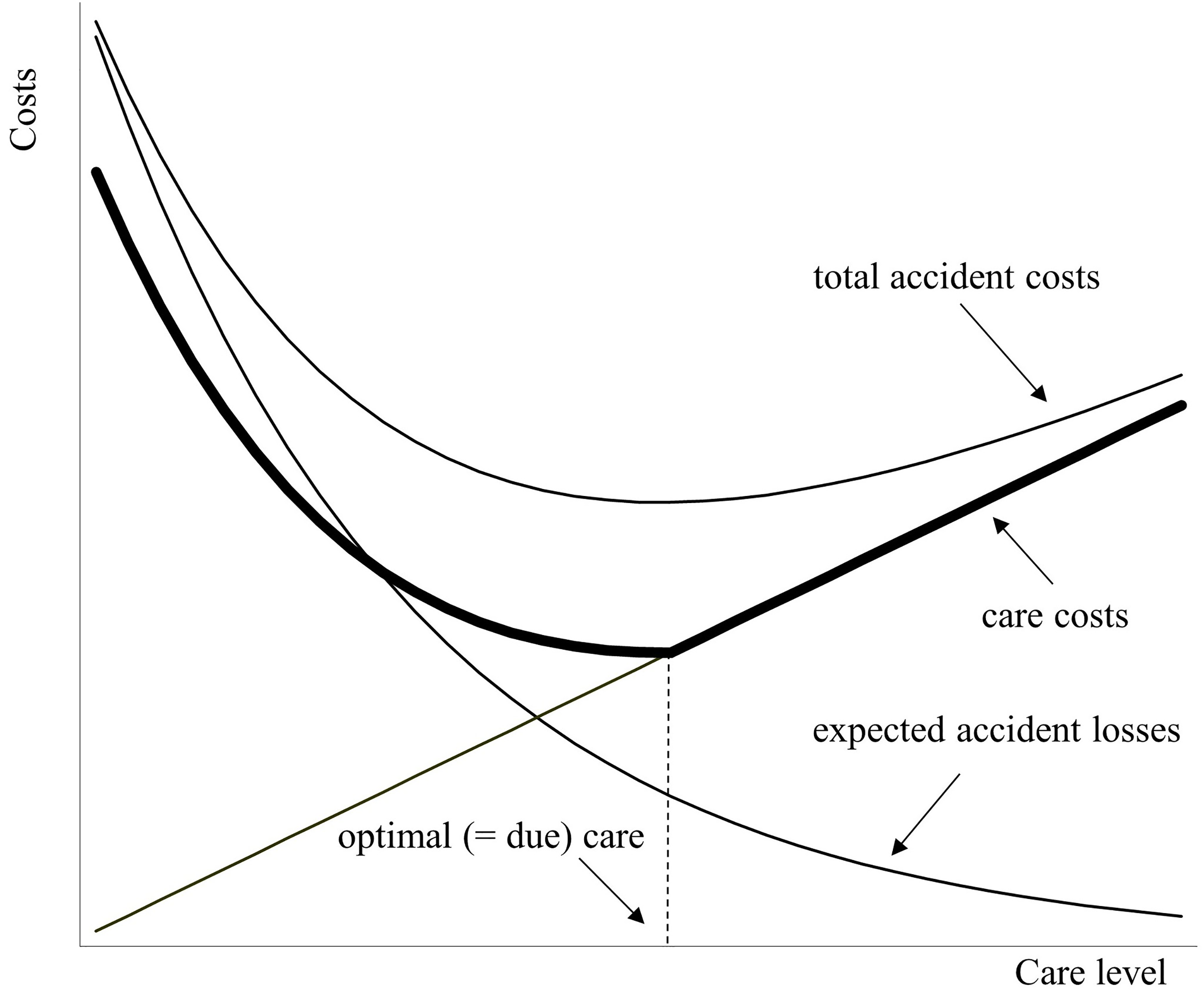
Fault liability with the requirement of causation.
It is clear that if courts set due care correctly, tortfeasors still are incentivised to take optimal care, because their expected costs are then minimised. So, the conclusion that both strict liability and fault liability can provide optimal incentives still holds, and most of the differences between strict liability and fault liability which are discussed in Section II.C are still relevant. However, the alleged difference regarding insolvency no longer exists, because that difference is caused precisely by the discontinuity.
Because a negligent tortfeasor does not ‘jump’ to the total accident cost curve but stays on a lower curve instead, negligence with an excessive due care level no longer results in quasi strict liability. Even if the due care level is set excessively high, the tortfeasor still will not be liable for the losses which also would have occurred at that high level of care. Hence, expected liability under fault liability with an excessively high due care level will be lower than expected liability under a rule of strict liability, exactly because the discontinuity has disappeared. Of course, the higher the due care level is set, the smaller this difference will become, because the situations where due care would not have avoided the losses become rarer. But analytically, we can no longer label the situation as quasi strict liability.
This ‘problem’, however, may be ameliorated by the reversed burden of proof from Article 7:658. Figure 5 above depicts the situation where the causation requirement is applied perfectly, so that injurers are only held liable for the losses that are caused by their fault. In reality, there can be uncertainty over causation, so it is not always clear whether a loss would also have occurred had the injurer taken enough care. Because Article7:658 applies a reversed burden of proof, this uncertainty poses a risk to employers. If they cannot prove that the loss would also have occurred had they taken more care, they will still be liable. This means that there will still be a discontinuity in the graph, namely, for those losses which are not caused by the fault of the employer but where the employer cannot prove this. The employer, hence, will be liable for some of the losses that are not caused by the toolow care level. Figure 6 depicts this situation.
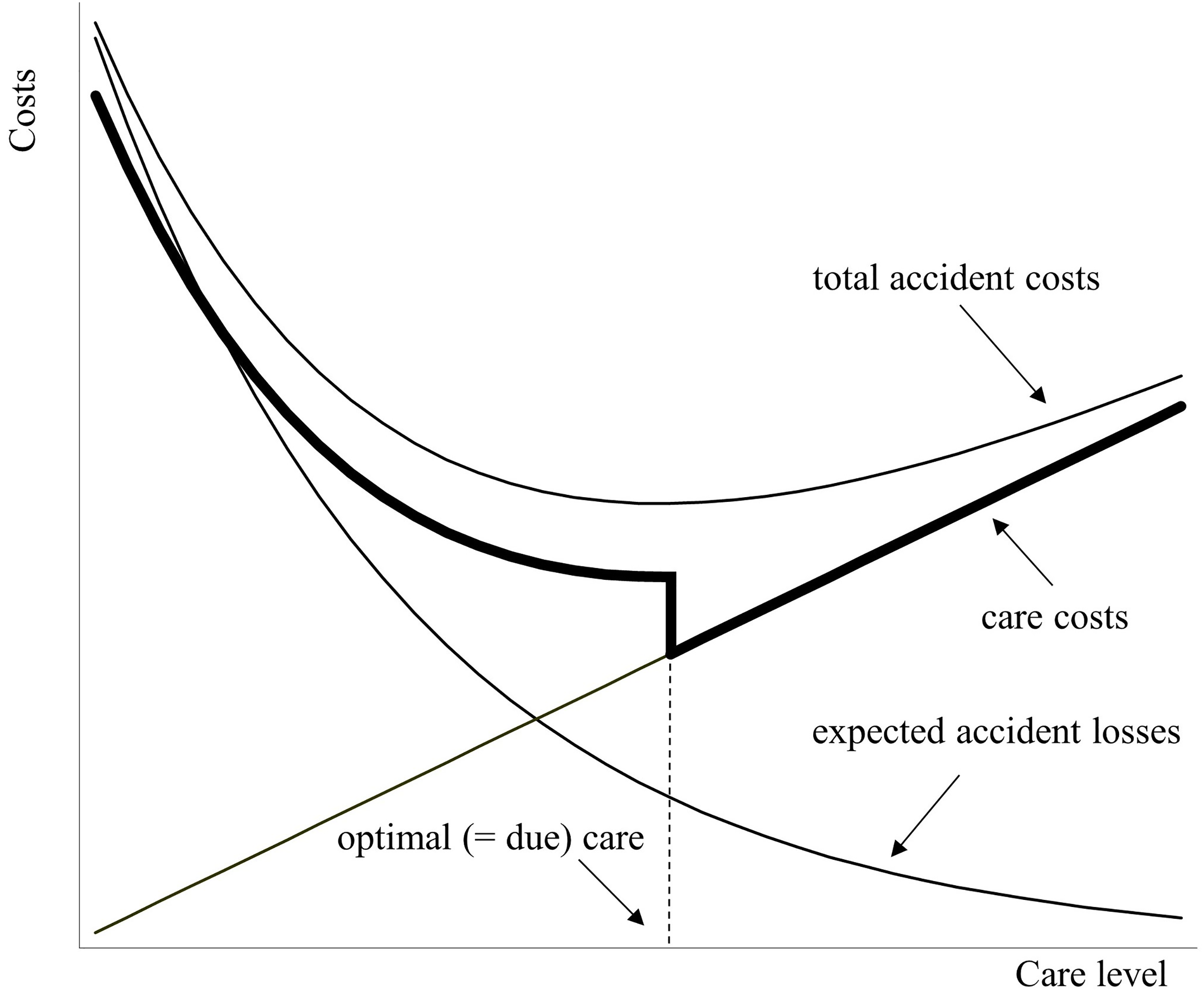
Fault liability with the requirement of causation and uncertainty over causation.
The fact that there is still a discontinuity if there is uncertainty over causation and a reversed burden of proof implies that the insolvency advantage of fault liability does remain after all, but to a lesser extent than before we introduced causation in the model. The interim conclusion can hence be that all the arguments developed so far still hold, although some of the differences between strict liability and negligence are smaller than suggested.
Whether fault liability can still turn into quasi strict liability now depends on how high the due care level is set, on the one hand (because this determines the vertical distance between the total accident costs curve and the expected cost curve of the injurer if the causation requirement is applied perfectly), and the required level of proof regarding causation, on the other (because the more difficult it is for the injurer to prove that the fault did not cause the loss, the larger the remaining discontinuity will be).
Figure 7 shows the impact of the due care level. In Figure 7a it is set a bit too high. Just as in Figure 3b, tortfeasors will follow this excessively high due care level to minimise their expected costs. Figure 7b shows the situation where the due care level is set much too high, so that it becomes cheaper for the tortfeasor to take optimal care (and be liable) than to take due care. So, if due care is set high enough, the injurer is still induced to take optimal care rather than due care. It is also clear that the vertical difference between the bold line and the total accident costs curve becomes smaller, the higher the due care level that is set.
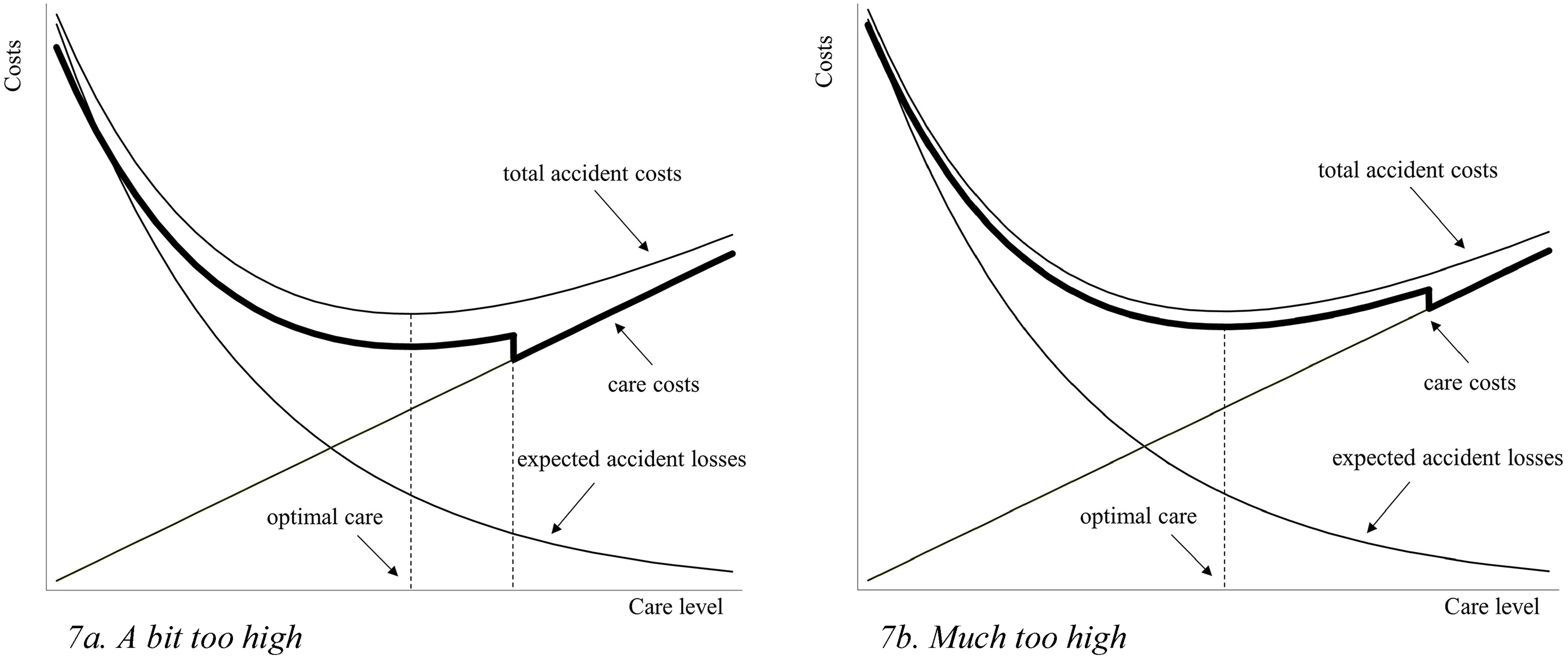
Fault liability, uncertainty over causation, and excessivelt high due care level.
If we compare Figure 7b with Figure 4 (quasi strict liability), two things become clear:
The due care level does not have to be as excessively high as before to induce the tortfeasor to take optimal rather than due care. This is so because the tortfeasor, if liable, will not bear all expected accident losses (as in Figure 4), but only those in respect of which he cannot prove that the fault did not cause these losses. However, Figure 7a clearly shows that there is still the risk of tortfeasors taking excessive care if the norm is not set high enough. The result in Figure 7b might not be labelled as quasi strict liability anymore, because the expected costs of the injurer are lower than those of strict liability. In terms of the figure: the bold curve lies below the total accident cost curve. The tortfeasor hence bears fewer costs than under strict liability, the difference being the expected accident losses of which the tortfeasor can prove that they would not have been avoided by taking due care. This implies that the activity level of the injurer will be higher than under (quasi) strict liability, and not all losses are spread via the price of the product or service. As discussed, the higher the court sets the due care level, the closer the bold curve will lie to the total accident costs. After all, if the due care level is set so high that it is almost impossible to reach it, there are almost no situations in which taking due care will not have avoided the losses. The requirement of a causal link between the fault and the losses in such cases almost does not result in a downward shift of the cost curve anyway, so that the expected costs of the injurer almost coincide with the total accident costs. Therefore, if the court sets the due care level excessively high (i.e., higher than in Figure 7b), the difference between strict liability and fault liability becomes very small. This holds even more if the court is very strict on the proof it requires from the tortfeasor to prove that the fault is not the cause of the losses, because then there will be a discontinuity, which brings the expected cost curve of the injurer even closer to the total accident costs curve. Therefore, the combination of an excessively high due care level and a high burden of proof regarding lack of causation can still result in a situation which may be labelled quasi strict liability.
The role of the defence in general
Law and economics distinguishes between unilateral and bilateral accidents. In the former, only the injurer influences the accident probability and/or severity. In the latter, the victim can also affect them. The above analysis of strict liability and fault liability primarily focused on the behavioural incentives of the injurer. However, in bilateral accident settings—and many work-related accidents are bilateral—the victim should also receive such incentives.
In the current subsection, I assume that tort damages are complete, so that the victim is indifferent about not suffering an accident, on the one hand, and suffering an accident but receiving tort damages, on the other. This assumption obviously will not hold true in many cases of workplace-related losses. In subsection IV.C, I therefore analyse how incomplete compensation affects the results of the analysis.
In a system of fault liability, in principle the victim automatically is incentivised to take care. After all, injurers who obey the legal norm are not liable. The victim then must bear its own losses and therefore is incentivised to take those measures which cost less than the decrease in expected accident losses they cause. In a system of strict liability, however, the victim is not automatically incentivised, because the injurer is always liable. The victim hence does not expect to bear any losses, provided that tort damages cover all the losses. 33 The victim, in that case, is indifferent about not suffering losses, on the one hand, and suffering losses and receiving damages, on the other. The victim then is not incentivised to take precautionary measures, because they will take time, money and effort, etc, but they will not yield anything. After all, if an accident happens, the victim is compensated for their losses by the injurer.
Under strict liability, a defence of contributory or comparative negligence is required to incentivise the victim. Victims who do not take enough care then receive no or less compensation. This incentivises them to take the care measures which cost less than the decrease in compensation that would result from being found to be contributorily/comparatively negligent. Under Article 7:658, if successful, the defence results in the victim not receiving any compensation, so this is a form of contributory negligence. In theory, this incentivises the victims to take optimal care. 34
The optimal care level of the victim is found by weighing the costs and benefits of care measures. This implies that, according to the law and economics approach, victims are contributorily/comparatively negligent if they have not taken those care measures that would have cost less than the reduction in expected accident losses these measures would have yielded. This does not imply that employees who make (small) mistakes should automatically be regarded as being contributorily/comparatively negligent. Experience shows that the care level among employees decreases when they have to execute repetitive activities and when they are in (possibly dangerous) working conditions on a daily basis. 35 This can be translated, in economic terms, into the idea that the costs of care for employees are relatively high. When weighing these (high) costs against the benefits of care, a relatively low care level will result as ‘optimal care’. So, if it is - humanly speaking - (almost) impossible for employees to take a high level of care all the time, this should be incorporated in the due care level, and hence it should be accepted that mistakes are made now and then (without these mistakes resulting in no or less compensation). It would not be optimal to require more care than this, because the care costs simply are too high.
However, if the care level of an employee falls below this relatively low due care level, it should be regarded as contributory/comparative negligence and the employee should receive no or less compensation. This, in theory, incentivises employees to take this (relatively low) level of optimal care. Societies that also want to compensate for losses of employees who have taken less care than this should choose a system of first party insurance. Making an employer, who might have taken all the required precautionary measures, liable for the losses of the employee, when the employee has taken too few precautionary measures, is not a good system through which to deliver compensation for such losses. It is much slower and more costly than insurance.
The defence in Article 7:658— Too strict a criterium
The defence set out in Article 7:658 does not correspond to the optimal care level of the employee as it results from a balancing of the costs and benefits of care. The employer has to show that the damage ‘to a substantial degree results from an intentional act or omission or from wilful recklessness on the part of the employee.’ 36 This strict criterium is based on the fact that it is unavoidable that mistakes are made now and then. 37 As mentioned, this can be translated into economic terms as ‘relatively high care costs.’
However, ‘intent or wilful recklessness’, in my view, is too restrictive. There are situations possible in which the employee could have taken care measures which would have avoided the accident. If these care measures are cheaper than the measures the employer would have to take to avoid the accident, the employee is the so-called ‘least cost accident avoider’. It is desirable that the least cost accident avoider is incentivised to indeed take these care measures. However, if employees are only deemed contributory negligent in case of intent or wilful recklessness, there can be situations where they clearly were the least cost accident avoider, but law does not require them to take the - relatively cheap - care measures. The following case provides a clear example. 38 A carpenter was working on the flat roof of a large building. He fell through the roof in an area where the new roof was already constructed, which was more than two meters away from where the scaffolding stopped. The carpenter had received explicit instructions not to walk on the new parts of the roof, it was stressed that employees had to stay on the scaffolding, and this was repeated several times to the carpenter when it was noticed that he did walk on the new parts of the roof. According to the Supreme Court, this was not enough to reject liability, because these facts did ‘not establish that the reckless character of this behaviour was present in the consciousness of the carpenter at the moment directly before the accident’ (my translation LTV). So, the behaviour might have been reckless, but not necessarily wilfully reckless.
If such behaviour does not constitute contributory or comparative negligence, then the defence in Article 7:658 in my view does not provide enough preventive incentives to the employee. From the ex post compensation perspective, it might be understandable that one wants to divert the losses of a (seriously) injured employee to the employer, a (large) firm that has liability insurance. However, from the ex ante perspective, what matters is incentivising parties to take optimal precautions. Article 7:658, in my view, provides too few incentives to the employee. If the behaviour described in the case of the carpenter is not enough for the defence to succeed, what is? It is, of course, a very serious situation if an employee suffers (potentially large) losses and does not receive compensation for these losses. But these losses might have been avoided by not being reckless (for example, by the carpenter staying on the scaffolding, as repeatedly instructed). And if the losses still happen, even at this higher care level, then at least the employee can hold the employer liable.
Besides the restriction to intent or wilful recklessness, the damage, moreover, should ‘to a substantial degree’ result from that behaviour. In case law it is established that this is only so if the intentional or wilfully reckless behaviour of the employee has contributed in such a way to the accident that the fault of the employer is negligible as a potential cause. This further restricts the possible role of the defence.
In conclusion, Article 7:658 provides—at least in theory—too few incentives to the employee, which results in higher than optimal total accident costs. After all, in cases where the employee is the least cost accident avoider, either the accident is not avoided (which results in higher expected accident losses than optimal), or the quasi strict liability induces the employer to take more than optimal care to offset the excessively low care level of the employee (which results in higher care costs than optimal).
Does ‘incomplete compensation’ solve the problem?
A possible response to the point made in the previous paragraph is that the alleged problem of a too restrictive defence assumes full compensation, which makes the employee indifferent about not having an accident, on the one hand, and having an accident but receiving compensation, on the other. In reality, there can - and will - be reasons why the employee will not be indifferent. First, a lawsuit takes time, money and effort. Second, it is questionable whether complicated heads of damage such as loss of future income and non-pecuniary losses (such as pain and suffering) will be fully compensated. Third, workplace accidents can result in fatalities, and it is very much questionable whether such losses can be fully compensated in the first place. 39
Due to this incomplete compensation, it is very likely that employees are not indifferent about having an accident or not. This implies that even if the defence of comparative or contributory negligence is formulated too strictly from a law and economics perspective, the employee will still receive preventive incentives, namely, the fear of suffering uncompensated losses. Isn’t this another example where ‘two wrongs make a right’, namely, that the excessively strict defence is offset by the incomplete damages? In my view, it is not.
First, it remains to be seen whether the fear of uncompensated losses provides enough preventive incentives to the employee. Looking at the behaviour of employees in cases where there is debate about the defence makes one sceptical. 40 But even if the employee does indeed receive adequate incentives due to the incompleteness of the compensation, the problem still is not solved. After all, if the employee does not receive compensation for all the losses suffered, then the employer does not pay compensation for all the losses caused. With strict liability, which the provisions of Article 7:658 boil down to, this causes incentive problems for the tortfeasor.
In Section II.B we saw that strict liability provides tortfeasors with optimal care incentives because they weigh the costs of care measures against the reduction in the expected accident losses which is caused by these measures. However, if tort damages are incomplete, then tortfeasors do not weigh the costs of care against the reduction in the full expected accident losses, but only against that part of the accident losses which is included in the damages. The uncompensated part of the losses remains for the victims, and hence is not included in the weighing.
Figure 2.2a above shows that strict liability with full compensation results in the injurer taking optimal care. Figure 8 shows the effect of uncompensated losses. Figure 8a shows the difference between the ‘expected accident losses’ and the ‘expected compensated accident losses’, which are reflected by the dashed line. Because not all losses are compensated, the curve of the expected compensated accident losses lies below the curve of the expected accident losses. The difference between the two curves reflects the part of the losses that the victim has to bear, because they are not compensated. This implies that strictly liable injurers do not include the full expected accident losses in their calculation, but only the expected compensated accident losses. This in turn implies that injurers no longer bear the full total accident costs, because they consist of the sum of the care costs and the expected accident losses. Instead, they now only bear the sum of the care costs and the expected compensated accident losses. This is reflected by the dotted line in Figure 8b. It is clear that this line lies below the original total accident costs, the difference again being the losses which are borne by the victim. It is also clear that the lowest point of the dotted curve lies to the left of the lowest point of the total accident costs curve. Therefore, in order to minimise their expected costs, injurers will choose a lower than optimal level of care. That was to be expected: the costs of care of the injurers remain the same, but the benefits of care for the injurers decrease. After all, the uncompensated losses are borne by the victim.
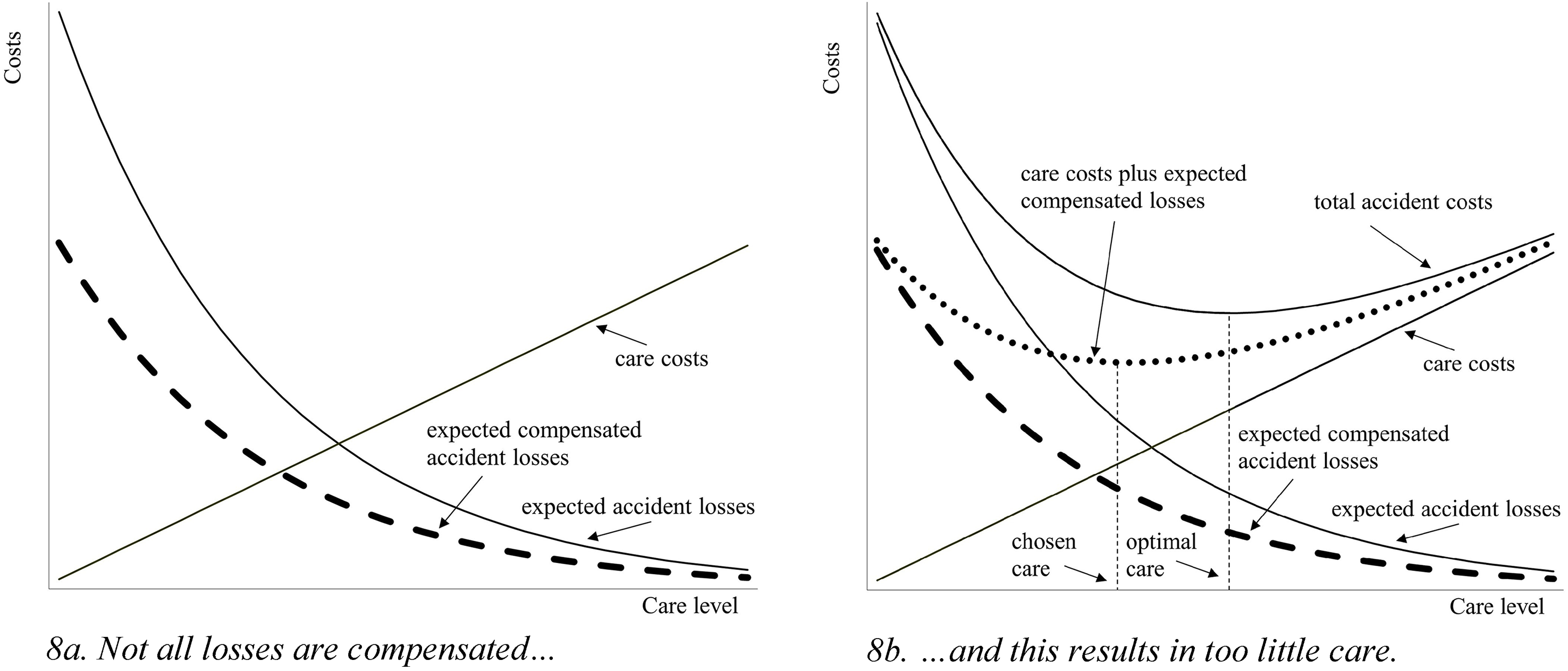
Strict liability with incomplete compensation.
Incomplete compensation, hence, does not solve the problem of the excessively strict defence of comparative or contributory negligence. If employees are adequately incentivised due to the incompleteness, then quasi strictly liable employers are given too few incentives for exactly the same reasons. This results in a lower care level on the part of the employees and the total accident losses are then higher than optimal. Of course, the fact that the employers themselves may also suffer losses due to the workplace accidents mitigates the problem. Think about the fact that the employer now must proceed without this employee, may have to continue paying their wages, may bear the burden of reintegration, etc. The desire to avoid these losses obviously provides employers with care incentives. Whether this offsets the problem of the incomplete compensation depends on the relative size of both problems, and a balance would be a matter of coincidence.
Article 7:658 is very interesting from a law and economics perspective. Notwithstanding the many advantages of strict liability, the Article applies fault liability. Due to the reversed burden of proof and the very high due care standard, however, the provisions of Article 7:658 boil down to quasi strict liability. Depending on the due care level and the required level of proof, this result may have to be qualified a bit if a causal link between the fault and the losses is required, but by applying an excessively high due care standard and a strict burden of proof, courts can still create quasi strict liability. This is an important insight, because at first glance one might think that in situations where strict liability is preferred from an incentive point of view but the legislator has chosen fault liability instead (possibly as a result of lobbying by potentially liable parties), tort law might not be able to adequately play its preventive role. However, courts (who may be less susceptible to the influence of interest groups) can correct this by applying a high duty of care and by placing the burden of proof on the defendant. Applied to the topic of employers’ liability, it implies that employers can still receive—at least in theory—the correct behavioural incentives, even though, formally speaking, a rule of fault liability applies. Two wrongs hence make a right.
In bilateral accident settings, victims should also be provided with behavioural incentives. (Quasi) strict liability then requires a defence of comparative or contributory negligence. In Article 7:658, this defence is restricted to situations where the employer shows that the damage, to a substantial degree, results from an intentional act or omission or from wilful recklessness on the part of the employee. This formulation, at least in theory, poses excessively low demands on the employee, because these requirements will not easily be met.
The fact that compensation is incomplete, especially now that workplace accidents can result in personal injury and even death, possibly provides enough incentives to employees, even though a full defence of comparative or contributory negligence is lacking. After all, if compensation is incomplete, tort liability does not make the victim whole and hence the employee is not indifferent about not suffering the accident, on the one hand, or suffering the accident but receiving compensation, on the other. However, if employees do not receive full compensation for their losses, employers do not pay full compensation and then an incentive problem may emerge on the employers’ side, because in their decisions they only incorporate that part of the losses which is included in the tort damages. Article 7:658 hence provides inadequate incentives to employees if compensation is complete (because then a full defence of contributory or comparative negligence is required, which Article 6:758 does not provide), and it provides inadequate incentives to employers if compensation is incomplete (because then they do not pay for all the losses of the employee, while full compensation is necessary for strict liability to provide the correct incentives to the tortfeasor). Four wrongs, hence, do not make a right, so employers’ liability as it is currently shaped in the Netherlands does not provide the correct behavioural incentives to the parties involved.
In theory there are various possible solutions, but in practice they are not so easy. A first solution is to ensure complete compensation and introduce a real defence of comparative or contributory negligence. 41 However, this assumes that it is possible to award a level of damages which makes employees indifferent about not suffering the losses or suffering the losses but receiving damages. It is very doubtful whether this, indeed, is possible, and in any case it would require much higher damages than currently awarded, especially for personal injuries and fatal accidents.
If full compensation is not possible, then (quasi) strict liability does not provide enough incentives for employers. Fault liability can still provide the correct incentives, also with incomplete compensation, as long as there is a discontinuity in the expected costs at the due care level. After all, due to the discontinuity it can be cheaper to take due care than to be liable, also if damages are incomplete. But in order to induce the employers to take optimal care, due care should be set at this optimal care level and not at the excessive level which creates quasi strict liability. If the disadvantages of fault liability vis-à-vis strict liability (Section II.C) weigh less heavily than the problem of employers receiving inadequate care incentives under (quasi) strict liability with incomplete compensation (Section IV.C), then fault liability could be preferred. But as discussed, the excessively high due care standard of Article 7:658 then must be reduced to the optimal care level. This again is not a perfect solution, because the disadvantages of fault liability then must be accepted.
So, if full compensation is impossible and if fault liability has disadvantages, we must choose between two evils. However, employers’ liability is not the only instrument used to prevent workplace accidents. The combination of tort law and safety regulation, in particular, is important in this respect. Regulation can require safety measures be taken by employers, which can be enforced via (ex post) liability but also via (ex ante) monitoring by public bodies. Substandard behaviour cannot only be sanctioned via liability, but also via administrative fines, or even by closing the workplace until the requirements are met. These sanctions are available before losses occur, so the problem of incomplete compensation ex post does not come into play. The deterrent incentives do not then result from the fear of liability after losses have been caused, but by the requirement to take certain precautionary measures in advance.
Ex post liability remains important, because safety regulation may impose excessively lenient demands due to industry lobbying, and because there may be situations in which more preventive measures can be demanded from individual employers than are required by regulation. Prevention, hence, requires a smart mix in which tort law and regulation both play a role. In as far as the goal is merely to compensate losses that already have occurred, it is better to opt for a system of insurance, because this is cheaper and quicker than the slow and expensive system of employers’ liability.
Footnotes
Declaration of conflicting interests
The author(s) declared no potential conflicts of interest with respect to the research, authorship, and/or publication of this article.
Funding
The author(s) received no financial support for the research, authorship, and/or publication of this article.
