




Abstract

Introduction
One of the main goals of the Dutch Act on the Employment Contract of 1907 was to offer protection to day labourers who sold their labour on a daily basis as ‘entrepreneurs of themselves’. 1 Under the Act, these workers were classified as ‘employees’, which made them less dependent on market forces and the whims of their employer. One may wonder, however, whether the (lack of) employment protection of the 19th century day labourer differed much from that of todays’ employees performing zero-hours work who, like those day labourers, have to cope with unpredictable working days and hours. This article seeks to answer this question through detailed analysis of the regulation of the zero-hours employment contract under Dutch labour law. In this context it will also address the impact of EU labour law on the regulation of zero-hours work arrangements.
Starting with a historical perspective, it is shown how the Dutch legislator's aim to create a new balance between ‘flexibility and security’ has strengthened the employment protection of zero-hours workers, which to some extent gives them advantages over dependent self-employed workers. On the other hand, however, the article reveals how subsequent legislative reforms have legally authorised zero-hours employment contracts and, as such, have legitimised zero-hours workers’ insecure employment conditions. In addition, while both the Dutch and the EU legislator have recognised that the balance between flexibility and security has tipped too much in favour of flexibility, this article argues that new instruments, among which is the EU Directive on Transparent and Predictable Working Conditions (2019/1152/EU), fail to restore this balance sufficiently. It is concluded that instead of achieving the EU policy objective of flexicurity, current employment relations in the Netherlands seem to reflect a state of flexi-insecurity.
Before I continue, it should be noted that zero-hours work is a type of work which is not defined in Dutch labour law. It is usually considered a sub-category of on-demand work in that zero-hours workers unlike, for example, workers on a min-max contract, lack guaranteed working hours. Statistical data show that the total number of on-demand workers has grown exponentially in the Netherlands. Since 2003, it has increased from 258,000 to 940,000 in 2021. 2
The article is organised in the following way. Section 2 analyses the regulation of zero-hours contracts in the Netherlands from a historical perspective. Section 3 examines the current legal regulation of zero-hours contracts. Section 4 analyses the impact of Directive 2019/1152/EU on the regulation of zero-hours work. Section 5 provides a brief conclusion.
The emergence of zero-hours contracts in the Netherlands
This section examines the legal construction and regulation of on-demand work and, more specifically, zero-hours work, in the Netherlands from a historical perspective. After going briefly into the history of the statutory employment contract (2.1), it is considered how on-demand work practices that emerged in the 1970s and 1980s were classified in case law and by legal doctrine (2.2). This subsection specifically examines the regulation of two types of zero-hours constructions that emerged in that period: the preliminary contract (2.2.1) and the MUP employment contract (2.2.2). 3 Finally, it shows how these two types of zero-hours constructions have been further regulated by subsequent legislative labour law reforms which sought to establish a balance between the flexibility of the labour market and the security of flexible workers (2.3).
The Act on the Employment Contract of 1907
In the Netherlands, as in other industrialising countries, the industrial revolution gave rise to the ‘social question’ concerning the growing group of dependent and impoverished day labourers living in bad social conditions. In 1891, in order to provide these labourers more legal security, Professor H.L. Drucker was given the task of designing an improved legal arrangement in the field of labour relations. To this end, he developed a definition of the employment contract that covered most of the employment relations of day labourers and other dependent workers. Workers falling under this definition would benefit from a set of mandatory employment law protections. 4 In the explanatory memorandum to the preliminary draft of the Act on the Employment Contract, Drucker underlined that the contract of employment aims to protect and to provide security to the dependent worker, regardless of the name the contracting parties have given to the employment relationship. 5
These ideas formed the basis for Article 1637a Civil Code of 1907 (now laid down in 7:610 Civil Code) that defined the employment contract as ‘a contract whereby one party, the employee, undertakes to perform work under the direction of the other party, the employer, in return for remuneration and for a certain period of time’. Clarifying that the employee works under the direction of the employer, the government intended to clearly distinguish employees from self-employed entrepreneurs. Following Drucker, the government further emphasised that a general arrangement for all employees or workers who are not self-employed should be preferred over a detailed description of different types of workers with the objection of granting these workers different rights in accordance with their different status. 6 This broad distinction between workers and self-employed entrepreneurs was also endorsed by Levenbach, one of the founding fathers of Dutch labour law. 7 Levenbach furthermore shared Drucker's position on the need to protect and provide security to economically dependent workers. As he argued, the protection of the weaker party under the employment contract reflects the private law principle of equality before the law. Quoting from Commons and Andrews, Levenbach asserted: ‘Where the parties are unequal (and a public purpose is shown) then the State which refuses to redress the inequality is actually denying to the weaker party the equal protection of the laws.’ 8 Nowadays, the Dutch legal doctrine still acknowledges ‘inequality compensation’ and protection of the weaker party as fundamental values in Dutch labour law, along with new values such as emancipation and the reconciliation of work and care. 9
The legal construction of flexible work relations in the 20th century
As explained in the previous subsection, it was the legislator's intention to protect a broad group of non-self-employed workers under the scope of labour law. In the 1970s and 1980s, however, in order to meet the need of the industry for flexible workers, employers invented new legal constructions outside of the scope of the employment contract. Although there are no clear statistical data available regarding the growth of these legal constructions, the data show a steady growth in flexible contracts in the 1970s and 1980s. 10
One such example of a legal construction that emerged outside the scope of the regulated employment contract is that of the contract between a temporary employment agency and a worker posted to third parties (companies) in need of flexible temporary workers. According to temporary employment agencies, they did not conclude an employment contract with this posted worker, who, in their opinion, should be classified as a self-employed worker. This assertion was questioned both in emerging case law and in legal doctrine. 11 In 1977 the Dutch Supreme court ended this dispute when it pointed out that parties (i.e. the worker and the employment agency) enter into an employment contract in sense of Article 1637a Civil Code when: 1) there exists a legal relationship between the worker and the employment agency which includes the obligation of the worker to perform work for and with third parties; and 2) the employment agency pays salary, taxes, and social security contributions. 12 However, notwithstanding the judgment of the Supreme Court, in practice (until the reforms of 1999; see section 2.3) employment agencies continued to hire agency workers as ‘self-employed workers’, when they should have been classified as employees.
Flexible employment relations were also constructed as ‘casual employment relations’. Employers hiring ‘casual workers’ held that these work relations did not fall under the scope of employment law, because the worker only performed work when needed and often had the opportunity to decline a call to work. The legal status of these workers was not clarified until 1980, when the Supreme Court had to rule the question of whether a casual worker had worked under an employment contract, as a result of which he could rightfully claim unpaid wages from his former ‘employer’. Stein, who annotated this judgment, explained the worker's status by making a distinction between two types of zero-hours employment constructions, namely, the preliminary contract and the MUP employment contract. He argued that only in the latter case could the contractual relation be classified as an employment contract. 13 Since then, the distinction between the preliminary contract and the MUP employment contract has been commonly used in Dutch case law. In the next sections the rights and obligations arising from these two types of zero-hours work relations, as well as the relevant academic discussion from that period, will be explained in more detail.
The preliminary contract
According to Stein, the preliminary contract is a contractual arrangement where parties agree that the employer can call upon the worker to work, and that the worker decides whether he or she wants to work when called upon to do so. Hence, an important characteristic of this contractual relation is that the worker has the freedom to reject a call to work, which indicates that the worker is not working under the direction of another person (the employer). 14 The preliminary contract is generally viewed as a legal relationship that is governed by the general principles of contract law. This implies that the principles of fairness and reasonableness play a role in the interpretation of the contract and that, for example, under specific conditions the worker may have a reasonable expectation to be called upon to work. 15 An employment contract only exists once the employee who has concluded a preliminary contract has accepted a call to work, for the duration of the work, even if the worker is called upon to work for very short periods (e.g., an hour). In addition, each time the worker actually works, a (new) employment contract starts. In the 1970s and 1980s this legal construction was often used by employment agencies. 16 Since the labour law reforms of 1999, preliminary contracts have become less relevant to zero-hours work constructions (see further in section 2.3) and will therefore not be further discussed. 17
The MUP employment contract
The second type of employment contract distinguished by Stein is the MUP employment contract. This is an employment contract with a deferred work obligation, or to put it otherwise, an employment contract that postpones the mutual obligation to perform. In contrast to the preliminary contract, the MUP employment contract obliges the employee to accept a call to work. In addition, the employer only pays wages for the hours actually worked.
Article 1638d, paragraph 2 and 3 Civil Code enabled this legal construction as these paragraphs permitted derogation from the ‘payment principle’ contained within paragraph 1, when agreed upon in writing. The payment principle in Art. 1638d, paragraph 1 Civil Code stipulated: Nor does the worker lose his entitlement to the time-tested wage, if he was prepared to carry out the stipulated work, but the employer did not make use of this, either through his own fault or even as a result of circumstances relating to him personally. Nor shall the worker lose his entitlement to wages fixed according to the time, if he was prepared to perform the stipulated work but the employer did not let him perform the work, either through his own fault or as a result of an accidental hindrance.
However, in the 1980s, notwithstanding the legislator's intentions, the derogation option was increasingly used to construct longer-term on-demand work (zero-hours) relationships. 22 While some labour lawyers suggested that these practices were clearly contrary to the intention of the legislator and that they therefore should either be reformed or abolished, 23 most legal commentators seemed to accept the construction of zero-hours employment relations. Moreover, since legal academics invented a (new) name to capture these practices - ‘MUP employment contract’ - and since then, have continued to use this name in their legal writings, it could be argued that they significantly contributed to the legal authorisation of zero-hours employment contracts.
In the 1980s labour lawyers also extensively discussed the labour law protection of these ‘new’ flexible on-call workers. Most of them were of the opinion that in line with the intentions of the legislator and labour law's objective to protect the weaker party, the MUP employment contract should be brought under the scope of labour law; and the employment protection of on-demand workers, particularly zero-hours workers, should be improved. 24 As will be further explained in section 2.3, in 1999 the legislator confirmed the legality of zero-hours employment relations and, in accordance with the prevailing opinion among labour lawyers, chose to bring zero-hours workers under the scope of regular labour law as much as possible.
Legislative reforms regulating flexible work
The Act on Flexibility and Security (Flexwet) of 1999 was the first major reform that affected the legal status of on-demand workers, including zero-hours workers. 25 Following advice from the social partners, 26 the government implemented a large number of new legal regulations aimed at reconciling the need for a flexible labour market with the need to provide more security to flexible workers. 27 On the steep increase of on-demand workers (and other flexible workers) since the implementation of this Act (see introduction), it can be argued that these regulations were first and foremost constitutive of new flexible labour relations. They legally authorised on-demand employment relations - already recognised by legal doctrine - that had been created by employers who needed control over a pool of flexible workers. Whilst giving flexible work constructions a legal basis, the legislator also offered the workers some labour law protection. This section examines the five ways in which the Act on Flexibility and Security regulated on-demand work relations.
First of all, the legislator explicitly confirmed the possibility of derogation from the payment principle. Before I examine the new derogation option, I first will consider the new formulation of the payment principle. Article 7:628 (1) Civil Code, which replaced Article 1638d (1) Civil Code, stipulated: The employer is obliged to pay the agreed wage if the employee fails to perform all or part of the stipulated work, unless the failure to perform the work should be at the expense of the employee.
At the same time, however, the legislator added a paragraph stipulating that the employer is allowed to derogate from the payment principle if agreed upon in writing during the first six months of the contract (Article 7:628 (5) Civil Code). Thus, this new paragraph, instead of referring to another provision (as its predecessor, Article 1638d (2)), explicitly regulates the option to derogate from the payment principle. However, in contrast to Article 1638d, the option to derogate from the payment principle is exercisable only within the first six months of the employment contract. Beyond the six-month period, derogation is, according to Article 7:628 (7), only permitted if regulated in a Collective Arrangement. 29 According to the government, regulation through a collective agreement ensures that derogation clauses will only be used in acceptable cases and under reasonable conditions. 30 As such, Article 7:628 (5) and (7) Civil Code met the desire of the government to end practices where employers could exclude (in writing) the payment principle from the employment contract permanently and in any circumstances, a practice which had never been intended by the legislator. 31 However, as previously mentioned, at the same time, these provisions legally authorised the use of MUP zero-hours employment contracts which could be extended indefinitely pursuant to a collective agreement (see further sections 3.2 and 3.4).
In order to further improve the legal certainty for flexible workers, the Act on Flexibility and Security of 1999 introduced two legal presumptions relating: (i) to the existence of an employment contract (Art 7:610a Civil Code), and (ii) to the number of working hours agreed in the employment contract (Article 7:610b Civil Code). While the first legal presumption particularly improves the legal position of workers who have been called upon to work after having entered a preliminary contract, 32 the latter legal presumption is particularly important for zero-hours workers on MUP employment contracts. This legal presumption, then, enables workers to transform their zero-hours contract into a temporary or permanent employment contract with a guaranteed number of hours equal to the number of hours they have worked in the past three months. Article 7:610b will be further addressed in section 3.5.
A third reform introduced with the Act on Flexibility and Security – the chain arrangement (ketenregeling) - provided more security for workers who entered a preliminary contract. This arrangement, inter alia, stipulates that a permanent employment contract exists after three temporary contracts or three instances of being called upon to work by one employer, on the condition that the period between two calls has not exceeded six months (Article 7:668a Civil Code). This limits the use of preliminary contracts as workers will enter a permanent contract if they are called upon to work for a fourth time in a row with the same employer.
The Act on Flexibility and Security also introduced a minimum entitlement to wages for on-demand employees (Article 7:628a Civil Code). According to this new provision, employers must pay a minimum of three hours’ wages each time they call upon an employee. This requirement is limited to on-demand employees working for a maximum of 15 hours per week (see further section 3.4).
A fifth and final major reform regarding the position of on-demand workers, introduced by the Act on Flexibility and Security of 1999, was the clarification of the employment status of agency workers, who are now, in accordance with the case law (see section 2.2) and following the advice of the social partners, classified as employees (Article 7:690 Civil Code). It is important to note at this point that employment agencies are allowed to derogate from the payment principle laid down in Article 7:628 Civil Code. Moreover, the most important collective agreements regulating employment contracts with employment agencies have extended the period in which they are allowed to derogate from the payment principle by 78 weeks. In other words, in this extended period temporary agency workers may have very similar working conditions to zero-hours workers on MUP employment contracts (e.g., they will have no guaranteed working hours). The only difference is that the agency worker can be called upon to work any time for a third party. In the remainder of this contribution, I will not address further the specific situation of the agency worker.
It took more than 15 years before a second major labour law reform, the Act on Work and Security (WWZ) of 2015, was introduced. 33 Like the Act on Flexibility and Security, the WWZ intended to meet the needs of a flexible labour market and to provide security to flexible workers. Nonetheless, the WWZ in fact further legitimised the use of zero-hours employment relations by explicitly noting that the fifth paragraph of Article 7:628 Civil Code permits the use of zero-hours employment contracts. 34 On the other hand, however, the WWZ added an additional protective measure by stipulating that the extension of the six-month period by collective agreement during which the employer is allowed to derogate from the payment principle only applies if the work is of an occasional nature and does not have a fixed scope (Article 7:628 Civil Code). This was necessary, according to the legislator, to prevent an indefinite derogation by collective agreement, resulting in long-term income insecurity for employees. 35
Only three years after the implementation of the WWZ, the government concluded that despite the previous reforms, persistent differences between permanent and flexible contracts had resulted in an increased dualism within the labour market: while some workers had permanent contracts with high levels of social and legal protection, the most vulnerable were increasingly bearing the risks of (income) insecurity in flexible jobs. 36 In order to improve the security of the latter group, the government introduced the Balanced Labour Market Act of 2020 (WAB). 37 This Act included, for the first time in labour law history, a clear definition of on-demand work. This definition and other relevant legal amendments introduced by WAB will be extensively discussed in section 3.
Conclusion
Whilst the Act on the Employment Contract of 1907 had intended to protect dependent day labourers by bringing them under the scope of labour law, throughout the 20th century employers invented new legal ways to maintain the supply of a flexible workforce. Overall, two strategies were used. First, employers argued that flexible workers should be classified as self-employed workers. Second, employers used Article 1638d Civil Code - against the legislator's intention - to derogate from the payment principle in cases where there was no work available. As such, the employer shifted the risk of the shortage of work to the worker.
Legal commentators significantly contributed to the legitimisation of these longer term on-demand employment relations by providing a name for these legal constructions (MUP employment contract) and by using the name in their legal writings, as if it constituted a lawful employment relationship. On-demand employment relations, including zero-hours employment relations, were eventually legally authorised with the Act on Flexibility and Security of 1999. This Act also sought to provide greater security for on-demand workers by: i) discouraging employers from using preliminary contracts; ii) providing zero-hours workers on MUP employment contracts with the right to be offered a number of hours of work after three months; and iii) limiting the ability to derogate from the payment principle to a six-month period, which could only be extended by collective agreement. Nonetheless, twenty years after the introduction of the Act on Flexibility and Security, the government concluded that the balance had tipped too far towards flexibility. To restore this balance to some extent, the government introduced the Balanced Labour Market Act (WAB) of 2020.
Legal regulation of zero-hours work after the Balanced Labour Market Act 2020
This section focuses on the regulation of zero-hours work (the MUP employment contract) in the Civil Code after the introduction of the WAB. To illustrate how social partners use their competence to derogate from the Civil Code, it will also analyse the Collective Agreement for the Hospitality Industry 38 – an industry with a high number of zero-hours workers. The first sub-section examines the definition of on-demand work introduced by the WAB (3.1). The subsequent sections analyse different aspects of the regulation of MUP zero-hours employment contracts, namely, the employer’s obligation to offer work (3.2); the zero-hours worker’s obligation to accept a call (3.3); the employer’s obligation to pay on-demand employees after withdrawing a call (3.4); the zero-hours worker’s options to obtain guaranteed working hours (3.5); and the employer’s obligation to offer zero-hours workers guaranteed working hours (3.6). Thereafter the extent to which the social protection of zero-hours workers on MUP employment contracts differs from those of other employees is examined (3.7). The last subsection provides a brief conclusion and considers some recent policy ideas for future regulation of zero-hours work (3.8).
The definition of on-demand work
The WAB introduced a clear definition of on-demand work: Article 7:628a (9) Civil Code classifies an employment contract as an ‘on-demand employment contract’ in each of the following three situations:
The number of monthly working hours is not stipulated in the employment contract. The number of yearly working hours is not stipulated in the employment contract with evenly spread wage payments. The employer is allowed to derogate from their obligation to pay wages if the employee has not performed the stipulated work due to a cause which in all reasonableness should be at the expense of the employer, because the parties have agreed in writing on derogation from the payment principle (Article 7:628 (1)) during the first sixth months of the employment contract (Article 7:628 (5), or during a longer period, because of an applicable collective agreement (Article 7:638 (7)).
Workers on MUP zero-hours employment contracts will normally fall under the scope of all three categories
The definition of on-demand employment contracts can be considered both a broad definition and a narrow definition. It is a broad definition because as soon as the parties have exercised the ability to derogate from the employer’s obligation to pay wages, the employment contract is defined as an on-demand contract. On the other hand, it is a narrow definition as workers with variable (unpredictable) working hours do not fall under the definition if they have agreed on guaranteed (annual) working hours and their pay is evenly spread over the year. The legislator has further explicitly excluded workers on a preliminary contract from the definition of on-demand work because these workers are entirely free to decline a call, which indicates that the worker is not working under the direction of another person (the employer). 39 Also, consignment services, on-call work and availability obligations imposed on employees such as care workers, firemen, etc., are excluded from the definition of on-demand work. 40
The employer’s obligation to offer work
As explained in section 2.2, the ability to derogate from the payment principle contained in Article 1638d Civil Code facilitated the hiring of workers on a zero-hours basis. In section 2.3, it was subsequently argued that Article 7:628 Civil Code, which replaced Article 1638d, legally authorised the use of zero-hours contracts. According to this provision, the ‘employer is obliged to pay the agreed wage if the employee fails to perform all or part of the stipulated work.’ Nonetheless, it can be questioned whether zero-hours contracts do in fact constitute a derogation from the payment principle laid down in Article 7:628 (1) Civil Code. It could also be argued, for example, that Article 7:628 (1) Civil Code is inapplicable because the essence of a zero-hours agreement is that no scope of work has been stipulated and that, therefore, it cannot be said that the work stipulated has not been performed. However, according to the legislator, it is generally assumed that zero-hours contracts do amount to a derogation from the payment principle, implying that payment is made only for hours actually worked during the first six months of the agreement if agreed in writing (by the employer and the employee) (Article 7:628 (5)), or for a longer period if determined by collective agreement (Article 7:628 (7)). 41
The ability to derogate from the payment principle also raises the question of whether the employer has any obligation to offer work to a zero-hours worker. In 1959 the Supreme Court judged that derogation from the payment principle cannot be used to deprive the employee of his wages after a null and void dismissal. 42 Case law based on the predecessor of Article 7:628 Civil Code - Article 1638d Civil Code (see section 2.2) - furthermore suggests that the use of the option to derogate from the payment principle is limited by the principle of fairness and reasonableness. 43 More recently the Supreme Court ruled that the principle of ‘good employment practices’ (Article 7:611 Civil Code), a central principle in Dutch labour law, can require the employer to call upon an employee when there is work, even if the additional work exceeds the working hours agreed in the employment contract. 44 Reasoning by analogy, this would imply that the principle of good employment practices may oblige the employer to provide work to employees even if the parties agreed upon a MUP zero-hours employment contract. Thus, the principle of good employment practices puts a limit to the employer’s freedom to call to work whomever he wants and, as such, prevents the employer’s arbitrariness.
The zero-hours worker’s obligation to accept a call
An important difference between the preliminary contract and the MUP employment contract is that a worker under the latter is obliged to positively respond to calls to work. This obligation may give rise to insecurity among zero-hours workers as they must be continuously available to their employer, without knowing when they will have to work. In order to provide more security to these zero-hours workers, the WAB introduced Article 7:628a (2) Civil Code, which stipulates that on-demand workers (falling under the scope of the aforementioned definition) are not obliged to respond to a call if they have not received the call in writing or electronically four days before the work starts. Social partners are allowed to limit the four-day notice period to 24 hours in collective agreements (Article 7:628a (4)). In addition, according to Article 7:628 (11) Civil Code, they are allowed to entirely exclude a notice period from an employment contract where the duration of the work is limited to nine months within a year due to climate and natural conditions and is not subsequently performed by the same worker. The workers falling under the scope of this provision will hereafter be referred to as ‘climate workers’.
The Collective Agreement for the Hospitality Industry has implemented the options for derogating from the four-day notice rule. This means that zero-hours workers working in the hospitality industry are required to respond to calls 24 hours in advance, and that zero-hours workers considered to be climate workers must respond to calls at any hour (Article 3.5a CAO). Interestingly, the exception for climate workers stipulated in Article 7:628 (11) Civil Code was adopted after an amendment proposed by a Member of Parliament of a small Christian political party intended to defend the interests of farmers in need of flexible workers. 45 Yet, as the Collective Agreement for the Hospitality Industry shows, other sectors have also introduced this option into their collective agreement, meaning that many zero-hours workers are still subjected to exceptional unpredictable working hours.
In addition to the limitations on the employer's ability to require the worker's constant availability created by the Article 7:628a Civil Code, further restrictions are imposed by the Working Hours Act of 1995. For example, Article 4:2 Working Hours Act obliges employers to inform the workers of their ‘working patterns’ which, according to the explanatory memorandum, should be interpreted as ‘working schedules’. The explanatory memorandum further explains that when it comes to ‘unpredictable working patterns’ (such as the working patterns of most zero-hours workers), the employer needs to at least inform the worker of their weekly rest periods. 46 In addition, Article 4:1a Act stipulates that the employer, in establishing working patterns, must account for the employees’ personal circumstances, including care responsibilities for dependent relatives and societal responsibilities. According to the legal literature, this provision also indicates that on-demand employees can decline a call due to personal circumstances. 47 However, as the Working Hours Act does not provide for a sanction that could be imposed on non-compliant employers, 48 zero-hours workers, especially climate workers, may still be limited in how they spend their non-working hours due to the risk of being called to work.
According to legal scholarship, the obligation to respond to a call is limited by the principle of good employment practices (Article 7:611 Civil Code) even if the worker is called upon to work in accordance with the notice period contained in Article 7:628 (2) and (4). This means that the on-demand worker must only respond to reasonable calls. Whether a call to work is reasonable depends, inter alia, on whether the work is foreseeable or not. For example, whilst an employer will be able to provide an advance working schedule for the summer holidays when they can reasonably expect to require several on-demand workers, this might not be the case when one of their regular employees falls ill. In the latter situation, it is unlikely that a call will be considered unreasonable when it is in accordance with the legislated notice period. By contrast, in the former situation, this call may might be considered unreasonable. 49
The Collective Agreement for the Hospitality Industry includes some provisions that limit the constant availability of workers and account for their personal circumstances. It stipulates, for example, that on-demand workers may decline a call because of other work, because they have to attend a class or have to take an exam (Article 3.5a). This provision thus allows zero-hours workers in the hospitality industry to have more than one employer and to study alongside their work. However, the collective agreement, by explicitly mentioning two circumstances allowing the worker to decline a call whilst not referring to other personal circumstances, may cause difficulties for zero-hours workers who wish to decline a call for other personal reasons (also see Article 4:1a Working Hours Act).
The employer’s obligation to pay on-demand employees after withdrawing a call
In certain circumstances, zero-hours workers who have accepted a call to work cannot claim for wages if the employer decides, last minute, that they are not needed. For example, suppose an on-call worker is called upon to work for eight hours on Monday and Tuesday the following week. Closer to the scheduled shifts, the employer finds there will be insufficient work and withdraws the shifts, yet the on-demand worker remains available to perform the work. If the payment principle is excluded (based on Article 7: 628 (5) and (7) Civil Code), the on-demand worker is not entitled to wages although the shortage of work is a risk assumed by the employer, not the worker.
Or consider a second example. An employer schedules an on-demand worker in advance on a monthly schedule. The scheduled days constitute the agreed work in that month, but some of these days are cancelled as the permanent staff can perform the work. The on-demand worker is willing to perform the work and makes himself available. Here too, if the payment principle is excluded then the on-demand worker is not entitled to full wages. 50
To provide more security to the on-demand worker, the WAB introduced two provisions that protect their right to wage if an accepted call is cancelled. According to the new Article 7:628a (3) and (4), the employer must pay the employee if the employer cancels the (accepted) call within the four-day notice period (7:628a (3)) or within a shorter period (a minimum of 24 hours) when agreed upon by the social partners in a collective agreement (7:628a (4)). The employer is not obliged to pay wages for the cancelled calls when a shift is cancelled more than four days prior to the work, or outside a shorter notice period regulated in a collective agreement. In addition, if the social partners have determined by collective agreement that the notice period does not apply to climate workers in accordance with Article 7:628a (11), the employer can cancel accepted calls at any time without being required to pay these climate workers. The Collective Agreement for the Hospitality Industry has implemented both options (i.e., Article 7:628a (4) and (11)).
When calls are not cancelled, zero-hours workers are entitled to three hours’ pay each time they are called upon to work, on the condition that they work less than 15 hours a week (Article 6: 728a (1)). This cannot be derogated from, either by individual contract or by collective agreement. For example, a climate worker (who works less than 15 hours a week) who is called upon to work for three hours, but is sent home after one hour of work, will still be entitled to three hours’ pay.
A zero-hours worker’s options to obtain guaranteed working hours
As mentioned in subsection 2.3, a zero-hours worker can invoke Article 7:610b Civil Code in order to demand working hours equal to the average number of monthly working hours they have worked in the past three months. As such, Article 7:610b provides the worker with clarity as to the extent of the contract of employment (number of working hours), but not as to the specific days and hours during which the worker performs that work (i.e. the work schedule). 51 According to case law, the reference period of three months can be extended if the calculation of the average monthly working hours over a period of three months would lead to unreasonable results (e.g. if the three-months period includes a seasonal peak period). 52
The Court of Appeal has ruled that Article 7:610b cannot result in an employment contract containing more working hours than the maximum number of hours the parties have agreed upon. 53 In that respect, zero-hours workers may be placed at an advantage in respect of other on-demand workers. For example, if two on-demand employees have worked an average of 30 hours per week in the past three months, the employee working on an on-demand contract for a maximum of 20 hours a week will be entitled to a contract of exactly 20 hours per week, pursuant to Article 7:610b. However, a worker on a MUP zero-hours employment contract will, in this example, be entitled to a contract of 30 hours per week.
Article 7:610b Civil Code is mandatory. This means that the legal presumption laid down in the provision cannot be contractually excluded, hence, a clause derogating from the payment principle (based on Article 7:628 (5) or (7)) preventing reliance on Article 7:610 (b). 54 It should be noted, though, that since employees risk the termination of their employment, they may not be inclined to actively invoke this provision before the court in practice (see further section 4.3).
The employer’s obligation to offer zero-hours workers guaranteed working hours
The WAB has introduced a new instrument to offer security to on-demand workers regarding the extent of their contract of employment. Article 7:628a (5) provides that, as of 1 January 2020, the employer must make the employee an offer of work (in writing or electronically) equal to the average number of hours worked by the employee during the last 12 months. This provision differs from Article 7:610b in several ways. First, while under Article 7:610b the burden of proof lies on the employee, Article 7:628a (5) forces the employer to offer the employee a guaranteed number of working hours. Second, in case the employer fails to provide an offer in accordance with Article 7:628a (5), the employee can bring a wage claim against the employer (Article 7:628a (8) Civil Code). Third, while the employment contract of a worker who has successfully invoked Article 7:610b may still constitute an on-demand contract, 55 the legislator has clarified that the work offer required in Article 7:628a (5) cannot consist of on-demand work. 56 Employers are allowed, however, to offer an employment contract with variable working hours as long as it establishes a guaranteed number of annual working hours with evenly spread wage payments. As a result, the worker may still be required to respond to calls to work without being protected by special regulations for on-demand workers. 57 Furthermore, the work offer required by Article 7:628a (5) does not apply to climate workers. Hence, these workers can only rely on Article 7:610b to obtain fixed working hours. 58
Since the implementation of the obligation to offer on-demand workers guaranteed working hours, there have been a few cases before the lower court and the Court of Appeal. According to a recent Court of Appeal judgment, when the employer has failed to offer the employee a guaranteed number of working hours in accordance with Article 7:628a (5), the employee is not required to be available for work to successfully bring a wage claim against the employer (Article 7:628a (8)). 59 In addition, the Court of Appeal ruled that the acceptance of an offer does not give rise to a new employment contract. 60 Finally, a lower court ruled that a worker who has declined an offer of work may still rely on Article 7:610b to obtain fixed working hours. 61
The various aspects of MUP zero-hours employment contracts which have been discussed so far are summarised in Table 1.
The regulation of MUP zero-hours employment contracts in the Netherlands.
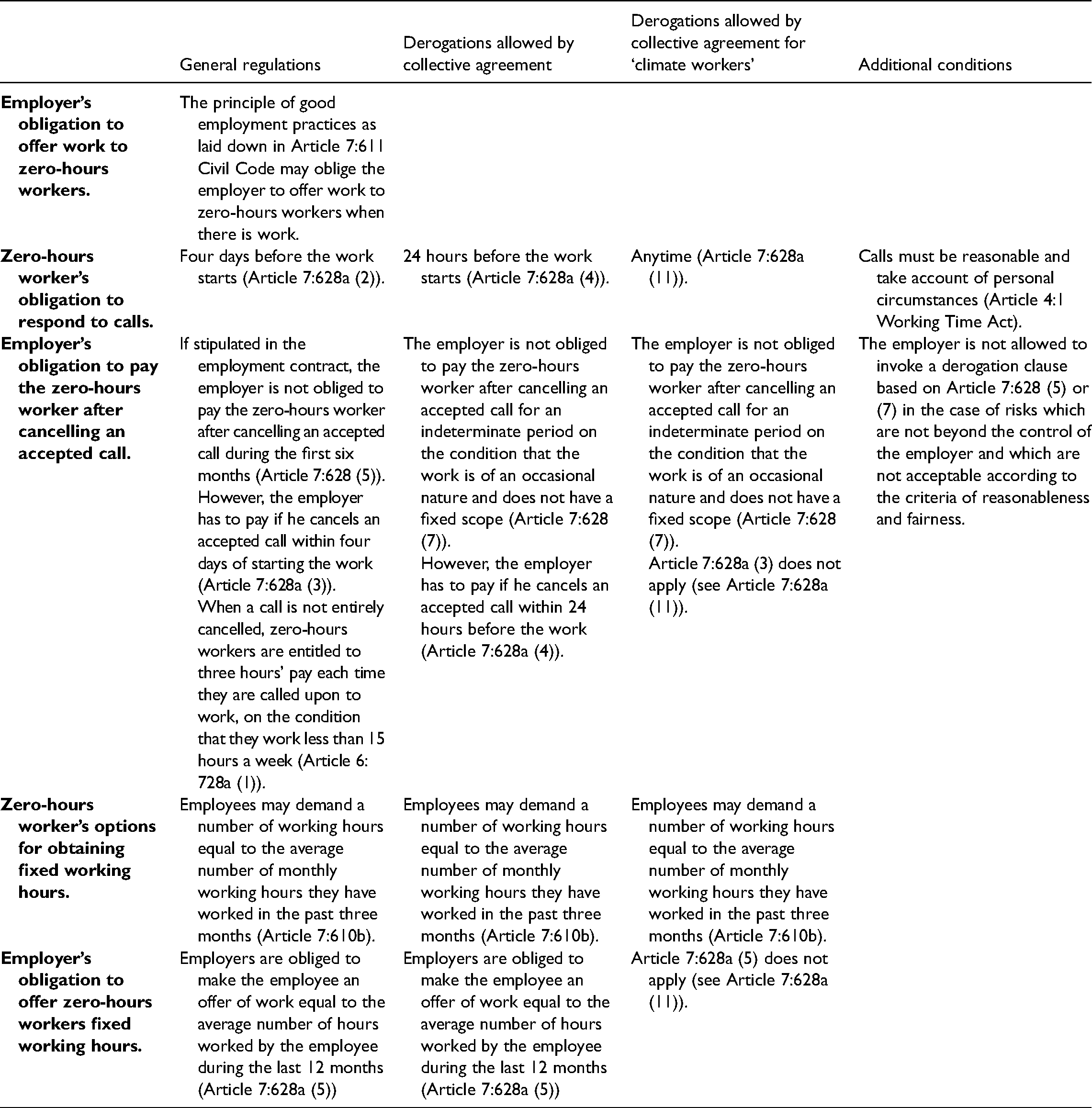
The regulation of MUP zero-hours employment contracts in the Netherlands.
In general, the law regulates the working conditions of on-demand workers (including zero-hours workers) and other employees in the same way. However, there are three important differences. First, as previously mentioned, the employer is obliged to pay for at least three hours’ work each time the employer calls upon the on-demand employee who works less than 15 hours a week (Article 7:628a (1) Civil Code). 62 Second, the notice period of on-demand employees is shorter compared to that of other employees. While the notice period for regular employees is one month, Article 7:672 (5) Civil Code, introduced by the WAB, stipulates that the notice period for on-demand employees is the same as the notice period beyond which employers must pay the worker when they withdraw a call to work (i.e., four days or 24 hours, see section 3.4). 63 This makes it easier for an on-demand employee to accept a different job with guaranteed working hours. Other employees must observe a minimum notice period of one month (Article 7:672 (1) Civil Code). Third, on-demand employees are disadvantaged compared to other employees when it comes to dismissal in cases of economic redundancy: they will be dismissed before regular employees (see Article 7:671a (5) Civil Code; Article 17 Dismissal Regulation). 64
Zero-hours workers on MUP employment contracts are, like other employees, entitled to social security benefits because of their employee status. Hence, these zero-hours workers have the same access to unemployment benefits, disability benefits and sickness benefits as regular employees. However, in practice it may be harder for zero-hours workers to become eligible for such benefits. For example, on-demand employees working a few hours with several employers will face difficulties becoming eligible for unemployment benefits as eligibility is conditional upon the loss of five weekly working hours with one single employer. Another problem concerns sick pay: according to the Civil Code, the employer is responsible for the payments of wages during periods of sickness for a maximum of two years (Article 7:629 Civil Code). If an employee remains sick after the employment contract has terminated (and the sickness has not exceeded the period of two years), the employee is eligible for sickness benefits. However, if a zero-hours worker falls ill when he or she has not been called upon to work, the employer is not required to pay wages. At the same time, this employee is not eligible for sickness benefits as employees are excluded from statutory sickness insurance. This Kafkaesque situation will be solved only if the on-demand worker successfully invokes Article 7:610b to claim a guaranteed number of monthly working hours. It must be noted, though, that this option only arises after the on-demand employee has worked for at least three months (or longer in the case of seasonal peak periods) with the employer in question. 65 In addition, as mentioned above, not all zero-hours workers will want to issue legal proceedings.
Conclusion and outlook
Despite the fact that the WAB has significantly improved the working conditions of zero-hours workers, this section has revealed two remaining areas of insecurity for zero-hours workers in the Netherlands: unpredictable working hours and financial insecurity.
On unpredictable working hours, it was noted that employers can cancel a call up to 1) four days before the work begins; 2) within a shorter period agreed in a collective agreement with a minimum of 24 hours; or 3) at any time in case of so-called climate workers. In addition, employers are not obliged to establish specific days and hours during which they will call upon their workers. Also, the opportunities for zero-hours workers to decline a call are limited. Furthermore, despite the employer’s obligation to offer on-call workers a guaranteed number of working hours equal to the average number of hours worked by the employee during the last 12 months (Article 7:628a (5) Civil Code), employees who accept offers of guaranteed hours may still receive variable working hours. This means they may still be required to be constantly available to the employer.
Zero-hours workers also suffer from financial insecurity. First, they cannot predict their long-term future earnings due to the aforementioned short notice period. In addition, depending on the contractual arrangements (Art 7:628 (5)) or the applicable collective agreement (Article 7:628 (7)), an employer may not be obliged to pay wages if they withdraw an accepted call upon to work in the requisite period. Furthermore, zero-hours workers may not be eligible for either remuneration or benefits in case of sickness. Whilst zero-hours workers who have accepted a work offer based on Article 7:628a (5) will have some financial security, climate workers do not have this option. They can only rely on Article 7:610b which, as explained, is difficult to invoke.
Some labour law reforms are being considered that could improve the above. In the explanatory memorandum to the WAB, the government announced the establishment of a commission to explore future labour market reforms. 66 In 2020 this committee (Borstlap Committee), mainly composed of labour law professors, published a report that contained various proposals aimed at reconciling the need for a flexible labour market with the need to protect vulnerable flexible workers. 67 These proposals are more radical than previous reforms. The Borstlap Committee, for example, recommends abolishing the derogation from the payment principle contained in Article 7:628 (5) and (7), and instead proposes the introduction of employment contracts where parties agree on a guaranteed number of quarterly working hours combined with variable working hours and a fixed monthly salary. 68 This proposal would improve the protection of on-demand workers in at least two ways. First, the guaranteed working hours combined with evenly spread wages would provide more income security to the worker. Second, the effect of limiting the employment contract with guaranteed working hours to three months would be that working patterns would become more predictable, compared to an agreement over the number of annual working hours. 69 The recommendation of the Borstlap Committee to remove the option to establish zero-hours employment contracts has been adopted recently by the Dutch Social-Economic Council (SER), 70 an important advisory council of the government, consisting of social partners and governmental representatives. Whilst these proposals would clearly provide more security to zero-hours workers, we must first await a legislative proposal to this effect. Faster improvements in the position of zero-hours workers may come from the EU Directive on Transparent and Predictable Working Conditions, which is discussed in the next section.
The influence of European Union law on the regulation of zero-hours workers in the Netherlands
In 2007, the EU introduced the concept of ‘flexicurity’ to guide EU social policies, which refers to the need to strike a balance between the need for flexible labour markets and the need to provide security to the workers. 71 New forms of flexible contractual arrangements, in combination with adequate social protection systems, were considered a hallmark of flexicurity. Interestingly, Dutch policies on flexibility and security (e.g., the Act on Flexibility and Security of 1999; see section 2.3) were a main source of EU Flexicurity policies. The word ‘flexicurity’ actually seems to have been used for the first time in documents of the Dutch Scientific Council for Government Policy (WRR) when it advised on the future of Dutch social security at the end of the 1990s. 72 While flexicurity is still an important concept in EU social policies, 73 it has also increasingly been acknowledged in the past decade that the balance has tipped too far in favour of flexible labour markets, resulting in a significant rise in precarious work. 74 In order to offer more protection to precarious workers on non-standard contracts, the European Commission proposed a new Directive on Transparent and Predictable Working Conditions, which was adopted in 2019 (2019/1152/EU) (the Directive), repealing Directive 92/533/EEC. This section will examine the extent to which the provisions in the Directive improve the working conditions of zero-hours workers on MUP employment contracts in the Netherlands. It will also reflect on the Dutch Government's implementation proposal. 75
Before I analyse the implementation of the Directive, it should be noted that there are also other EU Directives regulating atypical work relations, such as the Framework Agreement for Part-Time Work (Directive 1997/81/EC) and the Framework Agreement for Fixed Term Work (Directive 1999/70/EC). These Directives will not be examined because, under Dutch law, the same employment law regulations apply for zero-hours workers working on a temporary or fixed-term contract, and for zero-hours workers working full-time or part-time. In addition, whilst the Temporary Agency Work Directive (2008/104/EC) is relevant to the employment relations of zero-hours workers, the employment relationship of temporary agency workers is outside the scope of this article.
First, this section discusses the extent to which zero-hours workers on MUP employment contracts fall under the personal scope of the Directive (4.1). Next, building upon the conclusion in section 3, I analyse the requirement to provide information on predictable working conditions and the employer’s obligation to establish predictable working conditions (4.2). This is followed by analysis of the enforcement and effectiveness of the implementation Directive (4.3).
Personal scope of the Directive
Since the Directive applies to employees with an employment contract, the zero-hours worker with an MUP employment contract falls under its scope. It should be noted at this point that the Directive's personal scope is not limited to the employee with an employment contract (see Article 1 (2)). Rather, Article 8 of the Preamble refers to the definition of the employee given by the Court of Justice. It suggests that specific categories of workers categorised as ‘self-employed workers without employees’, whose working conditions are comparable to those of zero-hours workers on MUP employment contracts, may also fall under the scope of the Directive. For a discussion on the applicability of the Directive with regard to zero-hours workers with preliminary contracts, see the contribution in this special issue by Dermine and Mechelynck.
Article 1 (3) of the Directive stipulates that Member States may decide not to apply the Directive to workers whose actual working time is equal to or less than an average of three hours per week in a reference period of four consecutive weeks. According to the fourth paragraph of Article 1, however, the third paragraph shall not apply to an employment relationship where no guaranteed amount of paid work is pre-determined before the employment starts. Recital 12 clarifies that the employment relations referred to in the fourth paragraph includes zero-hours workers. Hence, zero-hours workers on MUP employment contracts who work on average less than three hours per week must fall under the scope of the Directive.
Predictability of working conditions
This section examines the extent to which the Dutch implementations proposal increases the predictability of working conditions for zero-hours workers on MUP employment contracts in the Netherlands. To this end it specifically examines the (proposed implementation of the) following provisions: Article 4 on the employer’s obligation to provide information about working conditions and Article 10 on the employer’s obligation to provide for minimum predictability of work.
Article 4 (2) (m) (ii) requires the employer to inform the worker of the reference hours and days on which they can be called upon to work. This Article should be read in conjunction with Article 10 (1) (a), which stipulates that workers are not required to work unless the work takes place within pre-determined reference hours and days. Recital 31 clarifies that reference hours and days should ‘be understood as time slots during which work can take place at the request of the employer, [and] should be established in writing at the start of the employment relationship’.
In addition, Article 4 (2) (m) (iii) stipulates that the employer is obliged to inform the worker of ‘the minimum notice period to which the worker is entitled before the start of a work assignment and, where applicable, the deadline for cancellation’. This provision should be read in conjunction with Article 10 (1) (b), which establishes the worker's right to be informed by their employer of a work assignment within a reasonable notice period. 76 Recital 32 clarifies that a reasonable minimum notice period is to be understood as ‘the period of time between the moment when a worker is informed and the moment when the assignment starts’. This Recital further states that ‘the length of the notice period may vary according to the needs of the sector concerned, while ensuring the adequate protection of workers’. According to the Commission services, the reasonable notice period will ‘vary depending on sector and nature of the work’. 77
Article 4 (2) (m) and Article 10 of the Directive thus stipulate two conditions regarding the predictability of work which must be fulfilled by the employer. The first condition entails the pre-determination of ‘reference hours and days’ during which the work can take place. The second condition concerns the establishment of a ‘reasonable notice period’. Where one or both conditions are not fulfilled, the worker has the right to refuse a work assignment without adverse consequences (Article 10 (2)). In addition, workers must be protected against loss of income resulting from the late cancellation of an agreed work assignment by means of adequate compensation if the employer cancels the assignment after a reasonable deadline (Article 10 (3)). Recital 34 clarifies that this so because workers with unpredictable work patterns should be able to plan their days when they agree to undertake a specific work assignment. Whilst these provisions are relevant for all zero-hours workers in the Netherlands who are confronted with unpredictable working hours, they seem to be particularly relevant for climate workers. As discussed in section 3, climate workers can be called upon to work at any time (i.e., with no reasonable notice period) and are not be entitled to payment when a call is cancelled (i.e., when there is no reasonable deadline).
However, Article 14 of the Directive recognises the broad discretion of social partners implementing the Directive, which arguably reduces the effectiveness of the obligation laid down in Article 10 to establish pre-determined reference hours and days. 78 This is illustrated by the Dutch implementation proposal. According to this proposal, an employee who performs work at largely unpredictable times, such as a zero-hours worker, 79 may only be required to perform work within pre-determined reference hours and days during which the employer is obliged to give notice in writing or electronically (proposed Article 7:628b (2) and Article 7:655 (1) (i) (2° ) (ii)). Outside these reference hours and days, the zero-hours worker may not be called upon to work. While this part proposal aligns with the Directive's aim, it further provides, using the derogation option provided for in Article 14 of the Directive, that the predetermined reference hours and days may also be laid down in a collective agreement (proposed Article 7:655 (2)). This implies, for example, that if a collective agreement stipulates that workers in a certain sector are expected to work between 8am and 8pm on Mondays to Fridays, a zero-hours worker will still have little certainty about the hours they will be asked to work. It can be questioned whether such a derogation is compatible with the objectives of the Directive.
Another issue concerns the ‘reasonable’ notice period. Based on the new proposed Article 7:628a (3) Civil Code, the employer is allowed to withdraw a call at any time without compensation for climate workers who have unpredictable work patterns in accordance with the applicable collective agreement (see Article 7:628 (11)). Although the notice period may vary depending on the sector and nature of the work (see recital 32), it is questionable whether the blanket exclusion of a notice period for a specific group of workers conforms with the objective of the Directive. It is also unclear to what extent these workers will be compensated in the relevant collective agreements in accordance with Article 10 (3) of the Directive.
In sum, zero-hours workers in the Netherlands, especially those workers in respect of whom the social partners have used the option to stipulate the predetermined reference hours and days in a collective agreement, will obtain little benefit from the Directive provisions that regulate the predictability of working conditions. Climate workers will probably not benefit at all. Whilst it seems reasonable that national legislation provides for specific regulation of these workers, it can be questioned whether the exclusion of a notice period without compensation is reasonable. At this point it should also be noted that the Commission underlined that the social partners should not frustrate the Directive's objective to improve working conditions by promoting more transparent and predictable employment whilst ensuring labour market adaptability. 80 The Commission also holds that workers for whom the minimum standards (e.g. under Article 10) have been lowered should be compensated by a higher level of protection in the collective agreement. 81 This further supports the general conclusion that the governmental implementation proposal is inconsistent with the Directive's aims
Enforcement and effective legal protection
The Directive contains some provisions aimed at ensuring its enforcement and offering effective legal protection to workers (Articles 15–19). Article 18 stipulates that ‘Member States shall take the necessary measures to prohibit the dismissal or its equivalent (…) on the grounds that [the workers] have exercised rights provided for in this Directive’. Recital 43 further clarifies that the situation of zero-hours workers who are no longer being assigned work is similar to that of employees whose employment contract has been terminated. According to the legislative proposal, this will be confirmed by Article 7:670 (9) Civil Code, which provides that the employer cannot terminate the employment contract when the employee invokes, inter alia, the proposed Article 7:628b Civil Code (on the employee’s right to predictable employment conditions) or the proposed amendments to Article 7:655 Civil Code (on the employer’s obligation to provide written information about essential aspects of the employment contract). Under Dutch law, it is not clear whether the practice of not assigning any more work to a zero-hours worker on an MUP employment contract should be interpreted as a termination of the contract. 82 Since the proposed Article 7:670 (9) Civil Code should be interpreted in conformity with the Directive, it is likely that it will also apply to zero-hours workers. However, the absence of explicit codification will disadvantage zero-hours workers who will often not be aware of the fact that not being assigned any more work amounts to termination of the employment contract.
Related to this, Article 16 stipulates more generally that ‘Member States must ensure that national legal systems provide access to effective and impartial dispute resolution and a right to redress and, where appropriate, compensation, for infringements of any of the rights established under the Directive’. In addition, according to Article 19, Member States ‘lay down the rules on penalties applicable to infringements of national provisions adopted pursuant to this Directive or to relevant provisions already in force concerning the rights which are within the scope of this Directive’. These penalties must be ‘effective, proportionate and dissuasive’.
Whilst the Dutch legislator does not believe that Article 16 and 19 requires further amendments to Dutch law, I disagree. First, it is doubtful whether vulnerable zero-hours workers will invoke their rights before an independent court. 83 In addition, particularly in the case of flexible working relationships, bringing legal proceedings is not straight-forward due to a lack of legal awareness, fear of retaliation by the employer, the complexity, costs, and the length of legal proceedings. 84 Control through governmental labour inspection, together with effective, proportionate and dissuasive sanctions, seems to be essential to realise the aims of the Directive and, in my opinion, needs to be further provided for in Dutch law. 85
Conclusion
The Act on the Employment Contract of 1907 intended to protect the dependent worker against market forces and clearly distinguish the dependent worker from the self-employed worker. Nonetheless, employers using on-demand employment constructions found new ways to shift labour market risks to (their) dependent workers. Although it was not entirely clear whether these constructions were lawful during that period, they were legitimised within legal academia and thereafter legally authorised with the Act on Flexibility and Security of 1999.
The current regulation of zero-hours work can be characterised as a regulatory patchwork that is probably incomprehensible to the average zero-hours worker 86 and therefore even more difficult to enforce. Moreover, under current labour law regulations, zero-hours workers on MUP employment contracts still suffer from highly unpredictable working hours and financial insecurity. Does this mean that the zero-hours worker on an MUP employment contract is worse off compared to a self-employed worker, such as the 19th century day labourers mentioned in the introduction?
On the one hand I would answer this question in the negative. For example, unlike self-employed workers, zero-hours workers on MUP employment contracts can demand a guaranteed number of working hours after three months and, under the principle of good employment practices, a right to work when there is work. Furthermore, like other employees, zero-hours workers fall under the scope of social security protections.
On the other hand, however, it can be argued that zero-hours workers on MUP employment contracts are also disadvantaged compared to self-employed workers. For example, whereas the employer of zero-hours workers may (under specific conditions) withdraw a call to work without payment, the client of a self-employed person cannot easily get out of an assignment contract without incurring costs. Moreover, whereas zero-hours workers on MUP employment contracts are obliged to respond to calls, self-employed workers will usually have the freedom to accept or reject assignments.
The regulation of atypical work, such as zero-hours work, has become a key objective of EU law. Ironically, Dutch labour law reforms that (unsuccessfully) sought to establish a balance between flexibility and security have been a source of inspiration of EU flexicurity policies. Like the Dutch Government, the EU has progressively reached the conclusion that the balance has tipped too far in favour of the promotion of flexible labour markets. In this respect, Directive 2019/1152/EU on Transparent and Predictable Employment Conditions is viewed as an important instrument with which to restore this balance. However, as shown by the Dutch implementation proposal, in some respects the Directive is less effective than intended. Indeed, in the Netherlands many zero-hours workers on employment contracts, and particularly those classified as climate workers, do not seem to benefit from more predictable employment after its implementation.
It remains to be seen whether (and when) recent ideas within Dutch policy discourse regarding abolishing zero-hours employment contracts will be translated into legislative proposals and, if adopted, how new regulations will be implemented in practice. In that regard, the fundamental power imbalance in employment relations and the limited access to justice of precarious workers must not be forgotten. Moreover, it is possible that any abolition of zero-hours work will (again) incentivise employers to develop legal constructions that shift the labour market risks to the dependent worker. Indeed, despite attempts to improve workers’ employment protection, more and more workers are confronted with insecure work relations, 87 reflecting the idea that, instead of flexicurity, flexi-insecurity has gradually become the new normality in the Dutch welfare state. 88
Footnotes
Declaration of conflicting interests
The author(s) declared no potential conflicts of interest with respect to the research, authorship, and/or publication of this article.
Funding
The author(s) received no financial support for the research, authorship, and/or publication of this article.