




Abstract
This article reflects on how appropriately the German Minimum Wage Act— the latest national minimum wage legislation within the EU— has been constructed so as to remedy the fading role of collective bargaining in wage setting and curb the increasing in-work poverty across the country. Based on identifying four fundamental parts of a minimum wage regime, it examines successively the corresponding provisions in the German law, with frequent comparisons with the legislation of several other Member States. It is found that Germany has refrained from learning the positive legislative experiences of its EU counterparts, and has developed a minimum wage regime that is distinct in more than one aspect. Such a wage floor, however, loses efficiency and momentum before serving the original purposes of its own introduction.
Introduction
To prevent the employed from being paid unfairly, EU countries apply two principal approaches to the wage-setting systems. For convenience, they could be referred to as participative and protective approaches, by drawing on Sengenberger’s distinction between protective and participative standards. 1 The core of the participative approach is that an employee or a representative has a right to codetermination or consultation on wage-related enterprise decision-making. However, the state does not exert direct influence by means of corrective measures. In a protective approach, the state itself intervenes in the wage-setting process by fixing a minimum amount. A country’s choice is usually dictated by the strength of domestic unions or other labour organisations to affect employer decisions on wage rates. Only in countries where unions are strong enough to counterbalance the power of employers (e.g. Sweden), can the participative approach work efficiently with the absence of a wage floor. Otherwise, a protective approach is taken in most cases, independently (e.g. UK) 2 or conjointly with the participative approach (e.g. Belgium and France).
Since the 1990s, Germany has been experiencing the obvious dysfunction of an autonomous wage-setting system. This situation derived from a dramatic weakening in the power of trade unions and a decline in the percentage of those covered by collective agreements. The low-wage sector has escalated across the whole country, particularly in East Germany. As warned by economists, Germany continued to retain a cautious attitude out of the fear that a national minimum wage would have a huge negative effect on employment. Subsequently, the enactment of the minimum wage legislation was postponed until 2015, when it turned out that no alternative way would be able to revitalise collective bargaining or enhance union strength. In the words of Bosch, ‘the new minimum wage is no “planned” child but was born out of necessity’. 3
In the year following the introduction of the statutory minimum wage, ‘predicted job drama did not occur’. 4 Rather, both West and East Germany witnessed the lowest level of unemployment since the early 1990s. 5 Regular employees with social insurance increased by 713,000 from October 2014 to the same month of 2015. 6 Typical low-income sectors, which seemingly suffered the heaviest impact from the new wage floor, recorded an above-average improvement in employment, while a few of the marginally influenced sectors saw a modest decrease in employment. 7 Statistics that reflect an apparent decline of marginal part-time jobs—the so-called ‘mini-jobs’— were considered by some as strong evidence of the negative effect on employment due to the new minimum wage. 8 Nonetheless, with further examination, later research reveals that just above half of the aforementioned reduction could be ascribed to the minimum wage legislation, and crucially, that the affected former mini-jobbers have by and large turned to a regular employment relationship subject to social insurance rather than getting fired. 9
It may be said that the negative influence on employment as a consequence of Germany’s introduction of a statutory minimum wage is not nearly as tenable as alleged. This is nevertheless not the focus of the present article. Alternatively, this is an effort to investigate another comparatively significant but much less debated question: Is the German wage floor appropriately constructed so as to ensure its efficiency in achieving the original goal of combatting the persistent spread of in-work poverty across the country?
In order to explore a materialised answer to the above question posed from a legislative perspective, four essential properties of a minimum wage regime should be identified. First, fixing a proper initial value is critical because a very low minimum wage can barely cut poverty, but at the other extreme, if too high, the multi-faceted control over employment, price level and compliance with the minimum wage will be impossible to achieve. 10 Additionally, decisions regarding the exclusion of certain categories of workers from the legal coverage of a minimum wage and regarding the adoption of a single or combined rates for covered workers have to be carefully made. This is dependent on what specific objectives are being pursued and what the actual role a state seeks to play in wage determination. Besides, the method and frequency of adjusting the level of a minimum wage have a sizable bearing on its adaptability to the time-varying conditions that are necessary for satisfying the basic material needs of working families. Lastly, an effective implementation system ensures that the purpose of a minimum wage is not defeated by non-compliance. Setting this up, however, relies on a wide range of institutional preconditions.
By observing these four fundamental sections of provisions in Germany’s first Minimum Wage Act, 11 and by referencing the relevant—successful or unsuccessful— legislative experiences amongst additional Member States, this article attempts to clarify what progress the German minimum wage legislation has achieved compared with its European counterparts. More importantly, the major problems embedded in this newly established minimum wage regime are revealed, which potentially limit its momentum to function as hoped.
2. A strong ‘Bite’? evaluations on the entry point of the German minimum wage
€8.5, 12 the initial rate of the German national minimum wage, was far below the level of several EU states when it started to be applied in 2015. What is the likelihood of this moderate minimum wage substantially improving the increasing working poor in Germany? Differently oriented evaluations have demonstrated the multiple facets of this issue. In short, the Kaitz Index is the most frequently used measure for having been established upon globally recognised concepts of ‘low pay’ and ‘poverty wage’, while a purchasing power comparison between EU countries helps clarify the actual value of a minimum wage of € 8.5. Differing from international comparative research, the German domestic investigations particularly value the calculation of the magnitude of potential beneficiaries as a direct way to see the influence of the initial minimum wage rate. And when contextualised against the pre-existing income support system of Germany, the efficacy of a legal wage floor of € 8.5 is found seriously derogated from.
2.1 Kaitz index
The Kaitz index is an economic indicator represented by the ratio of a legal minimum wage to the national median wage. 13 In the light of the standard benchmark built up by OECD reports and by the agenda-setting publications of LoWER, 14 ‘low pay’ means a gross hourly wage below two-thirds of the national median wage for full-time workers. 15 This definition, amongst many others existing in various studies of different countries, has been adopted by most current literature. A respectable agreement has been reached regarding the viewpoint that with an hourly wage below the ‘two-thirds’ threshold, even full-time workers are not able to obtain the socially acceptable level of economic resources in order to support a working family’s full participation in relative communities. 16 By analogy with the poverty threshold established by international research in this area, an individual wage below 50% of the median wage should be deemed to be a ‘poverty wage’, 17 with which working families cannot even maintain the average living standard in the society where they live, not to mention obtaining access to social inclusion.
With reference to the latest OECD statistics for 2015, Germany ranks in the lower middle section of the European countries where the relevant data is available (Figure 1). Its value of 48% on the Kaitz Index is not only far below the low-pay threshold but it is also beneath the poverty threshold. Due to the two-year freeze of the new minimum wage and the general wage increases year by year, the corresponding figure for 2016 is likely to be lower.
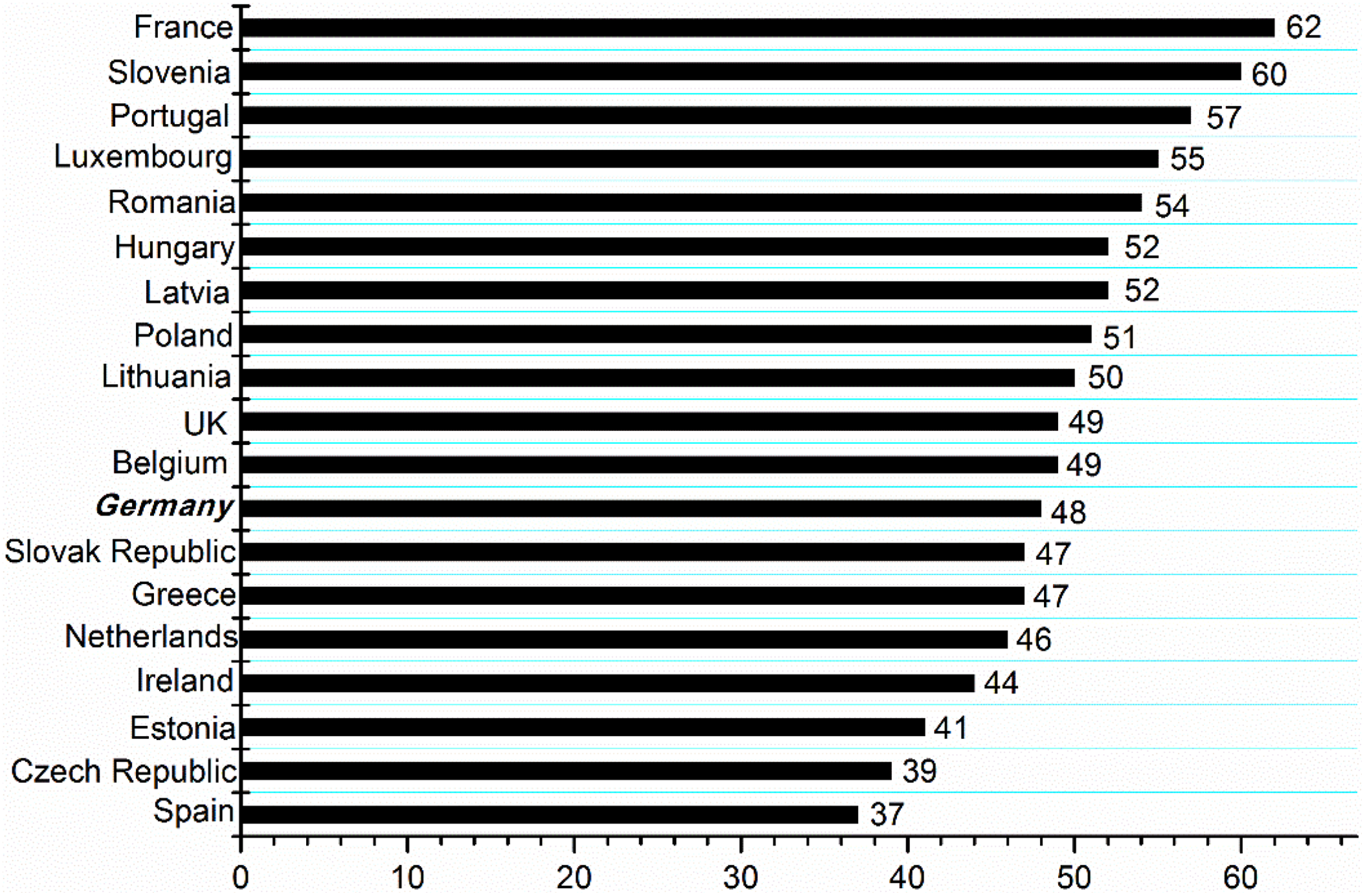
Kaitz Index Values of EU countries’ National Minimum Wages in 2015 (in Percentage Terms), Source: OECD., See <https://stats.oecd.org/Index.aspx?DataSetCode=MIN2AVE# > last accessed 12 January 2017.
In accordance with the decision of the German Minimum Wage Commission, the statutory minimum wage is € 8.84per hour from January 2017. 18 However, even assuming that the median hourly wage of 2017 does not increase compared with the 2015 level, the value of the German minimum wage on the Kaitz Index would not exceed 50%. 19 To sum up, the German minimum wage is set at an unreasonably low level providing it is assessed by the internationally prevailing standards concerning the relation between a minimum wage and the national wage structure. However, it is worth nothing that none of the inspected EU countries have performed satisfactorily under such an evaluation framework.
2.2 Purchasing power standard
Purchasing Power Standard (PPS) is an artificial currency unit named by Eurostat. An evaluation of PPS is desirable for detecting the actual level of a minimum wage, because one euro can buy different amounts of goods and services in different countries, due to the sizable price discrepancies across borders. The latest update of WSI Minimum Wage Database in January 2016 indicates that Germany ranks higher among its EU counterparts if its minimum wage is measured by PPS (Table 1). To be precise, after being adjusted for purchasing power, the level of the German minimum wage compares favourably with that of Ireland and Belgium, both of which have fixed higher nominal amounts. Furthermore, the gaps between the German minimum wage and the three highest rates paid in Luxembourg, France and the Netherlands are noticeably narrowed in the PPS comparison.
Minimum wages of EU countries in euro and PPS (Effective January 2016).
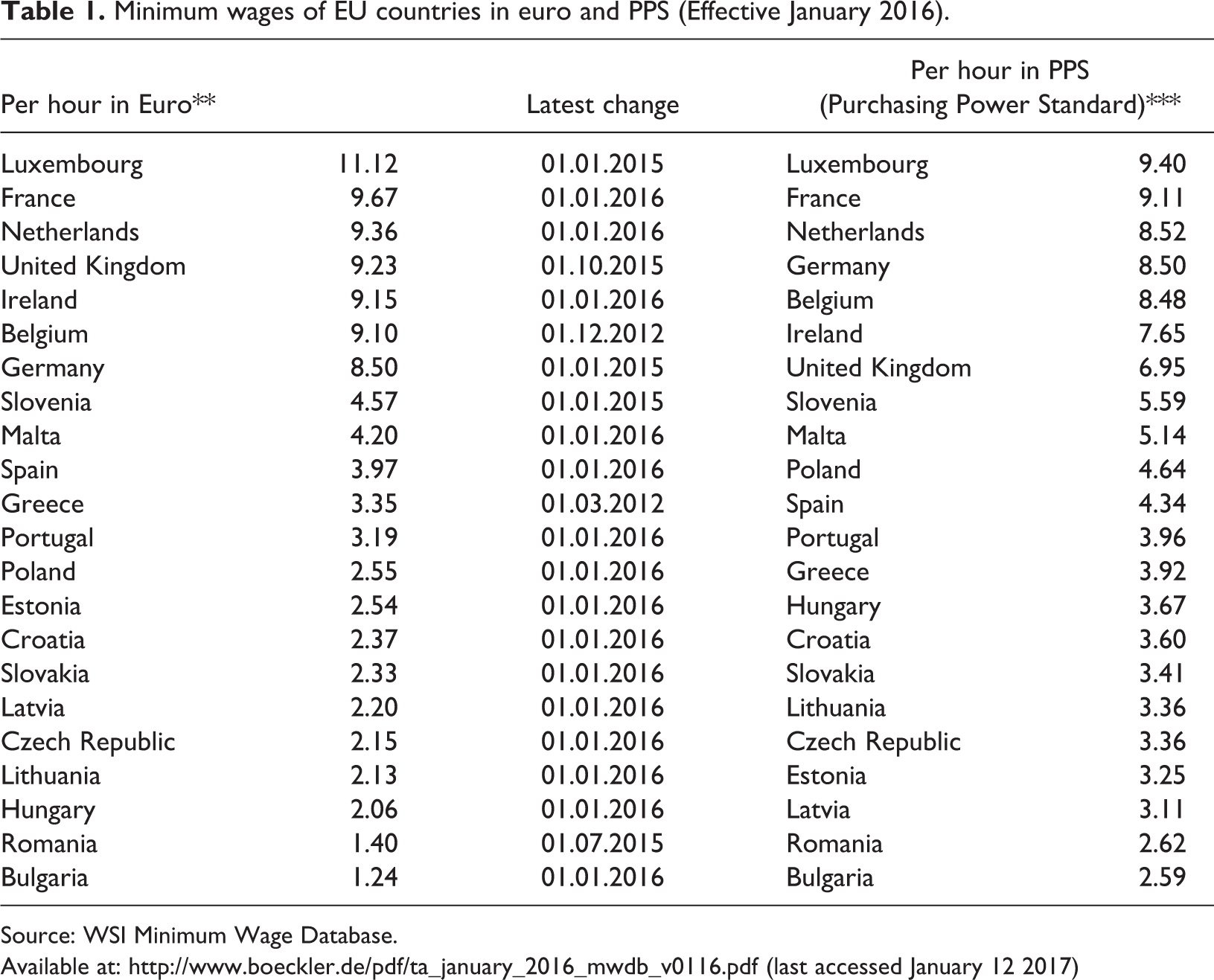
Source: WSI Minimum Wage Database.
Available at: http://www.boeckler.de/pdf/ta_january_2016_mwdb_v0116.pdf (last accessed January 12 2017)
2.3 Magnitude of potential beneficiaries
As some evident legislative defects in the German Minimum Wage Act increase the implementation uncertainty (see the last part of this article), it is difficult to count exactly how many employees can practically benefit from the new wage floor. Relatively speaking, calculating the number of employees that earned less than € 8.5 before the introduction of the minimum wage is a feasible method to measure the general magnitude of the beneficiaries. Yet, some authoritative evaluations that follow this way have produced inconsistent data. For instance, before the German Minimum Wage Act came into force, the Federal Ministry of Labour and Social Affairs (Bundesministerium für Arbeit und Soziales (BMAS)) predicted that some 3.7 million employees from low-wage sectors would benefit. 20 One year after the introduction of the minimum wage, WSI estimated that between 4.8 and 5.4 million employees—corresponding to a share of between 14.8% and 16.6% of all dependent employees—were paid less than € 8.5per hour in 2014. 21 The Federal Statistical Office (Statistisches Bundesamt/Destatis) provided a different statistical result showing that a total amount of 5.5 million employees earned less than € 8.5in 2014. 22 However, only 4 million would be potentially affected, because the reminder of 1.5 million belonged to the statutory exceptions to the application of the minimum wage. 23
Notwithstanding the indefinite quantity of German employees who received less than € 8.5 before the introduction of the minimum wage, it is largely agreed that some categories of employees—according to variant partition criteria—faced a higher probability of being paid below this price than others. Small (in particular micro) enterprises were characterised by a much higher proportion of employees who earned less than the minimum wage. 24 In terms of gender, the percentage of women working for less than € 8.5was twice that of men. 25 Additionally, wage levels are closely associated with working-time arrangements, thus, approximately three-fifths of mini-jobbers were paid less than € 8.5 in 2014, in contrast to one-fifth of part-time workers and one-thirteenth of full-time workers. 26 Alternatively, according to Destatis, people holding mini-jobs accounted for over a half of the working poor concerned. 27 As for the distribution of low wages in different sectors, hotels and restaurants constituted the major ones that would be affected, of which over half of employees worked for less than € 8.5. The retail sector took the second place with 30% of employees paid less than this amount. 28 Unsurprisingly, unskilled and semi-skilled workers were influenced more seriously by the minimum wage than skilled ones, due to being confronted with a higher risk of receiving ‘poverty wages’. 29 With respect to the impact on different regions, in West Germany, mini-jobbers were supposed to be the main beneficiaries of the minimum wage. In East Germany, apart from mini-jobs, a considerable portion of part-time jobs also paid less than the minimum wage, and even the hourly wages of full-time jobs concentrated in the area slightly above € 8.5. 30 Finally, low-wage earners not covered by collective agreements represented more than four-fifths of the working population paid less than € 8.5. 31 On the contrary, around four-fifths of the employees in collective agreements were paid more than 10 euros per hour. 32
Indeed, the groups subjected to hourly salaries below € 8.5 usually overlap, because factors that give rise to in-work poverty have been interweaving in Germany from 1990s onwards. In short, under the influence of the traditional German family model, women have scarcely been regarded as the main breadwinners. It is sometimes taken for granted that women would only be able to receive low pay in order to supplement the spouses’ earnings. 33 Therefore, in spite of the increasing public attention to low-wage earners in the German society, women, especially mothers, have become the main workforce of mini-jobbers. One should be able to imagine how difficult it is to organise these loosely connected people to maintain the power base for unionism. Meanwhile, mini-jobs are mainly provided by hotels, restaurants, the retailing and other service businesses. In these sectors, cheap labour expenditure is the rule, and the associations of employers are too fragmented to conclude an industrial minimum wage. 34 Consequently, a vicious cycle comes into being, and female mini-jobbers working in service industries are particularly trapped in lifelong economic powerlessness. In East Germany, mini-jobs are not as common as in West Germany. However, the severer erosion of union power and more widespread noncompliance with collective agreements in new federal states has further decreased the lower overall wage levels. 35
Undoubtedly, a statutory minimum wage that starts from € 8.5 could exert certain positive effects on the living standards of the aforementioned working poor, surviving on lower hourly wages and struggling to make ends meet. More significantly, it could play a great role in protecting these people against ceaseless ‘wage dumping’ in future. 36 Seen in this light, the new wage floor is nothing else than an encouraging move.
Still, it has to be acknowledged that with an entry point of € 8.5 the German minimum wage actually confines its influence to the very poor, rather than the average poor of the country. For the employees covered by collective agreements and accounting for more than 60% 37 of all the employed individuals in Germany, the new wage floor is insufficient to bring about any remarkable benefit, since most of them already earned more than € 8.5 per hour before 2015.
2.4 Efficiency derogated from by the income support system
Taking effect from 2005, the Hartz IV reform replaced Germany’s income-related unemployment assistance (Arbeitslosenhilfe) with a flat-rate, income-unrelated and means-tested benefit—unemployment benefit II (Arbeitslosengeld II) —paid at the same level as the also flat-rate and means-tested social benefit (Sozialgeld). Recipients of unemployment benefit II include all the long-term unemployed and employees whose household income is below the basic security level. Driven by the idea underlying both the OECD job strategy and the European Employment strategy, Hartz (I-IV) reforms were aimed at eliminating low-pay traps and disincentives to work, breathing new life into the economy by diminishing the costs incurred due to unemployment. 38 In comparison with the other three Acts, Hartz IV has a more direct objective to force unemployed people, especially those who used to earn a good salary, to accept the next available (often lower-paid) job, in order to reduce unemployment and the benefits paid to those out of work .
The necessity of assessing the level of the new minimum wage in the above context stems from the fact that the income support that unemployment benefit II gives to different types of recipients is a top-up benefit pushing up household income to subsistence levels. In a sense, the people entitled to income support get an ‘implicit minimum wage’ from the government. Statistics show that the introduction of the ‘real minimum wage’ has given rise to a fall in the number of ‘topper uppers’ (Aufstocker), from 1.268 million in December 2014 to 1.223 million in February 2015. 39 Nonetheless, compared with the same period of preceding years, which also saw some decreases of the supplementary claims for unemployment benefit II for some reasons, this is by no means a significant reduction. The limited role of the legal wage floor of € 8.5 in helping the poor break away from unemployment benefit II is put down to several unsolved practical issues, which piece together the latent interactions between different tools for combating poverty and hitherto lack any comprehensive reflection.
Firstly, unless the statutory minimum wage reaches a bar that is capable of ensuring earnings above the means-tested income support levels, the unemployed will not have any incentive to work. In this regard, the microsimulation model established by Müller and Steiner in 2008 reveals that the suggested minimum wage of € 7.5 per hour would be ineffective in stimulating unemployed people’s motivation to work due to the contemporary means-tested income support system. 40 However, few economic studies have been devoted to make analogous evaluations since the statutory minimum wage of € 8.5 was finally brought in.
Secondly, despite the conversion of the previous generous amalgamation of unemployment assistance and social welfare benefits into the present neat package, underpaid part-timers’ motivation to work longer hours has not increased. For people who are economically inactive and not employed full-time, a paradox exists in the system of income support that both benefit withdrawal rates and the marginal burden of tax and social security contributions increase simultaneously with the increasing wages. Hence, there is just no inducement to prolong working time, particularly above the mini-job level. 41 The introduction of a minimum wage of € 8.5 intensifies this conflict and forces mini-jobbers, those most affected, to adopt a negative coping strategy in the dilemma: now that earning a monthly wage less than € 450 is a condition for being exempt from tax and social security contributions, rational employees in marginal part-time employment are prone to work for a maximum of 53 hours per month to preserve the privilege and subsequently choose to live on the welfare benefits for additional support. This is a complex problem resulting from the disharmony between Germany’s income support system, tax and contribution collection systems, and the new minimum wage. Further serious exploration is imperative.
Finally, for both full-time and part-time employees in the low-wage segment, there is a risk that employers may further reduce wage rates, since the government would close the gap against the so-called basic security level. 42 Figuring out how widely a statutory minimum wage of € 8.5 could hold back this type of opportunistic practice is a meaningful part of the evaluation of its effectiveness.
3. The German model of flexibility within the general wage floor: rate diversity and coverage
3.1 Rate & coverage
The German Minimum Wage Act stipulates no second rate other than € 8.5. Groups that are not sheltered by the single minimum wage rate include trainees, young people doing their entry-level qualifications, people in compulsory practical training as part of an apprenticeship or university-level study course, and the long-term unemployed who receive a new job within six months. 43
From a global perspective, there is no universal answer to the queries of exactly who should be excluded from minimum wage protection and how many different rates a minimum wage regime should comprise. Multifarious systems have been developed around the world. At one extreme are the oversimplified systems that apply a sole minimum wage rate to all employees. At the other, overcomplicated systems that set a grid of up to hundreds of wage rates by sector, occupation, region, population or enterprise size. It is the disparities in the understanding as to how the minimum wage system should be structured in order to achieve the original purpose invested in it that fundamentally induce policymakers of different countries to make divergent choices. In general, the logic behind the application of one rate to all the employees of a country is the right to identical wage protection regardless of extrinsic factors, and that the basic needs of working families should be satisfied equally. 44 By contrast, systems that set forth exemptions or utilise multiple rates give more consideration to the flexibility and direct applicability of a minimum wage policy; in lieu of providing a base wage rate for the most vulnerable employees, the purpose is to facilitate some at-risk workers’ entry into the labour market or to yield actual influence on the wage rates of varying sectors and enterprises. 45 To avoid broad discussion, the focus of this part is narrowed to a comparison between Germany’s uniform national minimum wage and other homogeneous systems within the EU, in terms of exemption or differentiation across groups.
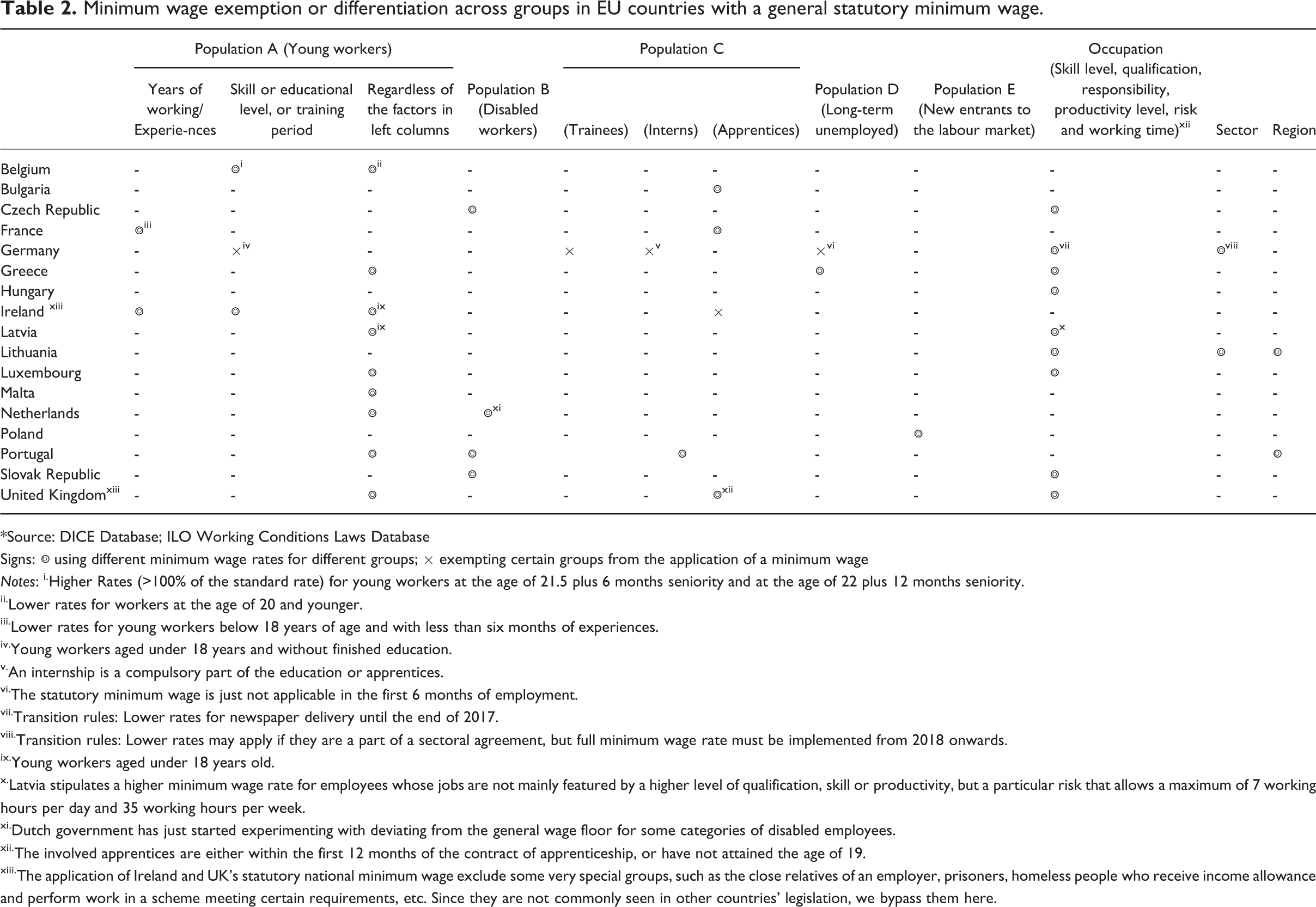
Overall, in the EU, Germany and 21 other countries (including the UK) have introduced a general statutory minimum wage, 46 protecting the majority of employees whilst excluding particular groups from legal coverage or setting sub-rates on top of the standard rate. From a global point of view, these countries’ minimum wage systems exhibit simplicity, as opposed to excessively complicated systems (e.g. Costa Rica) 47 in other areas of the world. Yet, the intention to draw upon some degree of flexibility from the more intricate systems is apparent. As indicated in Table 2, all the listed EU countries permit some legal deviations from the general wage floor. Exemptions or differentiated rates apply to certain groups, such as young workers, disabled workers, the inexperienced (trainees, interns and apprentices), or people within some professions that necessitate higher levels of qualifications or skills or have specific occupational features. The first three categories are linked with sub-average levels of productivity, whereas the last features above-average productivity or special responsibility. Imposing a flat rate covering everyone would probably hinder less productive workers’ entry into the labour market, or discourage competent people to occupy the more demanding jobs within society. This shared perception results in a similar rationale as is behind the EU minimum wage systems in question.
Minimum wage exemption or differentiation across groups in EU countries with a general statutory minimum wage.
*Source: DICE Database; ILO Working Conditions Laws Database
Signs: ◎ using different minimum wage rates for different groups; × exempting certain groups from the application of a minimum wage
Notes: i.Higher Rates (>100% of the standard rate) for young workers at the age of 21.5 plus 6 months seniority and at the age of 22 plus 12 months seniority.
ii.Lower rates for workers at the age of 20 and younger.
iii.Lower rates for young workers below 18 years of age and with less than six months of experiences.
iv.Young workers aged under 18 years and without finished education.
v.An internship is a compulsory part of the education or apprentices.
vi.The statutory minimum wage is just not applicable in the first 6 months of employment.
vii.Transition rules: Lower rates for newspaper delivery until the end of 2017.
viii.Transition rules: Lower rates may apply if they are a part of a sectoral agreement, but full minimum wage rate must be implemented from 2018 onwards.
ix.Young workers aged under 18 years old.
x.Latvia stipulates a higher minimum wage rate for employees whose jobs are not mainly featured by a higher level of qualification, skill or productivity, but a particular risk that allows a maximum of 7 working hours per day and 35 working hours per week.
xi.Dutch government has just started experimenting with deviating from the general wage floor for some categories of disabled employees.
xii.The involved apprentices are either within the first 12 months of the contract of apprenticeship, or have not attained the age of 19.
xiii.The application of Ireland and UK’s statutory national minimum wage exclude some very special groups, such as the close relatives of an employer, prisoners, homeless people who receive income allowance and perform work in a scheme meeting certain requirements, etc. Since they are not commonly seen in other countries’ legislation, we bypass them here.
What is notable is that Germany adopts somewhat distinctive strategies in respect of both manner and condition of its legitimate deviations from the general wage floor. It is manifest that the majority of countries in Table 2 display a preference for utilizing separate rates for certain individual groups. Germany is unique in that it sets no sub-rate to supplement the standard rate. Its acknowledgement of lower rates for newspaper delivery staff and for workers covered by deviating regulations of existent collective agreements is merely makeshift, 48 with a view to paving the way for the full implementation of the uniform minimum wage in the near future. The other involved groups are all exempt from the application of the legal wage floor.
However, adding sub-rates to the standard rate of a statutory minimum wage is a common means of buffering the impact of absolute exclusion of certain groups. Passing over this middle-ground approach means that the scope of exclusion must be defined cautiously— as small as possible but as large as necessary. Germany seems to have followed this principle and put strict restrictions on the exempted groups: for young workers, only those under 18 years old and without any completed vocational training are not regarded as workers within the meaning of the Minimum Wage Act; 49 interns are entitled to wages above the statutory minimum unless the internship is a compulsory part of the education or apprenticeship; 50 as regards the long-term unemployed, minimum wage protection is only absent in the first six months of any new employment. 51
It should be clarified that the six-month exclusion of those who used to be long-term unemployed is not a finalised rule as yet. The federal government was obliged to report to the legislative bodies on 1 June 2016 about the extent to which this rule can promote the reintegration of the long-term unemployed into the labour market and provide an assessment concerning whether it should continue. 52 In other words, verified positive effects on the reentry of long-term unemployed people into the labour market will be the only effective justification for the necessity of this rule.
Meanwhile, vocational training or education is the key factor highlighted in the other exemption situations. There is reason to believe that such a legislative predisposition is connected with the system of dual vocational training in Germany. 53 Dual vocational training is a system that combines vocational schooling and structured learning through work experience in undertakings to help young people improve skill and qualification levels. 54 It engages a major proportion of young German people and constitutes a formalised core of new entrants into the labour market. The point emphasised here is that while the school-based part of vocational education is government financed, the remainder of the training— the apprenticeship and on-the-job learning—hinges on the willingness of enterprises to afford the training costs within the firms. 55 It is well recognised in Germany that applying a remuneration rate that is considerably below the wage of a low-paid full-timer to involved young people is an acceptable and even necessary trade-off for motivated companies to commit themselves to the dual vocational training system. In one sense, instead of suffering, young people without completed vocational education benefit from moderate earnings, because regular and better-paid jobs will be more attainable after they complete the systematic training and education.
3.2 Pros and cons of the German model
The German minimum wage law is less complex to implement in comparison to that of other EU Member States. This is a major advantage. As concluded by the ILO, single-rate minimum wage systems are superior to multi-rate ones in the following aspects: 1) the determination of the initial rate and subsequent adjustment only requires relatively simple aggregate information and macroeconomic data, which a wage-setting body (say, a national minimum wage commission) can manage to process and analyse with the aid of professionals; 2) a single rate is easier to communicate and disseminate so that keeping people informed as well as implementing the adjustments would prove more effortless; 3) a single-rate minimum wage also lowers the difficulty of monitoring, given that inspectors need not consider the differences between sectors, groups, regions, occupations, or enterprise sizes, but just compare the actual wages with the wage floor; 4) the chance is greatly reduced that an enterprise refrains from hiring many an employee or moves to less developed regions in order to benefit from lower minimum wage rates. 56
Nevertheless, a corresponding drawback is that an undifferentiated statutory minimum wage can hardly benefit different levels of working poor. Choosing this solution amounts to throwing away the opportunity to enlarge the actual influence of the new wage floor. What is more problematic is that the German model is unable to avoid the ethical and legal concerns primarily faced by systems that adopt sub-minimum wage rates. 57
Critics of sub-minimum wage rates have mainly raised awareness of the possible violation of the principle of equal remuneration for work of equal value. The principle was initially acknowledged by the Treaty of Versailles in 1919, 58 and written into the Preamble of the ILO Constitution, as a key element of social justice. 59 Afterwards, it was entrenched by the reiteration in the Equal Remuneration Convention, 1951 (No.100). However, the concept of the principle had been limited to ‘equal pay for men and women doing work of equal value’. It was not until the adoption of the Discrimination (Employment and Occupation) Convention, 1958 (No. 111) that the principle was officially broadened to protect workers with different characteristics. In spite of the strong connection to Convention No. 100, Convention No. 111 aims to eliminate all distinctions, exclusions or preferences in respect of employment and occupation.
Conventions No.100 and No.111 are both fundamental ILO Conventions, and as a result are ratified by all EU Member States. 60 The prevalent use of sub-minimum wage rates within the EU can be attributed to a belief that some groups’ work is of less value than that of normal employees per unit time, as illustrated earlier. However, the truth is that productivity level not only varies from group to group, but also from individual to individual. It is questionable whether every individual in a generally advantaged group has the requisite mental and physical qualities to guarantee higher productivity. Indeed, a disadvantaged but industrious employee sometimes can outperform a normal one who is sluggish and inactive. In this case it is not convincing to apply a lower minimum wage to the more productive person.
A bigger problem may be found in the usage of sub-minimum wage rates. The disabled, the young, the long-term unemployed, trainees, interns and apprentices are all typical disadvantaged groups in the labour market. Nonetheless, as shown in Table 2, differentiated rates are not established for every foregoing group, no matter in which country. For example, Luxemburg sets lower rates for young workers, but entitles the disabled, the long-term unemployed, trainees and interns to receive the standard rate. It is necessary to query how the legislators determine that young workers are systematically of lower productivity while other groups under discussion are not. Unless the decision is backed by an evaluation comparing the average productivity levels of all groups, any imposition of sub-minimum wage rates would appear subjective and optional.
Moreover, there are numerous variables that intertwine and produce diverse effects on employee productivity, such as gender, age, experience, physical condition, skill level, job type and regional and sectoral features. It is worth contemplating why the gender-based difference is a taboo in justifying the wage gaps between groups whereas other variables are considered as good reasons for differentiated wage protection. In practice, granted that a country attempts to promote the employment of women by catering to the potential preference of employers, it would not formally legalise less favourable remuneration for female workers. Instead, lower minimum wage rates might be imposed on where female employees predominate in the name of sectoral or occupational differences. 61 As a matter of fact, the principle of equal remuneration for work of equal value is merely in theory applied to all kinds of employees that are likely to be discriminated against in labour legislation. Voices against the incautious introduction of sub-minimum wage rates have never been loud enough to break the parochialism in the application of the principle. Nor have they provoked overwhelming discussions about the incorporation of productivity variables into an integrated evaluation system that provides both qualitative and quantitative bases for differentiated minimum wage protection.
Although the German minimum wage law prescribes a single rate, the excluded groups in nature receive differentiated treatment. Similar problems arise with regard to the legitimacy for exempting these people from the minimum wage protection. In fact, the problems pertain to all minimum wage systems that abandon absolute egalitarianism in exchange for necessary flexibility. This sort of compromise is not necessarily good or bad per se. The crux is whether every determination in relation to weakening or removing minimum wage protection is robustly held to ensure that the original purpose is best served and the principle of equal remuneration for work of equal value is respected to the highest possible degree. This makes great demands on minimum wage legislation. In particular, concerning the first minimum wage law of Germany, existing inappropriateness can only be ferreted out by years of post-implementation assessment. A saving grace is that by placing training or education-related restrictions on the exclusion of interns, young workers and trainees, Germany’s current legislation demonstrates a tendency to build up relatively objective and consistent criteria for filtering out who is to stand a credible chance of being less productive and therefore, needing reduced wage protection in a national context.
4. Germany’s potential loss of efficiency adjusting the national minimum wage
4.1 Adjustment method
Domestic policymaking and lawmaking on the adjustment of the national minimum wage mainly tackle two issues— the method and frequency. In the EU, three major adjustment methods are recognised. The first is the indexation method, whereby the national minimum wage is adjusted automatically in the wake of the changes of certain economic indicators. The second is the negotiation method, basing the adjustment of the national minimum wage on negotiations between employers and trade unions. The state is only responsible for transposing the negotiation outcomes into the minimum wage legislation. Thirdly, there is the consultation method, which involves employers, trade unions and sometimes other people—for instance, academics—in institutionalised consultations on the adjustment of the minimum wage, however, ensures the state has the final say. 62
According to the DICE database, the vast majority of EU Member States with national minimum wages have introduced indexation or consultation methods or the combination of both for the adjustment. 63 The reason is that they are more timely and effective means of adjusting minimum wages. The indexation method makes sure that a minimum wage is adjusted regularly in light of variations in consumer prices, wage development or inflation. With a consultation method, the government lives up to its responsibility and takes necessary control over the adjustment of the national minimum wage.
Germany is a rare exception in that it has brought in a bipartite negotiation method. 64 It rules out automatic adjustments in line with changes of cost-living indexes, excuses the government from an obligation to construct decent minimum wage levels, and leaves the entire decision to collective bargaining parties. Although the procedure takes the form of minimum wage commission members voting upon resolutions in respect to the adjustment of the national minimum wage, the competition between employer organisations and trade unions is still the determinant. It is noteworthy that in Germany’s national minimum wage commission, apart from members with voting rights coming out of trade unions and employer associations, there are two advisory members without voting rights chosen from the scientific community. 65 From this perspective, the negotiation method adopted by the German legislation shares some similarities with the consultation method. Yet, it is distinguished from the consultation method in essence because the ultimate decision on minimum wage adjustment does not lie with the state.
Attention should be paid to the fact that Germany’s adoption of a bipartite negotiation method indeed reflects adherence to the constitutional guarantee of freedom of association. To be specific, the German Basic Law ensures every individual and every occupation or profession the right to form associations in order to safeguard and improve working and economic conditions. 66 The entitlement to form and act through trade unions and employer associations is rigidly protected, and simultaneously, the government plays a very limited role in setting working conditions. 67 There is generally no room for the government to exert control over matters that are typically negotiated by employee and employer associations; legislation enforcing a wage freeze or an increase would be challenged in terms of its constitutionality, unless it is applicable across all sectors. 68 In principle, the adjustment of the national minimum wage belongs to the scope within which the state is allowed to intervene, because it involves the whole economy instead of only certain sectors. However, the legislature of the Minimum Wage Act has made a ‘path-dependent’ option, despite the attempt to reform the national labour relations via the new legislation.
4.2 Adjustment frequency tied up with the adopted method
The German pace of adjusting the wage floor every other year 69 sets a record for the scantiest adjustments amongst all the EU countries with explicit provisions on the adjustment frequency. This is a consequence of the adjustment method, indeed. As the sole representative of the bipartite negotiation model within the EU, Germany attaches greater importance to social partner agreement upon adjustment plans than the practical development of the minimum wage level. Thus, a definitely lower frequency is prescribed for the updating of the minimum wage rate.
On the contrary, the meaning of the indexation method lies in adapting minimum wage adjustments to the changes to the living costs of working families and other economic conditions. Therefore, at least within the EU, countries adopting this method usually specify one year (e.g. in Luxembourg, Belgium, France, Malta, Slovenia, etc.) or a shorter period (for instance, six months in the Netherlands) as the interval between regular adjustments. Occasional political adjustments are added during this period for the purpose of coping with extra risks caused by the automatic updating of the minimum wage or abnormal index variations.
In Member States where consultation methods have been developed, the timeliness of minimum wage adjustments may not be valued as much as the balance between social acceptance and the government’s domination in decision-making. A few countries falling into this category fail to stipulate how frequently the national minimum wage rate should be adjusted (e.g. Bulgaria and Romania), while others basically mandate annual adjustments of the national minimum wages (e.g. UK and Croatia).
4.3 The lost efficiency: a diminutive growth of € 0.34costs two years
After being frozen for two full years, the first German minimum wage rate of € 8.5per hour will finally be replaced by a new one of €8.84 from January 2017. The real development of national minimum wages has been modest in the whole of Europe since the 2000s, due to the economic cycle. 70 However, it can more or less be anticipated that Germany —the largest European economy—would probably fall behind many of its counterparts in terms of providing an assurance regarding stable and regular increases of the minimum wage.
It is stated at the beginning of this article that the deterioration of the imbalance between the strength of the two parties at the ‘bargaining table’ is the fundamental cause of the introduction of a national minimum wage in Germany. Against this background, employing a method that virtually rests with both sides’ ability to exert political pressure is tantamount to putting ‘old wine in new bottles’. The German trade unions do not possess the power to force substantial minimum wage adjustments with which employers take issue. 71
Despite the German legislation setting a chairperson who has the casting vote in the minimum wage commission so as to prevent a potential deadlock, the trade unions’ plight is not improved, and adequate adjustments are unlikely to take place. To be specific, the chairperson is appointed upon a joint proposal of the central employer and the employee organisations; if no joint proposal is made, the chair will rotate between the nominees of both sides. 72 In the former scenario, the jointly nominated chairperson is under pressure from both parties, especially the influential employer side. Nothing more than a mild increase of the national minimum wage can be guaranteed. In the latter scenario, there seem to be opportunities to elevate the wage floor markedly when trade union nominees chair the passing of adjustment resolutions. Nevertheless, it should be taken into consideration that the chairperson is requested to abstain from voting immediately if the resolution does not have the majority of votes cast. A compromise proposal has to be made firstly, and the chairperson’s decisive vote must not be cast unless the compromise proposal lacks the majority of votes. 73 That is to say that capturing the position of chairmanship does not necessarily enable the trade unions to reach sufficient adjustments of the national minimum wage.
In the meantime, the biennial rhythm of adjustments worsens the situation. The initial rate and Kaitz index value of the German minimum wage are already below those of a number of EU Member States. These gaps are likely to continuingly widen, by reason of the infrequent updates that cannot catch up with the adjustment speeds of other countries nor the changes happening within the German domestic wage structure in general. Moreover, the two-year adjustment cycle prolongs the shortest interval between considerable increases of the national minimum wage to four years, because in the German context, trade unions have little chance of bringing about ample adjustments during the chairmanship of its opponent, and can only expect to gain the upper hand after another biennium.
It is clear that Germany is crying out for a more dynamic and forceful system to update the national minimum wage so that the spreading of in-work poverty across the country can be addressed more efficiently. The indexation or consultation method needs adopting as a supplement or alternative to the retrogressive negotiation procedure. In addition, no matter whether the adjustment frequency is specified, wage floors should be revised opportunely.
5. An implementation system flawed by inadequate preparation of essential rules or conditions
Level of difficulty in implementing a national minimum wage is influenced by the other three components of a minimum wage regime discussed in this article. Nevertheless, only the implementation system per se directly deals with the ways and process of putting the minimum wage into practice, and remains at the core of achieving employer compliance.
In view of the legislative experiences of a number of EU countries, a successful implementation system should touch upon the following key points in order to guarantee the execution of a national minimum wage: 1) instructions for employers must be clear and precise enough to comply with, inter alia those defining the contents of the minimum wage and its relationship with working hours; 2) the whole implementation system will come to nothing if there is no efficient monitoring; 3) to overcome moral persuasion’s lack of binding force, it is a must to introduce serious sanctions that deter non-compliance by making lawbreaking costs overweigh potential benefits; 4) employees deserve assistance in suing employers in order to recover minimum wage arrears, in particular the circumstances where supervision loopholes exist and unfair dismissal or victimisation may take place.
Below is an analysis of the existence and adequacy of these conditions for implementing the German Minimum Wage Act.
5.1 Provisions on calculating hourly remuneration and recording working hours
The primary technical issues envisaged to have direct effects on the realisation of a minimum wage entitlement are: a) which parts of remuneration should count towards the hourly wage of an employee; b) how the working hours are calculated and recorded. Until both issues are settled properly, ambiguities can give rise to factual evasion of the obligation to pay above the wage floor and set barriers for monitoring and liability identification. The UK has actually set a model in this regard since its national minimum wage was first introduced nearly two decades ago, under which the government endeavours to provide exhaustive guidance on the foregoing questions in order to eliminate misapprehensions in practice. 74
By contrast, the ‘immature’ minimum wage law of Germany has hitherto made much less efforts to clarify the issues listed above. Firstly, there is no explanation about what components make up an employee’s hourly remuneration. 75 In the face of the Federal Council’s criticism that the unavailability of concrete criteria could undermine the minimum wage, the Federal Government argues that the calculation of the minimum wage has indeed been clarified by the case law of the European Court of Justice (ECJ) and the Federal Labour Court (BAG). The fact is that no further detailed conclusions can be drawn from the ECJ and BAG case law, except from the principle of only payments recompensing the agreed normal performance being included in the calculation of the minimum wage. 76 Therefore, it is merely possible to confirm that bonuses for additional work (e.g. wages for overtime, public holidays, shift work and night work), payments with specific purposes (e.g. pension contributions, reimbursements), or voluntary compensations by third parties (e.g. tips) should be counted out. Salary elements that cannot be clearly recognised as payments for an employee’s normal performance (e.g. 13th month’s wage, year-end bonuses, Christmas bonuses, holiday bonuses) continue to be controversial among academics, judicial authorities and the government. 77
Apart from the calculation of hourly remuneration, the total amount of working hours in a pay reference period is a pivotal factor that could be falsified to sidestep the wage floor. Different from the UK law, which imposes a universal obligation to record working hours by elaborating on measurement rules in various situations, the German Minimum Wage Act only includes simplified regulations that oblige employers to document the commencement, end and duration of employees’ daily working hours and retain the records for at least two years. More importantly, these regulations just apply to marginal part-time jobs and the specific sectors or industry branches defined in section 2a of the Act to Combat Clandestine Employment. 78
The current legislative pattern seems not to conform to the social reality in Germany. As mentioned earlier, a considerable proportion of full-timers, chiefly in the East Germany, earn hourly wages roughly above or below € 8.5. Provided that these employees are frequently compelled to do additional unpaid work, the actual salaries they receive for each hour are likely to fall (further) below the minimum wage. Besides, when a piecework principle—work paid for according to the amount produced— is adopted by employers, it is also difficult to ensure hourly wage rates above the wage floor. The most effective way to reduce these manipulative behaviours of employers in low-wage sectors is sticking to the principle that the minimum wage must be achieved for every hour actually worked, which is confirmed by the explanatory memorandum attached to the law, and setting up common rules for the measurement of working time.
Yet, imposing an indiscriminate obligation to record working hours sometimes runs counter to economic realities, given the diverse features of different occupations and sectors. For example, for a salesman travelling between cities to market products all year round, it is almost impossible to precisely distinguish between the occupational and private behaviours that are subsumed by the manner of working. Another example is a warehouse guard. The person employed to take care of the products and facilities of a warehouse may be provided with a residence nearby and required to be prepared to handle emergencies at any time, but in reality, this person does not work 24/7. Personal activities, such as dining, rest and recreations, just proceed between routine inspections. In both instances, maintaining timesheets is challenging, due to the inexistence of apparent demarcation between on and off work. It may only be workable when minimum wage legislation is sophisticated insofar as rules about the measurement of working hours are designed for all possible movements of the employees in the above two examples. However, this is an endless and impractical task. Take UK, for instance. Its legislative model is one that attempts to exemplify as many scenarios as possible and tailor rules for different situations. This includes the calculation method of time spent travelling on business and criteria for judging the nature of sleeping hours between duties. Still, many possibilities that need clarification on the measurement of working time have been left out. That is because each case may be different, and a written law cannot cover all eventualities.
Therefore, the core idea advanced here is that perhaps the German minimum wage legislation should not have narrowed the application of regulations on working time recording to mini-jobs and sectors susceptible to illegal employment. This increases the likelihood that low-wage earners outside these limits could not practically reach the minimum wage entitlements. At the same time, considering the difficulties of recording employees’ precise working time in some occupations or sectors, legislators must come up with substitutes for a ‘one-size-fits-all’ settlement. Two possible approaches suggest themselves. First, the obligation to record working time could be forced widely on employers, however, the prerequisite is that authorised departments of the Federal Government legislate on how employers may simplify or modify the general manner of recording and retaining workers’ working hours whenever specific features of an occupation or sector necessitate alterations. 79 Second, in some exceptional cases, recording the working time of employees is not difficult, but is infeasible. Employers should be eligible to apply for exemption from the duty if ensuring employees annual or monthly gross salaries above a certain high amount. In doing so, working time autonomy is given back to occupations and sectors that feature unmeasurable working length or need employees to be on standby, and simultaneously, less opportunities are left for employers to bypass the hourly minimum wage.
5.2 The major monitoring authority and ‘risk-oriented’ approach
More than one government authority gets involved in the inspection of employer adherence to the minimum wage law in Germany, but the Financial Inspectorate of Undeclared Employment (Finanzkontrolle Schwarzarbeit (FKS)) is tasked with the leading role in this regard, as has been the case with sectoral minimum wages in the past. The basic reason for this is that this customs unit responsible for enforcing the law on illicit employment and benefit fraud is endowed with extensive investigatory powers to serve the original purpose of prosecuting cases of illicit employment, nicely facilitating intensive monitoring of the minimum wage. Compliance with the statutory wage floor is required to be examined during all FKS audits. Relevant information found by authorities that shoulder other labour protection responsibilities, such as the pension funds, trade inspectorates, employment agencies, social security funds, etc. in workplace checks shall be transferred to the FKS.
While the FKS has been expected to initiate massive scrutiny of the carrying out of the minimum wage in enterprises, the reality is somewhat disappointing. According to the figures provided by the Federal Ministry of Finance (Bundesministerium der Finanzen (BMF)), the FKS checked around 43,700 enterprises in 2015, over 30% less than the amount of 63,000 in 2014. In the construction sector, which is particularly vulnerable to illicit employment and ‘wage dumping’, the number of inspections fell by approximately half to 17,000. 80
The sudden decline of investigations originates from the incapacity of the FKS to handle the soaring workload caused by the additional mission of enforcing the minimum wage with the present staffing levels. More than a decade ago, the former Finance Minister Hans Eichel (SPD) launched a plan for increasing the amount of FKS customs officers gradually from 5,200 to 7,000 to cope with the long-standing staff shortage. At that time, an extra demand of investigating officers as a result of the introduction of a national minimum wage was not considered. According to the Ministry of Finance, 600 of the 6865 positions initially planned for 2015 had not yet been filled. To take over the monitoring of the national minimum wage, another 1,600 customs investigators are needed, but further recruitment has been delayed to the financial years of 2017-2022.Worse still, hundreds of the existing FKS employees have been dispatched to the Federal Office for Migration and Refugees to help with the current necessity of refugee control. 81
Thus, the FKS has adopted a ‘risk-oriented’ approach for checks on unreported employment as well as compliance with the minimum wage, reducing the total number of investigations and concentrating available resources on the revelation of suspected major violations. Despite the concern that such an approach may tempt fraudulent businesses—construction companies in particular—to make profits from illicit employment and disobedience to the minimum wage law, the FKS has no other viable option at present. 82
In fact, the problem does not lie in the insufficient preparation of the FKS for the expanded task, but in reality, there is no specialised labour inspectorate in Germany. Administrative control of working conditions, leaving aside occupational health and safety, is quite a new challenge for the German system of labour relations. At the moment, the complex mission to compel observance of a national minimum wage can only be assigned to an authority like the FKS who possesses a relatively higher capability of accomplishing the undertaking, despite not having reached the requisite staffing level. To some extent, it is an obvious consequence that the efficacy of minimum wage monitoring will continue to be thwarted by the staff shortage of the FKS in the next few years. Furthermore, due to the shortage of relevant experience in the inspection of working conditions, a prudent stance is likely to be maintained by the legislature on the way how the FKS manages this task.
5.3 Sanctions
In the EU, the most common sanctions for disobeying national minimum wages are pecuniary ones in the manner of fines. Still, discrepancies widely exist between the legislation of Member States with respect to the criteria of determining levels of fines and the diversity of penalties. As shown by the ILO Working Conditions Laws Database, 83 Bulgaria, Croatia, Czech, Estonia, Greece and Spain offer a numerical range of the whole fine system, requiring enforcement authorities to exercise discretion based on both the seriousness and type of violations. France, Hungary and the Netherlands clearly identify the number of employees concerned as a factor that should influence the total amount of a fine. The difference is that France and the Netherlands specify how much an employer will be fined if one employee is paid below the minimum wage—the penalty shall be applied as many times as there have been violations, 84 while Hungary stipulates different ranges of fines for cases involving one or multiple employees. Apart from the quantity of employees with unsatisfied minimum wage entitlements, statutory reasons for increasing or reducing fines mainly include repeat offences (e.g. in Hungary, Luxemburg and the Netherlands), severe accidents incurred by violations (e.g. in Slovakia), the turnover of an enterprise (e.g. in Portugal) and company size (e.g. in Slovenia).
Despite the dominance of financial penalties, a few EU countries (e.g. Belgium, Romania and Ireland) adopt imprisonment as an alternative. Offending against minimum wage entitlements of employees in these countries results in liabilities of fines or incarceration, or both.
In comparison with the rest of the EU, Germany has set a quite high upper range limit (€ 500,000) for the whole fine resulting from a failure to pay employees above the wage floor in due time. How factors, such as the number of involved employees, economic losses caused by violations, repeated offences and company scale should affect a penalty decision is not specified. Breaching one of the ancillary obligations to cooperate with enforcement authorities in audits, to notify the required information and relevant changes in due time and prescribed manner, and to record and retain employees’ working time properly can give rise to a fine of up to € 30,000. 85 An enterprise that has been fined more than € 2,500 shall be excluded from public procurement procedures in the fields of delivery, construction and service until its reliability has been reestablished. 86
In short, the sanction system for propping up the implementation of the German minimum wage has demonstrated two primary characteristics. Firstly, although imprisonment is not adopted, comparatively heavy economic penalties—significant fines plus loss of eligibility for tendering for a contract of public procurement—have been introduced as strong deterrents for various types of noncompliance with the Minimum Wage Act. Secondly, the domains in which offenders are deprived of the capacity to participate in public procurement procedures are those particularly susceptible to incorrect remuneration for employees because of high prevalence of low-paid work, illegal employment or ‘mini-jobs’. These two points mirror that appropriate attention has been paid to the effects of lawbreaking costs on employer adherence to the minimum wage and the possibilities of creating sanctions pertaining to domestic industrial attributes.
A deficiency of the German Minimum Wage Act is that it lacks provisions requiring an employer who infringes on a minimum wage entitlement to make a supplementary payment to the involved employee within a specific time in order to meet the required legal standard. The same loopholes are found in the legislation of other member states, except in the Netherlands, Malta and the UK. Whether liability to repay minimum wage arrears is prescribed as a component of the enforcement system of a minimum wage makes an essential difference. With the existence of this statutory liability, there is a higher chance that an employer will cover the shortfall as required by order of the enforcement authority so as to avoid further serious legal consequences. An employee need not necessarily resort to litigation to claim adequate remuneration. Conversely, when the statutory liability under discussion is absent, an employer may attempt to put off remunerating the employee to reach the wage floor, and it is more likely that an employee will take legal action and request arrears based on the judicial decision.
5.4 Viability of minimum wage litigation
Individual employees are not inclined to make use of judicial proceedings to realize minimum wage entitlements for fear of job loss or potential revenge tactics from employers. The situation can be altered, however, if effective assistance is provided for them in applying the right to judicial remedy. This is of particular significance for Germany, where the law fails to urge an offender to pay back arrears and an employee stands a good chance of needing to sue the employer in a court of law to receive minimum wage. Nevertheless, the German Minimum Wage Act has completely omitted this section of legislation that should have been put in place to improve the viability of minimum wage litigation.
As opposed to Germany, many Member States that recognise employees’ vulnerability in lawsuits against powerful employers offer constructive solutions in the domestic legislation. For instance, in the UK, an officer of the HM Revenue & Customs (HMRC)—the authority that enforces the national minimum wage—can take a case to an employment tribunal or county civil court (or Scottish equivalent) on behalf of an employee with a view to enforcing the minimum wage entitlement to be applied. If the employee suffers unfair dismissal or any detriment by the employer, the employee is entitled to present a complaint to an employment tribunal. In France, the associative right of a labour organisation to sue on behalf of employees is acknowledged. Therefore, trade unions can bring class action lawsuits to protect the rights of employees to be paid above the national minimum wage. 87
It is unsure which of the existing solutions agrees with the German national conditions, or whether Germany is in need of another way out. Nonetheless, there is no doubt that the realisation of minimum wage entitlements will be frustrated if the corresponding regulations remain unavailable in the German law.
6. Conclusion
Despite the fact that Germany’s introduction of a wage floor from the beginning of 2015 was a great breakthrough for national poverty reduction and wage structure rationalisation, it is perhaps not complete. This article throws doubts over the effects of this major policy change at a legislative level. By examining the German Minimum Wage Act in terms of the general minimum wage rate, flexibility in application, adjustment method and frequency, and implementation system from an EU perspective, it reveals that this legislation, despite making noticeable progress in some regards, has a huge potential for improvement.
A minimum wage of € 8.5 can hardly curb the in-work poverty across Germany according to the Kaitz index measurement. An evaluation in terms of PPS indicates a less pessimistic result, though. Current authoritative estimations disagree on the precise amount of latent beneficiaries, but it is certain that the main beneficiaries are those trapped in serious poverty for multiple interweaved reasons, in particular female mini-jobbers, and that the German average poor will not virtually benefit from the new minimum wage. An often-neglected problem with the general level of the German minimum wage is its unsuccessful link-up with the pre-existing income support and tax and contribution collection systems, which tends to significantly detract from the efficiency in promoting people’s economic activeness.
Germany has developed a distinctive model of flexibility within the general wage floor. It sets no sub-rate on top of the standard rate, but puts strict restrictions in relation to vocational training and education, on most groups exempted from the application of the minimum wage. Such a model is easier to implement, but the disadvantage is that it cannot exert actual influence over different levels of working poor nor avoid the ethical and legal concerns faced by multi-rate systems.
Ignoring the indexation and consultation methods prevalent in other Member States, Germany becomes the unique state that adopts a bipartite negotiation method of determining adjustments of the national minimum wage. Tied up with the adopted method, a biennial rhythm of adjustments is fixed. These two elements constitute an adjustment mechanism that is unable to ensure timely and efficient adjustments in a country like Germany.
The greatest drawbacks of the German minimum wage law are embedded in the implementation system. There is a lack of comprehensive guidance over the calculation of an employee’s hourly remuneration and the measurement of working hours to make employers meet the minimum wage. The FKS is assigned the undertaking of checking employer compliance with the minimum wage due to its extensive investigatory power in the monitoring of illicit employment, but its present staff level is far from adequate to handle both tasks. Compared with most other Member States, Germany adopts severer economic penalties to deter noncompliance with the minimum wage, but it fails to instruct offenders to repay arrears of wages, for which involved employees face a higher risk of having to turn to judicial proceedings to protect personal interests. Unfortunately, the high barriers standing in the way of an individual employee exercising the right to sue is entirely disregarded by the German minimum wage law, and no legal measure is in place to promote the viability of minimum wage litigation.
Footnotes
Declaration of Conflicting Interests
The author(s) declared no potential conflicts of interest with respect to the research, authorship, and/or publication of this article.
Funding
The author(s) received no financial support for the research, authorship, and/or publication of this article.