



Abstract
Background and aims
Majority of elective orthopaedic operations are postponed to accommodate the reallocation of healthcare resources to combat the pandemic. The aim of this paper is to evaluate the mental state of orthopaedic patients amidst limited orthopaedic management options. The secondary aim of this paper is to identify areas of significant stressors and to provide avenues for improvements.
Methods
A survey was administered on patients in outpatient clinics within a tertiary institution from 31 May to 13 June 2021 where government interventions prevented elective orthopaedic surgeries from being performed. Individuals' fatigue level were assessed with Chalder fatigue scale (CFS) and they were surveyed on their areas of stressors.
Results
A total of 160 orthopaedic patients (67 males and 93 females) were surveyed with an average age of 48.3 years old (range 17–88). 65 out of 160 (40.6%) were deemed to be severely fatigued (CFS > 4) with a higher prevalence amongst females than males (47.3% vs 31.3% respectively.) The top three areas identified as stressors included transmitting to family/friends, travel restrictions/quarantine orders and limitation on recreational/social activities (67.5%, 45.6% and 57.5% respectively). 25.6% of the patients indicated that the increased difficulty in accessing healthcare was a stress factor.
Discussion and conclusion
There is a high proportion of severe fatigue amongst orthopaedic patients. Combined with postponement of orthopaedic care and treatment, the detrimental effects of a prolong pandemic can be more pronounced on orthopaedic patients. Identified areas of stressors provide avenues for improvements to safeguard the mental health of orthopaedic patients.
Introduction
Just as high rates of vaccines for the COVID-19 virus were administered, more contagious new strains of the virus such as the Delta and Omicron strain has hindered our progress to normality by fuelling the majority of new transmissions. 1 Moreover, the newer strains are much more contagious as compared to the Alpha strain, 2 leading to larger waves of infection which can further compromise the healthcare system. The unprecedented prolonged fight during a pandemic triggers a phenomenon known as pandemic fatigue which can negatively affect individual’s emotional well-being, leading to emotional burnout and fatigue.3,4 Furthermore, To cope with the increasing strain of healthcare resources, government institutions and healthcare bodies have pre-emptively reduced elective caseloads to allow for diversion of manpower towards acute care. 5 As such, elective surgeries for non-acute orthopaedic conditions such as osteoarthritis or sports injuries were repeatedly postponed despite having significant debilitating effects on an individual’s quality of life.
The combination of delayed orthopaedic surgical interventions and unfavourable mental health environment during a prolonged pandemic will have detrimental effects on the management of elective orthopaedic conditions and fatigue levels of orthopaedic patients. The World Health Organisation (WHO) recommends identifying and surveying populations that are at risk of emotional burntout and fatigue as one of their cornerstone strategies. 6 Hence, the aim of this paper is to evaluate the current mental state of orthopaedic patients amidst the pandemic where management of orthopaedic conditions are significantly restricted. The secondary aim of this paper is to identify areas of significant stressors that can adversely affect the mental wellbeing of the patients and to provide avenues for improvements.
Methods
Data collection
This is a cross sectional study which involves a survey administered to orthopaedic patients. Orthopaedic patients were surveyed in outpatient orthopaedic clinics within a tertiary institution which has high volumes of patients daily. The period of study was from 31 May 2021 to 13 June 2021 which corresponds to the second half of Singapore’s ‘’Phase 2 heightened-alert’’. Within the tertiary healthcare institution, only infection, oncological, trauma or urgent spine surgeries were allowed to proceed. Elective cases such as joint replacement for osteoarthritis and ligamentous repair or reconstruction for sports injury were not permitted and repeatedly postponed. Orthopaedic patients were still allowed to attend their outpatient specialist appointments but there was a significant restriction on the number of patients per session.
Additional measures put in place by the government included social restrictions such as working from home as the default working arrangement, no dining in was allowed, social gatherings of no more than two individuals in public spaces or two unique visitors per day per household.
An Institutional Board waiver was obtained for this study.
Participants and recruitment
The study population included patients that presented to our outpatient orthopaedic specialist clinics. Patients were offered the opportunity to complete the survey in English or Chinese whilst waiting for their appointment or after their appointment. If the patient was unable to read, the clinic staff or the accompanying caregiver would assist with verbal translation. The entire recruitment process was on a voluntary basis. The survey was answered without any interference from the study administrator. The study administrators were not directly involved in the care of these patients. Individuals were allowed to leave out answers to questions where they were not comfortable with answering.
Variables
Basic demographics such as age, gender and occupation were recorded. No participant identifiers such as name and national identification number were captured. The survey comprised of 2 sections:
In the first section, Chalder Fatigue Scale (CFS) was selected to evaluate for the presence of emotional burnout and fatigue in orthopaedic patients. CFS is a self-administered questionnaire that evaluates for the presence of severe fatigue in an individual. It can also be used as a surrogate for mental health well-being due to their strong correlation. 7 It consists of 11 questions where responders answered either ‘’more than usual’’ or ‘’less than or normal’’. 8
The second section aimed to identify areas that contribute to orthopaedic patient’s stress levels, which included self-infection, transmission to friends/family, increased difficulty in healthcare access, loss of job/financial strain, disrupted work schedule, difficulty in family arrangement, travel restrictions/quarantine orders, limitation on recreational and social activities. Patients were provided all the options of areas of stressors, and to select the options that they associate with.
Mann U Whitney test was used for statistical analysis and was performed with IBM SPSS Statistics for Windows, Version 26.0 (Armonk, NY: IBM Corp)
Results
A total of 160 orthopaedic patients (67 males and 93 females) were surveyed with an average age of 48.3 years old (range 17–88). 65 out of 160 (40.6%) were deemed to be severely fatigued (CFS > 4) 8 with a higher prevalence amongst females than males (47.3% vs 31.3% respectively.) The top 3 areas that were affected more than usual were ‘Need to rest more’, ‘Tiredness’ and ‘Lack of energy’ (44.8%, 40.1% and 37.2% respectively). Table 1
The top three areas identified as stressors included transmitting to family/friends, travel restrictions/quarantine orders and limitation on recreational/social activities (67.5%, 45.6% and 57.5% respectively). 25.6% of the patients indicated that the increased difficulty in accessing healthcare was a stress factor as well. Table 2
Discussion
Our survey showed that 40.6% of orthopaedic patients were found to be severely fatigued with an overall CFS score of 4 or more. The top stressors identified were transmitting to family/friends, limitation on recreational/social activities, and travel restrictions/quarantine orders (67.5%, 45.6% and 57.5% respectively)
Within our study, higher number of patients indicated that they felt more tired than usual, lack of energy and needing to rest more than usual, as compared to other areas within the CFS. Existing literature has described increasing levels of fatigue and psychological symptoms during a prolonged pandemic due to social isolation and increased stressors.9–11 It is well established that fatigue and pain often co-exist and the most frequent presenting complain for orthopaedic patients is pain.12,13 Furthermore, severe fatigue is a clinically significant predictor for adverse outcomes in orthopaedic conditions such as lower back pain and osteoarthritis. 14 Patients with severe fatigue are more likely to have severe pain as severe fatigue itself have been hypothesized to intensify the pain sensation experienced,15,16 further complicating symptomatic indications for orthopaedic interventions. A study found that patients with high fatigue severity were more likely to have pain recur after surgical interventions such as total knee replacement, 17 potentially affecting patient reported outcome measures.
To accommodate reallocation of hospital resources for combatting the pandemic, elective orthopaedic surgeries around the world have been postponed or cancelled, including our study institution.18,19 Many countries in the world, including Singapore, have experienced repeated waves of infection which resulted in repeated postponement of elective surgeries. Despite their elective nature, orthopaedic procedures such as total knee replacements are associated with improvement in quality of life scores and reduced fatigue levels 6 months postoperatively. Delays in these procedures can prolong the duration of severe fatigue and negatively impact patient’s quality of life scores. 20 Knebel et al. found that cancellation of elective orthopaedic surgery during this pandemic lead to higher pain levels experienced and analgesia consumption as compared to when their surgeries were scheduled. 21 To address this issue, orthopaedic surgeons around the world are increasingly reverting to and recommending conservative management such as physiotherapy for elective conditions.22,23 However, increased fatigue levels are known to decrease adherence to physiotherapy and can undermine the efficacy of conservative management.24,25 Hence, severe fatigue has a multifaceted impact on the outcomes of orthopaedic conditions. The combination of increased fatigue and postponement of surgeries will likely complicate the management of elective orthopaedic conditions and have detrimental effects on their outcomes.
Top three areas of stressors identified by this survey are transmitting to family/friends, limitation on recreational/social activities, and travel restrictions/quarantine orders. The top area of stressor identified by orthopaedic patients in our study is transmission to family/friends, which is further echoed by another cross sectional survey performed in the US which also showed that transmission of the virus to their family members was a significant stressor. 26 Vaccinations can reduce transmission and severity of COVID-19 infection and therefore, alleviate the worries of transmission to friends’/family. During orthopaedic outpatient appointments, clinicians can consider checking on a patient’s vaccination status, addressing their vaccination concerns and to actively encourage them to participate in the vaccination drive.
The other two areas of stressors relates to the ability of individuals to pursue social and recreational activities. In a bid to control the virus spread, governments around the world imposed social restrictions which leads to isolation at home and decreased rates of physical activities. It is well established that increased physical activity is associated with lower pain levels and the sedentary lifestyle from social isolation can increase pain sensitivity.27–30 The decrease in physical activity level is likely to aggravate pain levels in orthopaedic patients, which is further worsened by the uncertain availability of surgical interventions. Extra effort should be taken to enable patients to remain physically active, whilst respecting government interventions. Static exercises can be performed at home with video tutorials that are readily available at home. Video consultation can be applied to conduct virtual remote physiotherapy sessions to encourage patient’s compliance.31–33
25.6% of the patients felt that there was increased difficulty in accessing healthcare. This could be explained to the fact that number of patient per clinic session was reduced by almost half, leading to longer follow-up intervals or increased difficulty in securing early appointments. Patients were also reluctant to attend hospital appointments due to the fear of contracting the virus and hence, there was a high default rate for clinic appointments. Local studies showed that patients were more reluctant to seek medical attention for health problems during this pandemic.34,35 Delayed presentation for orthopaedic issues can further complicate treatment management for an otherwise straightforward condition. Delayed abscesses can lead to dissemination and might require more extensive surgical debridement,36,37 delayed spinal cord compression can lead to permanent neurological deficit and delayed fractures can lead to increased bedbound risks and more technically challenging fixation.38,39
CFS questionnaire responses.

Areas of stressors identified by study individulas.
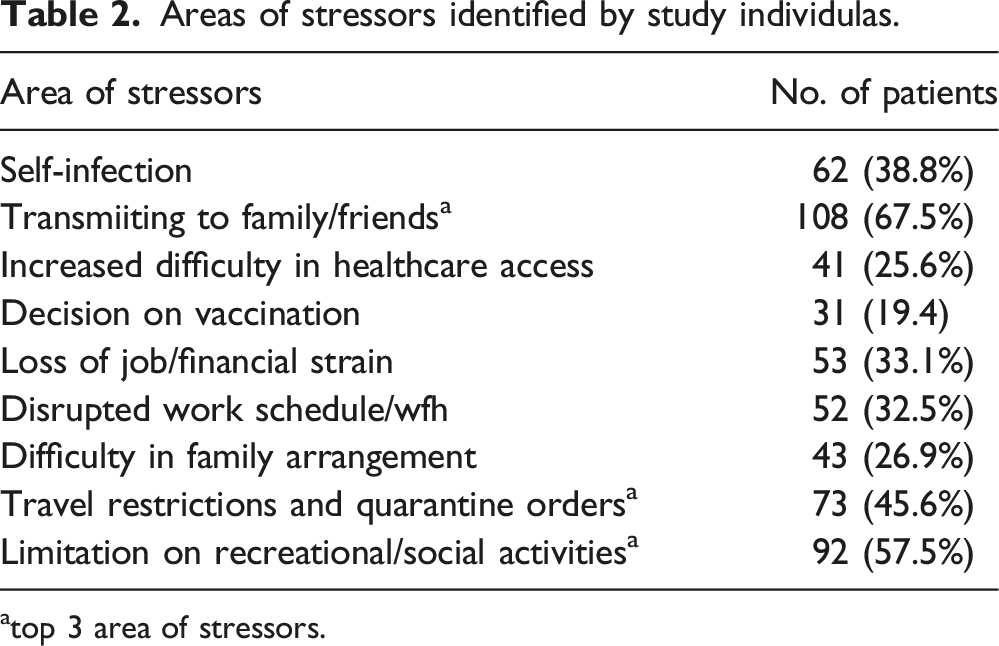
atop 3 area of stressors.
Strength and limitations
To our knowledge, this is the first study to date which examines the incidence of severe fatigue amongst orthopaedic patients during a pandemic. It has also highlighted areas of stressors which provide avenues for improvements. However, the lack of pre-pandemic fatigue levels makes it difficult to ascertain extent of the pandemic’s impact on fatigue levels for orthopaedic patients.
Conclusion
This study sheds light on the ruinous impact of a prolonged COVID-19 pandemic on various tenets in orthopaedic care. High prevalence of severe fatigue, altered patient behavioural patterns and postpone of orthopaedic consults and elective operations would have a deleterious effect on the outcomes of elective orthopaedic conditions and the quality of life of orthopaedic patients. Whilst the pandemic has a detrimental impact on mental health, it can be more pronounced on orthopaedic patients.
Footnotes
Author contributions
All authors contributed to the design of the study, data collection and processing and analysis of data. All authors reviewed and edited the manuscript and approved the final version of the manuscript.
Declaration of conflicting interests
The author(s) declared no potential conflicts of interest with respect to the research, authorship, and/or publication of this article.
Funding
The author(s) received no financial support for the research, authorship, and/or publication of this article.
Ethical approval
An Institutional Board waiver was obtained for this study.
Informed consent
Written informed consent was obtained from the patient(s) for their anonymized information to be published in this article.
Data availability
The datasets generated and/or analysed during the current study are available from the first author.
Disclaimers
None of the authors, their immediate families, or any research foundation with which they are affiliated has received any financial payments or other benefits from any commercial entity related to the subject of this article
