




Abstract
Introduction
Radiosynovectomy (also known as radiosynoviorthesis) is a local form of radiotherapy that is used in chronic hemophilic synovitis in the absence of radiological evidence of extensive joint damage and in patients that have failed conservative therapy with clotting factor replacement and physiotherapy.
Objectives
To evaluate the effectiveness of the Yttrium-90 (Y-90) colloid and Rhenium-186 (Re-186) sulphur colloid radiosynovectomy in hemophilic arthropathy in terms of bleeding frequency, pain score, range of motion and performance score.
Methodology
This was a prospective cohort trial. A total of 68 hemophilic arthropathy patients who had been treated with radiosynovectomy for knee, ankle, elbow and hip joint were included in this study. Patients were followed up to assess their bleeding frequency, pain score, range of motion of the affected joint and Karnofsky or Lansky performance scale at pre and 6 months post therapy.
Result
A marked decrease (80–100%) in bleeding frequency was seen in 66.2% of patients, 14.7% of patients had moderate decrease (51–79%) and mild decrease (30–50%) was seen in 14.7% of patients. The frequency of intraarticular bleeding and pain score were significantly reduced at 6 months follow up (p<0.005). The Karnofsky and Lansky performance scales were also improved at 6 months follow up (p<0.005). There was no significant difference between percentage of range of motion measured before and after the therapy (p>0.005).
Conclusion
Radiosynovectomy is a safe and effective procedure in limiting bleeding frequency, reducing pain and increasing performance scale.
Introduction
Hemophilia is a rare inherited bleeding disorder characterized by the absence of one of the coagulation factors which is factor VIII in hemophilia A and factor IX in hemophilia B. The average prevalence of hemophilia in the world is approximately 1 per 10,000 of the population. 1 Stonebrake, J.S et al. reported that in Malaysia, in 2006, the prevalence (per 100 000 males) of patients with hemophilia A was 6.6. 2 The type of inheritance is sex linked (chromosome X) and recessive. The occurrence of Hemophilia A is five times more common than Hemophilia B with the incidence of Hemophilia A is 1 in 5000 live male births and 1 in 25,000 live male births in Hemophilia B (National Hemophilia Federation, 2006).
The clinical presentation of Hemophilia A and B is similar depending on their amount of factor VIII and IX in the blood. The patient is graded according to the percentage of coagulation factor in their blood: severe (<1% of the normal amount of factor), moderate (1–5 % of the normal amount of factor) and mild (>5% of the normal amount of factor). Generally, the less the percentage of coagulation factor is, the greater the risk of hemorrhagic complication.
The major complication of hemophilia is intra-articular bleeding, in which majority of bleeding (80%) occurs in ankles, knees, elbows and shoulders. The remaining 20% of bleeding takes place in central nervous system and other organ system. This explains the great interest of orthopedic surgeon in hemophilia patient. 1 In children, hemarthrosis frequently starts early in life, with a 10-years-study suggesting that children with hemophilia typically experience their first joint bleed before the age of 2 years. In this group, evidence shows that musculoskeletal dysfunction and associated pain may affect their quality of life, performance and normal activities of daily living, for example avoidance of sports participation.
The aim of this study is to determine the effectiveness of radiosynovectomy in bleeding frequency, pain score, range of motion and performance scale in hemophilic arthropathy and also to compare the bleeding frequency, pain score, range of motion and performance scale of different types of joint in hemophilic arthropathy.
Methodology
This was a prospective cohort study. Study period was 6 months which is from the time of radiosynovectomy to the time of 6 months post therapy assessment. Location of research was at Nuclear Medicine Department, Hospital Kuala Lumpur. Inclusion criteria include:
I) Patient with Hemophilia A or B with more than 1 bleed per month in target joint. Patient could be from either group since there is no difference in their clinical presentation. Target joint is defined as 3 or more spontaneous bleeds into the same joint in a 6 month time period. ii) Chronic synovitis (patient had painless swelling of the target joint)
Definition of Variables
i) Bleeding frequency was evaluated by comparing the bleeding frequency of target joint before and 6 months after the procedure. The changes in the incidence of hemarthrosis of the treated joint were classified as follows: marked improvement—where the decrease of 80%–100% was seen in the number of hemarthrosis; moderate improvement—a 51%–79% decrease in the number of hemarthrosis; mild improvement—a 30%–50% decrease in the number of bleedings; and, no improvement—less than 30% decrease in the number of hemarthrosis. This can be objectively determined by the frequency of coagulation factor being administered per month. 3
ii) Range of motion (ROM) –measurement done during the physical examination. Normal adult range of motion values were used –ankle dorsiflexion (12 ± 4°), ankle plantar flexion (54 ± 6°), knee flexion (134 ± 9°), knee extension (−1 ± 2°), elbow flexion (141 ± 5°) and elbow extension (0 ± 3°). Normal paediatric range of motion values were used –ankle dorsiflexion (13 ± 5°), ankle plantar flexion (58 ± 6°), knee flexion (144 ± 5°), knee extension (−2 ± 3°), elbow flexion (145 ± 5°), elbow extension (1 ± 4°), hip flexion (123 ± 6) and extension (7 ± 7). 4 The worsening of range of motion is defined as reduction in range of motion by at least 5%. The improvement of range of motion is defined as an increment by at least 5%.
iii) Pain –any unpleasant sensory or emotional experience associated with actual or potential tissue damage 5
Pain finding (0–3)
0= no pain, no analgesia used except with acute hemarthrosis
1= mild pain, does not interfere with occupation, daily activities that occasionally require analgesia
2= moderate pain, partial or occasional interference with occupation or activities of daily living
3=severe pain, interferes with occupation or activities of daily living, frequent use of analgesics
For Pediatric cases, Wong-Baker Faces Pain Rating Scale was used
6
Figure 1. Wong-baker faces pain rating scale.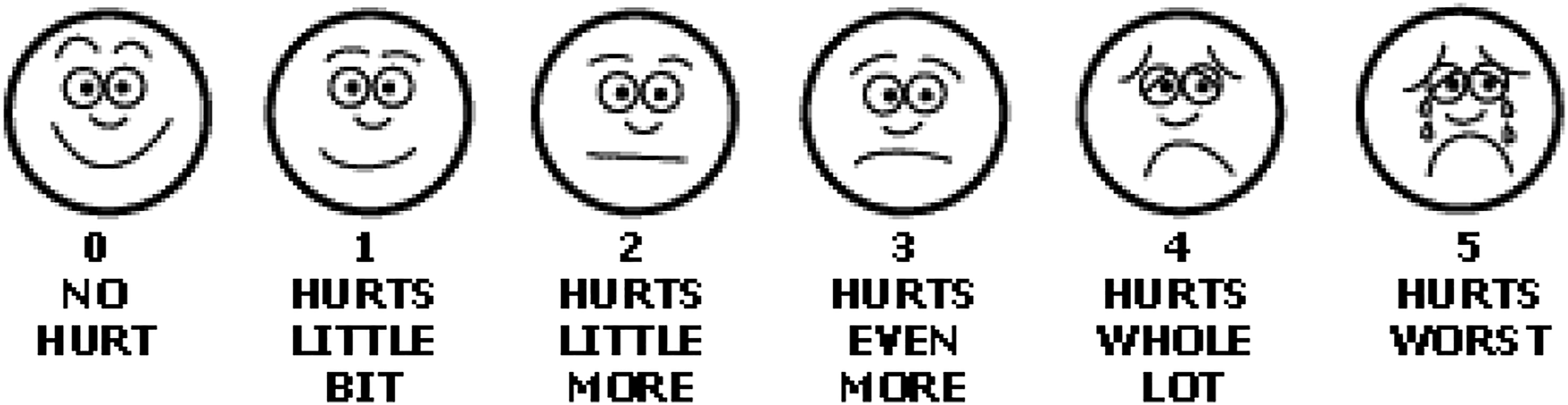
Karnofsky/Lansky Performance Scale.

Statistical Analysis
All the collected data was analyzed using IBM SPSS Statistic Version 19. A paired-samples t-test was conducted to compare the mean score of bleeding frequency, pain scale, range of motion and performance scale at pre and 6 months post radiosynovectomy for overall assessment of the joints. A p-value of less than 0.05 was considered significant and confidence interval (CI) was set at 95%. Wilcoxon signed ranked test was used to test the significance of differences between pre and post therapeutic variables.
Results
Out of 68 patients with hemophilic arthropathies, 31 patients underwent radiosynovectomy for elbow joint, 15 patients for knee joint, 21 patients for ankle joint and 1 hip joint. Majority of the patients (28 patients) were aged from 5 to 14 years. Among the patients, 38 of them were Malays while 30 of them were non-Malays. The non-Malay consisted of 18 Chinese, 9 Indian and 3 others.
Distribution of Number of Patient with Improvement in Joint Bleed
Distribution of Number of Patient with Improvement in Joint Bleed.

The Comparison Between Pre and 6 Months Post Radiosynovectomy Response on Pain
Distribution of Pain Score in Pre and Post Radiosynovectomy.

The Comparison Between Pre and 6 Months Post Radiosynovectomy Response on Range of Motion
Distribution of Number of Patient Based on Changes in Range of Motion Pre and Post Radiosynovectomy.

The Comparison Between Pre and 6 Months Post Radiosynovectomy Response on Karnofsky/Lansky Performance Scale
Karnofsky Performance Scale (16 Years and Above)
Therapy Response on Karnofsky Performance Scale (n = 36).

Lansky Performance Scale (Less than 16 Years Old)
Therapy Response on Lansky Performance Scale (n = 32).

The mean score for Lansky performance was 74.69 (6.21) within the last 6 months in the pretreatment evaluation. After the treatment, the mean score for Lansky performance increased to 81.88 (7.80) at the end of the follow up period. The mean score for Lansky performance between pre and post radiosynovectomy was significantly difference (p < 0.001, 95% CI −9.82, −4.56).
Changes of Mean Scores of Different Variables Before and After Intervention of Overall Joints
Changes of Mean Scores of Different Variables Before and After Intervention of Overall Joints (n = 68).

Discussion
Therapy Response on Bleeding Frequency
In this study, 45 patients (66.2%) had marked improvement (80–100% decrease in number of bleedings) at 6 months post therapy, 10 patients (14.7%) had moderate improvement and another 10 patients (14.7%) had mild improvement. This was comparable to the study by cuneyt et al. who reported a marked decrease in 75% of joints, a moderate decreased in 1% of joints, a mild decrease in 13% of joints and no improvement in 13% of joints. 3 There were 26 patients (38%) who had a complete cessation of bleeding after the therapy. This finding was good as the study by Heim only showed complete cessation of bleeding episodes in 15% of patients, 8 although another study done by Das et al. showed complete cessation in about 60% of patients. 9 There was a statistically significant difference in the mean score of bleeding frequency between pre and 6 months post radiosynovectomy (p < 0.05) in which there was an improvement of 85% in bleeding frequency after the radiosynovectomy. This improvement was seen in each different types of joint. The result was underlined by the data from Peter et al. 2005 10 and Tena et al. who reported good to excellent results for radiosynovectomy in 60–80% of patient with hemarthrosis. 11 Similar result was found in the study by Martinez, who reported a significant decreased in bleeding frequency in 70–80% of patient. 12 Rate of bleeding frequency was the only variable used to determine treatment failure, hence the need of further radiosynovectomy. Patient who had 2 or more bleeding episodes in the 6 months post therapy period was subjected for further radiosynovectomy. The similar procedure is to be followed as described for the first radiosynovectomy. 13 This discrepancy in term of the need to repeat radiosynovectomy is due to the fact that, in developed country, most of the patients are readily on prophylactic coagulation therapy. On the contrary, many hemophilic athropathy patients in Malaysia are on on-demand coagulation treatment. In this study, 16 (23.5%) patients were resubjected for further radiosynovectomy at 6 months post therapy. There were 19.3% of patients from elbow group (3 of them from the aged of 5–14 years), 33.3% of patients from knee group (3 of them from the aged of 25–44 years) and 23.8% of patients from ankle group (3 of them from the aged of 15–24 years old). This result was comparable with the study done by Hortensia et al. 2013 which found that 19% of the hemophilic patient needed further radiosynovectomy at 6 months interval Hortensia et al. 2013. Study done by Van Vulpen et al. showed patients who have undergone radiosynovectomy for knee joints require repeated treatment in case of severely thickened synovium. 14 The risk of failure after the first therapy was attributed to persistent chronic synovitis where it cannot be adequately ablated by a pure beta emitting radiocolloid. It is due to short penetration of this radiocolloid, between 2.2 and 2.8 mm in the thickened synovium in the later course of the disease. In the case of thick synovium, it may be necessary to perform several consecutive procedures. In addition to that, children and young adult were at risk of treatment failure due to their active lifestyle. Based on this study, knee joint contributed to the highest number of repeated procedure (33%). This could be due to the fact that, being the most active hinges joint, it is more susceptible to being over stretched compared to others.
Therapy Response on Pain Score
Paired T test showed the mean of pain score reduced from 0.54 (0.70) to 0.07 (0.26), which was statistically significant p < 0.05, with the percentage of improvement was 87% as compared to pre therapy score. It was also significantly reduced in all types of joints. This finding was better than that seen in a study done by H. De La Corte Rodriguez et al., as their study showed improvement of only 72%. 15 42.7% of patients had pain before the injection as compared to 7.4% 6 months into the treatment (35.3% improvement) which corresponds to the study done by Ozkan et al. which showed reduction of pain at 6 months post therapy. 16 Based on this finding, radiosynovectomy was found to be an effective treatment in reducing the pain score in patient with hemophilic arthropathy. Pain in patients with chronic hemophilic arthropathy could be due to arthritic pain or acute pain of hemarthrosis in a target joint.
Therapy Response on Range of Motion
Study showed that 35.93%23 of the patients had improvement in range of motion, 29.68% (19 patients) with similar range of motion and 34.37% (22 patients) with worsening of the range of motion at 6 months post therapy. Cuneyt et al. found a similar finding in which there were 31% of patients had improved range of motion, 41% had unchanged range of motion and 28% had worsening range of motion after treatment. 17 Another study done by Cuneyt et al., also found that there was no significant difference between percent joint ranges of motion as compared from normal measured before and after therapy. 3 The limitation of range of motion in hemophilia patients is due to chronic bleeding into the joint that produce inflammatory response that progress over the time to produce overt hemophilic arthropathy. In severe type of hemophilia, the joint limitation is also positively associated with recent orthopedic procedure, patient with inhibitors and the frequency of bleed. 4 Nuss et al. reported that based on MRI finding, the severity of synovial hyperplasia was unchanged 6 months after the procedure despite the improvement in bleeding frequency. This was due to the finding that the synovium become fibrotic and inactive rather regressing after radiosynovectomy. 18
Therapy Response on Karnofsky/Lansky Performance Scale
All patients recruited in this study had at least moderate performance score, with the lowest score for patient below aged 16 years was 70 (Lansky performance score) and for patient aged 16 and above (Karnofsky performance score) was 60. None of the patient was in severe performance score prior to the procedure. Only slight improvement was seen in performance scale in 6 months post therapy since none of them were functionally or physically affected by the disease at pre therapy state. This improvement was seen post procedure and it can be attributed to the reduce number of bleed and pain score after the therapy. No study reported an increased risk of cancer after radiosynovectomy. 19 The effective dose to the whole body with Erbium-169 citrate colloid and Rhenium-186 sulphur colloid was estimated to be 30 times lower than in iodine-131 therapy of benign thyroid disease. 20 If three consecutive radiosynovectomies given at 6 months interval fails, a surgical synovectomy is indicated as it is often more effective. 15
Conclusion
Radiosynovectomy should be considered as an initial procedure of choice for the treatment of patients with hemophilic arthropathy as it is simple, effective, safe and low-cost technique that can be performed in children and adult.
Footnotes
Acknowledgements
The authors would like to thank all the staffs from the Department of Nuclear Medicine Hospital Kuala Lumpur their cooperation and help
Author contributions
All authors managed the patient, and prepared the manuscript, edited, and approved the final draft.
Declaration of conflicting interests
The author(s) declared no potential conflicts of interest with respect to the research, authorship, and/or publication of this article.
Funding
The author(s) received no financial support for the research, authorship, and/or publication of this article.
Ethical approval
The study was approved by Human Research Ethics Committee USM (HREC), Universiti Sains Malaysia (JEPeM Code: USM/JEPeM/00,004,494) and National Medical Research Registration (NMRR-11–976-10,568).
Informed Consent
The patients were informed that their data would be submitted for publication and gave their written consent.
Trial Registration
(where applicable):
Availability of data
Data sharing does not apply to this article, as no data sets were generated or analysed.
