



Abstract
Introduction
Accumulating evidence recommends that infectious diseases including coronavirus disease 2019 (COVID-19) are often associated with oxidative stress and inflammation. Paraoxonase 1 (PON1, OMIM: 168,820), a member of the paraoxonase gene family, has antioxidant properties. Enzyme activity of paraoxonase depends on a variety of influencing factors such as polymorphisms of PON1, ethnicity, gender, age, and a number of environmental variables. The PON1 has two common functional polymorphisms, namely, Q192R (rs662) and L55M (rs854560). The R192 and M55 alleles are associated with increase and decrease in enzyme activity, respectively.
Objective
The present study was conducted to investigate the possible association of rs662 and rs854560 polymorphisms with morbidity and mortality of COVID-19.
Methods
Data for the prevalence, mortality, and amount of accomplished diagnostic test (per 106 people) on 25 November 2020 from 48 countries were included in the present study. The Human Development Index (HDI) was used as a potential confounding variable.
Results
The frequency of M55 was positively correlated with the prevalence (partial r = 0.487, df = 36, p = 0.002) and mortality of COVID-19 (partial r = 0.551, df = 36, p < 0.001), after adjustments for HDI and amount of the accomplished diagnostic test as possible confounders.
Conclusions
This means that countries with higher M55 frequency have higher prevalence and mortality of COVID-19.
Introduction
In late December 2019, patients having a mysterious pneumonia were discovered in Wuhan, China. Today, it is named coronavirus disease 2019 (COVID-19). COVID-19 has rapidly spread from China to other countries worldwide, 1 and until now (25 November 2020), more than 61 million confirmed cases with about 1.4 million deaths have been reported from all around the world.
A lot of studies have indicated that various genetic and environmental elements are involved in etiology and prognosis of infectious diseases.2–8 Therefore, it is really important to find out the factors that play a role in COVID-19 spreading. It should be noted that at the population level, understanding the relationship between the population genetic backgrounds as well as environmental factors and epidemiologic parameters of the COVID-19 plays a strategic role in making the best decision to control and prevent the pandemic.
Paraoxonase 1 (PON1, OMIM: 168,820), a member of the paraoxonase gene family, has antioxidant properties. Enzyme activity of paraoxonase depends on a variety of influencing factors such as polymorphisms of PON1, ethnicity, gender, age, and a number of environmental variables. The PON1 has two common functional polymorphisms, that is, Q192R (rs662) and L55M (rs854560). 9 It is well acknowledged that the R192 and M55 alleles are related with augmented and reduced enzyme activity, respectively. 10
Infectious diseases are often associated with oxidative stress and inflammation.11,12 Low-serum PON1 activity is observed in bacterial and viral infections.13–16 In septic patients, serum paraoxonase activity is remarkably decreased. 14 Accumulating evidence commends that oxidative stress increases the risk of infection of the human coronavirus HCoV 229E 17 and the SARS-CoV-2.18–20
There are limited ecologic and genetic association studies on relations between common genetic variations and morbidity/mortality of COVID-19.21–25 However, there is no study considering the correlation between PON1 polymorphisms and COVID-19. The rs662 and rs854560 are common functional polymorphisms. On the other hand, COVID-19 is associated with oxidative stress and inflammation. These provide solid rationale to carry out the present study.
Methods
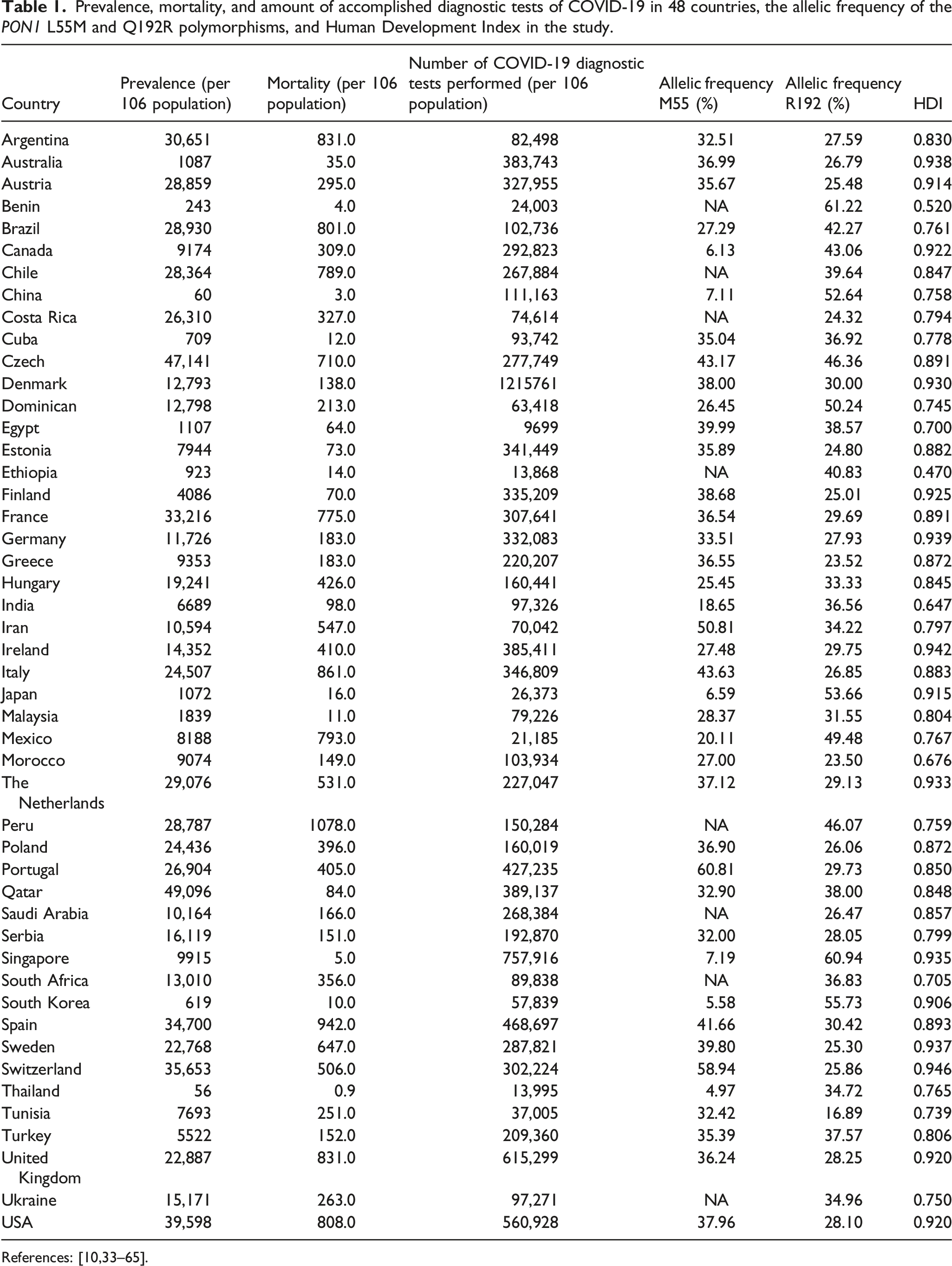
Prevalence, mortality, and amount of accomplished diagnostic tests of COVID-19 in 48 countries, the allelic frequency of the PON1 L55M and Q192R polymorphisms, and Human Development Index in the study.
The Human Development Index (HDI) is a statistic compound index which reflects three very important dimensions of human development, including life expectancy at birth, education (including literacy rate, gross enrollment ratio at different levels, and net attendance ratio), and the gross national income (PPP) per capita. The HDI is the geometric mean of the above-mentioned normalized indices. The HDI is estimated for countries. Countries with higher life expectancy, income, and educational levels have higher HDI value. To measure the level of human development for a given country, as well as to compare with other countries, researchers frequently used the HDI values. The HDI values are calculated annually and reported by the United Nations Development Program’s Human Development Report Office. The 2019 report is the latest one, which was used in the present study.
Data from 48 countries were used in the analysis. These countries are: Argentina, Australia, Austria, Benin, Brazil, Canada, Chile, People’s Republic of China, Costa Rica, Cuba, Czech Republic, Denmark, Dominican, Egypt, Estonia, Ethiopia, Finland, France, Germany, Greece, Hungary, India, Iran, Ireland, Italy, Japan, Malaysia, Mexico, Morocco, The Netherlands, Peru, Poland, Portugal, Qatar, Saudi Arabia, Serbia, Singapore, South Africa, South Korea, Spain, Sweden, Switzerland, Thailand, Tunisia, Turkey, United Kingdom, Ukraine, and United Sates of America.
Pearson correlation analysis and partial correlation analysis were used to examine the relationship between the selected epidemiological indices and the explanatory variables. Analyses were achieved using SPSS statistical software (Chicago, IL, USA, version 24). A p < 0.05 was considered a significant difference.
Results
Correlation between epidemiologic parameters of COVID-19 and study variables.

Note: Degree of freedom (df) for all correlations are 44, except for correlations shown by * which is 38.
Partial correlation between epidemiologic parameters and allelic frequency of study polymorphisms after adjusted for Human Development Index and amount of accomplished diagnostic test (per 106 people).

Note: Degree of freedom (df) for correlations shown by * and ** are 36, 44 respectively.
Discussion
Current results reveal that the allelic frequency of M55 is positively associated with the prevalence and mortality of COVID-19 (Tables 2 and 3). This is in very good agreement with the decrease of paraoxonase activity in the M55 variant, 10 rise of oxidative stress in COVID-19,18–20 and reduction of serum PON1 activity in septic patients. 14
A meta-analysis indicates that hypertension raises the risks of severity and fatality of COVID-19.26,27 The inverse association between PON1 activity and the risk of cardiovascular and inflammatory diseases has been reported previously.9,28,29 It might be concluded that low activity of PON1 is a common risk factor for susceptibility to hypertension and for risk of mortality due to COVID-19 in hypertensive patients.
In current pandemic, men are significantly more likely to die than women.29–31 It is worth noting that serum paraoxonase activity is higher in females. 32 Age of patients and co-morbidities are significant predictors of mortality due to COVID-19.27,30,31 Surprisingly, this is may also be explained by the reducing of serum PON1 activity with age and the association between low PON1 activity and the risk of cardiovascular disease.9,28
In previous pandemics and in the current COVID-19 pandemic, ethnicity has been involved. 31 Prevalence and mortality of COVID-19 are lower in East Asians compared with Caucasians. Actually, ethnicity has a very complex nature. Ethnic groups have many differences with each other in their gene pools and environmental factors such as socio-economic factors and cultural behaviors. The variations in the PON1 activity, which are attributed to both L55M and Q192R polymorphisms, are greater among Caucasians than Asians and Africans. 10 Taken together, at least in part, allelic frequency and effects of ethnicity-related factors on the PON1 activity may explain the difference in mortality and prevalence of COVID-19 between Eastern and Western countries. Taken together, the MM homozygous individuals showed considerably lower PON1 enzyme activity and the reduction in PON1 activity is greater among Caucasians than Asians and Africans. 10 Serum paraoxonase activity is higher in females, 32 and PON1 activity is negatively correlated with age.9,28 These facts may predict, at least in part, different prevalence/mortality of COVID-19 between ethnicities, age, and gender groups.
Finally, a major limitation of the present study should be acknowledged. We know that the rs662 and rs854560 polymorphic sites and other polymorphisms of the PON1 have strong linkage disequilibrium with each other. 66 In this study, the allelic frequencies in countries were estimated using published articles. However, there were no data on haplotypic frequencies in those articles. The present study is an ecological study, and it cannot be judged that people who carry the M55 allele of the rs854560 polymorphism are more susceptible to be infected by SARS-CoV-2 or have higher mortality rates due to COVID-19 than the carriers of the L55 allele. Therefore, in the interpretation of the present findings, care must be taken not to fall into the trap of ecological fallacy. However, it should be noted that there are some genetic association studies using case-control design67,68 which confirmed findings of previous ecologic studies.22,25 In order to generalize the findings of the present study at the individual level, further observational studies (such as case-controls and cohorts) are necessary to examine gene-environment interactions and combinations of polymorphisms in susceptibility to and outcome of COVID-19.
Conclusions
The present ecological study analyzed data of prevalence and mortality of COVID-19 from 48 countries. Statistical analysis revealed that the allelic frequency of M55 is positively correlated with the mortality of COVID-19. This means that countries with higher M55 frequency have higher prevalence and mortality of COVID-19.
Footnotes
Author’s contributions
The author has reviewed the literature, data collection, analyzed the data, summarized the findings, and written the manuscript.
Declaration of conflicting interests
The author(s) declared no potential conflicts of interest with respect to the research, authorship, and/or publication of this article.
Funding
The author(s) received no financial support for the research, authorship, and/or publication of this article.
