




Abstract
Four preregistered studies (N = 369) demonstrate a relationship between speech rate and politeness: participants experienced slower (/faster) versions of a foreign-language message as more (/less) compatible with politeness (Study 1); intended to speak more slowly (/faster) to convey more (/less) politeness (Studies 2a and 2b); and read a pre-written message more slowly when intending to be more polite (Study 3). Findings show the association between speech rate and politeness is robust, does not depend on content, and does not even require comprehension. Drawing on established theories of politeness, we suggest that speech rate may reflect and regulate three factors that influence politeness: the status of the addressee, the imposition placed on the addressee by the message, and the social distance between speaker and addressee. We discuss implications vis-à-vis construal level theory, which suggests a relationship between psychological distance and speed via social distance.
Keywords
Politeness costs nothing and gains everything.
Politeness is an ever-present aspect of human interaction (Holtgraves, 2002). Whenever we speak to another person, we decide how polite to be. Sometimes this decision is expressed in lexical choices – for example, the words “Hey, give me a hand here” vs. “Could you please help me lift that box?” Other aspects of politeness, however, are expressed in how we say things, including the clarity of speech, intonation, and speed (Caballero et al., 2018; He et al., 2022). The current research examines how politeness is related to the speed of speech. It specifically examines the prediction that speech rate is negatively associated with politeness – that is, that people tend to slow their own speech when speaking politely, and interpret slower speech in others as being more polite.
We draw on the prominent theory of politeness developed by P. Brown and Levinson (1987), which holds that politeness reflects and regulates three aspects of social relations: status, distance, and imposition. Specifically, people present as more polite to the extent that they address someone of higher status (Ambady et al., 1996; Gonzales et al., 1990; Holtgraves & Yang, 1990, 1992); that they address someone who is socially more distant (Holtgraves & Yang, 1992; Stephan et al., 2010; Wood & Kroger, 1991); and that the message being communicated represents more of an imposition on the addressee (Ambady et al., 1996; R. Brown & Gilman, 1989; Gonzales et al., 1990; Holtgraves & Yang, 1992). For example, people are likely to be more polite when speaking to a university president compared with a student (status), when addressing a stranger compared with a friend (social distance), and when asking for a large favor compared with a small one (imposition). Likewise, when someone addresses us more politely, we may infer that they perceive us as higher in status; that they consider us a stranger or acquaintance rather than friend; and/or that they wish to acknowledge the burden imposed by whatever they are asking from us (even if merely attention).
The possible link between speech rate and politeness is of interest not only for the study of politeness, which belongs to the fields of psycholinguistics and pragmatics, but also to broader fields of social psychology and cognition. Specifically, if politeness reflects and regulates social closeness, status, and imposition in social interactions, then the link between politeness and speech rate may provide a window into a more general social-psychological regularity, wherein these social phenomena are associated with speed more generally. We will explore this possibility in the general discussion.
Speech Rate
Speech rate is a universal and unavoidable feature of human spoken interaction. Yet while speech rate has been acknowledged as a potent pragmatic cue (B. L. Brown & Bradshaw, 1985; J. Miller et al., 1984), surprisingly little is known about it, including both the factors that govern it and those affected by it. In one study, children aged 10 to 14 were asked to repeat prerecorded sentences of two to seven words; the children tended to speak faster as the sentences got longer (Darling-White & Banks, 2021). Another study found that men tend to speak faster than women (Ofuka et al., 2000).
Turning to the social role of speech rate in communication, this has been examined mainly with respect to the speaker’s perceived credibility and persuasive power. In several studies, faster speech was found to facilitate persuasion through higher perceived credibility and confidence (Guyer et al., 2019; Mehrabian & Williams, 1969; N. Miller et al., 1976; Scherer et al., 1973). Smith et al. (1975) found that faster speakers were perceived as both more competent and more benevolent, although benevolence ratings increased only up to the rate of normal speed, and decreased after that.
Speech Rate and Politeness
As noted above, research has long acknowledged that politeness is conveyed not only in what people say (lexical and morphological aspects of language), but also in how people say it (pragmatic and phonetic aspects of language) (P. Brown & Levinson, 1987). However, only scant empirical attention has been dedicated to the prosodic cues associated with (im)polite speech (L. Brown et al., 2014; Laplante & Ambady, 2003; Winter & Grawunder, 2012), and most of this research has focused on pitch (average pitch, pitch variability) and loudness.
The only studies we are aware of that examined the role of speech rate in conveying politeness are those of Ofuka et al. (2000) and Winter and Grawunder (2012). Ofuka and colleagues examined the relationship between speech rate and perceived politeness in Japanese. Based on Ogino and Hong (1992), they expected slower speech to be associated with more politeness. They found an inverted U-shape, such that politeness ratings increased with slowness up to a certain point, then decreased. Furthermore, this relationship tended to depend on the rater’s own natural pace of speech. Winter and Grawunder (2012), with Korean participants, found that articulation rate as defined by syllables per second was slower for formal than informal speech (addressed, respectively, to socially more distant or closer interlocutors). They speculated that the slower speech rate for polite messages reflects hesitation (e.g., with pauses punctuated by utterances such as “ah . . .”).
Thus, extant explanations of the relationship between speech rate and politeness are relatively technical, having to do with the production of speech. Taking a broader socio-cognitive approach, and drawing inspiration from P. Brown and Levinson (1987), we suggest a more inherent association between politeness and pace of speech. As noted above, Brown and Levinson theorize that politeness is a function of relative power or status of the addressee over the speaker; the imposition placed on the addressee; and the social distance between the speaker and addressee. We suggest that each of these factors may contribute to an association between speech rate and politeness.
In the present study, we aim to demonstrate that the association between speech rate and politeness is independent of speech production and hesitation; that it is independent of content (the same message will be perceived as more [/less] polite when uttered more quickly [/slowly]); and that it occurs even in the absence of comprehension (i.e., when people rate messages in a language they do not understand). Altogether, we extend the studies described above (Ofuka et al., 2000; Winter & Grawunder, 2012) both empirically, by going beyond Japanese and Korean, and theoretically, by proposing to see the relation between speed and politeness as an instance of a broader social-cognitive regularity.
The Current Research
We contend that other things being equal, slower speech is perceived as more polite, and is used when speakers intend to be more polite. To examine this notion, we formulated three hypotheses and tested them in four studies.
First, we hypothesized that people experience compatibility between slowness and politeness (Hypothesis 1). Specifically, we predicted that participants would experience slow-paced speech in a foreign language as more compatible with a polite message, and fast-paced speech as more compatible with a casual, informal message, more than vice versa. We tested this prediction in Study 1.
Our next two hypotheses concern the effects of politeness on speech rate, looking first at intentions and then at behavior. Specifically, Hypothesis 2 predicted that people would intend to speak more slowly when they wished to speak politely and formally, and to speak faster when they wished to speak in a casual, informal manner, more than vice versa. We examined this hypothesis in Studies 2a and 2b. Finally, Hypothesis 3 predicted that this effect would be manifested in actual behavior, with participants articulating the exact same message more slowly when they intended to be polite compared with colloquial. We tested this effect in Study 3.
General Methodology
Studies 1 and 3 were conducted in Hebrew via two Israeli platforms (Hamidgam and Panel4All, respectively). Studies 2a and 2b were conducted in English via Prolific. All participants were university students and graduates aged 18 to 45 with no learning disabilities. Participants were instructed to complete the study in a quiet place from beginning to end with no breaks. In all studies, the ability to respond via smartphones was disabled.
The studies were presented to participants as focusing on intuitive information processing. Participants were allocated randomly to experimental conditions and to versions of the studies. IRB approval was received for all studies (protocol numbers 3517 and 3535).
Transparency and Openness
Preregistration
All studies were preregistered (designs, hypotheses and analysis plans). Links to all preregistrations are available below.
Sample Size
All sample sizes were determined a priori based on power analyses using G*Power (Faul et al., 2013). We assumed either a small-to-medium or a medium effect (d = 0.3–0.5) in a two-tailed test. The analyses suggested we should recruit 90–128 participants to achieve 80% power. As we ran the studies in noisy conditions (online), we aimed to recruit an additional 20–30 participants for Studies 1, 2a, and 2b. In Study 3, which involved participants recording themselves online, we aimed to recruit an additional 72 participants. We eventually collected data from 99 to 143 respondents in each study.
Exclusions
In all studies we excluded participants based on any of three criteria: failure to follow instructions, technical issues, or taking excessive amounts of time to complete the study (more than 3 SDs longer than the mean completion time). In Study 1, which used stimuli in Finnish to create the experience of hearing a foreign language, we also excluded participants who reported knowing Finnish or understanding any of the message. These exclusion criteria were preregistered.
Data and Materials
All data, materials and codes associated with this manuscript are available at https://osf.io/g92w5/overview?view_only=fc90b7c8c330412db7cdda8a56ff8ea3.
Study 1
Study 1 examined whether people who listened to a message in a foreign language that they did not understand would experience slow-paced speech as more compatible with a polite message and fast-paced speech as more compatible with a casual, informal message, more than vice versa (Hypothesis 1).
Method
This study was preregistered at AsPredicted.Org, https://aspredicted.org/jdmn-hpyw.pdf
Participants
One hundred sixteen Hebrew-speaking participants (65 identified as men, 51 as women, Mage = 29.75, SD = 3.94) participated in the study. Fourteen participants were excluded based on the preregistered criteria (four failed to follow the instructions; seven reported either speaking Finnish or understanding some of the content; and three had completion times greater than three SD above the average). Thus, 102 participants were included in the analysis.
Materials and Procedure
Participants were presented with three pairs of audio recordings. In each pair, the same short message was presented in Finnish, once at a slow pace and once at a fast pace. The slow- and fast-paced messages were derived from the same base message using a pitch-preserving speed-up algorithm – FL Studio’s Time Stretching Function. Slow-paced messages were played at 90, 92, and 86% of the original speed; these were paired with fast-paced messages played at 122, 112, and 113% of the original speed, respectively. All speeds were chosen to be identifiably slower or faster than the parallel version, while still falling within the range of natural speech. The audios in each pair were displayed side-by-side and were labeled Audio 1 and Audio 2.
After listening to each pair of audios, participants were asked to drag and drop each audio into one of two boxes, choosing the box that seemed to fit best. One box was labeled “polite and formal speech,” and the other was labeled “not too polite, casual speech.” Participants were assured that there were no right or wrong answers in this task and were encouraged to follow their gut feelings. The position of the audios on the screen was counterbalanced across two experimental versions.
Results and Discussion
The proportion of pairs placed in congruence with the hypothesis was 0.75 (SD = 0.28). A t-test comparing this proportion with the constant 0.5 yielded a significant difference, t(101) = 9.07, p < .001, d = 0.90, 95% confidence interval (CI) = [0.67, 1.13]. The effect did not vary between the versions, t(100) = −1.30, p = .196, d = −0.26, 95% CI = [−0.65, 0.33]. Thus, the results of Study 1 support Hypothesis 1, showing that people associate slow-paced spoken messages with greater politeness, and fast-paced spoken messages with less polite, colloquial language, more than vice versa.
Studies 2a and 2b
Studies 2a and 2b examined whether politeness affects speech rate. In particular, we tested whether people who wish to be polite and formal intend to speak more slowly than people who wish to be more casual and informal (Hypothesis 2).
Method
Both studies were preregistered at AsPredicted. Org, https://aspredicted.org/cx3h-shv4.pdf; https://aspredicted.org/tsks-4jvj.pdf.
Participants
In Study 2a, participants were 102 volunteers on the Prolific platform (37 identified as men, 64 identified as women, and one did not disclose their gender identity, Mage = 26.34, SD = 4.39). Two participants were excluded based on the preregistered criteria (completion time greater than three SD above the average). Thus, 100 participants were included in the analysis.
In Study 2b, participants were 99 Prolific volunteers (33 identified as men, 64 identified as women, and two did not disclose their gender identity, Mage = 25.98, SD = 4.00). Five participants were excluded based on the preregistered criteria (one reported technical problems, and four had completion times greater than three SD above the average). Thus, 94 participants were included in the analysis.
Materials and Procedure
In both studies participants were told that in social interactions, people can choose to be very polite, or to be not particularly polite, but rather more informal. They were asked to imagine that they were approaching a student they did not know and inviting him or her to take part in a getting-acquainted study together. They were further told that their task was to introduce themselves, and to ask for the other student’s participation as a small favor. We gave participants a written text containing this invitation and asked them to speak it aloud. Half of the participants were instructed to speak in a polite and formal manner, whereas the rest were instructed to speak in a casual and informal manner. After reading the text aloud, participants were asked whether, if they had to switch and say the same thing in a casual and informal (/polite and formal) manner, they would do so at a faster or slower pace of speech. In Study 2a, participants’ responses were either “faster or “slower.” In Study 2b, participants had also a third option –“would not change the pace.” Participants were assured that there were no right or wrong answers and were encouraged to follow their gut feelings.
At no point in this study were participants recorded. We chose to have participants speak the initial utterance aloud to render the procedure experiential, so as to increase our chances of tapping the effect.
Results and Discussion
In Study 2a, answers congruent with the hypothesis (i.e., the response “faster” when intending to speak more casually, or “slower” when intending to speak more politely) were coded as 1 and answers incongruent with the hypothesis were coded as 0. The proportion of answers congruent with the hypothesis was 0.80 (SD = 0.40). A t-test comparing this proportion with the constant 0.5 yielded a significant difference, t(99) = 7.46, p < .001, d = 0.75, 95% CI = [0.52, 0.97]. The effect did not vary between the versions, t(98) = 0.198, p = .843, d = 0.04, 95% CI = [−0.35, 0.43].
In Study 2b, we used two systems of coding for participants’ responses. First, as preregistered, answers in congruence with the hypothesis (“faster” when intending to speak more casually and “slower” when intending to speak more politely) were coded as 1. All other responses were coded as 0. The proportion of answers in congruence with the hypothesis was 0.63 (SD = 0.49). A t-test comparing this proportion with the constant 0.3333 yielded a significant difference, t(93) = 5.87, p < .001, d = 0.61, 95% CI = [0.38, 0.82]. The effect did not vary between the versions, t(92) = 0.64, p = .53, d = 0.13, 95% CI = [−0.27, 0.54].
Following this, an additional analysis (not preregistered) was conducted based on an alternative coding approach, where responses congruent with the hypothesis were assigned a value of 1, responses diametrically incongruent with the hypothesis were assigned a value of −1, and the response “wouldn’t change the pace” was assigned a value of 0. The proportion of answers in congruence with the hypothesis was 0.52 (SD = 0.68). A t-test comparing the average response with the constant 0 yielded a significant difference, t(93) = 7.39, p < .001, d = 0.76, 95% CI = [0.53, 0.99]. The effect did not vary between the versions, t(92) = 0.75, p = .454, d = 0.16, 95% CI = [−0.25, 0.56]. Thus, the results of Studies 2a and 2b support Hypothesis 2, showing that politeness affects the intended pace of speech.
In Study 1, participants listened to the exact same message twice and may have guessed that the speech rate was manipulated. Furthermore, they were informed that they would have to judge politeness before they listened to the audios. Thus, it is possible that some participants made a deliberate, conscious decision to match more politeness with slower speech and less politeness with faster speech rather than vice versa. Studies 2a and 2b also explicitly asked about the connection between speed of speech and politeness. Study 3 moves beyond these studies to test whether the effect also operates on a more implicit level. Specifically, we examine whether the relationship between politeness and speech rate is reflected in participants’ behavior even when pace is not mentioned in the instructions.
Study 3
Study 3 examined whether people would actually speak more slowly when they intended to be more polite, as compared to more colloquial (Hypothesis 3). Previous findings suggest that women tend to speak more slowly than men (Ofuka et al., 2000). Because participants in our pool were predominantly women and we could not hope to recruit a large enough sample of men, in this study we examined only women.
Method
This study was preregistered at AsPredicted.Org, https://aspredicted.org/xdbz-gp64.pdf.
Participants
One hundred forty-three Hebrew-speaking participants who self-identified as women (Mage = 32.20, SD = 6.91) were recruited for the study. This number was lower than our preregistered aim of 200 participants because the panel we used (Panel4All) lacked sufficient members meeting our criteria (female university students/graduates aged 18–45 with no learning disabilities and Hebrew as a mother tongue). Seventy participants were excluded based on preregistered criteria. Of these, 55 were excluded because their recordings were unusable, either for technical reasons (e.g., failure to record or excessive background noise) or failure to follow instructions (e.g., not reading the provided text in full with no changes or additions). The other exclusions included 11 who did not complete the study from beginning to end without interruption, two who reported technical problems, and two whose time to complete the study was greater than three SD above the average. The final sample thus consisted of 73 participants.
Materials and Procedure
As in Studies 2a and 2b, participants were told that in social interactions, people can choose to be very polite, or to be not particularly polite, but rather more informal. Next, they were asked to imagine meeting a student they did not know and asking her for a small favor: to fill out an “introduce yourself” questionnaire. They were instructed to imagine addressing the student by reading the text they were handed. Participants were randomly assigned to one of two experimental conditions: One group was instructed to address the student politely and formally, while the other was instructed to do so in a casual and informal manner. Participants recorded themselves.
For exploratory reasons, after completing their recordings, participants were asked to specify (in an open-ended question) what deliberate decisions they made while recording to follow their assigned instructions. We did not preregister any analysis of this question. Ultimately, only a few participants explicitly addressed the pace of speech, and many talked about more general features (e.g., “I used intonation.”) We therefore do not report the results of this analysis.
Results and Discussion
We measured the time elapsed between the first and last sound pronounced by participants in their recordings. We then conducted a t-test comparing the mean recording durations in seconds in the two experimental conditions. A significant difference emerged, t(71) = 2.80, p = .007, d = 0.66, 95% CI = [0.18, 1.13]. The results indicate that, as hypothesized, the average duration of recordings for polite, formal requests (M = 29.66, SD = 2.75) was longer than the average duration for casual and informal requests (M = 27.94, SD = 2.50), suggesting that participants in the polite condition spoke more slowly than those in the casual one. Because the distribution was positively skewed (skewness = 0.93; see Figure 1), we transformed the recording durations using a logarithmic function and repeated the analysis. The results held, t(71) = 2.89, p = .005, d = 0.68, 95% CI = [0.20, 1.15], Mpolite = 1.47, SD = 0.04; Minformal = 1.45, SD = 0.04.
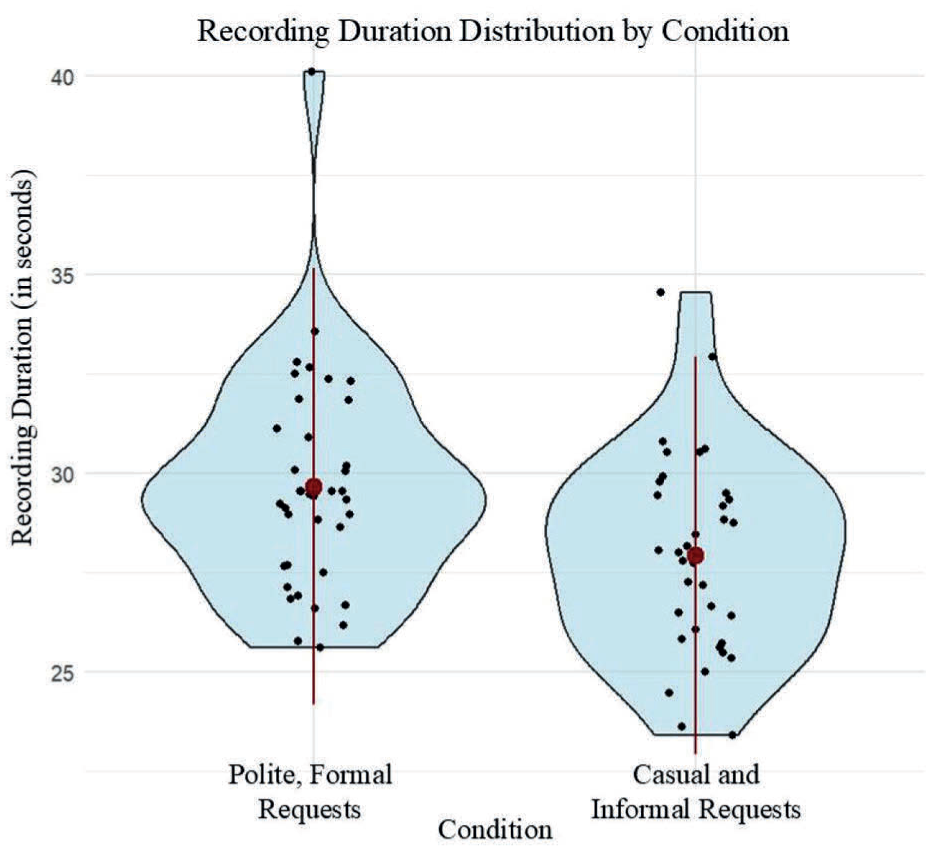
Recording duration distribution by condition.
The results of Study 3 supported our prediction that people who intend to be more polite would speak more slowly. This study is important because unlike in Studies 1, 2a, and 2b, the instructions did not make any reference to speech rate, so that participants’ choice of how fast to speak was spontaneous. Also important is that the text was prescribed and identical for both conditions, so that slowness could not be the result of adding “polite” words (e.g., please) or hesitation speech markers (e.g., eh . . .).
General Discussion
Politeness is an important aspect of social life, in that it reflects and regulates the perceived social status of the addressee, the burden imposed on the addressee by whatever is being communicated, and the social distance between the speaker and the addressee (P. Brown & Levinson, 1987). In four preregistered studies we examined how politeness is related to speed of speech, and specifically the predictions that slower speech is used to speak more politely and is interpreted as being more polite.
In Study 1, participants were found to associate a slow-paced spoken message in a foreign, unintelligible language with more politeness, and a fast-paced message with less politeness. Studies 2a and 2b demonstrated that politeness affects intended speech rate, with participants intending to speak more slowly (/faster) when planning to speak more politely (/more casually). Study 3 tapped the effect of politeness on speech rate in actual behavior. Participants took more time to articulate the very same request, using the same words, when asked to speak politely than when asked to speak casually.
Our findings expand the scarce existing empirical evidence on the link between politeness and speech rate (Ofuka et al., 2000; Winter & Grawunder, 2012). First, whereas extant findings suggested that slowness may reflect embarrassment or hesitation (e.g., saying “ahh . . .” or repeating words), our results show that the effect is wider, and cannot be explained only in that way. Second, our studies are the first to demonstrate an ability to deduce politeness in a foreign, unintelligible language from pace of speech (Study 1). Third, our studies are the first to provide evidence for the association between politeness and pace of speech outside the Japanese and Korean languages. Finally, and in contrast to previous research, our studies demonstrate the relation between politeness and pace of speech by manipulating politeness while keeping constant the content of the utterance.
Why should pace of speech be associated with politeness? We suggest that contributors or antecedents of the association between speech rate and politeness may include all three factors identified by Brown and Levinson (1987) as determining level of politeness: the addressee’s status, the imposition conveyed by the message, and social distance between the speaker and the addressee. Let us examine each in turn.
In terms of status, slower speech may signal acknowledgment of the addressee’s higher status because it suggests investment of greater effort both mentally (Alter & Oppenheimer, 2009; Hick, 1952; Koriat et al., 2014) and physically (Schmidt et al., 1979). Lower-status speakers may slow their speech to convey that the addressee is worthy of this greater effort and deliberation.
In terms of imposition, slower speech may signal acknowledgment that the message imposes a burden of some kind on the addressee, whether this involves a request for action or merely a demand for full attention. This may be because slower speech conveys hesitation or deliberateness, a sense that the message or request has been weighed and found worthy, but that the speaker nonetheless wishes to show consideration and respect toward the addressee’s needs or feelings. Likewise, slow speech may be used (deliberately or unconsciously) to convey patience and lack of pressure on the addressee to respond quickly, or to comply with the request. Moreover, it is well-established that processing and interpreting fast-paced speech is more demanding than processing and interpreting slow-paced speech (Koch & Janse, 2016; Müller et al., 2019 Winn & Teece, 2021). Thus, speaking slowly may represent or signal an attempt to reduce the burden on the addressee by facilitating understanding.
Turning to social distance, stimulus speed has been recently theorized to be related to psychological distance, of which social distance is a special case (Liberman & Trope, 2008; Trope & Liberman, 2010). 1 More specifically, Nussinson and colleagues (2024) suggested that psychological distance is associated in people’s minds with slow, whereas psychological proximity is associated with fast. Their studies demonstrated both effects of psychological distance on stimulus speed (e.g., participants perceived the pace of life in spatially more distant places as slower), and effects of stimulus speed on its psychological distance (e.g., participants perceived behaviors visualized as being performed slowly [/fast] as more imaginary as opposed to real – an effect of speed on hypotheticality). It is therefore possible that politeness is associated with speech pace because (a) politeness reflects psychological distance, and (b) an object’s psychological distance affects and is affected by its speed.
Importantly, our explanation of why the speed of speech is related to social distance, and thus also to politeness, derives from a more general theory on the relationship between speed in general and social distance. Nussinson and her colleagues (2024) predicted and showed that an array of manifestations of speed – not only how fast people speak, but also how fast they move or their general pace of life – are related to social distance.
Could there be a more general relationship also between speed and status, and between speed and imposition? In other words, could it be that status and imposition are, just like social distance, related not only to speed of speech but also to speed of movement and the pace of events? For example, it is possible that high-status people, or deliverers of weighty news, are expected to act more slowly (e.g., walk more slowly, take more time to respond) than low-status people or deliverers of mundane news. We think this is a viable hypothesis worthy of future investigation.
What is the causal process presupposed by our model on the relationship between speed of speech and politeness? In answering this question, we need to distinguish between (a) the causal process that gave rise to the cultural-linguistic norm that more polite speech should be slower; (b) the way this norm operates in concrete human interactions; and (c) the causal structure of our studies. On a cultural level, we propose that status, imposition and social distance often co-occur with slower speech (and perhaps also with slowness more generally), which gave rise to the norm that politeness should be expressed in slower speech. In a specific interaction, however, all three factors – status, imposition and social distance –typically precede and induce politeness, which is then expressed, among other things, in speech rate. In such cases, status, intended imposition and social distance can be inferred from level of politeness, just as an entity can be inferred from its index (e.g., students’ knowledge of math is a cause of their grade, and the grade can be used to infer their knowledge of math). In contrast, our studies, and in particular Studies 2 and 3, manipulated politeness and observed effects on speed of speech.
Our findings are limited in several respects. First, in examining Hypothesis 1 we only contrasted two speech rates for each participant, both of which were designed to feel natural. Ofuka et al. (2000) found that the relationship between politeness and speech rate followed an inverted U-shape. It is possible that in our study, reducing the rate of speech further would have exposed a decline in politeness. Second, in Study 3 our Hypothesis 3, positing that people indeed speak more slowly when they intend to be more polite, was only examined with women. It would be interesting to look at men, as well as extend this study to other age groups and perhaps other cultures. Finally, in Studies 2a, 2b, and 3, participants were expected to interact with a student they did not know. This may have rendered participants predisposed to be more polite. Future research may examine whether the same results are obtained when participants expect to interact with a friend, making them more inclined to be casual.
Future research may also attempt to manipulate speech rate while measuring both perceived politeness and the addressee’s inferred status and social distance, as well as the perceived imposition conveyed by the communication. It would be interesting to examine not only the effect of speech rate on inferred politeness, but also whether this is mediated by inferred status, imposition, and social distance.
In conclusion, our findings suggest that people not only associate politeness with a slower speech rate, but also use slower-paced speech to convey politeness. Our findings inform social psychology, the study of pragmatics, and the study of cognition in general. They raise the possibility that interpersonal variables – status, social distance, and intended level of imposition – are encoded in speech rate, though empirically testing this contention must be deferred for future research.
Footnotes
Handling Editor: Adam Hahn
Authors’ Note
Ravit Nussinson has previously published under the name Ravit Levy-Sadot.

Funding
The authors disclosed receipt of the following financial support for the research, authorship, and/or publication of this article: This research was supported by the Israel Science Foundation Grant 693/22 to R.N. The authors declare that there are no potential conflicts of interest with respect to the research, authorship, and/or publication of this article. The studies were conducted as part of a Master’s thesis by Chen Dahbash. We are grateful to Ido Liviatan for his invaluable advice on this work. We are grateful to Neta Ad, Helen Cohen, Adi Dali, and Gal Kahana for their assistance, and to Idan Katz for his help with the audios. We are grateful to Meira Ben-Gad for her assistance in copyediting.
Declaration of Conflicting Interests
The authors declared no potential conflicts of interest with respect to the research, authorship, and/or publication of this article.