



Abstract
Building on construal level theory, results from a survey based on a nationally representative sample of U.S. adults (N = 1000) indicate an indirect effect of social distance and temporal distance perception on emotional response, policy support, and vaccination intention through risk perception. This study also reveals that social dominance orientation contributes to perceived psychological distance of the monkeypox outbreak. These results suggest that communication about a public health crisis such as monkeypox needs to emphasize its broader community impact, rather than focusing on the primary population affected.
Introduction
Since May 17, 2022, there have been over 30,000 monkeypox cases in the U.S. The epidemiological curve shows that reported cases peaked nationally in early August 2022 (Centers for Disease Control and Prevention [CDC], 2022). Although the spread is mostly within a defined subpopulation—men who have sex with men, monkeypox is not a sexually transmitted infection. Anyone who comes to close contact with those who have monkeypox may contract the virus (CDC, 2022). Nevertheless, news coverage has primarily centered on this population (Petrow, 2022). As a result, people who view this social group as distant from themselves (i.e. dissimilar or outgroup) may perceive monkeypox as an irrelevant risk and subsequently express lower support for government response measures to control the outbreak. Similar trends have been observed during both the COVID-19 pandemic and the Ebola outbreak (Wong et al., 2022; Yang, 2019). Thus, the main objective of this research is to evaluate how perceived psychological distance of the monkeypox outbreak influences Americans’ risk perception and support for public health response measures.
To investigate how psychological distance influences risk perception and public support for response measures, this research applies the construal level theory (Trope and Liberman, 2010). Because vaccination is the most effective public health measure to prevent the spread of diseases, we also evaluate vaccination intention as a criterion variable. Lastly, informed by the risk communication scholarship, this research evaluates the mediating roles of risk perception and emotion, as well as individual characteristics such as social dominance orientation and trait empathy in shaping public risk perception.
Literature review
Psychological distance and risk perception
Construal level theory has been utilized in communication research to examine how psychological distance contributes to public perception about important risk topics such as climate change (e.g. Chu and Yang, 2019), the COVID-19 pandemic (Wong et al., 2022), and vaccination (Liu et al., 2019). The central premise of construal level theory is that our mental construal of an event is shaped by the perceived distance between the observer and the event. Over two decades of research has shown that increased psychological distance leads to more abstract, high-level mental construal (Trope and Liberman, 2010). For instance, Liberman and Trope (1998) found that participants described “moving into a new apartment” as “starting a new life” in the distant future condition (i.e. sometime next year), but as “packing and carrying boxes” in the near future (i.e. tomorrow). Similarly, mental construal has a reciprocal relationship with perceived psychological distance. That is, activating high-level mental construal leads people to think of events as psychologically distant. For instance, Liberman et al. (2007) found that when asked to describe “why” to take a vacation, as opposed to “how” to take a vacation, participants are more likely to anticipate taking the vacation in the more distant future.
Applying this theory to risk communication, Zwickle and Wilson (2013) argue that as the psychological distance between an individual and a risk event increases, the risk will be construed more abstractly. For example, as compared to a tsunami striking a foreign country, Americans are much more likely to perceive higher risk from a hurricane making landfall in their own community because the second risk is much more likely to be construed as a concrete event with greater relevance. As a result, a reduction in psychological distance is likely to be associated with higher risk perception because people are more likely to have concrete mental representation of the risk event.
There are four dimensions of psychological distance, all of which have been shown to influence risk perception in a variety of research contexts (e.g. Chu and Yang, 2018). For instance, Spence et al. (2012) found that perceptions that climate change is likely to impact local areas (i.e. spatial distance), affect similar others (i.e. social distance), occur sooner (i.e. temporal distance), with more certain consequences (i.e. hypothetical distance) are all significantly related to higher risk perception. Yang and McAllister (2020) found that portraying a measles outbreak as affecting similar others (i.e. social distance) and occurring in a spatially close location (i.e. spatial distance) decreased perceived psychological distance, which subsequently increased risk perception. Other studies have also shown that a reduction in temporal distance (Chandran and Menon, 2004) and hypothetical distance (So and Nabi, 2013) is related to higher risk perception. In this context, Americans who perceive the monkeypox outbreak as more likely to impact other countries and dissimilar others may report lower risk perception. Similarly, people who view the threat from monkeypox as more uncertain and occurring in the future may also perceive lower risk. Together, we anticipate that people who perceive the monkeypox outbreak as psychologically distant are likely to report lower risk perception:
H1: Perceived psychological distance will be negatively related to risk perception.
Past research has demonstrated that various psychological and social attributes may influence psychological distance perception. For instance, Rickard et al. (2016) found that portraying climate change impact as temporally far and spatially close is most effective in increasing conservatives’ concern about climate change and motivating them to support mitigation policy. In other words, political ideology influences the way in which people respond to communication messages embedded with different distance cues. This finding echoes Zwickle and Wilson’s (2013) argument that deeply rooted values may play a bigger role in shaping risk perception at increased psychological distance. In particular, construal level theory posits that as psychological distance increases, people are more likely to focus on central features of an event or object that remain unchanged from one context to the next. Here, predispositions and values are likely to influence people’s attitude toward contested social issues when they view these issues as psychologically distant. Past research has shown some support for this argument. For instance, Chu and Yang (2018) found that when climate change was portrayed as a distant risk, American participants were more likely to rely on their political ideology to form opinions about mitigation. Specifically, the gaps in risk perception and policy support were greater between liberals and conservatives when climate change impact was portrayed as more likely to affect a distant location. In this research, we explore social dominance orientation as a relevant value that is likely to shape people’s psychological distance perception related to the monkeypox outbreak because this value is pertinent to people’s attitude toward disadvantaged social groups.
Social dominance orientation
Social dominance orientation (SDO) depicts individuals’ attitudes toward inequality between social groups, reflecting whether people generally prefer their ingroups to be superior to their outgroups (Pratto et al., 1994). People with strong SDO prefer social hierarchies where higher status groups are at the top, dominating over the lower status groups beneath them. This concept is similar to the hierarchical cultural cognition (Kahan and Braman, 2006), which predisposes people to maintain existing social stratification. This notion is also similar to right-wing authoritarianism (Altemeyer, 1998), which predisposes individuals to prefer tradition and social order. In addition, Jost et al. (2003) found that SDO is closely associated with political conservatism.
SDO has been associated with general prejudice against a variety of marginalized social groups, such as ethnic minorities, immigrants, and refugees (e.g. Asbrock et al., 2010). In particular, previous research shows that individuals with stronger SDO tend to maintain prejudice toward people labeled as homosexuals (Rios, 2013). Further, Duckitt and Sibley (2007) found that while right-wing authoritarianism was related to prejudice against “dangerous” groups that posed threats to existing social order, SDO was related to prejudice against stereotyped groups that were disadvantaged. In addition, SDO has also been shown to influence support for social policies that uphold the hierarchical status quo, such as policies related to the criminal justice system (e.g. Sidanius et al., 2006).
Within the current research context, given media coverage’s focus on men who have sex with men at the peak of the monkeypox outbreak, it is reasonable to assume that individuals with strong SDO will be more likely to perceive this social group as marginalized, inferior, or even stigmatized. Supporting this conjecture, gay people are one of the social groups identified as the “derogated group,” toward whom people with strong SDO express strong negative attitude (Duckitt and Sibley, 2007). As a result, people who abide by strong SDO may perceive monkeypox victims as drastically different from themselves and view this public health crisis as psychologically distant. Thus, SDO is likely to have a negative relationship with perceived psychological distance of the monkeypox outbreak:
H2: SDO will be negatively related to perceived psychological distance.
Emotion
Decades of research have shown that risk perception constitutes both cognitive evaluation of a potential threat, as well as emotional response evoked by the threat (Finucane et al., 2000). Thus, people who have greater risk perception are more likely to experience stronger emotional response (Loewenstein et al., 2001). For instance, Griffin et al. (2008) found that residents of an urban watershed who perceived greater risk from flooding were more likely to feel anger toward management agencies. The broader health communication literature has abundant evidence that risk perception can increase negative emotions such as fear and anxiety (Witte, 1992). Specifically related to a disease outbreak, Yang (2019) found that Americans who perceived the Ebola outbreak as a higher risk reported greater fear and sadness. Similarly, we anticipate that people who perceive the monkeypox outbreak as a greater risk will report stronger emotional response:
H3: Risk perception will be positively related to emotional response.
Interestingly, construal-level theorists also call for more attention to the relationship between mental construal and emotion (Trope and Liberman, 2010). In particular, because reduced psychological distance leads to more concrete, low-level mental construal, people may experience more intense emotions when thinking of psychologically close events. To some extent, this notion is consistent with appraisal theories because emotions triggered by a concrete threat or harm (e.g. fear, anger) may be experienced more intensely at closer psychological distance (Nabi, 1999). Past research supports this conjecture. For instance, Chu and Yang (2019) found that perceived psychological distance of climate change was negatively correlated with anger, fear, sadness, and guilt. Further, psychological distance may influence emotional response through risk perception because risk perception is essentially a cognitive appraisal process that determines the type of emotions experienced (Smith and Ellsworth, 1985). Indeed, both the certainty and control dimensions of appraisal theories are key psychometric attributes that define risk perception (Slovic, 1987). Thus, perceived psychological distance may influence emotional response through risk perception because more abstract mental construal associated with farther psychological distance may lead to lower risk perception, which will result in less intense emotional reactions. Because no research to date has specifically examined this mediation path, we ask:
RQ1: Does risk perception mediate the relationship between psychological distance and emotional response?
Further, given the action tendency that is inherent in emotions (Frijda et al., 1989), emotions are uniquely powerful in motivating actions. For instance, Yang (2016) found that people who felt sad about Ebola were more likely to support their family and friends if they were to go to West Africa to aid the disaster response effort. Skurka (2019) found that anger elicited by advertisements for sugary beverages targeting children motivated participants to support punitive policies. More closely relate to the current study, Liu and Yang (2023) found that anger and fear mediated the relationship between risk perception and policy support related to the COVID-19 pandemic. In this context, we argue that people who experience stronger emotions toward monkeypox will be more likely to support government policies designed to mitigate risk. These individuals may also be more likely to express a stronger intention to get vaccinated to protect themselves from infection:
H4: Risk perception (H4a) and emotional response (H4b) will be positively related to policy support.
H5: Risk perception (H5a) and emotional response (H5a) will be positively related to vaccination intention.
Trait empathy
Because this research focuses on a disease outbreak where others’ suffering may trigger compassionate responses among individuals, especially those with higher trait empathy, we also examine this personality trait as an individual characteristic that may shape people’s emotional response to the monkeypox outbreak. Trait empathy denotes people’s innate ability to take the perspective of others and feel their pain or joy (Davis, 1983). In other words, empathy is likely to influence the extent to which people are concerned for the welfare of others. Past research has shown that empathy can greatly intensify people’s emotional reaction to others’ suffering (Swim and Bloodhart, 2015) and motivate subsequent pro-social behaviors. For instance, Lim and DeSteno (2016) found that empathy increased people’s compassion for others, which increased both charitable donation intention and time spent in helping others. In this study, we anticipate that individuals with higher trait empathy will experience stronger emotions when thinking about the monkeypox outbreak:
H6: Trait empathy will be positively related to emotional response.
To summarize, our hypotheses and research questions are illustrated in Figure 1.
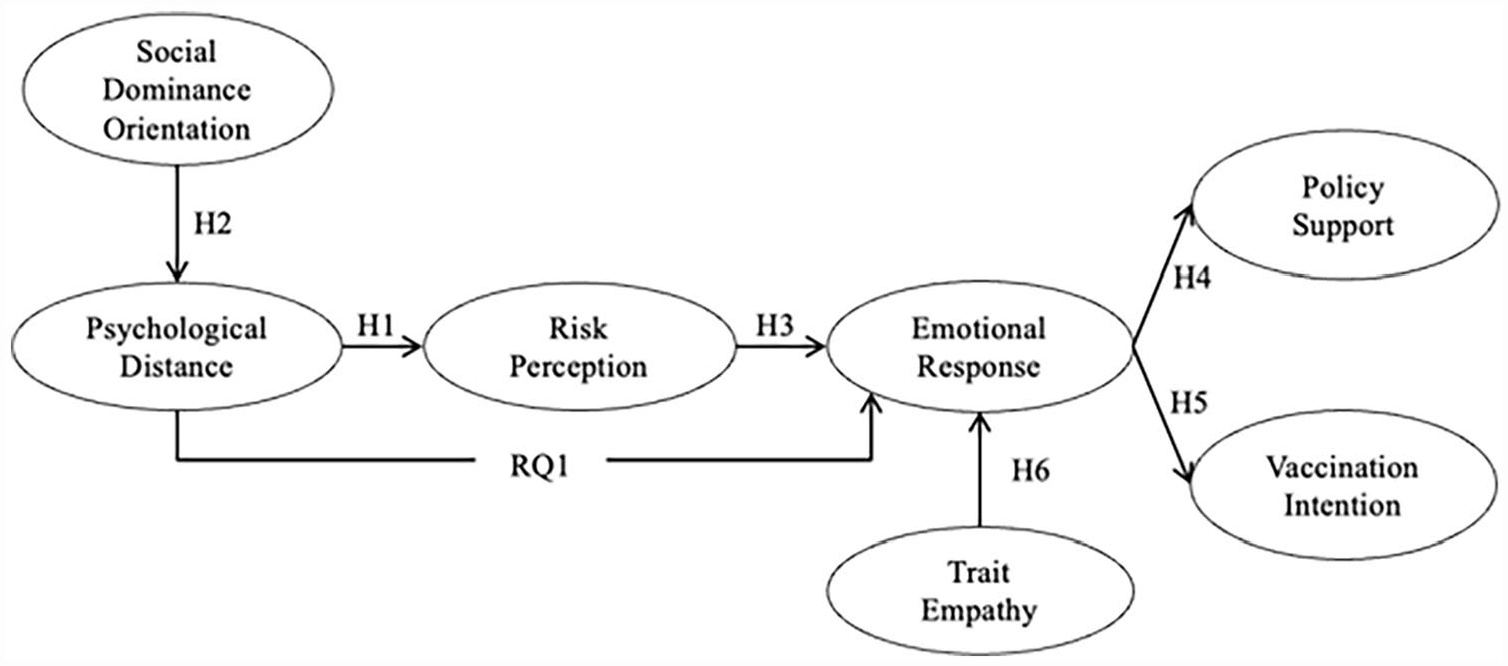
Theoretical model with hypotheses.
Methods
Sample
Data were collected from August 31 to September 20, 2022. We contracted Ipsos Public Affairs to recruit a nationally representative sample of American adults (N = 1000). The median survey completion time was approximately 15 minutes, and the completion rate was 62.2%. Approval of all research procedure was obtained from the Institutional Review Board (IRB) at the authors’ institution. Our sample was weighted to ensure accurate representation of the U.S. adult population. Participants’ mean age was 48.02 (SD = 17.85), ranging from 18 to 94. The sample was gender-balanced, with 488 (48.4%) males and 521 (51.6%) females. Consistent with the latest census data (United States Census Bureau, 2022), our sample was predominantly White (n = 620, 62%). More than one-third of participants (n = 348, 34.8%) had a bachelor’s degree or higher, followed by those who received high school education (n = 292, 29.2%), some college education (n = 264, 26.4%), and less than high school education (n = 96, 9.6%). The median household income was in the bracket of $75,000–$99,999. In terms of political ideology, the sample was slightly more conservative leaning (M = 4.13, SD = 1.56, 1 = extremely liberal, 7 = extremely conservative).
Procedure
All participants offered informed consent at the beginning of the survey. They then answered a series of questions detailed in the measures section. To reduce survey order effect, all measures were randomized (Day et al., 2012). Lastly, participants were debriefed and compensated at the completion of the survey. The full measures can be viewed via open science framework (OSF; https://bit.ly/3Nzfl82).
Measures
Psychological distance
On a 5-point scale, 12 items adopted from past research (Chu and Yang, 2019) measured perceived psychological distance of the monkeypox outbreak along the social (M = 3.23, SD = 0.96, α = 0.79), hypothetical (M = 3.34, SD = 0.95, α = 0.63), spatial (M = 2.80, SD = 0.86, α = 0.75), and temporal dimensions (M = 1.24, SD = 0.88, α = 0.82). Sample items included, “The monkeypox outbreak is unlikely to affect people like me,” and “Recent impacts of the monkeypox outbreak mean we must tackle the issue now.”
Risk perception
To measure risk perception, three items were adopted from past research (Leiserowitz, 2006) to evaluate perceived susceptibility, perceived severity, and general concern on a 6-point scale, anchored by the appropriate terms (e.g. 1 = not at all concerned; 6 = extremely concerned) measuring each dimension (M = 2.69, SD = 1.24, α = 0.87).
Emotional response
We included five negative emotions (sadness, fear, anxiety, anger, and worry) and two pro-social emotions (sympathy and compassion) to evaluate participants’ emotional response toward the monkeypox outbreak, on a scale from 0 = none of this feeling to 5 = a lot of this feeling (negative emotions: M = 1.59, SD = 1.34, α = 0.92; pro-social emotions: M = 2.67, SD = 1.55, α = 0.92). These emotions have been evaluated in past research related to disease outbreaks (Wong and Yang, 2021).
Policy support
Nine items evaluated participants’ support for public health and government assistance measures to curb the spread of monkeypox on a 5-point Likert scale (M = 3.15, SD = 1.00, α = 0.92) (Wong and Yang, 2021). Sample items included “The U.S. government should significantly increase monkeypox testing” and “I support increased government funding for monkeypox research.”
Vaccination intention
Three items assessed participants’ vaccination intention (Gerend and Shepherd, 2012) on a 6-point scale from 1 = very unlikely to 6 = very likely (M = 3.94, SD = 1.81, α = 0.90). Sample items included, “If you have been exposed to monkeypox, how likely is it that you will get the monkeypox vaccine?” and “If your healthcare provider stronger recommends the monkeypox vaccine, how likely is it that you will get the monkeypox vaccine?”
Social dominance orientation
Social dominance orientation was measured with the SDO7(s) scale (Ho et al., 2015) on a 7-point scale from 1 = strongly oppose to 7 = strongly favor (M = 2.91, SD = 1.13, α = 0.81). Sample items included, “An ideal society requires some groups to be on top and others to be on the bottom,” and “Group equality should not be our primary goal.”
Trait empathy
Trait empathy was measured with five items adapted from Davis’s (1983) interpersonal reactivity index on a 6-point scale (1 = does not describe me at all; 6 = describes me very well; M = 4.37, SD = 1.07, α = 0.90). Sample items included, “Before criticizing somebody, I try to imagine how I would feel if I were in their place,” and “I try to look at everybody’s side of a disagreement before I make a decision.”
Data analysis
Data were analyzed in Mplus 8.6, using the two-step procedure recommended by Kline (2015). The measurement model was first specified through confirmatory factor analysis, followed by the structural model. A maximum likelihood estimator (MLR) with robust errors was employed to account for potential issue with multivariate normality, although the normality assumption was not violated for any individual observed variable. Indicators of model fit included chi-square, comparative fit index, Tucker–Lewis index, root mean square error approximation, and standardized root mean residual (Hu and Bentler, 1999). All fit indices indicate excellent model fit for both the measurement model and the final structural model (Table 1).
Model fit statistics.
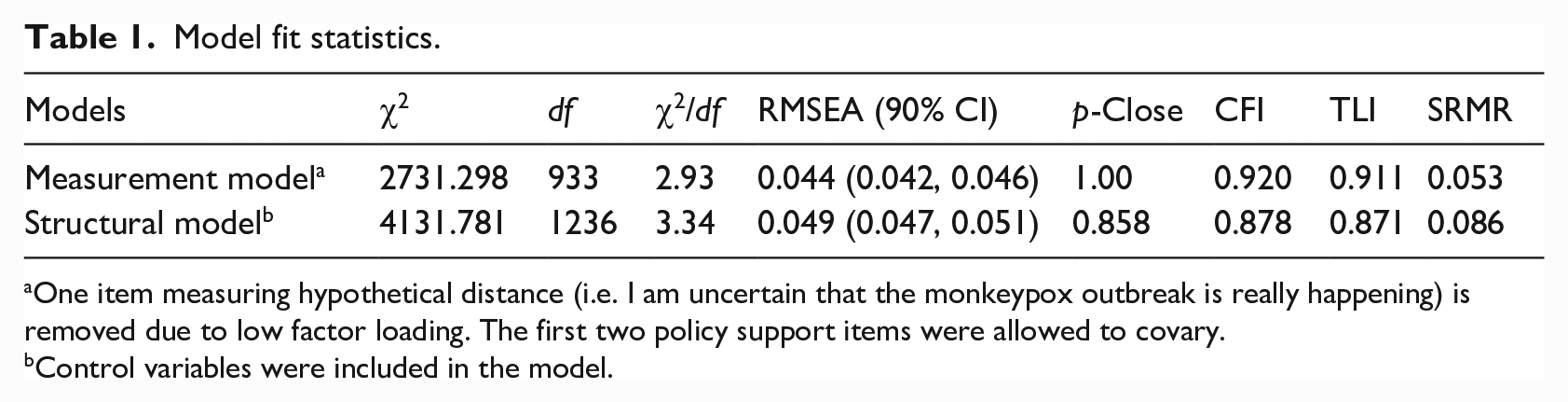
One item measuring hypothetical distance (i.e. I am uncertain that the monkeypox outbreak is really happening) is removed due to low factor loading. The first two policy support items were allowed to covary.
Control variables were included in the model.
Results
The first hypothesis stated that psychological distance would be negatively related to risk perception. As shown in Figure 2, results indicated that only social distance and temporal distance were negatively related to risk perception, while hypothetical distance and spatial distance were not significantly related to risk perception. Thus, H1 was partially supported.
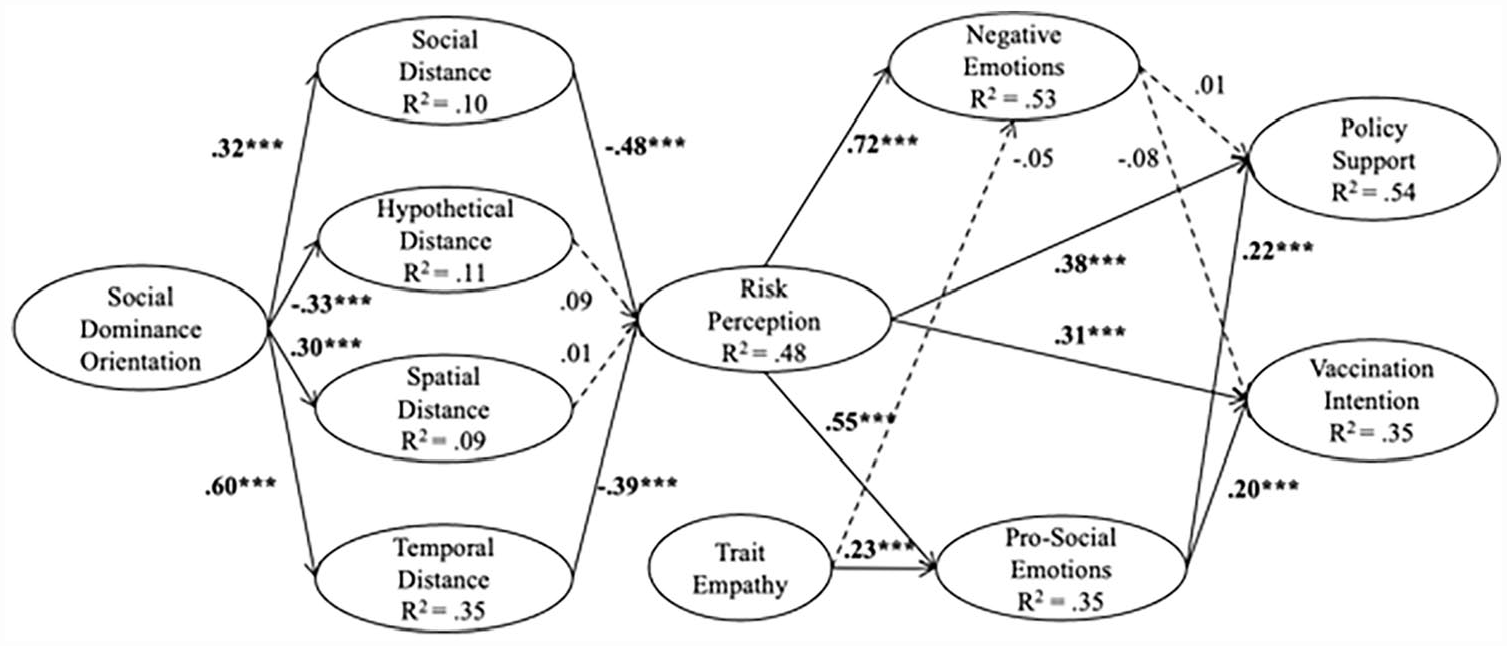
Standardized coefficients for the final model.
H2 proposed that SDO will be positively related to perceived psychological distance. SDO was indeed positively related to social distance, spatial distance, and temporal distance. However, there was a negative relationship between SDO and hypothetical distance. Thus, H2 was partially supported. Results showed that social distance (standardized indirect effect: β = −0.16, p < 0.001) and temporal distance (standardized indirect effect: β = −0.23, p < 0.001) mediated the relationship between SDO and risk perception.
The third hypothesis posited that risk perception would be positively related to emotional response. Results showed that risk perception was positively related to both negative emotions and pro-social emotions, supporting H3. To address the first research question, risk perception mediated the relationship between social distance (standardized indirect effect: β = −0.40, p < 0.001) and temporal distance (standardized indirect effect: β = 0.42, p < 0.001) and negative emotions. Similarly, risk perception mediated the relationship between social distance (standardized indirect effect: β = −0.41, p < 0.001) and temporal distance (standardized indirect effect: β = 0.43, p < 0.001) and pro-social emotions.
The fourth hypothesis stated that risk perception and emotional response would be positively related to policy support. Results indicated that risk perception and pro-social emotions were positively related to policy support, but negative emotions were not significantly related to policy support. Thus, H4 was partially supported. Risk perception also mediated the relationship between perceived social distance (standardized indirect effect: β = −0.18, p < 0.001) and temporal distance (standardized indirect effect: β = 0.15, p < 0.001) and policy support.
The fifth hypothesis stated that risk perception and emotional response would be positively related to vaccination intention. Results indicated that risk perception and pro-social emotions were positively related to vaccination intention, but negative emotions were not significantly related to vaccination intention. Thus, H5 was partially supported. Risk perception also mediated the relationship between social distance (standardized indirect effect: β = −0.15, p < 0.001) and temporal distance (standardized indirect effect: β = 0.12, p < 0.001) and vaccination intention.
Lastly, the sixth hypothesis posited that trait empathy would be positively related to emotional response. Results showed a positive relationship between trait empathy and pro-social emotions. Thus, H6 was partially supported. Trait empathy also had significant indirect effect on both policy support (β = 0.05, p < 0.001) and vaccination intention β = 0.05, p < 0.001) through pro-social emotions.
Among the control variables, political ideology was positively related to SDO (β = 0.54, p < 0.001). Consistent with existing research (Jost et al., 2003), conservatives reported higher SDO. Younger participants reported stronger policy support (β = −0.09, p = 0.001), whereas older participants reported higher vaccination intention (β = 0.14, p < 0.001). Male participants reported a higher vaccination intention (β = −0.14, p < 0.001), while minority participants reported stronger policy support (β = −0.07, p = 0.016). Participants with higher education reported lower policy support (β = −0.12, p < 0.001), whereas those with higher household income reported higher vaccination intention (β = 0.13, p < 0.001). Lastly, conservatives reported lower policy support (β = −0.38, p < 0.001) and lower vaccination intention (β = −0.29, p < 0.001). Overall, the model accounted for 48% of the variance in risk perception, 53% of the variance in negative emotions, 35% of the variance in pro-social emotions, 54% of the variance in policy support, and 35% of the variance in vaccination intention.
Discussion
Guided by construal level theory, this research examined whether perceived psychological distance of the monkeypox outbreak was associated with Americans’ risk perception and emotional response to this public health crisis. Support for government response measures and vaccination intention were included as criterion variables because they are frequently examined in past research as indicators of public attitude toward public health risk mitigation strategies (Wong et al., 2022). Social dominance orientation and trait empathy were incorporated as individual traits that might contribute to psychological distance perception and emotional response because of their unique connections to the current research context—a disease outbreak that primarily affected a stigmatized social group. Results indicate that SDO is indeed a pertinent disposition that shapes perceived psychological distance. Perceived social distance and temporal distance influenced policy support and vaccination intention indirectly through risk perception. Trait empathy was positively associated with pro-social emotions, which were positively associated with both policy support and vaccination intention. Although risk perception was positively related to both negative emotions and pro-social emotions, negative emotions were not significantly related to either policy support or vaccination intention.
The first set of findings related to psychological distance offer three meaningful insights. First, although SDO is significantly related to all dimensions of psychological distance, these associations are not unidimensional. People who score higher on SDO are more likely to see the monkeypox outbreak as socially, spatially, and temporally distant, but hypothetically close (i.e. with greater certainty). The direct interpretation of this finding is that those who prefer to see their ingroups as superior to their outgroups are more likely to see the monkeypox outbreak as affecting social groups that are more marginalized and inferior to themselves—gay, bisexual, and other men who have sex with men. Nevertheless, their fundamental support for social inequality leads them to perceive greater certainty in the impact of the monkeypox outbreak, primarily on the “dissimilar others,” not on themselves.
Second, across the four dimensions of psychological distance, only social distance and temporal distance contribute to risk perception. Specifically, people who perceive the monkeypox outbreak as more likely to affect others who are very different from themselves and more in the distant future also report lower risk perception. Looking at descriptive statistics, most participants view the monkeypox outbreak as temporally (average M = 1.24) and spatially (average M = 2.80) close, but socially (average M = 3.23) and hypothetically (average M = 3.34) far relatively. This result makes sense because data were collected right at the peak of the monkeypox outbreak in the U.S. Theoretically, this result suggests that people do not always see the same risk event as congruent in all distance dimensions. More importantly, depending on the research context, some distance dimensions may have a stronger impact on subsequent risk appraisal than others. A practical implication of this result is that when there is a need for public health experts to alert the public of a disease outbreak that people may not perceive as directly relevant to themselves (e.g. Ebola, Zika), it is crucial to highlight the immediacy of its potential impact on others who are similar to them. Of course, this does not suggest that the public should be concerned about any disease outbreak. The contrast between the Ebola outbreak and the COVID-19 pandemic offers a good set of comparisons here (Kilgo et al., 2019). When media either overly amplify or attenuate the risk of a communicable disease, public risk perception may be steered in a direction that is not conducive for disease control and prevention (Kasperson et al., 1988). In an increasingly connected world, no individuals or country can be completely shielded from a global pandemic. Thus, it may be worthwhile to refrain from portraying any disease outbreak as only affecting a specific social group, when there is always a possibility that it will be spread to a broader community (Wong et al., 2021).
Third, and perhaps most importantly, the indirect effect from social distance through risk perception on policy support and vaccination intention is negative, whereas the indirect effect from temporal distance through risk perception on these two outcome variables is positive. This result indicates that the perception that the monkeypox outbreak is less likely to affect oneself or one’s friends and family may have detrimental effect on downstream support for public health measures that may curb the spread of the disease in American communities or fund research and medical interventions that may help the victims (Wong et al., 2022). In contrast, when participants view the monkeypox outbreak as more likely to harm people in the future, they are more likely to support relevant policies and get vaccinated. Thus, when people acknowledge that the monkeypox outbreak may affect them in the future, they are more likely to support risk mitigation measures. Or, this finding may indicate a preference for delayed action because people who see the monkeypox outbreak as an immediate risk are less likely to support relevant policies or get vaccinated.
Related to the mediated paths through risk perception and emotional response, it is interesting, and perhaps encouraging, that even though elevated risk perception is positively correlated with both negative emotions and pro-social emotions, only pro-social emotions are positively related to policy support and vaccination intention. This result reflects similar findings in past studies showing that sympathy and compassion are emotions that foster greater engagement in actions that can benefit disease control and risk mitigation at both the societal level and the individual level (Yue and Yang, 2022). Theoretically, this finding speaks to the necessity to include not only negative emotions in risk communication research, but also takes into account positive, pro-social, or even moral emotions. Practically, this result suggests that communications surrounding public health crises may benefit from incorporating more uplifting messages that highlight the importance of hope, sympathy, and compassion for one another to encourage more pro-social behaviors among citizens.
Lastly, conservative participants reported higher SDO, lower policy support, and lower vaccination intention, which reflect trends observed during the COVID-19 pandemic (Gallup, 2021). Except for age and gender (i.e. older, male participants more likely to get vaccinated), which may reflect the higher risk facing some segments of this population, the other demographic variables are associated with support for public health response measures and vaccination intention along the division in socioeconomic status in the American society (Ruiz and Bell, 2021). Further, Sidanius et al. (2013) demonstrated that SDO and trait empathy may have a reciprocal relationship longitudinally. In particular, SDO seems to have a stronger effect on empathy over time, rather than vice versa. Sidanius et al. (2013) explain that because individuals high in SDO tend to support actions involving the suffering of others, this may reduce their empathy over time. Thus, future research may need to explore how these two factors influence public risk perception and support for risk mitigation measures longitudinally.
This study has several limitations. First, data were collected when the U.S. was experiencing a peak in monkeypox infections. Due to the ever-changing nature of any disease outbreak, our findings may have limited generalizability, even though data were collected based on a nationally representative sample. SDO and trait empathy are relatively stable traits, so results related to these variables may have more long-term utility. Future research should consider measuring the other key variables at different stages of a disease outbreak. Second, the cross-sectional data limit our ability to draw causal claims. Third, most of our measures achieve good reliability because they were previously validated. However, hypothetical distance had a lower reliability (α = 0.63) and we had to remove one of the items (i.e. I am uncertain that the monkeypox outbreak is really happening) in the final measurement model. This observation represents the challenge to evaluate perceived hypothetical distance when the event is ongoing. Future research should perhaps consider focusing on the likely impact of the event when measuring hypothetical distance.
Conclusion
In conclusion, focusing on the 2022 monkeypox outbreak, this study investigates how U.S. adults’ perceived psychological distance, risk perception, and emotional response, as well as individual characteristics such as SDO and trait empathy, contribute to their support for public health response measures and vaccination intention. This study has both theoretical and practical implications. Theoretically, the incorporation of SDO and trait empathy into the theoretical model deepens our understanding of how these predispositions contribute to perceived psychological distance of the monkeypox outbreak, as well as the public’s emotional reaction to this public health crisis. Guiding practice, our findings highlight the need for communication to portray a communicable disease not only by focusing on its initial target groups, but also by discussing its potential impact on the broader community. This strategy may garner greater support for public health response measures by counteracting the negative impact of some individuals’ innate tendency to support social inequality and generating more pro-social emotions such as sympathy and compassion for others.
Supplemental Material
sj-dat-2-hpq-10.1177_13591053231180457 – Monkeypox outbreak: Psychological distance, risk perception, and support for risk mitigation
sj-dat-2-hpq-10.1177_13591053231180457 for Monkeypox outbreak: Psychological distance, risk perception, and support for risk mitigation by Janet Z Yang and Xinxia Dong in Journal of Health Psychology
Supplemental Material
sj-docx-1-hpq-10.1177_13591053231180457 – Monkeypox outbreak: Psychological distance, risk perception, and support for risk mitigation
sj-docx-1-hpq-10.1177_13591053231180457 for Monkeypox outbreak: Psychological distance, risk perception, and support for risk mitigation by Janet Z Yang and Xinxia Dong in Journal of Health Psychology
Supplemental Material
sj-inp-1-hpq-10.1177_13591053231180457 – Monkeypox outbreak: Psychological distance, risk perception, and support for risk mitigation
sj-inp-1-hpq-10.1177_13591053231180457 for Monkeypox outbreak: Psychological distance, risk perception, and support for risk mitigation by Janet Z Yang and Xinxia Dong in Journal of Health Psychology
Supplemental Material
sj-out-1-hpq-10.1177_13591053231180457 – Monkeypox outbreak: Psychological distance, risk perception, and support for risk mitigation
sj-out-1-hpq-10.1177_13591053231180457 for Monkeypox outbreak: Psychological distance, risk perception, and support for risk mitigation by Janet Z Yang and Xinxia Dong in Journal of Health Psychology
Footnotes
Data sharing statement
The current article is accompanied by the relevant raw data generated during and/or analysed during the study, including files detailing the analyses and either the complete database or other relevant raw data. These files are available in the Figshare repository and accessible as Supplemental Material via the Sage Journals platform. Ethics approval, participant permissions, and all other relevant approvals were granted for this data sharing. The data files from the current study are also available in the OSF repository at  .
.
Declaration of conflicting interests
The authors declared no potential conflicts of interest with respect to the research, authorship, and/or publication of this article.
Funding
The authors disclosed receipt of the following financial support for the research, authorship, and/or publication of this article: This research is supported by a research grant from the National Science Foundation (NSF#2241463).
Ethics approval
This research was approved by the IRB at the University at Buffalo (STUDY00006719).
Informed consent
Informed consent was obtained from all participants.
References
Supplementary Material
Please find the following supplemental material available below.
For Open Access articles published under a Creative Commons License, all supplemental material carries the same license as the article it is associated with.
For non-Open Access articles published, all supplemental material carries a non-exclusive license, and permission requests for re-use of supplemental material or any part of supplemental material shall be sent directly to the copyright owner as specified in the copyright notice associated with the article.
