



Abstract
Children care for animals more than adults do, yet as they develop, find it increasingly acceptable to eat meat. How do children learn to consume some animals while continuing to care for others? We argue that observing the cultural importance of food practices leads children to trade-off their moral concern for animals against cultural values. In two pre-registered studies, we examined how the cultural importance (high vs. low) of eating animals influenced participants’ (total N = 597; ages 4–85), moral judgements and reasoning about eating animals. Based on quantitative and qualitative data, we show that only for children did high cultural importance lead to evaluations of eating animals as more morally acceptable, and to greater reasoning emphasis on human traditions. We conclude that in childhood, resolving the conflict between moral values and human cultural practices is one way in which humans come to care for some animals and harm others.
Humans have a complex relationship with other animals. Some animals, like pets, are treated with affection. Others, who are factory-farmed for their meat, experience harm. The inherent attributes of these species cannot be used to understand which species are loved, and which are eaten. For example, although dogs and pigs are both highly social and intelligent (Gerencsér et al., 2019), people (at least those in Western societies) treat them in strikingly different ways based solely on their species-membership (Caviola et al., 2019; Singer, 1975). Rather than treatment being based on intelligence or sentience, throughout human history and varying across human culture, some animal species, like pigs, assumed the role of food, whereas others assumed the role of companions (Alves & Albuquerque, 2017). How do humans learn who they should care for and who they should eat?
Eating animals potentially presents a challenge to children, as research shows children generally care for animals (including those used for food; hereon ‘farmed animals’) more than adults do (Caviola et al., 2025; McGuire et al., 2025; McGuire, Palmer, & Faber, 2023; Wilks et al., 2021). We argue that understanding the importance of human food practices enables children to diminish their moral concern for other species in contexts where eating animals is associated with high human significance (e.g., Christmas, Thanksgiving, Eid Al-Adha). Beginning to accept the consumption of animals through such cultural practices could in part be an active process (e.g., through conversations between parents and children, see Bray et al., 2016) as well as an implicit process (e.g., ‘do as others do’, and an increasing adjustment to the behaviours and rituals of others). Using samples of children, adolescents and adults between the ages of four and 85, and using both quantitative and qualitative data, we find that children evaluate and reason about the consumption of animals differently when the cultural importance of human food practices is made salient.
Children are highly driven by moral principles (Rutland et al., 2010). Children (at least those in WEIRD contexts; Henrich et al., 2010), compared to adults, assign greater moral status to farmed animals (e.g., McGuire et al., 2025; McGuire, Palmer, & Faber, 2023). Adults experience less conflict in part by perceiving farmed animals as unworthy of moral concern (Loughnan et al., 2010), and denying their mental capacities (Piazza et al., 2015). Individuals become increasingly selective about who to morally care for as they age (Marshall et al., 2025; Neldner et al., 2023). So far, little is known about the potential drivers of this developmental transition from expressing moral concern for farmed animals in childhood, to an acceptance of eating them (often daily) by adulthood. Here, we test the possibility that the cultural importance ascribed to food (particularly meat) is one way children begin to learn that it is acceptable to eat certain animals.
Children are highly attuned to processing social rules and behaviour (Heyes, 2024). Humans are sensitive to social norms by the age of 2 years (Schmidt & Rakoczy, 2023) and cultural and traditional practices determine children’s identity construction (Eaude, 2019). This likely helps children understand and reason about normative eating behaviours. Children enforce normative behaviours in situations where they themselves are not directly involved (Rakoczy et al., 2008), suggesting that children identify with the practices of their group and reinforce their group’s ways of doing things (Schmidt & Tomasello, 2012). Such practices grow in importance as children progress through middle childhood and adolescence, where youth conform to their cultural and social groups (House et al., 2020). Through awareness and participation in situations where eating meat is paired with an occasion of high cultural importance, children may be ‘taught’ to not just prioritize human lives over animal lives but also to prioritize human needs and cultural values over animal lives. Therefore, an important next step is to examine whether the perceived importance of human food practices (e.g., consumption on special occasions) relates to how humans across the lifespan think about eating animals and the moral value of those being eaten.
We offer the first experimental investigation of how moral concern for other species is associated with the human significance of food practices. In two studies, we investigate whether the importance of human food practices (high vs. low) influences how 8- to 11-year-old children versus adults (Study 1) and 4- to 7-year-old children (Study 2) think about eating animals and the moral value of farmed animals. In Study 1, we also include adolescents as an exploratory comparison group. In line with previous work, we predict that children will attribute higher moral status to animals and evaluate eating animals as less morally acceptable (with associated moral reasoning) compared to older participants. Crucially, we further expect that (a) children will evaluate eating animals as more morally acceptable when the high cultural importance of the eating practice is made salient compared to a context of low importance, (b) children will explicitly justify their moral evaluation of eating animals with greater reference to cultural values when the high cultural importance of the eating practice is made salient compared to context of low importance, and (c) the perceived importance of the eating context will not influence adults’ responses to the same degree. More exploratively, we test if participants apply their understanding of the importance of human food practices to both their own cultural context (the UK) and cultures external to their own (Ecuador). Ecuador was selected as we deemed it unlikely that participants would have knowledge of the cultural or meat-eating practices of this nation.
Method
Transparency and Openness
This research was financially supported by the University of Bremen and ethical approval was obtained from the University of Exeter. Both studies were pre-registered. The preregistrations, materials, data, and analysis scripts are publicly available at (https://researchbox.org/4394). There were deviations from the original preregistration which are described in Table S1 in the supplements. Where pre-registered sample size targets were not met, a full sensitivity analysis is reported (see supplementary materials). All data were analysed using R, version 4.4.1 (R Core Team, 2024).
Study 1
Design and Participants
We used a 3 (Age Group: Children vs. Adolescents vs. Adults) x 2 (Cultural Importance: High vs. Low) x 2 (Cultural Context: Own vs. External) between-subjects design. The final sample included 429 participants from 8 to 85 years old, from the UK, divided into groups of children (n = 130, M age = 9.99, SD = 1.34, minimum age = 8 years old, maximum age = 11 years old, female n = 60, male n = 54, other/not specified n = 16), adolescents (n = 145, M age = 14.47, SD = 1.97, minimum age = 12 years old, maximum age = 17 years old, female n = 69, male n = 71, other/not specified n = 5), and adults (n = 154, M age = 38.94, SD = 12.82, minimum age = 18 years old, maximum age = 85 years old, female n = 78, male n = 72, other/not specified n = 4). Justification of our youngest age range was based on theoretical work in developmental psychology which suggests by age 7 to 8, children become increasingly adept at weighing up moral and conventional considerations in their judgements (Rutland et al., 2010). Children and adolescents were randomly selected from five primary and secondary schools in the South of England. For details about demographics and exclusions, see supplements.
Procedure
Children and adolescents completed a survey in a classroom setting. They received consent from their parents or guardians to participate and gave their own assent on the day of testing. Adult participants registered to take part via Prolific Academic and gave informed consent before completing the survey. Adult participants were compensated £1.50 for participation. At the start of the experiment, children were given training questions to help them understand the type of questions and response format. The survey included attention check questions for all participants, and we included a check for bots in the online survey for adults.
First, participants were shown a vignette with a picture of a bird unfamiliar to participants, given the fictional name ‘harven’ (see Figure 1), alongside a picture of a human character, who was described as eating harven. A fictional bird was selected to ensure all participants had no existing exposure or preconceived ideas regarding the animal. In the vignette, we manipulated the cultural importance of the human food practice in which the hypothetical individual chose to eat the animal, and the cultural context in which the eating practice took place.
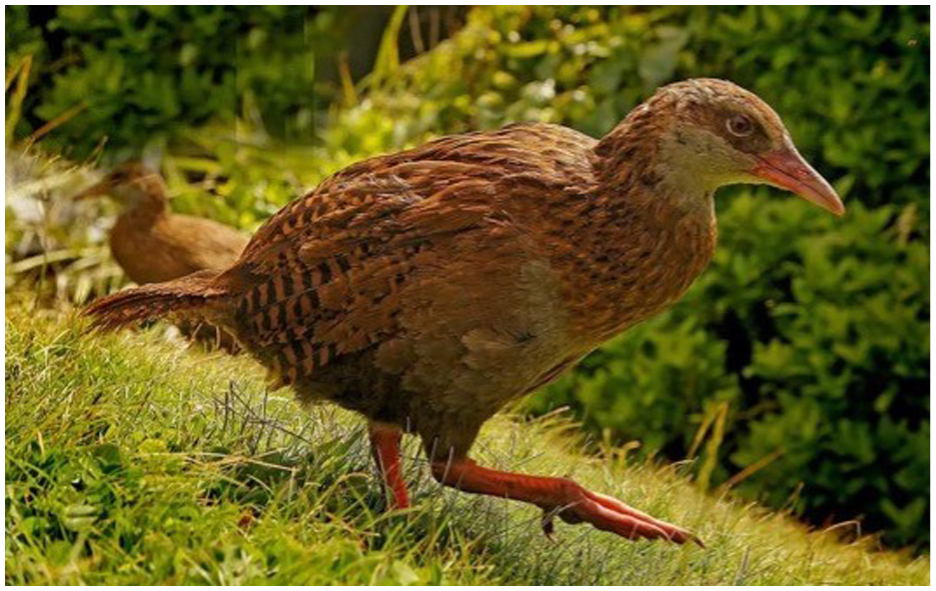
Image of the Bird Used in All Vignettes.
Cultural Importance of Human Food Practice
The core manipulation of this study was the emphasis on the cultural importance of the human food practice within the hypothetical scenario. The ‘Low Importance’ condition made no reference to the cultural importance of the eating practice, simply stating that the human character eats harven as part of a regular weekday. The ‘High Importance’ condition explicitly linked the eating of harven with an occasion of high human significance, stating that the character eats harven on a special cultural celebration. (See supplements for the full phrasings).
Own vs. External Cultural Context
To test if participants would extrapolate their understanding of the importance of the human eating practice, we also manipulated whether the scenario was set in the participants own country (UK) or an external country (Ecuador). The picture and name of the human character was adjusted to this context. Ecuador was selected as we deemed participants unlikely to have prior knowledge regarding the meat-eating norms of this culture, and is commensurate with similar literature which has used examples of ‘distant nations’ (Bratanova et al., 2011). To maintain the plausibility of our core manipulation we selected Christmas Day as the cultural celebration in the UK, and Fiesta de Quito as the cultural celebration in Ecuador.
Measures
Evaluation of Eating Meat
To assess the moral evaluation of eating animals, participants were asked how okay or not okay it was for the human character to eat the fictional bird on a six-point Likert-type scale (1 = really not okay, 6 = really okay).
Reasoning About Eating Meat
To assess their underlying reasonings, following the evaluation of meat-eating, participants were asked an open-ended question to explain their judgement. Participants were asked ‘why do you think it is okay or not okay for [character] to eat harven [on this regular day/during this celebration]?’
Moral Status Attribution
To assess their ascription of moral status, participants were asked how well they think the bird should be treated by humans: ‘how well should humans treat harvens?’ (1 = not well at all, 5 = extremely well).
Supplementary Measures
More exploratively, participants were also asked to evaluate how well they think the fictional bird is usually treated, the sentience (cognitive and emotional capacity) of the bird, how well the bird should be cared for compared to other species, and their willingness to volunteer to improve the quality of food and shelter for the bird. Results can be found in the supplements.
Data Coding & Analysis Plan
Open-ended reasoning data was coded using a framework (see Table 1 for definitions of the categories reported, see supplements for information on all reasoning categories) developed deductively using theory (Smetana et al., 2014; Turiel, 1983), and inductive category building based on the responses and recent developmental work in this area (McGuire et al., 2025; McGuire, Fry, et al., 2023). As pre-registered, categories were retained in analyses if they were used in more than 10% of cases. The reliability of the reasoning coding was assessed by two researchers independently coding the same responses (11% of all responses). Cohen’s κ = 0.82 indicated strong agreement between the coders.
Reasoning Category Use As a Function of Age Group.
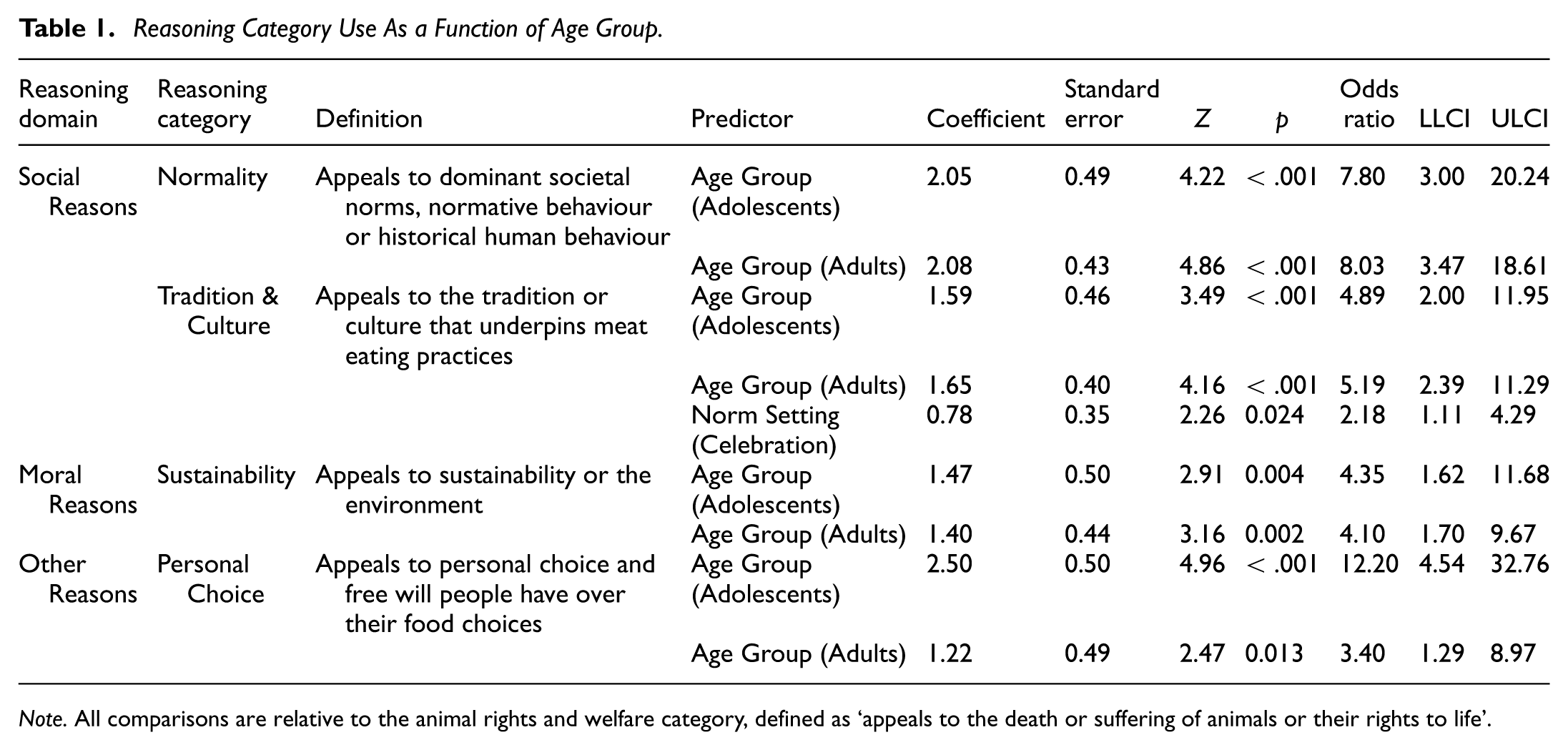
Note. All comparisons are relative to the animal rights and welfare category, defined as ‘appeals to the death or suffering of animals or their rights to life’.
The evaluation of eating animals and moral status attribution tasks were assessed using linear models. Age group, cultural importance, and cultural context were entered as fixed effects (with corresponding three-way and two-way interactions included in more complex models), with participant diet and pet ownership entered as covariates. Simple effects t tests were carried out where appropriate. Where higher order interactions were not statistically significant, model comparisons using Akaike information criteria (AIC) were conducted to justify the use of a simpler model.
Reasoning data was analysed using multinomial logistic regression. Age group, cultural importance, and cultural context were entered as fixed effects (with corresponding three-way and two-way interactions included in more complex models). We used animal rights & welfare as the reference category given that this is the primary moral justification for not eating animals (McGuire, Fry, et al., 2023) and to test what factors increase the likelihood of using other social-conventional or personal categories. Therefore, all references to likelihood refer to likelihood of using a reasoning category relative to the animal rights & welfare category.
Results
Evaluation of Eating Meat
The results of a linear model, R 2 = .17, F(11, 415) = 7.77, p < .001, demonstrated the main effect of age group was significant, F(2,415) = 20.48, p = < .001, η2 = .09, with adolescents, B = 1.12, SE = 0.27, LLCI = 0.59, ULCI = 1.64, t(415) = 4.15, p < .001, and adults, B = 0.82, SE = 0.26, LLCI = 0.31, ULCI = 1.34, t(415) = 3.14, p = .002, evaluating eating meat as more morally acceptable than children. No significant difference was found between adolescents and adults, B = -0.29, SE = 0.26, LLCI = -0.80, ULCI = 0.22, t(415) = -1.13, p = .26. The significant main effect was qualified by an interaction between age group and cultural importance, F(2,415) = 3.42, p = .03, η2 = .02. Simple effects analysis indicated that children were more likely to positively evaluate eating meat in the high cultural importance condition compared to the low cultural importance condition, F(1,415) = 7.07, p = .008. Adolescents’ and adults’ evaluation of meat consumption did not significantly differ between the cultural importance conditions (see Figure 2). Whether participants ate meat was a predictor of meat-eating evaluation, B = -0.93, SE = 0.18, LLCI = -1.29, ULCI = -0.57, t(415) = -5.13, p < .001, with participants who ate meat likely to report eating meat as more acceptable.
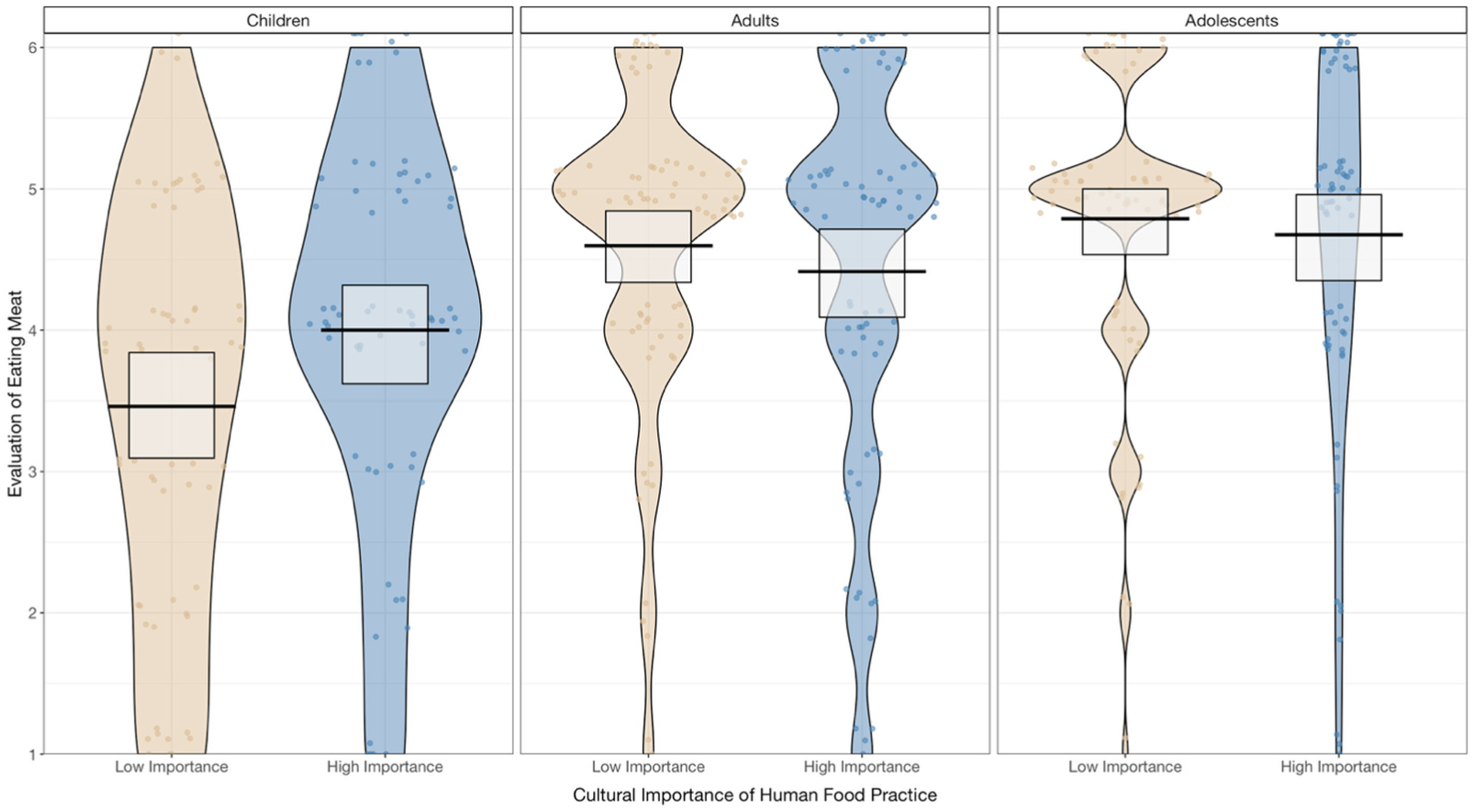
Moral Evaluation of Eating Meat as a Function of Participant Age (Children, Adolescent, Adult) and the Cultural Importance of the Human Food Practice (High, Low).
Reasoning About Eating Meat
For reasoning responses, model comparison results indicated the model with the main effects of age group, cultural importance, and cultural context, AIC = 1244.36, McFadden’s R 2 = 0.07, X 2 (20) = 92.25, p < .001, was a better fit than a model with two-way interactions (AIC = 1247.81) or 3-way-interaction (AIC = 1250.81) included. Coefficients (see Table 1) indicated that adolescents and adults were more likely than children to refer to normality, personal choice, sustainability, and tradition & culture.
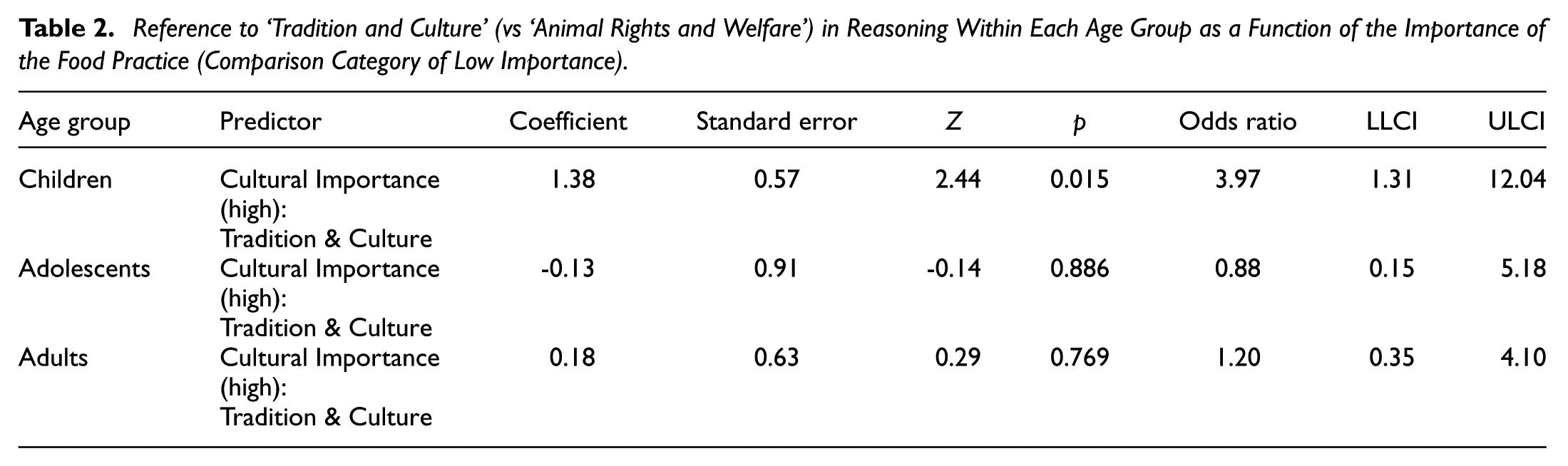
Over the whole sample, participants were also more likely to reference tradition & culture in the high cultural importance condition compared to the low cultural importance condition. Further analyses using age subsets showed, however, that children were more likely to refer to tradition in the high cultural importance condition compared to the low cultural importance condition. In contrast, in the adolescent and adult groups, there was no significant difference in appeals to tradition in the high importance condition (See Table 2).
Reference to ‘Tradition and Culture’ (vs ‘Animal Rights and Welfare’) in Reasoning Within Each Age Group as a Function of the Importance of the Food Practice (Comparison Category of Low Importance).
Moral Status Attribution
For evaluations of how humans should treat the bird, the results of a linear model, R 2 = .10, F(11, 416) = 4.32, p < .001, demonstrated the main effect of age group was significant, F(2,416) = 3.64, p = .027, η2 = .02. This effect was qualified by an interaction between age group and cultural importance, F(2,416) = 6.41, p = .002, η2 = .03. Simple effects analysis indicated that adults were more likely to attribute greater moral status to the bird in the high cultural importance condition compared to the low cultural importance condition, F(1,416) = 9.61, p = .002. For children and adolescents, there was no significant difference in moral status attribution between the cultural importance conditions (see Figure 3). In addition, there was a significant two-way interaction between age group and cultural context, F(2,416) = 6.37, p = .002, η2 = .03. Children were likely to attribute less moral status to the bird when eaten in the UK compared to Ecuador, F(1,416) = 5.26, p = .022, while adolescents decreased their moral status attribution to the bird in the Ecuador condition compared to the UK, F(1,416) = 7.04, p = .008. For adults, there was no significant difference in moral status attribution between the cultural contexts. Participants who ate meat were likely to attribute lower moral status to the bird, B = .26, SE = 0.11, LLCI = 0.04, ULCI = 0.48, t(416) = 2.37, p = .018. These results are not driven by people having different understanding of the experimental materials, as no differences were found between high and low socially important contexts regarding participants view on how humans usually treat food animals (see supplements).
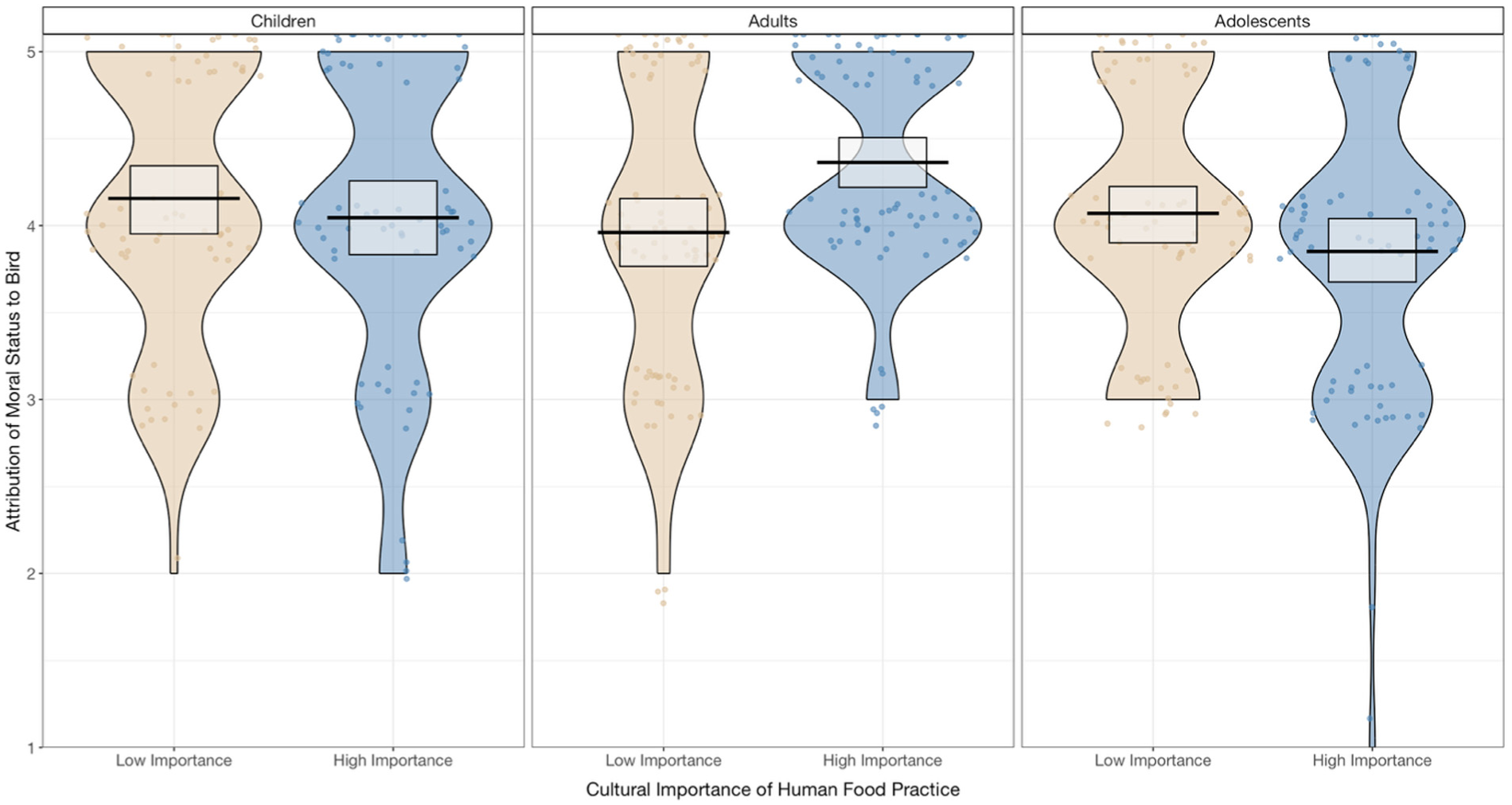
Moral Status Attribution as a Function of Participant Age (Children, Adolescent, Adult) and the Cultural Importance of the Human Food Practice (High, Low).
Taken together, our results show that children aged 8 to 11 years use the cultural importance of human food practices as an important cue to evaluate the consumption of meat as more morally acceptable, and to explicitly reference cultural values (e.g., traditions) in their reasoning. That was not the case for older participants. We conclude, therefore, that a trade-off between animal lives and cultural values is being made – at the latest–by the age of 8 to 11 years. Following this, we aimed to explore whether this trade-off would already be evident in a sample of younger children aged 4 to 7 years old. As there is no previous research on the trade-off between animal lives and cultural values that could indicate when it begins, we made conservative null hypotheses predictions regarding children’s moral evaluation of meat-eating and moral status attribution in situations of high vs. low cultural importance.
Study 2
Method
Design & Participants
This study employed a between-subjects design, manipulating the cultural importance (low vs. high) of the human eating practice in a younger sample of children. In total, 213 children were tested at a primary school within the South of England and at the entrance of a local zoo before interacting with any animals (see supplements for pictures of the testing site). Following our pre-registered exclusion criteria, the final sample for analyses included 168 participants (M age = 5.61, SD = 0.98, minimum age = 4 years old, maximum age = 7 years old, female n = 89, male n = 79, 46 tested in school, 122 tested in the zoo). Details about participant demographics and exclusions can be found in the supplements.
Procedure
All data was collected by the authors and trained lab assistants in one-to-one testing sessions. All stimuli were presented on tablets. School children were taken out of class to be tested individually, and children who participated at the zoo were tested individually at the site entrance. All children received consent from their guardians to participate and gave their own assent on the day of testing.
Due to the younger age range of participants, we employed a simplified version of the story and measures used in Study 1. The ‘Own vs. External Cultural Context’ manipulation was dropped, with all children in Study 2 reading the UK version of the story. The own cultural context was selected to increase the salience of the task for young children, and due to findings in Study 1 which indicate children extrapolate their understanding of tradition to external contexts. We retained the ‘Cultural Importance of Human Food Practice’ manipulation with children randomly assigned to see the hypothetical character eating on a day where the cultural importance was low (a regular weekday), or on a day of high cultural importance (Christmas day). After completion, participants were debriefed and children in the zoo were offered a sticker.
Measures
A subset of measures were taken from Study 1, with children responding to identical versions of the ‘evaluation of eating meat, ‘reasoning for eating meat and ‘moral status attribution’ tasks. As in Study 1, an exploratory measure asked participants to evaluate the sentience of the bird. Full details of this measure and the results can be found in the supplements.
Data Coding & Analysis Plan
Open-ended reasoning data was coded using the same framework and procedure as in Study 1 (see Table 1). As pre-registered, the categories used in more than 10% of cases were retained in analyses, this included the animal rights & welfare category (25%) and the tradition & culture category (17%).
The evaluation of eating animals and moral status attribution tasks were assessed using linear models with the cultural importance manipulation entered as a fixed effect. In addition, analysis of covariance (ANCOVA) was conducted for all tasks with centred age entered as a covariate. For all tasks, the effect of the cultural importance manipulation was consistent after controlling for variation due to age. The main effect of centred age and the interaction between centred age and cultural importance were not statistically significant in any model tested. To account for potential differences between the test sites, we also ran linear mixed effects models with test site included as a random effect. Statistical conclusions are consistent with the simple linear models, and the variance associated with test site was low for both measures (see supplements). As the present study does not meet the rules of thumb for obtaining robust and unbiased estimates of variance components in multilevel analysis (Aarts et al., 2014), all results presented will be from the simple linear models.
Reasoning data was analysed using multinomial logistic regression with the cultural importance manipulation entered as a fixed effect. In line with Study 1, in interpreting the findings, we used animal rights & welfare as the reference category. Therefore, all references to likelihood refer to likelihood of using a reasoning category relative to the animal rights & welfare category.
Results
Evaluation of Eating Meat
The results of a linear model demonstrated that the main effect of the cultural importance manipulation was significant, F(1,166) = 28.05, p < .001, η2 = .14, with children in the high cultural importance condition, B = 1.28, SE = 0.24, LLCI = 0.80, ULCI = 1.76, t(166) = 5.30, p < .001, evaluating eating the bird as more morally acceptable compared to children in the low cultural importance condition (see Figure 4).
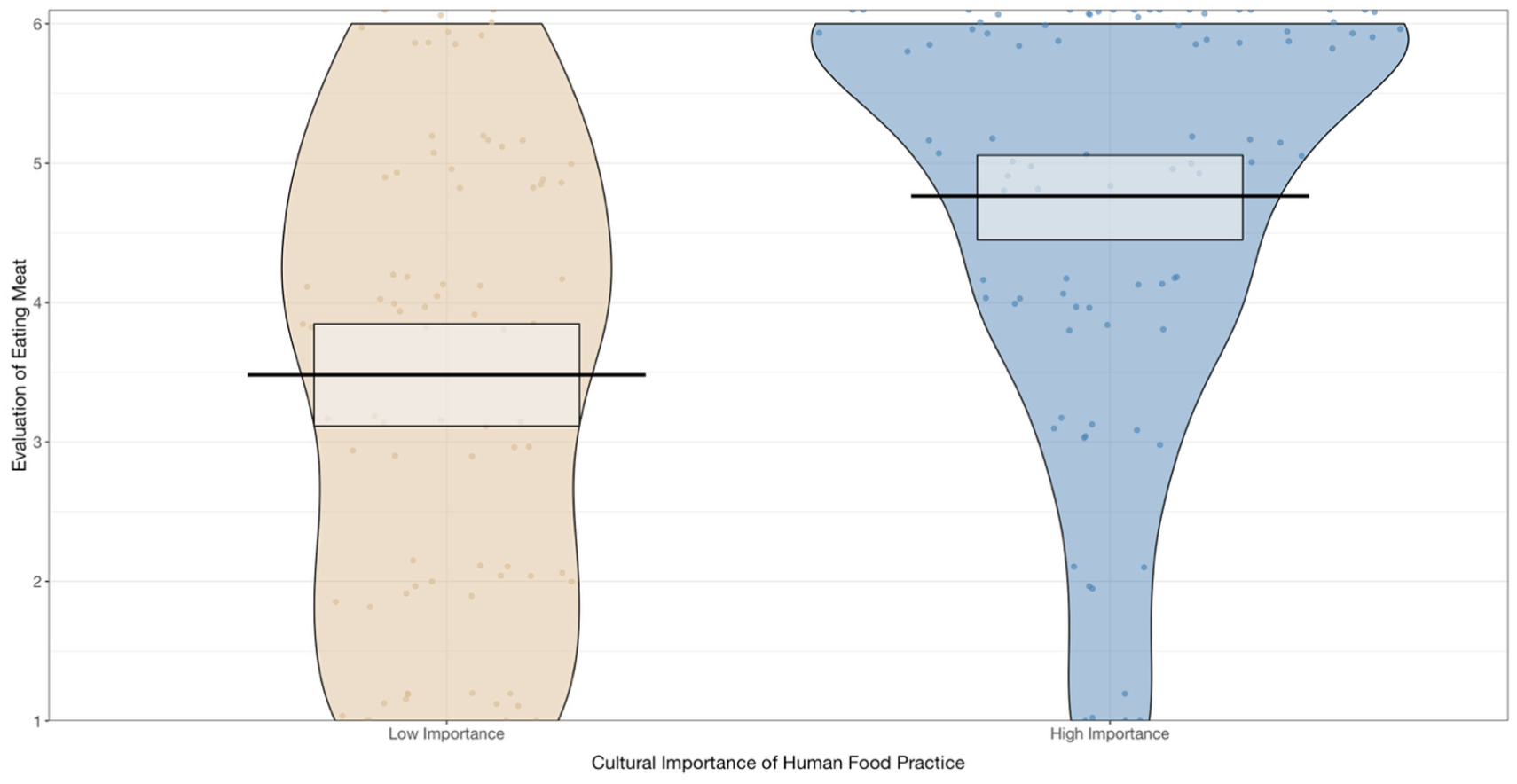
Young Children’s (Ages 4–7) Moral Evaluation of Eating Meat as a Function of the Cultural Importance of the Human Food Practice (High, Low).
Reasoning About Eating Meat
The results of a multinomial logistic regression indicated a model with the main effect of the cultural importance manipulation, AIC = 72.36, McFadden’s R 2 = 0.18, X 2 (2) = 15.26, p < .001, was a better fit than a model with the two-way interaction between age and the cultural importance manipulation, AIC = 72.87, McFadden’s R 2 = 0.22, X 2 (4) = 18.74, p < .001. Coefficients indicated that children were more likely to reference tradition & culture in the cultural importance condition (B = 3.02, SE = 1.07, Z =2.81, p = .005, OR = 20.40, LLCI = 2.49, ULCI = 166.97) compared to children in the low cultural importance condition.
Moral Status Attribution
For evaluations of how humans should treat the bird, the results of a linear model demonstrated the main effect of the cultural importance manipulation was not statistically significant, F(1,166) = 0.52, p = .472, η2 = .003, with children in the high cultural importance condition, B = 0.08, SE = 0.12, LLCI = -0.14, ULCI = 0.32, t(166) = 0.72, p = .472, attributing similar moral status to the animal compared to children in the low cultural importance condition.
General Discussion
Many people value human lives more than animal lives (e.g., Caviola et al., 2019), and meat-eating plays a central role in human cultural practices. Although adults are often capable of loving certain animals and eating others, how do children overcome their moral concern for other species to condone meat consumption? While prior studies have experimentally manipulated perceptions of animals as food and examined the impact on moral concern in adults (e.g., Bratanova et al., 2011), we provide the first experimental evidence showing that children can prioritize the importance of cultural values over animal lives. Across two studies, we found that children between the ages of 4 to 11 years traded off their moral concern for other species against the cultural importance of human food practices. This was expressed through evaluating meat-eating as more morally acceptable in situations where cultural values were made salient (i.e., ‘special’ food practices), and through justifications which increasingly referenced the significance of tradition.
Such findings illuminate the role of socialization as one key pathway which helps children endorse the consumption of animals as they develop. Recent perspectives suggest that the modelling of cultural values is one way in which children’s moral expansiveness is constricted across development (Marshall et al., 2025). We find the explicit pairing of meat consumption with valued human practices to be one important signal that children as young as 4 years old use to understand when and why it is acceptable to eat animals. The present study supports existing evidence and theory which states children are primed to the social norms of their environment and are motivated to reinforce the practices of their group (Heyes, 2024; Schmidt & Tomasello, 2012). In our study, children used valued human practices as justification to incur a moral trade-off, deeming the use of an animal’s life as more permissible under these conditions.
We found that only in childhood did an explicit cue to high cultural importance lead to evaluations of meat-eating as more morally acceptable. This suggests childhood is a critical window where moral and social conflicts regarding how humans see animals are most prominent. Adolescents, like adults, evaluated meat consumption as equally morally acceptable in contexts of high and low cultural importance, with a greater diversity of reasoning justifications. This may suggest that socialization into eating animals follows a dual pathway, with daily food practices involving meat consumption another important process through which youth learn to accept eating animals. The increasing and repeated exposure to meat-eating that children experience with age may help older individuals internalize meat-eating as a mundane act. Thus, at some point in development, additional social cues, such as the importance of human practices, are no longer needed to see eating animals as morally acceptable. We believe mundane meat consumption, in addition to human practices which reinforce the signal that cultural values are important, work in tandem to teach children who it is acceptable to eat. Future work should explore this potential dual pathway, with longitudinal research needed to identify when the salience of cultural values is no longer required to shift moral evaluations of meat-eating.
It is not the case that adults disregard the importance of human eating practices completely. Interestingly, adults gave higher moral status to an animal eaten as part of culturally important human practices. Adults perceive animals in their moral standing between humans and objects, with food animals of particularly low moral standing (Caviola et al., 2021). We speculate that indeed by adulthood, meat-eating has become so mundane, that eating these animals on a special occasion imbues them with some special quality wherein they ought to be treated better up until the point they are consumed by humans. Anecdotally, there are real world examples where humans imbue special status to animals as part of cultural practices, for example, the president of the United States issuing a ceremonial ‘pardon’ to a turkey. Moreso, in our own findings, people reasoned about the ethical production of food, expressing that animals should be cared for well up until the point of consumption. Nevertheless, this finding adds further complexity to research exploring how adults overcome meat-related cognitive dissonance (Rothgerber, 2020) and potentially indicates that meat-eating and moral status judgements do not entirely overlap. Indeed, assigning higher moral status to the animals eaten as part of important cultural practices may help to mitigate the uneasy psychological feelings associated with the knowledge that many animals suffer to make such practices possible. This research provides the first evidence that perceived acceptability to eat cannot be simply translated into an individual having low moral status, with adults assigning ‘special’ moral status to a species eaten on ‘special’ occasions. Future research is called for to further shed light on these processes.
Our work is not without limitations. The generalizability of our results is limited due to the cultural specificity of our design. We selected Christmas as the primary example of an occasion of high importance due to the target demographic of our research, and its implicit connection with meat consumption. Reliance on an occasion of religious and western origin limits our ability to generalize beyond these settings due to the interconnected nature of culture and food. Although our inclusion of an ‘external’ cultural context may help to mitigate against this, we cannot rule out the possibility that participants extrapolated their knowledge of Christmas for use in the Ecuador vignette. It is also important to note cultural practices exist that emphasize restricted meat diets (e.g., Buddhism, Hinduism), and future research should explore how these normative expectations shape the development of thinking around animals and food. Similarly, while we selected a bird species due to the commonality of eating birds as part of special human practices, it is important to note people may respond differently when asked about different animals, such as mammals. Future work should therefore investigate if similar patterns emerge for a greater range of human food practices, including those where other farmed animals are eaten.
In addition, reliance on the phrasing ‘how okay’ to elicit a moral evaluation is potentially ambiguous and could reflect non-moral concerns such as taste, cultural norms, or disgust. However, we believe this wording is suitable for the current work given it is one of the only that is suitable across our age range, and is comparable with existing moral development research (e.g., McGuire, Palmer, & Faber, et al., 2023, Reinecke et al., 2025). In addition, our reasoning data provides strong complementary evidence to suggest the evaluation questions are related to moral thinking, with moral arguments a primary response in youth (e.g., ‘Because you will have to kill it and that’s not ok’, ‘Because it’s cruel to eat it’), and adulthood (e.g., ‘Why do birds need to be harmed for some traditional festival?’). Yet, when working across broad age ranges it cannot be excluded that there have been differences in understanding. It would be ideal if future, methodologically oriented research could explicitly test how certain phrasings are perceived across development.
Eating animals has been leveraged for occasions of high importance throughout human history, something which the present work identifies as one important contributor to the way we think about animals. In recent years, the need for reduction of global meat consumption has become evident (Clark et al., 2020). To promote more sustainable food choices, raising the value of plant-based food by pairing it with occasions of high human significance may be one interesting avenue to explore. This work centres childhood as a period where moral values can conflict with human cultural practices, with the trade-off between these two concerns representing a key developmental and socialization milestone.
Supplemental Material
sj-docx-1-spp-10.1177_19485506251398890 – Supplemental material for Values Over Virtues: How Children Trade Off Their Moral Concern for Animals With the Importance of Human Eating Practices
Supplemental material, sj-docx-1-spp-10.1177_19485506251398890 for Values Over Virtues: How Children Trade Off Their Moral Concern for Animals With the Importance of Human Eating Practices by Alexander G. Carter, Nadira S. Faber and Luke McGuire in Social Psychological and Personality Science
Footnotes
Handling Editor: Lora Park

Author Contributions
Alexander G. Carter: Conceptualization, Methodology, Formal Analyses, Investigation, Writing – Original Draft Preparation, Visualization
Nadira S. Faber: Conceptualization, Methodology, Investigation, Writing – Review & Editing, Supervision
Luke McGuire: Conceptualization, Methodology, Investigation, Writing – Review & Editing, Supervision
Funding
The authors disclosed receipt of the following financial support for the research, authorship, and/or publication of this article: The lead author was supported by an Economic and Social Research Council Studentship
Declaration of Conflicting Interests
The authors declared no potential conflicts of interest with respect to the research, authorship, and/or publication of this article.
Data Availability Statement
Supplemental Material
The supplemental material is available in the online version of the article.
Author Biographies
References
Supplementary Material
Please find the following supplemental material available below.
For Open Access articles published under a Creative Commons License, all supplemental material carries the same license as the article it is associated with.
For non-Open Access articles published, all supplemental material carries a non-exclusive license, and permission requests for re-use of supplemental material or any part of supplemental material shall be sent directly to the copyright owner as specified in the copyright notice associated with the article.
