



Abstract
Minority group membership is often explicitly mentioned in news reports, while majority membership is unstated. This results in an overrepresentation of minority labels in negative contexts (e.g., crime reports). While this may reflect motivated biases to derogate minorities, we propose it may also result from a basic cognitive principle of differentiation. Distinctive features, such as minority status, are more likely to attract attention, be remembered, and be communicated. Across five studies (N = 905), we found that participants were more likely to mention individuals’ minority membership than majority membership when summarizing both negative and positive events. This communicative asymmetry persisted even when group labels were incidental and evaluatively neutral, and it was also evident in large language models trained on human data. The disproportionate communication of minority memberships creates a “minority dilemma” in news reporting: Because news media contexts are often negative, people may form overly negative stereotypes toward minorities.
Media coverage often disproportionately identifies individuals by their minority group membership, leaving majority group affiliations unstated. For example, a criminal suspect may be described as “an immigrant,” whereas majority characteristics such as “native-born” are rarely specified (Hestermann, 2019). This asymmetry contributes to a biased representational landscape in which minorities are overrepresented in media coverage of crimes (Dixon & Williams, 2015; Entman & Rojecki, 2001), despite comprising a smaller share of actual offenders (Federal Bureau of Investigation [FBI], 2019). While existing accounts often attribute such overrepresentation of minorities in the (mostly negative) news media environment to intentional biases or intergroup motivations, such as self-enhancement (Abrams & Hogg, 1988; Wilson et al., 2013) or preferences for hierarchical group structures (Pratto et al., 2006), we propose that a more “innocent” cognitive mechanism also plays a key role: the principle of differentiation. According to this principle, communicators preferentially attend to and transmit distinctive attributes (Grice, 1975; Hamilton & Gifford, 1976; Sherman et al., 2009). Because minority status inherently deviates from the social norm, it is more likely to be noticed, remembered, and communicated, regardless of communicators’ motives. While attentional and perceptual distinctiveness effects are well established, their implications for communication patterns, such as how minority labels propagate through speech, reporting, and media narratives, have not been systematically tested. In this project, we test whether the principle of differentiation contributes to systematic patterns in how group membership is communicated, specifically, whether minority group membership is disproportionately mentioned in descriptions of both negative and positive events. We introduce the concept of a “minority dilemma”: A communicative bias that, even in the absence of malicious intent, may reinforce social stereotypes through repeated over-labeling of minority identities in news reporting and public discourse. By doing so, we extend cognitive approaches into the domain of social communication, demonstrating that overrepresentation of minority identities is a predictable outcome of information transmission.
Differentiation in Attention, Learning, Memory, and Attitude Formation
The principle of cognitive differentiation, where distinct features receive priority over common ones, operates across multiple levels of cognition and helps explain why minority group membership becomes disproportionately salient in social perception. At the attentional level, people notice attributes that deviate from contextual norms. Minority-defining cues, therefore, stand out more than majority ones, especially in intergroup settings (Fiedler, 2000; Hamilton & Gifford, 1976; McGarty et al., 2002; Tajfel & Wilkes, 1963). This attentional advantage extends into learning and memory. Distinctive cues are learned and remembered more readily than redundant ones (Alves et al., 2020; Kamin, 1968; Kruschke, 2003, 2009; Rescorla & Wagner, 1972), making minority attributes more likely to be encoded and retained (Sherman et al., 2009).
Differentiation also shapes attitude formation. When evaluating unfamiliar people or groups, perceivers rely heavily on attributes that set them apart (Alves et al., 2018; Bruine de Bruin & Keren, 2003; Koch et al., 2024; Woitzel & Alves, 2024). Such distinctive features often define category representations (Krueger & Rothbart, 1990) and stereotypes (Ford & Stangor, 1992). As a result, members of minority groups are more likely perceived (and perceive themselves) in terms of their minority identity than are majority members (Nelson & Miller, 1995; Simon & Hamilton, 1994; Wooten, 1995). Over time, these processes amplify the salience of minority identities (Kardosh et al., 2022). When combined with rare and highly evaluative behaviors, such as crime, the joint distinctiveness of group and behavior can produce especially strong impressions, reinforcing negative stereotypes (Hamilton & Rose, 1980; Hamilton & Sherman, 1989).
Differentiation in Communication
We propose that cognitive differentiation also extends to communication. According to Grice’s (1975) Maxim of Quantity, effective communication is informative and avoids redundancy. Probabilistic models of pragmatic reasoning have formalized how speakers choose utterances to maximize informativeness relative to the listener’s expectations (Frank & Goodman, 2012; Goodman & Frank, 2016; Peloquin et al., 2020). In these models, an utterance is more likely to be produced if it reduces uncertainty for the listener, that is, if it conveys information that is distinctive, unexpected, or otherwise informative. Consequently, communicators mention distinctive attributes and omit redundant ones (Alves et al., 2022; Engelhardt et al., 2006). Minority membership is both statistically rarer and contextually distinctive, so it carries higher predictive value than majority membership, which is typically assumed by default. For instance, in the United States, describing someone as “the German neighbor” conveys more specific information than calling someone “the American neighbor.”
Linguistic research on markedness supports this asymmetry: Dominant categories (e.g., men, White Americans) function as unmarked defaults, whereas minority categories are explicitly labeled (Cheryan & Markus, 2020; Waugh, 1982). A Black man is labeled as such; a White man is usually just “a man,” mirroring broader social structures that treat majority status as normative (Brekhus, 1998). Media practice reflects this pattern, for example, by referring to Barack Obama as the “Black” presidential candidate and Hillary Clinton as the “female” candidate, with race and gender rarely specified for White male candidates (Holt, 2012).
If distinctive attributes are prioritized in communication as at different levels of cognition, then crime reports will disproportionately mention minority status while omitting majority labels. From an information-theoretic perspective, this selective labeling maximizes informativeness without requiring explicit bias, yet it inflates the visibility of minority perpetrators in news coverage (Colburn & Melander, 2018; Jacobs et al., 2018), particularly when the minority group is numerically small and, therefore, especially distinctive (Caliendo & McIlwain, 2006).
The Minority Dilemma
This communicative pattern becomes especially problematic in the context of the media’s negativity bias—its tendency to prioritize crime, violence, and other negative topics (Bednarek & Caple, 2017; Esser et al., 2016). This focus often contrasts with everyday experiences, where individuals are exposed to more positive social interactions (Alves et al., 2017; Unkelbach et al., 2019) and predominantly interact with majority group members (Halberstadt et al., 2011; Sherman et al., 2009). For many, the media serves as the primary source of information about minority groups, skewing perceptions by emphasizing negative contexts in which minorities are portrayed (Eberl et al., 2018; Gilliam & Iyengar, 2000).
Combining these considerations, we argue that minority groups face an evaluative disadvantage in media coverage, which we term the “minority dilemma.” Minority membership is more likely to be communicated than majority membership because it constitutes a differentiating attribute. In predominantly negative media contexts, this leads to an overrepresentation of minority labels in unfavorable settings.
The Present Research
This work tested the hypothesis that minority attributes are more likely to be communicated than majority attributes due to their distinctiveness. We first used an artificial setting with fictitious alien groups to ensure this principle operates independently of communicators’ self-serving motives or existing associations with the groups (Studies 1a–b and 2). We then examined real-world scenarios, investigating how participants reported on immigrant minorities in simulated crime-related news contexts (Study 3). To further test whether this reporting tendency reflects a general cognitive principle rather than context-specific motivations, we also examined reporting for positive incidents (Study 4). Finally, we tested our hypothesis on six large language models (LLMs) to see whether they reproduce this human communication tendency inherent in their training data.
Transparency and Openness
The hypotheses, designs, and analysis plans of all participant-based studies were preregistered. For all studies, we set sample sizes to detect small-to-medium-sized effects with sufficient statistical power (> .90) in the respective designs (Cohen, 1992). We report all data exclusions (if any), manipulations, and measures. All preregistrations, data, code, and materials are available on the Open Science Framework (OSF): https://osf.io/a43vt/overview?view_only=ad4910be34c84264ad397f03f13f6e51. Data were analyzed using R, version 4.3.1 (R Core Team, 2023). All studies were approved by the ethical committee of our university and met the ethical guidelines of the American Psychological Association (APA).
Studies 1a and 1b: Alien Groups
Studies 1a and 1b tested whether people are more likely to communicate a target’s minority attributes than its majority attributes. We chose fictional alien groups as targets to investigate participants’ communication behavior independent of their expectations or self-serving motivations. Specifically, we tested whether participants are more likely to mention an “evil” alien’s minority attributes (that distinguish it from the majority of other aliens) than its majority attributes (that it shares with other aliens) to warn about the alien, either by selecting from a given set of attributes (Study 1a) or describing them in their own words (Study 1b).
Participants
We recruited 201 participants (Study 1a: n = 100, Mage = 36.8 years, SDage = 10.5 years; 64% female, 36% male; Study 1b: n = 101, Mage = 39.2 years, SDage = 14.1 years; 60.4% female, 36.6% male, 1.0% other, 2.0% prefer not to say) on Prolific Academic. All participants were located in the United Kingdom and participated for a compensation of £9/hour.
Materials and Procedure
We employed an experimental learning paradigm in which participants were sent on a virtual “space explorer” mission and encountered a tribe of three aliens. Each alien displayed three visual features (i.e., blue vs. red skin, antennae vs. no antennae, tail vs. no tail). Each feature had a majority attribute (e.g., two out of three aliens had blue skin) and a minority attribute (e.g., one out of three aliens had red skin). Hence, each alien had two majority attributes and one minority attribute. Attribute assignments were randomized per participant. Figure 1 displays an exemplary stimulus set. Participants encountered each alien four times (randomized order) and were instructed to observe their attributes and form an impression of the tribe. Afterward, participants were told that one “evil alien” would steal future participants’ rewards in a monetary game and that they could warn those participants about that alien. After the presentation of the evil alien (one randomly displayed alien from the learning phase), participants in Study 1a received that alien’s attributes (e.g., blue skin, antennae, and no tail) and selected one to communicate to future participants. In Study 1b, participants freely described the alien using a textbox.

Exemplary Stimulus Set for Studies 1a and 1b
Results
For Study 1a, we conducted a binomial test to determine whether the probability of participants choosing the minority attribute significantly differed from the expected probability under the null hypothesis (i.e., 0.33, given that there was one minority attribute among three). In line with our predictions, participants chose the minority attribute significantly more often than expected under the null hypothesis, p(minority) = 0.65, 95% CI = [0.55, 0.74], p < .001. In other words, participants chose the minority attribute 65% of the time, which is significantly higher than the 33% expected by chance if they were equally likely to select any of the three attributes. For example, if an alien had blue skin (majority), antennae (majority), and a tail (minority), participants were more likely to select “tail” as the attribute to report.
For Study 1b, participants’ text responses were searched for words referring to antennae, skin color, or tail, and coded in a variable indicating whether each attribute was mentioned. We then determined whether each mention corresponded to the alien’s minority or majority characteristic and calculated, for each participant, the difference in the proportion of minority versus majority attributes mentioned. We then conducted a one-sample t-test that tested the observed mean difference in the proportion of mentioned minority versus majority attributes against the expected value of −0.33, that is, the expected difference under the null hypothesis: p(minority)—p(majority) = 0.33 − 0.66 = −0.33. An observed mean difference of 0 would indicate equal mention of minority and majority attributes, a positive Mdiff indicates more mentions of minority attributes, and a negative Mdiff indicates fewer mentions of minority attributes. Results revealed that participants mentioned minority attributes more often than majority attributes (Mdiff = 0.16, SDdiff = 0.95), and the difference was significantly higher than expected under the null hypothesis (i.e., Mdiff = −0.33), t(88) = 6.44, p < .001, d = 0.68, 95% CId = [0.45, 0.91]. Since participants in Study 1b were able to mention more than one attribute, we also investigated the subsample of participants who named only one single attribute and found an even stronger deviation of the observed mean difference (Mdiff = 0.38, SDdiff = 0.85) from the expected value under the null hypothesis (Mdiff = −0.33), t(67) = 7.034, p < .001, d = 0.85, 95% CId = [0.57, 1.13].
Discussion
Studies 1a and 1b showed that people are more likely to communicate minority attributes than majority attributes when asked to identify a target (here: alien) based on limited visual features. Study 2 tested the differentiation principle in a less restricted way by asking participants to write news headlines about crime incidents that involved alien suspects with several majority and minority features.
Study 2: Alien Incidents
Study 2 presented participants with descriptions of criminal incidents that happened on an alien planet, including the suspect’s attributes (e.g., number of eyes) and their prevalence on the planet. Participants were then asked to write a short news headline about the incident. We predicted that minority attributes would be more likely mentioned than majority attributes.
Participants
We recruited 100 participants (Mage = 43.0 years, SDage = 13.5 years; 49% female, 50% male, 1% other) on Prolific Academic. All participants were located in the United Kingdom and participated for £9/hour.
Materials and Procedure
Participants read a fictional press release about a crime that occurred on a faraway planet. The press release included information about the perpetrator alien, who was described by six attributes (tribe membership, skin texture, number of eyes, number of legs, number of antennae, and energy source). Three attributes were described as common among the planet’s population (i.e., majority attributes, > 90%, e.g., “92% of the aliens on this planet have four legs”) and three as rare (i.e., minority attributes, < 10%, e.g., “7% of the aliens on this planet are scale-covered”). Minority and majority status were randomly assigned for each attribute. The stimuli are available on the OSF. After reading the crime report, participants were asked to summarize it for a news article. We determined the number of mentions of minority and majority attributes by searching for words referring to the six attributes listed above, and then coding whether each mention corresponded to the alien’s minority or majority characteristic.
Results
We conducted a paired t-test to compare the number of majority versus minority attributes mentioned. In line with our predictions, participants reported more minority attributes (M = 1.62, SD = 1.25) than majority attributes (M = 0.85, SD = 1.13) of the perpetrator, t(99) = 6.26, p < .001, d = 0.63, 95% CId = [0.41, 0.84]. Participants mentioned minority attributes nearly twice as often as majority attributes, despite an equal number of minority and majority attributes in the press releases.
Discussion
Consistent with the differentiation principle, participants were more likely to mention minority attributes than majority attributes in news headlines. Next, we tested whether this effect extends to real-world contexts involving human suspects with majority or minority identities (i.e., U.S. natives vs. immigrants).
Study 3: Negative Real-World Incidents
Study 3 tested whether people are more likely to mention minority attributes than majority attributes when writing news headlines about crimes involving human suspects. Specifically, we hypothesized that participants would mention a perpetrator’s origin more often if it is a minority attribute (i.e., immigrant) than a majority attribute (i.e., U.S. native). We also assessed participants’ group memberships to account for ingroup biases and the length of written texts to account for detailedness.
Participants
We recruited 301 participants (Mage = 42.0 years, SDage = 14.0 years; 53.2% female, 44.9% male, 1.7% other, 0.3% prefer not to say) on Prolific Academic. All participants were located in the United States and participated for £9/hour.
Materials and Procedure
Participants read two fictional FBI press releases about criminal incidents (e.g., robbery, arson, and drug trafficking) along with perpetrator profiles. We manipulated within-participants whether the perpetrator was described as belonging to a majority or minority in the United States. In the majority condition, the perpetrator’s country of origin was the United States. In the minority condition, the perpetrator’s country of origin was one of the countries from which the largest immigrant groups in the U.S. originate (Mexico, India, China, Philippines, El Salvador, Vietnam, Cuba, Dominican Republic, Guatemala, Korea; random assignment). Sex (i.e., male) was kept constant, and all other characteristics (i.e., age, weight, height, clothing, and physical features) varied randomly across conditions (e.g., the two presented perpetrators never had the same clothing). The stimuli are available on the OSF. After reading each report, participants were asked to summarize it for a news article. We measured whether participants mentioned the perpetrator’s country of origin (or variations thereof, e.g., “Mexican” instead of “Mexico”). Participants also indicated their own group affiliation (U.S. native vs. presented minority vs. another minority) and estimated the minority group’s prevalence in the United States (analyses appear in the outputs section on the OSF, as they are not central to the question being asked in this article).
Results
We used the R package lme4 (Bates et al., 2015) to compare the two conditions (country of origin: minority/immigrant vs. majority/U.S.) in a mixed-effects logistic regression model, including condition (dummy-coded: 1 = minority and 0 = majority) as a fixed factor, participants as a random factor, and mention of country of origin (binary: 1 = yes and 0 = no) as the outcome. Results revealed a significant effect of condition, b = 3.42, 95% CIb = [2.42, 4.93], SE = 0.60, z = 5.68, p < .001. Participants were over three times as likely to mention the minority perpetrator’s origin as the majority perpetrator’s origin (see Figure 2A). This effect persisted when adding group membership (i.e., whether participants belong to the respective immigrant group) and length of written texts as predictors. It also remained significant within subsamples of participants who read about a perpetrator from their ingroup and those who self-identified as members of an immigrant minority (see the outputs section on the OSF for detailed results).
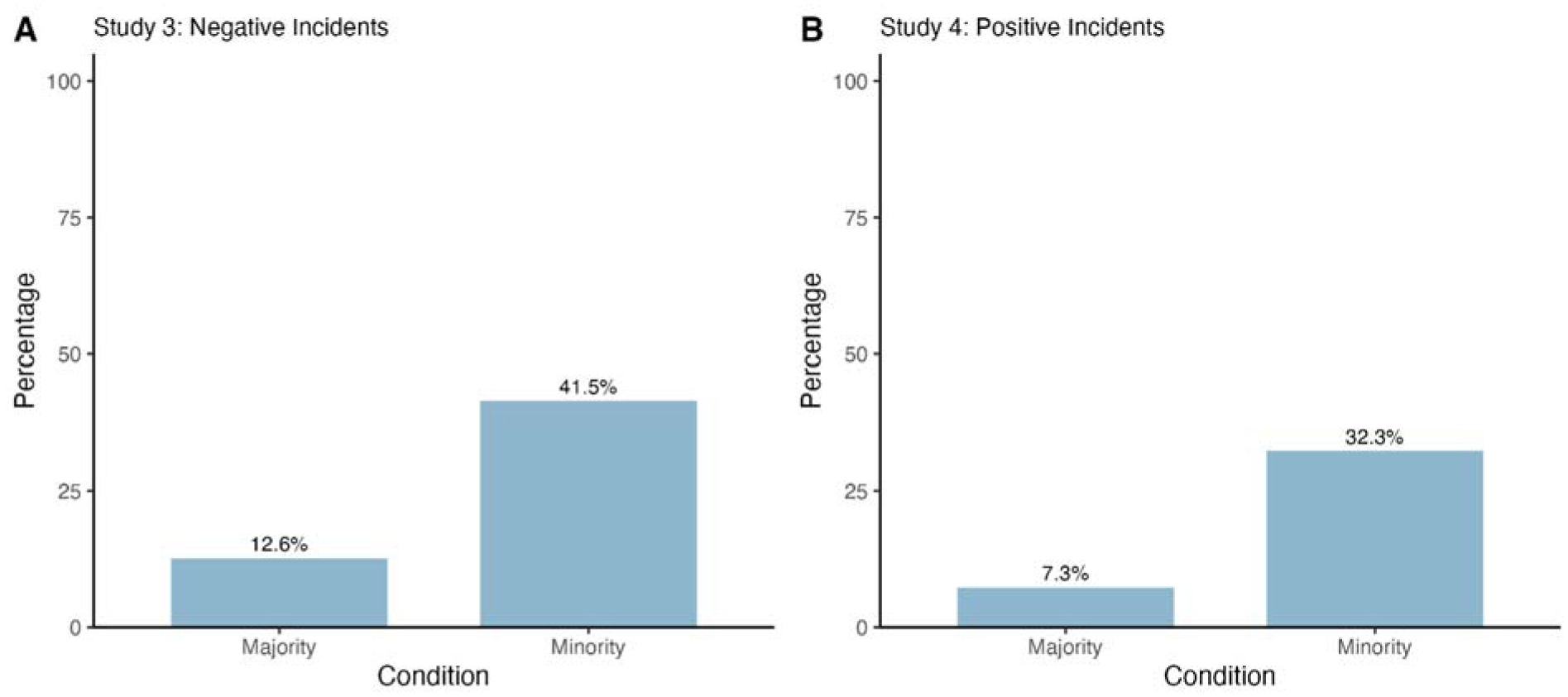
Percentages of Mentioning the Target Person’s Country of Origin for Study 3 (A) and Study 4 (B)
Discussion
Study 3 found that participants were more likely to mention a perpetrator’s minority origin (i.e., immigrant) than a majority origin (i.e., U.S. native) in headlines with negative news content. While this aligns with our idea of a differentiation principle that prioritizes distinct over redundant attributes in communication, it could also reflect motivated biases to derogate minorities. In contrast to motivated biases, the cognitive differentiation principle predicts that prioritization of minority over majority attributes should also be observed in reporting about positive events, which we tested in the following Study 4.
Study 4: Positive Real-World Incidents
Study 4 presented participants with reports of positive instead of negative events and attributes (including origin) of the person involved. We tested whether minority origin was again more likely to be reported than majority origin.
Participants
We recruited 303 participants (Mage = 38.7 years, SDage = 13.6 years; 48.2% female, 49.2% male, 1.3% other, 1.3% prefer not to say) on Prolific Academic. All participants were located in the United States and participated for £9/hour.
Materials and Procedure
The procedure was similar to Study 3, except that participants now read about two positive incidents (e.g., a lottery win, an unexpected discovery, a scientific breakthrough; see materials section on the OSF for detailed stimuli). We again manipulated within-participants whether the target person was described as belonging to a majority (i.e., U.S. native) or minority (i.e., immigrant) in the United States. Participants were asked to summarize the incident for a news article, indicate their group membership, and estimate the minority group’s prevalence in the United States.
Results
As in Study 3, we compared the two conditions (country of origin: minority/immigrant vs. majority/U.S.) in a mixed-effects logistic regression model, including condition (dummy-coded: 1 = minority and 0 = majority) as a fixed factor, participants as a random factor, and mention of country of origin (binary: 1 = yes and 0 = no) as the outcome. Results revealed a significant effect of condition, b = 2.47, 95% CIb = [1.77, 3.34], SE = 0.39, z = 6.28, p < .001. Participants were over four times as likely to mention the target’s country of origin when it constituted a minority rather than a majority (see Figure 2B). This effect persisted when adding group membership (i.e., whether participants belong to the respective immigrant group) and length of written texts as predictors. It also remained significant within subsamples of participants who read about a perpetrator from their ingroup and those who self-identified as members of an immigrant minority (see the outputs section on the OSF for detailed results).
Discussion
Study 4 replicated that minority attributes are prioritized in the reporting of positive news events. As in Study 3, participants mentioned the target’s origin more often when it constituted a minority rather than the majority. This suggests that minority status is seen as newsworthy in both positive and negative contexts, supporting our proposal that the prevalence of minority labels in media reflects a general cognitive principle of differentiation, not solely a motivation to portray minorities negatively.
Replication in Large Language Models
In addition to investigating human participants, we were interested in whether LLMs would reproduce the overreporting of minority labels. As LLMs play an increasingly central role in producing news content (Sonni et al., 2024), uncovering such asymmetries in AI-generated text is especially important. Prior research has shown that LLMs, trained on large corpora of human-generated text, often reflect and even amplify motivated biases embedded in their training data (Bai et al., 2025; Glickman & Sharot, 2025). Assuming that human communication tendencies are similarly reflected in their training data, we propose that they reproduce this pattern as well.
Materials and Procedure
We applied the tasks from Studies 3 and 4 to six different LLMs: ChatGPT-3.5 (OpenAI, 2023) and ChatGPT-4o (OpenAI, 2024), Cohere Command and Cohere Command Light (Cohere, 2024a, 2024b), and Mistral-7B and Mistral Small (Mistral AI, 2024a, 2024b). These models allow automated interactions using an application programming interface (API). We generated R code that automatically sends requests to the respective model and stores its responses. We used the following procedure for each model, separately for negative incidents (replicating Study 3) and positive incidents (replicating Study 4): First, we randomly generated 500 majority scenarios and 500 minority scenarios, using the same instructions and stimuli as in Studies 3 and 4, respectively. Next, we let the model respond twice to each of the 1,000 prompts to assess response reliability. Due to a high consistency (negative incidents: Cohen’s κ = .99; positive incidents: Cohen’s κ = .98) between responses across all LLMs, we coded them together. To increase reproducibility, the “temperature” of each model (i.e., the parameter controlling the randomness of the model’s predictions) was set to 0. Each request was independent of the previous one, approximating a between-subjects design.
Results
We analyzed the summaries generated by the LLMs regarding whether the perpetrator’s country of origin was mentioned. Table 1 shows how frequently each LLM mentioned it in each context. We tested the aggregated data in a logistic regression model predicting whether the LLMs mention the target’s country of origin (binary: 1 = yes and 0 = no) from condition (dummy-coded: 1 = minority and 0 = majority).
Percentages of LLMs Mentioning the Target’s Country of Origin
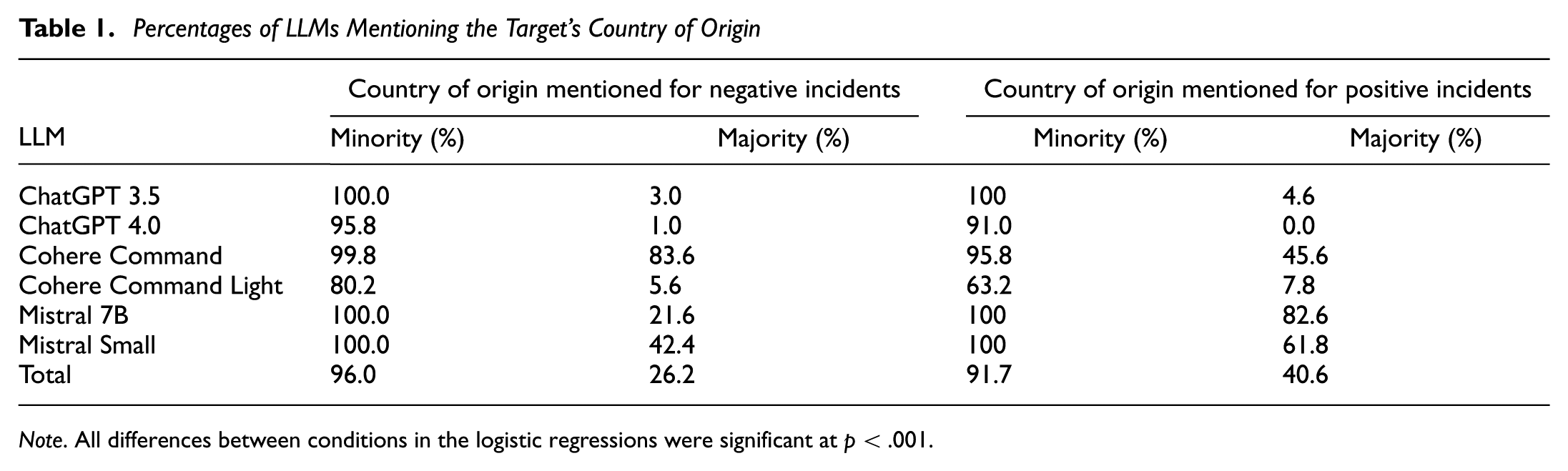
Note. All differences between conditions in the logistic regressions were significant at p < .001.
For the negative incidents, we found a significant effect of condition, b = 4.21, 95% CIb = [4.01, 4.41], SE = 0.10, z = 41.37, p < .001. The perpetrator’s origin was mentioned more than three times as often when it constituted a minority rather than a majority (see Figure 3A). This pattern was also significant for positive incidents, b = 2.78, 95% CIb = [2.63, 2.93], SE = 0.08, z = 36.64, p < .001. The target’s origin was mentioned more than twice as often when it represented a minority rather than a majority (see Figure 3B).
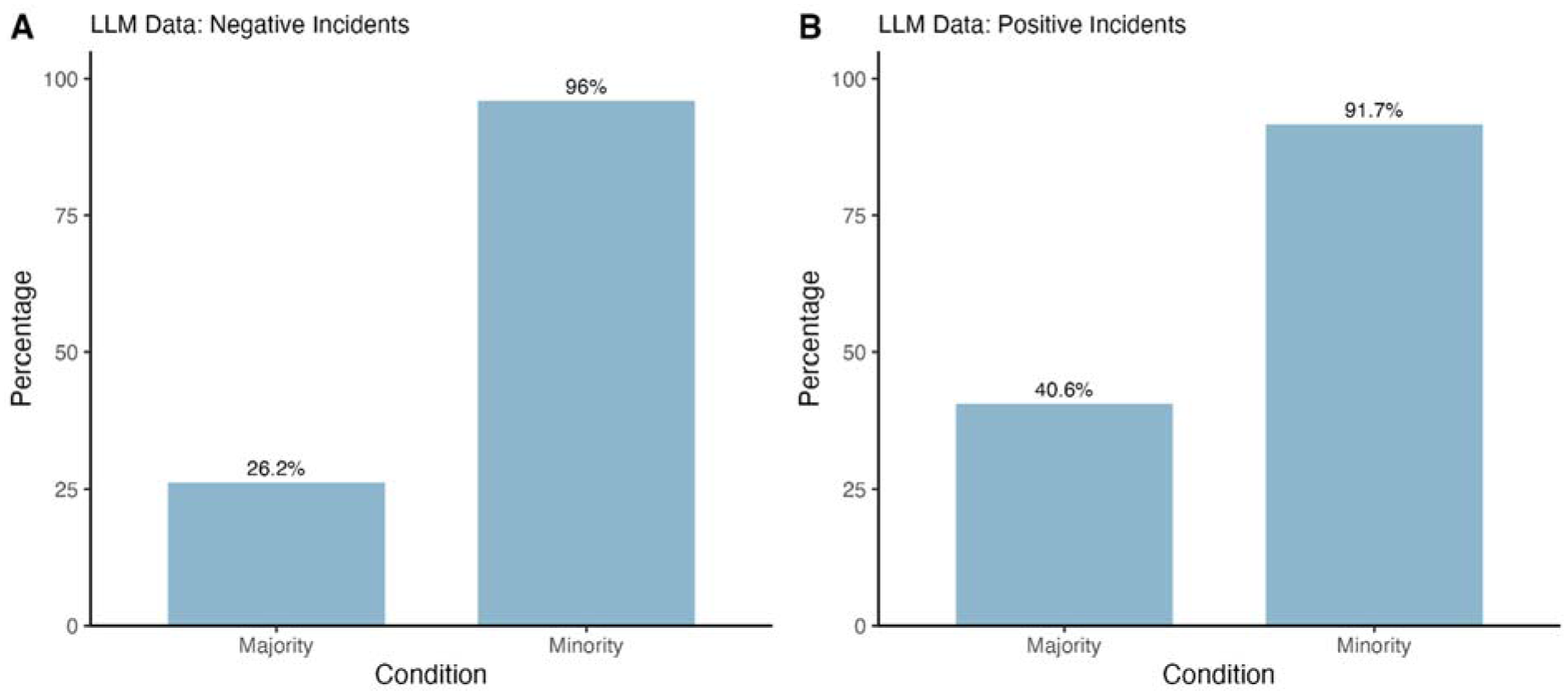
Percentages of LLMs Mentioning the Target Person’s Country of Origin for Negative Incidents (A) and Positive Incidents (B)
Discussion
These results show that the overreporting of minority attributes is reproduced in widely used LLMs. This extends prior work on social biases in AI (Bai et al., 2025) by demonstrating that LLMs not only reflect motivational biases but also fundamental communicative principles of language use (as they exhibited this tendency even for positive incidents). As LLMs are increasingly used for news production and summarization, these findings highlight the importance of addressing not only overt prejudice but also subtle cognitive-communicative dynamics in AI-generated text.
General Discussion
The present research demonstrated that humans (and AI) are more likely to communicate minority attributes than majority attributes. Studies 1 and 2 showed this in artificial settings, where participants more often mentioned an alien’s (evaluatively neutral) minority attributes when issuing warnings or describing crimes. Study 3 extended this finding to real-world scenarios, showing a tendency to more often mention a perpetrator’s minority than their majority membership in crime reports. Study 4 found the same tendency for positive events, suggesting minority attributes are seen as newsworthy regardless of context valence. We replicated these effects using six LLMs, suggesting that this human tendency is recognized and reproduced as a pattern in AI-generated text. These findings support our idea that a cognitive differentiation principle drives overreporting of minority membership in news, which, coupled with the media’s emphasis on negative events (Bednarek & Caple, 2017), may perpetuate negative attitudes toward minorities (Leonardelli & Brewer, 2001).
Theoretical and Practical Implications
Whereas prior research emphasized self-serving motivational causes for negative attitudes toward minorities, such as self-esteem enhancement (Abrams & Hogg, 1988) or social dominance (Pratto et al., 2006), our findings highlight the contribution of more “innocent” processes, such as basic cognitive principles (see also Bai et al., 2022; Fiedler, 1991; Koch et al., 2024; Woitzel & Alves, 2024) and general principles of informative communication (Frank & Goodman, 2012; Goodman & Frank, 2016; Peloquin et al., 2020). In support of our account, individuals more often communicated minority than majority attributes in negative and positive contexts.
A central aim of this work was to extend the well-documented differentiation principle from attention, learning, and memory to communication, demonstrating that people preferentially transmit distinctive information when describing social targets. Our findings suggest that communicators naturally highlight minority attributes, which helps explain the persistent over-labeling of minority group membership in media coverage. This is consistent with probabilistic models of pragmatic reasoning (Frank & Goodman, 2012; Goodman & Frank, 2016), which propose that speakers select utterances to maximize informativeness relative to a listener’s expectations—a core principle of journalism and news reporting.
In a media landscape that overrepresents negative events, the prioritization of communicating minority attributes can create the impression of a relation between minority membership and negativity, even when no actual correlation exists (Sampson & Wilson, 1995). This impression is likely amplified by people’s daily social encounters, which are usually positive and mostly involve majority groups. This results in an ecological correlation between group membership and valence, with positive encounters of majorities in daily life versus negative portrayals of minorities in the media, which likely contributes to the development of negative attitudes toward minorities (Kutzner & Fiedler, 2017).
Furthermore, LLMs reproduced this human communicative asymmetry to report a target’s minority origin and even amplified it (i.e., 96% vs. 41.5% for negative incidents and 91.7% vs. 32.3% for positive incidents). One possible explanation is that LLMs exploit statistical patterns in their training data to improve prediction accuracy (Glickman & Sharot, 2025). Because minority attributes occur less frequently and are thus more distinctive, mentioning them increases communicative specificity and informativeness (here defined as statistical distinctiveness). The finding that LLMs not only reproduce but also amplify the differentiation principle in communication has particularly important implications, as AI-generated news content becomes increasingly prevalent (Sonni et al., 2024).
Our findings further contribute to the debate on whether a perpetrator’s origin should be reported in the media. The studies reveal a tendency to communicate it only if it indicates minority membership, which can foster negative biases and animosity. However, completely omitting minority-related details could undermine media trust as audiences seek distinct information (Alves et al., 2022). A balanced solution might involve consistently reporting attributes, like perpetrators’ hometowns, that provide distinct information without disproportionately highlighting minority membership.
Limitations and Directions for Future Research
Our materials approximated real-world news reporting but remain laboratory stimuli. Prioritizing experimental control allowed us to isolate cognitive differentiation in communication; however, future work should analyze large-scale news corpora and other communicative settings to test whether the principle generalizes across minority attributes (e.g., gender and religion) and contexts, extending previous observations of minority overreporting in crime coverage (Hestermann, 2019).
Although the differentiation principle has been documented across cognitive levels, the relationships among these processes remain underspecified. Our findings show that distinctiveness shapes the communicative overreporting of minority membership, but they do not identify causal pathways linking attention, memory, and communication. For instance, communicative asymmetries may emerge because communicators amplify distinctions already salient at earlier processing stages, or because communicative intent independently reinforces differentiation. Future studies should systematically compare recall and communication tasks to determine how attentional salience and communicative intent jointly shape social information transmission.
Conclusion
This research shows that the cognitive principle of differentiation shapes communicative behavior, thereby contributing to the overreporting of minority traits in media. It suggests that this overemphasis arises not solely from self-serving motives but from a tendency to communicate distinct information. Recognizing this mechanism can inform strategies to reduce negative media biases and encourage balanced representations of minority groups.
Footnotes
Handling Editor: Eyal, Tal

Author Contributions
AS: conceptualization, data curation, formal analysis, investigation, methodology, software, visualization, project administration, and writing—original draft; MI: conceptualization, investigation, methodology, software, writing—review & editing; JW: conceptualization, methodology, and writing—review & editing; HA: conceptualization, funding acquisition, methodology, supervision, and writing—review & editing.
Funding
The authors disclosed receipt of the following financial support for the research, authorship, and/or publication of this article: This research was funded by the European Research Council under the European Union’s Horizon 2020 research and innovation program (Grant No. 947988).
Declaration of Conflicting Interests
The authors declared no potential conflicts of interest with respect to the research, authorship, and/or publication of this article.