




Abstract
Because an intellectually humble person is neither diffident nor arrogant in their views, intellectual humility (IH) is considered a virtuous mean. Yet, evidence for the virtuous mean account is mixed, with some studies finding evidence for it and some studies finding evidence against it. To clarify these ambiguities, we examined the curvilinear relations between multiple IH conceptualizations and belief strength across political, religious, and irreligious beliefs. In a secondary analysis of more than 4,000 participants, there was evidence for the virtuous mean account for political beliefs, evidence against it for religious beliefs, and little evidence for irreligious beliefs. Altogether, these results raise the possibility that the virtuous mean account of IH is not as generalizable as originally presumed. Thus, instead of asking whether IH is a virtuous mean, future research should ask when, why, and how IH is a virtuous mean for some beliefs and not for others.
Intellectual humility (IH)—which refers to tendencies to recognize one’s intellectual limitations and remain open to new evidence (see Porter et al., 2022)—is considered a “virtuous mean” (Church & Samuelson, 2016; Samuelson et al., 2015). According to this account, IH is distinguishable from both dogmatism (or intellectual arrogance) and diffidence (or intellectual servility). Dogmatism reflects the high end of the belief spectrum (with individuals being unjustifiably certain of their views), whereas diffidence reflects the low end of the belief spectrum (with individuals having no conviction in their views). An intellectually humble individual, then, does not claim to know more or less than is warranted and is willing to update their views when evidence calls to do so (Samuelson et al., 2015). Appreciating the limits of one’s knowledge and aligning one’s beliefs with evidence are increasingly important and relevant in the current sociopolitical climate characterized by heightened levels of polarization (e.g., Iyengar et al., 2019) and misinformation (e.g., van der Linden, 2022).
If IH is a virtuous mean, then it should contribute to holding balanced viewpoints and may be relevant to the problem of extremity. To explore this possibility, research has examined the potential relations between IH and political and religious extremity. Although research demonstrates that IH is not significantly related to political extremity (Bowes et al., 2020; Koetke & Schumann, 2024; Porter & Schumann, 2018), the picture is less clear when it comes to religious extremity. Some research suggests that IH is weakly related to less religious extremity (Hodge et al., 2019; Krumrei-Mancuso, 2018); other research suggests that they are not significantly related (Leary et al., 2017); and other research suggests that they are weakly positively related (Hill et al., 2021; Hodge et al., 2019).
Even when looking at the curvilinear relations between IH and belief strength—which provides a better test of the virtuous mean account because it clarifies relations at very low and very high levels of belief strength—the picture is still murky (religion: Hopkin et al., 2014; Krumrei-Mancuso, 2018; Leary et al., 2017; politics: Hoyle et al., 2016; Koetke & Schumann, 2024). Indeed, there has been evidence for the virtuous mean account (Hoyle et al., 2016), evidence against it (Krumrei-Mancuso, 2018), and no evidence for it (Koetke & Schumann, 2024; Leary et al., 2017). These inconsistent linear and curvilinear findings raise the possibility that there are overlooked boundary conditions in the relations between IH and belief extremity.
Belief Domains
One potential boundary condition is the belief domain in question. In considering that there are psychological similarities and differences across political and religious beliefs, there are two possible patterns for the relations between IH and belief strength. One possibility is that IH is a virtuous mean for both political and religious beliefs. Political and religious beliefs tend to closely map onto each other (Castle & Stepp, 2021; Hirsh et al., 2013), and political and religious identities have become increasingly aligned (see Newport, 2023). Having no political and religious convictions and holding political and religious views as absolute moral truths should both preclude IH, whereas moderate stances on political and religious views should coincide with IH.
Another possibility is that the relations between IH and belief strength may vary based on the belief domain. Although political and religious beliefs are closely aligned, they can differ in important ways. For instance, political and religious extremity are related to similar worldviews (e.g., experiencing beliefs as meaningful), but they are related to different underlying fears (e.g., worrying about the future of America) and grievances (e.g., personal versus fraternal deprivation; van Prooijen & Kuijper, 2020). Moreover, religious and political beliefs predict polarization on different political issues (Castle & Stepp, 2021). Indeed, the relations between IH and religious belief are theorized to be unique relative to other belief domains due to the existential security that religion provides and the centrality of faith to religious beliefs (Choe et al., 2024; Hall et al., 2023). Religious beliefs provide existential security, as they answer the ultimate questions in life pertaining to morality and the afterlife (see Van Tongeren et al., 2016). In addition, faith is a distinguishing feature of religion, with religious individuals placing their trust in the wisdom of a divine authority (Hill et al., 2018, 2021). This combination of existential security and a willingness to submit to the divine may contribute to more IH (Hall et al., 2023). In contrast, those who are moderate on measures of religiosity may be ambivalent or insecure compared with those who are committed to their faith, and, thus, religious moderates may score low on IH (Krumrei-Mancuso, 2018). Because of these possibilities, IH may be a virtuous mean for political beliefs but not for religious beliefs.
Conceptualizations of IH
Just as there may be differences across belief domains, there may also be differences across conceptualizations of IH. There is considerable debate surrounding how to define IH (Davis et al., 2023; McElroy-Heltzel et al., 2019). All definitions of IH include a metacognitive core, chiefly that IH comprises a recognition of one’s intellectual limitations (Porter et al., 2022). Some definitions, however, also cover interpersonal (e.g., respectfulness) and emotional (e.g., distress tolerance) features (Krumrei-Mancuso & Rouse, 2016). The virtuous mean account of IH similarly posits that there are metacognitive and interpersonal dimensions of IH, with the metacognitive dimension capturing appropriate levels of belief strength and the interpersonal dimension capturing appropriate characterizations of one’s knowledge (Samuelson et al., 2015).
Considering these differences, the relations between IH and belief extremity may vary based on whether IH is measured narrowly (metacognitive features in isolation) or broadly (metacognitive, interpersonal, and emotional features). For religious extremity, when using a narrow measure of IH, there was no evidence for the virtuous mean account of IH, but when using a broad measure of IH, there was evidence against the virtuous mean account of IH (i.e., IH was lowest at moderate levels of religiosity and highest at the extremes of religiosity; Krumrei-Mancuso, 2018). These results preliminarily suggest that there may be differences across IH measures in the curvilinear relations between IH and belief extremity. In identifying whether the virtuous mean account applies to certain IH features (and not to others), it will be possible to understand which features of IH are most important for mitigating belief extremity (and belief diffidence).
Dovetailing with these findings, the relations between IH and belief extremity may vary when contextualizing beliefs on measures of IH. Instead of referring to one’s beliefs in general, some measures of IH assess one’s level of IH toward a particular belief (Hoyle et al., 2016). When using a religion-specific measure (e.g., IH toward one’s religious beliefs; Hopkin et al., 2014) or a politics-specific measure (e.g., IH toward one’s political beliefs; Hoyle et al., 2016) of IH, there was evidence for the virtuous mean account. In contrast, when using domain-general measures of IH, meaning beliefs are not contextualized to a specific domain, there was no evidence for the virtuous mean account (Koetke & Schumann, 2024; Leary et al., 2017) and evidence against it (Krumrei-Mancuso, 2018). If the virtuous mean account is found only for domain-specific rather than domain-general IH, then the virtuous mean account may involve important nuances.
Present Investigation
Here, we sought to clarify ambiguities in the literature on IH and belief extremity in more than 4,000 participants. To do so, we tapped into different manifestations of belief strength, including political, religious, and irreligious beliefs, and multiple conceptualizations of IH. We included irreligious beliefs as separate from religious beliefs, as low levels of religious commitment are not the same as high levels of irreligious commitment (Alsuhibani et al., 2022). By examining the relations between IH and political, religious, and irreligious belief strength, it will be possible to clarify whether the virtuous mean account of IH holds across disparate beliefs and features of IH.
Method
Participants
This study is a secondary data analysis of seven samples. 1 Community participants were recruited on Amazon’s Mechanical Turk (MTurk; Samples 1, 3, 4, and 7) or Prolific (Sample 5). Undergraduate students were also recruited (Samples 2 and 6). We used several methods to screen for inattentive and careless responding (see Supplemental Materials 1).
To maximize statistical power for tests of curvilinearity, we collapsed across samples (N total = 4,352). 2 Participants in the collapsed sample (Mage = 32.01, SDage = 13.71) were primarily female (57.7%), White (67.6%), and non-Hispanic (85.4%). Other participants were Asian (18.1%), Black/African American (8.5%), or identified with another race (5.8%). In terms of political identification, most participants identified as Democratic (45.2%) followed by Republican (18.7%) and independent (18.0%); a minority of participants identified as having no political affiliation (10.6%) or with other political affiliations (e.g., Socialist, Libertarian; 7.5%). As for religious beliefs, most participants identified as Christian (46.6%) followed by agnostic (18.0%), other religious identities (e.g., Jewish, Muslim; 17.9%), or atheist (17.5%). The measures we employed varied across samples, so the sample sizes for our analyses ranged from 473 to 4,352 (Table 1).
Combinations of Measures Used Across Samples
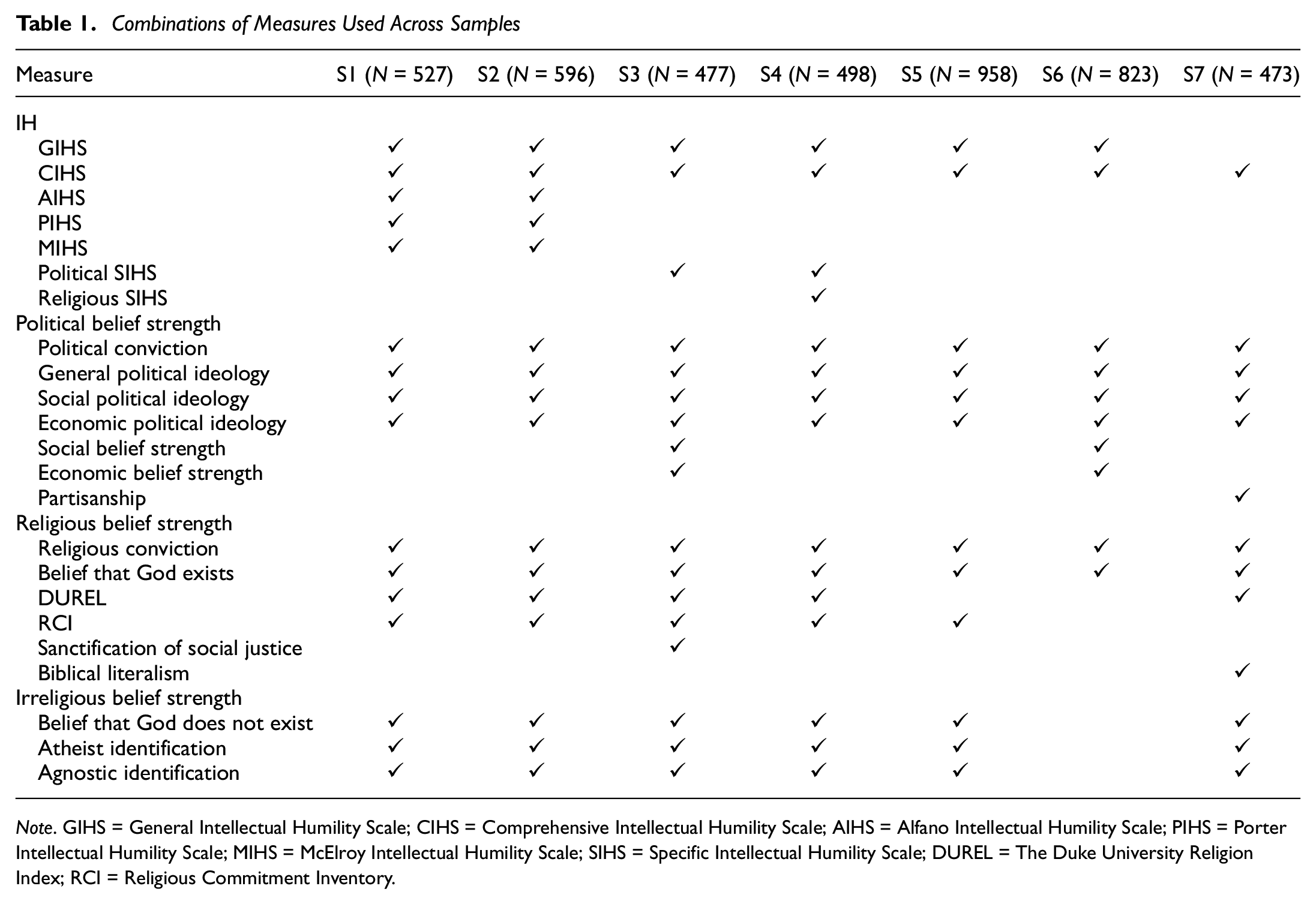
Note. GIHS = General Intellectual Humility Scale; CIHS = Comprehensive Intellectual Humility Scale; AIHS = Alfano Intellectual Humility Scale; PIHS = Porter Intellectual Humility Scale; MIHS = McElroy Intellectual Humility Scale; SIHS = Specific Intellectual Humility Scale; DUREL = The Duke University Religion Index; RCI = Religious Commitment Inventory.
Measures
Datasets and materials are available at https://osf.io/b8v26/. Descriptive statistics, internal consistency statistics, and response scales are reported in Table 2. Intercorrelations among measures are reported in Tables S1–S4.
Descriptive Statistics, Internal Consistency Statistics, and Response Scales for Study Constructs
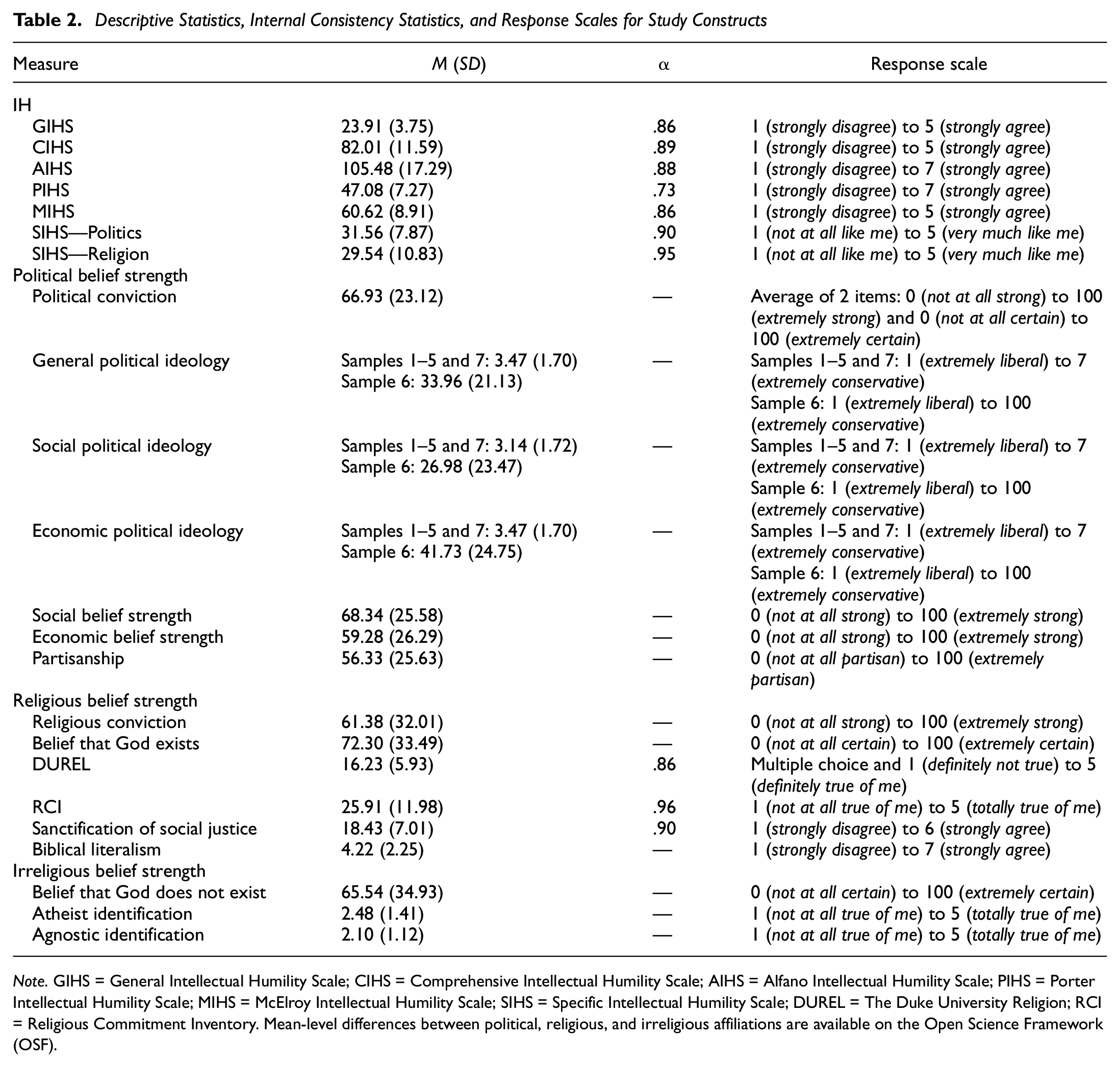
Note. GIHS = General Intellectual Humility Scale; CIHS = Comprehensive Intellectual Humility Scale; AIHS = Alfano Intellectual Humility Scale; PIHS = Porter Intellectual Humility Scale; MIHS = McElroy Intellectual Humility Scale; SIHS = Specific Intellectual Humility Scale; DUREL = The Duke University Religion; RCI = Religious Commitment Inventory. Mean-level differences between political, religious, and irreligious affiliations are available on the Open Science Framework (OSF).
IH
In all samples, participants completed the Comprehensive Intellectual Humility Scale (CIHS; Krumrei-Mancuso & Rouse, 2016), a 22-item measure of the metacognitive, interpersonal, and emotional aspects of IH. In Samples 1 and 2, participants completed three additional self-report measures of IH that capture the metacognitive, interpersonal, and emotional aspects of IH: (a) the 9-item Porter Intellectual Humility Scale (PIHS; Porter & Schumann, 2018), (b) the 16-item McElroy Intellectual Humility Scale (MIHS; McElroy-Heltzel et al., 2014), and (c) the 23-item Alfano Intellectual Humility Scale (AIHS; Alfano et al., 2017). 3 In Samples 1–6, participants also completed the General Intellectual Humility Scale (GIHS; Leary et al., 2017), a six-item measure of the metacognitive features of IH. Finally, in Sample 3, participants completed the nine-item Specific Intellectual Humility Scale (SIHS; Hoyle et al., 2016) in the domain of politics (P-SIHS); in Sample 4, participants completed the P-SIHS in addition to the SIHS in the domain of religion (R-SIHS).
Political Belief Strength
In all samples, participants rated their political conviction (two items that were averaged) and indicated their general, social, and economic political ideology. In Sample 6, political ideology variables were measured on a different response scale than in other samples (Table 2), so we analyzed them separately. In Samples 3 and 6, participants indicated their political conviction for social and economic political beliefs separately. In Sample 7, participants rated the extent of their partisanship.
Religious Belief Strength
Those who indicated they were religious on a religious affiliation question (i.e., did not select atheist or agnostic) completed the measures of religious belief strength. In all samples, participants rated their religious conviction and certainty that God exists. In Samples 1–4, participants completed two measures of religious commitment: the 5-item Duke University Religion Index (DUREL; Koenig & Büssing, 2010) and the 10-item Religious Commitment Inventory (RCI; Worthington et al., 2003). Participants in Sample 7 also completed the DUREL, and participants in Sample 5 also completed the RCI. Participants in Sample 3 completed the Sanctification of Social Justice Scale (SSJS; Todd et al., 2014), a 5-item self-report measure of the extent to which one perceives that social justice is an expression of God’s will. In Sample 7, participants completed a single-item indicator of biblical literalism (i.e., believing everything in the Bible is absolutely true).
Irreligious Belief Strength
Participants who indicated they were not religious (i.e., selected atheist or agnostic) completed measures of irreligious belief strength. Participants in Samples 1–5 and 7 rated the extent to which they were certain that God does not exist. In Samples 1–5 and 7, agnostic/atheist participants indicated the extent to which being agnostic/atheist is central to their identity (two items that were averaged for agnostics and atheists).
Data Analytic Plan
We examined the zero-order correlations between IH total scores and indices of political, religious, and irreligious belief strength. To examine the potential for curvilinearity in these relations, we conducted a series of hierarchical regressions. In the first step of the regression, we entered the mean-centered belief strength score, and, in the second step, we entered the squared belief strength score; the dependent variable was IH. To evaluate whether the addition of the quadratic term accounted for significantly more variance in IH above and beyond the main effect of belief strength, we examined whether the ΔR2 term was significant according to an F-test. All 95% confidence intervals were computed based on bootstrapped random resampling of 1,000 samples. We also conducted a series of two-line tests in which we estimated a regression with two separate slopes and identified a “breakpoint” using the Robin Hood algorithm (Simonsohn, 2018). If the two slopes from this interrupted regression have opposite signs and each slope is individually statistically significant, then it can be concluded that there is a significant quadratic effect. We consider both the hierarchical regression and two-line test results.
Results
We first focus on the zero-order relations and then the curvilinear relations between IH and belief extremity. We summarize the pattern of results by belief domain and then by IH conceptualization.
Zero-Order Correlations
IH was weakly to moderately and negatively related to belief strength (Table 3). 4 Of 94 correlations, 65 were negative (69%).
Correlations Between IH Total Scores and Belief Strength
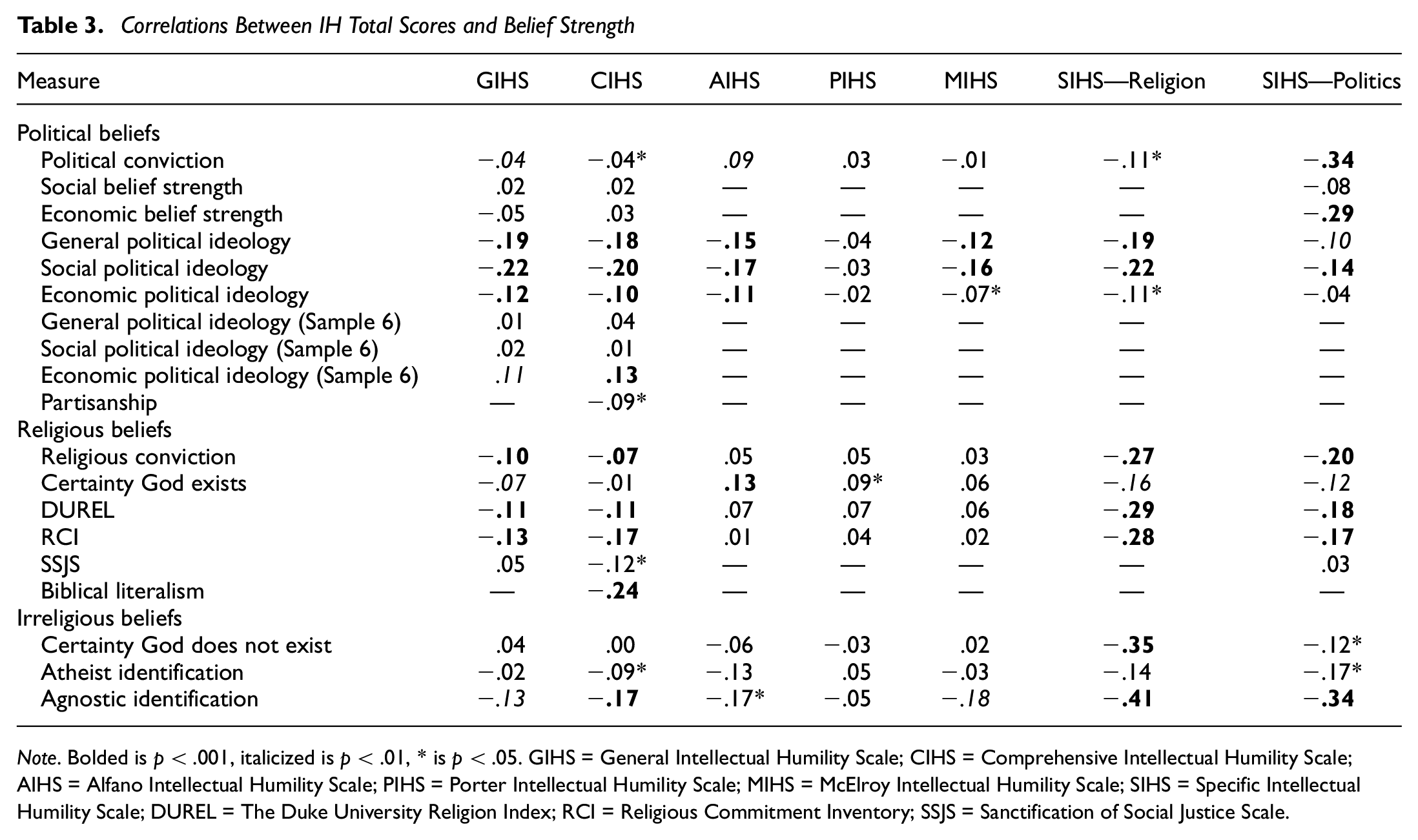
Note. Bolded is p < .001, italicized is p < .01, * is p < .05. GIHS = General Intellectual Humility Scale; CIHS = Comprehensive Intellectual Humility Scale; AIHS = Alfano Intellectual Humility Scale; PIHS = Porter Intellectual Humility Scale; MIHS = McElroy Intellectual Humility Scale; SIHS = Specific Intellectual Humility Scale; DUREL = The Duke University Religion Index; RCI = Religious Commitment Inventory; SSJS = Sanctification of Social Justice Scale.
Belief Domain
Few differences across belief domains in the relations between IH and belief strength were found. The average correlation between IH and belief strength within belief domain was −.08 (political beliefs), −.06 (religious beliefs), and −.12 (irreligious beliefs). In addition, 56% (religious beliefs) to 81% (irreligious beliefs) of the correlations between IH and belief strength within belief domain were negative, suggesting that IH tended to track with less belief strength.
IH Conceptualization
Although the relations between IH and belief strength did not vary by belief domain, the relations did vary by IH conceptualization. Domain-specific IH (religion and politics) tended to be moderately related to less belief strength (average rs across belief domains were −.16 [P-SIHS] and −.23 [R-SIHS]), whereas domain-general IH (GIHS, CIHS, AIHS, PIHS, and MIHS) tended to not be significantly related to the belief strength (average rs across belief domains ranged from −.07 [CIHS] to .01 [PIHS]). Moreover, domain-specific IH was more consistently related to less belief strength than domain-general IH: 93%–100% of the relations between domain-specific IH and belief strength were negative, whereas 45%–68% of the relations between domain-general IH and belief strength were negative.
Curvilinear Relations
The significant hierarchical regression results and corresponding two-line test statistics are in Table 4. The significant curvilinear relations between IH and belief strength are in Figures 1–6. Given the number of analyses conducted, we only describe the significant hierarchical regression results here. Full results (including those that were not significant) and the two-line test figures are available on the Open Science Framework (OSF) page.
Hierarchical Regression Results With a Significant ΔR2
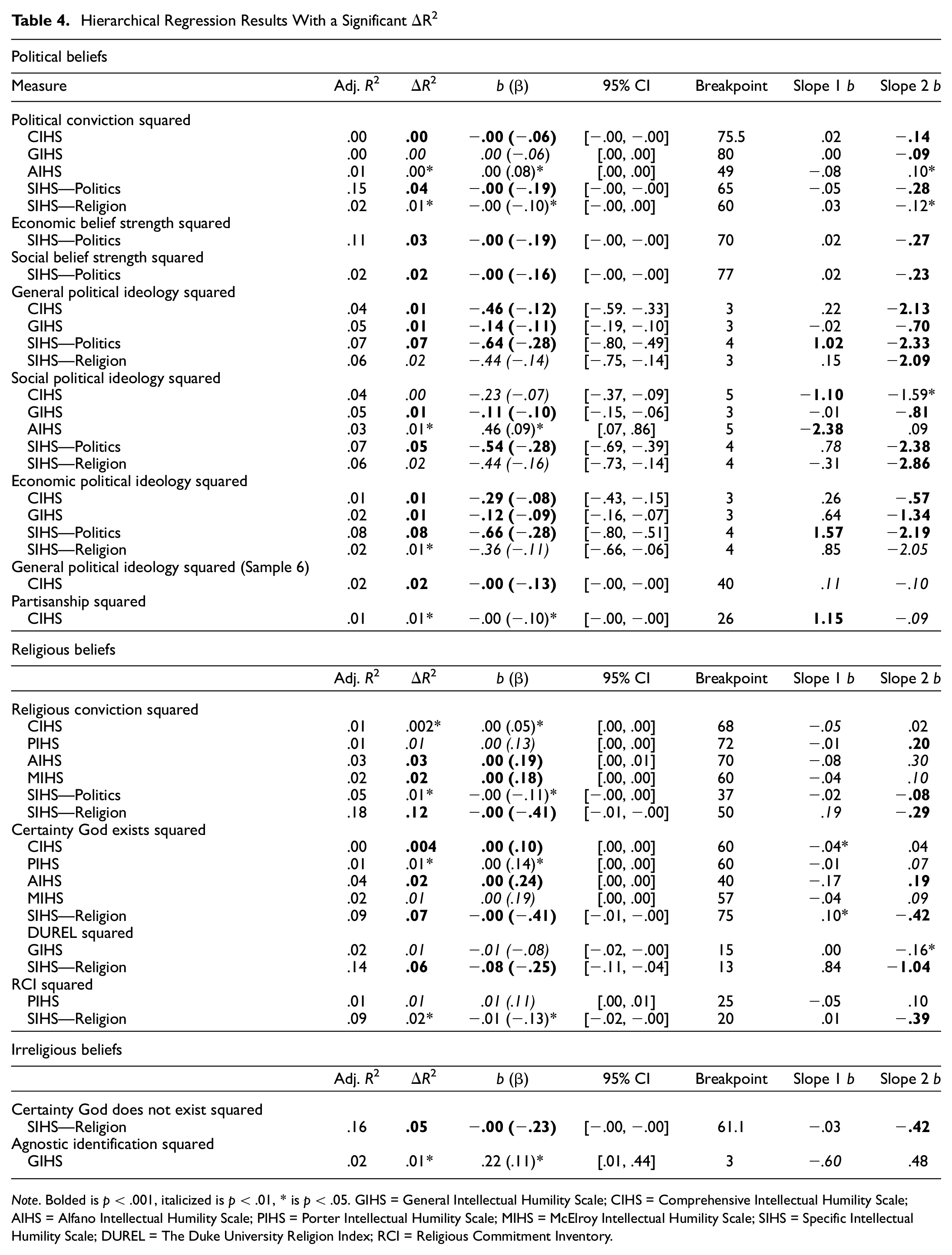
Note. Bolded is p < .001, italicized is p < .01, * is p < .05. GIHS = General Intellectual Humility Scale; CIHS = Comprehensive Intellectual Humility Scale; AIHS = Alfano Intellectual Humility Scale; PIHS = Porter Intellectual Humility Scale; MIHS = McElroy Intellectual Humility Scale; SIHS = Specific Intellectual Humility Scale; DUREL = The Duke University Religion Index; RCI = Religious Commitment Inventory.
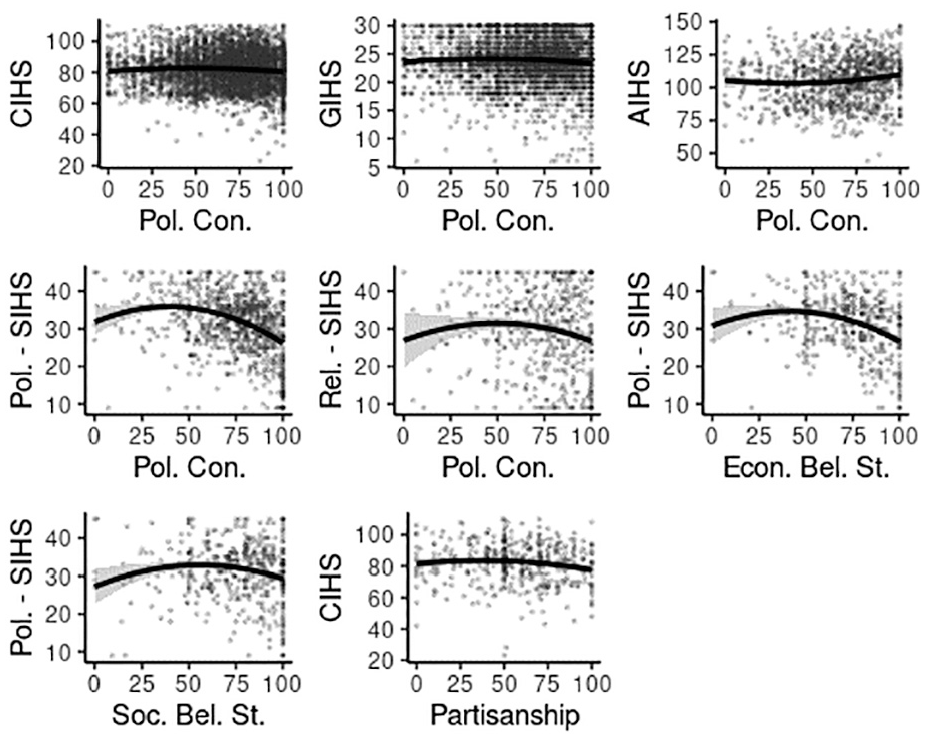
Significant Curvilinear Relations Between IH and Political Conviction, Economic and Social Belief Strength, and Partisanship
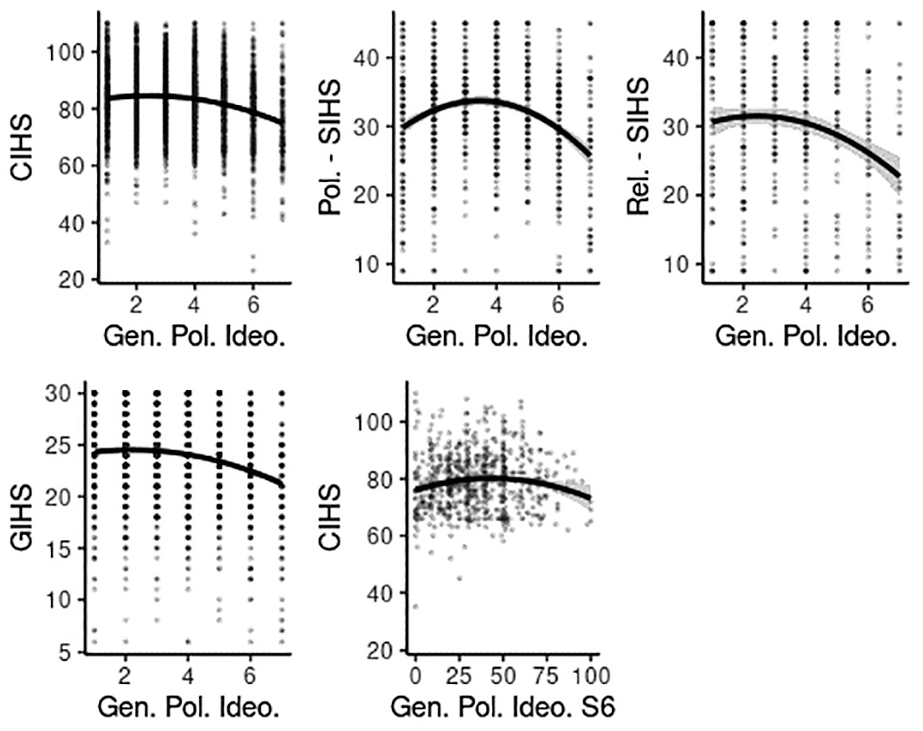
Significant Curvilinear Relations Between IH and General Political Ideology
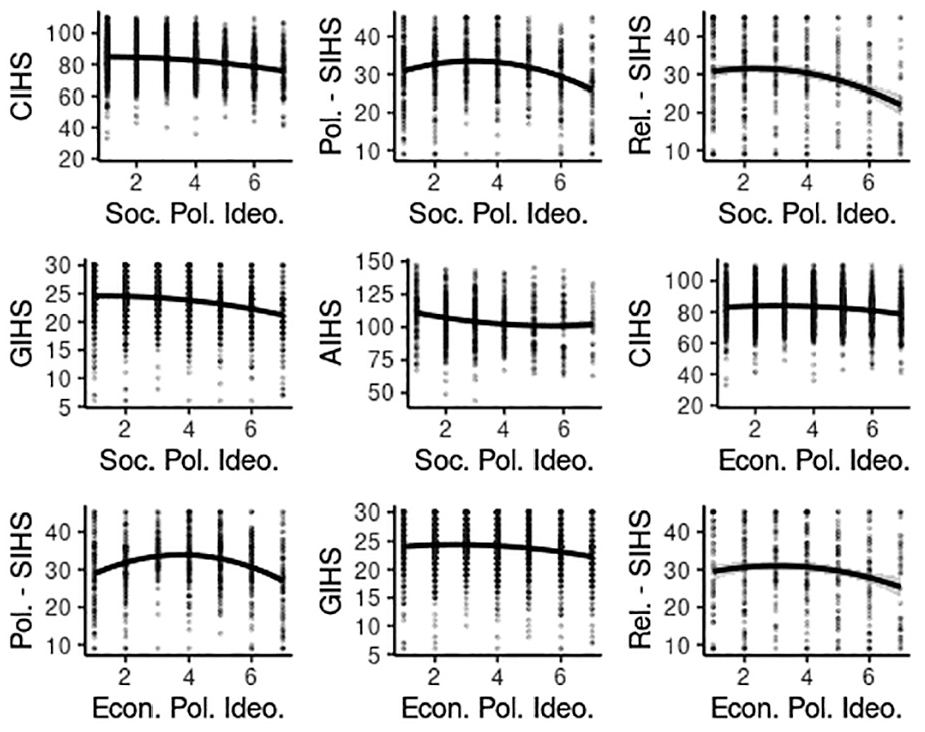
Significant Curvilinear Relations Between IH and Social Political Ideology and Economic Political Ideology
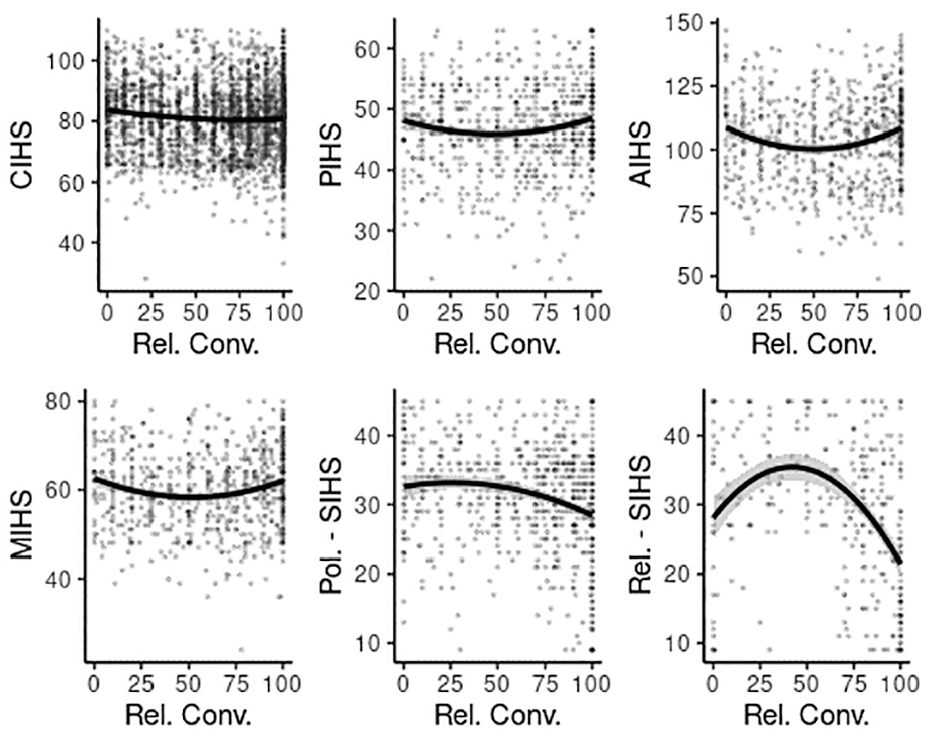
Significant Curvilinear Relations Between IH and Religious Conviction
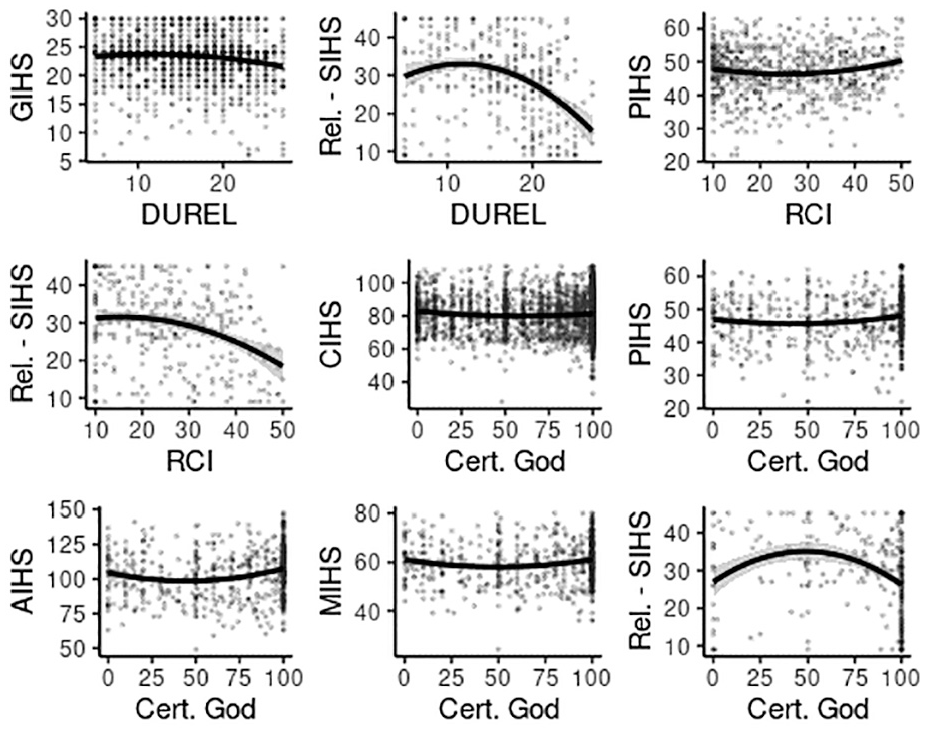
Significant Curvilinear Relations Between IH and the DUREL, RCI, and Certainty That God Exists
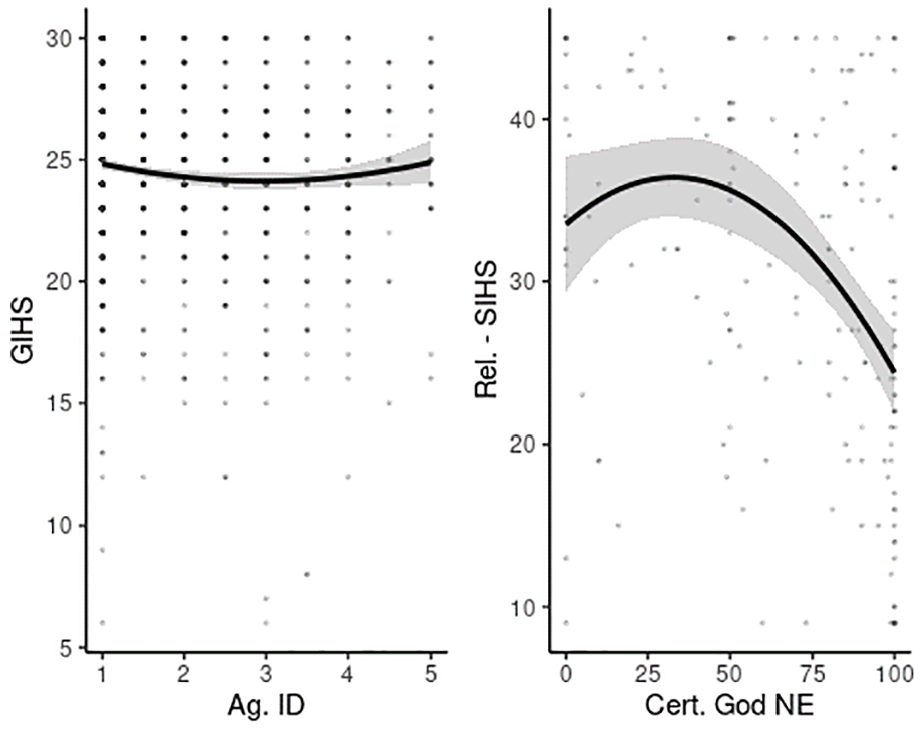
Significant Curvilinear Relations Between IH and Certainty That God Does Not Exist and Agnostic Identification
Belief Domain
There were differences in the curvilinear relations between IH and belief strength across belief domains. 5 Overall, 54% of the results for political belief strength (22 of 41 regressions) and 47% of the results for religious belief strength (15 of 32 regressions) indicated that the addition of the quadratic belief strength score resulted in a significant ΔR2. In contrast, 9.5% of the results for irreligious belief strength (2 of 21 regressions) indicated that the addition of the quadratic belief strength score resulted in a significant ΔR2. Thus, there was more evidence supporting a quadratic relation between IH and political and religious belief strength than there was for irreligious belief strength.
Burrowing into the pattern of significant curvilinear effects, 91% of the significant results indicated that the quadratic relations between IH and political belief strength were negative, meaning that IH was lowest at the extremes of political belief strength and highest at a moderate amount of political belief strength (20 of 22 regressions). The two-line tests indicated that only five results (23%) met full criteria for a significant quadratic relationship (each slope is significant and in opposite directions), and these results demonstrated that the relations between IH and political belief strength followed a negative quadratic function. Moreover, 77% of the significant results aligned with the criterion of each slope being in a different direction (17 of 22 regressions), again mostly providing evidence for a negative quadratic effect. Taken together, the significant curvilinear relations between IH and political belief strength align with the virtuous mean account.
In contrast, 60% of the significant quadratic effects for religious belief strength were positive and contradicted the virtuous mean account—IH tended to be lowest at a moderate amount of religious belief strength and highest at the extremes of religious belief strength (9 of 15 regressions). The two-line tests indicated that only two results (12.5%) met full criteria for a significant quadratic relation (both were negative). Although most results did not meet full criteria in terms of both slopes being significant, 93% of the significant results (14 of 15) did align with the criterion of each slope being in a different direction (generally supporting a positive quadratic effect). In aggregate, the relations between IH and religious belief strength do not align with the virtuous mean account (and, if anything, go against it).
Finally, the curvilinear relations between IH and irreligious belief strength were mixed. Of the two significant relations, one was negative (which is consistent with the virtuous mean account) and one was positive (which is inconsistent with the virtuous mean account). The two-line tests indicated that none of the significant results met full criteria for a significant quadratic relationship. Moreover, one of the two significant results aligned with the criterion of each slope being in a different direction (this result was positive). Thus, the relations between IH and irreligious belief strength are not adequately captured by a quadratic function, be it positive or negative.
IH Conceptualization
Just as the curvilinear relations between IH and belief strength varied by belief domain, they also varied by IH conceptualization. The curvilinear relations between domain-specific IH and belief strength were consistent with the virtuous mean account, whereas the curvilinear relations between domain-general IH and belief strength tended to oppose the virtuous mean account.
All the significant curvilinear relations, be they political or religious belief strength, were negative for domain-specific IH (16 of 16 regressions)—these results indicate that domain-specific IH was lowest at the extremes of belief strength and highest at a moderate level of belief strength. In contrast, 52% of the relations between domain-general IH and belief strength were positive (12 of 23 regressions)—these results indicate that domain-general IH was often lowest at a moderate amount of belief strength and highest at the extremes of belief strength. This pattern was especially evident for religious belief strength: 90% (9 of 10 regression results) of the significant curvilinear relations between domain-general IH and religious belief strength were positive (25% and 50% of the results were positive for political and irreligious belief strength, respectively).
Discussion
We examined, in more than 4,000 participants, the curvilinear relations between IH and political, religious, and irreligious belief strength. Although there was evidence for the virtuous mean hypothesis for political beliefs, there was evidence against it for religious beliefs and little evidence for it when it came to irreligious beliefs. Thus, a nuanced picture emerges when considering different belief domains and conceptualizations of IH.
Relations Across Belief Domains
At the zero-order level of analysis, IH was weakly related to less belief extremity, and relations were generally consistent across belief domains. Thus, IH consistently––albeit weakly––tracks with less belief extremity. IH also tended to be related to identifying as politically liberal. These results align with other research on IH (Koetke & Schumann, 2024), and a broad literature indicating that liberal political identification in the United States is related to more openness (Xu et al., 2021) and less dogmatism (Costello & Bowes, 2023).
Although there were few differences across belief domains when examining the linear relations between IH and belief strength, there were notable differences across belief domains when examining the quadratic relations. First, turning to political belief strength, 91% of the significant quadratic effects were consistent with the virtuous mean account. These findings corroborate theoretical accounts of IH advancing that IH is distinguishable from diffidence (low end of belief commitment) and dogmatism (high end of belief commitment; Samuelson et al., 2015) in the political domain. IH was also a virtuous mean when measuring political identification—IH scores tended to be highest in political moderates and lowest at the extremes of political identity, especially in those identifying as “extremely conservative.” These results are consistent with research finding that extreme partisanship, especially on the right, coincides with more dogmatism (Costello & Bowes, 2023). Altogether, for political beliefs, IH seems to be in the middle of diffidence and dogmatism, with intellectually humble individuals holding more moderate views and perhaps being willing to change their minds and update their views in the presence of compelling evidence. Although our results do not directly speak to belief updating in the political domain, they do suggest that IH is generally highest at moderate levels of political belief strength and lowest at the extremes of political belief strength.
For religious beliefs, the opposite pattern emerged. This result may be surprising when considering that it is potentially existentially more costly to be open about one’s religious views than one’s political views. Two questions, then, are worth considering: (a) Why do IH and religious commitment coincide? (b) What might be unique about religious beliefs compared with other beliefs? Although the present findings cannot directly answer these questions, below we consider some potential explanations as we look forward to additional research on these issues.
First, as previously noted, a fundamental difference between political and religious beliefs is the element of faith (Choe et al., 2024; Hall et al., 2023). Because of faith, religious beliefs have a unique epistemic justification: one cannot prove or disprove the existence of God (Hook et al., 2017), whereas one can prove or disprove the utility of stricter gun control legislation, for example. Religious individuals may recognize the limits of the evidentiary bases of their views insofar as they acknowledge that faith does not rest on an evidentiary foundation (Leary et al., 2017). In contrast, political certainty may contribute to a close-minded adherence to the evidence that supports one’s beliefs and preclude an appreciation of the limits of one’s knowledge. Moreover, because of faith, religious individuals submit themselves before a higher power and are aware that they do not possess all the answers (Hill, 2021; Hill et al., 2018). This willingness to defer to the wisdom of a higher power is unique relative to other beliefs and may reflect humility in of itself (e.g., Hill, 2021). Religious commitment, then, may arise from a deep reflection about the limits of one’s knowledge which, in turn, could promote IH.
Religious beliefs not only have a unique epistemic foundation but they also are existentially fulfilling (see Van Tongeren et al., 2016). Religion offers a sense of meaning and purpose, as people belong to something greater than themselves (see Hook et al., 2015). Religious individuals may be able to tolerate different points of view because they are secure in their own beliefs. Consistent with this possibility, there was some evidence that scores on IH dimensions pertaining to openness, respectfulness, and intellectual engagement were highest at higher levels of religious commitment (see Table S10). In contrast, those who are moderate in their religious worldviews may lack this existential security, and those who are less committed to their religious worldviews tend to have a weaker sense of meaning and purpose (Van Tongeren et al., 2013, 2016). As such, religious ambivalence could contribute to low IH in the form of more close-mindedness, anxiety, and an inability to accurately reflect on one’s religious beliefs (Krumrei-Mancuso, 2018; Van Tongeren et al., 2013). Between our findings and these potential explanations, future research can clarify why the virtuous mean account of IH may not hold for religious beliefs.
Although IH may coincide with stronger religious commitment, it is unlikely to coincide with more religious fundamentalism or belief superiority. One can be strongly religious without being dogmatic or strident. Put differently, a religious individual could be committed to their views but still be intellectually humble because they place their faith in the hands of the divine and treat others with different religious beliefs with openness and respect (Hill et al., 2021). Supporting this impression, religious commitment coupled with IH has been found to predict more religious tolerance, but conservative religious fundamentalism predicts less religious tolerance (e.g., Hook et al., 2017; Zhang et al., 2015). If we measured religious fundamentalism in the present investigation, a quadratic relationship consistent with the virtuous mean account may have emerged instead. Although religiosity on its own may coincide with more IH, we would not expect religious fundamentalism to coincide with more IH.
In contrast to both political and religious beliefs, there was scant evidence for curvilinearity in the relations between irreligious belief strength and IH. One potential methodological reason is that there were less irreligious participants than religious individuals, which reduces the power to detect a significant effect. Beyond methodological reasons, it is unclear why there were few significant curvilinear effects for irreligious belief strength. Few studies have examined IH in irreligious individuals (but see John Marriott et al., 2019; Van Cappellen & LaBouff, 2022), so little is known about how IH manifests in these populations. It is clear, however, that being low on religiosity is not the same as being high on irreligious belief. Some research suggests that religious individuals and irreligious individuals value, emphasize, express, and even conceptualize humility differently (Van Tongeren et al., 2018), which may in turn affect interpretation of IH measures and levels of IH in these populations. Religious people view themselves as more humble than irreligious people (Rowatt et al., 2014; Van Tongeren et al., 2018), perhaps due to the fact that humility is espoused as a virtue in most if not all major religions (see Choe et al., 2024). More research is needed to clarify the relations between IH and irreligious belief strength and to shed light on how to measure and understand IH in irreligious individuals.
Relations Across Conceptualizations of IH
At the zero-order level of analysis, there was little to no evidence for differences across measures of domain-general IH in their relations with belief strength. Whether a domain-general IH measure was narrow (metacognitive features in isolation) or broad (metacognitive, interpersonal, and emotional features), relations tended to be small and negative. This finding stands in contrast to the previous work indicating that there are differences between IH conceptualizations in their relations with other beliefs, including belief in misinformation (Bowes & Tasimi, 2022) and support for vaccinations (Huynh & Senger, 2021), with broad IH measures tending to be stronger predictors of these beliefs than narrow IH measures. Such results raise the possibility that IH conceptualizations differ from each other when predicting endorsement of specific beliefs rather than belief extremity.
Whereas domain-general IH often was weakly or not significantly related to belief strength, domain-specific IH was often significantly and moderately related to less belief strength. These findings are consistent with calls in the literature to better contextualize IH (Ballantyne, 2023). Although there is evidence for a general tendency to be intellectually humble, it is unlikely that people are invariably intellectually humble across all beliefs. By contextualizing IH, it is possible to gain insights on the ways in which IH may differ, or, alternatively, stay the same, across different beliefs (Hoyle et al., 2016). It is clear that when it comes to belief strength, belief-specific IH may contribute more to holding moderate views than general tendencies to be intellectually humble. Similar results are found when examining political polarization (Bowes et al., 2020) and political myside bias (Bowes et al., 2022).
There were also differences between measures of domain-general and domain-specific IH when examining the curvilinear relations between IH and belief strength. Although all the curvilinear relations for domain-specific IH were negative (consistent with the virtuous mean account), only 48% of the relations for domain-general IH followed this pattern. The differences across IH conceptualizations were especially evident for religious belief strength, as 90% of the relations for domain-general IH were positive (contradicted the virtuous mean account). Previous studies have also found that domain-general IH is lowest at moderate levels of religious belief strength (Krumrei-Mancuso, 2018), whereas religion-specific IH is highest at moderate levels of religious belief strength (Hopkin et al., 2014).
Our results do not illuminate why these differences between domain-general and domain-specific IH measures exist in the context of belief strength. One possibility is that people engage in different self-reflection processes across the two types of measures. When people complete a measure of domain-general IH, they could reflect on any one of their belief systems. In contrast, when people complete a measure of belief-specific IH, they are directly considering their level of IH for that particular belief. It is possible that people are more likely to say they are intellectually humble when considering their beliefs in general, leading to results that go against the virtuous mean account. In contrast, participants may zoom in on a more precise estimate of IH when considering a specific belief, leading to results that are consistent with the virtuous mean account. Putting these pieces together in the domain of religious belief strength, religious individuals may regard themselves as highly intellectually humble in general (e.g., Rowatt et al., 2014) but may acknowledge that they are not highly intellectually humble about their religious beliefs. This is not to say that one IH score is necessarily more “real” than another—instead, our results, in conjunction with results from previous research (e.g., Bowes et al., 2022; Hoyle et al., 2016), raise the possibility that domain-general and domain-specific measures of IH reflect different psychological processes.
Constraints on Generality
The design of our study, the composition of the sample, and the measures used may impose constraints on generality (Simons et al., 2017). First, this study was a secondary data analysis, allowing us to assess relations in thousands of participants and with multiple measures of IH and belief strength. Although we would expect results from our study to replicate in similarly designed studies, replication with a priori hypotheses is needed.
Moreover, we can only draw conclusions about participants from the United States. Culture potentially shapes IH and beliefs in multiple ways (see Porter et al., 2022)—the predominate belief system, the level of belief freedom, the extent to which individuals are politically engaged, and more vary considerably across cultures. As such, the relations between IH and belief extremity may differ across cultural contexts, with IH perhaps being a virtuous mean in some cultures and for some beliefs but not others. Along these lines, 72% of religious individuals were Christian, so our conclusions about religious belief strength largely pertain to Christian religious belief strength. The vast majority of research on religion and IH focuses on Christian individuals (see Choe et al., 2024), so it remains unclear whether and to what extent these results will replicate in samples that are more religiously diverse.
Regarding our measurement approach, our conclusions about religious belief strength only pertain to religious individuals. Religious and irreligious individuals completed different belief strength measures about God and religion. Since irreligious belief strength refers to the absence of religious belief and the belief that God does not exist, it may not be valid to ask irreligious individuals about their religious belief strength and their certainty that God does exist. In addition, separating irreligious beliefs from religious beliefs allowed for an understanding of the variance in belief extremity for the full spectrum of irreligious belief rather than an understanding of irreligious belief as very low levels of religious commitment. That said, it may be useful to have religious and irreligious individuals complete the same measure of certainty that God exists, with one pole being “completely certain that God does not exist” to “completely certain that God does exist.” This approach captures both extremes of beliefs surrounding the existence of God and may alter the shape and magnitude of the curvilinear effect for religious beliefs.
We additionally used single-item measures to assess belief strength, for the most part. There can be issues with low reliability for single-item scales and their predictive utility (e.g., Allen et al., 2022; Costello et al., 2023; Diamantopoulos et al., 2012). Nevertheless, single-item scales are not invariably flawed and, at times, can be more informative than composite scales (e.g., Allen et al., 2022; Mõttus et al., 2020). In the present investigation, patterns of results did not meaningfully change when using composite measures compared with single-item measures, suggesting that the pattern of results was not driven by a specific measurement approach. Still, it may be worthwhile for future research to directly compare composite and single-item rating scales to rule out the possibility that low reliability is contributing to the results.
It would also be fruitful for future research to examine other belief domains, as we can only draw conclusions about political, religious, and irreligious belief strength in the context of IH. Examining other belief domains would also shed light on the generalizability of the virtuous mean account of IH and whether religious beliefs are unique in their relations with IH. For instance, to clarify whether faith is driving the different patterns of relations for religious belief, other belief domains that include some element of faith should be examined.
Conclusion
The virtuous mean account of IH may not be as generalizable as originally presumed, and there seem to be important boundary conditions to it. Altogether, the present findings suggest that religious belief strength may operate differently from political belief strength in the context of IH, and contextualized IH may entail different psychological processes than decontextualized IH. These results provide the groundwork for future applied research—if scholars aim to find the “sweet spot” for IH in the service of reducing belief extremity, then the sweet spot appears to be different for different belief domains and conceptualizations of IH.
Supplemental Material
sj-docx-1-spp-10.1177_19485506241284020 – Supplemental material for Intellectual Humility and Belief Extremity: Evidence for Curvilinearity?
Supplemental material, sj-docx-1-spp-10.1177_19485506241284020 for Intellectual Humility and Belief Extremity: Evidence for Curvilinearity? by Shauna M. Bowes and Arber Tasimi in Social Psychological and Personality Science
Footnotes
Handling Editor: Eranda, Jayawickreme
Declaration of Conflicting Interests
The author(s) declared no potential conflicts of interest with respect to the research, authorship, and/or publication of this article.
Funding
The author(s) disclosed receipt of the following financial support for the research, authorship, and/or publication of this article: This work was funded by the Templeton Foundation (grant ID #61379). This material is also based on the work supported by the National Science Foundation SBE Postdoctoral Research Fellowship (grant no. 2313708).

Supplemental Material
Supplemental material for this article is available online.
Notes
Author Biographies
References
Supplementary Material
Please find the following supplemental material available below.
For Open Access articles published under a Creative Commons License, all supplemental material carries the same license as the article it is associated with.
For non-Open Access articles published, all supplemental material carries a non-exclusive license, and permission requests for re-use of supplemental material or any part of supplemental material shall be sent directly to the copyright owner as specified in the copyright notice associated with the article.
