



Abstract
Women’s everyday experiences of benevolent sexism include being praised for loving men (heterosexual intimacy), praised for caregiving (complementary gender differentiation), and being overhelped (protective paternalism). We investigated women’s perceptions of partners and their wellbeing in the context of self-reported experiences of benevolent sexism in their relationships with men. Integrated data analysis on three community samples of women in Australia (total N = 724) indicated that women’s experiences of protective paternalism were associated with greater psychological distress, lower relationship satisfaction, and perceiving partners as less reliable and more patronizing and undermining. By contrast, experiencing heterosexual intimacy was associated with perceiving partners as more reliable, less patronizing and undermining, and with greater relationship satisfaction. Mixed associations emerged for experiencing complementary gender differentiation, including lower psychological distress and also lower relationship wellbeing. These findings advance understanding of the specific costs and benefits of benevolent sexism in relationships between women and men.
Women’s experiences of sexism, such as being harassed about their physical appearance or being assumed to be primary caregivers of children, are linked with poorer psychological and physical health (Harnois & Bastos, 2018; Swim et al., 2001). Experiences of hostile sexism—expressions of overtly negative beliefs toward women—are linked with a host of negative outcomes. In the context of intimate relationships between women and men, men’s endorsement of hostile sexism is associated with correspondingly negative behaviors toward their partners which, in turn, undermine partners’ relationship satisfaction, problem resolution, and wellbeing (Bareket & Fiske, 2023; Hammond & Overall, 2017; Leaper et al., 2022; Overall et al., 2011). By contrast, women’s experiences of benevolent sexism—paternalistic idealization, protection and care specifically directed toward women—are less predictable. On one hand, men’s expressions of benevolent sexism to their partners can be experienced as patronizing and unfairly presume women’s need for help, leading to women feeling greater stress and lower wellbeing (e.g., Hammond & Overall, 2015; Lamarche et al., 2020; Shnabel et al., 2016). On the other hand, men’s expressions of benevolent sexism could be signals that they are devoted to the relationship, leading to women feeling more secure and satisfied (e.g., Cross & Overall, 2018; Hopkins-Doyle et al., 2019; Sarlet et al., 2012). In the current study, we consider both possibilities by testing the extent to which women’s experiences of benevolent sexism in their intimate relationships with men are associated with costs to their psychological wellbeing and/or benefits to their relationship wellbeing.
Ambivalent Sexism Theory and Experiences of Benevolent Sexism
Ambivalent sexism theory (Glick & Fiske, 1996) distinguishes hostile sexism from benevolent sexism. Benevolent sexism is ostensibly positive because it contains attitudes praising attributes of women, such as empathy and morality, and expresses men’s role as loving providers who are incomplete without women. Benevolent sexism encompasses three subtypes: protective paternalism (beliefs that men should protect and provide for women), complementary gender differentiation (beliefs about the complementarity of traditional gender roles), and heterosexual intimacy (beliefs about men’s dependence on women for intimate relationships). Benevolent sexism is typically viewed as “less sexist” than hostile sexism (Barreto & Ellemers, 2005; Dardenne et al., 2007, 2013) and people tend to underestimate the negative impact of benevolent sexism and overestimate the negative impact of hostile sexism (Bosson et al., 2010). Indeed, benevolent sexism is highly restrictive. The praise expressed for women’s qualities is constrained to their domestic and caregiving roles and, similarly, men’s prescribed responsibilities to provide for their families justifies men’s overrepresentation in higher-status roles (Glick & Fiske, 1996). In sum, benevolent sexism has several harmful correlates, but those harms are commonly overlooked relative to the overt harm of hostile sexism.
Benevolent sexism is typically investigated in the context of people’s endorsement (or rejection) of the attitudes, but another insight occurs via women’s experiences of benevolent sexism subtypes. For instance, undergraduate women’s experiences of protective paternalism in STEM (science, technology, engineering, and mathematics) domains—such as being treated as if they need more assistance than men do—predicted lower efficacy, lower intentions to pursue their degree, and lower grade point average (GPA; Kuchynka et al., 2018). Furthermore, women’s everyday experiences of complementary gender differentiation and protective paternalism have been found to be associated with greater depression and lower self-esteem, whereas experiencing heterosexual intimacy was not associated with wellbeing (Salomon et al., 2020). Similarly, Oswald et al. (2019) found that women’s experiences of protective paternalism were associated with negative outcomes, including lower psychological wellbeing and greater self-doubt, and no evidence that heterosexual intimacy was associated with wellbeing. However, the same study found that women’s experiences of complementary gender differentiation were associated with positive outcomes (e.g., greater psychological wellbeing and lower self-doubt). Altogether, extant research on women’s experiences of benevolent sexism subtypes illustrates a mix of associated costs and benefits. In the current research, we expected that these varied harmful and beneficial effects can be further clarified by investigating women’s experiences of the subtypes of benevolent sexism specifically within their intimate relationships.
Experiencing Benevolent Sexism is Harmful
Despite its subjective appeal, benevolent sexism expresses that women are weaker and less competent than men (Bareket & Fiske, 2023; Glick & Fiske, 1996; Hammond & Overall, 2017). Experimental research demonstrates the negative impacts of this paternalistic subtype of benevolent sexism across a range of contexts. For instance, exposure to benevolently sexist comments impairs women’s cognitive performance by increasing intrusive thoughts and recall of memories of incompetence (Dardenne et al., 2007; Dumont et al., 2010), leads women to feel less skilled and more stressed (Lamarche et al., 2020; Salomon et al., 2015), and activates regions of the brain associated with intrusive thought suppression (Dardenne et al., 2013). Similarly, women exposed to benevolent sexism described themselves as more relational and less task-oriented (Barreto et al., 2010), were more focused on their appearance (Calogero & Jost, 2011), and experienced greater body surveillance and body shame (Shepherd et al., 2011). Finally, one study examining self-reported experiences of benevolent sexism in the workplace found associations with lower self-efficacy and job performance (Jones et al., 2014). In sum, experiencing benevolent sexism is linked with several markers of psychological distress in women, including stress, anxiety, and negative self-views.
Given that benevolent sexism is fundamentally tied to processes within intimate relationships between women and men (Bareket & Fiske, 2023; Hammond & Overall, 2017; Sarlet et al., 2012), interacting with partners is a likely source of experiences of benevolent sexism for women. Indeed, women who were in romantic relationships reported more frequent experiences of benevolent sexism (Oswald et al., 2019). One observational study on couples’ support behaviors found that men high on benevolent sexism provided more dependency-oriented support and less relationship-oriented support in a discussion of their woman partner’s goal, including providing solutions for partners rather than listening to partners’ plans (Hammond & Overall, 2015). Similarly, men higher in benevolent sexism tended to offer women more dependency-oriented help in everyday tasks (Shnabel et al., 2016). Women who received dependency-oriented support reported lower goal-related competence, and felt less positively regarded (Hammond & Overall, 2015). In sum, women’s experiences of some forms of benevolent sexism—particularly “protective paternalism”—from their intimate partners may be associated with feelings of being patronized and greater symptoms of psychological distress.
Experiencing Benevolent Sexism Offers Benefits
On the other hand, benevolent sexism is theorized to operate via promoting closeness between men and women in intimate relationships (Glick & Fiske, 1996; Hammond & Overall, 2017; Leaper et al., 2022). Accordingly, benevolent sexism is linked with some positive outcomes for women in relationships. For instance, observational evidence indicated that men who endorse benevolent sexism were more open to their partners influence and were less hostile in discussions, which resulted in greater resolution of relationship problems (Overall et al., 2011). Indeed, women partnered with men who more strongly endorsed benevolent sexism reported experiencing fewer problems with power dynamics and more positive relationship evaluations, however, these benefits were offset by greater problems in financial and employment domains—contexts where patronizing paternalism is more likely to emerge (Cross & Overall, 2019).
Considering the simultaneous harms and benefits of benevolent sexism, the positivity of benevolent sexism is likely to be specific to heterosexual intimacy and complementary gender differentiation—the subtypes that align with romanticized expectations for intimate relationships (e.g., that men are “made whole” by women, and in turn, are devoted providers; Glick & Fiske, 1996). Indeed, prior research demonstrates that profiles of men who are described as endorsing benevolent sexism are rated as warmer and more willing to invest into relationships (e.g., Bohner et al., 2010; Gul & Kupfer, 2019; Hopkins-Doyle et al., 2019). Women’s perceived appeal of benevolent sexism from men translates to real relationship outcomes. For example, women who are told their partners are higher in benevolent sexism subsequently report greater positive regard from their partner and greater relationship security (Hammond et al., 2016). Similarly, for women, greater perceptions of partners’ benevolent sexism predicted perceiving partners to be more devoted and reliable, especially among women who were more insecure about their partner’s love (i.e., higher attachment anxiety; Cross et al., 2016). Overall, women’s experiences of “heterosexual intimacy” and “complementary gender differentiation” may be associated with greater feelings that their partner is loving, caring, and reliable, as well as with greater satisfaction in their relationships.
Current Research
Research on benevolent sexism overwhelmingly examines the outcomes associated with the endorsement of sexism, rather than experiences of people targeted by sexist expressions. We investigated women’s self-reported experiences of the subtypes of benevolent sexism in their intimate relationships with men—the context most relevant to beliefs involving intimacy, paternalism, and differentiation of gender roles. Our novel test of women’s experiences of protective paternalism, heterosexual intimacy, and complementary gender differentiation specifically within the context of intimate relationships with men furthers our understanding of the costs and benefits of benevolent sexism. In the current study, we conducted an integrative data analysis (Curran & Hussong, 2009) combining three community samples of women (total N = 724) who completed a version of Oswald et al.’s (2019) experiences with benevolent sexism scale adapted for their current intimate partner.
Our hypotheses were derived from past theory and research detailing the impact of expressions of benevolent sexism for women but were tested within the context of intimate relationships between women and men. We first hypothesized that women’s experiences of protective paternalism would predict perceptions of partners as patronizing and undermining, lower relationship satisfaction, and greater psychological distress, following research illustrating that paternalism is stressful, undermining, and unappealing (e.g., Gul & Kupfer, 2019; Hammond & Overall, 2015; Lamarche et al., 2020). Second, we hypothesized that women’s experiences of heterosexual intimacy would predict greater perceptions of their partner’s reliability, greater relationship satisfaction, and lower psychological distress, following evidence on the desirability of perceived partner devotion (e.g., Cross et al., 2016; Hopkins-Doyle et al., 2019). Third, we hypothesized that women’s experiences of complementary gender differentiation would predict greater relationship satisfaction and lower psychological distress, following Oswald et al. (2019). We did not have predictions for the unstated associations between experiences of each type of benevolent sexism and any outcome variables not specified here. However, for completeness, transparency, and to simultaneously adjust for their shared variance we conducted analyses including all types of benevolent sexism. Finally, our analyses adjusted for demographic characteristics (e.g., age, relationship length) and participants’ own endorsement of hostile and benevolent sexism.
Method
Transparency and Openness
Data were obtained from larger projects from 2021 to 2022, and the surveys included a range of other measures, but have not been reported in any other publication (see https://osf.io/mwbp2/). Our study was not preregistered. We report all details for the sampling strategy and all exclusion criteria. Study ethical requirements meant that data are not publicly available. Analyses were conducted using IBM SPSS Statistics (Version 29.0).
Participants and Procedure
A total of 1,597 participants from three sampling waves were recruited to complete a survey hosted on Qualtrics. We used snowball sampling on social media for recruitment in Sample 1 and Facebook advertising for recruitment in Samples 2 and 3. Eligible participants were living in Australia, aged 18 or over, and the surveys in Samples 1 and 2 were only open to women. Participants could enter a prize draw for one of five (Samples 1 and 2) or one of two (Sample 3) AU$50 gift vouchers. This study required data from women who were currently in a relationship with a man, and therefore we excluded 135 women (Sample 1) and 185 women (Sample 2) who were not in a relationship with a man, and 279 who were not women and 252 women not in a relationship with a man (Sample 3). In addition, five participants who gave non-genuine responses were excluded from Sample 1, and participants with incomplete data were also excluded (Sample 1: 16 participants, Sample 3: one participant). The final data set comprised a total of 724 women, integrating Sample 1 (n = 223, aged 18–73 years), Sample 2 (n = 162, aged 18–86 years), and Sample 3 (n = 339, aged 18–81 years). See Table 1 for full sociodemographic information. Funding for the study was provided by the School of Psychology, Deakin University. Ethical approval for the study was obtained from the Human Ethics Advisory Group—Health, Deakin University (approval number for Samples 1 and 2: HEAG-H 108_2021 and Sample 3: HEAG-H 113_2022).
Sociodemographic Characteristics and Descriptive Statistics for Sample 1 (n = 223), Sample 2 (n = 162), and Sample 3 (n = 339), and Total (N = 724)
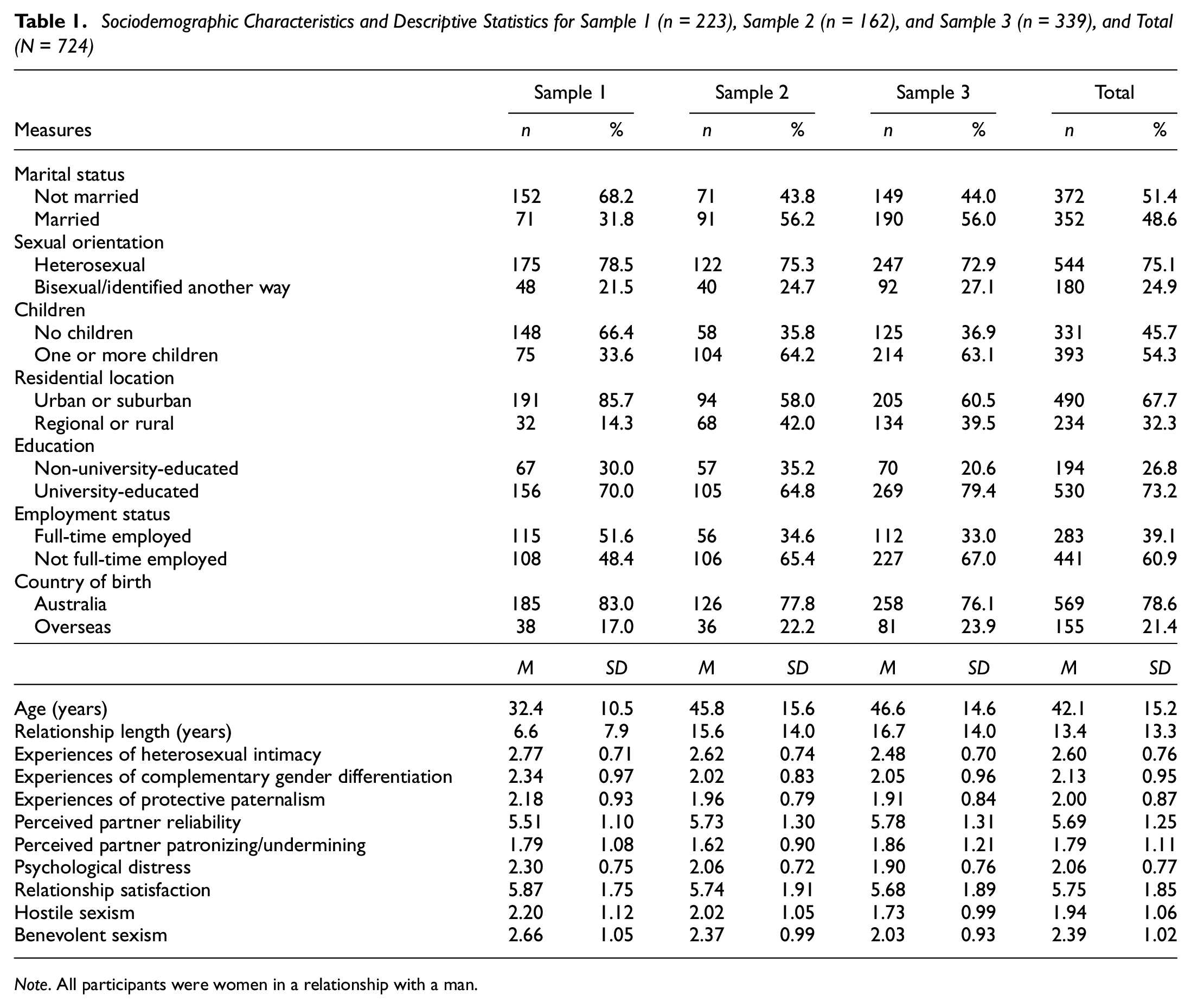
Note. All participants were women in a relationship with a man.
Materials
Participants first completed eligibility questions (i.e., age, gender, country of residence, relationship status), then the following scales in randomized order, and finally the remaining measures of sociodemographic variables.
Experiences of Benevolent Sexism
We adapted the 25-item Experiences of Benevolent Sexism Scale (Oswald et al., 2019) on the frequency of participants’ experiences of benevolent sexism to refer specifically to participants’ current partner. Participants indicated how frequently each event happened to them in their current relationship “because they are a woman,” 1 = the event never happened to 6 = the event happened almost all of the time (more than 70%) of the time. Items for each form of benevolent sexism experience were averaged for: heterosexual intimacy (e.g., “You have been put on a pedestal by your romantic partner?”; α = .70), complementary gender differentiation (e.g., “Your partner expected you to display purity in your behaviours?”; α = .75), and protective paternalism (e.g., “Your partner questioned your ability to handle situations by yourself?”; α = .81).
Perceiving the Partner as Reliable
Women completed three items from the perceived partner reliability index (Cross et al., 2016): “My partner is the kind of person who will stick by me through good times and bad,” “My partner is the kind of person who will always put our relationship first,” and “My partner is the kind of person who will make sacrifices to take care of me and our relationship” (1 = Strongly Disagree to 7 = Strongly Agree). Items were averaged to index greater perceptions of partner’s reliability (α = .88).
Perceiving the Partner as Patronizing and Undermining
Following Gul and Kupfer (2019), participants completed six items: “In your relationship with your partner, to what extent do you find him to be: … patronising, . . .controlling, … dominant” and “In your relationship with your partner, to what extent does he make you feel: … inferior, … powerless, … incompetent” (1 = Not at All to 7 = Very). Items were averaged to index greater perceptions of patronizing/undermining behavior (α = .93).
Psychological Distress
Participants completed the K10 scale (Kessler et al., 2002), which indexed frequencies of 10 distress symptoms experienced in the last 30 days, including feeling nervous, hopeless, or depressed (1 = None of the Time to 5 = All of the Time). Items were averaged to index greater psychological distress (α = .92).
Relationship Satisfaction
Participants completed the five-item relationship satisfaction subscale from Rusbult et al. (1998; e.g., “I feel satisfied with our relationship”; 0 = Do Not Agree at All to 8 = Agree Completely). Items were averaged to index greater relationship satisfaction (α = .94).
Hostile and Benevolent Sexism
Participants completed the 12-item short-form Ambivalent Sexism Inventory (Glick & Fiske, 1996; Rollero et al., 2014), including hostile sexism (e.g., “Women seek to gain power by getting control over men”) and benevolent sexism (e.g., “Women should be cherished and protected by men.”; 0 = Disagree Strongly to 5 = Agree Strongly). Items were averaged to index greater endorsement of hostile (α = .89) or benevolent sexism (α = .80).
Results
Descriptive statistics are supplied in Table 1, and zero-order correlations between key study variables for the combined samples are shown in Table 2. To test our research questions, we ran a series of regressions in the pooled data set (separate analyses for each sample are included in the Supplemental Material, Tables S1–S4). We examined whether results varied across samples by including interactions between the main effects and the sample source for each analysis (see Supplemental Material, Table S5), which revealed no meaningful differences in the results. Hence, we proceeded with the integrated analysis. We used expectation maximization to replace a small number of missing values that were missing completely at random (Sample 1: four values, Sample 2: three values, and Sample 3: six values). Data screening and assumption testing revealed no concerns for outliers/multicollinearity or violations of the assumptions of normality, linearity, or homoscedasticity.
Zero-Order Correlations for Study Variables in Combined Sample (n = 724)
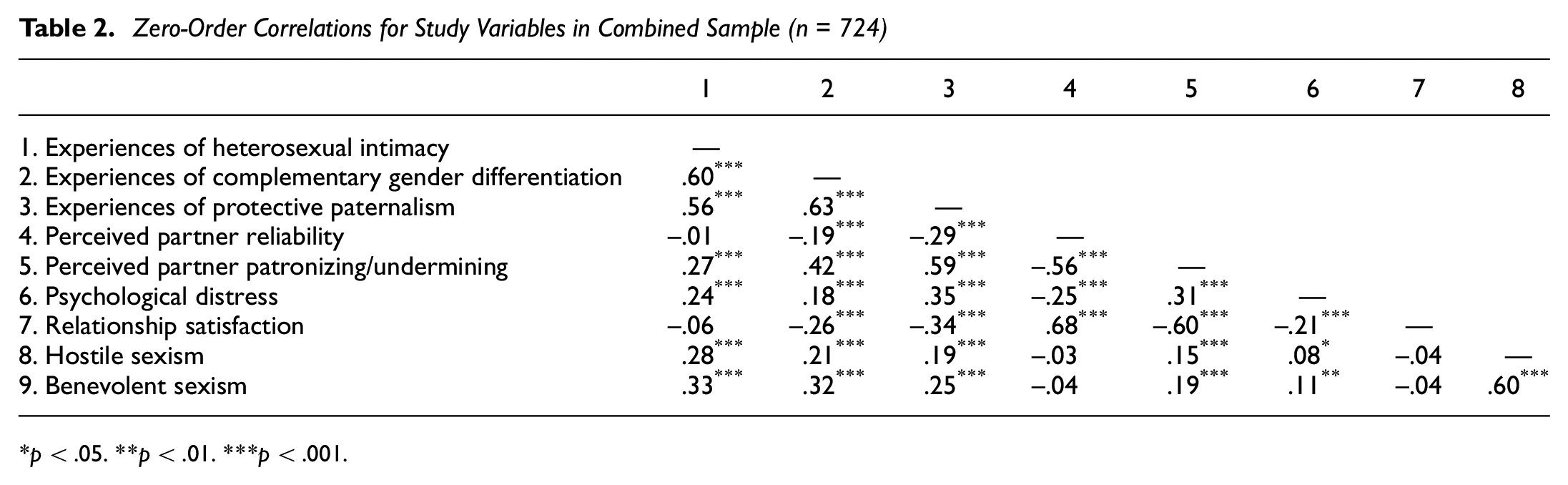
p < .05. **p < .01. ***p < .001.
We conducted separate models regressing each of the four outcome variables on all three subtypes of participants’ experiences of benevolent sexism (i.e., experiences of heterosexual intimacy, complementary gender differentiation, and protective paternalism), while statistically adjusting for the sample source, sociodemographic variables, and participant’s endorsement of hostile sexism and benevolent sexism. Results from the regressions are presented in Table 3. There was no evidence that participants’ endorsement of hostile sexism or benevolent sexism were associated with any of the outcomes. Regressions for experiences of each individual subtype of benevolent sexism (Tables S6–S8) and summaries of significant associations with the demographic covariates in the combined sample are supplied in the Supplemental Material.
Standardized Betas for Sociodemographic Characteristics, Sexist Attitudes, and Experiences of Benevolent Sexism in Regressions Predicting Perceptions of Partner Reliability, Perceptions of Partners as Patronizing/Undermining, Psychological Distress, and Relationship Satisfaction (N = 724)
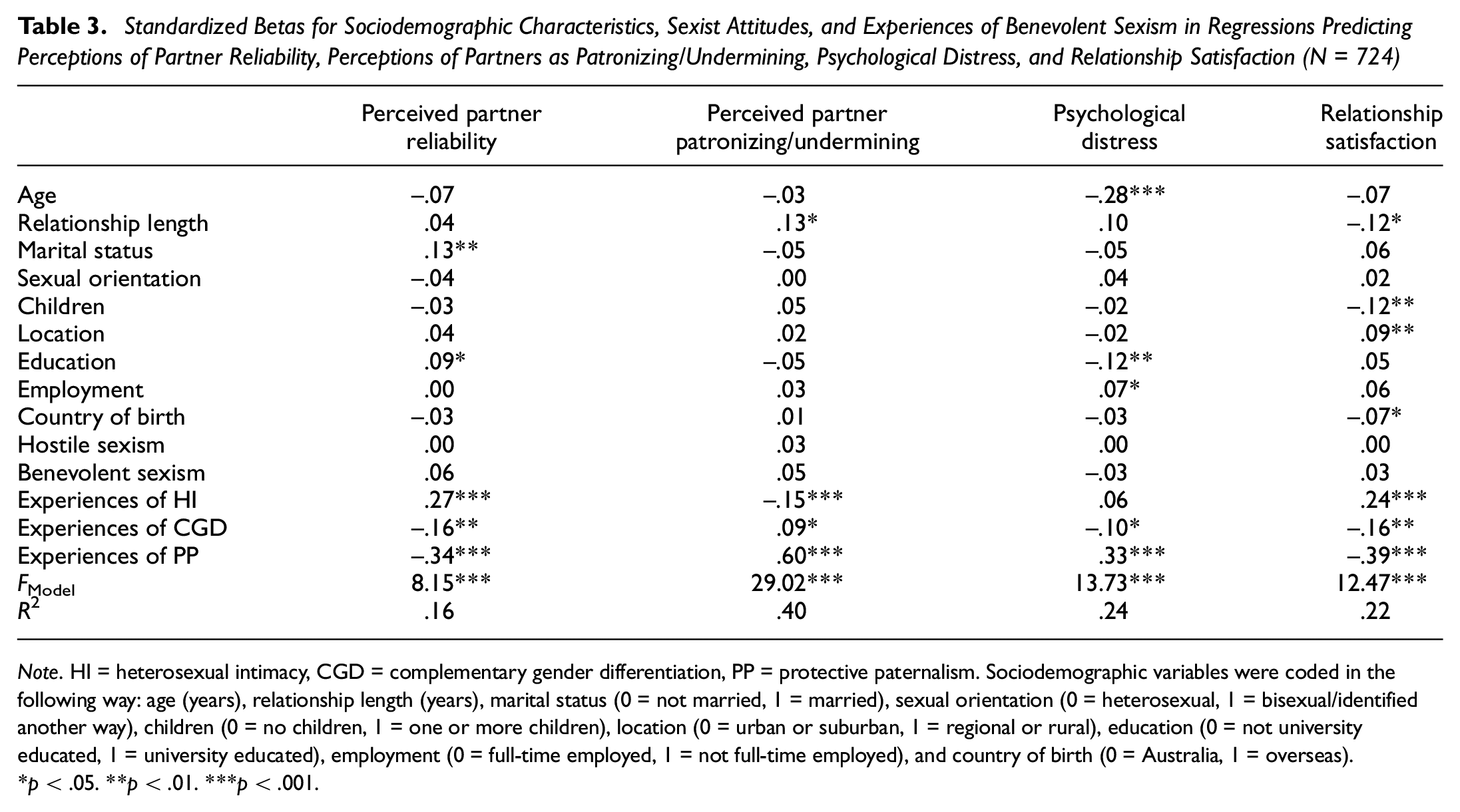
Note. HI = heterosexual intimacy, CGD = complementary gender differentiation, PP = protective paternalism. Sociodemographic variables were coded in the following way: age (years), relationship length (years), marital status (0 = not married, 1 = married), sexual orientation (0 = heterosexual, 1 = bisexual/identified another way), children (0 = no children, 1 = one or more children), location (0 = urban or suburban, 1 = regional or rural), education (0 = not university educated, 1 = university educated), employment (0 = full-time employed, 1 = not full-time employed), and country of birth (0 = Australia, 1 = overseas).
p < .05. **p < .01. ***p < .001.
We report the outcomes associated with experiences of each subtype of benevolent sexism (Table 3) in turn. First, more frequent experiences of heterosexual intimacy predicted greater perceptions of one’s partner as reliable (β = .27, p < .001, B = 0.44, 95% confidence interval [CI] [0.29, 0.59]), lower perceptions of one’s partner as patronizing and undermining (β = −.15, p < .001, B = −0.21, 95% CI [–0.32, –0.10]), and greater relationship satisfaction (β = .24, p < .001, B = 0.57, 95% CI [0.36, 0.79]), but not psychological distress (β = .06, p = .166, B = 0.06, 95% CI [–0.03, 0.15]). In sum, participants’ more frequent experiences of heterosexual intimacy, such as being told their love “completes” their partner, were linked with positive evaluations of their partner and their relationship, but not personal wellbeing.
In contrast, participants’ more frequent experiences of protective paternalism predicted lower perceptions of one’s partner as reliable (β = −.34, p < .001, B = −0.49, 95% CI [–0.62, –0.35]), greater perceptions of one’s partner as patronizing and undermining (β = .60, p < .001, B = 0.78, 95% CI [0.67, 0.88]), greater psychological distress (β = .33, p < .001, B = 0.29, 95% CI [0.21, 0.37]), and lower relationship satisfaction (β = −.39, p < .001, B = −0.83, 95% CI [–1.02, –0.64]). In sum, women’s more frequent experiences of protective paternalism, such as their partner prohibiting them from doing something for fear of harm, were strongly associated with negative outcomes for themselves, and negative evaluations of their partners and relationship.
Finally, more frequent experiences of complementary gender differentiation predicted lower perceptions of one’s partner as reliable (β = −.16, p = .004, B = −0.21, 95% CI [–0.34, –0.07]), greater perceptions of one’s partner as patronizing and undermining (β = .09, p = .042, B = 0.11, 95% CI [0.00, 0.21]), lower psychological distress (β = −.10, p = .050, B = −0.08, 95% CI [–0.16, 0.00]), and lower relationship satisfaction (β = −.16, p = .002, B = −0.31, 95% CI [–0.51, –0.11]). Thus, women’s experiences of complementary gender differentiation, including partner’s praise for housework, were linked with negative evaluations of partners and the relationship, but opposing those negative outcomes, lower levels of distress. 1
Discussion
We examined how 724 women’s experiences of the three subtypes of benevolent sexism from their male intimate partners predicted evaluations of their partners, relationship, and personal wellbeing. As hypothesized, women’s experiences of heterosexual intimacy were associated with greater perceptions of their partner’s reliability and greater relationship satisfaction, and unexpectedly predicted lower perceptions of partners as patronizing and undermining. Moreover, as expected, experiences of protective paternalism were strongly associated with greater perceptions of partners as patronizing and undermining, greater psychological distress, and lower relationship satisfaction, and (unexpectedly) lower perceptions of partner reliability. Finally, as expected, experiencing complementary gender differentiation was associated with lower psychological distress, yet also unexpectedly associated with lower relationship satisfaction and perceptions of partner’s reliability, and greater perceptions of partners as patronizing and undermining.
Our research indicated that women’s experiences of protective paternalism were particularly costly for their intimate relationships with men. Women’s experiences of protective paternalism, such as their partner prohibiting an activity for fear of them being hurt or their partner insisting on carrying heavy things without a request for help, were most strongly linked to negative outcomes for their relationships and their wellbeing. These results align with past findings that men’s benevolent sexism is stressful, undermining, and unappealing to women (e.g., Gul & Kupfer, 2019; Hammond & Overall, 2015; Lamarche et al., 2020; Oswald et al., 2019). Our specific focus on intimate relationships provides an important illustration of how expressions of benevolent sexism are often likely to be uncaring and damaging, despite the subjective positivity of its content. Specifically, benevolent sexism relies on people following general prescriptive norms rather than expressing understanding, and being responsive to, their partners’ specific abilities and needs. In other words, expressions of benevolent sexism are aligned with general conceptual understanding (i.e., that “caring” is positively valenced) but are antithetical to people’s personal relational needs, such as the need for partner responsiveness. Critically, these findings advance current empirical and theoretical understanding by showing that women’s experiences of specific aspects of benevolent sexism that emphasize gendered ways of providing advice, protection, and support compromise women’s wellbeing.
We also extended a key tenet of ambivalent sexism theory: benevolent sexism confers women some benefits within intimate relationships with men. Specifically, women’s experiences of heterosexual intimacy—including behaviors, such as feeling put on a pedestal, being financially provided for, and being told their love completes their partner—were associated with positive perceptions of their partner and relationship. These findings were consistent with the reasoning that “benevolent” expressions can function as signals of partner devotion and aligns with prior research showing that men who endorse benevolent sexism themselves (or their partner perceived them to endorse benevolent sexism) are perceived to be particularly reliable and invested partners (Cross et al., 2016; Hopkins-Doyle et al., 2019). It is noteworthy that there was no association between experiences of heterosexual intimacy and psychological distress. Despite the relationship benefits associated with these experiences, they did not extend to any benefits associated with women’s personal wellbeing. Thus, it appears that the benefits of heterosexual intimacy might be limited to perceptions of partners and the relationship itself, which may be due to women’s perceptions that this aspect of benevolent sexism offers them a greater sense of relationship security. However, the downsides of this neglect for women’s competence and independence may explain the lack of association with personal wellbeing (Overall & Hammond, 2018).
Findings for experiences of complementary gender differentiation, such as women being told they were/will be good mothers because they are caring, were mixed and showed the weakest effects overall. In line with previous research (Oswald et al., 2019), women’s experiences of complementary gender differentiation were associated with greater personal wellbeing. However, they were also unexpectedly associated with negative perceptions of their partner and relationship. Thus, experiencing behaviors, such as being praised by male intimate partners for doing domestic tasks appeared positive for wellbeing but costly for evaluations of partners and relationships. Perhaps women experienced relatively reduced stress when experiencing praise for adopting conventional behaviors in relationships that clarified their expectations for their roles (e.g., being expected to be a caregiver while men were expected to be providers), potentially due to reduced conflict or negotiation around relationship expectations. Nonetheless, the evidence suggests that this was associated with less satisfaction with partners and the relationship. These gendered role divisions may provide an expedient means to reduce tension among women in relationships with men, but at the cost of lowered evaluations of partners and the relationship itself.
Collectively, our findings illustrate that women’s experiences of three interrelated aspects of benevolent sexism in intimate relationships accompany mixed costs and benefits. These findings extend understanding of the insidious nature of benevolent sexism. Specifically, romanticized ideals about the mutual interdependence of genders appear to confer women some benefits in intimate relationships with men, but are packaged with downsides, including more frequent experiences of protective paternalism and, to some extent, complementary gender differentiation. The findings align with previous research suggesting that protective paternalism represents the costly side of benevolent sexism (e.g., Gul & Kupfer, 2019; Hammond & Overall, 2015; Lamarche et al., 2020; Oswald et al., 2019) but offers new evidence that, in intimate relationships with men specifically, those costs may be counteracted by the benefits of heterosexual intimacy. In addition, although women’s experiences of complementary gender differentiation correlated with more negative relationship outcomes, those same experiences were also associated with lower personal distress. These findings offer a potential clarification for why benevolent sexism may be appealing to women despite the well-established costs (Bosson et al., 2010), because it accompanies perceptions of reliability or signals of expected gender-role divisions (see Bareket & Fiske, 2023; Hammond & Overall, 2017). Practical efforts to mitigate the harms of benevolent sexism thus need to recognize relationship needs that are satisfied by benevolently sexist behaviors.
Limitations and Future Research
Our study was a cross-sectional design. We selected the directionality of our regression models following experiments indicating that women’s exposure to benevolent sexism affected their distress, evaluations of others, and self-perceptions (e.g., Lamarche et al., 2020; Salomon et al., 2015; Shepherd et al., 2011). While our results offer complementary evidence from women’s real-world relationship experiences, they do not provide causal or directional evidence. For instance, despite the possibility that women’s relationship experience changed their experiences of sexism, we did not find evidence to suggest that women’s own endorsement of benevolent sexism mitigated the costs (or enhanced the benefits) of experiencing benevolent sexism. However, contextual variables—such as the expected division of household labor or couples’ employment demands—might moderate the extent to which experiences of benevolent sexism are linked with costs and benefits for wellbeing (Bareket & Fiske, 2023; Waddell et al., 2021). Future research could utilize longitudinal experience sampling to examine the extent to which experiences of benevolent sexism are interlinked with the development of personal and relationship wellbeing across time.
Participants in our study self-reported their experiences of benevolent sexism from their partner, and different associations will likely emerge if partners’ reports of their own behavior were examined. Our study focused on women’s perceptions of their partner’s benevolently sexist behaviors that occurred in their relationship “because they are a woman” and thus relied on women’s attributions about gender-targeted behaviors. Intriguingly, we did not have evidence to suggest there were attributional differences. No evidence emerged that women’s own endorsement of sexism attenuated the negativity of sexist experiences: expressions of love and affection that occurred “because of being a woman” were generally linked with positive evaluations, whereas patronizing and paternalistic behaviors were generally negative. Nonetheless, we recognize that there are no objective assessments of sexist behavior and there are limitations to relying on people’s perceptions, including people making more charitable attributions of restrictions on women’s freedoms when put in the context of being protective of women (e.g., Moya et al., 2007). A logical step for future research is a dyadic study of sexist experiences that could examine bias and accuracy in both partners’ attributions of relationship behaviors (e.g., Cross et al., 2019). For instance, perhaps women and men differ on the extent to which they express (versus receive) love and care for qualities that are unique to their partner versus their partner’s gender or stereotypical role expectations.
Our efforts to obtain community-based samples meant that they included a mix of married and non-married participants in Australia, employed and non-employed participants, and a wide age range. However, participants were primarily born in Australia, university educated, and currently living in a relatively wealthy, industrialized, and Western country. It is possible that our participants were relatively more aware of, and intolerant of, the subtle ways sexism functions in their relationships with men, and thus their evaluations of partners and relationships may be particularly negative relative to women in less wealthy, industrialized, and Western contexts. Careful consideration of the context of women’s experiences of benevolent sexism is an important step for future research. To illustrate, the combinations of costs and benefits associated with experiencing complementary gender differentiation should consider the extent to which relationship roles adhere to the prescribed complementarity (e.g., taking time out of paid work to raise children, or adopting conventional divisions of labor; Bareket & Fiske, 2023; Barreto & Doyle, 2023). Future research on people’s experiences of benevolent sexism across micro- and macro-level contexts is necessary to build a model of related outcomes.
In conclusion, women’s experiences of benevolent sexism within their relationships with men were associated with mixed costs and benefits for personal and relational wellbeing. Experiences of protective paternalism were most strongly associated with negative evaluations of their partner and relationship. By contrast, and despite being highly associated with other experiences of benevolent sexism, women’s experiences of heterosexual intimacy were associated with greater relationship wellbeing. Finally, experiencing complementary gender differentiation was associated with higher personal wellbeing, but poorer relationship wellbeing. These findings affirm research and theory related to women’s and men’s endorsement of benevolent sexism that presupposes a corresponding pattern of behavior in men and experience in women. The combination of costs and benefits from different aspects of benevolent sexism likely render it difficult to challenge and change.
Supplemental Material
sj-docx-1-spp-10.1177_19485506241256695 – Supplemental material for Women’s Experiences of Benevolent Sexism in Intimate Relationships With Men Are Associated With Costs and Benefits for Personal and Relationship Wellbeing
Supplemental material, sj-docx-1-spp-10.1177_19485506241256695 for Women’s Experiences of Benevolent Sexism in Intimate Relationships With Men Are Associated With Costs and Benefits for Personal and Relationship Wellbeing by Beatrice Alba, Emily J. Cross and Matthew D. Hammond in Social Psychological and Personality Science
Footnotes
Acknowledgements
The authors thank Rebekah Abblitt, Jacqui Anastasi, Nicole Escuyos, Jordan Loukas-Marr, Rebecca Szabo, and Yizhen Wang for assisting with data collection for Sample 1.
Handling Editor: Husnu Shene
Declaration of Conflicting Interests
The author(s) declared no potential conflicts of interest with respect to the research, authorship, and/or publication of this article.
Funding
The author(s) disclosed receipt of the following financial support for the research, authorship, and/or publication of this article: This research was funded by the School of Psychology, Deakin University.

Supplemental Material
Supplemental material is available in the online version of the article.
Notes
Author Biographies
References
Supplementary Material
Please find the following supplemental material available below.
For Open Access articles published under a Creative Commons License, all supplemental material carries the same license as the article it is associated with.
For non-Open Access articles published, all supplemental material carries a non-exclusive license, and permission requests for re-use of supplemental material or any part of supplemental material shall be sent directly to the copyright owner as specified in the copyright notice associated with the article.
