



Abstract
Motivated by theoretical accounts positing that participation in intergroup conflict is driven by a desire to promote the in-group, past studies have explored the link between prosocial personality dimensions and out-group harm. However, while dimensions such as Honesty-Humility predict in-group cooperation, they do not explain out-group harm. Across two incentivized experimental studies (one preregistered; overall N = 1,584), we show that out-group harm is uniquely associated with higher levels of the Dark Factor of Personality (D), a personality dimension capturing the core of all aversive personality characteristics. Conversely, high levels of D, alongside low levels of Honesty-Humility, are associated with less in-group cooperation. Our results show that in-group cooperation and out-group harm are associated with distinct personality dimensions.
Out-group harm is present across human history and cultures (Pinker, 2011). Yet, while some individuals commit abhorrent acts against out-group members, others prefer peaceful cooperation (Aaldering & Böhm, 2020; Glowacki, 2022). So who is willing to harm out-groups? Influential theoretical accounts in social psychology (Tajfel & Turner, 1986; Yamagishi & Mifune, 2016), evolutionary anthropology (Choi & Bowles, 2007; Lehmann & Feldman, 2008), and economics (Abbink et al., 2012) posit that harmful behavior toward out-groups is driven by the desire to promote the in-group (for reviews, see Pisor & Ross, 2024; Rusch, 2014). According to these frameworks, in-group cooperation and out-group harm are inextricably linked. At the level of individual differences, this suggests that the same individuals who sustain cooperation within groups stoke conflict between groups (Pisor & Ross, 2024).
Crucial evidence in support of this view comes from experiments that operationalize harm as the imposition of monetary costs on others. Importantly, though, earlier studies conflate “weak parochial cooperation” (i.e., selective cooperation with in-group members which neither benefits nor harms out-group members) with “strong parochial cooperation” (i.e., cooperation with in-group members coupled with harmful behaviors toward out-group members). For example, the earliest empirical support for social identity theory came from settings in which individuals could only benefit in-group members by reducing the outcomes of out-group members (Tajfel et al., 1971). In these studies, the link between in-group cooperation and out-group harm thus arises from a confound in the design.
Only recently have new experimental paradigms disentangled weak parochial cooperation from strong parochial cooperation. The intergroup prisoner’s dilemma–maximizing difference (IPD-MD) game and the intergroup parochial and universal cooperation (IPUC) game allow for peaceful cooperation with the in-group without imposing harm on the out-group (Aaldering & Böhm, 2020; Halevy et al., 2008). Evidence from these paradigms shows that only a minority of individuals harm out-group members when they have the option to peacefully cooperate with their in-group. This holds true even when the groups have enmity or a history of conflict (for a review of IPD-MD studies, see Böhm et al., 2022). Moreover, individuals who behave more prosocially toward in-group members are also more generous, rather than more harmful, toward out-group members (Columbus et al., 2023). This suggests that in-group cooperation and out-group harm reflect distinct individual differences.
Personality and Intergroup Conflict
Identifying the personality dimensions implicated in strong parochial cooperation can shed light on the causes of intergroup conflict. If weak and strong parochial cooperation have different predictors, this would contradict theories which locate the source of intergroup conflict in in-group cooperation. However, personality dimensions linked to strong parochial cooperation are, at present, a missing link. Experimental studies using the IPD-MD and IPUC games have only identified personality dimensions associated with weak parochial cooperation. Consistently, individuals who are more prosocial (i.e., higher in dimensions such as Honesty-Humility and Social Value Orientation) cooperate more with their in-group (Aaldering & Böhm, 2020; de Dreu, 2010; de Dreu et al., 2015; de Dreu et al., 2010; Thielmann & Böhm, 2016). However, such individuals do not engage in out-group harm when they have the opportunity to peacefully cooperate with their in-group, which suggests that weak and strong parochial cooperation have different motivational bases.
Strikingly, experimental studies which disentangle out-group harm from in-group cooperation have failed to identify robust personality predictors of strong parochial cooperation. Several plausible candidates, such as Honesty-Humility, (HEXACO) Agreeableness, Social Dominance Orientation, and Right-Wing Authoritarianism failed to predict out-group harm (Aaldering & Böhm, 2020; Thielmann & Böhm, 2016). In survey studies, Honesty-Humility, Emotionality, and Openness to Experience were negatively associated with support for group-based violence (Lindström et al., 2024; Obaidi et al., 2023); however, such studies are unable to isolate preferences for harming out-groups from other factors, such as perceived threats to the in-group. Thus, it remains an open question which, if any, personality dimensions predict strong parochial cooperation. Here, we suggest, and find, that the Dark Factor of Personality (D)—the common core underlying aversive personality traits—best predicts which individuals harm out-group members even when they have the option to peacefully cooperate with their in-group.
Why D (but not Honesty-Humility) Should Predict Strong Parochial Cooperation
Honesty-Humility is one of the dimensions of the HEXACO model of personality (Ashton et al., 2014). Conceptually, it captures the tendency to avoid exploiting others even if one could do so without experiencing negative consequences (Ashton et al., 2014). Empirically, it is the strongest predictor of prosocial behavior among broad personality dimensions (Thielmann et al., 2020; Zettler et al., 2020). In particular, Honesty-Humility is negatively correlated with non-cooperation in social dilemma games, in which decision-makers face the choice between maximizing their individual outcomes and collective welfare (meta-analytic correlation
By contrast, we suggest that strong parochial cooperation is linked to high levels of D. D has recently been introduced to account for the common core of all aversive personality traits, such as egoism, Narcissism, Machiavellianism, psychopathy, and spitefulness (Moshagen et al., 2018; Moshagen et al., 2020a). 1 D is defined as “the general tendency to maximize one’s individual utility—disregarding, accepting, or malevolently provoking disutility for others—, accompanied by beliefs that serve as justifications” (Moshagen et al., 2018, p. 657). Correspondingly, D comprises two aspects, namely, the degree to which people strive for own utility maximization at the expense of others and to which they hold descriptive and injunctive beliefs that can be used to justify corresponding behavior (Hilbig et al., 2022). Aversive traits, in turn, are considered flavored manifestations of D with regard to two aspects: First, aversive traits might differ with regard to which aspect of D is pronounced (e.g., Sadism pronounces inflicting disutility on others). Second, aversive traits might entail different, essentially non-aversive characteristics (e.g., psychopathy is often considered to comprise disinhibition or a lack of self-control, which are not inherently aversive characteristics; Bader, Hilbig et al., 2022).
D has been linked empirically to a variety of malevolent behaviors, including criminal activities (Vize et al., 2021), counterproductive work behavior (Bader et al., 2022), internet trolling (Moshagen et al., 2020b), sexism (Schrödter et al., 2021), vengeance (Bader et al., 2021), and violence (Bader, Horsten, et al., 2022). D thus differs from (low) Honesty-Humility “in the extent to which utility is accompanied by or even achieved through inflicting disutility on others as well as beliefs and attitudes that are used to justify malevolent behaviors” (Horsten et al., 2021). Whereas individuals low in Honesty-Humility pursue material and immaterial outcomes for themselves, they appear rather indifferent to the outcomes of others. In contrast, individuals high in D are thought to derive subjective utility from the losses and suffering they inflict on others (Horsten et al., 2021; Moshagen et al., 2018). Correspondingly, accumulating evidence links D to harmful and destructive behaviors—even when these do not benefit the decision-maker materially (Horsten et al., 2021; Moshagen et al., 2018; Moshagen et al., 2020a, 2020b; Rose et al., 2023). Consequently, we posit that D may predict purely gratuitous out-group harm (i.e., strong parochial cooperation).
The Present Study
We study out-group harm using the established IPD-MD game (Halevy et al., 2008). In this game, members of two groups make decisions which affect their own and each other’s outcomes. A key advantage of the IPD-MD is that it separates behaviors that reflect self-interest, weak parochial cooperation, and strong parochial cooperation. Individual group members can allocate resources to themselves (self-interest), benefit their in-group (weak parochial cooperation), or benefit their in-group while imposing a cost on the out-group (strong parochial cooperation). Thus, individuals who are motivated to benefit their in-group are not forced to harm the out-group, and out-group harm is purely gratuitous (but individually costly). This allows us to identify the individual differences that underlie the willingness to harm out-groups even when this provides no material benefits to oneself or others. Specifically, we examine the role of D and of the six dimensions of the HEXACO model in intergroup conflict across two experiments with natural groups (Democrats and Republicans in the USA, Study 1) and minimal groups (Study 2).
Study 1
Methods
Data and Open Science Statement
Study 1 is based on a re-analysis of an experiment published in Columbus et al. (2023); the personality measures were not analyzed in the previous publication. The original study was preregistered, but did not specify any hypotheses with regard to the personality measures. Here, we follow the preregistered data exclusion criteria. Materials, data, and analysis code are available on the Open Science Framework (OSF; https://osf.io/5d642/).
Sample
We aimed to recruit 960 American supporters of the Democratic party through Prolific (http://prolific.co). In total,
Democrats and Republicans are increasingly affectively polarized (Iyengar et al., 2019). Therefore, using this sample allowed us to test the role of personality dimensions in intergroup conflict between natural groups with substantial negative attitudes toward each other.
Experimental Setup
We employed a one-shot IPD-MD game with two groups of
To avoid negative payoffs, each participant also received 100 MU they could not invest. To determine payoffs, we randomly selected 96 participants (i.e., 10%) to be matched to the sample of Republicans (the out-group) and have their decisions paid out. Earnings were paid out at a rate of 1 MU = US$ 0.05 to selected participants.
Personality Measures
We measured Honesty-Humility and Agreeableness versus Anger (in the following: Agreeableness) using the respective 16-item subscales of the HEXACO-100 (Lee & Ashton, 2018; Thielmann, Akrami, et al., 2020). D was assessed using the 16-item measure introduced by Moshagen et al. (2020a). Responses to all items were recorded on a five-point Likert-type scale (range: 1 = strongly disagree, 5 = strongly agree). All scales showed good internal consistency, as indicated by McDonald’s
Means, Standard Deviations, Internal Consistency Estimates, and 95% Confidence Intervals for Zero-Order Correlations of Contributions in the IPD-MD Game and Personality Measures in Study 1
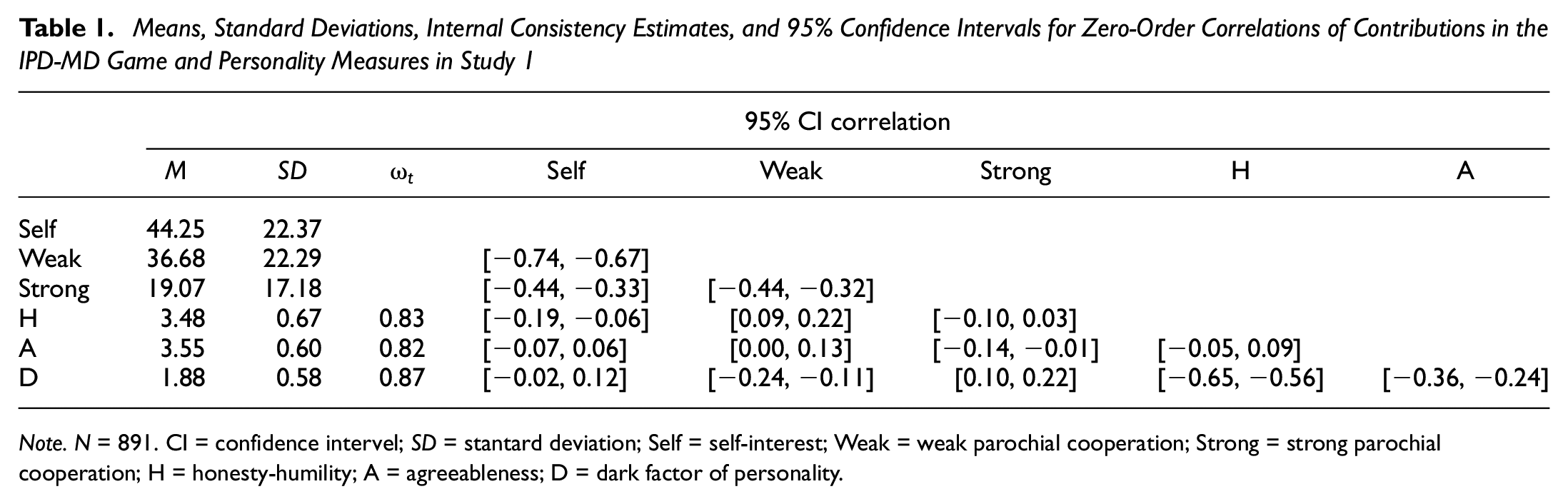
Note. N = 891. CI = confidence intervel; SD = stantard deviation; Self = self-interest; Weak = weak parochial cooperation; Strong = strong parochial cooperation; H = honesty-humility; A = agreeableness; D = dark factor of personality.
The study also contained measures of group-based preferences and beliefs about the behavior of in-group and out-group members, which are described in Columbus et al. (2023). We report correlations between personality dimensions and these measures in the supplementary materials. Basic demographic information was obtained from questions previously answered by participants and provided by Prolific.
Procedure
Participants signed up for a two-part study on two consecutive days. In the first part, they completed the Honesty-Humility, Agreeableness, and D scales and the other personality measures. The Honesty-Humility, Agreeableness, and D scales were presented in one block; the order of items was randomized.
In the second part, participants received detailed instructions for the IPD-MD game and answered three comprehension questions. Participants had two attempts to pass each question, after which they received the correct answers. Subsequently, we elicited participants’ beliefs about the behavior of in-group and out-group members. Finally, participants decided on their contributions to the different pools. Each participant made two sets of decisions, one for each threat conditions. The order of these conditions was counterbalanced.
Participants were paid US$2.80 plus a decision-based bonus (
Results
Exploratory Analyses
Descriptive statistics for Study 1 are shown in Table 1. We separately regressed three behavioral options (self-interest, weak parochial cooperation, and strong parochial cooperation) on all three personality dimensions. The outcome variables were averaged across the two threat conditions. For these analyses, we standardized all predictors and outcome variables. We also report how much each predictor contributes to the model
Honesty-Humility, Agreeableness, and D as Predictors of Weak and Strong Parochial Cooperation in the IPD-MD Game in Study 1
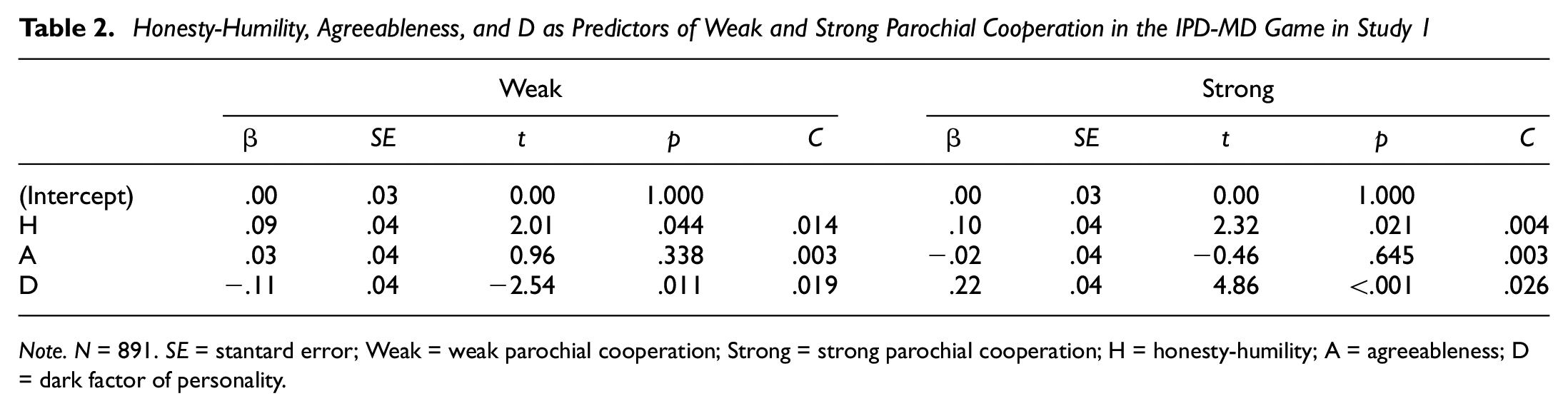
Note. N = 891. SE = stantard error; Weak = weak parochial cooperation; Strong = strong parochial cooperation; H = honesty-humility; A = agreeableness; D = dark factor of personality.
Self-interest was predicted by Honesty-Humility,
Weak parochial cooperation was positively associated with Honesty-Humility,
Finally, strong parochial cooperation was positively associated with Honesty-Humility,
Study 2
The exploratory results of Study 1 provide initial evidence that Honesty-Humility and D have distinct associations with behavior in intergroup conflict. In line with past findings (Aaldering & Böhm, 2020; Thielmann & Böhm, 2016), weak parochial cooperation was positively associated with Honesty-Humility. Extending past findings, weak parochial cooperation was negatively associated with D. Conversely, strong parochial cooperation was positively associated with D and, somewhat surprisingly (and contrary to past studies), also with Honesty-Humility. However, the association with Honesty-Humility was fairly weak and only surfaced when controlling for D.
In Study 2, we sought to replicate the key findings of Study 1 in a preregistered design. Specifically, we predicted that D would be positively associated with strong parochial cooperation after controlling for the six HEXACO dimensions (H1), and more strongly so than Honesty-Humility when controlling for the other five HEXACO dimensions (H2). In addition, we predicted that D would be negatively (H3) and that Honesty-Humility would be positively (H4) associated with weak parochial cooperation after controlling for the remaining HEXACO dimensions.
We extended Study 1 in several ways. First, whereas Study 1 only included Honesty-Humility and Agreeableness from the HEXACO model, we included all six HEXACO dimensions in Study 2. This allowed us to explore whether other HEXACO dimensions are associated with weak and strong parochial cooperation and to control for these dimensions in our analyses. Second, participants in Study 1 were members of natural (political) groups. In Study 2, we used purely artificial groups, which alleviates the concern that the observed associations were somehow confounded by political affiliation or specific to the political context. Third, Study 1 used a within-subjects manipulation to vary the threat posed by the out-group. This manipulation did not moderate any of the personality effects; in Study 2, we therefore used a simple one-shot IPD-MD game without additional manipulations.
Methods
Open Science Statement
This study was preregistered, including information about all hypotheses, how the sample size was determined, all data exclusions, all manipulations, and all measures in the study. The preregistration is available here (https://osf.io/pq2vm/?view_only=05790b0cd0eb47379d540173dc849a24). We did not deviate from the preregistration. Materials, data, and analysis code are available on the Open Science Framework (https://osf.io/5d642/?view_only=c7e98cc5bff1446cb1a57ba3af8c052e).
Sample
We determined the sample size based on a power analysis. Our key test is the association between D and strong parochial cooperation. In Study 1, this effect had a marginal
Participants were fluent English speakers living in the United States and recruited through Prolific. The study comprised two measurement occasions.
Participants were paid £1.20 for completing the first wave of the study and £1.00 for completing the second wave, for a total of about 10 min of effort. In addition, participants earned on average £0.87 in bonuses from the experimental game.
Experimental Setup
The experimental setup was similar to that of Study 1. We used the exact same IPD-MD game with the same parametrization. The main difference was that we did not include the threat manipulation, such that participants made only one decision (equivalent to the threat condition in Study 1).
Measures
We included the full 60-item HEXACO-PI-R (Ashton & Lee, 2009). The measure consists of six 10-item subscales, one for each HEXACO dimension (Honesty-Humility, Emotionality, Extraversion, Agreeableness, Conscientiousness, and Openness to Experience). D was again assessed using the 16-item measure introduced by Moshagen et al. (2020a). Responses to all items were recorded on a five-point Likert-type scale (range: 1 = strongly disagree to 5 = strongly agree). All (sub-)scales showed acceptable internal consistency, as indicated by McDonald’s
Means, Standard Deviations, Internal Consistency Estimates, and 95% Confidence Intervals for Zero-Order Correlations of Contributions in the IPD-MD Game and Personality Measures in Study 2
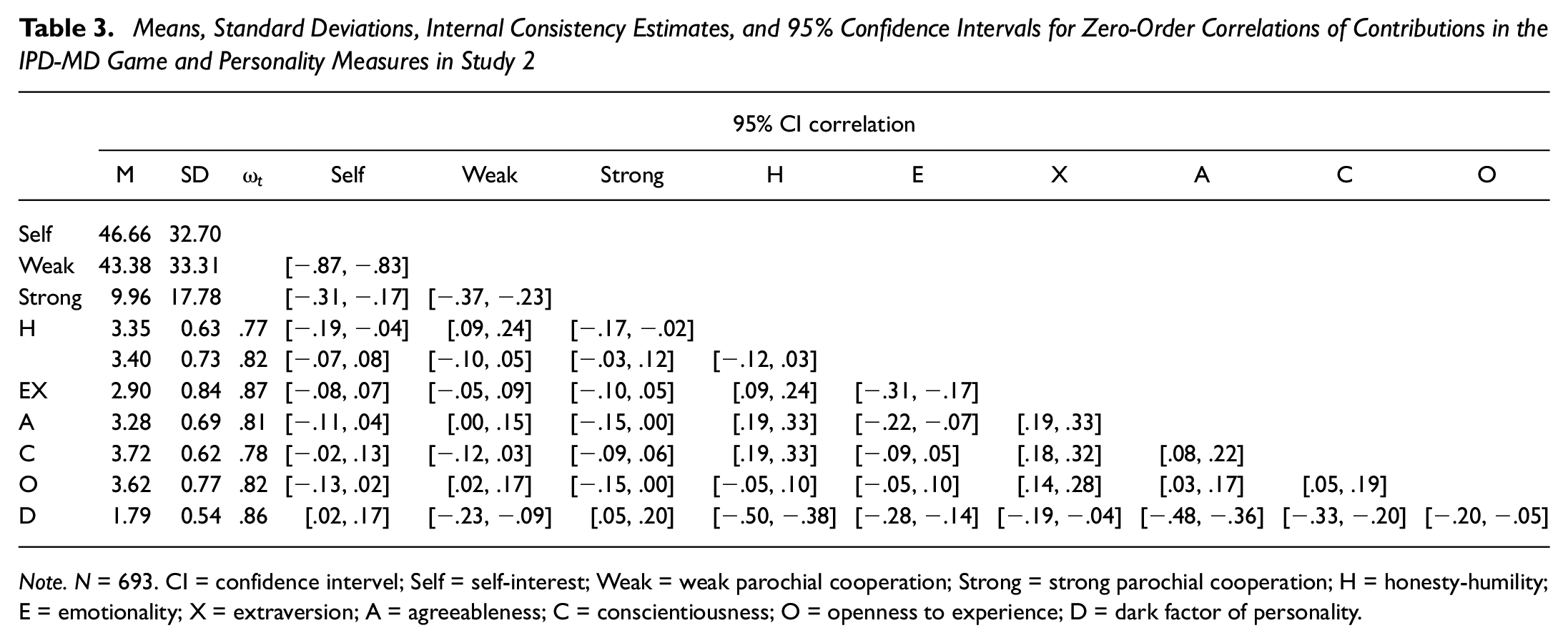
Note. N = 693. CI = confidence intervel; Self = self-interest; Weak = weak parochial cooperation; Strong = strong parochial cooperation; H = honesty-humility; E = emotionality; X = extraversion; A = agreeableness; C = conscientiousness; O = openness to experience; D = dark factor of personality.
Procedure
The study was conducted over the course of 2 days. On the first day, participants completed the two personality questionnaires in randomized order; the order of items was randomized within each questionnaire.
On the second day, participants were informed that they were assigned to groups of three (“OWN GROUP”) and paired with another group of three (“OTHER GROUP”), and that their decisions were payoff-relevant for themselves and the members of both groups. They were then introduced to the IPD-MD game. As in Study 1, the choice options were described as “green pool” (self-interest), “orange pool” (weak parochial cooperation), and “purple pool” (strong parochial cooperation). Participants then had three attempts to pass three comprehension questions, after which they were moved on to the next task. Finally, participants made their allocation decision.
However, 1 in 10 participants was selected for the decision-contingent bonus payment. To avoid negative payoffs, each participant also received a non-investable base pay of 100 MU. Earned MU were paid out at a rate of 1 MU = £0.05 to selected participants.
Results
Preregistered Confirmatory Analyses
Descriptive statistics for Study 2 are shown in Table 3. To test our predictions, we separately regressed weak and strong parochial cooperation on all six HEXACO dimensions and D. For these analyses, we standardized all predictors and outcome variables. Analyses are reported as preregistered with the exception of relative importance analyses. The full results are shown in Table 4 and Figure 1.
The Six HEXACO Dimensions and the Dark Factor as Predictors of Weak and Strong Parochial Cooperation in the IPD-MD Game in Study 2
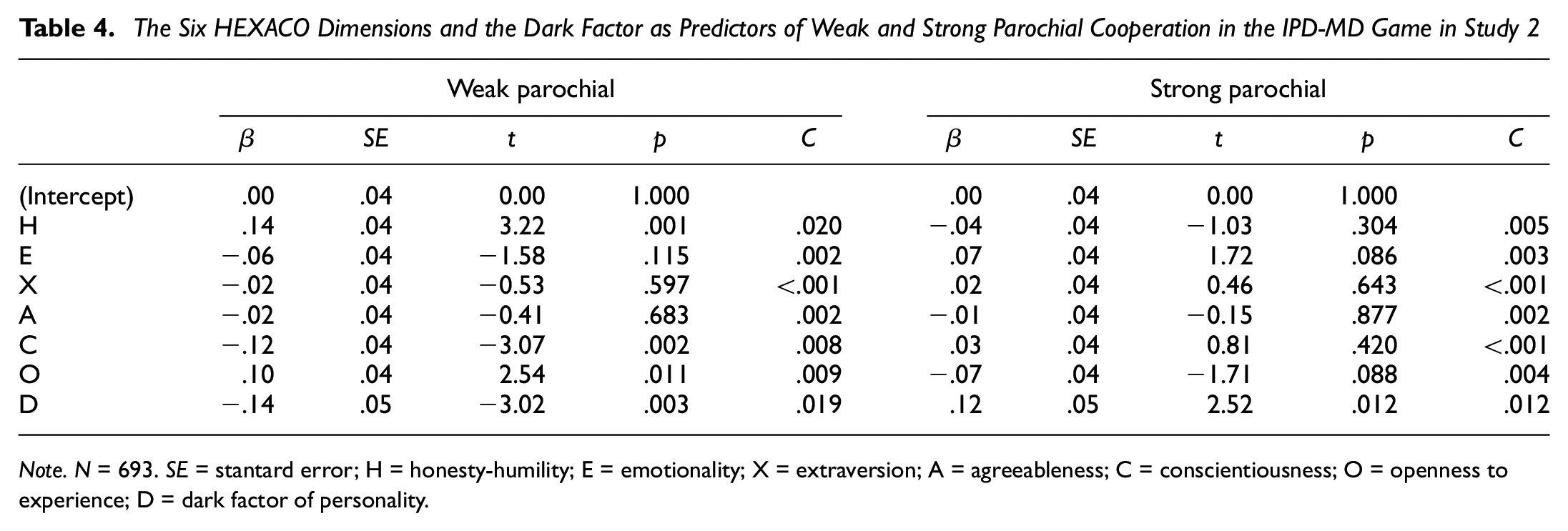
Note. N = 693. SE = stantard error; H = honesty-humility; E = emotionality; X = extraversion; A = agreeableness; C = conscientiousness; O = openness to experience; D = dark factor of personality.
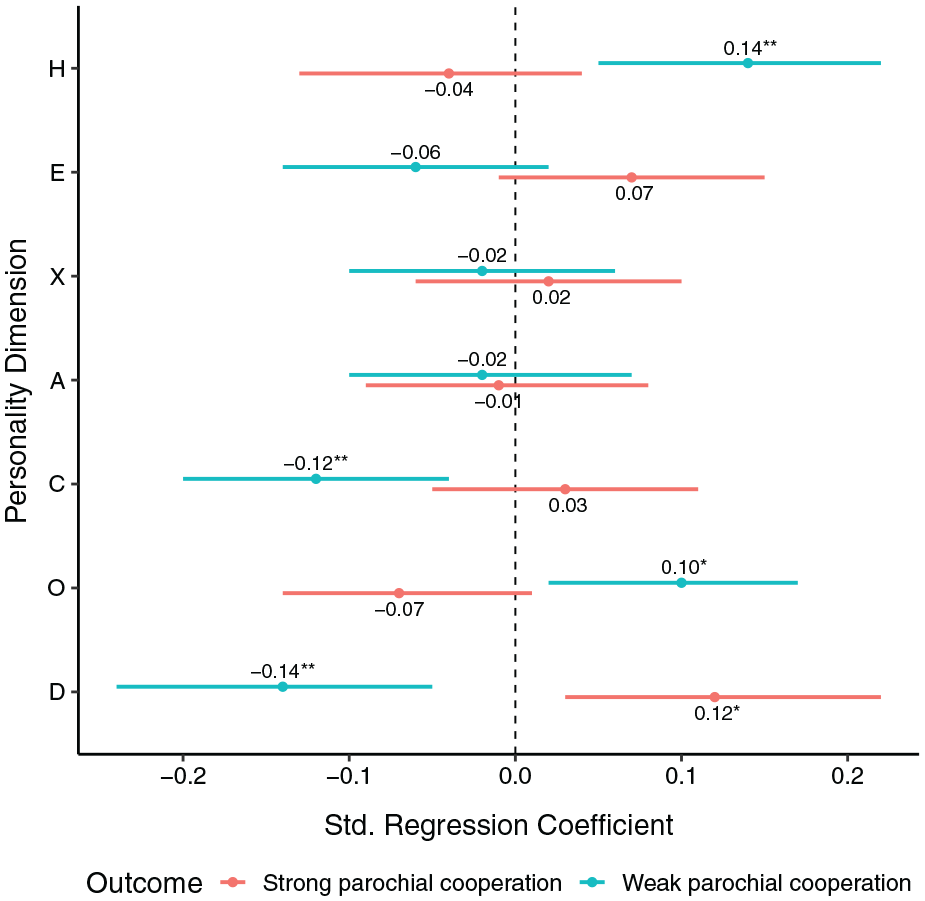
Standardized Regression Coefficients for Predictors of Weak and Strong Parochial Cooperation
As expected, Honesty-Humility was positively associated with weak parochial cooperation,
As predicted, D was positively associated with strong parochial cooperation,
As preregistered, we also tested whether D was a stronger predictor of strong parochial cooperation than Honesty-Humility. To do this, we tested the linear hypothesis that in the aforementioned model, the (absolute) coefficient of D is equivalent to the (absolute) coefficient of Honesty-Humility, by computing the Wald test for the comparison of the unconstrained model against a model in which the coefficients are linearly restricted. The difference in fit was not significant,
Exploratory Analyses
We also tested which personality dimensions predicted self-interest. As in Study 1, Honesty-Humility was negatively associated with self-interest,
Discussion
We studied the personality correlates of peaceful cooperation with one’s in-group (weak parochial cooperation) and harmful behavior toward out-groups (strong parochial cooperation). Individuals who scored higher on Honesty-Humility and lower on the Dark Factor of Personality cooperated more with their in-groups. However, only D consistently explained strong parochial cooperation: individuals who scored higher on D were more willing to harm members of an out-group, even when this provided no benefits to themselves or to their in-group. This was true across political partisans in the United States (Study 1) and minimal groups (Study 2). In addition, in Study 2, we found associations between Openness to Experience (positive) as well as Conscientiousness (negative) and peaceful in-group cooperation that require further investigation in future research.
It bears emphasizing that D was negatively associated with weak parochial cooperation, but positively with strong parochial cooperation. Indeed, these associations were balanced such that D was uncorrelated with overall contributions. This suggests two conclusions: First, in the context of potential intergroup conflict, individuals high in D are not behaving in a self-interested manner: they do not keep more of their endowment for themselves than individuals with lower levels of D. Second, as posited in the definition of D, individuals high in D seem to derive utility from the disutility of others: they engage in less peaceful cooperation with the in-group, but spend a larger share of their endowment to impose harm on the out-group. This is in line with recent arguments that D captures spiteful rather than purely selfish preferences (Horsten et al., 2021).
In contrast to D, Honesty-Humility was positively associated with weak parochial cooperation, yet uncorrelated with strong parochial cooperation, replicating past findings (Aaldering & Böhm, 2020; Thielmann & Böhm, 2016). The observed pattern suggests that, as proposed in the work by Horsten et al. (2021), Honesty-Humility relates more to self-interest (and, conversely, fairness) than to parochialism or malevolent tendencies. If anything, it may be somewhat surprising that Honesty-Humility was not negatively associated with strong parochial cooperation even though individuals had the option to peacefully cooperate with their in-group. Future research may explore why (some) individuals high in Honesty-Humility engage in behavior which harms out-groups.
Taken together, we find that weak and strong parochial cooperation exhibit different patterns of associations with personality variables. In particular, weak parochial cooperation appears to be driven by prosocial concerns (as indicated by the positive association with Honesty-Humility); in contrast, strong parochial cooperation appears to be driven by spiteful tendencies (as indicated by the positive association with D). This pattern of different relations provides further evidence against the proposed close link between intragroup cooperation and intergroup conflict (Pisor & Ross, 2024). Instead, at least at the level of broad personality dimensions, weak and strong parochial cooperation appear to be driven by distinct and even contradictory characteristics.
Limitations
We study a setting in which out-group harm is purely gratuitous: individuals cannot derive any personal or collective material benefits from harming others, and have the option to peacefully cooperate with their in-group. This may, in part, explain why Honesty-Humility was unrelated to strong parochial cooperation. In other settings, however, intergroup conflict provides opportunities for exploitation (de Dreu et al., 2016; Doğan et al., 2018). Depending on the context, aggression against out-groups can benefit oneself (i.e., produce a private good) but also other co-aggressors (i.e., produce a club good shared among co-aggressors) or even uninvolved members of one’s wider in-group (i.e., produce a public good). It is plausible that Honesty-Humility would be (negatively) associated with out-group harm where it involves exploitation, especially when the benefits only accrue to the individual. Similarly, in contexts in which out-group harm is a means to obtaining social status, this may be pursued primarily by individuals low in Honesty-Humility. Future studies may explore how the associations between personality dimensions and out-group harm vary with the strategic nature of intergroup relations, including in field settings.
Conclusion
Past studies have sought to identify individual differences in parochial cooperation (Aaldering & Böhm, 2020; Thielmann & Böhm, 2016). Yet, while Honesty-Humility was positively associated with weak parochial cooperation, none of the tested personality dimensions explained which individuals engaged in strong parochial cooperation. Across two studies, we bridge this gap by showing that the Dark Factor of Personality, a recently proposed personality dimension capturing the essence of malevolent tendencies (Bader, Hilbig et al., 2022; Moshagen et al., 2018), predicts harmful behavior toward natural and minimal out-groups.
Supplemental Material
sj-pdf-1-spp-10.1177_19485506241254157 – Supplemental material for Personality Correlates of Out-Group Harm
Supplemental material, sj-pdf-1-spp-10.1177_19485506241254157 for Personality Correlates of Out-Group Harm by Simon Columbus, Isabel Thielmann, Robert Böhm and Ingo Zettler in Social Psychological and Personality Science
Footnotes
Handling Editor: André, Mata
Declaration of Conflicting Interests
The author(s) declared no potential conflicts of interest with respect to the research, authorship, and/or publication of this article.
Funding
The author(s) received no financial support for the research, authorship, and/or publication of this article.
Supplemental Material
The supplemental material is available in the online version of the article.
Notes
Author Biographies

References
Supplementary Material
Please find the following supplemental material available below.
For Open Access articles published under a Creative Commons License, all supplemental material carries the same license as the article it is associated with.
For non-Open Access articles published, all supplemental material carries a non-exclusive license, and permission requests for re-use of supplemental material or any part of supplemental material shall be sent directly to the copyright owner as specified in the copyright notice associated with the article.
