



Abstract
The amount of social support partners provide and receive in romantic relationships is important for psychological well-being. But in what sense exactly? Divergent and highly nuanced hypotheses exist in the literature. We explicitly spelled out these hypotheses, specified a statistical model for each using response surface analyses, and simultaneously tested which model had the most empirical support. We analyzed data from more than 16,000 participants and investigated how the amount of social support relates to relationship satisfaction (of participants themselves and partners) and self-esteem (of participants themselves). For participants’ own relationship satisfaction, models postulating that more provided and received social support is linked to higher satisfaction had the most empirical support. For partners’ relationship satisfaction and participants’ self-esteem, models that also take partners’ (dis)-similarity in supportiveness into account received support. In total, the absolute amount of support seems to generally matter and, in some cases, partners’ (dis)-similarity seems relevant.
Keywords
Social support describes the amount of coping assistance that a person receives from another person both when dealing with stressful experiences and under normal circumstances (Feeney & Collins, 2015). Previous research has often investigated how different types of social support, such as material, emotional, informational, and instrumental social support, are linked to relationship functioning (Schwarzer et al., 2003). In contrast, the present research focuses on how the perceived amount of provided and received social support is related to the psychological adjustment of couples. Different theoretical positions have made divergent propositions about these relations. Our goal was to explicitly spell out each of the major propositions and to put them to a competitive empirical test that reveals which one is best supported by empirical data. We did so by considering the effects of perceived amount of support provided and received on two central indicators of psychological adjustment, relationship satisfaction and self-esteem (e.g., Furler et al., 2014; Mund et al., 2015).
Hypotheses on the Relations Between Social Support and Psychological Adjustment
We will next describe all major hypotheses concerning the associations of subjective perceptions of provided and received social support with psychological adjustment from the literature. For each hypothesis, we will point out a specific statistical model that it implies based on response surface analyses (RSA; Edwards, 1994, 2002). The RSA method is used to estimate a polynomial regression model to predict an outcome variable z from two predictor variables x and y. A detailed explanation is provided below. Eight models were specified, which were then tested against each other separately for each outcome variable (relationship satisfaction self, relationship satisfaction partner, and self-esteem). A summary of these hypotheses and a visual display of the predicted pattern of results are provided in Table 1.
Derived Hypotheses, Predicted Patterns, and Specified RSA Models for Each Hypothesis
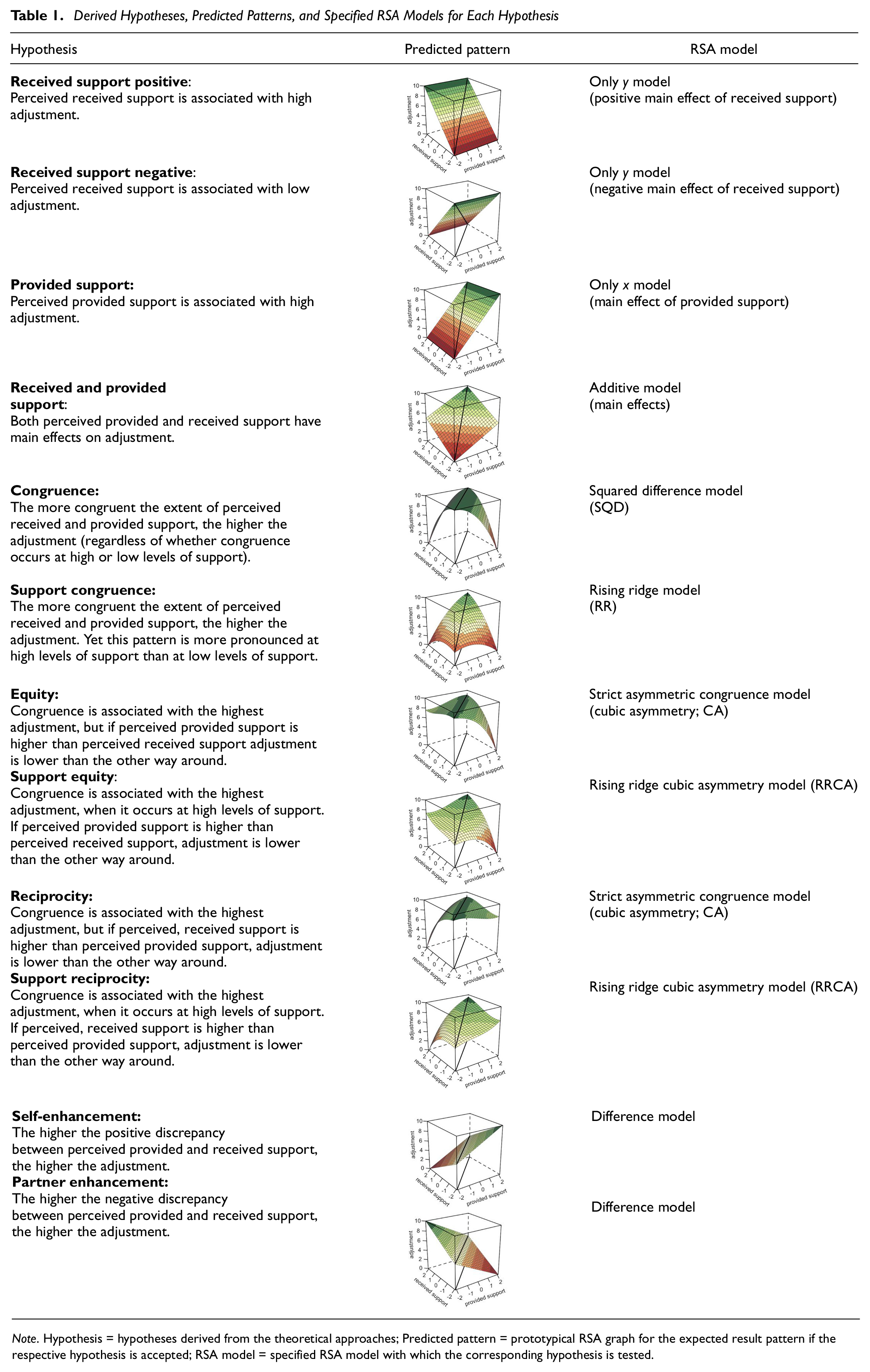
Note. Hypothesis = hypotheses derived from the theoretical approaches; Predicted pattern = prototypical RSA graph for the expected result pattern if the respective hypothesis is accepted; RSA model = specified RSA model with which the corresponding hypothesis is tested.
First, it has been proposed that the amount of social support one perceives to receive from one’s partner has a main effect on adjustment (received support hypothesis). Opposing claims have been made about the directionality of this main effect. Some authors have argued that social support should have a positive effect on adjustment because receiving social support from others serves as a buffer against stress and proves that one can rely on them (Atienza et al., 2001). In this case, relationship satisfaction and self-esteem should benefit from perceived social support. Others have argued that being dependent on social support puts one in a weak position and that receiving social support from the partner therefore has a negative effect on relationship satisfaction and self-esteem (Bolger et al., 2000; Gleason et al., 2003; McClure et al., 2014).
Other approaches have focused not so much on the reception of social support but on the provision of it. They proposed that the perceived provision of social support fosters feelings of efficacy and competence, thus enhancing adjustment (Brown et al., 2003; Taylor, 2011). This hypothesis, which we will refer to as the provided support hypothesis, implies a positive effect of perceived provided social support on relationship satisfaction and self-esteem. Of note, it is also possible that both the perceived received and the perceived provided hypothesis matter for adjustment, which would imply the main effects of both received and provided support. We will refer to this possibility as the received and provided support hypothesis.
Still other approaches have suggested that what matters most for psychological adjustment is not so much the absolute amount of social support one perceives to provide and receive, but rather that the constellation is important. Several nuanced hypotheses exist concerning this constellation. First, it has been stated that adjustment is highest when there is a perceived congruence between the amount of received and provided social support, that is, when a person feels that they are providing as little or as much support as they are receiving. Under that circumstance, the relationship is seen as fair and satisfying (Gleason et al., 2003). We will refer to this proposal as the congruence hypothesis.
The proposal that adjustment is highest when perceived received and provided support match has also been made by equity theory (Adams, 1965). Yet this theory further claims that one form of inequality is associated with more negative consequences than the other. Specifically, if individuals perceive that they provide more support than they receive, they feel disadvantaged because they have to invest more in the relationship than they get back from it. Thus, this kind of inequality should have more negative consequences for relationship satisfaction and self-esteem than when perceived received support exceeds perceived provided support (Bar-Kalifa et al., 2018; Hatfield et al., 2008; Utne et al., 1984). We will refer to this proposal as the equity hypothesis.
Consistent with equity theory, reciprocity theory (Gouldner, 1960; Uehara, 1995) assumes that perceived congruence is most beneficial. However, according to reciprocity theory, contributing less to the relationship than the partner has negative effects on relationship satisfaction and self-esteem. That is, people who feel they provide less support than they receive should experience more negative outcomes than people who feel their provided support exceeds their received support. This can be due, for example, to feelings of inferiority and perceived incompetence (Bolger et al., 2000; Gleason et al., 2003, 2008). We will refer to this proposal as the reciprocity hypothesis.
It is conceivable that the mechanism of beneficial mutual social support might only be effective if the two partners are rather supportive in the first place and that relationships in which both partners are equally low in their social support may not be very satisfying. This would imply that reciprocity is particularly beneficial if it occurs at high (but not low) levels of perceived received and provided social support. This ancillary assumption could be integrated into all three aforementioned hypotheses. We will refer to these hypotheses as the support congruence, the support equity, and the support reciprocity hypothesis.
A final class of approaches posits that adjustment depends on the discrepancy between perceived received and perceived provided support. Self-enhancement approaches (Taylor & Brown, 1988, 1994) have argued that the tendency to engage in favorable social comparisons has positive effects on self-esteem and interpersonal functioning. From this perspective, viewing the self as more supportive (i.e., more positively) than the partner could have a positive effect on adjustment (self-enhancement hypothesis). Alternatively, it has been proposed that in romantic relationships, partner idealizations are adaptive and that viewing the partner more positively than the self has positive effects on adjustment (Busby et al., 2009; Morry et al., 2010, 2014; Murray et al., 1996a, 1996b). In this case, viewing the partner as more supportive than the self should have a positive effect on adjustment (partner-enhancement hypothesis).
Methodological Considerations
Standard statistical approaches in the social support literature are not suited for detecting the nuanced patterns of results predicted by the aforementioned hypotheses. For example, studies testing congruence effects have often computed the absolute or squared difference between provided and received support and then correlated this difference score with some outcome variable. Such absolute or squared difference score approaches can produce false positive results (Edwards, 1994; Humberg et al., 2019) and cannot distinguish between different patterns of incongruence (see reciprocity and equity hypotheses) or between incongruence at high versus low levels of support (see support congruence, support equity, and support reciprocity hypotheses). Similarly, in studies on partner enhancement, an enhancement index was often computed by subtracting self-ratings from partner ratings and predicting the adjustment outcome with this difference score (e.g., Busby et al., 2009; Morry et al., 2014). This approach has impaired validity, as correlations with outcome variables are often driven by the main effects of the two variables, rather than their discrepancy (Dufner et al., 2015; Humberg et al., 2019).
Another limitation of past research is that tests of competing hypotheses are rare. In many studies, ostensive support for a specific hypothesis was found, yet most of the above-described hypotheses are incompatible. Hence, competitive testing would be preferable (Anderson et al., 2000).
These limitations can be overcome by combining RSA (Edwards, 1994, 2002; Humberg et al., 2019; Schönbrodt, 2016) with competitive hypothesis testing. RSA is based on the estimation of a polynomial regression model that predicts a given outcome variable z from two predictor variables x and y (including quadratic and interaction effects) and provides a statistical and graphical interpretation of the coefficients. Main effects, simple congruence effects, discrepancy effects (i.e., self- and partner-enhancement effects), and also asymmetric effects (see equity and reciprocity hypotheses) can be modeled (Humberg et al., 2020). For each hypothesis outlined above, a specific RSA model exists (see Table 1 and for more details, Supplementary Online Materials [SOM] A). These models can be tested against each other via an information-theoretic approach (Humberg et al., 2019). Before conducting our main analyses, we explored the results conventional methodological approaches would have yielded for comparison.
Method
Sample and Procedure
We analyzed data from the longitudinal panel Analysis of Intimate Relationships and Family Dynamics (pairfam, release 12.0, Brüderl et al., 2021). A detailed description of the pairfam study can be found in (Huinink et al., 2011) and on the study website (https://www.pairfam.de). For the current purpose, we analyzed data from the first wave (2008/2009), in which the sample size was the largest. We analyzed data from 16,137 participants from Germany (participants plus partners; 49.98% male, Mage = 27.19 years, SDage = 8.65). The sample is representative of selected age cohorts (see SOM B and https://www.pairfam.de/fileadmin/user_upload/redakteur/publis/Dokumentation/TechnicalPapers/pairfam_TP_01_2023.pdf for more detailed information). Relationship status was assessed by asking about participants’ current relationship status in the interview survey (“Are you currently in a committed relationship?”). Participants received 10 euros, but their partners did not receive any remuneration. The relationship duration was 89.78 months on average (SD = 72.63). No minimum relationship duration was defined, and we included both participants with heterosexual (n = 15,769) and homosexual orientation (n = 216) in our analyses.
Open Science Statement
The study was not preregistered. The data can be requested from the panel provider. Analysis code and SOM are provided on the Open Science Framework (https://osf.io/euqyb/?view_only=0be350ffbab147c9adc8ff19ea2c3a55).
Measures
The data of the main participants were collected through standardized interviews. The data of the partners were collected through standardized questionnaires. Participants completed all relevant variables, and their partners only rated relationship satisfaction and the perceived social support measures. A list of all assessed variables is provided on the study website.
Provided Support
The extent to which participants perceived they provided social support to their partners was assessed with an adapted short form of the Dyadic Coping Inventory (Bodenmann, 2008). This version includes three items from the subscale Supportive Dyadic Coping by oneself and has been successfully used in previous studies using pairfam data (e.g., Johnson et al., 2016; Reifman & Niehuis, 2018; Yurkiw & Johnson, 2021). The items are answered on a scale from 1 (never) to 5 (always) and asked, for example, “I let [name partner] know that I understand [him/her]” (α = .72).
Received Support
Adapted versions of the same three items (same response format) were used to assess the extent to which participants perceived they received social support from their partners (e.g., “[Name partner] lets me know that [he/she] understands me,”α = .81).
Relationship Satisfaction
Participants and their partners indicated how satisfied they were with the relationship on a single item from the Relationship Assessment Scale (Hendrick et al., 1998): “On the whole, how satisfied are you with your relationship?” (0 = very dissatisfied to 10 = very satisfied). A similar one-item measure of relationship satisfaction has been successfully used in previous research using pairfam data (e.g., Ciritel, 2022; Johnson et al., 2016).
Self-Esteem
Self-esteem was assessed only by the participants using three items from the Rosenberg Self-Esteem Scale (Rosenberg, 2011). For example, “All in all, I am pleased with myself” (α = .71). These Items were answered on a scale from 1 (not at all) to 5 (absolutely) and have been successfully used in previous studies (e.g., El Ghaziri et al., 2019; Luciano & Orth, 2017).
Analytic Approach
Model Specification
As outlined above, we applied specific RSA models (Humberg et al., 2020; Schönbrodt, 2016) to test the different hypotheses. To test the received support positive and negative hypotheses, we applied the only y model, which only includes a main effect of the y variable. To test the provided support hypothesis, we applied the only x model, which only includes the main effect of the x variable. To test the received and provided support hypothesis, we applied the additive model, which includes a main effect of both the x and the y variables. To test the congruence hypothesis, we applied the squared difference model and to test the support congruence hypothesis, we applied the rising ridge model. The squared difference model is a second-order polynomial regression but with restrictions on individual regression parameters. The rising ridge model belongs to the same class of models but imposes fewer restrictions on the parameters than the squared difference model, and it additionally allows the ridge to be tilted up or down. To test the equity- and reciprocity hypotheses, we applied the strict asymmetric congruence model, which is a third-order polynomial regression, but again with restrictions on the estimated parameters. The strict asymmetric congruence model is no longer restricted to be symmetric, so that asymmetric effects can be investigated (Humberg et al., 2020). To test the support equity- and support reciprocity hypotheses, the rising ridge cubic asymmetry model was applied, which imposes fewer restrictions than the strict asymmetric congruence model, so that it allows the ridge to be tilted up or down. Please note that because provided and received support were entered simultaneously into the model, their unique (i.e., partial) associations with the outcome variable were modeled.
Competitive Testing
The eight specified models were tested against each other separately for each outcome variable. The information-theoretic approach, which has also been used to test competing polynomial regression models in the past (Deventer et al., 2019; Förster et al., 2022; Schneider et al., 2022), allows for a simultaneous assessment of the empirical evidence of all competing models. Thus, a direct comparison of the evidence values of all selected models was obtained.
First, we estimated all models with the R package lavaan (Rosseel, 2012) using Full-Information-Maximum-Likelihood estimation to handle missing data. Since two participants were always nested within a relationship, we estimated cluster-robust standard errors (McNeish et al., 2017). We computed corrected AICc values for each model and derived AICc-weights (AICcWt) on the basis of all eight estimated models. These weights are the central elements of the model comparison analyses and determine the interpretation of the results (details on the interpretation of AIC values and results based on BIC values and weights are in SOM C). The AICcWt indicates for each model the probability that it provides the best, but also the most parsimonious, explanation for the data, accounting for all alternative models (Burnham et al., 2002). If a given model has the highest score, its underlying hypothesis has the strongest empirical support (in comparison to the other hypotheses).
If the AICcWt score of a given model exceeds .95, one can safely conclude that it fits the data best, as it is considered unlikely that the model ended up with such a high value due to sampling error. If the AICcWt score of the best-fitting model falls below the value of .95, no definitive statement concerning the best-fitting model can be made. In this case, the model with the highest AICcWt score is not the only one considered in the interpretation of results, but instead, all models that fell into the confidence set are. This confidence set includes all models whose cumulative AICcWt are greater than .95 (i.e., the next best models are added to the confidence set until the cumulative weights of all models in the set exceed 95%). Accordingly, it can be assumed below that there is a 95% probability that the best model among the selected models is included in the confidence set. The models that are not included in the confidence set have no empirical support; the probability that they are appropriate is less than 5% (Burnham et al., 2002; Deventer et al., 2019; Humberg et al., 2019).
Robustness Testing
When numerous complex models are tested, it can be unclear how statistically robust the results are. Accordingly, we used a randomized resampling approach, the Bootstrap method (Efron, 1979; Gong, 1986), to empirically test the robustness of the results. We used 1,000 resamples to verify the relevant parameters. We report the averaged AICc and BIC weights from the resampling approach, with the BIC values reported in the SOM C. Furthermore, we report how often each model showed the best fit in the 1,000 bootstrapping samples (model-win). We considered results robust if the models that were in the confidence set of the original analysis were the best-fitting models in more than 5% of the bootstrapped samples.
Results
Descriptive Statistics
Table 2 displays descriptive statistics, reliabilities, and intercorrelations. Despite the brief scales, reliabilities were acceptable and good. The mean scores indicated that, on average, participants perceived themselves and their partners as supportive and that relationship satisfaction was fairly high. Overall, the support variables were strongly correlated. Also, there was a significant correlation between relationship satisfaction between self and partner, meaning that the partners of participants who are satisfied with the romantic relationship are also satisfied. As expected, there was also a significant correlation between relationship satisfaction and self-esteem: Participants who are satisfied with the romantic relationship have a higher self-esteem on average.
Means, Standard Deviations, Reliabilities, Intercorrelations, and Confidence Intervals
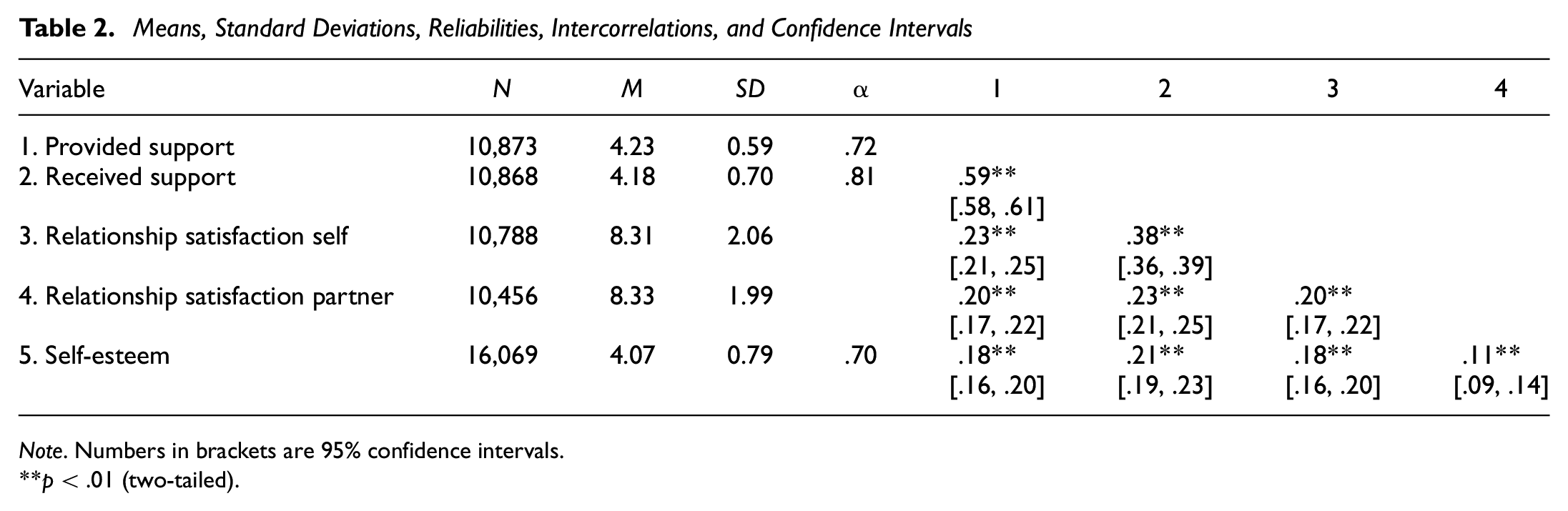
Note. Numbers in brackets are 95% confidence intervals.
p < .01 (two-tailed).
Conventional Approaches
We then explored which results conventional approaches would have yielded. To test the received positive and negative as well as the provided support hypotheses, we examined how received and provided social support are correlated with the outcomes. Table 3 shows that there were positive correlations in both cases, so that both hypotheses would be interpreted as confirmed. A conventional method for testing congruence effects would be to compute the absolute difference between received and provided social support and to correlate this difference with the adjustment outcomes.
Correlations Between Received and Provided Social Support, Conventionally Computed Congruence and Partner-Enhancement Indices and Adjustment Indicators
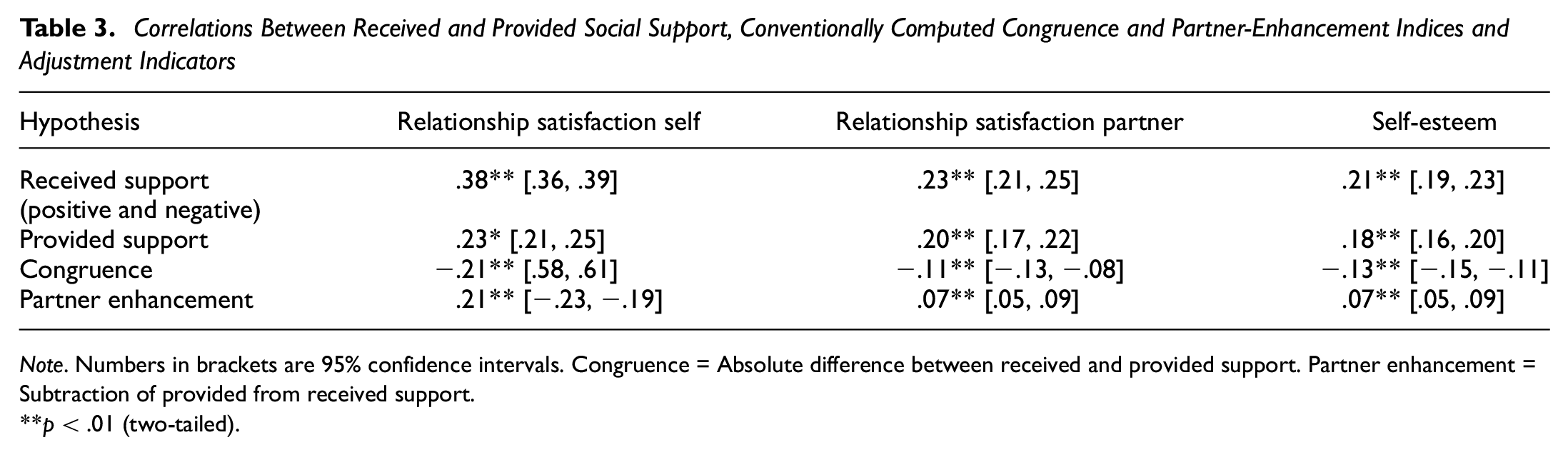
Note. Numbers in brackets are 95% confidence intervals. Congruence = Absolute difference between received and provided support. Partner enhancement = Subtraction of provided from received support.
p < .01 (two-tailed).
As displayed in Table 3, in all cases, the correlations were negative, which would indicate that a high level of congruence goes along with high adjustment. Thus, the results would seem to support the congruence hypothesis. The equity hypothesis is conventionally tested, creating three groups of overbenefited, equitably treated, and underbenefited people and then investigating mean differences between the groups in the adjustment outcomes (e.g., Utne et al., 1984). We thus first subtracted the provided social support from the received social support and then created these three groups. The overbenefited are those who receive more support than they provide to the partner (> M+ 1 SD on this difference). Those who receive from the partner what they provide to them are the equitably treated (> M+ 1 SD and > M− 1 SD on this difference). Those who received less support from their partner than they provided to them are the underbenefited (< M− 1 SD on this difference). For all three adjustment outcomes, the results seem to support the equity hypothesis; that is, the underbenefited were, on average, those with the lowest relationship satisfaction, those with the least satisfied partners, and those with the lowest self-esteem (Table 4).
Means, Standard Deviations, and F-Values for the Three Groups Formed to Test the Equity Hypothesis
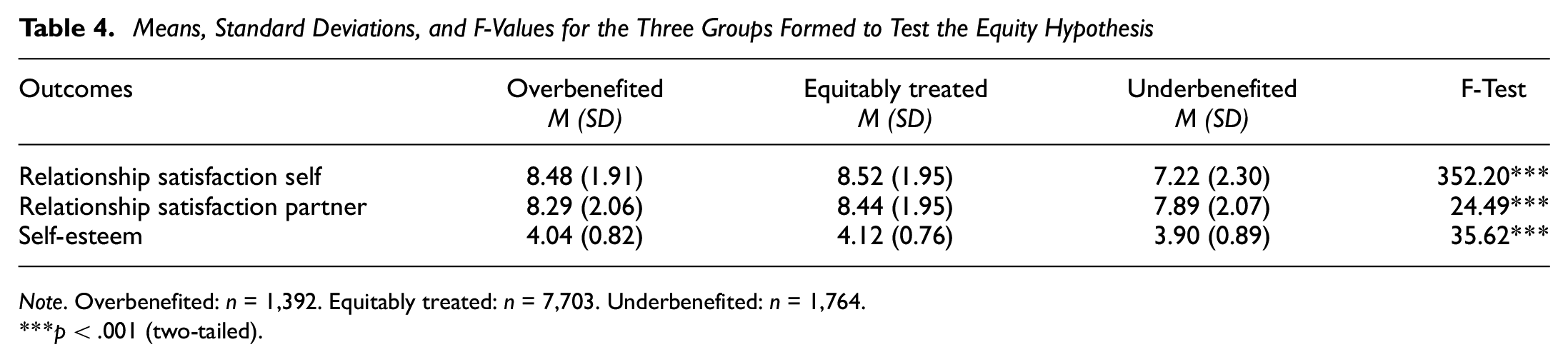
Note. Overbenefited: n = 1,392. Equitably treated: n = 7,703. Underbenefited: n = 1,764.
p < .001 (two-tailed).
Next, we computed a partner-enhancement index by subtracting provided social support from received social support and correlated this index with relationship satisfaction and self-esteem. All correlations were positive, which seems to support the partner-enhancement hypothesis (Table 3). Logically, however, the diverging hypotheses cannot all be true at the same time, which clearly illustrates the limitations of the conventional approach.
Competitive Testing
Relationship Satisfaction Self
Table 5 shows the results of competitive testing of the specified models using participants’ own relationship satisfaction as the outcome variable. The only y model (AICcWt = 0.57; supporting the received support positive hypothesis) and the additive model (AICcWt = 0.43; supporting the received and provided support hypothesis) fit the data best. These results were mirrored across the robustness tests. As Figure 1 shows, there was a clear positive effect of received social support that is potentially paired with a much weaker effect of provided social support. The coefficient estimates are provided in SOM D. We also explored for all outcome variables whether results differ substantially for couples with relatively short versus long relationship duration and found that this was not the case (see SOM E).
Model Comparison Relationship Satisfaction Self
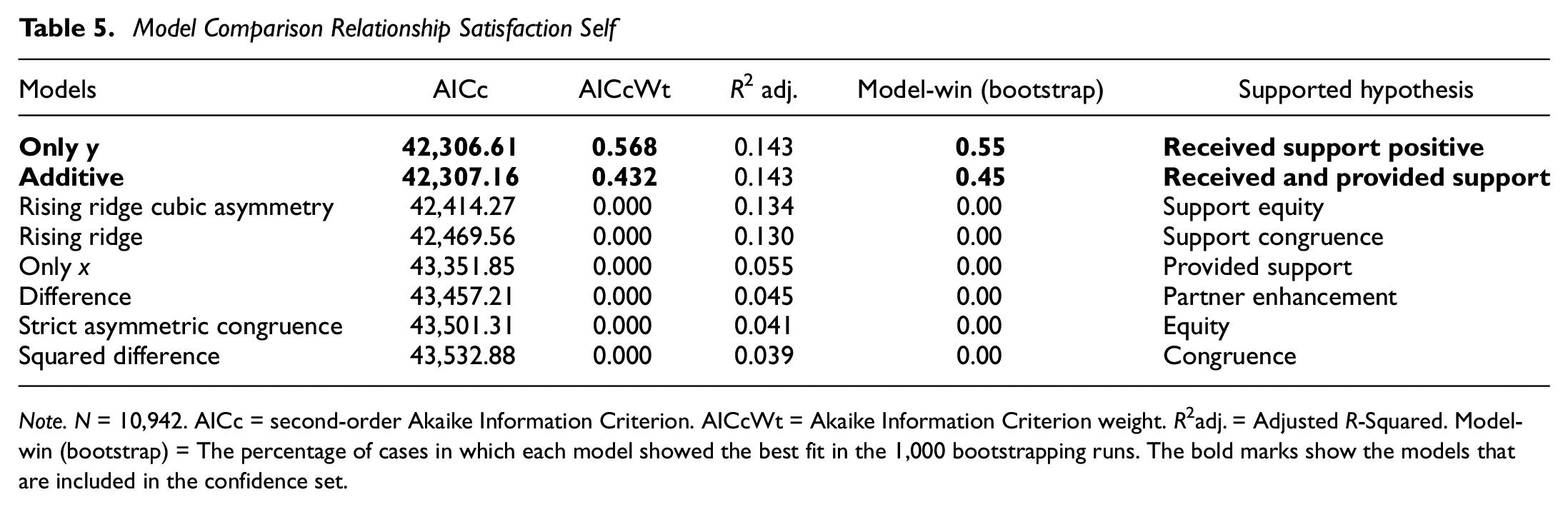
Note. N = 10,942. AICc = second-order Akaike Information Criterion. AICcWt = Akaike Information Criterion weight. R2adj. = Adjusted R-Squared. Model-win (bootstrap) = The percentage of cases in which each model showed the best fit in the 1,000 bootstrapping runs. The bold marks show the models that are included in the confidence set.
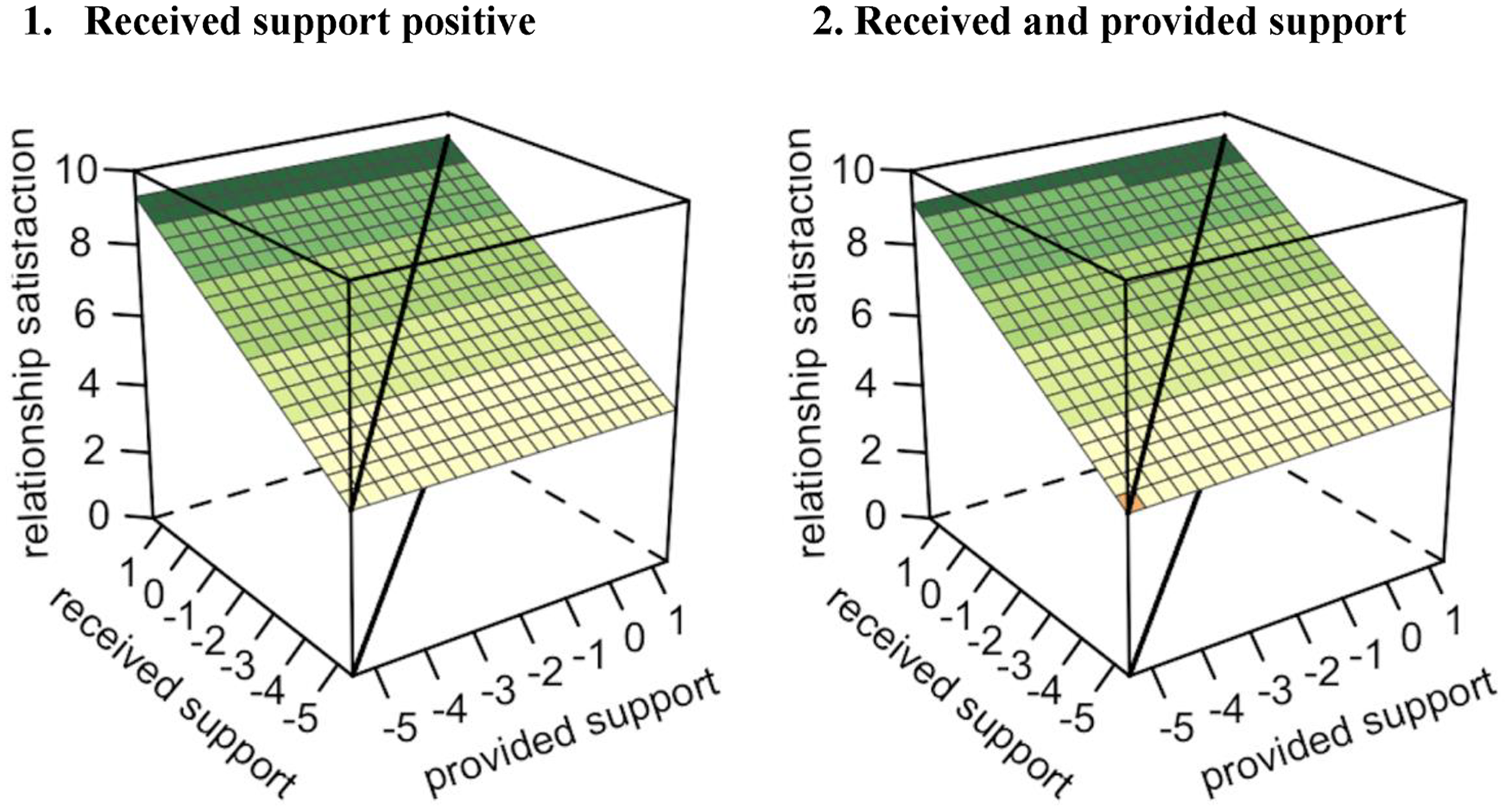
Models With the Best Fit for the Outcome Variable Relationship Satisfaction Self
Relationship Satisfaction Partner
Table 6 shows the results when the partners’ relationship satisfaction was used as the outcome variable. The confidence set included the additive model (AICcWt = 0.77; supporting the received and provided support hypothesis), the rising ridge model (AICcWt = 0.17; supporting the support congruence hypothesis), and the rising ridge asymmetry model (AICcWt = 0.1; supporting the support equity hypothesis). Again, these results were stable in the robustness test. All models from the confidence set indicated that the partners’ relationship satisfaction is highest if both received and provided support are high (see Figure 2). Moreover, to these main effects, it might be the case that high congruence is beneficial when support levels are high (which would favor the support congruence hypothesis) and that one type of inequality is more problematic than the other (which would favor the support equity hypothesis).
Model Comparison Relationship Satisfaction Partner
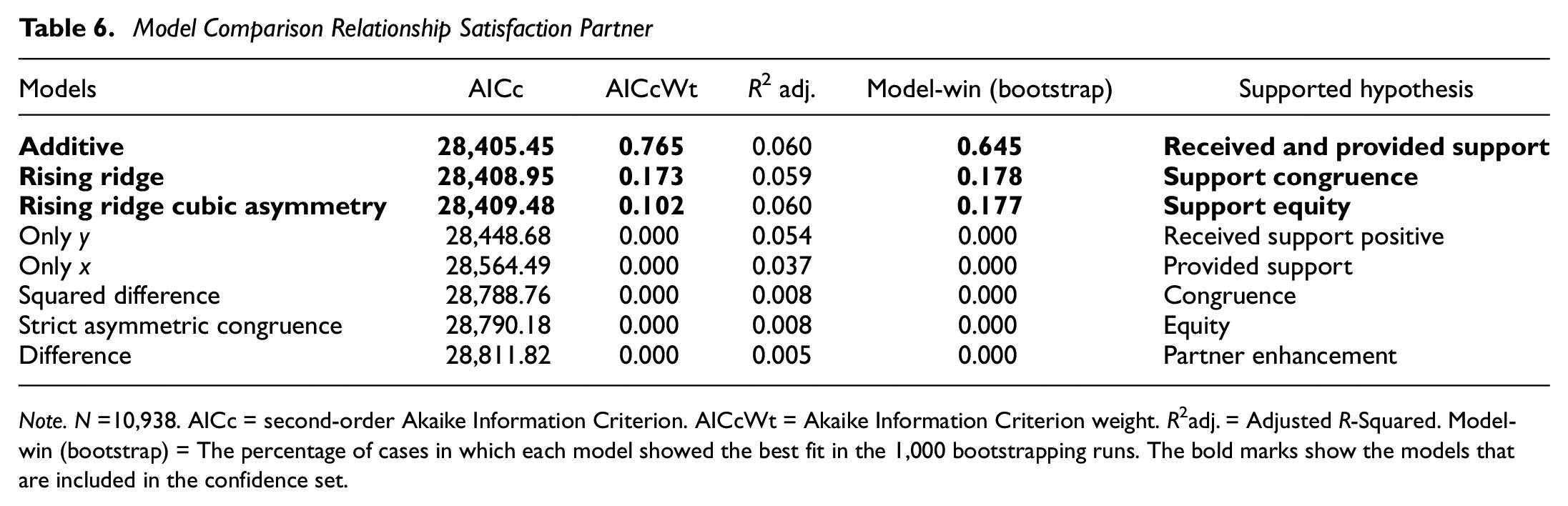
Note. N =10,938. AICc = second-order Akaike Information Criterion. AICcWt = Akaike Information Criterion weight. R2adj. = Adjusted R-Squared. Model-win (bootstrap) = The percentage of cases in which each model showed the best fit in the 1,000 bootstrapping runs. The bold marks show the models that are included in the confidence set.
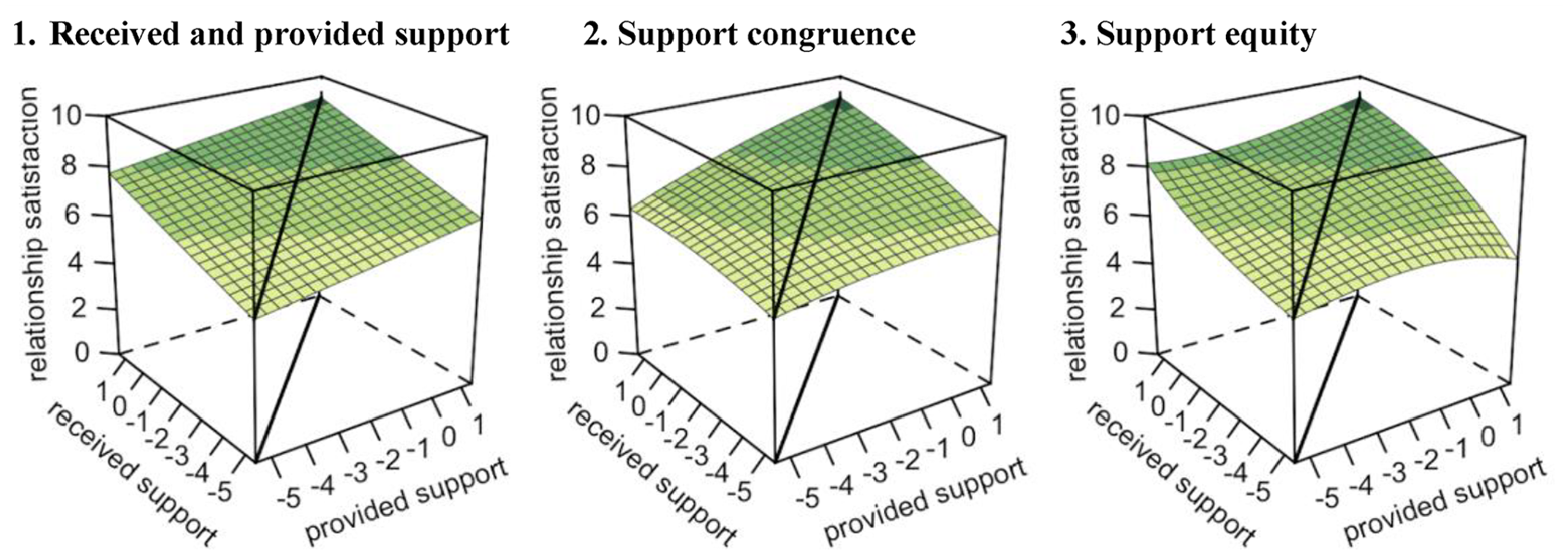
Models With the Best Fit for the Outcome Variable Relationship Satisfaction Partner
Self-Esteem
Table 7 shows the results of the model comparison for the outcome variable self-esteem. The rising ridge cubic asymmetry model (AICcWt = 0.58, which would support the support equity hypothesis) and the rising ridge model (AICcWt = 0.42, which would support the support congruence hypothesis) fit with the highest probability (see Figure 3). Again, these results were robust in the robustness test. For the rising ridge model, the interpretation would be that self-esteem is highest among persons who perceive that both themselves and their partners provide a comparable, yet high, level of social support. The cubic asymmetry rising ridge model in addition suggests that perceiving oneself as providing more support than one’s partner is associated with lower self-esteem than is perceiving the self as less supportive than the partner.
Model Comparison Self-Esteem
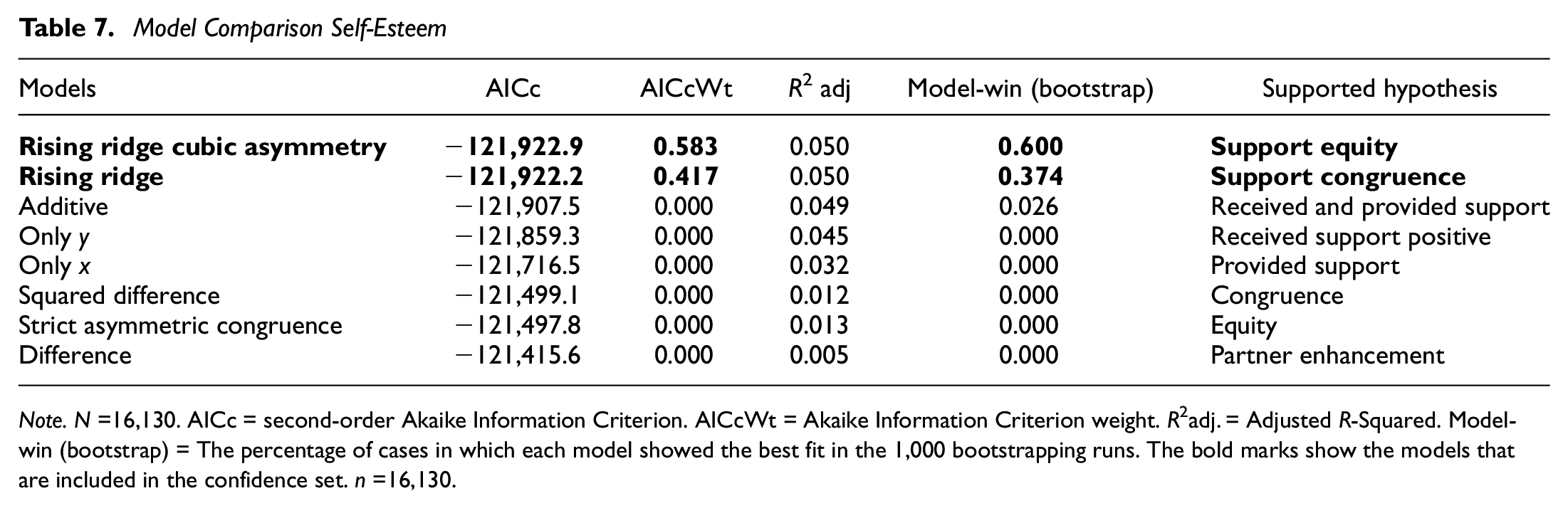
Note. N =16,130. AICc = second-order Akaike Information Criterion. AICcWt = Akaike Information Criterion weight. R2adj. = Adjusted R-Squared. Model-win (bootstrap) = The percentage of cases in which each model showed the best fit in the 1,000 bootstrapping runs. The bold marks show the models that are included in the confidence set. n =16,130.
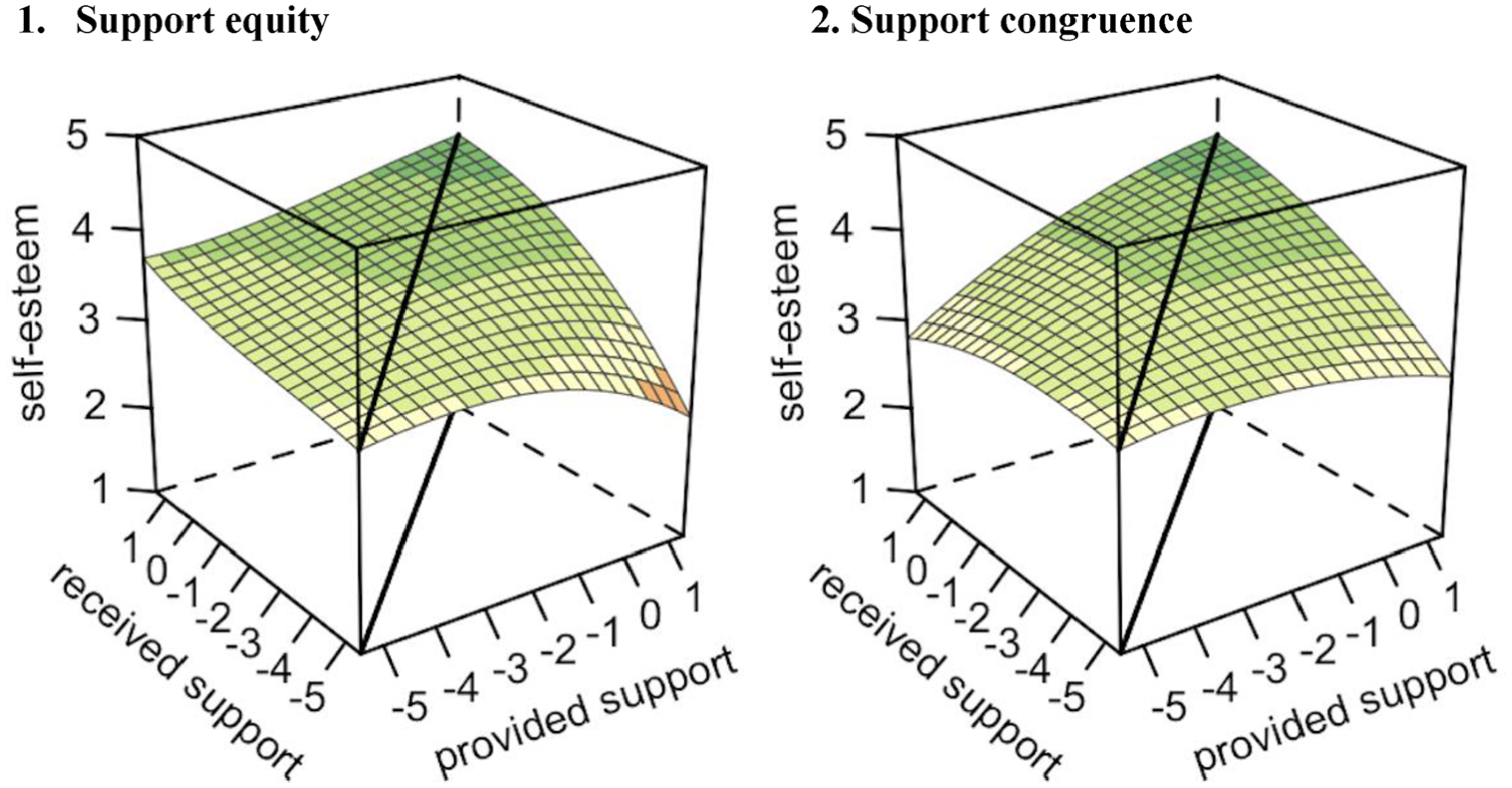
Graphical Representation of the Models With the Best Fit for the Outcome Variable Self-Esteem
Discussion
We first showed that conventional methodological approaches would have yielded misleading results and then used an analytic approach that allowed us to test the highly nuanced hypotheses from the social support literature in an appropriate and competitive fashion.
Support and Relationship Outcomes
Relationship Satisfaction
People’s own level of relationship satisfaction was highest when they perceived their partners as supportive (supporting the received support positive hypothesis). Potentially, there was also a main effect of provided social support (which would support the received and provided support hypothesis), but arguably, this effect was too small to be of substantial relevance. The positive main effect of received social support is consistent with the proposal that viewing one’s partner as a supportive partner is adaptive for relationship functioning (Atienza et al., 2001).
Relationship Satisfaction of the Partner
For the partners’ level of relationship satisfaction, three models were in the confidence set. First, the additive model suggests that the partners’ level of relationship satisfaction was highest when both partners were seen as supportive (as suggested by the received and provided support hypothesis). The mechanism underlying the main effect of provided social support could be similar to the one described above. When participants support their partners, it probably gets noticed by these partners, which then increases their relationship satisfaction. The main effect of received social support indicates that partners who are seen as supportive are also rather satisfied with their relationships. This result is an interesting deviation from the self-report perspective where self-reports of provided social support did not have a main effect on one’s own relationship satisfaction. Why is this the case? At least three interpretations of this pattern seem possible. First, partners who are highly satisfied with their relationship are actually more supportive but do not notice that this is the case (only their partners do). Second, it is not how supportive people see themselves but how supportive they are seen by their partners that counts. Providing support is a key task in romantic relationships and if one is seen as supportive, this task is well accomplished, which has a positive effect on relationship satisfaction. Third, in a reverse causal manner, it could be that such satisfied partners are not actually more supportive but only appear so, perhaps because they radiate positivity in general. Future research would need to employ objective assessments of provided social support to decide which of these possibilities apply. For now, one can conclude that there is a positive effect of received social support that is apparent from both partner perspectives, whereas the potential effect of provided social support is much less clear.
Second, the rising ridge model also suggests the main effects of provided and received support, but in addition, perceiving that one’s own high level of support is not mirrored by the partner is detrimental (as suggested by the support congruence hypothesis). Such a pattern indicates that incongruence between perceived support received and support provided in romantic relationships is problematic (Gleason et al., 2003).
Third, the rising ridge asymmetry model is identical to the rising ridge model but makes the additional assumption that seeing the self as highly supportive and the partner not so much seems more problematic than seeing the partner as more supportive than the self (support equity hypothesis). Such a pattern would be consistent with the support equity theory (Adams, 1965) and a recent relationship study using the RSA method (Bar-Kalifa et al., 2018). In summary, the results indicate that received and provided social support are positively linked to the partner’s relationship satisfaction, while it might also matter to what extent the amount of support one provides is mirrored by the partner.
Self-Esteem
For self-esteem, results were similar to the ones we obtained for the partners’ relationship satisfaction. Two models were in the confidence set. The rising ridge model corroborates the support congruence hypothesis and indicates that high levels of received and provided social support go along with high self-esteem but that perceiving that one’s high level of support is not mirrored by the partner is detrimental. The rising ridge asymmetry model supports equity theory (Adams, 1965) and therefore additionally assumes that seeing the self as more supportive than the partner is more problematic than the other type of incongruence. In either case, the results support the more general notion that the extent of mutual social support in relationships is an important source of self-esteem (e.g., Sciangula & Morry, 2009; Voss et al., 1999).
Integration of Results
Overall, the different theoretical propositions differed greatly in the extent to which they were supported by the data. Several hypotheses did not receive any empirical support. Among these were the hypotheses claiming (a) that social support has a negative effect on relationship functioning (received support negative hypothesis; e.g., Bolger et al., 2000; Gleason et al., 2003; McClure et al., 2014; Rafaeli & Gleason, 2009), (b) that directional discrepancy between provided and received are important (self-enhancement and partner-enhancement hypotheses; e.g., Busby et al., 2009; Taylor & Brown, 1988, 1994), and (c) that incongruence in the form of perceiving the partner as more supportive than the self is the more maladaptive form of incongruence (reciprocity hypothesis; e.g., Gleason et al., 2003, 2008). The results provide no evidence for theoretical claims underlying these hypotheses in the context of social support in romantic relationships that are representative for the selected age cohorts of the German population.
For all outcomes, perceived support was associated with high adjustment. Provided social support was also positively linked to most outcomes, which indicates that relationships are functioning best if people see themselves and their partners as supportive. Congruence may also be relevant for two out of three outcomes. However, this was only the case for congruence at high levels of support.
Limitations and Future Directions
In further studies, a specification of the type of social support (instrumental, emotional, etc.) as well as the source of the stress experience, whether it is caused more internally or externally to the relationship, should be considered. It is, for example, conceivable that reciprocity might be more relevant with regard to issues that are closely tied to the relationship, such as child-related problems, than for work-related issues, which often primarily affect one partner. In addition, the investigation of potential moderator variables is suggested in future studies to validate the results of this work and to expand the understanding of the effects.
Given that we have only analyzed cross-sectional associations, no causal conclusions can be drawn. To better understand the causal dynamics underlying the effects presented here, future research would do well to analyze the longitudinal interplay between social support and adjustment. In principle, the pairfam data would have allowed for longitudinal analyses. Yet, longitudinal RSA models would have been excessively complex and might have distracted from our main research question. This research examined which constellations or patterns of perceived received and provided social support are associated with the highest level of adjustment, a question that can be answered by cross-sectional observation. Nevertheless, future studies should examine the longitudinal interplay between social support and adjustment to gain further insights into the temporal and causal dynamics.
Also, it should be noted that participants in this representative sample had high satisfaction ratings overall and perceived themselves and their partners as supportive. It is uncertain whether samples with less satisfied and supportive couples would render different findings. Following this consideration, the fact that different assessment methods were used for relationship satisfaction in participants (interviews) and partners (questionnaires) was not ideal and could have led to an attenuated correlation between the two assessments in comparison to past research (e.g., Harris & Brown, 2019).
Conclusion
The current research tested all major hypotheses concerning the role of the amount of provided and received social support in romantic relationships in a competitive fashion. The results showed that some are backed up much more by the evidence than others. We hope that the methodological approach and empirical insights advance the field toward a better understanding of the functioning of social support in romantic relationships.
Supplemental Material
sj-docx-1-spp-10.1177_19485506241249816 – Supplemental material for How Are Provided and Received Social Support Related to Relationship Satisfaction and Self-Esteem? A Comprehensive Test of Competing Hypotheses
Supplemental material, sj-docx-1-spp-10.1177_19485506241249816 for How Are Provided and Received Social Support Related to Relationship Satisfaction and Self-Esteem? A Comprehensive Test of Competing Hypotheses by Anna Köhler, Christoph Heine, Birk Hagemeyer and Michael Dufner in Social Psychological and Personality Science
Footnotes
Handling Editor: Jennifer Bosson
Declaration of Conflicting Interests
The author(s) declared no potential conflicts of interest with respect to the research, authorship, and/or publication of this article.
Funding
The author(s) received no financial support for the research, authorship, and/or publication of this article.

Supplemental Material
Supplemental material for this article is available online.
Author Biographies
References
Supplementary Material
Please find the following supplemental material available below.
For Open Access articles published under a Creative Commons License, all supplemental material carries the same license as the article it is associated with.
For non-Open Access articles published, all supplemental material carries a non-exclusive license, and permission requests for re-use of supplemental material or any part of supplemental material shall be sent directly to the copyright owner as specified in the copyright notice associated with the article.
