



Abstract
Power balance, that is, equal levels of potential influence between relationship partners, has been linked to relationship happiness. This study examined whether power balance is indeed positively related to relationship quality (RQ) for both couple members using dyadic response surface analysis (total N = 879 couples). In Studies 1 to 3, we found linear but no similarity effects of power on RQ. Experiencing power was positively related to both actor’s and partner’s RQ. In Study 4, again, no similarity but actor and partner effects were found on sexual satisfaction. These findings show that the link between power balance and RQ found in previous research does not hold with sophisticated analysis techniques that overcome issues of previous approaches (e.g., difference scores). In fact, the absolute level of experienced power, not power balance, matters for both RQ and sexual satisfaction. Practitioners may target strengthening an individual’s power instead of focusing on issues of power balance.
Experiencing social power can make people happy. There is an abundance of research showing that powerful individuals are more authentic (Kraus et al., 2011), experience higher subjective well-being (Kifer et al., 2013), experience more positive than negative emotions (Langner & Keltner, 2008), and report lower loneliness (Waytz et al., 2015). However, the experience of power can also have negative effects on a counterpart (i.e., a less powerful individual). It has been found that these less powerful individuals are seen in stereotypical ways (Fiske, 1993) and are objectified (Gruenfeld et al., 2008). People with power also show less perspective taking, empathy and less accommodation behavior (Blader et al., 2016; Rusbult et al., 1991). These effects have also been observed in romantic relationships (e.g., Righetti et al., 2015). Such findings led researchers to conclude that a balance of power may be the most important step for increasing satisfaction in both members of a romantic couple (Knudson-Martin, 2013). This assumption relies on the reasoning that, in a situation in which both members of a dyad experience equal levels of power, the negative behavior of a power holder vis-à-vis a less powerful individual would not occur (Gray-Little & Burks, 1983). However, past research on this issue suffered from methodological shortcomings, which is why we examine whether power balance is indeed related to the relationship quality of romantic couples using dyadic response surface analysis (DRSA).
Power and Relationship Quality
Power is typically understood as the ability to influence others on the basis of asymmetric outcome control (Keltner et al., 2003; Overbeck, 2010). The subjectivity of power, that is, the belief that one has the potential to influence others, is often termed felt power or personal sense of power (Anderson et al., 2012; Tost, 2015). Felt power is a central variable in understanding several outcomes within intimate relationships (Kim et al., 2019; Simpson et al., 2015) such as negative behaviors like aggression (Overall et al., 2016) as well as prosocial behaviors (Körner, Schütz, et al., 2022). We focus on felt power because the perception of being able to exert influence has been reported as more predictive of relationship quality (RQ) than objective power indices per se (Körner & Schütz, 2021; Weisfeld et al., 1992).
Most major power theories do not directly predict how power balance relates to RQ but, for example, propose that relatively less power within a relationship is linked to inhibition, feelings of constraint, and negative experiences (Keltner et al., 2003; Magee & Smith, 2013; Simpson et al., 2015), which is why negative implications may be assumed for the lower power partner. Only Dyadic Power Theory (Dunbar et al., 2016) explicitly predicts that perceived power balance is positively associated with RQ, an assumption that has received some empirical support and has important implications for practice (e.g., couples therapy).
The link between power and RQ has also been intensively studied in the interpersonal relationship literature (e.g., Conroy et al., 2016; Gray-Little & Burks, 1983). In this literature RQ is usually understood as a broad construct comprising several dimensions such as trust, admiration of the partner, and long-term potential of the relationship with a higher-order factor of global RQ (Fletcher et al., 2000). Several researchers have reported that power balance is positively related to RQ (Bentley et al., 2007; Blood & Wolfe, 1960; Brezsnyak & Whisman, 2004; Caldwell & Peplau, 1984; Conroy et al., 2016; Drigotas et al., 1999; Gray-Little & Burks, 1983; Gray-Little et al., 1996; Lindová et al., 2020; Oyamot et al., 2010; Steil, 1997; Weisfeld et al., 1992; Whisman & Jacobson, 1990) whereas only a few studies report nonsignificant links (Körner & Schütz, 2021; Sprecher & Felmlee, 1997). Power balance in romantic relationships has also been linked to reciprocity and commitment, the absence of coercive power strategies, and thus less exploitation and objectification (Gray-Little & Burks, 1983). In fact, the idea of egalitarian partners matches modern relationship ideals. Therefore, power balance was suggested as a pathway to RQ (Knudson-Martin, 2013). However, past research in this realm has had serious methodological shortcomings.
Dyadic Response Surface Analysis to Examine Effects of Power Balance
First, some studies interacted with only one partner from the relationship (Caldwell & Peplau, 1984; Oyamot et al., 2010), thereby ignoring the mutual dependency of relationship partners. By contrast, dyadic power theories strongly emphasize the importance of analyzing both dyad members so as to be able to consider the interdependence of relationship processes and provide correct inferential statistics (e.g., Dunbar et al., 2016; Simpson et al., 2015). Other studies surveyed couples but did not make use of the dyadic nature of the data in their analyses (Brezsnyak & Whisman, 2004; Sprecher & Felmlee, 1997), thus contributing to the same issues as stated above. Some studies used difference scores (Körner & Schütz, 2021; Weisfeld et al., 1992; Whisman & Jacobson, 1990); however, this approach is problematic because it assumes that a difference at a higher level (e.g., 5-4=1) is equivalent to a difference at a lower level (e.g., 2-1=1; Schönbrodt et al., 2018). Such issues may lead to an incorrect assumption of support for similarity hypotheses, that is, power balance is positively related to a specific outcome (Edwards, 2001). Other researchers used relative measures (e.g., “Who has the final say–you or your partner?”; Conroy et al., 2016; Drigotas et al., 1999); however, this procedure has the same shortcoming as difference scores (Edwards, 2001). Moreover, relative measures require participants to compare two different components (one’s own and partner’s power) and thus combines two distinct concepts into a single score. The construct validity of such an approach has been heavily criticized (Edwards, 2001). Finally, some studies grouped participants into equal and non-equal couples (Gray-Little et al., 1996; Lindová et al., 2020). However, this practice was criticized for the same drawbacks as the difference score approach, moreover, it leads to a loss of information and decreases statistical power (Edwards, 2001).
A solution to these problems is DRSA based on polynominal regression analysis (Schönbrodt et al., 2018). It allows for testing dyadic similarity effects: Does similarity between partners in terms of a predictor variable relate to outcomes from both members of the couple? DRSA is a combination of the actor-partner interdependence model (Kenny et al., 2006) and response surface analysis (RSA; Edwards & Shipp, 2007; Humberg et al., 2019). RSA illustrates a polynominal regression equation in a three-dimensional plot (Schönbrodt et al., 2018). Hence, DRSA simultaneously accounts for the (a) non-independence of couple members when testing for (b) linear and nonlinear relationships as well as (c) actor and partner effects and provides a (d) visualization of the interactions between predictors. Importantly, DRSA circumvents the problems that arise with the use of difference scores or classification measures (e.g., ignoring the interdependence of couples, or being biased toward falsely accepting similarity hypotheses) and can test whether the effects of power balance on RQ are the same for men and for women. DRSA tests whether dyadic similarity impacts outcomes. That is, is RQ higher the more similar the two relationship partners are in felt power? Thus, DRSA is the appropriate state-of-the-art analysis technique to examine whether power balance does in fact matter for RQ.
Overview
In the present studies, we analyzed the link between power balance and RQ. We tested similarity effects across four independent samples to increase robustness of the findings. In all studies, the Personal Sense of Power Scale (Anderson et al., 2012), which is by far the most frequently used scale measuring power, was used. Using an instrument that is used in other research on power generally, and power in romantic relationships more specifically, allows for the comparison of these results with other studies (a shortcoming of almost all previous studies on power balance and RQ; Gray-Little & Burks, 1983). Furthermore, we used multi-item multidimensional measures of RQ because single items could inflate agreement and have less construct coverage. In Study 4, we used a well-established measure of sexual satisfaction to examine whether the findings also apply to the sphere of sexual happiness, because researchers have reported power balance to be particularly positively related to sexual desire and sexual satisfaction (Brezsnyak & Whisman, 2004; Caldwell & Peplau, 1984). Although some consider power a gendered construct with different implications for men and women (Sagrestano, 1992), recent research suggests that men and women do not differ in their felt power in relationships (Körner, Schütz, et al., 2022) and that correlates of power balance (e.g., RQ) are similar for men and women (Brezsnyak & Whisman, 2004). We therefore did not predict gender differences but in an exploratory fashion tested whether results differed between men and women. We preregistered our measures and analytic strategy (https://osf.io/ftqmv).
Method
Participants and Procedure
In Study 1, we recruited 181 couples (men: Mage=31.04, SDage=12.38, range: 19-73; women: Mage=29.19, SDage=12.55, range: 18-72). Some couples were married (22.7%) or engaged (3.6%), but most couples were unmarried (73.8%). The average relationship duration was 7.78 years (SD=10.30, range: 1 month to 52 years).
In Study 2, 209 couples were recruited (men: Mage=29.02, SDage=10.93, range: 18-69; women: Mage=27.10, SDage=10.20, range: 17-65). A minority of couples were married (16.7%) or engaged (3.8%), and most couples were unmarried (79.4%). The average relationship duration was 5.25 years (SD=7.19, Range: 1 month to 45 years).
In Study 3, we recruited 250 couples (men: Mage=26.78, SDage=8.66, range: 18-68; women: Mage=25.22, SDage=7.80, Range: 18-63). Most couples were unmarried (87.6%), and some were engaged (4.0%) or married (8.4%). The average relationship duration was four years (M=4.10, SD=6.03, Range: 1 month to 43 years).
In Study 4, 239 couples were recruited (men: Mage=29.99, SDage=12.31, Range: 19-67; women: Mage=27.92, SDage=11.45, Range: 18-60). A minority of couples were married (13.6%) or engaged (4.8%), and most couples were unmarried (81.6%). The average relationship duration was 6.17 years (SD=5.93, Range: 2 months to 35 years).
Additional information regarding data exclusions can be found at https://osf.io/jfskg/ As the four studies were part of other research projects, we did not do an a priori power analysis. However, the study of at least 175 couples has been suggested when aiming to detect between-couple effects of medium size with 80% power (r = .21, sensitivity analysis; Pusch et al., 2023). As our sample sizes are similar or much higher than 175, they can be considered to have high statistical power.
In all studies, dyads were recruited in Germany. Inclusion criteria of the online surveys were: ≥18 years; being in an opposite-sex relationship for ≥1 month. A couple code was generated to match data. Participants completed a series of different psychological variables along with assessments of power and RQ or sexual satisfaction. In the following, we present only the variables relevant to our research question.
Measures
We assessed felt power with the Personal Sense of Power Scale (Körner, Heydasch, et al., 2022). We used a relationship-specific instruction to assess an individual’s potential to influence his or her partner (6 items; e.g., “In the relationship with my partner…I can get him or her to listen to what I say”). Answers were given on a scale ranging from 1 (strongly disagree) to 5 (strongly agree). Reliabilities of all scales appear in Table 1.
Descriptive Statistics, Reliabilities, Partner Differences, and Within- and Between-Partner Correlations for Power and Relationship Quality
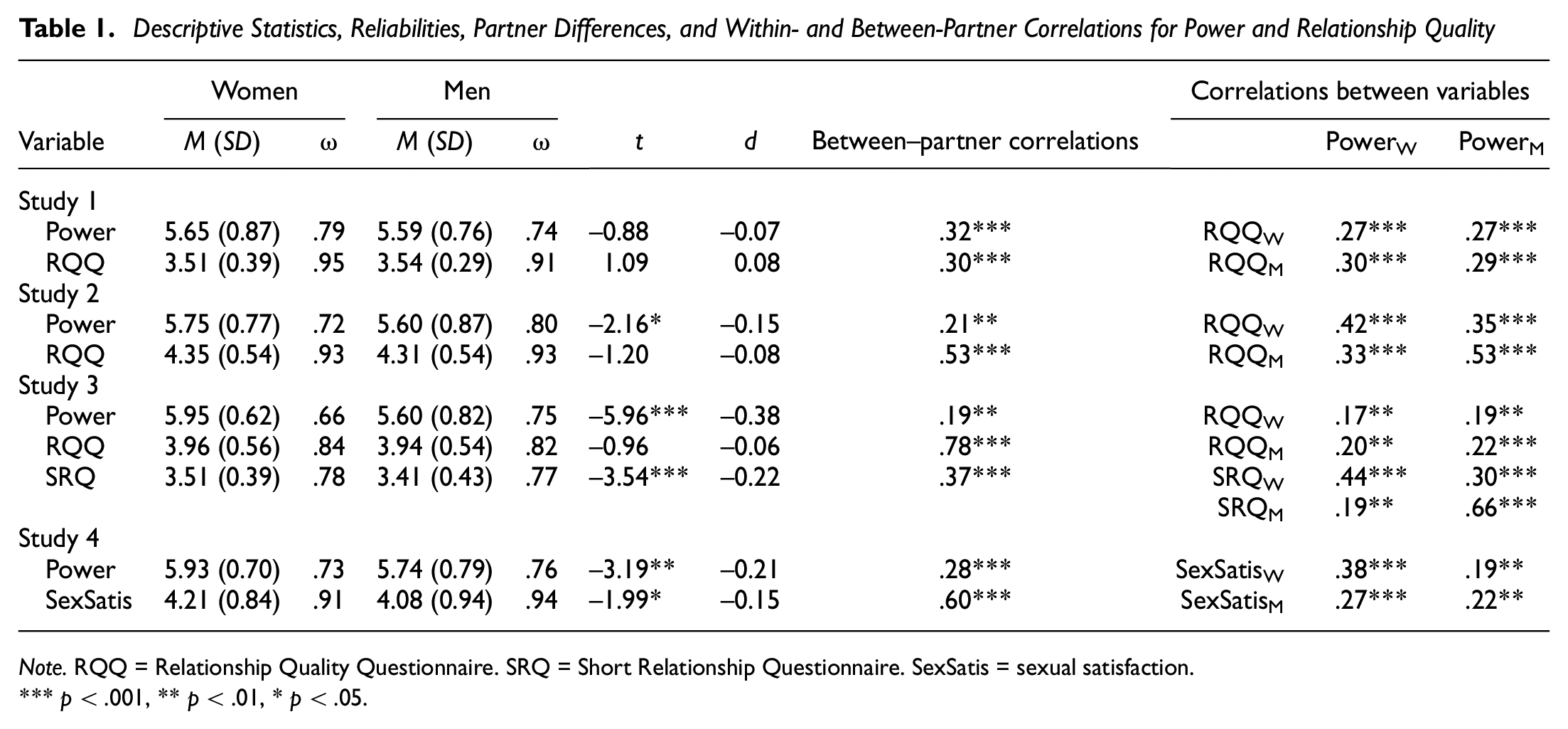
Note. RQQ = Relationship Quality Questionnaire. SRQ = Short Relationship Questionnaire. SexSatis = sexual satisfaction.
p < .001, **p < .01, *p < .05.
In Studies 1-3, we assessed RQ with the Relationship Quality Questionnaire (RQQ; Siffert & Bodenmann, 2010). The RQQ is a multidimensional instrument and the 26 items capture the topics fascination and admiration for the partner, investment in the relationship, sexual fulfillment, long-term potential of the relationship, mistrust toward the partner, and the experience of constraints (e.g., “I invest in our relationship”). Answers were given on a scale ranging from 1 (disagree) to 5 (strongly agree). A hierarchical model with a global RQ factor was supported by the authors.
In addition, we used the Short Relationship Questionnaire (SRQ; Kliem et al., 2012) in Study 3. The SRQ is about liking and spending time together, intimacy, and conflicts or disagreements in the relationship (9 items; e.g., “S/he criticizes me in a sarcastic manner”). In contrast to the RQQ, the SRQ asks for desirable behaviors provided by the partner. Answers were given on a scale ranging from 1 (never/very seldom) to 4 (very often).
Sexual satisfaction in Study 4 was assessed with the Sexual Satisfaction subscale of the Multidimensional Sexuality Questionnaire (Snell et al., 1993). Five items (e.g., “I am very satisfied with my sexual relationship”) were completed on a scale ranging from 1 (strongly disagree) to 5 (strongly agree). (We did not employ an RQ measure because Study 4 focused on power and sexuality and for the sake of a shorter study completion time.)
Data Analysis Strategy
We computed reliabilities (McDonald’s omega total), descriptive statistics, partner differences and within- and between-partner correlations for all variables. We then computed a series of DRSAs (Schönbrodt et al., 2018). DRSA is a combination of response surface analysis (Edwards & Parry, 1993) and the actor-partner interdependence model (Kenny et al., 2006). DRSA models the associations of two predictor variables (power scores for men and women) on two outcome variables (RQ scores for men and women) while accounting for the nonindependence of the dyadic data. We grand-mean centered the predictors before conducting analyses. The robust maximum likelihood estimator was used. Missing values were replaced with FIML. Bootstrapped 95% CIs (k=10,000) are reported for each coefficient.
First, within a DRSA model, ten polynominal regression parameters are computed (five for each sex). The parameters b1 and b2 reflect linear effects of power on RQ for the actor and the partner, respectively. The parameters b3 and b5 are the squared power scores of women and men; they indicate curvilinear effects. The parameter b4 indicates interaction effects (power of women*power of men).
Based on the polynominal regression parameters, DRSA computes eight response surface parameters (four for each sex; these allow plotting a response surface that displays predicted RQ for each combination of both partners’ power scores). These parameters shape two lines: The line of congruence (LOC) shows all combinations where couples are identical at different levels of the power scores; the line of incongruence (LOIC) shows where couples are perfectly dissimilar at different levels of the power scores. The parameter a1 indicates the slope of the LOC (a1>0: RQ is higher when the power scores of couples match at higher rather than at lower levels). The parameter a2 tests for nonlinear effects along the LOC (a2>0: power balance at extreme levels [instead of midrange levels] relates positively to RQ). The parameter a3 indicates the slope of the LOIC (a3≠0: RQ is higher if there is an incongruence between power scores between both partners). The parameter a4 tests for nonlinear effects along the LOIC (a4<0: RQ is higher the more similar partners are in power). We use the term “effect” in line with DRSA terminology; however, this does not imply causality.
To detect a similarity effect, that is, that power balance is positively related to RQ, the following conditions have to be met: a4=significantly negative; a1, a2, and a3=nonsignificant (Barranti et al., 2017; Schönbrodt et al., 2018). Note that a single RSA parameter in isolation does not indicate a similarity effect but only the combination of all variables allows one to draw such inferences (Figure 1). Moreover, caution is warranted in general when interpreting only a single parameter.
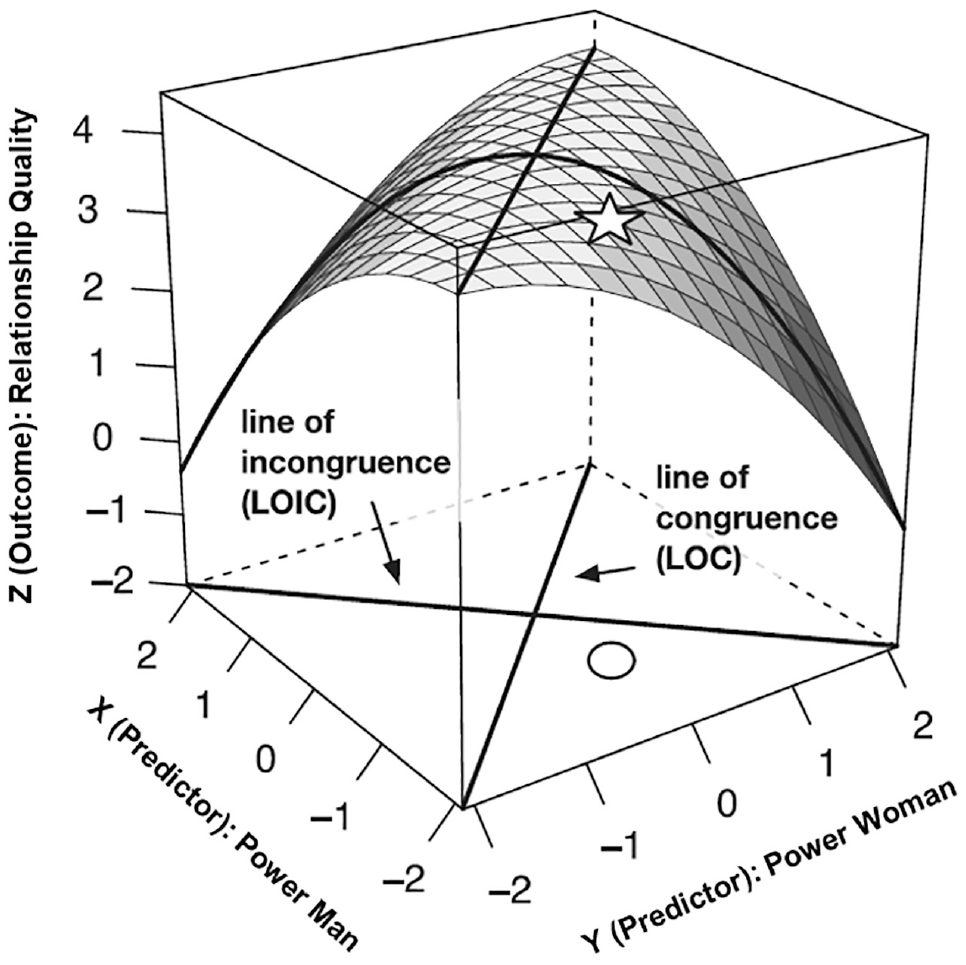
Illustrating a Positive Effect of Power Balance on Relationship Quality
Finally, we tested full DRSAs against constrained models in which the actor and partner effects were set as equal for men and women. To do so, we computed Likelihood-Ratio tests (nonsignificant values indicating preference of the constrained model). Analyses were done in R and Mplus. Data and syntax are available at https://osf.io/jfskg. In the OSF project, we also present results of DRSAs for the subscales of the two RQ measures (these results show positive [negative] actor effects of power on all positive [negative] RQ subscales and also a series of positive [negative] partner effects of power on several positive [negative] RQ subscales; further, only 2 out of 21 interactions and 2 out of 42 quadratic effects were significant. Thus, mostly linear actor and partner effects of power on RQ subscales emerged).
Results
In all studies, women reported slightly higher power than men (Table 1). In line with other research (Siffert & Bodenmann, 2010), RQ measures did not show a clear pattern of gender differences. Furthermore, power and RQ measures correlated substantially between partners, indicating robust interdependence (.19≥rs≥.78).
First, we tested whether there were enough couples with discrepancy in their power scores to provide useful DRSA results. According to a criterion of 0.5 z-points difference (see Schönbrodt et al., 2018) between power scores of men and women we found that there were enough discrepant couples in each study (Study 1: 64%, Study 2: 67%, Study 3: 62%, Study 4: 54%).
Second, Likelihood-Ratio tests indicated that DRSA parameters are identical for men and women in Studies 1 to 3 but not in Study 4, χ2(5)= 8.40, p=.008. Inspecting the polynominal regression coefficients, both RQ and sexual satisfaction are predicted from an actor’s and from a partner’s power (positive b1 and b2 coefficients in Tables 2–3). Thus, power relates positively to RQ and sexual satisfaction—for both partners. However, with respect to RSA parameters, the parameter a4 was not significant in any of the four studies (Tables 2–3). Thus, there is no evidence of a similarity effect—power balance is not linked to RQ or sexual satisfaction. 1 In each of the four studies the parameter a1 was significant and positive, indicating that RQ or sexual satisfaction is higher if power scores match at higher levels (relative to lower levels; Figures 2–4). Also, the parameter a3 was significant in Study 2 and in Study 3 for the SRQ. This indicates that individuals reported higher RQ if they felt more powerful than their partners did. For sexual satisfaction, we found that men’s surface parameter a2 was significantly positive (Table 3; Figure 4). Thus, power balance at extreme instead of midrange levels related positively to sexual satisfaction.
Results of DRSAs Predicting RQ (Studies 1–3)
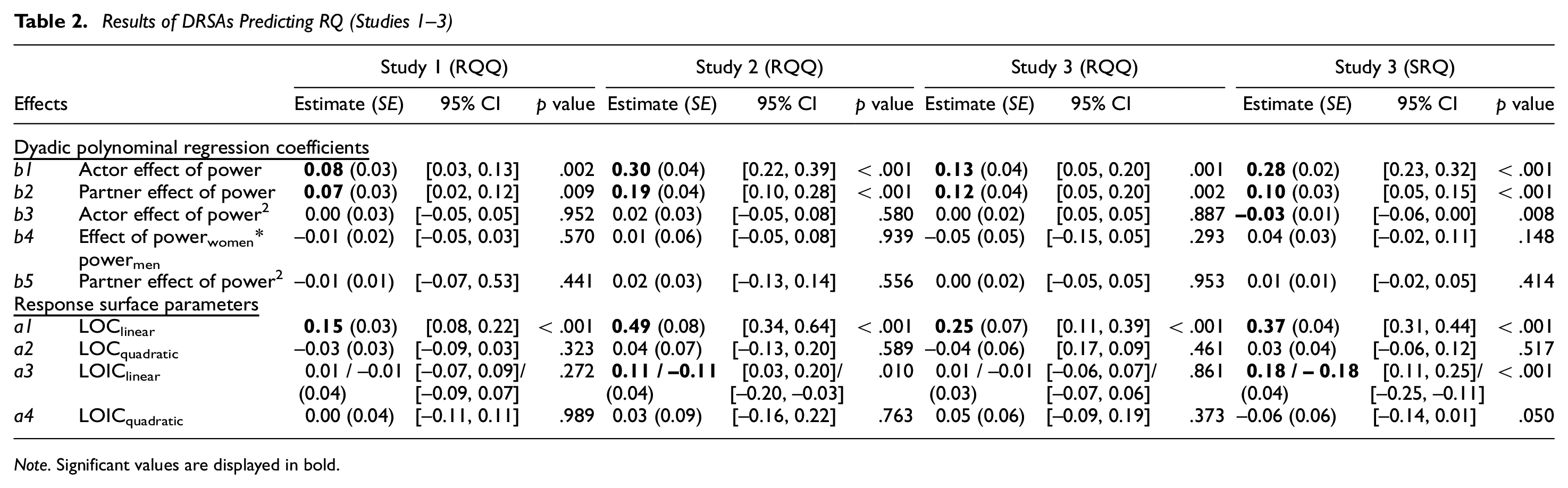
Note. Significant values are displayed in bold.
Results of DRSAs Predicting Sexual Satisfaction (Study 4)
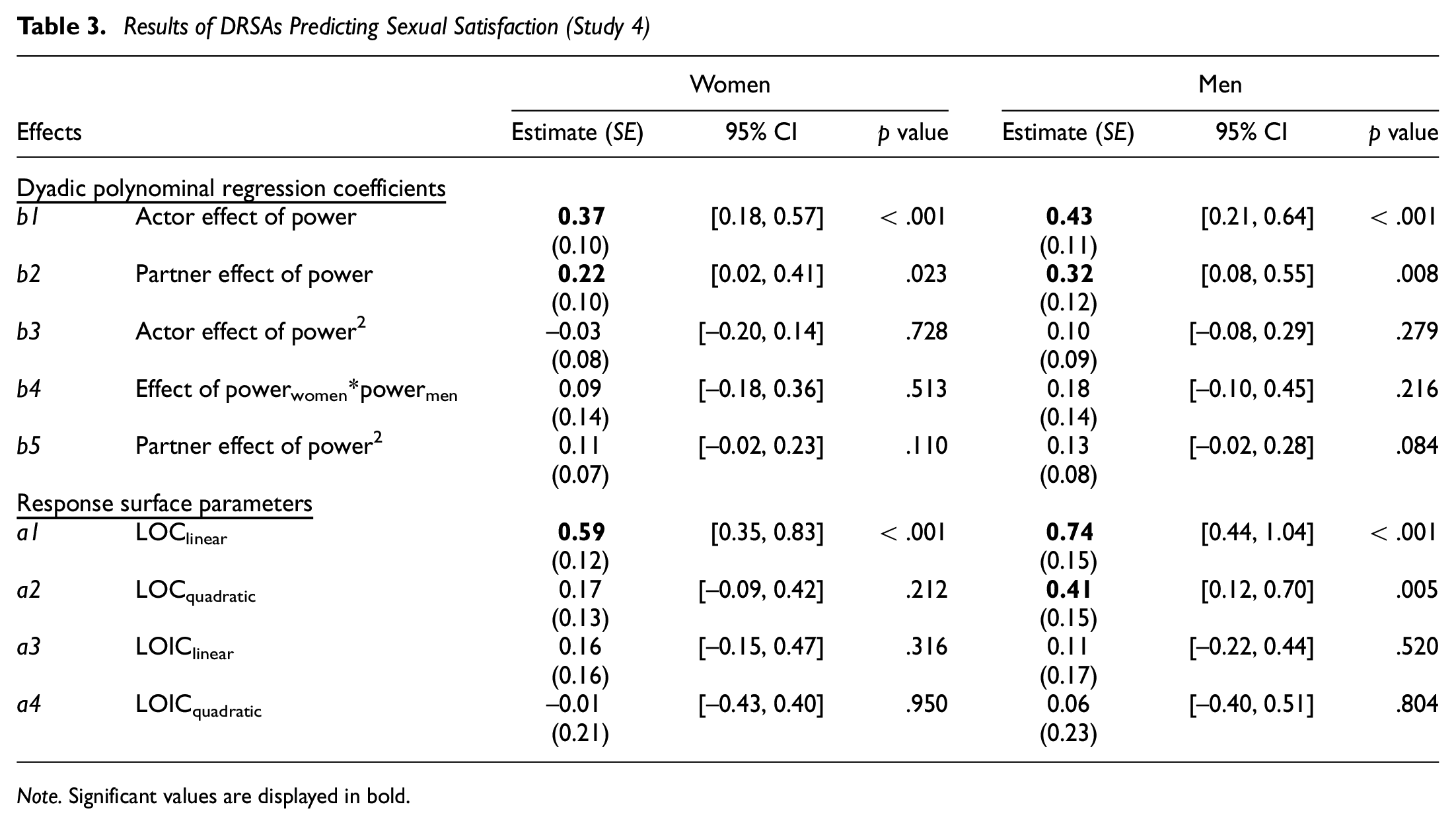
Note. Significant values are displayed in bold.
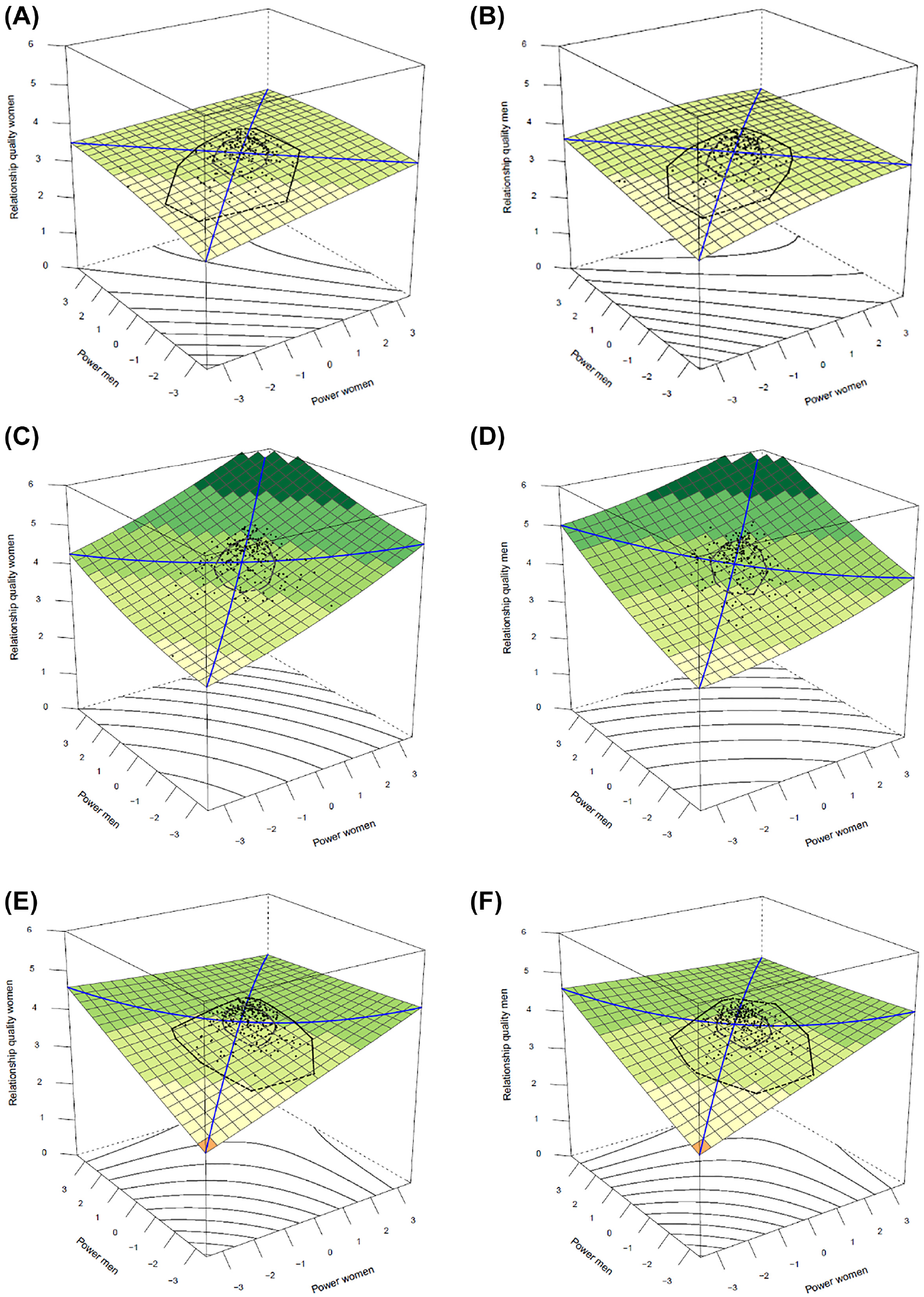
DRSA Plots of Studies 1 (at the Top), 2 (in the Middle), and 3 (at the Bottom). Predicting RQ of Women (Left) and of Men (Right) From Both Partner’s Power Scores
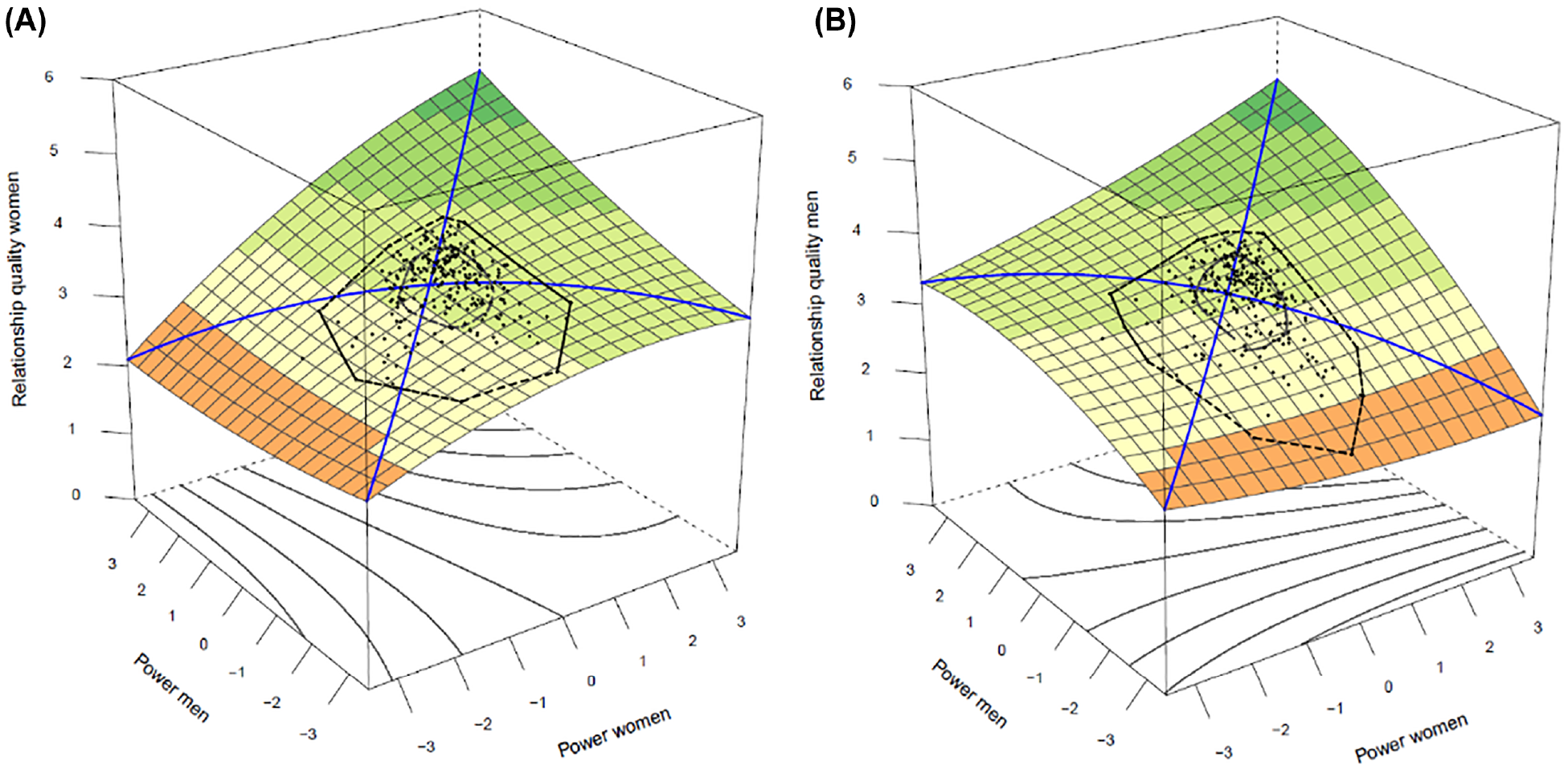
DRSA Plots of Study 3. Predicting RQ of Women (Left) and of Men (Right) From Both Partner’s Power Scores
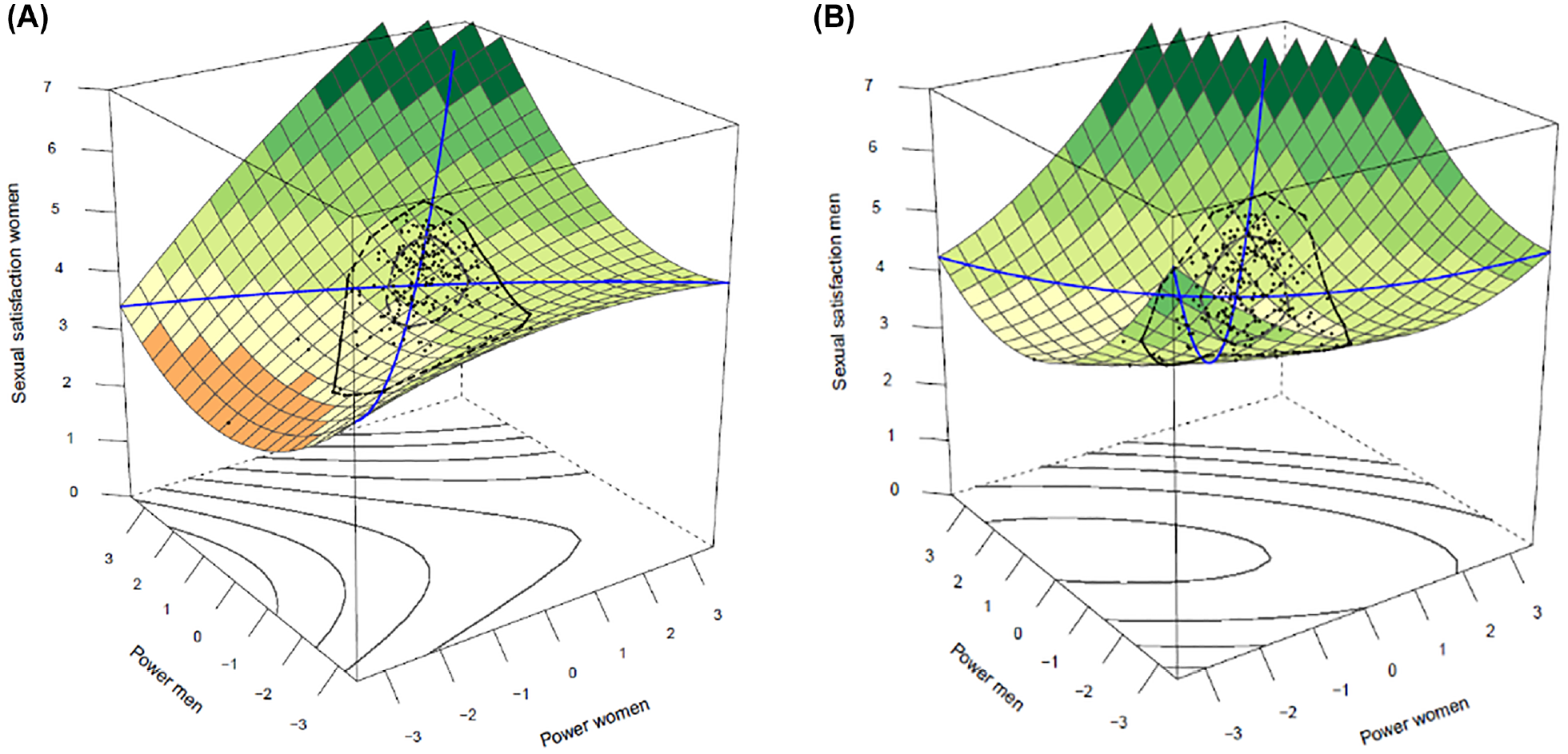
DRSA Plots of Study 4. Predicting Sexual Satisfaction of Women (Left) and of Men (Right) From Both Partner’ s Power Scores
In sum, there was mostly only evidence for linear main effects but not for quadratic effects of power on RQ and sexual satisfaction. No similarity effect (that power balance relates positively to RQ) was found. Finally, power explained much variance in RQ (Study 1: RQQwomen/men: 9%/15%; Study 2: RQQwomen/men: 27%/32%; Study 3: RQQwomen/men: 6%/7%; Study 3: SRQwomen/men: 25%/44%; Study 4: Sexual satisfacionwomen/men: 15%/15%).
Discussion
This research examined whether power balance is positively related to RQ. Using an analysis technique that overcomes issues of previous approaches (e.g., difference scores) and considers the dyadic nature of the data (Schönbrodt et al., 2018), we analyzed data from four independent samples and found no effect of power balance on RQ or sexual satisfaction. We did find, however, that an individual’s power related positively to their own as well as their partner’s RQ and sexual satisfaction.
First, several studies had suggested that power balance is relevant to relationship satisfaction (e.g., Gray-Little & Burks, 1983; Lindová et al., 2020) but no study so far has used DSRA. This is important because DSRA addresses many issues that obfuscate effects. Our results suggest that the previously found positive effect of power balance on RQ is a statistical artifact and our results are in line with the two studies that did not find effects of power balance on RQ (Körner & Schütz, 2021; Sprecher & Felmlee, 1997). We did find that power balances at high levels were better than power balances at low levels, however, a general similarity effect was not found. Note that most studies that have reported a positive effect of power balance on RQ used measures that capture an individual’s decision-making power (e.g., “Who more often gets his or her way in deciding …?”; e.g., Brezsnyak & Whisman, 2004; Drigotas et al., 1999; see also Gray-Little & Burks, 1983) and the PSPS is also about decision-making power (Anderson et al., 2012). Thus, the different findings do not seem to rely on different power measures but rather on statistical issues.
Second, what matters for RQ is not power balance but whether people feel that they can exert influence. In all studies, an actor’s power related positively to RQ. This finding is in line with studies reporting well-being, positive emotions, and behavioral approach as consequences of power (Berdahl & Martorana, 2006; Kifer et al., 2013). It is possible that high-power partners show an approach orientation as well as goal-oriented behavior that helps them to express their wishes and address interpersonal problems (Guinote, 2017), which may ultimately increase RQ. In Studies 2 and 3 (SRQ), we even found evidence that feeling more powerful than one’s partner was associated with higher RQ (actor effects were stronger than partner effects in these cases). Thus, individuals are happy with their relationship when they can make decisions (instead of their partners—at least to some degree and possibly about matters that are relevant to them).
Third, power is not only related to an actor’s but also to partner’s RQ and sexual satisfaction. Thus, feeling powerful is also associated with the partner’s positive overall evaluation of the relationship. Power has been reported to lead to self-focused behavior (Laurin et al., 2016) and less accommodation behavior (Rusbult et al., 1991), which suggests that a partner’s power should be negatively related to an actor’s RQ. However, power can also lead to positive interpersonal outcomes such as forgiveness (Körner, Schütz, et al., 2022). In particular, in close relationships in which one cares for their partner, power should be positively related to socially responsible behavior (Chen et al., 2001). Moreover, low-power partners feel inhibited (Keltner et al., 2003), and may therefore not address important relationship issues. They experience negative affect and low authenticity (Kraus et al., 2011; Langner & Keltner, 2008), which may elicit dissatisfaction in their partner (Merwin et al., 2017). Conversely, the positive effect of an actor’s power on RQ generalizes also to the partner’s RQ.
Finally, we found that the associations between power and RQ were independent of gender. This is in line with previous research, which also did not find a moderating role of gender in the link between power and relationship outcomes (Körner & Schütz, 2021; Overall et al., 2023; Righetti et al., 2015). However, with respect to sexual satisfaction, findings differed between men and women. Men and women reported sexual satisfaction when they and their partners feel powerful, but only for men was power balance at extreme high levels positively related to RQ. Apparently, men are most satisfied with their sex life if they and their partners report relatively similar high levels of power. Possibly, it may be important for men’s sexual satisfaction to (a) feel in charge, which may bolster self-perceptions of traditional virility but (b) also have a powerful female partner, possibly because power is linked to approach-related behavior such as sexual assertiveness (Lammers & Stoker, 2019).
The findings have important theoretical and practical implications. Dyadic power theories (e.g., Blood & Wolfe, 1960; Dunbar et al., 2016) suggest that power is an antecedent of relationship outcomes such as sexual satisfaction. Our research shows that power is indeed strongly related to relationship outcomes, and not only for the actor, but in fact for both partners—however, a balance of power is not the key. Thus, an updated view is necessary to understand that absolute, rather than balanced power is actually relevant to certain outcomes.
Furthermore, our findings add to the consequences of high absolute power predicted by major power theories: Approach/inhibition theory of power (Keltner et al., 2003) predicts the experience of positive emotions, focus on positive goals, and approach behavior as consequences of power. Guinote’s (2017) framework suggests that power increases activation and leads to approaching goals. This could in turn promote the active shaping of one’s relationship, which may explain RQ. By contrast, social distance theory of power (Magee & Smith, 2013) assumes that power leads to anger, contempt, and low affiliation motivation. As anger and distance in turn should be linked to low RQ, a negative link between power and RQ would be expected, but we found the opposite. However, the three aforementioned theories do not focus on romantic relationships. The dyadic power-social influence model (DPSIM; Simpson et al., 2019) clearly postulates positive and negative dyadic effects of relationship power on outcomes. As we found both actor and partner effects, the present study is in line with the DPSIM. Further, we provide evidence for the dyadic nature of power and its link to RQ (Overall et al., 2023). In addition, the positive actor and partner effects of power on RQ are in line with recent research that found both actor and partner power can have desirable effects (i.e., approach behavior in terms of promoting both one’s own and one’s partner’s needs) in intimate relationships (Overall et al., 2023).
The results suggest that a sense of power is not an antisocial attitude that is characterized by exploitative behaviors but that it correlates positively with desirable traits—a finding that dovetails with earlier reasoning on power (Anderson et al., 2012). By contrast, if other forms of power are at play, such as dominance or coercive power, balance may be more important. However, similarity at a high level of dominance may be a problem and lead to conflict—and in fact it was found that complementarity regarding dominance in dyads was linked to liking and acceptance (Tiedens & Fragale, 2003).
Practitioners may benefit from these findings, as promoting a power balance may not be useful in increasing RQ or sexual satisfaction, but promoting an individual’s power may be more relevant. In any case, power explains much variance in RQ and therefore may be an important topic to address when seeking to improve RQ, such as in couple’s therapy.
By using a replication procedure across four samples, as well as up-to-date analysis techniques, this research helps to clarify the link between power, power balance, and RQ. Moreover, results were quite similar across two different RQ measures and a sexual satisfaction measure. However, as all data are cross-sectional, we cannot indicate direction. Does an actor’s power increase RQ or does RQ increase an actor’s power? Also, future research should test the statistical power of our analyses to corroborate these findings, as soon as appropriate techniques are available. Furthermore, in our sample women reported more power than men, which may be in part because we had a sample of relatively highly educated participants. Studying power balances in samples with other sociodemographic characteristics may produce different results which would be important to consider. More generally, the results cannot be generalized to non-WEIRD (Western, Educated, Industrialized, Rich, Democratic) countries and same-sex relationships. In non-WEIRD countries with more pronounced power differences, balances of power may still be predictive of RQ.
Future research could also test whether the effects can be found in different domains in which power is exercised. The Relationship Power Inventory (Farrell et al., 2015) distinguishes between ten domains (e.g., how to spend time together and purchases). Studying the link between power balances on a more fine-grained level may uncover different associations with RQ than the use of global power measures. Possibly, a global power balance does not significantly relate to RQ because an individual’s absolute power across domains or in a certain domain may be more important than equal levels of power. However, if one partner, for example, decides on the couple’s vacation destination unilaterally, but the other partner had also wanted to participate in this decision-making process, a power balance within this domain may be important for RQ beyond linear main effects. Moreover, we studied subjective power because it has been reported to be more predictive of relationship outcomes than positional, respectively, objective power (Körner & Schütz, 2021). Nevertheless, it may be interesting to study whether a balance regarding specific objective power indices (e.g., occupational status, income) relates to RQ or sexual satisfaction using DRSA. For example, men have been reported to prefer outearning their female partners (Pierce et al., 2013), which is why future studies may test whether income imbalances favoring women are negatively related to men’s RQ or sexual satisfaction.
Moreover, our study designs were cross-sectional but strong and enduring power imbalances could have negative effects on RQ long term. Therefore, longitudinal studies should be conducted to explore both between-dyad and within-dyad effects (e.g., a power balance during the early stages in the relationship may be temporary but enduring imbalance may have negative effects on RQ). Finally, not only power measures but also dependent variables should be varied. Imbalance in power has been linked to conflict and aggression and low-power partners may be inhibited in expressing their emotions (Stanley et al., 2017). Thus, DRSAs could be employed to test for similarity effects of power on emotion regulation and conflict resolution.
Altogether, this research used DRSA and found that the link between power balance and RQ has been overstated in previous research and seems to be a statistical artifact. Instead, an individual’s absolute level of power is relevant to RQ and sexual satisfaction—both for the actor and for their partner. Thus, enabling individuals to experience social power can potentially benefit the love life of both couple members.
Footnotes
Handling Editor: Yuthika, Girme.
Declaration of Conflicting Interests
The author(s) declared no potential conflicts of interest with respect to the research, authorship, and/or publication of this article.
Funding
The author(s) received no financial support for the research, authorship, and/or publication of this article.
Ethical Approval
All procedures performed in studies involving human participants were in accordance with the ethical standards of the national research committee and with the 1964 Helsinki declaration and its later amendments or comparable ethical standards. This article does not contain any studies with animals performed by any of the authors.
Informed Consent
Informed consent was obtained from all participants who were included in the study.
