



Abstract
Research on person-situation dynamics has mostly focused on only the person or the situation in isolation in the prediction of outcomes and has relied on single rating sources. The current work examined simultaneously the effects of personality traits, personality states, situation characteristics, and trait × state as well as trait × situation interactions on teachers’ job performance using self-ratings and two types of other ratings. Twice daily during a 13- or 14-day experience sampling study, teachers’ personality states, situation characteristics, and job performance were rated by N = 173 teachers, N = 98 supervisors, and N = 1,295 students (69 classes). Results demonstrated main effects of personality traits, personality states, and situation characteristics on momentary job performance, with meaningful alignments between significant predictors (e.g., Extraversion and Positivity). With only one exception, no statistically significant interactions were found. Overall, these findings highlight that both personality and situation characteristics uniquely predict teaching performance.
The dynamic nature of personality, including traits and state expressions (e.g., momentary behavior), and situations has been increasingly highlighted over recent years (Kuper et al., 2021, 2022; Sosnowska, Hofmans, Rauthmann, & Wille, 2021). At the same time, related work in industrial and organizational (I/O) psychology found that work behaviors, such as job performance, demonstrate high levels of within-person variability (McCormick et al., 2020; Podsakoff et al., 2019). Importantly, such fluctuations in performance are often assumed to result from interactions between employees’ personality and the situations they find themselves in (Dalal et al., 2020; Tett & Fisher, 2021). In line with this, the current work examines the role of person-situation dynamics in explaining employees’ momentary performance at work and addresses two broad and common gaps of previous work.
First, most studies focused on only one part of the equation (e.g., the role of personality states in momentary performance; Debusscher et al., 2016a, 2017), hampering a comprehensive understanding of the complex interrelations between personality traits, states, and situation characteristics and the relative contribution of each in the prediction of outcomes (Beck & Jackson, 2022; Funder, 2006). Second and relatedly, due to the challenges associated with the inclusion of informants in within-person research designs, previous work has primarily relied on self-reports of dynamic behavior (Dalal et al., 2020; Kuper et al., 2021). However, such studies may mostly have measured individuals’ changes in self-concepts across time, rather than measuring actual within-person variability in personality states, highlighting the need for different, simultaneous data sources to tease apart data-source-specific patterns from more generalizable ones (Kuper et al., 2021, p. 34).
In line with this, the current work adopts a within-person approach using multiple rating sources to examine the relationship between personality traits, states, situation characteristics, and job performance. Understanding how person-situation dynamics and their outcomes may be perceived differently by self and others is a timely and important matter on both theoretical and practical levels. The current research is situated in an educational context (including teachers, their supervisors, and students) and focuses on how personality traits, personality states, and situation experiences predict job performance from the perspective of all actors involved (i.e., self-ratings, ratings by individuals with a supervisory role, and individuals that are the target of the behavior).
Background
Personality and Job Performance
A vast amount of research in personality and organizational psychology has demonstrated that individuals’ personality traits are associated with their job performance (e.g., Barrick et al., 2001; Barrick & Mount, 1991; Fang et al., 2015). Personality and job performance have been used as rather static entities, but their manifestations in situ also demonstrate large levels of variability within persons (Fleeson, 2001; McCormick et al., 2020; Podsakoff et al., 2019; Tett & Fisher, 2021). This highlights the need for more dynamic conceptualizations of both and their relations to each other (Dalal et al., 2020).
These momentary expressions of personality traits—or personality states—reflect thoughts, feelings, desires, or behaviors that arise in response to particular situations (Tett & Fisher, 2021, p. 1071). Similarly, within-person fluctuations in job performance, or dynamic job performance, refer to performance variability within an employee across time and situations (Dalal et al., 2020). Over the past decade, a small number of studies suggested that personality states are meaningfully associated with momentary performance at work (e.g., Debusscher et al., 2016a; Huang & Ryan, 2011; Sosnowska et al., 2019).
Importantly, personality as a dynamic system includes both between-person stability and within-person variability simultaneously (Sosnowska, Hofmans, & Lievens, 2021). In line with this, the current work examines independent effects of traits and states on momentary job performance, but also considers their joint effects (see Figure 1). That is, the impact of within-person differences in states on momentary job performance may also be moderated by between-person differences in traits, such that effects of states on performance may be different for different levels of traits (see, e.g., Hofmans et al., 2015). Previous work shows, for example, that trait Agreeableness moderates the relationship between momentary (affective) states and work-related outcomes such as organizational citizenship behavior (Ilies et al., 2006) and workplace helping (Conway et al., 2009). In the same vein, we examine to what extent individuals’ trait-level personality moderates the extent to which personality states impact momentary job performance.
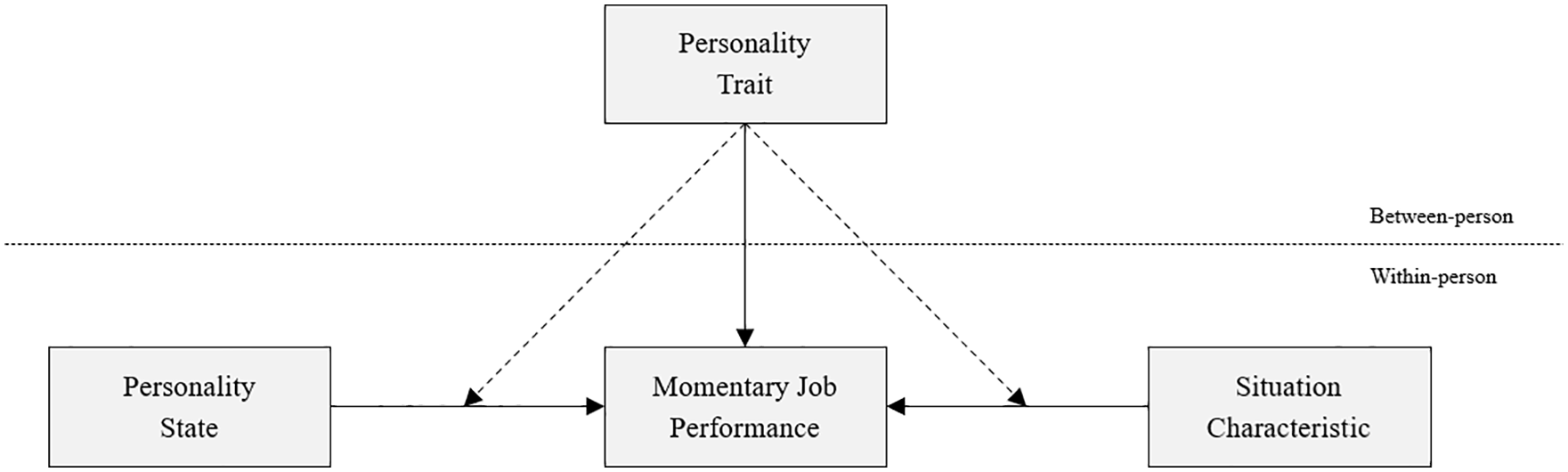
Predicted Associations Between Personality Traits, Personality States, Situation Characteristics, and Job Performance
Situations and Job Performance
People do not operate in a vacuum. It has been widely acknowledged that interactions between individuals and the situation they find themselves in impact behavior (Breil et al., 2019). Situations can be defined as momentary circumstances outside the person that are inherently dynamic, containing objective stimuli that can be subjectively perceived by individuals to yield a psychological situation (Kuper et al., 2021, p. 8). Importantly, previous studies may have led to relatively weak estimations of relationships between personality and performance as they have disregarded the role of the (psychological) situation in which the performance was provided (Debusscher et al., 2016b, p. 89). Specifically, characteristics of the work situation may impact momentary job performance in (at least) two ways.
First, one’s interpretation of a work situation may directly impact work-related outcomes (e.g., Freudenstein et al., 2020; Reindl et al., 2021). Although Alaybek and Dalal (2021, p. 1089) recently explicitly defined within-person performance variability as “the change in an employee’s performance level over time and/or across situations” (italics added), to date, only limited understanding exists on how situations impact or relate to performance on a momentary basis. However, given that situation experiences may be associated with within-person fluctuations in behavior (Abrahams et al., 2021; Sherman et al., 2015), the way in which one interprets a situation may also be associated to momentary job performance (see Figure 1).
Second, it is also critical to consider interactions between traits and situations when examining behavioral outcomes of personality. Trait Activation Theory (Tett & Guterman, 2000) suggests that the relationship between traits and outcomes is “stronger in situations that provide more cues for the expression of trait-relevant behavior” (Debusscher et al., 2016b, p. 89). Although empirical evidence on trait × situation interactions seems to be mixed (e.g., Breil et al., 2019; Kuper et al., 2023; Sherman et al., 2015; Wood et al., 2019), understanding how traits are expressed as a function of the situational characteristics at hand may significantly improve the predictive validity of personality in performance evaluations (Sosnowska, Hofmans, & Lievens, 2021). For example, being in a situation that is experienced as negative may lead to a larger decline in job performance for an employee that is high in trait Neuroticism than for an employee that is low in trait Neuroticism (see Figure 1).
Self-Ratings and Other-Ratings in Within-Person Research
A main challenge for empirical research on the within-person relationship between personality, situations, and job performance is that within-person ratings are generally limited to self-reports (Leikas & Lönnqvist, 2023). Although common rater biases may be less of an issue in within-person research (Debusscher et al., 2016a; Gabriel et al., 2019), additional rating sources may be indispensable as they bring unique perspectives to the table. For example, it is well known that some aspects of personality are known better to the self than to others and vice versa (Vazire, 2010). Similarly, situation characteristics may be evaluated differently by different raters (Abrahams et al., 2021; Rauthmann et al., 2015). Furthermore, different rater sources may value different aspects of job performance (Heidemeier & Moser, 2009). As such, obtaining self-ratings and other-ratings of traits and states, situation characteristics, and job performance may significantly increase our understanding of their relations with each other.
The Present Research
As can be seen in Figure 1, we set out to examine the role of traits, states, situation characteristics, and trait × situation characteristic and trait × state interactions in the prediction of employees’ momentary job performance. While previous work has mostly focused on only one or few of these in isolation (e.g., Debusscher et al., 2016b; Green et al., 2018; Wood et al., 2019), the current study enables a comprehensive assessment of the unique contribution of each of these in the prediction of dynamic job performance, by including multiple predictors (i.e., traits, states, situation characteristics), multiple dimensions (i.e., the Big Five for personality: McCrae & John, 1992; a combination of CAPTION and DIAMONDS for situation characteristics: Parrigon et al., 2017; Rauthmann et al., 2014), and multiple rating sources (i.e., self, supervisors, and the targets of the behavior).
Our study includes a sample of (student) teachers, 1 their supervisors, and their students for two reasons. First, these internships, during which teachers are supervised intensively, allow for the inclusion of two types of other-rating sources beyond the self (i.e., supervisors and students), which is relatively rare in organizational settings (and beyond) but has often been argued for (Dalal et al., 2020; Gabriel et al., 2019). Second, teachers’ profession is of a highly dynamic and interpersonal nature (Mount et al., 1998), leading to the expectation that fluctuations in states and situation experiences may play a particularly important role here.
Our goal is to identify the contribution of personality and situations in the prediction of performance more generally. For example, do interindividual differences (i.e., traits) play a role in the intraindividual relationship between momentary states, situations, and performance? Does either the person or the way in which one perceives a situation influence performance more strongly? Are the situation dimensions that predict performance the same as their conceptually related personality dimensions (e.g., Duty and Conscientiousness, see also Measures section)? We do not formulate dimension-specific hypotheses because which dimensions matter is also likely to vary across job type, with, for example, Conscientiousness, Agreeableness, and Emotional Stability being particularly important in task-oriented interpersonal work settings (such as teaching) but less so in jobs that are less interpersonal in nature (Mount et al., 1998). As such, all our research questions are exploratory and new. All our general hypotheses are visualized in Figure 1 and are discussed into more detail in the Data Analysis section.
Method
Transparency and Openness
We describe our sampling plan, all data exclusions, manipulations, and measures in the study. All data, analysis code, research materials, and Supplemental Materials are publicly available on the Open Science Framework (OSF) via https://osf.io/nat5v/. Data were analyzed using R, version 4.2.2 (R Core Team, 2022). The study design, hypotheses, and analysis plan were not preregistered. Data presented in this article were part of a broader data-collection effort, part of which has been published before (Abrahams et al., 2021, 2023), but the focus and analyses here are novel. A data transparency table and more detailed information on the current study’s methods can be found on OSF. The study was approved by the Ethics Committee of Ghent University.
Participants and Procedure
Two samples including a total of 194 teachers, 111 internship supervisors, and 72 classes (including 1,354 fifth- or sixth-grade students) participated in an experience sampling study during teachers’ internships (see the following paragraph for the final sample size after data exclusion). Teachers were recruited at a teacher training college where they were informed of the study by means of an information session. Supervisors were recruited via the teachers, either by an information leaflet (Sample 1) or email (Sample 2). Teachers could also participate in the study if their supervisor or students did not wish to participate. Supervisors decided whether they participated in the study with or without their students.
Upon signing up for the study, teachers completed a personality trait measure (see Measures section). Then, during their 13- or 14-day internship, teachers and their supervisors received a notification around 11:45 AM and 2:45 PM to rate the teachers’ personality states, situation characteristics, and momentary job performance on an online platform (https://formr.org; Arslan et al., 2020). After 2 hours, the survey expired. Students only rated their teacher’s momentary job performance. All students and participants who did not possess a smartphone participated using paper-and-pencil questionnaires. Paper-and-pencil observations that were completed too early or too late were excluded. For student ratings, we only retained assessments in which at least half of the class’ students completed the survey to avoid inclusion of surveys that were filled out randomly by students (i.e., when they were not supposed to). Students’ ratings were aggregated within class. Participants with less than three valid observations were excluded from all analyses. This resulted in a final dataset including 173 teachers (Mage = 20.03, SDage = 1.83; 154 female), 98 supervisors (Mage = 37.28, SDage = 10.54; 73 female) and 69 classes (including 1,295 students). The total number of observations for each variable can be found in Table 1.
Descriptive Characteristics and Within- and Between-Person Correlations
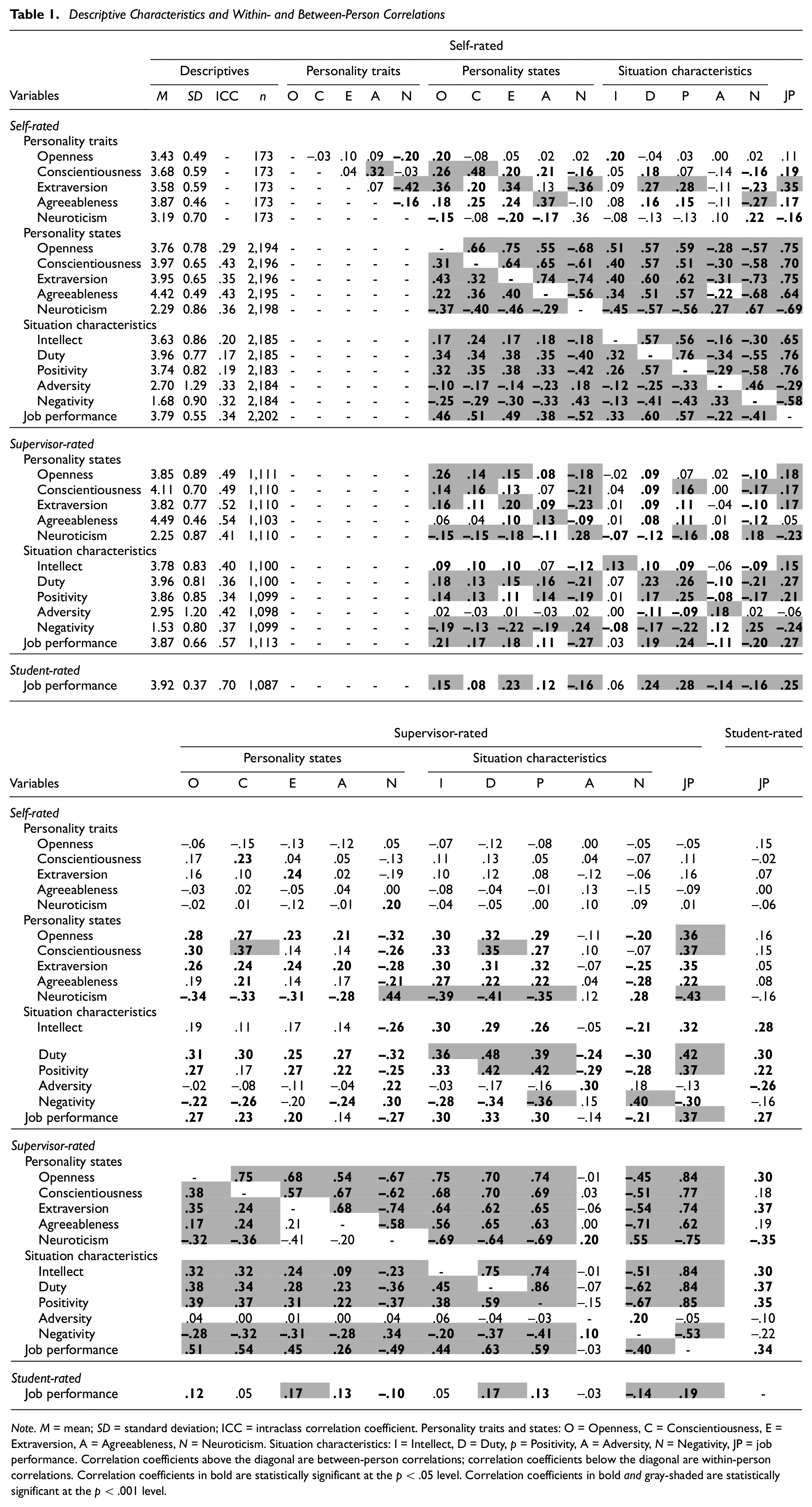
Note. M = mean; SD = standard deviation; ICC = intraclass correlation coefficient. Personality traits and states: O = Openness, C = Conscientiousness, E = Extraversion, A = Agreeableness, N = Neuroticism. Situation characteristics: I = Intellect, D = Duty, p = Positivity, A = Adversity, N = Negativity, JP = job performance. Correlation coefficients above the diagonal are between-person correlations; correlation coefficients below the diagonal are within-person correlations. Correlation coefficients in bold are statistically significant at the p < .05 level. Correlation coefficients in bold and gray-shaded are statistically significant at the p < .001 level.
Measures
All items in this study used a 5-point Likert-type response scale ranging from 1 (“completely disagree”) to 5 (“completely agree”) and are available on OSF.
Big Five Personality Traits
Big Five traits were assessed using the Dutch version of the Big Five Inventory (Denissen et al., 2008). Forty-four items measured participants’ self-reported levels of Openness to experience (McDonald’s ω = .85), Conscientiousness (ω = .89), Extraversion (ω = .89), Agreeableness (ω = .82), and Neuroticism (ω = .89).
Big Five Personality States
Big Five states were assessed using 10 adjective items (two per domain) developed for this study (see https://osf.io/nat5v/).
Situation Characteristics
Situation characteristics were assessed using five items. Specifically, for each of the five corresponding domains between DIAMONDS/CAPTION and the Big Five (i.e., Duty/Importance and Conscientiousness, Intellect/Complexity and Openness, Adversity/Negative Valence and Agreeableness, Positivity/Positive Valence and Extraversion, Negativity/Adversity and Neuroticism or Emotional Stability; Rauthmann & Sherman, 2018, 2020), only one situation item was included, and we retained the DIAMONDS terminology throughout this manuscript. Items were based on short-form measures of the DIAMONDS (S8-I; Rauthmann & Sherman, 2016) and CAPTION (CAPTION-sf; Parrigon et al., 2017) taxonomies.
Momentary Job Performance
Teachers’ self-, supervisor-, and student-rated momentary job performance was assessed using seven items developed based on main dimensions of teachers’ instructional quality or job performance (see, e.g., Kunter & Baumert, 2007; Seidel & Shavelson, 2016).
Data Analysis
We predicted teachers’ self-, supervisor-, and student-rated momentary job performance from personality traits, personality states, situation characteristics, and cross-level interactions between traits and situation characteristics and between traits and states. Seven sets of successive analyses were built toward a final model. Only results of the final model are reported here; results of the other models can be found in Tables S1–S6 in the Supplemental Materials on OSF.
Specifically, in these sets of analyses, self-, supervisor-, and student-rated job performance was predicted from (a) self-rated personality traits (Supplemental Material Table S1); (b) self- or supervisor-rated personality states (Supplemental Material Table S2); (c) self- or supervisor-rated situation characteristics (Supplemental Material Table S3); (d) self- or supervisor-rated personality states and situation characteristics (Supplemental Material Table S4); (e) self-rated personality traits, self- or supervisor-rated situation characteristics, and their cross-level interactions (Supplemental Material Table S5); and (f) self-rated personality traits, self- or supervisor-rated personality states, and their cross-level interactions (Supplemental Material Table S6).
Finally, in the seventh and most comprehensive set of analyses, we ultimately predicted self-, supervisor-, and student-rated momentary job performance from self- or supervisor-rated personality states and situation characteristics, self-rated personality traits, and cross-level interaction terms between traits and situation characteristics and between traits and their respective states (i.e., six models; Table 2). The generic model in multilevel notation (Snijders & Bosker, 1999) is

where Y = momentary job performance (for observation i in individual j), p = personality state, S = situation characteristic, T = personality trait, ITS = interaction between trait and situation, ITP = interaction between trait and state, and e = error term.
Personality Traits, Personality States, Situation Characteristics, and Their Interactions Predicting Momentary Self-, Supervisor-, and Student-Rated Performance
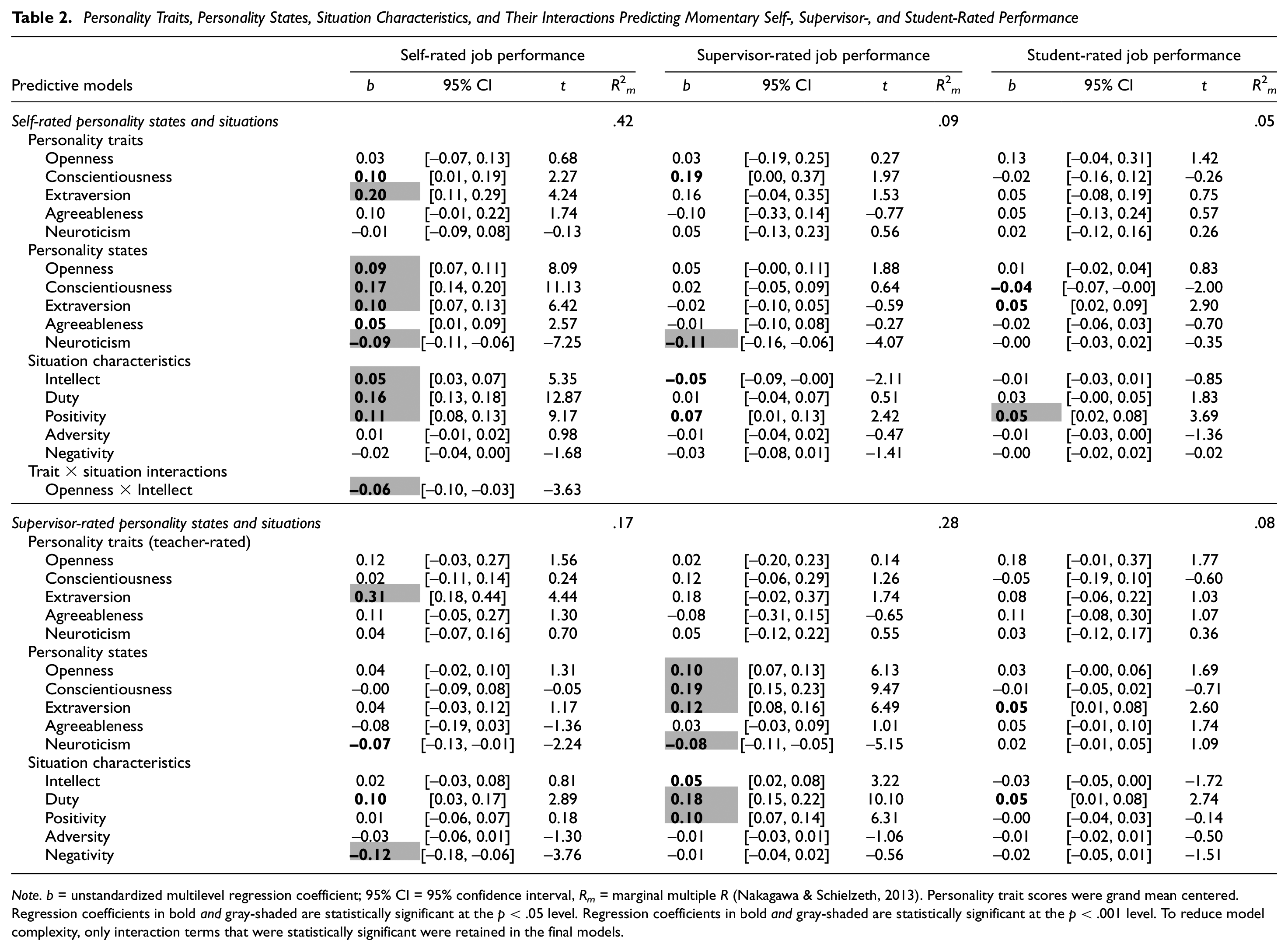
Note. b = unstandardized multilevel regression coefficient; 95% CI = 95% confidence interval, Rm = marginal multiple R (Nakagawa & Schielzeth, 2013). Personality trait scores were grand mean centered. Regression coefficients in bold and gray-shaded are statistically significant at the p < .05 level. Regression coefficients in bold and gray-shaded are statistically significant at the p < .001 level. To reduce model complexity, only interaction terms that were statistically significant were retained in the final models.
We only included those trait × situation interactions that could be expected based on the conceptual overlaps as specified in the Measures section (e.g., Duty-Conscientiousness, see also Rauthmann & Sherman, 2020). An example of a model is teacher-rated momentary job performance that was predicted from self-rated trait Conscientiousness, self-rated state Conscientiousness, self-rated Duty, the interaction between self-rated trait Conscientiousness and self-rated Duty, and the interaction between self-rated trait and state Conscientiousness. To reduce model complexity, only interaction terms that were statistically significant were retained in the final models and are reported here (a similar approach as in Abrahams et al., 2021).
Note that at the within-person level, we can make a distinction between mono-rater models (i.e., teacher-rated [resp. supervisor-rated] job performance predicted by teacher-rated [resp. supervisor-rated] personality states and situation characteristics) and hetero-rater models (e.g., teacher-rated or student-rated job performance predicted by supervisor-rated personality states and situation characteristics). Note that not all models are fully mono-rater or hetero-rater at the between-person level as personality traits were only rated by teachers.
All linear mixed-effect models were constructed using the lme4 package (Bates et al., 2015) in R version 4.2.2 (R Core Team, 2022) and included random intercepts but no random slopes due to possible convergence issues in some of the models. Situation characteristics and personality states were within-person centered, and personality traits were grand mean centered. We report fixed-effects estimates, 95% confidence intervals, as well as proportion of variance explained by fixed factors (R2 m ) (Nakagawa & Schielzeth, 2013).
Results
Means, standard deviations, and intraclass correlation coefficients (ICCs) are provided in Table 1. In each of the following sections, we discuss the linear mixed-effects findings for mono-rater and hetero-rater models separately (see Table 2).
Self-Rated Job Performance
Mono-Rater Model (Self-Rated Personality States and Situation Characteristics)
Teachers’ (average) self-rated momentary job performance was predicted by trait Extraversion (b = 0.20, 95% CI = [0.11, 0.29]) and Conscientiousness (b = 0.10, 95% CI = [0.01, 0.19]). 2 Furthermore, all self-rated personality states significantly predicted teachers’ self-rated performance (Conscientiousness: b = 0.17, 95% CI = [0.14, 0.20]; Extraversion: b = 0.10, 95% CI = [0.07, 0.13]; Openness: b = 0.09, 95% CI = [0.07, 0.11]; Neuroticism: b = −0.09, 95% CI = [−0.11, −0.06]; Agreeableness: b = 0.05, 95% CI = [0.01, 0.09]). For self-rated situation characteristics, significant effects were found for Duty (b = 0.16, 95% CI = [0.13, 0.18]), Positivity (b = 0.11, 95% CI = [0.08, 0.13]), and Intellect (b = 0.05, 95% CI = [0.03, 0.07]). There was only one significant trait × situation characteristic interaction, between trait Openness and Intellect (b = −0.06, 95% CI = [−0.10, −0.03]), but no significant trait × state interactions. Personality traits, states, and situation characteristics jointly predicted a relatively large proportion of variance in performance (R2 m = .65).
Hetero-Rater Model (Supervisor-Rated Personality States and Situation Characteristics)
Teachers’ self-rated job performance was predicted by trait Extraversion (b = 0.31, 95% CI = [0.18, 0.44]), supervisor-rated state Neuroticism (b = −0.07, 95% CI = [−0.13, −0.01]), and supervisor-rated Negativity (b = −0.12, 95% CI = [−0.18, −0.06]), and Duty (b = 0.10, 95% CI = [0.03, 0.17]). There were neither significant trait × situation characteristic nor trait × state interactions. Personality traits, states, and situation characteristics jointly predicted a moderate proportion of variance in performance (R2 m = .41).
Supervisor-Rated Job Performance
Mono-Rater Model (Supervisor-Rated Personality States and Situation Characteristics)
Supervisor-rated job performance was not predicted by personality traits. All supervisor-rated personality states except Agreeableness predicted supervisor-rated momentary job performance (Conscientiousness: b = 0.19, 95% CI = [0.15, 0.23]; Extraversion: b = 0.12, 95% CI = [0.08, 0.16]; Openness: b = 0.10, 95% CI = [0.07, 0.13]; Neuroticism: b = −0.08, 95% CI = [−0.11, −0.05]). Furthermore, supervisor-rated Duty (b = 0.18, 95% CI = [0.15, 0.22]), Positivity (b = 0.10, 95% CI = [0.07, 0.14]), and Intellect (b = 0.05, 95% CI = [0.02, 0.08]) were associated with supervisor-rated job performance. There were neither significant trait × situation characteristic nor trait × state interactions. Personality traits, states, and situation characteristics jointly predicted a moderate to large proportion of variance in performance (R2 m = .52).
Hetero-Rater Model (Teacher-Rated Personality States and Situation Characteristics)
Supervisor-rated job performance was predicted by trait Conscientiousness (b = 0.19, 95% CI = [0.00, 0.37]), teachers’ self-rated state Neuroticism (b = −0.11, 95% CI = [−0.16, −0.06]), and teachers’ self-rated Positivity (b = 0.07, 95% CI = [0.01, 0.13]) and Intellect (b = −0.05, 95% CI = [−0.09, −0.00]). There were neither significant trait × situation characteristic nor trait × state interactions. Personality traits, states, and situation characteristics jointly predicted a moderate proportion of variance in performance (R2 m = .30).
Student-Rated Job Performance
Hetero-Rater Model (Teacher-Rated Personality States and Situation Characteristics)
Student-rated job performance was not predicted by personality traits. Teachers’ self-rated state Extraversion (b = 0.05, 95% CI = [0.02, 0.09]) and Conscientiousness (b = −0.04, 95% CI = [−0.07, −0.00]) and teachers’ self-rated Positivity (b = 0.05, 95% CI = [0.02, 0.08]) significantly predicted student-rated momentary job performance. There were neither significant trait × situation characteristic nor trait × state interactions. Personality traits, states, and situation characteristics jointly predicted a small to moderate proportion of variance in performance (R2 m = .23).
Hetero-Rater Model (Supervisor-Rated Personality States and Situation Characteristics)
Student-rated job performance was not predicted by personality traits. Supervisor-rated state Extraversion (b = 0.05, 95% CI = [0.01, 0.08]) and supervisor-rated Duty (b = 0.05, 95% CI = [0.01, 0.08]) significantly predicted student-rated momentary job performance. There were neither significant trait × situation characteristic nor trait × state interactions. Personality traits, states, and situation characteristics jointly predicted a small to moderate proportion of variance in performance (R2 m = .28).
Discussion
Although research in personality psychology has shifted beyond the person vs. situation debate and now agrees that both matter, surprisingly little research has examined their joint importance for the same outcome (Beck & Jackson, 2022). The current work responds to this gap—and even extends beyond it—by examining the joint role of personality traits, personality states, situation characteristics, and their interactions in the prediction of employees’ momentary performance according to multiple rating sources. Our results are relevant both on theoretical and practical levels.
Overall, the current work found effects of personality traits (Conscientiousness and Extraversion; Barrick & Mount, 1991; Kim et al., 2019), personality states (mostly Conscientiousness, Extraversion and Neuroticism, and to a lesser extent, Openness and Agreeableness; cf. Debusscher et al., 2016a, 2017), and situation characteristics (mostly Duty, Positivity, and Intellect) on performance evaluations. In line with some previous work (Abrahams et al., 2021; Sherman et al., 2015) but contrasting others (Breil et al., 2019), we found almost no trait × situation characteristic interactions on outcomes (i.e., only one interaction between self-rated trait Openness and self-rated state Intellect on self-reported performance). Further, no trait × state interactions were found (contrasting recent findings by Beck & Jackson, 2022).
Interestingly, we found that patterns generalize across rating sources, construct types, and levels of analysis, suggesting a certain robustness of our insights. First, both of the mono-rater models yielded almost identical results (i.e., agreement across rating sources). For personality states, state Conscientiousness was most strongly related to state job performance in both self- and supervisor-ratings (mono-rater models), followed by Extraversion, and Openness and Neuroticism. Similarly, for situation characteristics, state Duty was most strongly associated with state performance in both self-ratings and supervisor ratings, followed by Positivity and Intellect (mono-rater models). Put differently, the personality and situation dimensions that are most strongly related to performance evaluations are the same for self- and supervisor-ratings when we look at the mono-rater models. Second, our results suggest various substantial and statistically significant effects of both personality (trait or state) dimensions and the situation characteristics they conceptually or content-wise align with (e.g., Conscientiousness and Duty were both related to state performance; i.e., agreement across construct types). Third, both at the trait and the state level, Conscientiousness and Extraversion emerged as the dimensions most strongly associated with teachers’ performance (i.e., agreement across levels of analysis). To illustrate this, our results suggest that—both at the between- and within-person levels of analysis—for both teachers and supervisors, most significant associations with performance were found for Conscientiousness and Duty (e.g., being diligent and experiencing hardworking situations), for Extraversion and Positivity (e.g., being enthusiastic and experiencing pleasant situations), and for Openness and Intellect (e.g., being curious and experiencing intellectually challenging situations), which is also in line with meta-analytic findings on personality and teacher effectiveness (Kim et al., 2019).
Agreeableness was the only dimension that was not related to performance, neither at the trait level nor the state level, which may seem surprising given that it is often assumed to be highly important in interpersonal jobs (like teaching; Mount et al., 1998). However, similar results were reported in the meta-analysis on teacher personality and effectiveness by Kim et al. (2019), in which effects of all personality traits except Agreeableness were also found. As Kim et al. (2019) argued, this may be due to limited variation in Agreeableness, causing restriction in variance and non-significant findings.
Note that we acknowledge that situation experiences may also be associated with personality states (see, e.g., Abrahams et al., 2021; Sherman et al., 2015) and that such associations may be moderated by traits (e.g., Breil et al., 2019). However, in the current research, the focus was rather on the contribution of each of these in the prediction of self- and other-rated momentary job performance rather than on their mutual relationships. As such, we did not focus on or include personality trait × situation interactions in the prediction of personality states in the current work.
Theoretical and Practical Implications
Already a decade ago, the question was raised on “what traits are best suited to study in relation to within-individual variation, particularly in relation to work experiences” (Judge et al., 2014, p. 215). Our study demonstrates that personality traits, states, and situation characteristics each have their unique share in the prediction of performance, not being redundant with one another. This highlights the pressing need for the development of an integrative model or theory explaining how self- and other-rated traits, states, and situation characteristics each contribute to self- and other-rated work-related outcomes. For example, researchers could combine the Trait-Reputation-Identity model (Connelly et al., 2022; McAbee & Connelly, 2016), which includes self-ratings and other-ratings of personality traits and has been applied to explain job performance evaluations, with ideas specified in the Whole Trait Theory (Fleeson & Jayawickreme, 2015), which includes within-person variability in states and perceptions of situations as mechanisms.
On a practical level, our findings may have important implications for the optimization of employee-selection procedures. Although trait assessments are still most widely used in personnel selection (Sosnowska, Hofmans, & Lievens, 2021), our (and other recent) research suggests that states and situation characteristics are related to work behavior at least equally strongly (Abrahams et al., 2023; Dalal et al., 2020; Debusscher et al., 2016a, 2016b, 2017). Furthermore, different occupations may require or value different situation characteristics and personality dimensions (e.g., Duty/Conscientiousness in accounting vs. Extraversion/Positivity in sales), suggesting that their inclusion could allow for a better fit between the person and the job, benefiting both the employer and the employee. For example, either existing selection methods can be adjusted, or new methods can be developed to capture within-person dynamics that are relevant in a particular job setting (e.g., Multiple Speed Assessments: Herde & Lievens, 2020; adaptions of situational judgment tests: Lievens et al., 2018).
Limitations and Future Directions
This work had several limitations that also point toward future research directions. First, our findings are based on a sample of (student) teachers, limiting the generalizability of our findings to other occupational groups. Particular personality states or situation experiences may be advantageous in some jobs but not in others (Tett & Fisher, 2021), similar to how the desirability of personality traits with regard to job performance depends on the particular characteristics of the job (Barrick & Mount, 1991).
Second, in contrast to all other variables in this research, personality traits were only self-rated. Although this choice was made deliberately because teachers and supervisors were not acquainted yet upon the start of the study, this prevented us to contrast fully mono-rater models from fully hetero-rater models and thus to better understand common and unique effects of different types of raters.
Third and finally, both personality states and situation perception show significant overlaps with positive and negative affect (Horstmann et al., 2021; Horstmann & Ziegler, 2019; Wilson et al., 2017). Although affect does not predict all within-person variance in personality states (Wilson et al., 2017), nor are situation perception and affect completely redundant with each other (Horstmann et al., 2021), including affect could provide a better insight into the mechanisms responsible for intraindividual variability in job performance.
Conclusion
The current work demonstrated that personality traits, personality states, and situation characteristics each were uniquely associated with employees’ job performance across different rating sources and that trait × situation characteristic as well as trait × state interactions were negligible. Meaningful links between both personality and situation characteristics and performance may likely vary across occupational contexts, highlighting the need for more research in this area to further develop theory and practice on person-situation dynamics in applied settings.
Supplemental Material
sj-docx-1-spp-10.1177_19485506241236812 – Supplemental material for Understanding Person-Situation Dynamics at Work: Effects of Traits, States, and Situation Characteristics on Teaching Performance
Supplemental material, sj-docx-1-spp-10.1177_19485506241236812 for Understanding Person-Situation Dynamics at Work: Effects of Traits, States, and Situation Characteristics on Teaching Performance by Loes Abrahams, John F. Rauthmann and Filip De Fruyt in Social Psychological and Personality Science
Supplemental Material
sj-docx-2-spp-10.1177_19485506241236812 – Supplemental material for Understanding Person-Situation Dynamics at Work: Effects of Traits, States, and Situation Characteristics on Teaching Performance
Supplemental material, sj-docx-2-spp-10.1177_19485506241236812 for Understanding Person-Situation Dynamics at Work: Effects of Traits, States, and Situation Characteristics on Teaching Performance by Loes Abrahams, John F. Rauthmann and Filip De Fruyt in Social Psychological and Personality Science
Footnotes
Handling Editor: Eranda Jayawickreme
Declaration of Conflicting Interests
The author(s) declared no potential conflicts of interest with respect to the research, authorship, and/or publication of this article.
Funding
The author(s) disclosed receipt of the following financial support for the research, authorship, and/or publication of this article: This research was supported by a BOF-grant (BOF.DOC.2017.0044.01) awarded to Loes Abrahams. Loes Abrahams also benefited from a grant from the Ayrton Senna Institute Endowed Chair at Ghent University.

Supplemental Material
Supplemental material for this article is available online.
Notes
Author Biographies
References
Supplementary Material
Please find the following supplemental material available below.
For Open Access articles published under a Creative Commons License, all supplemental material carries the same license as the article it is associated with.
For non-Open Access articles published, all supplemental material carries a non-exclusive license, and permission requests for re-use of supplemental material or any part of supplemental material shall be sent directly to the copyright owner as specified in the copyright notice associated with the article.
