




Abstract
The study aimed to investigate the status of within-person state variability in neuroticism and conscientiousness as individual differences constructs by exploring their (a) temporal stability, (b) cross-context consistency, (c) empirical links to selected antecedents, and (d) empirical links to longer term trait variability. Employing a sample of professionals (N = 346) from Australian organisations, personality state data together with situation appraisals were collected using experience sampling methodology in field and repeatedly in lab-like settings. Data on personality traits, cognitive ability, and motivational mindsets were collected at baseline and after two years. Contingent (situation contingencies) and non-contingent (relative SD) state variability indices were relatively stable over time and across contexts. Only a small number of predictive effects of state variability were observed, and these differed across contexts. Cognitive ability appeared to be associated with state variability under lab-like conditions. There was limited evidence of links between short-term state and long-term trait variability, except for a small effect for neuroticism. Some evidence of positive manifold was found for non-contingent variability. Systematic efforts are required to further elucidate the complex pattern of results regarding the antecedents, correlates and outcomes of individual differences in state variability.
Keywords
Introduction
Over the past decade or so, there has been a surge of interest in the dynamic components of personality, reflecting a recognition that between-person rank-order stability co-exists with within-person change in personality responses. Conceptualising personality as ‘dynamic’ means bringing ‘change over time’ into the study focus, with both short- and long-term person change being of interest (e.g. Beckmann & Wood, 2020). There is now mounting evidence to show that personality varies short-term (e.g. Beckmann et al., 2010; Debusscher et al., 2014, 2016; Fleeson, 2001, 2007; Fleeson & Gallagher, 2009; Judge et al., 2014; Minbashian et al., 2010; Sosnowska et al., 2019b) and long-term (e.g. Liu & Huang, 2015; Roberts et al., 2006; Wille & De Fruyt, 2014; Woods et al., 2019), but also that individuals differ in the extent to which they experience such change (e.g. Smith et al., 2009; Wille et al., 2014). Indeed, variability as an individual difference variable has long been of interest to researchers in both the personality and the cognitive ability research fields (e.g. Birney et al., 2019; Dalal et al., 2015; Fiske & Rice, 1955; Horn, 1950; Lievens et al., 2018; Salthouse, 2012). And yet, comparably little is known about why some individuals vary more than others, and whether those who experience more short-term variability in their cognitive, affective and behavioural states (e.g. moment-to-moment, or day-to-day), are also more likely to change and develop in their trait personality longer term (e.g. year-to-year). This matters to researchers and practitioners interested in personality change and development. For example, if strong empirical links exist between short- and long-term variability in personality responses, actively targeting states in interventions to elicit short-term fluctuation may offer a pathway to realising longer term change in traits (e.g. Blackie et al., 2014; Jayawickreme et al., 2019).
The current study makes the following three contributions: First, we aim to add to the small body of research literature on the linkages between short-term state and long-term trait variability using a non-student sample. Second, we seek to produce evidence on the antecedents and correlates of within-person variability by considering individual differences that are of relevance in learning and performance settings. These include implicit theories, goal orientations, and cognitive ability, in addition to Big Five traits. Third, we compare and contrast outcomes that are based on two commonly used forms of operationalising variability (an index of the total amount of variability, and a conditional response index) within the same sample and using lab and field data, to test whether different conceptual and operational approaches to short-term within-person variability result in differential correlation patterns with other individual differences variables.
Momentary and trait personality variability
Short-term personality state variability
Momentary (or state) personality has now been studied relatively widely in student and non-student samples (e.g. Beckmann et al., 2010; Debusscher et al., 2014, 2016; Fleeson, 2001, 2007, 2017; Huang & Ryan, 2011; Judge et al., 2014; Sherman et al., 2015; Sosnowska et al., 2019a; Zacher, 2016). As the focus is on short-term fluctuations in personality responses, the typical study employs an intensive repeated measurement design involving numerous measurement occasions within short time periods (typically one or multiple measurements per day for one or several weeks). For example, in a seminal series of studies, Fleeson (2001) collected Big Five personality state data in student samples five times per day over the duration of two to three weeks as students went about their daily activities. He showed that most students experienced considerable variability in their personality states during the study period and at the same time showed relative stability in their average responses. Variability in personality states has since been studied in employee samples and linked to work experiences and outcomes, such as job performance (e.g. Beckmann et al., 2010; Debusscher et al., 2014; 2016; Judge et al., 2014; Minbashian et al., 2010; Wood et al., 2019). Several insights can be derived from studies on momentary personality: First, within-person variability in state personality exists and is of a considerable amount. Second, this variability is at least to some extent systematic, i.e. non-random and substantive. Third, people differ in terms of (a) the extent to which they show variability in general, (b) what specific situational dynamics they respond to, and (c) the degree of responsiveness to those situational dynamics. Finally, momentary personality has been shown to be associated with trait personality assessed with conventional, one-off personality measures.
Experiential versus construed components of personality
Variations in personality states have distributional properties, such as means and standard deviations, that are systematic and theoretically substantive (Fleeson, 2001). While most people experience a range of different state levels (e.g. high and low levels of state conscientiousness), they tend to experience some state levels more frequently than others, this is reflected in their mean state. Mean personality states tend to correlate moderately strongly with scores from conventional Big Five trait scales (e.g. Fleeson & Gallagher, 2009; Wood et al., 2019), suggesting momentary personality is related to, but also distinct from trait personality. From a measurement perspective, a reasonable explanation of such distinction is that the repeated, often in-the-moment, assessment of personality states reflects (in part at least) reactions to, and interpretations of, one’s experience of the proximal circumstances the situation presents – thus state measures yield an experiential indicator of personality. On the other hand, the conventional one-off assessment of trait personality, which requires participants to, possibly implicitly, average across past experiences to report on how they think, feel and behave ‘in general’, is indicative of personality that is more construed. Experiential and construed components of personality may be related, such that experiences may influence self-construals, but are likely also distinct (cf. Kahneman & Riis, 2005). For example, individuals are unlikely to recall and draw on all experienced states equally strongly when construing an answer to items in trait questionnaires. Therefore, a statistical aggregation across experiences with equal weights, such as a mean state, is unlikely to produce an index of self-construed personality. Both experiential and construed personality indicators are informative in their own right; the former reflecting more directly a person’s day-to-day experiences and responses, the latter taking account of the subjective importance of experiences in the context of a person’s identity.
An important question is whether variability is of consequence to an individual’s psychological functioning. If consequential, variability may present an asset or might turn out to be a liability. Arguably, if variability is of no consequence, antecedents and/or correlates of variability matter less. To date, findings from studies on variability as an individual difference present a mixed picture. A number of early studies suggested variability in affect or personality to indicate a vulnerability with undesirable consequences for well-being or performance (e.g. Donahue et al., 1993; Kuppens et al., 2007; Reddock et al., 2011; see also meta-analysis by Bleidorn & Ködding, 2013; Suh, 2002). More recently, variability has been shown to be facilitating, as reflected in higher well-being or performance indicators (e.g. Lievens et al., 2018; Magee et al., 2018). Others report no, or considerably reduced, relationships between measures of variability and outcome variables of interest, particularly when controlling for scale means (Baird et al., 2006; 2017; Magee et al., 2018). While the evidence available to date on the potential costs or benefits of variability is not yet conclusive, it is clear that findings vary by attribute studied and variability operationalisation used.
Total amount and conditional variability in states
Within-person variability has been quantified in various ways. A common approach is to calculate person-specific standard deviation scores. In repeated measurement designs, within-person standard deviation scores capture the total amount of variability in a variable observed for a given person across measurement occasions. Because cross-occasion variability is often related to the scale mean (e.g. very high and very low mean scores indicate cross-occasion consistency in item responses, i.e. consistent item endorsement or rejection) – a widely recognised problem (e.g. Baird et al., 2006) – it is sensible to use mean-corrected measures of total variability. The relative variability index describes a proportional variability, that is, the ratio of observed variability and maximum possible variability given the scale mean (Mestdagh et al., 2018). Importantly, as demonstrated by Mestdagh and colleagues, operationalising within-person variability in this way does not create (a similarly ‘artificial’) independency between mean and variability indices; it merely removes the functional effect of the boundedness of the scale. An alternative approach is to conceptualise and operationalise within-person variability in states as a response contingent on the situation.
Situation contingencies describe within-person variability in personality state responses as a function of within-person variability in situation features, and as such reflect individual differences in response patterns (e.g. Berenson et al., 2011; Huang & Ryan, 2011; Minbashian et al., 2010; 2018; Sherman et al., 2015; Smith et al., 2009; Wood et al., 2019). The theoretical basis of situation contingencies lies in CAPS theory (cognitive-affective personality system; Mischel & Shoda, 1995), which postulates that situations trigger cognitive-affective response units, which in turn trigger observable behaviour (if … then … situation-behaviour profiles, e.g. Shoda et al., 1994). Situation contingencies are operationalised statistically as person-specific regression slopes 1 calculated using repeated measurement data (Fleeson, 2007). Note that situation contingencies are typically modelled as linear effects, but could take other functional forms. A major advantage of contingent variability indices is that they directly reveal systematic response variability (i.e. variability in personality states explained by variability in situations). Total variability indices reflect a combination of both systematic and unsystematic (potentially error) variance components. Procedures have now been proposed that permit disentangling systematic from unsystematic within-person variance when using operationalisations of total variability (see Lang et al., 2019; Storme et al., 2020).
Distinguishing between conditional and total response variability is important, because different operationalisations of variability are likely to emphasise different components of fluctuations in thoughts, feelings and behaviour, which likely contributes to the ‘mixed picture’ of findings mentioned earlier. A conditional response, as reflected in situation contingencies, implies conscious or subconscious adjustment of responses to situational demands or features. Such response adjustment is, however, not directly reflected in variability indices of the total amount of variability in states, as these indices capture both systematic and unsystematic components of variability (i.e. including non-situation-contingent but ‘true’ fluctuation). Hence, their relationships with antecedents and outcomes may differ. For example, total variability in state conscientiousness has been shown to present a liability in terms of employee performance (Debusscher et al., 2016), while a conditional response pattern, that is, variability in state conscientiousness as a function of task demand, can be performance-facilitative (Minbashian et al., 2010; 2018; Wood et al., 2019). Similarly, affect variability has been found to be associated with poorer health and well-being when operationalised as total variability and, in the same sample, with better psychological health and well-being when operationalised as a patterned, adaptive response variability (Hardy & Segerstrom, 2017).
To summarise, the operationalisation of personality state variability can be thought of comprising the following components: (a) systematic variance that is related to the mean and which partly reflects the boundedness of the scale; (b) systematic variance that is related to situational antecedents as captured by situation contingencies; (c) systematic but yet unexplained variance (e.g. contingent fluctuation in states based on unknown, or not measured antecedents which may or may not be related to the situation); and (d) unsystematic variance (e.g. measurement error). Total variability operationalisations – when controlled for the effect of the boundedness of the scale (Mestdagh et al., 2018) – therefore reflect several potential sources of systematic variance: the mean, situation-contingencies, and other non-situation related sources of systematic fluctuation (e.g. internal states). In other words, while in the strictest sense systematic variance is inherently ‘conditional’, the conditions or causes may lie outside the situation, or simply be unknown. In contrast, situation contingencies, as a patterned response variability measure, directly capture the component of systematic variance in states associated (typically linearly) with (known) situational antecedents. While there is overlap between different measures of variability, they also capture different components of variability to different degrees. At the same time, some personality variability will remain undetected and not all measured variability will be reflected in observable behaviour.
Long-term personality trait change
There has been a long-standing interest in the study of personality trait change over time, including work-related trait change. Compared with studies on variability in personality states, studies on trait change typically use longitudinal designs with fewer measurement occasions over longer timeframes, given their focus is on the more stable components of personality as indexed by conventional trait measures. A typical study involves two or three personality trait assessments over the course of several years, although some studies cover even larger timeframes (see Roberts et al., 2006). For example, employing a two-wave longitudinal design with a sample of over 1000 employees, Hudson and Roberts (2016) observed an increase in trait conscientiousness over the course of three years particularly for those employees who became increasingly invested in their work.
Several insights can be derived from the large body of work on long-term trait change. First, there is considerable evidence to support assumptions of trait malleability. For example, traits have been shown to change in response to vocational training and university education (e.g. Deventer et al., 2018; Lüdtke et al., 2011). Second, dependencies between traits and work demands are likely reciprocal in nature, such that traits function not only as antecedents, but also as outcomes of work experiences, such as career choices (e.g. Nieß & Zacher, 2015; Wille & De Fruyt, 2014; Woods et al., 2013; Woods et al., 2019). Third, it may be possible to actively evoke change in traits within relatively short timeframes. Recent research into the effectiveness of clinical intervention to trigger trait change suggests a time window of only about eight weeks to be sufficient (meta-analysis, Roberts et al., 2017). This is in contrast to commonly held assumptions of a more gradual, long-term developmental process of change in traits.
Finally, fewer studies have investigated individual differences in trait variability, and consequently comparably little is known about the consequences of long-term trait variability in terms of performance and/or well-being (exceptions include, e.g. Liu, 2018; Turiano et al., 2012; Wille et al., 2014). For example, Turiano et al. (2012) concluded that not only trait level but also trait change should be considered when investigating the relationship between personality and health outcomes. Using a US national sample of close to 4000 participants they found that change in trait conscientiousness (but not in other personality traits) over a 10-year period predicted the number of days participants were impaired in their work or normal household activities due to physical health reasons. Of course, staying healthy may also enable an individual to engage in activities or to be exposed to experiences that are conducive to improving conscientiousness.
Theoretical frameworks on the developmental linkages between state variability and trait development have been proposed both in personality science and organisational psychology (TESSERA; Wrzus & Roberts, 2016; Woods et al., 2013; Woods et al., 2019). These essentially describe a process of accumulation of experienced states to prompt and shape trait development. To our knowledge, very few studies have however combined the study of short-term state variability with the longer term repeated assessment of traits that would permit insights into the empirical relationships between experiential and construed personality components and their variability (for an exception, see Borghuis et al.’s (2020) study on daily negative affect and trait neuroticism development in adolescence).
Individual differences as antecedents of personality variability in learning and performance contexts
Relatively few studies have explicitly investigated individual differences constructs as antecedents of short- and long-term personality variability. Such studies have almost exclusively focussed on Big Five traits and often used student samples (e.g. Geukes et al., 2017; Jones et al., 2017; cf. Noftle & Fleeson, 2015). Overall, and similar to findings related to outcomes of variability, the result pattern is somewhat inconclusive. Big Five traits that were found to be correlated with variability in one study often are not in another. One exception is neuroticism as we explain below. Other prominent individual differences include implicit theories and goal orientations. These traits are widely recognised to be of relevance in learning and performance contexts and, given their conceptual linkages with notions of variability and change, may function as potential antecedents of within-person variability in such contexts. In the following, we briefly review each of the traits.
Among the Big Five personality traits, conscientiousness and to a lesser extent neuroticism tend to show the strongest relationships with a variety of outcomes of interest in work settings, including job performance (e.g. Barrick et al., 2001; Barrick & Mount, 1991, 2000; Salgado, 1997), and therefore these two traits are of particular relevance in the study of personality at work. Conscientiousness has also been found to be a robust predictor (and indeed the strongest among the Big Five traits) of educational outcomes, such as GPA (e.g. meta-analyses by McAbee & Oswald, 2013; Trapmann et al., 2007; Vedel, 2014; Noftle & Robins, 2007). Conscientiousness describes individual differences in approaching tasks as reflected in a person’s relative level of self-efficacy, achievement-striving, self-discipline, dutifulness, orderliness, and deliberation (Costa & McCrae, 1998) – attributes that are learning- and performance-facilitative. For instance, those scoring higher on trait conscientiousness scales may set themselves change goals and be self-efficacious and disciplined in pursuing them, leading to learning, development and change. Nevertheless, high levels of trait conscientiousness have also been associated with rigidity, or lack of flexibility, and ultimately lower job performance (Le et al., 2011; Pierce & Aguinis, 2013). A lack of flexibility may also be reflected in individuals’ state responses, rendering the trait a possible antecedent of state variability. For example, those higher in trait conscientiousness may be less inclined to downregulate their conscientious response when, for example, tasks are less demanding (Minbashian et al., 2010).
Neuroticism refers to individual differences in negative emotionality. Those who score high on trait neuroticism scales tend to describe themselves as more self-conscious, impulsive, vulnerable, anxious, depressed, or angry compared to low scorers. Trait neuroticism may function as an important antecedent of short-term variability in personality states. Several studies have found neuroticism to be associated with variability. For example, employing an experience sampling design with a sample of full-time employees, Judge et al. (2014) report that those higher in trait neuroticism tended to display higher levels of within-person variability (quantified as within-person SDs) in three personality states: agreeableness, conscientiousness, and neuroticism. Neuroticism has also been found to be associated with short-term variability in affect states (Dauvier et al., 2019; Kuppens et al., 2007), state self-esteem and interpersonal behaviour, and other personality-related behavioural manifestations or cognitive-affective states (Geukes et al., 2017; Jones et al., 2017). Another reason for particularly focussing on trait conscientiousness and trait neuroticism as potential antecedents is that these traits likely represent the boundary conditions within which variability in conscientious or neurotic states may be experienced.
According to Dweck (2000), individuals differ in their implicit theories (or belief systems) about the malleability (vs. fixedness) of human attributes, such as personality and intelligence. Incremental (changeability) beliefs suggest a person can develop their personality and increase their intelligence, for example through practice, while entity beliefs denote personality and intelligence to be essentially fixed, because they are fundamentally innate attributes and consequently not amenable to intervention. The degree to which individuals hold incremental beliefs is closely related to the goals they tend to pursue in learning and performance contexts, which has implications for performance. Incremental beliefs permit a preference for learning goals, that is, goals to increase knowledge and understanding, and develop new skills. Entity beliefs are aligned with a preference for performance goals, that is, goals to demonstrate ability, knowledge, and understanding (e.g. to others), in order to obtain favourable (prove goals), or avoid unfavourable (avoid goals) performance judgements. Generally, malleability beliefs and an associated learning goal orientation have been found to be positively associated with performance, while entity beliefs and performance goal orientations (particularly performance avoid goals) have been found to be negatively associated with performance (e.g. Dweck & Leggett, 1988; Heslin et al., 2005). We note that pursuing performance prove goals can be beneficial in contexts that emphasise performance (rather than learning), such as in assessment situations (e.g. Beckmann et al., 2009). Embracing incremental beliefs and setting learning goals may enable variability and facilitate personal change, while holding entity beliefs and pursuing performance avoid goals may encourage stability in responses.
The current study, its objectives, aims, and expectations
The current study was undertaken in a learning and developmental context that was of professional relevance to participants, who were employees in mid-level managerial positions. There are three strata of effects that we explore. Our overarching framework begins with an antecedent network of change-facilitating and change-inhibiting factors (historical effects). These historical effects are expected to impact experiential state responses to situational demands manifested both in mean level and in degree of variability. State response and situation contingencies define potential sources of systematic within and between person variability. Together, these factors inform potentiality for higher order trait change, which we investigate over the course of two years. The exploration objectives and how they link to the analysis aims in the current study are presented in Table 1.
Overview of exploration objectives and analysis aims.
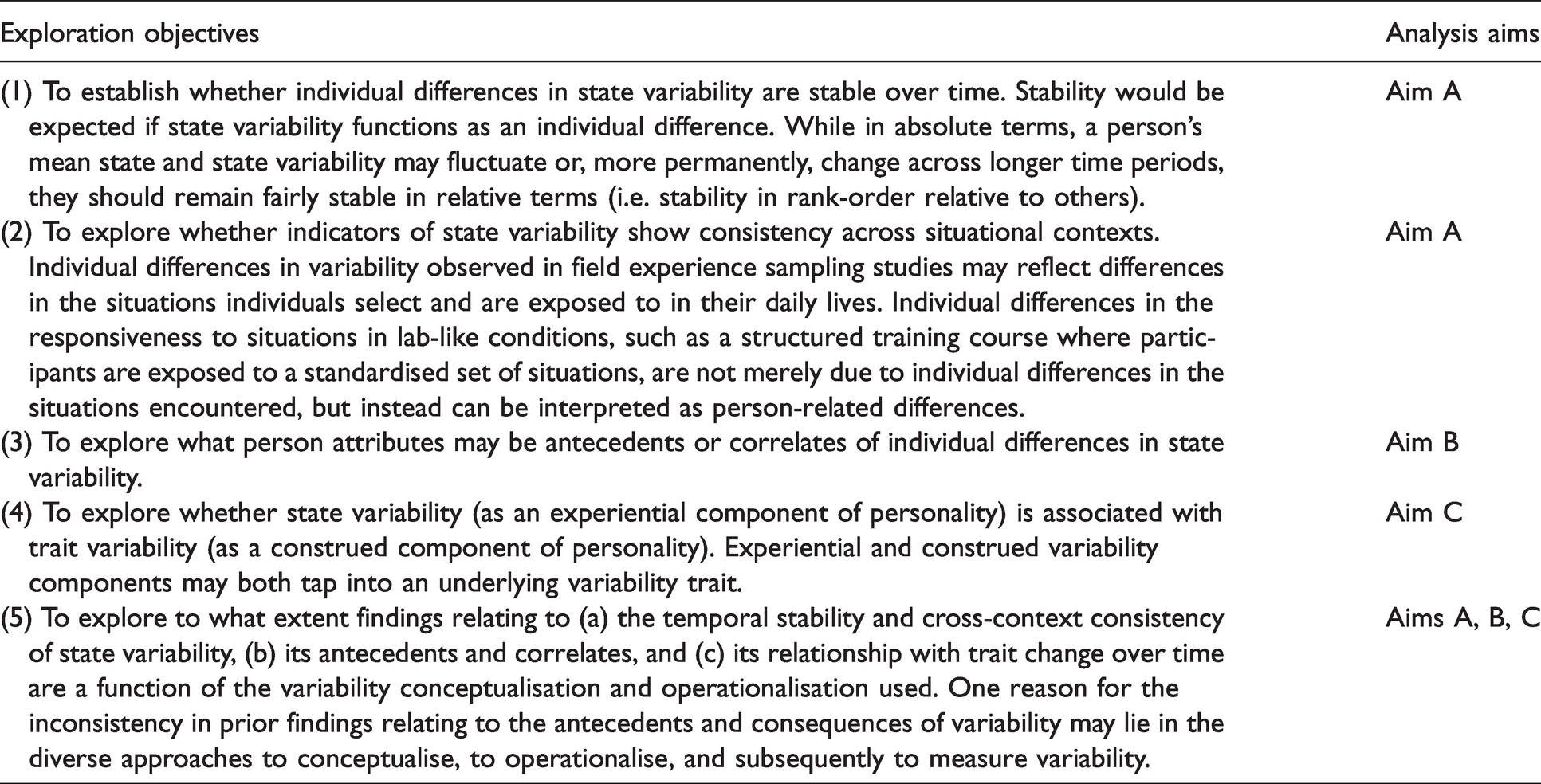
For (1) structured within-lab settings and (2) unstructured field settings, we investigated individual differences in short-term variability in conscientious and neurotic states with the aim to contribute to the relatively small literature on the antecedents and consequences of short-term variability in personality, and its links to trait variability. We focus on individual differences in (a) the total amount of within-person state variability (i.e. relative variability given the state mean, relative SD; Mestdagh et al., 2018), and (b) the strength of contingency between situational demands and variability in state responses (i.e. conditional, situation-state response patterns; Fleeson, 2007; Minbashian et al., 2010; Mischel & Shoda, 1995), as we expected these to be differentially related to antecedents and consequences, including trait change. Overall, Aim A considered the structure and relations between dynamic variables at different levels. We examined (i) their derivation, (ii) evidence in the data for substantial short- and long-term within- and between-person variance, (iii) the patterns of correlations between the conditional and relative variability indices, and (iv) the stability of individual differences in mean states and short-term variability in states over a two-year period. Aim B was to explore the relationships of short-term state variability with other individual differences (Big Five, implicit theories, goal orientations, and cognitive ability) that may function as antecedents or correlates of variability. Finally, Aim C explored the relationships between antecedents, short-term variability in states, and change in (conventional) traits. In combining all three aims we explored to what extent findings relating to (a) the temporal stability and cross-context consistency of state variability, (b) the antecedents of state variability, and (c) its relationship with trait change over time are a function of the variability conceptualisation and operationalisation used.
While links between individual difference variables (conventional/construed traits) and mean states (i.e. experiential traits) are well established, comparably less is known about associations between individual difference variables (particularly those outside the Big Five framework) and variability in states (e.g. Noftle & Fleeson, 2015). Findings are somewhat inconclusive; however, we expected trait neuroticism to be positively associated with state variability short- and long-term. Individual differences in state variability assessed at the start of the study were expected to remain relatively stable over the two-year study period. We also expected short-term variability in states to be associated with change in conventional traits, although the strength of the relationship was expected to vary depending on the variability operationalisation used. Specifically, we expected variability in state conscientiousness (or state neuroticism) to function as a temporal precursor of change in trait conscientiousness (or trait neuroticism) assessed over a two-year period. This was based on our reasoning that short-term variability may indicate a readiness for change in the respective trait. Given that variability in personality states is partly determined by variability in situations people encounter (e.g. stable situations may not provide much room for response variability), we studied state variability using data collected under lab-like conditions where all participants were exposed to the same tasks and therefore experienced similar situations. For a subset of participants, we then contrasted our findings for selected analyses with findings from data collected under more ecologically valid conditions, i.e. as participants went about their daily lives at work. The field data represent conditions in which participants were, at least to some extent, able to self-select and shape situations in line with their own preferences and traits.
The meaning of variability depends on the personality dimension for which variability is observed. We focussed on the two personality dimensions that have consistently been shown to be of relevance in organisational and other learning and performance contexts, conscientiousness and neuroticism. Variability in conscientious responses may indicate flexibility and an ability to adapt, for example by ways of conserving cognitive resources for the more demanding tasks (Minbashian et al., 2010); while variability in neurotic responses may in itself represent a vulnerability. Indeed, the very concept of neuroticism involves a tendency to fluctuate, and to be responsive to situational cues and demands, rather than be ‘emotionally stable’. Such variability may have detrimental consequences. For example, experiencing heightened negative affective states in response to perceived increases in task demands may not be conducive to task performance (Wood et al., 2019). Studying variability in conscientiousness and neuroticism therefore offers opportunities to compare findings for two dimensions for which variability has a markedly different meaning.
Taken together, our approach allowed us to explore antecedents and consequences of variability in states along three dimensions: (1) attribute, i.e. personality dimension studied (conscientiousness vs. neuroticism), (2) type of operationalisation used to quantify variability (total amount of variability vs. conditional response variability), and (3) level of situational control (lab vs. field setting). The study was not preregistered and is explicitly exploratory in nature. 2
Methods
Participants
Our analyses are based on a dataset of 346 high-performing managers from large Australian organisations who participated in the study as part of a professional development programme offered by a major Australian university. For a subset of participants (N = 200), this included participating in a field study undertaken at work. The sample is drawn from the Accelerated Learning Laboratory (ALL) Flexible Expertise data base (N = 423). 3 Participants (24–57 years, M = 34.48, SD = 6.30, 39% female) reported to have worked 0.5–10 years (M = 2.04, SD = 1.89) in their current role in one of five organisations from different industry sectors (aviation, insurance, broadcasting, finances, and packaging) and to have had 0.5–21 (M = 5.51, SD = 4.48) years of experience in management at the time of the study. In total, 69% reported to have completed a university degree (30% postgraduate, 39% undergraduate). The remaining 31% stated ‘high school’ (13%) or a different degree (‘other’, 10%) as their highest degree level, or did not indicate their degree level (8%). All procedures for the recruitment and treatment of participants in the current study were approved by the Ethics Committee of the University of New South Wales (UNSW Sydney, Australia).
Materials
Experience sampling measure
The experience sampling measure included 21 items tapping into momentary thoughts, feelings, and behaviours. For the purpose of the current study, items were selected to provide broad coverage of various facets of neuroticism and conscientiousness (as per the NEO framework; Costa & McCrae, 1992) and to be representative of the types of states managers were likely to experience at work. Four items were used to assess state conscientiousness: task efficiency (‘How efficiently are you working on this activity?’), task systematicity (‘How systematically are you approaching this activity?’), task effort (‘How hard are you working on this activity?’), and task focus (‘How focused are you on this activity?’). Seven items were used to assess state neuroticism: anxiety (‘How tense are you feeling right now?’, ‘How calm are you feeling right now?’ reverse-coded), angry hostility (‘How frustrated are you feeling right now?’), depression (‘How sad are you feeling right now?’), self-consciousness (‘How self-conscious are you feeling right now?’, ‘How dissatisfied are you feeling right now?’), vulnerability (‘How stressed are you feeling right now?’). Another two items were used to assess task demand characteristics: task difficulty (‘How difficult is this activity for you?’) and task urgency (‘How much time pressure are you experiencing while performing this activity?’). Participants were instructed to have the activity in mind that they were currently working on, or had just completed, when responding to the items. For data collected on computers (i.e. in the lab), the answer format was a visual analogue scale with the labels ‘not at all … extremely’, or ‘none at all … a lot’, which was later translated into a numerical scale ranging from 0 to 100. Field data were collected on handheld devices. The answer format was a seven-point scale (0–6) with the same labels ‘not at all … extremely’, or ‘none at all … a lot’. For the lab data, internal consistencies (Cronbach’s α coefficient) at the within-person and between-person levels were .68 and .81 for state conscientiousness, .84 and .92 for state neuroticism, and .64 and .70 for task demand. For the field data, the corresponding figures were .81 and .86 for state conscientiousness, .81 and .94 for state neuroticism, and .60 and .77 for task demand.
Trait scales
Big Five Personality traits were assessed using the 10-item International Personality Item Pool (IPIP) version of the NEO inventory (Goldberg et al., 2006; for the items refer to https://ipip.ori.org/newNEODomainsKey.htm). The IPIP NEO inventory is based on the Five Factor Model of personality (FFM; Costa & McCrae, 1992). It comprises 50 items assessing five broad-level personality dimensions (openness, conscientiousness, extraversion, agreeableness, and neuroticism). Participants were instructed to describe themselves as they generally are compared to other people of the same sex and roughly the same age. The answer format was a visual analogue scale that required participants to place a marker along a line with the polar ends labelled ‘very inaccurate’ to ‘very accurate’. The visual analogue scale was later translated into a numeric scale from 0 to 100 (Cronbach’s αO = .78, αC(time1) = .87, αC(time2) = .87, αE = .88, αA = .76, αN(time1) = .85, α N(time2) = .82, ωO = .85, ωC(time1) = .90, ωC(time2) = .90, ωE = .91, ωA = .84, ωN(time1) = .89, ωN(time2) = .88).
Implicit theories were assessed using eight items from Dweck’s (2000) Implicit Theories Scale: Four items from the Theories of Intelligence Scale-Self Form (items 1, 3, 6 and 7, Dweck, 2000, p.178) for intelligence (Cronbach’s α = .90, ω = .91) and four items from the ‘Kind of Person’ Implicit Theory Self Form (items 1, 2, 5, 8, Dweck, 2000, p.180) for personality (α = .83, ω = .87). Implicit theories refer to beliefs individuals hold about the malleability of intelligence and personality. High scores reflect incremental (malleability) beliefs. Goal orientations were assessed using the Vandewalle (1997) instrument (see Table 2 of that paper for the items), which assesses a person’s motivational framing of tasks as opportunities to learn or perform. Learning goal orientation was assessed with six items (α = .82, ω = .87); Performance-prove orientation (PGP) and Performance-avoid orientation (PGA) were each assessed with five items (prove: α = .57, ω = .68; avoid: α = .78, ω = .83).
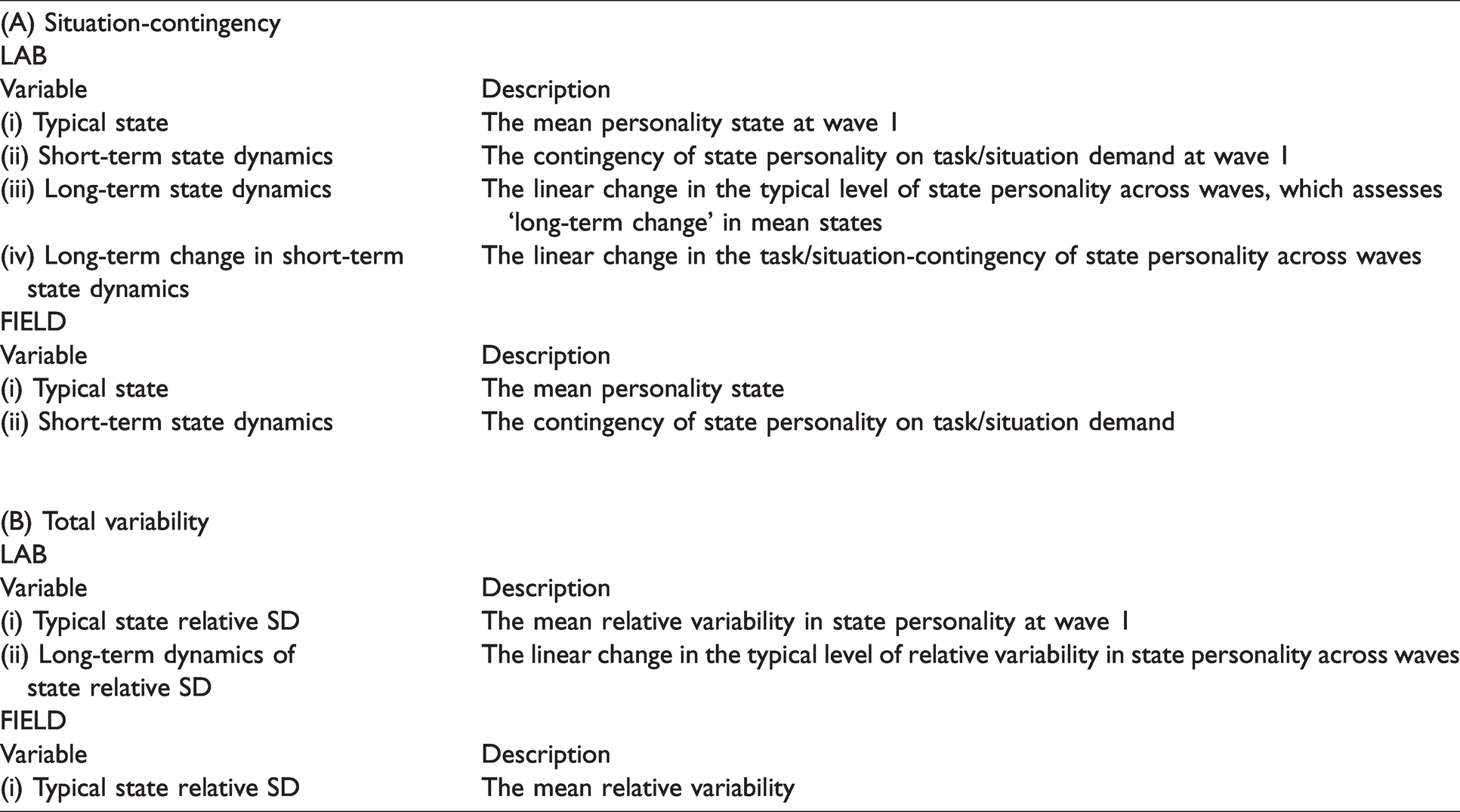
State dynamic variables derived for lab and field data as situation contingencies (A) and total variability (B).
SHL reasoning tests
Cognitive ability was assessed using commercially sourced reasoning tests in three domains: verbal, numerical, and abstract reasoning (shl.com). For the purpose of the current study, scores for abstract reasoning were of relevance. Abstract reasoning (SHL-Diagrammatic Series, DC3.1) is a 40-item test that measures the ability to reason with abstract figures and requires the recognition and application of logical rules governing sequence changes. The abstract reasoning test consisted of a series of diagrammatic sequences. The task was to identify the underlying structure of this sequence and select the figure that best completed the pattern (Cronbach’s α = .85, SHL, 2004). The number of correctly answered items, scaled to the published test T-score norm (M = 50, SD = 10), was used as an indicator of abstract reasoning ability. The SHL measures were moderately correlated with the RAVEN’s Advanced Progressive Matrices (set II) as reported in Birney et al. (2017, p. 74). The correlations were: r = .56 for the SHL abstract reasoning measure used in the current study, r = .52 for SHL verbal reasoning, and r = .64 for SHL numerical reasoning (N = 170).
Design and procedure
The study comprised a longitudinal design. Data on personality states together with situation appraisals were collected using experience sampling methodology in field settings as participants went about their day-to-day activities, as well as under more controlled conditions when completing a predetermined set of tasks in lab-like settings. The lab-based experience sampling required participants to respond to a brief questionnaire immediately before, during or after completing a set task during up to five 3-day training sessions (referred to as ‘modules’) offered by a major Australian university. The five modules, during which data collection waves were conducted, were spread evenly over two years. The field-based experience sampling involved participants responding to a brief questionnaire up to five times per day for 15 working days over three weeks. 4 A signal-contingent approach was implemented. Signals occurred between 9am and 7pm and were at least 1 h and no more than 3 h apart. Participants were allowed a time-window of 30 min to respond to a signal. In total, we collected 6627 responses in lab settings (responses per participant: M = 19.43, SD = 7.17, range = 1–32), and 7737 responses in field settings (responses per participant: M = 38.69, SD = 16.95, range = 2–76). Individual differences data (Big Five, cognitive ability, implicit theories, and goal orientations) were collected at baseline (in the first data collection wave) and after two years (Note 2).
Data analysis
Overview
To begin generally, the substantive focus of our analyses is the conceptualisation of personality as a dynamic attribute. The data clustering layout is summarised in Figure 1. Dynamic variables were derived at both ‘trait’ and ‘state’ levels. The dynamic ‘trait level’ variable was defined as the change in trait conscientiousness and trait neuroticism from the start (wave 1) to the end (wave 5) of the program (Figure 1(a)). The antecedents were also measured at this level. Dynamic state variables were derived and tested for lab and field data separately. For the lab data (Figure 1(b)), the repeated observations are clustered within data collection waves and within individuals. Accordingly, we conceived of a set of four dynamic state effects, three within-wave (mean state, situation-state contingency, and relative variability) and one set across waves (as linear change in each of the within-wave effects over wave 1 to 5). The field data (Figure 1(c)) was collected across a single three-week period, and therefore observations are clustered within individuals only. Accordingly, the same set of four dynamic state effects were considered, but without the cross-wave comparison. The generic dynamic state measures derived are summarised in Figure 1(d) and detailed in Table 2. The mean state measure (intercept, Figure 1(d)(i)) and task demand contingency (slope, Figure 1(d)(ii)) were derived and tested in the same models. However, because the relative variability index (i.e. relative SD; Figure 1(d)(iii)) aggregates over the clustering unit (by definition), it was necessary to derive these measures outside of the models and enter them as dependent variables in separate analyses (i.e. lab data using two-level clustering and the field data using single-level regression). The data analysis scripts together with supplementary material are openly accessible at https://osf.io/qp2nb/?view_only=3b85ace6b75e44b8b62a68f3fcf68d3a
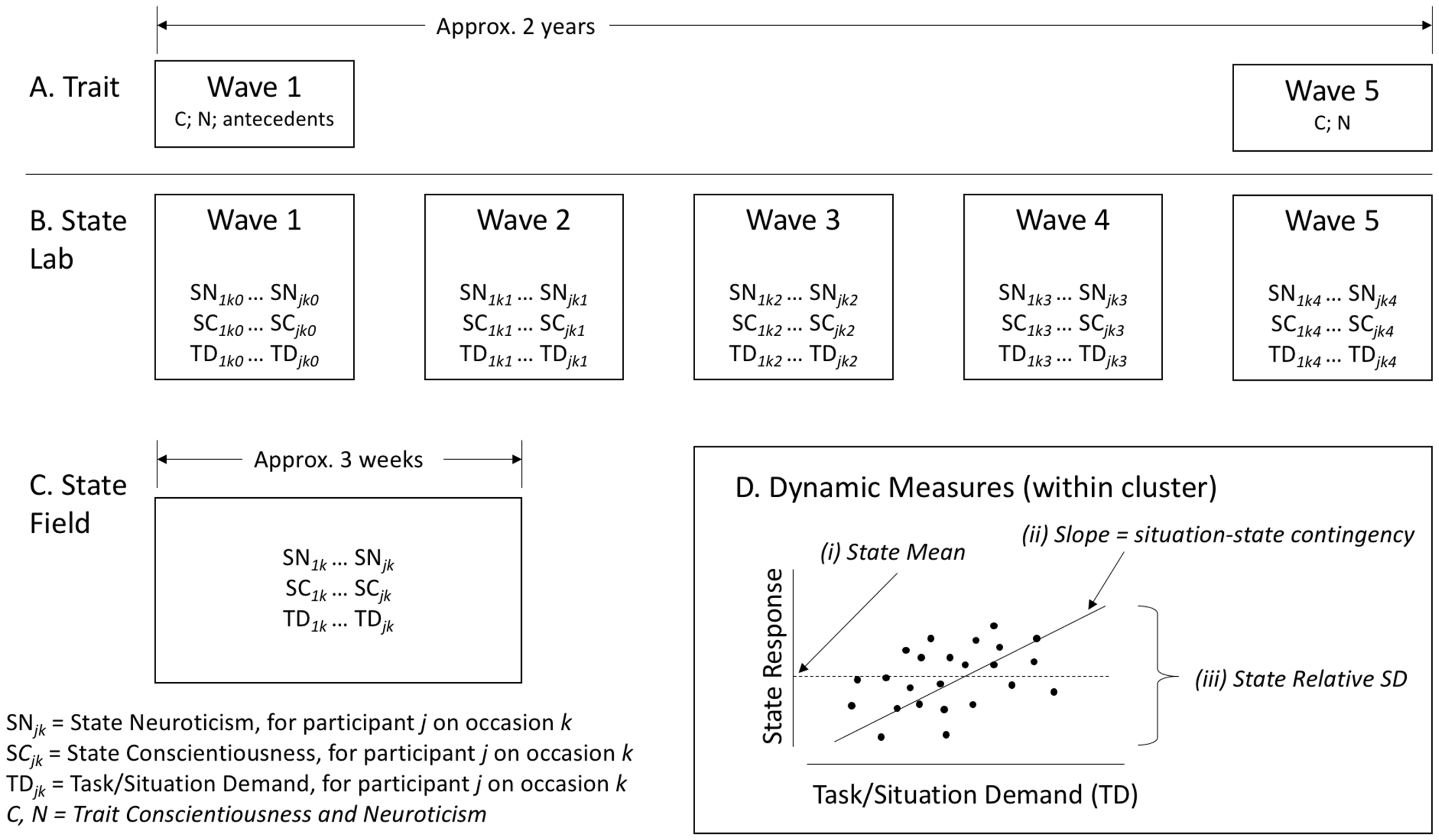
Overview of data structure and derivation of common dynamic measures.
Aim A: Dynamic variables
Multilevel modelling was adopted (using MPlus software, Muthen & Muthen, 1998-2015) to investigate the correlates of short-term state variability with other individual differences variables that may function as antecedents. There were two preliminary analytic steps required to achieve this. First, a fully unconditional analysis was conducted in order to estimate the partitioning of variability in state consciousness and state neuroticism into within-wave (i.e. level 1) variability, between-wave (level 2) variability, and between-person (level 3) variability in the lab data; and within-person (level 1) and between-person (level 2) in the field data. Second, in the lab data, for both state conscientiousness and state neuroticism, we estimated multilevel models in which (group-mean centred) task demand (i.e. the situational characteristic) was entered as a predictor at level 1 and wave (with wave coded so that wave 1 = 0) was entered as a predictor at level 2. This analysis defines estimates of four fixed effects (and their associated variances as individual differences) that constitute dynamic personality variables, (i) typical state, (ii) short-term state dynamics, (iii) long-term state dynamics, and (iv) long-term change in short-term state dynamics, as summarised in Table 2. In the field data, we considered two-level models in which (group-mean centred) task demand was entered as a predictor at level 1. This analysis defines estimates of two fixed effects and their variances: (i) typical state and (ii) short-term state dynamics (Table 2).
We estimated indices of the total amount of variability (relative SD) for both state conscientiousness and state neuroticism for each person per data collection wave in the lab, and for each person in the field data using the approach proposed by Mestdagh et al. (2018). We then derived the dynamic variables from these dependent variables. For the lab data, we followed the same two steps as above. First, a fully unconditional analysis was conducted to partition the variability in relative variability into within-person, between-wave variability (level 1) and between-person variability (level 2). Second, using two-level models with the relative variability index as the dependent variable and wave as the unit of observation, we estimated two fixed effects of the dynamic variables (and their variances): (i) typical state relative SD and (ii) long-term dynamics of state relative SD (Table 2). For the field data, single-level modelling was appropriate, and thus only (i) typical state relative SD was available (at the level of the individual). The extent that these analyses indicate substantive within- and between-individual differences addresses Aim A. They also provide the basis of the investigation of subsequent aims.
Aim B: Individual differences as antecedents of dynamic variables
To examine the relationships between personality traits assessed at the beginning of the learning and development program and the dynamic personality variables outlined above, we first extended the multilevel analyses from the Aim A investigations by including the (grand-mean centred) relevant personality trait as a between-person level predictor of the dynamic personality variables. Then, to more generally examine the independent effects of the individual difference antecedents of the dynamic personality variables, we estimated multilevel models in which all the individual difference measures (Big Five personality traits, implicit theories of personality, learning goal orientation, performance prove goal orientation, performance avoid goal orientation, and abstract reasoning) were entered as grand-mean centred predictors at the level of the individual (for situation contingencies: level 3 for lab data, and level 2 for field data; for relative variability: level 2 for lab data and level 1 for field, see Table 2).
Aim C: Antecedents of long-term trait change
To address Aim C, we conducted a series of analyses to examine whether the individual difference antecedents directly relate to changes in personality traits that occur across waves, and whether our dynamic personality constructs (including conditional and relative state variability) contribute above and beyond. We did this by explicitly computing the change in the relevant personality trait (either conscientiousness or neuroticism) between the start and end of the learning and development program and regressing this change score on the individual differences antecedences, with the dynamic personality variables as both criterion and predictors in single-level regression analyses via Amos (Arbuckle, 2014), 5 i.e. using a path mediation analysis modelling approach.
Results
Aim A: Dynamic variables
Partitioning of variance
Table 3 shows descriptive statistics and correlation coefficients for the main study variables at the between-person level. This includes the individual differences variables assessed at baseline (i.e. during the first data collection wave). In general, the correlation pattern of the individual differences variables was in line with expectations. For example, trait neuroticism was negatively related to the traits conscientiousness (r = –.32), extraversion (r = –.35), and agreeableness (r = –.39). Neuroticism was also negatively associated with the tendency to pursue learning goals (r = –.29), while being positively associated with the tendency to pursue performance avoid goals (r = .24), the latter typically being detrimental to performance. As expected, and in line with prior research (e.g. Fleeson & Gallagher, 2009), trait and their respective mean state measures were positively correlated (conscientiousness: r = .28; neuroticism: r = .27), although not highly. In terms of sample characteristics, we note the following: On average, participants described themselves as being conscientious in general (trait conscientiousness: M = 71, SD = 14, scale from 0 to 100) as well as when working on the tasks that were set as part of the learning and developmental programme (state conscientiousness: M = 68, SD = 10, scale from 0 to 100). They also described themselves as being relatively low in neuroticism in general (trait neuroticism: M = 31, SD = 14) and during task completion on the programme (state neuroticism: M = 35, SD = 10). On average, tasks set as part of the training and developmental programme were experienced as moderately demanding by participants (task demand: M = 44, SD = 11, scale from 0 to 100).
Between-person descriptive statistics for main study variables, including individual differences variables at baseline.
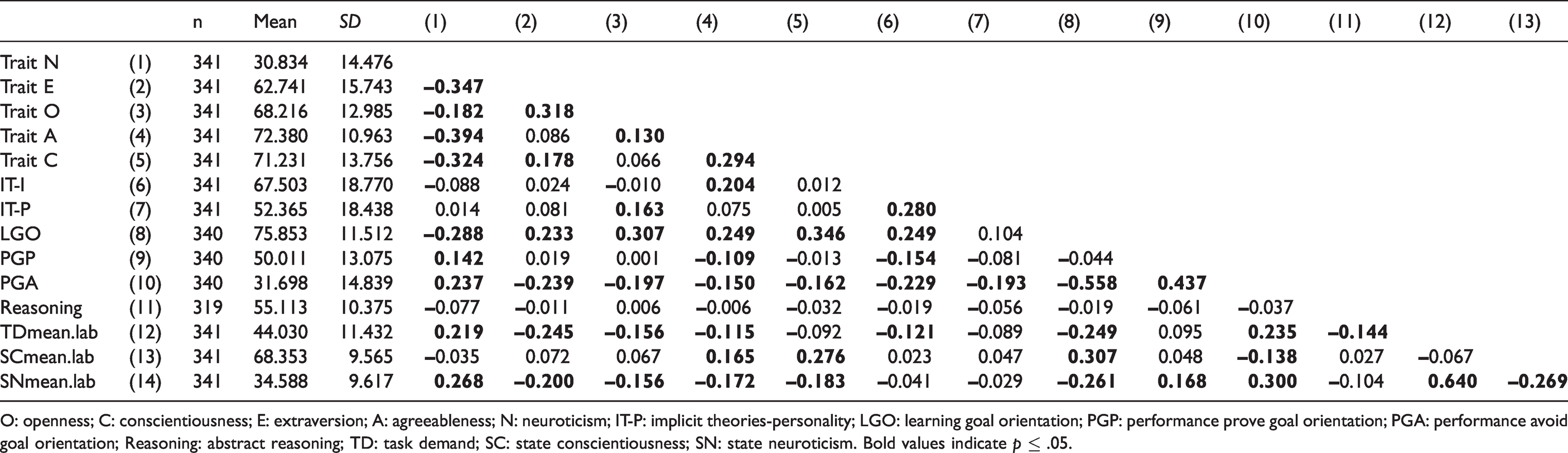
O: openness; C: conscientiousness; E: extraversion; A: agreeableness; N: neuroticism; IT-P: implicit theories-personality; LGO: learning goal orientation; PGP: performance prove goal orientation; PGA: performance avoid goal orientation; Reasoning: abstract reasoning; TD: task demand; SC: state conscientiousness; SN: state neuroticism. Bold values indicate p ≤ .05.
Tables 4 and 5 display the decomposition of the cross-occasion variability in task demand, state conscientiousness, and state neuroticism for lab (Table 4) and field (Table 5) data. Across all three experience sampling measures in both contexts, the majority of observed cross-occasion variability in task demand, state conscientiousness, and state neuroticism lied at the within-person level (i.e. within- and between data collection wave for data collected under lab-like conditions).
Variability in experience sampling measures decomposed into three sources of variance for lab data.

Levels 1 and 2 represent within-person variability; lab experience sampling measures were scaled from 0 to 100. Mixed model: Yijk = β + uk + rjk + eijk.
Variability in experience sampling measures decomposed into two sources of variance for field data.

Field experience sampling measures were scaled from 0 to 6. Mixed model: Yjk = β + uk+ rjk.
Dynamic variables as individual differences
Results in Table 6 (section A) provide evidence in relation to the dynamic conscientiousness constructs as defined above for the lab data (and in Table 2). Note that the beta coefficients in Tables 6--9 refer to unstandardised effects. First, there were significant between-person differences in state conscientiousness at wave 1 (τ = 44.2, p < .01). Second, in support of short-term dynamics, there was a significant positive effect of task demand on state conscientiousness at wave 1 for the typical person (β = 0.057, p < .01), which indicated that the typical person varied their level of conscientiousness across different levels of task demand within short time periods (i.e. state conscientiousness is task-contingent). However, there were significant between-person differences (τ = 0.022, p < .01), such that state conscientiousness was not contingent on or negatively contingent on task demand for some individuals, rendering this situation contingency unit an individual differences variable (task-contingent conscientiousness, TCC). Third, there was a positive effect for relative variability (rSD) in state conscientiousness at wave 1 for the typical person (β = 0.229, p < .01), but there were also significant between-person differences suggesting that participants differed in how much relative variability they experienced in state conscientiousness (τ = 0.007, p < .01). Fourth, in relation to long-term changes in state conscientiousness as a function of time (from wave 1 to 5), there was no evidence that the typical person’s state conscientiousness changed over the two-year duration of the study (β = 0.222, p = .40); however, the statistically significant variance suggested that for some individuals state conscientiousness increased across data collection waves whereas for others it decreased (τ = 4.508, p <.01). Finally, there was evidence that the short-term dynamics in conscientiousness, that is, TCC and relative variability in state conscientiousness decreased over time in a linear fashion across individuals (TCC: β = –0.020, p < .01, τ < 0.001, p = .85; relative SD: β = –0.014, p < .01, τ = 0.001, p = .08).
Individual differences predictors of dynamic conscientiousness constructs (lab).
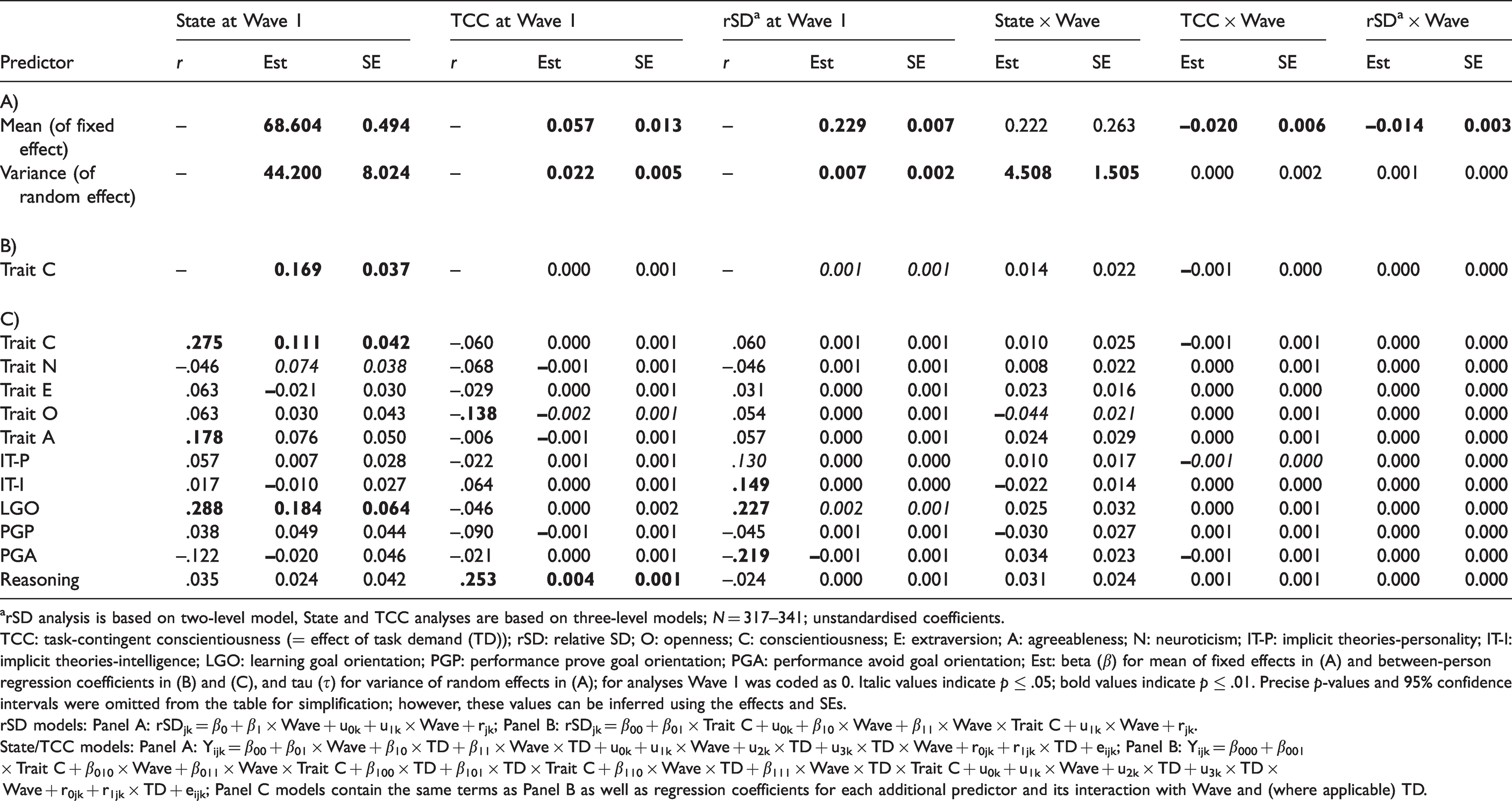
arSD analysis is based on two-level model, State and TCC analyses are based on three-level models; N = 317–341; unstandardised coefficients.
TCC: task-contingent conscientiousness (= effect of task demand (TD)); rSD: relative SD; O: openness; C: conscientiousness; E: extraversion; A: agreeableness; N: neuroticism; IT-P: implicit theories-personality; IT-I: implicit theories-intelligence; LGO: learning goal orientation; PGP: performance prove goal orientation; PGA: performance avoid goal orientation; Est: beta (β) for mean of fixed effects in (A) and between-person regression coefficients in (B) and (C), and tau (τ) for variance of random effects in (A); for analyses Wave 1 was coded as 0. Italic values indicate p ≤ .05; bold values indicate p ≤ .01. Precise p-values and 95% confidence intervals were omitted from the table for simplification; however, these values can be inferred using the effects and SEs.
rSD models: Panel A: rSDjk = β0 + β1 × Wave + u0k + u1k × Wave + rjk; Panel B: rSDjk = β00 + β01 × Trait C + u0k + β10 × Wave + β11 × Wave × Trait C + u1k × Wave + rjk.
State/TCC models: Panel A: Yijk = β00 + β01 × Wave + β10 × TD + β11 × Wave × TD + u0k + u1k × Wave + u2k × TD + u3k × TD × Wave + r0jk + r1jk × TD + eijk; Panel B: Yijk = β000 + β001 × Trait C + β010 × Wave + β011 × Wave × Trait C + β100 × TD + β101 × TD × Trait C + β110 × Wave × TD + β111 × Wave × TD × Trait C + u0k + u1k × Wave + u2k × TD + u3k × TD × Wave + r0jk + r1jk × TD + eijk; Panel C models contain the same terms as Panel B as well as regression coefficients for each additional predictor and its interaction with Wave and (where applicable) TD.
The results for the lab data in Table 7 (section A) provide evidence in relation to dynamic neuroticism constructs. First, there were significant between-person differences in state neuroticism at time zero, i.e. wave 1 (τ = 69.625, p < .01). Second, there was a significant positive effect of task demand on state neuroticism at time zero for the typical person (β = 0.266, p <.01), which indicates that for the typical person their level of neuroticism varied across different levels of task demand within short time periods (i.e. task-contingent neuroticism, TCN). Furthermore, although there were significant individual differences (τ = 0.010, p = .01), the positive values of the 95% credibility interval (0.066 to 0.466) indicated that even an individual at the lower extreme displayed some level of situation/task contingency, such that increases in task demand were positively associated with increases in state neuroticism. Third, there was a positive effect for the amount of relative variability (rSD) observed in state neuroticism for the typical person (β = 0.202, p < .01), there were also significant between-person differences suggesting again that participants differed in how much relative variability they experienced (τ = 0.004, p < .01). Fourth, state neuroticism decreased over the two-year programme for the typical person (β = –0.826, p < .01); however, there was also significant between-person variability, such that state neuroticism decreased at a quicker rate for some people than others (τ = 4.916, p < .01). Unlike TCC, TCN did not seem to change across waves, in that both the mean (β = 0.001, p = .87) and variance (τ < 0.001, p = .57) of the TCN × Wave interaction effect were not significantly different from zero. However, as was the case for relative variability in state conscientiousness, relative variability in state neuroticism decreased significantly across waves (β = –0.012, p <.01), but there was not enough evidence to suggest individual differences in the rate of decrease (τ < .001, p = .14).
Individual differences predictors of dynamic neuroticism constructs (lab).
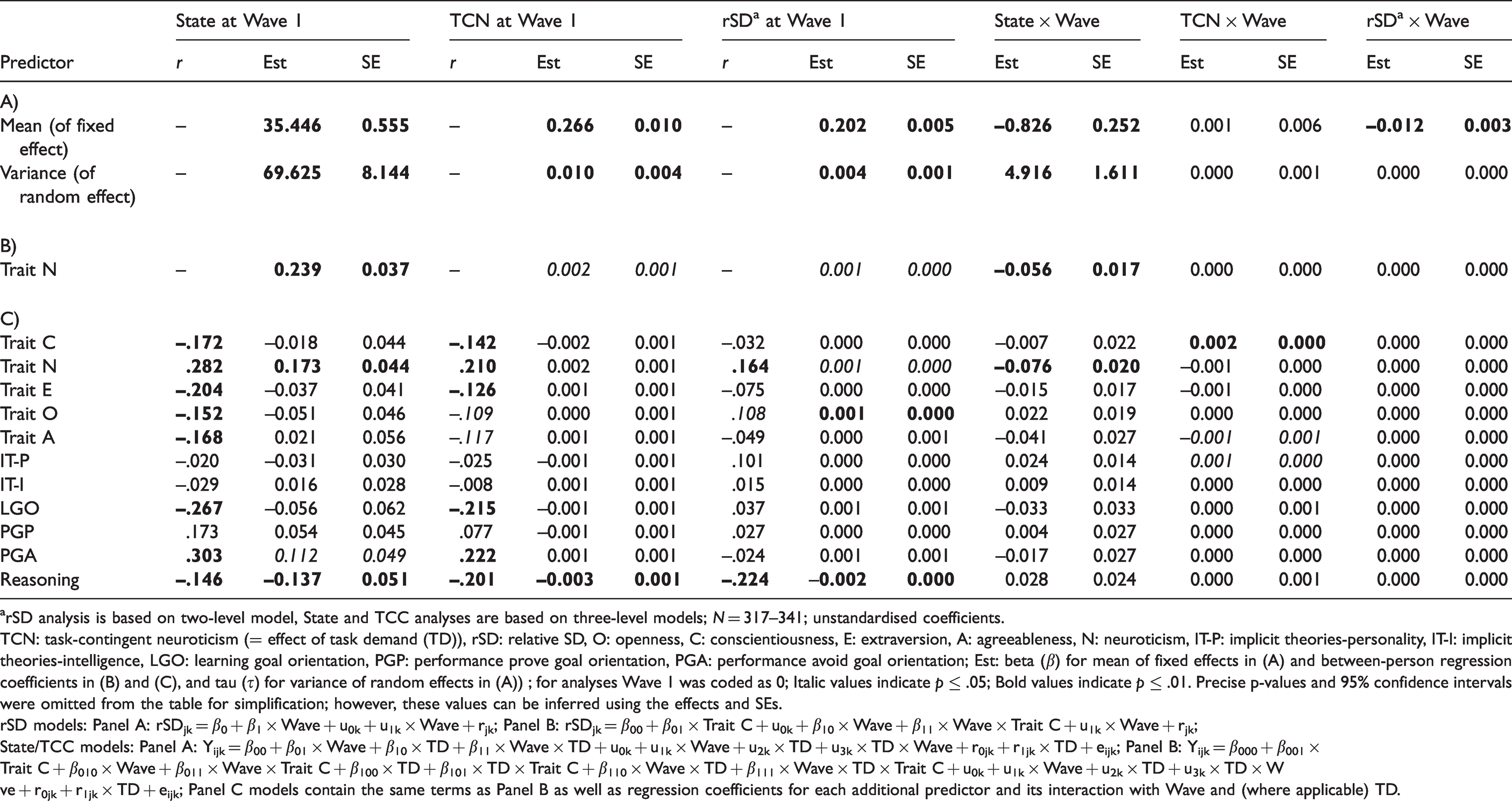
arSD analysis is based on two-level model, State and TCC analyses are based on three-level models; N = 317–341; unstandardised coefficients.
TCN: task-contingent neuroticism (= effect of task demand (TD)), rSD: relative SD, O: openness, C: conscientiousness, E: extraversion, A: agreeableness, N: neuroticism, IT-P: implicit theories-personality, IT-I: implicit theories-intelligence, LGO: learning goal orientation, PGP: performance prove goal orientation, PGA: performance avoid goal orientation; Est: beta (β) for mean of fixed effects in (A) and between-person regression coefficients in (B) and (C), and tau (τ) for variance of random effects in (A)) ; for analyses Wave 1 was coded as 0; Italic values indicate p ≤ .05; Bold values indicate p ≤ .01. Precise p-values and 95% confidence intervals were omitted from the table for simplification; however, these values can be inferred using the effects and SEs.
rSD models: Panel A: rSDjk = β0 + β1 × Wave + u0k + u1k × Wave + rjk; Panel B: rSDjk = β00 + β01 × Trait C + u0k + β10 × Wave + β11 × Wave × Trait C + u1k × Wave + rjk;
State/TCC models: Panel A: Yijk = β00 + β01 × Wave + β10 × TD + β11 × Wave × TD + u0k + u1k × Wave + u2k × TD + u3k × TD × Wave + r0jk + r1jk × TD + eijk; Panel B: Yijk = β000 + β001 × Trait C + β010 × Wave + β011 × Wave × Trait C + β100 × TD + β101 × TD × Trait C + β110 × Wave × TD + β111 × Wave × TD × Trait C + u0k + u1k × Wave + u2k × TD + u3k × TD × Wave + r0jk + r1jk × TD + eijk; Panel C models contain the same terms as Panel B as well as regression coefficients for each additional predictor and its interaction with Wave and (where applicable) TD.
In summary, our findings suggest substantial within-person variability in conscientiousness and neuroticism states, both in terms of short-term variability across tasks as reflected in the two situation contingencies (TCC, TCN) and, more generally, across occasions (relative variability in conscientious and neurotic states), and in terms of long-term variability over time. We also observed between-person differences in the majority of these effects.
For comparison purposes, we conducted analogous analyses using the field experience sampling data, for conscientiousness and neuroticism, respectively. Again, as reported in Table 8 (section A), we found a positive effect for task demand on state conscientiousness for the typical person (β = 0.300, p < .01), and individual differences in this effect (τ = 0.036, p < .01). Task demand was also positively associated with state neuroticism (Table 9, section A) for the typical person (β = 0.305, p < .01), and there was evidence to suggest that individuals differed in this effect (τ = 0.019, p < .01). In this sense, both TCC and TCN can be treated as individual differences variables. Note that field data were collected over a period of three weeks, and therefore we do not report any long-term time-related effects. For each person, relative variability indices (Mestdagh et al., 2018) were calculated for state conscientiousness (rSDcon: M = 0.33, SD = 0.11) and state neuroticism (rSDneu: M = 0.32, SD = 0.09) capturing variability in states across the three-week period of data collection in the field.
Individual differences predictors of dynamic conscientiousness constructs (field).
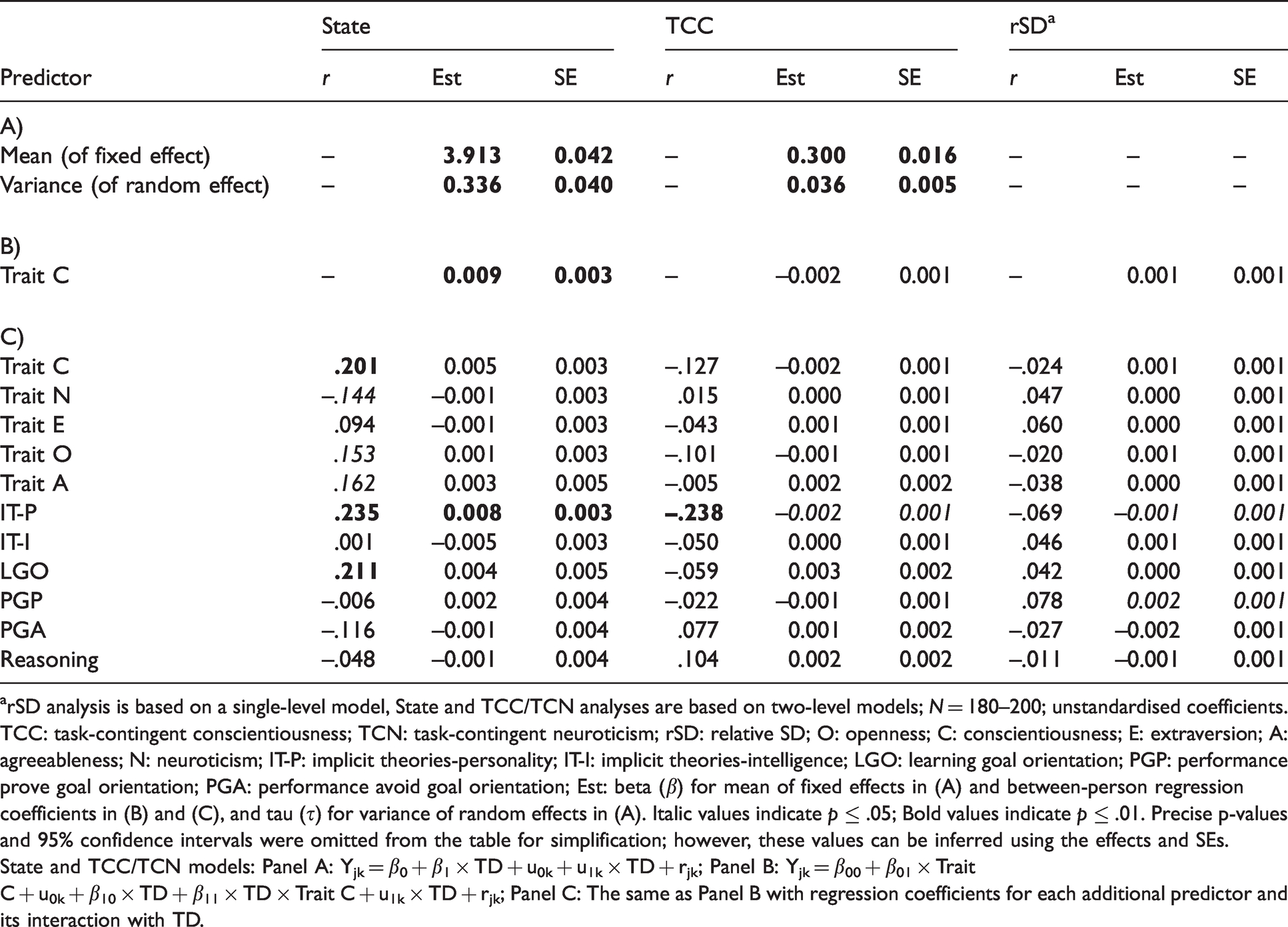
arSD analysis is based on a single-level model, State and TCC/TCN analyses are based on two-level models; N = 180–200; unstandardised coefficients.
TCC: task-contingent conscientiousness; TCN: task-contingent neuroticism; rSD: relative SD; O: openness; C: conscientiousness; E: extraversion; A: agreeableness; N: neuroticism; IT-P: implicit theories-personality; IT-I: implicit theories-intelligence; LGO: learning goal orientation; PGP: performance prove goal orientation; PGA: performance avoid goal orientation; Est: beta (β) for mean of fixed effects in (A) and between-person regression coefficients in (B) and (C), and tau (τ) for variance of random effects in (A). Italic values indicate p ≤ .05; Bold values indicate p ≤ .01. Precise p-values and 95% confidence intervals were omitted from the table for simplification; however, these values can be inferred using the effects and SEs.
State and TCC/TCN models: Panel A: Yjk = β0 + β1 × TD + u0k + u1k × TD + rjk; Panel B: Yjk = β00 + β01 × Trait C + u0k + β10 × TD + β11 × TD × Trait C + u1k × TD + rjk; Panel C: The same as Panel B with regression coefficients for each additional predictor and its interaction with TD.
Individual differences predictors of dynamic neuroticism constructs (field).
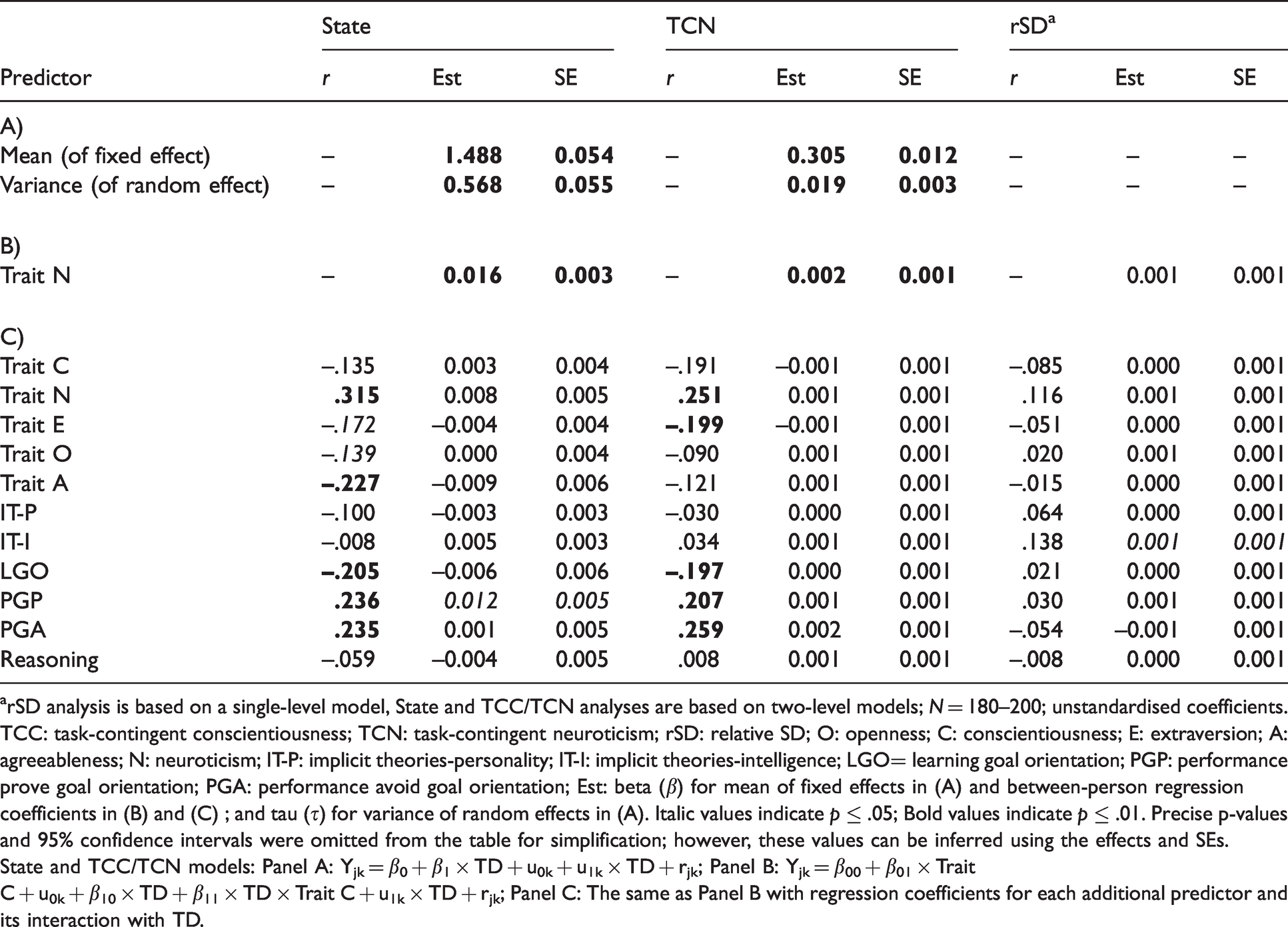
arSD analysis is based on a single-level model, State and TCC/TCN analyses are based on two-level models; N = 180–200; unstandardised coefficients.
TCC: task-contingent conscientiousness; TCN: task-contingent neuroticism; rSD: relative SD; O: openness; C: conscientiousness; E: extraversion; A: agreeableness; N: neuroticism; IT-P: implicit theories-personality; IT-I: implicit theories-intelligence; LGO= learning goal orientation; PGP: performance prove goal orientation; PGA: performance avoid goal orientation; Est: beta (β) for mean of fixed effects in (A) and between-person regression coefficients in (B) and (C) ; and tau (τ) for variance of random effects in (A). Italic values indicate p ≤ .05; Bold values indicate p ≤ .01. Precise p-values and 95% confidence intervals were omitted from the table for simplification; however, these values can be inferred using the effects and SEs.
State and TCC/TCN models: Panel A: Yjk = β0 + β1 × TD + u0k + u1k × TD + rjk; Panel B: Yjk = β00 + β01 × Trait C + u0k + β10 × TD + β11 × TD × Trait C + u1k × TD + rjk; Panel C: The same as Panel B with regression coefficients for each additional predictor and its interaction with TD.
Correlation pattern of variability indices
Table 10 shows the correlations across context (lab vs. field), operationalisation (contingent vs. relative variability) and dimension (conscientiousness vs. neuroticism). Three insights are offered: First, there was context alignment as evidenced by non-trivial correlations between lab and field indices (r[TCClab, TCCfield] = .34; r[TCNlab, TCNfield] = .26; r [rSDconlab, rSDconfield] = .36; r[rSDneulab, rSDneufield] = .27, boxed correlations in Table 10). These correlations suggest that those who showed more relative or contingent variability under lab-like conditions also did so as they went about their day-to-day activities (i.e. in the field). This is an important finding as it suggests systematicity in the variability indices, and is in support of an interpretation of state variability to function as an individual differences variable across contexts.
Cross-dimension, -context, and -operationalisation correlations between variability indices.
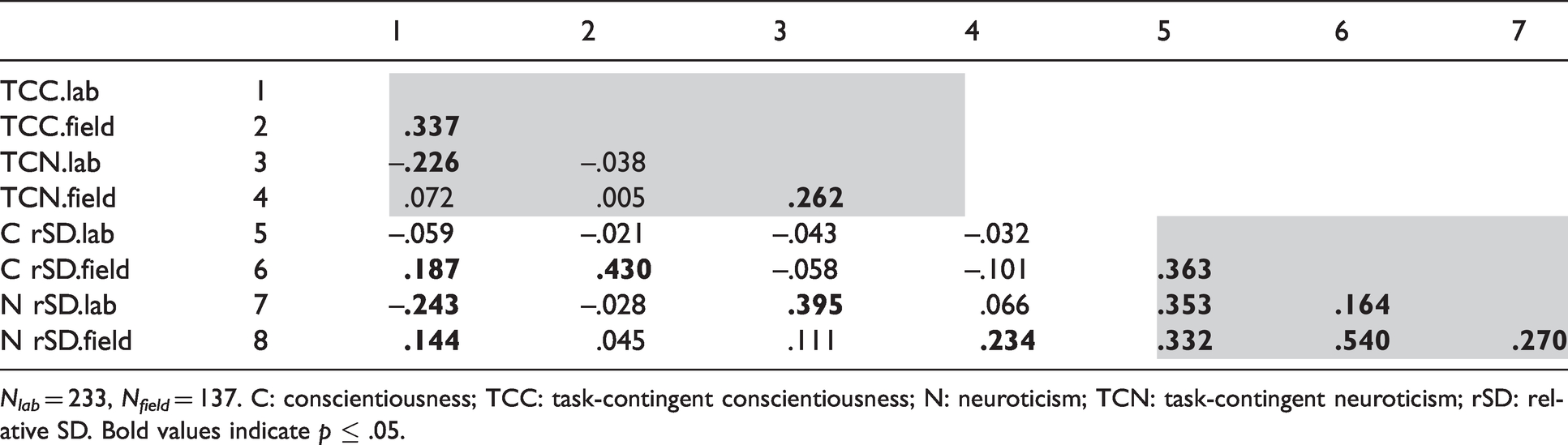
Nlab = 233, Nfield = 137. C: conscientiousness; TCC: task-contingent conscientiousness; N: neuroticism; TCN: task-contingent neuroticism; rSD: relative SD. Bold values indicate p ≤ .05.
Second, the operationalisation of variability (i.e. conditional vs. relative variability) mattered less for neuroticism than for conscientiousness. For neuroticism, the two types of variability indices were positively correlated, both under lab conditions where situations were more controlled (lab: r[TCN, rSDneu] = .40), and under field conditions (field: r[TCN, rSDneu] = .23), suggesting that contingent neurotic responding and relative (i.e. total) variability in neurotic states were related phenomena. For conscientiousness, the result pattern was less clear. The two types of variability indices were not related under lab conditions where situations were more controlled, r(TCClab, rSDconlab) = –.06, but they were in the field, r(TCCfield, rSDconfield) = .43. That is, how variability in conscientiousness was operationalised may have mattered less under field conditions. Note that the implication of state variability likely differs for the two personality dimensions. For conscientiousness, contingent responding as operationalised in the current study is likely adaptive, while relative variability (i.e. absolute fluctuation) in conscientiousness states may not be. For neuroticism, both contingent responding and relative variability are likely maladaptive.
Third, there was no strong evidence to suggest the existence of an overarching ‘variability trait’ given the lack of pervasive positive correlations (i.e. positive manifold) across dimensions, operationalisations, and contexts. However, separate inspection of the set of correlations between contingent variability indices (Table 10, top-left shaded section) and the set of correlations between the relative variability indices (Table 10, bottom-right shaded section) suggests a more nuanced interpretation is needed. There was evidence of positive manifold in relative variability, whereas this is distinctly not the case for task contingencies. Relative variability in conscientiousness was substantially correlated with relative variability in neuroticism, both under lab (r[rSDcon_lab, rSDneu_lab] = .35) and field conditions (r[rSDcon_field, rSDneu_field] = .54), a relatively common finding. When calculated across contexts, positive cross-dimension correlations were observed, but were in at least one case reduced (r[rSDcon_field, rSDneu_lab] = .16; r[rSDcon_lab, rSDneu_field] = .33). For contingent variability indices, across-dimension/within-context r(TCClab, TCNlab) = –.23; and r(TCCfield, TCNfield) = .01, and across-dimension/across-context correlations, r(TCClab, TCNfield) = .07; r(TCCfield, TCNlab) = –.04, were rather small. The remaining intercorrelations between the contingency and relative variability indices (unshaded section in Table 10) show similar disparity across dimension, operationalisation, and context.
Overall, if these variability indices were tapping an underlying variability trait, we would expect to find (a) substantive cross-dimension correlations in each context (lab, field) and (b) for those correlations to also hold across contexts given the alignment between field-and lab-based variability indices reported earlier. This was clearly not the case for contingent variability indices, but there was some evidence of positive manifold for relative variability indices. The stronger within-context compared to cross-context correlations between the relative variability indices for the different dimensions (neuroticism, conscientiousness) may still indicate that cross-dimension correlations reported in prior work (where there is typically only one context) may be somewhat inflated (for instance by a common method factor).
Two-year stabilities of variability indices
Having demonstrated that individuals differ in the amount of state variability they show and in their level of responsiveness to task demands, in a next step we investigated the stability of such individual differences in state variability over time. Stability may be interpreted as another characteristic of an individual differences variable. Table 11 shows the cross-wave correlations for situation contingences and relative variability indices for both conscientiousness and neuroticism. As can be seen, there was some evidence of stability (i.e. from wave 1 to 5) for both types of variability indices, and both personality dimensions. Effects were generally positive in sign and small in size. Overall, stability was weakest for TCC (mean r = .17), and of about the same size for the other three indices (TCN: mean r = .29; rSDcon: mean r = .26; rSDneu: mean r = .25).
Stabilities of variability indices across a two-year period (lab).
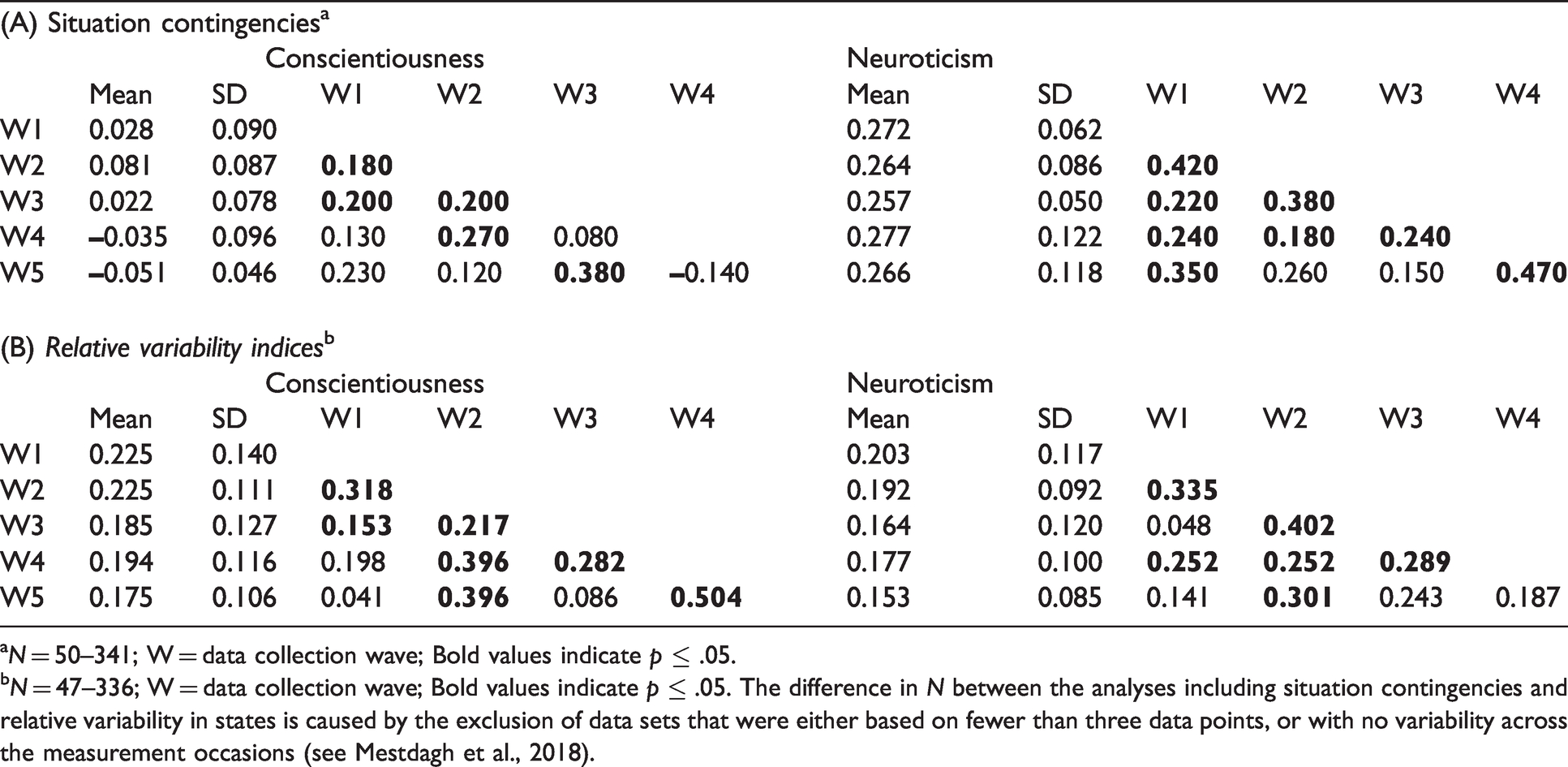
aN = 50–341; W = data collection wave; Bold values indicate p ≤ .05.
bN = 47–336; W = data collection wave; Bold values indicate p ≤ .05. The difference in N between the analyses including situation contingencies and relative variability in states is caused by the exclusion of data sets that were either based on fewer than three data points, or with no variability across the measurement occasions (see Mestdagh et al., 2018).
Aim B: Antecedents of dynamic variables
In order to explore possible antecedents, we first examined the relationships between conscientiousness and neuroticism traits and the respective dynamic personality variables, ignoring other individual difference variables. Table 6 (section B) shows that trait conscientiousness was positively and significantly related to the mean (β = 0.169, p < .01) and relative variability (β = 0.001, p = .04) in state conscientiousness at wave 1 (coded as 0 for analyses), but was unrelated to any of the other dynamic conscientiousness indices. Table 7 (section B) shows that trait neuroticism was significantly related to state neuroticism (mean state) at wave 1 (β = 0.239, p < .01), as well as the decrease in state neuroticism that occurred across time (β = –0.056, p < .01). Specifically, higher trait neurotics had higher state neuroticism than lower trait neurotics at wave 1, but their state neuroticism decreased at a quicker rate than that of lower trait neurotics over time (i.e. data collection waves). Trait neuroticism was also related to TCN at wave 1 (β = 0.002, p = .03). Higher trait neurotics displayed greater TCN than their emotionally more stable counterparts (i.e. their state neuroticism increased to a greater extent as task demand increased). Similarly, trait neuroticism was associated with greater relative variability in state neuroticism in wave 1 (β = 0.001, p = .029). These findings seem to indicate more variability and dynamic responding for those higher in trait neuroticism, both across situations and to some extent across waves.
The pattern of findings for the effects of the construed trait on contingent variability (i.e. TCC and TCN) are somewhat similar (but not identical) to the effects of the trait on relative variability (i.e. rSDcon, rSDneu): (i) for neuroticism, the trait was positively related to contingent variability and relative variability in the state; (ii) for conscientiousness, the trait was positively related to relative variability, but not to contingent variability in the state; (iii) for both conscientiousness and neuroticism, the change in both relative and contingent variability across time was unrelated to the trait (as perhaps was to be expected given the lack of evidence for individual differences in contingent and relative variability change across time, as noted previously).
In a next step, we examined individual differences antecedents of the dynamic personality variables more generally by simultaneously including all 11 individual differences measures in the analyses. Table 6 (section C) summarises the effects of the individual difference variables on the dynamic conscientiousness variables. First, state conscientiousness in wave 1 remained significantly related to trait conscientiousness, and was significantly related to trait neuroticism (β = 0.074, p = .05), and learning goal orientation (β = 0.184, p < .01). Specifically, individuals scoring higher on the traits conscientiousness, neuroticism, and learning goal orientation reported higher levels of state conscientiousness in wave 1. Second, TCC in wave 1 was significantly related to abstract reasoning (β = 0.004, p < .01) and trait openness (β = –0.002, p = .05). Those scoring higher on abstract reasoning and (perhaps surprisingly) those scoring lower on openness displayed greater TCC. Third, relative variability in state conscientiousness was only related to learning goal orientation (β = 0.002, p = .03), such that those scoring higher on learning goal orientation showed more state variability in wave 1. Finally, the change in state conscientiousness across time was related to trait openness (β = –0.044, p = .04). State conscientiousness was more likely to decrease across waves for individuals who scored higher on trait openness. The change in TCC across waves was related to implicit theory (personality) (β = –0.001, p = .03); however, given the earlier finding (see Table 6, section A) that between-person variability in changes in TCC across waves was not significant, this effect should be treated with caution.
Table 7 (section C) summarises the effects of the individual difference variables on the dynamic neuroticism variables. First, state neuroticism in wave 1 remained significantly related to trait neuroticism (β = 0.173, p < .01), and was related to performance avoid goal orientation (β = 0.112, p = .02) and abstract reasoning (β = –0.137, p = .01). Specifically, state neuroticism was higher for individuals scoring higher on trait neuroticism and performance avoid goal orientation, and for individuals scoring lower on abstract reasoning. Second, TCN in wave 1 was only significantly related to abstract reasoning (β = –0.003, p < .01), but we note relationships with trait neuroticism and trait conscientiousness were close to the boundary (p = .06). Individuals who scored higher on abstract reasoning were less likely to display TCN. Third, relative variability in state neuroticism was positively associated with trait neuroticism (β = 0.001, p = .03) and trait openness (β = 0.001, p = .01), and negatively with abstract reasoning (β = –0.002, p < .01). Finally, the decrease in state neuroticism across waves was related to trait neuroticism (β = –0.076, p < .01). Those scoring higher on trait neuroticism were more likely to display decreases in state neuroticism across waves. Note that those with higher trait neuroticism scores started with higher state neuroticism in wave 1. Finally, three individual differences were related to changes in TCN across waves. These were trait agreeableness (β = –0.001, p = .03), trait conscientiousness (β = 0.002, p < .01), and implicit theories (personality) (β = 0.001, p = .03). However, given the earlier finding (see Table 7, section A) that between-person variability in changes in TCN across time was not significant, the effects should similarly be treated with caution.
For comparison purposes, we conducted analogous analyses on the field data and note that the sample size is smaller for this set of analyses (N = 200). Trait conscientiousness was again a significant bi-variate predictor of mean state conscientiousness in wave 1 (β = 0.009, p < .01, Table 8, section B), but this was not the case when all other individual differences variables were included in the analysis (β = 0.005, p = .15, Table 8, section C). Controlling for the range of individual differences variables included in the current study, only implicit theories (personality) stood out as a unique predictor of the dynamic conscientiousness variables when using field experience sampling data (β = 0.008, p < .01). Specifically, individuals scoring higher on implicit theories (personality) reported higher levels of mean state conscientiousness. They also showed lower levels of TCC (i.e. less positive values reflected in β = –0.002, p = .02) and lower relative variability in state conscientiousness (β = –0.001, p = .03). Performance prove goal orientation (β = 0.002, p = .03) was the only other significant predictor being positively associated with relative variability only. Similarly, trait neuroticism was again a significant bivariate predictor of mean state neuroticism (β = 0.016, p < .01) and TCN (β = 0.002, p = .01), but not of relative variability in neuroticism states. However, when including all other individual differences variables in the analyses, these effects were reduced and no longer significant (Table 9). The only other significant predictive effects related to implicit theory (intelligence), which was positively associated with relative variability in state neuroticism (β = 0.001, p = .03), and performance prove goal orientation, which was positively associated with mean state neuroticism (β = 0.012, p = .02). Overall, we observed very few predictive effects with regard to the dynamic constructs under investigation when using field experience sampling data. This was particularly the case when predictor variables were analysed jointly, rather than as single predictors (see Tables 6 to 9 for bivariate correlations). Traits that may be of relevance and deserve further investigation were: implicit theories and performance prove goal orientation.
Aim C: Antecedents of long-term trait change
Finally, we tested whether variability in states and long-term change in conventional traits were related. Figure 2 depicts the change in trait scores from the first to last wave (A1 and B1), the density distribution of trait change scores (A2 and B2), and the relationship between baseline trait scores (trait scores at wave 1) and trait change scores (A3 and B3) for both conscientiousness (A) and neuroticism (B). While on average traits remained stable across waves, there were also individual differences, such that some individuals experienced a considerably increase or decrease in their trait standing over the course of the study.
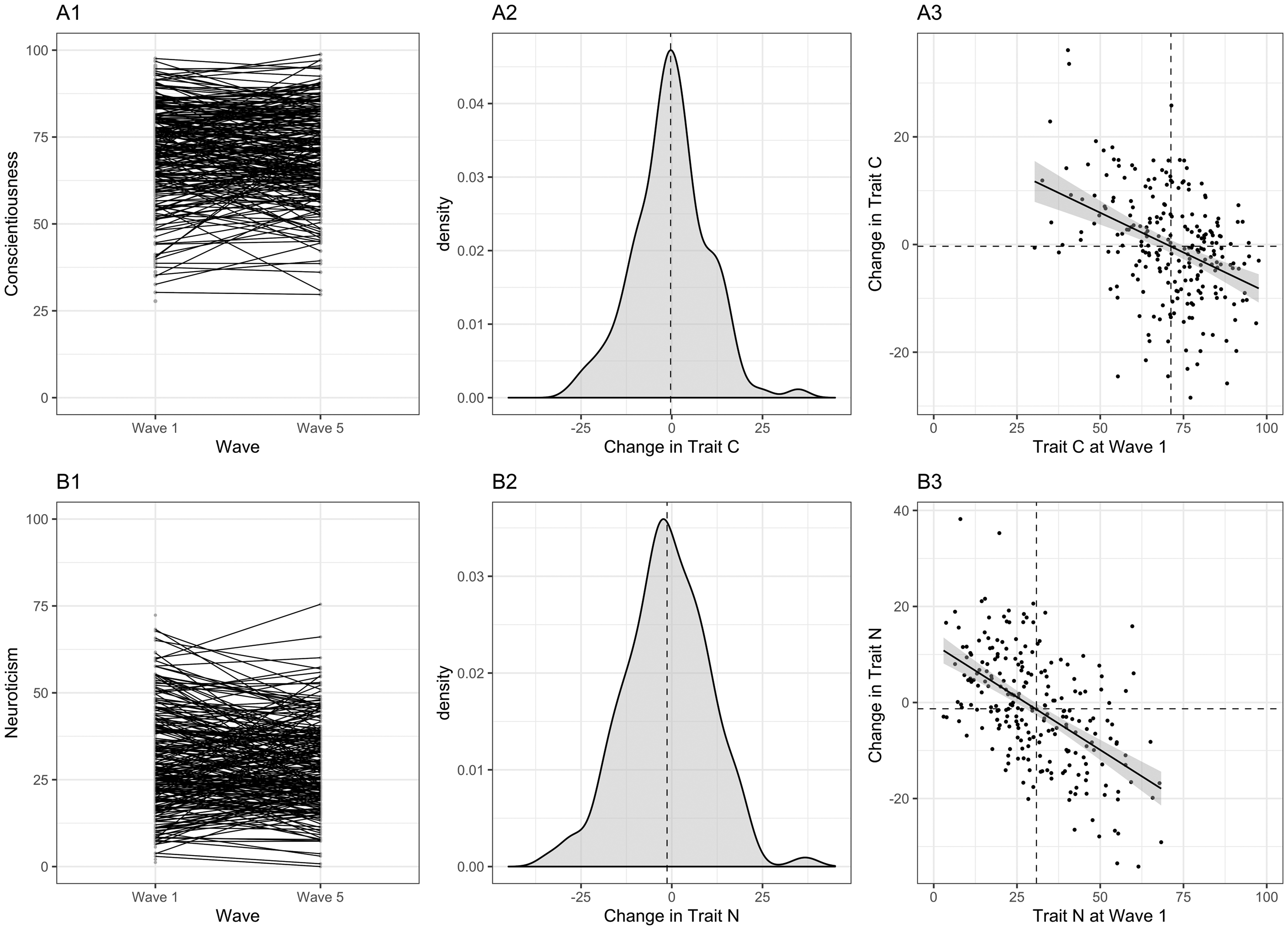
Trait change: Mean trait scores at baseline (time 1) and time 2 (left), density of trait change scores (middle), and correlation of baseline with trait change scores (right) for conscientiousness (upper) and neuroticism (lower).
In a next step, we tested whether state variability operationalised in the form of conditional or relative variability indices predicted individual differences in trait change while controlling for the respective mean states and the selected set of individual differences antecedents. We again contrasted findings for data collected in lab vs. field settings. All models are depicted in Figure 3, and findings relating to the dynamic variables (i.e. mean states, conditional and relative variability indices) are presented in Table 12. The following insights can be drawn: First, more variance was explained in trait change for neuroticism compared to conscientiousness. Second, the strongest effects were generally found for mean states predicting trait change, rather than state variability. Third, effects were generally stronger for lab compared to field data; however, we note sample sizes differed considerably (Nlab = 233; Nfield = 137). Fourth, coefficients tended to be close to zero or positive for variability in state conscientiousness predicting trait change, but negative for variability in state neuroticism predicting trait change.
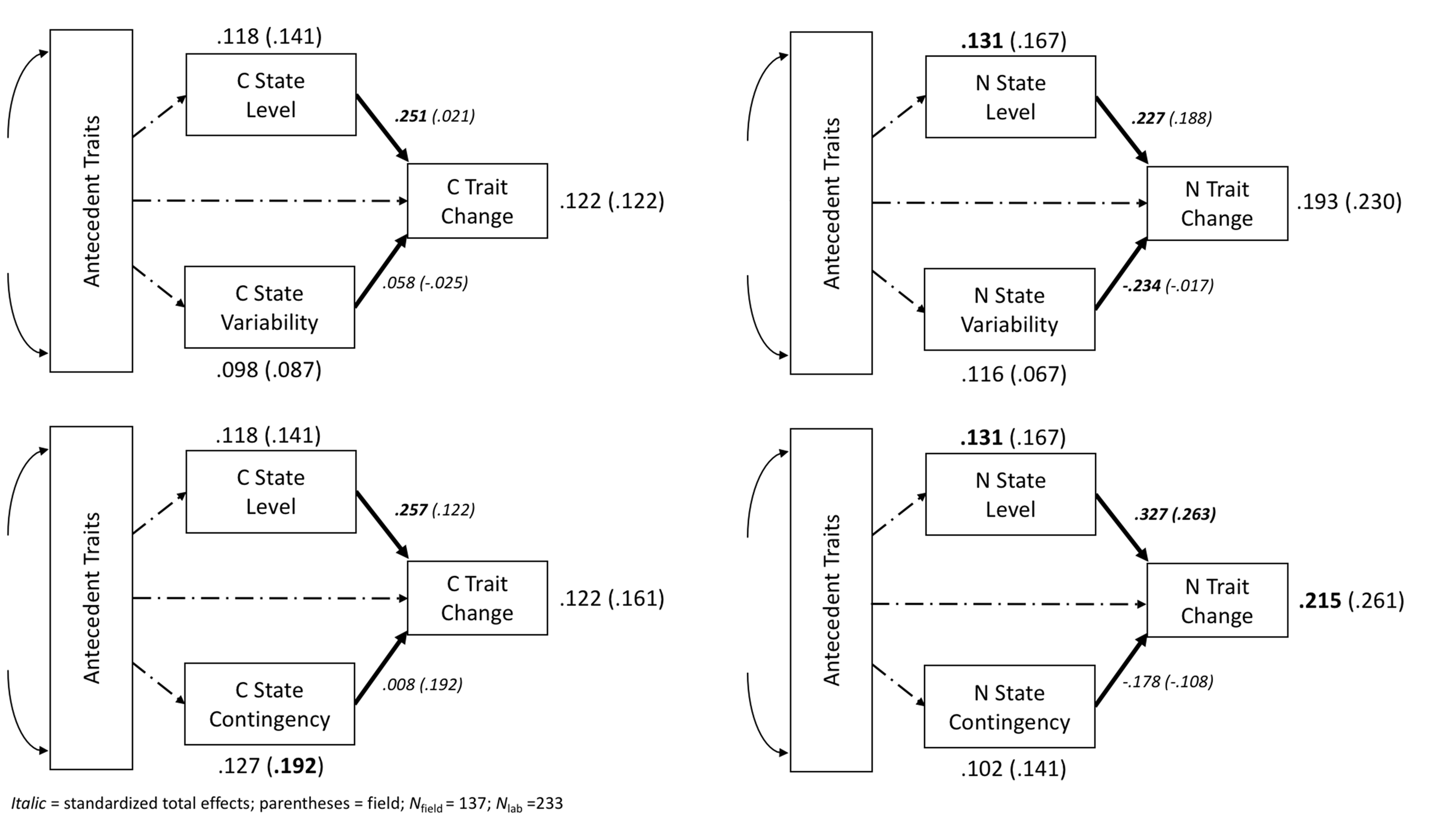
Individual differences and dynamic constructs as antecedents of trait change. All values reported are R2, except for those which are italicized which are the standardised regression coefficients of the direct effects; Values in parentheses are for the field data; Nfield = 137; Nlab = 233.
Dynamic constructs as predictors of change in construed traits with (i) referring to regression coefficients, and (ii) referring to R2 of endogenous variables
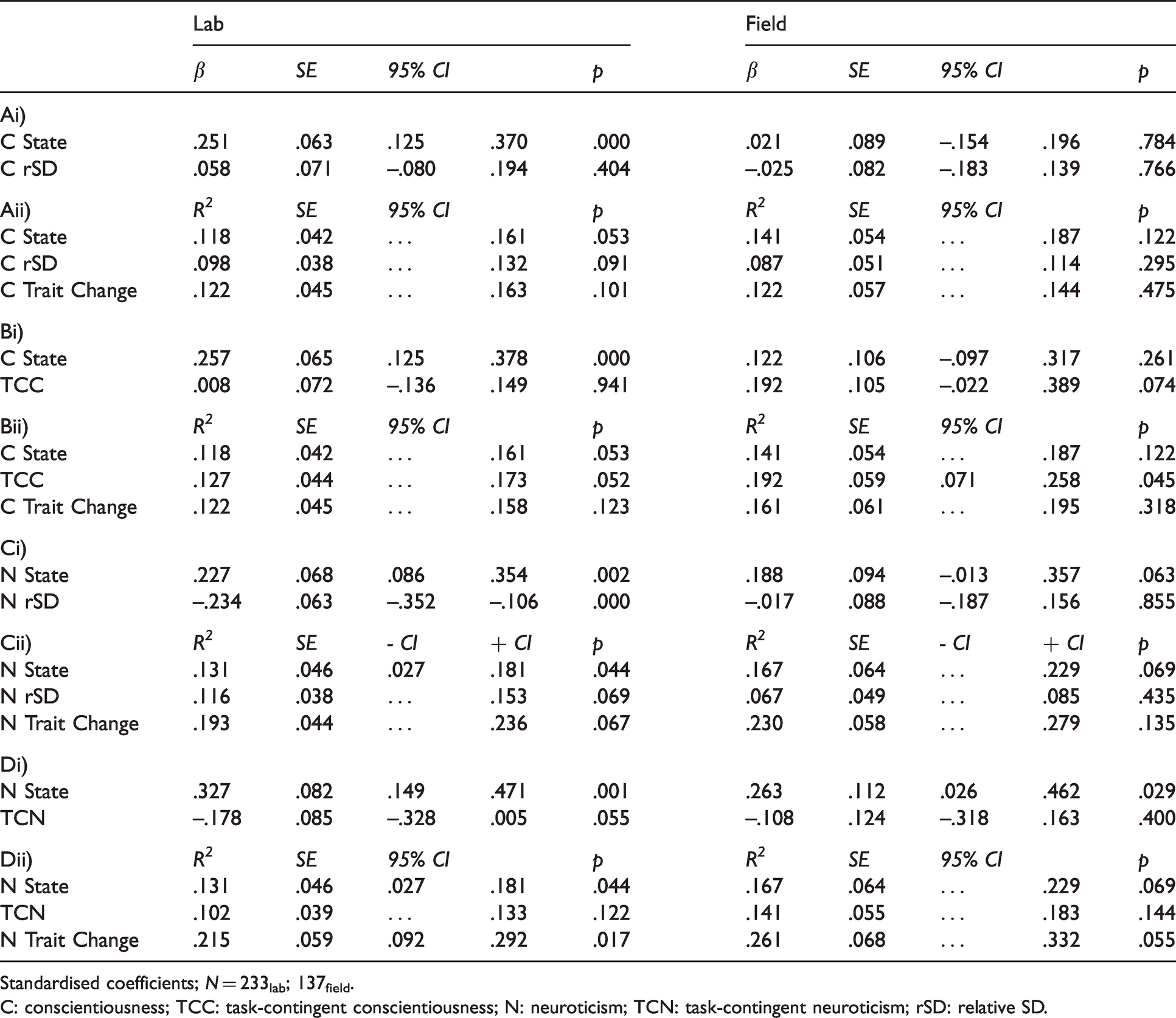
Standardised coefficients; N = 233lab; 137field.
C: conscientiousness; TCC: task-contingent conscientiousness; N: neuroticism; TCN: task-contingent neuroticism; rSD: relative SD.
Fifth, in relation to state variability as a predictor of trait change, the only statistically significant effect was found for relative variability in neurotic states. Figure 4(b) depicts this effect. For comparison purposes, in Figure 4(a) we also present the analogous but non-significant effect for conscientiousness. Negative change scores indicate a decrease in trait neuroticism and hence are generally desirable; while for conscientiousness positive change scores (i.e. an increase in trait conscientiousness) can generally be interpreted as beneficial. However, for some individuals adjusting their level of conscientiousness downwards may be strategically recommended (e.g. to prevent rigidity, and to use limited cognitive resources more strategically).
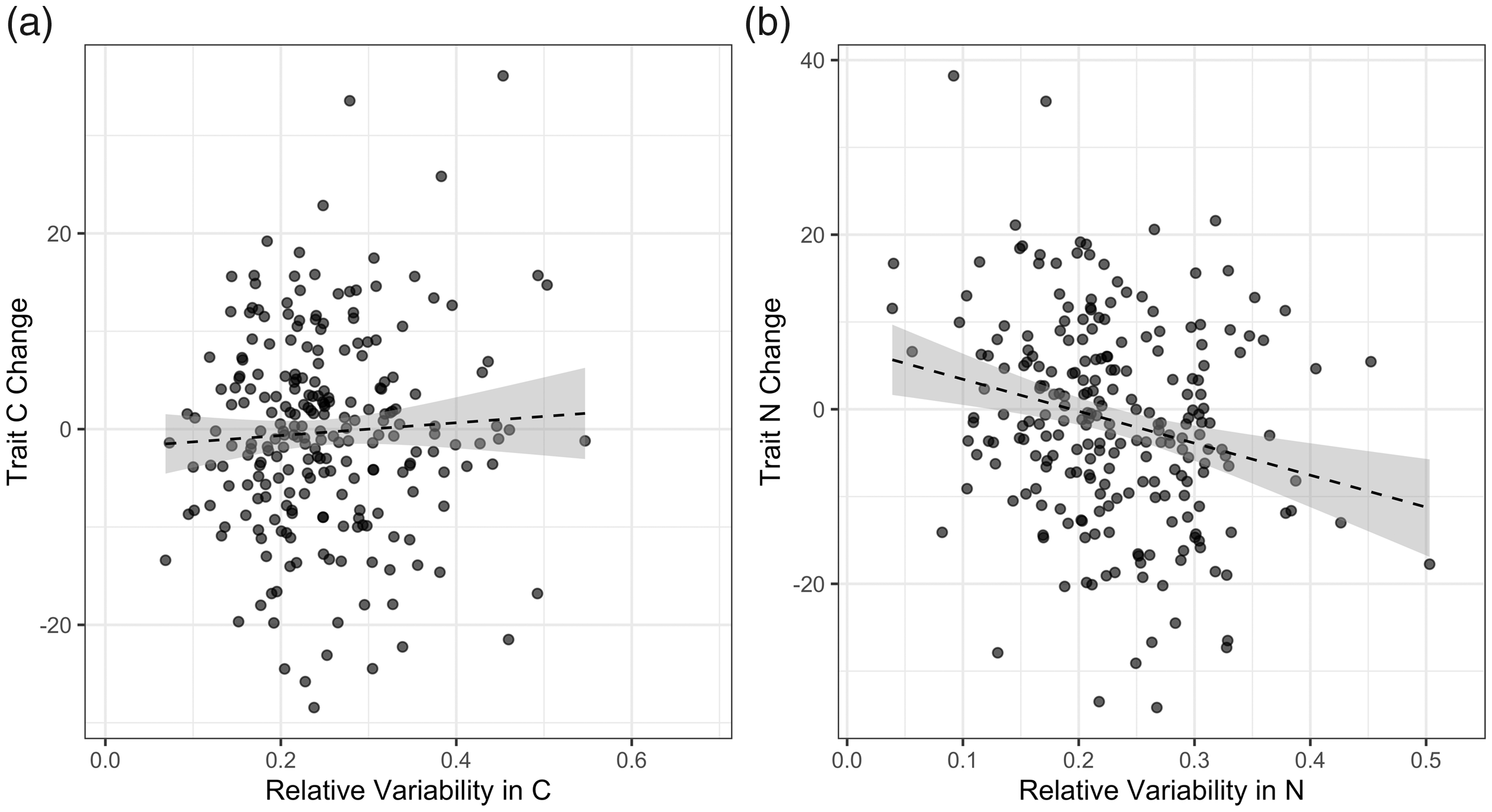
Relative variability as a predictor of trait change: (a) conscientiousness (non-significant effect), and (b) neuroticism (significant effect).
Figure 4 also shows that higher relative variability in neurotic states was associated with less positive and more negative trait change scores, suggesting that those whose response behaviour indicated a reduction in trait neuroticism at the end of the programme (wave 5, see Figure 1) tended to also display higher levels of relative state variability (controlled for the mean state and potential individual differences antecedents, including cognitive ability). In other words, individuals who had greater relative variability in state neuroticism at the beginning of the programme (wave 1) displayed a smaller increase/larger decrease in their level of trait neuroticism over time. Note however, the effect was small (β = –.23, p < .001) and with more uncertainty in the upper region of the scale (see Figure 4).
Discussion
Contributions and implications
The current study was undertaken to further investigate the individual differences status of within-person variability in personality states. To this end, we explored (1) the temporal stability and cross-context consistency of individual differences in state variability, (2) the potential antecedents of individual differences in state variability, and (3) the empirical links between short-term state variability and longer term trait variability. We also explored (4) the effects of different conceptualisations of variability and their respective operationalisations on above result patterns.
First, we consistently found evidence of individual differences in state variability, both from a conditional response and a total variability perspective. Importantly, such individual differences in state variability were relatively stable over time and consistent across contexts (lab vs. field). Second, overall, we observed relatively few associations of conditional and relative state variability indices with other individual differences variables that we had conceptually identified as potential antecedents. Predictive effects tended to be small, they also differed across dimensions (neuroticism vs. conscientiousness) and contexts (lab vs. field). However, results still indicated that state variability as operationalised in the current study reflected some systematic variability in some circumstances. Third, evidence in support of empirical links between short-term state variability and longer term trait change was limited. Fourth and finally, results often differed depending on the attribute studied (conscientiousness vs. neuroticism) and variability conceptualisation and operationalisation used (conditional vs. total amount of variability). In what follows we further elaborate on the implications of these four main findings.
Temporal stability and cross-context consistency
Our first aim was to explore the structure and relations between the dynamic variables at different levels. Evidence of individual differences in contingent responding and relative variability in states was observed under both lab and field conditions. This matters, as situations were held constant across individuals in lab conditions (compared to field conditions), and hence individual differences in response variability are more likely to be indicative of person-related differences in the way the situations are experienced (Fleeson & Law, 2015), rather than being an effect of the differences in situations that respondents may have encountered.
There was also evidence of temporal stability (i.e. from wave-to-wave) for both types of variability indices, again a finding that is supportive of an individual differences conceptualisation of state variability. Temporal stabilities of state variability operationalisations are often not reported, and where authors do report such stabilities these tend to encompass much shorter timeframes (e.g. a week or two, e.g. Fleeson, 2001; Jones et al., 2017; Minbashian et al., 2010; see also Podsakoff et al., 2019). In the current study, measurement intervals were of six months in duration spanning two years overall (see Table 11). Hence, these findings are promising in that they indicate that the short-term stabilities of state variability as defined and reported in prior research may hold more longitudinally. It is important to note, however, that the very concept of temporal stability in state variability is not yet fully determined in the study of personality dynamics (see also Beckmann & Wood, 2020). On the one hand, temporal stability is seen as a pre-condition of denoting variability indices as individual differences indicators. This was our starting position in the current study also. We expected mean-level changes, yet rank-order stability in state variability indices over time. On the other hand, the very premise for studying dynamic personality variables is to expect change, which may include or lead to change in interindividual rank ordering. Dynamic components of personality are by definition ‘dynamic’, which may manifest in absolute and relative terms (i.e. intraindividual changes in mean level and change in interindividual rank-order). We acknowledge more conceptual work needs to be done to deal with these psychometric challenges.
In addition to evidence of stability across time, there was evidence of consistency in variability across contexts – lab- and field-based variability indices were correlated. This is an important finding. It (a) indicates systematicity in the measurement of state variability (operationalised as conditional and relative state variability), (b) further supports an individual differences conceptualisation of state variability, and (c) shows that lab-based response variability can be indicative of response variability in every-day life settings. To our knowledge, this is the first study to provide lab vs. field comparisons of different state variability indices within the same sample.
Antecedents of individual differences in state variability
Our second aim was to explore possible antecedents of individual differences in state variability. We observed only a small number of predictive effects in relation to the dynamic variables under investigation, and these tended to differ between dimensions and contexts. It is important to note that our lab-based findings are arguably more robust, given the larger sample size and the between-person comparability of the situations participants were exposed to. Generally speaking, and as to be expected, the dimension-relevant trait tended to be a significant predictor of related dynamic variables, particularly with regard to the mean state, but importantly, in several instances, also with regard to conditional and relative variability indices. For example, trait neuroticism was a significant predictor of mean state neuroticism, and conditional and total variability in neurotic states. This is in line with prior work on the predictive effect of trait neuroticism on state variability (e.g. Dauvier et al., 2019; Geukes et al., 2017; Jones et al., 2017; Judge et al., 2014; Kuppens et al., 2007).
Across the range of individual differences variables, effects were typically stronger at bivariate level (as was to be expected since interdependencies among the potential predictors are not considered), and only few effects remained when controlling for all individual differences variables in the analyses (compare bivariate and combined effects in Tables 6 to 9). Under lab conditions, only abstract reasoning and trait openness explained unique portions of variance in selected dynamic variables across both dimensions (neuroticism, conscientiousness), while only implicit theories and performance prove goal orientation were unique predictors of selected dynamic variables across dimensions in field conditions. Nevertheless, the effect pattern at bivariate level – and in some instances at multivariate level – lend evidence to the suggestion that the variability indices capture, at least to some extent, systematic rather than mere error variance.
Important findings in this respect are those related to abstract reasoning as a significant predictor of conditional and total variability observed under lab conditions (see Tables 6 and 7). Given that the abstract reasoning test is an objective performance and non-self-report measure, concerns for example relating to common method bias when interpreting variable associations do not apply. In the current study, those with higher levels of abstract reasoning ability reported to think, feel, and behave more conscientiously when confronted with increasing task demand (higher levels of TCC). They were also less likely to respond with increases in neurotic states to increases in task demand (lower levels of TCN), and less likely to fluctuate in neurotic states overall (lower levels of rSDneu). A possible interpretation is that more cognitively resourceful participants were more strategic in their use of mental effort and less vulnerable affectively under demanding task conditions, at least in the more structured and controlled lab/training context. Given the scarcity of respective research reported in the literature and the explicit explorative focus of our study however, any such reflections are tentative and findings require replication.
Findings across the two contexts (lab, field) in relation to potential predictors of dynamic variables differ. In the field, unique predictors were tapping general dispositions for engaging in tasks (performance prove goal orientation) and views on malleability due to effort (implicit theories) – rather than general dispositions in cognitive ability (abstract reasoning) – that are more likely to be impactful in settings where there may be more freedom to select and shape situations, including tasks. However, note the direction of the effects were such that those who tended to hold incremental beliefs were more likely to vary in neurotic states, but less likely to vary in conscientious states. Implicit beliefs were also negatively related to TCC.
Short-term state and longer term trait variability
Our third aim was to explore the relationships between selected individual differences antecedents, short-term variability in states, and change in construed traits. There was limited evidence to suggest that conditional or total variability in states was related to change in traits; only one effect was found (when mean states and other individual differences antecedents were controlled). Specifically, those respondents with greater relative variability in state neuroticism showed less increase and more decrease in trait neuroticism over time. Taken at face value, this may suggest that variability in state neuroticism may indicate a potential for growth in emotional stability, but the effect was small. We highlight two considerations: First, given the training and developmental programme participants were enrolled in, the context in which the study was undertaken was conducive to personal development and change. Yet, on average, we did not observe major shifts in rank order (differential effectiveness) for trait conscientiousness or trait neuroticism for the majority of participants (individual differences in trait change notwithstanding). This may have limited our chances to detect associations of trait change with state variability. An experimental study that aims at trait change (see e.g. Hudson et al., 2019; Hudson & Fraley, 2015) may find stronger state-trait variability links. Second, even though a number of prominent individual differences variables were included in our models − notably indicators of personality and cognitive ability, as well as motivational mind sets − a considerable amount of existing variance in trait change remained unexplained (see Figure 3).
Nevertheless, our findings add to the small number of empirical studies on the possible associations between short-term personality state dynamics and trait development. In one of the few studies available to date (Borghuis et al., 2020), the authors reported evidence of a situation contingency being predictive of change in trait neuroticism, such that those who were more responsive (in terms of negative affect in response to conflict) showed an increase in trait neuroticism over time. None of the situation contingencies (TCC, TCN) investigated in the current study proved to be a significant predictor of trait change; however, we note that measures, sample, and study design differed between the two studies. In a more recent study using a daily diary approach to collect momentary states, Quintus et al. (2021) report that the repeated momentary experience of conscientious states was related to later trait change, which is in line with our findings (see Figure 3); although in the Quintus et al. (2021) study, this effect was not found for the neuroticism dimension. This, as the authors suggested, may be to do with the particular momentary state used to measure neuroticism (secure–insecure). Our finding of greater total variability in neurotic states being associated with change in trait neuroticism over a two-year timeframe may offer some optimism and encouragement for future studies to investigate links between short-term state and longer term trait change. One possible interpretation is that greater total state variability simply indicates a potential for trait change.
Different conceptualisations of variability
Finally, we were interested in establishing to what extent our findings relating to (a) temporal stability and cross-context consistency, (b) antecedents, and (c) trait change were a function of the specific variability conceptualisation and operationalisation used. While there was evidence of temporal stability and cross-context consistency for both types of variability indices, for all other analyses both the personality dimension for which variability was assessed (conscientiousness, neuroticism) and the variability operationalisation used (contingent variability, relative variability) made a difference. We discuss three observations in this respect. First, a number of authors have discussed the existence of an underlying variability trait based on substantive correlations between variability indices across personality dimensions assessed within the same context (e.g. Lang et al., 2019; Reddock et al., 2011; Storme et al., 2020). We found no strong evidence in support of an overarching variability trait across dimensions, operationalisations, and contexts. However, there was some evidence of positive manifold for total variability (including positive cross-dimension cross-context correlations), but not for contingent variability. This finding is relevant because it signals the necessity for a more nuanced interpretation of the ‘variability trait’. There are between-person rank-order consistencies in the unconditional variability one expresses, such that those who vary in one context seem to do so to similar extents relative to others, regardless of dimension. However, when this variability is conditionalised on the proximal demands of the situation, the rank-order stability breaks down, suggesting common situational triggers impact individuals idiosyncratically.
Second, taken together findings relating to neuroticism tended to be overall stronger, more consistent, and in line with prior research, including the discussion of neuroticism as an antecedent of state variability (Dauvier et al., 2019; Geukes et al., 2017; Jones et al., 2017; Kuppens et al., 2007). This may be indicative of greater within- and between-person systematicity in neurotic responses over time and across context. Our conclusions around neuroticism may therefore be more straightforward. Interestingly, we found substantial correlations between relative and conditional variability indices in both lab and field conditions for neuroticism, suggesting that the way state variability was operationalised made less of a difference for neuroticism. It is sensible to distinguish between a mere fluctuating in states (total variability) from contingent responding. The latter more strongly implies flexible adjustment (conscious or subconscious) to situational demands. However, with regard to neuroticism, independently of its operationalisation (total or conditional), variability constructs seem to tap similar underlying processes. As a consequence, any fluctuation in neurotic states (whether contingent on demand characteristics of the situation or not) may represent a potential liability. Such interpretation resonates with findings that different indices of variability in neuroticism were negatively correlated with performance indicators (Beckmann et al., 2020; Wood et al., 2019). Similarly, variability in negative affect has often been interpreted to indicate a vulnerability in terms of well-being and other outcomes of interest (e.g. Kuppens et al., 2007).
Third, others have distinguished within- from across-context variability in states and reported differential relationships of these state variability components with Big Five traits (Geukes et al., 2017). A change in context implies a change in situational demands (e.g. work vs. home, see also Beckmann et al., 2020). The current study was concerned with within-context state variability. We similarly found differential correlation patterns of variability components (i.e. total and conditional) with individual differences variables, going beyond the Big Five and including motivational mindsets and cognitive ability. Situation contingencies, as operationalised in the current study, are reflective of differences in (perceived) situation characteristics. When considering different variability operationalisations, it is important to recognise that a total variability index reflects both contingent and non-contingent variability components, while a situation contingency obviously reflects variability as a response to specific changes in a subset of situational characteristics. State fluctuation (as reflected in relative SD indices) may reflect an outcome of contingent responding (i.e. situation contingences, see Whole Trait Theory, Fleeson & Jayawickreme, 2015). If so, one would expect to find empirical associations between the two forms of operationalised variability. In our study this was the case for neuroticism in lab and field conditions with an even stronger effect under more controlled lab conditions (rlab = .40 and rfield = .23). Such pattern did not emerge for conscientiousness under lab conditions (rlab = –.06. and rfield = .43).
Whether state variability is adaptive or maladaptive may depend on how and why one varies or merely fluctuates (e.g. Hardy & Segerstrom, 2017; Japyassú & Malange, 2014; Magee et al., 2018), and not all situation dependent changes are adaptive adjustments. This complexity may partly explain the mixed result pattern relating to the antecedents and consequences of state variability reported in the literature and in the current study.
Limitations and future directions
The current study is unique in a number of ways. We employed an authentic sample of non-student participants using repeated waves of state assessment. Observations in field and lab settings allowed for the analysis of context specificity of effects. We also considered a comprehensive set of potential cognitive and non-cognitive antecedents and correlates. Regardless, there are also some limitations to be considered. While we were able to build our models on several waves of data collection for states, we only had two data points of trait measures and this limited our options for modelling links between state and trait variability. Further research is needed to extend on this, although circumstances where this is possible are hard to come by. Different approaches to the conceptualisation and analysis of variability and contingencies are also possible. For instance, we, as have others (Fleeson, 2007; Minbashian et al., 2010; Sherman et al., 2015), conceptualised contingences in terms of linear effects. It is conceivable that non-linear contingencies may provide even further and more differentiated insights into the complex interplay between state affect and situational demands, and to the existence of an overarching variability trait.
In experience sampling studies the number of items that can be included is limited due to feasibility constraints. In the current study, we chose items to represent a range of neuroticism and conscientiousness facets – in most cases by using a single item – in order to cover the trait domain. However, our effects may be specific to the facets we included rather than be representative of the broad trait. Future research would benefit from further analyses of facet-level versus domain-level effects. Another potential issue is the scaling. We used a visual analogue scale which permitted keeping the answer format constant across state and trait self-report measures (except for the field experience sampling measure where the software used on the mobile devices did not accommodate the use of a visual analogue scale). For example, both a five-point and a seven-point scale can be translated into the same visual analogue scale. However, the ‘coarseness’ of the scale can impact the results of an analysis (e.g. Aguinis, 2004, p. 91); too few or too many scale points can affect the signal to noise ratio. If this were to have had an impact on our results, the reported effects would represent rather conservative estimations of ‘true’ effects. Finally, we note that across our analyses, effects were generally small in size. While not unusual for the personality field (see Gignac & Szodorai, 2016), this indicates the necessity for replication, and caution when drawing conclusions. While our focus was on exploration with the aim to provide conceptual stimulation, further investigations of the practical implications of short-term variability as an individual differences construct are called for (see e.g. Sosnowska et al., 2021).
Conclusion
In conclusion, there is relatively robust evidence to show that both situation contingent and non-contingent state variability indices have characteristics of individual differences variables in terms of observed between-person differences, temporal stability and cross-context consistency. However, relationships with antecedents, correlates and outcomes, including trait development, are complex and currently available evidence is certainly mixed with few replicated results. Findings that appear more consistent are those relating to the neuroticism dimension. One reason for such diversity in results is that the psychological meaning of state variability changes as a function of a number of factors, including dimension, operationalisation, and context, and, of course, various interactions of these factors. Future research into these complex processes – for which this paper may serve as an impulse – is expected to contribute to the conceptual and methodological maturation of the field by involving authentic samples and studying state variability within and across situations and contexts that have sufficient valence to participants.
Supplemental Material
sj-zip-1-erp-10.1177_08902070211017341 - Supplemental material for Personality dynamics at work: The effects of form, time, and context of variability
Supplemental material, sj-zip-1-erp-10.1177_08902070211017341 for Personality dynamics at work: The effects of form, time, and context of variability by Nadin Beckmann, Damian P Birney, Amirali Minbashian and Jens F Beckmann in European Journal of Personality
Footnotes
Data accessibility statement
The data analysis scripts used for this article together with supplementary materials can be accessed at  In accordance with our ethics obligations (HREC HC06294) at the time of data collection, we are required to store electronic data password protected on the university’s internal server. Accordingly, we are unable to make the data freely available. However, researchers can request access to the data and such requests will be considered in light of the ethics regulations agreed upon at the time of data collection.
Declaration of conflicting interests
The author(s) declared no potential conflicts of interest with respect to the research, authorship, and/or publication of this article.
Funding
The author(s) disclosed receipt of the following financial support for the research, authorship, and/or publication of this article: This research was supported by the Australian Research Council (projects LP0669552 and DP0987584). The views expressed herein are those of the authors and are not necessarily those of the Australian Research Council.
Ethical approval
All procedures for the recruitment and treatment of participants in the current study were approved by the Ethics Committee of the UNSW Sydney.
Notes
References
Supplementary Material
Please find the following supplemental material available below.
For Open Access articles published under a Creative Commons License, all supplemental material carries the same license as the article it is associated with.
For non-Open Access articles published, all supplemental material carries a non-exclusive license, and permission requests for re-use of supplemental material or any part of supplemental material shall be sent directly to the copyright owner as specified in the copyright notice associated with the article.
