



Abstract
High levels of economic inequality are associated with numerous negative individual and societal consequences, and people prefer less of it. Opposition to redistributive policies designed to reduce inequality (e.g., taxing the rich to assist the poor), however, remains persistent. In this research, we propose a simple intervention to boost support for such policies. Specifically, we suggest that describing inequality between babies (in rich or poor homes) makes unequal opportunities more salient than describing inequality between adults. Because unequal opportunities are more difficult to rationalize than unequal outcomes, this results in a shift away from individualistic attributions and toward structural attributions for inequality. Critically, structural problems require structural solutions (e.g., redistributive efforts). We test this account across five preregistered studies (N = 5,800), spanning various presentation modalities (e.g., visual depictions, written descriptions), demographics (e.g., race, gender), inequality-reducing policies (e.g., taxation, food stamps), and a consequential choice underscoring implications for donation behavior.
Economic inequality is a major issue in the United States (Horowitz et al., 2020; Saez & Zucman, 2016) and around the world (Atkinson et al., 2011; Milanović, 2016; Piketty, 2014). Five percent of Americans control more than two thirds of the country’s wealth, while the bottom half owns less than 1% (Wolff, 2017). Globally, over the past three decades, the top 1% have captured 38% of all wealth growth, compared with just 2% for the bottom 50% (Chancel et al., 2022).
High levels of inequality have been associated with numerous negative outcomes, including poorer mental health (Andrés, 2005; Burns et al., 2014; Messias et al., 2011; Sommet et al., 2018), worsened physical health (Elgar et al., 2005; Henderson et al., 2004; Pickett et al., 2005; Pickett & Wilkinson, 2015), and unhappiness in developed countries (Oishi et al., 2011; Oishi & Kesebir, 2015), though some evidence questions the strength and direction of these associations in developing countries (Karlsson et al., 2010; Ngamaba et al., 2018). At the societal level, unequal areas tend to suffer from higher crime rates (Choe, 2008; Hsieh & Pugh, 1993; Kelly, 2000; Western et al., 2006), lower trust and support (Côté et al., 2015; Delhey & Dragolov, 2014; Jachimowicz et al., 2020; Kawachi et al., 1997), and slower economic growth (Auclert & Rognlie, 2018; Carvalho & Rezai, 2016; Easterly, 2007; Persson & Tabellini, 1994).
Surveys in both developed and developing countries indicate people prefer less income inequality (Kiatpongsan & Norton, 2014), yet opposition to policies intended to reduce inequality (e.g., progressively taxing the rich to assist the poor) remains persistent (Bartels, 2005; Chow & Galak, 2012). How, then, might policymakers and organizations committed to reducing inequality boost support for redistributive efforts that could narrow the gap between the haves and the have-nots?
In this research, we propose and test a simple intervention for achieving this goal. Specifically, we suggest that describing inequality between babies—who lack the agency and autonomy to bear responsibility for their own outcomes—systematically increases support for redistributive efforts more than describing similar levels of inequality between adults. We explain that this is because highlighting inequality between babies makes salient unequal opportunities, whereas highlighting similar levels of inequality between adults makes salient unequal outcomes. And because economic opportunities at birth are strongly predictive of economic outcomes later in life (Chetty et al., 2014; Chetty & Hendren, 2018; Mitnik et al., 2015), inequality in opportunities is ultimately a meaningful predictor of inequality in outcomes.
The distinction between opportunities and outcomes reflects different potential attributions for wealth and poverty. When considering financial outcomes—like being rich or poor—people tend to attribute wealth and poverty to an individual’s prior actions (Bullock et al., 2003; Furnham, 1983; Kluegel & Smith, 1986; Piff et al., 2018; Rowlingson & Connor, 2011). Such reasoning suggests people are personally responsible for their financial state (Feather, 1992, 1999; Kluegel & Smith, 1986). Although these attributional tendencies are culturally dependent (see “General Discussion”), beliefs that “people get what they deserve” develop early in life and can be hard to change (Callan et al., 2006; Lerner, 1977, 1980; Lerner & Miller, 1978). Consequently, people may be apprehensive about redistribution when they believe others are personally responsible for their financial outcomes.
However, each generation’s outcomes create the next generation’s opportunities. What if economic inequality were instead evaluated at the beginning of life—would people still make individualistic attributions for inequality?
The intervention we propose hinges on this insight, relying on the intuition that it is difficult to attribute individual credit or blame to babies, who are just beginning their lives, as compared with adults. As a result, when considering inequality between babies (relative to adults), people might be less willing to assign individual credit or blame and more willing to consider external, structural explanations (e.g., those implicating institutions, norms, policies, and socioeconomic factors). This heightened focus on structural issues could then underscore the need for structural solutions. As such, any shift away from individualistic attributions and toward structural attributions should coincide with increased support for redistributive policies (i.e., structural solutions) intended to reduce inequality.
Prior research has documented a link between the shift from internal (individualistic) to external (structural) attributions and support for redistribution (Chow & Galak, 2012; Ordabayeva & Fernandes, 2017; Piff et al., 2020). We advance this literature by proposing a novel, low-involvement intervention that reliably prompts this shift. It reflects a cheap, simple, and reliable method of increasing support for policies that redistribute resources from the rich to the poor—one that could be implemented by both policymakers and nonprofits alike (see “General Discussion”).
In summary, we propose that describing inequality between babies (i.e., making salient inequality of opportunity) as opposed to describing inequality between adults (i.e., making salient inequality of outcomes) increases support for redistributive policies. We further propose that this effect will be accompanied by movement away from individualistic attributions and toward structural attributions for inequality. This reasoning leads us to propose the following hypotheses.
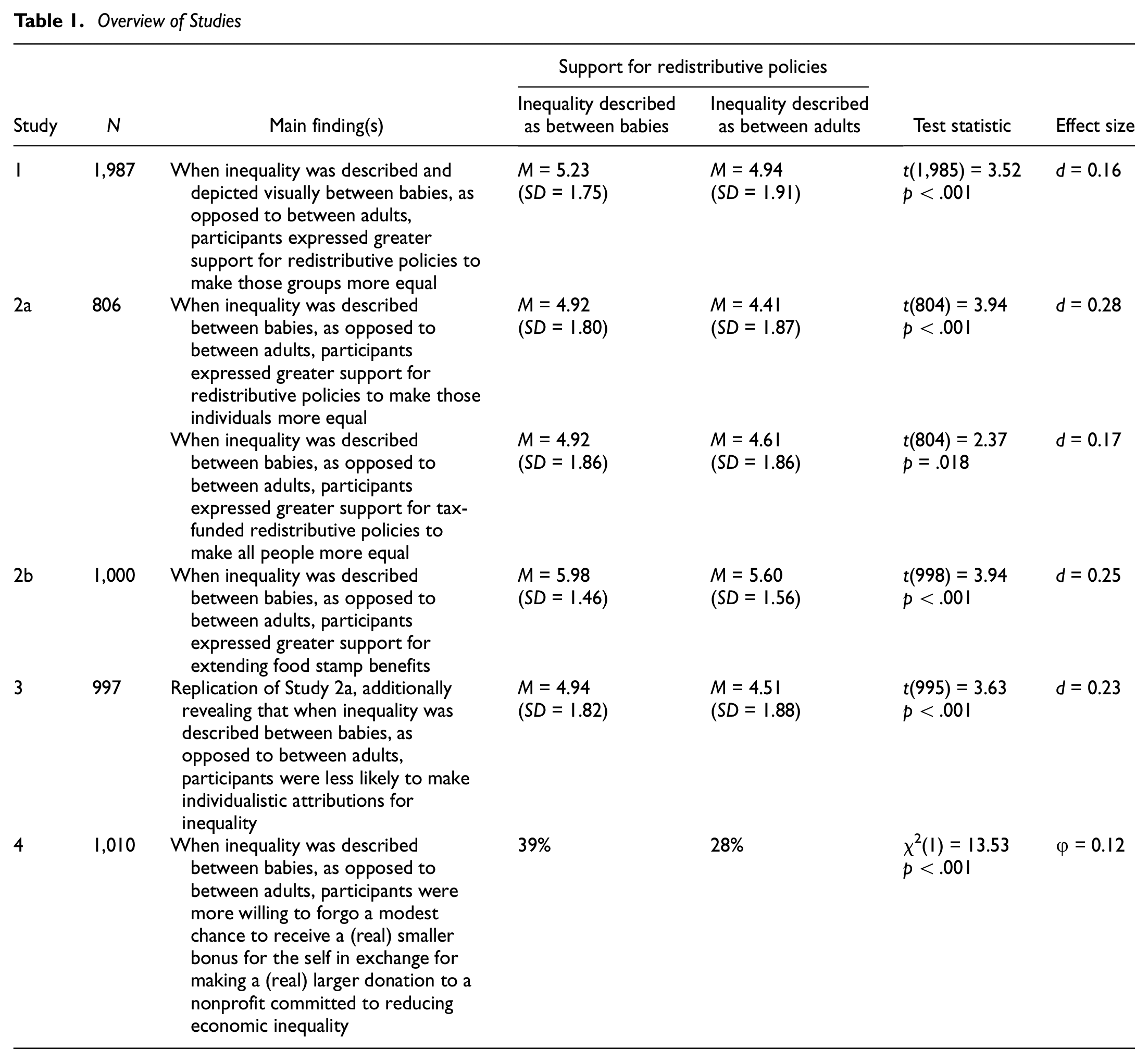
We test these hypotheses in five preregistered studies (N = 5,800; Table 1). Studies 1, 2a, and 2b test Hypothesis 1 across different presentation modalities, personal characteristics, and inequality-reducing policies. Study 3 tests Hypothesis 2, providing corroborating evidence for our account by highlighting changes in attributions for inequality. Study 4 highlights implications for donation behavior using an incentive-compatible design. The main findings of each study are summarized in Table 1.
Overview of Studies
Transparency and Openness
All studies were preregistered, and data were collected on Prolific Academic and Amazon Mechanical Turk (MTurk) with American participants (see “General Discussion”). All studies (including three supplementary studies) targeted sample sizes sufficient to detect a standardized effect size of Cohen’s d = 0.20 with between 80% (approximately N = 800) and 90% (approximately N = 1,050) power. Study 1 (N = 1,987) used a larger sample to test an interaction. Data were analyzed using R (version 4.3.1). All data, stimuli, code, preregistrations, and additional studies are publicly available at https://researchbox.org/581.
Study 1: Inequality Between Babies Versus Between Adults (Depicted Visually)
In Study 1, participants viewed photographs of groups of either babies or adults. We intended for this presentation style to resemble how people commonly encounter inequality in their own lives: as the faces of strangers who may be rich or poor, but about whom little else is known.
Method
We recruited 1,994 participants from Prolific for Study 1.
We aggregated photographs of babies and adults using publicly available images. 1 Participants were randomly assigned to an inequality condition in which they saw photographs of either babies or adults. One set of four photographs portrayed people with family household income in the bottom 10%, while the other set of four photographs portrayed people with family household income in the top 10% (Figure 1). From the set of eight possible photographs of babies or adults, we randomized the groupings and orderings of photographs across participants.
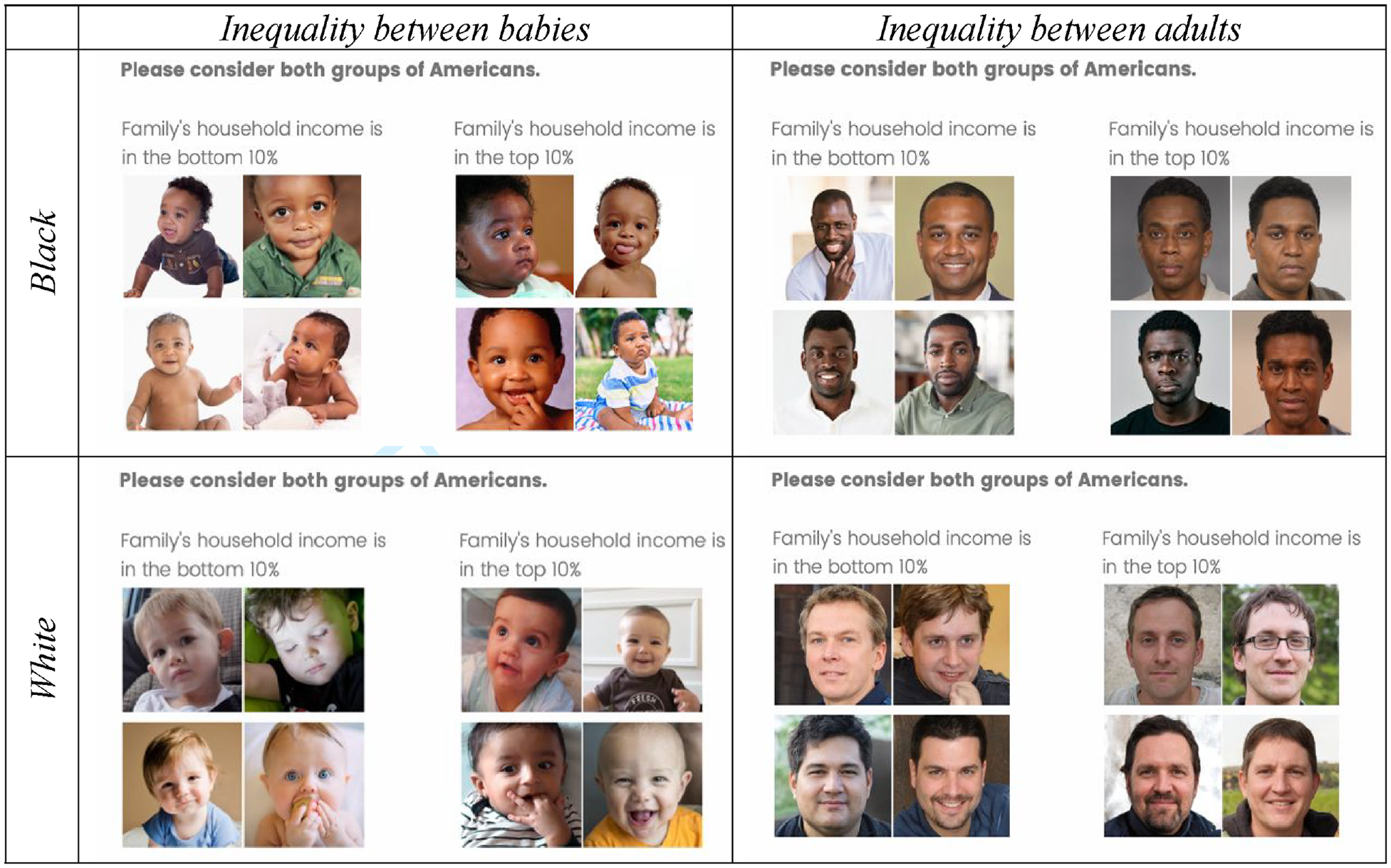
Study 1: Stimuli
Prior research suggests racial majority groups may express greater support for welfare policies when considering the financial needs of their racial ingroup, as opposed to racial outgroups (Brown-Iannuzzi et al., 2019, 2021). Thus, it seems possible that the proposed effect might be moderated by race. To explore this possibility, we manipulated race in the sets of photographs as a between-subjects factor. Specifically, participants saw photographs of either Black or White faces (Figure 1).
Results and Discussion
We excluded three responses linked to participant identifiers associated with a prior response (i.e., duplicate participation) and four participants who experienced image-loading errors. These exclusions resulted in a sample of 1,987 observations (Mage = 41.37, 44% female). None of the exclusions in this study or other studies substantively or significantly alter the interpretation of results.
Consistent with Hypothesis 1, a two-way analysis of variance (ANOVA) revealed a main effect of inequality condition, F(1, 1983) = 12.52, p < .001,
These initial results provide evidence for Hypothesis 1. When inequality was described and depicted visually between babies, as opposed to between adults, participants expressed greater support for redistributive policies to make those groups more equal. This main effect was qualified by race, reflecting a potential moderator (see “General Discussion”). 3
One concern with the current design is whether visual depictions of inequality may cue people to respond to the perceived cuteness of babies (Berry & McArthur, 1985; Lishner et al., 2008). Therefore, we move beyond visual depictions of inequality in the remaining studies.
Studies 2a and 2b: Inequality Between Babies Versus Between Adults (Described Nonvisually)
Studies 2a and 2b test Hypothesis 1 using written—rather than visual—descriptions. Beyond this change in presentation modality, Studies 2a and 2b seek to generalize the effect in several ways. First, whereas Study 1 focused on groups, Studies 2a and 2b focus on individuals. Second, we separately test descriptions of males (Study 2a) and females (Study 2b). Third, we consider infants (Study 2a) and toddlers (Study 2b). Fourth, we measure support for different types of policies designed to address economic inequality: tax-funded redistribution (Study 2a) and government food assistance programs (Study 2b).
Method
Participants
We recruited 806 and 1,000 participants from MTurk for Studies 2a and 2b, respectively.
Procedure
In both studies, participants were randomly assigned an inequality condition (babies vs. adults). Babies were described as infants (Study 2a) or toddlers (Study 2b). Adults were described as 35 years old. In each condition, we described two fictional people (one economically advantaged and the other economically disadvantaged).
Study 2a
In Study 2a, “Michael” and “Robert” (counterbalanced) were described as either 5-month-old babies or 35-year-old adults. One came from a rich home (top 10% of income), the other from a poor home (bottom 10% of income). We furnished additional details about each respective household’s education, income, and neighborhood (Table 2).
Descriptions of Economic Situations Used in Study 2a
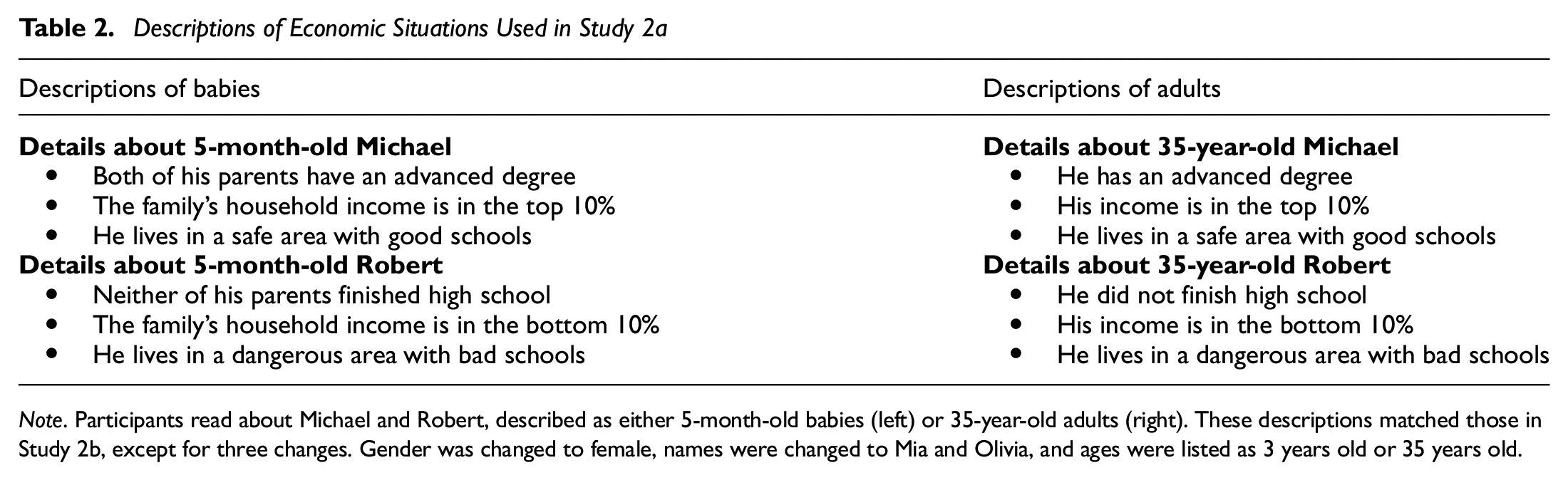
Note. Participants read about Michael and Robert, described as either 5-month-old babies (left) or 35-year-old adults (right). These descriptions matched those in Study 2b, except for three changes. Gender was changed to female, names were changed to Mia and Olivia, and ages were listed as 3 years old or 35 years old.
We first asked participants to evaluate a redistributive policy that was specific to Michael/Robert: “I would support a policy to make these two people more financially equal” (1 = strongly disagree; 7 = strongly agree). We then asked participants to evaluate a more general tax-funded redistributive policy: “Government policies can provide support for people with different opportunities and outcomes. Such programs can substantially improve the lives of people who have less. Funding for such programs, however, requires some people to pay more in taxes. To what extent do you agree or disagree with the following statement? I would support a policy to make all people more financially equal” (1 = strongly disagree; 7 = strongly agree).
Study 2b
We used the household economic descriptions from Study 2a to describe inequality between Mia and Olivia in Study 2b (Table 2). Aside from gender differences implied by the names, the only other difference was that when describing inequality between babies, we referenced 3-year-old toddlers (rather than 5-month-old infants).
We introduced a measure to capture support for another type of redistributive policy: government food assistance. Specifically, we asked, “To what extent would you support or oppose a policy to help people like Mia (Olivia) by extending pandemic food stamp benefits (providing an additional $82 per month)?” (1 = strongly oppose; 7 = strongly support).
Results
A total of 806 participants (Mage = 39.05; 54% female) completed Study 2a and 1,000 participants (Mage = 44.14; 56% female) completed Study 2b. All observations were included for analysis.
Study 2a
Participants expressed greater support for the redistributive policy that was specific to Michael/Robert as babies (M = 4.92, SD = 1.80), rather than adults (M = 4.41, SD = 1.87), t(804) = 3.94, p < .001, d = 0.28, conceptually replicating Study 1. Similarly, participants expressed greater support for the more general tax-funded redistributive policy in the babies inequality condition (M = 4.92, SD = 1.86) than in the adults inequality condition (M = 4.61, SD = 1.86), t(804) = 2.37, p = .018, d = 0.17.
Study 2b
Participants expressed greater support for extending food stamp benefits in the babies inequality condition (M = 5.98, SD = 1.46) than in the adults inequality condition (M = 5.60, SD = 1.56), t(998) = 3.94, p < .001, d = 0.25.
Discussion
Studies 2a and 2b build on the results of Study 1 in several ways. First, they extend the intervention to considerations of individuals (in addition to considerations of groups in Study 1). Second, they bolster the generalizability of the intervention by considering an explicitly tax-funded redistributive policy (Study 2a) and a specific food assistance program (Study 2b). Third, they demonstrate the intervention is not dependent on visual depictions of inequality.
Study 3: Attributions for Inequality
We designed Study 3 to test whether the effect corresponds to shifting attributions for inequality. Specifically, we predicted that describing inequality as between babies (vs. adults) would decrease individualistic attributions and increase structural attributions for inequality, coinciding with greater support for redistributive policies.
Method
A total of 1,002 participants were recruited from MTurk to complete Study 3, which was similar to Study 2a, with two exceptions. First, we measured support for redistributive policy with a single item: “I would support a policy to make these two people more financially equal” (1 = strongly disagree; 7 = strongly agree). Second, we subsequently measured both individualistic and structural attributions for inequality. Specifically, participants read, “There are clear differences between the economic circumstances of Michael and Robert. Please indicate the extent to which you believe each of the following is an important reason for why Robert (Michael) is financially worse-off, compared to Michael (Robert).” Participants then evaluated four different explanations, drawn from prior work (Bullock et al., 2003). Two described individualistic attributions (“a lack of motivation and laziness” and “a lack of intelligence”), and two described structural attributions (“structural inequities that don’t give all people an equal chance” and “the failure of society to provide good schools”). Participants responded to each statement (1 = strongly disagree; 7 = strongly agree) in random order.
Results and Discussion
We removed five participants who had missing responses for key variables, resulting in a sample of 997 complete responses (Mage = 40.99; 52% female).
To test Hypothesis 1, we considered the effect of inequality condition on support for a policy to reduce inequality. Directly replicating Study 2a, participants expressed greater support for the redistributive policy when considering babies (M = 4.94, SD = 1.82), rather than adults (M = 4.51, SD = 1.88), t(995) = 3.63, p < .001, d = 0.23.
To test Hypothesis 2, we considered whether describing inequality between babies versus adults is associated with shifts in attributions for inequality. We first collapsed the four attribution questions into two separate measures of individualistic and structural attributions (rindividualistic = 0.69; rstructural = 0.66). We then examined the set of zero-order correlations between the inequality condition (dummy-coded: babies = 1, adults = 0), individualistic attributions, structural attributions, and support for inequality-reducing policies (Table 3). 4
Zero-Order Correlations Between Measures in Study 3
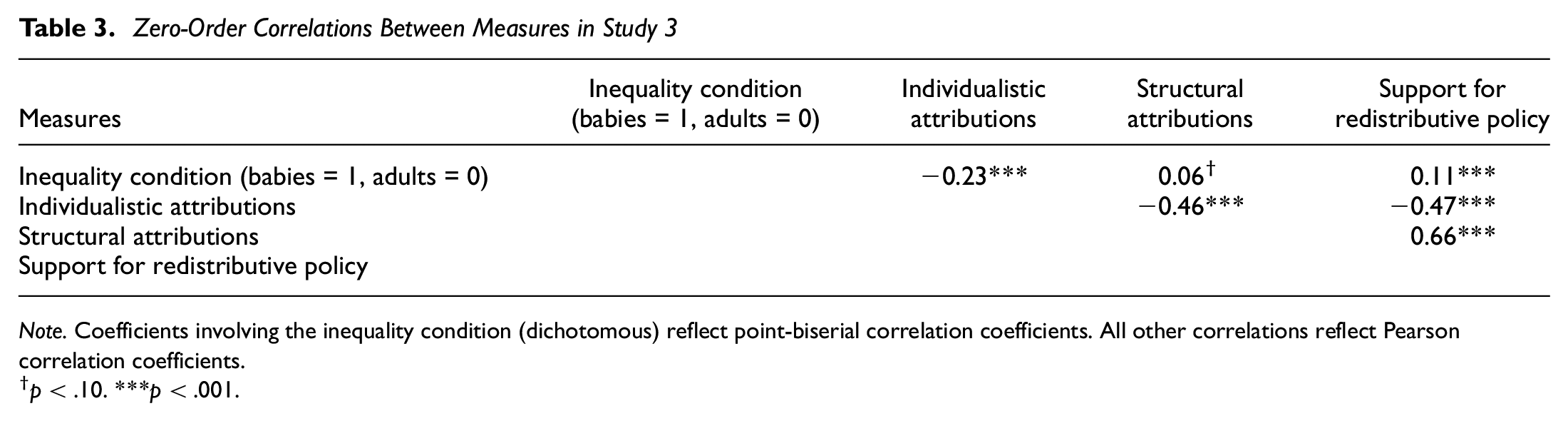
Note. Coefficients involving the inequality condition (dichotomous) reflect point-biserial correlation coefficients. All other correlations reflect Pearson correlation coefficients.
p < .10. ***p < .001.
The pattern of results is consistent with Hypothesis 2. Describing inequality between babies was negatively associated with individualistic attributions, r = −.23, p < .001, and positively (though not significantly) associated with structural attributions, r = .06, p = .071. We note that the manipulation was more strongly related to individualistic attributions (r = −.23) than to structural attributions (r = .06), t(993) = 5.39, p < .001. Meanwhile, support for the redistributive policy was negatively associated with individualistic attributions, r = −.47, p < .001, and positively associated with structural attributions, r = .66, p < .001. Here, we note that support for the redistributive policy was more strongly related to structural attributions (r = .66) than to individualistic attributions (r = −.47), t(993) = 7.85, p < .001. This highlights a potential asymmetry: Our intervention is most strongly related to individualistic attributions, while support for redistributive policy is most strongly related to structural attributions (see “General Discussion” for additional implications).
To better understand these relationships, we consider a preregistered mediation model in which inequality condition (dummy-coded: babies = 1, adults = 0) is simultaneously associated with both types of attributions and with policy support. This allows us to further clarify the relationships between variables beyond the zero-order correlations (i.e., estimating one attribution pathway while controlling for the other).
First, we observed significant associations between individualistic attributions (bi = −0.24, se = 0.03), z = −7.45, p < .001, and structural attributions (bs = 0.73, se = 0.03), z = 21.92, p < .001, on support for redistribution. A bootstrapped mediation analysis using the sem() function from the lavaan package in R (with 5,000 resamples; Preacher & Hayes, 2004) identified a significant indirect pathway through individualistic attributions (aibi = 0.17, 95% confidence interval = [0.11, 0.23]) and a nonsignificant indirect pathway through structural attributions (asbs = 0.12, 95% CI = [−0.01, 0.25]). The full set of estimates is provided in Figure 2.
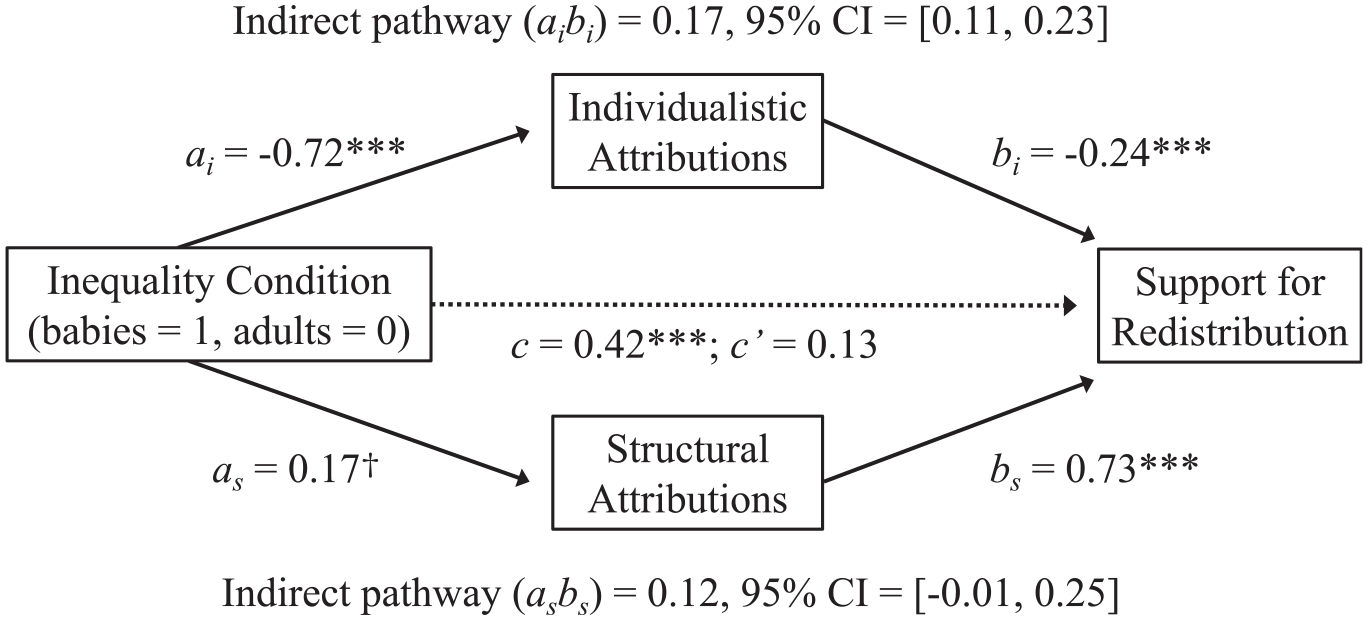
Study 3: Statistical Mediation Model Path Diagram
Although we caution that statistical mediation is not sufficient for establishing a causal pathway (Danner et al., 2015; Fiedler et al., 2011; Jacoby & Sassenberg, 2011), the patterns observed in Study 3 are consistent with shifts in attributions for inequality (Hypothesis 2). With multiple demonstrations of the basic effect and corroborating evidence for our proposed process, we examine a downstream consequence in our final study.
Study 4: Implications for Donation Behavior
In Study 4, we presented participants with a consequential choice. We predicted that describing inequality between babies (vs. adults) would increase willingness to forgo a modest chance to receive a (real) smaller bonus in exchange for making a (real) larger donation to a nonprofit committed to reducing economic inequality.
Method
A total of 1,010 participants were recruited from MTurk for Study 4, which was similar to Study 2a, with one exception. Rather than measuring support for redistributive policies, we presented participants with a consequential choice. Specifically, after reviewing information about Michael and Robert (who were 5-month-old babies or 35-year-old adults), participants learned they would have a chance to win a real bonus. They chose between a $10 payment credited to their MTurk account or a $100 donation to a nonprofit committed to reducing economic inequality (Jobs for the Future; https://jff.org). They selected “pay me $10 and donate $0 to reduce financial inequality” or “pay me $0 and donate $100 to reduce financial inequality.” We randomly selected a winner, who decided to take the $10 bonus.
Results and Discussion
All 1,010 participants were included in our analysis (Mage = 39.81; 50% female).
Participants were more likely to make the $100 donation (if they were selected as the winner) in the babies inequality condition (199/506; 39%) than in the adults inequality condition (143/504; 28%), χ2(1) = 13.53, p < .001, φ = 0.12.
This final study reveals that a subtle distinction in how inequality is merely described, as either between babies or adults, can affect a downstream choice. This result lends support to the potential real-world impact of our findings.
General Discussion
Economic inequality—measured in terms of income or wealth—is near historic levels in the United States and around the world (Atkinson et al., 2011; Horowitz et al., 2020; Milanović, 2016; Piketty, 2014; Saez & Zucman, 2016). In this research, we proposed and tested an intervention to boost support for redistributive policies to make people more equal. Specifically, we found that describing inequality at the beginning of life (between babies) versus in the middle of life (between adults) increased not only endorsement of various forms of redistribution, but also willingness to make an actual donation to an inequality-reducing cause. And consistent with our conceptualization, these effects coincided with a shift in beliefs about the underlying explanations for inequality (i.e., attributions).
Theoretical Implications and Limitations
An open question for future research is whether salience of inequality in opportunity, along with the resulting shift in underlying attributions, would trigger egalitarian responses more broadly, or whether they are specific to the focal depiction or description of inequality. For example, in Study 2a, we observed the intervention boosted support for both a redistributive policy specific to two individuals (Michael/Robert) and a more general tax-funded redistributive policy. In Study 2b, the intervention increased support for extending food assistance programs. Would similar effects be obtained for any class of redistributive policy, however concrete or abstract, designed to reduce inequality? Future research could further probe and define these boundaries.
Our results also suggest nuanced relationships between the intervention, individualistic and structural attributions for inequality, and support for redistribution. Consider the asymmetry noted in Study 3: the intervention was most strongly associated with a shift in individualistic attributions, while policy support was most strongly associated with structural attributions. Given this asymmetry, future research might prioritize ways to further shift structural attributions. Of course, the most effective intervention would be one that directly manipulates both individualistic and structural attributions (e.g., underscoring blamelessness of babies, toddlers, and children and highlighting broader economic and social inequalities).
In addition, the results of Study 1 suggest the effectiveness of our intervention may also depend on race—not only of those depicted or described as financially unequal, but also of those evaluating potential solutions. Specifically, in Study 1, the effect was moderated by whether participants reviewed photographs of Black or White faces. Notably, the Prolific and MTurk subject pools used for our experiments are predominately White (70%–80% are White; Douglas et al., 2023), and past work finds that racial majority groups are more likely to support welfare policies for their racial ingroup (Brown-Iannuzzi et al., 2019, 2021). However, we did not replicate this interaction in a preregistered supplemental study drawn from a similar population (i.e., MTurk; see Footnote 3). Additional research is needed to understand the reliability of any potential effects of race, and how to overcome any racial biases or stereotypes that may reduce the efficacy of this intervention.
Future research might also explore moderation by political orientation, which seems a natural extension of this work. For example, past literature suggests liberals tend to assume that the rich gain at the expense of the poor (i.e., zero-sum thinking), while conservatives tend not to assume the economic success of rich and poor are mutually exclusive (Davidai & Ongis, 2019). Conservatives, who rely more on individualistic attributions (Bobbio et al., 2010; Zucker & Weiner, 1993), may be especially swayed by depictions and descriptions of inequality among babies—though we note that even within political groups there remains meaningful variation in endorsement of such beliefs (Horowitz et al., 2020).
We acknowledge two important caveats for interpreting our results. First, in Study 4, participants faced a small probability of realizing a consequential outcome (i.e., we exercised the actual choice of one randomly selected participant). Follow-up work could replicate this finding in a large-scale, incentive-compatible field study and potentially capture sensitivity to the magnitude of the self-other trade-off (e.g., we tested only $10 for the self vs. $100 for the charity).
Second, our studies sampled exclusively from American participants on both Prolific and MTurk. Generalizability beyond the United States (and other western cultures) represents a broader challenge for research in psychology (Thalmayer et al., 2021). This is especially relevant given our focus on attributions for inequality, which are culturally dependent. For example, East Asians tend to attribute behavior more to collective as opposed to individual dispositions (Menon et al., 1999; Oyserman et al., 2002). And belief in a just world—the notion that people get what they deserve (Lerner & Miller, 1978)—not only consistent with individual attributions for inequality, but also varies across cultures (Furnham, 1993; Rubin & Peplau, 1975).
These cross-cultural differences yield several opportunities for future research. For example, people who perceive a greater overlap between the self and others (i.e., interdependent self-construal; Markus & Kitayama, 1991) may be less sensitive to inequality of opportunity, as they may generally make fewer individualistic attributions for outcomes. Or consider that rates of economic mobility exhibit considerable variation around the world (Narayan et al., 2018). Research in other nations—particularly those with differing levels of income inequality and intergenerational mobility—may yield more nuanced patterns.
Practical Implications and Implementation
This research highlights a cheap, simple, and reliable method to boost support for redistributive efforts, complementing recent work exploring similar effects resulting from higher-involvement manipulations (e.g., writing exercises and computer-based poverty simulations; Piff et al., 2020).
Organizations committed to reducing inequality, therefore, might harness the simplicity of this intervention to recruit and reinforce public support for redistributive efforts. For example, our results suggest nonprofits should not only feature babies, toddlers, and children more prominently in their fundraising campaigns, but also emphasize their lack of responsibility for their outcomes. Relatedly, donors could be explicitly encouraged to think about how their individual outcomes in midlife connect to the structural opportunities they enjoyed early in life. People might thus be motivated to create more of those opportunities for the less fortunate through their prosocial actions.
This research also suggests rhetorical insights for policymakers. For example, it may be more politically effective to promote baby bonds to pay for college, as opposed to student loan forgiveness for adults; criminal justice reforms could be reframed as restoring equal economic opportunities for the families of those incarcerated; or, when natural disasters such as floods and fires destroy houses, reconstruction efforts might highlight children who lost their homes (and thus access to the opportunities enabled by a stable living environment), rather than property owners who lost their assets. In each case, the same policy goal might be better achieved by thinking creatively about how to shift attention from outcomes to opportunities.
Finally, we expect that the basic insight underlying our findings could be leveraged more broadly, beyond just solutions for wealth and income inequality. For example, consider other outcomes that are not strictly financial (e.g., morbidity and mortality rates), which might also trace back to unequal opportunities relating to diet, exercise, and health care in early life; disparities in academic achievement may follow from disparities in academic access; business successes may follow from early-stage support. Thus, describing or depicting inequality at either end of these spectrums (e.g., opportunities vs. outcomes) could help achieve a wide range of policy goals (e.g., health care, education, business).
Conclusion
People generally prefer to live in a society with less inequality (Kiatpongsan & Norton, 2014). As noted, people report higher levels of mental health, physical health, and happiness when income inequality is low, and positive macroeconomic effects seem to follow. This research leverages insights from behavioral science to help increase support for redistributive efforts, with clear implications for improving societal welfare across generations.
Footnotes
Acknowledgements
The authors thank reviewers, participants, and audience members at the 2022 Society for Consumer Psychology Boutique Conference; the 2021 Association for Consumer Research Conference; the Technology, Race, and Prejudice Lab; and Aziza Jones for their valuable insights. We also thank the entire review team for their useful suggestions, feedback, and guidance.
Handling Editor: Unkelbach Christian
Declaration of Conflicting Interests
The author(s) declared no potential conflicts of interest with respect to the research, authorship, and/or publication of this article.
Funding
The author(s) disclosed receipt of the following financial support for the research, authorship, and/or publication of this article: The authors would like to express gratitude to the Morrison Center for Marketing and Data Analytics at UCLA Anderson for its financial support, which helped make this research possible.
