




Abstract
Although system-justifying beliefs can have a palliative effect on citizens, the underlying mechanisms and contextual moderators of this association are relatively unknown. Because system threats are likely to strengthen a defensive bolstering of the system, we assumed that the motivational factors behind system justification exert a stronger palliative effect in more dysfunctional systems. Specifically, we hypothesized that belief in a just world (BJW) would enhance well-being, particularly in countries with low system performance. Using nationally representative data from 29 countries (N = 49,519), multilevel analyses revealed indirect effects of BJW on subjective well-being via attitudes toward the system. Notably, these effects were stronger in countries with lower system performance. Our findings suggest that dysfunctional political-institutional systems can catalyze the bias of BJW in citizens’ perception of system performance, thus influencing subjective well-being. This highlights the importance of considering the social context when examining the palliative and system-justifying functions of BJW.
Introduction
Psychological well-being is significantly influenced by the social and political system in which we participate, as well as our attitude toward that system. However, system-related attitudes may not always align with reality. Indeed, they can be influenced by biased beliefs about the social world, such as the belief in a just world (BJW). BJW refers to the general belief that the social world operates fairly, with individuals receiving rewards and punishments based on their merits, thereby deserving their outcomes (Lerner, 1980). Research indicates that higher levels of BJW are associated with more positive subjective well-being and favorable attitudes toward the societal-political system (Hafer & Sutton, 2016).
System justification theory (Jost & Banaji, 1994) underscores the significance of BJW as a driving factor behind the belief that society and its social arrangements are fair, just, and desirable. The theory posits that positive views about the system serve as a protective function for psychological well-being, thereby providing a palliative benefit for endorsers (Jost & Hunyady, 2003). Moreover, empirical evidence suggests that these palliative effects are more pronounced in problematic systems and contexts (Napier, Bettinsoli, & Suppes, 2020). System-level problems can be considered a threat to the system, and such contextual threats induce system-justifying tendencies to restore the sense of justice and security (Kay & Zanna, 2009).
In this article, we expand upon the existing literature on the relationship between BJW, social attitudes, and the palliative function of system justification. We emphasize the crucial role of the social context. Our aim is to demonstrate that a negative context not only amplifies the palliative effect of positive views about the system, but also catalyzes the underlying motivations that give rise to these positive views. We demonstrate that BJW contributes to subjective well-being, partially through fostering a more positive attitude toward the system. Importantly, we also find that threatening contextual factors (namely, poor system performance) exerts a dual influence on the relationship between BJW, system attitudes, and subjective well-being. First, BJW provides greater protection for positive system attitudes in the face of lower system performance. Second, these distorted positive attitudes possess stronger palliative power in more problematic systems, as negative environments have the potential to intensify motivated misperceptions of the system.
System Justification and BJW
The relationship between positive system attitudes and BJW is a focal point in system justification theory (Jost & Banaji, 1994). In an unjust society, individuals experience emotional harm and distress, compelling them to perceive the social system, its institutions, leaders, practices, and arrangements, as fair, functional, and legitimate (Jost, 2019, 2020). To achieve this, a range of ideological beliefs rationalize social inequalities and the institutional, economic, and political practices that create and uphold them. These beliefs encompass racist and sexist views, the belief in meritocracy and social mobility, right-wing authoritarianism, anti-egalitarianism, and social and economic conservatism (Jost, 2020; Jost et al., 2003). By aligning personal beliefs with reality, these system-justifying beliefs frame inequalities and established societal structures as justified, fair, or natural. Moreover, the perception of reality can also be distorted to maintain a favorable attitude toward the system. Consequently, motivated processes, such as misperception, ignorance, and denial of significant social problems serve as tools for system justification (Feygina et al., 2010; Napier, Bettinsoli, & Suppes, 2020; Shepherd & Kay, 2012).
Lerner’s (1980) work on just-world beliefs is one of the fundamental theoretical underpinnings of system justification theory. As strong BJW motivates individuals to uphold their belief in the world’s justice, it becomes a crucial motivational factor for system justification and positive system attitudes (Jost, 2020; Jost & Banaji, 1994). BJW validates social inequalities by endorsing the notion that each social group’s position within the societal hierarchy is deserved, stemming from their essential positive and/or negative characteristics (Appelbaum et al., 2006; Lerner, 1980; Oldmeadow & Fiske, 2007). In addition, just-world beliefs reinforce the perception that political and social institutions, as well as their incumbents, operate fairly and with trustworthiness, both in terms of decision-making processes and outcomes (Correia & Vala, 2004; García-Sánchez et al., 2022; Gulevich & Sarieva, 2020; Martin & Cohn, 2004).
The Palliative Function of System Justification and BJW
Empirical evidence demonstrates that positive illusions based on BJW have a significant impact on people’s subjective well-being. Just-world beliefs enhance individuals’ sense of control, as they believe they can anticipate the outcomes of their actions, including rewards and punishments (Feinberg et al., 1982; Hafer & Sutton, 2016). In addition, BJW provides a meaningful interpretation of random life events (Dalbert, 1999; Hafer & Sutton, 2016; Lerner, 1980). Consequently, the belief that we reside in a fair and just social environment, where everyone receives what they deserve, elevates subjective well-being (Correia & Vala, 2004; Dalbert, 1999; Ucar et al., 2019).
System justification theory also highlights the societal-level relationship between just-world beliefs and subjective well-being. The crucial function of system justification is to alleviate anxiety and other forms of psychological distress that would arise from recognizing undeserved inequalities and injustices. Through this palliative function, system justification processes help safeguard and nurture individuals’ psychological health and subjective well-being (Jost & Hunyady, 2003). Relevant research indicates that ideological beliefs that rationalize the status quo are indeed associated with higher levels of subjective well-being. Sexism, racism, belief in meritocracy and social mobility, and conservatism justify unjust and/or unequal social arrangements, thus preserving subjective well-being (McCoy et al., 2013; Napier et al., 2010; Napier & Jost, 2008; Sengupta et al., 2017). Similarly, misperception and denial of significant social problems also contribute to this palliative effect. For instance, denial of group-based discrimination (Bahamondes et al., 2019; Suppes et al., 2019) and climate change (Hadarics, 2021) are also associated with higher subjective well-being.
Contextual Effects and the Palliative Function
Cumulative evidence indicates that certain contextual factors amplify both system justification and its palliative effect. As emphasized by Friesen et al. (2019); Kay & Friesen (2011), system threat is one of the most fundamental of these factors. As people are motivated to live in a safe and just society, they are more likely to engage in system justification if this sense of security or the image of a just society is challenged or threatened. Under such circumstances, people tend to restore their sense of justice by defensively bolstering of the status quo.
In line with this, a related body of research on the palliative function of ideological views shows that once system-justifying views have been accepted, they protect subjective well-being to a larger extent in more threatening contexts (Napier, Bettinsoli, & Suppes, 2020). In the majority of the relevant studies, system threat appears as the objective magnitude of various societal problems, and the results indicate that the larger the problem, the more pronounced the palliative effect of its justification becomes. For instance, belief in meritocracy exhibits a stronger relationship with subjective well-being in countries with larger income inequalities (Hadarics et al., 2021; Rözer & Kraaykamp, 2013). Similarly, sexist views provide greater protection for subjective well-being in countries with more significant gender inequalities (Napier et al., 2010), and racist views have a more pronounced effect in more unequal contexts (Sengupta et al., 2017). Furthermore, right-wing ideology demonstrates a stronger association with psychological well-being in contexts characterized by higher levels of inequality and threat (Napier & Jost, 2008; Onraet et al., 2017).
Misperceiving societal problems possesses greater palliative power when confronted with more significant and threatening issues. Napier, Suppes, and Bettinsoli (2020) found that denial of gender discrimination predicts subjective well-being to a greater extent in countries with higher levels of sexism. Likewise, climate change denial has a stronger palliative effect in countries more exposed to the adverse societal consequences of climate change (Hadarics, 2021). The wider the discrepancy between an inconvenient or threatening reality and our perception of it, the greater the emotional payoff may be.
System Attitudes as Reflections of System Performance
As people’s tendency to system justification is often measured by the expression of positive attitudes toward the system, it is worth considering the bases and indicators of these attitudes. Focusing on the political-institutional system, an array of concepts tapping into the perceived performance in advancing the common good plays an important role in this regard. For example, reflecting on the broader system justification literature (Jost, 2019), the items of the System Justification Scale (Kay & Jost, 2003) apply perceived social justice, equality of opportunities, and policies for the greater good as specific evaluative dimensions. The aspect of the common good appears also in experimental research investigating the contextual effects of system justification. Several of these experiments apply criteria that are not directly tied to social equality and justice but rather reflect political performance, such as crisis management or economic efficacy (e.g., Kay et al., 2005; Shepherd & Kay, 2014).
Political trust and satisfaction with different aspects of political performance have been applied as indicators of positive system attitudes and system justification (Brandt, 2013; Caricati, 2019; Szabó & Lönnqvist, 2021). The significance of trust is understandable as the perceived trustworthiness of any social target is among the most decisive determinants of the overall attitude toward that target (Goodwin et al., 2014; Landy & Uhlmann, 2018). Furthermore, political trust is also closely related to political performance. The performance of a political-institutional system in terms of economic prosperity, quality public services, and fair decision-making and distributional processes is considered a fundamental basis for political trust and legitimacy within the political support literature (Easton, 1965; Norris, 2017). Correspondingly, empirical evidence shows that the quality of performance in areas, such as democracy, the national economy, welfare services, and legal justice is strongly associated with positive attitudes toward the political-institutional system (Grimes, 2017; Kumlin, 2004; Listhaug & Jakobsen, 2018; van der Meer, 2017). In sum, perceived system performance in advancing the common good in terms of justice and welfare, along with the trust that develops based on these perceptions, serve as pivotal indicators of system attitudes.
BJW-Based System Attitudes in a Negative Environment
Given that BJW can serve as a foundation for positive system attitudes (Hafer & Sutton, 2016), BJW may contribute to subjective well-being by fostering positive views and attitudes toward the political-institutional system. However, as we have observed, BJW can also motivate processes aimed at upholding the illusion of a fair and well-functioning society (Jost, 2020; Lerner, 1980). Nevertheless, the concept of an illusion implies a discrepancy between perception and reality. In a well-functioning, stable, and egalitarian society, positive views are more justifiable based on the actual state of affairs. Thus, we argue that the reality of the societal context must be taken into account when examining and interpreting this relationship.
Beyond the assumption that the influence of BJW on subjective well-being is mediated by positive system attitudes, we posit that a threatening reality impacts both sides of this mediated process. Specifically, we contend that the social context’s reality can act as a catalyzer for motivated social cognition, heightening the influence of social needs on biased perceptions and attitudes, as well as the palliative effect of these attitudes.
With regard to the latter effect, existing evidence suggests that positive perceptions, despite a negative reality, enhance psychological well-being, and the greater the disparity, the more pronounced the palliative effect of motivated perceptions to mitigate the detrimental effects of a threatening reality (Hadarics, 2021; Napier, Suppes, & Bettinsoli, 2020). If we extend this principle to system attitudes, we can anticipate that positive views of the system will exert a stronger impact on subjective well-being within an underperforming system plagued by process and outcome problems. Ignoring and denying these issues can have a palliative effect, and the larger the magnitude of the actual problems, the more potent the palliative effect of misperception is anticipated to be.
Furthermore, BJW can compel individuals to develop and defend positive system attitudes, particularly when reality contradicts these optimistic attitudes in the form of a dysfunctional societal and political system. Consequently, the biasing effect of BJW on system attitudes and views should be most pronounced when reality fails to support positive attitudes and instead contradicts them. In such cases, BJW is anticipated to create a divergence between perception and reality to uphold the positive illusion of a well-functioning political-institutional system.
The Current Study
In the study presented below, we aimed to gather empirical evidence supporting the assumption that a negative social context catalyzes the palliative function of BJW. Our first hypothesis was that just-world beliefs would affect subjective well-being partly through a positive attitude toward the societal-political system. More importantly, we also hypothesized that the actual quality of the system would moderate both the effect of BJW on system attitudes and the effect of system attitudes on subjective well-being. We expected both of these effects to be stronger in more underperforming systems. The two hypotheses were tested using data from the ninth round of the European Social Survey (ESS) Program extended with data from international country ranking data sets to quantify system performance.
Data Sets and Measures
The ESS is a multinational survey program to explore the beliefs, affections, and attitudes of European citizens regarding a variety of societal and political issues. A special topic of the ninth data collection round (European Social Survey [ESS] Round 9 Data, 2018) was European citizens’ views on social justice, including their just-world beliefs. The data set from this round contains data from the probabilistic representative samples of 29 European countries. 1 The following ESS items were used in the study. 2
BJW
Just-world beliefs were measured on a 5-point scale with the following three items: “I think that, by and large, people get what they deserve”; “I am confident that justice always prevails over injustice”; “I am convinced that in the long run, people will be compensated for injustices.”
System Attitudes
Positive views about the societal and political system were measured by three main indicator groups. The first was political trust since the perceived trustworthiness of any social actor is a key component of the general attitude toward them (Landy & Uhlmann, 2018). Political trust was measured by three items (trust in parliament, legal system, and police). Another indicator was perceived performance in four areas of the political-institutional system (state of health care, and education; satisfaction with democracy, and economy). The third indicator was perceived equality of opportunities, which is an essential and widely supported aspect of social justice in democratic countries (Jost & Kay, 2010). This indicator was measured by two items (“Overall, everyone in [country] has a fair chance of . . .” (1) “achieving the level of education they seek”; (2) “getting the jobs they seek.”). All these indicator items were measured on 11-point scales (0–10).
Subjective Well-Being
Respondents’ subjective well-being was indicated by their life satisfaction and happiness (0–10 scales).
System Performance
We applied the Inequality-Adjusted Human Development Index (IHDI, United Nations Development Programme, 2023) as an indicator of system performance. The aim when creating the index was to widen the narrow focus on economic performance to a broader perspective emphasizing people-centered policy outcomes when evaluating the performance of national political systems (Land, 2015). Based on objective demographic data, the IHDI reflects the most important dimensions of system performance and quantifies how effective the political-institutional system is in providing its citizens with the three basic pillars of development and well-being: a long and healthy life, being knowledgeable and having a high standard of living. Furthermore, the IHDI also indicates how equitable the distribution of these benefits is across society. By incorporating measures of income inequality, education, and health disparities, the IHDI provides a nuanced understanding of a system’s performance in promoting welfare and reducing disparities. The quantification of the three pillars of the IHDI and their distribution is also in line with our indicators of system attitudes, since the latter ones incorporate the perception of the performance areas (education, health care, economy, democracy, and social justice) that produce these outcomes. 3
Control Variables
Additional control variables from the ESS database were respondents’ gender (0 = man; 1 = woman), age, education (according to the levels of the International Standard Classification of Education, household income (1 = lowest decile; 10 = highest decile within the country), ethnic minority status (0 = no; 1 = yes), self-reported religiousness (0 = not at all religious; 10 = very religious), and left–right ideological identification (0 = left; 10 = right).
Data Analysis
We applied multilevel structural equation modeling to test these hypotheses with the MPlus 8.6 software (Muthén & Muthén, 1998–2017). In each analysis, we used full-information Bayesian estimation with 100,000 iterations (with the first half of these as the burn-in phase), two Markov chain Monte Carlo (MCMC) chains, and a thinning rate of 10. We used priors with a mean of zero, an infinite variance, and a normal distribution in the case of each estimation, which works well in the case of samples with a high number of observations (Asparouhov & Muthén, 2010). Bayesian estimation was applied because evidence shows that this approach gives reliable model estimates with sample sizes and data structures typically found in the case of multinational data sets like the ESS (Hox et al., 2012). Proportional Scale Reduction (PSR) factor values indicated that model convergence was achieved in the case of each analysis (< 1.05).
To test the hypotheses, a multilevel structural equation model (SEM) was set up, where we predicted the within-level variance of subjective well-being by the within-level variance of system attitudes and BJW, while system attitudes were also predicted by BJW. These within-level model effects were controlled with the effects of the control variables. To model the cross-level interactions, the effect of BJW on system attitudes, and the effect of system attitudes on subjective well-being were defined as random slopes that could vary across countries. IHDI was then regressed on these random slopes to see whether these slopes change as a function of it. Subjective well-being, system attitudes, 4 and BJW were defined as latent variables from the within-variances of their indicator items. 5
Results
Descriptive statistics of the variables are reported in Table 1. Measurement invariances between countries of the latent variables on the within-level were tested by a maximum likelihood estimation-based multigroup confirmatory factor analysis. For that purpose, we set up a multigroup model with these latent variables and checked for configural and metric invariance. 6 Both the configural and the metric invariance models showed good fits (configural: comparative fit index [CFI] = .961; root mean square error of approximation [RMSEA] = .052; standardized root mean square residual [SRMR] = .041; metric: CFI = .952; RMSEA = .054; SRMR = .052). To evaluate metric invariance, we applied the criteria suggested by Chen (2007), which were met (ΔCFI < .010; ΔRMSEA < .015; ΔSRMR < .030). The psychometric qualities of the latent variables with three or more indicators were tested by their SRMR values in separate multilevel models for each variable since this fit measure can be computed by maximum likelihood estimation separately to the “within” and “between” levels. This was an important criterion because each latent variable was constructed only on the “within” level. The SRMR values indicated good fits for both latent variables that were put into the final random slope multilevel model (SRMRBJW = .000; SRMRsys-att = .021) The fit of the full measurement model of the “within” level with all three latent variables was also adequate (SRMR = .032).
Descriptive Statistics and Estimated Variances
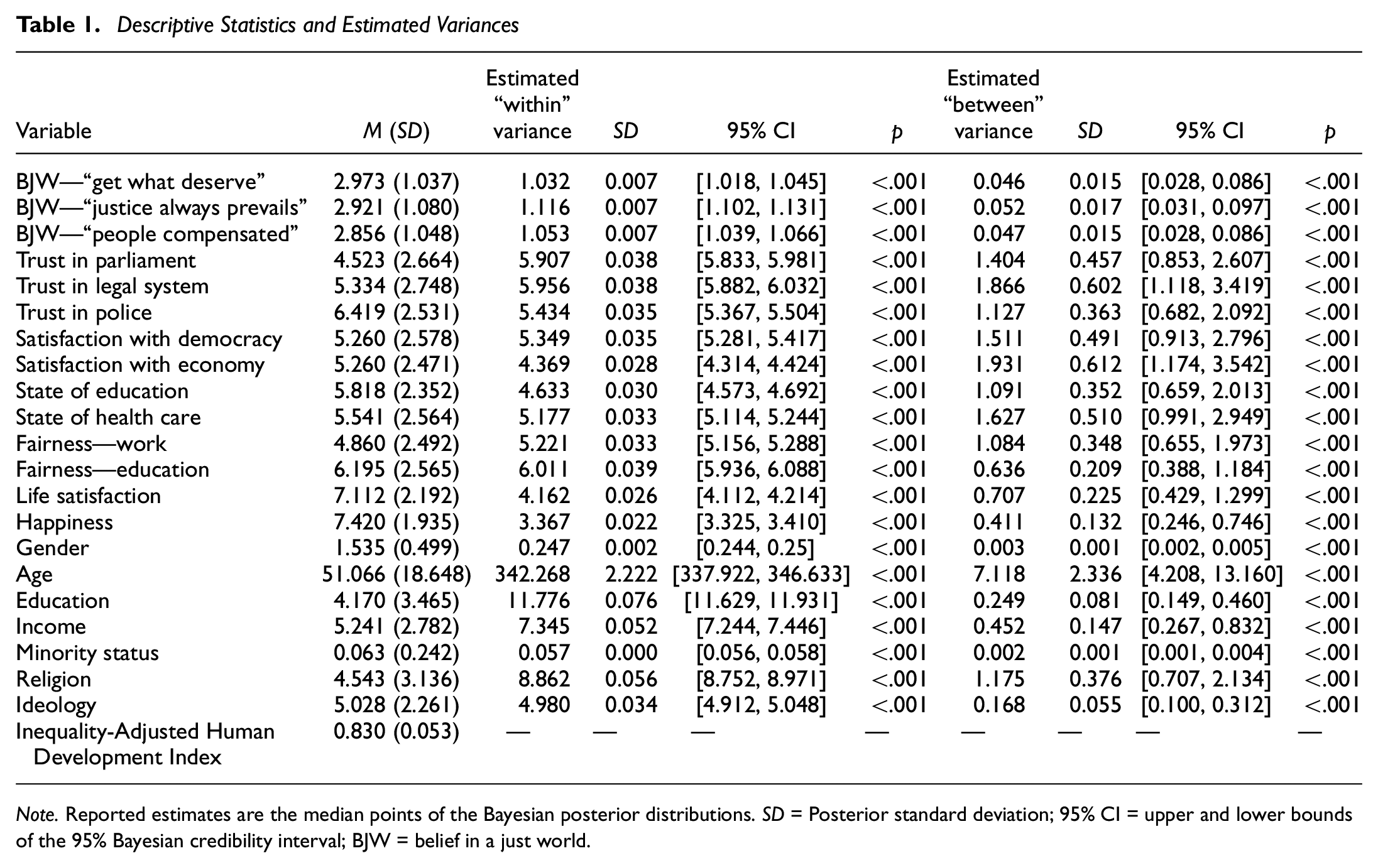
Note. Reported estimates are the median points of the Bayesian posterior distributions. SD = Posterior standard deviation; 95% CI = upper and lower bounds of the 95% Bayesian credibility interval; BJW = belief in a just world.
The main results of the multilevel moderated mediation model are shown in Figure 1. The details of this model can be found in the Online Supplementary Material Table 4, and here we only report the most relevant results. These indicate a positive relationship between BJW and system attitudes (b = .51; p < .001), just like between system attitudes and subjective well-being (b = .59; p < .001). Accordingly, the indirect effect of BJW on subjective well-being was also significant (b = 0.30; p < .001). Most importantly, IHDI moderated both the effect of BJW on system attitudes (b = –1.34; p = .046) and the effect of this latter on subjective well-being (b = –1.72; p = .004). The results of a series of subsequent simple slope analyses showed that both of these relationships were gradually increasing with the weakening of IHDI (see Table 2). Consequently, the indirect effect of BJW on subjective well-being also became stronger at lower levels of IHDI.
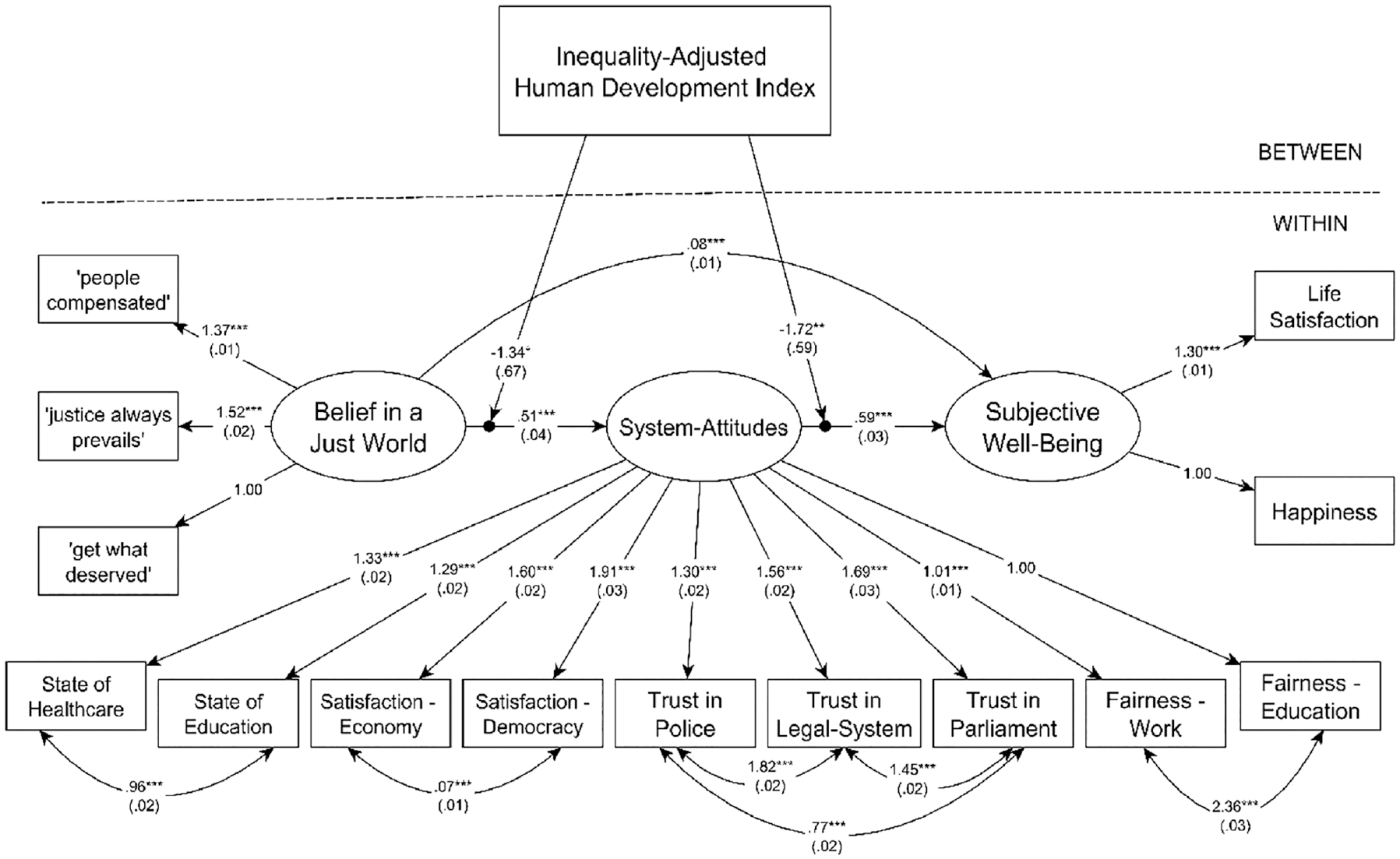
Multilevel Model Predicting the Indirect Effect of BJW on Subjective Well-Being Mediated by System Attitudes and Moderated by IHDI
Simple Slope Analysis for Direct and Indirect Effects Moderated by IHDI
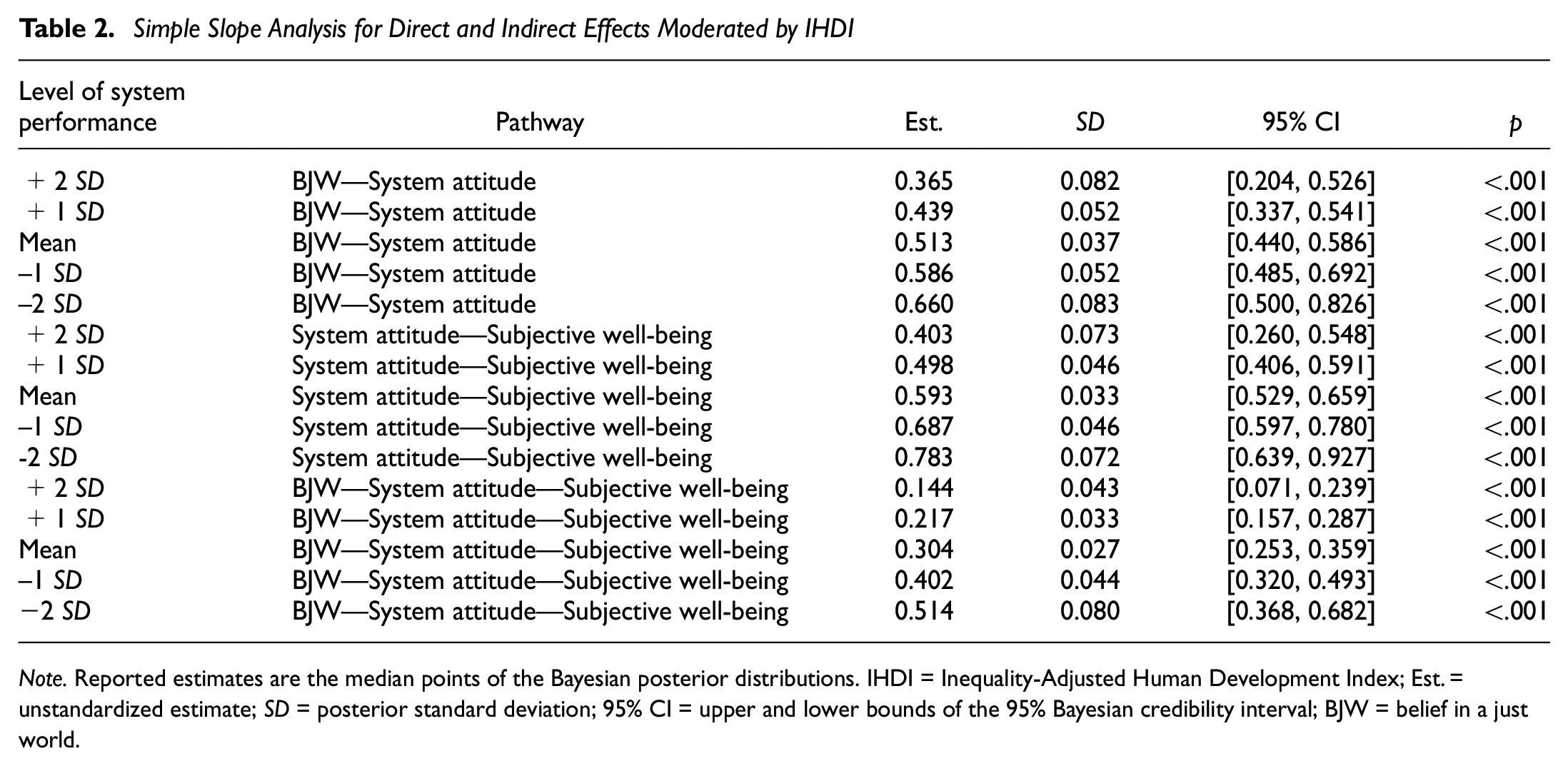
Note. Reported estimates are the median points of the Bayesian posterior distributions. IHDI = Inequality-Adjusted Human Development Index; Est. = unstandardized estimate; SD = posterior standard deviation; 95% CI = upper and lower bounds of the 95% Bayesian credibility interval; BJW = belief in a just world.
Discussion
Our research makes a contribution to the literature on the palliative function of motivated perceptions concerning the political system, shedding light on the intricate interplay between the social context, motivated perceptions, and subjective well-being. It becomes evident that a threatening reality acts as a catalyzer for motivated social cognition, influencing the strength of various interconnections between beliefs and emotions that play a role in the palliative effect of positive system perceptions. Particularly, when the system performs poorly, the influence of BJW in creating a divergence between subjective perceptions and the negative reality is amplified, mitigating the contextual threat by strengthening the palliative effect of these misperceptions.
Consistent with system justification theory, prior research demonstrates that beliefs contradicting a negative social reality can protect subjective well-being (Hadarics, 2021; Napier, Suppes, & Bettinsoli, 2020). Nonetheless, any exact motivational forces leading to misperception were absent from the relevant studies. Our results present the context-dependent effect of BJW, which is an essential motivational force behind system justification. The results indicate that BJW leads to positive perceptions that diverge from real societal conditions, and the worse these conditions are, the stronger motivated perceptions emerge based on BJW.
Taking a look at the other side of the same coin, it is probable that those who are not bound by BJW form more negative views about a dysfunctional system, the more problematic the system is, the more negative views. In this sense, personal attitudes fit with an inconvenient reality, but those with higher levels of BJW, bend their perception of reality in a more positive direction. If the perception of the system is accurate, it is reasonable to assume that the more dysfunctional the system is (and it is perceived accurately), the heavier the price citizens have to pay in terms of their subjective well-being. However, if BJW-based misperception results in biased evaluations, the drop in subjective well-being can be prevented. In this way, a negative social environment functions as a catalyzer for both motivated misperception and its palliative effect.
In our study, we concentrated on the influence of a specific motivational force, just-world beliefs, but future research should investigate the context-dependent nature of additional relevant motivational factors. Well-defined epistemic, existential, and relational needs are highlighted as basic motivations behind system justification (Jost, 2019; Jost et al., 2003), and it is probable that a negative social context has the potential to catalyze the effect of these motivational factors as it did in the case of BJW. It is equally important to emphasize that we investigated the interplay between subjective views and the objective context in the case of general system performance and performance-based subjective attitudes. Accordingly, the applied criteria for performance evaluation (e.g., economic efficacy, high-quality public service outcomes, equality of opportunity) are widely supported in developed countries, which is why they are among the most important foundations of political support (Listhaug & Jakobsen, 2018). Nonetheless, the evaluations of other outcome dimensions of the system are not that consensual and are more tightly related to one’s social status. System outcomes like inequalities in terms of wealth, gender, or minority status can be rationalized by different corresponding antiegalitarian justifying beliefs, and there is evidence indicating that these beliefs have a stronger palliative effect for those in a low-status position (Bahamondes-Correa et al., 2019; Li et al., 2020; Osborne & Sibley, 2013). Future research should test the potential catalyzer role of the objective context for different social groups in a disadvantaged status. It is possible that an adverse unequal reality boosts the effect of motivational factors like BJW to a higher extent for members of low-status groups. In this way, social status may further moderate the effects of motivated misperceptions and their palliative effect.
It is also worth emphasizing that we used one indicator for system performance. IHDI aims to show precisely what we were interested in, that is, how effectively and fairly the system creates well-being for its citizens in terms of health, education, and wealth. The application of one general performance index was also beneficial to avoid model estimation problems due to the limited degrees of freedom and potential multicollinearity on the between-level, which can be a serious threat in multilevel modeling (Schmidt-Catran et al., 2019). Although the high correlations between IHDI and other indicators of specific performance areas support IHDI as a valid indicator for system performance, future research should test the distorting effect of BJW in the case of more specific performance dimensions too.
Our study was based on data gathered from the representative samples of 29 European countries with answers from 49,519 respondents in total. Despite a large number of observations, the cross-sectional nature of the data made it unsuitable for determining the direction of the relationships between the variables of interest. Nonetheless, there is empirical evidence verifying the directions set up in our model. At least, one longitudinal study showed that BJW was a temporal antecedent of political trust, an indicator of positive system attitudes (Umemura & Šerek, 2016). Similarly, longitudinal and experimental studies also support the idea that endorsement of system-justifying views leads to an increase in subjective well-being (Vargas-Salfate et al., 2018; Wakslak et al., 2007). However, more recent theorizing about the bases of BJW suggests that former experiences with justice might be important antecedents of just-world beliefs (Fasel & Spini, 2010; Hafer & Sutton, 2016). If this is the case, we cannot rule out the possibility that personal experience with injustice perpetuated by representatives of the political-institutional system might cause deflation in BJW and system attitudes simultaneously as a confounding variable in this relationship pattern. Future research should consider this possibility too. Another limitation of this study is that we could only investigate contextual variation within Europe. While there is considerable variation in the performance of different European countries, much larger performance differences exist throughout the world. Therefore, extending the research to include regions beyond Europe is needed to examine the generalizability of our results.
Conclusion
Our results demonstrate that contextual factors play a significant role in the functioning of psychological mechanisms related to political support. Negative social contexts serve as catalyzers for motivated misperception and its palliative effect. One reason why we feel good is the belief that the political-institutional system that we depend on effectively creates and maintains the conditions for a meaningful and comfortable life. Even so, if the system is unable or unwilling to provide these conditions, just-world beliefs can create the illusion of an effective system and neutralize a threatening reality. However, this illusion is only needed if reality contradicts the expectations. Hence, context matters. It is reasonable that motivated social cognition starts to operate where and when certain motivations oppose reality constraints. An underperforming system can threaten one’s belief that the social world is a just and safe place, consequently, misperception of such a dysfunctional system can protect our psychological well-being.
Supplemental Material
sj-docx-1-spp-10.1177_19485506231204463 – Supplemental material for Belief in a Just World as a Basis for Biased System Attitudes and Their Palliative Effect: The Context Matters
Supplemental material, sj-docx-1-spp-10.1177_19485506231204463 for Belief in a Just World as a Basis for Biased System Attitudes and Their Palliative Effect: The Context Matters by Márton Hadarics and Anna Kende in Social Psychological and Personality Science
Footnotes
Handling Editor: Osborne Danny
Data Availability
The author(s) confirm(s) that the data supporting the findings of this study are available within the reference list of the article.
Ethical Approval
This study required no ethics approval.
Declaration of Conflicting Interests
The author(s) declared no potential conflicts of interest with respect to the research, authorship, and/or publication of this article.
Funding
The author(s) disclosed receipt of the following financial support for the research, authorship, and/or publication of this article: The work was supported by the National Research, Development and Innovation Fund. The organization providing the grand is a Hungarian public institute functioning under the supervision of the Ministry of Culture and Innovation (Grant Number: K-138429).

Supplemental Material
Supplemental material is available in the online version of the article.
Notes
Author Biographies
References
Supplementary Material
Please find the following supplemental material available below.
For Open Access articles published under a Creative Commons License, all supplemental material carries the same license as the article it is associated with.
For non-Open Access articles published, all supplemental material carries a non-exclusive license, and permission requests for re-use of supplemental material or any part of supplemental material shall be sent directly to the copyright owner as specified in the copyright notice associated with the article.
