




Abstract
Numerous studies have demonstrated a link between neuroticism and negative biases. Although some studies suggest that people with high neuroticism give more weight to negative information, others suggest that they respond more strongly to both positive and negative information. We investigated whether neuroticism is related to the evaluation of conditioned stimuli (CSs) in evaluative conditioning procedures that involve ambiguous learning conditions. We created ambiguous situations where CSs were paired with unconditioned stimuli (USs) consisting of both positive and negative pictures (Experiment 1) or paired alternatingly with positive and negative USs (Experiment 2). In addition to CSs consistently paired with positive and negative USs, we introduced neutral USs as a control condition. Our findings revealed that neurotic individuals negatively evaluated the CSs from ambiguous conditions relative to neutral conditions. In addition, participants with high neuroticism scores generally rated CSs more negatively. Theoretical and clinical implications of these results are discussed.
Neuroticism is one of the most investigated personality traits in the five-factor model (FFM) due to its association with both physical and mental health (e.g., Lahey, 2009; Sauer-Zavala & Barlow, 2021). It is characterized by the tendency to experience more frequent and intense negative emotions, perceiving the world as a generally dangerous place, and overreacting to both external and internal sources of stress, even if they are minor (Barlow et al., 2014; Eysenck, 1947; Goldberg, 1993). Recent meta-analytic findings have confirmed the link between heightened neuroticism and an increased propensity to experience negative affect (Kalokerinos et al., 2020).
The study of neuroticism is particularly important because it has been found to foster the development and maintenance of psychopathology, particularly in the context of mood disorders such as anxiety and depression (e.g., Barlow et al., 2014; Ormel et al., 2013; Vittengl, 2017; see the meta-analysis of Kotov et al., 2010). It has been argued that the onset, maintenance, and recurrence of mood disorder symptoms are rooted in a negativity bias in information processing (Beck & Haigh, 2014; Beck et al., 1979). Substantial empirical evidence indeed documents the link between negativity bias and neuroticism, emphasizing that highly neurotic people tend to give more weight to and selectively process negative internal and external information. For instance, Chan et al. (2007) concluded that people who score high on neuroticism show an increased tendency to process negative information and a decreased tendency to process positive information. Studies on neuroticism and attentional bias have also demonstrated that people with higher neuroticism scores allocate more attentional resources to negative stimuli and have difficulty withdrawing attention from them (e.g., Chen & Zheng, 2005; Rijsdijk et al., 2009). In addition, research on neuroticism and memory revealed that high levels of neuroticism are associated with a tendency to recall negative events (e.g., Gomez et al., 2002; Norris et al., 2019).
In this article, we focus on whether neuroticism is also associated with a negativity bias in emotional learning; more specifically, the effects of contingencies that involve negative events. According to Sauer-Zavala and Barlow (2021), a bias in emotional learning could lead to the acquisition of pathological behavior patterns. For instance, increased sensitivity to negative social consequences of public speaking could increase the likelihood of developing social anxiety. Our focus is on one emotional learning type, evaluative conditioning (EC). As a procedure, EC involves the pairing of conditioned stimuli (CSs) with positive or negative unconditioned stimuli (USs). As an effect, EC refers to changes in evaluative responses to CSs that result from CS–US pairings (De Houwer, 2007; see Moran et al., 2023, for a review). If highly neurotic individuals exhibit a bias in learning preferences that makes them more likely to acquire dislikes rather than likes, this could indicate potentially risky contexts for the development of internalized psychopathology, such as anxiety and depression. Over time, such people may perceive the world as darker, triggering negative responses. Another possibility is that high levels of neuroticism are related not only to a bigger impact of negative USs but also to a smaller impact of positive USs. In this case, CSs would be generally rated more negatively as neuroticism increases, regardless of US valence.
As far as we know, only one previous study has attempted to investigate the relationship between neuroticism and EC (Vogel et al., 2019). The researchers adopted a typical EC paradigm in which initially neutral stimuli (CSs) were repeatedly paired with either positive or negative USs. Their findings suggested that individuals with high neuroticism scores evaluated CSs paired with negative USs as more negative, while surprisingly, they also evaluated CSs paired with positive USs as more positive. In other words, an increase in neuroticism was associated with both a stronger negative valence transfer (from negative USs to CSs) and a stronger positive valence transfer (from positive USs to CSs). Rather than supporting the idea of a negativity bias in emotional learning, the data suggest that increased neuroticism is linked to a general strengthening of emotional learning (see Larsen & Diener, 1987).
The study by Vogel et al. (2019) may not have revealed a negative bias in emotional learning due to the straightforward contingencies presented to participants. In situations where the contingencies are clear and predictable, a propensity for negativity bias is less likely to manifest (Lissek et al., 2006). Therefore, we re-examined the relation between neuroticism and negative bias in more ambiguous EC procedures, that is, in procedures that create ambiguity regarding the contingencies in which negative stimuli are involved. In a situation that can be interpreted in more than one way (Carleton, 2012), negative events might still receive more weight than positive events for people high in neuroticism (i.e., negative outweighs positive; Brock et al., 2022; Snyder & Ickes, 1985). The results of our study are also likely to have higher ecological validity as many real-life situations involve ambiguous stimulus–stimulus contingencies.
To increase generalizability, we induced ambiguity in two ways. In Experiment 1, we used ambivalent USs, which were pictures blending two opposite valences. In Experiment 2, we conducted a conceptual replication of Experiment 1, but showing alternating pictures of opposite valence. Target CSs were paired with positive USs in 50% of trials and negative USs in the other 50%. While the first manipulation creates ambiguity regarding the valence of the US, the second manipulation creates ambiguity regarding the presence of a positive or negative US. As real-world analogs, consider giving presentations at different conferences and receiving a mix of positive and negative feedback within the comments (ambiguous feedback similar to the ambivalent USs from Experiment 1) or sometimes receiving overall positive comments and sometimes overall negative comments (ambiguous feedback similar to alternating USs in Experiment 2). Given the ambiguity, people might evaluate the feedback in multiple ways (Carleton, 2012). We predicted that participants scoring high on neuroticism would transfer negative valance to a higher extent than positive valance in ambiguous situations, as they tend to interpret such situations more negatively than others (e.g., Salemink & van den Hout, 2010). This would be an instance of a negativity bias in emotional learning, that is, more negative ratings for CSs from ambiguous conditions.
Experiment 1
In Experiment 1, we conceptualized ambiguity by using ambivalent USs (Glaser et al., 2018). These USs were used in addition to typical, positive, and negative USs. We also used neutral USs as a control. This allowed us to investigate whether the relation between neuroticism and emotional learning is specific to situations with ambivalent USs.
Method
Design
The procedure involved a four-level (US valence: positive vs. negative vs. neutral vs. ambivalent) within-subjects unifactorial design.
Participants
Participants (N = 556; 364 female, 192 male, Mage = 24.42, SD = 7.38) were undergraduate and graduate Romanian students. They received course credit in exchange for their participation.
Materials
The 48-item Neuroticism scale from the revised NEO Personality Inventory (Costa & McCrae, 1992) (α = .93) was used to measure both neuroticism and its six facets. We opted for this scale to extend the conceptualization of neuroticism beyond the anxiety and depression facets that Vogel et al. (2019) used in their research. The self-report measure uses a 5-point Likert-type scale (1 = not agree at all to 5 = agree at all). The descriptive statistics of the scale are presented in Supplemental Materials Section 2.
For the conditioning task, we utilized eight computer-generated grayscale fractals as CSs, previously employed successfully in similar evaluative conditioning studies (i.e., Sava et al., 2020). As in Glaser et al. (2018), a US consisted of two embedded pictures that were either both positive (unambiguous positive US), both negative (unambiguous negative US), both neutral (neutral US), or of opposite valence (i.e., one positive and one negative; ambiguous USs). Each of these four USs was presented twice. The stimuli used in constructing the USs were selected from the International Affective Picture System (IAPS; Lang et al., 2008). More details regarding the pairing and the USs are presented in Supplemental Materials Section 1. An example of an ambivalent US is also presented in the Supplemental Materials.
Procedure
Participants completed the experiment in a laboratory setting. They were informed that the experiment consisted of a visual perception task. The materials were presented on a computer screen via Inquisit 5 software (2016). After providing demographic information and completing the neuroticism scale, participants took part in the EC task. Each CS was repeatedly presented simultaneously with the same US (i.e., one-to-one pairing strategy). The CSs were always shown on the left side of the screen, while the USs were presented on the right. The size of the CSs was 3.15 × 3.15 inches, and the size of the USs was 4.17 × 3.15 inches. The whole EC procedure consisted of eight presentations for each of the eight CS–US pairs, resulting in 64 trials. The assignment of CSs to USs was counterbalanced across participants using a generalized version of the Latin square design of order eight (also see Sava et al., 2020). Each pair was presented on the computer screen for 2,500 ms with an inter-stimulus interval of 1,000 ms. After the EC procedure ended, participants were asked to evaluate how much they liked or disliked each fractal (i.e., likeability measure for each CS). Each CS was evaluated on a scale ranging from −3 (very unpleasant) to +3 (very pleasant). Valence awareness was also measured (Stahl et al., 2009) by asking participants which type of valenced US was paired with each CS during the EC procedure. Participants also evaluated the perceived valence of each US on a categorical scale. This measure was used as a valence check for USs. See Supplemental Materials Section 1 for details.
Sample Size Determination
When deciding on the sample size, we ensured sufficient participants for stable and reliable effects (Schönbrodt & Perugini, 2013) in the event of relatively small effect sizes. We aimed at collecting a sample size of at least 500 participants, which provides sufficient power at 0.80 (with α = .05 one-tailed) for detecting an effect of r≥ |.11|, which should be considered a relatively small effect (corresponding to Cohen’s d = 0.22).
Results
The analyses of Experiments 1 and 2 follow the same rationale. Both experiments’ data sets and R codes (we used version 4.1.1) can be accessed on the OSF repository through the following link: https://osf.io/mcgvs/.
Preliminary Analyses
To test our hypothesis on the interaction between neuroticism and the US valence on CSs, we used linear mixed-effects regression (Brown, 2021), modeled with the lmerTest package (Kuznetsova et al., 2017). First, we were interested in detecting the EC effect. Thus, we verified a null model by including random intercepts for participants and stimuli (i.e., 8 CSs). The variance of the CSs in this null model was close to zero (i.e., 0.07; see Supplemental Materials Section 3). Therefore, we implemented the general model by including only the by-participant random intercept: β = 0.25, SE = 0.03, 95% confidence interval (CI) [0.19, 0.32], t = 7.80, p < .001 (see Supplemental Materials Section 4).
As we introduced the ambivalent USs in addition to the positive, negative, and neutral USs, we used a dummy-coding scheme by setting the ambivalent valence as the reference level, treating the US valence as a categorical factor. First, we verified whether the EC effect emerged as intended. The full model indicated that the evaluation of CSs paired with negative USs was estimated as being significantly more negative relative to the CSs paired with ambivalent USs: β = −0.48, SE = 0.06, 95% CI [−0.61, −0.36], t = −7.62, p < .001. As expected, the evaluation of CSs paired with positive USs was significantly more positive relative to the CSs from the ambivalent condition: β = 0.89, SE = 0.06, 95% CI [0.77, 1.02], t = 14.09, p < .001. The CSs paired with neutral USs were also significantly more positively evaluated relative to the reference level: β = 0.30, SE = 0.06, 95% CI [0.18, 0.43], t = 4.78, p < .001. See Supplemental Materials Section 5 for details. Figure 1 depicts the descriptive statistics and the density of CSs evaluations for each condition.
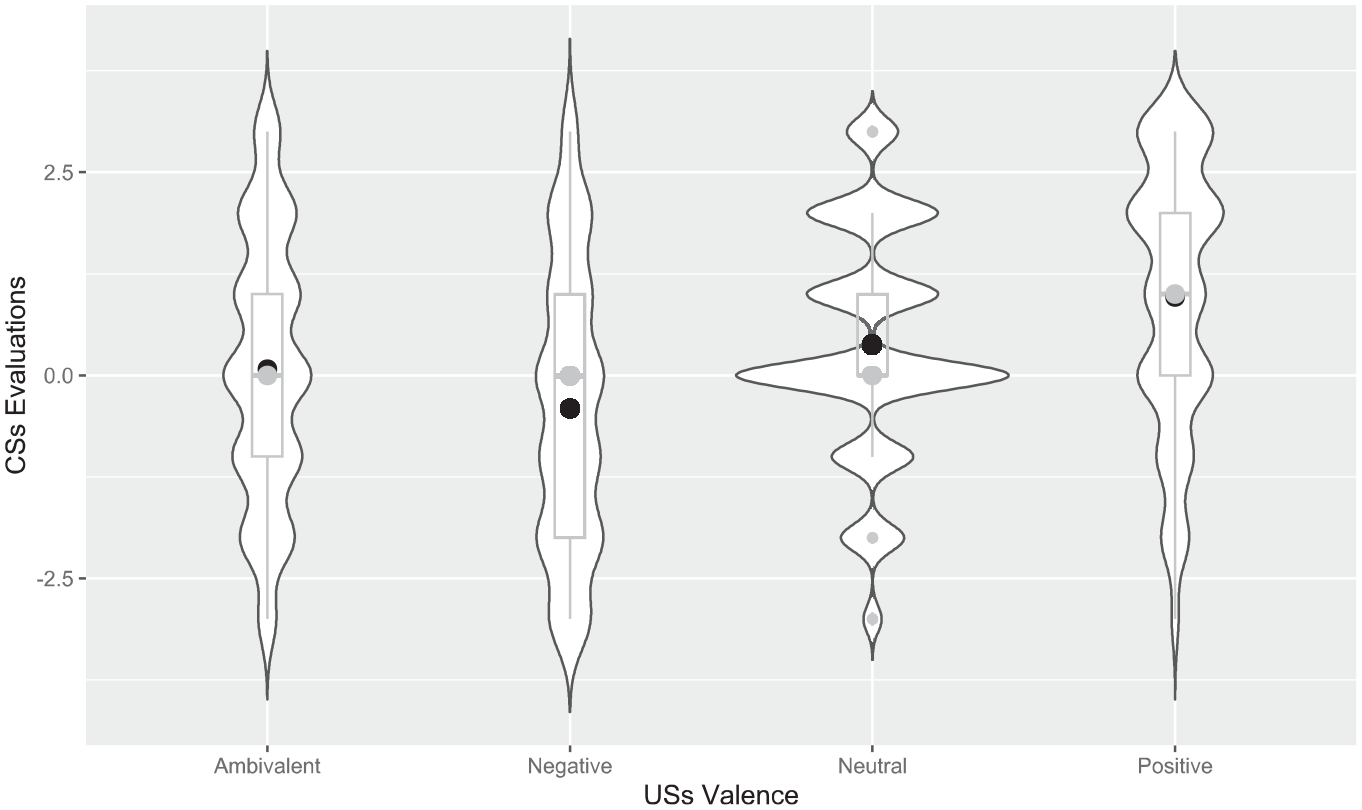
The Summary Statistics and the Density of the CSs Evaluations for Each Condition
Main Analyses
We introduced neuroticism as a supplementary predictor in the general model to investigate the interaction effect with the valences of USs paired with CSs. The results revealed a statistically significant interaction only between neuroticism and the evaluation of CSs paired with neutral USs relative to the CSs paired with ambivalent USs (the reference level): β = 0.005, SE = 0.002, 95% CI [0.001, 0.01], t = 2.33, p = .019. No interaction effects were found between neuroticism and CSs paired with positive USs or with negative USs relative to the ambivalent condition: β = 0.003, SE = 0.002, 95% CI [−0.001, 0.01], t = 1.54, p = .123; and β = 0.002, SE = 0.002, 95% CI [−0.001, 0.01], t = 1.15, p = .247, respectively. Decomposing the significant interaction effect, we found that highly neurotic people evaluated more negatively the CSs paired with ambiguous relative to the CSs paired with neutral stimuli (see Figure 2). Thus, the selective bias in evaluation seems to be captured here only when the evaluations of CSs paired with ambivalent USs are compared to a neutral, non-valenced learning condition. That is, highly neurotic people evaluated the CSs paired with ambivalent USs as more negative than the CSs paired with neutral USs. The magnitude of these effects was small (see Supplemental Material Section 6).
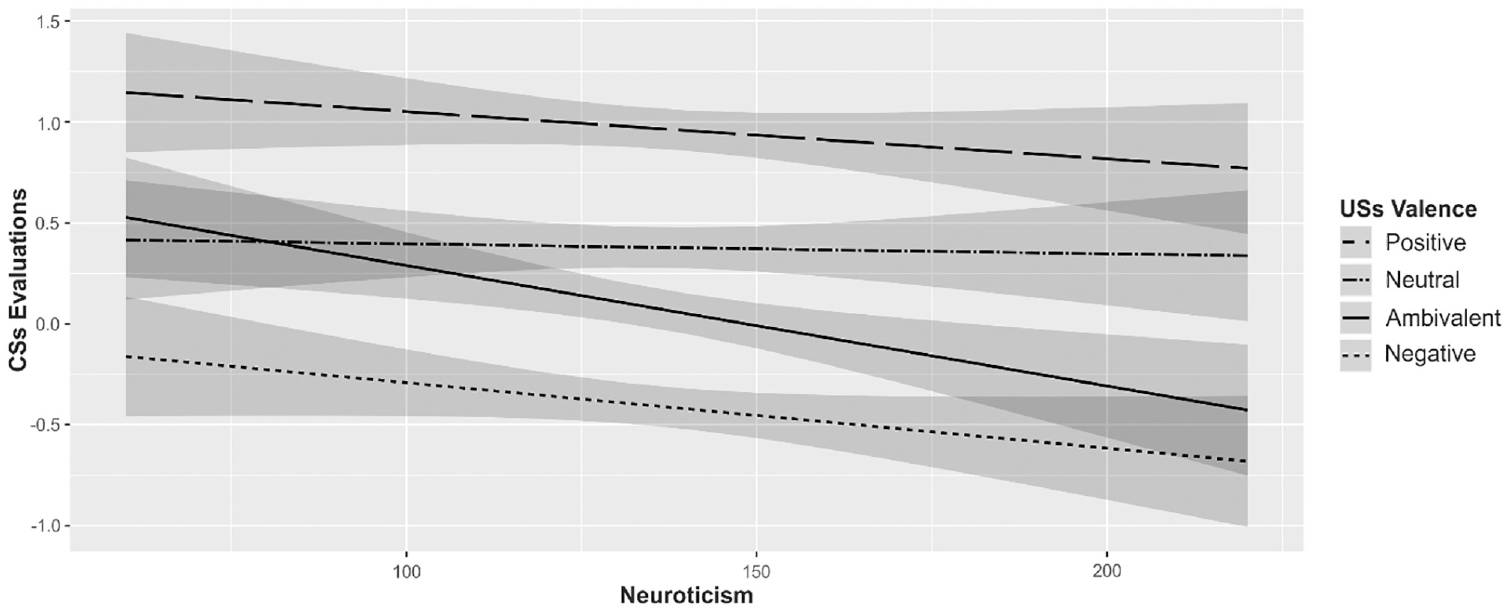
The Main Effect of Neuroticism on the CSs Evaluations
When we introduced the categorization of the USs valence as a dummy variable in the analysis (i.e., 1 [stimulus categorized according to its normative valence] vs. 0 [stimulus categorized as having different valence than intended]), the result of the interaction remained similar to the one presented earlier (see Supplemental Materials Section 7). Thus, the perception of the USs’ valence did not affect the robustness of the revealed interaction effect.
The analyses also revealed a significant main effect of neuroticism: β = −0.005, SE = 0.001, 95% CI [−0.01, −0.001], t = −3.18, p = .001. This effect showed that the ratings of CSs decreased across conditions as the neuroticism score increased in the sample. That is, highly neurotic participants gave lower ratings to the CSs, independent of the US valence paired with. Figure 2 shows these results, also highlighting the interaction effect previously discussed.
Experiment 2 1
Experiment 2 represents a conceptual replication of Experiment 1, the main difference being that ambiguity was operationalized by mixed pairings. Specifically, in the ambiguous condition, CSs were alternatingly paired with positive USs in 50% of trials and negative USs in the other 50% of trials. This experiment was preregistered at https://aspredicted.org/QB4_YZG.
We expected to find the same key results as for Experiment 1: a main effect of neuroticism on the CSs ratings and an interaction effect of neuroticism and the ambiguous experimental condition (compared to the control one).
Method
Design
The conditioning procedure involved a four-level (USs’ valence: 100% negative vs. 100% positive vs. 100% neutral vs. 50% negative–50% positive) within-subjects unifactorial design.
Participants
For this experiment, the participants were recruited via Prolific (https://www.prolific.co/). Four hundred participants (197 female, 203 male, Mage = 28.57, SD = 9.31), eligible based on the exclusion criteria mentioned in the pre-registration, took part in the study. Participants are part of the general population. In Supplemental Materials Section 8, a table with the country of residence for the participants involved in this experimental replication is presented.
Materials
Given the online data collection, we opted to use a copyright-free neuroticism scale (Johnson, 2014) (α = .91) for this second experiment. The scale is part of the International Personality Item Pool and can be accessed at https://ipip.ori.org/30FacetNEO-PI-RItems.htm. This scale also presents the six facets of neuroticism. Considering that our main aim was focused on the whole trait of neuroticism, in the main analyses reported in the manuscript, we did not take into account the individual facets. However, their descriptive statistics are reported in Supplemental Materials Section 8. This self-report measure also uses a 5-point Likert-type scale (1 = Strongly disagree to 5 = Strongly agree).
All eight fractals from Experiment 1 were employed as CSs. Ten pictures selected from IAPS (Lang et al., 2008) were used as USs: two for the positive condition, two for the negative condition, two for the neutral condition, and four for the ambiguous condition. All USs pictured a human face or, particularly, a child’s face expressing positive or negative emotions (except for the neutral condition). For this experiment, the USs are singular images, most of them being used for the merged US pictures from Experiment 1. The USs were not evaluated (as in Experiment 1), given the lack of an effect in the previous study. The IAPS codes and the detailed EC procedure are described in Supplemental Materials Section 8.
Procedure
All materials were presented using Inquisit 6 software (2016). After providing informed consent, participants completed the neuroticism self-report measure. The EC task started immediately afterward. Two CSs were always paired (100%) with positive USs (each CS was paired with the same US), two CSs were always paired (100%) with negative USs (each CS was paired with the same US), two CSs were always paired (100%) with neutral USs (each CS was paired with the same US), and two CSs were paired equally often with a positive US and with a negative US (i.e., 50% of the trials included a positive US and 50% included a negative US). Throughout the EC procedure, each CS was presented eight times with its corresponding US, resulting in 64 trials (similar to Experiment 1). The Latin square design of Order 8 allowed us again to counterbalance the CS–US pairings. The CSs were always presented on the left side of the screen, while the USs were presented on the right. The size of the CSs was 3.15 × 3.15 inches, and the size of the USs was 4.17 × 3.15 inches. As in Experiment 1, each pair was displayed on the computer screen for 2,500 ms with an inter-stimulus interval of 1,000 ms. After the EC procedure ended, participants were asked to evaluate how much they liked or disliked the fractals (from −3 = very unpleasant to +3 very pleasant). The valence awareness was also measured (see Experiment 1). The data collection concluded with a debriefing section.
Sample Size Determination
We targeted a sample size of around 400, which provides sufficient power at 0.80 (with α = .05 one-tailed) for detecting an r≥ |.14|, which is a relatively small effect (corresponding to Cohen’s d = 0.3).
Results 2
Similar to Experiment 1, we analyzed data using linear mixed-effects regression.
Preliminary Analyses
First, we tested whether there was an EC effect. We computed a null model by including random intercepts for participants and stimuli (i.e., eight CSs). The variance of the CSs in the overall model was close to zero, similar to Experiment 1 (i.e., 0.07; see Supplemental Materials Section 9). Thus, we implemented the general model by including only the by-participant random intercept: β = 0.002, SE = 0.04, 95% CI [−0.08, 0.09], t = 0.067, p = .947 (see Supplemental Materials Section 11).
Analogous to the analyses we carried out for Experiment 1, we used the percentage of the valence pairing as a categorical factor and created dummy scores by setting the 50%–50% condition as the reference level (i.e., the ambiguous condition). The results showed that the CSs paired only with negative USs were evaluated significantly more negatively relative to the CSs from the ambiguous condition: β = −0.24, SE = 0.06, 95% CI [−0.37, −0.12], t = −3.83, p < .001. The CSs paired only with positive USs were evaluated significantly more positive relative to the CSs from the ambiguous condition: β = 0.45, SE = 0.06, 95% CI [0.33, 0.58], t = 7.13, p < .001). Finally, the CSs from the neutral condition were evaluated significantly more positive relative to the ambiguous condition: β = 0.43, SE = 0.06, 95% CI [0.31, 0.56], t = 6.82, p < .001 (see Supplemental Materials Section 12). Figure 3 presents the descriptive statistics and the density of CS evaluations for each condition.
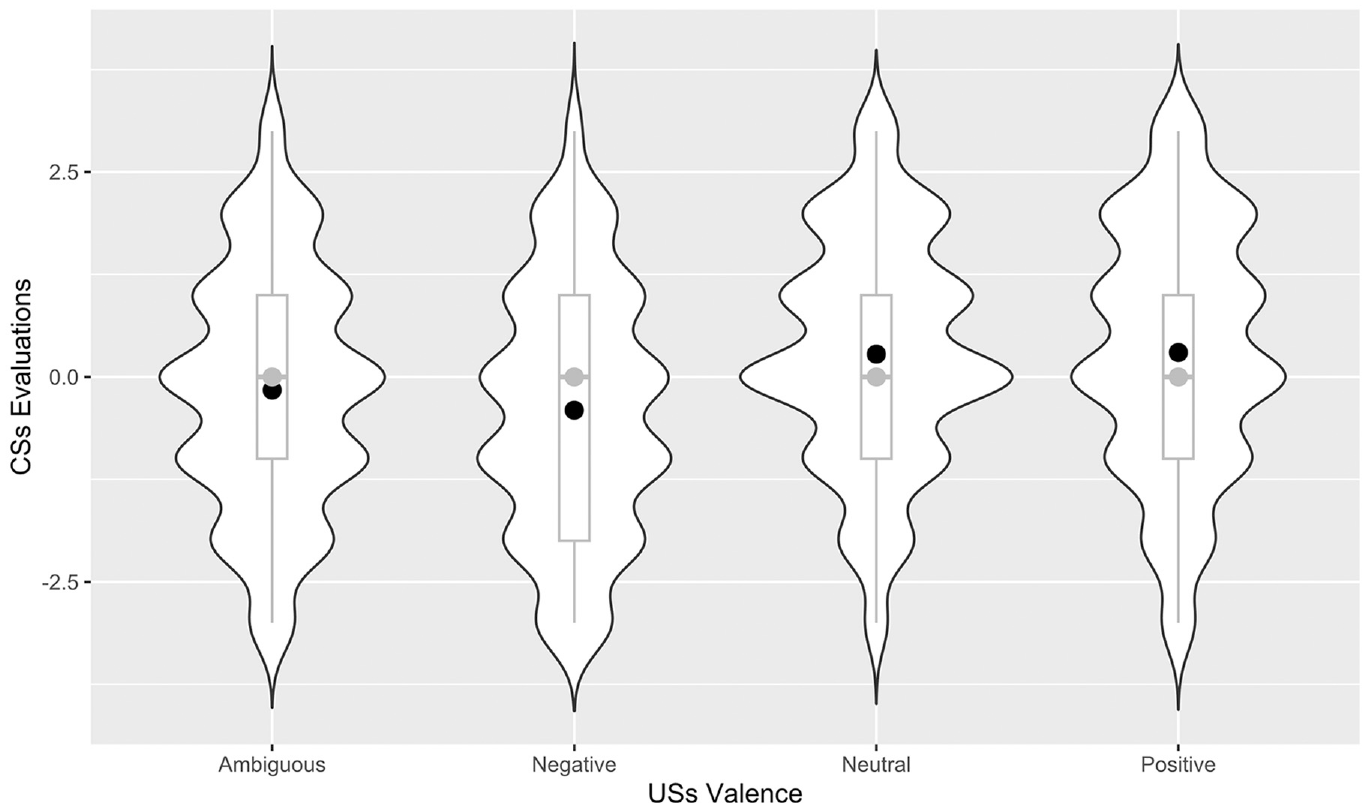
The Summary Statistics and the Density of the CS Evaluations for Each Condition
Main Analysis
Besides the categorical valence factors, we introduced the neuroticism score as a supplementary predictor in the general model to investigate the interaction effect between neuroticism and the conditions. Again, the reference level was represented by the ambiguous learning condition (50%–50%). When we looked at the interaction effect between neuroticism and the CSs from the neutral condition relative to the CSs from the ambiguous condition, we identified a significant interaction effect similar to that observed in Experiment 1: β = 0.01, SE = 0.003, 95% CI [0.00, 0.02], t = 2.77, p = .005 (see Figure 4).
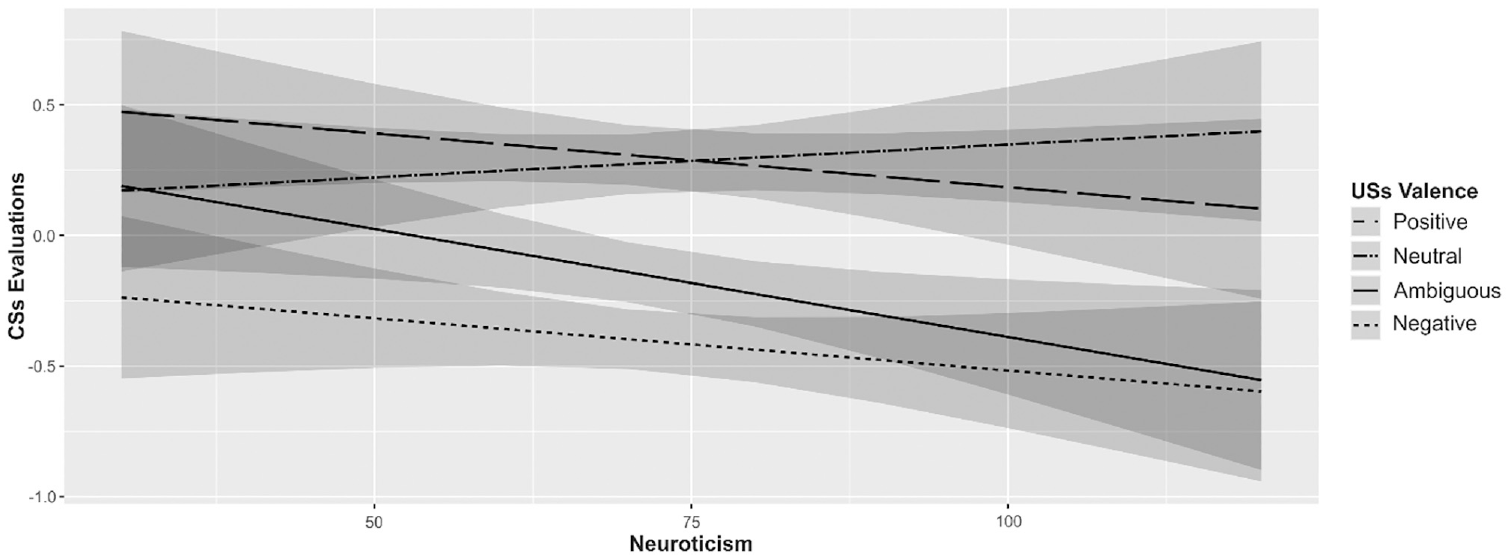
The Simple Effect of Neuroticism Factor on the CS Evaluations
Moreover, we did not identify any interaction effect between neuroticism and the CSs paired only with negative USs relative to the CSs from the ambiguous learning condition: β = 0.004, SE = 0.003, t = 1.09, p = .273. We also did not find an interaction effect between neuroticism and the CSs paired only with positive USs relative to the ambiguous learning condition: β = 0.004, SE = 0.003, t = 1.06, p = .287. Therefore, these results also replicate the findings of Experiment 1 (see Supplemental Materials Section 13).
A simple effect of the neuroticism factor revealed by the main analyses was also replicated: β = −0.008, SE = 0.003, 95% CI [−0.02, −0.001], t = −2.36, p = .018. Thus, the finding shows that the ratings of CSs generally decreased as the neuroticism score increased in the sample (see Figure 4).
Discussion
The current studies investigated the relationship between neuroticism and EC under ambiguous learning conditions. Neuroticism is a personality trait frequently associated with a negativity bias, a factor with an essential role in the onset and maintenance of emotional disorders (e.g., Beck & Haigh, 2014; Beck et al., 1979). Such biases were mostly captured at the level of attention and memory (e.g., Brock et al., 2022; Chen & Zheng, 2005; Gomez et al., 2002; Norris et al., 2019).
In the current article, we focused on capturing the negativity bias in emotional learning via EC procedures with ambiguous outcome stimuli. Vogel et al. (2019) previously identified, via a typical, unambiguous EC procedure, that people who score high on neuroticism respond more negatively to a negatively conditioned stimulus and more positively to a positively conditioned stimulus (as per the perspective of Larsen & Diener, 1987). In our research, we aimed to create conditions under which highly neurotic people may give more weight to negative events than to positive events. More specifically, in addition to pairing unambiguously positive, negative, and neutral USs with CSs, we introduced ambivalent USs (Experiment 1) or paired target CSs alternatingly with both positive and negative USs (Experiment 2). Considering evidence supports that highly neurotic people respond negatively under conditions of ambiguity (e.g., Lommen et al., 2010; Salemink & van den Hout, 2010), we expected that participants who scored high on neuroticism would evaluate the CSs from the ambiguous conditions more negatively relative to the CSs from the neutral ones.
The results of both experiments robustly showed that participants who scored high on neuroticism evaluated the CSs from the ambiguous conditions more negatively as compared to CSs from the neutral conditions. In other words, we found and replicated a relation between neuroticism and a negativity bias in emotional learning when comparing ambiguous conditions to unambiguously neutral conditions.
It should be noted, however, that we did not find this relation when comparing ambiguous situations with unambiguously positive or negative situations. Interestingly and unexpectedly, the CSs from the positive and negative conditions received more negative ratings at higher neuroticism scores. Thus, our results are neither in accordance with the findings of Vogel et al. (2019) nor with the classical theoretical perspective on neuroticism that emphasizes the prominent focus on negative valence as being an essential feature for highly neurotic people (e.g., Eysenck, 1967; Gray, 1981). Our findings seem to align more with the idea of dispositional negativity. People high in dispositional negativity experience distress not only in contexts with clear sources of stress but also when the potential stressors are diffuse or even absent (or positive, as in our positive learning conditions; see Shackman et al., 2016, for a theoretical and empirical review).
Having this said, a relation between neuroticism and the evaluation of CSs was absent for CSs paired with neutral USs. Rather than suggesting general dispositional negativity, this result indicates that neuroticism is related to general negativity toward emotional stimuli: It is not only the case that CSs related to negative stimuli are experienced as more negative but also that CSs related to positive stimuli are evaluated as less positive by people scoring high on neuroticism. This dispositional negativity in highly neurotic people could co-exist with a disposition to interpret emotionally ambiguous situations in a more negative manner. Such an interpretation is in line with our findings. Specifically, the relation between neuroticism and CSs paired with ambiguous stimuli was stronger than the relation between neuroticism and CSs paired with positive stimuli or with negative stimuli. However, this interpretation should be treated with caution because the significant effects were obtained for ambiguous conditions only in comparison with the neutral ones. Also, the effects were rather subtle in size. However, this is an important finding, informing that ambiguous situations might be the contexts under which neuroticism can predispose people to develop affective disorders such as (social) anxiety and depression (e.g., Sauer-Zavala & Barlow, 2021).
As limitations, we can note that we included only two CSs per condition in our experiments, whereas in the experiments of Vogel et al. (2019), the procedures involved twelve CSs. This complicates the comparison between our studies. Another difference concerns the selection of CSs. Vogel et al. (2019) implemented a pre-rating phase of CSs in some of their experiments and used only CSs that were rated neutrally. However, we used novel CSs but did not verify whether they were entirely neutral before the study. This again complicates the comparison between the studies. However, as noticed in a recent review (Moran et al., 2023), many experiments in the EC field have not used idiosyncratically determined neutral CSs (i.e., being pre-rated as neutral before including them in the EC procedure), an aspect which does not seem essential for EC. Another weakness of our studies, which might reduce the generalizability of the findings, concerns the stimuli selection and assignment in our EC paradigm. We used a limited number of specific USs for each of the four EC conditions. Future studies should consider employing a larger pool of USs with random assignment for each condition and each participant.
Future research should investigate the underlying mechanisms that lead to effects such as general negativity toward emotional stimuli and a negativity bias in ambiguous contexts. For instance, people scoring high on neuroticism may perceive USs as more negative than they are normatively perceived, as suggested by Ingendahl and Vogel (2023). Alternatively, they may transfer negative valence more easily from USs to CSs due to their heightened reactivity to emotional valence, as proposed by Casini et al. (2023). Another possibility is that highly neurotic individuals struggle more with negative emotions, leading them to rate such stimuli or emotions more negatively, as Trnka et al. (2012) noted.
These research questions, as well as the existing mixed findings on the relevance of neuroticism as a moderator for basic learning phenomena like EC, warrant further investigation to understand better the role of individual differences in conditioning and the significance of neuroticism as a basic personality trait in providing an account for the onset and/or maintenance of emotional disorders.
Supplemental Material
sj-docx-1-spp-10.1177_19485506231191861 – Supplemental material for The Moderating Role of Neuroticism on Evaluative Conditioning: Evidence From Ambiguous Learning Situations
Supplemental material, sj-docx-1-spp-10.1177_19485506231191861 for The Moderating Role of Neuroticism on Evaluative Conditioning: Evidence From Ambiguous Learning Situations by Cătălina Bunghez, Andrei Rusu, Jan De Houwer, Marco Perugini, Yannick Boddez and Florin Alin Sava in Social Psychological and Personality Science
Footnotes
Acknowledgements
We thank Laurenţiu Maricuţoiu, Marine Rougier, and Giulio Costantini for their valuable inputs regarding the linear mixed-effects models analyses.
Handling Editor: Bar-Anan Yoav.
Declaration of Conflicting Interests
The author(s) declared no potential conflicts of interest with respect to the research, authorship, and/or publication of this article.
Funding
The author(s) disclosed receipt of the following financial support for the research, authorship, and/or publication of this article: Our work received funding from the European Union’s Horizon 2020 research and innovation program under the grant agreement no. 952464 and from Exploratory Research Projects—2020 Call under the registration code PN-III-P4-ID-PCE-2020-1964.

Supplemental Material
The supplemental material is available in the online version of the article.
Notes
Author Biographies
References
Supplementary Material
Please find the following supplemental material available below.
For Open Access articles published under a Creative Commons License, all supplemental material carries the same license as the article it is associated with.
For non-Open Access articles published, all supplemental material carries a non-exclusive license, and permission requests for re-use of supplemental material or any part of supplemental material shall be sent directly to the copyright owner as specified in the copyright notice associated with the article.
