




Abstract
We propose that defensive forms of identity (i.e., nationalism and national narcissism) can harm the nation through a tendency to maximize the difference between own and other groups in resource allocation. We test this hypothesis by adopting a classic social psychological paradigm, the Tajfel’s matrices, to real-life scenarios designed in the COVID-19 context. We captured maximizing the difference as a preference for one’s nation being allocated more medical resources relative to other countries, but at the expense of absolute ingroup profit. In Studies 1 and 2, defensiveness in national identity predicted this counterproductive strategy that ultimately benefits neither ingroup nor outgroup. In experimental Study 3, inducing ingroup disadvantage led to a greater tendency to maximize the difference. The results provide evidence that defensive national identity might be liked to support for policies that offer a positive intergroup comparison, but simultaneously harm one’s own ingroup.
The COVID-19 pandemic offers a unique context to examine the interplay between the way people identify with their nation and their attitudes about resource allocation. Some governments have been guided by a “my country first” dogma to secure most equipment, vaccines, or drugs for their own (Bollyky & Bown, 2020; Fidler, 2020). This approach can be seen as an example of parochial altruism—the willingness to help one’s own group and reject others (Everett et al., 2015). Although this form of ingroup favoritism might be problematic in its own right, sometimes people might be willing to go even further and not only favor the ingroup over the outgroup, but also be ready to sacrifice ingroup benefits to show advantage over others. For example, in June 2020, President Trump was calling for reducing COVID-19 testing to make the country look better in international comparisons (Segers, 2020). Lincoln (2020) argued that the pandemic provides a natural experiment on the public-health effects of such hubris. This work examines national sentiments and support for competitive strategies that might harm one’s own nation.
Ingroup favoritism can been captured by the so-called Tajfel matrices, which examine different preferences for resource allocation between social groups (Tajfel et al., 1971). One striking strategy is the tendency to maximize the difference between groups—a preference for relative advantage over other groups at the expense of objective gains of one’s group (Tajfel et al., 1971). According to Hinkle and Brown (1990) this “positive intergroup differentiation” should be linked to “the strength of people’s identifications with a group” (p. 62). Yet, surprisingly, few studies to date have demonstrated the associations between identifying with one’s group and a preference for maximizing differentiation between groups (see Hinkle & Brown, 1990; Sidanius et al., 2007; cf. Perreault & Bourhis, 1999). One reason for this could be that research rooted in the social identity tradition rarely considers distinctions between more secure and more defensive identities inspired by the psychoanalytic tradition (Adorno et al., 1950; Cichocka, 2016; Golec de Zavala, Cichocka, & Bilewicz, 2013; Kosterman & Feshbach, 1989; Roccas et al., 2006; Schatz et al., 1999; Wagner et al., 2012; cf. Huddy & Khatib, 2007).
We argue that a preference for maximizing the difference between groups is not an automatic consequence of ingroup attachment. Rather, it is more likely to result from defensive concerns about one’s group, such as anxieties about the group’s image (Cichocka & Cislak, 2020), a need to assert dominance (Wagner et al., 2012; see also Sidanius et al., 2007), or compensating for ingroup disadvantage (Halevy et al., 2010). We test the idea that defensive identity, rather than the strength of ingroup identification, will be associated with a motivation to support policies aimed at boosting the ingroup’s perceived position in relation to outgroups, even at the expense of one’s ingroup’s gain.
We examined identity defensiveness in the context of national groups by integrating two lines of inquiry on national sentiments. We focus on national narcissism, a belief that one’s nation is exceptional and deserves recognition from others (Golec de Zavala et al., 2009), and nationalism, a perception that one’s nation should dominate over others (Kosterman & Feshbach, 1989; Wagner et al., 2012). National narcissism has consistently been associated with outgroup derogation, particularly when outgroups are seen as having threatened the ingroup’s image (Cichocka, 2016; Golec de Zavala et al., 2009; Golec de Zavala, Cichocka, & Iskra-Golec, 2013). Constantly seeking external validation is thus a characteristic of national narcissism (Cichocka & Cislak, 2020), and those high in national narcissism are more concerned by the ingroup’s image and prestige, and less by the fate of ingroup members (Cichocka, 2016; Cichocka, Cislak, et al., 2022; Eker et al., 2023). In the COVID-19 pandemic, national narcissism was related to various harmful outcomes, such as engagement with COVID-19 conspiracy theories (Hughes & Machan, 2021; Sternisko et al., 2023) and selfish behaviors (Nowak et al., 2020).
Nationalism is another instance of defensive ingroup identity. Nationalism has been described as a belief in national superiority (Kosterman & Feshbach, 1989) and “chauvinistic arrogance and desire for dominance in international relations” (Li & Brewer, 2004, p. 728). The need for intergroup differentiation is an integral part of nationalism, emphasizing differences between national groups (Li & Brewer, 2004) and rejection of outgroups (Mummendey et al., 2001). Nationalism entails the feeling that one’s country should be more powerful than others and is thus a robust predictor of support for aggressive foreign policies, armament, and war (Feshbach, 1987; Kosterman & Feshbach, 1989; Pratto et al., 1998). In the COVID-19 pandemic, nationalism was identified as a risk factor for reduced international cooperation and reluctance to aid disadvantaged countries (Bieber, 2022; Bollyky & Bown, 2020; Fidler, 2020).
National narcissism and nationalism are theoretically and empirically distinct: Whereas national narcissism is characterized by a quest for recognition, nationalism is better described as a quest for dominance (Cai & Gries, 2013; Federico et al., 2022; Golec de Zavala et al., 2009). For example, while both predict intergroup aggression, nationalism aims to dominate others with force, whereas national narcissism aims to establish recognition and respect for the national ingroup (Cichocka & Cislak, 2020; Golec de Zavala et al., 2009). However, nationalism and national narcissism share similarities in that both assume a hyperbolic view on ingroup greatness (Golec de Zavala et al., 2009; see Gronfeldt et al., 2021 for a review), and that both can be considered a defensive compensation for the feeling that the nation is chronically disadvantaged or relatively deprived in intergroup relations (see also Cichocka, Sengupta, et al., 2023; Lim, 2010; Marchlewska et al., 2018; Reyna et al., 2022; Sengupta et al., 2019; Wamsler, 2022).
Defensive needs for ingroup recognition and dominance might paradoxically lead people to support policies that are worse for the ingroup. Research has shown that national narcissism is linked to endorsement of policy proposals that are meant to affirm the ingroup’s positive image in contrast to others (Cichocka & Cislak, 2020; Gronfeldt et al., 2023). Such actions can be shortsighted. For example, national narcissism predicted support for unsustainable exploitation of nature to demonstrate that “this country will not be bossed around” (Cislak et al., 2018) and willingness to release COVID-19 vaccines prematurely to beat other countries (Gronfeldt et al., 2023). Similarly, nationalism has been linked to support for anti-environmentalist policies that are harmful for ingroup members’ health (Aydin et al., 2022), especially when an outgroup is perceived to be pushing for environmental protection measures (Bonaiuto et al., 1996). In sum, both the narcissistic need for recognition and the nationalistic need for dominance may be related to a tendency to support counterproductive actions aimed to bolster the ingroup’s status. Maximizing the difference between groups, even for vital resources, may therefore be an appealing strategy for those high in defensive national identity because it offers a positive social comparison and a perception of the ingroup being “on top” in intergroup relations (Sidanius et al., 2007; Tajfel et al., 1971).
Importantly, not all forms of identifying with the nation are defensive. Ingroup identification can be secure and confident. Patriotism is a feeling of love and pride for one’s country (Kosterman & Feshbach, 1989) that, compared with nationalism, generally predicts peaceful relations with other nations (see also Schatz et al., 1999; Wagner et al., 2012). When controlling for its overlap with national narcissism, national identification typically predicts greater outgroup tolerance (Golec de Zavala, Cichocka, & Bilewicz, 2013; Marchlewska et al., 2020) and solidarity (Górska et al., 2020; Marchlewska et al., 2020; Verkuyten et al., 2022). When the defensive components are covaried out, patriotism and national identification predict constructive intragroup outcomes, such as civic engagement, support for democracy, support for pro-environmental policies, volunteering, and positive interpersonal relations within groups (Aydin et al., 2022; Cichocka, Cislak, et al., 2022; Golec de Zavala, Cichocka, & Bilewicz, 2013; Lai et al., 2013; Marchlewska et al., 2022; Richey, 2011). In this article, we collectively refer to national identification and patriotism net of defensive forms of identity, as secure national identity. As secure national identity does not entail a nationalistic need to dominate (see also Federico et al., 2022; Wagner et al., 2012) or a narcissistic urge to spite others (Cislak et al., 2018), those high in secure national identity are less likely to be attracted by policies aimed solely at bolstering the ingroup’s status.
Present Research
We examined whether defensiveness in national identity would predict the tendency to show competitive advantage over other groups, even at the expense of the ingroup. We relied on the context of the COVID-19 pandemic and dilemmas around the distribution of medical resources. We revisited a classic instrument, the Tajfel matrices, which include items measuring intergroup discriminatory behavior (Tajfel et al., 1971). While originally invented to study minimal groups using symbolic points, research has demonstrated that Tajfel matrices can be applied to real-life social groups and allocation of resources (e.g., Bornstein et al., 1983; Malkin & Ari, 2013; Navarrete et al., 2010; Sidanius et al., 2007). Following Sidanius and colleagues (2007; see also Malkin & Ari, 2013; Navarrete et al., 2010), we specifically relied on the item capturing maximizing the difference between groups and adapted it to the disputes on resource allocation during the pandemic. At the high end of the maximum difference item, participants can hurt the outgroup by reducing the points allocated to it, but the price is that the ingroup also loses points. The ingroup is therefore winning, but only relative to the outgroup. Such a competitive choice goes against the interests of the ingroup in absolute terms, but the relative advantage in the points is in favor of the ingroup: The outgroup is hurt more than the ingroup.
In Study 1, we measured national narcissism and national identification as predictors of the maximizing-the-difference score. In Study 2, we included nationalism and patriotism as additional measures of defensive and secure forms of national identity, respectively. Study 3 relied on an experimental manipulation of perceived long-term ingroup disadvantage, which has sometimes 1 been associated with identity defensiveness (Marchlewska et al., 2018; Sengupta et al., 2019). In Study 1, we conducted sensitivity analysis and preregistered Studies 2 and 3 with predetermined sample sizes. All materials, data, and analyses are available here: https://osf.io/dn64b/
Study 1
In Study 1, we examined whether national narcissism would be related to the tendency to maximize the difference between groups in allocating doses of the AstraZeneca-Oxford vaccine between the United Kingdom and the European Union.
Method
We recruited 440 British Prolific workers. After completing the Tajfel matrices (see the following details), participants were asked whether they fully understood the task: 371 (84.32%) said they did, 62 (14.09%) were “not sure,” and seven (1.59%) said they did not. We excluded participants reporting they did not fully understand the task (this did not affect the pattern of results), leaving 433 for further analyses (66.74% women, 31.87% men, 1.39% Other, 89.09% White; Mage = 34.83, SDage = 12.53). A G*Power (Faul et al., 2007) sensitivity analysis suggested that this sample size provided 80% power to detect a small effect for a single regression coefficient (β = .13), assuming α = .05, two-tailed.
Measures and Procedure
Participants first completed the Tajfel matrices, and then measures of national narcissism and national identification (randomized; this did not affect the pattern of results). Next, participants answered questions on politics, ideology, and their background, and were debriefed. Participants received compensation in accordance with Prolific policy. Identity measures relied on a scale from 1 (strongly disagree) to 7 (strongly agree).
National Narcissism
National narcissism was measured with the five-item Collective Narcissism Scale (Golec de Zavala, Cichocka, & Bilewicz, 2013), α = .92, M = 2.59, SD = 1.41, (e.g., “Great Britain deserves special treatment”).
National Identification
National identification was measured with the 12-item social identification scale (Cameron, 2004), α = .87, M = 4.30, SD = 1.01, with three subscales: ingroup ties (e.g., “I have a lot in common with other British people”), centrality (e.g., “I often think about the fact that I am a British person”), and ingroup affect (e.g., “In general, I’m glad to be a British person”).
Maximizing the Difference
Tajfel matrices were constructed according to the guidelines by Bourhis and colleagues (1994). We designed a scenario in which participants were instructed to allocate doses of the AstraZeneca-Oxford vaccine between the United Kingdom and the European Union. The scenario was based on a dispute emerging when AstraZeneca, the vaccine manufacturer, failed to deliver the number of vaccine doses it had promised, whereas the United Kingdom’s supply was unaffected (Goenka, 2021). European Union leaders reacted strongly and called for supply to the United Kingdom to be restricted. Participants were asked to imagine that they could decide on how the vaccine was to be distributed. The study took place in early February 2021, around the time the AstraZeneca-Oxford vaccine was about to be released.
We analyzed the maximizing the difference item in the Tajfel matrices specifically (the remaining five matrices were fillers). The item is on a continuum of 13 scenarios, labeled from A to M, of allocations between the two groups (Figure 1). Each option represented millions of vaccine doses. Selecting Option A (i.e., United Kingdom = 19, European Union = 25) indicated maximum joint profit (i.e., greatest possible number of doses for the two parties combined) and maximum ingroup profit (i.e., 19 is the highest possible number for the United Kingdom, although that option entails the European Union getting 25). This scenario is the most economically sensible from the viewpoint of the ingroup although the outgroup will benefit more. Selecting an option closer to the midpoint (e.g., Option G, United Kingdom = 13, European Union = 13) signifies parity, although this hurts allocation to both groups compared with earlier options. Selecting the Option M (i.e., United Kingdom = 7, European Union = 1) indicates an extreme preference for maximum difference between the groups: both groups lose, but the ingroup still gains more than the outgroup. Out of a range from 1 to 13, participants on average chose 5.12 (SD = 3.75).

Item Capturing Maximum Difference Between Groups in Our Studies
Results and Discussion
National narcissism and national identification were significantly positively correlated, r(431) = .55, p < .001. National narcissism, r(431) = .18, p < .001, and national identification, r(431) = .13, p = .008, both correlated positively with maximizing the difference.
We conducted structural equation modeling using MPlus 8 (Muthén & Muthén, 2017) to test our hypothesis (see Figure 2 for model details). We used maximum likelihood estimation with robust standard errors. National narcissism was a significant positive predictor of the tendency to maximize the difference, β = .18, b = 0.58, 95% confidence interval (CI) = [0.04, 1.12], p = .036, whereas the effect of national identification was nonsignificant, β = −.001, b = −0.003, 95% CI = [−0.71, 0.70], p = .992 (see supplemental material for models controlling for task comprehension and demographics). Study 1 provided the first evidence that defensive national identity (in this case, national narcissism) is associated with a preference for maximizing the difference between groups.
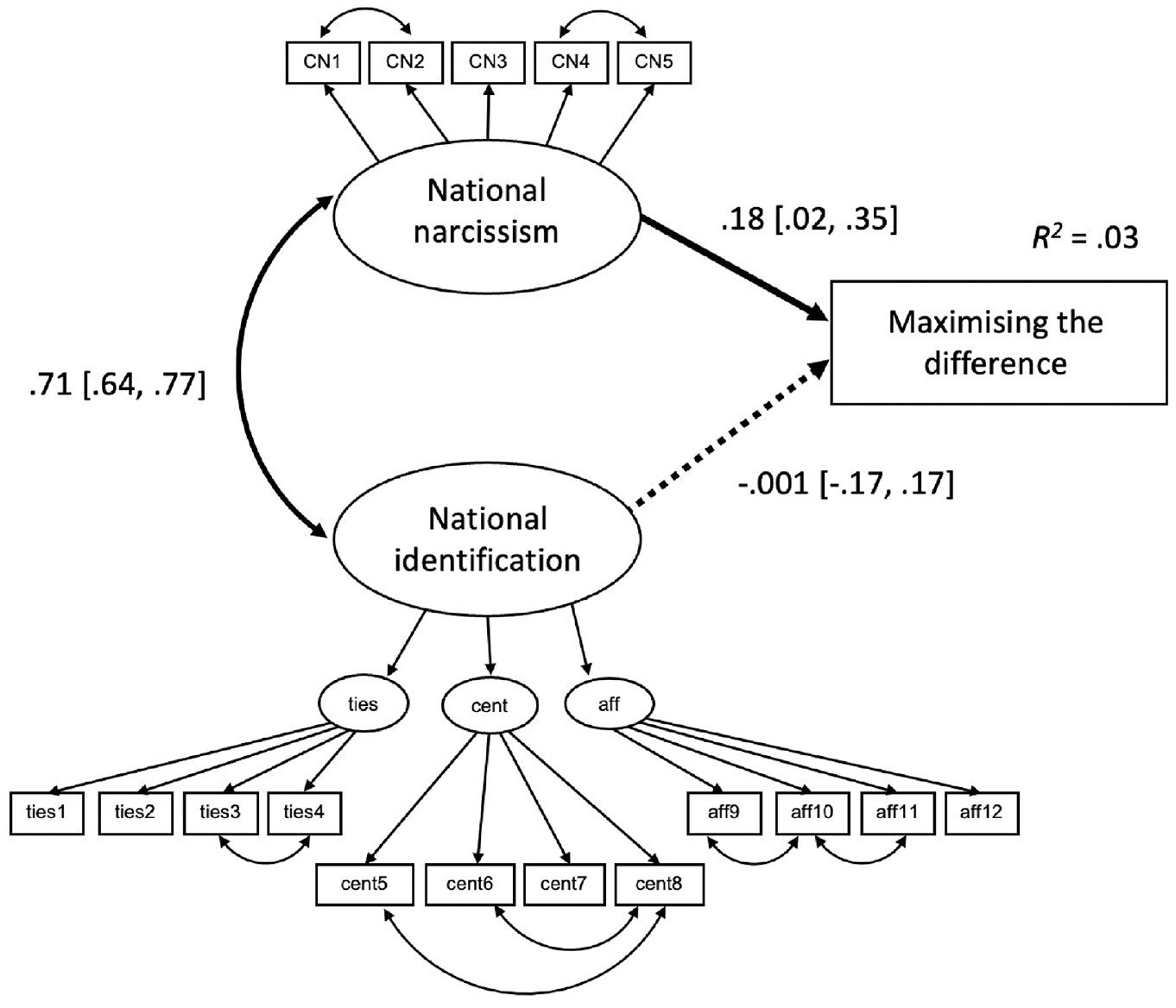
Structural Equation Model of National Identity Predicting Maximizing the Difference (Study 1)
Study 2
In Study 2, we examined whether defensive national identity more broadly (a combination of national narcissism and nationalism) would be related to maximizing the difference in vaccine allocation.
Method
Participants
A task using the same Tajfel matrices as in Study 1 was included in Wave 1 of a longitudinal study into British national identity. We preregistered (https://aspredicted.org/qf77t.pdf) a target sample size of 510 Prolific participants. We collected 516 responses. As in Study 1, participants were asked whether they understood the matrices task (83.30% said yes, 16.12% were not sure). Although we did not mention exclusions in our preregistration, three (0.58%) respondents said they did not understand the task. For the sake of consistency with Study 1, we excluded them from the analysis (this did not change the results). Using Prolific IDs, we further excluded 20 participants who participated in Study 1. This overlap in recruitment was unintentional, so this exclusion criterion was not preregistered but including these participants did not affect the results (see supplemental material). One participant left the Tajfel matrices empty. This left 491 responses (62.32% women, 36.05% men, 1.22% Other gender, 0.41% preferred not to say; Mage = 37.16, SDage = 13.79). With this sample size, we should have 80% power to detect an effect size of β = .11, assuming α = .05, two-tailed.
Measures
Participants first completed measures of national identification, national narcissism, patriotism, and nationalism (in this order, all scales from 1 = strongly disagree to 7 = strongly agree), and then the Tajfel matrices.
National Narcissism
National narcissism was measured with the nine-item version of the Collective Narcissism Scale (Golec de Zavala et al., 2009), α = .92, M = 2.84, SD = 1.13.
Nationalism
Nationalism was measured using Kosterman and Feshbach’s (1989) eight-item scale, α = .88, M = 2.87, SD = 1.15, (e.g., “Generally, the more influence Britain has on other nations, the better off they are”).
National Identification
National identification was measured with Leach and colleagues’ (2008) 10-item group-level self-investment scale, α = .95, M = 4.57, SD = 1.27, with three subscales: solidarity (e.g., “I feel a bond with British people”), satisfaction (e.g., “I am glad to be British”), and centrality (e.g., “I often think about the fact that I am British”).
Patriotism
Patriotism was measured using Kosterman and Feshbach’s (1989) 12-item scale, α = .93, M = 4.26, SD = 1.24, (e.g., “I love my country”).
Maximizing the Difference
The Tajfel matrices were identical to Study 1, but the introductory text was amended slightly to reflect the COVID-19 situation in April 2021 (see supplemental material for details). Maximizing the difference strategy was measured with the same item (M = 4.23, SD = 3.25).
Results and Discussion
See Table 1 for correlations among individual predictors and maximizing the difference.
Bivariate Correlations Among Variables (Study 2)
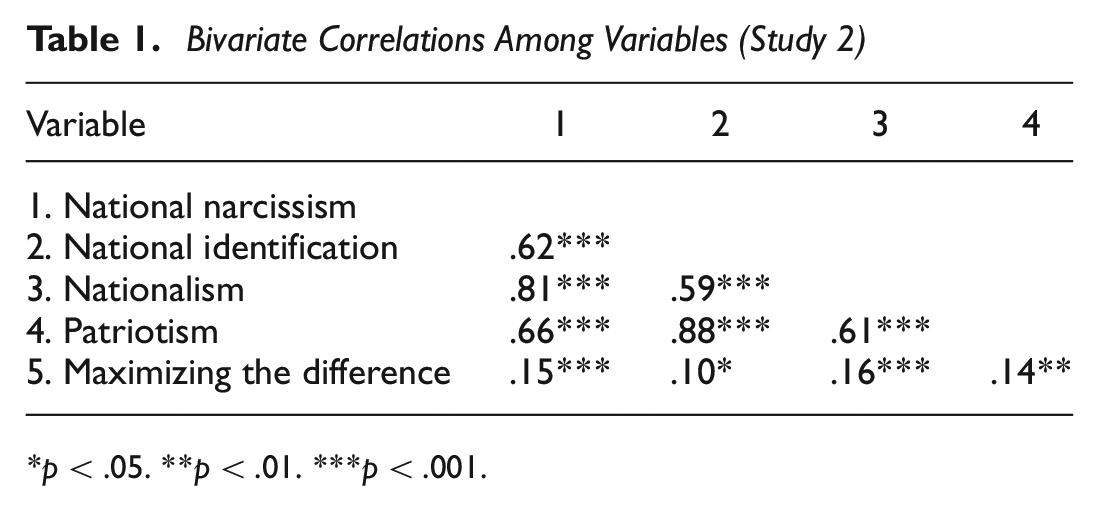
p < .05. **p < .01. ***p < .001.
Our preregistration focused on national narcissism and identification only. Our preregistered hypotheses were confirmed (see supplemental material for preregistered analyses). However, as Study 2 was part of a larger project on British identity, we decided to incorporate a broader approach to defensive identity. We constructed a structural equation model with two superordinate latent variables: defensive national identity and secure national identity, as predictors of maximizing the difference (see Figure 3 for model details). Defensive national identity comprised two latent variables (with factor loadings constrained to be equal): national narcissism and nationalism. Secure national identity comprised national identification and patriotism as two latent variables (again with equal loadings). Owing to a large number of predictors, we used parceling (Little et al., 2002) for patriotism, nationalism, and national narcissim. We used the three subscales as indicators of identification. Defensive national identity was a significant predictor of the tendency to maximize the difference, β = .16, b = 0.53, 95% CI = [0.056, 1.00], p = .028, whereas the effect of secure national identity was nonsignificant, β = .004, b = 0.01, 95% CI = [−0.43, 0.46], p = .950 (see supplemental material for models controlling for task comprehension and demographics).
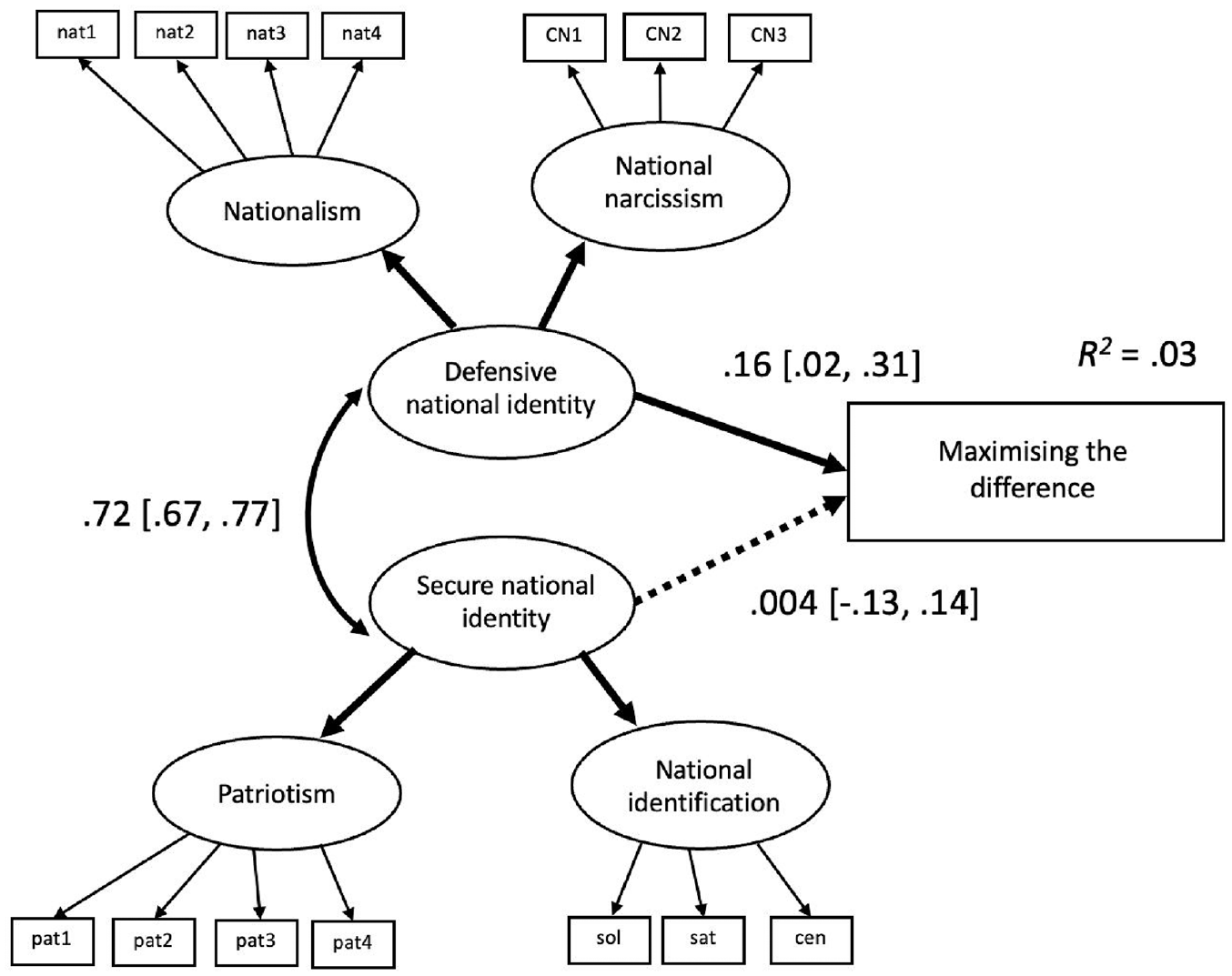
Structural Equation Model of National Identity Predicting Maximizing the Difference (Study 2)
Study 3
As Studies 1 and 2 were cross-sectional, in Study 3 we sought to examine the situational context that might affect a preference for maximizing the difference. Because it is difficult to manipulate national narcissism or nationalism directly, we relied on a manipulation of long-term ingroup disadvantage, a factor likely increasing identity defensiveness. In the past, it has been shown to increase national narcissism (Marchlewska et al., 2018) and to be linked to nationalism (Sengupta et al., 2019). Perceptions of ingroup disadvantage also make intergroup comparisons salient and thus can increase a need to boost ingroup image compared with other groups (Halevy et al., 2010; Mummendey et al., 2001).
One limitation of Studies 1 and 2 was that the Tajfel matrices did not present the number of vaccine doses in proportional terms, while the European Union has more than six-times more citizens than the United Kingdom. 2 Therefore, in Study 3, we asked participants to allocate resources proportionally. We predicted that, compared with a baseline condition, ingroup disadvantage would increase the tendency to maximize the difference, here measured in the context of distribution of antiviral COVID-19 drugs.
Method
Participants
According to G*Power, we needed a sample of 788 participants in an experiment with two conditions with 80% power to detect a small effect (Cohen’s d = .20). We preregistered (https://aspredicted.org/vj8iz.pdf) that we would exclude participants failing comprehension and attention checks. We asked participants whether they fully understood the Tajfel matrices, giving the option “yes” or “no.” The attention check asked participants what the article they read was about, giving them three options (one correct). We experienced considerable attrition due to the exclusion criteria and needed to recruit additional participants (see supplemental material). In total, we recruited 1,029 Prolific participants and excluded 178, leaving 851 responses for further analysis (68.27% women, 30.90% men, 0.71% Other, and 0.12% preferred not to say/missing; Mage = 41.68, SDage = 13.44).
Experimental Manipulation
We manipulated perceived long-term ingroup disadvantage by having participants read one of two passages, based on a manipulation by Marchlewska and colleagues (2018), which previously increased national narcissism (but decreased national identification). In the experimental condition (n = 418), participants read about the United Kingdom having been disadvantaged by the European Union for a long time. In the baseline condition (n = 433), participants read a neutral text on the relationship between the United Kingdom and the European Union. Subsequently, participants filled out the Tajfel matrices.
Maximizing the Difference
We designed a scenario around the emerging dispute between the United Kingdom and European Union on a new antiviral drug designed by the medical manufacturer AstraZeneca (AstraZeneca Says Drug Helps Cut Risk of Severe COVID, 2021) and administered a shortened Tajfel matrix with just one filler item. We instructed participants to think of the numbers of antiviral drug doses as proportional and affecting the United Kingdom and the European Union equally. Maximizing the difference strategy was measured with the same item as in the other studies (M = 6.70, SD = 3.54).
Results and Discussion
In line with our preregistered hypothesis, participants in the ingroup disadvantage condition (M = 6.94, SD = 3.49) reported a significantly higher tendency to maximize the difference than participants in the baseline condition (M = 6.46, SD = 3.57), t(849) = −1.97, p = .0497, Cohen’s d = .14 (see supplemental material for models controlling for demographics).
General Discussion
Across three studies, we applied the maximizing the difference strategy from the classic Tajfel matrices (Tajfel et al., 1971) to analyze a contemporary social problem: distribution of vital medical resources in the COVID-19 pandemic. We demonstrated that defensive national identity predicted renunciation of absolute ingroup profit in an exchange for relative advantage over other groups. In Study 1, we found a relationship between a preference for maximizing the difference in vaccine allocation and national narcissism, a form of defensive national identity characterized by a craving for recognition (Golec de Zavala et al., 2009). In Study 2, we additionally demonstrated that it was not merely the need for recognition, but also nationalism—the longing for national dominance (Kosterman & Feshbach, 1989)—that predicted maximizing the difference. In other words, those high in defensive national identity seemingly supported strategies that could harm their own nation’s capacity to fight the pandemic. In Study 3, we demonstrated that manipulating perceived ingroup disadvantage, which past research has associated with defensiveness in national identity (Marchlewska et al., 2018; Sengupta et al., 2019), increased the tendency to maximize the difference in distribution of antiviral medicine (see also Halevy et al., 2010). Importantly, we observed similar effects both for the politically contentious vaccines and less controversial antiviral medicine (Steenhuysen, 2021), supporting our claim that defensiveness can lead to counterproductive decision-making.
The COVID-19 pandemic offered a unique opportunity to study how people’s national identity influenced their decision-making on allocation of social resources. The pursuit of prestige or status in intergroup contexts can sometimes lead to shortsighted decision-making (Cislak et al., 2018; Cislak, Cichocka, et al., 2021; Gronfeldt et al., 2023). In past work on the negative intragroup outcomes associated with national narcissism, researchers focused on policy proposals that can potentially be harmful to the ingroup in the long run (e.g., anti-science policies; Cislak et al., 2018; Cislak, Marchlewska, et al., 2021). Here, we directly quantified ingroup harm with an item from the Tajfel matrices (Bourhis et al., 1994; Tajfel et al., 1971), where the preference for ingroup gains was outweighed by the preference for outgroup loss in a crucial domain of public health. Interestingly, past research using different operationalizations of maximizing differences between groups showed that this tendency increased in the context of ingroup disadvantage, likely due to a motivation not to fall behind (rather than to get ahead; Halevy et al., 2010). The fear of losing the positive image and status, which those with defensive identities or those experiencing ingroup disadvantage are motivated to achieve, might play a role in explaining the effects of maximizing the difference in competition for COVID-19 resources we observed. Crucially, this strategy refuses benefits for both parties, thus ultimately neither showing consideration for others nor one’s own ingroup members.
Tajfel and colleagues (1971) argued that such outgroup discrimination might be evoked because of “generic” social norms of intergroup behavior in many societies (p. 176). We showed it is more likely to be embraced by those temporarily (due to perceptions of ingroup disadvantage) or chronically (due to a form of identifying with the group) defensive about their group. Similarly, past work linked maximizing the difference with competitive predispositions, such as social dominance orientation (Sidanius et al., 2007; cf. Malkin & Ari, 2013). Such dominance motives likely not only underlie nationalism (Osborne et al., 2017; Wagner et al., 2012), but have also been linked to national narcissism (Golec de Zavala et al., 2009). Dominance motives can be satisfied by seeking ingroup advantage, which may take a form of ingroup enhancement (a strategy that requires cost and effort), or outgroup diminishment (Halevy et al., 2010). Our work suggests that identity defensiveness may be linked to seeking advantage through outgroup belittlement.
Importantly, in Studies 1 and 2, after partialing out the effects of defensive national identity, secure national identity was unrelated to maximizing the difference (see, for example, Cichocka, 2016; Cislak et al., 2018; Marchlewska et al., 2020). This suggests that intergroup differentiation is not linked to the strength but rather to the form of ingroup identity (cf. Hinkle & Brown, 1990). Those secure in their identity should be content with their ingroup and might not need to engage in intergroup differentiation (or they might prefer strategies that boost the ingroup without taking down outgroups).
The studies presented in this paper are not without limitations. The manipulation used in Study 3 is not a direct manipulation of national narcissism, but rather of long-term ingroup disadvantage—a condition that can sometimes increase defensiveness (Marchlewska et al., 2018). The manipulation was originally tested among U.K. participants in a pre-Brexit context and its effects may be weaker in times when U.K.–EU competition is less salient. Although it did significantly increase preference for maximum difference in line with our preregistered hypothesis, the effect size was small. A lack of validated experimental manipulations of collective narcissism remains a challenge for the field.
These findings have implications for the study of populist decision-making. A preference for maximizing the difference between groups may help explain why some populist leaders and movements initiate actions that seem to be self-defeating for the nation. Studies show that support for populist parties and politicians is linked to higher national narcissism (e.g., Lantos & Forgas, 2021; Marchlewska et al., 2018). Defensive national identities more broadly motivated support for policies that renounced benefits offered by membership in supranational organizations. For example, defensive British identities predicted support for the decision to leave the European Union (Cislak et al., 2020; Marchlewska et al., 2018; Zmigrod et al., 2018) and to forgo benefits of working with the European Union (Gronfeldt et al., 2023). Maximum differentiation between the ingroup and outgroup (at any cost) may characterize populist decision-making. Future research would do well to investigate how defensive national identities predict support for policies that may end up being problematic or counterproductive for the national interest.
Conclusion
The different ways people identity with their national group may map onto how they act on behalf of their group in competitive intergroup contexts. We found evidence suggesting that defensive national identity was related to a preference for maximizing the difference in COVID-19 resource allocation, an economically irrational strategy that provides a positive social comparison, but at the same time results in objective harm to the ingroup. This demonstrates how leaders focusing on their country’s disadvantage, entitlement, and superiority may manufacture consent among the public for accepting self-harm in intergroup relations. Less might be seen as more when it promises recognition or dominance of the ingroup.
Supplemental Material
sj-docx-1-spp-10.1177_19485506231185406 – Supplemental material for When Less Is More: Defensive National Identity Predicts Sacrifice of Ingroup Profit to Maximize the Difference Between Groups
Supplemental material, sj-docx-1-spp-10.1177_19485506231185406 for When Less Is More: Defensive National Identity Predicts Sacrifice of Ingroup Profit to Maximize the Difference Between Groups by Bjarki Gronfeldt, Aleksandra Cislak, Gaëlle Marinthe and Aleksandra Cichocka in Social Psychological and Personality Science
Footnotes
Acknowledgements
We are thankful to Adrian Wójcik, Anna Brown, Kristof Dhont, and Nikhil Sengupta for their help with the statistical models presented in this article.
Handling Editor: Federico Christopher
Declaration of Conflicting Interests
The author(s) declared no potential conflicts of interest with respect to the research, authorship, and/or publication of this article.
Funding
The author(s) disclosed receipt of the following financial support for the research, authorship, and/or publication of this article: Preparation of this article was supported by the Polish National Science Center Grant 2018/29/B/HS6/02826.

Supplemental Material
The supplemental material is available in the online version of the article.
Notes
Author Biographies
References
Supplementary Material
Please find the following supplemental material available below.
For Open Access articles published under a Creative Commons License, all supplemental material carries the same license as the article it is associated with.
For non-Open Access articles published, all supplemental material carries a non-exclusive license, and permission requests for re-use of supplemental material or any part of supplemental material shall be sent directly to the copyright owner as specified in the copyright notice associated with the article.
