




Abstract
How can intergroup trust and forgiveness be fostered in the face of violent, large-scale intergroup conflict? We addressed this challenge by testing the role of intergroup felt understanding—the extent to which outgroup members are perceived to understand ingroup perspectives—in predicting Ukrainian nationals’ inclinations to trust and forgive Russians for the conflict that has affected Ukraine since 2014. We did so using representative longitudinal data (N = 743; three time points) collected 6 months before Russia’s full-scale invasion. Pre-registered analysis of dynamic mediation models confirmed that increases over time in felt understanding predicted increases over time in perceived positive regard, which in turn predicted increased outgroup trust and forgiveness over time. A mini-multiverse analysis indicated that this pattern was also largely robust to varying time point specifications. The findings provide further evidence that the feeling of being understood may be a key psychological factor that enables reconciliation.
Russia’s full-scale invasion of Ukraine in February 2022, along with other conflicts and societal polarization around the world, has focused attention on a recurrent challenge: How can intergroup trust and forgiveness be fostered in the face of intergroup conflict and violent transgressions by an outgroup? In addition to geopolitical and socio-structural factors, the answer to this question requires attention to social psychological factors that shape individual group members’ inclinations to trust and forgive. Recent research has suggested that one such factor is the experience of feeling (mis)understood by outgroup members; that is, the extent to which outgroup members are perceived to understand and accept ingroup perspectives. Using longitudinal data gathered some months before Russia’s full-scale invasion of Ukraine, we tested the role of intergroup felt understanding in predicting change over time in Ukrainian nationals’ inclinations to trust and forgive Russians for the conflict that has affected Ukraine since 2014 and reshaped global geopolitics in 2022.
Felt Understanding in Intergroup Relations
Felt understanding in intergroup terms is the perception that members of an outgroup understand and accept ingroup members’ perspectives, including “our” beliefs, values, experiences, and identity (Livingstone, Fernández Rodríguez, et al., 2020; Oishi et al., 2010; Reis et al., 2017). It refers to a meta-meta level of perception (Gillespie & Cornish, 2010) in which the object is how “our” perspectives are understood by outgroup members: it addresses “our” perspectives on “their” perspectives on “our” perspectives. This emphasis on third-order intentionality/second-order theory of mind is a key component of human sociality (e.g., Dennett, 1989; Grice, 1969; Sperber, 2000; Tomasello et al., 2005) and also differentiates felt understanding from the related concept of “voice” in that the latter has a more direct connection to subjective agency or empowerment (Bruneau & Saxe, 2012; d’Estrée, 2006; Tajfel, 1975). In contrast, felt understanding refers more to what an audience is perceived to understand about one’s perspectives, rather than the ability to give those perspectives per se (Livingstone, 2023).
In terms of its value in social relations, felt understanding is associated in interpersonal relationships with positive social relational outcomes, such as relationship satisfaction (Reis et al., 2004), life satisfaction (Lun et al., 2008), and feelings of acceptance and joy (Rogers, 1965; Van Kaam, 1959). However, felt understanding (and meta-meta level of perception more generally) has not featured widely in research and theory on relations between groups (with some exceptions; for example, Mallett et al., 2016; Shelton et al., 2014).
Some recent evidence has begun to correct this imbalance, indicating that feeling understood in intergroup terms strongly predicts political attitudes such as separatism and also post-conflict trust and forgiveness in settings such as Northern Ireland (Livingstone, Fernández Rodríguez, et al., 2020; Livingstone, Windeatt, et al., 2020). In terms of process, an untested hypothesis from previous research is that feeling understood predicts more positive outcomes through felt positive regard: the belief that outgroup members regard the ingroup positively. This complements other evidence on the role of meta-perceptions in both driving and reducing polarization and intergroup tension (e.g., Frey & Tropp, 2006; Kteily et al., 2016; Lees & Cikara, 2020; Ruggeri et al., 2021; Vorauer et al., 1998), suggesting that, when we feel that outgroup members understand us, we in turn feel positively regarded by them, which in turn predicts outcomes such as trust and optimism (see also Putra, 2014; Simon et al., 2015). We report a test of this hypothesis in this article.
A further critical test is whether variation in intergroup felt understanding predicts trust and forgiveness over time in the midst of large-scale, violent intergroup conflict, such as that in Ukraine. The role of felt understanding is especially important to examine in such settings because they are often characterized by strongly competing narratives held by each group regarding the conflict (e.g., regarding its origins and each group’s role as perpetrator or victim). These conflicting narratives can present an obstacle to a sense of shared reality and mutual understanding, and undermine the potential for reconciliation (see Bilali & Vollhardt, 2019, for a recent review). Two related challenges of real-world relevance are also posed here: Can any associations between felt understanding and outcomes such as trust and forgiveness be modeled and tested in terms of longitudinal change, and can this be done in a “live” intergroup conflict such as that between Ukraine and Russia? We addressed these challenges in this research by conducting a pre-registered, mini-multiverse test of the role of felt understanding, using longitudinal data from a representative adult urban sample in war-torn Ukraine.
Context
The Russia–Ukraine war is an ongoing military conflict between Russia (including pro-Russian separatist forces) and Ukraine over territorial resources. It started in February 2014 following the Ukrainian Euromaidan Revolution and initially targeted the status of the Crimean Peninsula and the Donbas region of Ukraine, internationally recognized as sovereign territory of Ukraine (e.g., Mykhnenko, 2020). Although sometimes portrayed as a civil war between Europhile Ukrainians and Russophone Ukrainians residing in Donbas, there is a general consensus that the geopolitical issues underlying the conflict center on Russian backlash to Ukraine’s decision to apply for membership of the European Union following the Euromaidan revolution in 2014 (e.g., Chayinska et al., 2019; Kuzio, 2015; Raik, 2019; Zelinska, 2017). 1 The overall number of confirmed casualities of Ukrainians in the war in Donbas was estimated at 14,200 to 14,400 as of December 31, 2021, including civilians (OHCHR, 2022).
The Current Study
The study was conducted between May and August 2021 in the seventh year of the armed conflict in the Donbas region. We recruited Ukrainian nationals in a three-wave panel design, with measurement time points separated by 6 weeks each. This enabled a dynamic mediation (Selig & Preacher, 2009) test of the within-person indirect association over time between change in felt understanding and change in trust and forgiveness through change in felt positive regard. This involves representing change between time points in each of the variables as latent variables in a structural equation model (McArdle, 2009) and estimating the direct and indirect associations between these latent change variables (e.g., Selig & Preacher, 2009)—a procedure that we describe in more detail in the following.
Predictions
The main prediction was that change over time in felt understanding would indirectly predict change in trust and forgiveness over time through change in perceived positive regard, that is, there would be a positive indirect path from change in felt understanding to change in trust and change in forgiveness through change in perceived positive regard. We did not have specific predictions regarding the associations between baseline levels of each variable and the latent change scores, but these are estimated as a matter of course in the model.
Method
The method followed the plan pre-registered at https://doi.org/10.17605/OSF.IO/HEQRM. The preregistration protocol was specified between Times 2 and 3; thus, while some data had been collected already, the pre-registered mini-multiverse analysis was not possible prior to the preregistration. The full Ukrainian, Russian, and English versions of the questionnaire items described in the following can be found in the supplemental materials, and a description of all variables in the data file (along with the data file) can be found at the project Open Science Framework (OSF) site: https://osf.io/a7dfb/?view_only=383c08b7af4142108c6dc473ec511c58.
Participants and Design
Participants were recruited by the online polling platform “Gradus” that recruits respondents in urban and noncombat (i.e., not occupied by Russia-backed military forces) areas of Ukraine. The sociodemographic characteristics of this national panel correspond to the profile of adult urban dwellers in terms of age and gender. All respondents were recruited in cities with a population of more than 50,000 and within an age range from 18 to 60 years. All participants gave their informed consent before participation in the surveys.
The primary determinant of sample size was the size of the rolling panel of 1,000 Ukrainian nationals available using Gradus. These 1,000 participants completed measures at Time 1. Of these participants, 743 completed measures that could be matched across all three time points. As per the preregistration plan, the final sample only includes these participants who completed measures at all three time points.
Of the 743 participants in the final sample, 290 (39%) identified as male and 453 (61%) identified as female. The mean age of the sample was 39.29 years (median = 39.00; SD = 9.19).
At Time 1, 324 participants completed the survey in Ukrainian, whereas 419 completed it in Russian. At Times 2 and 3, 327 participants completed the survey in Ukrainian, whereas 416 completed it in Russian. 2
Statistical Power
We estimated the power with which obtained the sample size and model specification would allow us to detect a range of effects (from a “medium”β of .3, down to a “small”β of .1) for the three main structural paths between latent change variables (as indicated in Figure 1, equivalent to Paths a, b, and c in a simple mediation), and also for the indirect path (calculated as a*b, so ranging from a maximum of .09 down to .01). This sensitivity analysis approach was taken in view of the fact that the sample size and model were set by other considerations, so our main interest was in estimating the smallest effects we could detect with reasonable power. We did this using the pwrSEM shiny app developed by Wang and Rhemtulla (2021). An initial run of Model 1 was used to help estimate parameters assumed in the simulations (i.e., parameter values other than those for which the power analysis was run).
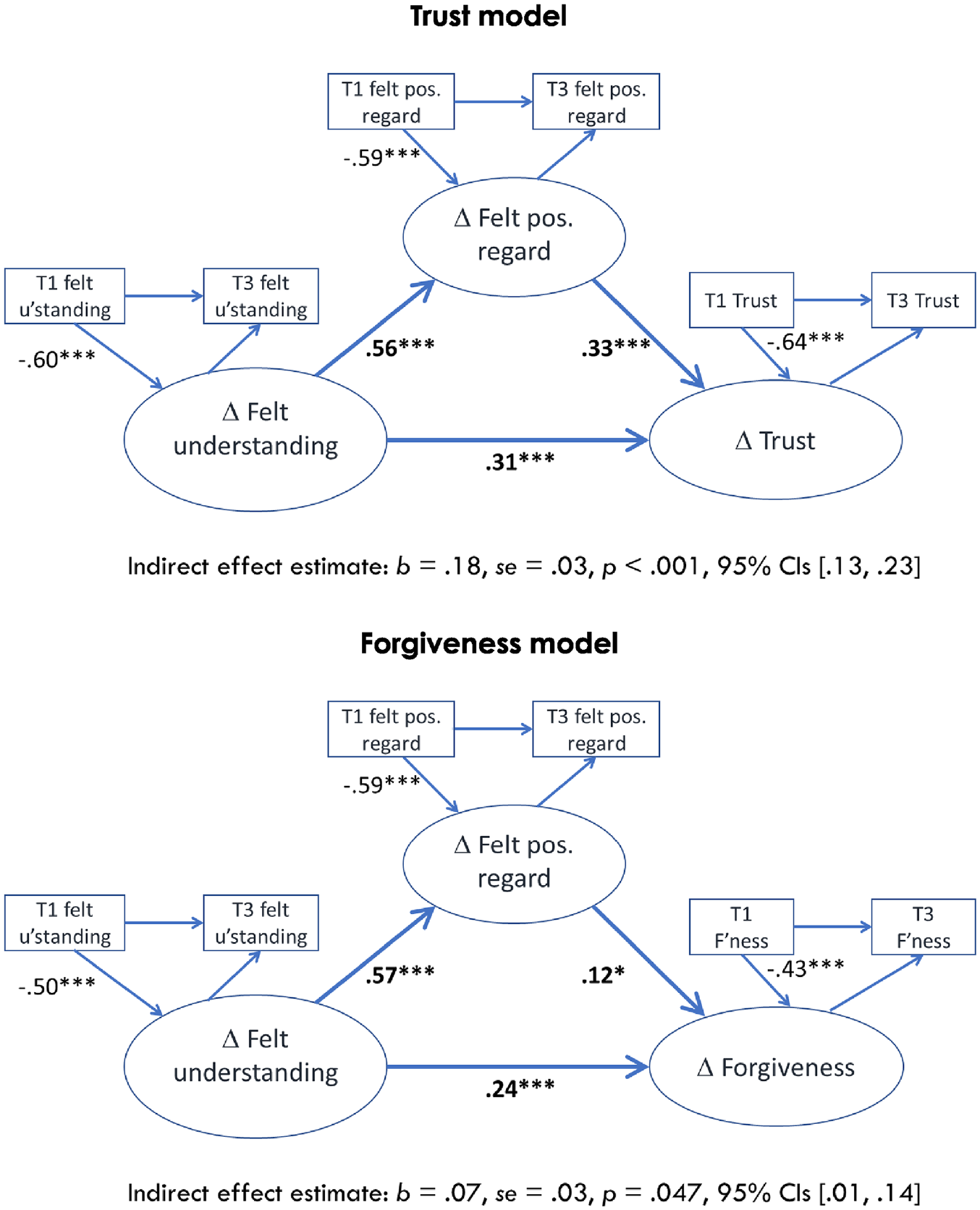
Dynamic Mediation Analyses for Trust (Upper Panel) and Forgiveness (Lower Panel) Following the Model 7 Specification (All Latent Change Estimated From Time 1 to Time 3)
With regard to the three direct paths, the simulations (1,000 run in each case) indicated that the sample provided approximately 80% power to detect an effect as small as β = .1. For the indirect effect, the sample provided more than 80% power to detect an effect of .02 or larger, and 60% to 70% power to detect an effect of β = .015 (which would involve at least one of the constituent direct effects being on the cusp of “trivial,” that is, .1). A summary of the outputs of each set of simulations can be found in the supplemental materials.
Materials and Procedure
Time 1 data were collected between May 5 and May 14, 2021. Time 2 data collection took place approximately 5 to 6 weeks after Time 1 (between June 15 and June 22, 2021), and Time 3 data collection took place approximately 6 weeks after Time 2. The survey contained identical measures at each time point pertaining to the analyses reported in the following. Responses were recorded on a scale ranging from 1 (strongly disagree) to 5 (strongly agree).
Felt Understanding
Felt understanding was assessed using a seven-item scale based on previous research (Livingstone, Fernández Rodríguez, et al., 2020); αs = .92, .91, and .93 for Times 1 to 3, respectively. Example items include “In general, Russians understand the values of Ukrainians,” “In general, Russians have no understanding of the views of Ukrainians” (reverse-scored), and “In general, Russians know a lot about Ukrainians’ perspectives.”
Felt Positive Regard
Felt positive regard (referred to as felt liking in the preregistration) was assessed using a three-item scale adapted from previous research (Livingstone, Fernández Rodríguez, et al., 2020; Livingstone, Windeatt, et al., 2020), αs = .91 at Times 1 to 3. Example items include “In general, Russians have negative views about Ukrainians” (reverse scored), and “In general, Russians like Ukrainians.”
Trust
Trust was assessed using a three-item scale adapted from previous research, such as Noor et al. (2008) and Livingstone, Fernández Rodríguez, et al. (2020), αs = .88, .88, and .89 at Times 1 to 3, respectively. Example items include “Most Russians cannot be trusted to act in the interests of Ukrainians” (reverse scored), and “Most Russians try to be fair.”
Forgiveness
Forgiveness was assessed using a three-item scale adapted from previous research, such as Noor et al. (2008) and Livingstone, Fernández Rodríguez, et al. (2020), αs = .80, .83, and .81 at Times 1 to 3, respectively. Example items include “I hold feelings of resentment towards Russians for their misdeeds” (reverse scored), and “I am prepared to forgive Russians for their misdeeds.”
Additional Variables
National Identification
National (Ukrainian) identification was measured using a four-item scale (Doosje et al., 1995), αs = .89, .87, and .89 at Times 1 to 3, respectively. Example items include “I identify with other Ukrainians,” and “I feel strong ties with other Ukrainians.”
Results
The following analyses followed the pre-registered plan described at https://doi.org/10.17605/OSF.IO/HEQRM.
Dynamic Mediation Analysis With a Mini-Multiverse Approach
To test our hypothesis, we adopted a dynamic mediation approach. Building upon latent change score modeling (Grimm et al., 2012; McArdle, 2009) in a structural equation modeling framework, dynamic mediation involves testing a mediation model in terms of within-person change over time in a predictor, mediator, and outcome variable (e.g., Selig & Preacher, 2009). In this model, change over time in a variable, such as felt understanding, is represented as a latent variable, predicted by baseline between-person scores in felt understanding (plus an error term), and in turn predicting felt understanding scores at the later time point. Predictive paths can then be specified between latent change in different variables—for instance, a predictive path from change in felt understanding to change in felt positive regard.
Advantages of this approach include that, unlike traditional cross-lagged regression models, it permits tests of predictive relations between within-person change in an outcome variable and within-person change in a predictor (as opposed to between-person variation), that is, changes predicting changes, either within the same time frame or across different time frames (Cole & Maxwell, 2003). Second, because it is conducted within a structural equation modeling framework, this approach also involves estimating change while also taking measurement error into account (e.g., Judd et al., 2001). Finally, dynamic mediation also involves estimates of paths between change over time in variables of interest, while also separately estimating associations between those change variables and between-person baseline variation in the measures of those variables. For example, in the models presented in Figure 1, paths are specified between each of the Time 1 measures of the three variables to each of the three latent change factors. This means that the estimates of the indirect association between change in felt understanding and change in trust and forgiveness through change in perceived positive regard also take into account between-person variation in baseline levels of each variable.
The main, pre-registered analysis also adopted a mini-multiverse approach (Steegen et al., 2016) by testing a set of 10 dynamic mediation models for trust, and a similar 10 for forgiveness. These models test the same conceptual specification (change in felt understanding predicting change in perceived positive regard, in turn predicting trust or forgiveness) but cover the 10 plausible combinations of time points that could test this specification, given the three time points. In addition to testing the conceptual specification per se, this mini-multiverse approach also provides an indication of the robustness or otherwise of the results to different analytic decisions regarding the use of data from different time points. These combinations are summarized in Table 1. For illustration, the estimates for the fully concurrent model that examined change between Time Points 1 and 3 in all three variables in the model (Model 7) are presented in Figure 1 (trust in the upper panel, and forgiveness in the lower panel). The point estimates and confidence intervals (CIs) for the indirect (Δfelt understanding →Δperceived positive regard →Δtrust/forgiveness) and direct paths between latent change variables in each of the 10 models for each of the outcome variables are summarized in Figures 2 (trust) and 3 (forgiveness). The data and R code (using the lavaan package; Rosseel, 2012) used to run the analyses are available at the project OSF site: https://osf.io/a7dfb/?view_only=383c08b7af4142108c6dc473ec511c58. The zero-order correlations between all variables are reported in Table 2.
Summary of Model Specifications
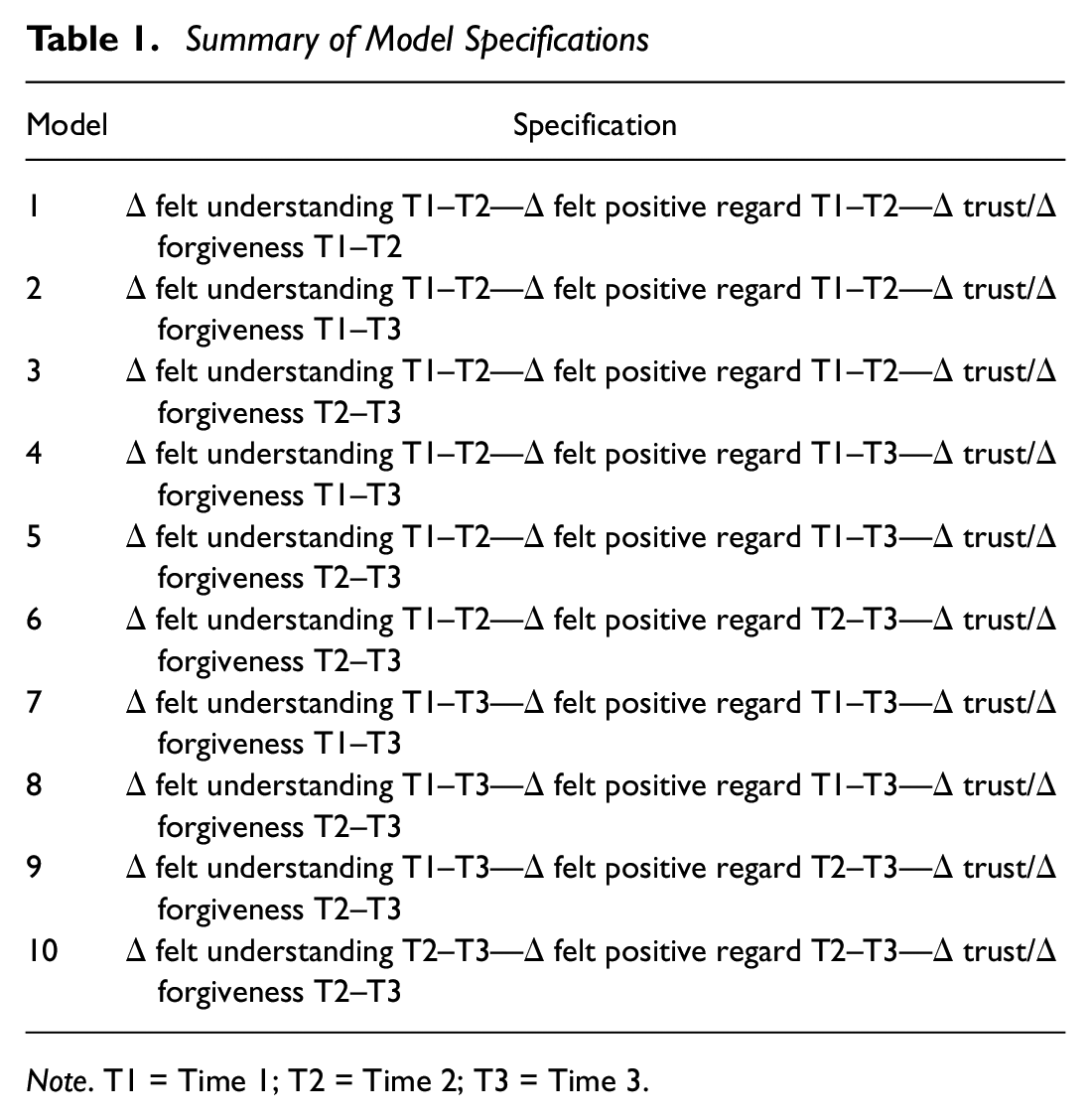
Note. T1 = Time 1; T2 = Time 2; T3 = Time 3.
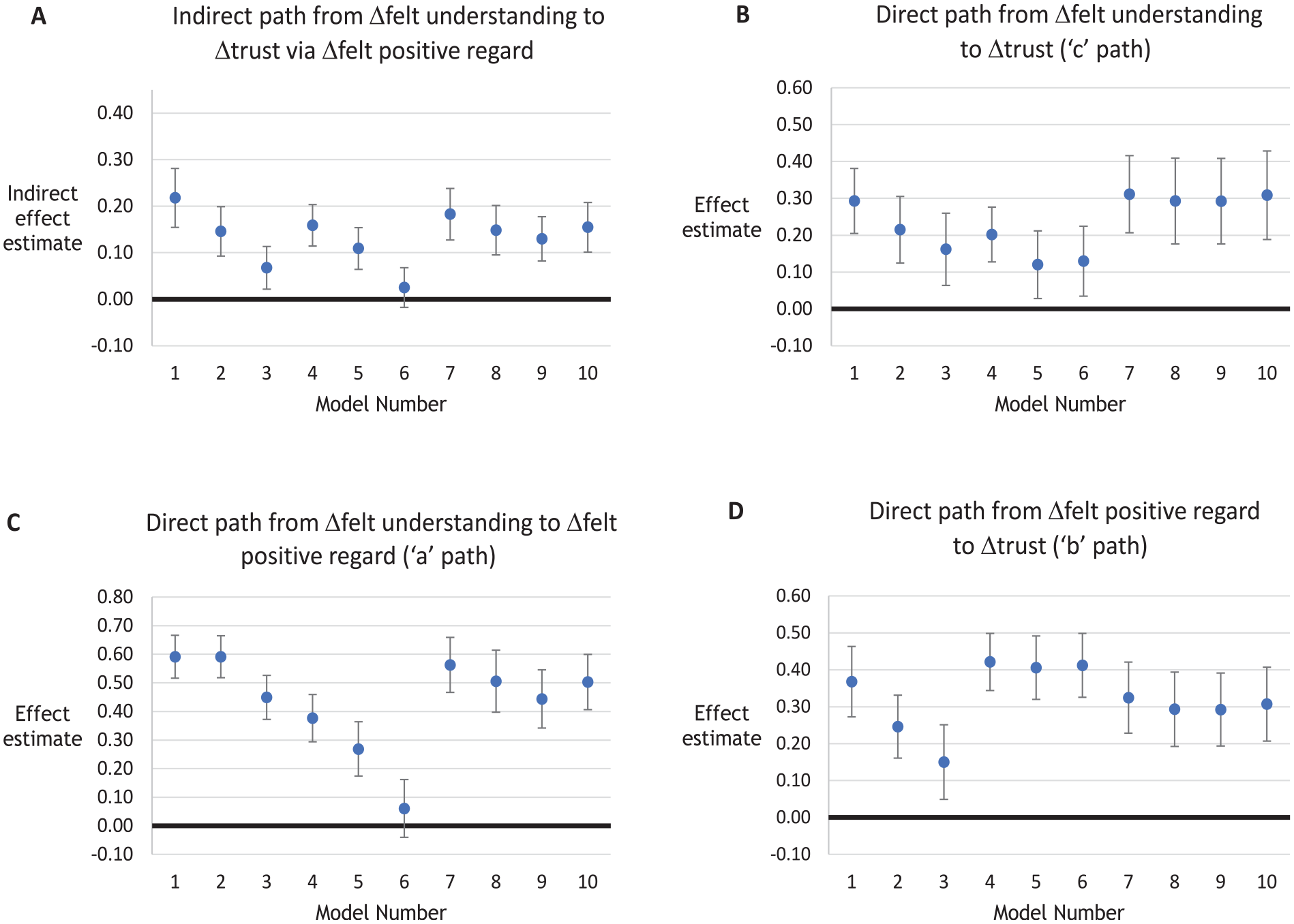
Point Estimates and 95% Confidence Intervals for Indirect (Panel A) and Direct (Panels B–D) Paths Between Latent Change Variables for Models Examining Trust as the Outcome
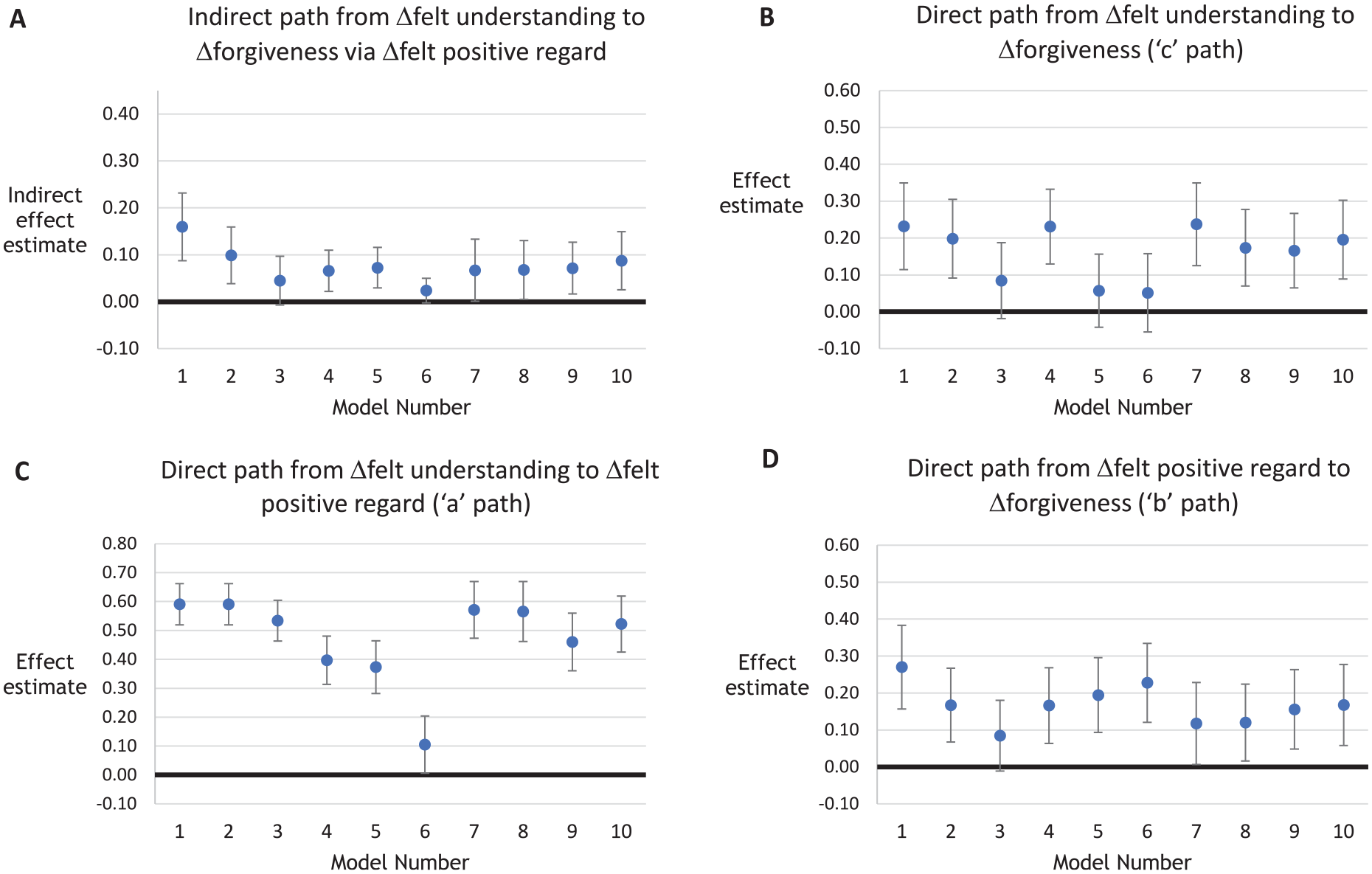
Point Estimates and 95% Confidence Intervals for Indirect (Panel A) and Direct (Panels B–D) Paths Between Latent Change Variables for Models Examining Forgiveness as the Outcome
Zero-Order Correlations and Descriptive Statistics
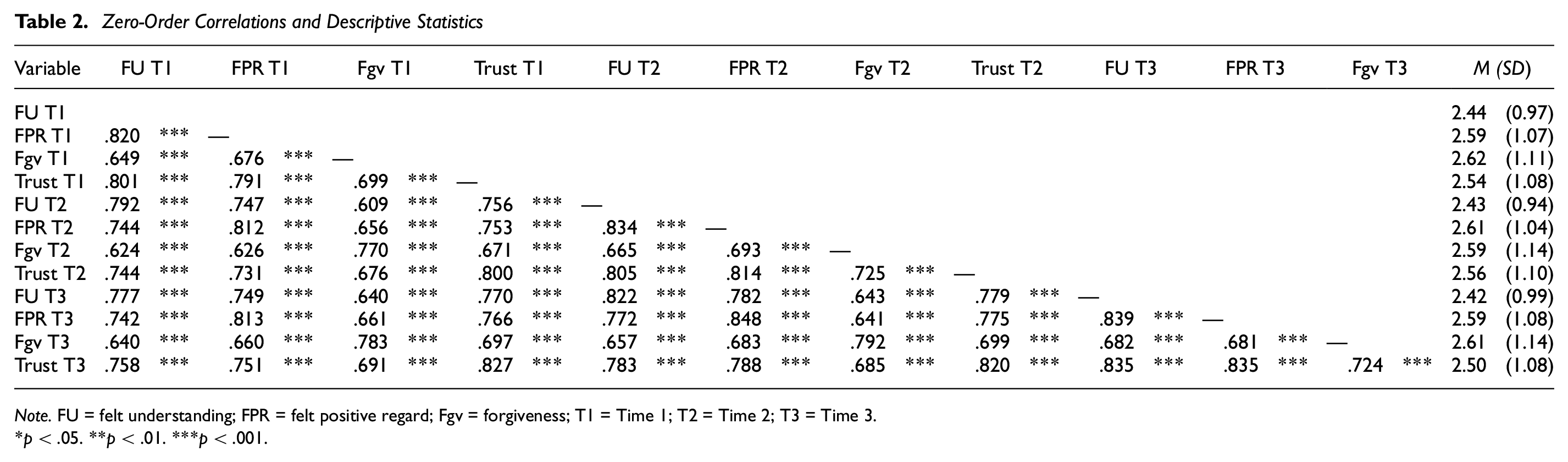
Note. FU = felt understanding; FPR = felt positive regard; Fgv = forgiveness; T1 = Time 1; T2 = Time 2; T3 = Time 3.
p < .05. **p < .01. ***p < .001.
Main Analyses for Trust and Forgiveness
Estimates for the Model 7 specification are summarized in Figure 1 (trust in the upper panel; forgiveness in the lower panel) and estimates across all 10 models are summarized in Figures 2 (for trust) and 3 (for forgiveness). A full list of estimates and 95% CIs can also be found in the supplemental materials. The indirect path between change in felt understanding and change in trust through change in felt positive regard was highly significant in nine of the 10 models for trust (bs = .07–.16, SEs = .02–.03, ps < .005), and in eight of the 10 models for forgiveness (bs = .07–.16, SEs = .02–.04, ps < .047). In each case, change in felt understanding over time predicted change in felt positive regard (trust: bs = .27–59, SEs = .04–.06, ps < .001; forgiveness: bs = .37–59, SEs = .04–.05, ps < .001), which in turn predicted change in trust (bs = .15–.42, SEs = .04–.05, ps < .005) and forgiveness (bs = .12–.27, SEs = .05–.06, ps < .038). The remaining direct paths from change in felt understanding to change in trust (bs = .12–31, SEs = .04–.06, ps < .011) and to change in forgiveness (bs = .17–.24, SEs = .05–.06, ps < .002), were also significant, with the exception of Model 5 for forgiveness.
The exceptions to this pattern were Model 6 for trust and forgiveness, and Model 3 for forgiveness. Model 6 specified Δ felt understanding from Time 1 to Time 2, and Δ felt positive regard and Δ trust from Time 2 to Time 3—that is, the change in felt understanding occurred over a time period that did not overlap with the time period of the changes in felt positive regard and trust. In this case, the indirect path from change in felt understanding through change in felt positive regard was not significant for trust (b = .03, SE = .02, p = .239, 95% CI = [–.02, .08]), or forgiveness, although the 95% CI did not contain 0 (b = .02, SE = .01, p = .070, 95% CI = [.001, .05]). As indicated in Panel C of Figures 2 and 3, this is primarily because the path from change in felt understanding to change in felt positive regard was, in this case, not significant.
In the case of Model 3 for forgiveness, Δ felt understanding and Δ felt positive regard were specified from Time 1 to Time 2, and Δ forgiveness from Time 2 to Time 3; thus, the changes in felt understanding and felt positive regard occurred over a time period that did not overlap with the time period of the change in forgiveness. In this specification, the indirect path was not significant, b = .05, SE = .03, p = .091, 95% CI = [–.01, .10].
The models also provide estimates of the association between change in each variable over time, and between-person baseline variation in those variables. As summarized in Figure 1 for Model 7, change in each of the variables was significantly greater among those who scored lower on baseline measures—for instance, change in felt understanding was greater among those who were lower in felt understanding to begin with (e.g., b = –60, SE = .05, p < .001, 95% CI = [–.68, –.51] for trust in the upper panel in Figure 1). Estimates for these associations were similar across all 10 models.
Secondary Analyses: Adjusting for Ingroup/National Identification
The measure of ingroup (national/Ukrainian) identification also allowed us to check whether the above findings were robust to the inclusion of ingroup identification in the model. The rationale for doing so is that strength of attitude (including potentially felt understanding) in intergroup contexts such as this are conceivably confounded with identification, whereby less strident views simply reflect lower levels of national identification. As per the preregistration plan for secondary analyses, we reran each of the 10 models for trust and forgiveness after adding change over time in identification as a covariate (i.e., with change in identification as an additional predictor of change in felt positive regard, and of change in trust and forgiveness). In each case, the time period of change in identification (e.g., Time 1–Time 2) was matched to that for change in trust/forgiveness. These models also included paths from baseline (Time 1 or 2, depending on the model) levels of identification to each of the change variables, and a summary of the models and output can be found on the project OSF site. Results of these additional analyses indicated that the outcomes reported above were substantively unaffected by adjusting for national identification, both in terms of effect sizes and significance levels for direct and indirect effects.
Post hoc Analyses
Based on a suggestion during the peer review process, we also tested the indirect effects across the 10 models separately for those who completed the Time 1 survey in Ukrainian, and those who completed it in Russian. These revealed that the indirect effects of change in felt understanding through change in felt positive regard to change in trust and forgiveness were broadly similar: the average estimates across the trust models were b = 0.10 (average 95% CIs = [.04, .17]) for Ukrainian language completions and b = 0.15 (average 95% CIs = [.07, .22]) for Russian language completions. For the forgiveness models, the average estimates across the models were b = 0.08 (average 95% CIs = [.02, .17]) for Ukrainian language completions and b = 0.07 (average 95% CIs = [–.01, .15]) for Russian language completions. Indirect effects for each model broken down by language of completion can be found in the supplemental materials.
Discussion
In this study, we addressed the pressing challenge of understanding the bases of trust and forgiveness amid violent intergroup conflict. With a representative, longitudinal panel of participants in urban areas in Ukraine, we tested whether intergroup felt understanding—the belief that outgroup members (Russians, in this case) understand ingroup members’ perspectives—provides an important psychological basis for trust and forgiveness, and the role of felt positive regard in these links.
Results of pre-registered dynamic mediation analyses indicated that, in the great majority of time point combinations tested, change over time in intergroup felt understanding predicted change over time in felt positive regard, which in turn predicted change over time in trust and forgiveness of Russians. More concretely, increases between time points in the belief that Russians understood Ukrainian perspectives were associated with increases in the perception that Russians regarded Ukrainians positively, which were in turn associated with increases over time in trust in, and forgiveness of, Russians.
The only exceptions to this pattern were in the time point combination in which the change in felt understanding occurred over a time period (between Times 1 and 2) that did not overlap with the time period of the changes in felt positive regard and trust (between Times 2 and 3). This provides a helpful caveat to the more general implication that felt understanding predicts greater trust and forgiveness: an increase in our sense of feeling understood by an outgroup is likely to be associated with an increase in trust and forgiveness, as long as those changes are assessed during an at least partly overlapping time period.
These results provide further evidence for the role of felt understanding as a psychological component of more positive intergroup relationships (Livingstone, Fernández Rodríguez, et al., 2020; Livingstone, Windeatt, et al., 2020), echoing the better established importance of felt understanding when it comes to close, interpersonal relationships (Itzchakov et al., 2022; Oishi et al., 2010; Reis et al., 2017). The reason for this is likely to be that felt understanding taps into a level of perception and intentionality (third order, or second-order theory of mind) that very few other established predictors in intergroup relations address, despite the fact that this meta-meta level of perception is acknowledged as crucial to human sociality more generally (Sperber, 2000; Tomasello et al., 2005). It suggests that we are not only concerned with how members of other groups perceive “us” per se (as suggested by extensive research on intergroup meta-perceptions; Lees & Cikara, 2020; Ruggeri et al., 2021; Vorauer et al., 1998), but also with how they perceive and evaluate our own perspectives, experiences, and so on, in turn. As our findings suggest, this higher order perception of “our” own perspectives in the mind’s eye of outgroup members in turn provides a basis for feeling positively regarded by outgroup members: we feel that our perspectives, values, experiences, and so on, are understood, and so we feel better liked and respected in turn. This lower order meta-perception of feeling positively regarded by outgroup members then provides a proximal psychological platform for more positive relations (e.g., Putra, 2014; Simon et al., 2015), including as a component of post-conflict reconciliation.
Although our findings provide insight into possible mechanisms for reconciliation following devastating intergroup conflict and injustice, the study also has limitations that should be addressed in future research. Among these are the correlational nature of the data (notwithstanding the longitudinal design and the latent change-based analysis), which leaves open the possibility of influence by unmeasured factors that covary with those in the analysis. This is addressed to an extent by previous evidence of the casual role of felt understanding (Livingstone, Windeatt, et al., 2020) and felt positive regard (Putra, 2014; Simon et al., 2015), and of the robust role of felt understanding while adjusting for other major predictors (e.g., stereotypes, threat perceptions, and perceptions of negative interdependence) of intergroup attitudes (Livingstone, Fernández Rodríguez, et al., 2020). Nevertheless, there would be clear value in replications of the present findings, including in other settings of violent intergroup conflict that would help gauge the generalizability of the findings to other contexts.
The focus on felt understanding also leaves open questions about whether the perception of being understood by outgroup members is itself accurate, and what may happen if it is not. It is conceivable that a mismatch between felt understanding and outgroup members’ actual understanding of ingroup perspectives could be problematic in different ways. On one hand, it may be that conflict is stoked in part by inaccurate perceptions that outgroup members misunderstand ingroup perspectives—a possibility that echoes recent findings about exaggerated, negative misperceptions of outgroup meta-perceptions about the ingroup and how these misperceptions drive polarization (Lees & Cikara, 2020; Ruggeri et al., 2021). On the other hand, the feeling of being understood—and the trust it may facilitate—could potentially be maladaptive if outgroup members in fact do not understand ingroup perspectives particularly well. In terms of translation into groups’ actual, sustained engagement in reconciliation, feeling understood may therefore be especially effective if it also has an element of accuracy, so that it is not undermined over the course of subsequent interactions.
The findings of this study also beg important questions about how felt understanding might actually be brought about against the backdrop of intergroup violence, and polarization in societies more generally. One approach would be to test how intergroup felt understanding may be fostered using communication-based processes in which perspectives are shared, but then also explicitly reflected back in a structured manner, so that others’ understanding of “our” perspectives is communicated clearly rather than left tacit (Bruneau & Saxe, 2012; Itzchakov et al., 2022). This draws not only upon techniques used in diverse settings such as interpersonal therapeutic relationships (Rogers, 1965), but also in problem-solving workshop approaches to addressing intractable intergroup conflict (e.g., Fisher, 2020; Kelman, 1990). A key implication of this research is that, in psychological terms, a critical process in the success of such approaches is the experience of feeling understood (implied also by work on feeling “heard”; Bruneau & Saxe, 2012; Roos et al., 2021).
The above suggestion in turn raises practical questions about how to do this in view of the enormity of conflict in a context such as Ukraine. The drastic escalation of the conflict following Russia’s invasion in 2022 means that actual prospects for reconciliation are undoubtedly much smaller than at the time of data collection. We also echo others who have emphasized the importance of multilevel approaches to peace building, with social psychological processes such as those examined here being only one facet of any enduring solution to protracted conflict (Rouhana, 2004). It is important more generally to articulate psychological explanations with insights from other disciplines, such as history and political science, which address the social and political realities of post-conflict reconciliation. Nevertheless, one message that can be drawn from peace processes as diverse as South Africa and Lebanon is that efforts to elicit understanding from an enemy may not always succeed (and indeed, frequently fail) in the face of entrenched views and ongoing violence; but, where reconciliation is achieved, it is fostered in part through careful processes of structured sharing of perspectives, and the recognition of those perspectives, in turn, by erstwhile opponents (Fisher, 2005, 2020). Our findings suggest that the feeling of being understood may be one of the key psychological factors that characterizes the shift from resistance to openness to reconcile.
Supplemental Material
sj-docx-1-spp-10.1177_19485506231183195 – Supplemental material for How Feeling Understood Predicts Trust and Willingness to Forgive in the Midst of Violent Intergroup Conflict: Longitudinal Evidence From Ukraine
Supplemental material, sj-docx-1-spp-10.1177_19485506231183195 for How Feeling Understood Predicts Trust and Willingness to Forgive in the Midst of Violent Intergroup Conflict: Longitudinal Evidence From Ukraine by Tymofii Brik, Andrew G. Livingstone, Maria Chayinska and Evgeniya Bliznyuk in Social Psychological and Personality Science
Footnotes
Handling Editor: Malgorzata Kossowska
Declaration of Conflicting Interests
The author(s) declared no potential conflicts of interest with respect to the research, authorship, and/or publication of this article.
Funding
The author(s) received no financial support for the research, authorship, and/or publication of this article.

Supplemental Material
The supplemental material is available in the online version of the article.
Notes
Author Biographies
References
Supplementary Material
Please find the following supplemental material available below.
For Open Access articles published under a Creative Commons License, all supplemental material carries the same license as the article it is associated with.
For non-Open Access articles published, all supplemental material carries a non-exclusive license, and permission requests for re-use of supplemental material or any part of supplemental material shall be sent directly to the copyright owner as specified in the copyright notice associated with the article.
