




Abstract
This research tests the unique predictions of three different theoretical perspectives on the self-esteem benefits of religiosity: the religiosity-as-a-personal-relationship-with-a-higher-power perspective, the religiosity-as-a-resource perspective, and the religiosity-as-social-value perspective. To do so, we used random-intercept cross-lagged panel models and examined the between- and within-person associations between three indicators of religiosity (belief in God, service attendance, and prayer frequency) and self-esteem across 11 annual assessments in a nationally representative sample of Dutch individuals (N = 12,915). The results reveal largely nonsignificant associations between all three religiosity indicators and self-esteem at the between- and the within-person levels. This finding supports the religiosity-as-a-social-value perspective, suggesting that the self-esteem benefits of religiosity are restricted to religious cultures only. This research extends previous research by showing that the results hold across different measures of religiosity and by providing some initial evidence that the power of the religiosity-as-a-social-value perspective might be larger than formerly assumed.
Religiosity appears to be a wellspring of psychological benefits (Gebauer et al., 2012; Newman & Graham, 2018) as religious individuals tend to have higher self-esteem (Aydin et al., 2010; Benson & Spilka, 1973; Krause & Van Tran, 1989) and to be better psychologically adjusted than nonreligious individuals (Garssen et al., 2021; McCullough et al., 2001). However, the associations between religiosity and self-esteem are often small (Ellison & Levin, 1998) and culturally specific (Diener et al., 2011).
Theoretically, there are at least three explanations for the observed associations between religiosity and self-esteem. First, according to the religiosity-as-a-personal-relationship-with-a-higher power (RAPR) perspective, religiosity bolsters self-esteem through establishing an intimate relationship with a deity (Ellison & Levin, 1998; Hayward & Krause, 2014). Second, according to the religiosity-as-a-resource (RAR) perspective, religiosity boosts self-esteem through providing access to important social resources, particularly among older adults (Ellison & Levin, 1998; Hayward & Krause, 2014). Third, according to the religiosity-as-social-value (RASV) perspective, religiosity is positively associated with self-esteem because religious individuals feel like valued members in religious societies but to a lesser degree in secular societies (Gebauer et al., 2012, 2017).
The three perspectives make different predictions about the self-esteem benefits of different aspects of the religious experience and the generalizability of these effects. Although many studies have tested for the associations between religiosity and self-esteem, to our knowledge, no study has tested these predictions against each other. Moreover, most of the extant studies relied on cross-sectional data and, hence, little is known about the longitudinal associations between self-esteem and religiosity. The purpose of this study was to address these gaps using 11 waves of longitudinal data from a nationally representative sample from the Netherlands.
RAPR Perspective
The RAPR perspective proposes that the self-esteem benefits of religious individuals stem from their personal relationship with a deity. The perspective dates back to Gordon Allport (1950) who theorized that religiosity integrates the self with a superordinate being, thereby providing individuals with a master motive for life, which consequentially leads to higher self-esteem (Batson et al., 1993). In addition to purpose and meaning, an intimate relationship with a deity offers unconditional love and acceptance: feelings that are also at the core of high self-esteem (Bradshaw & Kent, 2018; Ellison & Levin, 1998).
Following this perspective, the associations between religiosity and self-esteem should be most pronounced for (or even restricted to) religiosity measures that focus on the personal aspects of religiosity, such as individuals’ belief in God or desire to pray. Furthermore, longitudinal effects between religiosity and self-esteem should be bidirectional, such that individuals who develop a personal relationship with a deity experience subsequent increases in self-esteem, whereas people with decreasing levels of self-esteem may turn to religiosity to reap the self-esteem benefits that religiosity promises to offer (Ano & Vasconcelles, 2005; George et al., 2002).
Several studies have tested the RAPR perspective by examining the cross-sectional associations between personal aspects of religiosity and self-esteem. These studies provided mixed results. Whereas some studies documented a positive link between personal aspects of religiosity and self-esteem (e.g., Abdel-Khalek, 2011: religious belief; Steger & Frazier, 2005: religious belief), some reported no associations (e.g., Krause & Van Tran, 1989: nonorganizational religiosity; Schieman et al., 2017: prayer frequency). Moreover, only four studies have examined these links in longitudinal data. These studies also found mixed results. Whereas Krause (2006) and Krause (2009) found evidence for longitudinal effects of religious doubts and perceptions of a close relationship with God on self-esteem, Bradshaw and Kent (2018) and Kent et al. (2018) found no evidence that religiosity, measured as prayer frequency (Kent et al., 2018) and secure attachment to God (Kent et al., 2018), was associated with subsequent increases in self-esteem. Notably, only one study to date examined the longitudinal effects of self-esteem on subsequent changes in religiosity (Grubbs et al., 2016). Contrary to the propositions of the RAPR perspective, this study found a negative association between self-esteem and subsequent increases in religious and spiritual struggles. Overall, thus, the evidence for the RAPR perspective is mixed.
RAR Perspective
According to the RAR perspective, religiosity is positively associated with self-esteem because it provides believers with access to important social resources. Specifically, religious individuals are generally better socially integrated, tend to receive more social support, and experience their social activities as more meaningful than nonreligious individuals (Ellison & Levin, 1998; Salsman et al., 2005), all of which are factors known to bolster self-esteem.
Following this perspective, the association between religiosity and self-esteem should be restricted to religiosity measures that focus on the social aspects of religiosity, such as the frequency of service attendance. Furthermore, longitudinal effects should be bidirectional, such that people who become more religious should experience subsequent increases in self-esteem, whereas people who experience decreases in self-esteem should also experience subsequent decreases in service attendance. The second effect should be true because low self-esteem individuals are thought to withdraw from social activities rather than approach them (Johnson & Spilka, 1991). For instance, many studies showed that depressed people who reported to have low self-esteem (Orth & Robins, 2013) tend to avoid and withdraw from other persons instead of turning toward them to seek help and social support (Jacobson et al., 2001; Steger & Kashdan, 2009).
Finally, the effect should be moderated by age because there is some evidence that older people are more likely to use religiosity as a social resource than younger people (Krause & Hayward, 2014). Hence, according to the RAR perspective, the associations between religiosity and self-esteem should be particularly pronounced in older adults.
Several studies have tested the associations between different social aspects of religiosity (i.e., service attendance) and self-esteem and most of them found evidence for a positive link between the two constructs, supporting the RAR perspective (e.g., Abu-Raiya et al., 2021; Hayward & Krause, 2014; Krause & Van Tran, 1989; Sherkat & Reed, 1992). Yet all of these studies relied on cross-sectional data, whereas the two studies that tested the propositions of the RAR perspective in longitudinal data found no evidence for an association between service attendance and subsequent increases in self-esteem (Kent et al., 2018; Krause, 2009).
RASV Perspective
According to the RASV perspective, religiosity is positively associated with self-esteem because religious individuals feel as valued members in most societies, that is, in societies in which religiosity is culturally normative. Feeling as a socially valued member of a society, in turn, is associated with higher self-esteem (Gebauer et al., 2012, 2017). Notably, the RASV perspective posits that the association between religiosity and self-esteem hinges on the cultural context. In religious cultures, the associations should be stronger because religious individuals should feel particularly valued in religious cultures. In secular cultures, however, the associations should be small or almost nonexistent.
Following this perspective, in religious cultures, the associations between religiosity and self-esteem should generalize across different measures of religiosity and the causal effect should go both ways. By contrast, in secular cultures, the effects should be smaller or perhaps even nonexistent.
So far, two studies have tested whether the associations between religiosity and self-esteem are contingent on the religiosity of the cultural context (i.e., the propositions of the RASV perspective). Both studies found that that the associations between religiosity and self-esteem were stronger in religious cultural contexts than in secular cultural contexts; that is, both studies found support for the RASV perspective (Gebauer et al., 2012, 2017). However, both studies relied on a single measure to assess religiosity (i.e., religious beliefs) and were based on cross-sectional data. To date, no study exists that has tested for propositions of the RASV perspective in a longitudinal research design.
The Present Research
This research aims to test the unique predictions of three different theoretical perspectives on the self-esteem benefits of religiosity. Specifically, we used random-intercept cross-lagged panel models (RI-CLPM; Hamaker et al., 2015) to examine the between- and within-person associations between three indicators of religiosity (belief in God, service attendance, and prayer frequency) and self-esteem across 11 annual assessments in a nationally representative sample of Dutch individuals.
As outlined above, evidence for the RAPR perspective would be reflected in positive between- and within-person associations between the two personal indicators of religiosity (i.e., belief in God and prayer frequency) and self-esteem. Evidence for the RAR perspective would be reflected in positive between- and within-person associations between the social indicator of religiosity (i.e., service attendance) and self-esteem, particularly among older adults. Finally, evidence for the RASV perspective would be reflected in small or even nonsignificant associations between all three religiosity indicators and self-esteem because the Netherlands is a particularly secular culture and religiosity is hence not a valued trait in this culture. Notably, a comprehensive test of the RASV perspective would require a longitudinal cross-cultural dataset, that is, a dataset containing multiple assessments of religiosity and self-esteem from several cultures that vary in their culture-level religiosity. Unfortunately, these datasets are not available yet. The present results from a singular secular culture need to be interpreted with this caveat in mind.
In addition to testing the average associations between self-esteem and the three religiosity measures, we examined the moderating role of age and gender for all associations.
Method
This study used data from the Longitudinal Internet Studies for the Social Sciences (LISS) panel. LISS is a publicly available, de-identified dataset exempt from institutional review board (IRB) approval. Other research has used these data; an overview is provided at https://www.dataarchive.lissdata.nl/publications. We have used these data previously to investigate religiosity development across the life span and the association between religiosity and the Big Five personality traits (Bleidorn et al., 2022; Lenhausen et al., 2023). No previous research has used these data to examine the reciprocal associations between religiosity and self-esteem, which is the primary goal of this study. This study was not preregistered. The code for the analysis can be accessed at: https://osf.io/hsynq/?view_only=831178204dc2405aa02c946230a69599. The data and study material can be accessed here: https://www.lissdata.nl/
Sample
The LISS panel is a true probability sample of Dutch individuals drawn from the population registrar of the Netherlands (Scherpenzeel, 2010). To account for attrition and maintain the target of 5,000 households, the panel is updated every 2 years by recruiting a refreshment sample, giving a total of ∼20,000 participants. Participants complete an array of monthly surveys every year, starting in 2007. We used data from all participants who responded to at least one religiosity assessment and at least one self-esteem assessment of the 11 assessment waves from 2008 to 2019. 1 This selection criteria resulted in a total sample of N = 12,915 individuals, ranging from 16 to 100 years of age (54% women, Mage = 44.51 years, SDage = 17.78 at first assessment). Table 1 provides an overview on the sample demographics in each chronological wave.
Sample Demographics by Chronological Wave
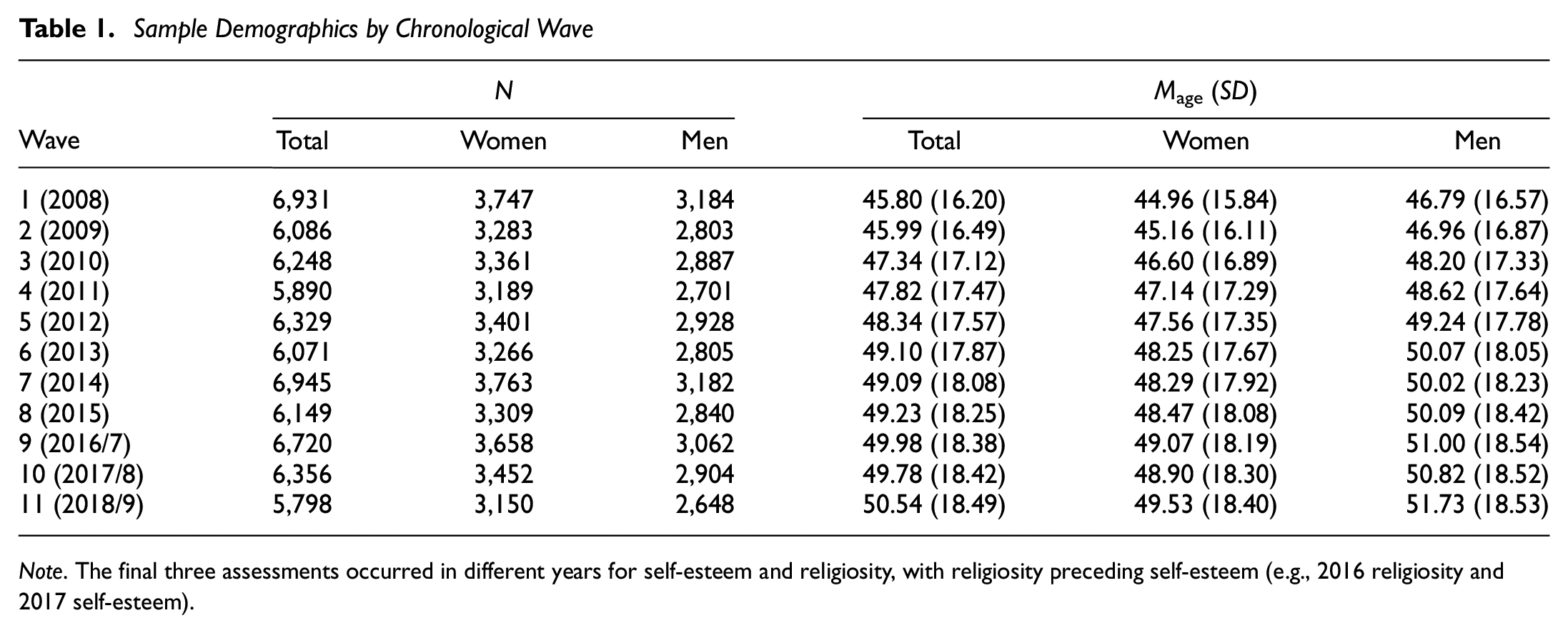
Note. The final three assessments occurred in different years for self-esteem and religiosity, with religiosity preceding self-esteem (e.g., 2016 religiosity and 2017 self-esteem).
Measures
Self-Esteem
At each assessment wave, participants reported on their self-esteem using the 10-item Rosenberg Self-Esteem Scale (RSES; Rosenberg, 1965). An example item of the RSES is as follows: “On the whole, I am satisfied with myself.” Responses were measured on a 7-point Likert-type scale ranging from 1 (totally disagree) to 7 (totally agree). At the first assessment, internal consistency was
Religiosity
At each assessment wave, participants responded to a variety of questions pertaining to their religiosity. We used three items from this collection assessed at each wave. The first item assessed belief in God with the single item, “Which of the following statements best matches your idea of God?” measured on a 6-point Likert-type scale ranging from 1 (I do not believe in God) to 6 (I believe without any doubt that God exists). The second item measured religious attendance (“Aside from special occasions such as weddings and funerals, how often do you attend religious gatherings nowadays?”) and the third item measured prayer frequency (“Aside from when you attend religious gatherings, how often do you pray?”). The last two items were measured on a 7-point Likert-type scale ranging from 1 (every day) to 7 (never). We reverse coded responses so that 1 indicates never and 7 indicates every day.
Controls
At each assessment wave, participants were asked for their birthyear and gender. We excluded all participants who changed their answers to these two questions during the study period and used the respective answers from the participants’ baseline assessment for the moderator analysis. Specifically, we formed three age groups of the age variable: (1) individuals aged below 36 years, (2) individuals aged older than 36 years but below 65 years, and (3) individuals aged older than 65 years. Gender was coded as a binary variable, with 1 indicating men and 2 indicating women.
Analyses
For all analyses, we used Holm’s correction (Holm, 1979) and only interpreted effects with a p value < .01 as significant. Throughout the article, we report 99% confidence intervals (CIs). To replicate the cross-sectional associations between religiosity and self-esteem observed in previous research, we calculated the correlations between each religiosity indicator and self-esteem at participants’ baseline assessment. To examine the intraindividual associations between religiosity and self-esteem, we estimated one RI-CLPM for each religiosity indicator and self-esteem. This allowed us to investigate the within-person cross-lagged associations and the within-person concurrent associations over time. Specifically, the cross-lagged associations in a RI-CLPM indicate whether a deviation from an individual’s average level of religiosity predicts a subsequent deviation in their average levels on self-esteem, and vice versa. The concurrent associations in a RI-CLPM indicate whether participants’ deviations from their average religiosity in one year is associated with deviations from their average self-esteem score in the same year. In all three models, we estimated all paths using the observed variables for religiosity and self-esteem. Furthermore, we began with constraining all auto-regressive paths, all concurrent paths, and all cross-lagged paths to be equal. We determined absolute fit using root mean square error of approximation (RMSEA), standardized root mean square residual (SRMR), and comparative fit index (CFI), with RMSEA ≤.08, SRMR ≤.08, and CFI ≥.95, indicating good model fit (Cheung & Rensvold, 2002). Next, we examined whether freeing these paths significantly improved model fit by comparing the fit indices across models. Fit indices were considered similar if they differed from each other by maximal Δ≤.010 for CFI, Δ≤.015 for RMSEA, and Δ≤.030 for SRMR (Chen, 2007).
To test whether age or gender moderated the associations between religiosity and self-esteem, we refitted the RI-CLPMs in a multigroup framework, using either the age groups or gender as grouping variables. 2 Specifically, we tested whether sequentially freeing the equality constraints on intercept correlations, the cross-lagged, and the concurrent associations across groups resulted in a significant improvement in model fit as indicated by the model fit indices. We relied on the same criteria for determining changes in model fit as before.
All analyses were conducted in R 4.1.3 (R Core Team, 2022). Data cleaning and preparation was conducted with the package tidyverse (Wickham et al., 2019), all RI-CLMs were estimated with the lavaan package (Rosseel, 2012) using Full Information Maximum Likelihood to account for missing data.
Results
Replication of Prior Cross-Sectional Findings
We first aimed to replicate prior research reporting positive cross-sectional associations between religiosity and self-esteem (see Table 2). Notably, we did not replicate prior findings but found that the two personal religiosity indicators, belief in God and prayer frequency, were not associated with self-esteem, r = –.13, 99% CI = [–.039, .013] and r = –.19, 99% CI = [–.045, .007]. Moreover, we found that the social religiosity indicator service attendance was negatively associated with self-esteem, r = –.038, 99% CI = [–.064, –.012] in the Netherlands.
Baseline Correlations Between Religiosity and Self-Esteem
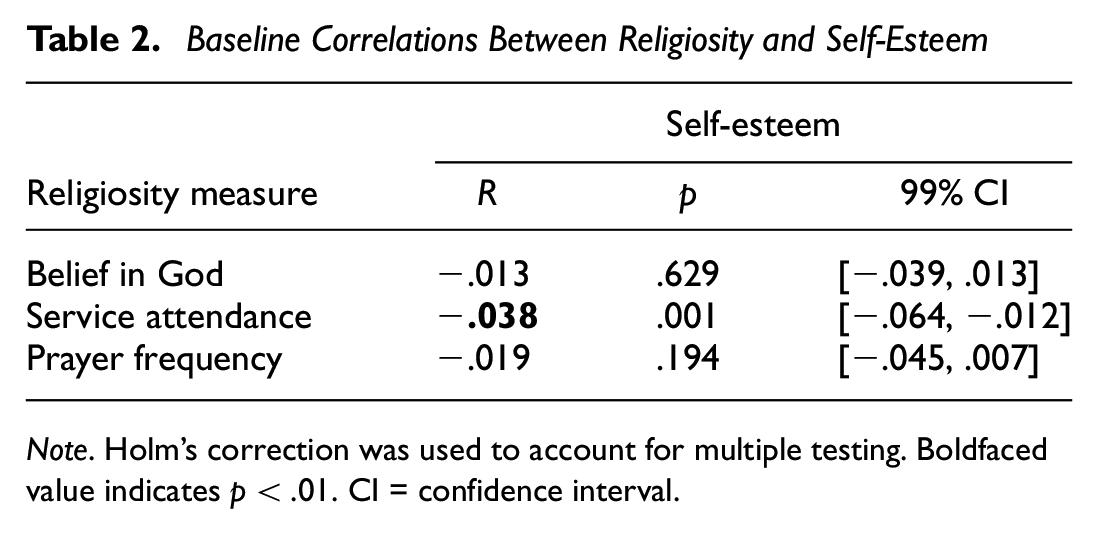
Note. Holm’s correction was used to account for multiple testing. Boldfaced value indicates p < .01. CI = confidence interval.
Intraindividual Associations
All RI-CLPMs had excellent fit with CFI > .95, RMSEA < .08, and SRMR < .08 (see Supplemental Table S1). Constraining the auto-regressive, cross-lagged and concurrent paths to be equal did not worsen the model fit. Hence, we present, in the following, the constrained and standardized within-person cross-lagged and concurrent associations as well as random-intercept correlations from the RI-CLPMs (see Table 3). This reflects our theory that associations would be consistent across measurement waves and also aggregates our power across cross-lagged paths to estimate associations with greater precision. We averaged the estimates across the assessment waves because estimates differed slightly across assessment waves due to slightly different sample sizes across waves (see Table 1).
Random-Intercept Cross-Lagged Panel Model Results
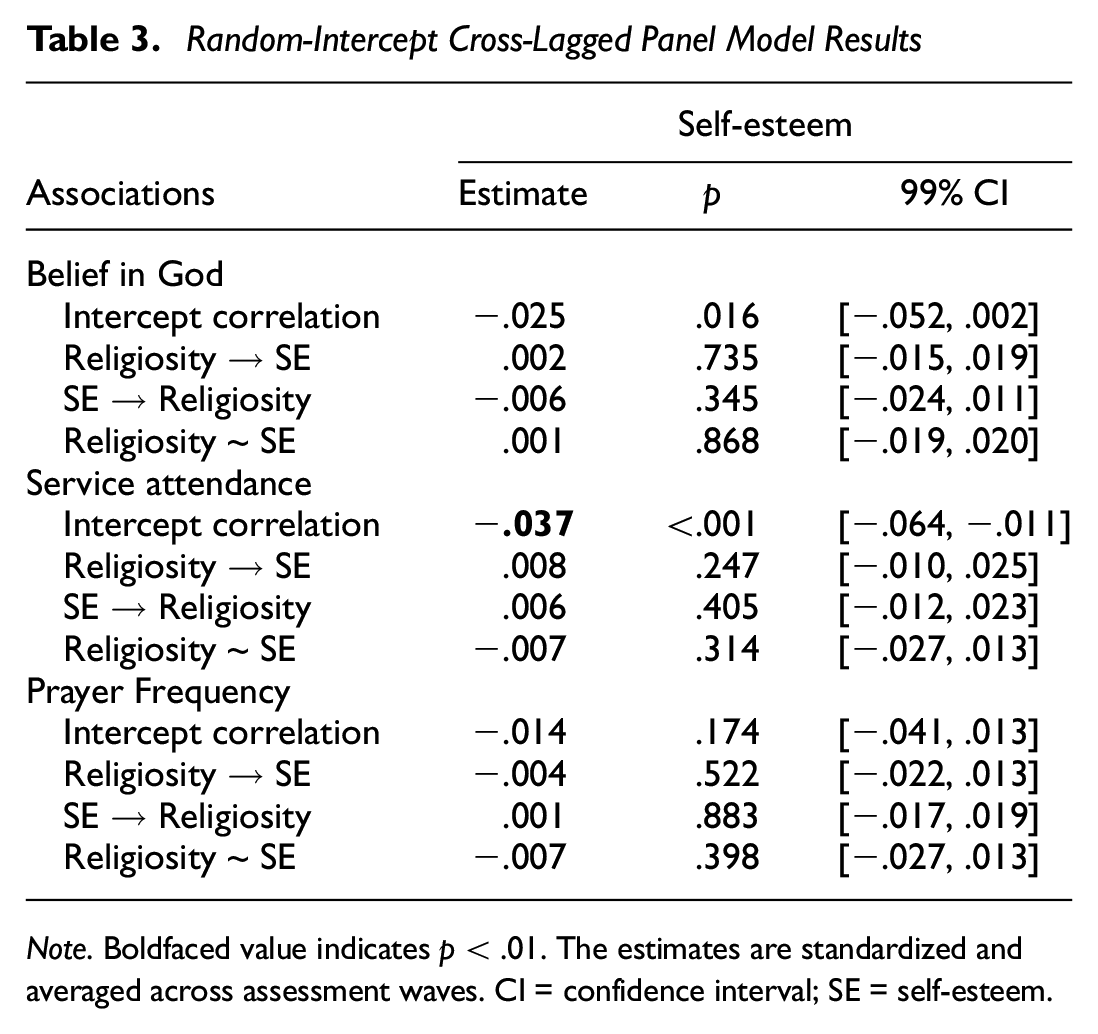
Note. Boldfaced value indicates p < .01. The estimates are standardized and averaged across assessment waves. CI = confidence interval; SE = self-esteem.
Cross-Lagged Associations
The within-person cross-lagged associations between religiosity and self-esteem indicate whether participants’ deviations from their average religiosity (self-esteem) score in one year is associated with deviations from their average self-esteem (religiosity) score in the following year. As shown in Table 3, we did not find any significant cross-lagged associations. Neither were increases in religiosity associated with subsequent increases in self-esteem (belief in God: zPE = .002, 99% CI = [–.015, .019]; service attendance: zPE = .008, 99% CI = [–.010, .025]; and prayer frequency: zPE = –.004, 99% CI = [–.022, .013]), nor were decreases in self-esteem associated with subsequent changes in religiosity (belief in God: zPE = –.006, 99% CI = [–.024, .011]; service attendance: zPE = .006, 99% CI = [–.012, .023]; and prayer frequency: zPE = .001, 99% CI = [–.017, .019]).
Concurrent Associations
The within-person concurrent associations between religiosity and self-esteem indicate whether participants’ deviations from their average religiosity score in one year is associated with deviations from their average self-esteem score in that same year. Notably, because religiosity and self-esteem were assessed in separate surveys, measurements within the same wave were nonetheless, on average, 4 months apart from one another, rather than concurrent (see “Limitations” section for further details). None of the three within-person wave-specific associations were significant at p < .01, belief in God: zPE = .001, 99% CI = [–.019, .020]; service attendance: zPE = –.007, 99% CI = [–.027, .013]; and prayer frequency: zPE = –.007, 99% CI = [–.027, .013]).
Intercept Correlations
The intercept correlations mirrored the correlations at baseline. We did not find any evidence for an association between the two personal religiosity indicators and self-esteem, belief in God: r = –.025, 99% CI = [–.052, .002] and service attendance: r = –.014, 99% CI = [–.041, .013]. Moreover, we found that the social religiosity indicator service attendance was negatively associated with self-esteem, r = –.037, 99% CI = [–.064, –.011] in the Netherlands.
Moderating Effects of Age and Gender
Finally, we examined the moderating effects of age and gender on the intercept, cross-lagged, and concurrent associations in the RI-CLPMs. As can be seen in Table 4, constraining these associations to be equal across age groups or genders did not produce significantly worse fitting models compared with the free models, suggesting no age or gender differences in the associations between religiosity and self-esteem.
Moderator Analysis for Age and Gender
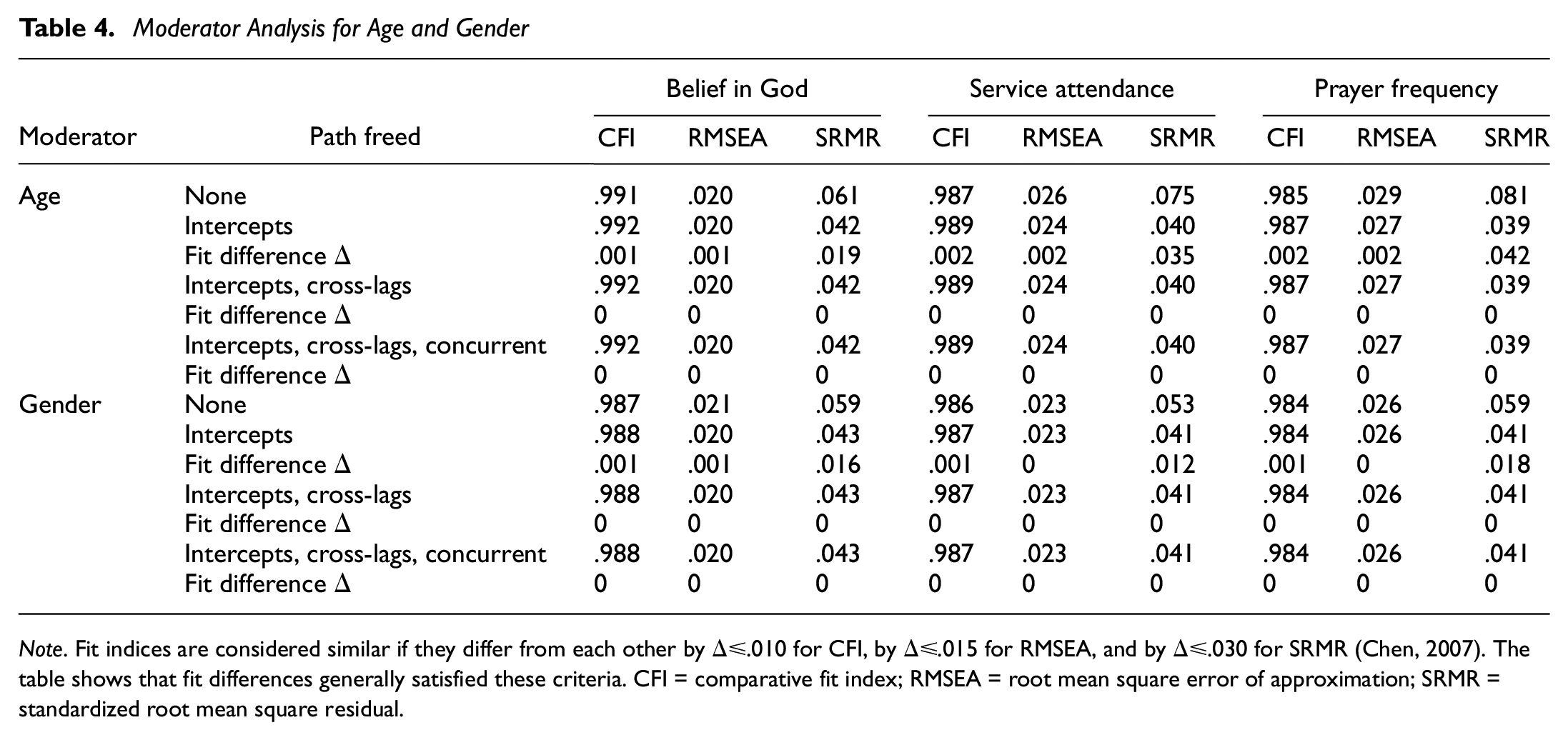
Note. Fit indices are considered similar if they differ from each other by Δ≤.010 for CFI, by Δ≤.015 for RMSEA, and by Δ≤.030 for SRMR (Chen, 2007). The table shows that fit differences generally satisfied these criteria. CFI = comparative fit index; RMSEA = root mean square error of approximation; SRMR = standardized root mean square residual.
Robustness Checks
In a last step, we repeated all analyses using only participants who reported being religious throughout the entire study period (N = 3,624). Excluding nonbelievers from the sample, however, did not change the results. The online Supplemental Tables S3 and S4 contain the results.
Discussion
This research tested the unique predictions of three different theoretical perspectives on the self-esteem benefits of religiosity, using RI-CLPM to examine the between- and within-person associations between three indicators of religiosity (belief in God, service attendance, and prayer frequency) and self-esteem across 11 annual assessments in a nationally representative sample of Dutch individuals.
At the between-person level, we found no evidence for links between the two personal religiosity indicators (i.e., belief in God and prayer frequency) and self-esteem. Furthermore, the social religiosity indicator (i.e., service attendance) was negatively associated with self-esteem, implying that attending services more (less) often is associated with lower (higher) self-esteem. Finally, we did not find any evidence for associations between religiosity and self-esteem at the within-person level. Overall, all longitudinal and concurrent associations between the three religiosity indicators and self-esteem were nonsignificant, implying that, in the Netherlands, there are no self-esteem benefits from religiosity. These findings contradict previous studies that reported a positive association between religiosity and self-esteem (Aydin et al., 2010; Krause & Van Tran, 1989). Second, they speak against theoretical perspectives that conceptualize religiosity as a relationship with a divine power (RAPR) or a social resource (RAR) to explain potential self-esteem benefits.
However, the findings are consistent with perspectives that view religiosity as a social value, the RASV perspective. According to this perspective, the association between religiosity and self-esteem hinges on the religiosity of the ambient cultural context. In religious cultures, religious individuals are more likely to feel valued as members of their societies and should thus experience self-esteem benefits. In secular cultures, however, religious individuals do not experience social value for being religious and should thus not experience self-esteem benefits. This study was conducted in the Netherlands, a particularly secular culture (Pew Research Center, 2020), suggesting that the lack of an association between religiosity and self-esteem may be explained by the key premises of the RASV perspective.
Our findings extend previous research on the RASV perspective in two ways. First, to assess participant’s religiosity, previous studies commonly relied on a personal religiosity indicator (i.e., religious belief). This study, by contrast, relied on three different indicators to assess religiosity (two personal religiosity indicators and one social religiosity indicator) and thus allowed a more fine-grain examination of the associations between religiosity and self-esteem. Interestingly, this research found nonsignificant associations between the personal religiosity indicators and self-esteem, but a negative association between the social religiosity indicator (i.e., service attendance) and self-esteem at the between-person level. From an RASV perspective, one reason for this finding could be that, in secular cultures, religious individuals do not receive social support through service attendance. In fact, most previous studies providing evidence that religious individuals receive more social support than nonreligious individuals stem from the United States—a rather religious culture (Hayward & Krause, 2014). Consistent with this idea, one previous study did not find any evidence that religious individuals receive more social support than nonreligious individuals in secular cultures (Kvande et al., 2015). By contrast, this study even found that older religious individuals receive less social support than older nonreligious individuals in secular cultures, suggesting that the social support benefits of religiosity are restricted to religious cultures only (Kvande et al., 2015). In this research, we found a small negative association at the between-person level only. Future studies should replicate these associations in different life stages and across levels of assessment.
Second, previous studies on the RASV perspective study found that the associations between religiosity and self-esteem were notably smaller (but still existent) in secular cultures as compared with religious cultures (Gebauer et al., 2017). Our results, however, revealed that the associations between religiosity and self-esteem were nonexistent in the Netherlands, a particularly secular culture. Previous studies on the RASV perspective relied on exceptionally large, cross-cultural datasets a powerful approach for testing whether an effect is present or not (Gebauer et al., 2012, 2017). Yet these datasets were also cross-sectional and nonrepresentative in nature.
This study, by contrast, is based on one longitudinal and representative dataset of Dutch individuals, allowing us to estimate the effects in this culture with high precision. Thus, one reason for the differences in the effect sizes between previous studies and this study might stem from the different study designs. However, it might also be that previous research has underestimated the power of the RASV perspective. More precisely, it is also possible that the religiosity of the culture not only diminishes, but also nullifies or even reverses the associations between religiosity and self-esteem. Hence, future research is needed to further quantify the power of the RASV perspective.
Limitations
This study had several strengths that allowed us to test and extend prior research, thus better understanding the nature of the associations between religiosity and self-esteem. Nonetheless, there were also limitations. First, there was a ∼4-month separation between the assessments of religiosity and self-esteem at each wave, with religiosity preceding self-esteem. Importantly, the 4-months’ time interval between the religiosity and the self-esteem assessment does not pose a threat to the validity of our findings. Self-esteem is a relatively stable construct with rank-order stabilities that are comparable to other personality traits (Moor et al., 2021; Robins & Trzesniewski, 2005) and, hence, it seems unlikely that self-esteem changed much in the 4 months after the religiosity assessments. However, this research design is inconsistent with typical RI-CLPM designs in which assessments are made concurrently, and the space between the following assessment is the same for each variable.
Second, the time intervals between the assessment waves were roughly a year. Previous research, however, often relied on longer time intervals between the assessment waves (e.g., 3 years; Bradshaw & Kent, 2018; Krause, 2009). Theoretically, there is reason to assume that the processes proposed by the different perspectives take longer to unfold. For instance, it might take longer than a year to establish a personal relationship with a deity and to feel unconditionally loved and accepted by this superordinate being the core process through which religiosity bolsters self-esteem according to the RAPR perspective. Hence, future research should replicate our findings using longer time intervals between the different assessment waves.
Finally, our data stem from participants residing in a secular Western country. As pointed out above, a comprehensive test of the RASV perspective would require a longitudinal dataset containing data from different cultures that vary in their culture-level religiosity. Unfortunately, these datasets do not exist yet. Hence, we were not able to test the full RASV perspective in this study, but offer suggestive longitudinal evidence that adds to the existing cross-sectional findings supporting the RASV perspective. Furthermore, our reliance on a dataset from only a single, secular culture also restricted the generalizability of our findings in other regards. More precisely, most cultures are still relatively religious (Diener et al., 2011) and thus, in most cultures, we should find associations between religiosity and self-esteem. Furthermore, it is also well possible that in religious cultures there is evidence for the core assumptions of the RAPR and/or the RAR perspective. Therefore, replications of our findings in longitudinal and cross-cultural datasets are warranted.
Conclusion
Contrary to some theory and several empirical studies that found positive associations between religiosity and self-esteem (e.g., Abu-Raiya et al., 2021; Krause & Van Tran, 1989; Steger & Frazier, 2005), we found no evidence for an association between religiosity and self-esteem at either the within-person or between-person level. This finding questions some major theories regarding the function of religiosity and strengthens perspectives that stress the power of religiosity as cultural dimension (Gebauer & Sedikides, 2021). This finding highlights the importance for future research on the psychological correlates of religiosity to take into account the role of culture.
Supplemental Material
sj-docx-1-spp-10.1177_19485506231169811 – Supplemental material for No Evidence for Transactional Effects Between Religiosity and Self-Esteem in a Secular Country
Supplemental material, sj-docx-1-spp-10.1177_19485506231169811 for No Evidence for Transactional Effects Between Religiosity and Self-Esteem in a Secular Country by Theresa M. Entringer, Madeline R. Lenhausen, Christopher J. Hopwood and Wiebke Bleidorn in Social Psychological and Personality Science
Footnotes
Handling Editor: Will Gervais
Declaration of Conflicting Interests
The author(s) declared no potential conflicts of interest with respect to the research, authorship, and/or publication of this article.
Funding
The author(s) received no financial support for the research, authorship, and/or publication of this article.

Supplemental Material
The supplemental material is available in the online version of the article.
Notes
Author Biographies
References
Supplementary Material
Please find the following supplemental material available below.
For Open Access articles published under a Creative Commons License, all supplemental material carries the same license as the article it is associated with.
For non-Open Access articles published, all supplemental material carries a non-exclusive license, and permission requests for re-use of supplemental material or any part of supplemental material shall be sent directly to the copyright owner as specified in the copyright notice associated with the article.
