




Abstract
People in close relationships can, and often do, experience ambivalence (i.e., mixed feelings) toward their romantic partner. Although ambivalence is common and consequential, research on this phenomenon is fragmented. The present work examines how four different types of ambivalence (i.e., objective, subjective, implicit-explicit, and implicit ambivalence) relate to well-being. In four intensive studies (N = 1,134) and internal meta-analyses, ambivalence was related to lower personal and relational well-being, but this association was only statistically significant for explicit (i.e., objective and subjective) types of ambivalence, with subjective ambivalence showing the strongest association, particularly for relationship outcomes. This work is the first systematic study of ambivalence and well-being in relationships and highlights the importance of capturing mixed feelings in relationship research and how such focus can benefit research on attitudinal ambivalence and well-being more broadly.
It is an irony of life that the people we love most, such as our romantic partners, are also the people toward whom we sometimes feel very strong negative emotions. When people hold mixed feelings, both positive and negative, they are in a state of “ambivalence” (Schneider & Schwarz, 2017; Thompson & Holmes, 1996; Thompson & Zanna, 1995). Research has shown that ambivalence is often experienced toward our significant others (Zayas et al., 2017), more so than toward other people we do not feel very close to (Fingerman et al., 2004). Importantly, ambivalence has significant, and often negative, downstream consequences on how people feel, think, and act (van Harreveld et al., 2015) and is a unique predictor of personal and relational outcomes above and beyond people’s univalent (i.e., non-ambivalent) evaluations (e.g., Holt-Lunstad & Uchino, 2019; Uchino et al., 2014). As such, capturing ambivalence is important for the advancement of relationship science and the understanding of how relationships impact well-being.
Previous work has provided valuable insights into ambivalence in relationships, highlighting that ambivalence toward a partner can manifest in different ways, both explicitly (i.e., deliberate evaluations, such as those directly reported in questionnaires) and implicitly (i.e., automatic reactions, such as those indirectly reflected in performance-based tasks; Zayas et al., 2017). 1 However, it is not yet known whether the different ways in which ambivalence manifests are all equally important for people’s well-being. This is because previous studies have typically examined only one type of ambivalence at a time, making comparisons over studies difficult. This leaves the current knowledge about ambivalence in relationships—and its relation to health and well-being—fractioned and incomplete. Addressing this problem, the current work integrates research on emotions, attitudes, and relationship science to present the first systematic study of ambivalence in romantic relationships.
Types of Ambivalence in Relationships
The way people evaluate their partner is critical for their personal and relational well-being (McNulty et al., 2013; Robles et al., 2014). Building on the tenet that people can hold both positive and negative, explicit and implicit, evaluations of their partners at the same time (McNulty et al., 2019; Zayas & Shoda, 2015) and that these evaluations are not always in agreement (Fazio, 1990; Hicks et al., 2018), we focus on four different types of ambivalence, described below. By doing so, we capture both the explicit and implicit evaluations that people hold of their partner (Fincham & Linfield, 1997; Zayas et al., 2017) and the potential inconsistencies within and between them.
The first type, objective ambivalence (also sometimes referred to as potential ambivalence), reflects the degree to which people explicitly hold both positive and negative evaluations at the same time (Armitage & Arden, 2007; Kaplan, 1972). This type of ambivalence is calculated from the explicit positive and negative evaluations and reflects the strength and similarity of the two unipolar evaluations but does not necessarily reflect how torn people feel between their evaluations. The second type, subjective ambivalence (also sometimes referred to as felt ambivalence), does reflect the direct experience of conflict and is measured by asking people to explicitly report how mixed and conflicted they feel toward a certain attitude object (Priester & Petty, 1996).
These first two types—objective and subjective ambivalence—have received the most attention in attitude research and relationship science. Both are related to negative health outcomes, such as higher stress, blood pressure, and inflammation, as well as worse relational outcomes, such as lower relational intimacy and thoughts of breakup (e.g., Birmingham et al., 2019; Herr et al., 2019; Zoppolat et al., 2022). Importantly, these associations occur above and beyond people’s general positive or negative feelings toward their partner. This suggests that there is something uniquely distressing about mixed and conflicting evaluations that cannot be captured by univalent (negative) assessments. Although both explicit types of ambivalence seem to be consequential, subjective ambivalence, in particular, may be especially distressing (Newby-Clark et al., 2002; van Harreveld et al., 2009, 2015) given the discomfort stemming from the awareness of the conflicting evaluations (de Liver et al., 2007; Nordgren et al., 2006; van Harreveld et al., 2009). In romantic relationships, because people tend to be highly motivated to see their partner in a good light (Murray et al., 1997), explicitly experiencing mixed feelings toward them should be particularly troublesome, at least in the short run (see Thompson & Holmes, 1996). As such, it is possible that subjective ambivalence would have the strongest (negative) association with well-being. However, this assertion has yet to be tested.
The third type of ambivalence, implicit-explicit ambivalence, 2 refers to the mismatch between people’s self-reports and their implicit evaluations (Petty & Briñol, 2008; Petty et al., 2012), and can occur even in the absence of explicit ambivalence. This type of ambivalence has been examined in domains such as self-concept (Olson & Fazio, 2007), racial attitudes (Johnson et al., 2017), and health behavior (Goldstein et al., 2014) and is associated with greater discomfort, distress, anxiety, and lower well-being (e.g., Briñol et al., 2006; Johnson et al., 2017; Rydell et al., 2008), above and beyond both explicit and implicit evaluations. So far, despite the evidence that the conflict between implicit and explicit evaluations is generally aversive and consequential (for reviews, see Gawronski, 2012; Petty et al., 2012), this type of ambivalence has not been examined in the context of romantic relationships. Nonetheless, it is important to consider it given research showing that both explicit and implicit partner evaluations affect health and well-being (see Hicks & McNulty, 2019; Holt-Lunstad et al., 2010) but that these evaluations are not always aligned (for reviews, see Faure et al., 2020; Hicks & McNulty, 2019).
The fourth type, implicit ambivalence, similarly to objective ambivalence, refers to the structure of the attitude, but occurs at an implicit level when people have strong positive and strong negative automatic evaluations (de Liver et al., 2007; Zayas et al., 2017, 2022). Although a novel area of research, this construct stems from a long tradition in attitudes research suggesting that people register and store simultaneous mental representations toward an attitude object—including a romantic partner (Zayas & Shoda, 2015)—that can be both positive and negative (Cacioppo et al., 1997; Gawronski & Bodenhausen, 2006). In fact, despite commonly reporting high positive explicit evaluations toward their partner, people can also hold a considerable degree of implicit ambivalence toward them (McNulty et al., 2019; Zayas et al., 2017; Zayas & Shoda, 2015). Importantly, initial evidence suggests that implicit ambivalence is uniquely consequential for relationships (Faure et al., 2022), above and beyond explicit or implicit univalent evaluations. These last two types—implicit-explicit and implicit ambivalence—have received the least amount of attention in the attitudes and relationship science literatures. However, to comprehensively assess the link between ambivalence and well-being, it is important to capture the explicit and implicit ways in which mixed and conflicting evaluations manifest.
So far, studies that have simultaneously examined the different types of ambivalence have mainly focused on objective and subjective ambivalence and found that they are not strongly correlated with one another, underlining their distinct nature (Armitage & Arden, 2007; Birmingham et al., 2019; Glaser et al., 2018; Lendon et al., 2014; Mikulincer et al., 2010; Priester & Petty, 1996; Thompson et al., 1995). This work, together with the body of research examining the distinctness of implicit and explicit partner evaluations (e.g., Faure et al., 2021; Hicks et al., 2018; McNulty et al., 2013), suggests that although the different ways that ambivalence is experienced are somewhat related to one another, they tap into potentially different ways in which mixed and conflicting evaluations manifest. Previous research examining one type of ambivalence at the time has shown that each type can be potentially consequential for well-being (Birmingham et al., 2019; Faure et al., 2022; Holt-Lunstad & Uchino, 2019; Petty et al., 2012). However, scholars have also argued that ambivalence should be particularly distressing when the evaluative conflict is explicit and salient in people’s mind, that is, when people experience subjective ambivalence (e.g., Newby-Clark et al., 2002; van Harreveld et al., 2009). Thus, it is important to include all types of ambivalence in a single design to test whether certain types of ambivalence weigh more strongly than the others and whether one type of ambivalence (e.g., subjective ambivalence) is indeed more strongly associated with well-being. By doing so, the present work also offers useful and unique data on the associations between explicit and implicit types of ambivalence, explicit and implicit partner evaluations, and well-being outcomes.
Research Overview
We conducted four intensive studies with couples and individuals in a romantic relationship (N = 1,134 individuals), and meta-analyses over these studies, to test the association between four different types of ambivalence (i.e., objective, subjective, implicit-explicit, and implicit ambivalence) and personal and relational well-being at a single time point, on a daily basis, as well as over a longer period of time. Studies included laboratory intakes (Studies 1, 2, and 4), daily diaries (ranging from 8 to 14 days; Studies 1–4), and follow-ups spanning the course of 1 year (Studies 1 and 2). Studies 1 and 2 relied on existing data sets, while Studies 3 and 4 were specifically designed to test the present research questions (i.e., whether the type of ambivalence matters for well-being). Ambivalence types were regressed simultaneously in all studies (two ambivalence types were available in Study 2, three in Study 1, and all four in Studies 3 and 4) to test the unique effects of each type of ambivalence. To ensure that the associations between ambivalence and well-being were specific to ambivalence rather than a general devaluation of their partner, we performed all analyses controlling for these variables at both the explicit and implicit levels. All materials, code, and data for the meta-analyses are posted on the Open Science Framework (OSF): https://osf.io/z49mg/?view_only=90a7251f3cb04509be5e101644480cd6.
In what follows, we briefly describe the general method of the studies and analytical strategy. We then present the result of the meta-analyses that highlights the key findings of our research. The details of each individual study can be found in the Supplemental Material.
Studies 1 to 4 3
Method
Participants
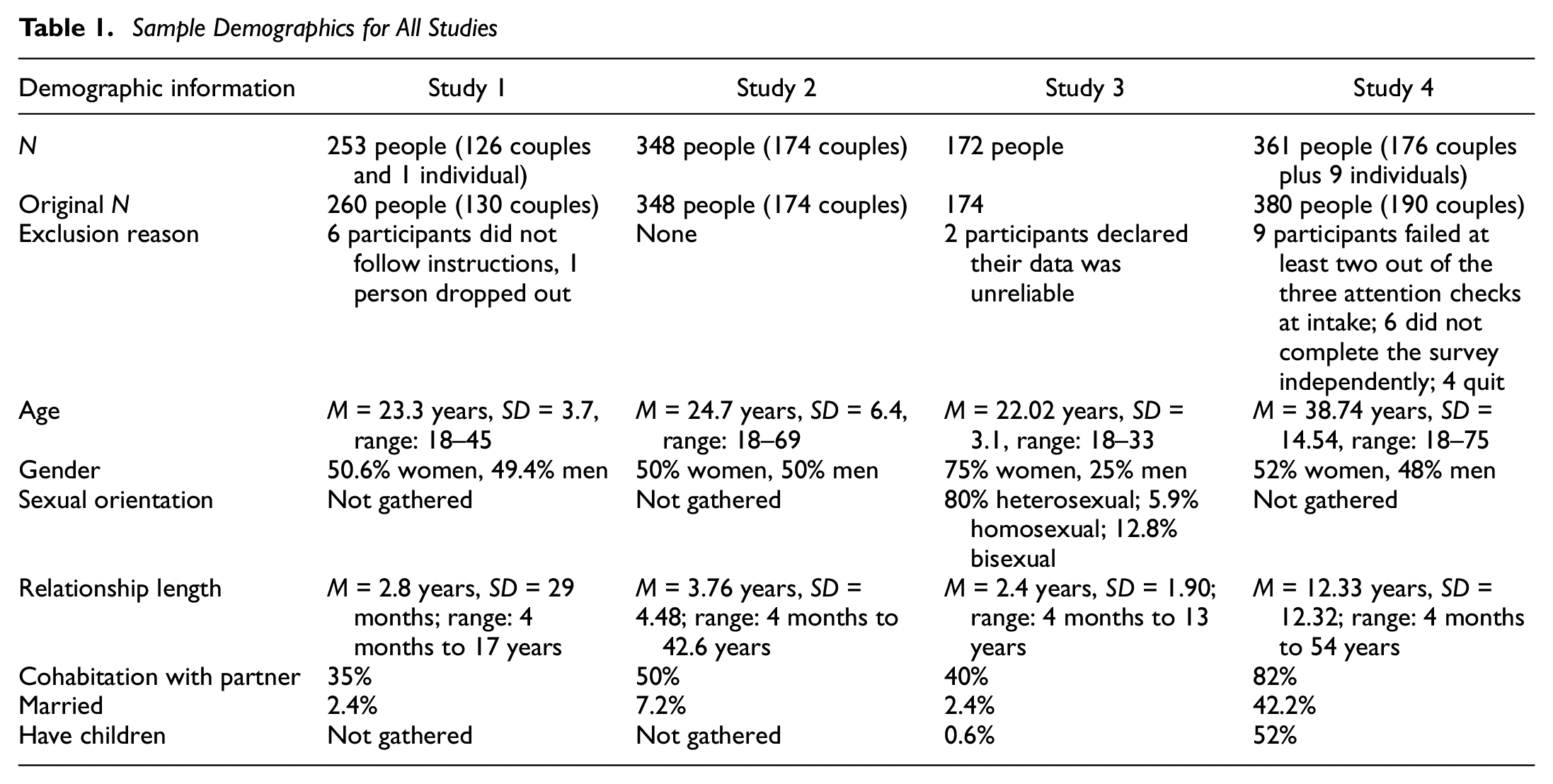
Participants were couples (Studies 1, 2, and 4) or individuals in a romantic relationship (Study 3) living in the Netherlands. See Table 1 for sample demographics and exclusion criteria. In all studies, participants were required to be in an exclusive relationship for at least 4 months and were recruited through a local recruitment agency, personal approach, and social media. Sample size was determined a priori based on best practices in relationship science (Finkel et al., 2015) and coupled with repeated measures designs to maximize power.
Sample Demographics for All Studies
Procedure
Couples were invited for an in lab (Studies 1 and 2) or online (Studies 3 and 4) intake session. After independently completing a series of questionnaires and the implicit task, participants then received information about the next portion of the study, the Diary Phase, which started shortly after the intake (the first Saturday or Tuesday after the intake for Studies 1 and 3, respectively; the day after intake for Studies 2 and 4). Every evening, for 8 consecutive days in Study 1, 14 days in Study 2, 10 days in Study 3, and 12 days in Study 4, participants received an email at 8.00 p.m. with a link to the daily diary questionnaire. Participants were instructed to complete the survey before midnight, in a quiet environment, and independently from their partner. In addition, participants were sent a follow-up questionnaire over e-mail 1 year later in Study 1 and three follow-up questionnaires, one every 4 months (spanning the course of 1 year) in Study 2.
Measures
For parsimony, we list all relevant measures, and refer readers to the Supplemental Material for full details on the items for each study.
Ambivalence
In Study 1, three types of ambivalence were measured at intake (objective, subjective, and implicit-explicit ambivalence). In Study 2, two types of ambivalence (subjective and implicit-explicit ambivalence) were measured at intake, at each of the three follow-ups, and every day in the diary. In Study 3, all four types of ambivalence were measured daily in the diary. In Study 4, four types of ambivalence were measured at intake and in the daily diary.
Objective ambivalence derived from two items assessing positive and negative feelings toward the partner and calculated based on the widely used (e.g., Birmingham et al., 2019; Herr et al., 2019; Hsieh & Hawkley, 2018; Uchino et al., 2014) Griffin formula (Thompson et al., 1995):
(Positive + Negative) / 2) − |Positive − Negative|
Subjective ambivalence was assessed by rating the extent to which participants felt they had mixed feelings toward their partner using the popular (e.g., Birmingham et al., 2019; DeMarree et al., 2015; Sawicki et al., 2013; Tormala & DeSensi, 2008) Priester and Petty (1996) scale (e.g., “I have mixed and conflicting feelings toward my partner”; 1-item in Study 1, three items in Studies 2–4). Implicit-explicit ambivalence was calculated following established procedures (e.g., Briñol et al., 2006; Johnson et al., 2017; Rydell et al., 2008) as the discrepancy score between explicit evaluation (e.g., “I am satisfied with my relationship”; Rusbult et al., 1998) and implicit partner evaluation (assessed through indirect performance-based tasks), both standardized. Implicit partner evaluations were assessed using previously validated indicators of automatic partner evaluations and used the Single Category Implicit Association Test (SC-IAT; Faure et al., 2018; Karpinski & Steinman, 2006) in Study 1, a variation of the Affect Misattribution Procedure (Larson et al., 2022; Payne & Lundberg, 2014) in Study 2, and the Partner-Evaluative Priming Task (PEPT; McNulty et al., 2013) in Studies 3 and 4. Implicit ambivalence was calculated using the Griffin formula (see above) based on the implicit positive and implicit negative values from the PEPT in Studies 3 and 4 and following previously established procedures (Faure et al., 2022; Zayas et al., 2022). The correlations between different types of ambivalence varied, with generally weak to moderate correlations in most cases, with strong correlations between objective and subjective in Studies 3 and 4, and in some cases, no significant correlation. See the Supplemental Material for details.
Well-Being
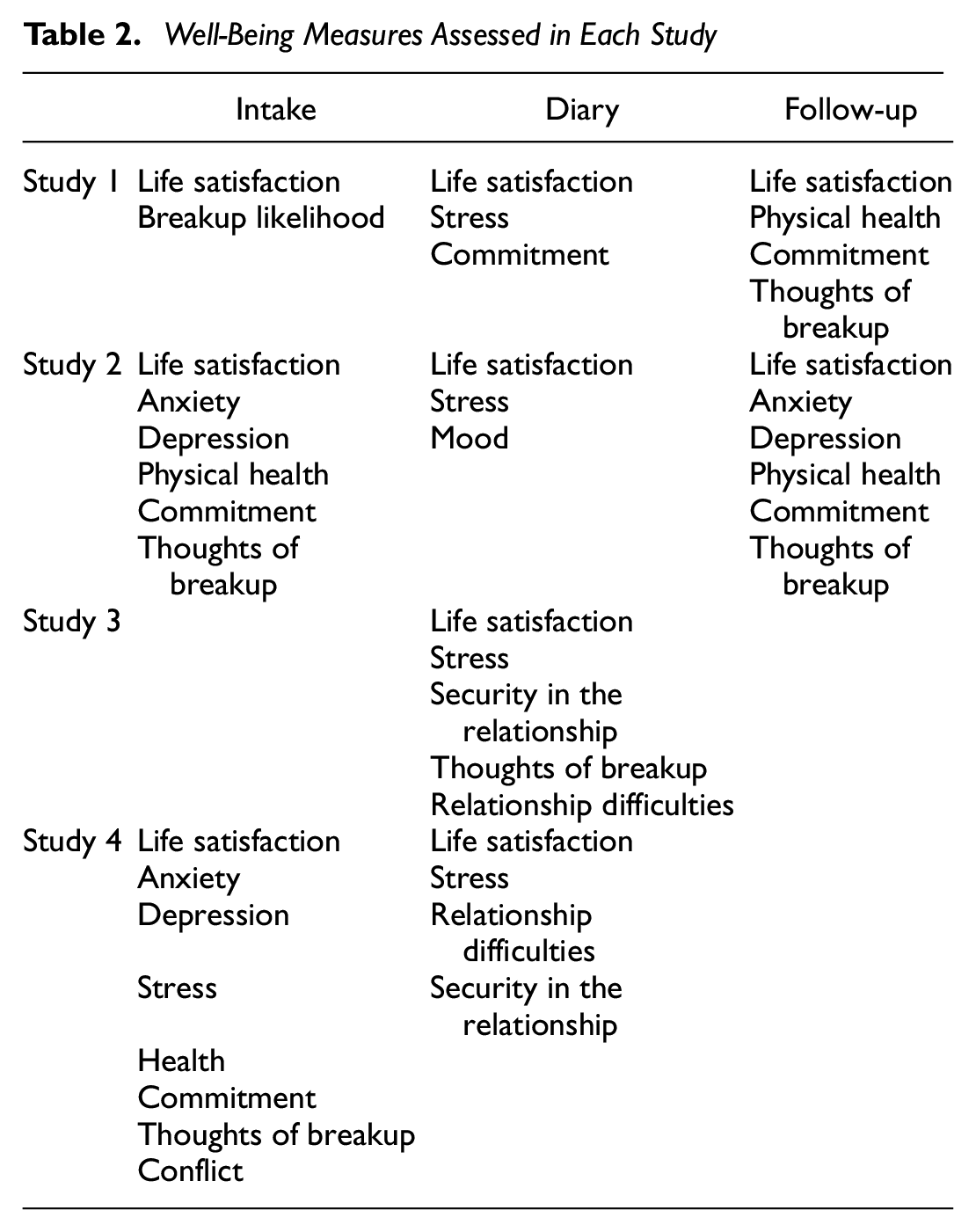
Participants rated their personal and relational well-being with commonly used measures in relationship science (Holt-Lunstad et al., 2010; Joel et al., 2020; Righetti et al., 2022). For all details, see the Supplemental Material. As measures of personal well-being, participants rated their life satisfaction (e.g., “My life is close to my ideal”), stress (e.g., “I feel stressed”), physical health (e.g., “How would you evaluate your physical health”?), anxiety (e.g., “Worrying thoughts go through my head”), depression (e.g., “I feel that I have nothing to look forward to”), and mood (“How do you feel?”).
Relational well-being was measured by asking participants to rate their commitment (e.g., “I am oriented toward the long term future of my relationship”), thoughts of breakup (e.g., “Have you ever discussed the possibility of breaking up with your partner while talking to a close friend?”), perception of break-up likelihood (“How likely are you to break-up with your partner?”), conflict (e.g., “How often do you and your partner argue with each other?”), relationship difficulties (“How much did you experience problems, difficulties, or struggles in your relationship today?”), and security in the relationship (“I feel safe and secure in the bond I have with my partner”). Table 2 shows the well-being variables assessed in each study. See the Supplemental Material for descriptive statistics.
Well-Being Measures Assessed in Each Study
Results
Analytical Strategy
Multilevel analyses were performed to account for the non-independence and nested nature of the data (Kenny et al., 2020), with participants nested within couples (time points nested within individuals for Study 3). Intercepts were allowed to randomly vary, and slopes were treated as fixed. In all analyses, all available ambivalence types were entered simultaneously, together with explicit and implicit partner evaluation as control variables, to predict each personal and relational well-being index separately. The results from the separate studies serve as input for the meta-analyses across all studies.
In Study 1, we first tested the associations between ambivalence at intake and well-being at intake, then between ambivalence at intake and well-being scores over the daily diary, and finally the association between ambivalence at intake and the follow-up well-being 1 year later. In the daily diaries in Studies 2 to 4, all predictor variables were within-person centered to examine within-person variations across the diary days (Bolger & Laurenceau, 2013), which allows to assess whether on days when people reported higher (or lower) ambivalence compared with their own average across the diary they also reported better (or worse) well-being. In the longitudinal assessments in Study 2 (i.e., four time points: one intake and three follow-ups), we assessed the associations cross-sectionally. 4
To summarize the results and formally estimate the statistical association between the four types of ambivalence and well-being, we conducted meta-analyses across all four studies using the R metafor package (Viechtbauer, 2010). We grouped the effect sizes from personal well-being (k = 59) and relational well-being (k = 42) outcomes and conducted separate meta-analyses for the two types of well-being. We used random effects procedure with standardized partial effect (i.e., Betas obtained from the multilevel analyses in each study—as described above—with standardized variables; Le & Impett, 2019; Lorah, 2018; Peterson & Brown, 2005) and applied a multilevel approach to the meta-analysis with the rma.mv function to account for the dependency between effect sizes (Assink & Wibbelink, 2016; Van den Noortgate et al., 2015). This approach allows to compare effect sizes within and between studies (Lorah, 2018) and results in more accurate and reliable effect and standard error estimates (Assink & Wibbelink, 2016; Balduzzi et al., 2019; Harrer et al., 2021). To be consistent across studies, we considered all the cross-sectional associations only and we always controlled for implicit and explicit evaluations.
In the first meta-analysis, estimates were standardized partial effects obtained from multilevel models of each type of ambivalence predicting personal and relational outcomes (each well-being index regressed separately), controlling for explicit and implicit partner evaluations to estimate the effects of ambivalence on well-being above and beyond people’s general evaluations of their relationship. In a second meta-analysis, effect sizes were standardized partial effects of each ambivalence controlling for the other ambivalence types in each model, and also controlling for explicit and implicit partner evaluations, which most closely reflected the analyses conducted for each study. The results are similar across meta-analyses (see Tables 3 and 4). For each effect size, we coded the following moderators: type of ambivalence (objective, subjective, implicit-explicit, and implicit), effect type (from within-person or between-person models), and study section (intake, diary, or follow-up analyses). For each meta-analysis, we first looked at the main effect of ambivalence (irrespective of type) and then examined whether type of ambivalence moderated the association. This approach allows us to examine whether different types of ambivalence have differential effects above and beyond the fact that there is ambivalence in general. The full data sets with all estimates for each meta-analysis, as well as the code, are uploaded to the study’s OSF page. As we were most interested in the pattern of results across studies (i.e., the association between ambivalence and personal well-being, between ambivalence and relational well-being, and whether the type of ambivalence moderated these associations), below we focus on the results from the meta-analyses. Full details of the results of each individual study are reported in the Supplemental Material.
Meta-Analytical Main Effects of Each Ambivalence Type (From Models Not Including the Other Types of Ambivalence) Predicting Personal and Relational Well-Being
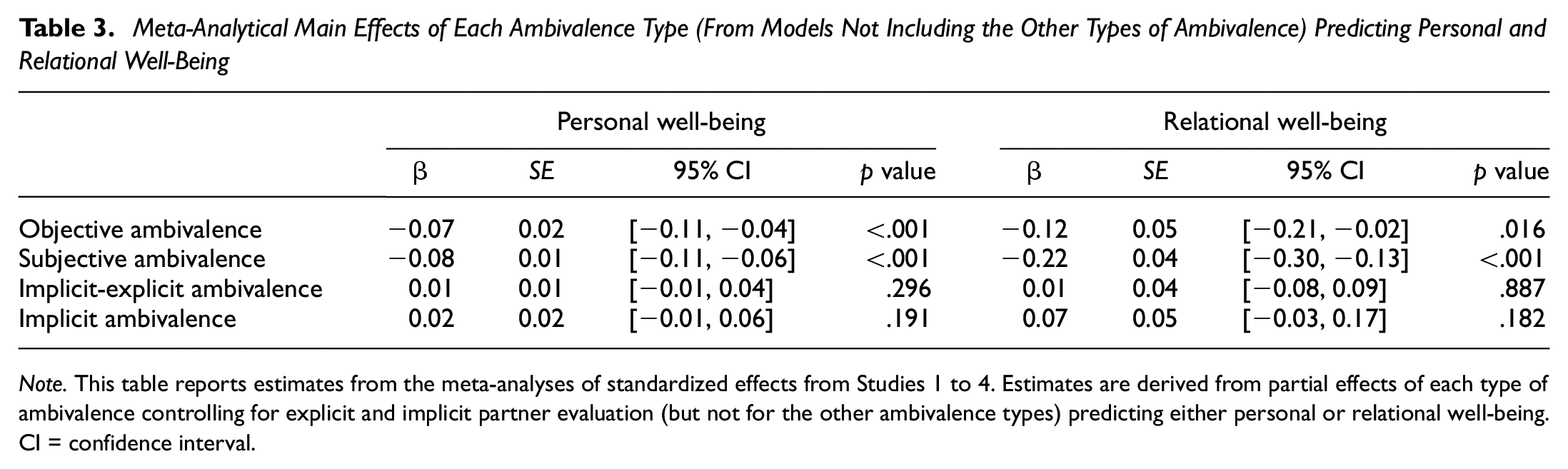
Note. This table reports estimates from the meta-analyses of standardized effects from Studies 1 to 4. Estimates are derived from partial effects of each type of ambivalence controlling for explicit and implicit partner evaluation (but not for the other ambivalence types) predicting either personal or relational well-being. CI = confidence interval.
Meta-Analytical Main Effects of Each Ambivalence Type Predicting Personal and Relational Well-Being, Above and Beyond the Other Types of Ambivalence
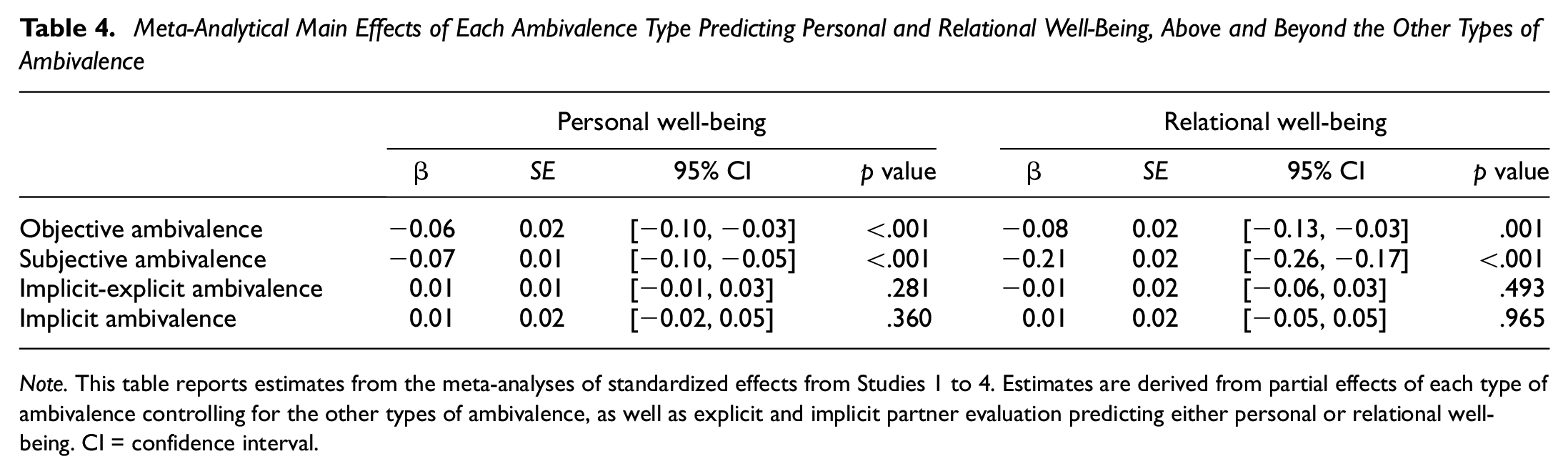
Note. This table reports estimates from the meta-analyses of standardized effects from Studies 1 to 4. Estimates are derived from partial effects of each type of ambivalence controlling for the other types of ambivalence, as well as explicit and implicit partner evaluation predicting either personal or relational well-being. CI = confidence interval.
Key Findings for Personal and Relational Well-Being
Overall, as expected, and in line with previous research, we found significant negative associations between ambivalence and personal well-being (for the first meta-analysis, β = −.03, SE =.01, 95% CI [−.05, −.02], p < .001; for the second meta-analysis, β = −.03, SE =.01, 95% CI [−.05, −.01], p = .002) and between ambivalence and relational well-being (for the first meta-analysis, β = −.10, SE = .02, 95% CI [−.14, −.05], p < .001; for the second meta-analysis, β = −.08, SE =.02, 95% CI [−.12, −.04], p < .001).
Were there differences between the different types of ambivalence? To answer this question, we ran moderation analyses for the two types of well-being (personal and relational). We found a significant moderation by type of ambivalence for both personal well-being—F(3, 55) = 22.920, p < .001 in the first-meta-analysis and F(3, 55) = 17.17, p < .001 in the second—and relational well-being—F(3, 38) = 19.41, p < .001 in the first meta-analysis and F(3, 38) = 18.76, p < .001 in the second meta-analysis. Specifically, objective and subjective ambivalence were significantly and negatively associated with personal and relational well-being, while implicit-explicit and implicit ambivalence showed no significant association (see Tables 3 and 4 showing main effects of each ambivalence type).
There was no difference between objective and subjective ambivalence (p =.609 in the first meta-analysis, p = .567 in the second meta-analysis) in the association with personal well-being. There was, however, a significant difference in their association with relational well-being (p = .018 in the first meta-analysis, p < .001 in the second meta-analysis), with subjective ambivalence having a stronger negative association than objective ambivalence. 5
There was no moderation by whether the association stemmed from between or within person designs (ps > .600) nor by whether the effect sizes were taken from models assessing ambivalence at intake, in daily diaries, or in follow-ups (ps > .400). Overall, these results suggest that, across studies, both objective and subjective ambivalence had a significant negative association with well-being, and for relational well-being that association was stronger for subjective ambivalence compared with objective ambivalence. Implicit types of ambivalence were not significantly associated with either type of well-being.
General Discussion
The present work presents an integrated approach to the study of ambivalence in romantic relationships. Although it has been argued that people can manifest ambivalence in different ways (Faure et al., 2022; van Harreveld et al., 2015; Zayas & Shoda, 2015), and that all types of ambivalence are connected to well-being (e.g., Birmingham et al., 2019; Herr et al., 2019; Rydell et al., 2008), our work puts these assumptions to an empirical test and shows that the type of ambivalence that is examined matters. In four longitudinal studies and internal meta-analyses across the studies, we find that experiencing greater ambivalence toward a partner was associated with worse personal and relational well-being, but these associations were significant only for explicit types of ambivalence (i.e., objective and subjective). Furthermore, subjective ambivalence was more strongly negatively associated with relationship well-being than objective ambivalence. Implicit types of ambivalence (i.e., implicit-explicit and implicit) were statistically unrelated to well-being. Notably, all results held when controlling for explicit and implicit partner evaluations, highlighting the unique role that ambivalence plays above and beyond people’s positivity or negativity toward their partner.
For decades, relationship science has largely assessed people’s experiences in their relationships along a single continuum ranging from negative to positive. This type of evaluation implies that when people feel positive, they cannot also feel negative, and vice versa, which largely misrepresents the affective reality of most relationships (Zayas et al., 2017) and most human experience more generally (Cacioppo et al., 1997; Schneider et al., 2016; Thompson & Zanna, 1995). Our work highlights the importance of going beyond univalent assessments of affect when examining relationships and well-being. In fact, although univalent evaluations can be highly informative and consequential, ambivalent evaluations may be able to explain variance above and beyond them (Schneider & Schwarz, 2017; van Harreveld et al., 2015). Indeed, ambivalence can be particularly consequential and distressing (even more so than purely negative relationships) given that people tend to care a great deal about their ambivalent relationships (Holt-Lunstad & Uchino, 2019).
At the same time, not all ambivalence is alike. In particular, the negative effects of ambivalence have been found to occur primarily when people explicitly report feeling ambivalent (Newby-Clark et al., 2002; Nordgren et al., 2006; van Harreveld et al., 2009), making it likely that subjective ambivalence would be the most strongly related to well-being outcomes. Indeed, the present findings suggest that it is primarily the awareness of conflicting feelings (i.e., subjective ambivalence) that is especially associated with people reporting negative outcomes, at least for relational well-being. In romantic relationships, people may be most threatened by the awareness of their ambivalence given the strong desire to see their partner positively (Murray et al., 1997) and the potentially relationship- and life-altering implications that acting upon one’s evaluations may have. This idea is also consistent with research showing that ambivalence is most influential when people ruminate about their relationship (Kachadourian et al., 2005), that is, when the salience of the conflict is strong.
It is interesting that, in our studies, implicit types of ambivalence were not consistently correlated with explicit types of ambivalence or with explicit and implicit partner evaluations. This lack of consistent correlation between constructs may point to poor validity of the implicit ambivalence measures. Indeed, a close read of the existing literature on implicit ambivalence types reveals similar inconsistencies (Faure et al., 2022; Goldstein et al., 2014; Rydell & Durso, 2012; Zayas et al., 2022). It is also possible that the small or missing correlations are because explicit and implicit types of ambivalence are related but separate phenomena. Indeed, consistent with prominent models of attitudes (e.g., Fazio, 1990; Gawronski & Bodenhausen, 2006), empirical research typically shows weak and sometimes even null associations between explicit and implicit evaluations of romantic partners, particularly when people are motivated and cognitively able to maintain positive views of their relationship through deliberative reasoning (e.g., Hicks et al., 2021). Thus, just as explicit and implicit partner evaluations can be unrelated (e.g., McNulty et al., 2013), whether a person reports explicit feelings of ambivalence toward their partner may or may not be related to whether they automatically associate their partner with positive and negative evaluations, and such relation might depend, at least partly, on one’s motivations and opportunities to engage in deliberative reasoning. However, given that research on implicit types of ambivalence is nascent within relationship science, more work is needed to further establish the validity of the measurement tools employed and to examine under which conditions implicit and explicit ambivalence may more likely align.
In addition, although our data support the idea that ambivalence may often be largely negative for well-being in the short-run, research suggests that ambivalent evaluations toward a romantic partner may motivate individuals to change (Thompson & Holmes, 1996) and make improvement efforts (Faure et al., 2022; Zoppolat et al., under review) that may ultimately benefit relationships and well-being in the long(er) run. Future research should examine whether and under which conditions ambivalence may become more or less functional for couples.
One strength of this work is the reliance on daily diary, longitudinal, and ecologically valid data. However, this approach also means that associations are correlational and casual conclusions cannot be drawn. Still, previous longitudinal work suggests that ambivalence is associated with poorer relationship interactions (Zoppolat et al., 2022), and theoretical models support this directionality, particularly in regard to personal well-being (Holt-Lunstad & Uchino, 2019). Another limitation is that studies differed in the type of implicit task employed. However, the meta-analysis revealed no significant between-study differences, indicating that the actual task used likely did not influence the overall pattern of results. Relatedly, attitude research has sometimes used other methods to assess ambivalence indirectly (e.g., mouse tracking, Schneider et al., 2015). Although we selected the most common implicit measures, future research could examine whether other types of indirect measures of ambivalence are associated with well-being in relationships.
Overall, the present work takes a first important step in expanding knowledge about relationships and well-being and the role that mixed emotions play in this highly personal and consequential domain. Our findings show that capturing ambivalence—and especially its explicit forms—is essential for understanding the complex affective landscape of relationships.
Supplemental Material
sj-docx-1-spp-10.1177_19485506231165585 – Supplemental material for A Systematic Study of Ambivalence and Well-Being in Romantic Relationships
Supplemental material, sj-docx-1-spp-10.1177_19485506231165585 for A Systematic Study of Ambivalence and Well-Being in Romantic Relationships by Giulia Zoppolat, Francesca Righetti, Ruddy Faure and Iris K. Schneider in Social Psychological and Personality Science
Footnotes
Handling Editor: Bar-Anan Yoav
Declaration of Conflicting Interests
The author(s) declared no potential conflicts of interest with respect to the research, authorship, and/or publication of this article.
Funding
The author(s) disclosed receipt of the following financial support for the research, authorship, and/or publication of this article: This research was supported by grants from the Netherlands Organization for Scientific Research (NWO) awarded to Francesca Righetti (Veni grant 451-12-024 and Vidi grant 195.010) and by a joint Open Research Area (ORA) grant awareded to Francesca Righetti and W. Hofmann (NWO Grant 464-15-093 and German Research Foundation Grant HO 4175/6-1, respectively).

Supplemental Material
Supplemental material is available in the online version of the article.
Notes
Author Biographies
References
Supplementary Material
Please find the following supplemental material available below.
For Open Access articles published under a Creative Commons License, all supplemental material carries the same license as the article it is associated with.
For non-Open Access articles published, all supplemental material carries a non-exclusive license, and permission requests for re-use of supplemental material or any part of supplemental material shall be sent directly to the copyright owner as specified in the copyright notice associated with the article.
