




Abstract
We predicted and found in three experiments that psychological distance increases conceptual generalization. We manipulated psychological distance by describing a medicine as being either domestic (proximal) or foreign (distal) and examined generalization by testing how information about initial experience (positive vs. negative) with this medicine influences evaluations of similar products. In all three experiments, and across both Israeli and German participants, we found that people generalized from experience with products that are distal (foreign) more than from proximal (domestic) products. We explain the relation between distance and generalization in terms of the accuracy–applicability trade-off inherent in generalization and discuss how it aligns with construal-level theory.
Introduction
Imagine that you suffer from a rash and make an appointment with a dermatologist. At the clinic, you find out that the dermatologist happens to be from a foreign country. The treatment is effective, and you are satisfied with the result. Which future expectations would you update based on this experience? Most likely, you would expect this dermatologist to also treat a future problem effectively. But would you expect all dermatologists from the same country to be good? Or perhaps go as far as expecting any physician from that country to be good? Now imagine a similar experience with a dermatologist from your own country. Would you be as likely to generalize the positive experience beyond the specific dermatologist and expect every physician from your country to be good? We suspect that the answer to the last question is negative. This example illustrates our research question: Do people generalize more from an experience with more psychologically distal objects?
The question of how much to generalize is a fundamental problem that humans constantly solve in essentially every domain (Austerweil et al., 2019). In social psychology it is known as attitude generalization—how people use past experiences in making judgments and decisions about different yet related objects (Fazio et al., 2004; Gawronski & Quinn, 2013; Harwood et al., 2011; Hütter & Tigges, 2019; Ranganath & Nosek, 2008; Ratliff et al., 2012; Tausch et al., 2010). The question of generalization emerges in studies on learning (e.g., evaluative conditioning) and attitude formation and is relevant to stereotypes, intergroup relations, consumer behavior, and clinical psychology (e.g., research on depression, phobias, and trauma). Research on attitude generalization has found more generalization of negative than positive experiences and more generalization to novel objects that are more similar to the object of the original experience either perceptually or conceptually (Fazio et al., 2004; Hughes et al., 2018; Shook et al., 2007). Going beyond these classic findings, the present research explores whether generalization is affected by psychological distance. Specifically, we predict that experiences with distal objects would be generalized more than similar experiences with proximal objects.
This prediction derives from a view of generalization as involving a trade-off between accuracy and applicability. If you generalize less then you are less likely to err, but also less likely to make use of past experience. For example, generalizing from one treatment by a dermatologist to another treatment by the same dermatologist is more likely accurate than generalizing to all dermatologists. But encountering that same dermatologist is less likely than encountering any dermatologist, and hence such generalization would be less likely applicable. Conversely, generalizing an experience with one dermatologist to all dermatologists is more likely to be applicable in future encounters, but less likely to be correct.
We propose that this accuracy–applicability trade-off is inherently related to whether the objects we learn from and the objects we generalize to are proximal or distal. This is because the likelihood of encountering distal (vs. proximal) objects is lower. For example, one is less likely to encounter a dermatologist from a specific foreign country than from one’s own country. As a direct consequence, and most relevant for the present line of theorizing, once we experience a distal object (vs. a proximal object), experiencing the next object from the same distal (vs. proximal) category is less likely (for an empirical support for the notion that in the context of our experiments people perceive this to be the case see Experiment S3 in the supplemental online material [SOM]). In our example, encountering another dermatologist from the same foreign country (vs. from one’s own country) is unlikely, and therefore generalizing one’s experience with a dermatologist from a foreign country to all physicians from the same foreign country might be more optimal, albeit risking inaccuracy. We thus predict more generalization when the objects we learn from and the objects we generalize to are more distant.
This prediction aligns with construal-level theory (CLT), according to which people represent more distant objects and situations in a more abstract way (Liberman & Trope, 2008, 2014). Applying this logic to generalization, when the objects we learn from and the objects to which we generalize are more psychologically distant, they should be represented more abstractly, by more inclusive categories. In our example, a dermatologist from a foreign country (vs. from one’s own country) would be represented more abstractly, using more inclusive categories (e.g., “physicians” as opposed to “dermatologist”), thus supporting more generalization. In the general discussion, we explain in more detail how the accuracy–applicability trade-off is related to CLT.
To summarize, we predict that people more readily generalize an initial experience to related objects when the object of the experience from which they generalize, and the new target object to which they may generalize are distant compared with proximal (e.g., foreign vs. domestic). The present research tests the functional aspect of this prediction, that is, its manifestation in overt behavior (i.e., evaluations of novel objects following initial positive vs. negative experience with a similar object). We do not, at this stage, examine the underlying cognitive processes (see De Houwer, 2011). Our experiments examine the prediction in a specific content, but vary context (i.e., the way we manipulate foreign vs. domestic).
Overview of Experiments
We examined the effect of psychological distance on generalization in three experiments. Specifically, we tested how positive and negative information about a particular headache medicine influences evaluations of related objects. We manipulated psychological distance by describing the drug company as being either domestic (proximal) or foreign (distal).
We operationalized generalization as the difference in evaluations of another product following the initial positive versus negative information about the headache medicine. A larger difference between subsequent evaluations indicates more generalization, because it means a higher tendency to apply the past experience with the headache medicine to new objects. We predicted that evaluations would be more positive after an initial positive experience, and less positive after an initial negative experience, when the experience concerns a foreign rather than a domestic product. Statistically, this translates to an interaction between distance and valence (i.e., a larger effect of information valence in the foreign than in the domestic condition).
Of note, extent of generalization could also be conceptualized in terms of the scope (or the width) of objects for which generalization occurs. That is, a stronger response for novel objects that are relatively less similar to the object of initial experience. According to this conceptualization, wider generalization for foreign products translates statistically to both an interaction between distance and valence, and a three-way interaction between distance, valence, and similarity to initial product (i.e., a larger effect of information valence in the foreign than in the domestic condition, for products that are less similar to the initial product). As a first step toward examining the effect of psychological distance on generalization, we focus on the first and simpler conceptualization. (We report exploratory analyses of scope generalization in the SOM.)
Importantly, although we compared evaluations following positive and negative experiences, the current design does not allow to examine separately generalization from positive versus negative experiences. Rather, this comparison indicates generalization per se. If evaluations are more positive after an initial positive experience than after an initial negative experience, we know that generalization occurred, but we cannot tell whether the positive or the negative experience had a larger effect.
In all experiments, participants read vignettes about positive or negative experiences with medicines. In Experiments 1 and 2, we recruited German and Israeli participants and presented information about German and Israeli products. In Experiment 1, both German and Israeli medicines served as domestic and foreign products, depending on the country. In Experiment 2, we used German and Israeli medicines in the respective domestic conditions, and used Canadian medicines in the foreign conditions. In Experiment 3, we recruited Israeli participants and used Canadian medicine in the foreign conditions. In all three experiments, we manipulated psychological distance (domestic vs. foreign) and valence of the information about the initial experience (positive vs. negative) between participants.
Open Science
We conducted three laboratory-based experiments, which we report here in the order in which we conducted them, and two online experiments, which did not yield the predicted effect, potentially due to the failure of the distance manipulation. These are reported in the SOM. We report all measures, manipulations, and exclusions in the experiments. Experiments 2 and 3 were preregistered. In Experiment 1, we set a target sample for 50 participants per cell for a design with unknown effect size (Ledgerwood, 2015), which gives us power to detect an effect of generalization of f = .14 (d = .28). We based the sample sizes of Experiments 2 and 3 on Experiment 1. The OSF page contains all materials, data, syntax and the preregistrations.
Experiment 1
Experiment 1 examined whether psychological distance (domestic vs. foreign) influences generalization. More specifically, we examined whether information about a medicine generalizes to other, related products more when the medicine is foreign than when it is domestic. An auxiliary experiment (N = 54) demonstrated that when the medicine is foreign (vs. domestic), the potential target objects of generalization (i.e., additional products) are perceived as more psychologically distant. That is, for foreign (vs. domestic) products, participants rated the likelihood of future encounters as lower, the time to a future encounter as longer, the likelihood it would be found in a spatially close place as lower, and the likelihood that people close to them could have tried this medicine as lower (see the SOM for a detailed description).
Method
Participants
We manipulated information valence (positive vs. negative), distance (domestic vs. foreign), and country (Israel vs. Germany) between participants, with the latter factor being quasi-experimental. Four hundred nineteen 1 students participated in the experiment in return for a chocolate bar. We excluded three participants because they were younger than 18 and could not provide consent to data usage. The final sample consisted of 416 participants; 200 from a German University and 216 from an Israeli University (Mage = 23.17, and one missing, SDage = 4.51; 239 women, 172 men, 5 other). Participants in each of the two samples were randomly assigned to one of four conditions: Ndomestic-positive=110, Ndomestic-negative=106, Nforeign-positive=101, Nforeign-negative 99. Supplemental Table S1 in the SOM reports cell sizes by nationality.
Procedure and Materials
Instructions informed participants that the experiment was about consumer behavior. After signing an electronic consent form, the survey randomly assigned them to one of four conditions and they read the respective vignette. Below is an English translation of the text that German participants in the proximal positive condition received. The small changes of the text for Israeli participants in the proximal positive condition are presented in parentheses. The text for the negative conditions appears in brackets:
Imagine that you are suffering from a headache. You go to the nearest pharmacy and buy a medicine that you have never tried before. It is a domestic brand, a medicine by a German (Israeli) company that was manufactured in Germany (Israel). Shortly after taking the medicine, your headache disappears and you feel much better [the pain only gets worse and you even develop a nauseous feeling].
In the distal conditions, participants read about a foreign medicine that was manufactured outside of their country. German participants read about an Israeli company and Israeli participants read about a German company. Thereafter, participants indicated their intentions to buy five products: (1) the same medicine, by the same company; (2) another headache medicine by the same company; (3) vitamins by the same company; (4) a band-aid by the same company; and (5) a headache medicine by another company from the same country. All items used 10-point scales (1 = not likely at all, 10 = very likely). These questions create a gradient of decreasing conceptual similarity to the original product.
Next, participants indicated whether they have previously used medicines from the mentioned country, and provided demographic information. Finally, as a memory check, participants indicated where the described medicine was manufactured. We did not intend to exclude participants based on this item, nor did we preregister any such exclusion in Experiments 2 and 3. The SOM reports the main analyses by these variables for all experiments.
Results and Discussion
Table 1 shows the means and standard deviations of participants’ intentions to buy each of the target products as a function of distance (domestic vs. foreign), and valence of initial experience (positive vs. negative). We analyzed participants’ intentions in a 5 × 2 × 2 mixed-design analysis of variance (ANOVA) with target product (1–5) as a within-subject factor, and distance and valence of initial experience as between-subject factors.
Means and Standard Deviations of Intentions to Buy Target Products as a Function of Valence of the Initial Experience and Psychological Distance in Experiment 1
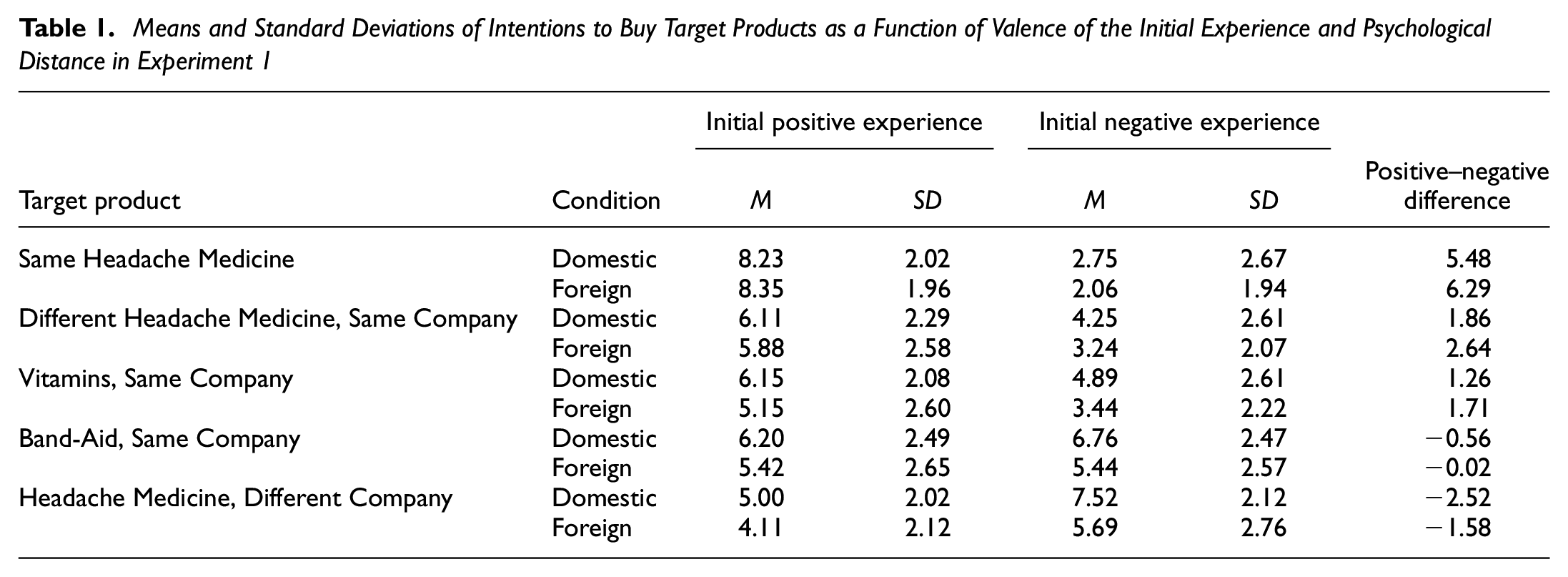
A main effect of valence, F(1, 412) = 82.75, p < .001,
Importantly, the predicted interaction between valence and distance was significant, F(1, 412) = 4.83, p = .029,
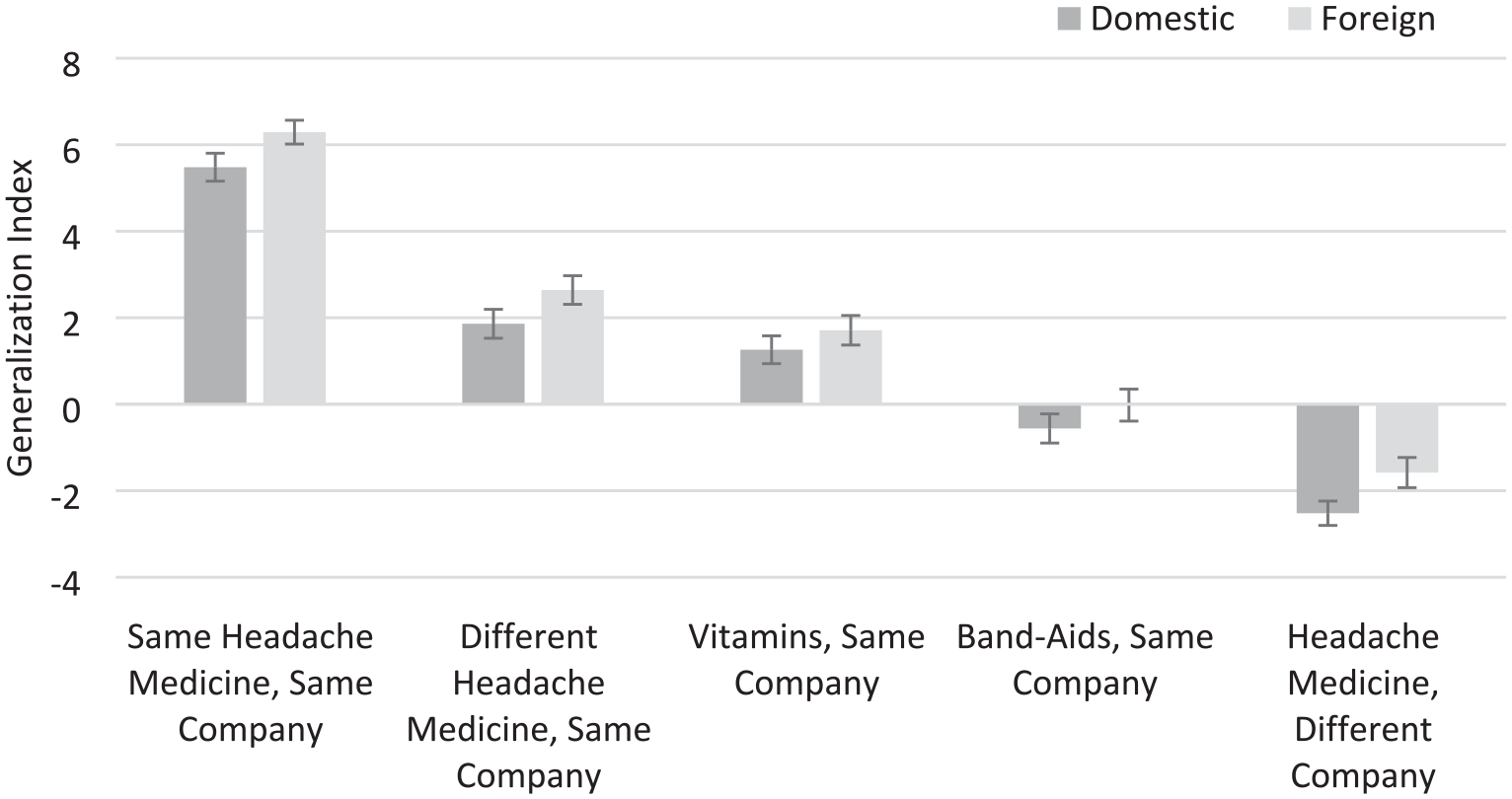
Generalization (Operationalized as the Difference Between Participants’ Intention to Buy a Target Product Following a Positive vs. a Negative Initial Experience) as a Function of Psychological Distances and Target Product in Experiment 1
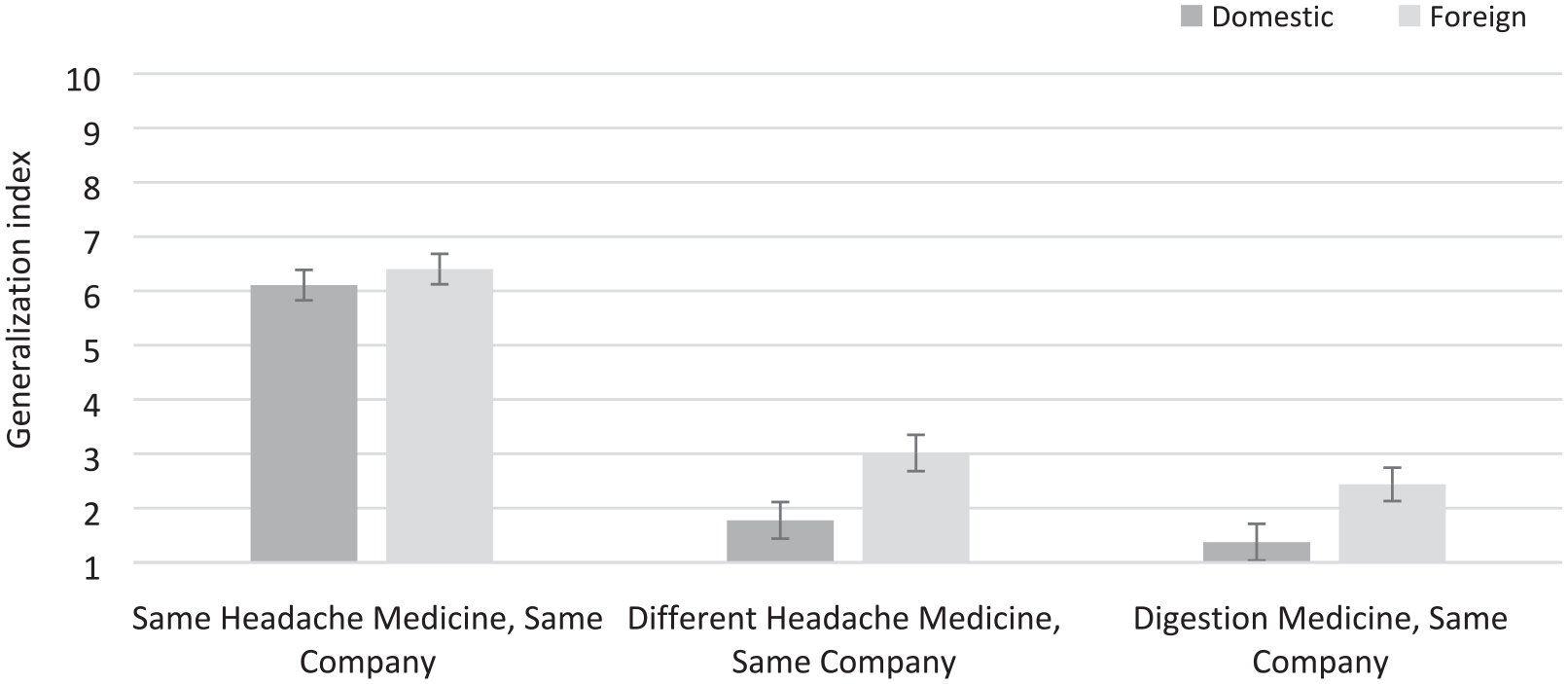
Generalization (Operationalized as the Difference Between Participants’ Intention to Buy a Target Product Following a Positive vs. a Negative Initial Experience) as a Function of Psychological Distances and Target Product in Experiment 2
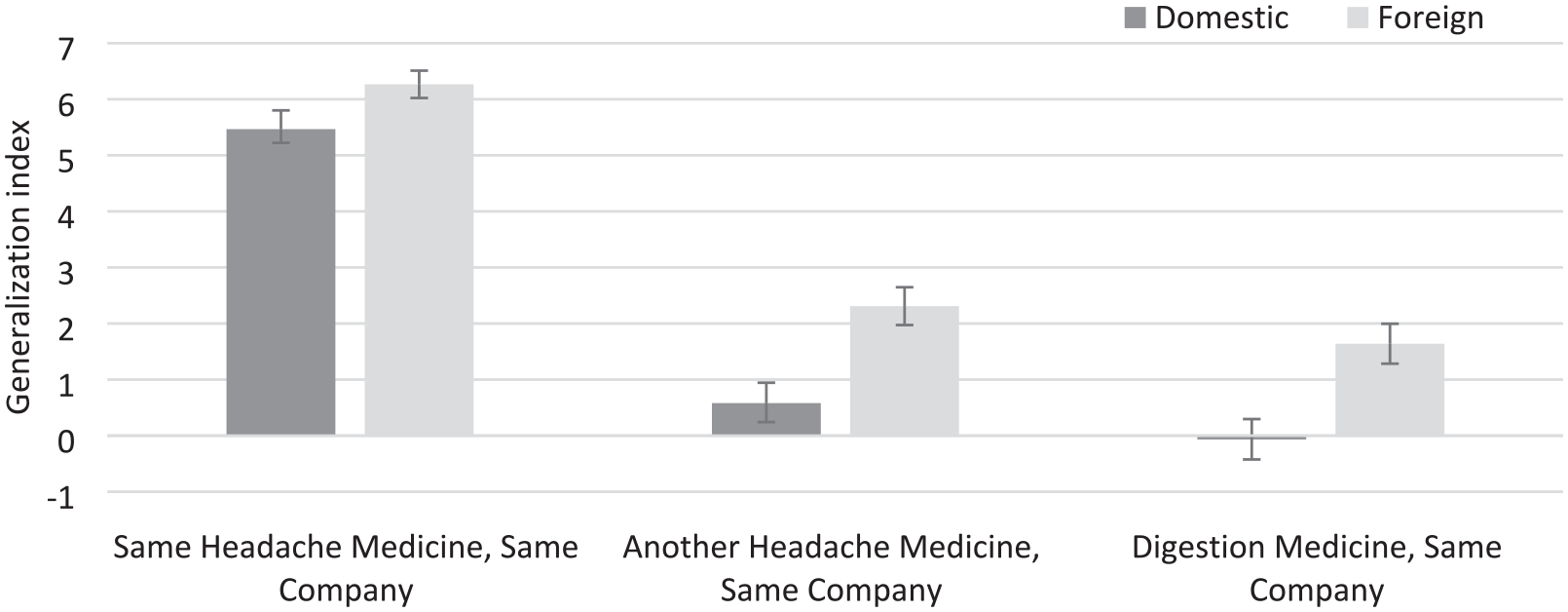
Generalization (Operationalized as the Difference Between Participants’ Intention to Buy a Target Product Following a Positive vs. a Negative Initial Experience) as a Function of Psychological Distances and Target Product in Experiment 3
In addition, a main effect of distance, F(1, 412) = 32.24, p < .001,
We did not expect the reversed effect of valence for the medicine from a different company, such that the intention to buy a headache medicine from another company was on average higher after a negative initial experience than after a positive initial experience (in Figure 1, negative difference scores in the rightmost two bars). That is, participants who had a negative experience with a headache medicine with one company opted to try next time a headache medicine from different company more than those who had a positive experience with the initial product. One might speculate that the switch to another company is more strongly motivated by an initial negative experience, compared with an initial positive experience, even though we expected that the initial experience would generalize to a different company from the same country in much the same way that it generalized to other products of the same company (i.e., in a valence-congruent manner). Nevertheless, this unexpected result was smaller in the distal than the proximal condition, in line with stronger (valence-congruent) generalization in the distal condition.
In summary, we found generalization in learning from a hypothetical experience, which increased as a function of the conceptual similarity between the original experience and the novel object. Importantly, as predicted, people generalized more from experience with foreign (distal) products than with domestic (proximal) products.
These results suggest that generalization does not extend to products that are too different from the original product (i.e., vitamins and band-aids). Therefore, we did not include these products in the main analyses of the following experiments. However, Experiment 2 includes the dissimilar product from a different company that showed a reverse tendency for exploratory purposes. In addition, because evaluations of the same headache medicine by the same company could be considered as too similar to the original experience to be meaningfully called generalization, in the following experiments we decided to analyze it separately.
Experiment 2
Experiment 2 was a preregistered replication of Experiment 1 with the following changes: First, the foreign conditions for both the German and the Israeli samples described a Canadian medicine. This was intended to rule out the possibility that the distance effects in Experiment 1 are specific to the relationships between Germany and Israel. Second, we replaced the two questions that showed only a weak generalization effect in Experiment 1 (vitamins and band-aids by the same company) with a question that we thought was semantically closer to the experienced product—digestion medicines by the same company. Third, although it was not the focus of the present investigation, we further explored the reverse tendency for generalization to products of a different drug company by adding another target product (a digestion medicine) from a different drug company. We planned to analyze the two target products from a different company separately. Because generalization to products from another company was not our main focus, and because we preregistered a separate analysis of these products, we report them in the SOM.
We also preregistered a separate analysis of the first question (same medicine, same company), because it could be argued that this product is too similar to the originally experienced one to be called generalization, or different than generalizing to another product. As before, we predicted more generalization for foreign (vs. domestic) products. In Experiments 2 and 3, we focused our prediction on novel products by the same company.
Method
Participants
Three hundred eighty-six students at a German University and an Israeli University participated in the experiment in return for a chocolate bar. Per our preregistered exclusion criteria, two Israeli participants were excluded because Hebrew was not to their native language. Additional four participants were excluded because they were younger than 18. The final sample consisted of 380 participants; 179 from a German University and 201 from an Israeli University (Mage = 23.17 and one missing, SDage = 4.37; 230 women, 145 men, four other, and one missing). Participants were randomly assigned to one of four conditions: Ndomestic-positive=96, Ndomestic-negative=97, Nforeign-positive=95, Nforiegn-negative=92. Supplemental Table S1 in the SOM reports cell size by nationality.
Procedure
The experimental procedure was similar to Experiment 1, except that in the distal condition both German and Israeli participants read about a medicine from Canada, and we replaced the questions on the vitamins and the band-aid with questions on a digestion medicine by the same drug company, and a question on a digestion medicine manufactured by another drug company from the same country.
Results and Discussion
As specified in the preregistration form, we analyzed participants’ intentions to buy the five different target products in three separate sets, and predicted our effect (i.e., more generalization of initial experience to foreign than to domestic products, revealed as an interaction between valence and distance) for products by the same company (i.e., the first two sets of variables) and were exploratory about the products from the different company. We report the results of the exploratory analysis in the SOM.
Other Medicines by the Same Company as Targets
We analyzed participants’ intentions to buy other products by the same drug company in a 2 × 2 × 2 mixed-design ANOVA with target product (headache medicine vs. digestion medicine) as a within-subject factor, and distance (domestic vs. foreign) and valence of initial experience (positive vs. negative) as between-subject factors (Table 2 shows the descriptive statistics).
Means and Standard Deviations of Intentions to Buy Target Products as a Function of Valence of the Initial Experience and Psychological Distance in Experiment 2
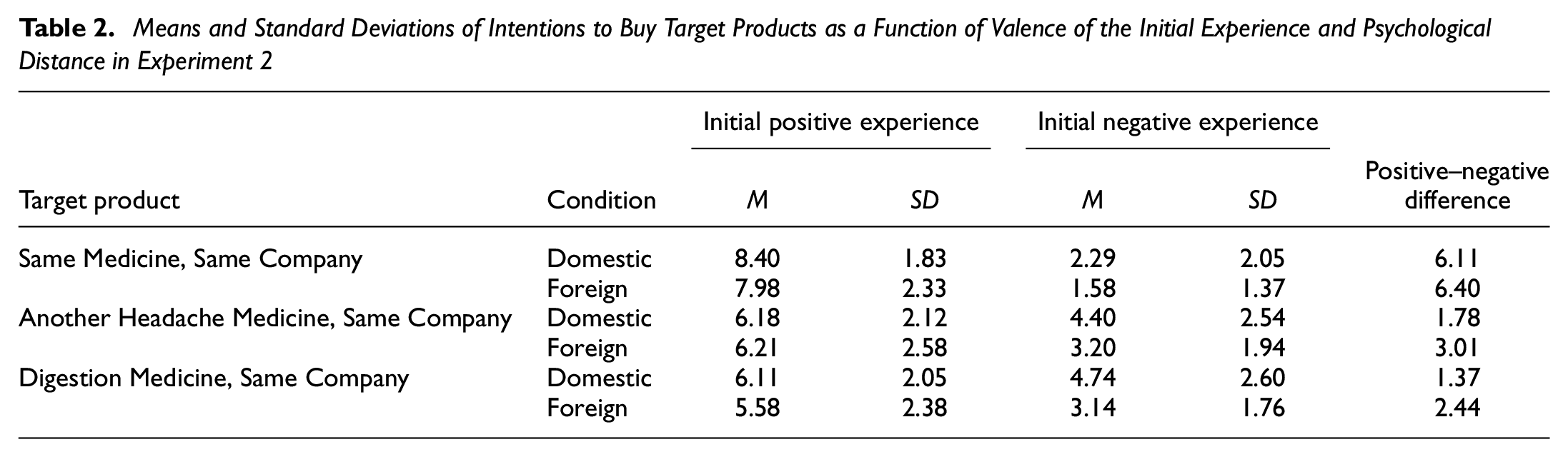
Importantly, this analysis showed the predicted interaction between valence and distance, F(1, 376) = 8.18, p = .004,
The expected effect of valence was significant, F(1, 376) = 113.82, p < .001,
There was a main effect of distance, F(1, 376) = 16.86, p < .001,
The Same Medicine as the Target Product
A 2 × 2 ANOVA with distance (domestic vs. foreign) and valence of initial experience (positive vs. negative) as between-subject factors, revealed a main effect of valence, F(1, 376) = 996.93, p < .001,
In summary, Experiment 2 replicates and qualifies the initial findings. First, we replicated the effect of distance on generalization with different materials and a different foreign country. That is, people generalize to novel products from the same company more when that company is distant. Second, we found no distance effect on generalization when the target of generalization was the same medicine from the same company. In this latter case, generalization was very high of both domestic and foreign experiences, and while the difference between them was numerically in the expected direction, it was not significant.
Experiment 3
Experiment 3 was a preregistered replication of Experiment 2. Due to Covid-19 and intermitted lockdowns, we were able to recruit only Israeli participants. We included only the three questions about products by the same company, which were the focus of interest in Experiment 2. That is, we excluded products from another company which were analyzed in Experiment 2 in an exploratory way. As before, we predicted that experiences with distal objects would be generalized more than experiences with proximal objects, and focused this prediction on novel medicines by the same company.
Method
Participants
Four-hundred and two students at an Israeli University participated in the experiment in return for a chocolate bar. Per the preregistered exclusion criteria, 39 participants were excluded because Hebrew was not their native language. Two additional participants were excluded because they were younger than 18. The final sample consisted of 361 participants (Mage= 24.83, SDage= 3.37; 187 women, 178 men, and one missing). Participants were randomly assigned to one of four conditions: Ndomestic-positive=90, Ndomestic-negative=94, Nforeign-positive=91, Nforiegn-negative=86.
Procedure
The experimental procedure was similar to Experiment 2, except that it included only three generalization questions: intentions to buy the same headache medicine, another headache medicine, and a digestion medicine, all by the same company.
Results and Discussion
As preregistered, we analyzed participants’ intentions to buy the three different target products in two separate sets. We predicted more generalization to foreign than to domestic products only for novel products by the same company (i.e., the second set of variables, which included, as in Experiment 2, another headache medicine, and a digestion medicine) and were exploratory about the same medicine by the same company (the first question).
Other Medicines by the Same Company as Targets
We conducted a 2 × 2 × 2 mixed-design ANOVA with target product (headache medicine vs. digestion medicine) as a within-subject factor, and distance (domestic vs. foreign) and valence of initial experience (positive vs. negative) as between-subject factors (Table 3 presents the descriptive statistics). The predicted interaction between valence and distance, F(1, 357) = 14.05, p < .001,
Means and Standard Deviations of Intentions to Buy Target Products as a Function of Valence of the Initial Experience and Psychological Distance in Experiment 3
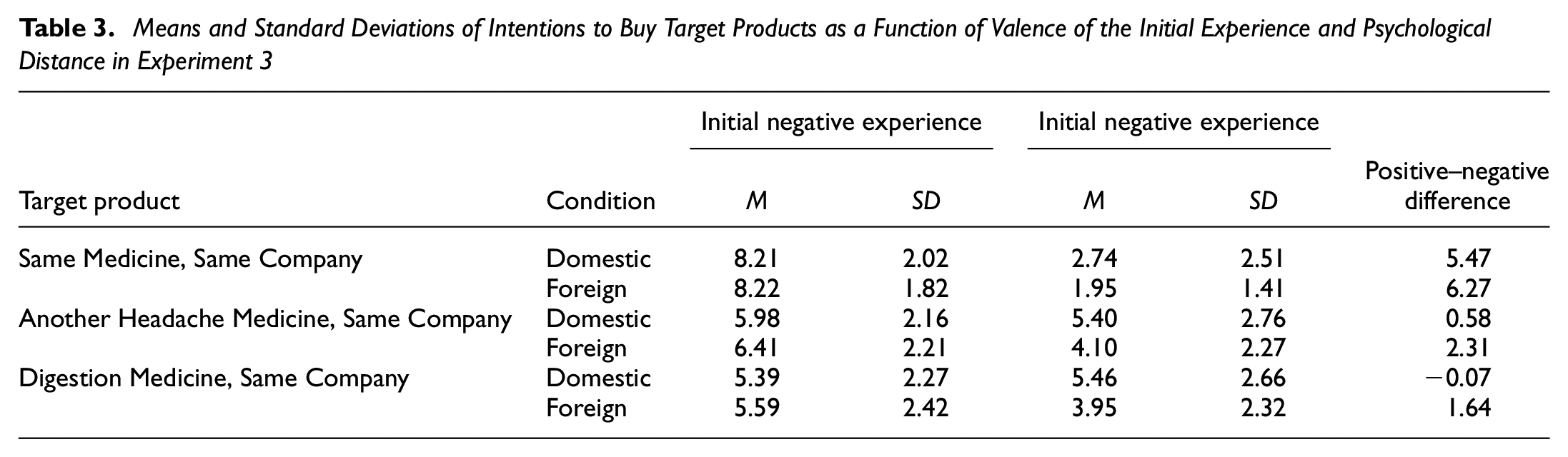
The expected effect of valence, F(1, 357) = 23.52, p < .001,
There was a main effect of distance, F(1, 357) = 5.60, p = .018,
The Same Medicine as the Target Product
A 2 × 2 ANOVA with distance (domestic vs. foreign) and valence of initial experience (positive vs. negative) as between-subject factors revealed a main effect of valence, F(1, 357) = 782.21, p < .001,
In summary, Experiment 3 replicated Experiment 2 and further demonstrated that experiences with psychologically distal object are generalized more than similar experiences with proximal objects.
General Discussion
In three experiments, two of which included two samples (two countries, two languages), we predicted and found more generalization when the objects participants learn from and the objects they generalize to were distant (i.e., a foreign, imported product) rather than proximal (i.e., a domestic, local product). We predicted this effect based on reasoning about how distance affects the accuracy–applicability trade-off that is inherent to generalization. Specifically, with distal (i.e., foreign) objects, the expectation to encounter the same and/or similar objects is low. To ensure that the learned experience would be applied to an object encountered in the future, people should “cast the net wider,” namely, generalize more. However, when the objects are proximal (i.e., domestic), the likelihood of encountering the same and/or similar objects is high. Therefore, even lower generalization would still be applicable to objects encountered in the future.
This logic is also consistent with CLT (Trope & Liberman, 2010) and our studies, we believe, contribute a novel insight to this literature. Specifically, research within the framework of CLT has shown that people use wider, more abstract categories for distant compared with proximal objects (Fujita et al., 2006; Liberman et al., 2002; Wakslak et al., 2006), and our explanation of the effect of distance on generalization in terms of the accuracy–applicability trade-off highlights one way to explain this effect. Namely, it suggests that people use broader categories for distant objects because in the distance exemplars are sparser (see Experiment S3 in the SOM), and optimal differentiation between them entails using larger categories (Maglio & Trope, 2011).
Our findings contribute to the literature on attitudes by demonstrating how psychological distance moderates attitude generalization. All our experiments involved generalization of experience with headache medicines but varied the way foreign versus domestic products were operationalized. Future research should examine other attitude objects. We believe that the same logic applies to other attitude objects (people, services, objects) and other contexts (person perception, attitude formation, product evaluation). Specifically, our reasoning is relevant to any situation in which one would expect more frequent exposure to domestic/ingroup than to foreign/outgroup objects. For example, to the extent that the frequency of encountering students from one’s own university is higher than students from another university, we would predict that an experience with a student from one’s own university (vs. another university) would be generalized less (e.g., to other students from the same program). Similarly, we would predict that an experience with a musician from a foreign country would be generalized more (e.g., to other musicians that graduated from the same music school) if this player is from a foreign country than one’s own country.
Our manipulation of country of origin is obviously related to the vast literature on in-group favoritism—the tendency to favor one’s own group over other groups (Tajfel & Turner, 1979; Turner et al., 1987). Indeed, in all three experiments, participants indicated that they would be more likely to buy domestic compared with foreign products (Javalgi et al., 2005; Shimp & Sharma, 1987). This effect, labeled “consumer ethnocentrism,” deserves future study, but it was not the focus of our work. Importantly, favoring domestic products (which is manifested in our design as a main effect of distance) is independent of our main prediction and finding about more generalization with increased distance, which is manifested in our design as an interaction between distance and valence of initial experience.
Future studies, with a different experimental design, might address the question of whether distance moderates generalization differently from positive versus negative experiences. Prior research showed a variety of asymmetries in processing negative versus positive information (see Baumeister et al., 2001; Unkelbach et al., 2020, for overviews), including generalization asymmetry. The picture, however, is complex. On one hand, there are findings showing negative generalization asymmetry: a tendency to generalize from negative stimuli more than from positive stimuli (Fazio et al., 2004, 2015; Laufer & Paz, 2012; Ram & Liberman, 2019; Ratliff & Nosek, 2011; Shook et al., 2007). Conversely, there are findings showing that positive information is typically perceived as being more similar to other positive information, compared with how similar negative information seems to other negative information (Alves et al., 2016; Gräf & Unkelbach, 2016; Koch et al., 2016; Unkelbach et al., 2008), which should translate into more generalization in the positive rather than the negative domain. In addition, when comparing generalizations from positive and negative experiences, correctness considerations could interact with the accuracy–applicability trade-off (i.e., with the question of the consequences of an inaccurate generalization). Future research which will focus on valence asymmetries could examine whether correctness considerations are valence-dependent.
Supplemental Material
sj-docx-1-spp-10.1177_19485506231164701 – Supplemental material for Psychological Distance Increases Conceptual Generalization
Supplemental material, sj-docx-1-spp-10.1177_19485506231164701 for Psychological Distance Increases Conceptual Generalization by Hadar Ram, Nira Liberman and Christian Unkelbach in Social Psychological and Personality Science
Footnotes
Handling Editor: Grossmann Igor
Declaration of Conflicting Interests
The author(s) declared no potential conflicts of interest with respect to the research, authorship, and/or publication of this article.
Funding
The author(s) disclosed receipt of the following financial support for the research, authorship, and/or publication of this article: This research was supported by the Argentina Chair of Social Psychology to Prof. Nira Liberman and Minerva Grant.

Supplemental Material
Supplemental material is available in the online version of the article.
Notes
Author Biographies
References
Supplementary Material
Please find the following supplemental material available below.
For Open Access articles published under a Creative Commons License, all supplemental material carries the same license as the article it is associated with.
For non-Open Access articles published, all supplemental material carries a non-exclusive license, and permission requests for re-use of supplemental material or any part of supplemental material shall be sent directly to the copyright owner as specified in the copyright notice associated with the article.
