




Abstract
When photographing moments in their lives, people can use a first-person (capturing the scene as they saw it) or third-person (capturing the scene with themselves in it) perspective. Past research suggests third-person (vs. first-person) images better depict the meaning (vs. physical experience) of events. The current work suggests the use and impact of perspective in personal photography follow this representational function. Across six studies (N = 2,113), we find that the goal to capture meaning (vs. physical experience) causes people to be more likely to use third-person (vs. first-person) photos, that people are reminded more of the meaning (vs. physical experience) when viewing their own actual third-person (vs. first-person) photos, and that people like their photos better when the perspective matched (vs. mismatched) their goal for taking the photo. Discussion focuses on theoretical and practical implications of extending the representational function of imagery perspective to everyday uses of photographic imagery.
Decades before the rise of the smartphone camera, cultural critic Susan Sontag (1977) observed, “It would not be wrong to speak of people having a compulsion to photograph: to turn experience itself into a way of seeing” (p. 24). Indeed, photographing one’s life has become an everyday activity (Van House, 2011). For instance, more than a billion active users collectively post more than 95 million images per day on the social media platform Instagram (Dixon, 2022; Marr, 2021). Sontag (1977) suggested that the growing ubiquity of photography conditions us to think of our lives in terms of photographable moments, confronting us with countless decisions about which aspects of a given moment we want to capture and how to do so.
Personal photography can serve multiple potential functions (e.g., to re-immerse oneself in a past moment, to create an opportunity to reminisce with others, to convey something meaningful about one’s identity, values, or goals, etc.), and people’s motivations for taking photos can vary across situations (Petrelli et al., 2014). When it comes to using photographs to document personal life events, research on personal narratives can provide insights into dimensions of events that people might be especially motivated to focus on. This literature shows that narratives of personal events may cohere around capturing the physical details and subjective experience of being there, or they may cohere around a broader theme or interpretive framework that enhances its meaning (Adler et al., 2018). So, capturing the physical experience of an event or its broader meaning may be two particularly prominent motivations for taking personal photos. For instance, someone at the beach with a friend may take a photo to capture the physical experience of the beautiful and relaxing day, or take a photo to capture the bigger meaning of spending time with a close other. In addition, not only do people’s motivations for taking photos differ across situations, but so too do the types of photos they take. One inherent dimension along which photos vary is the perspective they are taken from: When people photograph moments in their lives, they must decide (even if implicitly) whether to take the photo from the first-person perspective, capturing the moment as they see it (e.g., Diehl & Zauberman, 2022), or from the third-person perspective with themselves in the scene (e.g., via posed photos taken by another person or taking a selfie; Berger & Barasch, 2018; Frosh, 2015).
In the current work, we test how people’s goals influence the perspective they use in personal photography. Past research suggests imagery perspective influences processing style such that first-person imagery attunes people to their experiential reactions to features of an event, whereas third-person imagery attunes people to its bigger meaning (Libby & Eibach, 2011; Niese et al., 2021). The current work tests if the use and impact of perspective in personal photography follow this representational function. Specifically, we test if people use third-person (vs. first-person) photos to capture the meaning (vs. physical experience) of the moment, if a photo’s perspective predicts whether it reminds people more of the meaning (vs. physical experience), and if there are consequences of these effects on liking of the photo itself.
The Role of Imagery Perspective
When taking a photo, one must decide which perspective to take it from. That is, should the image be a first-person photograph depicting the scene as one is experiencing it, or should the image be a third-person photograph depicting oneself in the scene? Indeed, people seem to commonly use both perspectives in their photos: evidence from the current work (Studies 4 and 6) considering more than 7,500 of Instagram users’ recent posts found nearly an even split of first-person (49%) and third-person (51%) photos, with most individuals (70%) having at least one recent photo from each perspective.
Importantly, a host of psychological research suggests that visual perspective shapes the way people interpret events. First, work on actor-observer effects highlights how scenes depicted from the target’s vantage point (as in first-person photos) make people more likely to form situational attributions about a target’s behavior, whereas scenes depicted from an observer’s vantage point (as in third-person photos) make people more likely to form dispositional attributions (Storms, 1973). Similarly, to the extent that third-person (vs. first-person) photos tend to depict greater distance from an individual, construal-level theory suggests people should make more abstract attributions about the event (Trope & Liberman, 2010; Wakslak et al., 2008). In addition, recent research suggests that merely including a person in an image shifts whether people engage in relational processing of objects in the scene (Kalkstein et al., 2020). Indeed, prior research has demonstrated that when viewing photos of others from each perspective, people are more likely to describe depicted actions (e.g., locking a door) in third-person (vs. first-person) photos in terms of the actor’s broader goals (e.g., securing the house) than in terms of details about the action itself (e.g., inserting and turning a key; Libby et al., 2009).
These findings fit with evidence suggesting that imagery perspective holds a range of implications for people’s judgments, decisions, and behaviors by shifting processing style (Libby & Eibach, 2011; Niese et al., 2021). First-person imagery evokes a processing style in which people understand events in terms of their experiential reactions to concrete features of the scene, whereas third-person imagery evokes a processing style in which people understand events in terms of broader knowledge structures and belief systems. Accordingly, first-person imagery causes people to interpret events in line with their experiential reactions (Libby et al., 2014; Niese, Libby, Eibach, & Carlisle, 2019; Niese, Libby, Fazio, et al., 2019), whereas third-person imagery causes people to interpret events in line with their abstract self-beliefs about their traits, values, preferences, and developmental trajectories (Libby & Eibach, 2011; Libby et al., 2014; Marigold et al., 2015; Niese, Libby, Eibach, & Carlisle, 2019; Niese, Libby, Fazio, et al., 2019). Analogous results have been demonstrated via carryover effects—in which people view images from either the first-person or third-person perspective before completing an unrelated task—providing stronger evidence that these effects are driven by processing style shifts (Niese, Libby, Eibach, & Carlisle, 2019; Niese, Libby, Fazio, et al., 2019; Shaeffer et al., 2015).
Current Research
Prior research has focused on how taking photos influences people’s experience in the moment, sometimes heightening experiences by helping people attend to the situation, and other times, detracting from the experience (Barasch et al., 2018; Diehl et al., 2016). The current research instead explores people’s goals for taking a photo, as well as the consequences those goals have for the type of photo people take and their eventual liking of it. Personal photos offer the potential to re-immerse people in the physical experience of past events or to document the meaning of important life events. In addition, past research on imagery perspective suggests that photos from the first-person and third-person perspective should be differentially equipped to capture each of these dimensions. While there is evidence that people take both first-person and third-person photos, there is no published work that we are aware of testing whether people adaptively choose to take photos from the perspective that suits their goal.
The current research first tests whether people take third-person (vs. first-person) photos to capture the meaning (vs. physical experience) of an event. In an initial set of studies, participants read about hypothetical scenarios and reported what type of photo (first-person or third-person) they would take depending on their goal (measured in Study 1; experimentally manipulated in Studies 2 and 3). Studies 4 and 5 explored these effects with photos people took and posted on Instagram, testing whether people’s actual third-person (vs. first-person) photos reminded them more of the meaning (vs. physical experience) of events. Finally, mirroring various other findings demonstrating that a fit between the goal people hold and the strategies they use for pursuing it can positively influence subsequent evaluations (Fujita et al., 2008; Higgins, 2005; Miele et al., 2020), Study 6 tested whether people liked their photos more when the perspective matched (vs. mismatched) their goal for taking the photo.
Studies 1 to 3
Do people use third-person (vs. first-person) photos to capture the meaning (vs. physical experience) of events? As an initial test of this hypothesis, Study 1 tested whether people indicate that they would take third-person (vs. first-person) photographs for events in which the meaning (vs. the physical experience) is more important. Studies 2 and 3 experimentally manipulated people’s goals for taking a photo to test whether doing so causally impacts the photo perspective people choose.
Method
Participants
Study 1 appeared at the end of another unrelated study via Amazon’s Mechanical Turk in exchange for $1.75. The site returned 604 responses, of which 169 were excluded for being likely bots, 1 leaving data from 435 participants (277 men, 158 women; Mage = 37.19, SDage = 10.18).
Study 2 was preregistered (https://aspredicted.org/gk6u3.pdf) to collect 150 responses based on the number of participants a less sensitive model averaging across the repeated-measures element of the design would require to detect a medium effect (d = 0.5) at adequate power (1 −β = 0.80) after exclusions. We recruited participants via Prolific.co in exchange for $1.25. The site returned 152 responses, of which three were flagged as likely bots, leaving data from 149 participants for analysis (75 men, 70 women, three self-identified, one preferred not to say; Mage = 34.31, SDage = 13.13).
Study 3 was preregistered (https://aspredicted.org/qq75a.pdf) to collect 250 responses based on the number of participants a less sensitive model averaging across the repeated-measures element of the design would require to detect a small effect (f2= .04) at adequate power (1 −β = 0.80) after exclusions. We recruited participants via Prolific.co in exchange for $1.50. The site returned 250 responses, of which 11 were flagged as likely bots, leaving data from 239 participants for analysis (141 men, 95 women, two self-identified, one preferred not to say; Mage = 41.67, SDage = 13.75).
Procedure and Materials
Participants first read a brief description explaining that when people take photos, they sometimes wish to capture the physical experience of the moment, and other times, they wish to capture the meaning of the moment. In addition, instructions explained that when taking photos, people can use either a first-person perspective, capturing the scene as it looks from their own eyes, or a third-person perspective, including themselves in the photo (e.g., a selfie). Then, participants read hypothetical scenarios in which they might wish to take a photo (e.g., spending the day at the beach with a close friend). In Study 1, participants first rated for each scenario, “How important would
Study 3 also manipulated the goal of taking a photo within-participants, this time using hypothetical scenarios about other people, such as a woman attending a local fair who wanted to take a photo capturing either the physical experience or bigger meaning of the moment. For each scenario, participants viewed two photos that included an identical background (e.g., a fairground) that was roughly equally obscured by a first-person cue (e.g., the woman’s hand holding cotton candy) in one photo and a third-person cue in the other (e.g., the woman herself holding cotton candy) and were asked which type of photo they would take if they were the person in the scenario (688 first-person, 746 third-person). Doing so allowed us to test the effect across different contexts while equating a variety of other factors that might often differ across photos from the two perspectives (e.g., other objects in the photo, background, percentage of the background obscured).
Results
We hypothesized that the goal to capture meaning (vs. physical experience) would predict an increased likelihood of taking a third-person (vs. first-person) photo. We used a hierarchical binomial regression to predict the likelihood of taking a third-person photo (first-person = 0, third-person = 1) from the goal (measure in Study 1: difference in importance of meaning vs. physical experience, person-mean-centered; manipulation in Studies 2 and 3: physical experience = −1, meaning = 1), while including scenario and participant as random intercepts.
Study 1 revealed evidence supporting the hypothesis that greater importance of an event’s meaning (vs. physical experience) predicted an increased likelihood of taking a third-person (vs. first-person) photo, b = 0.14, SE = 0.05, z = 2.62, p = .009, odds ratio (OR) = 1.15 (95% confidence interval [CI] = [1.03, 1.29]).
Studies 2 and 3 experimentally replicated this effect, finding that the goal to capture meaning (vs. physical experience) caused people to be more likely to take a third-person (vs. first-person) photo (Study 2: b = 0.46, SE = 0.07, z = 6.36, p < .001, OR = 1.58 (95% CI: 1.37, 1.82); Study 3: b = 0.15, SE = 0.05, z = 2.70, p = .007, OR = 1.16 (95% CI: 1.03, 1.31)). Follow-up chi-square tests revealed that when participants were given the goal to capture physical experience, they tended in the direction of taking a first-person photo, Study 2: 60.0% first-person, 40.0% third-person; χ2(1, 447) = 17.72, p < .001; Study 3: 51.1% first-person, 48.9% third-person; χ2(1, 713) = 0.32, p = .574, whereas when they were given the goal to capture meaning, they were more likely to take a third-person photo, Study 2: 39.3% first-person, 60.7% third-person; χ2(1, 445) = 20.28, p < .001; Study 3: 44.5% first-person, 55.5% third-person; χ2(1, 715) = 8.73, p = .003.
Study 4
Studies 1 to 3 found that people use third-person (vs. first-person) photos to capture the meaning (vs. physical experience) of a moment, but do people’s actual photos from each perspective better capture these dimensions? We tested this question by conducting three versions of Study 4 in which participants viewed five (4a) or 10 (4b and 4c) of their most recent Instagram photos, indicated the perspective of each photo, and reported whether each photo made them think about the physical experience or meaning of the moment. Thus, Study 4 extends upon the previous studies by using real photos taken by participants in their lives and providing an initial test of whether the two perspectives differentially capture meaning versus experience in personal photos.
Method
Participants
In Study 4a, we preregistered (https://aspredicted.org/4em74.pdf) to collect 200 responses based on the number of participants a less sensitive model averaging across the repeated-measures element of the design would require to detect a small effect (f2 = .05) at adequate power (1 −β = 0.80) after exclusions. The results from Study 4a were directionally consistent with our hypotheses but not significant. Thus, we conducted a pair of highly powered preregistered replications with Studies 4b (https://aspredicted.org/ui5iv.pdf) and 4c (https://aspredicted.org/m7tc5.pdf). Specifically, we increased power by asking participants in these versions to provide responses to 10 (rather than five) photos and collecting 250 responses (rather than 200), allowing a less sensitive model averaging across the repeated-measures element of the design to detect a smaller effect (f2 = .04) at adequate power (1 −β = 0.80) after exclusions.
For all versions, we recruited participants with Instagram accounts via Prolific.co in exchange for $1.25 (4a) or $1.50 (4b and 4c). In total, the site returned 702 responses (N4a = 196, N4b = 250, N4c = 251), of which 14 were flagged as bots (5 bots 4a , 5 bots 4b , 4 bots 4c ) leaving data from 688 participants for analysis (30 men 4a , 32 men 4b , 71 men 4c ; 164 women 4a , 207 women 4b , 168 women 4c ; two self-identified 4a , three self-identified 4b , seven self-identified 4c ; three preferred not to say 4b , one preferred not to say 4c ; Mage (SDage) = 32.194a (10.93), 30.614b (11.60), 31.344a (10.03).
Procedure and Materials
Participants were instructed to go to their Instagram account and open their most recent post sharing one of their photos (i.e., not a repost of someone else’s photo). Participants indicated whether the photo was taken from the first-person (“A photo of the scene as it looked from my own eyes”) or third-person (“A photo with myself in the scene”) perspective (3,001 first-person, 2,891 third-person). Then, participants answered “What does this photo make you think about more?” with the response options, “The physical experience of the moment” or “The bigger meaning of the moment” (3,375 physical experience, 2,519 bigger meaning). We also included a variety of exploratory measures after the primary dependent measure (see Supplemental Material).
Results
We hypothesized that people would think more about the meaning (vs. physical experience) of the moment when viewing their third-person (vs. first-person) photos. We integrated the data across versions 3 and used a hierarchical binomial regression to predict what each photo made people think about (physical experience = 0; meaning = 1) depending on perspective (first-person = −1; third-person = 1), while including participant and study version as random intercepts. As hypothesized, there was a significant effect of perspective, such that people were more likely to think about meaning (vs. physical experience) for third-person (vs. first-person) photos, b = 0.19, SE = 0.03, z = 6.21, p < .001, OR = 1.21 (95% CI = [1.14, 1.29]).
Study 5
Study 4 employed a correlational design to demonstrate a connection between meaning (vs. physical experience) and a photo’s perspective. Study 5 sought to extend this finding by experimentally testing whether the goals to capture meaning (vs. physical experience) cause people to use their actual third-person (vs. first-person) photos.
Method
Participants
We preregistered (https://aspredicted.org/ri5nz.pdf) to collect 250 responses based on the number of participants a less sensitive model averaging across the repeated-measures element of the design would require to detect a small effect (f2 = .04) at adequate power (1 −β = 0.80) after exclusions. We recruited participants with Instagram accounts via Prolific.co in exchange for $2.50. The site returned 248 responses, of which five were flagged as bots, leaving data from 243 participants for analysis (126 men, 108 women, seven self-identified, two preferred not to say; Mage = 32.67, SDage = 9.82).
Procedure and Materials
As in Study 4, participants in Study 5 responded about their own photos they had posted on their Instagram account. However, rather than correlationally testing the hypothesis within a specified set of participants’ photos as in Study 4, Study 5 experimentally tested the hypothesis by manipulating participants’ goals for selecting photos. Specifically, we asked each participant to select three photos that best capture the physical experience of an event in their life, as well as three other photos that best capture the bigger meaning of an event in their life. Each participant was asked to select six unique photos, counterbalancing whether participants selected physical experience or bigger meaning photos first. After selecting each photo, participants generated a hashtag that highlights the specified event dimension (physical experience or bigger meaning) captured by the photo. Then, participants were reshown each hashtag one at a time, asked to relocate the photo it corresponded to, and answer questions about the photo, including whether it was taken from a first-person (812) or third-person (646) perspective. We also included exploratory measures after the primary dependent measure (see Supplemental Material).
Results
We hypothesized that the goal to find photos capturing the meaning (vs. physical experience) of an event would cause people to select more third-person (vs. first-person) photos. We used a hierarchical binomial regression to predict the perspective of each photo (first-person = 0; third-person = 1) depending on manipulated goal (physical experience = −1; meaning = 1), while including participant as a random intercept. As hypothesized, the goal to capture meaning (vs. physical experience) caused people to select more third-person (vs. first-person) photos, b = 0.12, SE = 0.06, z = 2.18, p = .029, OR = 1.13 (95% CI = [1.01, 1.27]).
Study 6
The previous studies suggest people use third-person (vs. first-person) photos to capture the meaning (vs. physical experience) of a moment, and viewing personal photos from each perspective differentially reminds people of these different dimensions. However, the decision to take a photo from either perspective is undoubtedly multiply-determined, meaning that there are likely times when people want to capture physical experience but take a third-person photo or want to capture meaning but take a first-person photo. So, what are the consequences when people choose to take a photo from the perspective that matches (vs. mismatches) their goal? Study 6 tests the consequences for people’s liking of their photos. Specifically, we hypothesize that photos in which the perspective matches the goal (i.e., a first-person photo with the goal of capturing physical experience or a third-person photo with the goal of capturing meaning) will be evaluated more positively than photos in which the perspective mismatches the goal (i.e., a third-person photo with the goal of capturing physical experience or a first-person photo with the goal of capturing meaning).
Method
Participants
We preregistered (https://aspredicted.org/jp9c8.pdf) to collect 360 responses based on the number of participants a less sensitive model averaging across the repeated-measures element of the design would require to detect a small effect (f2 = .025) at adequate power (1 −β = 0.80) after exclusions. We recruited participants with Instagram accounts via Prolific.co in exchange for $1.25. The site returned 361 responses, of which two were flagged as likely bots, leaving data from 359 participants for analysis (55 men, 295 women, seven preferred to self-identify, two preferred not to say; Mage = 28.81, SDage = 10.17).
Procedure and Materials
Participants were instructed to go to their Instagram account and open their most recent post sharing one of their photos (i.e., not a repost of someone else’s photo).
Measuring the Goal
Participants first answered, “What were you trying to capture with this photo?” with either the option “The physical experience of the moment” or “The bigger meaning of the moment” (1,029 physical experience, 766 bigger meaning). Then, participants rated on individual 5-point scales ranging from (1) Not at all to (5) Extremely, the questions, “To what extent were you trying to capture
Measuring Perspective
Next, participants indicated whether the photo was taken from the first-person (“A photo of the scene as it looked from my own eyes”) or third-person (“A photo with myself in the scene”) perspective (754 first-person, 1,041 third-person).
Measuring Evaluations
Then, participants answered “How do you feel about this photo?” on a 5-point scale ranging from (1) Not at all positive to (5) Extremely positive (M = 4.16, SD = 0.85). 4
Results
We hypothesized that photos that matched (vs. mismatched) perspective and goal would be evaluated more positively. To test this prediction, we used hierarchical linear regression to predict evaluations of each photo depending on perspective (first-person = −1, third-person = 1), goal (capture physical experience = −1; capture meaning = 1), and their interaction, while including participant as a random intercept.
As hypothesized, there was a significant interaction between photo perspective and goal, b = 0.06, SE = 0.02, t(1,707.52) = 3.09, p = .002, f2 = .006. In particular, third-person (vs. first-person) photos were rated more positively when the goal was to capture meaning, b = 0.08, SE = 0.03, t(1,762.03) = 2.67, p = .008, f2 = .002. The pattern reversed when the goal was to capture physical experience, though the simple effect was not significant, b = −0.04, SE = 0.03, t(1,789.68) = 1.42, p = .155, f2 = .001 5 (see Figure 1).
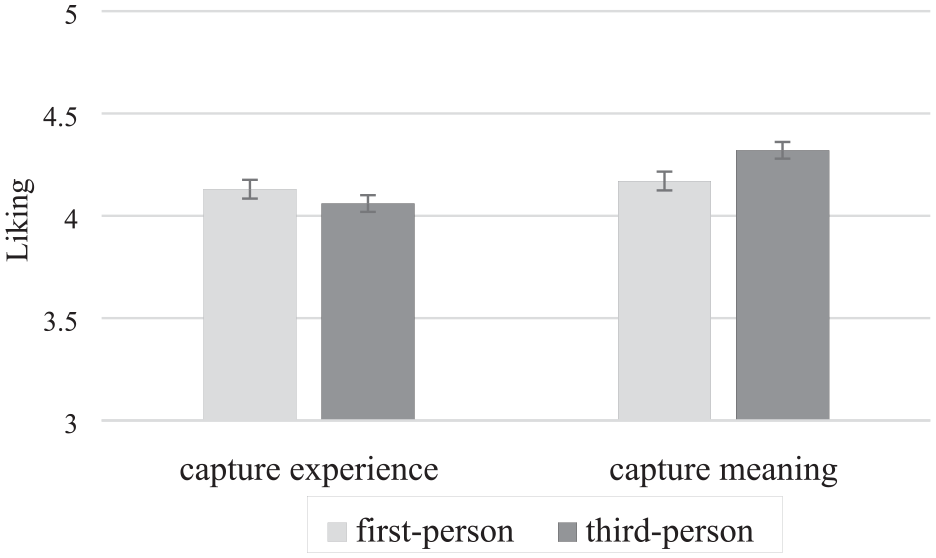
Liking of Instagram Photos Depending on People’s Goal to Capture Meaning Versus Experience and Perspective of the Photo
General Discussion
The current work provides novel insight into the function of perspective in personal photos. Natural variation in how important people viewed the meaning (vs. physical experience) of hypothetical events predicted an increased likelihood of taking third-person (vs. first-person) photos in Study 1. Experimentally manipulating people’s motivations in Studies 2 and 3 replicated this pattern, demonstrating how the goal to capture meaning (vs. physical experience) causes people to be more likely to take a third-person (vs. first-person) photo. Study 4 provided evidence suggesting there is some basis for this choice: When viewing their own past photos on Instagram, participants reported that third-person (vs. first-person) photos reminded them more of the meaning (vs. physical experience). Furthermore, when people were given the goal to choose photos that capture meaning (vs. physical experience) in Study 5, they were more likely to select their third-person (vs. first-person) photos. Finally, Study 6 provided evidence that the extent to which the perspective of photos matched (vs. mismatched) people’s goal for taking them predicted subsequent liking of the photos. Thus, the current studies not only provide novel insight into the decisions people make about an inherent dimension of their personal photos (i.e., which perspective to take the photo from), but also suggest consequences of this decision.
The current findings are consistent with work showing that the two perspectives support qualitatively distinct processing styles (Libby & Eibach, 2011). Indeed, prior research has demonstrated that when viewing photos of other people from each perspective, third-person (vs. first-person) photos cause people to describe the person’s actions more abstractly (vs. concretely; Libby et al., 2009). In Study 4 of the current work, participants reported thinking more about the meaning (vs. physical experience) of the moment when viewing their third-person (vs. first-person) Instagram photos. This extends previous findings by demonstrating the effects with people’s actual photos of themselves. In addition, by moving beyond demonstrating perspective’s role in causing people to interpret actions abstractly (vs. concretely), the current work extends prior research by testing a potential function of this shift: to capture the meaning (vs. physical experience) of a moment. Furthermore, Studies 2, 3, and 5 provided stronger experimental evidence for this process by demonstrating how manipulating people’s goals impacted their decisions about the perspective to use. This also provides novel evidence that people appear to have some intuition about perspective’s ability to capture these two dimensions and make decisions about which perspective to use given their goal (Miele et al., 2020). Study 3 particularly demonstrates the unique role of perspective by asking participants to make choices between pairs of photos that varied in perspective but held constant other dimensions that might typically differ between photos from the two perspectives. In addition, Study 6 demonstrates that these decisions might impact people’s attitudes about a photo depending on whether they used the perspective that better matches their goal for taking it.
These findings are consistent with a host of other theoretical approaches that would predict that third-person (vs. first-person) images should better capture the meaning (vs. physical experience) of events—for instance, by promoting a high-level construal (Trope & Liberman, 2010). Accordingly, although perspective represents an inherent decision people must make when taking a photo, these approaches suggest other dimensions may hold similar consequences. For instance, given that black-and-white (vs. color) photos promote higher level construal (Lee et al., 2014), might people similarly be more likely to add a black-and-white filter to photos that they want to capture the meaning (vs. physical experience) of a moment, and might doing so lead them to like the photo more? In addition, while the current work focuses on people’s reactions to their own photos, taking and sharing photos is a social activity, suggesting future research could explore the impact of photo perspective on photo-viewer’s inferences about the photo-taker’s goal for taking a photo, the photo’s communicative value, evaluations of the photo and photo-taker, and more (Berger & Barasch, 2017).
The current findings also provide novel insight into the increasingly frequent practice of documenting and sharing one’s life with photography (Dixon, 2022). Prior research on this topic has focused on how the act of photo-taking impacts people’s experience of the moment itself (Barasch et al., 2018; Diehl et al., 2016), how personality traits predict who tends to take certain types of photos (Halpern et al., 2016), or how other people’s evaluations of the individual are impacted by features of the photo (Berger & Barasch, 2017). The current work instead explores how people’s goals influence their decision about an inherent feature of the photo they take: its perspective. Furthermore, the current work highlights potential consequences of this feature. Viewing photos from the third-person (vs. first-person) reminds people of the meaning (vs. physical experience) of the photographed event. As such, people subsequently prefer their photos in which the photo’s perspective matches what they wanted to capture.
The current work provides empirical evidence of at least two different motivations for taking a photo, complementing other literatures that have explored these questions using primarily qualitative means (e.g., Petrelli et al., 2014). Furthermore, given the importance that personal photography holds for people’s life narratives, the current work paves the way for future research exploring this connection. For instance, psychologists have long viewed the self as a dual-faceted construct comprising both experiential and conceptual components (James, 1890/1950). Given that the current work suggests people use photos to sometimes capture the physical experience of the moment, and other times to capture the meaning, might people use different types of personal photos (e.g., first-person vs. third-person) to document these different facets of the self? Exploring this possibility suggests people’s decisions about the type of photo to take might not only impact their subsequent reactions to the photo, but might also hold broader implications for the development of people’s self narratives and the role personal photography plays in this process (Breen et al., 2021).
Finally, the current research relied on online samples of participants from the United States, with a racial composition that roughly matches the racial composition of the country based on recent census data (see the Supplemental Material for exact comparisons). Thus, a natural next question for future research is to explore the extent to which the current effects extend to other countries and cultures. Indeed, given the ubiquity of personal photography worldwide (Kislinger & Kotrschal, 2021), the effects studied in the current article have the potential to be widely applicable, suggesting value for future research to directly test whether people hold similar goals for taking first-person versus third-person personal photographs across cultures, and whether there are similar consequences when viewing photographs that match one’s goals.
Conclusion
Sontag (1977) argued that the cultural dominance of photography has conditioned us to be on the lookout for potential photographable moments as we navigate life. If this was the case when Sontag was writing, then it is likely even more true today given the ubiquity of smartphone cameras. We might therefore expect that people have developed an awareness that there are distinct qualities of life moments that they might choose to capture in photographs, as well as intuitive photo-taking strategies for doing so. However, relatively little work has empirically investigated the different motivations people have for taking photos, how this shapes the inherent decisions they make about the photos they take, and the consequences. The current research provides initial insight into these questions, demonstrating how differences in people’s goals for taking a photo influence whether they choose to take a first-person or third-person photo, and that this, in turn, can have consequences for people’s subsequent reactions to their photos.
Supplemental Material
sj-docx-1-spp-10.1177_19485506231163012 – Supplemental material for Picturing Your Life: The Role of Imagery Perspective in Personal Photos
Supplemental material, sj-docx-1-spp-10.1177_19485506231163012 for Picturing Your Life: The Role of Imagery Perspective in Personal Photos by Zachary Adolph Niese, Lisa K. Libby and Richard P. Eibach in Social Psychological and Personality Science
Footnotes
Handling Editor: Veronika
Declaration of Conflicting Interests
The author(s) declared no potential conflicts of interest with respect to the research, authorship, and/or publication of this article.
Funding
The author(s) disclosed receipt of the following financial support for the research, authorship, and/or publication of this article: This research was supported in part by a National Science Foundation (NSF) (grant number: 1729482).

Supplemental Material
Supplemental material is available in the online version of the article.
Notes
Author Biographies
References
Supplementary Material
Please find the following supplemental material available below.
For Open Access articles published under a Creative Commons License, all supplemental material carries the same license as the article it is associated with.
For non-Open Access articles published, all supplemental material carries a non-exclusive license, and permission requests for re-use of supplemental material or any part of supplemental material shall be sent directly to the copyright owner as specified in the copyright notice associated with the article.
