




Abstract
Previous research suggests that moral foundations have consequences for intergroup relations, but the evidence is mostly correlational and gathered mainly in north American countries. This work aimed to replicate the conceptual findings in the European context and test the effects of manipulating a moral framing on the perceived (im)morality of minority groups, willingness to defend their rights collectively and support for anti-immigration policies. A correlational study showed that binding and individualizing foundations contributed to predict support for anti-immigration policies and willingness to participate in collective actions for immigrants’ rights. A follow-up experiment suggested that emphasizing the benefits for society of fairness—an individualizing foundation—(vs. authority—a binding foundation) may improve intergroup evaluations, increase collective action intentions, and reduce support for anti-immigration policies. Although a second preregistered experiment could not replicate the results, complementary analyses suggested some positive effects of fairness compared with the control and authority conditions. These results open a path to investigate whether a fairness moral reasoning might improve attitudes toward immigrants.
Does morality influence how intergroup relations are shaped? Morality is a system of rules that facilitate and coordinate group living, playing an important role in evaluating and treating outgroup members. The moral foundations theory (Graham et al., 2009; Haidt & Graham, 2007, 2009) proposes five domains of morality that can be grouped into two broad categories: individualizing and binding foundations. Previous research suggests that binding foundations are positively associated with intergroup hostility and discrimination, whereas the relationship is negative for individualizing foundations (Hadarics & Kende, 2017, 2018; Kugler et al., 2014). However, this evidence is mostly correlational. The current research aims to provide causal evidence on the effect of a moral framing on intergroup orientations, specifically on (im)morality attributed to immigrants and support of actions that contribute to or impede their integration. For that purpose, we first conducted an exploratory study to find out whether moral foundations were related to intergroup orientations beyond traditional intergroup processes. Then, in two experimental studies, we made salient the moral framings of fairness and authority to check their impact on orientations toward immigrants.
Moral Foundations and Intergroup Relations
According to the Moral Foundations Theory (MFT; Haidt & Graham, 2007; Haidt & Joseph, 2004, 2008), moral intuitions are primarily determined by personal moral foundations, being innate bases of moral reasoning with evolutionary roots but also shaped by the sociocultural environment. Moral systems contribute to decision-making and regulate social interaction in the most cooperative possible way, helping overcome selfishness and establishing agreements between individuals (Haidt & Kesebir, 2010; Vaughan et al., 2019). The MFT proposes five foundations: Harm/care motivates compassion and concern for the well-being of others; Fairness/reciprocity underlies concerns for equitable treatment of others, motivating social equality and justice; Ingroup/loyalty encompasses concerns for the responsibilities one has to social groups, motivating ingroup allegiance; Authority/respect underlies a need for social order, motivating deference for tradition and sanctioned authorities; and Purity/sanctity relates to respect for both physical and metaphysical sacredness, motivating the pursuit of chastity and reverence for divinity (for a review see Graham et al., 2009, and Haidt et al., 2009). 1
Moral foundations are compressed into individualizing (care and fairness) or binding (loyalty, authority, and sanctity) foundations (Graham et al., 2009; Graham, Nosek, et al., 2011a; Nilsson et al., 2016). Individualizing foundations establish the individual as the focal point of morality and are based on direct disapproval of harming others, general concern for rights, welfare, and protection. In contrast, binding foundations refer to allegiances and obligations as the focal points of morality, promoting the protection of communities by binding people to groups, institutions, and well-defined roles (for a review see Graham, 2013).
The focus of moral concerns has important consequences for intergroup attitudes and behaviors. The arrival of immigrants with different cultural traditions can be challenging for the native population if they feel that their cultural norms and identity are threatened, a key factor when analyzing attitudes toward immigration (Schmuck & Jörg, 2017; Valentino et al., 2017). Moral contents are key to defining whether others represent an opportunity or a threat (Brambilla et al., 2013) and are related to the perception of interpersonal intentions and intergroup relations (Brambilla et al., 2019; Leach et al., 2015; López-Rodríguez & Zagefka, 2015; Monroe & Plant, 2019; Ray et al., 2021).
Polarized attitudes toward immigrants (i.e., solidarity and violence) may reflect different morally relevant motives, both on the individual and intergroup level (Kertzer et al., 2014; Nicol & Rounding, 2018; Petrović, 2019). Individualizing foundations are negatively associated with the perceived threat regarding immigration (Hadarics & Kende, 2017) and positively related to helping intentions toward outgroups in need (Nilsson et al., 2016; Obeid et al., 2017; Smith et al., 2014; Wilhelm et al., 2020), empathic concerns and perspective taking (Hannikainen et al., 2020), greater endorsement of human rights principles (Stolerman & Lagnado, 2020), and collective action intentions in equality-focused movements (Milesi, 2017). Quite the opposite, binding foundations are positively associated with intergroup prejudice (Hadarics & Kende, 2017; Low & Wui, 2016; Van de Vyver et al., 2016), the perception of culturally different outgroups as threatening (Hadarics & Kende, 2018; Stewart & Morris, 2021), negative attitudes against immigrants (Koleva et al., 2012), and discrimination against foreigners and immigrants (Kugler et al., 2014), findings that have questioned its moral character.
Moral Foundations as Motivated Reasoning for Attitudes
Some scholars debate whether moral foundations are the core motivations of political attitudes or a product of ideological justifications or rationalizations. Most MFT research assumes that moral foundations predict political beliefs (e.g., Franks & Scherr, 2015; Kertzer et al., 2014; Koleva et al., 2012; Milesi, 2017; Wilhelm et al., 2020). Other researchers have proposed that moral foundations are part of a motivated cognition that justifies our attitudes and actions, defending a reciprocal relation between moral foundations and political attitudes (see Hatemi et al., 2019; Strupp-Levitsky et al., 2020; Van Leeuween & Park, 2009). Therefore, binding foundations can serve as a motivated compass to guide moral reasoning and attitudes, although their consequences are not always prosocial.
Previous research has suggested that moral framings may shape people’s subsequent attitudes, particularly if the moral foundations seem relevant (Day et al., 2014). Manipulation of moral arguments have been found to reinforce certain political attitudes (Feinberg & Willer, 2012) as well as environmental attitudes and charitable giving (e.g., Feinberg et al., 2020; Feinberg & Willer, 2013; Feygina et al., 2010; Winterich et al., 2012). Past research on moral foundations has mainly focused on differences between the political spectrum (i.e., liberals and conservatives in the U.S. context). In the last few years, new studies have examined the association of moral foundations with intergroup orientations (i.e., Hadarics & Kende, 2018; Mobayed & Sanders, 2022; Monroe & Plant, 2019).
The present research contributes to this discussion providing correlational and experimental evidence in the European context. Specifically, we examined how binding and individualizing foundations may shape intercultural relations and intergroup attitudes by looking at their impact on the stereotypical image of immigrants, willingness to participate in collective action for the immigrants’ rights, and support for anti-immigration policies. First, we provide data from a correlational study among moral foundations and intergroup orientations in the Spanish context. Then two experiments explored the causal effect of promoting a binding versus individualizing moral framing on intergroup orientations.
Overview
The growing number of migrant populations worldwide requires a full understanding of how to promote better protection of minorities’ rights. However, there still needs to be more knowledge on how moral foundations may facilitate relations between immigrants and the majority group. To contribute to this aim, we conducted three studies in Spain, which has one of the highest percentages of immigration (14.6 %) in the European Union (EU) (McAuliffe & Triandafyllidou, 2021) and where a far-right party called VOX has recently gained media and political influence. This party builds its agenda and discourse in opposition to immigration and border control, among other conservative ideas (see Fernández-Suárez, 2021). Since 1978, Spain has been a parliamentary monarchy. Previously, for 36 years, there was a semi-fascist dictatorship preceded by a civil war that pitted the left and the right. Overall, in Spain, the right and the left political orientation distinguishes mainly between progressive and conservative, being different from other countries where more research in MFT has been conducted.
In Study 1, we explored the relationship between moral foundations and the perception of immigrants and support for actions that facilitate or restrict their rights. Studies 2 and 3 tested the effect of manipulating a moral framing based on binding versus individualizing foundations on the perception of a specific group of immigrants (Muslims) and support for actions that facilitate or restrict their rights. It was expected that the moral framing of fairness (vs. authority) would lead participants to improve their moral perception of the minority group, increase their willingness to participate in collective action for immigrants’ rights, and reduce their support for anti-immigration policies. Materials, data sets and the codebook for the three studies and the preregister for the third study are available at https://osf.io/f2hbq/?view_only=b93a10c5c58c44ada6c66391e064eb6f.
Study 1
This study explored the relationship between moral foundations and perceived (im)morality, support for collective action for immigrants’ rights, and anti-immigration policies while controlling the influence of other factors that also shape intergroup orientations such as ideological motivations (i.e., social dominance orientation) and classical intercultural conditions (i.e., quantity and quality of intergroup contact).
Method
Participants
One hundred and fifty Spaniards (68.7% women) from 19 to 76 years old (Mage = 41.67, SDage = 13.37) voluntarily participated in an online survey. Four participants were previously discarded for not being Spaniards. Participants were recruited following a nonprobabilistic sampling within a panel of volunteers. A sensitivity analysis using G*Power (Erdfelder et al., 1996) indicated that a sample size of 150 participants allows detecting an effect of f2≥ .086 in a multiple linear regression (R2 increase) assuming an alpha level of .05% and 90% power.
Measures
Unless otherwise specified, scales ranged from 0 (Completely disagree) to 6 (Completely agree).
Perceived (Im)morality of Immigrants
We measured the perceived morality of immigrants with three items, “honest,”“sincere,” and “trustworthy” (α = .96; Leach et al., 2007; adapted to Spanish by López-Rodríguez et al., 2013) and perceived immorality with the items of “treacherous,”“aggressive,” and “malicious” (α =.95), based on Sayans-Jiménez et al., (2017) in a scale ranging from 0 (Nothing at all) to 6 (Extremely).
Willingness to Participate in Collective Action for Immigrants’ Rights
Participants indicated to what extent they were willing to engage in seven different actions, such as “Attending demonstrations to demand the rights of immigrants” on a scale (α = .95) adapted from Duncan (1999) ranging from 0 (Not willing at all) to 6 (Totally willing).
Anti-Immigration Policies
Measuring participants’ agreement with eight anti-immigration policies (α = .87), such as “Raising the requirement in terms of language, taxation and integration for the acquisition of nationality,” taken from the electoral program of a Spanish far-right party (VOX) previously used in López-Rodríguez et al. (2020). 2
Moral Foundations
Measured using the 30-item version (Moral Foundations Questionnaire [MFQ]; Graham, Nosek, et al., 2011b, adapted to Spanish by Gudiño Paredes & Fernández Cárdenas, 2015): Harm/Care (α = .63); Fairness/Reciprocity (α = .60); Ingroup/Loyalty (α = .72); Authority/ Respect (α = .71); and Purity/Sanctity (α = .71). The composite of individualizing foundations was computed by averaging the Harm and Fairness subscales, r(148) = .73, and for binding foundations by averaging the Ingroup, Authority, and Purity subscales (correlations between the subscales ranged from .61 to .66).
Social Dominance Orientation (SDO)
Measured through the scale of SDO (Pratto et al., 1994) of 12 items (α = .85).
Quantity of Contact
Evaluated by asking participants how much contact they had with immigrants on a scale from 0 (Not at all) to 10 (Very much).
Quality of Contact
Participants were asked if their contact with immigrants was pleasant, egalitarian, cooperative and voluntary (α = .91) based on Vázquez et al. (2021).
Political Orientation
Participants indicated their political beliefs in relation to economic and social issues (adapted from Atwell Seate & Mastro, 2015) on a scale from 1 (Extreme left) to 7 (Extreme right). The two items were averaged to form a composite of political orientation, r(148) = .65, p < .001, revealing an orientation to the left (M = 3.04, SD = 1.15).
Sociodemographics
Participants also reported their sex, age, nationality, and subjective social status (Adler et al., 2000). Then, they were debriefed and thanked.
Results
Correlations
Table 1 shows descriptive statistics and correlations. Participants showed greater endorsement and use of the individualizing moral concerns of Harm/Care and Fairness/Reciprocity than of the binding moral concerns of Ingroup/Loyalty, Authority/Respect, or Purity/Sanctity. The endorsement of authority and purity was negatively associated with perceived morality and collective actions for immigrants’ rights and positively associated with perceived immorality and anti-immigration policies. Ingroup was only associated with anti-immigration policies. Fairness seemed to favor positive attitudes toward immigrants and immigration, as it was positively related to perceived morality and collective actions and negatively with anti-immigration policies. Harm was only positively related to collective actions.
Descriptive Statistics and Correlations
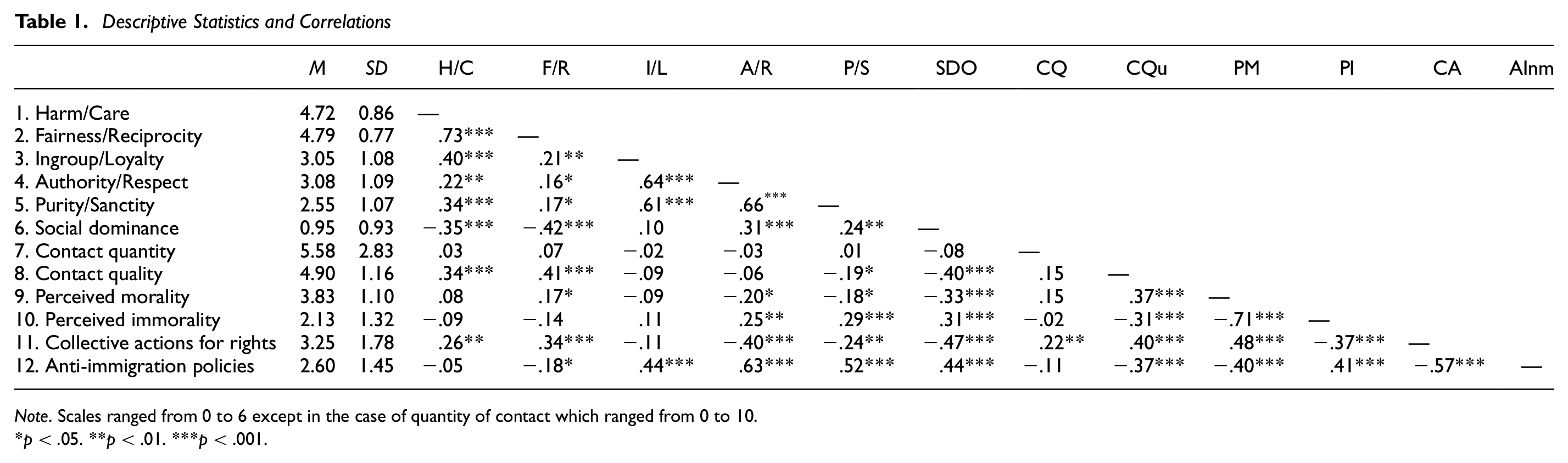
Note. Scales ranged from 0 to 6 except in the case of quantity of contact which ranged from 0 to 10.
p < .05. **p < .01. ***p < .001.
Regression Analyses
To analyze whether individualizing and binding foundations contributed to predicting perceived (im)morality, collective actions, and anti-immigration policies, we conducted four hierarchical linear regressions controlling for the influence of SDO and quantity/quality of contact in Step 1.
The regression analysis with perceived morality and immorality as criterion variables (see Table 2) showed that only SDO and quality of contact were significant predictors.
Hierarchical Regression for Perceived Morality and Immorality
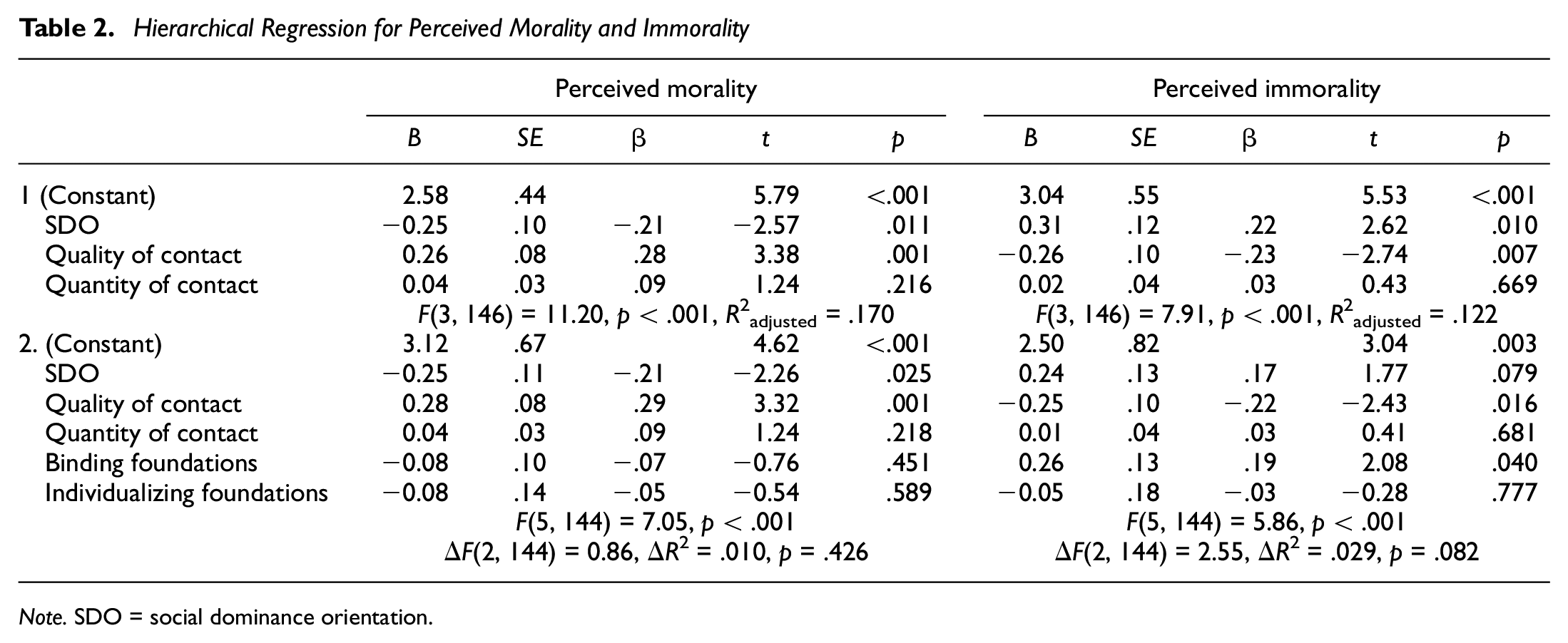
Note. SDO = social dominance orientation.
When predicting willingness to participate in collective action and support of anti-immigration policies, moral foundations significantly improved the predictive model (see Table 3). Binding foundations were negatively associated with supporting collective action for immigrants’ rights and positively associated with anti-immigration policies. On the contrary, individualizing foundations were strongly and positively associated with willingness to collective action for immigrants’ rights but negatively associated with supporting anti-immigration policies. The contribution of the moral foundations was especially considerable when predicting anti-immigration policies, doubling the size of the R2 in Step 2 compared with Step 1, having binding moral foundations a preponderant role.
Hierarchical Regression for Willingness to Participate in Collective Actions for Immigrants’ Rights and Support to Anti-Immigration Policies
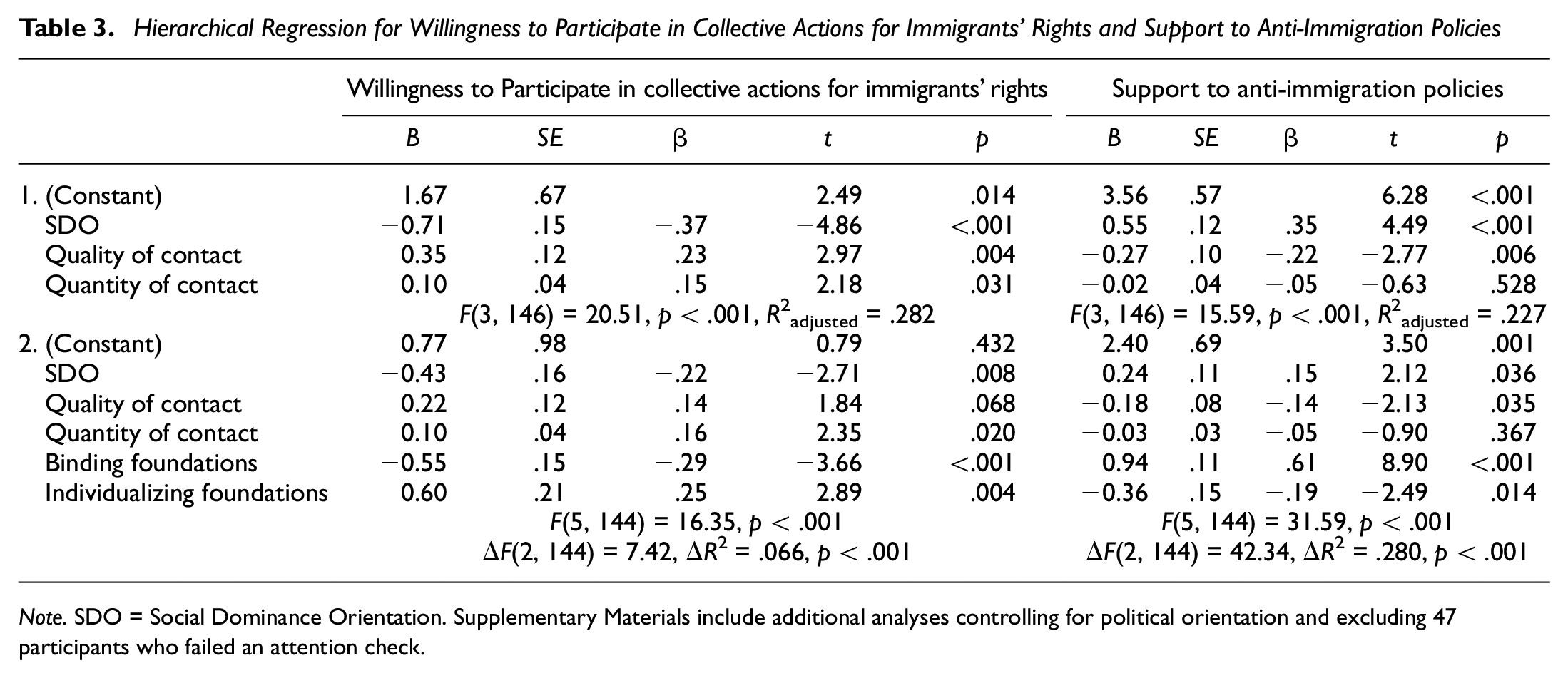
Note. SDO = Social Dominance Orientation. Supplementary Materials include additional analyses controlling for political orientation and excluding 47 participants who failed an attention check.
Discussion
Our findings showed that individualizing and binding foundations, once adjusted for covariates, were good predictors of support for collective actions for immigrants’ rights and anti-immigration policies. The potential dark side of binding moral standards (e.g., Kugler et al., 2014; Smith et al., 2014) is reflected in our findings. Binding moral foundations were strongly associated with support for anti-immigration policies, a key component within the narrative of the Spanish far-right party, VOX. However, given the limitations of correlational data and because participants assessed immigrants as a vague category, in the following studies, we experimentally tested the effects of framing individualizing versus binding moral arguments on attitudes toward a specific stigmatized minority.
Study 2
Based on the correlational findings from Study 1, Study 2 aims to explore the causal effects of different moral framings on the orientations toward immigrants. Based on the results of the previous correlational study indicating that binding and individualizing foundations may have opposite effects on the support of immigrants’ rights, we manipulated a moral framing making salient the societal benefits of promoting fairness vs. authority.
In Study 2, the focal outgroup were Muslim immigrants, a minority community highly stigmatized in Europe (European Union Agency for Fundamental Rights [FRA], 2017). From an exploratory approach, we expected that participants in the fairness (vs. authority) condition would perceive more morality (H1), sociability (H2), and competence (H3) and less immorality (H4) in Muslim immigrants and would show a greater willingness to participate in collective action their rights (H5), and less support for anti-immigration policies (H6). We had no clear hypotheses about the comparison of the control condition with the other two. Also, since liberals and conservatives have been found to rely on different moral standards (Graham et al., 2009), we tested whether ideological orientation moderates the effects.
Method
Participants
One hundred and seventy-eight Spaniards (92 women, Mage = 39.01, SDage = 13.32) voluntarily participated in an online study about intergroup relations. Participants were recruited by a snowball technique such that undergraduate Criminology students received course credits if they invited four acquaintances to participate and later explained the research goals and method to them. A sensitivity analysis using G*Power (Erdfelder et al., 1996) indicated that a sample size of 178 participants allows to detect an effect of f2≥ .27 in an ANOVA (fixed effect, omnibus, one-way) with three groups, assuming an alpha level of .05 and 90% power.
Procedure
Participants first read a summary of a fictitious study that analyzed the factors that predict social well-being in different cultures. They were randomly assigned to one of the three experimental conditions. In the fairness condition, participants learned that “societies in which actions are taken to protect people who suffer emotionally and where there is a concern to guarantee the rights of the weakest and most vulnerable show a higher level of social well-being in the long term and manage to recover faster and more effectively from crises.” In the authority condition, participants learned that “societies where chaos and disorder are avoided, respect for authority is shown, and traditions prevail show a higher level of long-term social well-being and are able to recover more quickly and effectively from social crises.” Finally, participants in the control condition were informed that “societies where work and leisure time are well balanced show a higher level of long-term social well-being and are able to recover more quickly and efficiently from social crises.” After reading this, participants gave one or two examples of actions that had recently made them feel good related to the manipulation they read—(a) fairness: protection and justice actions; (b) authority: actions related to order, respect for authority or traditions, or (c) leisure activities. A one-way ANOVA showed that there were no differences in credibility among conditions, F(2,175) = 0.72, p = .488, η2p = .01. After the manipulation, participants proceeded to the rest of the questionnaire.
Perceived morality (“honest” and “trustworthy,”r = .83), perceived immorality (“treacherous” and “aggressive,”r = .76), perceived competence (“intelligent” and “able,”r = .78), and perceived sociability (“open” and “friendly,”r = .70). All df = 176, all ps < .001 (adapted from Sayans-Jiménez et al., 2017).
Willingness to participate in collective action for Muslim immigrants’ rights (α = .96), agreement with anti-immigration policies (α = .87) and political orientation, r(176) = .72, p < .001, were measured as in Study 1. The sample was centered along the political spectrum (M = 4.12, SD = 2.00).
At the end of the questionnaire, we assessed the credibility of our manipulation with four items (convincing, valid, realistic, and credible) ranging from 0 (Completely disagree) to 6 (Completely agree), α = .94. Finally, participants were debriefed and thanked.
Results
Table 4 shows the descriptive statistics and correlations, and Table 5 shows the mean values and standard deviations per condition. All measures correlated significantly between them.
Descriptive Statistics and Correlations
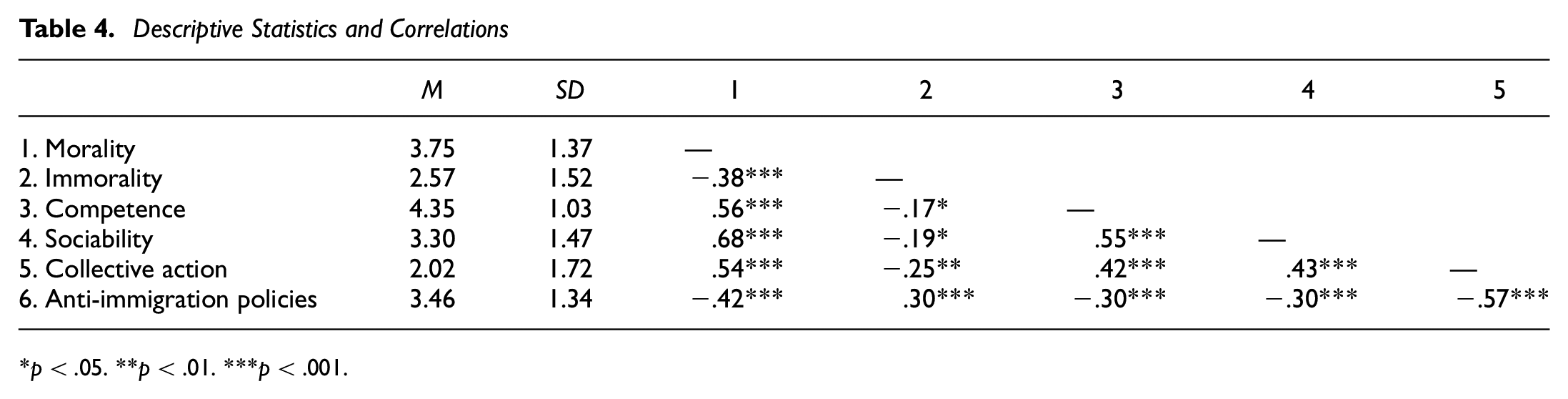
p < .05. **p < .01. ***p < .001.
Mean Values and Standard Deviations Per Condition
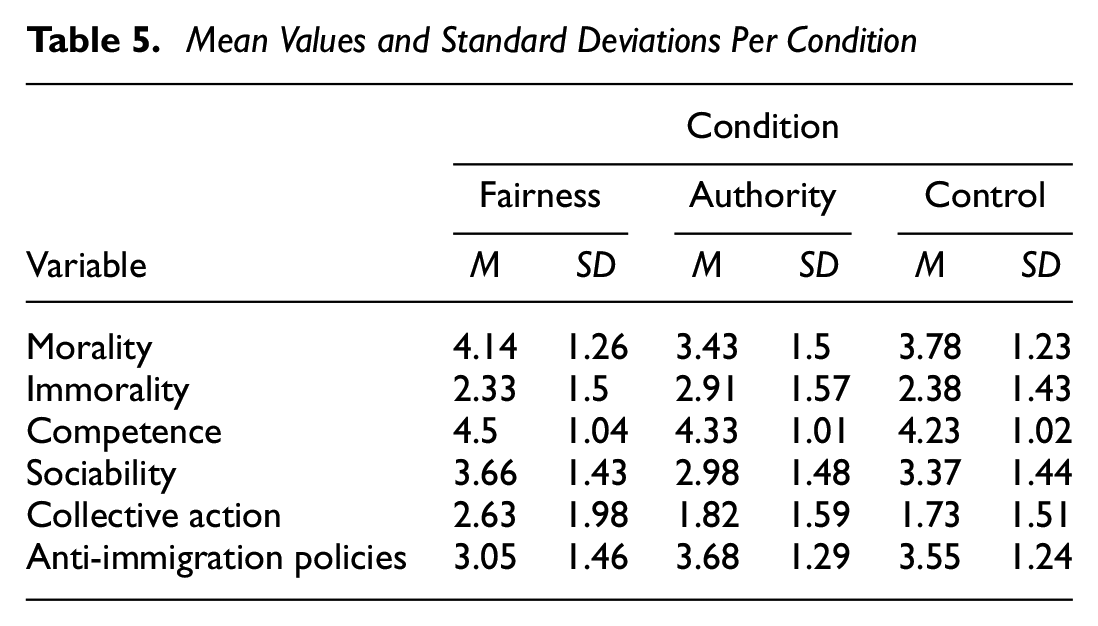
To check the effect of the experimental manipulation, we conducted a series of ANOVAs on the dependent variables. Given that independent hypotheses were tested, according to Rubin (2021), the significance threshold is not necessary to be corrected even when conducting multiple tests. Nonetheless, for the sake of transparency, we provide the adjusted p-values using the Holm–Bonferroni correction in parentheses for each test.
Stereotypical Image of Muslims
The effect of condition on the perceived morality of Muslims yielded a significant effect of condition, F(2,175) = 4.09, p = .018 (padj = .090), η2p = .05. Pairwise comparisons with Bonferroni test indicated that participants in the fairness condition perceived Muslims as more moral than those in the authority condition, p = .015 (see Figure 1). The other two comparisons were not significant, ps > .418.
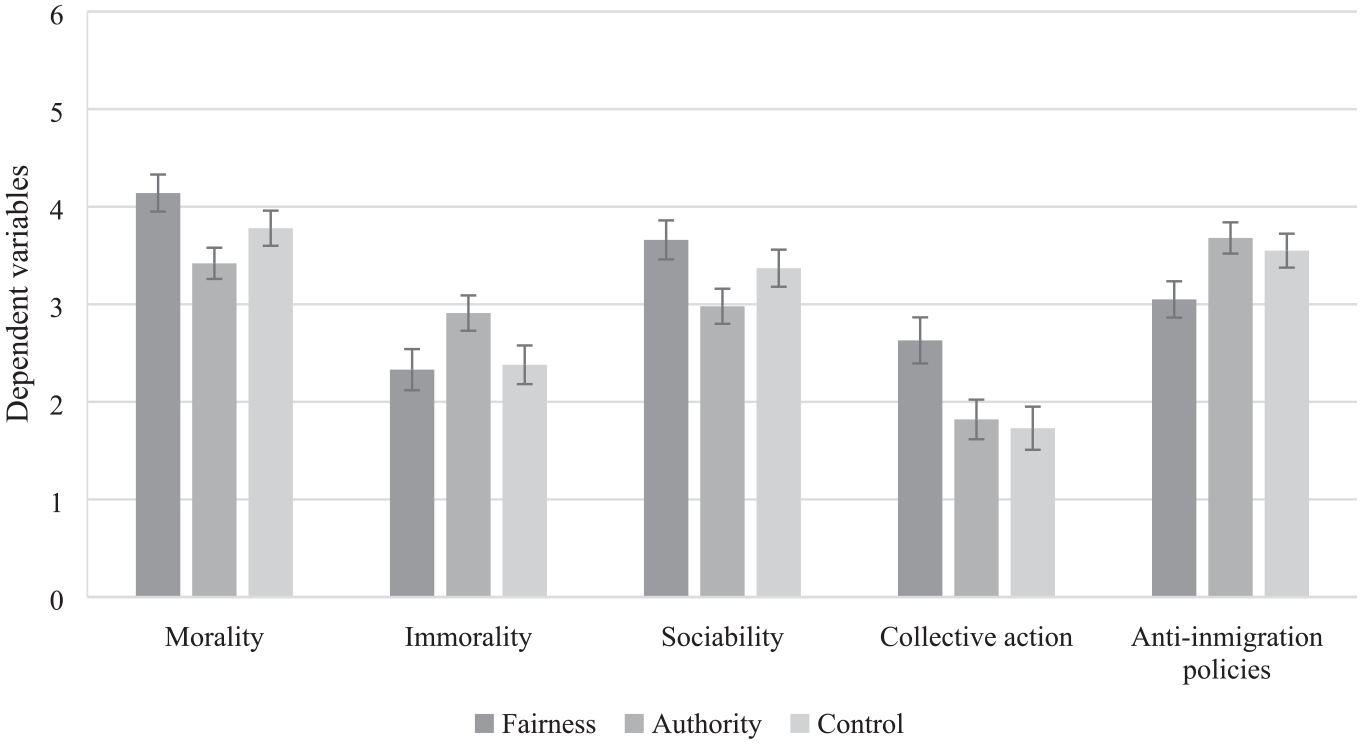
Perceived Morality, Immorality, and Sociability of Muslims, Willingness to Engage in Collective Action for Muslim Immigrants and Support for Anti-Immigration Policies Depending on the Experimental Condition
The ANOVA on perceived sociability yielded a significant effect of condition, F(2,175) = 3.30, p = .039 (padj = .132), η2p = .04. Participants in the fairness condition perceived Muslims as more sociable than those in the authority condition, p = .037. The other two comparisons were not significant, ps > .394.
The ANOVAs on the perceived immorality and perceived competence of Muslims yielded nonsignificant effects of the condition. F(2,175) = 2.89, p = .058 (padj = .132), η2p = .03, and F(2,175) = 0.94, p = .392 (padj = .392), η2p = .01, respectively.
Collective action for Muslim Immigrants’ Rights
The ANOVA on collective action intentions yielded a significant effect of condition, F(2,175) = 4.65, p = .011 (padj = .066), η2p = .05. Participants in the fairness condition were more willing to participate in collective action for Muslim immigrants’ rights than participants in the authority, p = .030, and control conditions, p = .019. No difference emerged between the authority and control conditions, p = 1.000.
Support for Anti-Immigration Policies
The ANOVA on support for anti-immigration policies showed a significant effect of condition, F(2,175) = 3.46, p = .033 (padj = .132), η2p = .04. Participants in the fairness condition supported anti-immigration policies more than participants in the authority condition, p = .035. The other two comparisons were not significant, ps > .153.
Significantly, political orientation did not moderate the effects of the manipulation on our dependent variables (see Supplementary Materials).
Discussion
When considering independent tests and comparing the conditions of fairness and authority, Study 2 suggests that pointing out the positive consequences of fairness could facilitate relations between Muslim immigrants and the majority group. Those participants who were reminded of the societal benefits of fairness perceived Muslims as more moral and sociable, increased their willingness to participate in collective action for Muslim immigrants’ rights (H2), and reduced their support for anti-immigration policies (H3) as compared with participants who read about the benefits of authority. These effects were nonsignificant when the p-values were adjusted, although this correction may not be necessary for individual testing as ours (Rubin, 2021). To analyze the consistency of these results, we conducted a final preregistered study, including a manipulation check that was absent in Study 2.
Study 3
To replicate the results of Study 2, we conducted a similar, preregistered study with a larger sample. 3 We tested the following main hypotheses based on Study 2: Participants in the fairness moral framing would perceive Muslim immigrants as more moral and sociable, would be more willing to participate in collective action for their rights, and would show less support to anti-immigration policies than participants in the control and authority moral framing conditions. No differences were expected in perceived competence and immorality of Muslim immigrants between the conditions.
Method
Participants
Three hundred fifty-one adults voluntarily participated (199 women, Mage = 31.54, SDage = 14.15). Of those, 55 were discarded for not being Spaniards or taking excessive time to complete the questionnaire. The final sample consisted of 296 Spaniards (165 women, Mage = 31.16, SDage = 13.56), recruited by a snowball technique such that undergraduate Psychology and Labor Relations students invited four acquaintances to participate as in Study 2. A sensitivity analysis indicated that 296 participants could detect an effect of f2≥ .21 in an ANOVA (fixed effect, omnibus, one-way) with three groups, assuming an alpha level of .05 and 90% power.
Procedure
Participants reported their sociodemographic data and political orientation (M = 3.78, SD = 1.37), r(294) = .66, p < .001, as in previous studies. Then, they were randomly assigned to one of the three experimental conditions as in Study 2. The perceived credibility of our manipulation (α = .89) was similar across conditions, F(2, 293) = 0.62, p = .542, η2p = .004. After the manipulation, participants completed the measures of perceived morality (r = .82), immorality (r = .67), competence (r = .66), and sociability (r = .62) of Muslims (dfs = 294, ps < .001), willingness to participate in collective action for Muslim immigrants’ rights (α = .95), and agreement with anti-immigration policies (α = .86) as in Studies 1 and 2. We also assessed the extent to which participants perceived that the fundamental principle to guarantee collective well-being should be fairness and authority. To that end, we created two Likert-type scales with three items each, ranging from 0 (Completely disagree) to 6 (Completely agree). Example items were “Ensuring that all people are treated fairly” for the fairness scale (α = .83) and “Guarantee citizen security” for the authority scale (α = .88). Finally, participants were debriefed and thanked.
Results
Table 6 shows the descriptive statistics and correlations, and Table 7 the mean values and standard deviations per condition. All measures correlated significantly between them, except that fairness did not correlate with support for anti-immigration policies and authority did not correlate with the perceived morality, immorality, and sociability of Muslims.
Descriptive Statistics and Correlations
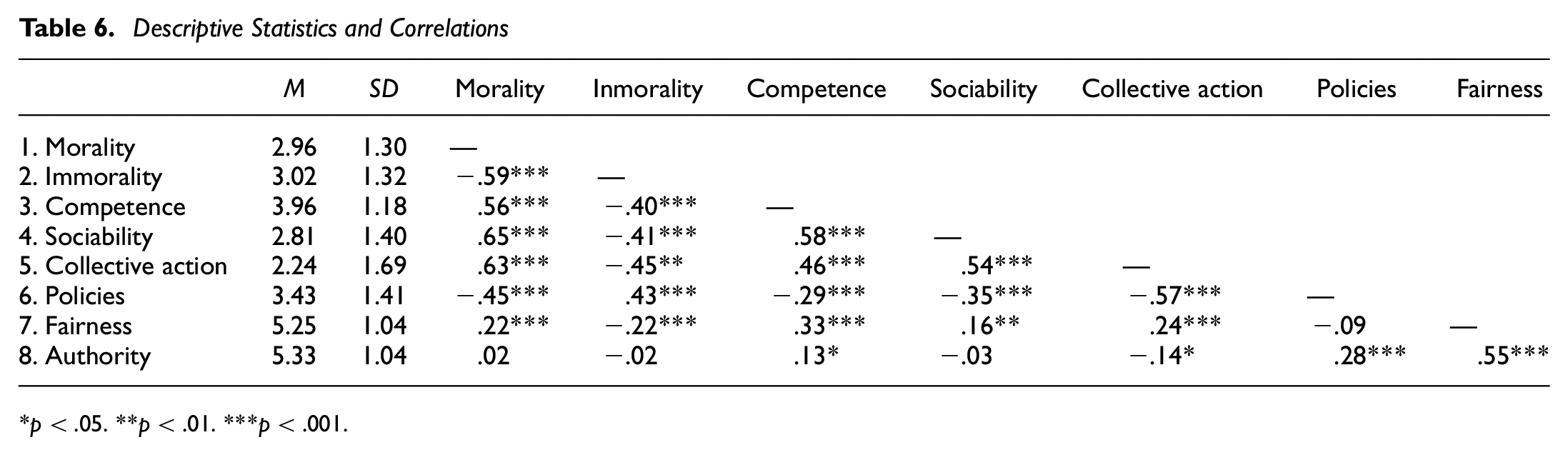
p < .05. **p < .01. ***p < .001.
Mean Values and Standard Deviations Per Condition
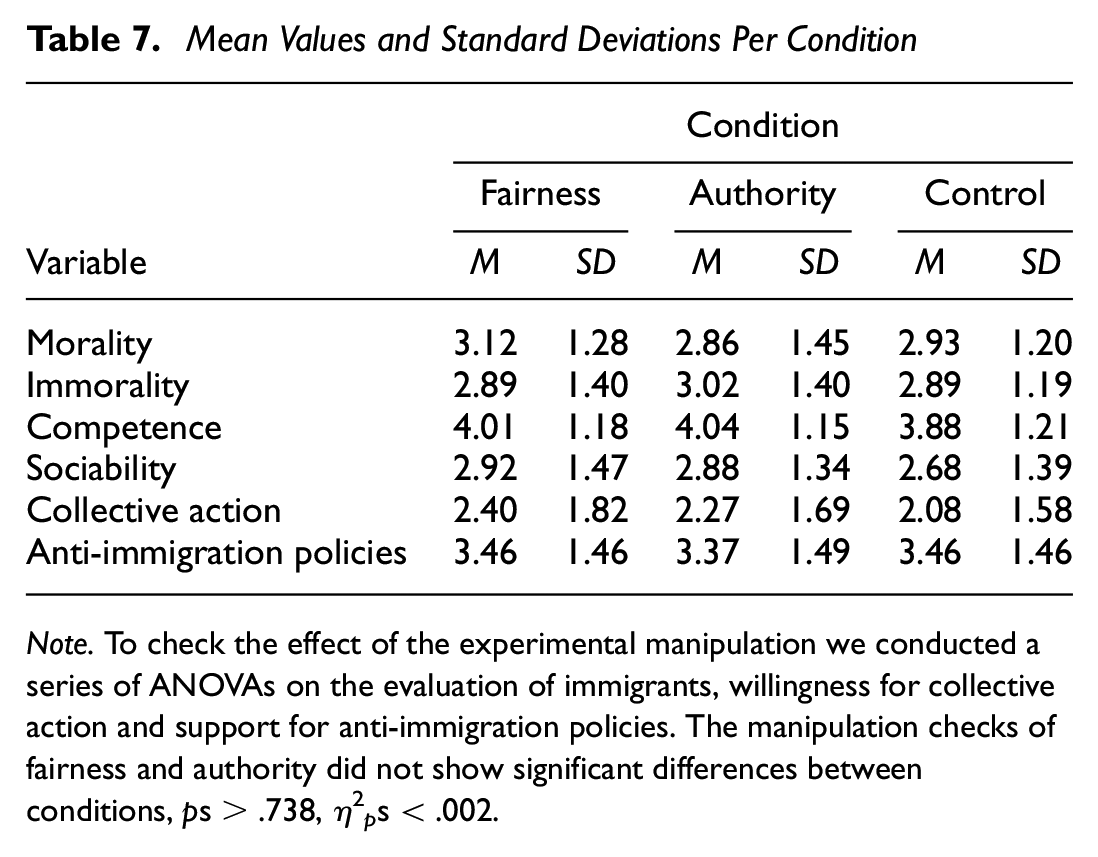
Note. To check the effect of the experimental manipulation we conducted a series of ANOVAs on the evaluation of immigrants, willingness for collective action and support for anti-immigration policies. The manipulation checks of fairness and authority did not show significant differences between conditions, ps > .738, η2 p s < .002.
Political orientation did not moderate the effects of the manipulation on the dependent variables. It did moderate the effect of the authority manipulation on the manipulation check on authority, b = −0.23, p = .020, 95% CI [−0.42, −0.04], such that the manipulation was successful for left-wing participants, b = 0.36, p = .040, 95% CI [0.02, 0.71], but not for center and right-wing participants, ps > .267.
We did not find support to any of our hypotheses. For exploratory purposes and deviating from the preregistered plan, we conducted additional analyses considering political orientation as a covariate instead of a moderator and discarded those participants who did not provide examples of authority or fairness as required by the manipulation. These analyses showed that participants in the fairness condition attributed less immorality to Muslim immigrants and were more willing to be involved in collective actions for their rights than participants in the control condition and attributed more morality than participants in the authority condition (see Supplementary Materials). If the alpha threshold is adjusted due to multiple testing, none of these results was significant.
Discussion
In Study 3, we found no clear causal effects that could replicate Study 2. Our manipulation did not exert the expected effects, although considering fairness as a moral principle to ensure collective well-being correlated positively with collective action intentions on behalf of Muslim immigrants, whereas endorsing authority as a moral principle to ensure collective well-being correlated positively with support for anti-immigration policies. Also, additional, non-preregistered analyses controlling for political orientation and guaranteeing the salience of fairness suggested that a fairness moral reasoning may contribute to a positive attitudinal and behavioral change toward stigmatized minorities. We discuss potential explanations for the differences between Studies 2 and 3 in the general discussion.
General Discussion
In three studies, we presented evidence that contributes to a better appreciation of the impact of the intergroup-level influence of moral foundations, a need pointed out by several researchers (i.e., Graham, 2013; Talaifar & Swann, 2019). Our work expands this application on MFT in three aspects. First, providing correlational evidence for a conceptual replication of findings from previous research suggesting a relationship between moral foundations and intergroup attitudes. Second, exploring the effects of a moral framing highlighting the societal benefits of promoting fairness versus authority in a society. Finally, testing a moral manipulation in the context of intergroup relations and focusing on a particular group of immigrants instead of immigration in general (i.e., Hadarics & Kende, 2017; Nath et al., 2022).
The relationship between morality and attitudes toward immigration is supported by our findings in Study 1 and is in line with recent research on MFT in other cultural settings (Federico et al., 2016; Han & Dawson, 2022; Petrović, 2019; Stewart & Morris, 2021).
In our studies, we went beyond correlational evidence, and wanted to test casual effects of the moral framing. The salience of fairness as opposed to authority seemed to increase participants’ perception of Muslim immigrants as moral and sociable and the willingness to participate in collective action for immigrants’ rights and to reduce the support for anti-immigration policies. The significance of these findings did not resist the multiple-tests correction, although this adjustment may not be necessary considering that our hypotheses were independent (Rubin, 2021). However, in Study 3, we did not replicate these findings.
One possible explanation for the different results of Studies 2-3 lies on the societal context in which they were conducted. Study 2 was completed during the COVID-19 pandemic when the contribution of immigrants as essential workers (supermarkets, agriculture, etc.) became clear and the concern for the protection of the most vulnerable was highly salient. This was made evident when reading the examples that most of the participants gave across conditions. This societal context favoring fairness was absent in Study 3 (1 year later) and could have maximized the efficacy of the fairness manipulation in Study 2.
The main limitation of our experimental studies is the instability of the effects which reduces the generalizability of the results. The causal effects are unclear but establish a way of testing the effect of moral framing on orientations toward minority groups. Another limitation is that only fairness and authority framings were considered. New manipulations should make salient other moral foundations as purity/sanctity, which could have a more prominent role in outgroup perception. As another potential limitation it could be argued that the results are due to a demand effect such that participants in the fairness condition assumed that more positive intergroup orientations were expected of them. According to this reasoning, participants in the authority condition should have inferred otherwise, but they did not differ from the control condition. Finally, we measured intentions to act rather than actual behaviors (for a review, see Ellemers et al., 2019). Although some studies on morality support the congruence between self-report and behavioral measures (Nilsson et al., 2016; Villegas, de, & Vargas-Trujillo, 2015), future studies could include social dilemmas to capture intergroup behavior.
These findings may contribute to the debate on the potential negative impact that binding foundations have in intergroup settings (i.e., Jost, 2009; Jost et al., 2003; Kugler et al., 2014; Strupp-Levitsky et al., 2020). However, more experimental evidence is needed. Our experimental results suggest that perhaps more contextual and ideologically sensitive manipulations related to moral reasoning are needed to promote a change in attitudes toward a specific group. For example, in research providing information on immigration with two online samples, Grigorieff et al. (2018) found that Republicans respond more strongly to the information, both in terms of their views on immigrants and in terms of their policy preferences. Also, another important aspect to be considered in further studies is the possibility to measure participant’s moral values before the manipulation. Studies on moral reframing have found that the perceived overlap between the message’s argument and one’s moral conviction mediates the effect of moral framing in attitude’s change (Feinberg & Willer, 2015).
Finally, it is important to remember that most of the studies that have found support for a causal or moderating role of moral framing in issues related to immigration have taken place in the United States (i.e., Day et al., 2014; McCright et al., 2016; Nath et al., 2022; Voelkel & Feinberg, 2018). Despite the limitations, our results present data from another context and open a discussion about the possibilities and implications of framing immigration issues from a moral argument perspective. This is not incompatible with the idea that moral foundations can serve as a motivated cognition that reinforces previous political attitudes (see Hatemi et al., 2019). Still, as pointed out by Atari et al. (2022), more research is needed to fully understand the reciprocal relation between moral foundations and political attitudes in other contexts.
Supplemental Material
sj-docx-1-spp-10.1177_19485506231162161 – Supplemental material for The Effect of Moral Foundations on Intergroup Relations: The Salience of Fairness Promotes the Acceptance of Minority Groups
Supplemental material, sj-docx-1-spp-10.1177_19485506231162161 for The Effect of Moral Foundations on Intergroup Relations: The Salience of Fairness Promotes the Acceptance of Minority Groups by Catalina Argüello-Gutiérrez, Lucía López-Rodríguez and Alexandra Vázquez in Social Psychological and Personality Science
Footnotes
Handling Editor: Christopher Federico
Declaration of Conflicting Interests
The author(s) declared no potential conflicts of interest with respect to the research, authorship, and/or publication of this article.
Funding
The author(s) disclosed receipt of the following financial support for the research, authorship, and/or publication of this article: This work is part of the I+D+i project “Limitations of the classical strategies to reduce prejudice and new proposals for the improvement of intergroup relations based on morality” (RTI2018-098576-A-I00), funded by the Ministry of Science, Innovation, and Universities of Spain, the State Research Agency (AEI: 10.13039/501100011033, and FEDER “A way to make Europe.”

Supplemental Material
Supplemental material for this article is available online.
Notes
Author Biographies
References
Supplementary Material
Please find the following supplemental material available below.
For Open Access articles published under a Creative Commons License, all supplemental material carries the same license as the article it is associated with.
For non-Open Access articles published, all supplemental material carries a non-exclusive license, and permission requests for re-use of supplemental material or any part of supplemental material shall be sent directly to the copyright owner as specified in the copyright notice associated with the article.
