




Abstract
The extensive literature on the contact hypothesis reports a positive association between intergroup contact and outgroup attitudes, yet it remains unknown whether this association reflects within-person (i.e., situational changes within individuals) or between-person (i.e., stable differences between individuals) effects. To investigate this question, we applied (random-intercept) cross-lagged panel models in two studies featuring different samples, measurements, and contexts. We found longitudinal contact–attitude associations in cross-lagged panel models, which cannot differentiate within-person and between-person effects. In random-intercept cross-lagged panel models, we identified between-person effects but not within-person effects. These results conflict with the contact hypothesis, which assumes that contact leads to intra-individual attitude change. We further investigated whether between-person effects represent spurious correlations caused by potential confounders (demographic characteristics, personality, and intergroup ideologies), but found that this was not the case. Our findings highlight the need to further investigate within-person effects and potential explanations of between-person differences in contact and attitudes.
Keywords
The contact hypothesis states that if an individual experiences intergroup contact, this will positively affect their outgroup attitudes (Allport, 1954). Several meta-analyses have identified a positive association between contact and attitudes (Davies et al., 2011; Lemmer & Wagner, 2015; Pettigrew & Tropp, 2006), leading to the conclusion that “there is little need to demonstrate further contact’s general ability to lessen prejudice” (Pettigrew & Tropp, 2006, p. 768).
Yet, scientific evidence—not only in the case of intergroup contact, but also in any domain where change over time is analyzed—can be interpreted differently depending on whether the study design and data analysis techniques enable the separation of within-person and between-person effects (Hamaker et al., 2015). A within-person effect indicates, in line with the contact hypothesis, that an individual’s increase in contact subsequently predicts an intra-individual improvement in attitudes. In contrast, a between-person effect merely reflects the degree to which individuals with consistently high levels of contact also consistently report more positive attitudes in an inter-individual comparison with individuals with consistently low levels of contact. Between-person effects are uninformative regarding whether a change in contact leads to a change in attitudes, and thus provide limited support for the contact hypothesis.
Much evidence for the contact hypothesis comes from cross-sectional survey studies (Pettigrew & Tropp, 2006), which are only indicative of correlational between-person effects (Shadish et al., 2002). Stronger evidence can be provided by within-person effects identified in either experimental or longitudinal studies. However, such studies are still comparatively rare and seldom employ analysis techniques that adequately separate within-person and between-person effects. As a consequence, there is uncertainty regarding the conclusions that can be drawn from their findings (Curran & Bauer, 2011; Hamaker et al., 2015). In response, in the present research, we apply recent methodological advances in longitudinal data analysis to separate within-person and between-person effects and thus improve our understanding of the nature of the association between intergroup contact and outgroup attitudes.
Within-Person and Between-Person Effects of Contact on Attitudes
Intergroup contact research often studies the effects of naturally occurring contact. For such purposes, longitudinal data are useful because they can provide information on the temporal order of effects (i.e., assessing whether changes in contact precede changes in attitudes) and insights into the dynamics, predictors, covariates, and consequences of change processes in individuals’ everyday lives (Kotzur & Wagner, 2021; van Zalk et al., 2021).
One additional, yet underutilized, benefit of longitudinal data is that they enable the separation of stable between-person differences and situational within-person processes, which is required to understand the nature of the association between contact and attitudes (Hamaker et al., 2015; Usami et al., 2019). In most prior research, longitudinal contact effects have been assumed if the level of contact at one time-point predicts outgroup attitudes at a later time-point, over and above the stability of outgroup attitudes (Granger, 1969). However, such conventional cross-lagged effects conflate within-person and between-person effects and may therefore indicate (1) inter-individual effects in which individuals reporting higher (vs. lower) levels of contact across all time-points also report more positive (vs. negative) outgroup attitudes across all time-points (i.e., a stable between-person association between contact and attitudes), (2) intra-individual effects in which an individual experiencing more contact than their usual level at one time-point reports more positive attitudes than their usual level at the subsequent time-point (i.e., a within-person effect of contact on attitudes), or (3) a mixture of both effects (Hamaker et al., 2015).
Within-person effects align with the contact hypothesis, which proposes an intra-individual change in attitudes following an increase in contact. In contrast, between-person effects provide weaker support for the contact hypothesis, as they indicate a correlation between stable levels of both contact and attitudes, and provide no information about the effect of individual-level changes in contact on attitudes.
Although separating within-person and between-person effects is critical to understanding the association between contact and attitudes, few studies have employed adequate analytical techniques to investigate these effects (Barlow et al., 2019; Bohrer et al., 2019; Boin et al., 2020; Schäfer et al., 2022), and none has compared and discussed differences across models that can and cannot separate these analysis levels. One study used methodology comparable to the present study and found few within-person processes, but strong between-person associations between contact and attitudes (Bohrer et al., 2019). More systematic research is required given the potential implications of such findings on researchers’ understanding of the contact hypothesis and on the implications for policy, given that interventions based on contact are widespread. Accordingly, the first aim of the present research is to systematically investigate the within-person and between-person effects of intergroup contact on outgroup attitudes across two studies using different contexts, samples, time intervals, and measurement operationalizations.
Moreover, no research to date has investigated which factors might explain the between-person contact–attitude association. This is important because between-person effects, without within-person effects, are consistent with third-variable explanations (Kühnel & Mays, 2019). Specifically, an association between between-person differences in contact and attitudes might result from unobserved third variables that cause inter-individual differences in contact and attitudes to correlate (i.e., confounding variables causing spurious correlations). For example, if individuals with certain personality traits engage in more intergroup contact and hold positive outgroup attitudes, we may identify a positive between-person association, but this finding would result from differences in personality and not from a process in which contact affects attitudes. Thus, it is important to understand the extent to which trait-like variables explain stable between-person differences in intergroup contact, outgroup attitudes, and their association. We pursue this second research aim in Study 2.
Inspired by prior cross-sectional moderation analyses and guided by the availability of relevant variables in our data, we investigate three different categories of variables that might plausibly predict between-person differences in contact and attitudes: (1) demographic characteristics, including gender, age, education, and political orientation, as these variables have often been identified as relevant predictors of outgroup attitudes (e.g., Anderson & Ferguson, 2018; Cowling et al., 2019); (2) the Big Five personality dimensions of openness to experience, conscientiousness, extraversion, agreeableness, and neuroticism, which have been shown to influence contact and attitudes (Antonoplis & John, 2022; Turner et al., 2014, 2020; Vezzali et al., 2018); and (3) the intergroup ideologies right-wing authoritarianism (RWA; Altemeyer, 1983) and social dominance orientation (SDO; Sidanius & Pratto, 1999), whose influence on the evaluation of outgroups and engagement in contact is described in the dual-process theory of ideology and prejudice (Duckitt, 2001).
The Present Research
We seek to advance understanding of the longitudinal contact–attitude association through the separation of within-person and between-person effects. Our two exploratory research aims are the following: (1) to describe the nature and extent of the within-person and between-person effects of contact on attitudes (and vice versa), and (2) to explore whether demographic characteristics, personality traits, and intergroup ideologies can explain between-person differences in intergroup contact and outgroup attitudes and their association.
We address our research aims using (1) cross-lagged panel models (CLPMs), which are commonly used in the contact literature (e.g., Hässler et al., 2019; Swart et al., 2011; Tropp et al., 2012; Wagner et al., 2008), but are unable to separate within-person and between-person effects, and comparing them with (2) random-intercept cross-lagged panel models (RI-CLPMs; Hamaker et al., 2015; Mulder & Hamaker, 2021), which are an extension of the conventional CLPM that accurately separates within-person and between-person effects. By applying both CLPMs and RI-CLPMs, we compare explicitly the kinds of conclusions that might be drawn if stable differences between individuals and temporal changes within individuals are, or are not, differentiated.
Due to the lack of prior research, we formulate the following exploratory research questions (RQ) instead of directed hypotheses:
We present two studies addressing these research questions. The studies draw on different large-scale longitudinal data sets collected in distinct intergroup contexts: Study 1 analyzes data from a five-wave social network study conducted over one academic year in two U.K. schools. We study outgroup attitudes among both White British and Asian British students, and assess intergroup contact using both rating scale and network nomination measures. Study 2 analyzes data from two subsamples of a large-scale panel study of the German population, which assessed contact with and attitudes toward Muslims and Sinti/Romani 1 in four measurement waves over a 1.5-year period.
In summary, we will investigate one of the main premises of the contact hypothesis, namely its proposed within-person effect, in two large-scale, multifaceted data sets. In addition, we potentially extend the contact hypothesis by pioneering a new way of investigating the impact of sociodemographic, personality, and ideological variables on the stable between-person association between contact and attitudes.
Method
The data, online supplementary materials (OSM), and R markdown documentations of all analyses are provided here: https://osf.io/gxjpd/. This research was not preregistered because the authors had extensive knowledge of the data sets prior to the analysis.
Data
Study 1
Study 1 draws on data from a five-wave social network study conducted over the academic year 2017–2018 in two schools in North West England. We collected data from Asian British (N = 829) and White British (N = 341) students 2 (52.3% female, MAge = 12.11 years, SDAge = 0.89). All survey measures relevant to the research question (i.e., contact and attitudes) were included in the analyses. For Asian British students, contact and attitudes toward White people were assessed, while for White British students, contact and attitudes toward Asian people were assessed. At each wave, students completed one single-item measure of outgroup attitudes and two single-item measures of intergroup contact, consisting of rating scales, a general measure of contact across all contexts, and network nominations, a robust measure of friendships within the school context (Wölfer & Hewstone, 2017). We assume intergroup friendships are powerful intergroup experiences, qualitatively different from (and more effective than; Davies et al., 2011) general intergroup contact, and thus expect larger contact–attitude effects for the friendship indicator (Page-Gould et al., 2022). A detailed overview of the variables is provided in OSM-1 (for further methodological information, see Bracegirdle et al., 2022).
Study 2
Study 2 analyzes data from the GESIS Panel (Bosnjak et al., 2018), a probability-based mixed-mode access panel targeting the German-speaking population aged 18 to 70 years permanently residing in Germany. The survey included single-indicator demographic variables (i.e., age, gender, level of education, political orientation); two indicators each for positive intergroup contact, outgroup attitudes, and each of the Big Five personality dimensions; and multi-item scales for RWA and SDO. All survey measures relevant to the research question were included in the analyses. The variables were measured between spring 2016 and fall 2017. 3 A detailed overview of the variables is provided in OSM-1. We defined our target sample as German participants without migration experience in their own or parental generation (52.5% female, MAge = 50.33 years, SDAge = 14.16). The GESIS Panel deployed a random sample split, which led to distinct subsamples responding to contact and attitude items for two different outgroups (Subsample 1: Muslims, N = 715; Subsample 2: Sinti/Romani, N = 678). 4
Analysis
We conducted all data preparation using IBM SPSS Statistics (Version 27) and ran all substantial analyses in R lavaan (Rosseel, 2012) using robust maximum likelihood estimation (MLR) to account for multivariate non-normality. In Study 1, we used single indicators for all constructs. In Study 2, we averaged all multi-item scales after evaluating their dimensionality, reliability, and scalar measurement invariance over time (see OSM-2 for details). We based our modeling procedure on Mulder and Hamaker (2021) and included the following steps.
We first modeled a conventional CLPM of contact and attitudes for all time-points, which included autoregressive stability paths (describing how contact and attitudes at one time-point predict their levels at the subsequent time-point, respectively) and bidirectional cross-lagged paths (describing how contact at one time-point predicts levels of attitudes at the subsequent time-point and vice versa). Within-wave (residual) covariations were freely estimated. To increase parsimony and interpretability, we tested whether stationarity assumptions (i.e., equality of the path coefficients between time-points; Cole & Maxwell, 2003) could be imposed (see OSM-3 for details). We evaluated model fit using three criteria (root mean square error of approximation [RMSEA] ≤.08, standardized root mean square residual [SRMR] ≤.10, and comparative fit index [CFI] ≥.95; Schermelleh-Engel et al., 2003) and examined the valence and significance of cross-lagged coefficients between contact and attitudes.
Next, we modeled an RI-CLPM, which extends the conventional CLPM by separating the observed variables into stable between-person differences and situational within-person effects (i.e., deviations from the individuals’ stable average level of contact and attitudes). Using the same stationarity assumptions as in the CLPM, we modeled stability and cross-lagged relations between the within-person factors of contact and attitudes. The between-person differences in contact and attitudes covaried freely and were independent of the within-person processes. We used a multiple-group analysis to examine whether the (RI-)CLPM regression and covariation parameters could be constrained to equality across different subsamples. This allowed us to examine whether belonging to the Asian British versus White British sample (Study 1), or rating Muslims versus Sinti/Romani (Study 2), moderated the results. We compared model fit for the CLPM and RI-CLPM using MLR-corrected χ2-difference tests (Jorgensen et al., 2018) and compared the valence and significance of the cross-lagged coefficients in the RI-CLPM and CLPM. Finally, we examined the distribution of the observed variables between the between-person and within-person effects based on the standardized factor loadings.
Finally, in Study 2 5 , we extended the RI-CLPM by including predictors of the stable between-person differences in contact and attitudes. We used a stepwise process, with models including (1) only demographic characteristics (age, gender, education and political orientation), (2) additionally, the Big Five personality dimensions, and (3) additionally, RWA and SDO. We examined the valence and significance of the regression coefficients, the explained variance of the between-person differences, and the change in the (residual) correlation between the between-person differences in contact and attitudes when the predictors were added to the RI-CLPM.
Results
Study 1
The multiple-group analysis of the (RI-)CLPMs indicated that the results did not differ significantly for the Asian British and White British subsamples (see OSM-3). Consequently, we report pooled results across both subsamples. We first modeled the CLPMs of the rating scale and network nomination indicators (see Figure 1, panel A1/B1), for which we could assume no stationarity (see OSM-3). In both cases, the model fit was not adequate, which suggests that the CLPM did not accurately represent the empirical relations between the variables, and the results should be interpreted with caution.
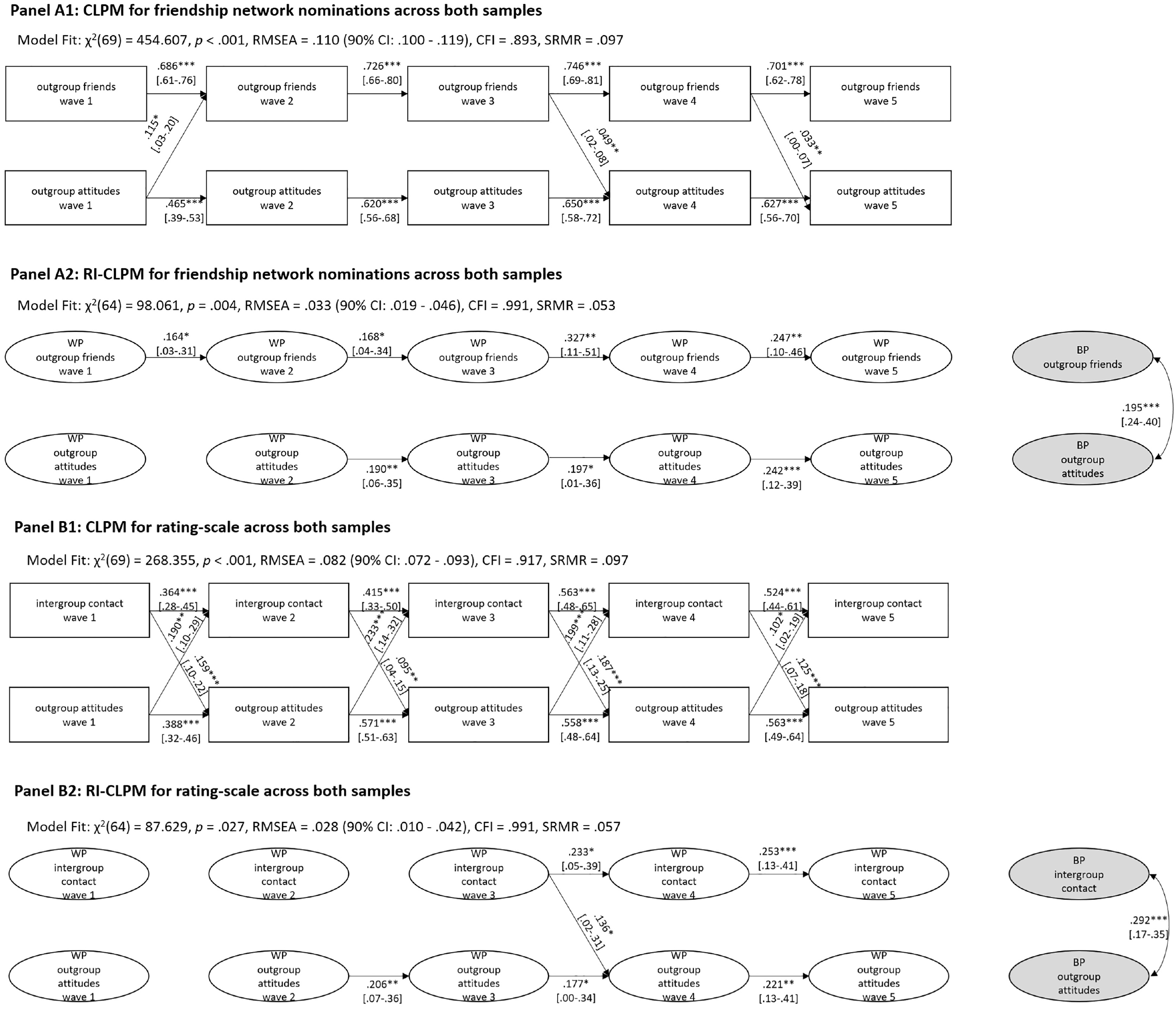
Unstandardized Path Coefficients for the CLPM and RI-CLPM in Study 1
The cross-lagged effects differed across the two contact measures. For the network nomination measure, we found inconsistent evidence of an effect of outgroup friendship on subsequent outgroup attitudes (and little evidence of a reverse effect). For the rating scale measure, we found consistent positive and significant effects of contact on subsequent attitudes and vice versa. Thus, the results of the CLPM provided strong support for the contact hypothesis when using a conventional rating scale of intergroup contact, but mixed results when using a friendship network nomination measure.
In a second step, we modeled the RI-CLPMs (see Figure 1, panel A2/B2), which fit the data well and significantly better than the CLPMs in all cases (see OSM-3). Therefore, the RI-CLPM should be the preferred model from a statistical perspective. As shown in Table 1, the share of variance in contact and attitudes explained by between-person differences and within-person changes was distributed roughly equally and unsystematically. We found only one significant cross-lagged effect in the RI-CLPMs, in which the rating scale measure of intergroup contactT3 positively predicted outgroup attitudesT4. All other cross-lagged effects identified in the CLPMs were not replicated in the within-person part of the RI-CLPMs.
Standardized Factor Loadings and Explained Variance by the Within-Person and Between-Person Effects of the RI-CLPM in Study 1
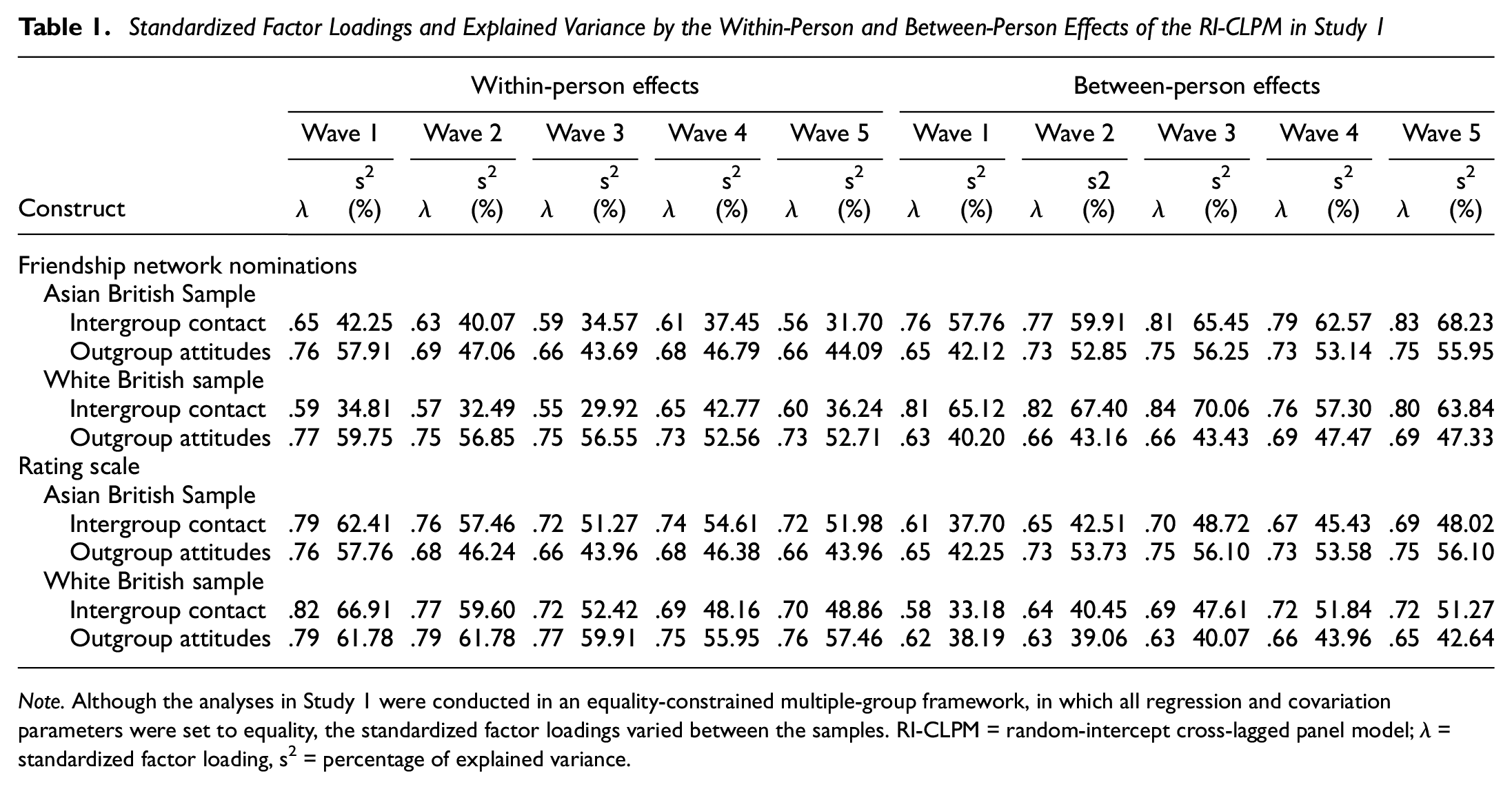
Note. Although the analyses in Study 1 were conducted in an equality-constrained multiple-group framework, in which all regression and covariation parameters were set to equality, the standardized factor loadings varied between the samples. RI-CLPM = random-intercept cross-lagged panel model; λ = standardized factor loading, s2 = percentage of explained variance.
This analysis indicates, contrary to the predictions of the contact hypothesis, that within-person changes in contact rarely predicted subsequent within-person changes in attitudes. In contrast, the stable between-person differences in contact and attitudes showed significant positive correlations for both contact measures. Thus, individuals with higher contact levels across all time-points also held more positive attitudes across all time-points, compared with individuals with low stable contact levels. This does not indicate a longitudinal effect of contact on attitudes.
Study 2
The multiple-group analysis of the (RI-)CLPMs indicated that the results differed significantly for the subsamples evaluating the outgroups Muslims and Sinti/Romani (see OSM-3). Thus, we report separate results for each subsample. We first modeled the CLPMs (see Figure 2, panel A1/B1), for which we could assume full stability and cross-lagged stationarity (see OSM-3). However, the fit for both models was not adequate; therefore, the CLPM results should be interpreted with caution. For the Muslim outgroup, all cross-lagged coefficients were positive and significant. In contrast, for Sinti/Romani, attitudes consistently predicted subsequent contact, while the reverse effect was nonsignificant. Thus, the results of the CLPMs showed a positive effect of contact on attitudes toward Muslims in accordance with the contact hypothesis, but did not show an effect of contact on attitudes toward Sinti/Romani.
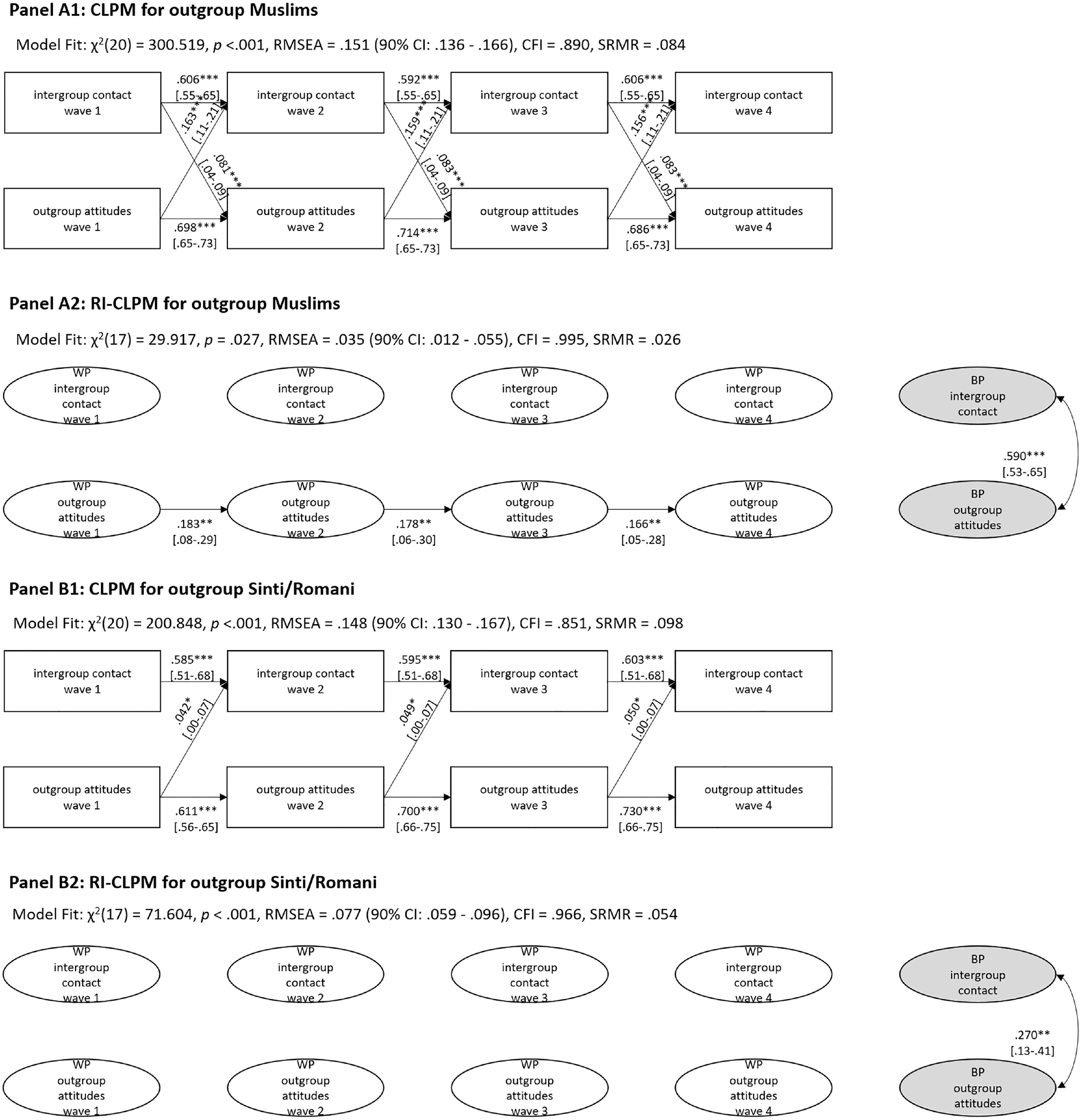
Standardized Path Coefficients for the CLPM and RI-CLPM in Study 2
We next modeled the RI-CLPMs (see Figure 2, panel A2/B2), which both fit the data well and significantly better than the CLPMs (see OSM-3). Thus, the RI-CLPM should be preferred from a statistical perspective. As shown in Table 2, on average, both the contact and attitudes indicators showed more between-person than within-person variance.
Standardized Factor Loadings and Explained Variance by the Within-Person and Between-Person Effects of the RI-CLPM in Study 2
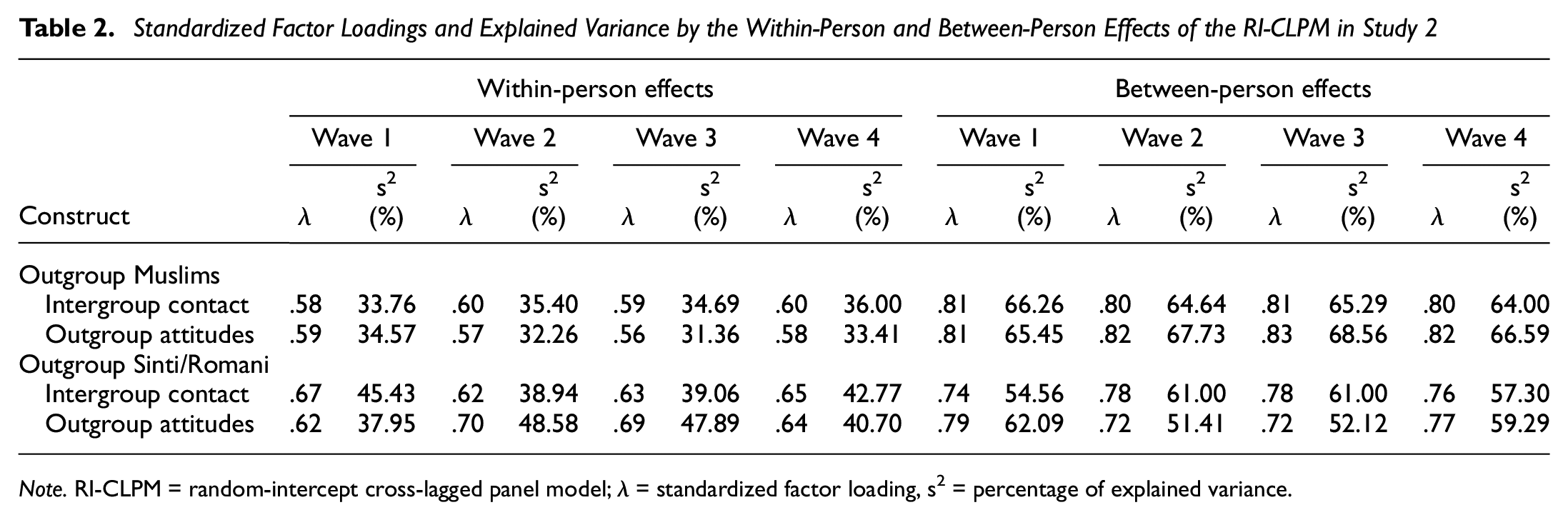
Note. RI-CLPM = random-intercept cross-lagged panel model; λ = standardized factor loading, s2 = percentage of explained variance.
None of the cross-lagged effects identified in the CLPMs were replicated in the within-person part of the RI-CLPMs. This indicates, in contrast to the predictions of the contact hypothesis, that contact did not predict within-person change in attitudes toward Muslims or Sinti/Romani. The stable between-person differences in contact and attitudes showed significant positive correlations in both cases, indicating that individuals with greater contact across all time-points also held more positive attitudes across all time-points.
To summarize, Studies 1 and 2 obtained highly similar results regarding our first research aim. The RI-CLPM, which enables the separation of within-person and between-person effects, should be preferred from a statistical perspective. The significant cross-lagged coefficients identified in the CLPM were not replicated in the within-person part of the RI-CLPM, while between-person differences in contact and attitudes correlated significantly and positively in all cases. This indicates that individuals with higher (vs. lower) contact levels across all time-points also held more positive (vs. less positive) attitudes, but does not indicate a longitudinal within-person effect of contact on attitudes. Therefore, we found some evidence in support of the contact hypothesis when using CLPM, but not when separating within-person and between-person effects in RI-CLPM.
Explaining Stable Between-Person Differences in Intergroup Contact and Outgroup Attitudes
To address the second research aim, we extended the RI-CLPMs in Study 2 by regressing the stable between-person difference factors for intergroup contact and outgroup attitudes on a number of potentially relevant time-invariant predictors. The results are reported in Table 3. Each inclusion step of the predictors increased the share of explained variance in the between-person differences, which ranged from 3.2% to 38.0%. Although the results varied somewhat for the two outgroups (i.e., Muslims and Sinti/Romani), we consistently found (1) negative relations between age and stable between-person differences in contact, indicating that younger people experience more contact; (2) negative relations between political orientation and stable between-person differences in attitudes, indicating that people oriented more strongly toward right-wing political positions hold less positive attitudes; (3) negative relations between both RWA and SDO and stable between-person differences in attitudes, indicating that people higher in RWA and SDO hold less positive attitudes; and (4) positive relations between agreeableness and stable between-person differences in attitudes, indicating that more agreeable people hold more positive attitudes. 6
Regression Coefficients of the Demographic Variables, Personality Dimensions, RWA, and SDO Predicting Between-Person Differences in Intergroup Contact and Outgroup Attitudes in a Stepwise Regression (Significant Findings Are Highlighted in Bold Print)
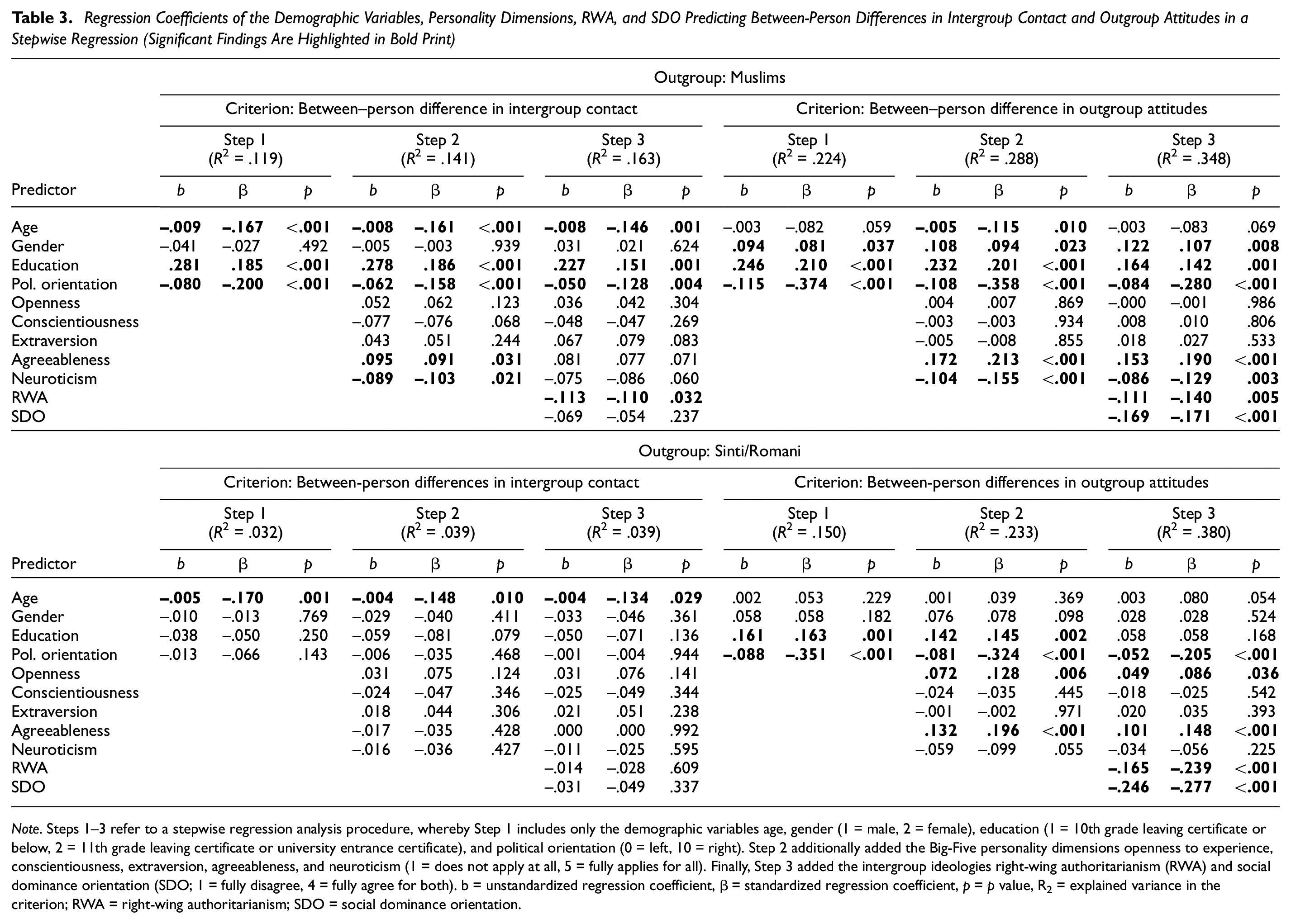
Note. Steps 1–3 refer to a stepwise regression analysis procedure, whereby Step 1 includes only the demographic variables age, gender (1 = male, 2 = female), education (1 = 10th grade leaving certificate or below, 2 = 11th grade leaving certificate or university entrance certificate), and political orientation (0 = left, 10 = right). Step 2 additionally added the Big-Five personality dimensions openness to experience, conscientiousness, extraversion, agreeableness, and neuroticism (1 = does not apply at all, 5 = fully applies for all). Finally, Step 3 added the intergroup ideologies right-wing authoritarianism (RWA) and social dominance orientation (SDO; 1 = fully disagree, 4 = fully agree for both). b = unstandardized regression coefficient, β = standardized regression coefficient, p = p value, R2 = explained variance in the criterion; RWA = right-wing authoritarianism; SDO = social dominance orientation.
To investigate whether these predictors explained the between-person association identified between contact and attitudes, we inspected the change in the (residual) correlations of the between-person factors. A reduction in the between-person correlation when the predictors are included would indicate that these are spurious correlations introduced by confounding third variables (demographics, personality, and intergroup ideologies). For the Muslim outgroup, the correlation between stable differences in intergroup contact and outgroup attitudes was r = .59 (95% confidence interval [CI]: [.53; .65], p < .001) in the RI-CLPM without predictors and r = .53 (95% CI: [.44; .61], p < .001) in the RI-CLPM including all predictors. For the Sinti/Romani outgroup, the initial correlation of r = .27 (95% CI: [.13; .41], p < .001) changed to r = .26 (95% CI: [.11; .41], p < .001) when including all predictors. Thus, our chosen predictor variables account for only a small and nonsignificant part of the positive correlation between stable differences in contact and attitudes. Therefore, these predictors do not function as confounding variables provoking spurious correlations between contact and attitudes.
Discussion
Longitudinal data on contact and attitudes provide an essential source of information for intergroup contact research (O’Donnell et al., 2021). Yet, their statistical interpretation is often impaired by methodological issues common to many fields, including the potential confounding of within-person and between-person effects (Hamaker et al., 2015; Usami et al., 2019). Across two studies, we investigated this issue using both CLPMs and RI-CLPMs, of which only the latter allows for the separation of between-person and within-person effects. In addition, we investigated the influence of time-invariant predictors on between-person differences in contact and attitudes. Our research findings offer a novel way of conceptualizing (longitudinal) intergroup contact effects: Do such effects represent within-person changes in contact and attitudes over time, as implied by the contact hypothesis? Or do we mainly find between-person associations, indicating stable predispositions to experiencing contact and holding positive attitudes?
Our findings unanimously show that, statistically, the RI-CLPM should be preferred over the CLPM. Although we found evidence of positive cross-lagged effects of contact on attitudes in CLPMs, these effects were not replicable on the within-person level in RI-CLPMs. This finding conflicts with the contact hypothesis, which proposes a within-person process in which contact intra-individually changes attitudes. Instead, we found persistent positive between-person associations between contact and attitudes, indicating that individuals who experienced more (vs. less) contact across all time-points also held more positive (vs. negative) attitudes across all time-points. The consistency of our findings, combined with the large scale and diversity of our data (including two different national and intergroup contexts, minority- and majority-group perspectives, youth and population-representative samples, varied measurement intervals, and different contact measures), reduces the risk of our results being singular to unobserved particularities of the data and increases the generalizability of our findings.
Our findings have implications for research on the contact hypothesis and beyond. Our results suggest that the positive effects of contact on attitudes, which have been frequently reported in published literature using CLPMs (Hässler et al., 2019; Swart et al., 2011; Tropp et al., 2012; Wagner et al., 2008), might have been interpreted as within-person processes in line with the contact hypothesis without necessarily representing intra-individual change. The longitudinal contact effects reported in prior research may instead be driven by stable between-person effects. Our findings may also inform other fields of research for which the separation of between-person and within-person effects is of theoretical importance (for initial divergent evidence concerning CLPM and RI-CLPM in other fields of psychological research, see, for example, Dietvorst et al., 2018; Keijsers, 2016; Mastrotheodoros et al., 2020).
The presence of between-person effects and the absence of within-person effects identified in the present research could theoretically be explained by the asymptotic model of intergroup contact (MacInnis & Page-Gould, 2015; Page-Gould et al., 2022). This model proposes a nonlinear relationship between contact and attitudes, in which the first intergroup encounters have a strong impact on outgroup attitudes, but this effect diminishes with each subsequent interaction until reaching a stable state in which intergroup contact has negligible effects. Accordingly, within-person effects may occur during the first intergroup interactions and evolve over repeated interactions into stable between-person associations between contact and attitudes. If we assume that the participants in our studies had numerous intergroup encounters before the initial measurement, this could explain the absence of within-person effects captured in our timeframe (between 2 and 6 months), coupled with the presence of a strong between-person association between contact and attitudes that reflects the accumulated effect of previous contact experiences.
For several reasons, our findings do not imply a complete absence of within-person effects in the intergroup contact literature, nor a fundamental conflict with the contact hypothesis. Not least, there is an abundance of (quasi-)experimental studies attesting to the intra-individual effect of contact on attitudes when contact is externally induced (Guffler & Wagner, 2017; Reimer et al., 2022; Schäfer et al., 2022; van Zalk et al., 2021; Wölfer et al., 2016). In contrast, the present data sets did not show substantial changes in contact over time, and the within-person and between-person variance distribution was either about equal (Study 1) or favored the between-person part (Study 2), which might make it implausible to expect significant within-person effects. Importantly, (RI-)CLPMs are inadequate statistical models for analyzing intervention data because these models do not provide information about temporal mean-value changes, but only about covariances across time (Usami et al., 2019). Thus, carefully balancing the research questions, analytical framework and methodological potential of the data might increase the probability of identifying within-person effects in future research.
In addition, the intergroup contact literature offers little insight into the timeframe over which to expect within-person change in attitudes. Although the measurement intervals varied between 2 and 6 months in our data, such periods might be inappropriate for detecting within-person processes (Dormann & Griffin, 2015). Within-person effects may occur over longer timeframes (e.g., if attitudes show high between-person stability over time, within-person changes might occur after a considerable amount of intergroup contact, such as a year’s experiences) or shorter timeframes (e.g., if within-person changes in attitudes are short-term and volatile). Future research employing study designs that can capture short-term effects (e.g., between daily and a few weeks; see Górska & Tausch, 2022) and long-term effects (e.g., annual assessments over many years; see Sengupta et al., 2023) is required to identify the timeframe over which contact may lead to within-person change in attitudes.
We also investigated whether demographic characteristics, personality traits, and intergroup ideologies can explain the stable between-person differences in contact, attitudes, and their association. Our findings support the predictions of the dual-process theory of ideology and prejudice (Duckitt, 2001) and corroborate research on the relationship between political orientation and attitudes (e.g., Prusaczyk & Hodson, 2020; Van Assche et al., 2019). Together, these findings provide an initial characterization of the stable between-person differences and suggest who is more likely to engage in contact and hold positive attitudes.
Importantly, our selected predictors, which many would consider among the most plausible confounders of the association between contact and attitudes, could not explain away the between-person associations, meaning these predictors did not function as confounders producing spurious correlations. Alternative factors might, however, explain the association, such as neighborhood diversity, perceived social norms, and extended contact experiences (Christ et al., 2014; Wagner et al., 2006), which could affect the frequency and desirability of intergroup contact and the formation of outgroup attitudes. Additional contextual factors, such as media reports and societal narratives, might also influence individuals’ outgroup attitudes and engagement in contact, through perceptions of threat and negative interdependence (e.g., Czymara, 2020; Czymara & Dochow, 2018). The presence of stable between-person differences in contact and attitudes might suggest a change in policy recommendations. For instance, it is conceivable that the dominant between-person associations between contact and attitudes would render contact interventions that focus on intra-individual change ineffective (Page-Gould et al., 2022). In such instances, other means of prejudice reduction might be required (for an overview, see, for example, Paluck et al., 2021).
Further research is required to replicate our initial findings and overcome the methodological limitations of the present research. These methodological limitations include the reliance on single-indicator measures in Study 1, the inconclusive dimensionality and low reliability of the short-form personality scale (see OSM-2), and the use of an atypical context-specific political orientation measure in Study 2. Future studies should also replicate the present research with varying time intervals between waves, to identify the timeframe over which contact may lead to within-person change in attitudes. Finally, researchers should re-analyze published longitudinal data sets, applying RI-CLPM to assess whether the longitudinal findings reported in the intergroup contact literature to date represent within-person or between-person effects.
Conclusion
Across two studies, we applied recent methodological advances in longitudinal data analysis to investigate the within-person and between-person effects of intergroup contact on outgroup attitudes. We found consistent stable between-person associations, but little evidence of a within-person effect of contact on attitudes. These findings conflict with the contact hypothesis, which proposes that contact affects attitudes on a within-person level. We further investigated the effects of plausible potential confounders (demographic characteristics, personality, and intergroup ideologies) on the between-person association between contact and attitudes. We found, however, that these variables only accounted for a small part of the between-person associations. Overall, the present research provides novel insights into the nature of the association between intergroup contact and outgroup attitudes and highlights the need for further longitudinal research that separates within-person and between-person processes.
Footnotes
Acknowledgements
The authors thank Ellen Hamaker and Jeroen Mulder for their methodological advice as well as Debbie Anav for her assistance in preparing this manuscript.
Handling Editor: Robyn Mallett
Author Contributions
M.T.F.: Conceptualization, Data curation, Formal analysis, Methodology, Validation, Visualization, Writing—Original draft.
C.B.: Conceptualization, Data Curation, Formal analysis, Investigation, Methodology, Project administration, Supervision, Validation, Writing—Original draft.
N.K.R.: Formal analysis, Validation, Writing—Review & editing.
R.W.: Writing—Review & editing.
P.S.: Conceptualization, Methodology, Resources, Writing—Review & editing.
U.W.: Conceptualization, Resources, Writing—Review & editing.
M.H.: Conceptualization, Funding acquisition, Writing—Review & editing.
Declaration of Conflicting Interests
The author(s) declared no potential conflicts of interest with respect to the research, authorship, and/or publication of this article.
Funding
The author(s) disclosed receipt of the following financial support for the research, authorship, and/or publication of this article: This research was funded by the Economic and Social Research Council (ESRC) grant “Positive and negative asymmetry of intergroup contact: A dynamic approach” (ES/N018893/1) and the NordForsk grant “Structural, cultural and social integration among youth: A multidimensional comparative project” (95263).
Data Availability
The Study 1 data are available on the Open Science Framework project page https://osf.io/4ea9w/?view_only=d3d3c9cbefb8418ca8b493ba5495628d. The Study 2 data are from the GESIS Panel survey, which can be accessed via the GESIS Leibnitz Institute for Social Sciences in Mannheim, Germany (see  ).
).
Open Science Statement
We provide our analysis code and results as well as other online supplementary materials on the Open Science Framework project page . The analysis was not pre-registered because the authors were highly familiar with the data sets at the beginning of the project.