




Abstract
Some scholars observed a “nostalgia bump” during the COVID-19 pandemic, where people compensated for social isolation by engaging with products and experiences evoking nostalgia. To further explore this effect and its underlying mechanism, the authors tested the hypothesis that reduced social contact during lockdown conditions would lead people to feel lonely and bored and, in turn, increase their consumption of nostalgic music. Study 1 (Nsong = 213,464) established the temporal relationships between social contact and nostalgia by analyzing mobility data and daily listening patterns of top songs on the music platform Spotify from 2019 to 2021. Study 2 (N = 525) was a retrospective survey of individual experiences during the lockdown period. Results showed that reduced social contact had an indirect positive effect on consumption of nostalgic songs through loneliness, but not boredom. These findings shed light on the use of nostalgia as a coping strategy during times of isolation.
Nostalgia is a wistful affection for the past, a yearning for personally meaningful events and a sense of connectedness with significant others in autobiographical memory (Sedikides & Wildschut, 2019; Sedikides et al., 2008; Wildschut et al., 2006, 2010). Research shows that nostalgia functions to establish self-continuity across the lifespan and protect individuals from self-related, social, and existential threats (Hong et al., 2022; Iyer & Jetten, 2011; Sedikides et al., 2008, 2016; Wildschut et al., 2006). Even brief engagement with nostalgia—such as reflecting on an event or interacting with a product from one’s childhood—promotes subjective meaning in life, personal growth, and emotional well-being (Baldwin & Landau, 2014; Cox et al., 2015; Hepper et al., 2021; Kelley et al., 2022; Layous et al., 2022; Routledge et al., 2011, 2012; van Tilburg et al., 2019; for a discussion of the complex relationship between nostalgia and well-being in daily life, see Newman et al., 2020).
Given these findings, it is likely people find solace in nostalgia when a personal or collective crisis makes them feel socially isolated. In fact, some researchers observed a “nostalgia bump” in the early stage of the COVID-19 pandemic, where people stuck at home turned to music, board games, and other experiences reminiscent of their “good old days” (Gammon & Ramshaw, 2021; Wulf et al., 2021; Yeung, 2020). For example, the number of Google searches for nostalgic products increased when COVID-19 cases spiked (Barauskaite et al., 2022).
Prior studies of “pandemic nostalgia” are intriguing but limited in two respects. First, they typically measured reduced social contact indirectly based on the timing of pandemic-related events (e.g., case reports and stay-at-home policies). The current Study 1 goes further by analyzing personal mobility data to estimate contact with people outside the home. A second limitation is that the psychological mechanism underlying pandemic nostalgia remains unknown (Barauskaite et al., 2022; Wulf et al., 2021). On the basis of prior research (discussed shortly), we designed Study 2 to examine the potential mediating roles of loneliness and boredom.
Pandemic Nostalgia and its Mechanism
The COVID-19 pandemic prompted lockdown and containment policies restricting face-to-face social interactions. Although these social distancing measures were effective in controlling the spread of the disease, they led many people to feel isolated and eager to return to prepandemic levels of social contact. In such situations, people may compensate for social isolation by engaging with products and experiences evoking nostalgia. For example, Zhou et al. (2022, Study 1) found that people who lived alone for some time during the pandemic were more likely to experience nostalgia. This may be due to their lack of opportunities to interact with others during the period and the intention to find solace in nostalgia. Studies that observed a nostalgia bump during the pandemic also stressed the importance of social isolation in explaining the phenomenon (Gammon & Ramshaw, 2021; Wulf et al., 2021; Yeung, 2020), but none of them directly measured or tracked social contact patterns. The current Study 1 analyzed daily mobility and nostalgic consumption indices to test the hypothesis that reduced social contact predicts attraction to nostalgia-inducing experiences.
This hypothesis raises a further question: What is the mechanism by which reduced social contact during the pandemic predicts nostalgia engagement? Some insight comes from prior work on loneliness. In studies conducted prior to the pandemic, people used nostalgia to allay loneliness by symbolically reconnecting with close others (Sedikides & Wildschut, 2019; Turner et al., 2013; Wildschut et al., 2006, 2010; Zhou et al., 2008). Based on these findings, it is possible that when pandemic-era stay-at-home restrictions deprived people of contact with close others, they felt lonely and found comfort in nostalgia. Consistent with this possibility, loneliness during lockdown took a toll on people’s psychological well-being (Aknin et al., 2022; Brooks et al., 2020; Fried et al., 2022) and predicted engagement with nostalgia, which in turn counteracted loneliness and improved happiness (Dennis & Ogden, 2022; Faul & De Brigard, 2022; Zhou et al., 2022).
An alternative mechanism is boredom. In prepandemic studies, nostalgia helped people counteract boredom by reviving experiences that affirm a global sense of meaning and purpose in life (van Tilburg et al., 2013). It is likely that, during the pandemic, extended periods stuck at home with minimal social contact deprived people of sources of interest and meaning, prompting a compensatory turn to nostalgia. Studies show that boredom during the pandemic was as strong, or even stronger, than loneliness (Brodeur et al., 2021). During the initial March 2020 lockdown, 25% of Americans felt lonely and 45% felt bored (Gallup, 2022). Although the relationship between loneliness and nostalgia has been directly examined during the pandemic (Zhou et al., 2022), no prior studies (to our knowledge) have examined the role of boredom in the context of pandemic nostalgia.
In sum, lockdown conditions bred loneliness and boredom, and prior work shows that both emotions predict nostalgia engagement. Based on these findings, we hypothesized in Study 2 that loneliness and boredom would mediate the relationship between reduced social contact and nostalgia during lockdown.
Consumption of Nostalgic Music
We operationally defined nostalgia engagement as consumption of nostalgic music. Several studies conducted prior to the pandemic show that music is a potent trigger of nostalgia (for a review, see Sedikides et al., 2022). Listening to or merely recalling music—particularly songs from the time of one’s adolescence—increases feelings of nostalgia, activates fond autobiographical memories, and strengthens perceived connections with close others (Barrett et al., 2010; Batcho, 2007; Cheung et al., 2013; Janata et al., 2007; Juslin et al., 2008; Krumhansl & Zupnick, 2013; Wildschut et al., 2006; Zentner et al., 2008).
In the context of the pandemic, studies conducted in several countries showed that people reported listening to music to cope with social isolation and other stressors created by lockdown conditions (Cabedo-Mas et al., 2021; Krause et al., 2021; Vidas et al., 2021). Indeed, people reported stronger emotional reactions to music during lockdown compared with prepandemic times (Ziv & Hollander-Shabtai, 2021). Although people report several psychological benefits of listening to music during lockdown (e.g., improving mood; Cabedo-Mas et al., 2021), it is possible they used music to evoke nostalgia. Accordingly, when Wulf et al. (2021) asked people about the nostalgia-inducing media they consumed during the pandemic, the most common response was music (35%), followed by movies (14%) and television series (14%). Taken together, these studies suggest that listening to songs from the “good old days” serves as a useful measure of nostalgia engagement.
Study Overview
Study 1 aimed to establish the temporal relationships between social contact and the consumption of nostalgic music using data accessed from the Spotify Application Programming Interface (API) service and Google and Apple’s mobility reports. Study 2 was a retrospective survey regarding individual experiences of social contact, emotions, and music-listening behavior during the lockdown period. We hypothesized that reduced social contact during lockdown would predict feelings of loneliness and boredom, which would in turn predict consumption of nostalgic songs. The data, materials, preregistration, and analytic R syntax are available on the Open Science Framework page at https://osf.io/m4fcg/.
Study 1
We analyzed daily listening patterns on the music streaming platform Spotify to examine the temporal relationship between social contact and nostalgia. Spotify is the most popular streaming service with over 80 million users in the United States. We chose Spotify over other platforms due to its popularity and easy-to-access information through its API service.
We used daily mobility indices as measures of day-to-day changes in social contacts at the collective level. In the time when people were less likely to go out to public places or visit their friends (i.e., low mobility) due to containment measures, the amount of face-to-face interpersonal contact was supposed to be limited. Mobility-based contact measures have been used in multiple studies in the context of the COVID-19 pandemic (e.g., Benzell et al., 2020).
Data
We constructed a data set of daily U.S. Top 200 songs across 3 years from 2019 to 2021 (across 1,096 days). First, we created a list of daily top 200 most-streamed songs from the official Spotify website (https://spotifycharts.com) and then accessed the Spotify API through R (R Core Team, 2022), which provides detailed information regarding songs and their audio features (N = 219,200). During the initial analyses, we found that nostalgia indices were very high around Halloween and Christmas across 3 years and that many top songs during these periods were holiday songs released years ago. We thus removed Halloween- and Christmas-related songs released before 2000, yielding a final sample size of 213,464 (4,853 unique songs). See Supplementary Table 1 for a list of holiday songs removed in the study and Supplementary Figure 1 for the trend of the nostalgia index without removing these songs.
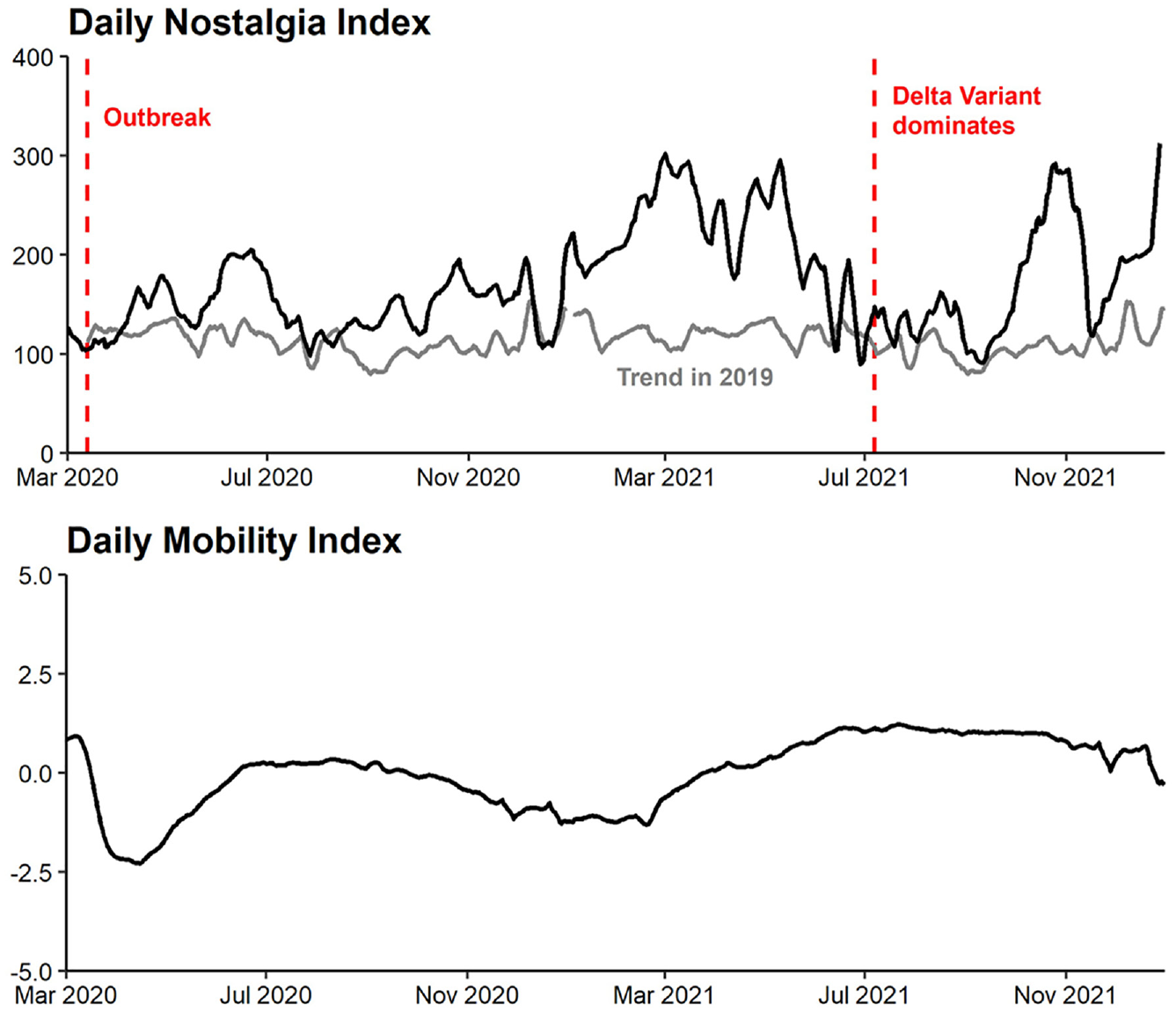
Daily Nostalgia and Mobility Indices During the COVID-19 Pandemic
The data were then collapsed across the day and linked to Google COVID-19 Community Mobility Reports (Google LLC, 2022) and Apple’s COVID-19 Mobility Trends Reports (Apple, 2022). Both reports were originally released to track how people reacted to social distancing and stay-at-home policies during the pandemic. They provided different measures of human mobility calculated by the relative numbers of route search usage in Google Maps and Apple Maps, which can be considered an indirect measure of social contact at an aggregated level. Finally, the data were separated into pre-COVID and COVID periods by March 13, 2020, the day when the president of the United States declared COVID-19 a national emergency. The main analyses focused on the data during the COVID period because mobility indices were not available (and less informative) before the outbreak of COVID-19.
Measures
Daily Mobility Index
We averaged five mobility indices from Google’s mobility report (i.e., the relative number of requests for direction to places including retail and recreation, groceries and pharmacies, parks, transit stations, and workplaces; Cronbach’s α = .75) and three mobility indices from Apple’s mobility report (i.e., the relative number of requests for directions by car, public transit, and walking; Cronbach’s α = .93), respectively. Values from the two reports were standardized and averaged to create a daily mobility index for the study (r = .69). Higher scores on the mobility measure reflect more usage of the route search services using different measures and to different locations, which implies that people were more likely to go out and engage in social contact with nonhousehold members during the day. Seven-day moving averages were used to remove weekend/weekday effects.
Daily Nostalgia Index
We calculated the median number of days after the release date of the top 200 songs as the nostalgia index for each day. The index represents in general how old the top songs were on a specific day during the pandemic period. We chose median values rather than mean values due to the fact the distribution was highly skewed (skewness = 8.06). Seven-day moving averages were used to remove weekend/weekday effects.
Results
Figure 1 shows the trend of nostalgia and mobility indices in the target period. As shown in the figure, the nostalgia index in 2019 (gray line) was rather stable, while more fluctuations can be observed since the outbreak of COVID-19. For the mobility index, there was a dramatic decrease in mobility from March to May 2020 under the stay-at-home orders in the United States.
We found that nostalgia index scores increased since the outbreak of COVID-19 with a large effect size, t(826.7) = −25.85, p < .001, Cohen’s d = 1.35, 95% CI = [1.20, 1.50]; pre-COVID period: M = 117.47, SD = 15.96; COVID period: M = 173.98, SD = 52.43. Regression analyses showed the mobility index negatively predicted nostalgia scores, β = −.10, SE = .04, t(654) = −2.45, p = .01, 95% CI = [−.17, −.02], during the pandemic, and the coefficient remained significant, β = −.29, SE = .04, t(648) = −7.17, p < .001, 95% CI = [−.37, −.21], after controlling for log-transformed new confirmed COVID-19 cases, β = .06, SE = .03, t(648) = 1.77, p = .08, 95% CI = [−.01, .13], and nostalgia scores in the same period in 2019, β = .19, SE = .04, t(648) = 5.19, p < .001, 95% CI = [.12, .26], and dummy-coded year, β = .57, SE = .03, t(648) = 16.54, p < .001, 95% CI = [.50, .63]. In other words, after considering the influence of the severity of the pandemic and the seasonal trends before the pandemic, mobility index still negatively predicted the nostalgia index.
Discussion
Study 1 demonstrated that people tended to listen to older songs since the outbreak of COVID-19, especially during times where social contact with people outside the household was lacking. Using a novel approach, this study supported our hypothesis that reduced social contact (as assessed by lower mobility) could predict consumption of nostalgic music using macro-level data of consumer behaviors in real-life settings.
Through the use of online streaming data, our study joins a growing research trend of using collective-level data to gain insights into psychological processes (e.g., Anderson et al., 2021; Liew et al., 2022). Nevertheless, these collective-level data do not directly measure how individuals feel and would react under certain situations. Furthermore, it is sometimes difficult to control other structural factors that might confound the results. For instance, an alternative explanation for the observed relationship between mobility and nostalgia index relates to the impacts of the pandemic on the music industry (Khlystova et al., 2022). It is reasonable to argue that artists were less likely to produce new songs during the lockdown period, so people listened to more old songs simply because fewer new songs were available. To address these limitations, we conducted a second study using a self-report questionnaire to understand how individual differences in interpersonal contact patterns influenced the consumption of nostalgic music.
Study 2
Study 2 tested whether self-reported reduced social contact would predict the consumption of nostalgic music during the lockdown period in early 2020, as well as the mediating roles of loneliness and boredom. The data analysis plan and hypotheses were preregistered.
Participants
A Monte Carlo power analysis indicated that 488 participants are required to achieve 80% power for the mediation model. 1 In total, 529 undergraduate students were recruited from the psychology participant pool at the University at Buffalo. Four participants who did not complete all items of the dependent variables were excluded as preregistered. The final sample size was 525 (44% female, Mage = 19.12, SDage = 1.54). Among them, 55% were White, 24% were Asian, 11% were Black or African American, 6% were Hispanic or Latino/a, and 4% identified as belonging to other racial-ethnic groups.
Procedure
The study was approved by the Institutional Review Board of the University at Buffalo. The data were collected from April 28 to May 11, 2022. Participants were informed that the study was about their experiences during the lockdown period. We acknowledged that participants had to recall experiences from about 2 years ago, so we reminded them of the context and period of lockdowns at the beginning of the questionnaire: Since the COVID-19 outbreak in early 2020, the pandemic has changed our lifestyle in many ways including how we interact with our family and friends. In the study, we are interested in your experiences during the COVID-19 lockdowns (i.e., March 2020 to May 2020 in New York State).
Participants completed the measures on their own devices.
Measures
Social Contact
Participants reported whether the experiences of social contact they had with family and friends changed during the COVID-19 lockdowns with three items: “During the COVID-19 lockdowns, I had a hard time reaching out and making social contact with my friends and family,”“During the COVID-19 lockdowns, it was difficult for me to maintain important social relationships,” and “During the COVID-19 lockdowns, the COVID-19 did NOT affect my ability to get needed interpersonal contacts” (reversed item). The items were adapted from the Resource subscale of the Coronavirus Impacts Questionnaire (Conway et al., 2020) and rephrased to fit the context of social contact. The items were rated on a 7-point scale (1 = Not true of me at all; 7 = Very true of me) and averaged to create a measure of reduced social contact (α = .65). For exploratory purposes, we also included an item about how strictly they followed the stay-at-home order: “How strictly you had followed the stay-at-home order during the COVID-19 lockdowns?” (1 = Very loosely; 7 = Very strictly).
Consumption of Nostalgic Music
Participants reported whether the frequency of three activities had changed during the lockdown period: “Listening to music I used to listen to when I was younger (childhood or/and adolescence),”“Listening to old music that was released before I was born,” and “Listening to music that reminds me of the past.” The items were rated on a 7-point scale (1 = Much less; 7 = Much more). The options of “Not applicable” were also provided if they did not listen to music at all. The scale was averaged to create a measure of nostalgic music consumption (α = .78). We also included an additional item measuring changes in music consumption in general (i.e., “Listening to music”) using the same format.
Loneliness and Boredom
Loneliness and boredom during the lockdowns were assessed using one item, respectively: “During the COVID-19 lockdowns, how often did you feel lonely?”“During the COVID-19 lockdowns, how often did you feel bored?” The items were rated on a 5-point scale (1 = Never, 2 = Hardly ever, 3 = Occasionally, 4 = Nearly always, and 5 = Always).
Covariates
We included a series of covariates to rule out possible confounding effects, including living arrangements during the lockdowns (i.e., living alone or not), COVID-related stress (Perceived Stress Scale of COVID-19; Cronbach’s α = .80; Campo-Arias et al., 2022), self-reported memory accuracy (i.e., “How accurate do you think you are when reporting your experiences during the lockdown period?”), and demographic variables (i.e., gender, age, and race/ethnicity).
Results
Preregistered Analysis
Consumption of nostalgic music during the lockdown period was regressed on social contact. Reduced social contact did not predict changes in consumption of nostalgic music, β = .07, SE = .05, t(480) = 1.49, p = .14, 95% CI = [−.02, .16], even when covariates were included, β = .02, SE = .05, t(468) = 0.42, p = .67, 95% CI = [−.07, .12]. Mediation analyses with 1,000 bootstrapped resamples were then conducted to examine the indirect effects through loneliness and boredom. As shown in Figure 2, reduced social contact positively predicted both loneliness (β = .34, SE = .03, p < .001, 95% CI = [.27, .40]) and boredom (β = .13, SE = .03, p < .001, 95% CI = [.07, .20]), but only loneliness predicted changes in consumption of nostalgic music (β = .27, SE = .05, p < .001, 95% CI = [.12, .41]). The indirect effect was significant for loneliness (Estimate = .09, SE = .03, p < .001, 95% CI = [.04, .14]) but not for boredom (Estimate = .007, SE = .009, p = .43, 95% CI = [−.01, .02]). Similar results were found when controlling for the covariates, except that reduced social contact no longer predicted boredom in the model (β = .05, SE = .03, p = .15, 95% CI = [−.02, .12]).
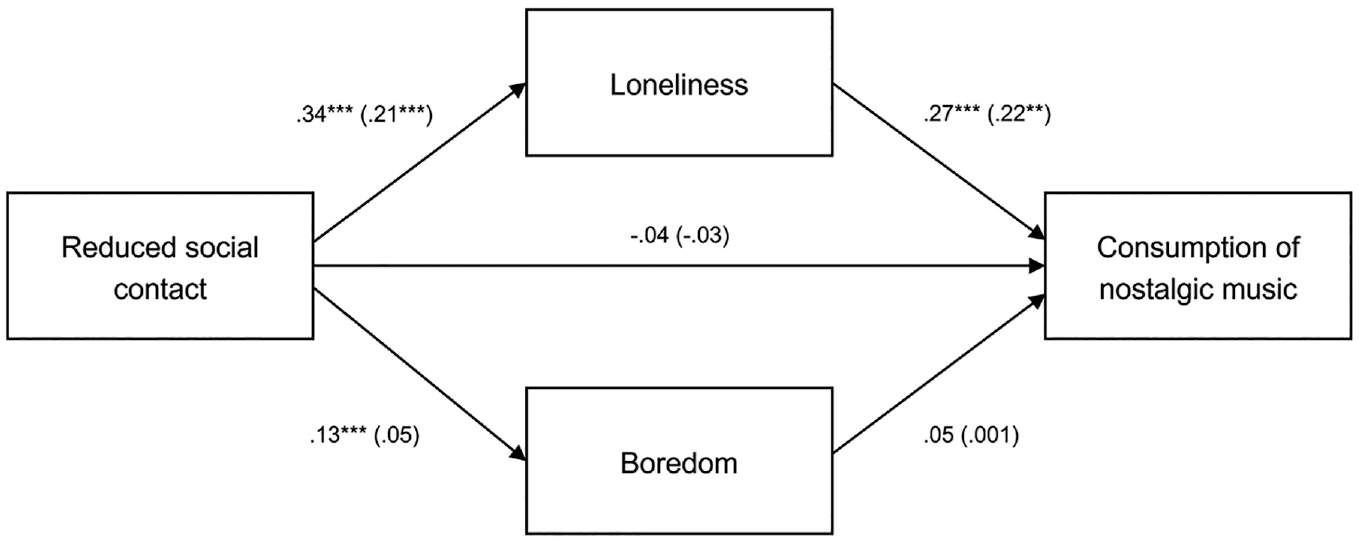
Direct and Indirect Effects of Reduced Social Contact on the Consumption of Nostalgic Music
Additional Analysis
We found that few participants reported that they were less likely to listen to nostalgic music during the lockdowns (i.e., chose one to three on a 7-point scale). The proportion of participants reported they had reduced consumption of nostalgia music were 10%, 15%, and 8% for the three nostalgic consumption items, respectively, making the distribution of the scale skewed. Thus, we ran the same regression analyses removing participants who reported a decrease in the consumption of nostalgic music. Results showed that reduced social contact positively predicted an increase in consumption of nostalgic music, β = .15, SE = .05, t(376) = 3.07, p = .002, 95% CI = [.06, .25], but the effect was not significant when including the covariates, β = .06, SE = .05, t(364) = 1.19, p = .24, 95% CI = [−.04, .17]. Similar indirect effects of loneliness were found in the bootstrapped mediation model without (Estimate = .25, SE = .07, p < .001, 95% CI = [.11, .40]) or with covariates (Estimate = .12, SE = .05, p = .02, 95% CI = [.03, .25]). Nostalgic consumption was also regressed on self-reported compliance with stay-at-home orders. Compliance predicted consumption of nostalgic music, β = .14, SE = .05, t(376) = 2.83, p = .005, 95% CI = [.04, .24], but the effect was not significant when including the covariates, β = −.02, SE = .06, t(364) = −0.42, p = .68, 95% CI = [−.13, .09]. An indirect effect of loneliness was found in the bootstrapped mediation model (Estimate = .11, SE = .06, p = .003, 95% CI = [.05, .19]), but the effect was not significant when the covariates were included (Estimate = .004, SE = .02, p = .83, 95% CI = [−.04, .05]). These additional analyses showed some (though inconsistent) evidence of total effects of reduced social contact on nostalgic consumption and more stable indirect effects through loneliness.
Furthermore, it is possible that reduced social contact increased music consumption in general instead of the consumption of nostalgic songs in particular. We checked whether the same effects of social contact could be observed in an increase in music consumption in general. Reduced social contact did not predict changes in general music consumption without covariates, β = .08, SE = .05, t(515) = 1.67, p = .09, 95% CI = [−.01, .17] or including covariates, β = .01, SE = .05, t(503) = 0.25, p = .80, 95% CI = [−.08, .10]. Surprisingly, reduced social contact had an indirect effect on music consumption through boredom (Estimate = .05, SE = .02, p < .001, 95% CI = [.03, .09]) but not loneliness (Estimate = .04, SE = .03, p = .14, 95% CI = [−.01, .09]) in the bootstrapped mediation model. The effect, however, became nonsignificant when the covariates were included (Estimate = .02, SE = .01, p = .08, 95% CI = [−.001, .04]). In other words, the relationship between social contact and nostalgic music through loneliness cannot be explained by a general increase in music consumption.
Discussion
Study 2 found that reduced social contact during lockdown periods had an indirect effect on the consumption of nostalgic music through the mediating role of loneliness. That is, the lack of social contact made people more likely to experience loneliness, and those who experienced higher levels of loneliness were more likely to listen to nostalgic songs. These findings were consistent with previous research on the association between loneliness and nostalgia (Wildschut et al., 2006; Zhou et al., 2008, 2022). More importantly, the study demonstrated that social relationships and the lack thereof can explain why we witnessed a nostalgia bump during the pandemic. The pandemic created a situation that isolated people, who then found recourse in music that affirmed connection from their prepandemic “good old days.” On the contrary, although reduced social contact during lockdown predicted feelings of boredom, boredom did not, in turn, increase consumption of nostalgic music. Instead, we found that boredom was associated with a general increase in music listening, not necessarily limited to nostalgic music. Maybe people listened to music when they felt bored because they wanted to pass the time or generally lift their overall mood, without the intention to experience nostalgia.
General Discussion
The COVID-19 pandemic has dramatically changed our lifestyles and social contact patterns. Since the outbreak of the disease, many people have been suffering from social isolation and have wanted to return to the prepandemic normal. These psychological and emotional responses to collective threats may have systematic changes in human emotion and behaviors. The current study provided empirical evidence for the “pandemic nostalgia” phenomenon and its psychological mechanisms. Across the studies, we found that reduced social contact can predict the consumption of nostalgic songs during the COVID-19 pandemic and that loneliness plays an important role in linking these two variables. When people were isolated from each other and experiencing strong feelings of loneliness, they were more likely to listen to more nostalgic music that reminded them of bittersweet memories from the past.
We believe that the motivation to approach old objects reflects one’s unsatisfied need to connect and interact with others in a time of crisis. For example, Loveland et al. (2010) revealed that activating the need to belong increases the preference for nostalgic products and that consumption of nostalgic products can satiate the need to belong. No matter whether you are playing traditional board games with family or cooking dishes that you used to eat in childhood, social connection is usually the main theme of these nostalgia-based pandemic activities. These experiences of nostalgia such as listening to old music could potentially help us cope with the pandemic and even orient us toward the future (e.g., Abeyta et al., 2015; Cheung et al., 2013).
The present study not only resonates with the idea that people tend to become nostalgic in the face of social threats such as loneliness in general (Wildschut et al., 2006; Zhou et al., 2008) and during times of crisis (Wulf et al., 2021; Zhou et al., 2022), but extended the literature by demonstrating that large-scale social changes, such as pandemic and lockdown policies, can provide contexts that foster nostalgic feelings and nostalgic consumption.
Limitations and Future Directions
First, the study used data from Spotify and a retrospective survey 2 years after the outbreak of COVID-19 to investigate the phenomenon of nostalgic consumption. Neither of them was a direct measure of human behaviors during the pandemic. A better way would be to conduct a survey during the lockdown period and ask participants about their motivations and feelings about nostalgic music, but to our knowledge, there are no such data available. At least, the present study tried to use different methods to establish the relationship between social contact and nostalgia.
Second, we used the median age of the top songs as a measure of nostalgia in Study 1, but it is important to note that song age does not equate with a song’s nostalgic resonance. Newer songs with lyrics referring to the past may also facilitate nostalgia. Also, people might listen to old songs because they crave familiarity rather than nostalgia per se. Future research may want to consider using more elaborate measures of daily nostalgia such as subjective nostalgia/familiarity ratings or an analysis of song characteristics.
Third, the measurement-of-mediation design used in Study 2 does not permit causal conclusions. Further research should consider corroborating the findings using designs that directly manipulate the mediators.
Fourth, despite the significant indirect effects, we failed to find a total effect of reduced social contact on nostalgic consumption in Study 2. There may be unmeasured mediation processes that counteract the indirect effect of loneliness. For example, reduced social contact under lockdown restrictions may predict lower well-being, which in turn predicts a decrease in active engagement in leisure activities including music listening. Alternatively, the lack of a total effect may be due to measurement issues. Additional analyses in Study 2 did find some evidence of a total effect when addressing the skewed distribution of the nostalgia index.
Fifth, the findings of the studies cannot be generalized to populations other than young adults in the United States. Spotify users are generally younger than the whole population, and the participants in Study 2 were undergraduate students in New York state. As nostalgia may have different meanings and psychological functions across the lifespan (J. R. Turner & Stanley, 2021) and cultures (Hepper et al., 2014; Sedikides & Wildschut, 2022), future studies should replicate the effects in different populations such as older adults or individuals from non-Western cultures. Finally, the study focused only on the consumption of music while there are many other products and activities that can trigger nostalgia such as movies, sports, games, and food. We expect similar effects can also be found in the consumption of other kinds of nostalgic materials.
Supplemental Material
sj-docx-1-spp-10.1177_19485506221149463 – Supplemental material for Pandemic Nostalgia: Reduced Social Contact Predicts Consumption of Nostalgic Music During the COVID-19 Pandemic
Supplemental material, sj-docx-1-spp-10.1177_19485506221149463 for Pandemic Nostalgia: Reduced Social Contact Predicts Consumption of Nostalgic Music During the COVID-19 Pandemic by Kuan-Ju Huang, Ya-Hui Chang and Mark J. Landau in Social Psychological and Personality Science
Footnotes
Acknowledgements
The authors gratefully acknowledge Dr. Jen-Hao Chen, Dr. Kenneth DeMarree, Dr. Xian Zhao, and the organizers and participants of the 2021 Summer Institute in Computational Social Science at Taiwan (SICSS–Taiwan) for valuable comments on the project. We would also like to thank Dr. Kenneth DeMarree for his generous support for data collection. Portions of this research were presented at the 2022 Society for Personality and Social Psychology (SPSP) Annual Convention.
Declaration of Conflicting Interests
The author(s) declared no potential conflicts of interest with respect to the research, authorship, and/or publication of this article.
Funding
The author(s) received no financial support for the research, authorship, and/or publication of this article.

Data Availability
Supplemental Material
Supplemental material for this article is available online.
Notes
Author Biographies
References
Supplementary Material
Please find the following supplemental material available below.
For Open Access articles published under a Creative Commons License, all supplemental material carries the same license as the article it is associated with.
For non-Open Access articles published, all supplemental material carries a non-exclusive license, and permission requests for re-use of supplemental material or any part of supplemental material shall be sent directly to the copyright owner as specified in the copyright notice associated with the article.
