



Abstract
We aimed to derive a more systematic understanding of the persuasive advantages of self- versus other-generated arguments. Through three initial data collections (Ntotal = 492) and another two large preregistered studies (Ns = 528 and 496), we found that when people experienced a low level of difficulty (measured or manipulated) generating the arguments, self-generated arguments were more persuasive than other-generated arguments. However, when people experienced a high level of difficulty (measured or manipulated), the typical self-persuasion advantage was reduced significantly. Factor analyses identified perceptions of argument quality as a plausible and replicated mediator of the persuasive advantage of self-generated over other-generated arguments.
People resist change, especially when a message opposes their current beliefs. Yet, government, schools, or parents might want to shift the attitudes of citizens, students, or children to convince them to adopt more favorable attitudes toward key proposals or objects, such as environmental preservation, schoolwork, or daily hygiene. One intriguing possibility for effective change is if people persuade themselves. For example, work on the role-playing paradigm suggested that people actively generating their own arguments can lead to substantial and long-lasting self-persuasion (Aronson, 1999). Yet, a systematic understanding of what makes self-persuasion work (and when) remains incomplete.
Persuasive Effects of Self-Generated Arguments and the Role of Difficulty as a Moderator
Janis and King (1954) reported one of the earliest experiments demonstrating the persuasive advantages of self-generated over other-generated (i.e., passively received) arguments. Self-generation participants tended to reformulate the main points, insert illustrative examples, and invent additional arguments. Anecdotally, if they experienced difficulty generating arguments, they improvised less, leading to less self-persuasion. Although follow-up research in self-persuasion directly examined improvisation and performance satisfaction, the question of generation difficulty lay dormant for most of the history of self-persuasion research. We build on the literature on ease-of-retrieval (Schwarz et al., 1991; Weingarten & Hutchinson, 2018) as a possible foundation for generation difficulty as a moderator of self-persuasion effects. That is, if people experience difficulty generating arguments to support a particular position, the difficulty might have meta-cognitive implications. Difficulty might be associated with perceptions of fewer arguments available to support the position or with less truth value described in the arguments. Consistent with this idea, Wänke et al. (1997) found that participants asked to generate one reason to prefer a BMW over a Mercedes were more favorable toward BMW than those asked to generate 10 reasons (cf. Petty et al., 2002).
Although promising, previous work on ease-of-retrieval has not been fully integrated into the literature on self-persuasion in that most ease studies do not compare the impact of the same generated arguments on the generator and on yoked recipients. To demonstrate that difficulty reduces the impact of self-generated thought on attitude change, Müller et al. (2017) manipulated the number of arguments generated in two studies, one of which compared self-generation with other-generation. In both studies, being asked to generate a larger number of arguments led to less persuasion than being asked to generate a smaller number of arguments. However, Müller et al. did not yoke self-generated and other-generated arguments. Rather, in the one study where arguments were provided to participants, the arguments were selected from a previous study based on external raters’ quality judgments. When manipulating ease through the number of requested arguments, the content, amount of information, and potentially, the quality of the arguments (e.g., when people generate unrequested thoughts, Tormala et al., 2007) is confounded with generation difficulty. Thus, in the current work, we employed the yoked design used in the previous self-persuasion research and integrated the ease literature by examining meta-cognitive perceptions of difficulty when generating arguments. We expected that the benefits of self-generated over other-generated arguments might require a perception of relative ease rather than difficulty in argument generation. 1 In some previous research on self-generated arguments, participants were given “things to consider” prompts to help make argument generation manageable. In a large preregistered study, we manipulated the difficulty of argument generation by including or excluding such “things to consider” prompts while keeping a similar number of arguments generated.
Potential Reasons Behind Self-Generation Benefits
Besides the conditions in which persuasive benefits of self-generation exist, researchers have also been intrigued by the possible mechanisms driving this effect. Janis and King (1954) initially identified two possible mechanisms—improvisation and satisfaction. The satisfaction hypothesis suggested that participants engaged in active role-playing felt confidence in their overt performance, and this sense of accomplishment led to positive reactions toward the position they had taken. The improvisation hypothesis suggested that enhanced influence by self-generated arguments was due to generators’ active participation in providing uniquely appealing and new supporting arguments in their speeches.
King and Janis (1956) pitted these two hypotheses against each other and demonstrated that compared with the control (passive reception) condition, only participants in the improvisation condition (but not the satisfaction condition) showed more attitude change. However, some studies found similar effects from simply expecting to play a role and receiving role-supportive arguments rather than having to generate the arguments (e.g., Greenwald, 1969). Thus, though improvisation has been generally supported as a partial explanation for the benefits of self-generated arguments (e.g., Eagly & Chaiken, 1993; Wegener et al., 2019), the role of improvisation and the mechanisms involved remained under-specified.
Since the early research distinguishing improvisation and satisfaction, a number of potential explanations have received attention. Improvisation has been linked to systematic processing or elaboration (e.g., Eagly & Chaiken, 1993; Wegener et al., 2019). Greenwald and Albert (1968) suggested an alternative when they found that self-generated arguments were viewed as more original than the same arguments received from another person. Although perhaps debatable, Greenwald and Albert described the originality ratings as reflecting more favorable views of one’s own than others’ arguments. Consistent with this idea, Baldwin et al. (2013) found that participants rated self-generated arguments as more convincing than other-generated arguments. No mediational analyses were conducted by Greenwald and Albert (1968)—so it remains unknown whether originality perceptions relate to persuasion—but one study by Baldwin et al. (2013) found that ratings of argument convincingness mediated between generation conditions and attitudes. It is also possible, however, that participants were reporting on their own sense that their opinion had changed (i.e., that they had been convinced).
Baldwin et al. (2013) argued that perceptions of convincingness came not from the fact that the self (vs. other) was the source of the generated argument but, rather, from the extent to which the arguments addressed the concerns that people had about the issue. When manipulating (through leading questions) whether generated arguments tended to match or mismatch the participants’ own concerns about smoking, regardless of the argument source (i.e., self vs other), arguments that matched participants’ top concerns were viewed as more convincing and led to more smoking cessation attempts (though no differences in attitudes were observed). These data suggested that equating key qualities of the arguments, mere differences in the source of the argument had little influence on argument persuasiveness. Yet, the research did not examine whether self-generated arguments typically matched recipient concerns better than other-generated arguments. Thus, though the extent of knowledge fit of the message to the recipient might be a plausible reason for the greater effectiveness of self-generated arguments, that possibility awaits more direct evidence.
Current Research Goals
Despite abundant research demonstrating the benefits of self-persuasion, little research documents reasons for and limits to such benefits. Therefore, the goals of the current research were two-fold. First, we sought to derive a more systematic understanding of the perceptions of the self- or other-generated arguments and generation/reception process that might produce self-persuasion advantages. We examined a number of potential mediators of the self-persuasion effect, including enjoyment of, elaboration in, resistance to, perceptions of argument quality, and fit of the generated or received arguments. In so doing, we sought to meaningfully cluster potential mediators to arrive at an understanding of how these variables might relate to one another. Second, we sought to examine whether generation/reception difficulty reduced (vs. enhanced) the benefits of argument self-generation and to examine why such moderation occurs by using a yoked design with both self- and other-generation conditions.
To address these goals, first, we conducted three exploratory data collections in which we conducted exploratory factor analyses (EFAs) of the potential mechanism measures. Then, we adopted core features of the initial materials to conduct two large preregistered replications (with one measuring perceptions of difficulty and one manipulating the difficulty level) to serve as confirmatory tests of our previously obtained findings.
Initial Data Collections
We aggregated across the three exploratory data collections (Ntotal = 492) and briefly present the key findings (see full report in the Online Supplement). 2 After the consent procedure, participants in Data Collections 1 and 2 first rated the likelihood that there will be no paper currency in the U.S. within a particular period of time (10–15 years in Data Collection 1 or 15–20 years in Data Collections 2 and 3). In Data Collection 3, the likelihood measures were replaced with attitudes measures. Then participants were randomly assigned to generate at least 3 or 4 arguments to convince other participants that it would be likely (in Data Collections 1 and 2) or good (Data Collection 3) that paper money would disappear in the U.S. or read arguments generated by another yoked participant. In Data Collections 2 and 3, we attempted to reduce the overall difficulty by providing participants in the self-generation condition with five “things to consider” prompts they could use when generating arguments (e.g., whether there might be environmental benefits), adapted from Greenwald and Albert (1968).
After generating or reading arguments, participants completed the post-message likelihood/attitudes measure, along with the key moderator (i.e., perceived difficulty), and an array of process measures (i.e., one enjoyment item, two knowledge fit items, three resistance items, one effort item, three elaboration items, three argument quality items, two argument uniqueness items, and one argument liking item). 3
Key Results
We first conducted a multiple linear regression with the self/other-generation condition, participants’ level of judged difficulty in generating or reading, and their interaction as predictors of persuasion (post-message responses when controlling for people’s pre-message responses—included in the model as a covariate). At relatively low levels of perceived difficulty (−1 SD below the mean), participants in the self-generation condition thought that cash is more likely to disappear or that it would be more positive if cash disappeared in the U.S. compared with participants in the other-generation condition, B = .52, t(487) = 3.36, p = .001, 95% confidence interval (CI): [0.21, 0.82], r = .15. However, this effect did not hold for participants who experienced higher levels of difficulty (+1 SD above the mean), B = .08, t(487) = 0.55, p = .59. This pattern produced a significant argument generation X perceived difficulty interaction, B = −.13, t(487) = −2.01, p = .04, 95% CI: [−0.25, −0.003], r = −.09 (see Figure S2 in the Online Supplement). 4 There was no moderation of the generation X difficulty interaction by data collection (ps > .73). 5
Possible Mediators: Factor Analysis
EFA (following Fabrigar & Wegener, 2012) examined possible relations among the various process measures. We examined the two-factor and three-factor solutions based on oblique rotations (for factor loadings, see the Online Supplement). In both, the argument quality/uniqueness/liking items loaded on the first factor. The knowledge fit items loaded on the first factor in the two-factor solution but created their own factor in the three-factor solution (that was moderately to highly correlated with factor one). The resistance items tended to cross-load weakly on two factors with relatively equal weights on each. It seemed, therefore, that resistance did not form a core part of either factor.
Because Baldwin et al. (2013) specifically focused on knowledge fit and our three-factor solution split out knowledge fit from other perceptions of argument quality, we decided to focus on the three factors of argument quality (consisting of one argument liking, three argument quality, and two argument uniqueness items), effort (consisting of one enjoyment, one effort, and three elaboration items), and knowledge fit (consisting of two knowledge fit items).
Mediation
We examined a moderated mediation model using generation condition as the independent variable, perceived difficulty as a moderator (of paths a1-a3, modeled influences of generation condition on the mediators, and c, direct effects of generation condition after controlling for the mediators), post-message likelihood/attitudes as the dependent variable, and pre-message likelihood/attitudes as a covariate. We entered argument quality, knowledge fit, and effort as parallel mediators. Using the PROCESS macro (model 8), only the mediation path through argument quality was significantly moderated by perceived difficulty, effect = −.09, bootstrapped 95% CI: [−0.15, −0.04] (see Figure S4 in the Online Supplement), suggesting that the modeled indirect effect of generation condition on post-message likelihood/attitudes through argument quality was significantly stronger when participants perceived relatively low (vs. high) difficulty. This pattern did not differ across data collections.
Study 1: Preregistered Replication
To perform a confirmatory analysis to boost confidence in the described effects, we ran a preregistered replication study (https://aspredicted.org/blind.php?x=ny2dj2). We sought to examine whether (1) the perceived difficulty of argument generation/receipt reduces the persuasive benefits of self-generated arguments, (2) the previously obtained three-factor structure of potential mediators would provide reasonable model fit, and (3) the argument quality factor would serve as a significant mediator of the key generation condition X perceived difficulty interaction.
Method
Participants and Design
We used the effect size obtained in Data Collection 3 for estimation given the procedural similarity between the current study and that used in Data Collection 3. An effect size of q = .26 and a 5% Type I error rate would suggest 177 to 395 participants to obtain 80% power for the design (J. Cohen, 1988). To hedge against the uncertainty inherent in power estimates (Pek et al., in press), we recruited a larger sample (i.e., 528 undergraduate participants) from a large Midwestern university.
Procedure
Participants rated their pre-message attitudes toward cash being replaced by digital/electronic payment options in 15 to 20 years. Participants were randomly assigned to the self-generation condition or the other-generation condition. Then participants answered the same post-message attitudes, moderator, and mediator measures used in Data Collection 3, though the three resistance items were not included.
Moderator
Participants rated how difficult it was to generate (in self-generation conditions) or read (in other-generation conditions) arguments supporting the given position on a 7-point scale anchored with extremely easy and extremely difficult.
Pre-Message Attitudes Measure
Participants rated the extent they thought it would be negative or positive if cash (paper and coins) were replaced by digital currency in the U.S. on a 7-point scale anchored with extremely negative and extremely positive.
Post-Message Attitudes Measures
Participants rated their attitudes toward replacing cash with electronic/digital currency in the U.S. on three 7-point semantic differential scales (extremely negative/undesirable/harmful—extremely positive/desirable/beneficial). These items were averaged to form the post-message attitudes measure (α = .92).
Process Measures
Argument Quality Factor
Participants rated how strong/compelling/convincing/unique/novel (cf. Baldwin et al., 2013; Greenwald & Albert, 1968) the arguments were and how much they liked them on 7-point scales from not at all to very much (extremely for the liking item).
Knowledge Fit Factor
Participants rated the extent to which the generated or received arguments fit with their way of thinking and are phrased in a way that is similar to their way of thinking (each on a 7-point scale anchored with not at all and very much; Baldwin et al., 2013).
Effort Factor
Participants rated how enjoyable it was to generate or read arguments on the given topic on a 7-point scale anchored with extremely boring and extremely enjoyable. Also, they rated their agreement that they put a lot of effort into generating or reading the arguments on a 7-point scale anchored with extremely disagree and extremely agree. In addition. they reported on how carefully/deeply/much they thought about the issue on three 7-point scales anchored with not at all and very much (cf. Petty & Cacioppo, 1986).
Results
To examine the interactive effect of generation condition and perceived difficulty on participants’ post-message attitudes measure when controlling for people’s pre-message attitudes, we ran the same regression analysis described previously and found a significant self-generation effect on post-message attitudes, B = .48, t(524) = 5.28, p < .001, 95% CI: [0.30, 0.65], r = .22. Importantly, this effect was moderated by perceived difficulty, B = −.15, t(523) = −2.66, p = .008, 95% CI: [−0.26, −0.04], r = −.12 (see Figure 1). At relatively low levels of perceived difficulty (−1 SD below the mean), participants in the self-generation condition were more persuaded than participants in the other-generation condition, B = .70, t(523) = 5.59, p < .001, 95% CI: [0.46, 0.94], r = .24. However, for participants who experienced higher levels of difficulty (+1 SD above the mean), this effect did not hold, B = .22, t(523) = 1.62, p = .11. 6 Using a mixed model that took the yoked pairs into consideration, the same key generation by difficulty interaction emerged, B = −.14, t(516) = −2.62, p = .009, 95% CI: [−0.25, −0.04], r = −.11.
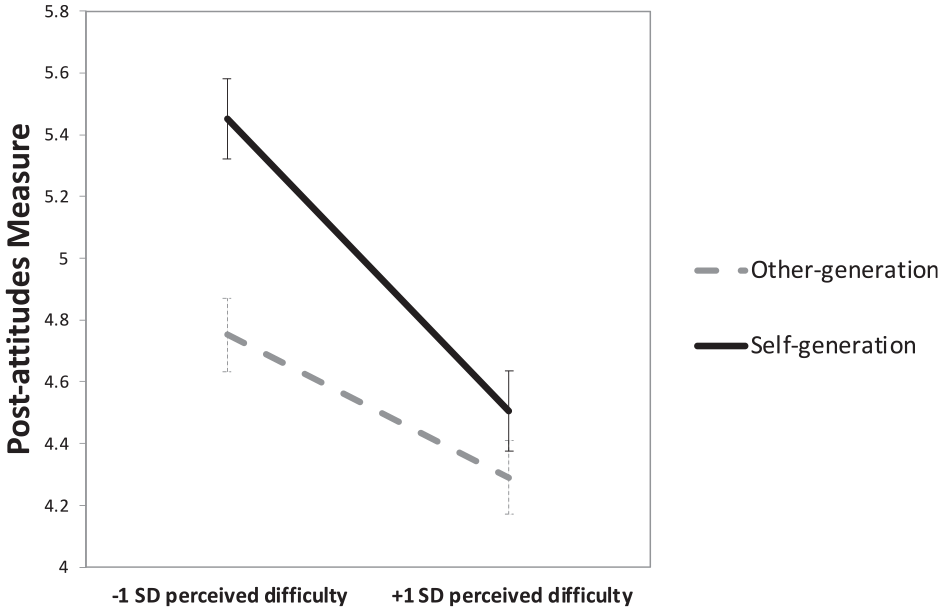
Participants’ Perceived Level of Difficulty Moderating the Self-Generation Effect in Study 1
Mediators: Confirmatory Factor Analysis
The specified three-factor model based on the previously obtained EFA results showed reasonable fit overall: root mean square error of approximation (RMSEA) = .107, normed fit index (NFI) = .89, and comparative fit index (CFI) = .90. Compared with a two-factor model that collapsed the argument quality and knowledge fit factors into a single factor, the three-factor model showed significantly better model fit (
Mediation
We first ran the same regression described above, only replacing the post-message attitudes measure with each of the three mediators. The generation by difficulty interaction was significant on argument quality, but did not reach significance for knowledge fit or effort (Table 1).
The Generation Condition by Perceived Difficulty Interaction on the Three Composite Mediator Measures in Study 1

Note. CI = 95% confidence interval.
We ran the same parallel mediation analysis as in the initial data collections. All prior results were replicated. Argument quality served as the only significant mediator of the interaction between generation condition and difficulty level on post-message attitudes, effect = −.08, bootstrapped 95% CI: [−0.14, −0.04] (Figure 2). When controlling for the mediators, the generation by perceived difficulty interaction ceased to be significant, B = −.03, t(520) = −0.61, p = .54.
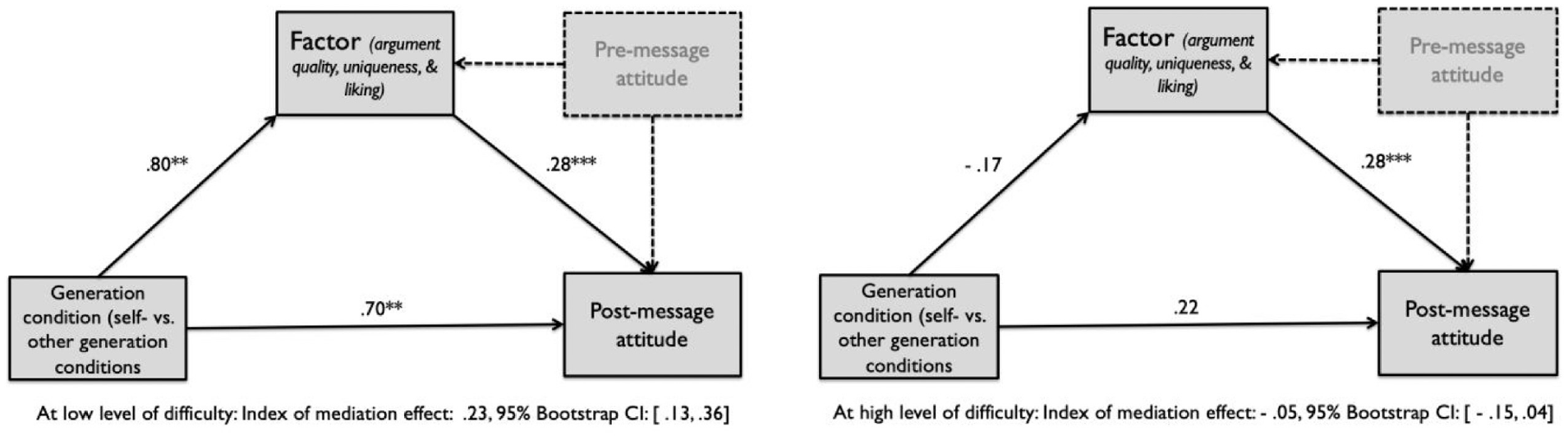
Moderated Parallel Mediation Model Depicting Only the Mediation Effect of Generation Condition on Post-Attitude Measure Through the Argument Quality Factor (i.e., Argument Quality, Uniqueness, and Liking) at Low (−1 SD) and High (+1 SD) Level of Perceived Difficulty (Left and Right Panel Respectively) in Study 1
Study 2: Manipulation of Difficulty—A Preregistered Study
In previous studies, we only measured perceived difficulty. To draw causal conclusions, in this new preregistered study (https://aspredicted.org/D1G_NRJ), we manipulated both the generation condition and generation difficulty.
Method
Participants and Design
Using an estimated effect size of q = .2, paralleling previous studies, and a 5% Type I error rate would suggest 400 participants to obtain 80% power for the design (J. Cohen, 1988). To hedge against the uncertainty inherent in power estimates, we recruited a larger sample (i.e., 496 Mechanical Turk workers).
Procedure
Participants rated their pre-message attitudes toward cash being replaced by digital/electronic payment options in 15 to 20 years. Participants were randomly assigned to the self-generation condition or other-generation condition. To manipulate difficulty in the self-generation condition, in the low difficulty condition, we asked participants to generate at least three arguments, and we cued participants with “things to consider” prompts they could use when generating arguments. In the high difficulty condition, we asked participants to generate at least four arguments and did not include the “things to consider.” A pretest with a separate sample of participants from the same pool (N = 123) showed that those in the low difficulty condition perceived argument generation as significantly easier (M = 3.29, SD = 1.87) than those in the high difficulty condition (M = 4.16, SD = 1.77), t(121) = −2.63, p = .01. In the other-generation condition, each participant was randomly assigned to receive one set of available self-generated arguments (with “things to consider” if the self-generator had received them) and was assigned to the difficulty condition under which the arguments had been generated. Then participants answered the same post-message attitude and mediator questions used in Study 1. To facilitate visualization of the data, we computed attitude change scores by subtracting the pre-message attitudes from the post-message attitudes (see Figure 3).
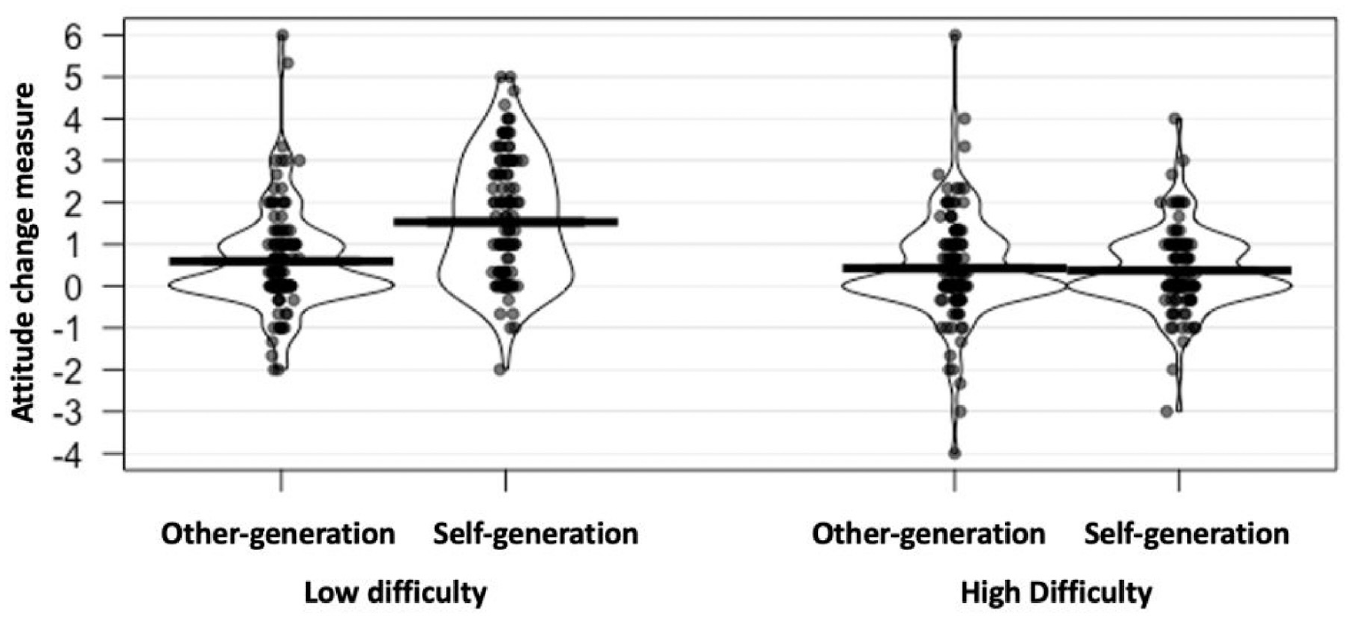
Violin Plots of the Distribution of Attitude Change by Difficulty and Generation Conditions in Study 2
Results
We ran the same regression analysis as in Study 1, only replacing perceived difficulty with the difficulty manipulation. There was a significant self-generation main effect on post-message attitudes, B = .50, t(492) = 4.88, p < .001, 95% CI: [0.30, 0.70], r = .21. Importantly, this effect was moderated by the difficulty condition, B = −.98, t(491) = −4.88, p < .001, 95% CI: [−1.37, −0.59], r = −.22 (see Figure 4). In the low difficulty condition, self-generated arguments were more persuasive than other-generated arguments, B = 1.00, t(491) = 6.99, p < .001, 95% CI: [0.72, 1.28], r = .30. However, for participants in the high difficulty condition, this effect did not hold, B = .02, t(491) = 0.11, p = .91. Using a mixed model that took the yoked pairs into consideration, the same key interaction emerged, B = −.98, t(246) = −4.74, p < .001, 95% CI: [−1.39, −0.57], r = −.29. 7
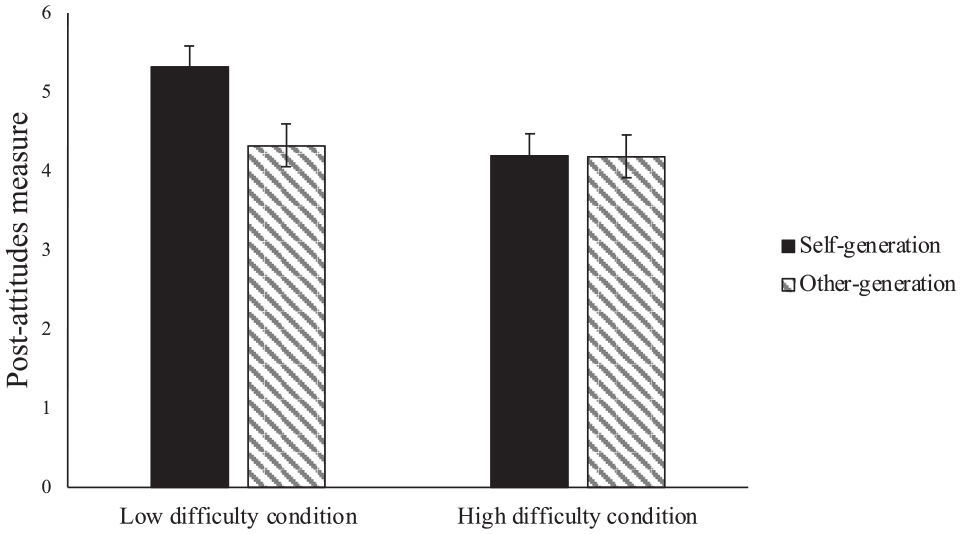
Difficulty Condition Moderating the Self-Generation Effect in Study 2
Influences on Mediators
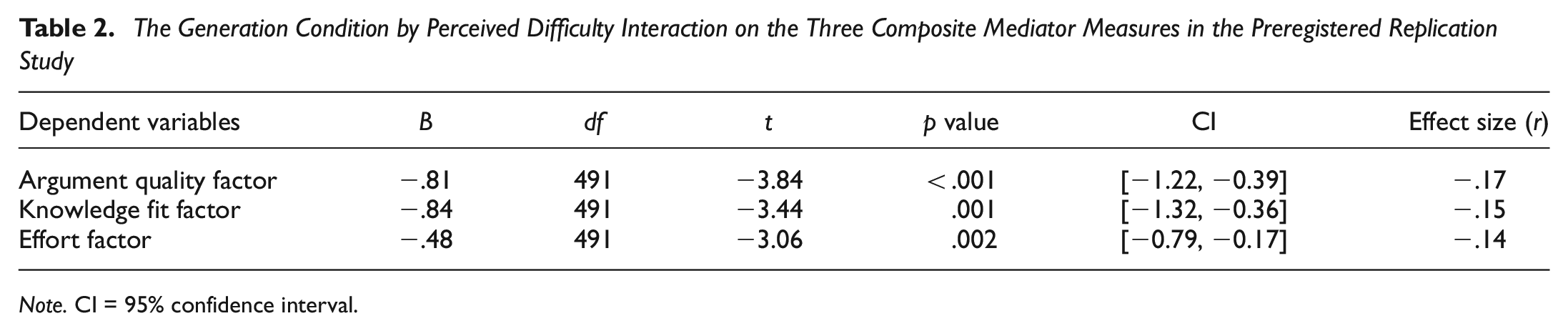
We computed the three-factor model based on the previous EFA and confirmatory factor analysis (CFA) results. Then we ran the same regression model described above, only replacing the dependent measure with each of the three mediators. All effects were in the consistent direction found in Study 1. However, in this study, the key interaction was significant on the knowledge fit and effort factors (see Table 2).
The Generation Condition by Perceived Difficulty Interaction on the Three Composite Mediator Measures in the Preregistered Replication Study
Note. CI = 95% confidence interval.
Mediation
In parallel moderated mediation analysis with argument quality, knowledge fit, and effort as mediators, argument quality again served as a significant mediator of the interaction between generation condition and difficulty on post-message attitudes, effect = −.34, bootstrapped 95% CI: [−0.56, −0.16] (see Figure 5). In this study, knowledge fit also served as a significant, though somewhat weaker, mediator, effect = −.19, bootstrapped 95% CI: [−0.34, −0.07] (see Figure 5). The indirect effect through effort was not significant, effect = −.006, bootstrapped 95% CI: [−0.05, −0.05]. When controlling for the mediators, the generation and difficulty interaction remained significant, but significantly reduced in size, B =−.44, t(488) = −2.80, p = .01, 95% CI: [−0.75, −0.13], r = −.13.
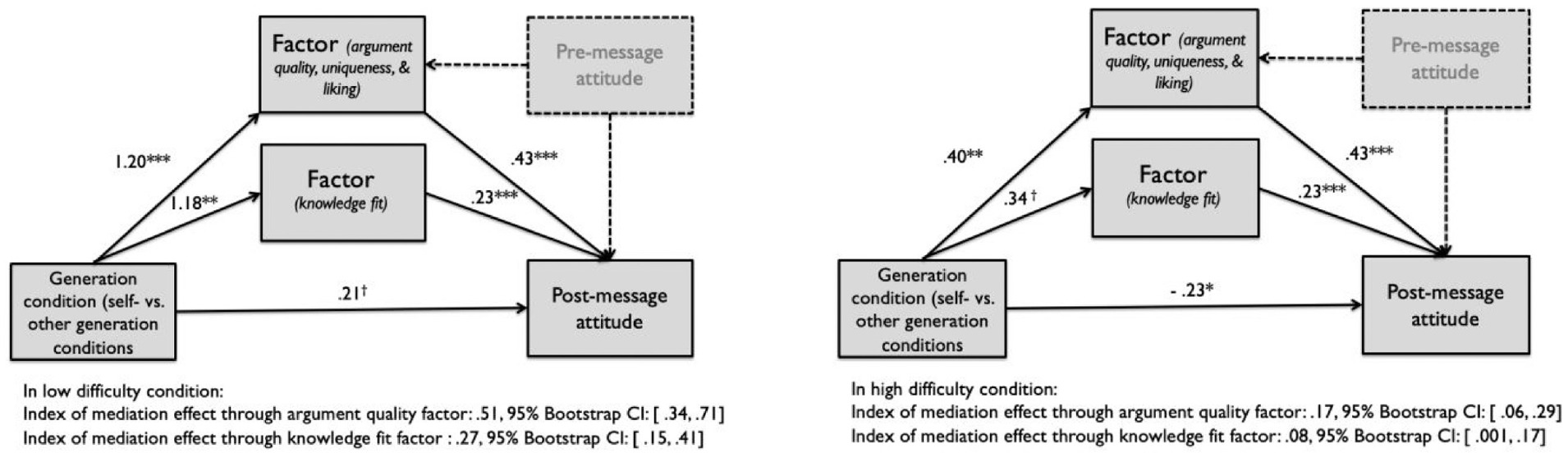
Moderated Parallel Mediation Model Depicting the Mediation Effects of Generation Condition on Post-Attitudes Through Argument Quality and Knowledge Fit at Low (Left Panel) and High Difficulty (Right Panel) in Study 2
General Discussion
Through three initial data collections, a large preregistered replication measuring generation difficulty, and a preregistered study manipulating generation difficulty, we found that difficulty in generating the arguments reduced the self-persuasion advantage. To better understand reasons self-generated arguments might be more persuasive (when generation is easy), we examined an array of relevant perceptions of the arguments and of the process of generating (vs. receiving) them. Consistently across studies, when the difficulty of argument generation/reception was not particularly high, self-generated arguments were viewed as stronger, which then also uniquely predicted persuasion by those arguments. There was also some potential additional role for perceptions of knowledge fit.
Theoretical Implications
The current work offers several theoretical insights. First, it helps one better understand the long-standing effects of self-generated arguments. Researchers had observed that the self-persuasion advantage did not always happen, and some had speculated that difficulty in argument generation might play a role (e.g., Mann, 1967). Some prior work examined the meta-cognitive consequences of ease of generation (e.g., Müller et al., 2017; Wänke et al., 1997) without directly comparing reactions to the same self-generated and other-generated arguments or examining the perceptions of the arguments potentially responsible for such effects. Identifying difficulty as a moderator is important, as it also speaks to reasons why cognitive role-playing might sometimes be less effective than emotional role-playing (Mann, 1967). Participants might have had an easier time generating arguments for topics used in emotional role-playing (e.g., quitting smoking) than for topics used in the research on cognitive role-playing (e.g., justifying the number of commercial movie theaters that will be in business 3 years from now).
Traditional research mostly offered speculations on why active argument generation is more effective than passive argument reception. The current work identified perceived argument quality as a primary factor contributing to self-persuasion, with knowledge fit possibly being a secondary contributor. By using a wide spectrum of argument quality, novelty, and liking measures closely tied to perceptions of the arguments, we conceptually replicated previous results and buttressed previous arguments that perceptions of overall argument quality were at least partly responsible for persuasive advantages of self-generated over other-generated arguments (cf. Greenwald & Albert, 1968), even when controlling for knowledge fit (cf. Baldwin et al., 2013).
It is worth noting that Baldwin et al. (2013) argued that argument convincingness came from the extent to which the arguments match the participants’ own concerns on the issue. In the current work, this sense of match versus mismatch might have been captured to some degree by the knowledge fit factor. When constraining our EFA models to two factors, knowledge fit did load with the perceptions of argument quality. However, when allowing for a three-factor solution, knowledge fit loaded separately, and it was the argument quality perceptions that served as the primary mechanism responsible for self-generation effects. However, it remains possible that our measures of knowledge fit reflected more of a cognitive fit (i.e., the way the person thinks about the issue) than in the Baldwin et al. (2013) research (i.e., addressing the person’s concerns on the issue). To the extent that the various perceptions of knowledge fit play a role, however, the current work suggests that their contributions might rely on their connections to perceptions of the overall argument quality.
Limitations and Future Directions
All studies showed the same difficulty by generation interaction pattern, but there was also a consistent pattern across all studies, such that participants with relatively negative attitudes at Time 1 (i.e., those who generated counter-attitudinal arguments) showed a more pronounced difficulty by generation interaction compared with those with relatively positive initial attitudes. However, favorability of initial attitudes did not moderate the difficulty by generation patterns on the mediators. This consistent pattern is not what one would predict based on Briñol et al. (2012). However, the attitudes in the current research were likely quite different from those in Briñol et al. (2012). Briñol et al. (2012) used a familiar topic (tuition increase/decrease) for which people likely had rather strong, well-formed attitudes. In contrast, the topic we chose for our studies was more in line with the classic self-persuasion literature—something quite novel for participants. When participants were initially unfavorable toward the disappearance of paper money, this might simply reflect that they had more room to be convinced otherwise (even with the same perceptions of the mediators). This might have allowed participants with less favorable attitudes to show the most pronounced two-way interaction between difficulty and generation conditions, whereas more well-formed attitudes might have reduced self-persuasion. It would be worthwhile for future work to explore the potential moderators of when generating arguments for a somewhat counter-attitudinal position results in more versus less impact of the generated arguments.
In addition, the current difficulty moderation might relate to research on mere thought effects. Although the traditional effect of mere thought was to polarize attitudes, moderation can occur when people are required to think longer and experience more difficulty in generating new supportive thoughts, creating less confidence in those thoughts and less persuasion by them (Clarkson et al., 2011; cf. Tormala et al., 2007). Because it seemed odd to consider generation difficulty as influencing confidence in thoughts toward other-generated arguments, we did not assess confidence in thoughts. However, future research could have participants generate cognitive responses to the arguments and assess confidence in those thoughts. This could raise a host of intriguing questions, such as whether thought confidence is necessary for the effects of perceived argument quality.
Summary
We aimed to derive a more systematic understanding of the persuasive advantages of self-generated arguments. Across over 1500 research participants, self-generated arguments were more persuasive than other-generated arguments when argument generation was relatively easy rather than difficult. Such effects were likely driven at least in part by parallel patterns in perceptions of argument quality and, to a lesser extent, by perceptions of knowledge fit.
Supplemental Material
sj-docx-1-spp-10.1177_19485506221146612 – Supplemental material for Persuasive Benefits of Self-Generated Arguments: Moderation and Mechanism
Supplemental material, sj-docx-1-spp-10.1177_19485506221146612 for Persuasive Benefits of Self-Generated Arguments: Moderation and Mechanism by Mengran Xu and Duane T. Wegener in Social Psychological and Personality Science
Footnotes
Handling Editor: Yoav Bar-Anan
Declaration of Conflicting Interests
The author(s) declared no potential conflicts of interest with respect to the research, authorship, and/or publication of this article.
Funding
The author(s) received no financial support for the research, authorship, and/or publication of this article.

Supplemental Material
Supplemental material is available in the online version of the article.
Notes
Author Biographies
References
Supplementary Material
Please find the following supplemental material available below.
For Open Access articles published under a Creative Commons License, all supplemental material carries the same license as the article it is associated with.
For non-Open Access articles published, all supplemental material carries a non-exclusive license, and permission requests for re-use of supplemental material or any part of supplemental material shall be sent directly to the copyright owner as specified in the copyright notice associated with the article.
