




Abstract
Xenophobia and anti-immigrant attacks rose during the COVID-19 pandemic, yet this may not be solely due to the disease threat. According to theories of frustration and scapegoating, situational obstructions and deprivation can motivate prejudice against outgroups. Using a global natural quasi-experimental design, this study tests whether the restrictiveness of national lockdowns can explain higher individual-level perceptions of immigrant threat. Data of 45,894 participants from 23 countries were analyzed. Both lockdown duration and lockdown severity were positively associated with individuals’ perceived threat of immigrants. The lockdown effects were independent of objective and subjective measures of disease threat, and there was no evidence that disease threat drives people’s prejudice toward immigrants. Subgroup analysis suggested the lockdown effects were reliable in Europe and the Americas, but not in Asia. These findings suggest a need to mitigate frustration and scapegoating when implementing lockdowns, and to distinguish the influence of societal restrictions from disease threat.
The COVID-19 pandemic is not only an unprecedented public health crisis but also a global political and civil liberties challenge. In this context, xenophobia and racist attacks rose dramatically (Gover et al., 2020; He et al., 2021): In the United States, the police recorded anti-Asian hate crimes increased by 45% in 2020 compared with 2019, despite an overall 6% drop in hate crimes (Center for the Study of Hate & Extremism, 2021). Whereas the United States showed more negative attitudes and blame for Asians (Reny & Barreto, 2020), residents in Japan held stronger exclusionary attitudes toward foreigners in general as the spread of COVID-19 increased (Yamagata et al., 2020). Prejudicial attitudes toward immigrants and minority groups determine how they are treated in society and can even influence the health and wellbeing of such groups during a pandemic (Dhanani & Franz, 2021). Similar prejudicial phenomena, in the context of disease outbreaks, have been noted for centuries: during the Black Death in the 14th century, Jews and minorities were scapegoated and massacred. The 2014 Ebola outbreak led to a rise in anti-African racism and xenophobia in Europe (Prati & Pietrantoni, 2016). The human tendency to derogate the “other” during disease outbreaks appears to be ancient, yet little is understood about the situational causes of this phenomenon.
A prevailing assumption is that xenophobia during the pandemic is a response to disease threat (i.e., concerns about risk of infection, Schaller & Neuberg, 2012; Van Bavel et al., 2020). According to the behavioral immune system theory (Murray & Schaller, 2016; Schaller & Park, 2011), pathogen stress can exacerbate the formation or strengthening of group consciousness (Fincher & Thornhill, 2012). When human beings become vectors for a prevalent infectious disease, one effective way to avoid infection is to reduce exposure to people who have been infected. Given the difficulty of detecting infected people, however, an adaptive response might be to avoid interactions with unknown out-groups altogether (Horita & Takezawa, 2018; Murray & Schaller, 2016; Schaller & Park, 2011). Hence, prejudice and hostility toward immigrants could be driven by realistic fears of virus infection and the (mis-)perception that immigrants carry the pathogen (Cashdan & Steele, 2013).
Although the disease threat hypothesis is a prominent theoretical stance, the present research considers how prejudicial attitudes during the pandemic may not be exclusively due to infection fears—such prejudice could also be a classic, displaced aggressive response to the co-occurring societal restrictions (Ihedioha, 2020). According to theories of frustration-aggression and scapegoating (Allport, 1954; Glick, 2005; Leander et al., 2020), prejudicial attitudes toward foreigners and other minorities could be derived from being thwarted and disempowered by mandatory lockdown and quarantine. Superficially, fears and frustrations might yield similar outcomes—such as the increased perception of outgroups as threatening. However, the threats and thwarting that lead to such responses have different antecedent conditions. They also serve different functions (Leander et al., 2020): whereas threat- or fear-related responses serve to prevent a future loss (e.g., prevent COVID-19 infection), frustration- or thwarting-related responses serve to symbolically compensate for losses that have already occurred (e.g., psychological deprivation from lockdowns). If restrictive public policies have unintended consequences on vulnerable groups, then research is needed to disentangle any potential influence of the lockdowns from disease treat.
Psychology has long recognized that societal frustrations—especially those experienced collectively—can predict displaced prejudice toward other groups (Allport, 1954; Rothschild et al., 2012). Although societal lockdowns are among the most effective measures for pandemic control and have been widely implemented by most countries around the world since the COVID-19 outbreak, people become socially and physically isolated during lockdown (Mucci et al., 2020). The obstruction, social isolation, and deprivation caused by lockdown can adversely influence psychological well-being (Brooks et al., 2020). In situations of thwarted control—be it obstructed goals, ostracism, or simply being used as instruments to others’ goals, displaced aggression can be a compensatory response for restoring psychological control (Jasko et al., 2020; Leander & Chartrand, 2017; Poon et al., 2020; Warburton et al., 2006). This view is consistent with recent research, in New Zealand and the United States, showing that perceived disempowerment in society predicted prejudicial responses to minority groups victimized by White Supremacist mass shootings (Leander et al., 2020).
We propose that although the lockdown restriction could make people feel protected, it can also be a form of societally imposed thwarting or frustration and thus drive displaced prejudice toward immigrants during the COVID-19 pandemic. Providing indirect support for lockdown-induced frustration-aggression phenomena, it has been reported that the domestic violence and intimate partner violence increased following the implementation of lockdown measures (Johnston, 2020). However, data are lacking that directly link such outcomes to specific lockdown conditions. It would be useful to know whether prejudicial attitudes are higher when individuals are in more restrictive and/or longer national lockdowns.
To test the plausibility of a frustration-related hypothesis of prejudicial attitudes, this study examined lockdown conditions across countries during the initial wave of the COVID-19 pandemic. Given that the definition of minorities varies across different countries, this study examines attitudes toward international migrants in general. We operationalized the COVID-19 lockdown as a global natural quasi-experiment; the research question was whether objective, national lockdown conditions (i.e., lockdown severity and duration) predict perceived threat of immigrants at the individual-level. We sought to recruit tens of thousands of participants globally in March–May 2020. The lockdown conditions were operationalised at the individual-level by linking objective COVID-19 lockdown intervention data with subjective attitudes towards immigrants. To provide discriminant validity, we additionally tested whether any effects of the lockdown conditions are independent of objective or subjective COVID-19 disease threat (i.e., tested against the prevailing disease threat hypothesis). We further explored whether such lockdown effects are mediated through frustration-related concerns about being thwarted and disempowered in society, and whether lockdown measures influence people’s general affect towards immigrants.
Materials and Methods
Data Source
This study was based on the data linkage between individual-level survey data from our PsyCorona Project on COVID-19 (Agostini et al., 2022; Han et al., 2021; Nisa et al., 2021), and country-level, daily lockdown severity data from the Oxford COVID-19 Government Response Stringency Index (OxCGR, Hale et al., 2021). PsyCorona is a web-based survey that aims to investigate the psychological impact of the coronavirus spread. From March 19 to May 11, 2020, we recruited 51,547 participants from 23 countries using paid and unpaid procedures (Argentina, Australia, Brazil, Canada, France, Germany, Greece, Indonesia, Italy, Japan, Netherlands, Philippines, Romania, Russia, Saudi Arabia, Serbia, South Africa, South Korea, Spain, Turkey, Ukraine, the United Kingdom, and the United States of America). Of these participants, 27,463 participants were sampled online through Qualtrics’ panel management service (about 1000 participants for each country), so that they are representative of the country’s general population in terms of gender and age. Another 24,084 participants were recruited via email invitation or social media. The study was approved by the Ethics Committees of the University of Groningen (PSY-1920-S-0390) and New York University Abu Dhabi (HRPP-2020-42).
The Oxford COVID-19 Government Response Tracker (OxCGRT) calculates a daily stringency index (on a 0–100 scale) of most countries from January 21, 2020. The stringency index is based on nine indicators of government responses, including school closing, workplace closing, canceling public events, restrictions on gatherings, closing public transport, stay-at-home requirements, restrictions on internal movement, international travel controls, and public information campaigns.
Eligible Participants
We excluded participants with missing values on perceived threat of immigrants, age group, gender and education level (n = 884), and those who considered themselves to be immigrants (n = 4,769). After exclusion, a total of 45,894 participants were included in this study (sample sizes by country are presented in Supplementary Table 1).
Measures
Dependent Variables
The main outcome variable of interest, individual-level perceived threat of immigrants (based on the intergroup-threat theory, Stephan et al., 2009), was measured with a validated scale used in the American National Election Studies (American National Election Studies, 2014, 2019) and the European Social Survey (2017). In this scale, two items assess material or realistic concerns related to the economy and crime (Migrants who come to live here, generally. . . “take jobs away: create new jobs,” and “. . . make crime problems worse: make crime problems better”); two items assess symbolic concerns related to cultural supremacy (“. . . undermine the cultural life: enrich the cultural life,” and “. . . harm this country’s culture: benefit this country’s culture”). In the PsyCorona survey, a fifth, ad hoc item was added to specifically assess disease-threat concerns (that migrants “. . . bring diseases: help prevent diseases”). Participants rated each item on a 10-point Likert-type scale from 1 to 10, reverse-coded so that higher scores represent higher perceived threat of migrants. All five items were very highly interrelated (r ranged from .61 to .85) and the Cronbach’s α coefficient (.92) showed a good internal consistency reliability of this scale. The country-level Cronbach’s α ranged from .85 to .93 (Supplementary Table 1). Although the realistic and symbolic concerns can form two distinct sub-scales, confirmatory factor analysis for the measurement model based on single-factor structure showed a good model fit in the whole sample (comparative fit index [CFI] = 0.955, root mean square error of approximation [RMSEA] = 0.040, standardized root mean square residual [SRMR] = 0.033), indicating the five items can form a scale representing generalized perceived threat. This is also consistent with recent findings that in the COVID-19 context, anti-immigrant sentiments are generalized and not specific to any single concern (Hartman et al., 2021). To further check the measurement invariance of this scale across countries, we used multi-group confirmatory factor analysis with the alignment method (Asparouhov & Muthén, 2014; Supplementary Methods).
To assess whether people report more general negativity toward immigrants, we included a “feeling thermometer” in the PsyCorona survey as a secondary dependent variable. This item assesses individual-level generalized affect towards migrants (from 0 [Very cold or unfavorable feeling] to 100 [Very warm or favorable feeling], Nelson, 2008; Zavala-Rojas, 2014). We reverse-coded this item so that a higher score refers to more unfavorable feeling (consistent with the main dependent variable). The feeling thermometer is a common measure of prejudice/attitude (Nelson, 2008), and has been used in the American National Election Survey since the late 1960s and other studies to measure prejudice toward several migrant groups (Kteily et al., 2015; Scott & Safdar, 2017).
Predictors
Lockdown duration for each participant was computed by both country-level daily OxCGRT stringency index and each participant’s date of participation in the PsyCorona survey. We considered the date on which the OxCGRT stringency index is larger than zero as the start date of lockdown, then calculated the number of days between the start of lockdown in participant’s country and the participant’s PsyCorona survey completion date. During the survey period, the OxCGRT stringency index in all 23 countries remained above zero after the start date of lockdown (i.e., no early termination). The lockdown severity for each participant was calculated as the average score of OxCGRT stringency index from the start of lockdown to the participant’s survey completion date.
Covariates
A range of theoretically tangential covariates were assessed in the PsyCorona survey, including age group, gender, and education level, and subjective disease threat (individual-level perceived COVID-19 infection risk). To explore frustration-related processes, we assessed individual-level perceived disempowerment in society (3 items, e.g., “Not a lot is done for people like me in this country”; Gootjes et al., 2021; Leander et al., 2019, 2020), and individual-level personal concerns about the coronavirus thwarting one’s life plans and daily routines (2 ad hoc items). Full details of the above items, along with a list of other exploratory covariates, are reported in Supplementary Table 2. Correlations between these survey-based measures are presented in Supplementary Table 3. The actual calendar date of the survey was also a potential covariate in the analysis (computed as the number of days between January 1, 2020, and the survey completion date of each participant).
To control for objective disease threat, each participant’s data were linked to the confirmed total COVID-19 deaths and COVID-19 infections (both absolute numbers and per million population), in participants’ country of residence by the survey completion date (extracted from the OxCGRT database); although the data were based on national statistics in each country, these variables were individual-level variables because participants completed the PsyCorona survey at different calendar dates and the case numbers varied over time. We also extracted several country-level attributes, including gross domestic product (GDP) per capita, Gini index (World Bank, 2020) and immigrant percentage in 2019-2020 (United Nations, 2019).
Statistical Analyses
Structural Equation Model (SEM) Analysis
Within the multilevel SEM (Model 1), associations between lockdown indices and a latent variable, generalized perceived threat of immigrants (measured by five items), were estimated based on multilevel linear regressions, with country-level intercept as a random effect. We used multilevel regression models (Austin et al., 2001) because this was a hierarchical dataset (where participants were nested within countries), and country-level differences needed to be controlled for to obtain accurate standard errors and significance tests. Instead of controlling for country as a fixed-effect covariate (i.e., creating 22 dummy variables), the use of random-effect variable is more statistically efficient (Bingenheimer & Raudenbush, 2004).
The dependent variable was the latent variable measuring perceived threat of immigrants; the predictor variables were lockdown duration, lockdown severity and a two-way interaction term of lockdown duration × lockdown severity. The interaction term helps to explore whether lockdown duration and severity effects were additive, substitutable, or multiplicative. To account for potential confounding bias, we adjusted for age group, gender, and education level in the SEM (Model 1). Standardized regression coefficients were estimated and tested in all regression models. The linear assumption was checked by adding quadratic terms of lockdown duration and severity which were not statistically significant and thus removed (p > .05). The correlation between lockdown duration and lockdown severity was weak (r = .06 in the SEM). Multiple fitting indices including CFI, RMSEA, and SRMR were calculated to evaluate the overall model fit.
Controlling for Objective Measures of COVID-19 Severity and Subjective Risk Perception of COVID-19
To investigate whether any variation in perceived threat of immigrants was due to the lockdown measures, independently of disease threat, we conducted another SEM analysis adjusting for various individual-level COVID-19 threat measures and actual calendar date (Model 2). The objective measures were confirmed total COVID-19 deaths and COVID-19 infections by the survey completion date. The subjective measure was the risk perception of getting infected with coronavirus. To be noted, calendar date is objectively distinct from days in lockdown, given that different countries started their lockdowns at different points in time. By controlling for this, we can ensure that the effect of lockdown duration is not merely a history effect.
Indirect Effects Analysis
To identify potential process explanations for the lockdown effects on perceived threat of immigrants, we used the Delta method (Rosseel, 2012) to test the indirect effects of lockdown duration and severity, via perceived disempowerment in society (mean of three items) and/or concerns about thwarted life plans and routines (mean of two items).
Impact of Lockdown on General Affect Toward Immigrants
We further built a multilevel linear regression model to explore whether the lockdown conditions also increased general negativity toward immigrants (measured by the feeling thermometer). The use of this alternative exploratory dependent variable can help assess the robustness of the generalized influence of lockdown measures on perceived threat of immigrants and corroborate our inference regarding overall prejudice/attitude toward immigrants. In addition, moderate correlations were observed between feeling thermometer and the five immigrant threat items (r ranged from .44 to .58), which provided convergent validity for the threat scale.
Subgroup and Sensitivity Analyses
To explore whether the observed effects vary across different sub-populations, we conducted several subgroup analyses based on Model 1 according to continent, age group (<35 vs. ≥35 years old), gender (male vs. female), and education level (below Bachelor’s degree vs. Bachelor’s degree or above). To assess the robustness of our main findings, we conducted several sensitivity analyses, such as additionally adjusting for several individual-level and country-level covariates, restricting the analysis to the representative sub-sample, and modifying the operationalization of predictors and dependent variables (see Supplementary Methods for details).
All statistical analyses were conducted using R software (version 4.0.0). The sem function of lavaan package (Rosseel, 2012) was used for the SEM analysis. All statistical tests are two-sided. Where applicable, p < .05 indicates statistical significance.
Results
Population Characteristics and Descriptive Analysis
Of the 45,894 participants, 60% were women; 43%, 48%, or 9% were aged between 18 and 34, 35 and 64, or ≥65 years; and 50%, 30%, or 20% had education level below, equivalent, or above Bachelor’s degree. Participants’ time in lockdown varied from 14 to 129 days (M = 70 days, SD = 17 days). The OxGRT lockdown severity index for each participant varied from 7.8-78.2 on the 0-100 scale (M = 37.5, SD =13.4). The individual means (SDs) of the five immigrant threat items are 4.6 (2.6), 5.3 (2.3), 4.0 (2.9), 4.2 (2.9) and 5.1 (2.4) respectively on the 1-10 scale (higher score refers to higher perceived threat).
The scatter plots showed that the average score of perceived threat of immigrants was positively correlated with both lockdown duration (Figure 1A) and lockdown severity (Figure 1B).
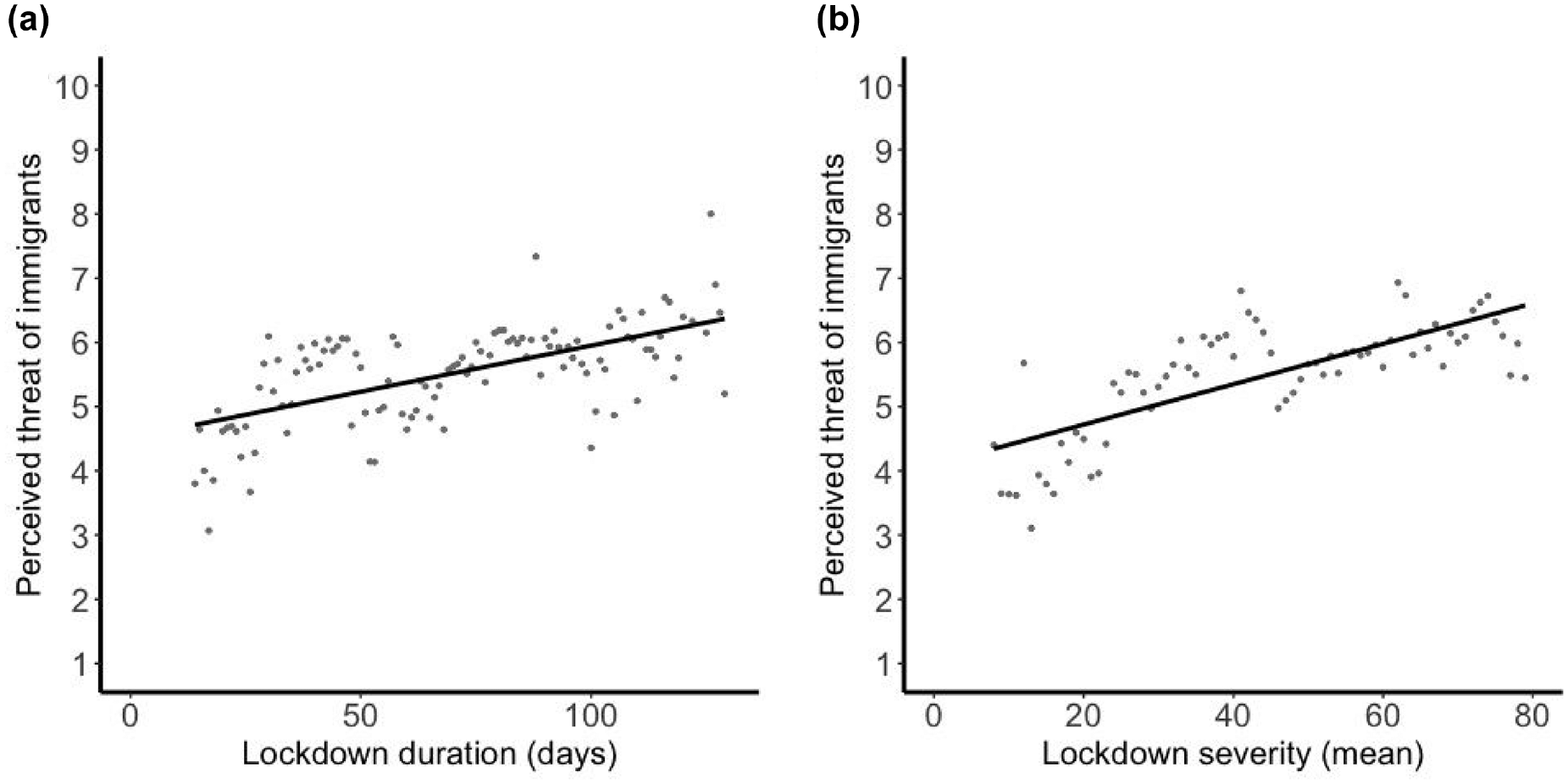
Scatter Plots of Perceived Threat of Immigrants According to Different Levels of Lockdown Duration and Lockdown Severity.
Effects of Lockdown Duration and Lockdown Severity on Perceived Threat of Immigrants
We built a multilevel SEM to examine how lockdown duration and lockdown severity predict the latent variable of perceived threat of immigrants (Model 1; Figure 2). The model achieved a good fit with the data (CFI = 0.951, RMSEA = 0.020, SRMR = 0.014). The main effects indicated that longer lockdown duration and higher lockdown severity were each reliably associated with higher perceived threat of immigrants (standardized β = 0.174 [p < .001] and 0.123 [p = .002], respectively).
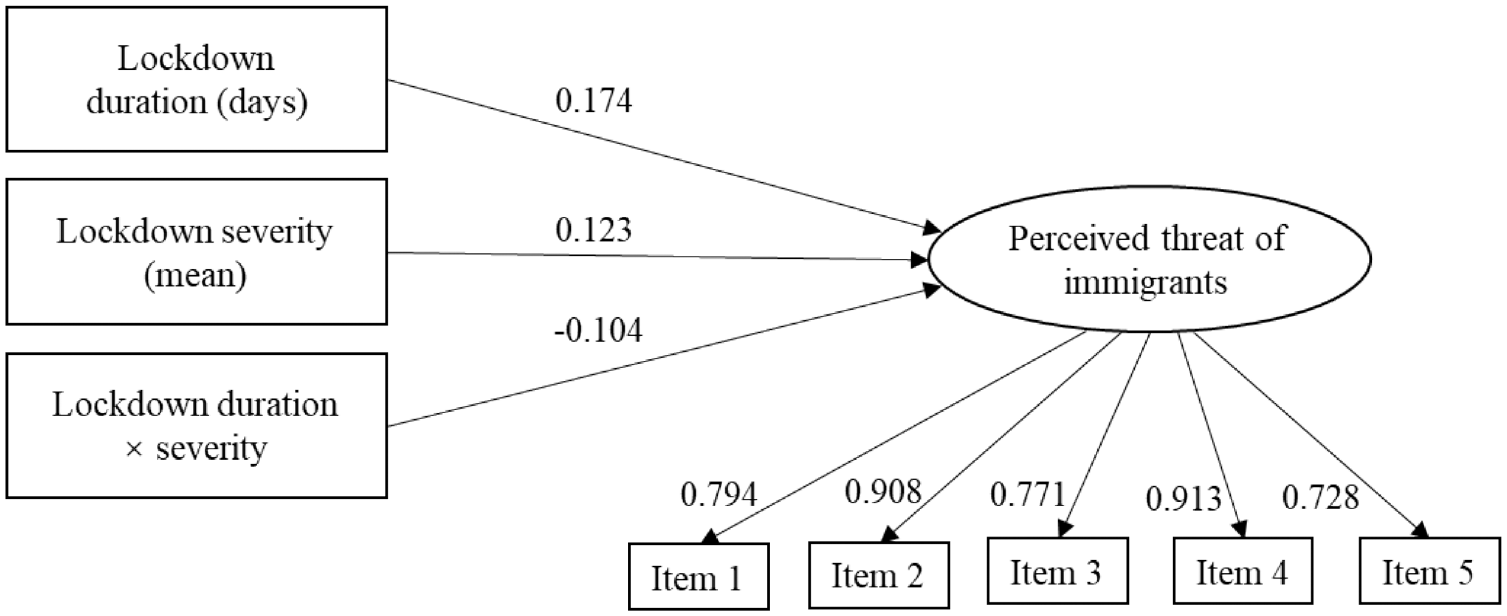
Results of Structural Equation Model Analysis.
There was also a negative two-way interaction of these two indices (β of interaction term between standardized variables = −0.104, p < .001). This suggests the effects of lockdown severity and duration were not additive or multiplicative. Rather, they were largely interchangeable: as illustrated in Figure 3, participants who had been in a relatively mild lockdown for a longer duration reported similar levels of perceived immigrant threat as those in a severe lockdown of any duration, and perceptions of immigrant threat were lowest among participants who completed our survey after only a brief duration in mild lockdowns.
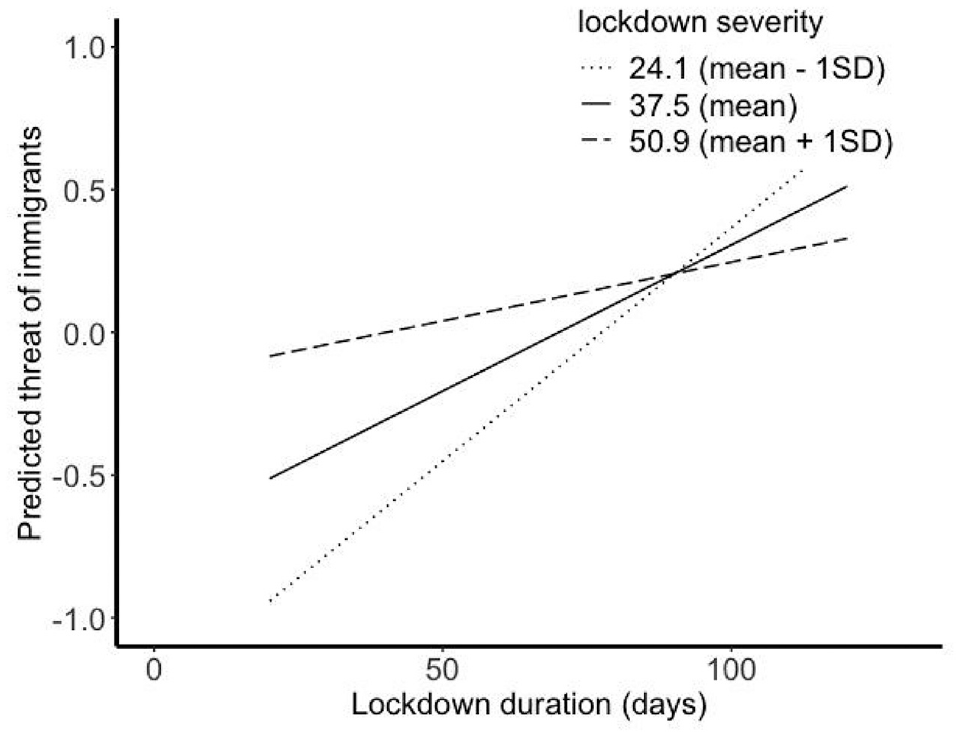
Predicted Values of Perceived Threat of Immigrants Across Lockdown Time at Different Levels of Lockdown Severity.
Drivers of Perceived Threat of Immigrants: Lockdown Conditions or Disease Threat?
Results were virtually unchanged when adjusting for objective and subjective measures of disease threat (Model 2): there remained main effects of lockdown duration (standardized β = 0.191, p < .001) and lockdown severity (standardized β = 0.146, p = .018) and the interaction term (β = −0.093, p = .004). These results demonstrated that the lockdown effects were independent of the disease threat measures.
With regards to the effects of these covariates themselves, both total new COVID-19 cases in participants’ country and participant’s subjective risk perception of getting infected had a weak negative association with perceived threat of immigrants (standardized β = −0.075 and −0.047, p = .044 and .003, respectively). The negative relationships of disease threat were in contrast to the positive relation between lockdown conditions and perceived threat of immigrants, suggesting that a disease threat hypothesis may not explain the increased anti-immigration views during the early stage of the COVID-19 pandemic. There were no effects of the total COVID-19 deaths in participants’ country (p = .357) or of calendar date of participation (p = .492). This model achieved a good fit with the data (CFI = 0.949, RMSEA = 0.020, SRMR = 0.012).
Indirect Effects Through Frustration-Related Variables
The full patterns of results of indirect effect analysis are in Supplementary Figures 1 and 2. Lockdown duration had a significant indirect effect on perceived threat of immigrants, through both thwarted life goals and routines and disempowerment (overall indirect effect combining the two mediators = 0.024, p = .002; 14% of the total effect of lockdown duration); post hoc tests for indirect effects through each variable showed marginal statistical significance.
Lockdown severity also had a significant indirect effect on perceived threat of immigrants through these two variables (overall indirect effect = 0.024, p = .007; 13% of the total effect of lockdown severity); post hoc tests showed that only the effect through thwarted life was significant (indirect effect = 0.019, p = .029). These indirect effects could imply process evidence, but these variables do not fully explain the variance in the outcome predicted by the lockdown conditions.
Exploring the Lockdown Impact on General Affect Toward Immigrants
Results from a multilevel linear regression, treating the feeling thermometer toward immigrants as the dependent variable, similarly indicated direct effects of lockdown duration and severity: standardized β = 0.169 (p < .001) and 0.108 (p = .003), respectively, with an interaction term of −0.084 (p = .001). The pattern of the data matched that for the immigrant threat scale.
Subgroup and Sensitivity Analyses
Results of subgroup analyses based on Model 1 showed that the lockdown effects were consistently observed across different gender, age and education strata (Supplementary Table 4). However, the analysis by continent showed that the lockdown effects were only significant in Europe and the Americas, and not in Asia (Supplementary Table 4); hence, the lockdown effects on perceived threat of immigrants might primarily be a Western phenomenon. Results of the sensitivity analyses supported the robustness of the main findings (Supplementary Table 5).
Discussion
The heightened anti-immigrant attitudes and racist incidents during the lockdown have become a serious social issue and a secondary consequence of the COVID-19 pandemic (Gover et al., 2020). However, previous evidence regarding the contribution of lockdown to prejudice toward immigrants was scarce—and no prior research has sought to distinguish the disease threat itself from societal restrictions on civil liberties that arose in response to the threat. In this global, natural quasi-experiment of COVID-19 lockdown conditions on individuals’ perceived threat of immigrants, we observed that longer lockdown duration, or more severe lockdown restrictions, was each significantly associated with higher perceived threat of immigrants.
The results are consistent with theories of frustration-aggression and scapegoating (Allport, 1954; Glick, 2005; Leander et al., 2020), to the extent that the lockdowns led to obstruction and deprivation. Prior research on displaced aggression suggests that people are prone to displace their frustrations when the true source of frustration is too powerful to act against (Marcus-Newhall et al., 2000). In the current context, the very power of federal governments to impose lockdowns may lead people to look for easier targets to aggress against—perhaps to reassert their own sense of control and efficacy (Leander & Chartrand, 2017; Rothschild et al., 2012). The present data suggest that this can occur quickly under severely restrictive or frustrating conditions, or eventually under less-severe conditions.
From a frustration-aggression perspective, the unpredicted negative two-way interaction between these two lockdown indices, when considered in combination with the stronger main effects, merely indicates that either prolonged lockdown or more severe restrictions suffices to increase perceived immigrant threat. The two lockdown indicators are substitutable for each other. However, this interpretation is driven by our a priori theoretical assumption that lockdown duration and severity each reflect an increased potential for thwarting and deprivation. A plausible alternative interpretation of the interaction is that the impact of lockdown duration on perceived immigrant threat was weaker under severe lockdowns because people under that condition already had a high level of perceived immigrant threat right after the strict lockdown. From this perspective, the attenuation pattern may suggest habituation, in which people’s response to lockdown restrictions was attenuated in the most extreme conditions (Mackintosh, 1987). Regardless, consistent with our theorizing, perceived immigrant threat was lowest under the least lockdown conditions (less severe, shorter duration), while all other conditions correspond with relatively higher perceived threat (as shown in Figure 3).
In addition, our data revealed robust effects of the lockdown conditions on generalized perceived threat of immigrants, independent of subjective risk perception of COVID-19 and objective disease severity. This finding is inconsistent with the disease threat hypothesis that, according to the behavioral immune system theory (Murray & Schaller, 2016; Schaller & Park, 2011), the fear of virus infection drives people’s prejudice toward out-groups during a pandemic. There have indeed been mixed findings from empirical studies regarding this theory. Although self-reported disease vulnerability and concerns of health threats could make people less supportive of unfamiliar immigrants (Faulkner et al., 2004), a recent study in Turkey revealed a more complex picture: although higher COVID-19 threat perception was associated with higher perceived threat from Syrian immigrants, it was also associated with higher common in-group identity under the extended social category that all human beings are potential victims of COVID-19 (Adam-Troian & Bagci, 2021). The findings of our study showed that both the objective disease threat (i.e., the total new cases of COVID-19) and participants’ subjective risk perception of getting infected were associated with more positive attitudes toward immigrants (albeit weakly), which was opposite to what the disease threat hypothesis would suggest and instead indicates a possible unifying effect of COVID-19 threat (Cohn, 2012). Although the effect sizes of these virus threat indices were smaller than the effect sizes of lockdown indices in our study, the opposing directions of the effects further suggest that situational threats and frustrations could yield distinct, even contradictory outcomes.
The inconsistencies do not necessarily place a frustration-based explanation in direct competition with behavioral immune system theory; the theories may be complementary, and their applicability may vary by timing and circumstance. If threats and thwarting increase prejudice for different motivational reasons (e.g., Leander et al., 2020), it remains possible that each theory only becomes applicable under certain conditions or stages of a threat. For instance, news of the impending pandemic preceded the global implementation of national lockdowns, so it is possible that threat-based responses had already transpired prior to our data collection. A second possibility is that any non-zero level of disease threat sufficed to serve as a sequential precondition to any lockdown effects.
The lockdown effects on perceived threat of immigrants could mainly be a Western phenomenon. Results of subgroup analyses showed lockdown effects in the Americas and Europe but not in Asia, suggesting either a cultural and regional difference in the contribution of lockdown to xenophobia, or that such prejudice was mainly toward Asian people who would be minorities in Western countries. Future research could also investigate if there are cross-cultural differences in experience with—and acceptance of—restrictive government measures to control an epidemic, and whether Western countries are more prone to frustration due to societal norms for liberty.
The main practical implication is that societies that restrict individual liberty in service to public health may need to plan for frustration-related responses against vulnerable groups. It is noteworthy that, immediately after the United Kingdom initiated a lockdown in April 2020, the rate of racially or religiously motivated hate crimes reached the highest level in five years, according to the Crime Survey of England and Wales (CSEW) and the U.K. Police Recorded Crime Series (Home Office, 2020). Negative intergroup attitudes can predict the rationalization of such hate crimes among the broader population (Leander et al., 2020). Even with regards to controlling a disease outbreak, increased xenophobia could be counterproductive to the extent that health protection relies on solidarity and cooperation between groups. In the current context, lockdown-induced xenophobia may not only have threatened the safety and health of immigrants (Lee & Waters, 2021), but also impeded the collaborative control of coronavirus globally. Given that our data suggest that policymakers cannot simply soften the restrictions over time to avoid these outcomes, policymakers may consider interventions to address the negative intergroup attitudes or redirect individuals’ responses to being thwarted toward prosocial alternatives (Leander & Chartrand, 2017; Leander et al., 2020).
From a methodological perspective, this study showed how to apply a quasi-experimental approach to social psychological problems, using database integration and metadata (country, timestamps) to conduct natural quasi-experiments on a global scale in times of crisis. The strengths of this natural experiment include a massive sample size and representation across the East and West. Through the use of multilevel SEM, with country as a random effect, we can isolate the effects specifically to the lockdown conditions without concerns for cultural confounds. Moreover, given that lockdown severity and duration are objective, real-world indices developed by outside experts (Hale et al., 2021), these measures are unlikely to suffer from demand characteristics or common method bias that often plague classic surveys and perhaps even some experimental research. This study also minimizes reverse causality bias because the longitudinal nature of lockdown duration (ranging from 14 to 129 days—albeit between-subjects) and lockdown severity (calculated as the average level across the lockdown period) ensures a clear direction of the potential causal link pointing from lockdown measures to anti-immigrant attitudes. Finally, the migrant threat items adapted from the ANES and ESS scales have been widely used in various research fields, and have high reliability in our study sample (Cronbach’s α = .92).
This study has several limitations. First, the OxCGRT policy indices were calculated at the country level, so we lack more precise local level of lockdown data to be mapped to each participant (such data may become available in time). Nevertheless, during the data collection period (March 19 to May 11, 2020), most of the 23 countries implemented national lockdown measures instead of local measures. Second, self-reported perceptions of immigrant threat are inherently subjective and may suffer from measurement error. Third, it would be useful to test whether lockdown-induced population shifts in intergroup attitudes indeed predict regional increases in hate crimes against immigrants, intentions to help redress immigrants’ heightened vulnerability to the COVID-19 health risk and economic consequences (Hu, 2020; Raisi-Estabragh et al., 2020), and immigration policy preferences (Adam-Troian & Bagci, 2021). Such information could give a clear understanding of the practical outcomes of lockdown-related frustrations and thus provide policymakers and the public a more comprehensive view of the social-psychological risks of lockdown.
To conclude, this study demonstrated that national lockdown duration and severity were positively associated with individual-level perceptions of immigrant threat. The lockdown-induced prejudice toward immigrants was independent of the objective and perceived disease threats. When implementing restrictive policies in future, similar crises, relevant interventions may be needed to protect against classic frustration and scapegoating effects and prevent secondary social crises.
Supplemental Material
sj-docx-1-spp-10.1177_19485506221127487 – Supplemental material for Impact of National Pandemic Lockdowns on Perceived Threat of Immigrants: A Natural Quasi-Experiment Across 23 Countries
Supplemental material, sj-docx-1-spp-10.1177_19485506221127487 for Impact of National Pandemic Lockdowns on Perceived Threat of Immigrants: A Natural Quasi-Experiment Across 23 Countries by Qing Han, Bang Zheng, N. Pontus Leander, Maximilian Agostini, Ben Gützkow, Jannis Kreienkamp, Maja Kutlaca, Edward P. Lemay, Wolfgang Stroebe, Michelle R. vanDellen and Jocelyn J. Bélanger in Social Psychological and Personality Science
Footnotes
Handling Editor: Danny Osborne
Authors’ Note
The full co-author list of the PsyCorona Collaboration is: Georgios Abakoumkin, University of Thessaly. Jamilah Hanum Abdul Khaiyom, International Islamic University Malaysia. Vjollca Ahmedi, Pristine University. Handan Akkas, Ankara Science University. Carlos A. Almenara, Universidad Peruana de Ciencias Aplicadas. Mohsin Atta, University of Sargodha. Sabahat Cigdem Bagci, Sabanci University. Sima Basel, New York University Abu Dhabi. Edona Berisha Kida, Pristine University. Allan B. I. Bernardo, De La Salle University. Nicholas R. Buttrick, University of Virginia. Phatthanakit Chobthamkit, Thammasat University. Hoon-Seok Choi, Sungkyunkwan University. Mioara Cristea, Heriot Watt University. Sára Csaba, ELTE Eötvös Loránd University, Budapest. Kaja Damnjanovic, University of Belgrade. Ivan Danyliuk, Taras Shevchenko National University of Kyiv. Daniela Di Santo, University “La Sapienza,” Rome. Karen M. Douglas, University of Kent. Violeta Enea, Alexandru Ioan Cuza University, Iasi. Daiane Gracieli Faller, New York University Abu Dhabi. Gavan Fitzsimons, Duke University. Alexandra Gheorghiu, Alexandru Ioan Cuza University. Ángel Gómez, Universidad Nacional de Educación a Distancia. Ali Hamaidia, Setif 2 University. Mai Helmy, College of education, Sultan Qaboos University, Muscat, Oman; Faculty of Arts, Menoufia University, Egypt. Joevarian Hudiyana, Universitas Indonesia. Bertus F. Jeronimus, University of Groningen. Ding-Yu Jiang, National Chung-Cheng University. Veljko Jovanović, University of Novi Sad. Željka Kamenov, University of Zagreb. Anna Kende, ELTE Eötvös Loránd University, Budapest. Shian-Ling Keng, Monash University Malaysia, Malaysia. Tra Thi Thanh Kieu, HCMC University of Education. Yasin Koc, University of Groningen. Kamila Kovyazina, Independent researcher, Kazakhstan. Inna Kozytska, Taras Shevchenko National University of Kyiv. Joshua Krause, University of Groningen. Arie W. Kruglanski, University of Maryland. Anton Kurapov, Taras Shevchenko National University of Kyiv. Nóra Anna Lantos, ELTE Eötvös Loránd University, Budapest. Cokorda Bagus Jaya Lesmana, Udayana University. Winnifred R. Louis, University of Queensland. Adrian Lueders, Université Clermont-Auvergne. Najma Iqbal Malik, University of Sargodha. Anton Martinez, University of Sheffield. Kira O. McCabe, Carleton University. Jasmina Mehulić, University of Zagreb. Mirra Noor Milla, Universitas Indonesia. Idris Mohammed, Usmanu Danfodiyo University Sokoto. Erica Molinario, University of Maryland. Manuel Moyano, University of Cordoba. Hayat Muhammad, University of Peshawar. Silvana Mula, University “La Sapienza,” Rome. Hamdi Muluk, Universitas Indonesia. Solomiia Myroniuk, University of Groningen. Reza Najafi, University of Padova. Claudia F. Nisa, New York University Abu Dhabi. Boglárka Nyúl, ELTE Eötvös Loránd University, Budapest. Paul A. O’Keefe, Yale-NUS College. Jose Javier Olivas Osuna, National Distance Education University (UNED). Evgeny N. Osin, National Research University Higher School of Economics. Joonha Park, NUCB Business School. Gennaro Pica, University of Camerino. Antonio Pierro, University “La Sapienza,” Rome. Jonas Rees, University of Bielefeld. Anne Margit Reitsema, University of Groningen. Elena Resta, University “La Sapienza,” Rome. Marika Rullo, University of Siena. Michelle K. Ryan, The Australian National University, University of Groningen. Adil Samekin, School of Liberal Arts, M. Narikbayev KAZGUU University, Astana, Kazakhstan. Pekka Santtila, New York University Shanghai. Edyta Sasin, New York University Abu Dhabi. Birga M. Schumpe, University of Amsterdam. Heyla A. Selim, King Saud University. Michael Vicente Stanton, California State University, East Bay. Samiah Sultana, University of Groningen. Robbie M. Sutton, University of Kent. Eleftheria Tseliou, University of Thessaly. Akira Utsugi, Nagoya University. Jolien Anne van Breen, Leiden University. Caspar J. Van Lissa, Tilburg University. Kees Van Veen, University of Groningen. Alexandra Vázquez, Universidad Nacional de Educación a Distancia. Robin Wollast, Université Clermont-Auvergne. Victoria Wai-lan Yeung, Lingnan University. Somayeh Zand, University of Milano-Bicocca, Milan, Italy. Iris Lav Žeželj, University of Belgrade. Andreas Zick, Bielefeld University. Claudia Zúñiga, Universidad de Chile.
Declaration of Conflicting Interests
The author(s) declared no potential conflicts of interest with respect to the research, authorship, and/or publication of this article.
Funding
The author(s) disclosed receipt of the following financial support for the research, authorship, and/or publication of this article: This research received support from the New York University Abu Dhabi (grant no. VCDSF/75-71015), the University of Groningen (Sustainable Society & Ubbo Emmius Fund), Wayne State University (Saperstein endowed chair), and the Government of Spain (grant no. COV20/00086). It was co-funded by the European Regional Development Fund (ERDF “A way to make Europe”). The funding source had no other role other than financial support.
Ethical Approval
The study was approved by the Ethics Committees of the University of Groningen (grant no. PSY-1920-S-0390) and New York University Abu Dhabi (grant no. HRPP-2020-42).

Supplemental Material
Supplemental material for this article is available online.
Author Biographies
References
Supplementary Material
Please find the following supplemental material available below.
For Open Access articles published under a Creative Commons License, all supplemental material carries the same license as the article it is associated with.
For non-Open Access articles published, all supplemental material carries a non-exclusive license, and permission requests for re-use of supplemental material or any part of supplemental material shall be sent directly to the copyright owner as specified in the copyright notice associated with the article.
