




Abstract
Perceiving one’s partner as supportive is considered essential for relationships, but we know little about which factors are central to predicting perceived partner support. Traditional statistical techniques are ill-equipped to compare a large number of potential predictor variables and cannot answer this question. This research used machine learning analysis (random forest with Shapley values) to identify the most salient self-report predictors of perceived partner support cross-sectionally and 6 months later. We analyzed data from five dyadic data sets (N = 550 couples) enabling us to have greater confidence in the findings and ensure generalizability. Our novel results advance the literature by showing that relationship variables and attachment avoidance are central to perceived partner support, whereas partner similarity, other individual differences, individual well-being, and demographics explain little variance in perceiving partners as supportive. The findings are crucial in constraining and further developing our theories on perceived partner support.
Perceiving one’s partner as supportive is considered an essential element in romantic relationships, but we lack knowledge about which factors are central to predicting such perceptions. Several relationship theories (e.g., attachment theory, self-determination theory, and interdependence theory) have underscored the centrality of partner support in promoting well-functioning relationships. Existing research has examined several potential factors that are considered important for perceived partner support, but it has not compared the relative importance of these different factors, in part because traditional statistical analyses are not well-equipped to examine a large number of potential predictors at once. The purpose of this study was to leverage the power of machine learning to compare which theoretically relevant relational and individual variables—from the perspectives of both the support receiver and the support provider—predict the most variance in perceived partner support.
Established Relational Predictors of Perceived Partner Support
According to attachment and interdependence theories, actors should perceive partners as more supportive when the relationship is characterized by high satisfaction, empathy, commitment, trust, and willingness to sacrifice, and low conflict (Feeney & Collins, 2015; Kelley & Thibaut, 1978; Mikulincer & Shaver, 2009; Rusbult & Van Lange, 2003; Ryan & Deci, 2000). This is because partners in these relationships can count on each other to provide support and are thus more open to support when needed or may be more willing to take risks (Rusbult & Van Lange, 2003). This in turn leads the recipients to perceive their partners as supportive. Furthermore, the transactive goal dynamics theory suggests that high goal correspondence allows partners to better coordinate their efforts to achieve their goals and thus is likely to be more supportive (Fitzsimons & Finkel, 2018). Finally, self-expansion theory (Aron et al., 1991) suggests that inclusion of other in the self enables greater shared intimacy, in turn leading partners to share resources and to perceive each other as more supportive. Based on these theories, we would expect relationship variables (see Table 1 for the full list of variables) to be important for perceiving partners as supportive, but it is not clear whether there are specific relational variables that contribute to perceptions of support more than others.
The List of Included Variables With a Theoretical Rationale for Inclusion.
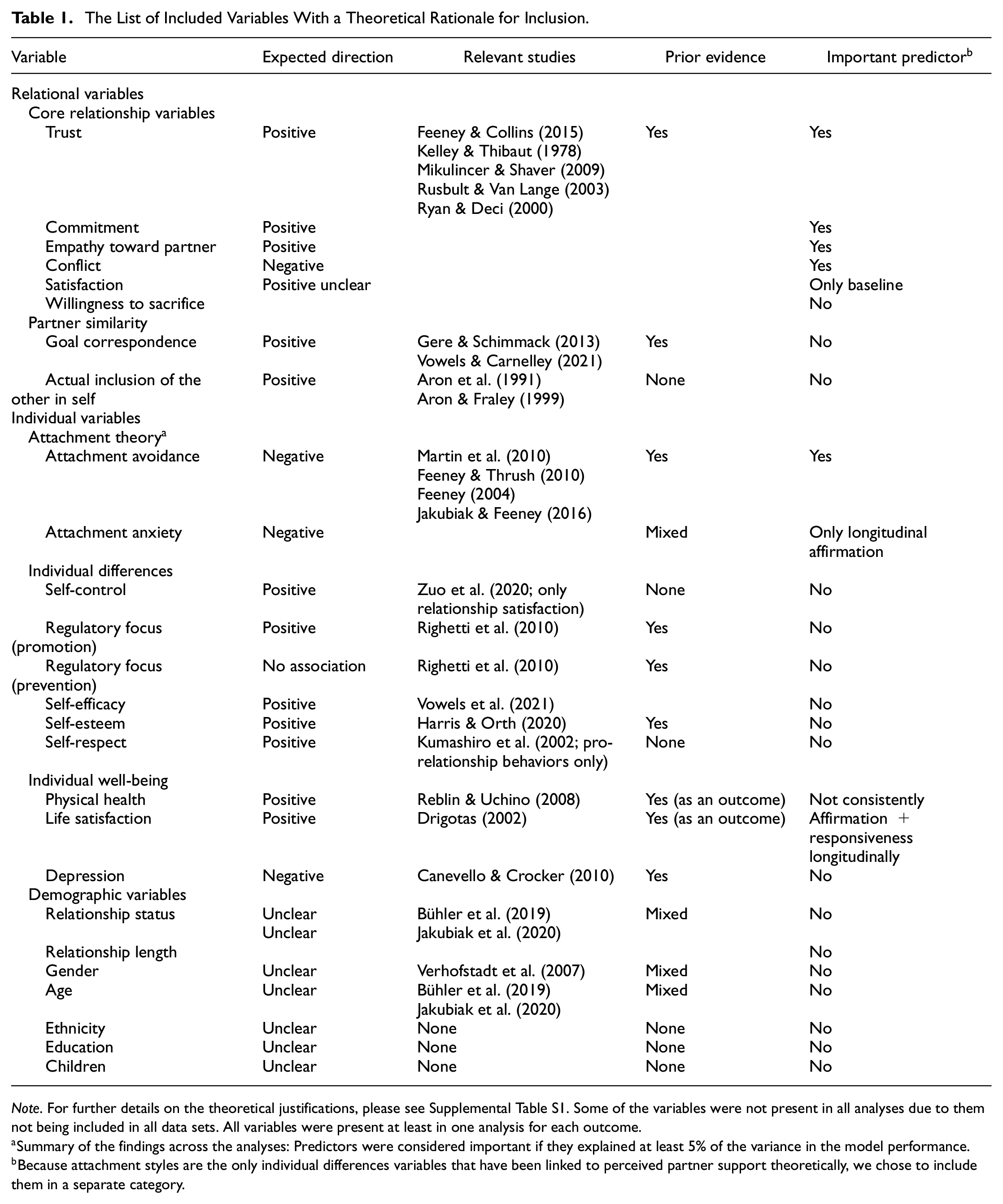
Note. For further details on the theoretical justifications, please see Supplemental Table S1. Some of the variables were not present in all analyses due to them not being included in all data sets. All variables were present at least in one analysis for each outcome.
Summary of the findings across the analyses: Predictors were considered important if they explained at least 5% of the variance in the model performance.
Because attachment styles are the only individual differences variables that have been linked to perceived partner support theoretically, we chose to include them in a separate category.
Established Individual Predictors of Perceived Partner Support
Interestingly, few theories on partner support have explicitly discussed which individual differences variables are the most likely to explain why some partners perceive and are perceived as more supportive than others (see attachment theory for an exception; Mikulincer & Shaver, 2009). Attachment theory suggests that avoidantly attached individuals perceive partners as less supportive because they doubt partners’ availability (Martin et al., 2010), whereas anxiously attached individuals doubt their worthiness of being supported but feel others as capable of providing support, which has resulted in mixed findings for attachment anxiety (Feeney, 2004; Feeney & Thrush, 2010; Jakubiak & Feeney, 2016; Martin et al., 2010). According to attachment theory, individuals who trust themselves are also more likely to trust others’ capacity to be supportive when needed (Collins & Feeney, 2004) and thus are more likely to perceive their partners as supportive. Thus, we expect that individuals higher in promotion orientation (i.e., regulatory focus on dreams and aspirations; Righetti & Kumashiro, 2012), self-control (Zuo et al., 2020), and self-efficacy (Vowels & Carnelley, 2020; Vowels et al., 2021) feel a greater sense of autonomy (self-determination theory; Ryan & Deci, 2000) and trust in their ability to achieve their goals (attachment theory; Collins & Feeney, 2004). Furthermore, we expect that individuals high in self-esteem (Harris & Orth, 2020) or self-respect (Kumashiro et al., 2002) would perceive their partners as more supportive as they may self-select into healthier relationships or be able to elicit higher quality support from their partners. In addition, while better physical (Reblin & Uchino, 2008) and emotional well-being (Canevello & Crocker, 2010; Drigotas, 2002) have often been considered as outcomes of perceived partner support, it is also likely that individuals with higher well-being are more easily supported. For example, depression makes people more pessimistic and view everything in a negative light (Anzaldi & Shifren, 2019). Thus, we expect that people who have higher well-being are more optimistic in their perceptions of partner behaviors and act in ways that tend to elicit positive behaviors from their partners.
Finally, demographic variables, such as relationship length, age, and gender have previously been associated with perceived partner support, with mixed results (Bühler et al., 2019; Jakubiak et al., 2020; Verhofstadt et al., 2007). Several researchers have hypothesized that support for goals is likely more important in early stages of the relationship, with the importance of support declining over time (Bühler et al., 2019; Jakubiak et al., 2020; Verhofstadt et al., 2007), whereas other researchers have found that longer relationship length predicted higher perceived partner support (Lantagne & Furman, 2017). Furthermore, because women are traditionally socialized to be more caring, partners may find women more supportive. Indeed, previous research has found women to be perceived as more supportive; however, both men and women felt equally supported by their spouse (Verhofstadt et al., 2007). There is no prior literature on education, ethnicity, or children on perceived partner support, but we have provided a rationale for their inclusion in Supplemental Table S1.
Machine Learning
Previous research has relied exclusively on traditional linear models (Breiman, 2001b; Lundberg et al., 2020; Luque-Fernandez et al., 2018; Orben & Przybylski, 2019; Peters et al., 2017). Machine learning algorithms have several key advantages over these models: they can learn highly nonlinear relationships between variables, handle a large number of predictors at once, and estimate complex interactions between different variables. As such, they are not susceptible to multicollinearity or functional form (e.g., expecting an association to be linear, whereas the real relationship is cubic) misspecification (Vowels, 2021). Because of this, using machine learning provides a much more flexible and powerful approach to predicting an outcome. Machine learning algorithms are traditionally fed as many predictors as possible to maximize prediction. It then learns which variables are important for predicting the outcome. In this study, we use a random forest algorithm (Breiman, 2001a), which is a form of explainable decision tree that can handle highly nonlinear relationships and complex interactions without overfitting to the data.
Machine learning models, including random forests, have traditionally been “black box models” where the researcher is unable to understand what the algorithm has used for predicting the outcome. However, recent developments in machine learning have provided tools that allow interpretation of the results through explanations of machine learning models (Lundberg et al., 2017, 2019). This work is particularly interesting because it enables researchers to combine the use of powerful machine learning algorithms and state-of-the-art tools for model explainability that can provide accurate predictions as well as increase our understanding of which factors are the most important in predicting the model outcome. The latter is of particular importance because one of the principal aims of psychology is to develop a deeper understanding of human behavior (Grosz et al., 2020). In this study, we take advantage of this new development in machine learning by using Shapley values (Lundberg et al., 2017, 2019) to estimate the effect size and direction of the effect of each variable predicting perceived partner support
The Current Research
Our aim was to examine which relational and individual factors are the most predictive of perceived partner support. We examined two types of perceived partner support (Feeney & Collins, 2015): perceived partner responsiveness (i.e., being available and responsive to the partner’s needs, and understanding and validating one’s overall self; Reis et al., 2004) and perceived affirmation of the ideal self (i.e., perceiving and behaving in a manner consistent with the partner’s ideal self; Drigotas et al., 1999). The former is a broader construct and is considered one possible central organizing theme for the diverse phenomena relationship scientists study (Reis, 2007), whereas the latter is more specific and focused explicitly on partner’s role in helping individuals become closer to their ideal self (Drigotas et al., 1999). As such, although both are frequently used to examine partner support in romantic relationships, they may be predicted by different factors due to affirmation being more specifically about the ideal self.
The predictor variable selection for this study was guided by existing theoretical frameworks to test the explanatory power of different relational and individual variables (see Table 1 for the variables, expected direction of the effect, and state of the current evidence). The selection was somewhat limited by the availability of variables across the data sets. Furthermore, because there are (at least) two people in romantic relationships, it is important to understand whether one person’s outcome is only determined by their own variables (actor effects) or whether their partner’s reports also predict the actor’s outcomes (partner effects). Our hope is to add to the current understanding of the factors that are the most and least likely to predict perceived support. We used data from five dyadic data sets that had a large number of common predictor variables and addressed the following research questions:
Method
Participants and Procedure
The preregistration and materials for the project can be found on the Open Science Framework (OSF) https://osf.io/v368c/. 1
Five dyadic data sets (Finkel, 2020a; 2020b; Rusbult et al., 2019a, 2019b) were combined in this project to create a large data set of couples. These data sets were chosen because they included a large number of predictor variables that were the same across the samples. We are aware of no other data sets with such high overlap in the variables. All data sets included cross-sectional self-reported data collected from both dyad members in romantic relationships. Two of the data sets included only dating couples (n1 = 74, n4 = 92), one data set included newly committed couples (e.g., engaged, married, or moving in together; n3 = 178), and two data sets included married couples (n2 = 120, n5 = 77). The final sample consisted of 550 couples (1,100 individuals). Data set 3 was also used to predict support 6 months later and included 161 couples.
On average, participants were aged 28.32 years (SD = 10.90, range = 18–79) and had been in a relationship for 5.59 years (SD = 8.13, range = 0.08–61.50). Most of the participants were White (n = 876, 80%), with a minority being African American (n = 83, 8%), Hispanic (n = 35, 3%), or Asian (n = 72, 7%). The sample was primarily well educated: 196 (18%) participants had a graduate degree (MS/PhD), 466 (42%) a bachelor’s degree, 379 (34%) at least some college, and 60 (5%) had no college courses. The couples were married (n = 266, 48%), cohabiting (n = 127, 23%), or dating and not living with each other (n = 220, 40%) and most of the couples did not have any children (n = 462, 84%). All data were collected in the United States.
Measures
The outcome variable, perceived partner support, was measured using the 18-item responsiveness scale (Reis et al., 2004) in four data sets and the partner affirmation scale (Drigotas et al., 1999) in three data sets. The rest of the variables from each data set were included in the final data set as predictors if the variable appeared in at least three of the five data sets. These variables were divided into actor’s and partner’s individual (n = 17) and relational (n = 11) predictors (summarized in Table 1; see supplemental material for the description of the scales used).
Data Analysis
Details of the data preparation and analyses can be found in the supplemental material. The results were analyzed using Python 3.7 and the code can be found here: https://github.com/matthewvowels1/Aff_Eff_PPR. Each data set was analyzed using a random forest regressor (Breiman, 2001a). A random forest is a type of decision tree that trains on bootstrapped subsamples of the data to avoid overfitting. We used the default “scikit learn” random forest regressor with tenfold cross-validation (Pedregosa et al., 2011). The metrics for test data model performance used were the mean square error (which is the averaged squared difference between the prediction and the observed value), the R2, and the variance explained. The full last model trained was saved and explained using the “SHapley Additive exPlanations” package (SHAP; Lundberg et al., 2017, 2019, 2020). The results are provided as feature importances, which describe how important the variable is for the model outcome and how much it changes the outcome.
The analyses were conducted separately by first including as many participants as possible in each analysis and then by including as many variables as possible. This resulted in a total of four analyses (three for perceived partner responsiveness and one for affirmation) that were conducted twice: once including only actor effects and once including both actor and partner effects. The included variables and the results for all analyses can be found on the OSF project page. Random forests in their current form are unable to explicitly model hierarchies in the data and it is possible that hierarchical data can inflate the predictive performance. However, given we were primarily interested in the relative performance of different predictors, which is not affected by hierarchical data, this is less of an issue in this study.
Results
Total Variance Explained (Research Questions 1–3)
Table 2 presents the overall prediction results for each outcome variable for each model for relational and individual variables as well as for models including actor effects only and for models including both actor and partner effects. In the actor only models, we were able to explain the most variance in perceived responsiveness overall (48.2%–55.3%), with relational variables generally predicting the largest percentage of the variance (57.1%–69.2%). Individual variables predicted a total of between 30.8% and 42.9% of the variance. Partner effects did not improve the predictive power of the models; if anything, partner effects contributed noise to the data and made the prediction less accurate. However, in the models with partner effects included, partners’ individual variables predicted between 11.6% and 13.4% of the variance. In contrast, partners’ relational variables predicted very little variance (3.2%–5.5%).
The Overall Prediction Results for Each Outcome Variable for Individual and Relational Variables and Models With Actor Effects Only and With Both Actor and Partner Effects.
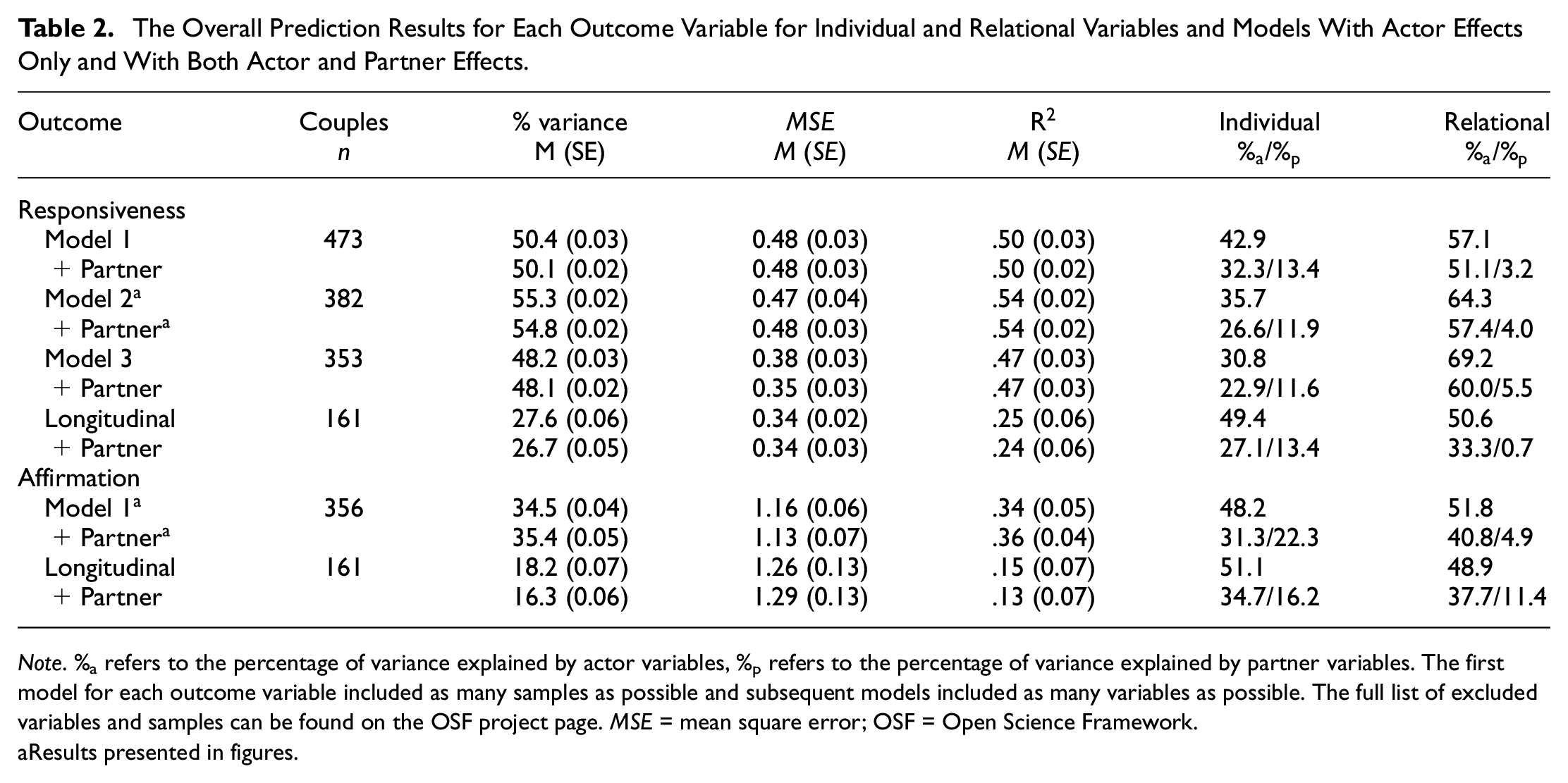
Note. %a refers to the percentage of variance explained by actor variables, %p refers to the percentage of variance explained by partner variables. The first model for each outcome variable included as many samples as possible and subsequent models included as many variables as possible. The full list of excluded variables and samples can be found on the OSF project page. MSE = mean square error; OSF = Open Science Framework.
Results presented in figures.
For perceived affirmation, the model with actor effects was able to predict 34.5% of the variance with relational and individual variables predicting similar amounts of variance (48.2% and 51.8%, respectively). In the models with both actor and partner effects, actors’ relational variables predicted the most variance (40.8%) followed by actors’ individual variables (31.3%). Partners’ individual variables contributed 22.3% of the variance, whereas partners’ relational variables contributed very little (4.9%).
Most Predictive Variables (Research Question 4)
In most of the models, the predictive importance of the variables decreased after only a small number of predictors. The rest of the predictors contributed only a small amount of variance into the model individually. We used 5% as a cutoff for percentage change in the model. We present the top 10 variables for each outcome in the figures and all predictors in Table 3 for the percentage model change for the main actor models. In the figures, the left side provides the average effect of each variable on the model outcome. The right side of the figure provides the estimates for each individual participant. Red (dark grey) indicates a higher value of the predictor variable and blue (light grey) indicates a lower value. For example, red is equal to 1 and blue is equal to 0 for binary variables. The Shapley values are additive and can be interpreted similarly to an average effect from a linear model. For example, 1 unit increase in relationship satisfaction predicted a corresponding average increase of 0.33 units in perceived responsiveness. The individual effects show that low relationship satisfaction predicted up to a –3.0-unit change in perceived responsiveness compared with average relationship satisfaction, whereas a high relationship satisfaction score predicted up to 0.5-unit increase in perceived responsiveness compared with average relationship satisfaction. In Table 3, the impact is rescaled to be between 0 and 1 for ease of interpreting and comparing effect sizes.
The Impact of All Variables of the Most Predictive Models for Responsiveness and Affirmation.
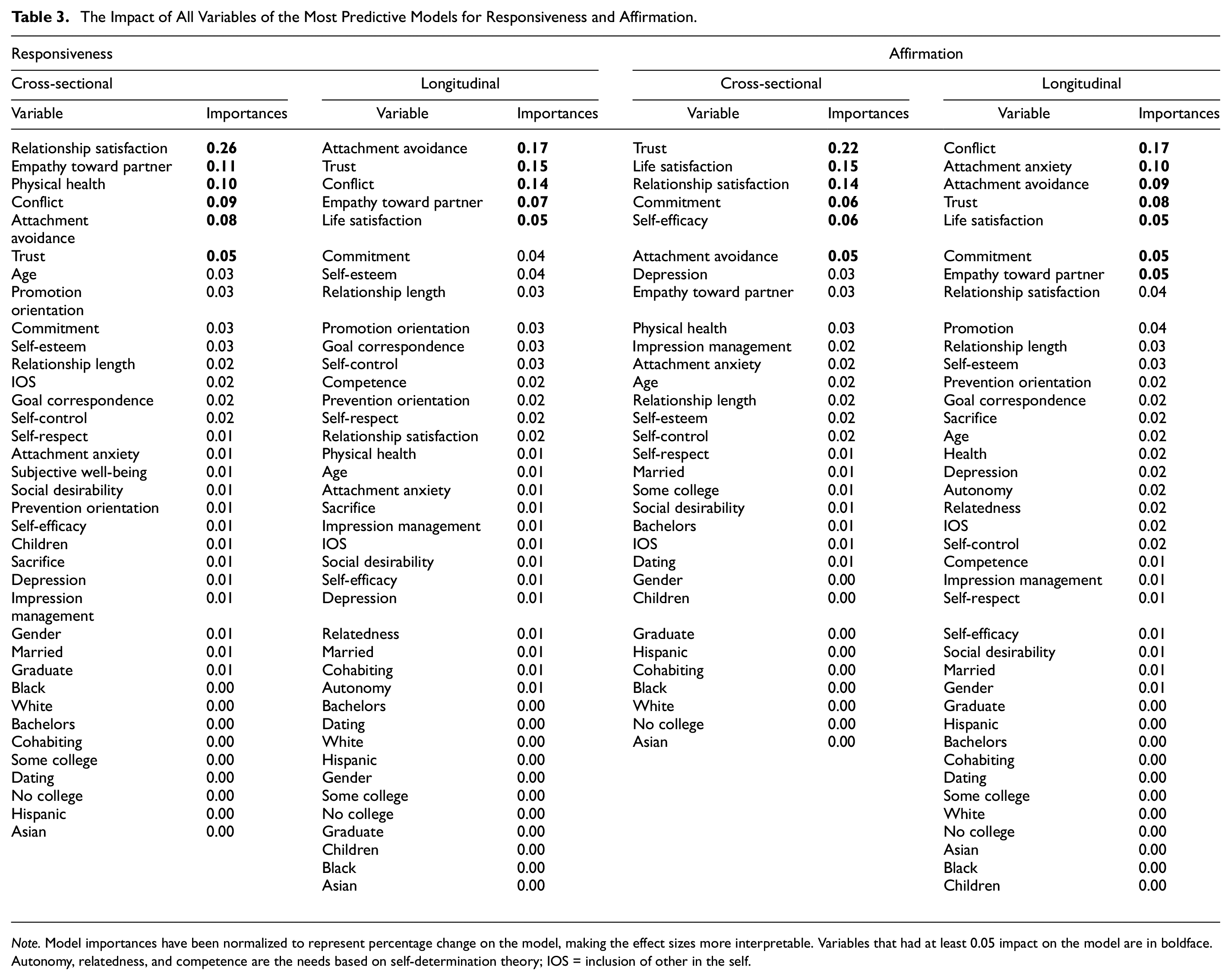
Note. Model importances have been normalized to represent percentage change on the model, making the effect sizes more interpretable. Variables that had at least 0.05 impact on the model are in boldface. Autonomy, relatedness, and competence are the needs based on self-determination theory; IOS = inclusion of other in the self.
Perceived partner support was measured using two variables: perceived responsiveness and affirmation. There were four relational (relationship satisfaction, empathy toward partner, trust, and commitment) predictors that were consistently predictive of higher levels of perceived responsiveness (see Figure 1) and affirmation (see Figure 2). Experiencing higher conflict in the relationship in general predicted lower perceived responsiveness and affirmation. Willingness to sacrifice and inclusion of other in the self, on the contrary, explained very little variance in the outcomes.
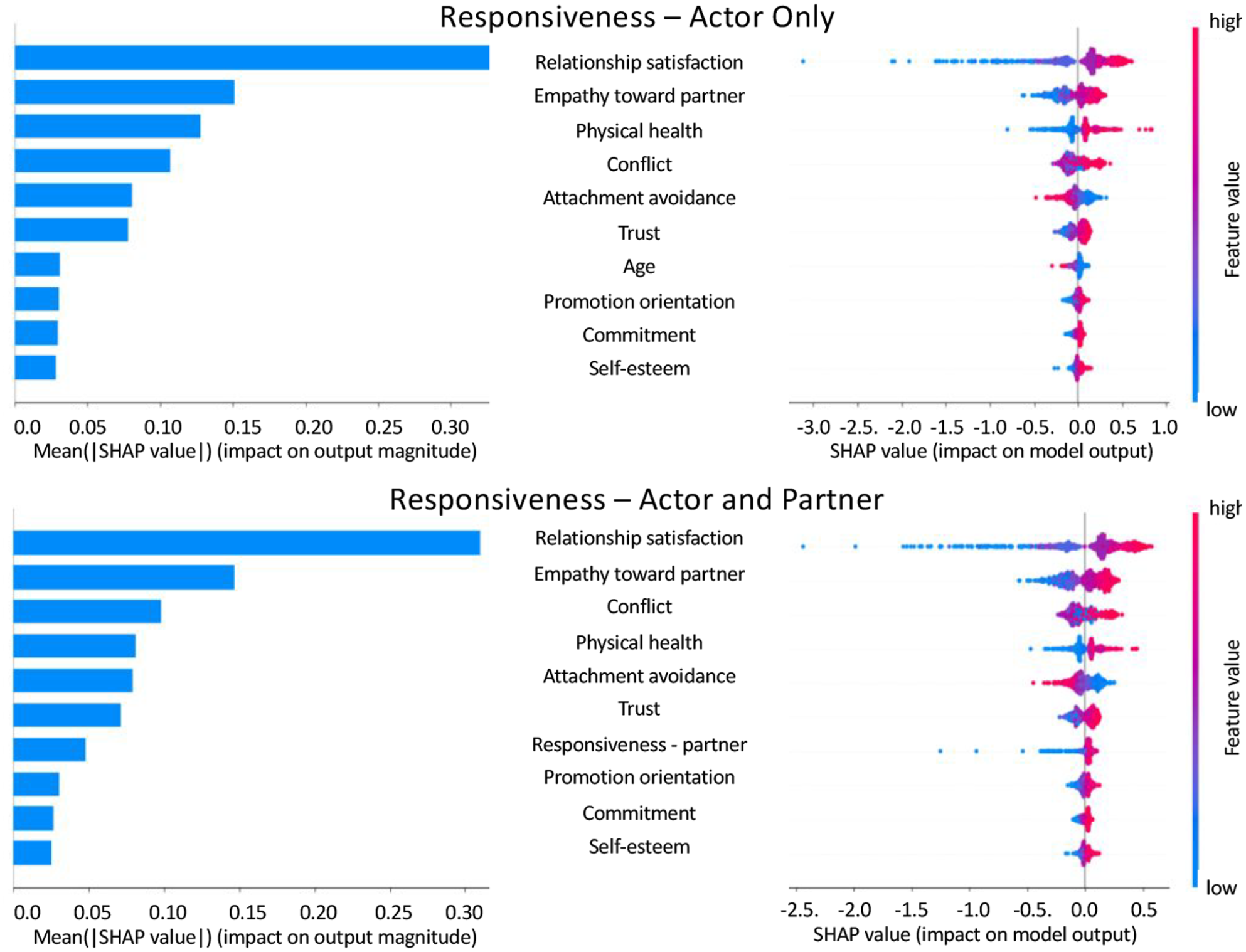
The Top 10 Most Important Predictors for Responsiveness for Models With Actor Effects and Both Actor and Partner Effects.
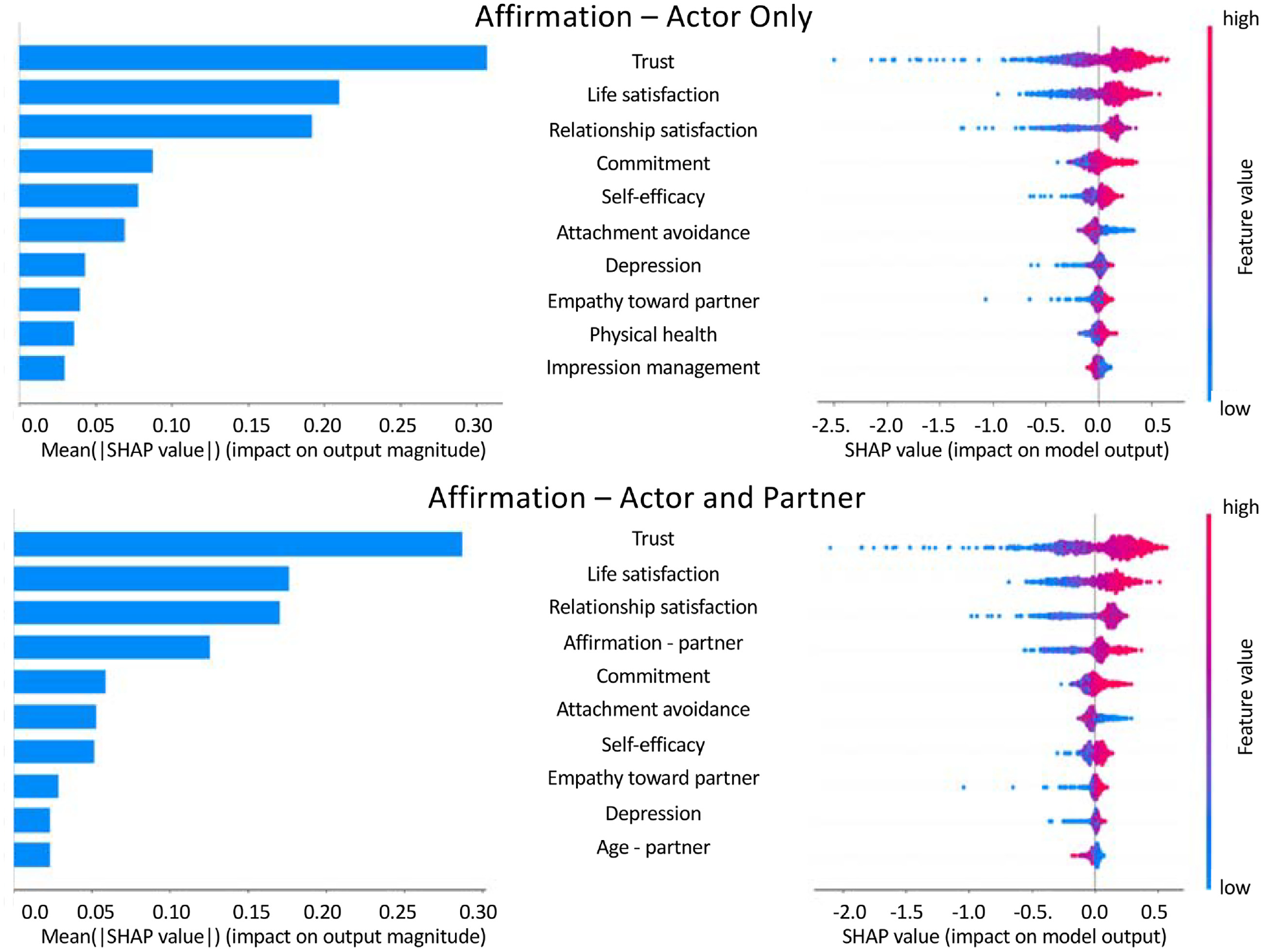
The Top 10 Most Important Predictors for Affirmation for Models With Actor Effects and Both Actor and Partner Effects.
Out of individual (attachment, individual differences, individual well-being, and demographics) variables, only higher actor attachment avoidance predicted lower perceived partner responsiveness and affirmation across analyses. Better physical health also predicted higher perceived responsiveness, whereas greater life satisfaction and depression predicted higher perceived affirmation. There were several variables that explained very little variance in the outcome, including all demographic variables and individual differences variables (other than attachment). There were no partner variables that predicted perceived responsiveness and affirmation consistently across analyses.
Exploratory Longitudinal Analyses
Finally, to examine whether the variables at baseline would be able to predict support 6 months later, we used Sample 3 (n = 322 [161 couples]) to estimate the longitudinal associations between the predictor variables and the outcome. 2 Overall, we were able to predict 27.6% of variance in responsiveness and 18.2% of variance in affirmation with only actor effects. Models with actor and partner effects were somewhat less predictive (26.7% for responsiveness and 16.3% for affirmation). Relational and individual variables were equally predictive of support (see Table 2 for the full model results and Table 3 for normalized impact on the model). The only consistently important predictors across analyses were trust, commitment, attachment avoidance, and life satisfaction. Trust and commitment consistently predicted higher responsiveness and affirmation 6 months later, but relationship satisfaction did not. Both higher attachment anxiety and higher attachment avoidance predicted a decrease in perceived affirmation 6 months later but only attachment avoidance predicted responsiveness. Participants who reported higher life satisfaction at baseline reported higher perceived affirmation and responsiveness 6 months later.
Discussion
The purpose of this study was to add to the growing body of literature on perceived partner support by using explainable machine learning to understand which variables reliably predict perceived partner support and which variables do not. It was the first study to compare a large number of variables providing novel insights into who perceive their partner as supportive and in which types of relationships. It is important to understand what researchers, practitioners, and policy makers should, and should not, focus on when designing interventions to improve support, whether for quitting smoking, achieving career goals, or beating cancer. Overall, we were able to predict a large amount of variance in both outcomes at baseline and 6 months later but not predict any change over time. Joel et al. (2020) also found that variables included in existing data sets were unable to account for changes in relationship satisfaction and commitment over time. Thus, it appears that, although we can predict outcomes as a field, we are unable to predict changes over time. Because perceived partner support has been robustly associated with better individual and relationship well-being, it is useful to understand variables that predict perception of support. However, we should also be able to predict changes in our outcomes. Predicting actual change will likely become an important challenge for the future of relationship research.
Summary of the Most and Least Important Predictors and Implications for Theory
There were two types of variables that reliably predicted perceived support both at baseline and 6 months later: general relationship variables and attachment styles. The finding that general relationship variables is important for perceived partner support is unsurprising and in line with major relationship theories suggesting that happier relationships are important for perceived partner support (Feeney & Collins, 2015; Kelley & Thibaut, 1978; Mikulincer & Shaver, 2009; Rusbult & Van Lange, 2003; Ryan & Deci, 2000). Specifically, higher trust, commitment, and empathy toward partner, and lower conflict, predicted an increase in perceived partner support. However, there were some relationship variables that varied across analyses and were less robustly associated with perceived partner support. Interestingly, relationship satisfaction was only predictive at baseline but not longitudinally, suggesting that, perhaps when taking away shared method variance, overall relationship satisfaction is not that important for perceived support, at least when compared against other relationship variables. Willingness to sacrifice was the only relationship variable that did not predict perceived partner support. Sacrifice is often seen as a mixed blessing in relationships (Day & Impett, 2018; Impett & Gordon, 2010) and we showed that people who are willing to sacrifice do not perceive their partners as more supportive and are not perceived as more supportive.
Of individual variables, actors’ attachment avoidance was the only consistent individual predictor of partner support: highly avoidant people perceived their partners as less responsive and affirming. This finding is theoretically consistent, given that individuals high in attachment avoidance are theorized to have a negative model of others and do not trust others’ capacity to be there when needed (Bartholomew, 1990). Previous research has also found avoidance to be associated with perceiving partners as less supportive (Collins & Feeney, 2004; Florian et al., 1995; Martin et al., 2010). Interestingly, attachment avoidance was also more predictive of perceived partner support longitudinally than relationship-related variables, highlighting its centrality for perceived partner support. High attachment anxiety only predicted lower affirmation 6 months later. Results for attachment anxiety are often mixed because while anxious individuals seek reassurance and support excessively, they doubt whether they are worthy of receiving the support (Collins & Feeney, 2004; Martin et al., 2010). The finding may be explained by attachment-anxious individuals being more focused on relationship maintenance than individual goal pursuit (Mikulincer & Shaver, 2007). As such they may perceive their partners also as less supportive.
Furthermore, there were five categories of variables that did not reliably predict perceived support: partner similarity, individual differences, individual and relational demographics, individual well-being, and all partner variables. Understanding which variables are not that influential in predicting perceived partner support is important, so that researchers do not spend unnecessary time and resources on examining these variables and can instead focus on variables that are central to perceived partner support. There are several variables (e.g., inclusion of other in the self, gender, goal correspondence, regulatory focus, self-esteem, and self-efficacy) within these broader categories that would be expected to theoretically predict perceived partner support but, when compared against more central predictors, are not that important. Finally, in line with previous research (Joel et al., 2017, 2020), we found that, whereas partner-reports explained a small amount of variance across outcomes, they did not explain any variance over and above actor-reports, did not predict much variance in the outcome, and even made the prediction worse longitudinally. Together, these findings can help constrain relationship theories to focus more on variables that are central to perceived partner support.
Overall, we show that perceived partner support is shaped by the environment in which it occurs (i.e., the relationship itself), suggesting that, to understand perceived partner support, we need to understand the quality of the relationship. We are likely to learn less by examining individual factors, with the exception of attachment styles, which are perhaps the most relational of the individual differences variables in this literature. These findings support attachment theory’s notion that, when partners have created a safe relationship environment, each partner feels they can count on the other to provide support when needed and thus perceive each other as supportive. Thus, our findings show that, if we want to better understand relationship processes, we need to look into the relationships which shape these processes and in which these processes are enacted.
Strengths, Limitations, and Future Directions
This study provides a comprehensive examination of self-report predictors associated with perceived partner support. The study has several strengths, including the use of explainable machine learning, cross-validation, data across five studies, prediction over time, and examination of both actor and partner effects. Our findings shed light onto which variables future research should focus on and which are perhaps not worthy of further study.
However, there are several features that limit the generalizability of the findings. Most couples were relatively satisfied, mixed sex, primarily White, middle class, and from North America. Thus, some demographic variables may have not accounted for much of the variance because of the lack of variability in the samples. Future research is therefore needed in more diverse samples to examine whether the variables found important in the Western, satisfied samples generalize beyond these samples. For example, goal congruence was important in some analyses but not in others. Goal congruence was high in these samples and thus may only become important when goal congruence between partners is very low, leading to more conflict. This is supported by general relationship conflict being central to perceived partner support across the analyses.
Furthermore, we were unable to account for all variables that may be associated with support (e.g., personality, the dark triad) due to lack of availability of some measures in the preexisting data sets. Therefore, there may be other variables that are equally important and could help improve the predictive ability of the models. For example, we only included self- and partner-report data predicting perceived support and were thus unable to examine observed support behaviors or enacted support. The variables in this study were shown to be important for overall levels of perceived partner support but there may be other factors in the moment-to-moment support exchanges or enacted support that we were unable to measure in this study. Future research will be important to understand whether the same variables are predictive of momentary support interactions or enacted support, or whether there are other factors that are more central in these situations.
In addition, while the machine learning used in the study accounts for functional form misspecification, it does not account for potential structure in the data (e.g., mediators). Thus, our results cannot be used to make causal conclusions. Finally, cross-sectional analyses are susceptible to shared method variance, meaning that the correlations are higher due to the measurement method rather than real correlations. We circumvented this issue by including longitudinal analyses, but baseline analyses should be considered with this in mind.
Conclusion
In conclusion, this study provided novel insights into which self-report variables are the most (and least) likely to contribute to perception of support by using state-of-the-art explainable machine learning. Our novel results advanced the literature by showing that relationship variables and attachment avoidance hold as central to perceived partner support, whereas partner similarity, other individual differences, individual well-being, and demographics are not important to perceiving partners as supportive. The findings are crucial in constraining and further developing our theories on perceived partner support and suggest that perceived partner support is shaped by the relationship environment.
Supplemental Material
sj-docx-1-spp-10.1177_19485506221114982 – Supplemental material for A Machine Learning Approach to Predicting Perceived Partner Support From Relational and Individual Variables
Supplemental material, sj-docx-1-spp-10.1177_19485506221114982 for A Machine Learning Approach to Predicting Perceived Partner Support From Relational and Individual Variables by Laura M. Vowels, Matthew J. Vowels, Katherine B. Carnelley and Madoka Kumashiro in Social Psychological and Personality Science
Footnotes
Acknowledgements
The authors thank Eli Finkel for sharing his data.
Handling Editor: Jennifer Bosson
Authors’ Note
The study received ethical approval from the authors’ institutional review board and all participants consented to participate in the study.
Declaration of Conflicting Interests
The author(s) declared no potential conflicts of interest with respect to the research, authorship, and/or publication of this article.
Funding
The author(s) disclosed receipt of the following financial support for the research, authorship, and/or publication of this article: This research was supported by the first author’s Jubilee Scholarship, University of Southampton. Funding for the Samples 1 and 2 were obtained from the National Science Foundation (BCS-719780) awarded to Eli J. Finkel, for the Sample 3 from the National Science Foundation (BCS-0132398) awarded to Caryl E. Rusbult, for the Sample 4 from the Fetzer Institute awarded to awarded to Caryl E. Rusbult, and for the Sample 5 from the Templeton Foundation (5158) awarded to Caryl E. Rusbult..

Supplemental Material
The supplemental material is available in the online version of the article.
Notes
Author Biographies
References
Supplementary Material
Please find the following supplemental material available below.
For Open Access articles published under a Creative Commons License, all supplemental material carries the same license as the article it is associated with.
For non-Open Access articles published, all supplemental material carries a non-exclusive license, and permission requests for re-use of supplemental material or any part of supplemental material shall be sent directly to the copyright owner as specified in the copyright notice associated with the article.
