



Abstract
Recent research has showed that people with right-wing political orientations and political extremists are more likely to harbor conspiracy beliefs. Utilizing a multisite data set (23 countries, N > 20,000), we show that corruption moderates how political orientation predicts conspiracy beliefs. We found that (1) the difference between left- and right-wingers in terms of adopting a conspiracy mind-set is attenuated in countries with high corruption; and (2) left-wingers are more likely to believe left-wing conspiracy theories, and right-wingers are more likely to believe right-wing conspiracy theories in high corruption countries. Including quadratic effects of political orientation yielded the same results. We argue that this is because corruption increases perceived plausibility of conspiracies, and everyone across the political spectrum becomes similarly likely to adopt a conspiracy mentality. This heightened suspicion, however, is reflected on partisan conspiracy theories differently for left- and right-wingers, depending on their different understandings of outgroup.
Conspiracy theories (CTs) could be regarded as alarm signals to prepare us against the dangers posed by malicious outgroups (van Prooijen & van Vugt, 2018). Each CT—regardless of whether it is about evil scientists, shape-shifting aliens, or a secret society—functions as a “wake-up call” for people that are about to be harmed by an ill-intentioned outgroup, given that the theory is correct. Recent research suggested that certain social factors, including but not limited to corruption (Alper, 2021; Alper, Douglas, & Capraro, 2021) and inequality (Casara et al., 2022), could be triggering conspiracy beliefs because the perceived discrepancy in outcomes could be seen as signs of being exploited by outgroups. In this article, we make use of a large, multisite data set (23 countries, N > 20,000; Imhoff, Zimmer, et al., 2022) to analyze how country-level corruption predicts conspiracy beliefs among people with right-wing and left-wing political orientations. We argue that both right- and left-wingers would become hypersensitive to threat posed by their outgroups in high corruption contexts, and thus corruption would render both ends of the political spectrum more prone to believe in CTs speculating on the malicious intentions of their political rivals.
CTs as a Threat Monitoring System
It has been argued before that the receptivity to conspiracy beliefs could be evolutionary adaptive because it heightens the vigilance against the dangers posed by rival coalitions (van Prooijen & van Vugt, 2018). Human history is full of conflicts between competing coalitions (Roser, 2016), and other humans have posed one of the biggest threats to human well-being with, for example, wars leaving behind 150 million to 1 billion deaths throughout history (Hedges, 2003). Considering the potential dire consequences of an overseen threat posed by other people, it might be considered as reasonable to be extra-suspicious of others (van Prooijen & van Vugt, 2018). Applying Error Management Theory (Haselton & Buss, 2000) to the case of conspiracy beliefs, van Prooijen and van Vugt (2018) argue that mental faculties that heightened sensitivity to external cues indicating the possibility of conspiracies could be evolutionary adaptive. According to Error Management Theory, false positives (e.g., believing that you are in danger while you are not) are less costly than false negatives (e.g., believing that you are not in danger while you are) because the cost of a false positive is unnecessary precaution whereas a false negative could lead to much more detrimental consequences and can even be fatal (van Prooijen & van Vugt, 2018). From this perspective, it is adaptive to err on the side of a false positive, as compared with a false negative. Believing in a CT could be regarded as an example of this process because a conspiracy believer might be risking believing in a threat that does not exist, but at the same time avoiding the possibility of overseeing a threat that does exist, which would be a much more costly error (van Prooijen & van Vugt, 2018). And in fact, people with a general tendency to explain the fate of the world with conspiracies (i.e., those with a high conspiracy mentality) are quicker to perceive others as untrustworthy (Frenken & Imhoff, 2022) and exhibit less behavioral trust in others’ propensity to reciprocate (Meuer & Imhoff, 2021), irrespective of the absence or presence of threat cues.
Corruption and Conspiracy Beliefs
The probability of making these errors is also likely to vary across different contexts. In countries with high corruption, for example, the expectation of secretive alliances is relatively more plausible because “actual conspiracies” (e.g., nepotism, bribery, censorship) frequently happen in these contexts (Alper, 2021). Similarly, both correlational and experimental evidence suggest a link between inequality and conspiracy beliefs, and this link is mediated by the perception that there is a social dysfunction and chaos (Casara et al., 2022). Precarity (job insecurity) similarly relates to conspiracy beliefs, and people with lower sense of security have higher conspiracy beliefs due to their lower level of trust for institutions (Adam-Troian et al., 2021). In places with higher corruption, inequality, and/or precarity, belief in CTs cannot be considered as being detached from reality because the probability of being under threat is arguably higher in these contexts (Alper, 2021). Thus, believing in the existence of a conspiracy is not necessarily the result of inner needs (Douglas et al., 2017) but can also be interpreted as more or less valid detection of actual signals (Imhoff, 2022). There is further evidence that conspiracy beliefs might be more reasonable in contexts with high risk of being under threat. In a recent study, it was found that the negative correlation between education and conspiracy beliefs is weaker in high corruption countries, as compared with low corruption ones (Alper, 2021). One potential explanation is that being suspicious of potential conspiracies is relatively more reasonable in high corruption contexts, and thus even highly educated people find them more plausible, which renders education status less influential in predicting conspiracy beliefs (Alper, 2021). Not all conspiracy beliefs are made equal, however, as we will briefly elaborate (for an extensive discussion, see Imhoff, Frenken, & Bertlich, 2022).
Differentiating General Mind-setand Specific CTs
One of the most robust findings in scholarship on conspiracy beliefs is that the endorsement of specific CTs is typically highly correlated, that is, a person who endorses any one conspiracy belief is relatively more likely to also endorse any other (Bruder et al., 2013; Goertzel, 1994), even if these beliefs are logically incompatible (Imhoff & Lamberty, 2020; Wood et al., 2012). Conspiracy beliefs thus form a closely knit belief network (Williams et al., 2022) that systematically sorts people into believers of differing degrees (Frenken & Imhoff, 2021). This has led some authors to infer a latent variable behind these specific theories, a general mind-set to see the world as secretly governed by elites, a conspiracy mentality (Imhoff & Bruder, 2014). Measures of conspiracy mentality tap into this general tendency without explicitly mentioning specific events or blaming specific culprits. Specific CTs, in contrast, typically blame a specific group for a specific action and are thus often seen as partisan rhetoric (e.g., nationalist blaming an outgroup for plotting against the nation or Christians blaming the Jews for undermining their societies). This differentiation is relevant because even if conspiracy beliefs are stripped of such partisan baggage (as in the case of conspiracy mentality), there are pronounced political asymmetries.
Political Orientation and the Potential Moderating Effect of Corruption
Past research has shown that both political right-wingers and left-wingers could believe in CTs, although right-wingers are more likely to do so (Alper, Bayrak, & Yilmaz, 2021; Imhoff, Zimmer, et al., 2022, Study 1; Nera et al., 2021; van der Linden et al., 2021). These studies suggest that this is even the case for measures of a generalized conspiracy mentality, stripped on any partisan content (Imhoff, Zimmer, et al., 2022; Nera et al., 2021; van der Linden et al., 2021; van Prooijen et al., 2015). 1
It is difficult to know, to what extent the higher inclination among the right-wingers to believe CTs (i.e., their higher conspiracy mentality) might not have rational grounds and be the result of less accurate perceptions of the social context. An indirect way to address this is to compare this pattern across contexts that differ in their actual likelihood of secret misbehavior and transparency. If a stronger inclination to endorse conspiracies on the political right is a greater sensitivity to actual threat, this relation should be particularly pronounced if the social context is indeed full of signs of ill-intentioned coalitions, like in the case of corruption. If however, the relation between political orientation and conspiracy beliefs is based on oversensitivity to threat when it is objectively not there, high levels of corruption should attenuate this relation. This is because in contexts with high levels of corruption, everyone could be sympathetic to conspiracy beliefs because it is now more reasonable to believe in them. This takes us to our first hypothesis:
This may be different, however, for specific partisan conspiracy allegations. It has been found that the relationship between ideology and conspiracy beliefs varies based on the content of the CT. Right-wing authoritarianism, which is one of the main pillars of conservatism, is more strongly related to pro-establishment (i.e., favoring the political status quo; e.g., “The current state of moral degeneracy is the result of a carefully-planned campaign by those who would seek to destroy our way of life”), as opposed to anti-establishment (e.g., “Those in power will inevitably abuse their positions by conspiring against their own people”), conspiracy beliefs (Wood & Gray, 2019). Similarly, Nera et al. (2021) made the distinction between downward and upward conspiracy beliefs with the former being about disadvantaged groups (e.g., Muslims in Europe; lesbian, gay, bisexual, transgender, and intersex [LGBTI]+) and the latter being about powerful groups (e.g., elites, corporations). It was found that upward conspiracy beliefs were more strongly endorsed by political extremists whereas downward conspiracy beliefs were more closely linked with a conservative ideology (Nera et al., 2021). These results suggest that CTs vary in their content, and different contents could be differentially appealing for left- and right-wingers. If corruption renders conspiracy beliefs easier to believe, it is likely to boost particularly those conspiracy beliefs that are in line with one’s general worldview. Thus, for specific partisan CTs, we expect a high corruption environment to exacerbate the association with political orientation in that left-wingers (respectively, right-wingers) are more likely to endorse left-wing (respectively, right-wing) CTs in high corruption contexts. Therefore, we propose a second hypothesis:
Overview of the Current Research
The novel contribution of this study is to integrate two lines of research on conspiracy beliefs, one on the effect of political orientation and the other regarding the effect of country-level corruption rendering conspiracy beliefs more plausible. To our knowledge, this is the first study to investigate cross-country variation in the association between political orientation and conspiracy beliefs, and propose a theory-informed variable, corruption, to explain this difference. Both evolutionary psychology accounts (van Prooijen & van Vugt, 2018) and empirical evidence (Alper, 2021) suggest that a corrupt political context would signal a high likelihood of conspiracy. We also expect that, based on the past research (Enders & Uscinski, 2021), this would have differential effects for a general conspiracy mind-set and specific partisan conspiracy beliefs.
In a nutshell, we expected a positive linear effect of political orientation on conspiracy mentality, moderated by a (negative) interaction of political orientation and country-level corruption indicative of an attenuation of the linear effect. For partisan CTs, we expected country-level corruption to accentuate the respective negative linear effect on left-wing CTs and positive linear effect on right-wing CTs (i.e., a negative interaction term for left-wing CTs and a positive interaction term for right-wing CTs). We conducted a re-analysis of an existing data set (Imhoff, Zimmer, et al., 2022) to test these possibilities. Although our theorizing pertains to linear effects and their moderation by political orientation, we also included quadratic terms of political orientation and their moderation by country-level corruption in all models. Curvilinear effects of political orientation on conspiracy beliefs have been well-documented, not the least based on the data set we used for our analyses. We had no strong a priori theorizing about the influence of local corruption on quadratic effects and hence treated these as exploratory.
Method
Data
The analyses were conducted on the data set retrieved from Imhoff, Zimmer, et al. (2022). The sample included more than 20,000 participants from 23 countries (exact number of participants varied for each analysis). Data are available at https://osf.io/jqnd6/?view_only=46794772adfa48d48af8edc1658e16fa.
Materials
The variables that were included in the analyses are as follows (see Imhoff, Zimmer, et al., 2022, for the complete list of variables available in the data set).
Conspiracy Mentality
The five-item Conspiracy Mentality Questionnaire (Bruder et al., 2013) was utilized. An example item was “I think that there are secret organizations that greatly influence political decisions.” Participants responded to each statement on an 11-point scale (0=0% certainly not, 11=100% certain). In the original study, one item (“I think that politicians usually do not tell us the true motives for their decisions”) was dropped, and a four-item version was used to improve configural and metric invariance. We similarly adopted a four-item version in our analyses. Cronbach’s alpha was found to be .82.
Left-Wing and Right-Wing Conspiracy Beliefs
Imhoff, Zimmer, et al. (2022) measured belief in a list of country-specific CTs. They analyzed three types of specific CTs in each country, which were generated by local researchers as one example of each left-wing, right-wing, and politically neutral conspiracy beliefs (see https://osf.io/vgsy8/?view_only=46794772adfa48d48af8edc1658e16fa for the complete list). In line with the notion that politically right-wing people have an overall higher conspiracy mentality, they also endorsed politically “neutral” CTs to a greater extent. This makes it somewhat unclear whether these should be treated as partisan (due to their association with right-wing orientation) or neutral. As we focused on clearly partisan CTs in the present article, we only report the analyses for neutral conspiracy beliefs in the Supplemental Material. Left-wing and right-wing conspiracy beliefs, however, were related to ideology in the expected direction, even after adjusting for an overall conspiracy mentality and demographic differences (see the Supplemental Material for the analyses on validation of country-specific conspiracy beliefs). An example of left-wing CT was “Oil companies are deliberately suppressing better car technology” whereas an example of right-wing CT was “There is an ongoing attempt to Islamise and Arabise Britain, thereby weakening Britain’s existing culture and values” (both items were from the English version of the survey). We also explored the content of each CT in terms of the alleged conspirator. We found that most of the left-wing conspiracy beliefs were about corporations/rich people and governments/politicians, whereas right-wing conspiracy beliefs tended to be about ethnic or religious minorities, NGOs/activists, and foreign countries (see Table 1).
The Breakdown of Left- and Right-Wing Conspiracy Theories in Terms of the Alleged Conspirator.

Note. Please see the online Supplemental Material for detailed statistics for each country.
Political Orientation
Participants stated their political orientation on a single item (1=very left-wing, 9=very right-wing).
Corruption
Country-level corruption scores were retrieved from the Corruption Perceptions Index (Transparency International, 2020; https://www.transparency.org/en/cpi/2020). 2 We multiplied corruption scores with −1, so that higher scores indicated higher corruption. 3
Control Variables
Political control (whether the political party the participant voted for was a part of the government; 0=no, 1=yes), age, sex (male, female, or other; dummy-coded into two variables as male vs. female and other vs. female), and education were included as control variables to be adjusted for. Education status was included as two dummy-coded variables for the contrast between high (above high school) and medium (high school diploma), and low (no high school diploma) and medium. We report all our analyses both with and without adjusting for these control variables.
Analysis Procedure
We conducted linear mixed model analyses, using GAMLj module available at jamovi (The jamovi project, 2021) statistical software. Data were clustered based on country, and the intercepts were treated as random coefficients. Restricted maximum likelihood model was adopted for estimation. Corruption was standardized whereas political orientation was standardized clusterwise because the placing on the political orientation continuum could have different correspondences in different countries. In each analysis, control variables, linear effect of political orientation, quadratic effect of political orientation, corruption, and the interaction of corruption with linear and quadratic effect of political orientation were entered as predictors. Focusing only on the linear effects of political orientation and dropping the control variables yielded results with slightly different parameter estimates, but qualitatively identical overall findings.
Results
Conspiracy Mentality
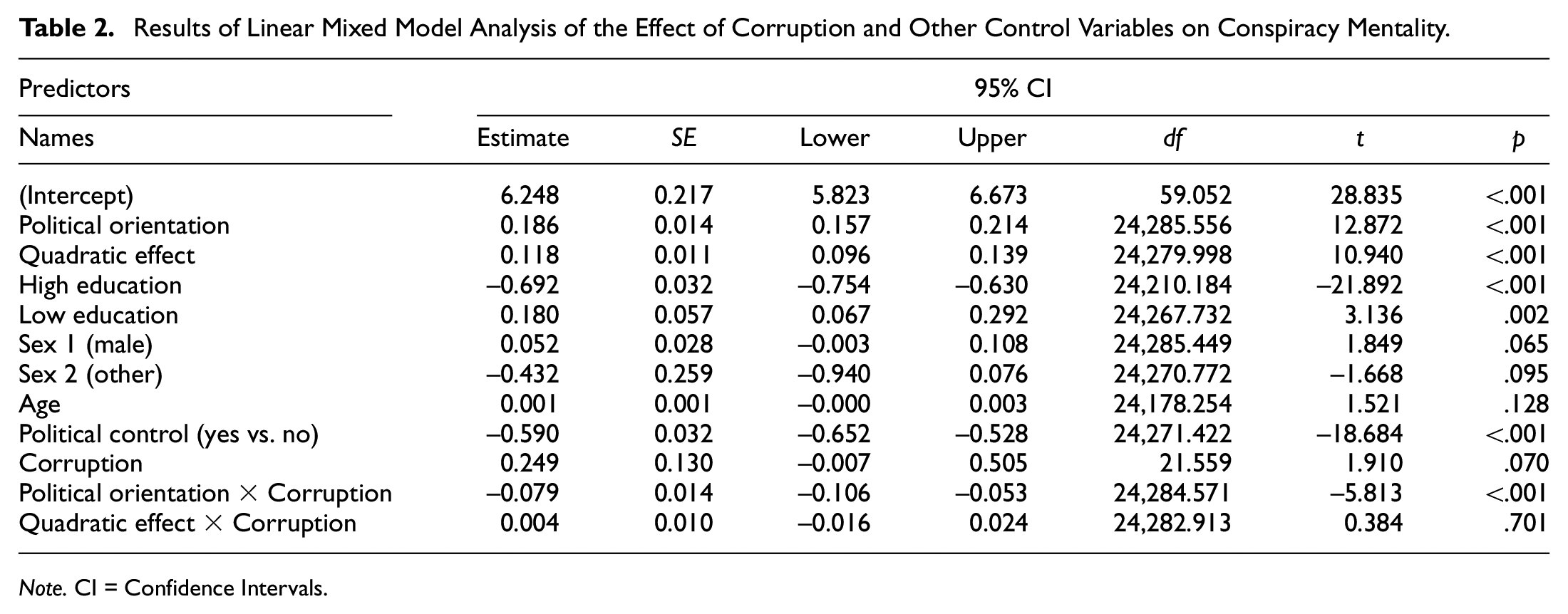
After adjusting for differences in age, sex, education, political control, quadratic effect of political orientation, and its interaction with corruption, the interaction between linear effect of political orientation and corruption was—as expected—negative and significant, but corruption’s interaction with the quadratic effect was not (see Table 2).
Results of Linear Mixed Model Analysis of the Effect of Corruption and Other Control Variables on Conspiracy Mentality.
Note. CI = Confidence Intervals.
As can be seen in Figure 1, although conspiracy mentality showed a relative increase across the board as the political orientation leaned toward the right (i.e., a higher score on the political orientation scale), the increase had a relatively more gentle slope in high corruption countries while it was steeper in low corruption contexts. Simple slope analyses of the linear effects painted a similar picture: Right-wingers were more likely to score high on conspiracy mentality in low, b=.270, SE=.021, 95% CI=[.230, .310], t(24,283.506)=13.145, p < .001, mean-level, b=.195, SE=.015, 95% CI=[.166, .223], t(24,283.994)=13.401, p < .001, and high corruption countries, b=.119, SE=.018, 95% CI=[.083, .155], t(24,283.999)=6.503, p < .001, though the association was stronger in low corruption countries (see Figure 1). The results suggest that although conspiracy mentality was associated with a right-wing ideology in general, this association became weaker in highly corrupt countries, and left-wingers were relatively more likely to endorse a conspiracy mentality in high corruption countries (see the left side of Figure 1).
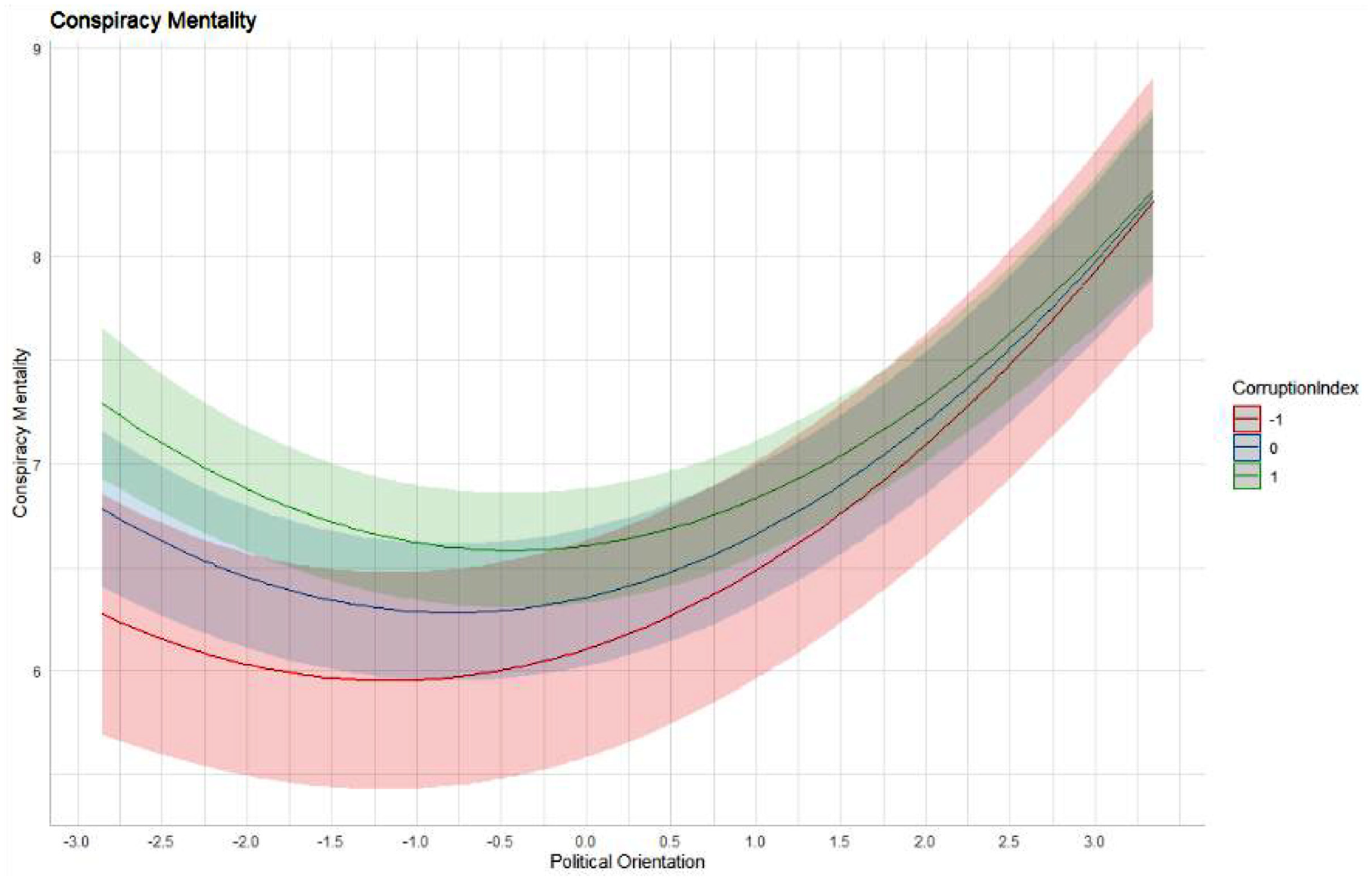
The Association Between Political Orientation and Conspiracy Mentality for Different Levels of Country-Level Corruption.
Left-Wing Conspiracy Beliefs
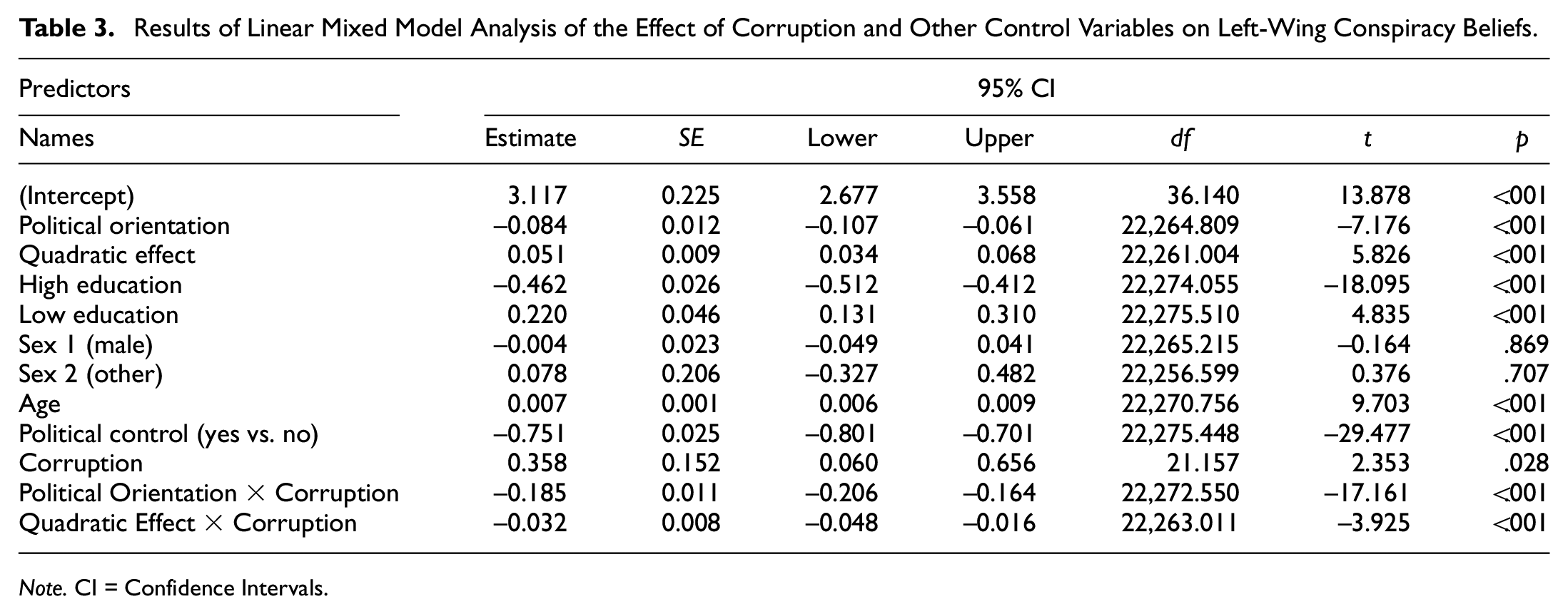
We conducted parallel analyses for left-wing CTs. The interaction between linear effect of political orientation and corruption was significant (Table 3). The interaction between the quadratic effect of political orientation and corruption was also significant, after adjusting for control variables and the linear effect of political orientation and its interaction with corruption.
Results of Linear Mixed Model Analysis of the Effect of Corruption and Other Control Variables on Left-Wing Conspiracy Beliefs.
Note. CI = Confidence Intervals.
As can be seen in Figure 2, partisan (left-wing) CTs followed a clear partisan pattern (strong, purely linear negative effect) in high corruption countries. This was markedly different in low corruption countries, where the pattern followed a quadratic function with even greater endorsement at the political right. Again focusing only on the linear effect, left-wingers endorsed more left-wing CTs in high corruption countries, b=–.256, SE=.015, 95% CI=[–.285, –.227], t(22,273.115)=−17.213, p < .001, and less pronouncedly in mean-level corruption countries, b=−.074, SE=.012, 95% CI=[–.097, –.052], t(22,264.262)=−6.355, p < .001 (see Figure 2). Interest-ingly, in countries with low corruption, the association between political orientation and left-wing conspiracy beliefs was actually positive, b=.107, SE=.017, 95% CI=[.074, .140], t(22,263.478)=6.421, p < .001, suggesting that right-wingers in these countries were particularly likely to endorse (supposedly left-wing) CTs. In sum then, left-wingers were more likely to believe in left-wing conspiracy beliefs in high, but not low, corruption countries.
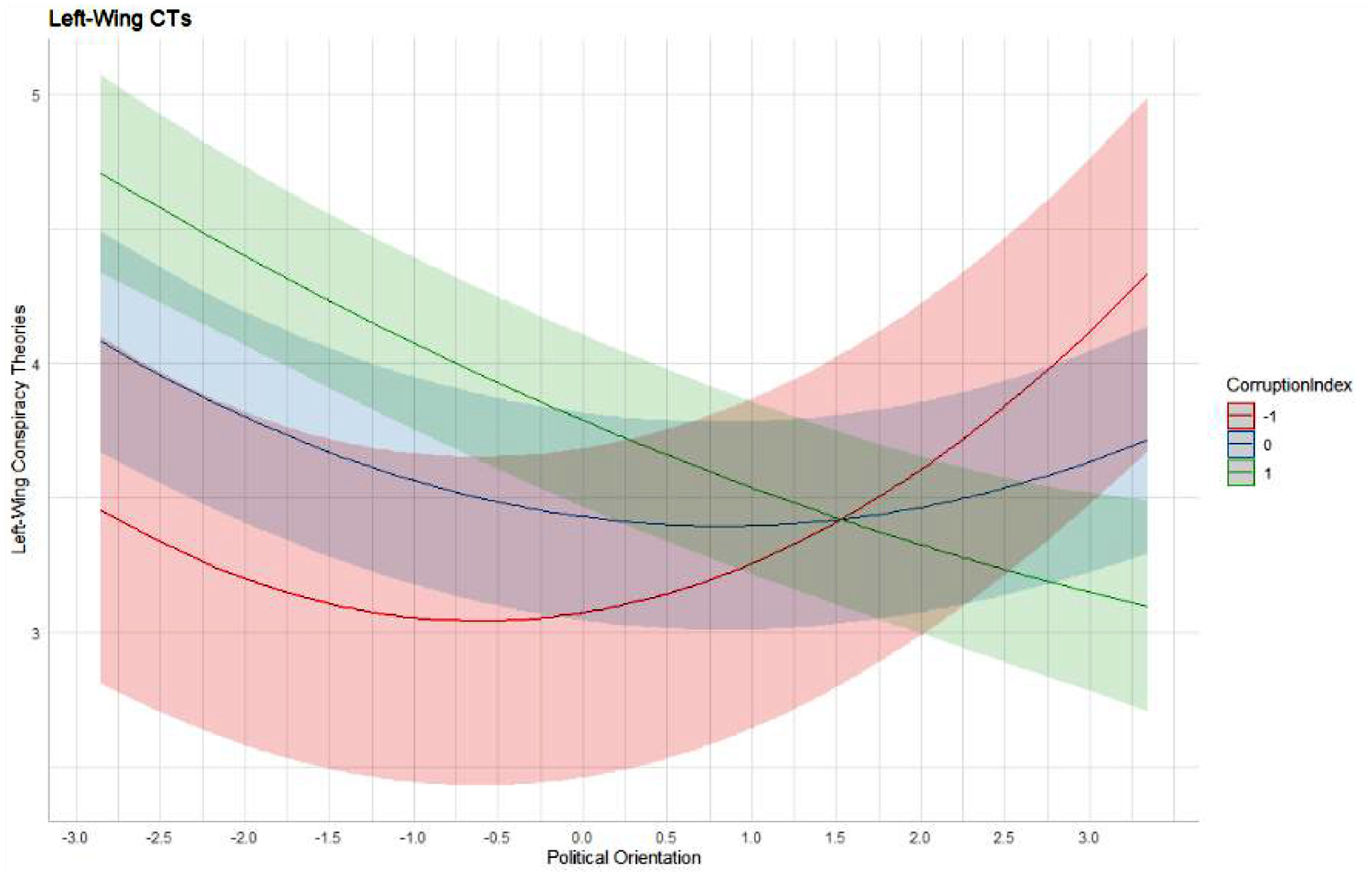
The Association Between Political Orientation and Left-Wing Conspiracy Beliefs for Different Levels of Country-Level CorruptionNote. Shades represent 95% confidence intervals.
Right-Wing Conspiracy Beliefs
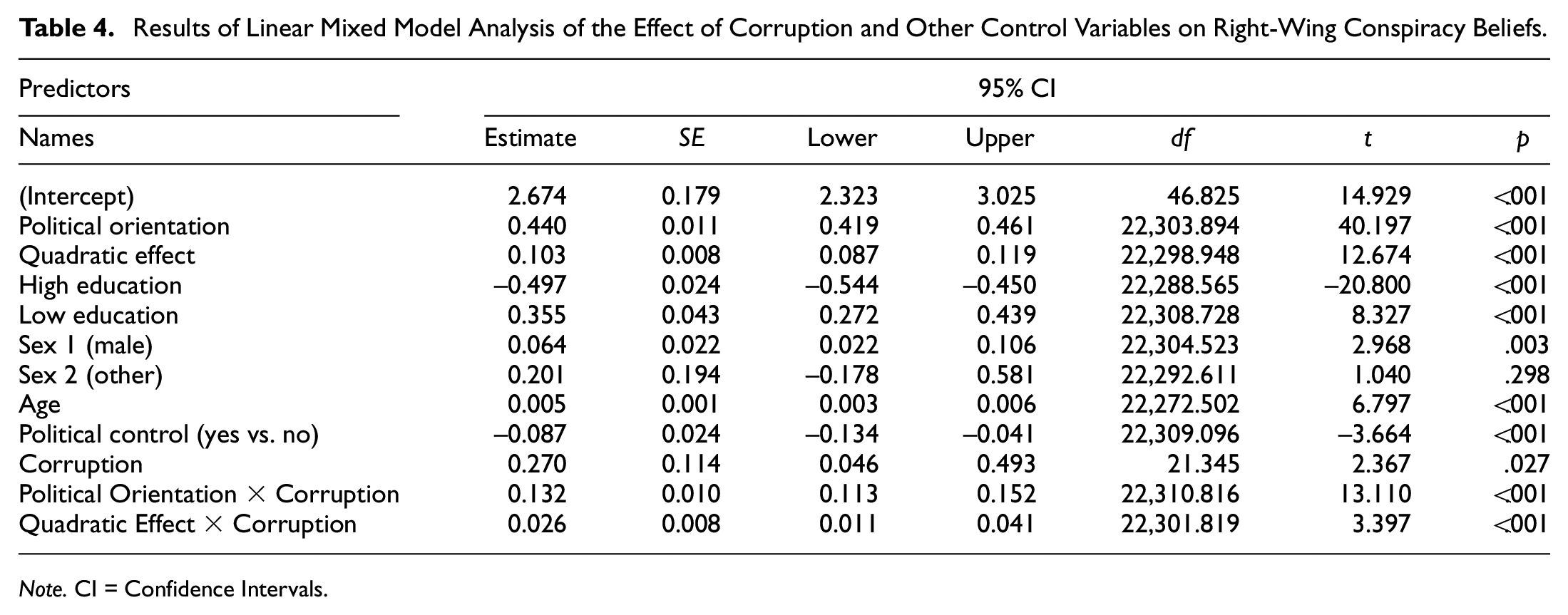
Mirroring the same analyses, the interaction between linear effect of political orientation and corruption was similarly significant and positive as expected (Table 4). The interaction between the quadratic effect of political orientation and corruption was also significant.
Results of Linear Mixed Model Analysis of the Effect of Corruption and Other Control Variables on Right-Wing Conspiracy Beliefs.
Note. CI = Confidence Intervals.
Interpretation of the exact pattern is facilitated by the plotted estimates (Figure 3). What becomes apparent is that already in low corruption countries there is a clear linear trend of greater endorsement at the political right with the quadratic effect merely indicating a (nonlinear) increase in gradient. The two positive interactions with country-level corruption are based on an accentuation of both these patterns (the linear effect and its nonlinear acceleration) in high corruption countries. Thus, right-wingers show markedly greater endorsements of partisan CTs in high corruption contexts, as predicted. This is also reflected in separate estimates of only the linear effect for low, medium, and high corruption contexts: Right-wing political orientation was positively related to right-wing conspiracy beliefs in low, b=.304, SE=.016, 95% CI=[.273, .334], t(22,302.236)=19.459, p < .001, mean-level, b=.434, SE=.011, 95% CI=[.412 .455], t(22,303.245)=39.441, p < .001, and high corruption, b=.563, SE=.014, 95% CI=[.536, .591], t(22,310.966)=40.421, p < .001, countries.
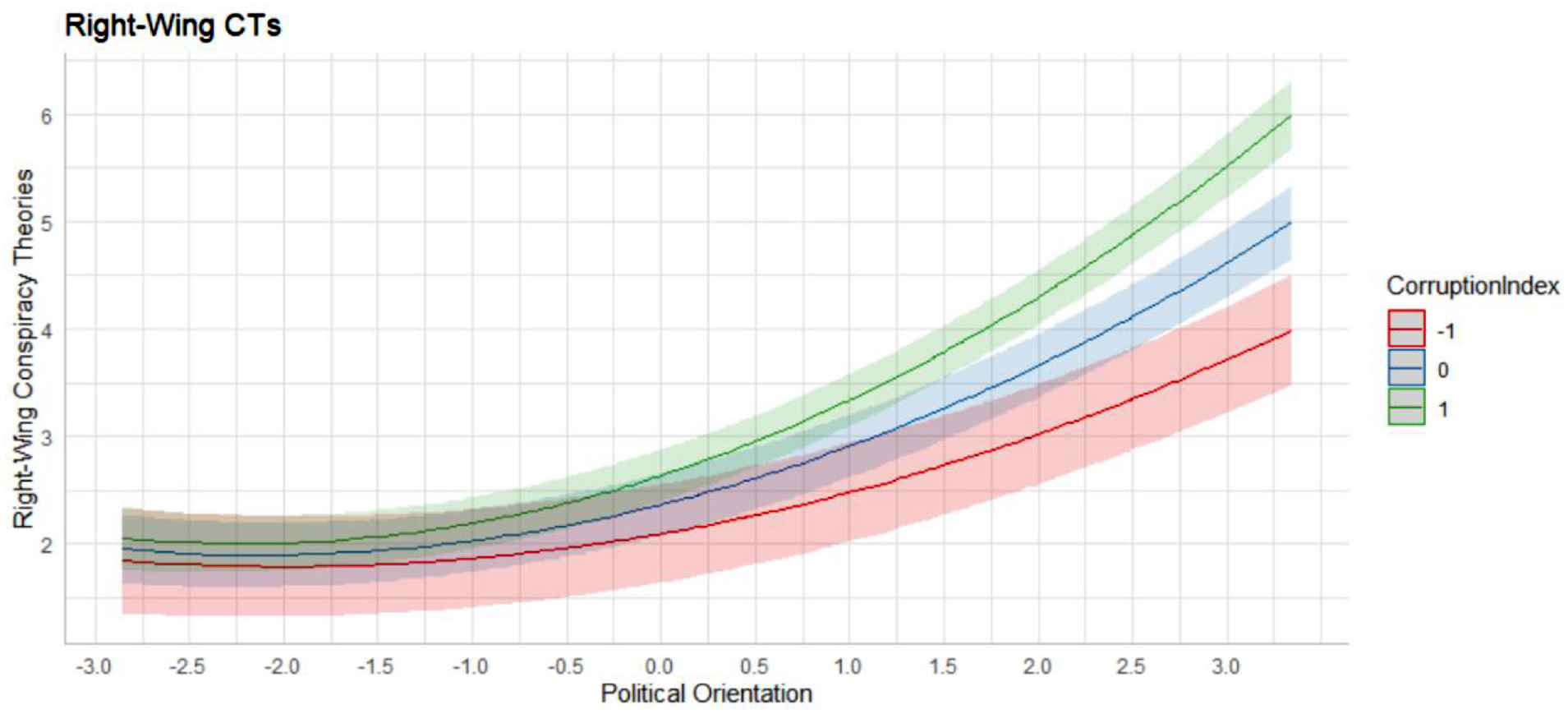
The Association Between Political Orientation and Right-Wing Conspiracy Beliefs for Different Levels of Country-Level Corruption.
Discussion
We re-analyzed data from a diverse range of national contexts to explore the association between political orientation and general conspiracy mentality as well as specific partisan conspiracy beliefs as a function of whether such foul play is more or less likely (i.e., the local level of corruption). The data suggest that the role of right-wing orientation in the general tendency to endorse conspiracy worldviews is attenuated in high corruption context, as—arguably—the greater plausibility of CTs makes everyone more suspicious of such secret plots.
The opposite is true, however, for partisan CTs that express a clear left-wing or right-wing stance. For these, their association with political orientation was exacerbated in high corruption countries. Contexts saturated with threat cues beg for a group or agents to blame (Alper, 2021; Casara et al., 2022; van Prooijen & Douglas, 2017). Here, then, the most accessible explanation, one that fits with one’s political worldview is favored and partisan conspiracy beliefs are endorsed to an even larger degree. For left-wing CTs, our data even suggest a more pronounced acceptance of such conspiracy-laden statements by right-wingers in low corruption countries.
Conjointly our findings then suggest that contexts with many (arguably valid) threat cues make people more suspicious of foul play in general (conspiracy mentality), but particularly wary of the “usual suspects,” that is, those culprits that are already notoriously accessible as target of blame in their political worldview. The conspiracy mentality was more prevalent among people with a right-wing worldview, consistent with the past literature (Alper, Bayrak, & Yilmaz, 2021; Imhoff, Zimmer, et al., 2022; Nera et al., 2021; van der Linden et al., 2021; van Prooijen et al., 2015), but this ideological difference was attenuated in countries with high corruption. Considering that foul play is indeed more likely in high corruption contexts (Alper, 2021; Gächter & Schulz, 2016; Muthukrishna et al., 2017), social cues of corruption might render having a conspiracy mentality as more rational. As a result, everyone, regardless of their political orientation, would adopt a more suspicious mind-set, as more suspicion is warranted in such contexts. However, a heightened conspiracy mentality would have different reflections on specific CTs for different people. All CTs share the common theme of an outgroup secretly plotting against oneself (Douglas et al., 2019) or rather humankind (Imhoff & Lamberty, 2018). Then, by definition, the kind of specific CTs exacerbated by increased corruption would depend on the person’s definition of outgroup. In the current research, left-wing CTs were about people with a different worldview attacking left-wing values (e.g., financial crisis being deliberately started to cripple the social security system) and the same for right-wing CTs (e.g., Muslim immigrants planning to take control of Europe). Thus, an increased level of overall conspiracy mentality would be differentially related to these specific CTs, depending on the person’s worldview. As expected, our findings showed that corruption strengthens the association between left-wingers and left-wing CTs and right-wingers and right-wing CTs.
The differentiation between conspiracy mentality and specific CTs is important as it further adds to a more nuanced perspective on the connect and disconnect between general conspiracy worldviews and specific CTs (for a recent overview, see Imhoff, Frenken, & Bertlich, 2022). Although the two are typically highly correlated (Imhoff & Bruder, 2014; Study 4), they are not to be equated. To employ an analogy from the physics of the force of a vector, while general conspiracy mentality may indicate the magnitude of conspiracy thinking, specific beliefs inform about their direction. In the present case, corruption increased the magnitude overall, but political orientation determined its direction.
There were also some unexpected differences in believing left- versus right-wing CTs. Regardless of the corruption level, right-wingers were more likely to believe in right-wing CTs while higher corruption strengthened this association (see Figure 3). However, for left-wing CTs, there was a different pattern: In high corruption countries, left-wingers were more likely to believe left-wing CTs, whereas in low corruption countries the pattern was reversed, and right-wingers were more likely to believe left-wing CTs (see Figure 2). On a close inspection, it appears that left-wing CTs are largely about suspicions over big corporations, financial institutions, and governments whereas right-wing CTs mostly consist of anti-immigrant, anti-Semitic, xenophobic beliefs (see https://osf.io/vgsy8/?view_only=46794772adfa48d48af8edc1658e16fa for the complete list). It could be the case that (1) right-wing CTs are deeply incompatible with a left-wing worldview, thus they are unique to right-wingers, whereas right-wingers are even more likely to endorse these theories in high corruption contexts, (2) left-wing CTs are not that alien to right-wingers, considering that hostility toward financial institutions might be compatible with the anti-elite sentiments prevalent in right-wing populism (e.g., Greven, 2016). Particularly relevant for conspiracy beliefs about corporations and financial institutions, parts of the political right endorse an explicitly anti-elite and anti-capitalist rhetoric that calls for a national revolution (Imhoff, 2015) and vilifies big business, often with anti-Semitic connotations (Imhoff, 2020). We have also investigated whether the content-wise variation in right- and left-wing CTs map onto the distinction between downward versus upward conspiracy beliefs (Nera et al., 2021). Although our analyses showed that right- and left-wing CTs are related to political ideology in the expected directions, they cannot easily be separated into downward and upward categories. The most common alleged conspirator in right-wing CTs was ethnic and religious minorities (which would be downward CTs), but there were also CTs about arguably powerful agents, like foreign countries and international NGOs (which would be upward CTs). For left-wing CTs, the target was more likely to be a powerful agent, like the government or corporations. Thus, although neither right- nor left-wing CTs were homogenous in their downwardness or upwardness, it could be argued that left-wing CTs were predominantly upward whereas right-wing CTs were more mixed in their content. This could be one reason why right-wingers, who also believe some of the upward CTs, find merit in some of the left-wing CTs. Left-wingers, however, believe in almost only upward CTs, and might find it harder to believe in right-wing CTs, which are at least partially downward.
Similar to some of the past literature (Alper, Bayrak, & Yilman, 2021; Imhoff, Zimmer, et al., 2022; Nera et al., 2021; van der Linden et al., 2021), we have also found that right-wingers are more likely to possess a conspiracy mentality, a stable attitude indicating proneness to conspiracy beliefs that vary in content (Imhoff, Zimmer, et al., 2022; Sutton & Douglas, 2020). We have also found that they are more likely to endorse CTs that are arguably politically neutral (see the Supplemental Material). Thus, it might be the case that left-wingers are more distanced toward conspiracy beliefs in general, and only in a high corruption context they embrace politically concordant CTs. Right-wingers, however, are more receptive to CTs in general but distance themselves from left-wing CTs only in high corruption contexts because left-wingers are embracing them in such contexts. Future studies should seek to replicate this pattern and put potential explanations for it to the empirical test.
The current findings have contributed to the literature in two respects. First, they showed that the association between political orientation and conspiracy beliefs is context-dependent, and country-level corruption is a significant factor moderating this relationship. This added to a recent line of research focusing on how social factors such as corruption (Alper, 2021), inequality (Casara et al., 2022), precarity (Adam-Troian et al., 2021), and political control (Kofta et al., 2020) feed conspiracy beliefs. Our current findings indicate that country-level corruption could be increasing the plausibility of CTs, which extinguishes the difference between left- and right-wingers with regard to adopting a conspiracy mentality. Left-wingers were less likely to do so, even when it comes to believing in specific left-wing CTs, when they were in a low corruption context. This suggests that left-wingers could be less conspirational in low, but not high, corruption contexts. This is in line with a current finding showing that the negative association between conspiracy beliefs and education becomes weaker in high corruptions context, suggesting that being more educated does not prevent you from adopting these beliefs in high corruption countries because conspiracies are arguably more plausible and more likely to happen in these contexts (Alper, 2021). Second, a vast number of studies has looked into the relationship between conspiracy beliefs and political orientation (Alper, Bayrak, & Yilman, 2021; Imhoff, Zimmer, et al., 2022; Nera et al., 2021; van der Linden et al., 2021), as well as political extremism (Imhoff, Zimmer, et al., 2022; Nera et al., 2021; van der Linden et al., 2021; van Prooijen et al., 2015). But, to our knowledge, the current research provided one of the first pieces of evidence that a social factor that is beyond a personal perception, country-level corruption, moderates these relationships.
Limitations and Future Directions
Despite being based on one of the largest data sets to date, our findings are of course limited by the fact that the majority of sampled countries are in Europe and that the level of corruption does not span the whole range. However, it should be noted that, out of a potential range from 0 to 100, the mean corruption score in the countries included in the data was 58.48 and the median was 56, with the worst performing two countries both ranking 111th with a score of 35. Thus, the corruption scores were not overly clustered on the upper side of the continuum, despite the majority of countries being European.
Future research might thus elucidate even further how the association between political identity and conspiracy beliefs is moderated by corruption or even further cues to foul play. Such work will have to tackle the challenge of the very concept of left versus right as the core dimension of political orientation not being a universally shared one. In other contexts, political affiliation might follow lines of ethnic and religious belonging to a much greater extent, making direct comparisons challenging. Nevertheless, future research should embrace this challenge and provide a better—and more globally applicable—understanding on conspiracy beliefs in context with marked (vs. no) actual nontransparent agreements.
Supplemental Material
sj-docx-1-spp-10.1177_19485506221113965 – Supplemental material for Suspecting Foul Play When It Is Objectively There: The Association of Political Orientation With General and Partisan Conspiracy Beliefs as a Function of Corruption Levels
Supplemental material, sj-docx-1-spp-10.1177_19485506221113965 for Suspecting Foul Play When It Is Objectively There: The Association of Political Orientation With General and Partisan Conspiracy Beliefs as a Function of Corruption Levels by Sinan Alper and Roland Imhoff in Social Psychological and Personality Science
Footnotes
Handling Editor: Osborne, Danny
Declaration of Conflicting Interests
The author(s) declared no potential conflicts of interest with respect to the research, authorship, and/or publication of this article.
Funding
The author(s) received no financial support for the research, authorship, and/or publication of this article.

Supplemental Material
The supplemental material is available in the online version of the article.
Notes
Author Biographies
References
Supplementary Material
Please find the following supplemental material available below.
For Open Access articles published under a Creative Commons License, all supplemental material carries the same license as the article it is associated with.
For non-Open Access articles published, all supplemental material carries a non-exclusive license, and permission requests for re-use of supplemental material or any part of supplemental material shall be sent directly to the copyright owner as specified in the copyright notice associated with the article.
