




Abstract
People often tell others about recent daily hassles. Such social sharing of emotion is often assumed to support affect repair, but empirical evidence points to the contrary. We tested the notion that social sharing primarily serves relationship closeness, rather than immediate affect repair. Using dyadic experience sampling with N = 100 couples, we captured social sharing in everyday contexts and assessed socioemotional implications for speakers and listeners. Across M = 87 individual measurement occasions, both partners reported potential social-sharing episodes following daily hassles and rated their momentary negative affect and relationship closeness. Global evaluations of relationship closeness were assessed at baseline and 2.5 years later. Social sharing involved both affective benefits and costs, but it predicted momentary and long-term increases in partners’ relationship closeness. These results suggest that sharing bad news in relationships may not primarily serve immediate affect–repair functions. Rather, it may be a catalyst for creating and nourishing relationship closeness.
Why do people tell others if something bad happened to them? This behavior, also referred to as social sharing of emotion (Rimé et al., 2020), represents one of the most frequent reactions to experiencing daily hassles (Bucich & MacCann, 2019; Liu et al., 2021). The question why people so frequently engage in this behavior is not fully understood. The answer seems relatively clear for sharing positive news: People may savor, prolong, and intensify positive emotions by sharing them with others, creating positive exchanges that build and strengthen social bonds (Lambert et al., 2013; Reis et al., 2010). However, the answer is less clear when it comes to sharing bad news, which can be aversive for the speaker (Nils & Rimé, 2012; Rimé, 2009), emotionally burden the listener (Lewis & Manusov, 2009; Pennebaker, 1997), and create relationship tensions (Dagan et al., 2014). In the present research, we investigated spontaneous instances of social sharing related to daily hassles—experiences of daily living that people perceive as salient and harmful or threatening to their well-being (Lazarus, 1984). Our aim was to further understanding of the benefits that this behavior offers, despite the various costs it may entail. We hypothesized that social sharing primarily serves interpersonal, rather than affect-regulation functions. To test this idea, we employed a dyadic experience-sampling design with a longitudinal follow-up in a sample of cohabitating couples.
Does Social Sharing Really Support Affect Repair?
People tend to believe that social sharing, be it with a social partner or a symbolic addressee (like a diary) helps them to “vent” and downregulate their negative emotions (Bucich & MacCann, 2019; Duprez et al., 2015). This belief aligns with theoretical notions that emotional disclosure fosters catharsis and cognitive restructuring in the speaker (e.g., Pennebaker, 1997; Rimé et al., 2020). In contrast, ample empirical evidence suggests that social sharing is ineffective for affect repair (Frattaroli, 2006; Frisina et al., 2004) or may even counteract it (Meads & Nouwen, 2005; Rimé et al., 2020; Smyth, 1998). These effects may derive from reactivating one’s memory of the event while talking about it (Nils & Rimé, 2012). Furthermore, most social sharing happens shortly after the event, when it is typically aimed at interpersonal validation rather than cognitive restructuring (Duprez et al., 2015; Pauw et al., 2018, 2019; Rimé, 2009). To date, only a few studies have assessed social sharing shortly after the event, with mixed results. In two experience-sampling studies, Brans and colleagues (2013) found no change in momentary affect (Study 1) and even intensified momentary affect (Study 2) in the speaker after social sharing. Another study used daily diaries and documented prolonged affective experiences in the speaker after social sharing (Verduyn et al., 2011). From these past findings, we hypothesized that social sharing after daily hassles predicts increases in speakers’ momentary negative affect.
This May Hurt Twice: Social Sharing May Also Harm the Listener’s Affect
Importantly, social sharing is an inherently interpersonal phenomenon (Frisina et al., 2004). It may contribute to negative affect in the listener as well (e.g., through emotional attunement or emotional burden; Nelson et al., 2017; Smith & Rose, 2011). Such listener effects have been documented in autobiographical and experimental paradigms (Bareket-Bojmel & Shahar, 2011; Christophe & Rimé, 1997). In the current study, we investigated listener effects with dyadic experience sampling to reduce reporting biases (e.g., oversampling of emotionally intense conversations; Bolger & Laurenceau, 2013) and to simultaneously model effects for both partners, thus accounting for spillover or alignment effects that may occur independent of the effects of social sharing (Sels et al., 2020). Based on past evidence, we assumed that social sharing of recent daily hassles is associated with increases in momentary negative affect, both in the speaker and the listener.
Then Why Do People Engage in Social Sharing?—Assumed Interpersonal Functions
The well-documented emotional costs for both partners in social sharing seem at odds with the popularity of everyday social sharing. However, social sharing may offer interpersonal benefits that outweigh the emotional costs of social sharing (Rimé et al., 2020). The interpersonal process model of intimacy (Reis & Patrick, 1996; Reis & Shaver, 1988) maintains that disclosing emotional experiences creates interpersonal closeness by inviting interpersonal processes involving trust, validation, and social support. Research has indeed documented temporary increases in relationship closeness after social sharing (Cameron & Overall, 2018; Laurenceau et al., 2005, 1998; Lippert & Prager, 2001; Rossignac-Milon et al., 2020). Importantly, these momentary effects are also assumed to have long-term implications. Social sharing may help the partners to increasingly refine mutual social support processes (Reis & Patrick, 1996; Reis & Shaver, 1988) and to build a shared reality that facilitates the interpersonal alignment of emotions, goals, and actions during future interactions (Rossignac-Milon et al., 2020). The effects of social sharing may thus accumulate over time to foster positive relationship development. However, empirical evidence that social sharing predicts long-term change in closeness was missing to date.
Present Study and Hypotheses
In summary, sharing bad news may involve a trade-off: It may have affective short-term costs for both partners, but promote perceptions of relationship closeness in the moment and over time. In the present study, our goal was to provide evidence for this notion of interpersonal over affect–repair functions. We used dyadic experience sampling to capture spontaneous instances of everyday social sharing of emotion in daily life, and again followed up on the couples 2.5 years later. This allowed us to document social sharing in close relationships with enhanced ecological validity and shortly after its occurrence, to investigate both partners’ contributions to this inherently dyadic phenomenon, and to address short- and long-term implications of social sharing, as theorized but not addressed empirically to date. To enhance the generalizability of our findings, we included participants from two age groups (younger and older adults aged 20–30 or 70–80 years, respectively). This also allowed us to explore age differences in social sharing, which have been described as theoretically plausible but have received no empirical support to date (Rohr et al., 2019). 1 Our research was guided by three main hypotheses:
Method
Open Practices Statement
The data, research materials, model equations, analysis code, and additional result tables are available at https://osf.io/vzd5m/. This study was not formally preregistered.
Participants and Procedure
The sample consisted of 100 heterosexual couples (n = 200 persons). We included two age groups to increase the representativeness of our sample: n = 100 younger adults (age range = 20–30 years, M = 25.94, SD = 2.94) and n = 100 older adults (age range = 69–80 years, M = 74.20, SD = 2.89). Participants were recruited from the greater area of Berlin, Germany, using newspaper advertisements and a recruitment company. 2 Inclusion criteria were that the partners were cohabitating and were both fluent in German. All participants were German. About half of the couples (51%) were married, and about half of the participants (54%) had graduated from high school or a higher educational institution. Participants were informed that the study investigated “couples’ experiences in daily life.” They received up to 195 Euros for participating in all parts of the study. The local ethics committee had approved of the study protocol and materials.
In an initial baseline session (T1), partners provided individual ratings of relationship closeness, among other things. Couples then participated in a 3-week experience sampling phase, during which they carried individual mobile phones during their daily routines. Partners were prompted simultaneously six times daily throughout 15 days and completed 87 momentary assessments on average (range = 72–94; SD = 3.48). Assessments were pseudo-randomized with assessment intervals between 20 and 120 min. On each occasion, both partners provided individual reports of recent daily hassles, social sharing related to this hassle, momentary negative affect, and momentary perceptions of relationship closeness, among other things. Approximately 2.5 years later (Minterval = 2.46 years, SD = 0.16), n = 72 couples (n = 39 old couples and n = 33 young couples) returned to the laboratory for a follow-up session (T2) and again provided individual ratings of global relationship closeness, among other things.
Returning couples and those who dropped out did not differ in their baseline perceptions of relationship closeness (dyadic means at pretest for returning couples: M = 5.63, SD = 1.12, for dropout couples: M = 5.70, SD = 1.09, t(98) = .26, p = .61), nor regarding social sharing during the experience-sampling phase (returning couples’ dyadic means in the percentage of hassles that they had disclosed to their partners: M = 57%, SD = 22; dropout couples’ means: M = 60%, SD = 22, t(98) = .59, p = .56).
Measures
The measures comprised momentary variables and person-level variables. The wording of all experience-sampling items is documented in Table S1 in the supplementary materials. Table S2 lists the descriptive information for all central continuous study variables and their within-couples and within-person intercorrelations. We did not exclude any data from the analyses.
Momentary Measures
Daily hassles and social sharing were assessed during experience sampling. At each measurement occasion during the experience-sampling phase, participants reported whether they had recently (i.e., in the 20–120 min since the last measurement or since getting up) experienced a hassle. Before the study, we informed participants, You will be asked at each beep if you experienced something very unpleasant since waking up / since the last beep. For example, maybe you overslept, or you thought about a recent fight. This question asks about events or thoughts that you personally judge as very unpleasant.
During the study, we asked participants at each beep, “Did you experience anything very unpleasant since the last beep?” On average, participants confirmed this on 10 occasions (M = 10.16 hassles on average, range: 0–47, SD = 8.00). For each hassle, participants reported how important it was (from 0 = not at all to 6 = very important; M = 3.88, mean within-person SD = 1.03) and whether or not they had told their partner about it. By the time of the assessment following a hassle, participants had disclosed it to their partner in more than half of all observations (M = 57% of the hassles had been disclosed; SD = 0.27; in absolute numbers, this equals an average of M = 5.73 events of social sharing, SD = 4.83). On average, there were 3.38 occasions per couple (SD = 2.07) where both partners had experienced a hassle during the time interval preceding the assessment. On these occasions, the partners could potentially engage in mutual sharing (i.e., each disclose a hassle). Out of these observations, 74% were indeed followed by mutual sharing (2.50 observations per couple, SD = 1.77).
Momentary negative affect (NA) was measured with four affect items (angry, downcast, disappointed, nervous; 0 = not at all to 6 = very much) that we aggregated per person and occasion to obtain a composite score of this person’s momentary NA (theoretical range: 0–6, within-person reliability: .62). NA was positively skewed, and not all parameter estimates in the later analyses were robust after applying a transformation to this variable to approach normality. We therefore applied a transformation of −1/x to this variable before the analyses (Tabachnick et al., 2014).
Momentary closeness was assessed by asking both partners at each experience-sampling measurement occasion, “How close do you feel to your partner right now?” Responses were given on a 7-point scale (from 0 = not at all to 6 = very close).
Person-Level Measures
As a measure of participants’ typical tendency to engage in social sharing, we calculated each person’s individual percentage of hassles disclosed to the partner during the experience-sampling phase. This variable ranged from 0 to 1 and was normally distributed in the sample.
Participants’ perceptions of global relationship closeness were obtained using the pictorial Inclusion of Other in the Self Scale (Aron et al., 1992) that we administered at pretest and at follow-up 2.5 years later (theoretical range: 1–7). The scale has good retest reliability and converges with other measures of subjective partnership functioning (Gächter et al., 2015).
Analytic Approach
The analyses tested predictions on two different time scales. First, to test changes in momentary NA and momentary closeness shortly after social sharing, we analyzed dyadic experience sampling data using longitudinal two-intercept models for distinguishable dyads (Bolger & Laurenceau, 2013; Laurenceau & Bolger, 2005; Raudenbush et al., 1995). This approach provides parallel estimates for men and women, while accounting for statistical non-independencies arising from repeated individual assessments over time and dyadic interdependencies within couples. Second, long-term changes in global relationship closeness were investigated by analyzing longitudinal follow-up data spanning 2.5 years using actor–partner–interdependence models (Kenny et al., 2020). The aim of both analytic approaches was to test whether changes in negative affect and closeness were predicted by both partners’ individual social-sharing behaviors. Building on the logic of actor and partner effects in dyadic analyses (Kenny et al., 2020), we distinguished (a) speaker effects (denoting the effect of one’s own social sharing, while controlling for effects of the other partners’ sharing behavior) and (b) listener effects (denoting the effect of other partners’ social sharing, controlling for own sharing behavior). The data were analyzed using SAS Version 9.4 and SPSS Version 26.
Results
Momentary Affect After Social Sharing (H1)
To test the hypothesis that both partners would experience more NA after social sharing, we predicted momentary NA with recent episodes of social sharing, using all occasions where at least one partner had experienced a hassle and could potentially talk about it (N = 3,324 observations). To consider both partners’ individual contributions to sharing, we included three fixed effects: First, we modeled the effect of having recently told the partner about a daily hassle (coded 0/1), which we will refer to as the speaker effect. In addition, we modeled the effect of recently having listened to one’s partner’s disclosure of a recent hassle (coded 0/1), which will be called the listener effect. The additionally included interaction effect of speaking and listening is referred to as mutual sharing effect (coded 0/1). Mutual sharing is coded 1 if both partners had experienced a hassle and had both disclosed it to each other. On these occasions, each partner took on a double role as both speaker and listener (i.e., speaking and listening are 1 so that their interaction is 1). Inclusion of this interaction effect implies that the main effects of listening and speaking refer to conditional effects when the other predictors equal zero. Emotionally intense experiences invite social sharing (Rimé, 2009). Multilevel logistic regression showed that more important hassles were indeed more likely to be shared (estimate for men = 0.34, SE = 0.05, p < .01, odds ratio = 1.41, 95% confidence interval [CI] = [1.28, 1.55], estimate for women = 0.15, SE = 0.05, p < .01, odds ratio = 1.16, 95% CI = [1.06, 1.28]). Furthermore, hassle importance also predicted higher momentary NA (see Table 1). We therefore controlled for hassle importance as a possible confound in associations of social sharing and momentary affect. As shown in Table 1, men experienced less NA if they had recently disclosed (vs. not disclosed) a hassle, which was unexpected. This effect was not significant in women, however. In contrast, and in support of H1, women (but not men) experienced more NA after listening to their partner’s disclosures. Effects of mutual sharing (i.e., interactions of speaking and listening) were not significant above and beyond these main effects. Although speaker effects were confined to men, and listener effects were confined to women, there were no significant gender differences in any of these effects, nor were there any age differences in the effects of speaking or listening on partners’ momentary NA (ps for all contrasts >.08).
Predicting Momentary Negative Affect With Social Sharing
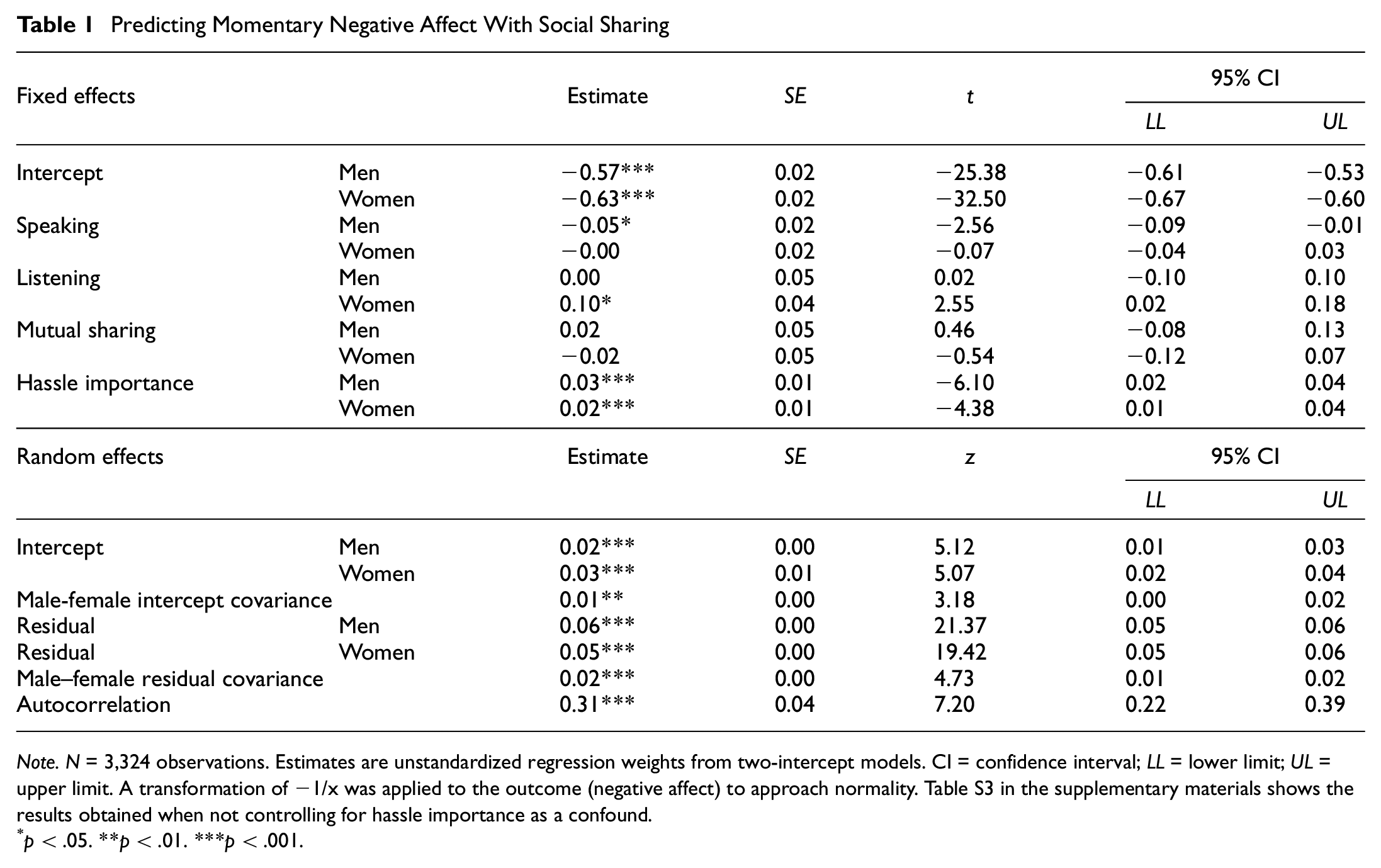
Note. N = 3,324 observations. Estimates are unstandardized regression weights from two-intercept models. CI = confidence interval; LL = lower limit; UL = upper limit. A transformation of −1/x was applied to the outcome (negative affect) to approach normality. Table S3 in the supplementary materials shows the results obtained when not controlling for hassle importance as a confound.
p < .05. **p < .01. ***p < .001.
The size of the effects of social sharing on momentary NA was small. The unstandardized parameter estimates indicate that the differences in momentary affect as predicted by social sharing were smaller than half a scale point on the 7-point scale. In summary, effects of social sharing for momentary affect were mixed, with affective benefits for men as speakers and affective costs for women as listeners after social sharing.
Momentary Relationship Closeness After Social Sharing (H2)
We again used two-intercept models to test H2. We predicted momentary perceptions of relationship closeness with recent instances of social sharing, again modeling the unique contributions of speaking (coded 0/1), listening (coded 0/1), and mutual sharing (the interaction effect of speaking and listening) on the outcome (N = 3,324). We again initially included hassle importance as a potential control variable, but it was not a significant covariate (ps > .122) and was hence stripped from the model following calls for justifiable inclusion of covariates (Monteith, 2020; VanderWeele, 2019). The results are presented in Table 2 and illustrated in Figure 1. Supporting H2, social sharing was associated with momentary increases in relationship closeness in both speakers and listeners: Telling one’s partner about a recent hassle was followed by enhanced perceptions of momentary closeness. Furthermore, listening to one’s partner’s disclosures was linked to enhanced momentary closeness in the listener. Both effects, of speaking and listening, were stronger in younger than older women (ps < .045). There were no age differences in men, nor were there any gender differences (other ps > .072). The results were robust to controlling for relationship closeness at the previous measurement occasion: Previous closeness was a significant predictor of current closeness (ps > .001), suggesting some within-person continuity in closeness perceptions. Above and beyond these stability effects, however, the speaker effects in men and women, the listener effects for men and women and the effect of mutual sharing in women were still significant and in the same direction.
Predicting Momentary Relationship Closeness With Both Partners’ Social Sharing Behaviors
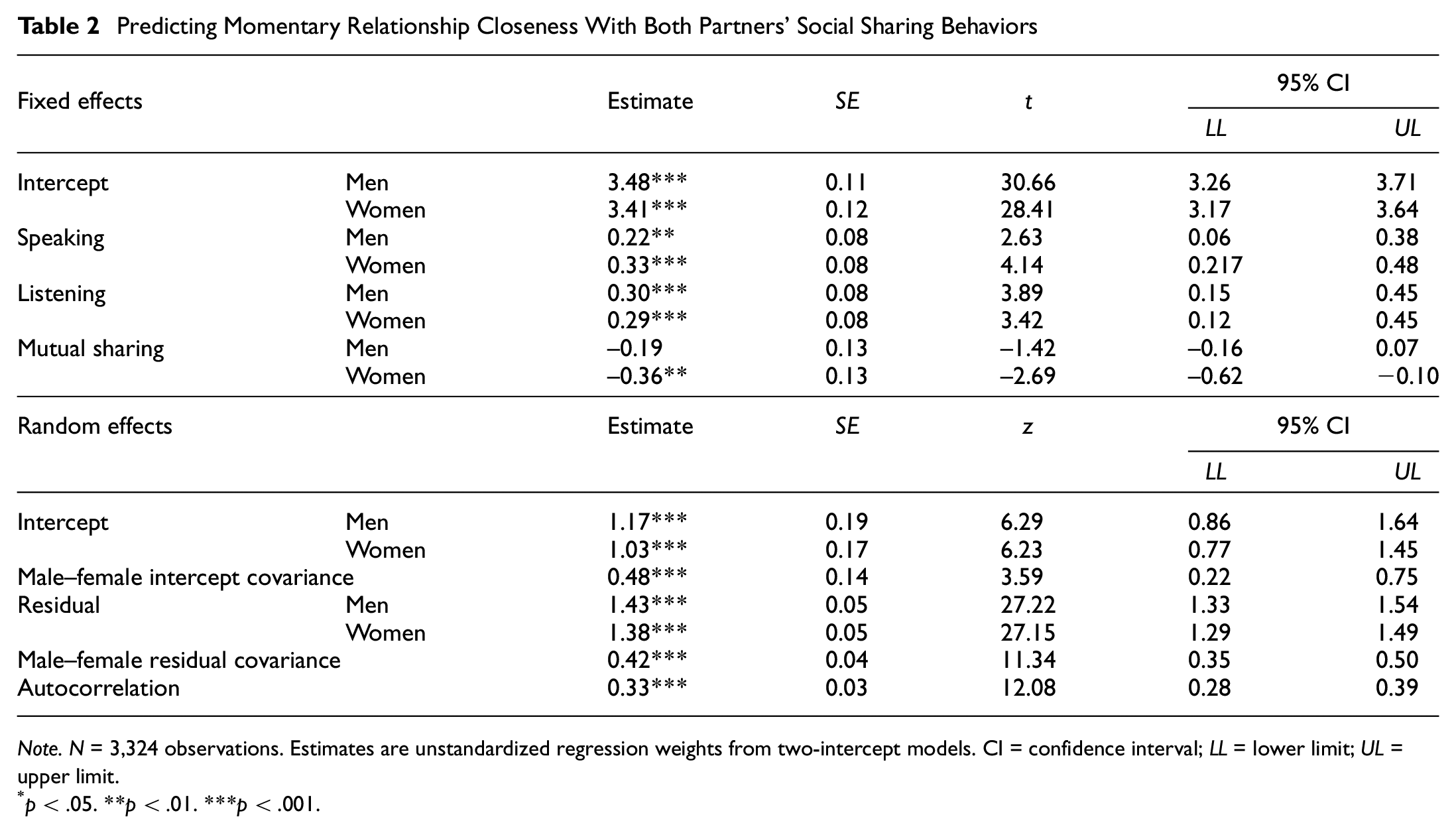
Note. N = 3,324 observations. Estimates are unstandardized regression weights from two-intercept models. CI = confidence interval; LL = lower limit; UL = upper limit.
p < .05. **p < .01. ***p < .001.
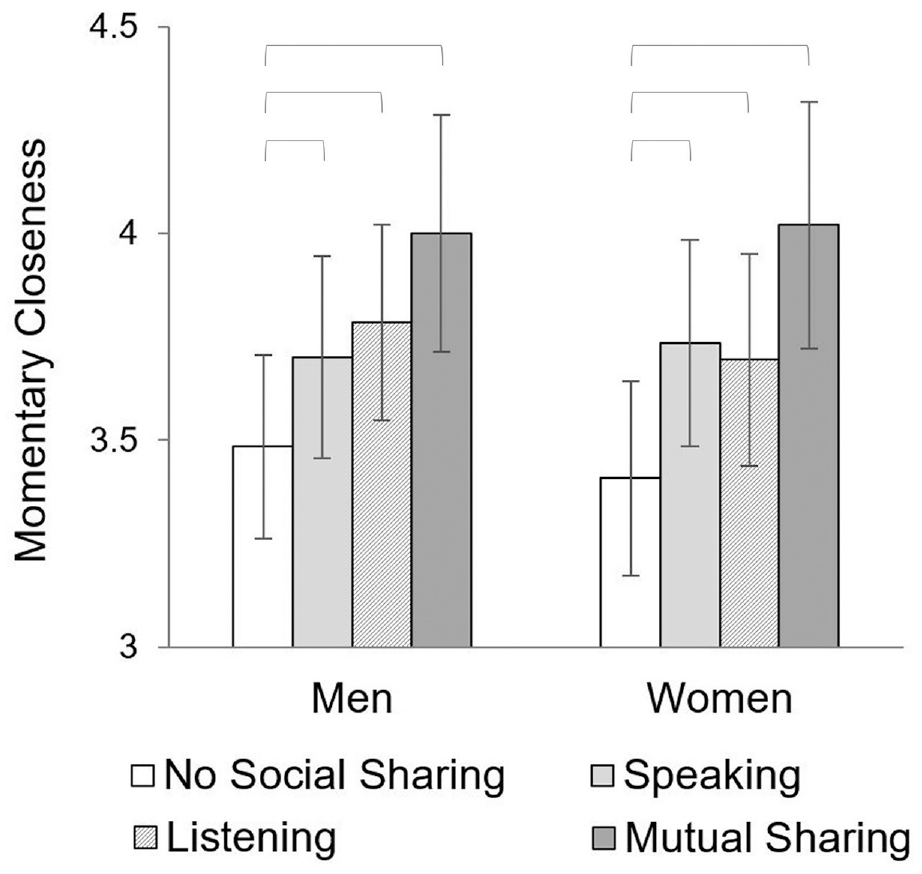
Both Partners’ Perceptions of Momentary Closeness After Daily Hassles.
While the size of the significant effects varied with the roles that the partners took on in social sharing, the effects were small throughout. The unstandardized parameter estimates indicate that differences in momentary closeness (as predicted by social sharing) did not exceed half a scale point on the 7-point scale of momentary closeness, across all the constellations of social sharing (speaking, listening, and mutual sharing).
Prospective Prediction of Long-Term Changes in Relationship Closeness (H3)
Our prediction that social sharing predicts long-term changes in global relationship closeness was tested using actor–partner–interdependence models for distinguishable dyads (Kenny et al., 2020). We predicted interpersonal closeness at follow-up with both partners’ individual social sharing scores from the experience-sampling phase, controlling for baseline closeness.
Effects of people’s own sharing are called speaker effects and effects of the other partner’s sharing are called listener effects. Initial closeness perceptions were predictive of closeness perceptions 2.5 years later, suggesting some within-person continuity in closeness representations (estimate = 0.56, SE = 0.09, t = 6.40, p < .001, 95% CI = [0.38, 0.73]). Above and beyond these effects of continued closeness perceptions, however, and in support of H3, a significant listener effect emerged: Having a partner who more frequently disclosed recent hassles predicted later increases in closeness (estimate = 1.05, SE = 0.38, t = 2.75, p = .007, 95% CI = [0.29, 1.80]). In contrast, there was no speaker effect: One’s own social sharing did not predict later changes in own closeness perceptions (estimate = 0.47, SE = 0.39, t = 1.19, p = .36, 95% CI = [−0.31, 1.24]), and there was no interaction effect of speaking and listening (estimate = 0.51, SE = 0.13, t = 0.40, p = .69, 95% CI = [−0.20, 3.01]). We tested for gender or age differences in any of these effects, which were not significant (all ps > .28).
Following recommendations by Castro-Schilo and Grimm (2018), we next confirmed that the results were robust when using difference scores, which also offer a more intuitive interpretation of the direction of the effects. We predicted the difference between closeness at baseline and follow-up after 2.5 years with both partners’ engagement in social sharing during the experience-sampling phase. The results again indicated that the partner’s, but not one’s own social sharing, was related to prospective changes in perceptions of relationship closeness over time. The size of the effects is illustrated in Figure 2. On average, people with partners who did not share at all lost 0.62 points in global closeness and people with partners who shared all their hassles gained 0.44 points in closeness throughout the 2.5 years of the study interval. People whose partners shared 25% of their hassles (M− 1 SD) lost 0.34 points on average and people whose partners shared 75% of their hassles (M+ 1 SD) gained 0.16 points from baseline to follow-up. Table S4 in the supplementary materials shows the parameter estimates from both analytic approaches.
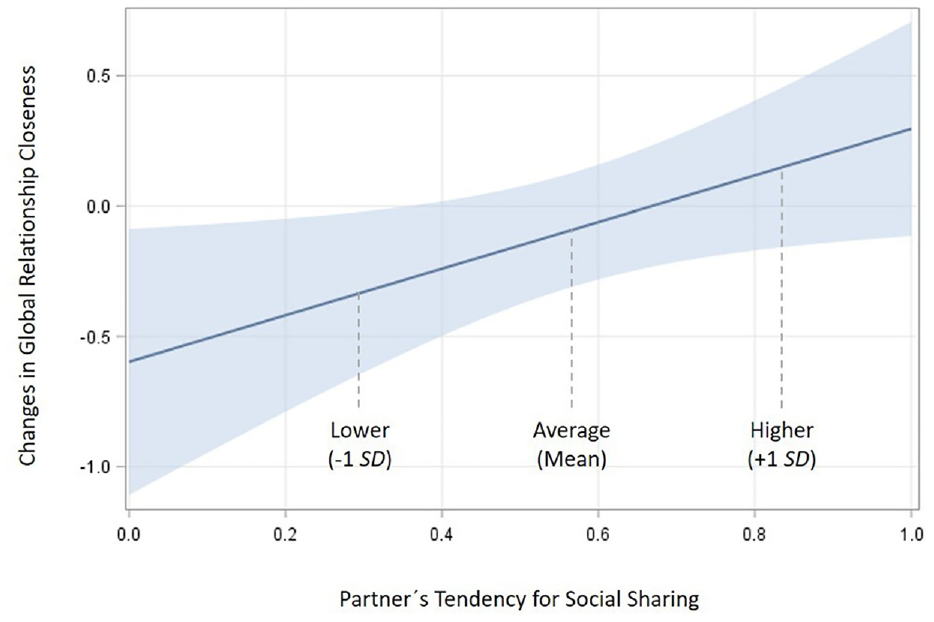
Changes in Global Relationship Closeness Across 2.5 Years as a Function of the Other Partner’s Social Sharing.
Discussion
This study proceeded from an apparent conundrum: Theory and lay conceptions claim that the frequent everyday behavior of social sharing supports affect repair. In contrast, a large body of past empirical evidence has shown it to be ineffective for affect repair or even counteract it. We argued that social sharing in daily life typically involves recent hassles and close social partners. This may delimit its effectiveness for affect repair, while it may effectively support interpersonal enhancement. We investigated this assumption in a dyadic experience-sampling study with a longitudinal follow-up spanning 2.5 years. This study is the first to directly contrast affective and interpersonal implications of everyday social sharing in both speakers and listeners and to cover both momentary and long-term dynamics. The results provide evidence that everyday social sharing does not only involve affective benefits but also affective costs. Furthermore, social sharing was associated with partners’ increased closeness perceptions, both in the moment, and across the subsequent 2.5 years.
Together, the results support the notion that sharing bad news may be more effective in promoting interpersonal enhancement than immediate affect repair. This possibility had been theorized before (Duprez et al., 2015; Rimé et al., 2020) but had, to the best of our knowledge, not yet been tested for social sharing in everyday life.
Frequent Social Sharing in Daily Life
In more than half of the observations, recent hassles had already been disclosed to the partner, no longer than 2 hr after the event. This replicates past evidence that social sharing is frequent in daily life (Bucich & MacCann, 2019; Liu et al., 2021). It also supports the notions that everyday social sharing typically happens shortly after the event (Rimé, 2009) and that romantic partnerships are a common context for social sharing across adulthood (Rimé et al., 1998). After experiencing a hassle, older adults were more likely than younger adults to have disclosed it to the partner by the time of the next experience-sampling assessment. While this age-related difference appears to be in contrast with a previous laboratory study (Rohr et al., 2019), it aligns with evidence from a previous daily-diary study (Rimé et al., 1998). It is possible that older adults’ daily routines leave more time and opportunities for discussing recent events, compared with younger adults.
Affective Benefits and Costs After Social Sharing
There was only limited support for our first hypothesis predicting higher momentary negative affect in both partners after social sharing. Instead, we observed both affective benefits and affective costs after social sharing. In our sample, men experienced less NA after own sharing, and women experienced increased NA after listening to their partner’s disclosures. Importantly, contrast tests suggested that neither the speaker effects nor the listener effects are significantly different by gender. The results thus provide no compelling evidence for gender differences.
The predicted finding that women experienced increased NA after listening to their partner’s disclosures converges with past evidence (Bareket-Bojmel & Shahar, 2011; Christophe & Rimé, 1997). In contrast, and contrary to our expectations, male speakers in social-sharing exchanges experienced lower NA after they had disclosed a hassle, compared with not sharing. While this finding is compatible with the notion that social sharing can serve reappraisal, distraction, or social support (Rimé et al., 2020), it is at odds with previous evidence (Lens et al., 2015; Meads & Nouwen, 2005; Zech & Rimé, 2005). It is noteworthy that our results would have converged with past findings, and would have supported our hypothesis, had we not controlled for hassle importance as a confound. Therefore, including this variable in future studies seems recommendable. Together, there was no compelling evidence that social sharing as it typically occurs in daily life serves immediate affect repair. Instead, social sharing involved both affective costs and benefits. Of note, these findings do not contradict existing evidence that social sharing can in principle indeed help affect repair if specific circumstances are met (e.g., if the listener invites reappraisal; Nils & Rimé, 2012). However, the present data suggest that these circumstances might not be very common in everyday interactions. Affect repair may thus not reliably occur across typical variations of social-sharing interactions in daily life, whereas effects of interpersonal closeness may emerge despite and across these variations. A promising avenue for future research is to identify everyday circumstances that might moderate these average effects for different outcomes of social sharing (DiGiovanni et al., 2021).
Prospective Changes in Closeness After Social Sharing
The findings supported H2 predicting higher closeness in both partners shortly after social sharing. These findings replicate earlier findings from previous daily-diary and experience-sampling studies (Cameron & Overall, 2018; Laurenceau et al., 2005, 1998; Lippert & Prager, 2001) and extend them by showing that closeness effects after everyday social sharing apply to both speakers and listeners, and can be traced both as momentary implications and over the course of years.
Following up the couples over time, we furthermore found that people’s overall tendencies to engage in social sharing during the experience-sampling phase prospectively predicted increases in their partner’s (but not their own) global perceptions of closeness over the course of 2.5 years. Prevailing listener (over speaker) effects in dyadic disclosure have also been reported in previous studies (Sprecher, 1987; Sprecher et al., 2013). Theoretical notions suggest that being the recipient of disclosures signals trust, reduces uncertainty in the listener, and promotes a more nuanced and positive image of the speaker (for an overview, see Sprecher et al., 2013). Over repeated interactions, such experiences may accumulate to promote changes in global relationship closeness. In comparison, speaker effects may rely on additional factors like listener responsiveness. For example, sharing could backfire for the speaker (but not necessarily, for the listener) if the listener repeatedly displays unresponsive behavior after the speaker’s disclosures (Laurenceau et al., 1998; Reis & Shaver, 1988). Effects of one’s own sharing behavior may therefore be more conditional on moderating factors, and this could involve more reliable links between one’s partner’s social sharing (compared with own sharing) when predicting future perceptions of closeness. This possibility remains to be tested in future studies.
We also tested for age and gender differences in the implications of social sharing, which hardly emerged. As one exception, social sharing was followed by greater boosts in momentary closeness for younger versus older women. This unexpected finding awaits replication in future research.
Limitations and Future Directions
Our sample was heterosexual and included younger and older couples with rather high baseline perceptions of relationship closeness. The generalizability of our findings to other groups remains to be shown. Furthermore, although the current study found little support for immediate affect repair, more consistent emotional benefits of disclosing daily hassles may occur with a delay. For example, social sharing could alter people’s preparedness for future hassles.
We also note that definite causal conclusions are not warranted based on the correlational data of the present study. For example, social sharing could be a behavioral expression of individual differences such as communication or attachment style, which could contribute to long-term changes in closeness above and beyond, or mediated by, social sharing. Similarly, time-varying states may affect people’s willingness to disclose a given event and also contribute to momentary within-person boosts in closeness shortly after sharing. However, our approach is in line with the call that research outside the laboratory should seek to approximate causal inferences using longitudinal data and conceptual rigor (Rutter, 2007). Our findings trace closeness on two timescales: hourly within-person fluctuations in closeness and between-person trajectories across years. Both sets of findings are compatible with plausible and well-documented mechanisms that causally link social sharing to interpersonal closeness (Aron et al., 1997; Rimé et al., 2020; Sprecher et al., 2013). Furthermore, the present findings were not explained by initial levels of closeness. Earlier closeness predicted later closeness, but social sharing had an effect above and beyond such continued representations. This was true for both momentary boosts in closeness shortly after sharing, and for long-term changes in closeness across 2.5 years. These convergent patterns suggest that social sharing has the potential to nudge people’s closeness perceptions upward, beyond their expected short- and long-term trajectories.
In the long run, this perspective might be useful for reconciling seemingly contradictory findings in past research. Meta-analytic reviews suggest that disclosing negative experiences or trauma is ineffective for affect repair, but linked to better physical health (Frattaroli, 2006; Frisina et al., 2004). In light of accumulating evidence for powerful and causal links between social identity and health (Steffens et al., 2021), it is conceivable that the health benefits of social sharing do not primarily derive from catharsis or reappraisal of stressors, as has been speculated in the past, but from processes involving social identity and integration (Koenig Kellas et al., 2015). Following up on this possibility is a promising route for future research.
In conclusion, disclosing daily hassles is effective in creating closeness among the relationship partners—both in the moment and over time. These effects of sustained interpersonal enhancement may explain why people so frequently share bad news with others, despite the mixed bag of affective costs and benefits that this implies.
Footnotes
Acknowledgements
We thank Dulce Erdt and many student research assistants for their support in collecting the data, and the participants for their engagement in this research.
Handling Editor: Veronika Job
Declaration of Conflicting Interests
The author(s) declared no potential conflicts of interest with respect to the research, authorship, and/or publication of this article.
Funding
The author(s) disclosed receipt of the following financial support for the research, authorship, and/or publication of this article: This research was funded by the Max Planck Society and by the Friedrich Schiller University of Jena, Germany.
Ethics approval
Ethics approval was obtained from the Max Planck Institute for Human Development (Berlin, Germany).
Data Availability
The affect ratings included in a subset of the analyses were also used in an unrelated publication on adult-age differences in everyday empathic accuracy (Rauers et al., 2013). The original data, research materials, model equations, and analysis code are available as supplemental material at  .
.