




Abstract
In the standard volunteer’s dilemma (VoD), a single prosocial act (i.e., volunteering) yields the optimal overall outcome. Whereas the volunteer’s outcome is certain, the defector’s outcome depends on what others do. This research addressed the confounding of prosocial responses with uncertainty avoidance in the standard VoD. In Experiment 1, participants (N = 102) considered 18 hypothetical one-shot two-person VoD scenarios with certain, risky, and uncertain outcomes when volunteering. In Experiment 2, participants (N = 496) considered three hypothetical one-shot two-person VoD scenarios; a certain VoD and two uncertain VoDs of which one had a lower expected collective outcome of volunteering than the certain VoD and the other a higher one. Results suggest that volunteering does not reflect a desire to avoid uncertainty but to maximize expected collective outcomes, reinforcing the assumption that the high volunteering rates we see in a standard VoD are due to social/moral preferences and social projection.
Suppose a relative needs a ride home from the airport. You and your brother are available to do the pick-up, but you cannot coordinate because your cell phone died. Trying to decide whether to go to the airport, you face a dilemma: Both you and your brother know that neither of you is eager to make the trip. As only one ride is needed, it would be wasteful if both drove to the airport, but things would be even worse if neither did, which would leave your relative stranded and you feeling guilty. Given these conditions, what would you do—and why?
This scenario captures the volunteer’s dilemma (VoD), described by game theorists (Diekmann, 1985) and studied by social scientists (Krueger, 2019). VoD-like situations are common. For example, the classic bystander situation, where a single helper can resolve an emergency, can be modeled as a VoD (Fischer et al., 2011). Any additional volunteering is unnecessary and even wasteful as it degrades the collective outcome. Figure 1 shows the payoff matrix for a one-shot, two-person VoD. For each decision-maker, or “player,” unilateral defection yields the greatest gain. Using Rapoport’s (1967a) notation, we refer to this payoff as “T” for temptation. The payoff for volunteering is termed “R”; it refers to the reward for cooperation and it is smaller than T. Critically, R does not vary with the other player’s choice. Finally, the payoff for mutual defection, which is termed “P” for penalty, is lowest. Thus, a social dilemma is a VoD if T > R > P.
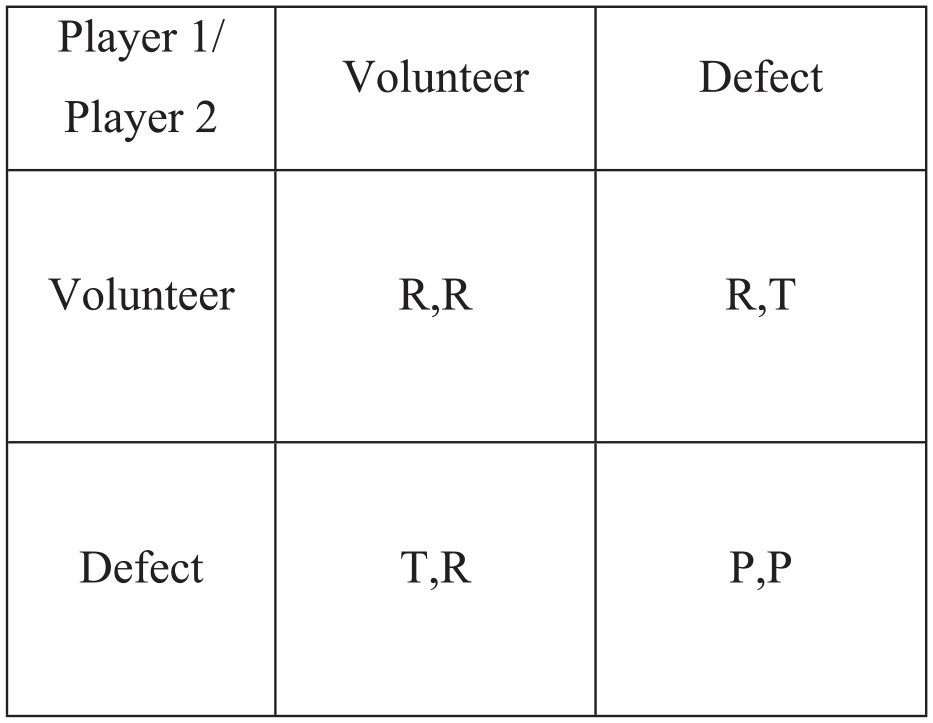
Payoff Matrix of the VoD.
The VoD offers no “dominating strategy.” Neither volunteering nor defecting yields a higher payoff no matter what the other player does. Classic game-theory offers a probabilistic solution by deriving the Nash-equilibrium probability of volunteering from the prospective payoffs that render the other player indifferent between strategies. The theory assumes that rational players find and use this probability. For the VoD, this probability is computed as p = 1 − (T − R)/(T − P). However, many players volunteer in excess of this probability, which suggests they are either irrational or rational in a way not accounted for by game theory (Kim et al., 2018; Krueger et al., 2016, 2018; Olivola et al., 2020). 1
Social distance moderates this general finding. The evidence for overvolunteering is strongest for players who are socially or psychologically close to one another (Krueger et al., 2016). When two brothers need to independently decide whether to make the trip to the airport, they are more likely to find themselves in the inefficient situation of mutual volunteering than two strangers would. The brothers’ eagerness to volunteer ends up self-defeating. Yet, as Diekmann (1985) has shown, overvolunteering can be partly understood as the result of “superrational” decision-making under the assumption that closely related players wish to maximize the collective outcome and expect the other player to share this wish. A superrational player volunteers with p = 1 − (T − R)/2(T − P), which is always greater than the Nash equilibrium probability.
Another explanation for overvolunteering is that volunteering and defecting, respectively, please and offend a player’s moral sense. This moral-tag hypothesis is supported by respondents regarding volunteering as more moral than defecting, by players believing they are more likely to volunteer than are people in general (Heck & Krueger, 2017), and by players choosing to volunteer even when knowing that others volunteer too (Bergstrom et al., 2019; Tham et al., 2019).
Egocentric myopia has also been shown to contribute to overvolunteering. Myopic respondents focus on their own potential payoffs while neglecting the payoffs available to others (Krueger et al., 2018). This finding presents a puzzle. If respondents focus on the ranking of their own payoffs, why would they not defect, hoping to attain the desirable T payoff? A possible solution lies in a typically overlooked feature of the standard VoD. A fixed payoff R accrues to volunteering regardless of the other player’s strategy. In contrast, defection yields either payoff T or payoff P depending on the other player’s choice. Therefore, it is possible that some players volunteer to curb uncertainty and to remain independent of the other player. If so, their volunteering is morally neutral.
Prospect theory provides further perspective on the bias of uncertainty aversion by noting that it is limited to the domain of potential gains (Kahneman & Tversky, 1979; Tversky & Kahneman, 1986). This “reflection effect” refers to people being risk-averse when confronted with gains and risk-seeking when confronted with losses. The effect is amplified if one of the options involves a certain outcome. Together, the reflection effect and the certainty effect may enhance the attractiveness of volunteering in a standard VoD when payoffs are framed as gains.
Research on prospect theory compares certain with risky outcomes (i.e., having objective probabilities), whereas in the standard VoD, the outcomes of defection are uncertain (i.e., having subjective probabilities) as the probability of the other player’s defection is unknown (Knight, 1921). In other words, players have to subjectively assess the likelihood that the other player defects (cf. Savage, 1954). To explore the relevance of prospect theory for volunteering, it is necessary to introduce dilemmas involving risk or uncertainty for the volunteers. To date, there is little relevant research. Using gain frames, Olivola et al. (2020) found that male (but not female) participants volunteered more in a risky VoD than in a certain (i.e., standard) VoD. This finding contrasts with prospect theory, which predicts that in a gain frame volunteering is most attractive if it involves certainty.
The Present Research
In the present research, we contrast the willingness to volunteer in a dilemma where the outcome of volunteering is certain (as in the standard game) with the willingness to volunteer when the outcome is risky or uncertain. In Experiment 1, these three types of outcome are either framed as gains or as losses to test differential predictions derived from prospect theory. At this, the Nash equilibrium for rational and self-regarding volunteering is held constant; a design feature that yielded an inequality in collective outcomes. To address this issue, Experiment 2 pits uncertainty avoidance against collective interests by varying whether uncertain collective outcomes are larger or smaller than certain collective outcomes. Taken together, these two experiments provide an answer to the question of whether uncertainty avoidance or the pursuit of larger collective outcomes better explains volunteering in VoDs.
Experiment 1
We designed the first experiment to explore respondents’ willingness to volunteer in dilemmas in which the outcome of volunteering is either certain (as in the standard game), risky, or uncertain. This manipulation is of interest because a reduction in volunteering in risky or uncertain VoDs would indicate that volunteering is not only driven by moral concerns. We also varied whether payoffs were framed as gains or losses. Prospect theory suggests that certain outcomes should be particularly attractive in a gain frame and particularly unattractive in a loss frame due to the certainty effect. Moreover, a gain frame should lead to more volunteering than a loss frame because of the reflection effect. In the preregistration of this experiment, we stated the following working hypothesis. There is an interaction between outcome condition and framing such that compared with certain VoDs, volunteering will increase when risky and uncertain VoDs are presented in a loss frame and decrease when they are presented in a gain frame. 2
Method
Participants and Design
The preregistered number of 104 participants was recruited at a large Swiss University. One participant failed to pass the comprehension test and another did not complete the questionnaire, leaving an effective sample of 102 participants (75 women, 27 men, median age = 21). Participants earned research credit for completing the experiment.
The factorial design involved three within- and three between-subjects factors. The within-subjects factors were the outcome condition (certain, risky, uncertain), outcome framing (gains, losses), and scenario number (there were three similar scenarios per scenario type). The between-subjects factors were scenario type (development or emergency scenarios), framing order (gain or loss frames presented first), and outcome condition order (risky VoD as second game or uncertain VoD as second game − certain VoD was always the first game).
Statistical Power
We did not conduct a formal power analysis because this would have required several arbitrary assumptions regarding the random effects in the preregistered mixed-model analysis. Yet, using a comparable analysis strategy, the design can be shown to have reasonable sensitivity. In a conventional mixed ANOVA with scenario number as a fixed factor, the hypothesized interaction would be tested with 2 numerator and 188 denominator degrees of freedom, affording 80% power to detect an effect size of .05 partial eta-squared (i.e., a medium size).
Materials
A questionnaire presented 18 (i.e., the product of the three within-subject factors) scenarios where participants had to make choices affecting the life and death of fictive people. These scenarios described a VoD resembling Tversky and Kahneman’s (1981) disease problem. Participants rated their willingness to volunteer on a bipolar 8-point scale (cf. Kim et al., 2018) where 8 stood for very strong volunteering preferences, 5 for weak volunteering preferences, and 1 for very strong defecting preferences (the questionnaire used neutral labels, e.g., “preference for option A”).
Figure 2 displays the manipulation of risk and uncertainty. All VoDs were constructed so that a rational, self-regarding, and risk-neutral player who assumes the other player to share these orientations volunteers with a probability of .5. However, holding this Nash equilibrium constant across the three conditions, the sum of possible outcomes accruing to the collective of players given at least one cooperative player was lower in the uncertain VoD. This confound will be addressed in Experiment 2. Risk was implemented such that volunteering produced a set of equally likely outcomes, such as 7, or 8, or 9 survivors. The critical feature of the uncertain VoD was that the outcome of volunteering depended on the other player’s choice, which was unknown. 3 The decision frame was manipulated by either referring to survivors or deaths, and it was switched in the middle of the questionnaire.
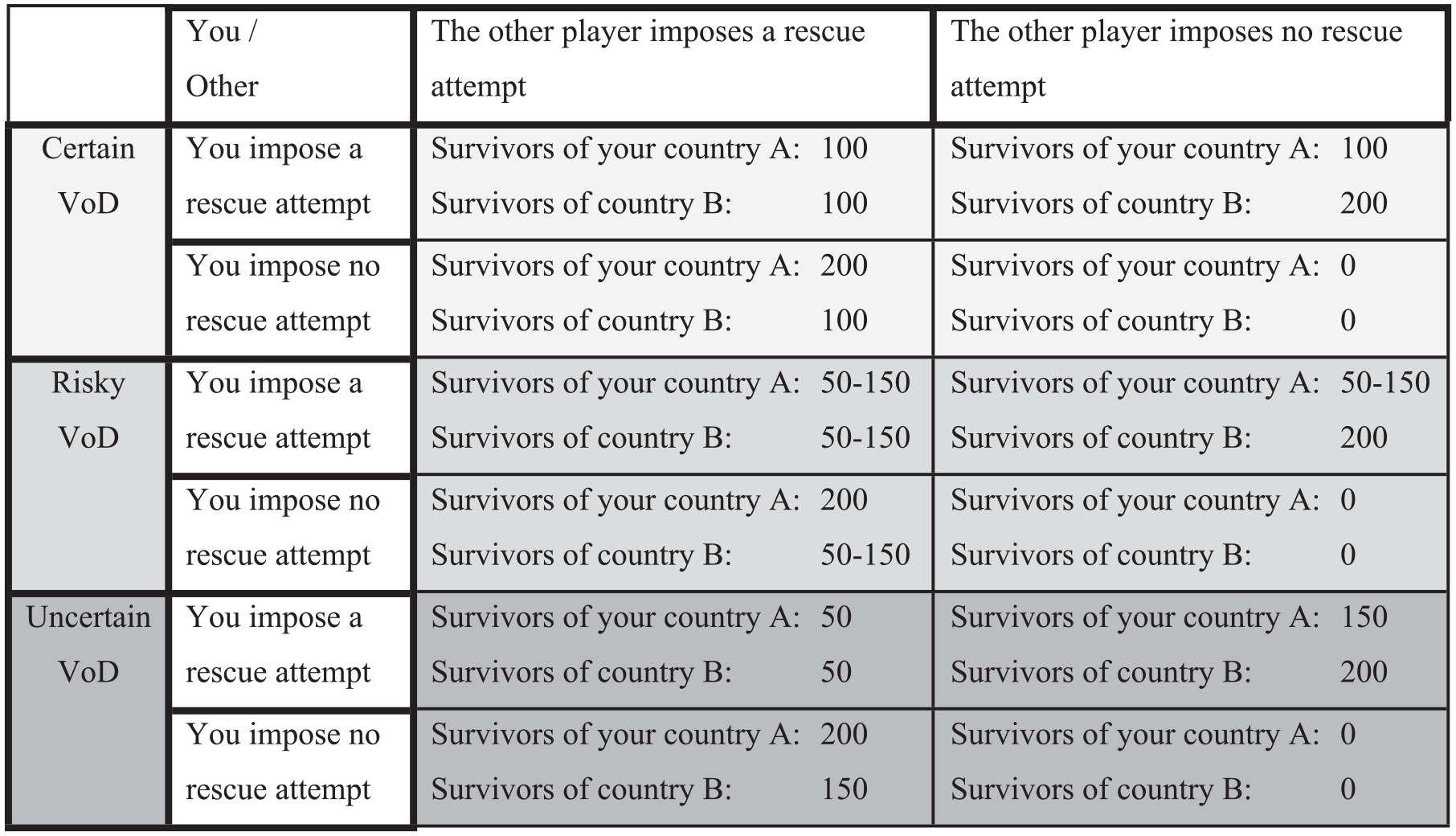
Payoff Matrices of a Certain, Risky, and Uncertain VoD.
The two scenario types were “development” and “emergency.” Development scenarios included challenges (a disease, a drought, or polluted water) affecting the country of which the participant is the prime minister plus a neighboring country. To meet these challenges, at least one country (i.e., prime minister) has to volunteer, while mutual volunteering is wasteful. Emergency scenarios were constructed in an analogous way, referring to mountaineers, soldiers, or astronauts in an immediate emergency situation. The numbers of possible deaths/survivors were smaller than in the development scenarios. English translations of all materials (plus data and code) are available at https://osf.io/wudf6/?view_only=852d1a2759884bd984ce82589bd6bf90
Procedure
The experiment was conducted as a paper-pencil test in group sessions in a large lecture hall and it took about 30 to 45 min to complete. Once they had responded to a scenario, participants were not allowed to go back and make corrections. After turning in their questionnaires, participants could add their name to a list to receive research credit.
Results
Analytical Strategy
Our theoretical focus was on the interaction between framing and outcome condition. To assess the potential influence of the other factors (capturing procedural variations) we compared six nested regression models of participants’ preferences for volunteering: A null model comprised only the intercept, a main effect model included the factors outcome condition, framing, scenario type, framing order, and outcome condition order, and the full models included all interactions of the next higher order up to the five-way interaction model.
To address the statistical dependencies of repeated measures, we used a mixed-model approach with random intercepts and slopes (Judd et al., 2012). Assuming variation between participants and between different scenarios of the same type to be random, all models included random intercepts for participants and scenarios. The main effects model included random effects of framing and outcome condition for participants and a random effect of framing for scenarios (given that further random effects for scenarios would lead to singular models). All interaction effects models also included a random effect for the interaction between framing and outcome condition among participants. 4 Analyses were performed with the package lme4 (Bates et al., 2019) written in R (R Core Team, 2019).
Preliminary Analyses
The best-fitting model (judged in terms of AIC, BIC, and log-likelihood tests) was the two-way interaction model, which originally included 10 interaction terms. Further model comparisons suggested that interactions involving the factors framing order and outcome condition order were not reliable. Thus, the final model included only the interactions between outcome condition, framing, and scenario type. Table 1 depicts the respective coefficients (applying effect coding). See supplementary materials for details on preliminary analyses.
Main Effects, Interactions, and Effect-Coded Variables of Final Model.
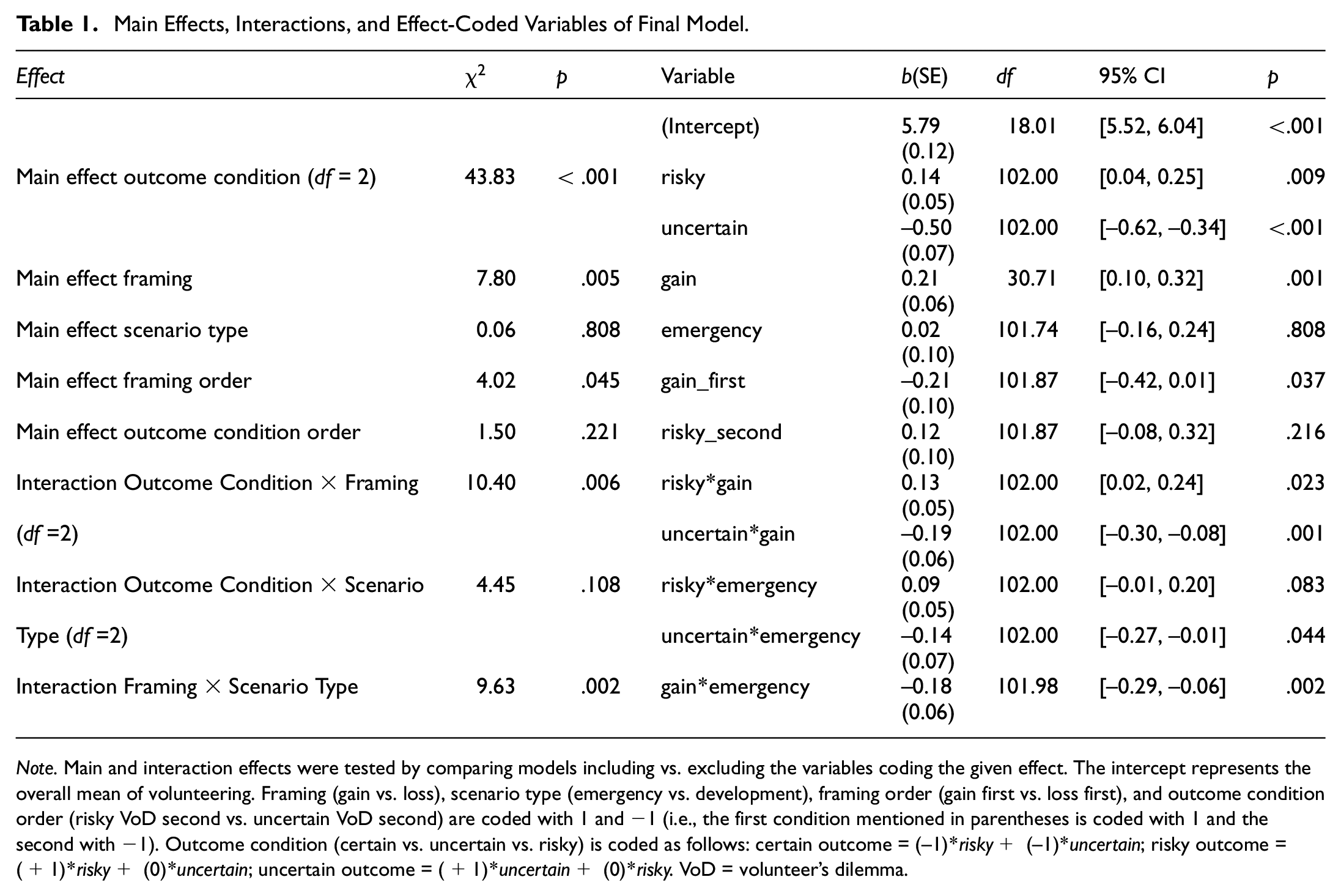
Note. Main and interaction effects were tested by comparing models including vs. excluding the variables coding the given effect. The intercept represents the overall mean of volunteering. Framing (gain vs. loss), scenario type (emergency vs. development), framing order (gain first vs. loss first), and outcome condition order (risky VoD second vs. uncertain VoD second) are coded with 1 and −1 (i.e., the first condition mentioned in parentheses is coded with 1 and the second with −1). Outcome condition (certain vs. uncertain vs. risky) is coded as follows: certain outcome = (–1)*risky+ (–1)*uncertain; risky outcome = (+1)*risky+ (0)*uncertain; uncertain outcome = (+1)*uncertain+ (0)*risky. VoD = volunteer’s dilemma.
Findings
The general finding that respondents in hypothetical situations prefer to volunteer rather than defect emerged clearly in this experiment as well; the intercept indicates that the mean rating was above the midpoint of the scale (M = 5.79, SD = 1.79). The interaction between outcome condition and framing was critical for our hypothesis. A model comparison revealed that the model including the two effect-coded interaction terms risky*gain and uncertain*gain was significantly better than a model without these terms,
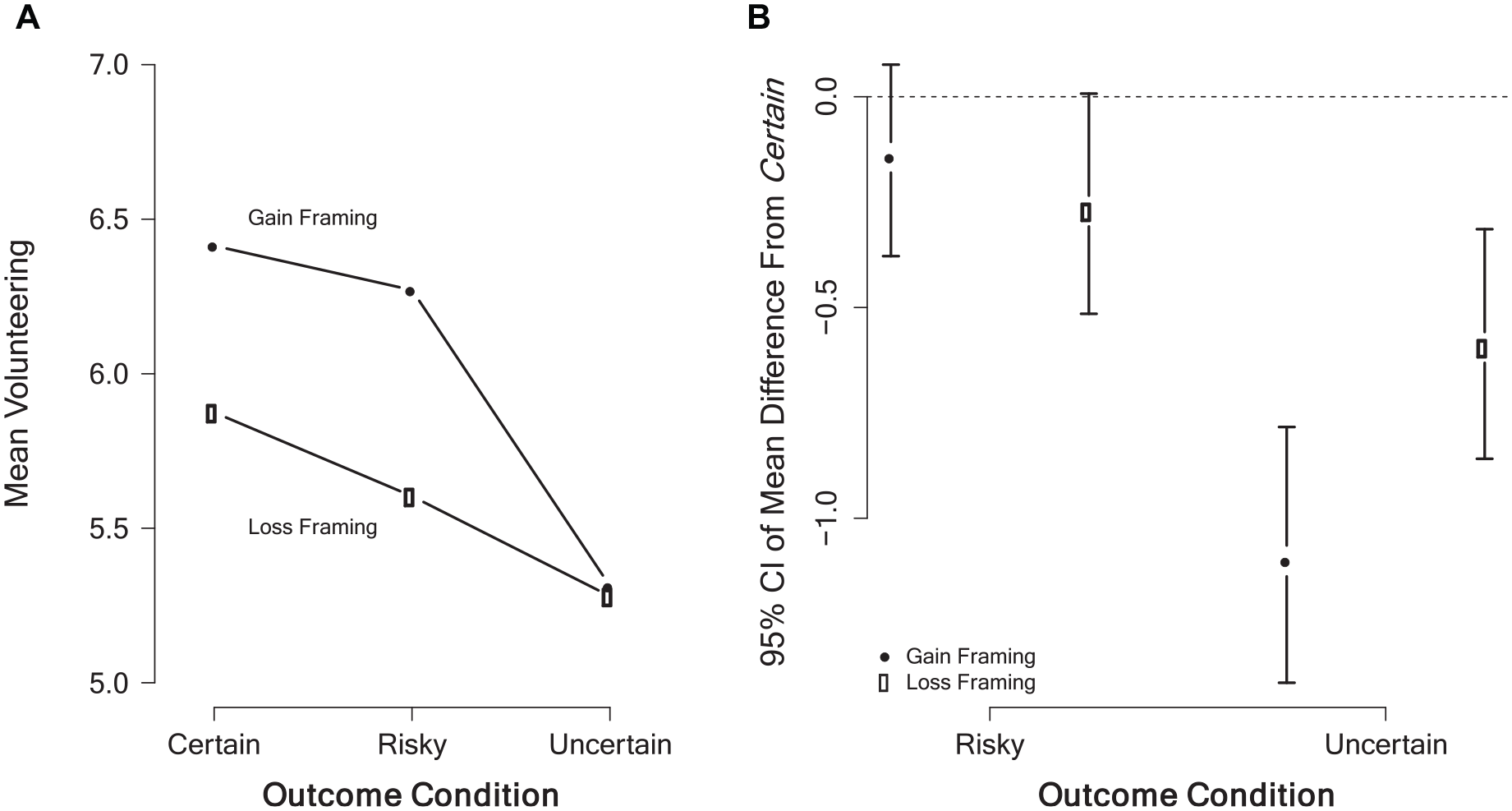
a) Mean Volunteering in Certain, Risky, and Uncertain VoDs, Depending on Framing; b) Mean Difference in Volunteering Between Certain and Risky/Uncertain VoDs, Depending on Framing.
The same interaction can be broken down by outcome condition allowing us to compare the classic framing effect (Tversky & Kahneman, 1986) across certain, risky, and uncertain VoDs. Considering that in the standard VoD, a preference for volunteering implies a preference for the riskless option, we expected greater volunteering in the gain frame than in the loss frame. Indeed, while certain VoDs (b = 0.54; 95% CI = [0.25, 0.86]) and risky VoDs (b = 0.67; 95% CI = [0.39, 0.93]) show a framing effect (i.e., less risk-seeking in the gain frame), uncertain VoDs do not (b = 0.03; 95% CI = [−0.29, 0.38]).
The framing effect also depended on the scenario type (p = .002). Development scenarios exhibited a strong framing effect, where a switch from loss (intercept at 5.38) to gain frames increased volunteering preferences by 0.77 (95% CI = [0.46, 1.07]). In contrast, no significant effect was found for emergency scenarios (b = 0.06; 95% CI = [−0.26, 0.39]).
Interactions involving outcome condition and scenario type were not significant (two-way interaction, p = .11; three-way interaction with framing, p = .82). Finally, exploratory analyses revealed that the reported effects of outcome condition and framing were not moderated by gender.
Discussion
Our first experiment asked whether respondents volunteer to curb uncertainty. The standard VoD yields a certain and invariant payoff for volunteering, whereas defection can result in either highly attractive or catastrophic outcomes. To remove the confounding of the prosocial option with the certain option, we introduced risk and uncertainty into the volunteers’ outcomes. Moreover, we also varied whether outcomes constituted gains or losses relative to a reference point.
All conditions showed volunteering above the mixed-strategy Nash equilibrium provided by game theory, replicating previous results (Krueger, 2019). The effects of outcome condition yielded a pattern that departs from prospect theory (Tversky & Kahneman, 1986): Regardless of framing, uncertain outcomes (but not risky outcomes) reduced volunteering preferences relative to the standard VoD with certain outcomes. It appears that volunteering is in part motivated by a desire to avoid uncertainty, but not by a desire to avoid risk.
An aversion to uncertainty or ambiguity (Ellsberg, 1961) amounts to a preference for objective (clear) over subjective (uncertainty) probabilities. Within a certain or risky VoD, volunteering is attractive because, in contrast to defecting, it involves objective and not subjective probabilities. This interpretation is consistent with Kelsey and le Roux (2015, 2017, 2018), who let participants play different social games, including a variant of a VoD, and generally conclude that ambiguity aversion influences behavior in these games. Moreover, there is evidence that ambiguity aversion is less prevalent or even reversed in the loss domain (Kocher et al., 2018; Trautmann & van de Kuilen, 2015). This could explain why differences in volunteering between certain/risky and uncertain VoDs were significantly smaller in loss than in gain frames.
However, there is an alternative explanation for our results: Given our goal of holding the Nash equilibrium value constant across outcome conditions, collective outcomes had to vary. Specifically, the expected collective payoff of volunteering was larger in the certain/risky VoDs than in the uncertain VoDs, whereas the expected collective payoff of defecting was larger in the uncertain VoDs than in the certain/risky VoDs. This circumstance is irrelevant for players only interested in their own payoff. However, players seeking to maximize collective payoff and expecting that others would too (i.e., superrational players) might have volunteered less in the uncertain VoDs than in the certain/risky VoDs because the smaller collective payoff made volunteering less attractive and not because the outcomes were uncertain. 5
Experiment 2
Experiment 2 was designed to test whether variance in expected collective payoff of volunteering explains the findings of Experiment 1 better than ambiguity aversion. We contrast two versions of the uncertain VoD; the uncertain– VoD with lower expected collective payoffs of volunteering (and higher expected collective payoffs of defecting) and the uncertain+ VoD with higher expected collective payoffs of volunteering (and lower expected collective payoffs of defecting). We anticipated three potential outcomes: if (1) [certain VoD > uncertain+ VoD = uncertain– VoD], players are ambiguity averse; if (2) [certain VoD = uncertain+ VoD > uncertain– VoD], players are both ambiguity averse and consider the expected collective payoff; and if (3) [uncertain+ VoD > certain VoD > uncertain– VoD], players (mainly) consider the expected collective payoff. Which of these outcomes would prevail was the empirical question.
We simplified the design by omitting risky VoDs as they have the same expected collective payoffs as certain VoDs, and by only using one scenario (mountain rescue in a gain frame) because this game led to the largest uncertainty effect in the first experiment.
In the preregistration, we submitted the following working hypothesis. There is a dependence between volunteering and outcome condition (part a) and participants are not indifferent between the three outcome conditions with regard to preferability (part b). 6
Method
Participants and Design
On September 22, 2021, we recruited participants at the same Swiss University, aiming to surpass the preregistered minimum of 105. 618 participants started the questionnaire and 517 finished it. Of these, 21 participants failed to pass the comprehension test in the second try, leaving an effective sample of 496 participants (385 women, 107 men, 4 non-binary, median age = 20). Deviating from our preregistration, we did not exclude participants who completed the questionnaire on their phone because this would have reduced sample size by 144. This deviation does not affect our conclusions. 7
The factorial design involved the within-subjects factor outcome condition (certain, uncertain–, uncertain+) and the between-subjects factor order (the six ways the variable outcome condition can be ordered).
Statistical Power
The sample size was determined by a safeguard power analysis (Perugini et al., 2018). This method uses the lower limit of the 95% CI for a previously observed effect as the expected effect size. Using the smallest effect observed in Experiment 1 (space station scenario, d = 0.61, lower limit of the effect size’s 95% CI is 0.356) we determined that we needed 105 participants to have 95% power.
Materials
A questionnaire presented three versions of the mountain rescue VoD used in the first experiment: a certain VoD, an uncertain– VoD, and an uncertain+ VoD. Figure 4 depicts the payoff matrices of these three VoDs. All three VoDs were constructed so that a rational, self-regarding, and risk-neutral player who assumes the other player to share these orientations volunteers with a probability of .5. Participants rated their willingness to volunteer on the same scale as in Experiment 1.
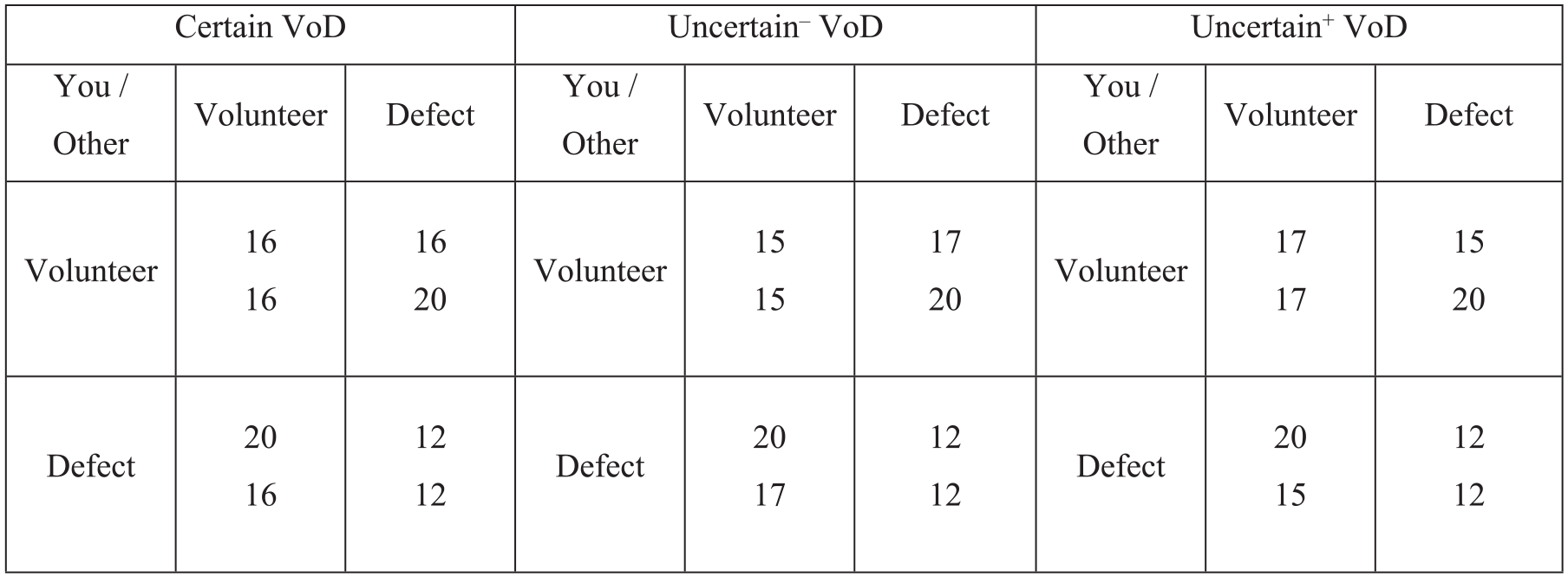
Payoff Matrices of Certain VoD, Uncertain– VoD, and Uncertain+ VoD (Mountain Rescue Scenario).
After participants had played the three VoDs, participants were shown the three payoff matrices again and asked to rank the games by classifying them as most preferred (“situation they would most preferably be in”), least preferred, and indicate ties.
Procedure
The experiment was conducted in a mass testing session at the end of a lecture. Students accessed the online questionnaire using their own laptops, tablets or mobile phones. The questionnaire took 7 to 10 min to complete.
Results
Analytical Strategy
Our theoretical focus was on the effect of the outcome condition on volunteering. To also assess—less interesting—potential order effects we compared the nested regression models of participants’ preferences for volunteering: a null model comprised only the intercept, the main effects model included the factors outcome condition and outcome condition order, and a two-way interaction model that also included the interaction between outcome condition and outcome condition order.
To address the statistical dependencies of repeated measures, we used a mixed-model approach with random intercepts (Judd et al., 2012). Assuming variation between participants to be random, all models included random intercepts for participants. 8
Finally, we used a Pearson chi-square test to determine if one of the three outcome conditions is clearly preferred. Analyses were performed with the package lme4 (Bates et al., 2019) written in R (R Core Team, 2019).
Preliminary Analyses
The best-fitting model (judged in terms of AIC and BIC) was the main effects model with outcome condition and order as independent variables. Table 2 depicts the respective coefficients (applying effect coding). See supplementary materials for details on preliminary analyses.
Main Effects and Effect-Coded Variables of Final Model.
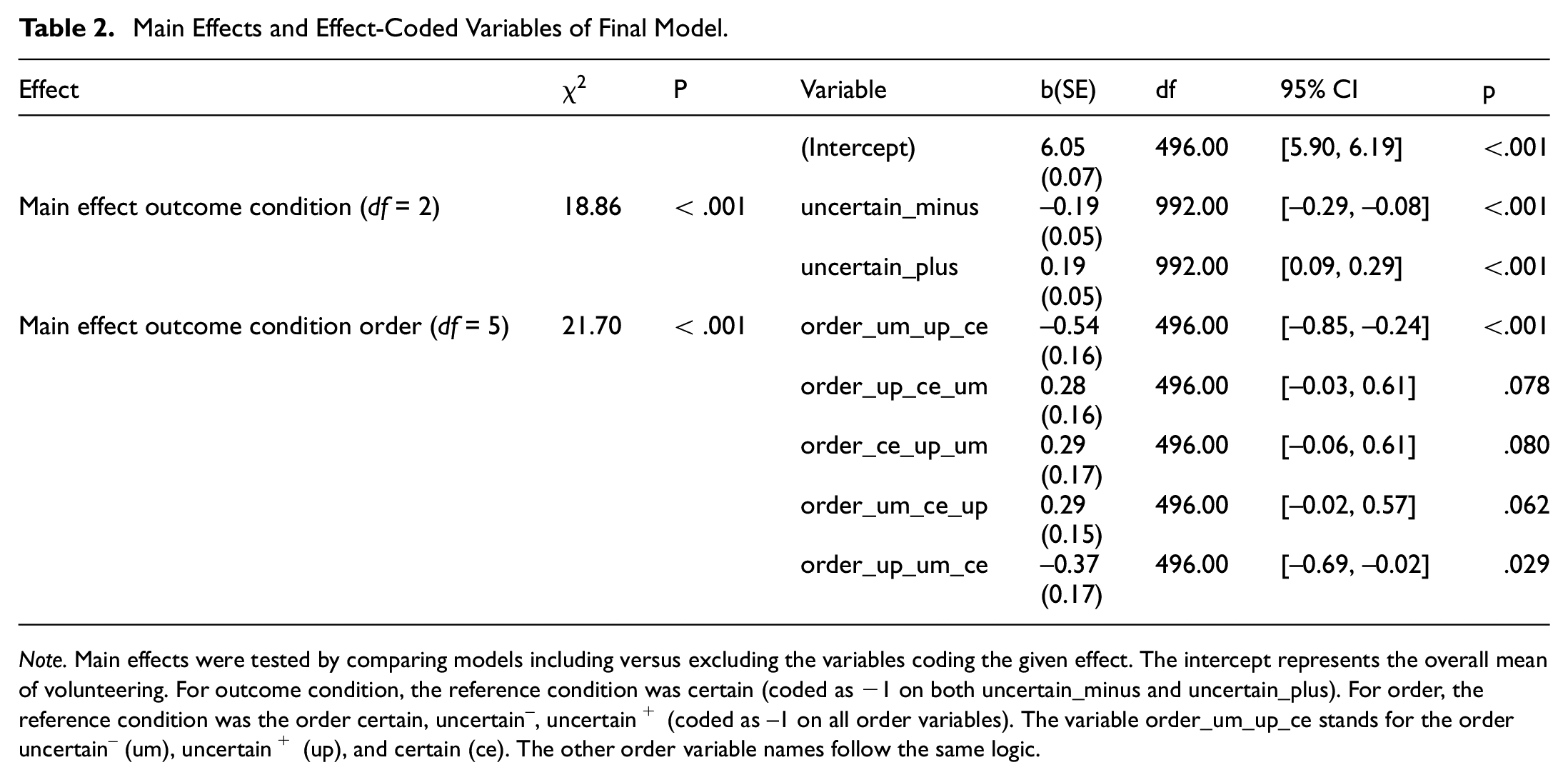
Note. Main effects were tested by comparing models including versus excluding the variables coding the given effect. The intercept represents the overall mean of volunteering. For outcome condition, the reference condition was certain (coded as −1 on both uncertain_minus and uncertain_plus). For order, the reference condition was the order certain, uncertain–, uncertain+ (coded as –1 on all order variables). The variable order_um_up_ce stands for the order uncertain– (um), uncertain+ (up), and certain (ce). The other order variable names follow the same logic.
Findings
Again, respondents preferred to volunteer, with the intercept indicating a mean rating above the midpoint of the scale (M = 6.05, SD = 1.97). More importantly, volunteering varied over outcome condition (p < .001). Figure 5a shows the respective pattern, and Figure 5b the 95% CIs of the difference of volunteering in the uncertain– and the uncertain+ VoD as compared with the certain VoD. As shown in the figure, volunteering for uncertain+ outcomes was significantly higher than volunteering for certain outcomes (b = 0.19; 95% CI = [0.02, 0.36]; d = 0.10), whereas volunteering for uncertain– outcomes was lower, but not significantly so (b = 0.18; 95% CI = [0.00, 0.37]; d = 0.09).
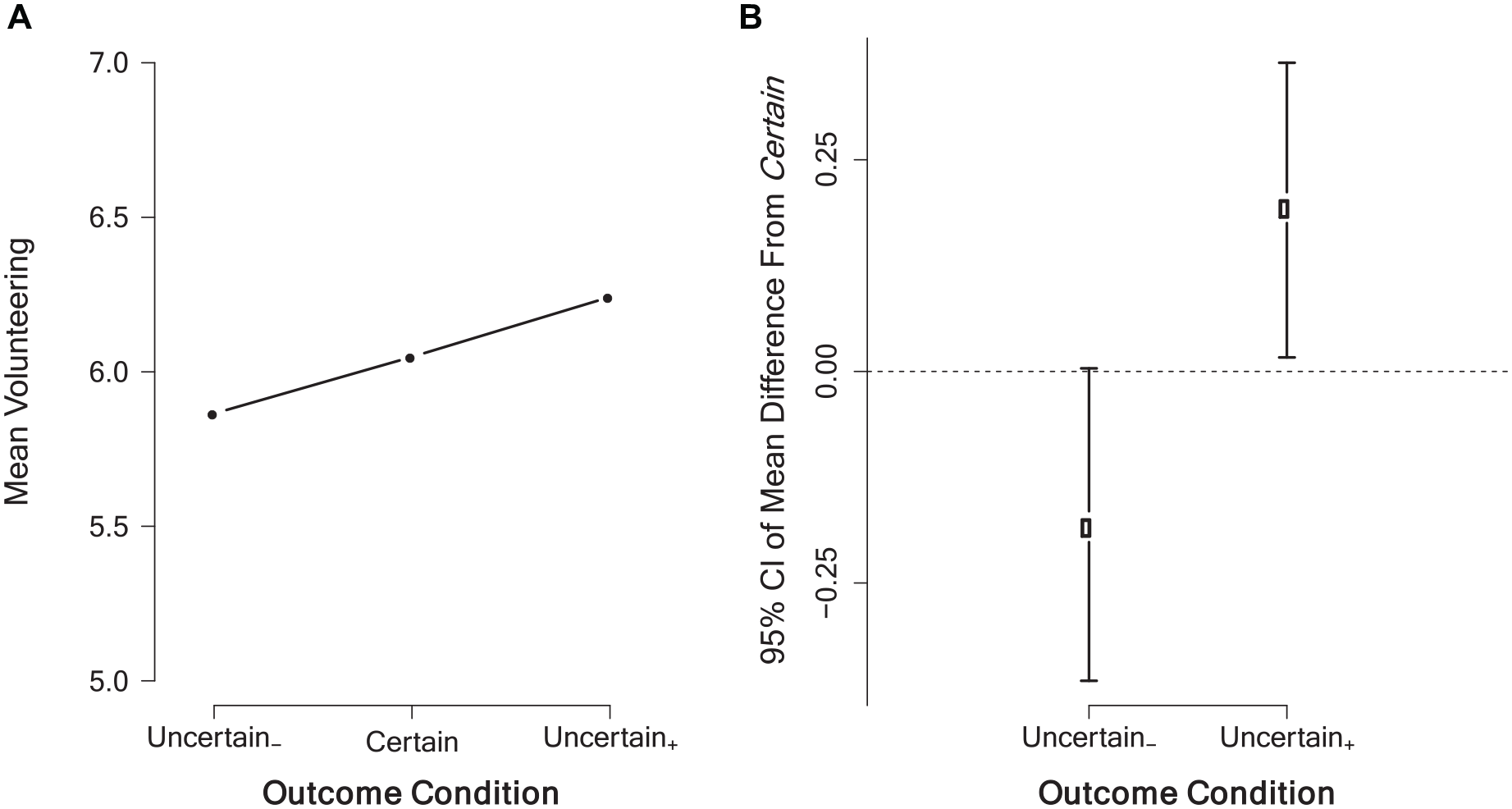
a) Mean Volunteering in Certain, Uncertain–, and Uncertain+ VoD; b) Mean Difference in Volunteering Between Certain and Uncertain–/Uncertain+ VoD.
Volunteering depended on outcome condition order (p < .001), but there is no pattern indicating why participants in some order conditions volunteered more than in others. Although we have no explanation for these order effects, we note that order did not interact with outcome condition and thus does not affect our conclusions regarding uncertainty avoidance.
Turning to the question of which outcome condition participants preferred, there was a clear pattern with 258 participants preferring the uncertain+ VoD (55%), 121 the uncertain– VoD (26%), and 88 the certain VoD (19%), p < .001. Figure 6 shows the distribution as a pie chart.
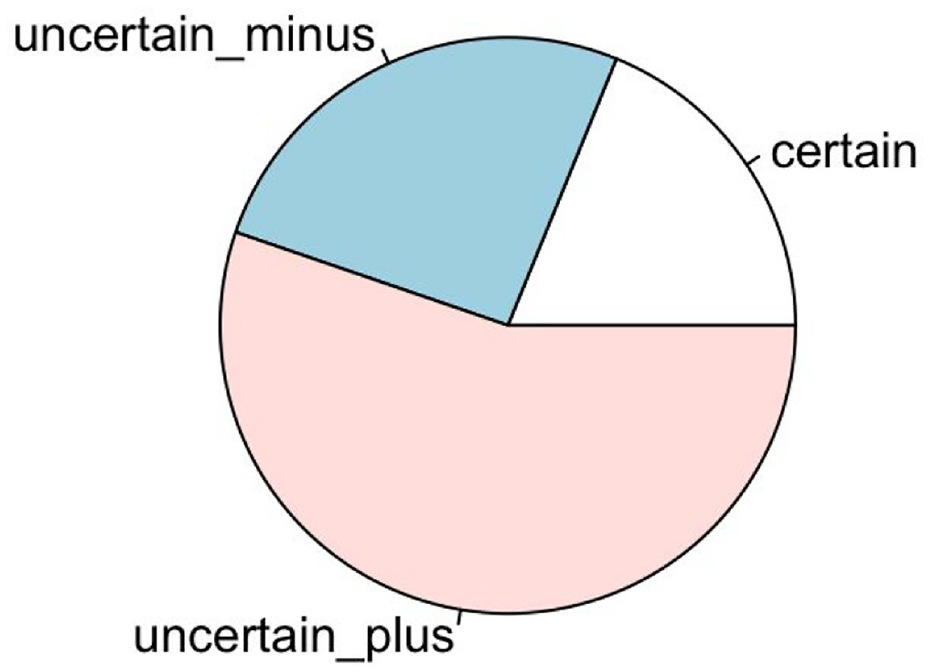
Most Preferred Outcome Condition.
Participants then indicated on a 5-point scale how well they could put themselves in the decision-maker’s shoes. Here, we find that a higher score goes along with higher volunteering preferences (b = 0.40; 95% CI = [0.25, 0.55]). Finally, exploratory analyses revealed that the reported effects of outcome condition were not moderated by gender.
Discussion
Experiment 2 explored whether variance in expected collective payoff might be a better explanation of the results of Experiment 1 than ambiguity aversion. Results suggest that it is. Participants sought to maximize the expected collective outcome regardless of whether doing so introduced uncertainty in individual outcomes. Furthermore, when asked which version of the dilemma they would rather like to be in, most participants selected the uncertain+ VoD. Volunteering, it now seems, is not motivated by a desire to avoid uncertainty as suggested by Experiment 1, but by a desire to maximize the expected collective payoff.
General Discussion
The present study explored the role of certainty in a VoD. The standard VoD offers a certain and invariant payoff for volunteering that does not depend on the other player’s choice. By contrast, defection yields a catastrophic outcome if the other player also defects or a highly attractive outcome if the other player volunteers. We implemented VoDs in which the outcome of volunteering is risky (i.e., a lottery) or uncertain (i.e., it depends on the other player’s choice) so as to remove the confounding of the prosocial option with the certain option in a standard VoD.
Experiment 1 examined the role of certainty by varying the type of outcome condition (certain, risky, and uncertain), the type of scenario (emergency and development), and the framing of outcomes (gain and loss). The findings revealed that independent of framing, certain VoDs led to higher volunteering rates than uncertain VoDs (but not risky VoDs), suggesting that certainty (i.e., objective probabilities) plays a role in a standard VoD. However, given our goal to hold the Nash equilibrium value constant, collective outcomes had to vary. As a result, uncertain VoDs involved a lower expected collective payoff of volunteering than certain/risky VoDs, confounding our finding of ambiguity aversion.
Experiment 2 introduced another uncertain VoD (i.e., uncertain+ VoD) with higher expected collective outcome of volunteering than the certain VoD. This experiment ‘also included the uncertain VoD (i.e., uncertain– VoD) and the certain VoD from Experiment 1. Results showed that the uncertain+ VoD was the most preferred one and led to the highest volunteering rates. Participants maximized expected collective outcome and were unaffected by the fact that doing so introduced uncertainty in individual outcomes.
We had initially hypothesized that the strong preference for volunteering that we typically see in standard VoDs might not be entirely due to moral preferences but partly due to the prosocial action yielding a certain outcome. Now we may reject this hypothesis and conclude that people display social/moral preferences and social projection.
The fact that volunteering increased with the expected collective outcome of volunteering implies that participants consider the expected collective outcome when making their choices. In other words, participants seem to have weighed both their own and the other player’s outcome, displaying social preferences. However, the choice that maximizes expected collective outcome is also the morally superior choice (cf. superrationality and Kantian equilibrium, see Diekmann, 1985). Thus, the pattern of volunteering we observed reflects social or moral considerations—or both. The superrational strategy of maximizing collective outcome presupposes the expectation that the other player will do the same. In other words, participants seem to have projected their own choice on the other player, a finding observed in previous research (Krueger, 2019; Krueger et al., 2016).
The present research contributes to the VoD literature by shedding light on the role of outcome certainty in the standard VoD. Many real-life VoDs involve uncertain outcomes not only for defecting but also for volunteering. Our results suggest that if this feature of real-life VoDs is captured in stylized games, preferences for volunteering will be similar as people are not affected by a VoD’s outcome condition. Furthermore, people appear to (also) consider a VoD from a collective outcome perspective and assume that the other player does so too.
This research also has limitations. We neither collected the expectations of participants about the other player’s behavior, nor their motivation behind their choice. Furthermore, results might have been more self-regarding if the hypothetical choices had affected participants themselves and not (only) people they were responsible for (in the study, self-regard required an ingroup bias which might have been rather low). This is a potential focus for future research.
To conclude, we see that the circumstance of certainty in a standard VoD does not affect volunteering. Instead, volunteering is motivated by a desire to maximize expected collective outcomes. As a consequence, the study reinforces the assumption that the typically strong preference for volunteering that we see in standard VoDs is due to social/moral preferences and social projection.
Supplemental Material
sj-docx-1-spp-10.1177_19485506221107268 – Supplemental material for The Role of Certainty in a Two-Person Volunteer’s Dilemma
Supplemental material, sj-docx-1-spp-10.1177_19485506221107268 for The Role of Certainty in a Two-Person Volunteer’s Dilemma by Daniel Villiger, Johannes Ullrich and Joachim I. Krueger in Social Psychological and Personality Science
Footnotes
Handling Editor: Lisa Libby
Declaration of Conflicting Interests
The author(s) declared no potential conflicts of interest with respect to the research, authorship, and/or publication of this article.
Funding
The open access publication of this article was funded by the The Consortium of Swiss Academic Libraries.

Notes
Author Biographies
Handling Editor: Lisa Libby
References
Supplementary Material
Please find the following supplemental material available below.
For Open Access articles published under a Creative Commons License, all supplemental material carries the same license as the article it is associated with.
For non-Open Access articles published, all supplemental material carries a non-exclusive license, and permission requests for re-use of supplemental material or any part of supplemental material shall be sent directly to the copyright owner as specified in the copyright notice associated with the article.
