



Abstract
Does the common advice to “be yourself” lead people to reveal who they truly are? And what broader personal and social implications might this advice bear? In an experimental first-impression study, we examined whether a manipulation instructing some people to be themselves (vs. no explicit instructions) led targets to have their unique personality profiles more accurately perceived, and carried personal and social benefits. Specifically, 204 targets participated in a video interview, with half the targets told to “be yourself” before the interview. Then, 373 observers watched subsets of target video interviews. Overall, the manipulation led targets to be seen with greater distinctive accuracy, especially on their more observable and evaluative self-aspects. However, the manipulation did not significantly influence impression normativity, target likability, nor target post-interview well-being. In sum, being told to be oneself elicits more accurate first-impression perceptions but may not bear immediate personal or social consequences.
“Be brave. Be you.” (BrenéBrown, 2014; Oprah Magazine). “Unless you’re Oprah, ‘be yourself’ is terrible advice.” (Adam Grant, 2016; New York Times)
Before a first date or a job interview, people often receive the advice to “just be yourself.” Is this advice effective? Does telling people to “be yourself” lead them to indeed express their unique personality characteristics more accurately? Furthermore, does this advice bear positive or negative consequences? Historically, behaving coherently and authentically has long been a posited hallmark of psychological and social adjustment (e.g., Harter, 2002; Kierkegaard, 1843/1943; Maslow, 1968; Rousseau, 1761/1964; Sartre, 1943). However, in recent pop-culture opinion pieces, scientists have diverged, with some claiming that being yourself is “terrible advice” likely leading people to behave in disinhibited, socially inappropriate ways (Chamorro-Premuzic, 2020; Grant, 2016). To shed light on these competing possibilities, we examined the implications of giving others the advice “be yourself” via an experimental manipulation, which we term authenticity manipulation, in first impressions. Specifically, we explored whether telling participants to be themselves enhanced their expressive accuracy—the tendency to be viewed in line with one’s unique personality profile—and whether it influenced state well-being and likability.
Defining Expressive Accuracy
First, how do we define expressive accuracy? We use the term expressive accuracy to reflect the extent to which a target’s distinct personality is accurately perceived on average across a number of previously unacquainted observers. To this end, we need an indicator of one’s actual personality as an accuracy criterion, against which to compare first-impression observations. In the present research, we indexed targets’ actual personality based on the composite of self- and close-other ratings (see Funder, 1995). Next, using a profile approach, we examined the extent to which previously unacquainted observers saw targets in line with their accuracy criterion across a wide range of personality items simultaneously (see Human et al., 2019). That is, on Ted’s first day at the office, can his new colleagues see that he is more helpful than assertive, and more assertive than relaxed?
Specifically, we wanted to examine whether the manipulation led targets to reveal what was unique about them. To do so, we disentangled two sources of information which observers rely on when forming impressions: “distinctive accuracy,” relying on a specific target’s idiosyncratic cues, and “normative accuracy,” relying on information about how people tend to be in general (Biesanz, 2020; Cronbach, 1955). For example, if Ted’s new colleague Patrick accurately sees him as more helpful than assertive, and this is how most people are, it is unclear whether Patrick specifically understands Ted’s idiosyncratic tendencies, or simply understands people in general. Therefore, we control for normative accuracy and examine distinctive accuracy: Does Patrick see the extent to which Ted is even more helpful than assertive compared with the average person? In parallel to reflecting profile, within-target accuracy, this approach also reflects item-wise between-target accuracy, such as perceiving whether Ted is less assertive than others and more helpful than others (Biesanz, 2020). Thus, we define expressive accuracy as the extent to which a person’s personality profile is perceived with distinctive accuracy above and beyond that person’s tendency to be perceived normatively.
Importantly, the normative profile not only reflects the average target’s personality, but also the average person’s tendency to rate oneself based on item desirability (Edwards, 1953; Leising et al., 2013; Rogers & Biesanz, 2015; Wessels et al., 2020). As such, “normative accuracy”not only reflects perceiving how a target aligns with the average profile, but also with what is positive and socially desirable. Although highly correlated (generally above r = .80; Edwards, 1953, 1957; Wood & Furr, 2016), normative accuracy and social desirability appear to have independent associations with personal and social outcomes (Rogers & Biesanz, 2015; Wessels et al., 2020), requiring caution in interpreting normative accuracy when social desirability is not partialled out (Wessels et al., 2020). In the present research, we deliberately controlled for this blended indicator of average and positive self-aspects (Wood & Furr, 2016), to specifically examine how the manipulation influenced targets’ distinctive profiles. Of note, distinctive accuracy is independent of normative accuracy and evaluatively neutral, as people could deviate from the normative profile both in desirable and nondesirable ways, such as being more versus less reliable than the average person (see Kerr, Tissera, et al., 2020; Leising et al., 2015).
“Being Yourself” and Expressive Accuracy
But how might trying to “be yourself” lead to being more accurately perceived? According to the Realistic Accuracy Model (RAM; Funder, 1995), for accurate personality judgments to take place, targets must provide relevant cues, and make those cues available to observers, who then detect and appropriately utilize the cues to correctly infer targets’ personalities. Although targets can influence all these stages, including perceivers’ attention and motivation to detect and correctly interpret their cues (e.g., Human et al., 2012), instructions to “be yourself” may most likely promote expressive accuracy by leading targets to reveal relevant cues about themselves. But how?
Such instructions may lead them to behave congruently with their unique personality, formally termed distinctive personality–behavior congruence (Sherman et al., 2012), which has been associated with distinctively accurate first impressions (Human et al., 2019). Alternatively, they may verbally provide more self-relevant information. Indeed, those motivated to be viewed in line with who they are tend to provide more personally relevant—albeit not necessarily systematically accurate—narratives (Rice & Pasupathi, 2010), which have been found to enable distinctively accurate in-person first impressions (Wallace & Biesanz, 2021). Finally, in situations where people report feeling that they can “be themselves,” they also report feeling more relaxed (Lenton et al., 2016), which at the trait level, relates to accurately expressing one’s less observable distinctive personality characteristics (Human et al., 2020).
Indeed, instructions to “be yourself” could lead to accurately expressing certain self-aspects over others based on how observable or socially evaluative these self-aspects are. Regarding observability, the authenticity manipulation could especially affect less observable items, such as forgiving, which tend to be seen less accurately (e.g., Funder & Dobroth, 1987), thus affording greater room for improvement. Alternatively, more observable items, such as outgoing, generally have clearer behavioral manifestations (e.g., talking a lot), making them easier to control and amplify on demand. For evaluativeness, more socially evaluative self-aspects (e.g., reliable) tend to be viewed less accurately (John & Robins, 1993), perhaps partly due to self-presentational goals to conceal unique standing on such characteristics. The manipulation could potentially reduce these self-presentational goals, thereby especially enhancing accuracy on evaluative items. Alternatively, people may feel more comfortable revealing their more neutral characteristics (e.g., tense), therefore selectively (consciously or not) providing more relevant cues on such items. In sum, we examined whether people can voluntarily increase how much they reveal their unique personality and, in exploratory analyses, whether this depends on item observability and evaluativeness.
Consequences of “Being Yourself”
Beyond potentially fostering personality expressive accuracy, prior research suggests that the act of being oneself may hold personal and social benefits. In terms of correlational evidence, behaving congruently with one’s distinctive personality profile has been linked to greater well-being (Human et al., 2014, 2019). In terms of experimental evidence, in-lab inductions of “felt authenticity,” the subjective experience of acting “in accord with one’s true self” (Harter, 2002, p. 382), have promoted positive affect, life satisfaction, or meaning in life (Kifer et al., 2013; Schlegel et al., 2009; Thomaes et al., 2017), and socially appropriate behaviors (Gino et al., 2010). However, these experimental studies have manipulated people’s subjective experience of authenticity (e.g., via recalling past inauthentic behavior), rather than their tendency to increase “authentic” cues. Thus, the present study tests for the first time whether direct, explicit instructions to be oneself enhance expressive accuracy and carry immediate psychological and social benefits, enhancing state well-being and likability.
Method
All procedures were approved by the University’s ethics review board. Hypotheses and analyses conducted in the present research were not preregistered because portions of data from Wave 1 were already analyzed for an undergraduate honors thesis in 2016, before preregistration was relatively standard. Study codebook, de-identified data, and R code for analyses are available on the Open Science Framework: (https://osf.io/pkt92/). We state all data exclusions, analyses conducted, and variables pertaining to the present research questions. 1
Overview
Our primary aim was to determine whether we could enhance expressive accuracy via simple instructions to “be yourself.” Following previous work demonstrating that personality accuracy can be enhanced in first impressions for observers (Biesanz & Human, 2010) or targets (Human et al., 2012), we used a similar procedure involving experimenter-delivered instructions in a video-interview design. In the first phase, targets completed questionnaires and participated in a video interview, with half the targets randomly assigned to the authenticity manipulation in which they were instructed to “be themselves” during the interview. In the second phase, previously unacquainted observers watched subsets of target videos and provided impression ratings for each target.
We first examined the influence of the manipulation on expressive accuracy. Second, we examined whether the manipulation led people to reveal certain types of items over others, based on item observability or evaluativeness. Third, we examined immediate consequences of the manipulation on state well-being and likability. In addition, we controlled for possible confounds, namely trait self-esteem and gender, and conducted exploratory analyses examining several potential mechanisms at the cue relevance and other stages of the RAM (Funder, 1995). Covariate and mechanism analyses can be found in Supplementary Online Materials (SOM; pp. 1–10).
Target Phase
Participants
We determined our sample size of targets based on current sample size standards (200–250 participants) for sufficient power to detect the average effect size in personality and social psychology research (r = .21; Fraley & Vazire, 2014; Richard et al., 2003). Thus, we aimed to obtain a sample of 200 targets, and the final sample consisted of 204 targets (136 women; MAge = 20.90, SDAge = 2.79). Eligible participants were recruited from the undergraduate student participant pool and were at least 18 years old. Participants predominantly identified as Caucasian/European (n = 144), followed by Black/African (n = 16) and East/South Asian (n = 13). Each participant was compensated US$15 or 1 course credit. Targets also provided the contact information of up to three close others (NCloseOthers = 270, MClose-OtherAge = 29.44, SDClose-OtherAge = 14.25), who were invited via email as informants to report on the target’s personality. Overall, 54 participants had no informant, 60 participants had one, 60 participants had two, and 30 participants had three informants.
Procedure
Targets came into the lab individually. First, they completed an initial questionnaire about their personality. In this article, we only examined a subset of questionnaires administered in the study. The study codebook with all available measures, experimenter protocol, and script is provided here: https://osf.io/pkt92/. Following the initial questionnaire, experimenters explained the video-interview portion of the study, telling all targets that this study was about accuracy of impressions, and that their videos would later be rated by observer participants. Control targets did not receive additional instructions before the interview. In contrast, experimental targets were told: Please try to be yourself as much as possible throughout the interview. That is, try to express yourself as accurately as possible to the interviewer and any others who may view your video in the future. Do you understand?
This study included two waves. In Wave 1 (NTargets = 105), an interviewer was present to ask video-interview questions. This interviewer was absent during the instructions, thus blind to the condition. In Wave 2 (NTargets = 99), targets faced the camera alone, and read interview questions from a sheet provided by the experimenter. Study results were consistent across the two waves and were not moderated by wave (all ps > .255). Thus, we used the full sample with the two waves combined. 2
Interview
During the interview, targets answered eight questions, including “what are your passions?” and “what do you do in your leisure time?.” The full list of interview questions is available in the study codebook: https://osf.io/pkt92/.Target interviews on average lasted 9.73 min (SD = 4.16). To create target video-sets for observer viewing, video interviews were edited to only include responses to the two interview questions stated above (MVideo-ClipLengthPerTarget = 1.79 min; SDVideo-ClipLengthPerTarget = 0.74 min). We selected these two questions as they have been used in prior research and were initially derived from online dating websites (e.g., Match.com) in an effort to reflect real-world getting-acquainted contexts (Human et al., 2014). In total, each set of videoclips was on average 23.23 min (SD = 0.96 min).
Measures
Personality Ratings
Targets’ self- and close-other ratings of personality included the 44-item Big Five Inventory (BFI; John & Srivastava, 1999), with items such as “Is full of energy,” and three intelligence items, including “Is intelligent,”“Is bright,”“Receives very good grades,” on a scale from 1 (strongly disagree) to 7 (strongly agree). For our accuracy criterion (e.g., Funder, 1995), we averaged target self-reports and close-other reports on a 24-item subset that paralleled observer ratings (see below). Specifically, for each item, close-other reports for a given target were first averaged together, and then averaged with target self-ratings. For targets without close-other reports, we used only self-reports.
Manipulation Check
Targets rated how much they felt they “were themselves” via two single items, “I really tried to be myself during the interview” and “I behaved in line with my personality,” on a 1 (strongly disagree) to 7 (strongly agree) scale, averaged into a composite (M = 5.82, SD = 0.92, α = .78, r = .65).
Target Post-Interview Well-Being
Targets completed a single item assessing self-esteem “I have high self-esteem” (M = 4.76, SD = 1.55) and life satisfaction “I am satisfied with my life” (M = 5.08, SD = 1.45), on a 1 (strongly disagree) to 7 (strongly agree) scale. These items were averaged as a composite of post-interview well-being (M = 4.92, SD = 1.31, α = .68, r = .52).
Observer Phase
Participants
The sample consisted of 373 observers (204 women; MAge = 22.32, SDAge = 6.09), recruited from the undergraduate student participant pool. Eligible participants were at least 18 years old. Participants predominantly identified as Caucasian/European (n = 229), followed by Black/African (n = 44) and East/South Asian (n = 32). Each participant was compensated US$20 or 2 course credits. Wave 1 included 94 observers and Wave 2 included 279 observers.
Procedure
Observers came into the lab to watch 9 to 15 target video interviews (MdnTargetVideosPerObserver = 10), and each target was viewed by 10 to 54 observers (MdnObserversPerTargetVideo = 14), totalling 4,177 unique observer–target pairs. After each target video, observers rated the target’s personality and likability. We only retained previously unacquainted observer–target pairs (NPairs = 4,083; NPairsWave1 = 1,360; NPairsWave2 = 2,723). 3
Measures
Personality Ratings
Following each target video, observers rated the target’s personality on a 21-item subset of the BFI (John & Srivastava, 1999; see Human & Biesanz, 2011 for the specific items), as well as the same three intelligence items used in the target phase, on a 1 (strongly disagree) to 7 (strongly agree) scale.
Target Likability
Following each video, observers also rated the likability of each target (M = 4.80, SD = 1.33), based on the following item: “Is very likable,” on a 1 (strongly disagree) to 7 (strongly agree) scale. Given that we were interested in likability as a target-level characteristic, we estimated the mean of likability ratings across observers for a given target, thus providing each target with an individual likability score (M = 4.85, SD = 0.71).
Item Characteristics: Observability and Evaluativeness
We obtained a separate sample of undergraduate students from the same population (N = 106) to rate the 24 personality items in terms of how “observable or visible” they were, on a 1 (strongly disagree) to 7 (strongly agree) scale (M = 4.77; SD = 0.88). They also rated items’ social desirability, on a 1 (strongly disagree) to 7 (strongly agree) scale (M = 4.95; SD = 1.67). We then transformed social desirability ratings into evaluativeness levels by mean-centering scores, followed by squaring scores to obtain a continuum from neutral to strongly socially evaluative.
Analytical Approach
We conducted analyses in R (R Development Core Team, 2016) with the lme4 package (Version 1.1-21; Bates et al., 2014). See R code and raw data to recreate our primary analyses here: https://osf.io/pkt92/. To measure accuracy, we used the social accuracy multi-level modeling approach (SAM; Biesanz, 2020). Specifically, we predicted observer ratings of each target on each personality item by both (a) the target’s personality accuracy criterion (self- and close-other reports for distinctive accuracy) and (b) the average target self-reported mean on that item (for normative accuracy). Both distinctive and normative accuracy criterions were allowed to vary randomly across observers and targets. To test our primary question of whether the authenticity manipulation influenced expressive accuracy, we included the dummy-coded manipulation (i.e., control condition = 0, experimental condition = 1) as a moderator of the distinctive and normative validity criterion measures to predict observer impressions. In this model, we then added an additional moderator for item type, to examine whether the condition influenced expressive accuracy to a greater extent based on item observability or evaluativeness (including item-characteristic moderators one at a time in the model). Multi-level equation details are available in SOM (pp. 11–12). We then ran linear regressions, examining the effect of the manipulation on the manipulation check and target outcomes, including post-interview well-being and perceived likability.
Effect Sizes
For multi-level SAM analyses examining the effect of the authenticity manipulation on distinctive and normative accuracy, both on average across items, and at different levels of item observability and evaluativeness, we calculated effect sizes (ds) as the change in distinctive and normative accuracy slopes when shifting from control to experimental condition, divided by the target random-effect standard deviation estimate for that slope (see Orehek et al., 2020). Given the large sample of observations, we estimated 95% confidence intervals (CIs) with the Wald method, using the lme4 package (see Human et al., 2020; Orehek et al., 2020). We also calculated Cohen’s d effect sizes for our linear regression analyses, using the psych package for Cohen’s d 95% CIs.
Results
Preliminary Analyses
Mean Levels of Observer Impressions
On average, observers viewed targets’ personality with significant levels of distinctive accuracy, b = 0.12, z = 6.51, p < .001, thereby accurately detecting targets’ unique, self-, and close-other reported personality profile. Observers also viewed targets in line with the normative profile on average across all personality items, b = 0.66, z = 23.40, p < .001, thus viewing targets in a quite positive, socially desirable light.
Item Observability
In line with previous research (e.g., Human & Biesanz, 2011), items ranked as more observable (e.g., outgoing) were viewed with greater distinctive accuracy (b = 0.06, z = 14.08, p < .0001), but items ranked as less observable were viewed with greater normative accuracy (b = −0.26, z = −27.57, p < .0001). That is, observers may have access to plenty of cues to accurately perceive targets’ standing on more observable characteristics, but may need to fill in the gaps with normative information for less observable characteristics.
Item Evaluativeness
Items ranked as more evaluative (e.g., outgoing) were viewed with both lower distinctive (b = −0.01, z = −6.79, p < .0001) and normative (b = −0.02, z = −9.26, p < .0001) accuracy. Thus, in judging someone’s standing on highly evaluative characteristics, observers may rely on information other than a person’s distinctive ratings or the average person’s ratings, possibly because these characteristics elicit stronger biases both in targets and observers (John & Robins, 1993).
Authenticity Manipulation Check
The authenticity manipulation significantly enhanced people’s tendency to feel that they were being themselves, b = 0.35, t = 2.79, p = .006, d = 0.39, 95% CI = [0.11, 0.67], as targets in the experimental condition reported feeling that they behaved in line with their true selves (M = 6.00; SD = 0.80) to a greater extent than their control counterparts (M = 5.65; SD = 0.99), suggesting that targets in the experimental condition paid attention to manipulation instructions.
Primary Results: Authenticity Manipulation and Expressive Accuracy
Distinctive Accuracy
Critically, were people in the authenticity condition seen more in line with their true selves? Overall, the manipulation significantly enhanced distinctive accuracy, b = 0.09, z = 2.51, p = .013, d = 0.36, 95% CI = [0.08, 0.64]. Specifically, the experimental condition led targets to be perceived significantly more in line with their unique personality profile, b = 0.17, z = 6.39, p < .001, compared with controls, b = 0.08, z = 3.09, p = .002. Importantly, when removing two outliers in the experimental condition with expressive accuracy scores three standard deviations above the mean, the effect held and was quite similar in magnitude, b = 0.08, z = 2.14, p = .034, d= 0.31, 95% CI = [0.03, 0.60], with experimental targets seen with greater distinctive accuracy, b = 0.15, z = 5.96, p < .001, than control targets, b = 0.08, z = 3.23,p = .001.
Normative Accuracy
The manipulation did not significantly impact normative accuracy, b = −0.05, z = −1.28, p = .202, d = −0.19, 95% CI = [−0.48, 0.10]. Thus, targets who were instructed to be themselves were not seen significantly more or less in line with the average, socially desirable personality profile, b = 0.63, z = 17.60, p < .001, compared with controls, b = 0.69, z = 19.98, p < .001.
Finally, the manipulation did not affect the model’s intercept, b = −0.04, z = −1.38, p = .168, reflecting the predicted mean rating across observers, targets, and items, and not of substantive interest.
Moderating Role of Item Characteristics
Item Observability
Importantly, authenticity instructions interacted with item observability to predict distinctive accuracy (b = 0.04, z = 4.79, p < .0001), promoting greater distinctive accuracy only for items high (b = 0.12, z = 3.23, p = .001, d = 0.48, 95% CI = [0.19, 0.77]), but not low (b = 0.05, z = 1.32, p = .189, d = 0.20, 95% CI = [−0.10, 0.49]) in observability. Thus, in addition to people’s general tendency to be perceived with greater distinctive accuracy on more observable traits, receiving instructions to be yourself may lead one to amplify even more those observable self-aspects (see Figure 1). Furthermore, the authenticity condition interacted with item observability to predict normative accuracy (b = 0.07, z = 3.51, p < .001), decreasing normative accuracy for items low (b = −0.10, z = −2.19, p = .029, d = −0.34, 95% CI = [−0.65, −0.04]), but not high (b = 0.02, z = .39, p = .695, d = 0.06, 95% CI = [−0.26, 0.38]) in observability. Thus, observers may rely less on normative information in judging experimental targets’ less observable characteristics potentially because they relied more—albeit nonsignificantly—on experimental targets’ distinctive information for those items.
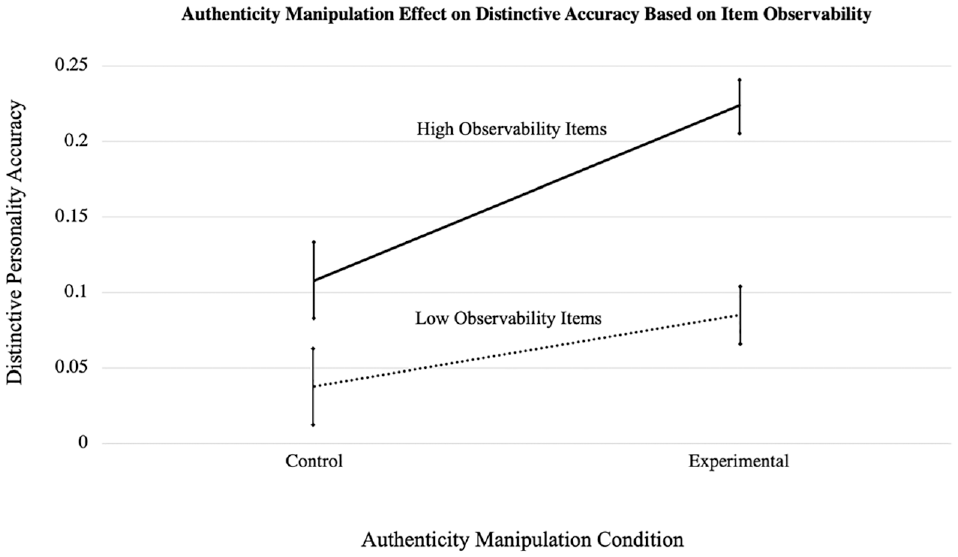
Authenticity Manipulation Effect on Distinctive Accuracy Based on Item Observability.
Item Evaluativeness
Authenticity instructions also interacted with item evaluativeness to influence distinctive accuracy (b = 0.01, z = 2.38, p = .017), fostering distinctive accuracy for evaluative items (b = 0.11, z = 3.01, p = .003, d = 0.46, 95% CI = [0.16, 0.76]) more than for neutral items (b = 0.08, z = 2.07, p = .040, d = 0.32, 95% CI = [0.02, 0.62]), albeit influencing both significantly. Thus, although people generally express their distinct standing on more evaluative, socially valuable items less accurately, instructions to “be yourself” led them to express evaluative self-aspects with almost as much distinctive accuracy as less evaluative ones (see Figure 2). In addition, the authenticity condition interacted with item evaluativeness to predict normative accuracy (b = −0.01, z = −3.01, p = .003), though simple slopes were not statistically significant for either high (b = −0.06, z = −1.32, p = .189, d = −0.20, 95% CI = [−0.50, 0.10]) or low (b = 0.01, z = .24, p = .813, d = 0.04, 95% CI = [−0.29, 0.37]) evaluativeness. However, the simple slope pattern suggests that observers may rely less on normative information in judging experimental targets’ evaluative characteristics, perhaps due to relying more on targets’ distinctive levels for those items.
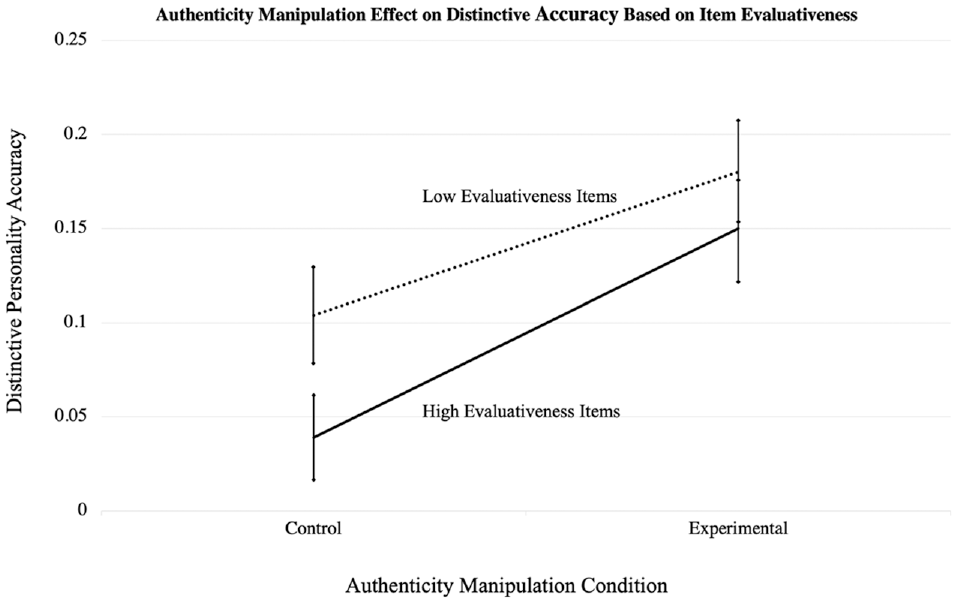
Authenticity Manipulation Effect on Distinctive Accuracy Based on Item Evaluativeness.
Additional Analyses: Authenticity Manipulation and Target Outcomes
Target personal well-being and likability did not differ significantly based on the manipulation. Thus, targets instructed to be themselves were not viewed as more, or less, likable by observers, b = −0.03, t = −0.25, p =.801, d = −0.04, 95% CI = [−0.31, 0.24], nor did they report significantly better, or worse, post-interview well-being, b=0.03, t=0.15, p=.882, d=0.02, 95% CI=[−0.25, 0.30].
Discussion
It appears that people can turn up, on demand, the extent to which they accurately express their unique personality profiles, such as whether they are more helpful than assertive. That is, targets in the authenticity condition were seen significantly more in line with their distinctive personality profile. Notably, the “be yourself” manipulation especially promoted accuracy on more observable and socially evaluative items. It may be that people amplify more observable characteristics (e.g., outgoing) because these characteristics have clear behavioral manifestations, such as talking a lot, which may be easier to control. Conversely, the present low-stakes setting may have limited opportunities for targets to reveal less observable characteristics, such as how forgiving they are. In terms of evaluativeness, the manipulation fostered targets’ expressive accuracy for their neutral self-aspects (e.g., tense), but even more so for their highly evaluative self-aspects (e.g., reliable). Thus, when told to “be yourself,” targets may be willing and able to reveal what is more socially evaluative about them, providing observers with insight into the characteristics they likely care most about.
Moreover, targets instructed to be themselves were not viewed more in line with the average, socially favorable personality profile, nor were they perceived as more likable, and they did not report any significant changes to their well-being. Thus, simply giving the advice “be yourself” may be effective, leading to more accurate personality expression, yet may not bear immediate social or psychological consequences in such low-stakes first impressions.
Authenticity Manipulation and Expressive Accuracy
Why did instructions to be oneself enhance expressive accuracy? Exploratory analyses of potential mechanisms suggest that the authenticity manipulation may have particularly influenced expressive accuracy via the relevance stage, leading targets to behave more congruently on their highly observable and evaluative self-aspects, and to verbally disclose more self-relevant information. Analyses and discussion for all potential mechanisms explored are available in SOM (pp. 3–10).
The present research complements previous experimental work demonstrating the malleability of accuracy in similar video-interview designs. For example, observers told to “try to form an accurate perception” saw targets’ distinct personalities more accurately (Biesanz & Human, 2010), and targets told to “make a good impression” led observers to pay more attention to them and in turn to see them with both greater distinctive accuracy and positivity (Human et al., 2012). Thus, our study extends this prior work, showing that directly instructing targets to reveal their true selves may fuel their active role in the overall accuracy process, thus representing an additional pathway to enhance distinctive accuracy. Future research may also examine potential synergistic effects of instructing targets to be themselves as well as instructing observers to accurately perceive targets, thereby simultaneously capitalizing on both the target and the perceiver roles in the accuracy process.
Given the simplicity of the experimental instructions provided, these results suggest an easy intervention to enhance expressive accuracy, which may be useful given that being viewed accurately is linked to both greater well-being (e.g., Human et al., 2014, 2019) and being liked more (Human et al., 2013, 2020; see SOM, p. 13). This could especially benefit those lower in trait self-esteem who tend to have lower expressive accuracy (Human et al., 2019; Kerr, Borenstein-Laurie, & Human, 2020). Importantly, the manipulation’s effect on expressive accuracy did not seem to depend upon targets’ trait self-esteem (see SOM, p. 1), indicating that those lower in self-esteem may also attain greater expressive accuracy. To further examine the potential for interventions, future research should replicate this manipulation in more naturalistic, face-to-face first-impression contexts, such as getting-acquainted round-robin designs (e.g., Human et al., 2019), where people informally get to know one another as opposed to answering predetermined interview questions. In addition, given that our manipulation was administered right before the interview, it would be important to examine its effectiveness when administered at different time points (e.g., a few hours prior or the day before) and by different people (e.g., friend or family member). These adjustments may reflect with greater ecological validity the circumstances in which people receive this advice in real life.
Authenticity Manipulation and Target Outcomes
The present study showed no evidence of benefits or drawbacks of the “be yourself” instructions on personal and social outcomes, as it did not significantly impact having one’s personality viewed more normatively, being viewed as more likable, or greater state well-being. Of course, we should be cautious about interpreting null effects, as this advice could affect personal and social outcomes more indirectly or have stronger effects in other contexts or over time.
Moreover, being oneself may especially, or only, be useful for those who have more appealing characteristics. In the present research, baseline self-esteem did not interact with the manipulation to affect well-being and likability (see SOM, pp. 1–2), but future research should continue to examine moderation effects of desirable characteristics, perhaps especially in higher-stakes contexts, such as first dates and job interviews, where making an accurate impression on others may only be beneficial if it is also positive (Day et al., 2002; Kerr, Tissera, et al., 2020; Moore et al., 2017). In addition, considering our quite homogeneous sample of healthy undergraduate students (Ley & Young, 1998; Nielsen et al., 2017), it would be worthwhile to examine consequences of this manipulation in clinical samples, including individuals with personality disorders, with potentially less socially favorable traits, who may be more ambivalent about heeding the advice to be themselves in first impressions, as they may reap more negative social consequences if they do (Oltmanns et al., 2004; Rogers et al., 2018).
In sum, “just be yourself” may not be terrible advice after all. In the present low-stakes first-impression context, simple instructions to be oneself led people to express their unique personalities and did not appear to bear positive or negative immediate consequences.
Supplemental Material
sj-docx-1-spp-10.1177_19485506221101000 – Supplemental material for Just Be Yourself? Effects of an Authenticity Manipulation on Expressive Accuracy in First Impressions
Supplemental material, sj-docx-1-spp-10.1177_19485506221101000 for Just Be Yourself? Effects of an Authenticity Manipulation on Expressive Accuracy in First Impressions by Marie-Catherine Mignault, Lauren G. Kerr and Lauren J. Human in Social Psychological and Personality Science
Footnotes
Handling Editor: Yuri Miyamoto
Declaration of Conflicting Interests
The author(s) declared no potential conflicts of interest with respect to the research, authorship, and/or publication of this article.
Funding
The author(s) disclosed receipt of the following financial support for the research, authorship, and/or publication of this article: This research was supported by the Fonds de Recherche du Québec—Société et Culture (FRQSC; 197450), and Social Sciences and Humanities Research Council (SSHRC) of Canada Grants to Lauren J. Human (435-2016-0499). Preparation of this manuscript was supported in part by funding from the Canada Research Chairs program to Lauren J. Human, SSHRC doctoral scholarship to Lauren G. Kerr, and SSHRC Joseph-Armand Bombardier Canada doctoral scholarship to Marie-Catherine Mignault.

Supplemental Material
The supplemental material is available in the online version of the article.
Notes
Author Biographies
References
Supplementary Material
Please find the following supplemental material available below.
For Open Access articles published under a Creative Commons License, all supplemental material carries the same license as the article it is associated with.
For non-Open Access articles published, all supplemental material carries a non-exclusive license, and permission requests for re-use of supplemental material or any part of supplemental material shall be sent directly to the copyright owner as specified in the copyright notice associated with the article.
