




Abstract
Across nine experiments (eight preregistered) involving Western and Asian samples, we showed that people providing ambiguous (vs. specific) responses to questions in various social scenarios are seen as less likable. This is because, depending on the social context, response ambiguity may be interpreted as a way to conceal the truth and as a sign of social disinterest. Consequently, people reported lower inclination to befriend or date individuals who appeared to provide ambiguous responses. We also identified situations in which response ambiguity does not harm likability, such as when the questions are sensitive and the responder may need to “soften the blow.” A final exploratory study showed that response ambiguity also impacts personality perceptions—individuals providing ambiguous responses are judged as less warm, less extraverted, less gullible, and more cautious. We discuss theoretical implications for the language psychology and person perception literatures and practical implications for impression management and formation.
Axioms abound from rhetoricians since antiquity that encourage language clarity and discourage language ambiguity. Aristotle (350 B.C.E./2004) advised that “Style to be good must be clear” (p. 121), and Quintilian (95 A.D./1856) contended that “Above all, ambiguity must be avoided” (p. 83). Modern philosophies contend that language is a manifestation of thought (Wittgenstein, 1953); thus, language that lacks clarity may be a reflection of a mind that lacks perspicuity. People’s disdain for ambiguous language can be further gleaned from qualitative public opinions—“Critics characterize equivocating sources as waffling, weak willed, lacking conviction, mealymouthed, and spineless” (Hamilton, 1998). On the psychological science front, speaker ambiguity disrupts the implied division of labor between interactants and burdens the listener as they would then need to engage in further mental processing or clarifications to comprehend the message (Ferreira, 2008).
Indeed, response ambiguity 1 is a ubiquitous conversational cue in human social interactions. It refers to the level of vagueness or imprecision with which questions are answered (Bavelas et al., 1990a). Despite the aforementioned narrative in favor of precise, nonambiguous language, there appears to be substantial variation in how ambiguous people allow themselves to be when communicating in everyday life (Turner et al., 1975). For instance, if asked how they scored on an assessment, a student may respond with “71%,” “low 70s,” or “not too bad.” While the use of ambiguous response in everyday conversations is common, it remains unclear whether they are judged favorably by others and whether there are previously unrecognized reputational or social consequences that accompany their usage. This was investigated in this study.
Theoretical Distinctions
Previous studies have examined concepts that are similar to response ambiguity, and it is important to first make theoretical distinctions between these concepts to pre-empt potential confusion. One such concept is paltering (Rogers et al., 2017), which refers to the deliberate wording of answers to mislead people with specific false impressions. For example, in response to “You had no sexual relationship with this woman?” an individual could answer with “There is not a sexual relationship” to create the impression that there was never a sexual relationship when the word “is” simply refers to the now. The responder in this case would be attempting to conflate the two words, thereby creating the impression of having never had a sexual relationship with the woman, without directly lying. This strategy is similar to the concept of artful dodging (Rogers & Norton, 2011), which refers to the deliberate avoidance of a question by answering a slightly different question. For instance, in response to a question relating to military budget projections, politicians may attempt to respond with an answer relating to the infrastructure budget in hopes that the questioner forgets the initial question. Another, more blatant way to avoid answering a specific question is simple nondisclosure, such as when an individual remains silent in response to a question (Turner et al., 1975).
In contrast, ambiguous responses refer to vague or imprecise answers that allow for more than one specific interpretation (Bavelas et al., 1990a). For example, in response to “How many years have you worked here?,” the answer “Quite some years” could be taken to mean multiple specific possibilities, such as four, nine, or any number of years within a reasonable range. This is fundamentally different from paltering, artful dodging, and nondisclosures, since these three response strategies all result in the complete avoidance of the initial question, either adroitly or blatantly. Providing an ambiguous response, however, at least answers the original question, and unlike the previously studied concepts wherein the key variable is whether the original question was answered, the central dimension of response ambiguity is the level of precision of the answer. As such, while the detection of paltering, artful dodging, or nondisclosures would understandably result in negative interpersonal evaluations, it is less clear how response ambiguity is perceived.
Response Ambiguity
Prior to taking a person perception perspective on response ambiguity, it is perhaps a good starting point to consider why people in conversations sometimes opt for ambiguous (over specific) responses in the first place. A prominent line of research that comprehensively investigated this question is that of Bavelas and colleagues (for a review, see Bavelas et al., 1990a) whose earlier efforts involved systematically defining and measuring response ambiguity (Bavelas & Smith, 1982). They conceptualized ambiguity as suboptimal levels of clarity on the communicative parameters of sender, content, receiver, or context, and quantify ambiguity as observers’ ratings of the extent to which a message is unclear on each of these four parameters (Bavelas & Smith, 1982).
Subsequently, attempts were made at pinpointing the characteristics of situations in which participants would choose to use ambiguous responses. Both when prewritten response options were provided (Bavelas, 1983) and when participants were asked to generate responses spontaneously (Bavelas & Chovil, 1986) in hypothetical communicative situations, studies revealed that ambiguous responses are used mostly in “avoidance-avoidance conflicts.” Avoidance–avoidance conflicts refer to situations where a response is needed but both truthful and deceptive answers would be unpleasant if answered with precision, so responders tend to resort to ambiguous responses. For example, when asked by a well-liked individual about their awful gift, the receiver may experience a conflict of goals whereby one goal, such as to not hurt the gift giver’s feelings, clashes with the goal of being honest (Bavelas, 1983). This situational explanation of response ambiguity was supported by various subsequent studies including a field replication (Bavelas et al., 1988) and laboratory replication involving face-to-face and verbal communication (Bavelas et al., 1990b).
Various researchers have extended the situational model of response ambiguity to applied settings and have argued for the utility of ambiguous responses. For instance, employers can use ambiguous language to foster organizational cohesion since ambiguous language is capable of accommodating multiple interpretations of the same policy or mission statement (Eisenberg, 1984). Company spokespersons are evaluated more favorably when they use ambiguous language (vs. open transparency) in avoidance–avoidance situation as it minimizes the financial, legal, and reputational risk they might otherwise subject their company to Kline et al. (2008). This is especially pertinent in the early stages of crisis management, where information may be limited, unreliable, and difficult to interpret, and therefore, excessive information disclosure may be misleading and unfair to the parties involved. Interestingly, when a goal conflict is not present, clear messages are evaluated more positively than ambiguous messages. Similarly, politicians often use “strategic ambiguity” to avoid offending population subgroups, to maximize their popularity among voters (Clementson & Eveland, 2016). Ambiguous language use in these contexts may reduce disagreements and objections from listeners because of the assimilation effect (Zimbardo, 1960) where listeners interpret ambiguous statements to be closer in meaning to their own attitudes/beliefs. Specific language on the contrary does not offer the same latitude for such assimilation and projection tendencies.
While research on response ambiguity has been extensive, a common feature of previous studies is the confinement to, and salience of, avoidance–avoidance situations. Even when the scenarios presented to participants did not involve high-stakes events such as organizational crisis management (Kline et al., 2008), participants were usually aware of the avoidance–avoidance conflict in the situation (e.g., Bavelas & Chovil, 1986). In everyday life however, ambiguous answers may not always be used to transcend such “communicative minefields” (Bavelas et al., 1988) and may be unintentional, such as due to the genuine inability to recall the precise answer. Furthermore, while research on why people choose to respond ambiguously is prolific, much less research attention has been given to exploring how ambiguous responders are perceived. The fact that observers may not always be aware of the avoidance–avoidance conflict experienced by responders raises an important question: How are ambiguous responders perceived by observers, especially in everyday social interactions when an avoidance–avoidance conflict is not present or conspicuous to the observer? Therefore, in this study, we sought to investigate response ambiguity from a person perception angle.
Likability
In the present research, we sought to examine the prediction that ambiguous (vs. specific) responses in conversations make responders less likable. Likability is an important concept to investigate because people strive to be liked by others, and interpersonal liking is a vital component of people’s social and everyday lives. This notion is not only in line with lay perception, popular media, and other cultural artifacts, but also numerous lines of psychological research. For instance, researchers in the domains of self-determination theory (Ryan & Deci, 2000) and social exclusion (K. D. Williams, 2009) would agree that interpersonal liking plays a fundamental role in people’s mental well-being. This is reflected in various subordinate concepts and tenets such as the psychological need for relatedness (Deci et al., 1996), the extrinsic goal of popularity (Sheldon et al., 2001), the emphasis people tend to place on external approval (Howard et al., 2017), and the destructive effects of social rejection on psychological well-being (Zadro et al., 2004).
The centrality of interpersonal liking on psychological well-being is also echoed by the proliferation of social cognition research in which the concept of liking takes center stage (e.g., Boothby et al., 2018; Huang et al., 2017; Wolf et al., 2021). Such extensive research attention has consequently established likability as a highly interconnected variable in the sense that a myriad of factors and behaviors can influence likability, which in turn guides people’s social decision-making. For instance, perceived morality, self-promotion, and question asking all affect an individual’s likability (Hartley et al., 2016; Huang et al., 2017; Sezer et al., 2018). Being liked then comes with many social advantages, such as being preferred in workplace collaborations (Casciaro & Lobo, 2005), receiving favorable service evaluations (Jayanti & Whipple, 2008), and being perceived as attractive (Singh & Tor, 2008). Despite research on the plethora of antecedents and consequences of interpersonal liking and likability, this study is the first to examine response ambiguity and how, why, and when it affects likability, as well as corresponding social decision-making consequences.
Limitations of Existing Research
To date, research has not examined the effect of response ambiguity on the broad outcome of likability, but rather, on perceptions of very specific traits such as the speaker’s communication competence and politeness (Bello & Edwards, 2005; Edwards & Bello, 2001). Collectively, these studies suggest that ambiguous language is viewed favorably on some dimensions but unfavorably on others. For instance, ambiguous language has been shown to increase perceived speaker reliability (M. Williams & Goss, 1975), politeness (Holtgraves, 1986), and mitigate disagreements (Koniak & Cwalina, 2022), but decrease perceived speaker power (Bradac & Mulac, 1984), dynamism (Hamilton, 1998), trust (Koniak & Cwalina, 2022), and communication competence (Bello & Edwards, 2005). It, therefore, remains unclear whether response ambiguity has a net positive or net negative impact on interpersonal liking more generally.
Most critically, a striking commonality of previous research is that ambiguous messages have been pitted against counterattitudinal/undesirable messages. This means that any results may have been overpowered by the confounding factor of response attitudinality, rather than due to ambiguity. For instance, M. Williams and Goss (1975) found that conveying ambiguous messages earned people more favorable character ratings compared with conveying clear messages that the listener disagreed with. Other studies asked participants to compare ambiguous performance feedback such as “it was interesting” to clear criticism such as “you messed up” (Bello & Edwards, 2005; Edwards & Bello, 2001). As such, existing findings are unable to offer valid evidence that people systematically prefer specific over ambiguous responses, and only show that people prefer responses that appear to be most aligned with what they want to hear. This confound precludes us from drawing a clear-cut conclusion as to whether response ambiguity diminishes likability, and calls for an investigation of this question that circumvents the influence of response attitudinality.
Social Bonding From Information Sharing
Why would response ambiguity make responders less likable? Our prediction is grounded in the vast body of research showing that human social bonding is enhanced by the sharing of information and mental states between individuals (e.g., Rossignac-Milon et al., 2021; Wolf & Tomasello, 2020b). For instance, self-disclosure (Aron et al., 1997), gossip (Dunbar, 2004), possessing shared knowledge (Soley & Spelke, 2016), shared attention (Wolf & Tomasello, 2020a), and shared experiences (Gao et al., 2021) have all been shown to be conducive to social bonding. This sense of “shared reality” serves as a platform on which individuals could establish common ground about their thoughts, such as similarities in attitudes and preferences (Bosson et al., 2006), leading to general feelings of synchrony, interpersonal liking, and closeness. These findings are also in line with Grice’s (1975) cooperative principle—that interactants should share a mutual goal of cooperative and effective communication. Gricean maxims that underscore the importance of conversational informativeness and clarity include supermaxims/submaxims under the categories of quantity—“Make your contribution as informative as required” (p. 45) and manner—“Be perspicuous” and “Avoid ambiguity” (p. 46). As such, response ambiguity limits the amount of information shared between interactants and violates conversational norms expected from a cooperative interactant, ultimately precluding common ground to be established between interactants. In light of this view, we propose below two theoretically distinct and independent mechanisms through which response ambiguity could diminish responder’s likability.
Perceived Insincerity, Social Disinterest, and Boundary Conditions
From a responder perspective, ambiguous responses may be used out of good intentions, such as to prevent the questioner from losing face or feeling hurt (Bavelas et al., 1990a; Bello, 2000). However, every interaction is different, and different contexts may prompt observers to infer different motives. It is possible that observers assume that responders are being ambiguous to conceal the truth, at least partially, because the precise truth may harm their self-interest. For instance, if a doctor in private practice is asked how much cheaper public clinics would cost, providing the specific answer (“26% cheaper”) could harm their self-interest. An ambiguous answer (“a bit cheaper”) would, therefore, allow them to circumvent this dilemma. As such, while ambiguous responses are not considered outright deception, they are considered by some researchers as a partial concealment of the truth, and hence insincere (e.g., Buller et al., 1994). This perceived insincerity would violate Grice’s (1975) notion of quality—“Try to make your contribution one that is true” (p. 46) and relation—“Be relevant” (p. 46), and hence be judged as uncooperative and unlikable.
Since information sharing aids in social bonding (Aron et al., 1997), responders may share limited information with others via ambiguous answers also because they are insufficiently motivated to share more detailed information. The reason for this is that ambiguous answers often require less mental resources in the form of attention. As an example, when asked about recent exercise frequency, it could be easier to say “not very often” than to recall and count the exact frequency, such as seven times a month. As a result, the responder may be seen as being unenthusiastic about socially engaging with the questioner since people usually dedicate more attention to stimuli that they find more rewarding (Le Pelley et al., 2016). In accordance with Grice’s (1975) theory of conversational implicature where interactants often try to deduce what their interlocutor is implying, response ambiguity may be inferred as the responder’s unwillingness to invest effort in the conversation and, therefore, social disinterest (Coplan et al., 2004). Since people show a proclivity to reciprocate by liking those who like them (Aronson & Worchel, 1966), they should also like responders less if they infer social disinterest from the responder.
Given that people are constantly making inferences of other people’s intentions (Malle & Holbrook, 2012) and given that social interactions are ubiquitous in everyday life, observers should possess a fairly accurate set of intuitions about what response ambiguity reflects in different situations. Specifically, observers may perceive responders providing ambiguous (vs. specific) responses as either wanting to conceal certain truths, uninterested in socializing with the questioner, or both, depending on the conversational context. As a result, observers would see responders providing ambiguous answers as less likable.
At this juncture, it is important to note that, as with most social psychology phenomena, we do not predict the effect of response ambiguity on likability to be universal. For instance, there are classes of conversations whereby neither truth concealment nor social disinterest are contextually relevant to any significant degree. For instance, if an individual is asked by a stranger where the nearest subway station is, there would be no reason for them to conceal the truth, and given the brief nature of such interactions, also no reason for social disinterest to be a salient dimension of evaluation. In such instances, response ambiguity would likely be attributed to other reasons such as the responder’s genuine lack of knowledge of the landmark location, thus not damaging responder’s likability. There are also classes of conversations in which ambiguous answers are indeed used to conceal the truth, but with good intentions. Specifically, some conversations entail overly sensitive or serious questions. One benevolent purpose of providing an ambiguous answer would be to “soften the blow” when delivering an answer that, if delivered in its raw form, may be potentially harsh or hurtful. In such cases, the ambiguous response would admittedly be crafted in an attempt to mislead the questioner into overestimating the rosiness of reality, with an intention similar to that of a white lie but without lying (Bavelas et al., 1990a). We, therefore, predict that when the questions are sensitive such that the answers may be harsh or hurtful, ambiguous answers could be used without damaging responder’s likability compared with specific answers.
Overview of the Present Research
Given the importance of response ambiguity and likability in interpersonal judgments and the corresponding gap in the literature, we tested the prediction that responders providing ambiguous (vs. specific) responses are perceived as less likable. Nine experiments (eight preregistered) were conducted to comprehensively examine the predicted phenomenon. Before these, we conducted a pilot study to establish experimental stimuli that would assuage the concern of results being confounded by response attitudinality. We then tested the basic effect of response ambiguity on likability (Study 1), followed by an examination of the underlying mechanisms of perceived insincerity and perceived social disinterest (Study 2, and Studies S1 and S2 in the Supplementary Online Materials [SOM]). Moderating variables were also explored, including whether the basic effect weakens when the scenario involves sensitive questions (Study 3), and whether the strength of the basic effect depends on the number of responses observed (Study S3). Next, we examined whether the basic effect engendered consequences in social decision-making—are people less inclined to continue befriending or dating ambiguous responders (Study 4)? We also tested the generalizability of the predicted effect in a different demographic (Study 5a) and for video stimuli (Study 5b; see Table 1 for details of each study). A final exploratory study was conducted to examine whether response ambiguity affects how the responder is judged on factors other than likability (Study 6).
The Effect of Response Ambiguity on Likability, Overview, and Results of All Studies.
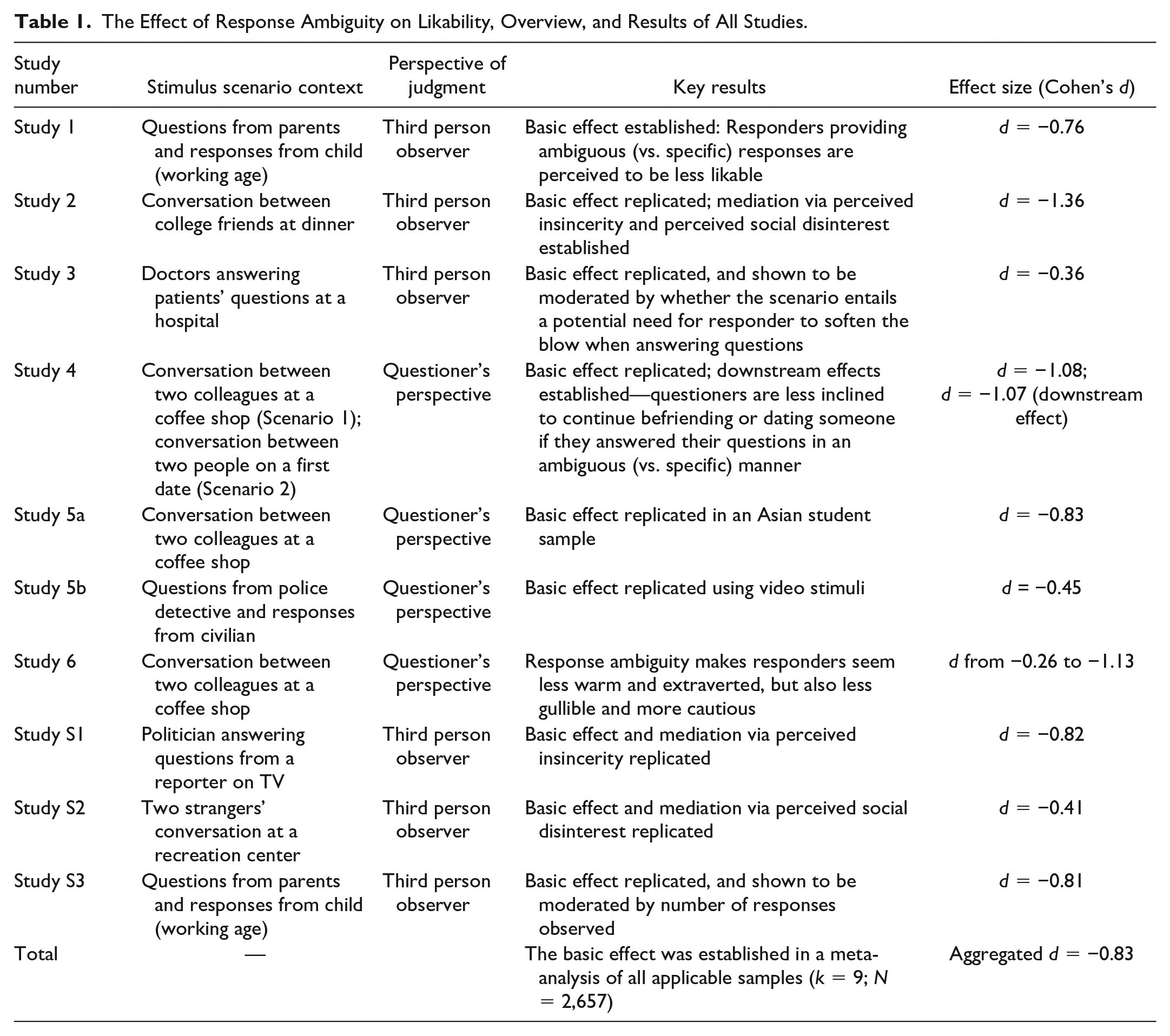
All studies reported in this article adhered to ethical guidelines of the James Cook University Australia institutional review board, and all variables and conditions are reported. G*Power suggested that 100 participants per condition would offer 80% power for an independent t-test to detect a typical between-group effect size in social psychology (Cohen’s d = 0.40; Richard et al., 2003). This was consistent with the conservative rule of thumb of at least 100 participants per condition, as stated in our preregistrations. As such, we adhered to this minimum for all studies and also recruited an additional 10% to account for exclusions. All studies’ design, sample size, exclusion criteria, and analyses (with the exception of Studies 1 and 6) were preregistered a-priori, and for all studies, data were never analyzed before termination of data collection. For brevity, sample age, gender, source, exclusions (and criteria), reimbursement, attention check, and suspicion probe information are summarized in Table S1 in the SOM. We confirm we have reported all preregistered analyses in the article. Data (code dictionary contained within) files, analyses, and preregistration links are available on the Open Science Framework (OSF) at https://osf.io/gnx3h/.
Pilot Study
The goal of this pilot study was to ensure that our experimental stimuli are developed and matched such that response attitudinality/desirability would be equal across experimental conditions. To this end, we designed multiple question and answer vignette stimuli with no or minimal ego involvement. For instance, we included a question where the responder is asked how many years they have not played basketball (a situation where the questioner’s ego is not at stake), rather than to evaluate the questioner’s basketball skill level (a question that may elicit an ego-boosting or ego-damaging response). Moreover, we only included questions that require a numerical answer, and sought to establish the median inferred specific values corresponding to each ambiguous response included. For instance, how old would people assume the response “I’m in my 30s” to mean more specifically? These median inferred specific answers would then be used for participants in the control condition of our main studies so that systematic differences in specific responses inferred from the ambiguous versus specific answers would be minimized.
Method and Results
In this pilot study (N = 101; Mage = 30.16; SDage = 11.59; 42 females), online crowdsourced participants from Prolific completed a survey with the following instructions:
Below, you will be presented some scenarios where an individual has provided some responses to questions, but in an ambiguous way. We would like to know how you would interpret these answers, that is, what specific value you would infer from each ambiguous answer.
Participants were then presented with various scenarios and dialogue stimuli, and for each response asked to provide their own interpretation of the specific answer. Note that a document containing the full set of stimuli included in the pilot and the corresponding median results has been made available on the OSF page, but see example below:
Scenario: conversation between two strangers at a basketball court
Person A: “How many years has it been since you last played basketball?”
Person B: “Many years”
What is your interpretation of Person B’s response?—Number of years (responses gathered in an open-ended textbox).
Before obtaining the median values, we inspected the dataset for any nonsensical answers and upon deletion, and calculated the median values (applying pairwise deletion) for each response. The resulting median values were subsequently used in the main studies of this research as stimuli for the “specific responses” condition.
Study 1: Establishing the Basic Effect of Response Ambiguity on Likability
Method
Study 1 (N = 213) followed a single factor two level (response ambiguity: specific vs. ambiguous) between-participants design. Upon entering the study, participants were first presented with the scenario below, either with specific or ambiguous (in parentheses) versions of the responses, depending on the condition they were allocated to.
You are currently living in the US. One evening, you are watering your garden and your neighbour—a middle-aged American couple is having a family dinner. Their son Cameron, who has been working in another city, has returned to stay with family for a long weekend. You cannot hear everything that they said but some fragments of what you overheard are presented below:
Cameron’s grandmother: Wow this pork is so tender, how many hours did you stew it for?
Cameron: About 3 hours (Quite a while)
Cameron’s mother: So how much money are you making per year now?
Cameron: A little over 30000 dollars a year (Same as most people with office jobs)
Cameron’s father: I heard you’re selling your car, how much are you selling it for?
Cameron: 8000 dollars (Same price as most second hand Sedans)
Participants were subsequently presented the dependent measure of likability, which was adapted from a likability measure used in a previous study (Huang et al., 2017). Specifically, participants were asked to rate the degree to which they agree with each of four statements with respect to their impression of the responder. These four items included “Cameron is likable,” “I like Cameron,” “I would enjoy spending time with Cameron,” and “I dislike Cameron (reverse scored and averaged with the three previous items to form a mean likability score; Cronbach’s alpha = .863),” presented in random order, with response scales from 1 (strongly disagree) to 7 (strongly agree). This was followed by a suspicion probe, where participants were asked: Before we move on, if you think you know the study’s hypothesis already (e.g., if you have participated in a study in the same series), please write below what you think the hypothesis is. If you are unaware/unsure, simply leave blank.
Next, participants were asked to complete the manipulation check, “how ambiguous were Cameron’s answers in general?,” and responded on a scale from 1 (very ambiguous) to 7 (very specific). Participants were then presented the attention check: “Have you ever visited the planet Venus?” and asked some demographic questions before being presented with the debriefing sheet.
Results
For this and all remaining studies, all manipulations were successful (e.g., participants in the ambiguous condition consistently rated the responder’s answers as significantly less specific than those in the specific condition) and manipulation check results are, therefore, reported in the SOM for concision.
In line with our prediction, participants rated responders providing ambiguous answers (M = 3.69, SD = 1.24) as significantly less likable than responders providing specific answers (M = 4.52, SD = 0.91), t(188.56) = −5.55, p < .001, Cohen’s d = −0.76, 95% confidence interval (CI) for the mean difference [−1.12, −0.53]. See Figure 1 for a graphical representation of the main effects of this and all other applicable experiments in this research. In the next study, we tested whether the effect of response ambiguity on likability is driven by perceived insincerity.
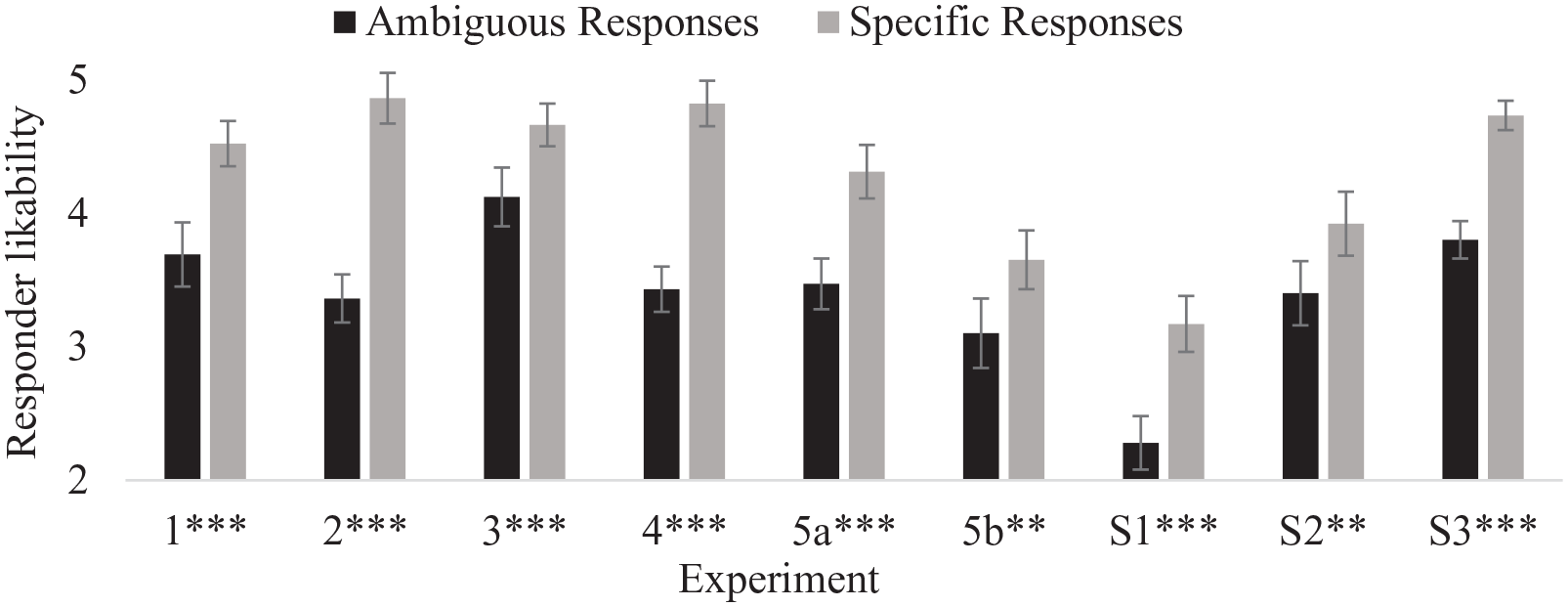
Likability Ratings for Responders Providing Ambiguous versus Specific Responses in Experiments 1 to 5b
Study 2: Mediation Through Perceived Insincerity and Perceived Social Disinterest
Method
Study 2 (N = 289) replicated the design of Study 1 but with a different scenario—college students’ casual conversation at dinner. For brevity, all vignette stimuli are reported in the SOM for this and subsequent studies. A second difference was that this time the measures were intertwined in random order with the items measuring perceived insincerity and perceived social disinterest. The former was operationalized using contextually appropriate statements reflective of the responder’s intention to conceal the truth. Specifically, the two items were as follows: “It seems that Cameron is trying to hide the exact truth” and “It seems that Cameron is trying to avoid telling the precise truth” (averaged to form a mean perceived insincerity score; r = .865; p < .001). The items measuring perceived social (dis)interest were adapted from an intention to affiliate measure used in previous research (Teng et al., 2015). Specifically, the three items were as follows: “It seems like Cameron is open to interacting with your friends,” “It seems like Cameron is open to spending time with the questioner,” and “It seems like Cameron is open to making friends with your friends” (Cronbach’s alpha = .957), the results of which were averaged to form a mean score. All above items utilized response scales from 1 (strongly disagree) to 7 (strongly agree).
Results
Participants rated the responder providing ambiguous answers (M = 3.36, SD = 1.10) as significantly less likable than the responder providing specific answers (M = 4.86, SD = 1.11), t(287) = −11.54, p < .001, Cohen’s d = −1.36, 95% CI for the mean difference [−1.75, −1.24].
To test the proposed mediators, we conducted bootstrapped regressions using the PROCESS SPSS macro (Model 4; 5,000 bootstraps; Hayes, 2013) with response ambiguity specified as the predictor, likability specified as the outcome, and perceived insincerity and perceived (dis)interest specified as parallel mediators. As predicted, the indirect effect of response ambiguity on likability via perceived insincerity (b = 0.33, 95% CI = [0.14, 0.55]) and via perceived social disinterest (b = 1.19, 95% CI = [0.93, 1.47]) were both significant. The corresponding direct effect was nonsignificant (b = −0.03, 95% CI = [−0.27, 0.21]).
Results of Study 2 suggest that people judge responders providing ambiguous (vs. specific) answers as less likable because they are seen as insincere and socially disinterested. We conducted two additional studies (Studies S1 and S2; see SOM) in which we examined the two mechanisms individually using different vignette scenarios, yielding results consistent with the above, supporting the replicability and generalizability of the proposed mechanisms. In the next study, we tested whether the basic effect weakens when the scenario entails sensitive questions to which the responses may be harsh or hurtful.
Study 3: Ambiguous Responses Are Appropriate for Sensitive Questions Whereby Responses May Be Harsh
Method
Study 3 (N = 439) followed a 2 (response ambiguity: specific vs. ambiguous) × 2 (question type: regular questions vs. sensitive questions) between-participants design. Upon entering the study, participants were first shown a scenario involving conversations between patients and a doctor. Participants were shown either a scenario involving regular questions where the responses were unlikely to be harsh, or a scenario involving sensitive questions such that the responses were more likely to be harsh.
Participants were subsequently presented the same measures used in Study 1 except that an additional manipulation check was also added after the original manipulation check. This was to confirm that participants shown the scenario with the sensitive (vs. regular) questions indeed believed that the questions were more sensitive and, therefore, had a greater potential to elicit harsh responses. Specifically, participants were asked: “For some questions, it is understandable that some responders would prefer not to provide a specific answer since the answer may be too harsh or hurtful. Generally speaking, do the 3 questions above fit this description?” and responded on a scale between 1 (not at all) and 7 (very much so).
Results
Participants rated the responder providing ambiguous answers (M = 4.12, SD = 1.67) as significantly less likable than the responder providing specific answers (M = 4.66, SD = 1.23), t(399.36) = −3.82, p < .001, Cohen’s d = −0.36, 95% CI for the mean difference [−0.81, −0.26].
To examine the moderation effect of question type, we conducted bootstrapped regressions using the PROCESS SPSS macro (Model 1; 5,000 bootstraps; Hayes, 2013) with response ambiguity specified as the predictor, likability specified as the outcome, and question type specified as the moderator. In line with our prediction, the interaction effect between response ambiguity and question type was statistically significant, F(1, 435) = 30.10, p < .001, ΔR2 = .061, b = −1.47. Specifically, the effect of response ambiguity on likability evaporated when the scenario contained sensitive questions (ambiguous: M = 4.72, specific: M = 4.52), b = −0.20, SE = 0.19, t(435) = −1.08, p = .282, 95% CI = [−0.58, 0.17], but remained when the scenario consisted of regular questions (ambiguous: M = 3.53, specific: M = 4.80), b = 1.27, SE = 0.19, t(435) = 6.69, p < .001, 95% CI = [0.89, 1.64]. See Figure 2 for a graphical representation of the abovementioned moderation effect.
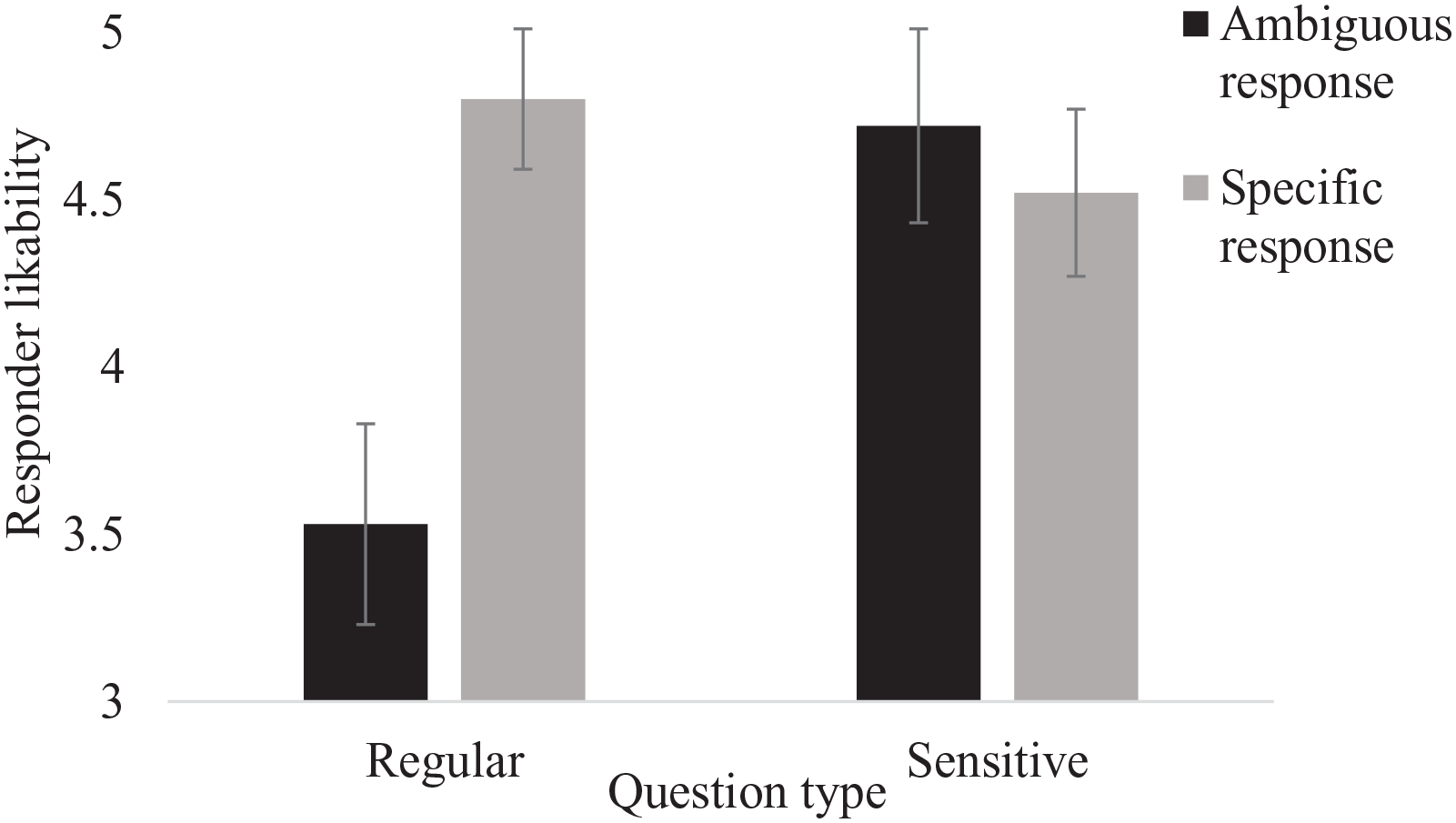
The Interactive Effect of Response Ambiguity and Question Type on Responder’s Likability (Study 3).
Results of Study 3 highlight a boundary condition of the basic effect—ambiguous responses do not make responders less likable when the questions asked are deemed to be overly sensitive such that the answers may be harsh.
Study 4: Downstream Effects on Social Decision-Making
In Study 4, we tested whether response ambiguity diminishes likability when participants are asked to imagine themselves as the questioner, and if so, whether the effect could trickle down to their social decision-making. We presented two hypothetical scenarios, one pertaining to friend making and one pertaining to dating, and tested whether response ambiguity could affect people’s desire to befriend or date others.
Method
Study 4 (N = 434) followed a 2 (response ambiguity: specific vs. ambiguous) × 2 (scenario: friend vs. date) between-participants design. Upon entering the study, participants were shown either a conversation between two co-workers or a conversation between two people on a first date.
Participants were subsequently presented the same measures from Study 1 but with the addition of the three-item intention to affiliate measure (Teng et al., 2015) adapted for the current scenarios in random order. These include “I would like to continue interacting with this person,” “I would like to spend more time with this person,” and “I would like to make friends (OR go on more dates, depending on the scenario condition) with this person,” answered on a scale between 1 (strongly disagree) and 7 (strongly agree).
Results
Participants rated the responder providing ambiguous answers (M = 3.43, SD = 1.33) as significantly less likable than the responder providing specific answers (M = 4.82, SD = 1.22), t(432) = −11.30, p < .001, Cohen’s d = −1.08, 95% CI for the mean difference [−1.63, −1.14].
The predicted downstream effect also emerged. Participants expressed less desire to befriend or continue dating the responder providing ambiguous answers (M = 3.02, SD = 1.56) compared with the responder providing specific answers (M = 4.62, SD = 1.41), t(432) = −11.19, p < .001, Cohen’s d = −1.07, 95% CI for the mean difference [−1.88, −1.32]. To confirm that the downstream effect generalized across scenario and did not differentially manifest in the two scenarios, we conducted bootstrapped regressions using the PROCESS SPSS macro (Model 1; 5,000 bootstraps; Hayes, 2013) with response ambiguity specified as the predictor, intention to affiliate specified as the outcome, and scenario specified as the moderator. In line with our prediction, the interaction effect between response ambiguity and scenario was not statistically significant, p = .333.
Results of Study 4 suggest that response ambiguity could diminish likability such that questioners become less inclined to continue affiliating with the responder.
Study 5a: Cross-Cultural Generalizability
Thus far, our samples have consisted mostly of participants from Western countries. Given that “face saving” is an important element of many Asian cultures (Qi, 2011), and that this may necessitate the use of ambiguous answers in order not to be too blunt in conversations (Turner et al., 1975), it is important to explore whether ambiguous responses are differentially perceived in an Asian sample.
Method
Study 5a (N = 207) utilized the co-worker scenario of Study 4 in terms of design and sampled students in a Singaporean university.
Results
Participants rated the responder providing ambiguous answers (M = 3.47, SD = 1.00) as significantly less likable than the responder providing specific answers (M = 4.31, SD = 1.02), t(205) = −5.94, p < .001, Cohen’s d = −0.83, 95% CI for the mean difference [−1.11, −0.56]. These results show that the effect of response ambiguity on likability is generalizable to nonwestern participants.
Study 5b: Replication Using Video Stimuli
While the use of vignette scenarios is in alignment with the methodological conventions of previous studies in the literature (e.g., Bello & Edwards, 2005), we acknowledge that the presence of additional nonverbal cues such as appearance and tone of voice may dilute the predicted effect. Nevertheless, it seems intuitively unlikely for verbal cues to be completely overshadowed by nonverbal cues. We, therefore, tested whether the predicted phenomenon still manifests when video stimuli are used in Study 5b.
Method
Study 5b (N = 215) replicated Study 1 but with video stimuli (available on OSF) instead of vignette stimuli. Participants were shown a short video clip in which two actors portrayed a conversation between a civilian and a police detective.
Results
In line with our prediction, participants rated responders providing ambiguous answers (M = 3.10, SD = 1.32) as significantly less likable than responders providing specific answers (M = 3.65, SD = 1.13), t(213) = −3.28, p = .001, Cohen’s d = −0.45, 95% CI for the mean difference [−0.88, −0.22]. These findings show that the effect of response ambiguity on likability remains significant for video stimuli.
Study 6: Additional Reputational Effects of Response Ambiguity
An ancillary goal of the present research was to explore whether response ambiguity engenders additional reputational consequences. For instance, giving precise and potentially important information to another party might expose people to exploitation, especially if people are not being selective with the parties with whom they share important information (e.g., with strangers; Evans & van de Calseyde, 2018). As such, responders providing specific responses may be seen as gullible and incautious. Moreover, since providing specific responses signal social interest toward the questioner, it may also lead to inferences of warmth and extraversion (Wang & Ziano, 2022). Taken together, we predict that in addition to diminishing responder’s likability, response ambiguity should also make the responder seems less warm and extraverted, but more cautious and less gullible. This study was not preregistered given its exploratory nature.
Method
Study 6 (N = 389) utilized the co-worker scenario of Study 4 in terms of design, simply with the dependent measures replaced by several items pertaining to perceived gullibility, cautiousness, warmth, and extraversion, presented in random order. Specifically, in line with previous research, we used the items “gullible” and “naïve” to measure perceived gullibility (r = .48; Teunisse et al., 2020), the single item of “cautious” to measure perceived cautiousness (Stolier et al., 2020), the items “warm” and “friendly” to measure perceived warmth (r = .78; Halkias & Diamantopoulos, 2020), and the items “extraverted” and “enthusiastic” to measure perceived extraversion (r = .63; Gosling et al., 2003). Given the significant intercorrelations listed above (all p < .001), we aggregated all two item measures into single indices.
Results
Participants rated the responder providing ambiguous answers (M = 3.14, SD = 1.23) significantly less warm than the responder providing specific answers (M = 4.55, SD = 1.26), t(387) = −11.17, p < .001, Cohen’s d = −1.13, 95% CI for the mean difference [−1.66, −1.16]. Participants rated the responder providing ambiguous answers (M = 2.67, SD = 1.18) as significantly less extraverted than the responder providing specific answers (M = 3.89, SD = 1.21), t(387) = −10.06, p < .001, Cohen’s d = −1.02, 95% CI for the mean difference [−1.46, −0.98]. Participants rated the responder providing ambiguous answers (M = 2.79, SD = 1.16) as significantly less gullible than the responder providing specific answers (M = 3.09, SD = 1.21), t(387) = −2.52, p = .012, Cohen’s d = −0.26, 95% CI for the mean difference [−0.54, −0.07]. Participants rated the responder providing ambiguous answers (M = 5.35, SD = 1.52) as significantly more cautious than the responder providing specific answers (M = 3.70, SD = 1.57), t(387) = 10.49, p < .001, Cohen’s d = 1.06, 95% CI for the mean difference [1.33, 1.95]. In summary, these results show that responders providing ambiguous (vs. specific) answers are judged as less warm and extraverted, but also less gullible and more cautious.
General Discussion
Across nine experiments, we investigated whether responders providing ambiguous (vs. specific) responses to questions would be perceived as less likable. This main prediction and its generalizability was supported by our findings in both Western (Study 1) and Asian samples (Study 5a), as well as when using video stimuli (Study 5b). It appears that ambiguous responses make responders less likable because they are seen as the responder’s intention to conceal certain truths, and are hence perceived as insincere and because they signal the responder’s lack of intention to affiliate with the questioner, and hence social disinterest (Studies 2, S1, and S2). However, ambiguous responses do not always make people less likable. Specifically, ambiguous responses can be used without damaging the responder’s likability in situations that call for the responder to soften the blow, such as when the questions are sensitive and the answers may be harsh or hurtful (Study 3). It also seems that single instances of ambiguous responses do not harm the responder’s likability since at least two ambiguous responses are needed for observers to find the responder less likable (Study S3). Nevertheless, when response ambiguity diminishes likability of the responder, it often leads to social consequences, such as questioners showing a lower desire to continue befriending or dating the responder (Study 4). We also found in an additional exploratory study that beyond diminished likability, observers also judged responders providing ambiguous responses as less warm and extraverted, but more cautious and less gullible (Study 6).
In addition to participant culture and stimuli format, the predicted effect was examined across a range of social scenarios such as conversations between strangers at a basketball court, colleagues at lunch, and people on their first date. This includes scenarios that typically contain avoidance–avoidance conflicts such as interviews with politicians (e.g., SS1) and more common scenarios such as dinner conversations (e.g., S2). We also incorporated various question types ranging from trivial questions (e.g., basketball/hobby-related questions) to potentially sensitive questions (e.g., age-related questions). In some studies (e.g., Study 2), participants were asked to judge likability as a third person observer, while in others, participants were asked to imagine themselves as the questioner (e.g., Study 4). Across these replications, ambiguous (vs. specific) responders were consistently rated as significantly less likable, speaking to the generalizability of the predicted phenomenon.
Theoretical Implications
This study contributes to the literature in several important ways. Language ambiguity is a ubiquitous conversation cue in all modalities of communication that is controllable yet inherently varied across individuals and situations. Liking is also a crucial variable in social dynamics, with various important social consequences, such as workplace favoritism (Casciaro & Lobo, 2005). Despite the ever-presence of response ambiguity in everyday communication, and the centrality of interpersonal liking in people’s social lives, previous studies have not yet examined the role of the former on the latter. By establishing that response ambiguity lowers responder’s likability, this study provides novel empirical evidence bridging this knowledge gap, and connecting and extending these two important literatures. Moreover, while previous studies have focused on the effects of speaker ambiguity on how others evaluate the speaker on specific qualities such as reliability (M. Williams & Goss, 1975), this study provides a more overarching picture because likability is a broad concept. Findings of this study help enrich existing understanding of how ambiguity in communication is perceived because it shows that language ambiguity in everyday conversations tend to produce a net negative overall effect on how others perceive the speaker.
A key strength of the present research is that our study design allows us to rule out the potential confounding effects of response attitudinality. This confound has precluded previous studies from providing conclusive evidence of whether the dimension of ambiguity alone engenders reputational consequences for the speaker, since the effects are also attributable to response attitudinality (e.g., Bello & Edwards, 2005). This study is the first to demonstrate that when holding response attitudinality equal, response ambiguity causes people to view the responder as less likable, less sincere, less socially interested, less warm, less extraverted, less gullible, and more cautious. Establishing these effects while ruling out the confounding effects of response attitudinality helps set the record straight in terms of whether response ambiguity alone systematically affects how people form impressions of the responder. It seems that people dislike responders not only when responses are not in alignment with their beliefs, but also when the language used in the response is insufficiently precise. The revelation that response ambiguity diminishes likability when attitudinality is held constant is of theoretical value for one additional reason: Ambiguous language is not used exclusively when there is an inherently different implicature between the ambiguous and specific responses, such as in avoidance–avoidance situations (Bavelas et al., 1990b), and may be used unwittingly. For instance, ambiguous language may be used because of a language barrier, individual and cultural differences in speaking habits, or genuinely not possessing sufficient information to provide a precise answer (Grice, 1975). In such cases, there is likely no systematic attitudinal difference between ambiguous and specific responses, and this study’s design mirrors this.
The findings of the present research are consistent with the notion that shared mental activities between people, such as information and experiences, are crucial to social bonding and liking (Bosson et al., 2006; Gao et al., 2021). When information is shared from responders to questioners in the form of providing specific answers, they are rated as more likable compared with when responders conceal information in the form of providing ambiguous answers. This helps augment the existing literature by showing that beyond catalyzing the social bonding process, information sharing also provides reputational benefits from a person perception angle—sharing precise (vs. ambiguous) information makes people more likable.
In line with the notion that people have a tendency to infer other people’s intentions during social interactions (Malle & Holbrook, 2012), participants in the present research were shown to be capable of inferring mechanisms underlying the effect of response ambiguity on likability. They found responders providing ambiguous (vs. specific) responses to be less likable because packaging the response in an ambiguous way was seen as the responders attempt to conceal certain truths. Given the importance of sincerity in interpersonal trust and relationships (Boyd et al., 2003), it makes sense that perceived truth concealment engenders detrimental reputational consequences. Moreover, sometimes ambiguous responses were seen as a reflection of the responder’s social disinterest, which in turn made the responder seem less likable, presumably because people tend to reciprocate interpersonal liking and disliking (Aronson & Worchel, 1966). Collectively, these findings help paint a more complete picture of the proposed theoretical model by revealing two additional ways in which laypeople interpret ambiguous responses and what they signal.
Furthermore, important nuance was added to the present theoretical model with the illumination of two boundary conditions. First, ambiguous responses appeared to engender no harm to responder’s likability when the situation entailed overly sensitive questions. This makes intuitive sense as ambiguous responses would be seen to function as a nondeceptive version of white lies in such scenarios. This is also consistent with previous research demonstrating favorable judgments of ambiguous performance feedback as compared with unequivocal criticism, which are likely hurtful (e.g., Bello & Edwards, 2005).
A second boundary condition (established by Study S3 in the SOM) was that a single ambiguous answer was not sufficient to elicit negative effects on responder’s likability, and at least two ambiguous answers are needed for responder’s likability to be damaged significantly. This finding is in line with Kelley’s (1973) attribution theory, in which the dimension of behavioral consistency is outlined. Specifically, repeated behaviors are more likely to be attributed to the actor’s dispositional tendencies while single instances of behaviors may be attributed to situational factors. These results help extend the literature on equivocation perceptions by illuminating the frequency of response ambiguity as a novel moderating factor. However, it is important to be cognizant of the fact that this finding was established using relatively mundane conversation topics. Perhaps in high-stakes situations such as job interviews and business meetings where interactants are naturally more vigilant, a single instance of response ambiguity may be enough to harm responder’s likability.
Practical Implications
People strive to be liked by others in everyday life, and likability plays an obvious and fundamental role in multiple key life domains, such as social (Collisson & Howell, 2014) and occupational (Jayanti & Whipple, 2008) success. The present findings suggest that beyond occasional ambiguous answers, and beyond scenarios that call for the use of ambiguous responses to mask harsh or hurtful answers, it is advisable to make a deliberate effort to keep conversational responses specific. This is because the effect of response ambiguity on likability seems to trickle down to social decision-making—people are more inclined to befriend or date individuals providing specific, rather than ambiguous responses. Given the far-reaching implications of likability and the ever-present and controllable nature of response ambiguity, our findings suggest that people should be mindful of their response ambiguity in everyday interactions.
In addition to implications for responders, questioners and observers are reminded to be mindful of situational factors that may have resulted in others using ambiguous language in their responses. It would be unfair for the responder to misattribute response ambiguity to deliberate truth concealment or social disinterest if response ambiguity was in fact the result of situational reasons such as genuinely not knowing the specific answer. Fortunately, we found that people already seem to be somewhat sensitive to these factors, such as the need to package potentially harsh answers. However, it is worth highlighting that people share a tendency to imagine the worst in uncertainty, and orient to the negatives in life more generally (Baumeister et al., 2001). This is consistent with tenets of error management theory (Haselton & Buss, 2000) which suggests that people tend to be biased in ways that minimize threats and risks to survival. In this case, when it is unknown whether an individual’s response ambiguity was due to innocent reasons or ulterior motives, being oversensitive to potential malicious intent may be evaluated as a safer option than to be undersensitive. This is because, for example, the cost of misjudging an insincere responder positively usually outweighs that of misjudging an innocent responder negatively. It is, therefore, understandable for people to have difficulty overriding such deep-rooted mental heuristics, and to assume the worst and err on the side of false alarms over misses in the face of uncertainty. Nevertheless, given the potentially hefty costs of misjudgment in either direction, particularly in high-stakes scenarios such as business talks and conversations in the judicial setting, follow-up questions are encouraged so that any judgments are more well-informed.
Limitations and Future Research
At first glance, the results of this study seem to suggest that specificity should be mindlessly maximized when responding to most questions. However, one factor that was not measured in this study is the presence and magnitude of the optimal level of specificity for each question type or conversational context. For instance, it would be unnecessarily precise for someone to say “72.83 kg” when asked about their weight during a casual conversation. However, if asked about their weight by a weight loss coach as part of progress tracking, a precise answer may be preferred. Indeed, one of the Grice’s (1975) maxims states: “Do not make your contribution more informative than is required,” since this may waste time or blur the focus of the interaction. As such, responses to questions should not be aimed solely at maximizing specificity, and how much precision is optimal is likely context-dependent and more dynamic than what the present findings seem to suggest. Admittedly, this study was primarily aimed at understanding the overall effects of response ambiguity across relatively low-stakes common social interactions, and it was not within the scope of this research to examine in depth the potential effects of social context or question type. Future studies are, therefore, encouraged to explore potential response specificity “sweet spots” across different social contexts and question types.
Next, while the present research examined response ambiguity from a person perception angle, as with most social psychology topics, language ambiguity is a multifaceted subject. It must, therefore, be clarified that this study was not aimed at dismissing the value of ambiguous language, or a sweeping statement that condemns the use of ambiguous language, without regard for contextual features. In fact, there are classes of situations in which the use of ambiguous language can bring about social benefits or avoid harm. After all, communication is not solely aimed at truth-seeking, but also other social goals such as relationship maintenance and conflict avoidance (Turner et al., 1975). For instance, when the truthful answer is embarrassing, ambiguous answers may be used to avoid hurting the individual, jeopardizing the friendship, or face loss (Turner et al., 1975). Moreover, ambiguous responses are pervasive in political settings since interviewers often design questions such that any direct responses from politicians could make them vulnerable to attacks and exploitation from adversaries (Bull, 2008) or risk offending the public. As such, nonstraightforward response styles may sometimes be adopted to effectively avoid trouble, rather than conceal the truth (Clementson & Eveland, 2016).
The aforementioned examples show that authentic communicators can use ambiguous responses for well-meaning or at least nonmalign intentions to transcend avoidance–avoidance conflicts without being untruthful. Yet our results seem to highlight a darker narrative that ambiguous responses are seen as an attempt at truth concealment. It is important to distinguish here that unlike Bavelas et al’s (1990a) line of research which has been primarily concerned with the conditions that entice people to use ambiguous language, the present research is concerned with how ambiguous language appears to perceivers. Naturally, there may be differences between why ambiguous language is actually used, and why perceivers think ambiguous language is used. As such, beyond perceived truth concealment and social disinterest, future studies may explore whether people infer additional, perhaps more positive intentions behind ambiguous responses. Nevertheless, despite these limitations on scope and methodology, the present research offers robust evidence that for relatively low-stakes everyday social interactions, the choice to use ambiguous responses can come with reputational and social costs.
Supplemental Material
sj-docx-1-psp-10.1177_01461672231199161 – Supplemental material for Give Me a Straight Answer: Response Ambiguity Diminishes Likability
Supplemental material, sj-docx-1-psp-10.1177_01461672231199161 for Give Me a Straight Answer: Response Ambiguity Diminishes Likability by Deming Wang and Ignazio Ziano in Personality and Social Psychology Bulletin
Footnotes
Declaration of Conflicting Interests
The author(s) declared no potential conflicts of interest with respect to the research, authorship, and/or publication of this article.
Funding
The author(s) received no financial support for the research, authorship, and/or publication of this article.

Data Analysis
Supplemental Material
Supplemental material is available online with this article.
Notes
References
Supplementary Material
Please find the following supplemental material available below.
For Open Access articles published under a Creative Commons License, all supplemental material carries the same license as the article it is associated with.
For non-Open Access articles published, all supplemental material carries a non-exclusive license, and permission requests for re-use of supplemental material or any part of supplemental material shall be sent directly to the copyright owner as specified in the copyright notice associated with the article.
