




Abstract
Across cultures, women reliably exhibit higher levels of Neuroticism than men. Recent work shows that this sex difference, particularly in Neuroticism’s anxiety facet, is partly mediated by the sex difference in physical strength. We build on this finding by testing pre-registered predictions of mediation by physical strength of the sex differences in HEXACO Emotionality and its Anxiety and Fearfulness facets (HEXACO stands for the factors of honesty–humility, emotionality, extraversion, agreeableness, conscientiousness, and openness to experience). Facultative calibration models predict that levels of these two facets, but not necessarily Emotionality’s other facets, will be adaptively adjusted during ontogeny to a person’s relative physical formidability. Results from five samples of U.S. undergraduates (total N = 1,399) showed that strength mediated the sex difference (women > men) in Emotionality and all its facets, but that the mediation effect was strongest for Fearfulness and weakest for Sentimentality. Overall, findings are consistent with the hypothesis that physical strength explains sex differences found in fearful and anxious personality traits.
Women and men differ quantitatively in some aspects of personality. With respect to the Big Five/five-factor model (FFM) dimensions, several studies have shown that, across cultures, women reliably exhibit higher levels of Neuroticism—which captures between-person variation in anger, anxiety, depression, self-consciousness, immoderation, and perceived vulnerability—than men (Costa et al., 2001; Lippa, 2010; Mac Giolla & Kajonius, 2019; Schmitt et al., 2008). Furthermore, this research has shown that sex differences in Neuroticism are, if anything, larger in countries characterized by stronger institutionalized gender equality, falsifying any simple version of the hypothesis that gender-specific socialization produces sex differences in personality (Lippa, 2010; Schmitt et al., 2008). What does account for these sex differences?
Recently, Kerry and Murray (2018, 2021) proposed that sex differences in aspects of personality related to fear and anxiety (e.g., threat avoidance and felt vulnerability) derived in part from the sex difference in physical strength. This hypothesis is grounded in models of personality development wherein trait levels are facultatively calibrated—that is, adjusted contingently in ontogeny—in response to cues that predict the costs and benefits of variable behavioral strategies (Lukaszewski, 2013; Lukaszewski & Roney, 2011; Tooby & Cosmides, 1990). Across human evolutionary history, an individual’s physical strength, relative to others, has been a determinant of their ability to avoid ecological dangers such as predation and starvation, prevail in interpersonal conflicts (Sell et al., 2012; von Rueden et al., 2008), and attract social partners such as allies and mates (Lukaszewski et al., 2016; Redhead & von Rueden, 2021; Sell et al., 2017). Because of their relatively greater vulnerability to physical threats, physically weaker individuals, relative to stronger ones, would have been less likely to obtain the benefits of socially competitive or otherwise risky strategies (e.g., resource acquisition, alliance formation, and mating success), and more likely to pay the costs of such strategies (e.g., social devaluation, injury, and death). If so, natural selection may have favored the evolution of psychological mechanisms that facultatively calibrate a man or woman’s levels of fear and anxiety in response to an internal estimate of their relative physical strength to facilitate the avoidance of situations and strategies that are likely to result in net costs (Kerry & Murray, 2018, 2021; Lukaszewski, 2013). Consistent with this hypothesis, cross-sectional studies have demonstrated apparently functional coordination of physical strength with within-sex variation in fear- and anxiety-linked personality traits, including Big Five/FFM Neuroticism (Fink et al., 2016; Kerry & Murray, 2018, 2021; von Borell et al., 2019) and HEXACO Emotionality (Lukaszewski, 2013; Rodriguez & Lukaszewski, 2020; HEXACO stands for the factors of honesty–humility, emotionality, extraversion, agreeableness, conscientiousness, and openness to experience). Because men are, on average, up to 3 SDs higher on muscle mass and physical strength than women (Lassek & Gaulin, 2009; Sell et al., 2012), Kerry and Murray (2021) reasoned that sex differences in fear- and anxiety-linked personality traits would emerge from the facultative calibration of these traits to physical strength. In support of this, they found that physical strength partly mediated the sex difference in Big Five Neuroticism (Kerry & Murray, 2018), especially its Anxiety facet (Kerry & Murray, 2021).
The Present Investigation
In this article, we use data from five samples of U.S. undergraduates to replicate and extend Kerry and Murray’s (2021) findings. Our principal innovation is to use the Emotionality dimension of the HEXACO personality structure (Ashton et al., 2014; Ashton & Lee, 2007), rather than the Neuroticism dimension of the Big Five/FFM structure, as our outcome variable. Although Kerry and Murray found evidence supporting the proposed mediation of the sex difference in Anxiety by physical strength, strength’s direct and indirect associations with Anxiety were relatively small and not entirely stable across samples. We propose that, relative to Big Five Neuroticism, the content of HEXACO Emotionality may permit stronger tests of the general hypothesis that the sex differences in fear- and anxiety-linked traits are explained by physical strength. This is true for several reasons. First, the sex difference in Emotionality is generally larger (mean d = .84 across 48 countries; (Lee & Ashton, 2018, 2020) than that for Neuroticism (d = ∼.50; Costa et al., 2001). Women consistently score higher than men on all four facets (see in the following) of the Emotionality dimension (Lee & Ashton, 2018, 2020), whereas some populations show no sex difference in the Angry Hostility facet of Neuroticism (Costa et al., 2001). Second, although both Neuroticism and Emotionality contain facets labeled Anxiety, only Emotionality contains a facet directly tapping Fearfulness. Furthermore, this Fearfulness facet focuses on fear of physical harm, being tapped by items such as “I would feel afraid if I had to travel in bad weather conditions.” Finally, Rodriguez and Lukaszewski (2020) recently found, in a sample of more than 700 participants, that the Fearfulness facet was the strongest and most consistent within-sex correlate of physical strength. Thus, it may be important to replicate and extend Kerry and Murray’s (2021) findings using HEXACO Emotionality—especially its Anxiety and Fearfulness facets.
Based on the foregoing, we made the following predictions, which are pre-registered at https://osf.io/d3hk4?view_only=e6f9e5cd7ba54cc39de95411f252a086.
The sex difference in the Anxiety facet of HEXACO Emotionality is mediated by physical strength.
The sex difference in the Fearfulness facet of HEXACO Emotionality is mediated by physical strength.
The sex difference in the overall HEXACO Emotionality factor is mediated by physical strength.
In addition to tests of these predictions, we present exploratory analyses of physical strength as a mediator of sex differences in the other two Emotionality facets, Sentimentality and Emotional Dependence. Sentimentality pertains to empathetic concern for others, whereas Emotional Dependence concerns the need for emotional support from others (Ashton et al., 2014; Ashton & Lee, 2007). We see no obvious a priori reason that physical strength should modulate the cost-benefit tradeoffs of variation in these facets.
Method
Participants
A total of N = 1,405 undergraduate students from four U.S. universities participated in one of five separate studies for course credit. We note that our preregistration indicated that only three participant samples were available. After it was posted, two additional collaborators joined the study. Samples 1 and 2 were recruited from the same university, in the western United States. Samples 3, 4, and 5 were collected from three different universities, all in the southwestern United States. In Samples 1 to 4, among the participants for whom both HEXACO and strength data were collected, no participants’ data were excluded from analysis. Six Sample 5 participants indicated that they were transgender or of nonbinary gender. We had no strong predictions regarding transgender or nonbinary individuals, and because there were too few of them for meaningful statistical treatment, their data were excluded from analysis. Thus, our final aggregate sample size was 1,399. We chose these five samples because data on the two variables of interest, HEXACO Emotionality and physical strength, had already been collected from these participants for other research purposes. See Table 1 for a complete description of sample characteristics (due to researcher error, race/ethnicity data were not collected for Samples 2 and 4). All data collection was approved by institutional review boards (IRBs; approval numbers AS14132 [Oklahoma State University], 00009081 [Arizona State University] and 2019010130 [University of Texas])
Sample Characteristics.
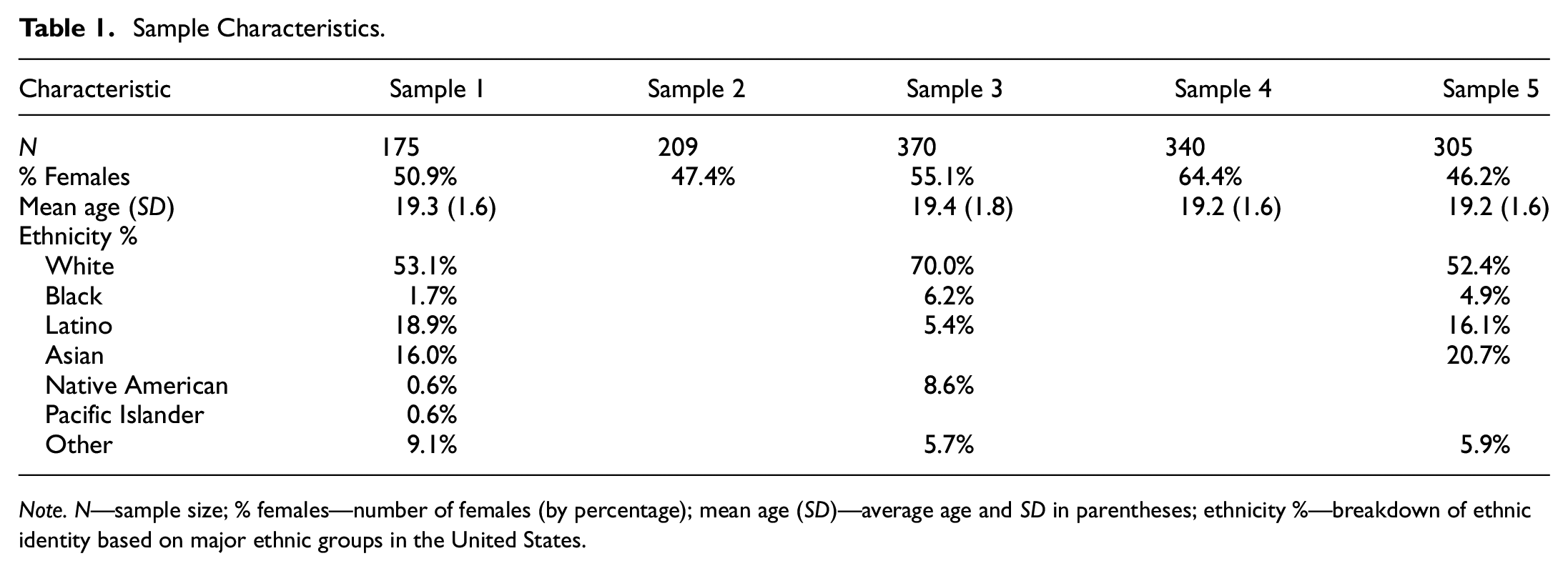
Note. N—sample size; % females—number of females (by percentage); mean age (SD)—average age and SD in parentheses; ethnicity %—breakdown of ethnic identity based on major ethnic groups in the United States.
Measures and Procedures
HEXACO Personality Measures
Participants in Samples 1 and 2 were asked to complete the International Personality Item Pool (IPIP)-HEXACO Inventory. This 240-item instrument, developed by the IPIP project (http://ipip.ori.org/), measures the six HEXACO dimensions and their facets (four facets per dimension). Thus, each facet is tapped by 10 items. Examples of items, by Emotionality facet, include “I tremble in dangerous situations” (Fearfulness), “I worry about things” (Anxiety), “I am sensitive to the needs of others” (Sentimentality), and “I often need help” (Emotional Dependence). Responses are made on a 7-point Likert-type scale anchored by strongly disagree and strongly agree. None of the 10 Emotional Dependence items are reverse-keyed, whereas for each of the other three facets, half the items are reverse-keyed.
Participants in Samples 3, 4, and 5 were asked to complete the 100-item HEXACO-Personality Inventory–Revised (PI-R) scale (Lee & Ashton, 2004, 2018). Each facet is tapped by four items. Examples of items, by Emotionality facet, include “I would feel afraid if I had to travel in bad weather conditions” (Fearfulness), “I get very anxious when waiting to hear about an important decision” (Anxiety), “I feel like crying when I see other people crying” (Sentimentality), and “When I suffer from a painful experience, I need someone to make me feel comfortable” (Emotional Dependence). Responses are made on a 5-point Likert-type scale anchored by strongly disagree and strongly agree. One of the four Emotional Dependence items is reverse-keyed. For each of the other three facets, two of its four items are reverse-keyed.
For both the IPIP-HEXACO and HEXACO-PI-R responses, facet scores were computed as the mean across the items comprising that facet, and overall Emotionality scores were computed as the mean score across the four facets.
Physical Strength
Samples 1, 2, and 3
Physical strength was calculated using a composite of measurements of grip and chest strength (kg/F; Chua et al., 2020). Grip strength was measured using a dynamometer (Jamar Model No. 5030JI). In a standing position, feet shoulder-width apart, participants squeezed the dynamometer in their dominant hand until they applied maximum pressure. Chest strength was measured using the same stance. Participants held the dynamometer in front of their chest, elbows parallel to the floor, and pushed inward until they exerted their maximum capacity (see Lukaszewski & Roney, 2011; Sell et al., 2009).
Samples 4 and 5
Physical strength was calculated using measurements of grip strength only. Grip strength was measured using a Camry digital hand dynamometer in Sample 4 and a Jamar Plus (Model No. 081406453) digital hand dynamometer in Sample 5.
Data Analysis
Imputation of Missing Values
Samples 1 and 2 each included one participant with a missing value for chest strength. These values were imputed from the grip strength variable, which correlated with chest strength at r = .82 in both samples. Using the predictive mean matching method in the R package mice (van Buuren & Groothuis-Oudshoorn, 2011), we ran 50 imputations for each missing value, and used the mean of these values in all subsequent analyses. Sample 5 included seven participants with missing grip strength values. Using the same methods as for Samples 1 and 2, we imputed these values from the observed values of four anthropometric variables, all of which were positively correlated with grip strength. These four variables, and their correlations with grip strength, were average biceps circumference (r = .57), total muscle volume (r = .82), torso muscle volume (r = .82), and arm muscle volume(r = .83).
Regression and Mediation Analyses
For our primary analyses, we combined the samples into a single sample (N = 1,399). To ensure comparability among the five samples, we used grip strength as the sole measure of strength because it was the only strength variable measured in all five samples. Before analysis, personality and strength measures were standardized (converted to z scores). Measures of Emotionality and its four facets were standardized separately within aggregated Samples 1 and 2 (which completed the 7-point IPIP-HEXACO Inventory), and within aggregated Samples 3 to 5 (which completed the 5-point HEXACO-PI-R scale). Grip strength was standardized separately within each sample. Sex was effect-coded (male = −1, female = +1), so that associations from the models could be interpreted as standardized effects. For overall Emotionality, and for each facet of Emotionality, we regressed the personality trait on sex, controlling for physical strength. We regressed the personality trait on strength for women and men separately. Finally, we carried out mediation analyses in which physical strength was hypothesized to mediate between sex and the personality trait. Analyses were carried out in MPlus (Muthén & Muthén, 2008–2017), using the stratification option, which corrects the standard errors of the model for nonindependence of observations due to the nesting of the data within samples.
As a secondary set of analyses, we ran the correlation, regression, and mediation analyses for each of the five samples separately, using standard scripts from the R package psych (Revelle, 2020).
Results
Data used in this study are publicly available through Dryad at https://doi.org/10.5068/D17D58.
Descriptive Statistics
Supplemental Table S1 shows descriptive statistics for the strength measures. Men were significantly (p < .001) stronger than women, with large effect sizes, in all five samples (Sample 1: t = 17.46, d = −2.67; Sample 2: t = 20.18, d = −2.73; Sample 3: t = 21.24, d = −2.36; Sample 4: t = 13.95, d = −1.73; and Sample 5: t = 19.72, d = −2.19). Table 2 shows (1) the scale reliability (Cronbach’s α), (2) overall mean and standard deviation, (3) sex-specific means and standard deviations, and (4) effect size (Cohen’s d) of the sex difference for Emotionality and its four facets, for each sample. Women scored significantly higher (p < .05) than men on all the personality traits in all five samples. Except for Anxiety in one sample and Emotional Dependence in two samples, all sex differences in personality traits were significant at p < .001.
Descriptive Statistics and Sex Differences, HEXACO Emotionality and Its Facets.
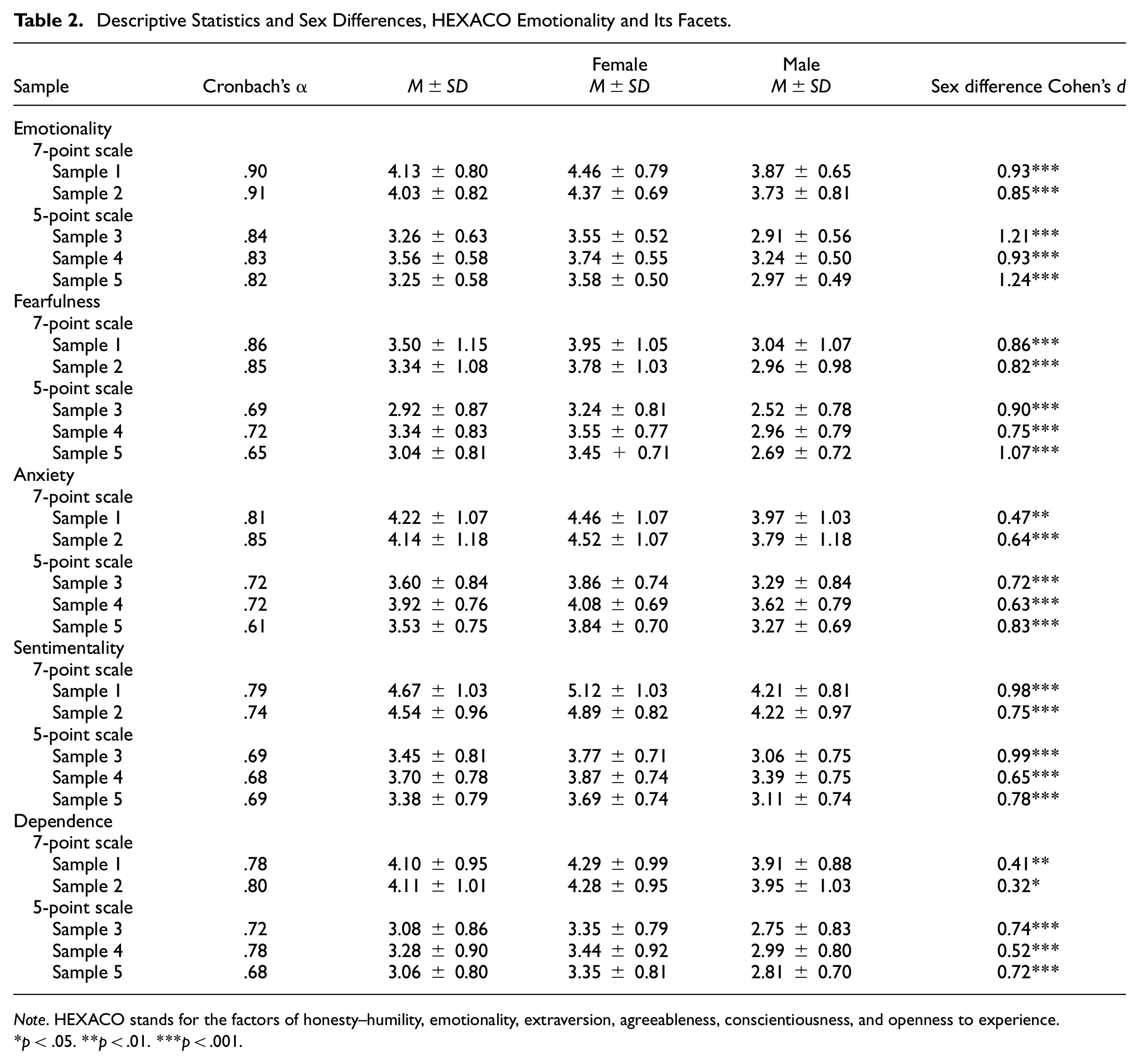
Note. HEXACO stands for the factors of honesty–humility, emotionality, extraversion, agreeableness, conscientiousness, and openness to experience.
p < .05. **p < .01. ***p < .001.
Correlation, Regression, and Mediation Analyses
Table 3 shows results of analyses testing whether the effect of sex on Emotionality and its facets is mediated by physical strength. Strength was significantly (ps < .001) negatively correlated with every facet, and with overall Emotionality, when both women and men were included in the analyses. In describing these results, we will use the phrase “indirect effect” to refer to the extent that personality traits are influenced by sex through strength, “direct effect” to refer to the extent that personality traits are influenced by sex other than through strength, and “total effect” to refer to the extent through which personality traits are influenced by sex, including both indirect and direct effects.
Correlations and Mediation Analyses, Combined Data (N = 1399)
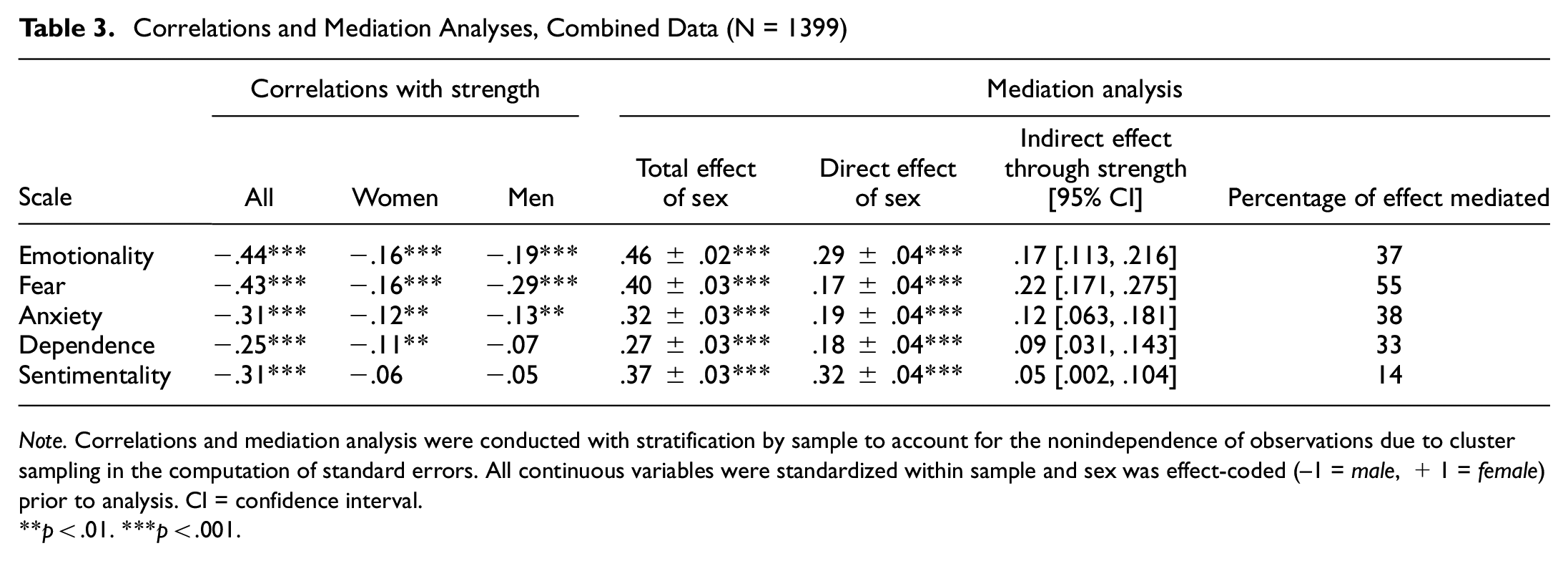
Note. Correlations and mediation analysis were conducted with stratification by sample to account for the nonindependence of observations due to cluster sampling in the computation of standard errors. All continuous variables were standardized within sample and sex was effect-coded (–1 = male, +1 = female) prior to analysis. CI = confidence interval.
p < .01. ***p < .001.
Total effects and direct effects (ps < .001) and indirect effects (95% confidence interval [CI] not including zero) were significant for overall Emotionality and all four of its facets. In other words, physical strength partly accounted for the sex differences in these personality traits. Women’s relatively higher levels of Emotionality and its facets, compared with men, can be partially explained by women’s lower measured strength. However, the percentage of the total effect that was mediated through strength varied considerably across the personality traits. More than half of the total effect of sex on Fearfulness was mediated through strength. Anxiety, Emotional Dependence, and overall Emotionality showed mediation percentages of 33% to 38%. Only 14% of the total effect on Sentimentality was mediated through strength. Supplemental Figure S1 provides a graphical visualization of the results.
Results from the secondary analyses, carried out separately for each sample, are presented in Supplemental Tables S2 to S6. In Sample 1, mediation was complete (>100%) for Fearfulness, Anxiety, and Emotional Dependence, whereas in Sample 2, mediation was complete for Fearfulness and Emotional Dependence.
Discussion
In this study, we sought to build upon Kerry and Murray’s (2018, 2021) finding that physical strength statistically mediated the relationship between sex and Big Five Neuroticism, particularly its Anxiety facet. Using HEXACO Emotionality and its facets as our outcome measures, we conceptually replicated their finding that physical strength mediated the sex difference in Anxiety, as well as the overall Emotionality factor. We also reported the novel finding that physical strength mediated the sex difference in Fearfulness. In two of five samples, mediation was complete. We made no predictions regarding mediation by physical strength of sex differences in Emotional Dependence or Sentimentality, but we did find such mediation effects, although the mediation effect was small (14% of the total effect), for Sentimentality. Overall, these findings provide additional support for the adaptationist hypothesis that the large sex differences in fear- and anxiety-linked psychological traits result in part from the facultative calibration of these traits in response to physical strength.
Physical strength appears to be a stronger and more consistent correlate of Fearfulness than Anxiety. This was true in this study of sex differences, as it was in a recent multi-sample investigation of the within-sex associations of physical strength with the HEXACO personality facets (Rodriguez & Lukaszewski, 2020). From an evolutionary standpoint, it is reasonable that physical strength would be an especially strong correlate of individual differences in Fearfulness, given that physically weaker people are, and have been throughout our ancestral past, more vulnerable to a range of physical threats than stronger people (Sell et al., 2012). However, it is not entirely clear why individual differences in Anxiety—which, similar to fear, functions in the domain of threat avoidance and mitigation (Nesse, 2005)—appear somewhat less strongly and consistently associated with physical strength than Fearfulness. One possibility is that the HEXACO Fearfulness facet narrowly targets reactive fear in response to threats to physical integrity, whereas the Anxiety facet encompasses anxiety and worry about a relatively unbounded set of threats and problems (Lee & Ashton, 2018). For example, the Anxiety item, “I often check my work over repeatedly to find any mistakes,” may not tap self-perceived vulnerability to physical threats but could instead capture variation in the motivation to attain status and occupational success. Similarly, the reverse-keyed item, “I worry a lot less than most people do,” leaves unspecified the subject of the participant’s worry. As such, the extent to which the Anxiety facet’s items capture the motivation to avoid threats that are buffered by greater physical strength may depend on differences across individuals or samples in the types of threats they tend to spontaneously imagine when answering these somewhat vague questions on personality tests. Future research could test this possibility by examining differential predictors of domain-specific measures of anxiety and worry.
Our findings, along with Kerry and Murray’s (2018; 2021), may at least partially explain sex differences in the prevalence of certain fear- and anxiety-linked psychological disorders. Women tend to be at higher risk for developing affective disorders, including generalized anxiety disorder (Breslau et al., 1995; Jalnapurkar et al., 2018), depression (Hopcroft & Bradley, 2007; Seedat et al., 2009), posttraumatic stress disorder (Breslau, 2009; Breslau et al., 1997), and panic disorder (Jalnapurkar et al., 2018; Weissman et al., 1997). If these disorders are underlain in part by a highly elevated propensity of the fear or anxiety system to activate, it is possible that women are more likely to develop them than men, in part, due to their lower physical strength and higher consequent vulnerability to physical threats. Consistent with this, Hagen and Rosenström (2016) found that variation in physical strength partly explained greater rates of depression among women, as well as higher levels of anger among men. Future research could test whether this applies to other fear- and anxiety-linked disorders. It could also examine whether the documented effectiveness of self-defense training for reducing psychological distress in female trauma victims (David et al., 2006; Hollander, 2018) is explained by the effect of increased physical formidability on propensity to experience fear and/or anxiety.
An important direction for future research is to establish the causality of physical strength’s association with fearful and anxious personality traits outside of undergraduate students. A study by Petersen and Dawes (2017) examined the longitudinal association of physical strength with aggression and found evidence for a cross-lagged association of earlier levels of physical strength with later levels of aggression. A similar study predicting longitudinal changes in fearful and anxious personality traits among a more diverse sample is warranted. Such longitudinal studies could supplement any experimental attempts to increase physical strength and thereby reduce levels of fear and anxiety. It may be that physical strength has reciprocal associations with fear and anxiety across development, especially if dispositional fearfulness predicts peoples’ engagement in activities that enhance physicality (e.g., sports, combat training, and resistance training).
Future research could also examine whether the within-population explanation for sex differences in Emotionality tested in this study can account for cultural variation in the size of sex differences in Emotionality. Recent research documents variation across countries in the magnitude of the sex difference in Emotionality, ranging from d = .41 in South Korea to d = 1.21 in Argentina (Lee & Ashton, 2020, Table 2). This variation is positively associated with institutionalized gender equity, such that more gender egalitarian nations tend to exhibit stronger sex differences. This study suggests that cross-cultural variation in the sex difference in physical strength—which could itself be linked to many exogenous socioecological factors—will be positively associated with variation in the magnitude of the sex difference in Emotionality and its Fearfulness and Anxiety facets. Moreover, according to the logic of the calibrational hypothesis, this relationship could be moderated by additional socioecological factors that reduce or increase the importance of physical formidability for buffering oneself from threats (e.g., local rates of conspecific assault, predation risk, opportunities to escape harsh weather, and need to travel on treacherous terrain).
The findings of this study generally support the emerging consensus that narrow personality traits provide more functional and mechanistic insight than broad trait factors (Condon et al., 2021; Mõttus et al., 2019). In particular, our results suggest that within- and between-sex variation in Fearfulness arises through the calibrational effects of physical strength on the fear system. A recent model of the fear system’s calibration sketched by Moscarello and Hartley (2017) posited an important role for the perceived controllability of potential threats, such that prototypically fearful (i.e., defensive) responses are expected to be more pronounced, relative to proactive responses, when threats are estimated to have low controllability. One possibility, therefore, is that having greater physical strength makes (or is perceived to make) a range of social and environmental threats more controllable through intentional action (e.g., by increasing one’s ability to neutralize an attack), thereby altering the fear system’s calibration. Regardless of the mechanistic details, if the causes of individual differences in fearfulness can be located within the parameterization of the fear system, this would deliver on the promise of recently proposed frameworks for personality science, which emphasize characterizing the computational architectures of mechanisms that regulate behavioral variation (Baumert et al., 2017; Lukaszewski, 2021; Lukaszewski et al., 2020; Rauthmann, 2021; Wood et al., 2015).
Conclusion
This study suggests that the sex difference in Fearfulness—which is one of the largest and most cross-culturally consistent sex differences in any personality trait—is at least partly explained by the calibration of fear in response to physical strength. We look forward to additional research designed to establish the causal links implied by our correlational findings, determine the relevance of physical strength for sex-biased personality disorders, and characterize the mechanistic underpinnings of the strength–fear association.
Supplemental Material
sj-docx-1-spp-10.1177_19485506221094086 – Supplemental material for Sex Differences in Fearful Personality Traits Are Mediated by Physical Strength
Supplemental material, sj-docx-1-spp-10.1177_19485506221094086 for Sex Differences in Fearful Personality Traits Are Mediated by Physical Strength by Joseph H. Manson, Kristine J. Chua, Nina N. Rodriguez, Michael Barlev, Patrick K. Durkee and Aaron W. Lukaszewski in Social Psychological and Personality Science
Footnotes
Handling Editor: Peter Rentfrow
Declaration of Conflicting Interests
The author(s) declared no potential conflicts of interest with respect to the research, authorship, and/or publication of this article.
Funding
The author(s) received no financial support for the research, authorship, and/or publication of this article.

Supplemental Material
Supplemental material is available in the online version of the article.
Author Biographies
References
Supplementary Material
Please find the following supplemental material available below.
For Open Access articles published under a Creative Commons License, all supplemental material carries the same license as the article it is associated with.
For non-Open Access articles published, all supplemental material carries a non-exclusive license, and permission requests for re-use of supplemental material or any part of supplemental material shall be sent directly to the copyright owner as specified in the copyright notice associated with the article.
