




Abstract
We propose that an organizational culture where playing politics is important for advancement, compared with an organizational culture where showing competencies is important, elicits stronger lack of fit experiences for women than for men. In a pre-study, playing politics was perceived as dominant, typically male work behaviors, whereas showing competencies was perceived as competent, typically female work behaviors. We then tested in two experiments (689 individuals, integrated in a small-scale meta-analysis) the joint effect of organizational culture and gender on four lack of fit indicators (self-concept conflict, fear of backlash, intention to seek power positions, concerns about one’s skills). As expected, women indicated more lack of fit experiences than men in politics cultures, but not in competencies cultures. Our findings suggest that perceived organizational culture may play an important role in understanding the dynamics of career advancement of women and men.
What is required to advance to higher positions in an organization? Not surprisingly, research on antecedents and lay theories of power identified competence, structural position (e.g., access to information), demographics, and personality as predictors for advancement (Anderson & Brion, 2014; Belmi & Laurin, 2016; ten Brinke & Keltner, 2020). In addition, and of prime interest in the present research, political behaviors such as deciding strategically, using social connections instrumentally, and forming alliances have been discussed as necessary and useful to attain higher positions (Anderson & Brion, 2014; Belmi & Laurin, 2016). Playing politics is different from single instrumental work behaviors (e.g., instrumental networking) as it includes multiple behaviors focusing on advancement to power positions using a “pragmatic and Machiavellian approach to impression management and social relationships to get ahead” (Belmi & Laurin, 2016, p. 505). Although strategic networks and assertive self-promotion drive success (Belmi & Laurin, 2016), playing politics is often viewed negatively (Doldor et al., 2013; Pfeffer, 2010). Afterall, playing politics behaviors are manipulative and self-interested behaviors (Belmi & Laurin, 2016).
In this article, we propose that, at least for some individuals, playing politics may violate self-definitions and societal expectations regarding adequate behavior and will, therefore, lead to lack of fit experiences. This should be especially true for women for whom society prescribes communal behavior and proscribes dominant behavior (Prentice & Carranza, 2002).
This assumption is in line with previous findings: Even though women and men both rate playing politics as effective and necessary behaviors to acquire power (Belmi & Laurin, 2016, Online Supplement), and do not differ in their political skill levels or effective use of those skills (Harris et al., 2007; Judge & Bretz, 1994; Todd et al., 2009; Treadway et al., 2005), qualitative interview studies suggest that politics cultures constitute a comparatively high hurdle for women’s advancement. Women described playing politics as dominant, stereotypical male behaviors, reported to dislike playing politics, perceived playing politics to be at odds with female identity, and preferred success built on achievements (Davey, 2008; Doldor et al., 2013).
We further argue that the gender difference regarding lack of fit experiences expected in a politics culture should be less pronounced or even disappear in gender-neutral competencies cultures that require doing an excellent job, being highly motivated, and being a team player to succeed. The competence facet of agency is nowadays perceived as gender-neutral, whereas the dominance facet of agency is still stereotypically associated with masculinity, and communion is still stereotypically associated with femininity (Abele et al., 2016; Eagly et al., 2019). For men, lack of fit experiences in competencies cultures might depend on how much stereotypical female communal skills are emphasized in a specific competencies culture.
In the present research, we examine four indicators of a lack of fit experience. First, self-concept conflict reflects the experienced mismatch between one’s self-concept and an organization’s culture (Belmi & Laurin, 2016). Due to gender stereotypes and socialization, women’s (compared with men’s) self-concepts are more strongly characterized by communion and less strongly characterized by the dominance component of agency (Guimond et al., 2006; Hentschel et al., 2019). These self-concepts can be hypothesized to contrast with the dominant, typically male behaviors required in politics cultures. If so, politics cultures should elicit more self-concept conflict for women than for men, whereas in competencies cultures differences in self-concept should be less pronounced.
Second, fear of backlash is defined as being afraid of others’ reactions when violating expectations based on stereotypes (Moss-Racusin & Rudman, 2010). Gender stereotypes prescribe women to show communal and proscribe to show dominant behaviors (Prentice & Carranza, 2002). According to prior research, women are evaluated negatively for showing dominance (i.e., backlash), but not for showing competence or communion (Rudman & Glick, 2001; Williams & Tiedens, 2016). Moreover, women anticipate backlash (i.e., fear of backlash) and consequently self-limit their behavior (Amanatullah & Morris, 2010; Moss-Racusin & Rudman, 2010). So far, fear of backlash has been studied in specific situations (e.g., self-promotion, negotiation, Amanatullah & Morris, 2010; Moss-Racusin & Rudman, 2010). Going beyond specific situations, we examine whether organizational culture can induce general feelings of fear of backlash as one indicator of lack of fit experiences.
Third, lack of fit experiences (e.g., self-concept conflict) may lead to self-limiting behaviors (Heilman, 1983). These self-limiting behaviors can be reflected in lowered intentions to seek power which constitute a more indirect measure of lack of fit. This assumption can be built on research by Belmi and Laurin (2016) who found that individuals with low (vs. high) social class strive less for power when playing politics (vs. showing competencies 1 ) is important for advancement. Interestingly, with respect to gender differences in power motivation, prior research has revealed mixed findings. Some research suggest similar levels of power motivation for women and men (Anderson & Brion, 2014), whereas other research reports a lower implicit (Denzinger et al., 2016) and explicit power motive in women than in men (Gino et al., 2015). Although women view advancement as equally attainable, they perceive power as less desirable (Gino et al., 2015). These mixed findings point toward moderating variables. We propose that organizational cultures can function as moderators and hypothesize increased gender differences in the intention to seek power positions in politics (compared with competencies) cultures.
Fourth, limited experience and self-stereotyping may raise one’s concerns about one’s skills in playing politics (Belmi & Laurin, 2016). If so, women may believe that they lack the necessary skills to play politics (vs. showing competencies).
This present research is—to the best of our knowledge—the first quantitative, experimental investigation of the joint effect of organizational culture and gender on lack of fit experiences (in particular, including critical comparisons between different organizational cultures) showcasing the importance to disentangle the competence and dominance facets of agency. This approach, thus, also echoes the call to address structural hurdles in gender research (England et al., 2020) by linking structural aspects (organizational culture) with individuals’ resulting lack of fit experiences.
Pre-Study
The assumption that playing politics is perceived as typically male behavior and showing competencies as gender-neutral (or slightly female behavior) has so far been only addressed in qualitative research (based on interviews with women). To our knowledge, quantitative research with female and male participants has not yet been reported. Therefore, in a first step, we tested whether women and men both perceive playing politics as typically male behavior and showing competencies as gender-neutral (or even slightly female behavior). Moreover, we assessed dominance and competence as facets of agency as well as warmth and morality as facets of communion. We expected that playing politics is perceived by both women and men as more dominant, less competent, less warm, and less moral behavior compared with showing competencies.
Method
Participants
We recruited 100 participants via a participant pool from University of Mannheim and via posts on social media (75% female, Mage=33.90, SDage=11.90, 97% with higher educational level, 30% students, 72% working, average work experience M=9.40 years, SD=10.80, 16% held a leadership position). For all studies reported participant treatment was in accordance with ethical standards from APA and University of Mannheim, participants could sign up for a lottery for Amazon vouchers, and materials, data and code for all studies are available through OSF (https://osf.io/astpf/?view_only=5774fd3a384b426aaff0e2d4c8ba506b).
Procedure and Design
After providing their demographics, participants were presented with two sets of work behaviors. Seven behaviors described the examples for playing politics and seven examples described showing competencies reflecting a one-factor (playing politics vs. showing competencies) within-subjects design. An example for playing politics is “Make decisions strategically, that is, decide on a purely business basis, and not pay attention to the sensitivities of others (e.g., colleagues).” An example for showing competencies is “Do excellent work and be competent at what you do” (based on Belmi & Laurin, 2016). Each behavior was evaluated on several dimensions (see below). The order of the two sets and the order of the behaviors within one set were randomized. Finally, participants indicated their self-ascribed masculinity-femininity (we expected comparable results for biological sex and self-ascribed gender identity; see Online Supplement).
Measures
Gender Typicality Rating
Participants rated how typically feminine or masculine they perceive described work behaviors to be (−3=typically female to +3=typically male). The reliabilities of these ratings were α=.67 for playing politics and α=.62 for showing competencies.
Agency and Communion Ratings
Participants rated each behavior in terms of agency and communion. For each behavior, participants indicated how much they associated a person showing the behavior in question with 12 different adjectives (1=not at all to 7=very much). Three adjectives each represented the four sub-facets dominance, competence, warmth, and morality (Abele et al., 2016). For example, participants indicated how much they associated “Do excellent work and be competent at what you do” with a person who is assertive (one of three indicators for dominance; αpolitics=.88; αcompetencies=.87), efficient (competence; αpolitics=.91; αcompetencies=.87), caring (warmth; αpolitics=.91; αcompetencies=.86), and trustworthy (morality; αpolitics=.88; αcompetencies=.85).
Results and Discussion
As predicted, playing politics was perceived as a typically male behavior (M=0.61, SD=0.67), t(99)=9.17, p < .001, d=0.92 (significant deviation from scale midpoint zero), whereas showing competencies was perceived as a typically female behavior (M=−0.43, SD=0.52), t(99)=−8.22, p < .001, d=0.82.
Furthermore, a repeated measure ANOVA revealed the expected Work Behavior × Agency-Communion-Rating interaction, F(1.84, 159.05)=420.73, p < .001, η2;=.81 (with Greenhouse–Geisser correction). Participants rated playing politics compared with showing competencies as higher in dominance (mean difference of 0.93, SE=0.07, p < .001), lower in competence (mean difference of 1.07, SE=0.08, p < .001), lower in warmth (mean difference of 1.87, SE=0.08, p < .001), and lower in morality (mean difference of 2.18, SE=0.08, p < .001; see Figure 1). 2
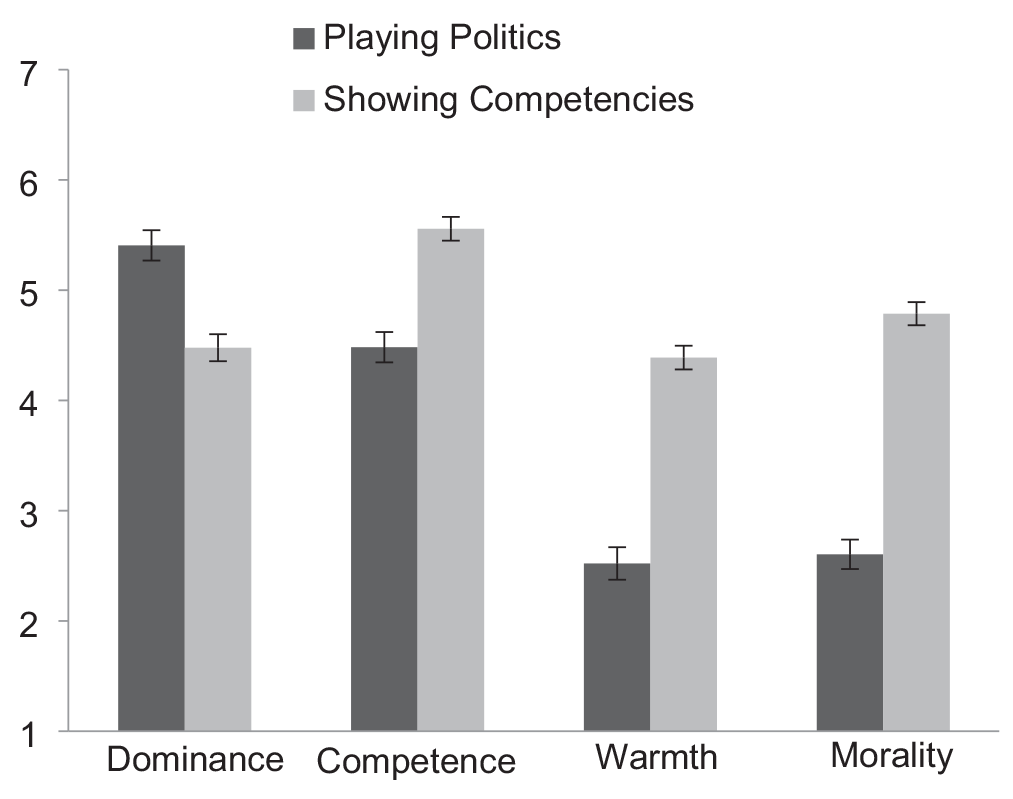
Participants’ Dominance, Competence, Warmth, and Morality Ratings of Playing Politics and Showing Competencies
These results confirm our starting assumption that playing politics is perceived as typically male, dominant behavior. Showing competencies is perceived as typically female, competent, communal behavior. Women and men seem to share this perception. These findings underline the importance to disentangle the competence and dominance facets of agency.
Studies 1a and 1b
The pre-study clearly indicated that playing politics (compared with showing competencies) was perceived as stereotypic male and dominant behavior. Given these perceptions, organizational cultures emphasizing playing politics are more likely to elicit lack of fit experiences in women than in men. In Study 1a, participants imagined working for a company either with a playing politics culture or a showing competencies culture. Study 1b was a direct replication of Study 1a using the same design and materials to test the stability and reliability of the results and increase test power. We hypothesized that women would report more lack of fit experiences (i.e., self-concept conflict, fear of backlash, intention to seek power positions, and concerns about one’s skills) in an organizational culture of playing politics, whereas this gender difference should be less pronounced in an organizational culture of showing competencies.
Method
We present an integrative data analysis based on the pooled raw data of the two independent samples of Studies 1a and 1b including a dummy indicating the respective sample, as well as a small-scale meta-analysis (Curran & Hussong, 2009). Separate analyses per sample are reported in the Online Supplement. Although the descriptive pattern of results was highly consistent, differences in significances between the pooled data and the individual studies are reported in footnotes.
Participants
We recruited university students via www.surveycircle.com and by spreading the study link via e-mail at multiple universities across Germany. We excluded three participants in Study 1a and eight participants in Study 1b who indicated at the end of the study that they did not answer the questions conscientiously. Furthermore, we excluded two participants in Study 1b with gender category “other” as this sample was too small for statistical analyses and 10 participants in Study 1b who indicated they had participated in this study before. For Study 1a, a power analysis for an ANOVA with interactions revealed a minimum sample size of N=128 to detect a medium-sized effect, f=0.25, with a power of (1 −β)=.80 at α=.05 for the proposed univariate Participant Sex × Culture interactions (G*Power, Faul et al., 2007). After reaching the suggested sample size, we continued recruitment until each condition contained at least 50 respondents (see suggestion by Simmons et al., 2013) resulting in 317 participants. With those 317 observations in four groups the analysis had 80% power to detect an interaction effect of f≥ 0.16 at α=.05. For replication purposes, for Study 1b we aimed to reach a sample comparable to Study 1a. The resulting sample size was 372 for Study 1b. The integrative data analysis based on the pooled raw data of Studies 1a and 1b (N=689, 68% women) had 80% power to detect univariate Participant Sex × Culture interaction effects of f≥ 0.11. 3 See Table S11 in the Online Supplement for detailed demographics of the participants in Studies 1a and 1b.
Procedure and Design
After providing their demographics, participants had to imagine starting their career after university in a well-regarded (fictitious) German consulting company Swathmore International. All participants read that they would enter, as every new employee does, as Associate Consultant with the option to advance to higher positions. Then half of the participants learned, allegedly from sources within the company, that it would take playing politics to move up the ranks, whereas the other half learned that it would take showing one’s competencies. This reflects a 2 (participant sex: male vs. female) × 2 (condition: politics culture vs. competencies culture) between-subjects design with random assignment to conditions. We presented the same examples for showing competencies or playing politics as in the pre-study to describe the respective company culture. 4 Afterward, participants answered a manipulation check, indicated their self-concept conflict and fear of backlash, as well as their intention to seek power and concerns about their skills when using the strategies that promise advancement in the respective organization. Last, we added some exploratory questions (e.g., self-ascribed masculinity-femininity). Procedure and materials were adopted from Study 2 from Belmi and Laurin (2016).
Measures
Participants responded to all measures on 7-point rating scales ranging from 1=strongly disagree to 7=strongly agree if not indicated otherwise.
Manipulation Check
We asked participants to rate their agreement with two statements: “What people at Swathmore International primarily need to advance to a higher position is strategic skills” and “What people at Swathmore International primarily need to advance to a higher position is hard work and motivation.,”r(687) =−.34, p < .001 (Belmi & Laurin, 2016). We also asked participants at the end of the study how well they could imagine the described situation (not at all to very well).
Self-Concept Conflict
Participants indicated their agreement with six statements (α=.96) about self-concept conflicts regarding the behaviors needed to advance to a higher position, for example, “I feel that these strategies conflict with who I am as a person” (Belmi & Laurin, 2016).
Fear of Backlash
We assessed fear of backlash with an adapted selection of six items (α=.92) from Rudman and Fairchild’s (2004) fear of backlash scale. Participants were asked to imagine performing the behaviors needed to advance to a higher position (in the respective experimental condition) and to indicate to what extent (1=not at all to 7=very much) they would fear their colleagues’ reactions, for example, “Would you be concerned that your colleagues might dislike you?” 5
Intention to Seek Power
We asked for the participants’ intention to seek power when thinking about the respective behaviors needed to advance to a high position with four questions, for example, “I would aspire to be in a high-ranking position in this organization” (Belmi & Laurin, 2016). In addition, we presented stairs depicting the seven different positions available in the company from lowest [Assistant Consultant] to highest [Partner] and asked “Which position would you like to occupy in this organization in the future?” (Belmi & Laurin, 2016). We combined both measures by standardizing and then averaging the items (α=.96).
Concerns About One’s Skills
We assessed participants’ concerns about their skills with two items, r (687)=.52, p < .001 (Belmi & Laurin, 2016), for example, “I feel that I do not have the skills to perform these behaviors.”
Additional Measures
Identical to the pre-study, we assessed participants’ social gender with the German version of the Traditional Masculinity-Femininity Scale (Kachel et al., 2016; see Online Supplement). Furthermore, as prior research found that social class predicts the intention to seek power positions (Belmi & Laurin, 2016), we included a measure of the participants’ subjective social class (Euteneuer et al., 2015). Controlling for social class led to consistent results (see Online Supplement).
Results
Manipulation Check
Participants could overall imagine the situation well (M=5.11, SD=1.56), with no significant differences due to participant sex, condition, study, and the interactions (all ps > .076). As intended, participants in the politics culture condition rated playing politics (M=6.51, SD=0.98) as more helpful than showing competencies (M=4.10, SD=1.97), whereas the reverse pattern emerged in the competencies culture, Mcompetencies=6.51, SD=0.94 versus Mpolitics =4.58, SD=1.83; Manipulation Check Items × Condition interaction, F(1, 681)=591.98, p < .001, η2;=.47. Importantly, the three-way interaction Manipulation Check Items × Participant Sex × Study Dummy as well as the other two-way interactions were not significant, Fs < 1.82, ps > .178.
Lack of Fit—Multivariate Results
A MANOVA (see Table S12 in the Online Supplement for intercorrelations of the lack of fit indicators) revealed a significant main effect for participant sex, F(4, 678)=9.84, p < .001, η2;=.06, a significant main effect for condition, F(4, 678)=206.64, p < .001, η2;=.55, and the hypothesized Participant Sex × Condition interaction, F(4, 678)=5.87, p < .001, η2;=.03. The main effect of study, the two-way interactions with study as well as the three-way interaction were non-significant (see Online Supplement, also for the following results). Planned univariate 2 (participant sex: male vs. female) × 2 (condition: politics culture vs. competencies culture) contrasts are reported below (see Figure 2).
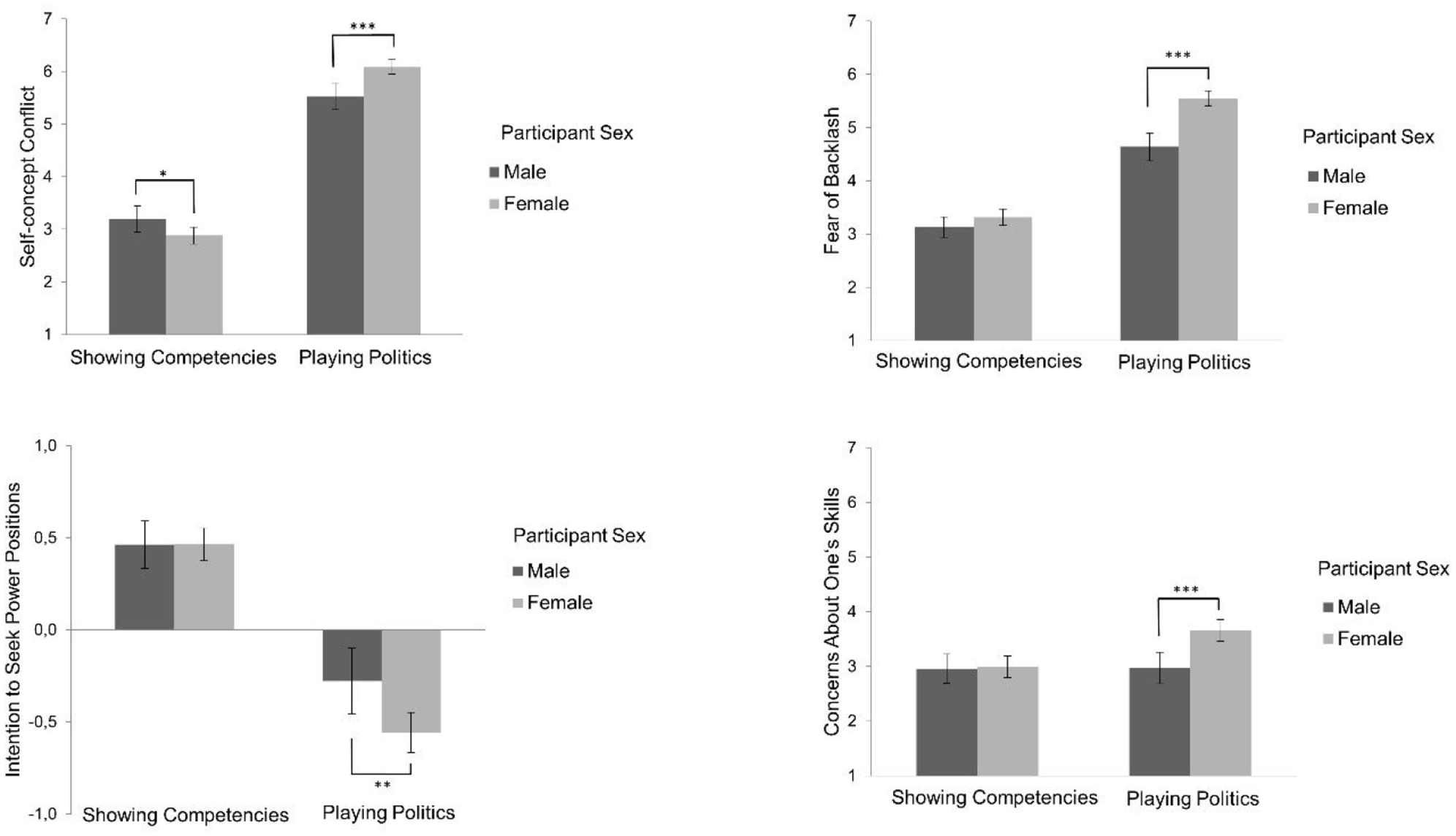
Lack of Fit Experiences Depending on Organizational Culture and Participant Sex
Self-Concept Conflict
Participants reported more self-concept conflict in the politics compared with the competencies culture condition, F(1, 681)=760.35, p < .001, η2;=.53. Crucially, this effect was more pronounced for women than for men, F(1, 681)=19.06, p < .001, η2;=.03 (Participant Sex × Condition interaction). As predicted, women reported more self-concept conflict in the politics culture condition than men, t(183.01)=−3.90, p < .001. Unexpectedly, in the competencies culture condition, men reported more self-concept conflict than women, t(203.83)=2.14, p=.034. 6
Fear of Backlash
Women reported more fear of backlash than men, F(1, 681)=30.58, p < .001, η2;=.04. Furthermore, participants in the politics culture condition reported more fear of backlash than participants in the competencies culture condition, F(1, 681)=372.48, p < .001, η2;=.35. Most importantly, the latter effect was more pronounced for women than for men, F(1, 681)=13.73, p < .001, η2;=.02 (Participant Sex × Condition interaction). In line with our hypothesis, women reported more fear of backlash in the politics culture condition than men, t(178.24)=−5.97, p < .001, whereas no gender difference emerged in the competencies culture condition, t(246.37)=−1.43, p=.153.
Intention to Seek Power Positions
Women reported less intention to seek power positions than men, F(1, 681)=4.68, p=.031, η2;=.01. 7 Furthermore, participants indicated less intention to seek power positions in the politics culture condition compared with the competencies culture condition, F(1, 681)=180.10, p < .001, η2;=.21. With respect to our hypothesis, women reported a lower intention to seek power positions than men in the politics culture, t(197.77)=2.64, p=.009, 8 whereas this difference did not emerge in the competencies culture condition, t(219.90)=−0.01, p=.99; F(1, 681)=4.37, p=.037, η2;=.01 (Participant Sex × Condition interaction). 9
Concerns About One’s Skills
Women reported more concerns about their skills than men, F(1, 681)=7.96, p=.005, η2;=.01. 10 Participants in the politics culture condition reported more concerns about their skills than those in the competencies culture condition, F(1, 681)=7.71, p=.006, η2;=.01. A significant Participant Sex × Condition interaction emerged, F(1, 681)=6.91, p=.009, η2;=.01. 11 As expected, women reported more competence-based concerns in the politics culture condition than men, t(685)=−3.90, p < .001, whereas no gender difference emerged in the competencies culture condition, t(685)=−0.19, p=.847.
Robustness Check With Small-Scale Meta-Analysis
Beyond the integrated data analysis with the pooled data sets, we conducted a small-scale meta-analysis (fixed-effect model) across the individual studies. We transformed the η2; of the interactions into d-effect sizes and weighted them by their sample’s inverse variance weight (i.e., one over the square of their standard errors, Lipsey & Wilson, 2001). Results are summarized in Table 1. The small-scale meta-analysis demonstrates significant Participant Sex × Condition interactions for all four lack of fit indicators across Studies 1a and 1b. The effect sizes indicate small effects according to Cohen’s (1988) classification, with self-concept conflict showing the strongest gender difference in lack of fit depending on organizational culture.
Results of the Small-Scale Meta-Analysis With the Participant Sex (Female vs. Male) × Condition (Politics Culture vs. Competencies Culture) Interaction Effects of Studies 1a and 1b
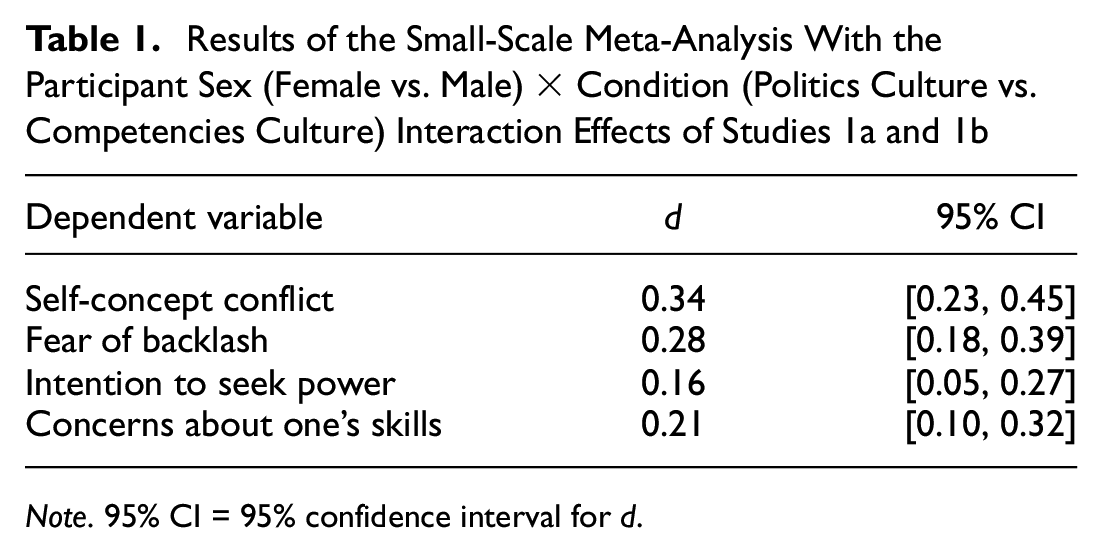
Note. 95% CI = 95% confidence interval for d.
Discussion
The obtained findings suggest that women experience a stronger lack of fit than men when faced with situations in which playing politics (relative to showing competencies) is the key driver for career advancement. Beyond this significant interaction effect, it is noteworthy that lack of fit experiences was lower for all participants in the politics compared with the competencies condition. Importantly, the interaction pattern holds after controlling for subjective social class (see Online Supplement). Supporting the reliability of these findings, consistent results were obtained across two studies. The small-scale meta-analysis suggests that the hypothesized effect is presumably smaller for the intention to seek power than for the other three indicators of lack of fit experiences.
General Discussion
In summary, the present study clearly demonstrated the joint effects of gender and organizational cultures on lack of fit expectations of potential applicants for higher organizational positions. The results of a pre-study document that playing politics (vs. showing competencies) are perceived as dominant, typically male behavior, thus supporting prior qualitative research (Davey, 2008; Doldor et al., 2013). Subsequently, across two studies, women indicated more lack of fit experiences than men in organizational cultures where playing politics (vs. showing competencies) drives success. Effects were consistent across four different indicators of lack of fit experiences: Women reported more self-concept conflict, more fear of backlash, more concerns regarding the skills allegedly responsible for success in the respective organizations, and less intentions to seek power positions than men.
Presumably, the stronger experienced lack of fit results from women’s internalized or perceived prescriptive stereotypes to be communal and prescriptive stereotypes to refrain from being dominant (e.g., forming alliances for one’s own career advancement, see Belmi & Laurin, 2016). However, future studies will have to explicitly test these assumptions (and the relative importance of communal prescriptions and dominance proscriptions). Moreover, it would be particularly interesting to examine whether women’s fear of being negatively viewed for behaving politically has a valid basis. Even if the evaluation of dominant men and women does not differ, as reported by Steffens and colleagues (2009, see also Williams & Tiedens, 2016, for reduced backlash effects outside North America), women’s lack of fit experiences are still highly consequential due to the self-limiting behaviors.
Effect sizes for the different indicators varied in our studies but proved reliable in a small-scale meta-analysis. Interestingly, the weaker effects regarding women’s reduced intention to seek power in political culture organizations resemble inconsistent findings regarding gender differences in the intention to seek power in prior research (e.g., Anderson & Brion, 2014; Denzinger et al., 2016; Gino et al., 2015). One may speculate that, compared with the other indicators of lack of fit, the intention to seek power is a more distal outcome that is not only influenced by joint effects of organizational culture and gender, but also, for example, by prestige or salary.
The obtained findings mirror prior research on the interplay of social class and organizational culture—with the results for women reflecting the same pattern as those for low socio-economic status individuals (Belmi & Laurin, 2016). Importantly, however, women’s lack of fit experiences were observed independently of subjective social class.
The present research was based on students’ reactions to descriptions of different organizational cultures. Although entering vocational activities for the first time is a crucial decision, it would be interesting to investigate lack of fit of employees already working in organizations with more or less playing politics cultures. One may speculate that the actual confrontation with the respective culture enhances lack of fit. 12
From a practical point of view, it is also worth stressing that beyond the gender differences that were our major research topic, the present results also show that politics cultures overall are perceived negatively, both by women and men. Therefore, organizations may well be advised to develop an organizational culture where competencies (not politics) are perceived important for advancement. Such a focus will also attract women for leadership positions. In this respect, it is interesting to note that men indicated more self-concept conflict for showing competencies compared with women (for the other three lack of fit measures no gender difference emerged). This might be due to the specific measure of showing competencies (e.g., having good communication skills) used in the present study (based on the work of Belmi & Laurin, 2016). Organizations may therefore be well-advised to focus on competencies that are not perceived as gender-specific.
Evidence about a stagnating progress in gender equality in the past years has been combined with the call to attend more to structural hurdles (England et al., 2020). Organizational cultures may constitute such structural hurdles as they potentially create boundary conditions for the effectiveness of diversity interventions (Baron et al., 2021). The present research, thus, echoes the call addressing structural aspects by focusing on the interplay of organizational culture and gender on individuals’ lack of fit experiences. Although readily acknowledging the necessity of future research, we strongly believe that the present results constitute an important step in understanding that organizational culture affects gender equality at work.
Supplemental Material
sj-docx-1-spp-10.1177_19485506221075898 – Supplemental material for The Politics Hurdle: Joint Effect of Organizational Culture and Gender on Lack of Fit Experiences
Supplemental material, sj-docx-1-spp-10.1177_19485506221075898 for The Politics Hurdle: Joint Effect of Organizational Culture and Gender on Lack of Fit Experiences by Mona Salwender, Christiane Schoel, Herbert Bless and Dagmar Stahlberg in Social Psychological and Personality Science
Footnotes
Acknowledgements
The authors thank Kerry L. Marsh and Felicia Pratto for their valuable feedback regarding the design of Studies 1a and 1b.
Handling Editor: Robyn Mallett
Declaration of Conflicting Interests
The author(s) declared no potential conflicts of interest with respect to the research, authorship, and/or publication of this article.
Funding
The author(s) disclosed receipt of the following financial support for the research, authorship, and/or publication of this article: This research was supported by departmental budget resources of the Chair for Social Psychology and the Chair for Microsociology and Social Psychology.
Open Practices Statement
Pre-study and Study 1a were not preregistered. We preregistered Study 1b on OSF ( ). In an exploratory data analysis in Study 1a we found the interaction term concerning intention to seek power to be significant for participants being highly interested in consulting and therefore aimed to investigate this further. However, in Study 1b interest in consulting significantly differed between the politics and the competencies condition. Therefore, we did not analyze the results as preregistered. Details can be obtained from the first author (msalwend@mail.uni-mannheim.de).
Supplemental Material
The supplemental material is available in the online version of the article.
Notes
Author Biographies
References
Supplementary Material
Please find the following supplemental material available below.
For Open Access articles published under a Creative Commons License, all supplemental material carries the same license as the article it is associated with.
For non-Open Access articles published, all supplemental material carries a non-exclusive license, and permission requests for re-use of supplemental material or any part of supplemental material shall be sent directly to the copyright owner as specified in the copyright notice associated with the article.
