




Abstract
We draw on a field experiment conducted in five European countries to analyze hiring discrimination on the basis of gender and race. We adopt an intersectional perspective and relate existing theories on gender and racial discrimination to recent work on the gendered stereotype content of different races. We find that employers prefer hiring white women over men for female-typed jobs. By contrast, women of color do not have any advantage over men of the same race. Moreover, black and Middle Eastern men encounter the strongest racial discrimination in male-typed jobs, where it is possible that their stereotyped masculinity, made salient by the occupational context, is perceived as threatening. Overall, we argue that the employment chances of applicants of different gender and racial backgrounds are highly dependent on their perceived congruence (or lack thereof) with the feminine or masculine traits of the job they apply to.
Keywords
A wealth of field experimental research has shown compelling evidence of hiring discrimination against members of subordinate groups, such as ethnic and racial minorities. Although the levels of discrimination vary across national contexts and labor market segments, the general picture is one of severe disadvantage (Bertrand and Duflo 2017; Zschrint and Ruedin 2016). Ethnic inequality in European labor markets can be characterized as having a pronounced gender dimension (Heath, Rothon, and Kilpi 2008). Although there are various supply-side mechanisms assumed to produce these patterns in part, gendered ethnic discrimination by employers might be a contributing factor on the demand side.
A few field experiments on employers’ hiring decisions show that ethnic discrimination varies significantly depending on the gender being considered (e.g., Arai, Bursell and Nekby 2016; Bursell 2014; Midtbøen 2016), although the findings are inconsistent. A recent meta-analysis found no systematic gender differences in the levels of ethnic hiring discrimination (Zschrint and Ruedin 2016). This indicates that the gendered ethnic preferences of employers might depend on the particular occupation or minority group considered.
Several theoretical perspectives on the intersection of gender and race or ethnicity in producing enduring patterns of inequality have been developed in social psychology (Cole 2009; Kang and Bodenhausen 2015), sociology (Collins 1998; Ridgeway and Kricheli-Katz 2013), and women’s studies (Cho, Crenshaw, and McCall 2013), bracketed under the umbrella term intersectionality, but these have to a lesser extent been linked explicitly to experimental evidence of hiring discrimination. With this study, we examine this link by merging two strands of literature that have developed independently: first, the subordinate male target hypothesis and theories of double jeopardy (for a review, see Purdie-Vaughs and Eibach 2008) that have theorized about greater ethnic discrimination against one or the other gender but without considering the occupational context or the stereotype content of specific outgroups; and second, role congruity theory and lack-of-fit models (for a review, see Eagly and Koenig 2008; Heilman 2012) that have theorized about gender differences across occupational contexts without considering nonwhite groups, implicitly assuming that gendered stereotype content is universal. We combine these theories and rely on gendered racism theory (Hall et al. 2019) to develop intersectional hypotheses. We follow the suggestion by Browne and Misra (2003:507) that “scholars must develop more middle-range theories to specify the conditions under which intersections of gender and race are exacerbated or neutralized.”
To summarize, our focus is on how employers evaluate applicants with intersecting group membership (i.e., gender and race) while making hiring decisions in more or less gender-typed occupational contexts. Overall, we expect the gendered nature of racial discrimination to differ across minority groups and labor market segments, depending on the stereotype content of specific gender-race subgroups and the gender typing of the job. To test our predictions, we draw on a large-scale, cross-national field experiment on hiring discrimination conducted as part of the Growth, Equal Opportunities, Migration & Markets project (GEMM; for more detailed information on the study, see Lancee et al. 2019a). The experiment followed a factorial design that allowed for orthogonal variation between gender and ethnic/racial background (Di Stasio and Lancee 2020). In addition, we focused on a large number of outgroups, whereas previous experimental studies on ethnic discrimination have only examined a few selected groups of particular interest (typically the most marginalized groups in society) and often of one gender only (Bertrand and Duflo 2017). We randomly assigned a country of origin and gender to fictitious applicants and replied to real-world job openings in a range of occupations varying in gender composition in five national contexts. We used country of origin to distinguish between different racial and ethnic groups. By comparing the responses received from employers (callbacks), we were able to identify racial discrimination and its interplay with gender discrimination in different occupational contexts.
A Brief Note on Ethnicity and Race
Before describing the theoretical framework, it is important to clarify how we defined ethnic and racial categories in our analysis. The use of the terms ethnicity and race is still contested in the social sciences, with recent works emphasizing their conceptual overlap rather than their differences and making the case for an integrated view (e.g., Brubaker 2009). Although scholars in northern and continental Europe are generally reluctant to use the term race and prefer to focus on ethnicity—sometimes in relation to other attributes, such as immigrant background and religion—race and ethnicity are often used interchangeably in American and British scholarship (for a discussion, see Verkuyten 2018).
In this study, we follow the approach proposed by Sen and Wasow (2016) of treating race and ethnicity as composite variables (or “bundles of sticks”) that can be disaggregated into various ethnic and racial markers of “otherness,” some of which are acquired genetically and are more immediately visible and less mutable (e.g., physical features), whereas others are culturally or historically inherited (e.g., names and language) and are therefore more changeable over a lifetime or multiple generations. In the literature review, we adopted the labels originally used in the studies we cited.
Much of the literature on gendered racism, racial stereotype content, and intersectionality is centered on the US context. By applying these theories to the European context, we extend their reach in two important ways. First, European countries are characterized by relatively more recent migration waves compared to the United States, and the categories of race and migration background are inextricably linked: in other words, nonwhite groups are primarily either first-generation migrants or descendants of recent migrants. Second, studies conducted in the American context typically compare whites, blacks, and Asians (sometimes Hispanics are added to the analysis). This triracial hierarchy, however, does not fully reflect the ethnic and racial hierarchy found in European countries, where Middle Easterners are one of the most stigmatized groups, partly due to the role of Islam as a bright symbolic boundary in secularized European societies of Christian heritage (Foner and Alba 2008). Hence, we examined five groups of job applicants: whites without a migrant background and four groups of migrants of different races or origins (whites, blacks, Asians, and a residual group originating from regions commonly associated with Islam, i.e., the Middle East, North Africa, and Pakistan, hereafter referred to as MENAP).
Theory
Subordinate Male Targets and Ethnic Stereotypes: Gendering Outgroups as Masculine
Intersectional approaches to the study of inequality share the increasing recognition that multiple categorical identities may interact in complex ways and fundamentally alter the meaning of category membership. Originally developed within black feminist scholarship to account for the severe oppressions experienced by women of color in many domains of life, the intersectional perspective has emphasized the social construction of race, gender, and other categories that are best understood in relational terms rather than independent of one another. The common thread of much of this literature is the expectation that black women, who are marginalized members of both social dimensions, experience a double disadvantage that cannot be captured by gender or racial discrimination alone. 1
Several experimental studies found that minority men, however, tend to experience more severe ethnic penalties than minority women do (Andriessen et al. 2012; Bursell 2014; Dahl and Krog 2018). Rooted in social dominance theory, the subordinate male target hypothesis (SMTH; Pratto, Sidanius, and Levin 2006; Sidanius and Pratto 1999; Sidanius and Veniegas 2000) explains this anomaly and suggests that outgroup males are the main target of discrimination. Discrimination is seen as a form of intrasexual competition, primarily perpetrated by and directed against men (a “male-on-male project,”Pratto and Espinoza 2001:778). Navarrete and colleagues (2010) qualified the SMTH by showing that women can be as biased as men, although their primary motivator of bias against outgroup male targets is fear of sexual coercion. Whether driven by social dominance and resource competition or threat avoidance, the SMTH posits that racial and ethnic bias should be primarily directed toward outgroup male targets. The SMTH can be understood as a fundamental mechanism shaping gendered outgroup hostility and has received substantial empirical support in a wide range of contexts (for a review, see Pratto et al. 2006; Sidanius and Pratto 1999). Research showing that national stereotypes are more closely aligned with stereotypes of men than of women (Eagly and Kite 1987; Ghavami and Peplau 2013) also leads to the expectation of more severe discrimination against minority men. Accordingly, we hypothesize:
Hypothesis 1: Due to men being the primary targets of outgroup hostility, we expect ethnic and racial minority men to experience relatively greater discrimination than ethnic and racial minority women (outgroup-as-male hypothesis).
The SMTH is very general in scope. Although it can help in forming expectations regarding the gendered aspect of outgroup hostility and the severe burdens experienced by minority males, it is not necessarily readily applicable in all occupational contexts.
Role Congruity and Lack of Fit: Racing Gender as White
Gender is one of the primary frames used in social interactions because it provides simplified and culturally defined shortcuts guiding processes of social categorization (Brewer and Lui 1989; Ridgeway and Correll 2004). Individuals instantly categorize others’ gender based on minimal cues and unconsciously activate gender stereotypes whose salience depends on situational factors (e.g., whether the context or task is culturally linked to gender) and on whether the group members being categorized are considered prototypical of their social categories (Ridgeway 2011; Ridgeway and Kricheli-Katz 2013).
As extensively documented in the literature on gender stereotypes (Ellemers 2018; Heilman 2012; Manzi 2019), people conform to descriptive stereotypes, namely, widely shared beliefs of what groups do, of their typical behavior. In regard to gender, people tend to associate agentic (achievement-oriented) characteristics, such as assertiveness, autonomy, decisiveness, and competence, to men and communal (social- and service-oriented) characteristics, such as warmth, kindness, and empathy, to women. Gender stereotype content is also oppositional so that women are typically perceived as lacking agency, whereas men are viewed as lacking communality. These hegemonic beliefs provide a frame through which to anticipate, interpret, and respond to the behavior of women and men.
Role congruity theory (Eagly and Diekman 2005; Eagly and Karau 2002; Eagly and Koenig 2008) and Heilman’s (1983, 2001, 2012) lack-of-fit model provide a convincing account of how gender bias emerges in work settings. According to role congruity theory, prejudice is profoundly contextual and stems from a perceived mismatch between the characteristics ascribed to a given gender and the attributes that are believed to be necessary for carrying out and being successful in certain social roles. The lack-of-fit model deals more specifically with the formation of expectations and competence evaluations in the workplace. Generally speaking, men are perceived as more fit and competent to perform male-typical jobs, and women are seen as more fit and competent to perform female-typical jobs. The perceived lack of fit between female stereotypical attributes and the requirements of male-typed jobs—and vice versa—leads to gender bias in competence assessments and performance expectations. As a result, individuals aspiring to occupy gender-atypical roles are seen as less competent and less likely to succeed in the role (Heilman, 1983, 2001, 2012). This gender system is self-sustaining: the sex ratio of an occupation makes gender salient and determines whether feminine or masculine traits are regarded as necessary for success (Cejka and Eagly 1999; Ridgeway and Correll 2004). 2
Consistent with role congruity theory and the lack-of-fit model, the experimental literature on gender discrimination provides evidence of discrimination against men and women applying to gender-incongruent positions in simulated (Davison and Burke 2000; Kübler, Schmid, and Stüber 2018) and real employment contexts (Azmat and Petrongolo 2014; Riach and Rich 2002; Rich 2014). An important shortcoming of these studies, however, is their narrow focus on whites. Because white men and white women are the dominant groups in the US and European societies, they are also the prototypical members of the male and female gender categories. Therefore, some scholars note that hegemonic beliefs about men and women are, implicitly, beliefs about whites (Goff and Kahn 2013; Rosette et al. 2018) and that “theoretical approaches to gendered interactions are ‘white-washed’” (Chavez and Wingfield 2018:188; see also 185 on the “implicit racing” of gender as white). Because people have ethnocentric biases in their beliefs about men and women (Pratto and Espinoza 2001) and the stereotypes attributed to nonwhite men and women are different (e.g., Asian women are often perceived as competent, whereas black women are perceived as dominant, and Asian men are often perceived as passive, whereas black men are perceived as threatening: Donovan 2011; Niemann et al. 1994; Weitz and Gordon 1993), the lack-of-fit model may be unsuited to explain how nonwhite women and men are evaluated in gender-typed occupations. This leads us to the following hypothesis:
Hypothesis 2: Employers prefer to hire female job applicants over male applicants in female-typed occupations, and vice versa, but this gender-congruence premium is stronger for white applicants than for nonwhite applicants (gender-as-white hypothesis).
Gendered Race Theory and the Intersectional Invisibility of “Off-Diagonal” Individuals
To fully understand the interplay between gender and racial discrimination in different occupational contexts, the theoretical perspectives presented thus far are unsatisfying. On the one hand, the SMTH is a general hypothesis derived from social dominance theory that does not differentiate between outgroups commonly perceived as aggressive and threatening and outgroups perceived as submissive and passive. It also predicts that men from subordinate groups always experience the greatest disadvantage, regardless of context. On the other hand, role congruity theory and the lack-of-fit model provide a convincing explanation for the emergence of gender bias in specific occupational contexts but pay no attention to the stereotype content of nonwhite subgroups.
Gendered race theory tries to overcome these shortcomings from an intersectional perspective. According to this theory, there is an implicit overlap between gender and race that determines who is considered most prototypical of gender or racial stereotypes (Chavez and Wingfield 2018; Hall et al. 2019; Ridgeway and Kricheli-Kratz 2013). Stereotypes of blacks as aggressive, hostile, and dominating tend to overlap with traits that signal prototypical masculinity, and stereotypes of Asians as gentle, passive, and weak tend to overlap with signals of prototypical femininity. As a result, Asians are generally perceived as gentle and feminine, and blacks are perceived as vigorous and masculine, regardless of their gender (Galinsky, Hall, and Cuddy 2013). The association of varying degrees of masculinity and femininity to different racial groups influences cortical processing, leading to biased visual perceptions (Stolier and Freeman 2016) and gender misattributions in face recognition tasks (Goff, Thomas, and Jackson 2008; Johnson, Freeman, and Pauker 2012).
According to gendered race theory, race and assumed biological sex separately contribute to perceptions of an individual’s femininity or masculinity (i.e., their “gender profile”; Hall, Galinsky, and Phillips 2015). This, in turn, determines one’s perceived fit and hireability for occupational roles that are perceived as feminine or masculine. Because whites are perceived to be “the norm,” feminine and masculine stereotypes are the only ones applied to white women and white men, respectively. When evaluating nonwhite applicants, however, the stereotype content applied to a given subgroup can be amplified or diluted (Hall et al. 2019). Amplification occurs when two demographic categories have consistent stereotypes (in this case, feminine gender and Asian phenotype) because the individual is perceived to be highly prototypical of both categories. As a result, the stereotypes that are activated and applied to highly prototypical individuals are stronger than those that are activated and applied to less prototypical individuals (Hall et al. 2019; Ridgeway and Kricheli-Katz 2013; Schug, Alt, and Klauer 2015). Dilution occurs when two demographic categories have inconsistent stereotypes (e.g., feminine gender and black phenotype) because the individual is perceived as less prototypical of any given category. An evaluator might then apply diluted feminine stereotype content to black women. Consistent with the stereotype dilution mechanism, research has found that nonprototypical group members, who in the intersectionality literature are referred to as “off-diagonal” (e.g., black women and Asian men), are less likely to be recognized as members of a given category and are less likely to be recalled and credited for their contributions (Schug et al., 2015; Sesko and Biernat 2010). This resonates with the notion of intersectional invisibility (Purdie-Vaughns and Eibach 2008:381), defined as “the general failure to fully recognize people with intersecting identities as members of their constituent groups” due to their status as “marginal members within marginalized groups.” 3
Because individuals who are perceived as nonprototypical of their gender and race are judged in less gender- and race-stereotypic terms, intersectional invisibility and stereotype dilution may even create opportunities, or “freedoms,” in specific settings (Ridgeway and Kricheli-Katz 2013). For example, black women, by being seen as nonprototypical women and nonprototypical blacks, may experience less of a disadvantage than white women in occupational contexts that are seen as requiring masculine traits. By the same token, Asian men, by being considered nonprototypical men and nonprototypical Asians, may trigger less backlash in contexts where femininity is valued than white men would.
We derive the following two hypotheses (intersectional hypotheses):
Hypothesis 3: Due to potentially being stereotyped as masculine, black women are considered more suitable for male-typed jobs (Hypothesis 3a) and less suitable for female-typed jobs (Hypothesis 3b) than white or Asian women, and callbacks will reflect this better- or worse-perceived fit.
Hypothesis 4: Due to potentially being stereotyped as feminine, Asian men are considered more suitable for female-typed jobs (Hypothesis 4a) and less suitable for male-typed jobs (Hypothesis 4b) than white or black men, and callbacks will reflect this better- or worse-perceived fit. 4
We refrain from formulating clear expectations toward the racial perceptions of applicants signaling a background from the MENAP group, given the lack of research on their perceived masculinity or femininity, but we expect them to experience substantial discrimination partly driven by Islamophobia (Di Stasio et al. 2019; Larsen and Di Stasio 2019) and the salience of the Islam religion as a bright symbolic boundary in the European context (Foner and Alba 2008). It is also possible that Muslim men are associated with threat or masculinity. For example, to explain the more severe discrimination of male minorities compared to female minorities in male-dominated occupations in Sweden, Bursell (2014:407) reasoned that “because stereotypes of Arabs and North Africans are typically masculine, men from these groups are also perceived as prototypical Arabic people in male-dominated occupations, and the negative stereotypes linked to these groups are applied accordingly.”
In summary, whereas males are seen as prototypical in male-dominated occupations, the dynamics might be different in gender-balanced or female-dominated occupations. In other words, the outgroup-as-male hypothesis introduced earlier, positing stronger racial discrimination toward ethnic and racial minority men compared to minority women, is here contextualized. Although the subordinate male target hypothesis leads to the general expectation that outgroup men are the primary targets of discrimination, men from specific groups, for example blacks or Middle Easterners, might be perceived as more threatening than other outgroup men (e.g., Asian men who are stereotypically associated with femininity and thus potentially seen as less threatening)—and this, in turn, might depend on occupational context.
It is worth noting that Hypotheses 2, 3 and 4 all point to the same three-way interaction between the applicant’s gender, race, and the gendered profile of the occupation in question. Whereas Hypothesis 2 revolves around whether the gender-congruence premium (i.e., the interaction between gender and occupation) varies with race, Hypotheses 3 and 4 posit that the interaction between gender and race varies with occupational context. We do not see either of our hypotheses as competing, but rather that Hypotheses 2 through 4 add nuance and context to the more general (and perhaps simplistic) Hypothesis 1: in particular, Hypothesis 2 highlights the importance of occupational context for the effect of gender, and Hypotheses 3 and 4 unpack the potentially heterogeneous effects of role congruity—that is, the congruence between one’s gender and the gender-typed nature of the occupation—for different racial groups.
Methods
We relied on data from the GEMM project, a set of field experiments simultaneously conducted in five European countries (Britain, Germany, the Netherlands, Norway, and Spain). To the best of our knowledge, this is the first large-scale, comparative, and harmonized field experiment ever conducted on this topic. The design was factorial, meaning that several characteristics were simultaneously varied across applications, including the gender and race of the applicant. Only a single fictitious applicant was sent to each vacancy. The unpaired, between-subject design allowed for randomization of multiple orthogonal treatments without the need for larger sets of fictitious applicants, thus minimizing the risk of detection (Larsen 2020; Weichselbaumer 2015).
We sent more than 19,000 job applications in the five countries. We tracked the responses received by employers and politely declined any invitation to a job interview. We applied to jobs in six core occupations: store assistants, receptionists, payroll clerks, cooks, software developers, and marketing/sales representatives (Table 1). Four additional occupations were added in some countries to increase the number of available vacancies. The sample includes higher-status occupations (e.g., marketing professionals and software developers) and lower-status occupations (e.g., hairdressers and pipe fitters). The occupations were classified as having either “low” or “high” educational requirements, where high refers to university-level degrees (e.g., a bachelor’s degree).
Occupations Used in the Field Experiment
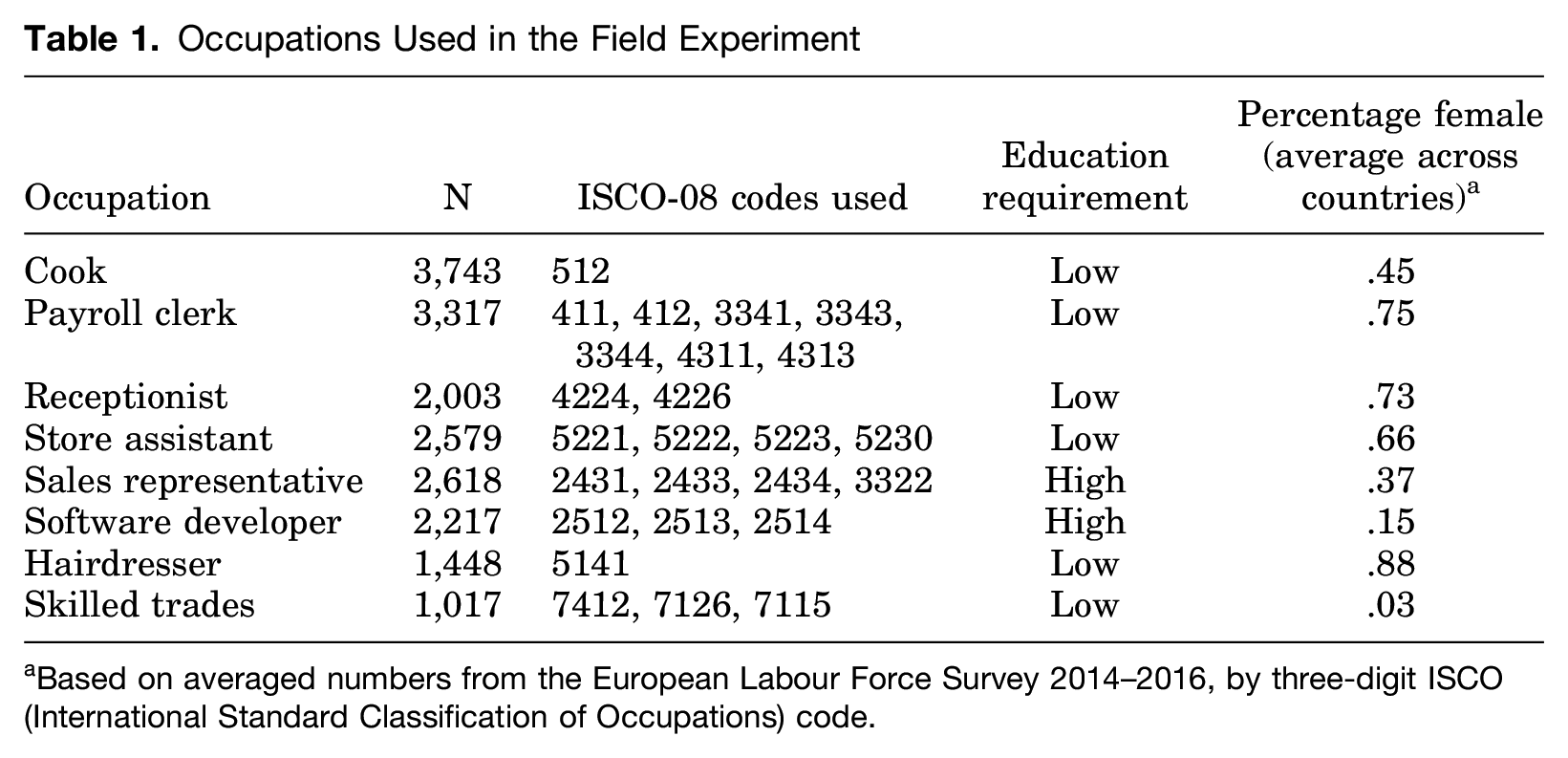
Based on averaged numbers from the European Labour Force Survey 2014–2016, by three-digit ISCO (International Standard Classification of Occupations) code.
We further used data from the European Labour Force Survey (EU-LFS) to estimate the ratio of female and male employees in each occupation for each single country. 5 It is important to acknowledge that the sample lacked a substantial selection of male-dominated occupations. The exceptions were software developers, electricians, plumbers, and carpenters—the latter three being among the occupations added to the experiment to increase the overall sample size. Consequently, the applications sent in male-dominated occupations were fewer than in female-dominated occupations.
All applicants were qualified for the jobs they applied to and had four years of uninterrupted work experience. Depending on the occupation they applied to, their ages ranged from 22 to 26. This is because the years of education required to obtain an occupationally relevant qualification varied among occupations (e.g., jobs in software engineering required a university degree, whereas jobs in the skilled trades required a vocational qualification). For a comprehensive overview of the data collection and coding, see the GEMM Data Codebook (Lancee et al. 2019a) and Technical Report (Lancee et al. 2019b).
Measurements
The main treatments of interest (independent variables) were the applicants’ ethnic minority background and gender.
Racial/ethnic outgroups
Proxied by the applicants’ countries of origin, ethnicity was communicated through names and reinforced through a statement in the cover letter and the language skills mentioned in the CV. In Germany, Spain, and the Netherlands, a photo of the applicant was added to the CV, because this is typically required in job applications. Because one of the purposes of the GEMM study was also to examine the impact of phenotypical signals independent of country background and migration status, photos with different phenotypes were randomly assigned to the applications. 6 To test the hypotheses derived from gendered race theory, we grouped applicants that differed in language, names, and ancestry but shared a similar skin color and physical features and compared groups of blacks, Asians, and whites from a variety of countries of origin. For the two countries where pictures were not included in the job applications (Norway and the UK), we classified applicants into racial groups depending on their country of origin. For example, East Asian applicants were coded as Asian, and European applicants were coded as white. In Germany, Spain, and the Netherlands, only East Asian applicants with phenotypically East Asian photos were coded as Asian; the remaining applicants with nonprototypical phenotypes (N = 4,021) were excluded from the analysis. We recognize that these cases are not unrealistic or necessarily rare; however, we believe our operationalization is the most adequate to test assumptions from gendered race theory, in which stereotype prototypicality is central. The subset we produced thus only contains prototypical applicants for each phenotype-country combination.
The resulting subset of data contained 14,307 observations distributed according to a five-category grouping, shown in Table 2.
Outgroup Operationalization
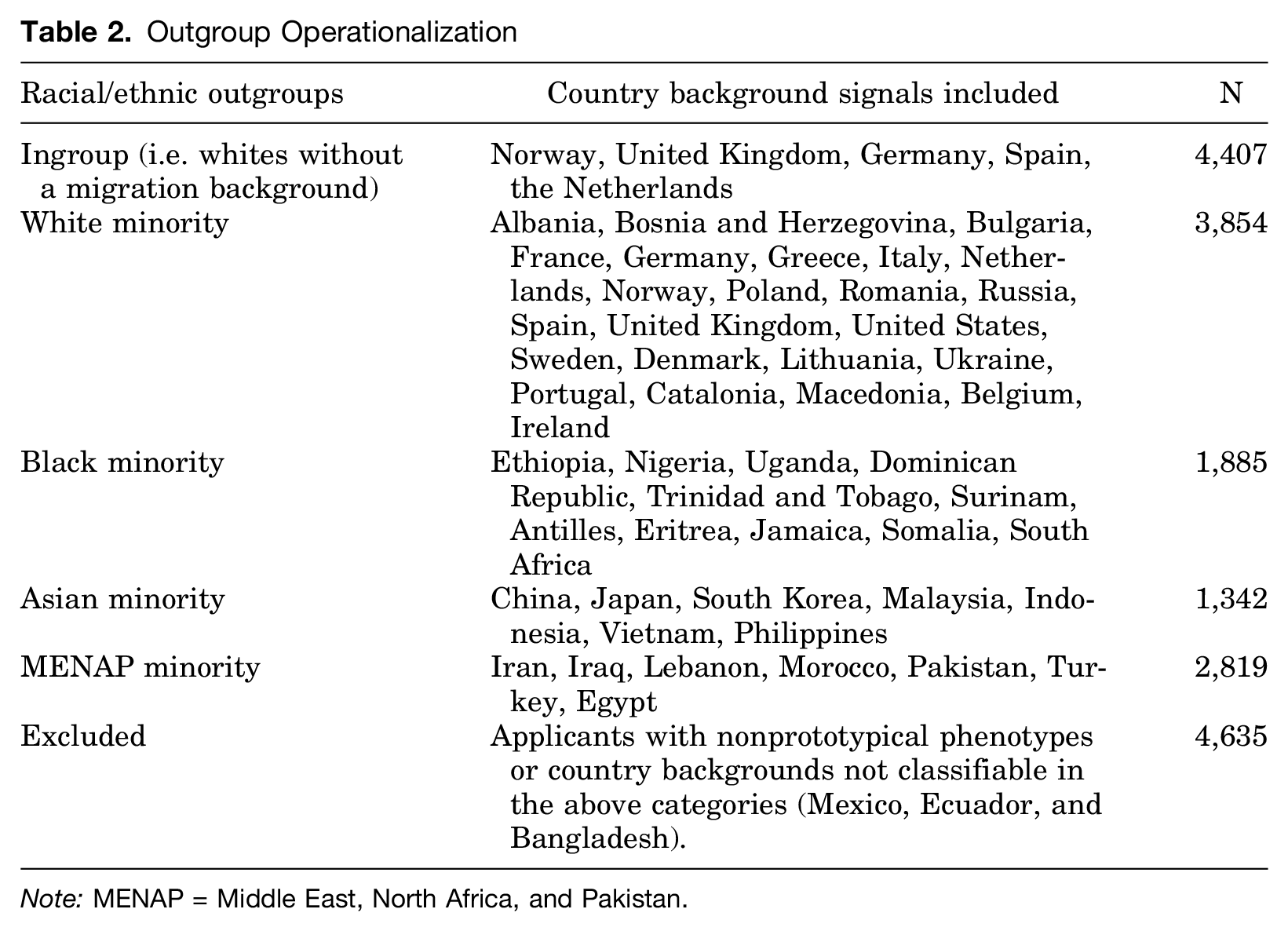
Note: MENAP = Middle East, North Africa, and Pakistan.
Contrary to the white, black, and Asian groups, which are defined by phenotype and country of origin, the MENAP category functions as a geographically defined residual group. 7 The literature on gendered racism traditionally focuses on blacks and Asians, and for clarity, we do not assume any racial prototypically (in the eyes of the employers) for the MENAP group.
Gender
Gender was communicated through the applicant’s name and in most cases, through the personalia section of the CV. 8
Dependent variable
The dependent variable measured whether the fictitious applicant received a positive callback indicating some form of interest from the employer. It can be argued that a more restrictive callback based on interview invitations alone should be preferred because these are unambiguously positive; however, we argue that valuable information on employer interest is lost when we disregard other potentially positive responses, such as requests for additional information. A restrictive operationalization based solely on interviews was used for robustness checks. 9
Analytical Approach
We use both linear and logistic regression models predicting callbacks based on outgroup and gender. For ease of interpretation, the results are reported as predicted probabilities of the applicant receiving a callback. 10 Because we have no explicit expectations regarding cross-national differences regarding the interplay between gender and racial and ethnic outgroup and to preserve sample sizes, we estimate all models on a pooled data set with fixed effects for countries.
Results
To provide a descriptive overview of the findings, Table 3 reports the unadjusted callback rates by gender and outgroup signal per occupation. In this first step of analysis, all racial and ethnic outgroups are pooled into a single category.
Unadjusted Callback Rates and Ratios by Occupation, Gender, and Outgroup Signal
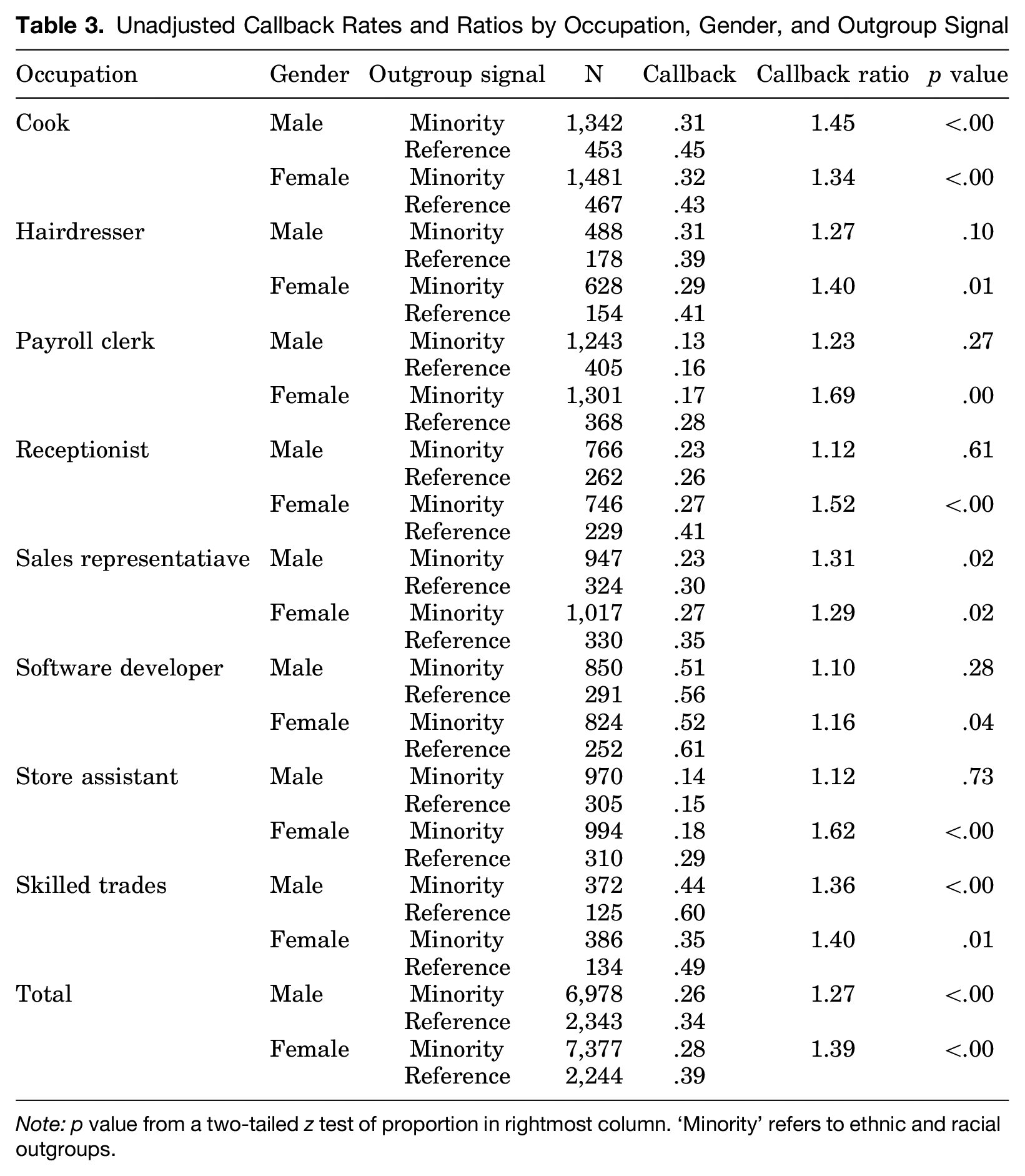
Note: p value from a two-tailed z test of proportion in rightmost column. ‘Minority’ refers to ethnic and racial outgroups.
Table 3 shows a pervasive disadvantage for ethnic and racial outgroups in comparison with the ingroup in all occupations, although the relative callback ratios differ across occupations. In all occupations except for cooks, female candidates in general receive higher callback rates. There are also differences in the ingroup-outgroup callback gaps between the genders: among cooks and sales representatives, male candidates experience higher degrees of ethnic and racial discrimination, whereas the reverse holds true for store assistants, receptionists, payroll clerks, and software developers. The final row shows the overall ethnic penalties across all occupations for men (1.27) and women (1.39). This is contrary to the expectations from our first hypothesis (outgroup-as-male); it seems that overall, ethnic and racial penalties are more severe among women—but that these patterns are highly dependent on the occupation in question.
In Table 4, we report results from linear probability models. Results from the same models estimated with binomial logistic regression remain substantially unchanged. 11
Linear Probability Models
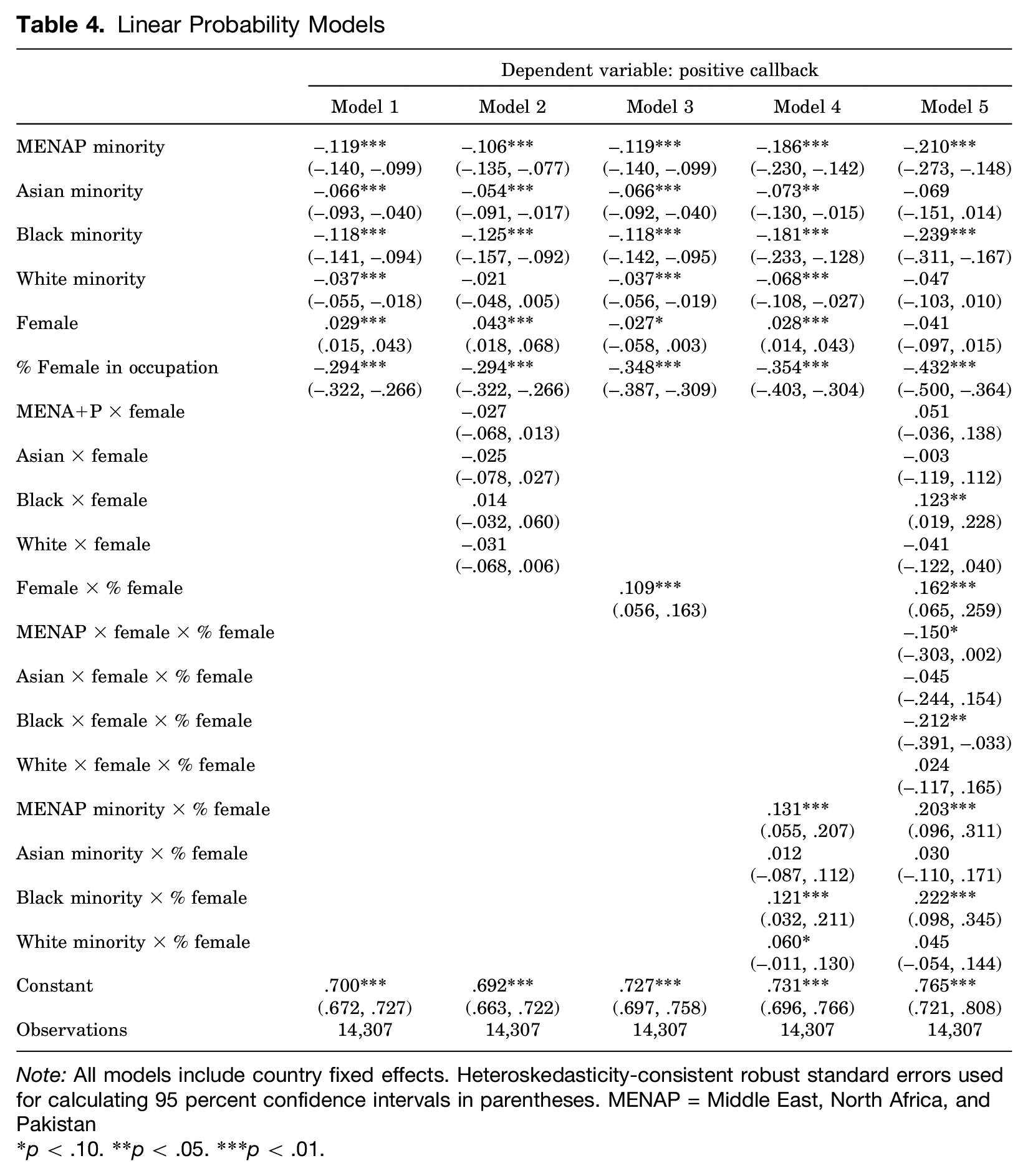
Note: All models include country fixed effects. Heteroskedasticity-consistent robust standard errors used for calculating 95 percent confidence intervals in parentheses. MENAP = Middle East, North Africa, and Pakistan
p < .10. **p < .05. ***p < .01.
Each model contains three key variables: a set of dummy variables indicating belonging to an ethnic or racial outgroup (reference: ingroup), a dummy variable for female applicants (reference: male), and a continuous variable indicating the proportion of female employees in the given country-occupation combination (female/male ratio). For clarity, each model introduces new interaction terms in a stepwise fashion: Model 1 shows the main effects of each variable, whereas Model 2 interacts the outgroup dummies with gender; Model 3 interacts the applicant gender with the female/male ratio of the occupation; Model 4 interacts the outgroup dummies with the female/male ratio of the occupation; and finally, Model 5 introduces three-way interaction terms between all key variables.
A first point to note is that most outgroups—to varying extent—experience significant callback penalties. The point estimates from Model 1 range from –11.8 percent and –11.9 percent for Black and MENAP minorities, respectively, to –6.6 percent and –3.7 percent for Asian and White minorities, respectively. In addition, female candidates have an overall 2.9 percent higher callback probability. Finally, the proportion of females in the occupation is associated with significantly lower callback probabilities. This can be explained by at least two factors: either labor supply was higher in these occupations during the implementation of the study or the fictitious applications constructed for these occupations were relatively less competitive compared to the profiles for the other occupations.
Building on the SMTH, our first hypothesis stated that men would experience the highest degree of ethnic and racial discrimination (outgroup-as-male hypothesis). The results from Model 2, where the outgroup dummies are interacted with gender, show that discrimination is, if anything, slightly more severe for women (except for the case of black minorities), but the effects are not statistically significant. Thus, Hypothesis 1 is rejected. Overall, ethnic and racial penalties are similar across genders.
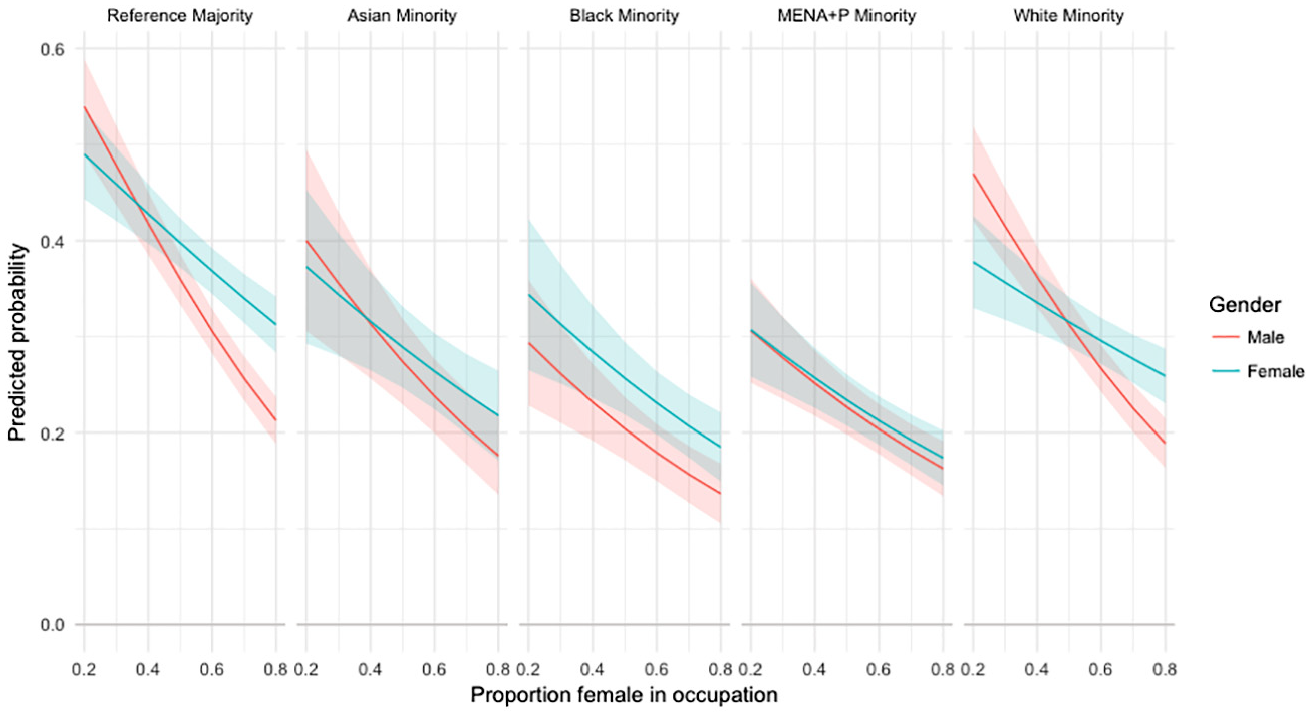
Our second hypothesis—that female and male candidates are rewarded when applying to gender-congruent occupations but that this benefit primarily applies to the white majority—requires us to interact all three key variables. The significant interaction term in Model 3 shows that indeed, female candidates are rewarded in female-dominated occupations. This is in line with previous findings on gender discrimination and expectations derived from role congruity theory and lack-of-fit models. However, when we take racial background into account in Model 5, the gender premium is cancelled out for black and Middle Eastern women, indicated by the significant three-way interaction terms. For white women, the interaction term is statistically indistinguishable from zero, indicating that the female premium remains. Figure 1 visualizes these patterns.
Predicted Probabilities with 95 Percent Prediction Intervals
Thus, we do find support for the gender-as-white hypothesis: white candidates, regardless of immigrant background, are rewarded when applying to gender-congruent jobs, especially in female-dominated occupations. This is not the case for racial minorities.
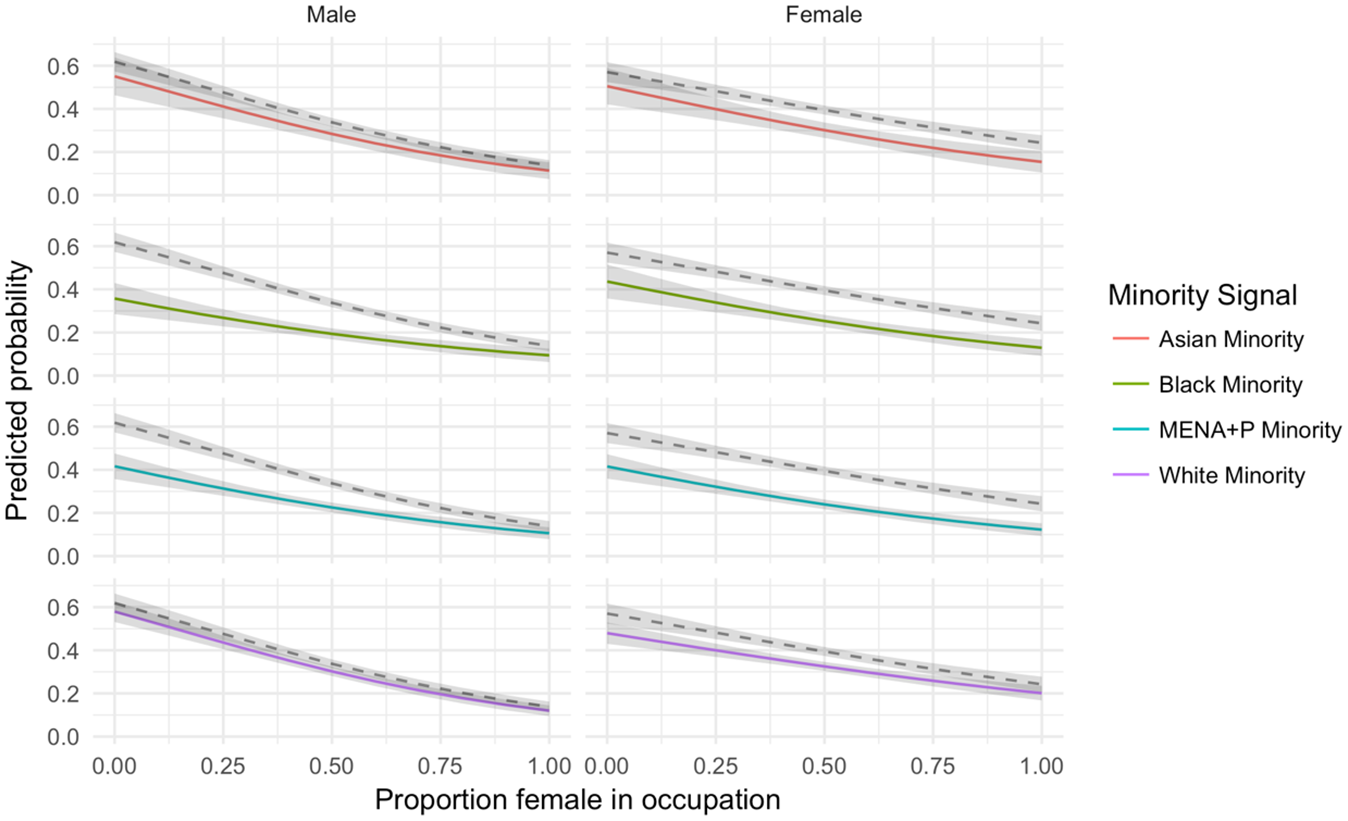
In the final step of analysis, we turn to Hypotheses 3 and 4, derived from gendered race theory. Figure 2 shows the same estimates from Model 5 in Table 4. This time, each panel shows the comparison between one specific outgroup and the reference majority (represented by the dotted lines) for a given gender and how this relationship is influenced by the gender composition of the occupation along the horizontal axis.
Predicted Probabilities with 95 Percent Prediction Intervals
The results shown in Figure 2 confirm that in gender-balanced or male-dominated occupations, ethnic and racial penalties for black and Middle Eastern candidates are present for both genders, but only female candidates experience substantial penalties in female-dominated occupations. In other words, although the ethnic and racial penalty for men disappears as the proportion of female candidates grows, it persists for women. Turning to our expectation regarding the perceived masculinity of black applicants and the perceived femininity of Asian applicants, we can make the following observations: black female candidates, although less penalized than black male candidates overall, are still treated worse than Asian and white women are. Thus, we find no clear evidence supporting Hypothesis 3, which postulated that they would experience less discrimination in male-dominated occupations due to their perceived masculinity and vice-versa in female-dominated occupations. Asian men, on the other hand, experience no systematic ethnic penalties in female-dominated occupations, which strictly speaking is in line with the expectation of Hypothesis 4b; however, neither do males in any of the other racial groups.
Discussion
In this study, we examined the intersection between gender and race in determining employers’ hiring preferences in five European labor markets. We relied on a cross-nationally harmonized field experiment with an innovative design including a large number of outgroups and applicants of both genders. This design provided the unique opportunity to test predictions derived from multiple theoretical perspectives on the role of gender and race and their intersection in the labor market.
The most glaring finding is that across occupations, members of racial or ethnic minorities face substantial discrimination, and race trumps gender as the target of discriminatory behavior by employers. Building on the SMTH, the first hypothesis suggested that minority men bear the largest burden of ethnic and racial discrimination (outgroup-as-male hypothesis). Our findings indicate that these mechanisms are dependent on the occupational context, more specifically, the gender composition of occupations; in female-dominated occupations, minority women experience substantial ethnic and racial discrimination, whereas minority men receive callbacks at a comparable rate to majority men (and more generally, the callbacks received by all men are negligible). Majority women are strongly preferred in female-dominated occupations, confirming previous experimental findings on gender discrimination in general (Azmat and Petrongolo 2014; Riach and Rich 2002; Rich 2014). Thus, the findings do not support the first hypothesis. These results are consistent with research on perceived discrimination and the ethnic prominence hypothesis, which suggests that women of color are more likely to be the target of racial discrimination than of gender discrimination (Levin et al. 2002). It is plausible that the negative stereotyping of black women as loud, aggressive, strong, and domineering (Donovan 2011; Weitz and Gordon 1993) makes them appear less suited for female-typed jobs. Among outgroups, furthermore, only white women – e.g. descendants of migrants from other European countries or the US - benefit from applying to gender-congruent occupations. Even then, the female bonus for white minority women in female-dominated occupations is much smaller than the female bonus for the white majority group. Hypothesis 2 was thus supported.
One could interpret the findings as an expression of the intersectional invisibility or stereotype dilution of men in female-dominated occupations. Within these occupations, minority men occupy two subordinate positions, which might prevent them from being fully recognized as subordinate in either dimension, lessening the potential disadvantage stemming from race or gender. The results can be seen as indicative that a reversed pattern holds for male-dominated occupations, but we are cautious in stressing these findings due to our smaller sample size of male-dominated occupations.
In regard to the intersectional hypotheses, we only found limited support for gendered race theory. We hypothesized that black women, due to their perceived masculinity, would be less penalized in male-dominated occupations (Hypothesis 3a) and more penalized in female-dominated occupations (Hypothesis 3b) than white and Asian women. The results indicate that black women experience more discrimination than white and Asian women regardless of the gender distribution of the occupation in question. Still, the decreasing gap in callbacks for black women vis-à-vis white women in occupations with a lower share of females is consistent with the idea that the stereotype of black women as dominant may be less of a liability in more male-typed occupations. Further, Hypothesis 4 suggested that Asian men, due to their perceived femininity, would be less penalized in female-dominated occupations (Hypothesis 4a) and more penalized in male-dominated occupations (Hypothesis 4b). Although we found no racial discrimination toward Asian men in female-dominated occupations, this pattern held for male minorities in general: Gaps were small to nonexistent in female dominated occupations. In balanced and male-dominated occupations, Asian men were even less penalized than black and Middle Eastern men but more penalized than white minorities.
Although innovative in its comparative design, the focus on employers in real hiring contexts, and the inclusion of various ethnic and racial outgroups of both genders, our study is not without limitations. First, the occupations included partly reflected a bias toward service-oriented and administrative occupations in the online recruitment platforms that are typically used as sampling frames in field experiments on hiring discrimination. A larger and more varied sample of occupations may be needed to expose the unique intersectional binds or freedoms experienced by specific subgroups. For example, the stereotypical image of Asian men as feminine may be a significant barrier in jobs that are perceived to require muscular strength. In male-typed jobs requiring problem-solving skills and cognitive insight, the stereotype of Asians as a model minority may be more applicable.
Second, the stereotypes remain unmeasured. Progress in this area requires a more direct measurement of stereotypes by gender, ethnicity, race and their combination. Consistent with the intersectionality hypothesis, an interesting study by Ghavami and Peplau (2012) revealed distinctive gender-by-ethnicity stereotypes that cannot be reduced to the simple combination of gender and ethnic stereotypes. It remains untested whether their findings can be generalized beyond their sample of undergraduate students from a public university in southern California. Surveying the same employers that were targeted in the field experiment would provide extremely valuable information in this regard, but given the typically low response rates of employer surveys, this strategy is unlikely to be feasible.
Third, we assumed similar gender and race stereotypes in all five countries and included country fixed effects in all of our analyses. In a robustness test, we ran the models shown in Table 4 separately for each country. 12 We found roughly comparable patterns in each country, but sample sizes restrict us from making substantial claims about the cross-national comparison. Interestingly, only in Norway did employers seem to prefer applicants whose gender was incongruent with the role. Bursell (2014) observed the same gender-compensating pattern in Sweden, a country where gender norms are comparably progressive.
Fourth, although we examined in detail the intersection between gender and race, the applicants in our study did not provide any information on their parental status. It is possible that their young age conveyed childbearing age and proximity to parenthood to employers. We think it is unlikely, though, that the results are biased by gendered expectations about the work commitment of parents. In male-dominated occupations, we found no evidence of gender discrimination. In female-dominated occupations, white women were even strongly preferred over males. If concerns over the commitment of mothers had played a role, the strong preference for white women is surprising given that black and Asian women are more likely than white women to combine the roles of worker and childcare provider (Rosette et al. 2018). Including variation in applicants’ ages, although methodologically challenging, is an interesting avenue for future correspondence studies on the intersection between gender, parental status, and race.
Finally, the applicants had uninterrupted work histories and did not apply to elite or managerial jobs. Previous research has pointed to the intersections between unemployment and ethnicity or race (Birkelund, Heggebø, and Rogstad 2017; Pedulla 2018), nonstandard employment histories and gender (Pedulla 2016), gender and class (Rivera and Tilcskik 2016), and race and class (Gaddis 2014). Although the findings cannot be generalized to high-status, managerial, and late-career jobs (see Tinkler et al. 2019) and this segment of the labor market is difficult to target with correspondence tests, the early-career discrimination experienced by ethnic and racial minorities is an obvious obstacle to their career advancement. Because exposure to discrimination reduces the opportunities for human capital acquisition and increases inequalities in earnings, tenure, and on-the-job training, this gap is only likely to grow over time (Tomaskovic-Devey, Thomas, and Johnson, 2005). Moreover, our results show that members of minority groups face barriers in accessing even lower-status jobs: it is plausible to assume that they face even higher barriers when trying to access more prestigious occupations.
Overall, the findings cannot be explained by gender or racial discrimination alone, which highlights the importance of studying hiring discrimination with an intersectional approach. Our contribution to the literature is threefold. First, we contextualized the SMTH by testing its applicability across different occupations and outgroups. We have shown that Black men and Middle Easterners encounter the strongest ethnic and racial discrimination in male-typed jobs, where it is likely that their masculinity, made salient by the occupational context, is perceived as threatening. Although some caution is warranted due to the very low number of callbacks received by men of all ethnic and racial groups in female-dominated occupations (where floor effects may have prevented us from detecting discrimination), future studies should focus on the drivers of outgroup hostility toward men in contexts where masculinity is more or less salient.
Second, we tested the scope conditions of role-congruity theory and the lack-of-fit model, two well-established perspectives on how gender stereotypes lead employers to prefer one gender over the other in occupational contexts where gender is salient, such as gender-typed occupations. Our findings add nuance to this argument, showing that nonwhite applicants do not benefit from a gender-congruence premium. Future studies on stereotype content should examine whether the lower callbacks for nonwhite women in female-dominated occupations and nonwhite men (particularly blacks and Middle Eastern men) in male-dominated occupations are due to negative stereotypes associated with specific gender-race subgroups.
Third, although the findings do not lend unequivocal support to the intersectional hypotheses we initially formulated, the decreasing gap in callbacks between white and black women as the share of males in the occupation increases is consistent with the argument of intersectional invisibility of women who are off-diagonal and are perceived as nonprototypical of their gender and race. The dominance commonly attributed to black women, although exposing them to a strong disadvantage in female-typed occupations, is perhaps less of a liability in male-typed occupations. We encourage future research to continue exploring the stereotype content of specific race-gender combinations, adding a comparative perspective to a research tradition that has been primarily US-centered. In the European context, and certainly in the GEMM study, migration background may color the stereotypes associated with specific genders, races, or combinations thereof. According to previous research on the stereotype content model, most immigrant groups in the United States receive ambivalent stereotypes, with specific attributions depending on nationality (Lee and Fiske 2006). It is possible that these stereotypes also vary according to the gender of the group considered. This is an interesting avenue for future research. Moreover, studies conducted outside of the US context are needed to assess existing findings on gendered racism in a comparative perspective. With this contribution, we have made one step in this direction.
Supplemental Material
supplementary_material – Supplemental material for The Racialized and Gendered Workplace: Applying an Intersectional Lens to a Field Experiment on Hiring Discrimination in Five European Labor Markets
Supplemental material, supplementary_material for The Racialized and Gendered Workplace: Applying an Intersectional Lens to a Field Experiment on Hiring Discrimination in Five European Labor Markets by Valentina Di Stasio and Edvard N. Larsen in Social Psychology Quarterly
Footnotes
Authors’ Note
Authorship appears in alphabetical order; the authors contributed equally to this project.
Funding
The authors disclosed receipt of the following financial support for the research, authorship, and/or publication of this article: This research has been supported by funding from the European Commission in the Horizon 2020 project, Growth, Equal opportunities, Migration and Markets (GEMM), Grant No. H2020 649255.
Supplemental Material
Supplemental material for this article is available online.
1
A core concept of this line of research is that of double jeopardy (Beale 1970): these models expect people with multiple subordinate categories to be worse off than people with single subordinate categories. Recent formulations of intersectionality theory stress that social categories can combine in nonadditive ways too (Collins 1998). For a more extensive review of how the intersectionality paradigm has developed, see Browne and Misra (2003), Purdie-Vaughns and Eibach (2008), and  .
.
2
Individuals who challenge descriptive stereotypes can still be exposed to prescriptive stereotypes of desirable behavior. Behavior that violates gendered prescriptive stereotypes of what men and women should do is sanctioned (Ellemers 2018; Heilman 2001, ).
3
As noted in , the notion of intersectional invisibility also offers a novel explanation for the greater discrimination experienced by minority men (see section on the SMTH). Minority men are considered the prototypical outgroup members and are judged more stereotypically as a result. However, minority women, by virtue of their nonprototypicality, are less likely to be the target of discrimination.
4
Note that we do not measure stereotypes directly (hence the inclusion of the word potentially in the hypotheses). Nevertheless, if the arguments about stereotype dilution and amplification hold true, we should find a pattern in the callbacks received by the various race-gender subgroups in female- or male-typed contexts that is consistent with the stereotype content of specific subgroups.
5
Averaged across the three years preceding data collection: 2014, 2015, and 2016.
6
7
In Spain, Germany, and the Netherlands, only candidates with a Middle-Eastern/Arab photo signal were included; the rest were dropped from the analysis. In Norway and the UK, where photos were not included in the job applications, all candidates from these countries were included.
8
In Germany, Spain, and the UK, explicitly stating one’s gender in the CV is uncommon. Therefore, the applicant’s gender was signaled by names. In Spain and Germany, the gender of the applicant was additionally signaled by the photo included and the occupational title of the applicant that differs by gender.
10
We prefer using linear probability models over logistic models due to the more straightforward interpretation of interaction effects (Breen, Karslson, and Holm 2018; ).
11
These results can be found in Table A1 in the appendix available with the online version of the paper at .
12
See Figures A1 through A5 in the appendix available with the of the paper.
Bios
References
Supplementary Material
Please find the following supplemental material available below.
For Open Access articles published under a Creative Commons License, all supplemental material carries the same license as the article it is associated with.
For non-Open Access articles published, all supplemental material carries a non-exclusive license, and permission requests for re-use of supplemental material or any part of supplemental material shall be sent directly to the copyright owner as specified in the copyright notice associated with the article.
