




Abstract
Status holders across societies often take moral initiatives to navigate group practices toward collective goods; however, little is known about how different societies (e.g., the United States vs. China) evaluate high- (vs. low-) status holders’ transgressions of preached morals. Two preregistered studies (total N = 1,374) examined how status information (occupational rank in Study 1 and social prestige in Study 2) influences moral judgments of norm violations, as a function of word–deed contradiction and cultural independence/interdependence. Both studies revealed that high- (vs. low-) status targets’ word–deed contradictions (vs. noncontradictions) were condemned more harshly in the United States but not China. Mediation analyses suggested that Americans attributed more, but Chinese attributed less, selfish motives to higher status targets’ word–deed contradictions. Cultural in(ter)dependence influences not only whom to confer status as norm enforcers but also whom to (not) blame as norm violators.
Across societies, social members with high status—featured by their superior prestige and admiration afforded by others (Magee & Galinsky, 2008)—often are conferred with leadership positions and trusted upon to establish social norms and navigate intragroup normative conducts (e.g., toward a sustainable future; Henrich & Gil-White, 2001; Simons et al., 2015; Simpson et al., 2012). However, cultures seem to react very differently when their esteemed social members transgress what they preach (e.g., flying with private jets). While “failing to practice what one preaches” is usually deemed as hypocritical in independent cultures (Barden et al., 2005; Jordan et al., 2017), contradictory preaching to actual misdeeds is attributed less to self-oriented motives and thus receives less condemnation in interdependent cultures (Effron, Markus, et al., 2018).
Importantly, high- (vs. low-) status holders are valued more for their efforts on moral preaching and norm enforcement (Brown et al., 2005; Henrich & Gil-White, 2001). Furthermore, status has distinct social foundations in independent versus interdependent cultures (Curhan et al., 2014; Miyamoto et al., 2018; Torelli et al., 2014). Whereas much cultural and cross-cultural evidence has accumulated on how status is attained and conferred (e.g., Anderson & Kilduff, 2009; Cheng et al., 2013; Torelli et al., 2014), little is known about how people from different cultures evaluate high- (vs. low-) status holders when they transgress, particularly when they transgress what they preach. The current research examines whether cultural dynamics shape judgments of status-characterized word–deed contradictions. We more specifically presume a relatively harsh judgment in independent (vs. interdependent) cultures when their high- (vs. low-) status targets enact contradictory (vs. noncontradictory) transgressions.
Cultural Understanding of Word–Deed Contradiction
In independent cultures, word–deed contradictory transgressions usually induce harsher condemnations than noncontradictory ones (Effron, Markus, et al., 2018; Effron, O’Connor, et al., 2018). People often interpret word–deed contradictions as hypocrisy to conceal bad deeds and maintain undeserved positive reputations (Jordan et al., 2017; Laurent & Clark, 2019). In contrast, in interdependent cultures, people imbue word–deed contradictions with less selfish underpinnings (Effron, Markus, et al., 2018). While observers from independent cultures more readily attribute contradicted words with deeds to flawed personal integrity and self-oriented motives (Friedman et al., 2018), people from interdependent cultures are more likely to see behavioral changes as adaptive to situational and relational demands (Choi et al., 1999; Nisbett et al., 2001) and as maturity rather than hypocrisy in social interactions (Matsumoto et al., 2009). People from interdependent (vs. independent) cultures thus show more tolerance of word–deed contradictions (Choi & Nisbett, 2000; Spencer-Rodgers et al., 2010) and can even ascribe other-oriented motives to such contradictions. For example, word–deed contradictions may appear benevolent when word–deed contradictory transgressors have suffered from their misdeeds and intend to prevent others from making the same mistakes (Effron, Markus, et al., 2018; Effron & Miller, 2015).
The Role of Status
The current research proposes that cultural differences should be extremely salient when high- but not low-status holders contradict between words and deeds. And it should be noted that we focus on status built on social prestige (instead of dominance; Cheng et al., 2013; Kakkar et al., 2019), in which case, people usually give high- (vs. low-) status transgressors more moral credentials and judge them leniently (Kakkar et al., 2019; Polman et al., 2013). Our proposition is mainly based on different underpinnings of status in independent versus interdependent cultures. Although both cultures emphasize agentic qualities (e.g., competence and dominance; Cuddy et al., 2009; Miyamoto et al., 2018), interdependent (vs. independent) cultures give more weight to communal qualities (e.g., warmth and interpersonal harmony; Chen et al., 2016; Miyamoto et al., 2018; Rule et al., 2010; Torelli et al., 2014) in status conferral. Correspondingly, self-enhancement and status-seeking behaviors in interdependent (vs. independent) cultures feature more other-oriented (vs. self-oriented) motives, for example, accommodation to boost group cohesion (Miyamoto et al., 2018; Savani et al., 2011; Sedikides et al., 2003). Differences in sociocultural dynamics shape not only people’s own behaviors but also their social cognition of others’ behaviors (Nisbett et al., 2001; Zou et al., 2009). Thus, people higher on interdependence (vs. independence) are more likely to relate status with other orientation (vs. self-orientation; Torelli et al., 2014).
We reason that contradictory (vs. noncontradictory) preaching should induce more cultural divergence in evaluations of higher status transgressors due to different attributions of selfish motives. Hence, in independent cultures, moral leniency toward higher status transgressors can be reduced because their word–deed contradictions are more likely to be seen as intentional and fueled by selfish motives (e.g., misleading others to not punish them and grant additional moral credits; Fragale et al., 2009; Karelaia & Keck, 2013). In contrast, in interdependent cultures where high- (vs. low-) status targets are deemed as more communal, observers may be more prone to believe that higher status targets preach morals that contradict their misdeeds out of nonselfish motives and thus show stronger permissiveness of such word–deed contradictions.
Taken together, integrating insights on the cultural underpinnings of status and word–deed contradiction, we presume that word–deed contradictory (vs. noncontradictory) transgressions are evaluated more negatively in independent than interdependent cultures, and the above cultural difference should be more pronounced when the transgressors possess high rather than low social status (as shown in Figure 1).
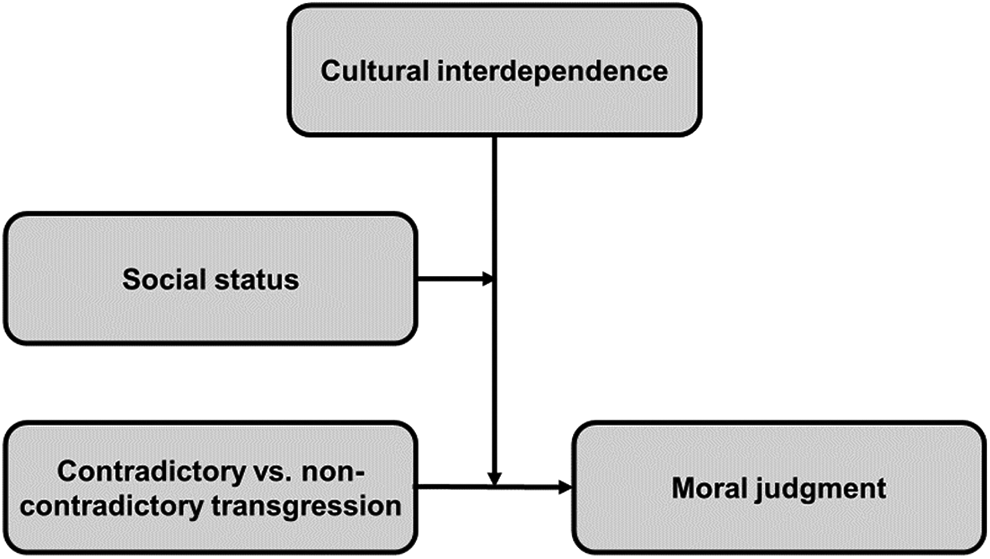
Theoretical model of the current research.
Overview of the Current Research
Two preregistered studies (preregistered respectively at https://aspredicted.org/4ke2s.pdf and https://aspredicted.org/c7878.pdf) examined how status characteristics influence moral judgments of transgressive behaviors with (vs. without in Study 1) contradictory (vs. noncontradictory in Study 2) preaching and how such judgments differ in countries high on independence (i.e., the United States) versus interdependence (i.e., China). Both studies examined the presumed mechanism of selfish motive attribution by testing its mediation in the cultural effect on moral judgment. Besides its stronger interdependence, China as a vertical-collectivist country also endorses power differentiation (i.e., different levels of control over important resources; Blader & Chen, 2012; Fragale et al., 2011; Magee & Galinsky, 2008) to a greater extent than the United States (Brockner et al., 2001; Kuwabara et al., 2016). We thus explored additional cultural factors of targets’ power and observers’ power distance beliefs in Study 2.
Participants from both countries completed the surveys in their native languages. Sample size across the studies was determined before data collection. We reported all measures, materials, and exclusions. In the Supplementary Materials (SM), we appended two pilot studies that we conducted prior to these two studies.
Study 1
Study 1 conceptualized status as high versus low occupational rank and examined within-participants moral judgments of identical transgressions before versus after presenting contradictory norm preaching.
Method
Participants and Design
We employed a 2 (culture: American vs. Chinese) × 2 (status: high vs. low rank) × 2 (transgression type: with vs. without contradictory preaching) mixed design with only transgression type as within-participants variable. As preregistered, we determined our sample size based on a priori power analysis, which yielded n = 198 to detect a small status by transgression type interaction effect (i.e.,
Procedure
Participants were randomly assigned to either a high-status (American n = 86 and Chinese n = 105) or a low-status (American n = 93 and Chinese n = 114) condition, each evaluating two transgressors—one male (introduced below) and one female (see SM)—presented in a random sequence.
We first introduced the target’s occupational status (as a “high-ranked research director” in the high-status condition vs. an “intern” in the low-status condition, both working in a “market research company”). As a manipulation check, the target’s competence (“competent/capable/efficient”; α = .93 for all six items across the two scenarios) was evaluated as a cross-cultural outcome of having status (Fiske et al., 2002).
Participants were then presented with the target’s transgressive behavior (“…falsified some data and exaggerated the market prospect of the client’s product”) and then judged his behavior (“moral/ethical/acceptable”; α = .74 for all six items). Participants also indicated their selfish motive attribution (“To what extent do you think…falsified data out of his own volition?” and “To what extent do you think…falsified data due to the wishes of other people?”[reverse-coded]; α = .54 for all four items), and moral impression of the target regarding “What kind of person do you think…is?” (“honest/trustworthy/principled/sincere/moral”; α = .81 for all 10 items). We then manipulated contradictory preaching by presenting “…condemns those who present false results to meet clients’ expectations or to reach a partnership.” Participants were then asked to answer identical questions about moral judgment (α = .75), selfish motive attribution (α = .53), and moral impression (α = .87; see SM for reports on moral impression). All the measures were administered on a 7-point scale (ranging from 1 = not at all to 7 = extremely) and averaged across the two scenarios.
Results
Manipulation Check
As intended, participants in both cultures rated the high-status targets (M = 5.91, SD = 0.83) as more competent than the low-status targets (M = 4.93, SD = 1.00), F(1, 394) = 112.85, p < .001,
Moral Judgment
For both Studies 1 and 2, the descriptive information in each condition (see Supplementary Tables S1, S3, and S4) and complete reports of other ancillary effects are reported in SM. As preregistered,
2
a mixed analysis of variance (ANOVA) revealed a culture by contradiction interaction effect, F(1, 394) = 22.91, p < .001,
Crucial to our main hypothesis, we found a significant three-way culture by status by contradiction interaction effect (see Figure 2), F(1, 394) = 8.08, p = .005,
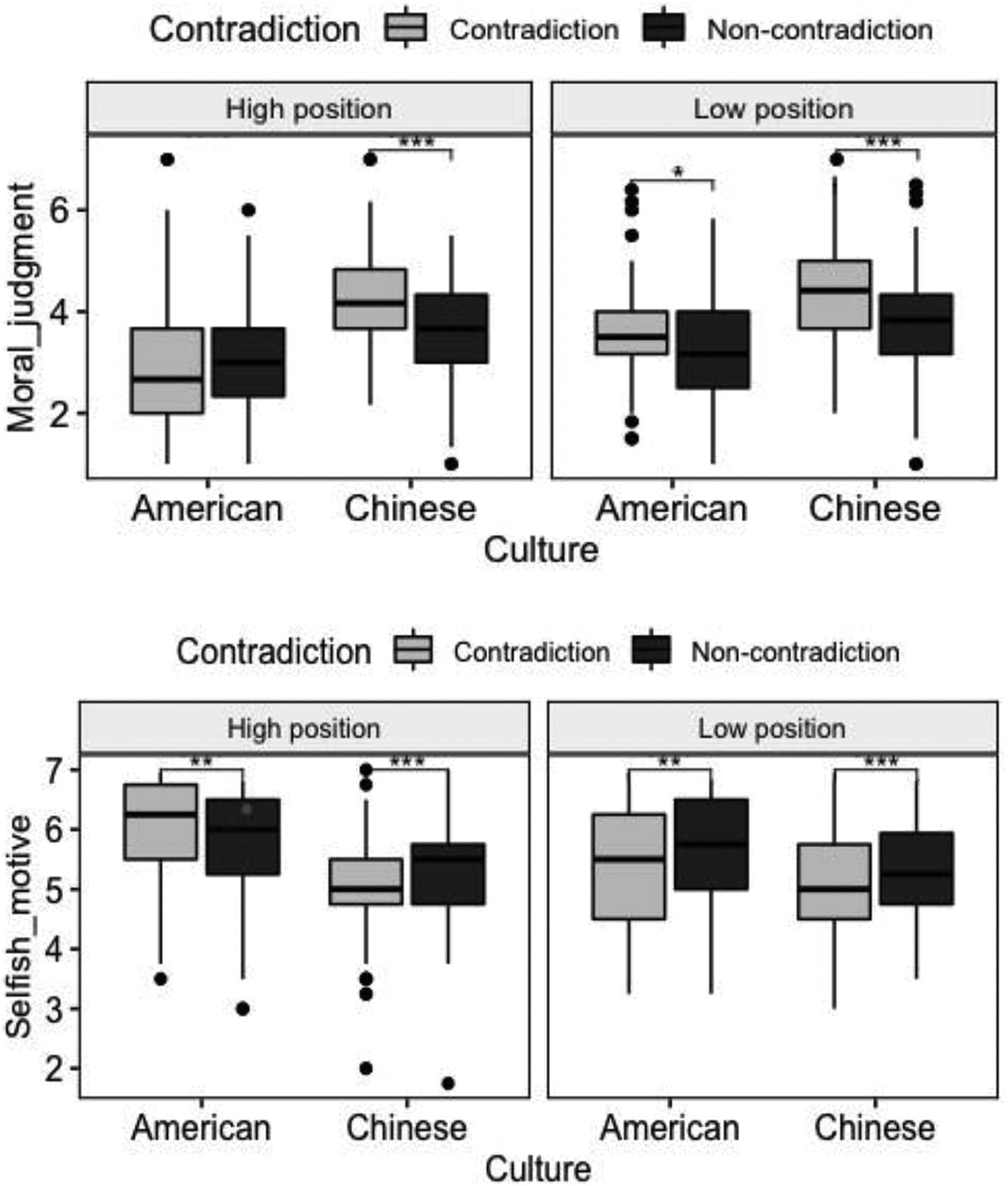
The culture by status (as occupational rank) by contradiction three-way interaction effect on moral judgment (upper panel) and selfish motive attribution (lower panel) in Study 1. *p < .05. **p < .01. ***p < .001.
Selfish Motive Attribution
Mirroring the results on moral judgment, we found significant culture by contradiction two-way, F(1, 394) = 6.89, p = .009,
This culture by contradiction interaction effect was further influenced by the targets’ status (see also Figure 2) such that people from different cultures only perceived distinct motives from high-status, F(1, 196) = 22.10, p < .001,
A within-participants mediation analysis (Tingley et al., 2014), with 5,000 simulations and the nonparametric bootstrapping method, showed that the three-way culture by status by contradiction interaction effect on moral judgment (total effect = .08, 95% confidence intervals [CI] [.007, .15], p = .03) was reduced by the inclusion of selfish motive attribution (direct effect = .07, 95% CI [−.002, .14], p = .06), that is, a significant mediation effect (indirect effect = .01, 95% CI [.008, .02], p = .03; see Supplementary Table S2 for specific path coefficients).
Discussion
Study 1 showed that Americans—but not Chinese—judged transgressions with (vs. without) contradictory preaching more harshly when the targets possessed high rather than low status. Furthermore, the above cultural difference only manifested in moral judgment of transgressions but not moral impression of transgressors (see SM). Whereas Americans attributed more selfish motives to higher status transgressors’ contradictory preaching, Chinese did not, which partially explained people’s moral evaluations in the respective cultures.
Study 2
Study 2 is designed to replicate and extend Study 1 in two important aspects. First, we employed a fully between-participants design and operationalized the noncontradictory control condition as preaching an unrelated norm to the transgressive behavior. In Study 1, the control condition did not include an act of preaching. Study 2 was thus designed to exclude an alternative interpretation, namely that the effects of culture emerged due to different understandings of preaching morals, instead of contradictions between preaching and behavior. Second, in addition to measuring selfish motive attribution, we manipulated targets’ power and measured observers’ power distance beliefs to exclude an alternative explanation. Chinese endorse vertical-collectivist values (e.g., power differentiations) to a greater extent than Americans (Brockner et al., 2001; Kuwabara et al., 2016), which may also account for Chinese (vs. American) people’s stronger permissiveness of high- (vs. low-) status holders’ word–deed contradictions.
Method
Participants and Design
We employed a 2 (culture: American vs. Chinese) × 2 (status: high vs. low) × 2 (power: high vs. low) × 2 (transgression type: contradiction vs. noncontradiction) between-participants design. A priori power analysis required a sample of N = 779 to detect a small status by hypocrisy by culture interaction effect (
Procedure
Participants first indicated their power distance beliefs (extracted from Zhang et al., 2010; e.g., “In work-related matters, managers have a right to expect obedience from their subordinates,” α = .51 across eight items). Then, they were randomly assigned to one of the four status by power conditions. Participants read that four to-be-presented persons had similar status and power background. They were then assigned to either a contradictory or a noncontradictory transgression condition, each evaluating four gender-matched transgressors in a randomized order.
To manipulate the targets’ high (n = 474) versus low (n = 502) status, participants were informed that the targeted persons “have a great deal of (very little) status. That is to say, they have (lack) prestige, are highly respected and (not very respected or) held in high esteem. People (do not) look up to them and (or) value their opinions.” Then, the manipulation of high (n = 515 vs. low, n = 461) power followed, describing the targets “have a great deal of (very little) power. That is to say, they have a lot of (basically have no) control over important resources and play a significant (insignificant) role in determining others’ outcomes.” To amplify the effect of our manipulations, participants were asked to briefly describe an actual or imaginary person with these characteristics, about how they possibly think, feel, and behave. As a manipulation check, participants evaluated the depicted targets on respectively status, power, and competence (on a 7-point scale ranging from 1 = very little to 7 = a great deal).
Participants in both contradiction (n = 505) and noncontradiction (n = 471) conditions read about four gender-matched transgressors (i.e., keeping using disposable dinnerware, inaction in charity activities, drunk driving, and smoking in public places). In the contradiction condition, the transgressions were preceded by contradictory norm preaching (i.e., environmental protection, active charity participation, against drunk driving, and harsh punishment of smoking in public places). In contrast, we shuffled the combination of preaching and transgression in the noncontradiction condition such that the four transgressors respectively preached active charity participation, environmental protection, harsher punishment of smoking in public places, and against drunk driving. After reading each target’s preaching and transgression, participants indicated their selfish motive attribution on two questions (extracted from Effron, Markus, et al., 2018; “How generous or selfish do you think [name]’s reasons are for preaching…?” rated from 1 = completely generous to 7 = completely selfish, and “Do you think that [name] preaches…because they care more about doing the best for other people vs. the best for themselves?” from 1 = only about others to 7 = only about themselves; α = .89 for eight items across four scenarios). As in Study 1, participants evaluated the transgressive behavior on three items (“moral/ethical/acceptable”; on a 7-point scale ranging from 1 = not at all to 7 = extremely; α = .81 for all 12 items). We aggregated and averaged participants’ answers in the four scenarios.
Results
Manipulation Check
We conducted three ANOVAs to examine the effects of status and power manipulations and their interaction on status, power, and competence perceptions, respectively. As predicted, we found significant main effects of the status manipulation on status perception, M
high = 6.09, SD = 1.03 versus M
low = 2.91, SD = 1.74; F(1, 972) = 1221.88, p < .001,
Moral Judgment
As preregistered, we conducted an ANOVA, including status, power, contradiction, culture, and their interactions, all as between-participants factors. Consistent with Study 1, two significant effects emerged. First, we found a significant culture by contradiction interaction effect, F(1, 960) = 7.45, p = .006,
More importantly, a significant three-way status by contradiction by culture interaction emerged (see Figure 3), F(1, 960) = 25.08, p < .001,
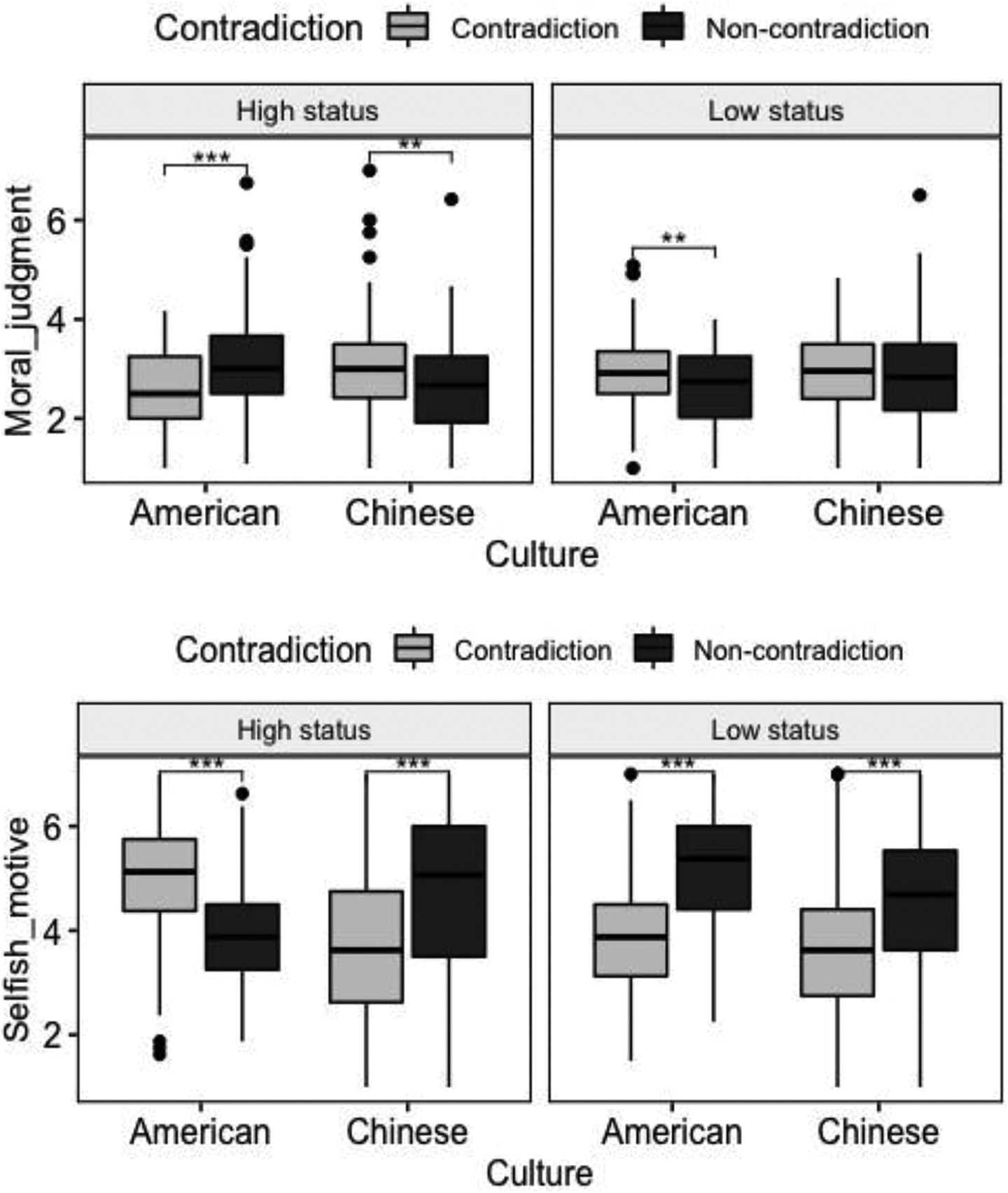
The culture by status (as social prestige) by contradiction three-way interaction effect on moral judgment (upper panel) and selfish motive attribution (lower panel) in Study 2. **p < .01. ***p < .001.
Selfish Motive Attribution
Consistent with the results on moral judgment, we found significant culture by contradiction two-way, F(1, 960) = 25.41, p < .001,
The culture by contradiction interaction effect was further influenced by the targets’ status (see also Figure 3), in that the cultural difference only manifested in evaluations of high-status, F(1, 470) = 83.50, p < .001,
Further mediation analysis with 5,000 resampling also revealed a significant mediation of selfish motive perception (indirect effect = .06, 95% CI [.04, .08], p < .001). The cultural divergence on the evaluation of status-based contradictions was reduced by the inclusion of selfish motive attribution (total effect = .14, 95% CI [.24, .71], p < .001; direct effect = .08, 95% CI [.03, .14], p = .005; see Supplementary Table S6 for specific path coefficients).
Power distance beliefs correlated with both culture (Chinese = 1 and American = −1; r = .50, p < .001) and moral judgment (r = .12, p < .001). However, the correlation between power distance beliefs and the crucial culture by status by contradiction interaction was nonsignificant (r = .04, p = .21; see Supplementary Table S5 for specific correlations), indicating that power distance beliefs did not mediate this effect.
Discussion
The findings were consistent between Studies 1 and 2, suggesting cultural differences on how people evaluate transgressions that are contradictory to self-preaching and how such evaluations differ depending on transgressors’ social status. Americans (but not Chinese) judged transgressions characterized by word–deed contradictions (vs. noncontradictions) more negatively for higher status (but not higher power) targets, partially due to their stronger inferences of selfish motives.
General Discussion
This research investigated how status information influences cultural perception of word–deed contradictory transgressions, where status characterizes social prestige and esteem (Henrich & Gil-White, 2001; Magee & Galinsky, 2008). Two preregistered studies revealed that high- (vs. low-) status targets’ word–deed contradictory (vs. noncontradictory) transgressions were judged more harshly in the United States than in China. These two countries differ on multiple dimensions (e.g., tolerance of contradictions, Choi & Nisbett, 2000; Spencer-Rodgers et al., 2010; power distance beliefs, Brockner et al., 2001; Zhang et al., 2010; see SM for specifics). However, we only found support for the effect of cultural independence/interdependence, in that people generated harsher judgments of higher status transgressors when they interpreted word–deed contradictions as selfish (e.g., in independent cultures) but perceived identical transgressions more leniently when the transgressors’ misaligned words with deeds were seen as nonselfish (e.g., in interdependent cultures).
The present findings contribute to the extant literature in at least three ways. First, although Effron, Markus, et al. (2018) suggested that word–deed contradictions (vs. noncontradictions) are judged more harshly in independent than interdependent cultures, their study materials mainly focused on targets with relatively high social status (e.g., journalists, managers). With more systematic manipulations of targets’ status, we highlight that the above cultural divergence only manifests in evaluations of high- but not low-status targets’ word–deed contradictions. Second, our preregistered hypothesis emphasized that cultural independence (vs. interdependence) would intensify the moral negativity toward high-status targets’ word–deed contradictions (vs. noncontradictions). Instead, we found that the culturally divergent judgments were additionally driven by (1) independent cultures rating low-status targets’ word–deed contradictions (vs. noncontradictions) more positively and (2) interdependent cultures rating high-status targets’ word–deed contradictions (vs. noncontradictions) more positively. Both low status in independent cultures (Fiske et al., 2002) and high status in interdependent cultures (Torelli et al., 2014) can be imbued with communal orientations, especially when the targets advise against misdeeds that they have suffered from (i.e., in the word–deed contradictory condition). Correspondingly, participants in these two conditions attributed less selfish motives to word–deed contradictory than noncontradictory transgressions (in both Studies 1 and 2). Third, extending the established cultural differences on status conferral (e.g., Chen et al., 2016; Torelli et al., 2014), our work is among the first to demonstrate cultural differences in understanding status-based transgressions.
However, some limitations should be noted. First, the mediation effects of perceived selfish motives on moral judgments were correlational and therefore should be interpreted with caution. Second, we demonstrated the role of status in moral judgments of social norm violations; the present findings provide no information to what extent they might generalize to evaluations of more extreme transgressions (e.g., those involving physical harm to others). Third, we captured status by its essential underpinning of social esteem; its implications on other status-related indicators (e.g., socioeconomic status; Trautmann et al., 2013) can be intertwined by status and power (Dubois et al., 2015) and should thus be tested with scrutiny.
The actions of high-status people, such as leaders, do not always align with how they present themselves publicly. The current research adds insights into the political debates on followers’ capacities to hold leaders accountable for their actions (Bøggild, 2020; DeScioli & Bokemper, 2019). A deeper understanding of the cultural roots of social status may help global audiences look under the hood of different attitudes toward social elites’ norm violations. Seeing the world as interdependent, and especially believing that humans (including leaders) act out of concerns for themselves and others, is crucial for whether we give high-status others the benefit of the doubt—or not.
Supplemental Material
Supplemental Material, sj-pdf-1-spp-10.1177_1948550621990451 - Culture, Status, and Hypocrisy: High-Status People Who Don’t Practice What They Preach Are Viewed as Worse in the United States Than China
Supplemental Material, sj-pdf-1-spp-10.1177_1948550621990451 for Culture, Status, and Hypocrisy: High-Status People Who Don’t Practice What They Preach Are Viewed as Worse in the United States Than China by Mengchen Dong, Jan-Willem van Prooijen, Song Wu and Paul A. M. van Lange in Social Psychological and Personality Science
Footnotes
Data Accessibility Statement

Declaration of Conflicting Interests
The author(s) declared no potential conflicts of interest with respect to the research, authorship, and/or publication of this article.
Funding
The author(s) disclosed receipt of the following financial support for the research, authorship, and/or publication of this article: This research was funded by the China Scholarship Council (201606040158).
Supplemental Material
The supplemental material is available in the online version of the article.
Notes
Author Biographies
Handling Editor: Yuri Miyamoto
References
Supplementary Material
Please find the following supplemental material available below.
For Open Access articles published under a Creative Commons License, all supplemental material carries the same license as the article it is associated with.
For non-Open Access articles published, all supplemental material carries a non-exclusive license, and permission requests for re-use of supplemental material or any part of supplemental material shall be sent directly to the copyright owner as specified in the copyright notice associated with the article.
