




Abstract
In the global crisis of the COVID-19 pandemic, many countries attempt to enforce new social norms to prevent the further spread of the coronavirus. A key to the success of these measures is the individual adherence to norms that are collectively beneficial to contain the spread of the pandemic. However, individuals’ self-interest bias (i.e., the prevalent tendency to license own but not others’ self-serving acts or norm violations) can pose a challenge to the success of such measures. The current research examines COVID-19-related self-interest bias from a cross-cultural perspective. Two studies (N = 1,558) sampled from the United States and China consistently revealed that participants from the United States evaluated their own self-serving acts (exploiting test kits in Study 1; social gathering and sneezing without covering the mouth in public in Study 2) as more acceptable than identical deeds of others, while such self-interest bias did not emerge among Chinese participants. Cultural underpinnings of independent versus interdependent self-construal may influence the extent to which individuals apply self-interest bias to justifications of their own self-serving behaviors during the pandemic.
The novel Coronavirus Disease (below as COVID-19) has become an unprecedented global epidemic, and has urged tremendous changes to politics, economics, and ordinary people’s daily life. New formal and informal norms—both regulating the personal (e.g., washing hands frequently) and the social (e.g., working from home) sphere—have been proven as effective to contain the spread of the disease over time, and thus are widely enforced across many countries. However, the efficiency of these measures varies to a great extent across different countries. To illustrate, we take the extreme contrast between the United States and China as an example. The United States, as well as many other Western countries, have been experiencing a high rate of deaths and infections until the end of the year 2020 (World Health Organization, 2020). At the same time, and in striking contrast, research on China has switched attention to the “post-pandemic” age and explored ways to encourage citizens back to the restaurants (Palacios et al., 2021). In the current research, we take a cross-cultural perspective to understand the national differences on COVID-19-related normative judgments. In particular, how do people from the United States versus China evaluate their own COVID-19-related self-serving acts as compared to those of others?
To facilitate citizens’ compliance with COVID-19-related preventative recommendations, social and behavioral scientists have endeavored to illuminate effective ways to disseminate these appeals (e.g., Jordan et al., 2020; Van Bavel et al., 2020). However, it is noteworthy that many people seem to acknowledge the importance of respecting new regulations but often excuse themselves for transgressions when self-interest is at stake (Fancourt et al., 2020; Jin et al., 2021). The current research investigates this self-interest bias in people’s judgments of own as compared to others’ COVID-19-related self-serving behaviors. Across two studies, we investigate such bias from a cross-cultural perspective. Extending previous insights on self-interest bias within Western cultures, we hypothesize that East Asians would show less self-interest bias than Westerners.
Self-Interest Bias: Moral Judgments for the Self versus Others
Even with a general consensus on which behaviors are considered right or wrong, the perceived moral acceptability of self-serving transgressive behaviors can be biased when self-interest is at stake. Individuals often judge others’ misdeeds as more acceptable when they can (vs. cannot) benefit from these misdeeds. As such, people see others’ cheating behavior as more acceptable when the cheater can (vs. cannot) share the unethical gains with them (Bocian & Wojciszke, 2014). Relatedly, people often evaluate their own wrongdoings more leniently than identical deeds of others, and such moral discrepancy between self and others is often considered as a sign of moral hypocrisy (Graham et al., 2015; Lammers et al., 2010; Valdesolo & DeSteno, 2008; Weiss et al., 2018).
Self-interest bias has been established in evaluating various norm violations such as breaking the speed limit to make an appointment on time (Lammers et al., 2010) or keeping too much change received from a cashier (Weiss et al., 2018). However, to the best of our knowledge, it is not yet known how it explains COVID-19-related normative conducts. In terms of COVID-19-related behaviors, in particular, people use their knowledge about social norms to evaluate the moral wrongness of others’ violations (Andrews et al., 2020; Habersaat et al., 2020), but the decision-making dynamics can be more complicated when it comes to complying with COVID-19 guidelines themselves. Indeed, recent empirical evidence suggests that even established theoretical frameworks underlying cooperation fail to predict COVID-19-related motivations and behaviors (Romano et al., 2021). Thus, it becomes essential to investigate whether people’s moral evaluations and decisions of their own COVID-19 normative behaviors are subject to self-interest bias, as it can have a considerable impact on societal welfare. To serve the long-term collective goal of containing the coronavirus, people need to sacrifice their immediate self-interest regarding, for example, gathering with families and friends and having holiday trips (Jin et al., 2021; Jordan et al., 2020). Thus, despite the common knowledge of COVID-19-related social norms, the involvement of self-interest may bias people’s moral judgment of their own COVID-19-related self-serving behaviors. Moreover, people often consider themselves as more unique, superior, and privileged as compared to general others (Haslam et al., 2005; Lammers et al., 2010; Weiss et al., 2018), and these perceptions can motivate people to justify their own but not others’ COVID-19-related self-serving behaviors. As above, we reason that, as in many other moral or normative domains, self-interest bias might apply in the context of COVID-19-related self-serving behaviors. Therefore, we hypothesize that:
Hypothesis 1: People’s own self-serving behaviors against others’ interest or public norms will be more likely to be viewed as justified than identical deeds of others.
Culture and Self-Interest Bias
Importantly, cultures differ in the extent to which people understand themselves and their behaviors with reference to others and social norms (Markus & Kitayama, 1991, 2010). However, the cultural difference on self-interest bias has not yet been tested, and may have important implications for the national differences in the violations of COVID-19 mitigation measures. One crucial difference between Westerners and East Asians is their independent versus interdependent self-construal (Markus & Kitayama, 2010), which may also play a part in understanding self-interest bias of COVID-19-related self-serving behaviors. Cross-cultural literature suggests that though desires to achieve a positive self-regard are deemed as universal, people from different cultures pursue such positivity through different tactics (Sedikides et al., 2003). While Westerners incline to enhance feelings of self-worth through individualistic behaviors (e.g., arguing for own position and against affiliated groups), East Asians are more likely to self-enhance through collectivistic actions (e.g., defending affiliated groups’ decisions; Sedikides et al., 2003). When it comes to norm violations and related perceptions of moral wrongness, Westerners are more likely to base their decisions on agentic capacities (e.g., acting with free will), while East Asians place more emphasis on the extent to which the transgressions jeopardize public welfare or deviate from social norms (e.g., severity of social consequences; Buchtel et al., 2015; Feinberg et al., 2018; Sullivan et al., 2016).
These cultural differences between Westerners and East Asians have originated from culturally embedded self-construal (Markus & Kitayama, 2010), and may also apply in self-interest bias of COVID-19-related self-serving behaviors. Westerners are often deemed to have an independent self-construal, which endorses the uniqueness of individual self and autonomous decisions against situational constraints; in contrast, East Asians are more likely to embrace an interdependent self, which emphasizes connectedness with others and behavioral accommodation to normative standards (Markus & Kitayama, 1991, 2010; Morling et al., 2002). Interdependent (vs. independent) self-construal may not directly translate into less (vs. more) self-serving behaviors (Cohn et al., 2019; Romano et al., 2017), but may reduce the extent to which people evaluate their own transgressions more favorably as compared to others’ (i.e., self-interest bias). The latter proposition relates to the fact that East Asians’ (vs. Westerners’) moral standards are more strongly guided by perceptions of social norms (e.g., Buchtel et al., 2015; Sullivan et al., 2016). And supporting this proposition, East Asians (vs. Westerners) are more likely to adjust their self-evaluations contingent on relational demands (English & Chen, 2007) and social-role expectations (Boucher, 2011). We therefore predict a cultural difference in COVID-19-related self-interest bias. More specifically, we hypothesize that:
Hypothesis 2: Individuals will display more leniency toward their own (vs. others’) COVID-19-related self-serving behaviors, and such self-interest bias will be more pronounced among Westerners than East Asians (e.g., people from the United States than from China).
Overview of the Current Research
To examine people’s COVID-19-related self-interest bias and its cultural differences, we conducted two studies with participants from the United States and China—two countries that strongly differ for independent versus interdependent self-construal (Markus & Kitayama, 2010). We predict that participants should evaluate their own self-serving acts as more acceptable than others’, and the above self-interest bias should be more pronounced among people from the United States than from China.
We conducted two studies to test these propositions. In Study 1, we operationalized self-serving behaviors as the exploitation of COVID-19-related medical resources in short supply (i.e., test kits and disinfectants). In Study 2, self-serving behaviors were conceptualized as violations of COVID-19 norms that restricted social contact (i.e., social gathering and sneezing without covering the mouth in public). To examine potential cross-cultural implications, both studies compared the occurrence of self-interest bias in the United States and China, potentially as a function of independent versus interdependent self-construal. All the materials were developed in Chinese, and were translated into English and back translated. We reported all the materials and ancillary results in the Supplemental Materials.
Study 1
Aim of the Study
Study 1 preliminarily tested the cultural differences on COVID-19-related self-interest bias. More specifically, we examined how people from the United States and from China evaluated their own or others’ exploitation of COVID-19-related resources (i.e., test kits and disinfectants), which posed conflicts between individual interest and societal welfare (Columbus, 2021).
Method
Participants
Before running the study, we conducted an a-priori power analysis of ANOVA with G*Power (Faul et al., 2007). We estimated small-to-medium effects of violator and country by violator interaction, based on the average achieved effect size of social psychological studies (
Data collection involving Chinese participants started on February 7th, 2020, recruiting participants through social networks. Participants from the United States were recruited on April 20th, 2020, from the crowdsourcing platform Turkprime (Litman et al., 2017). Data collection was implemented at the early rising stage of the coronavirus disease in the respective cultures. At the time of survey administration, in total, China had 31,215 confirmed cases and 637 deaths, and the United States featured 723,605 confirmed cases and 38,512 recorded deaths (World Health Organization, 2020). In total, 426 participants from China (183 males; Mage = 28.7, SD = 10.5) and 283 participants from the United States (154 males; Mage = 39.9, SD = 12.2) completed our survey voluntarily with no monetary incentives.
To estimate the achieved power of our structural equation modeling (SEM), we also conducted post-hoc power analyses with the R package “semPower” (Moshagen & Erdfelder, 2016). Based on the parameters of our baseline structural model (df = 66, RMSEA = .05; see the Results section for details), a sample size of N = 709 yielded a power larger than 99.99% to reject a wrong model on an alpha level of 05. Alternative power analyses forcing β1 or β2 to be equal across the two countries showed similar power (i.e., >99.99%).
Data analysis
We employed a 2 (violator: self vs. other) by 2 (country: the United States vs. China) by 2 (scenario: disinfectants vs. test kits) mixed factorial design, with violator and country as between-subjects factors and scenario as a within-subjects factor.
In both Studies 1 and 2, a three-step modeling strategy was implemented to ensure the statistical rigor of the cross-cultural comparisons.
In the first step, we tested measurement invariance with a multi-group confirmatory factor analysis (i.e., CFA; Van de Schoot et al., 2012). And following Shi et al.’s (2019) recent suggestions, we aimed to examine the metric invariance of the two latent variables across the two countries, identify non-invariant parameters (if any), and allow these parameters to be freely estimated in the partial invariance model and subsequent analyses.
In the second step, we deployed multi-group structural equation modeling (SEM) to test our hypotheses (Borsboom, 2008). In addition to incorporating the partial invariance measurement models, multi-group SEM effectively partials out the confounding effects of measurement errors. The SEM that was applied collapsing together the US and Chinese participant pools can be seen in Figure 1.
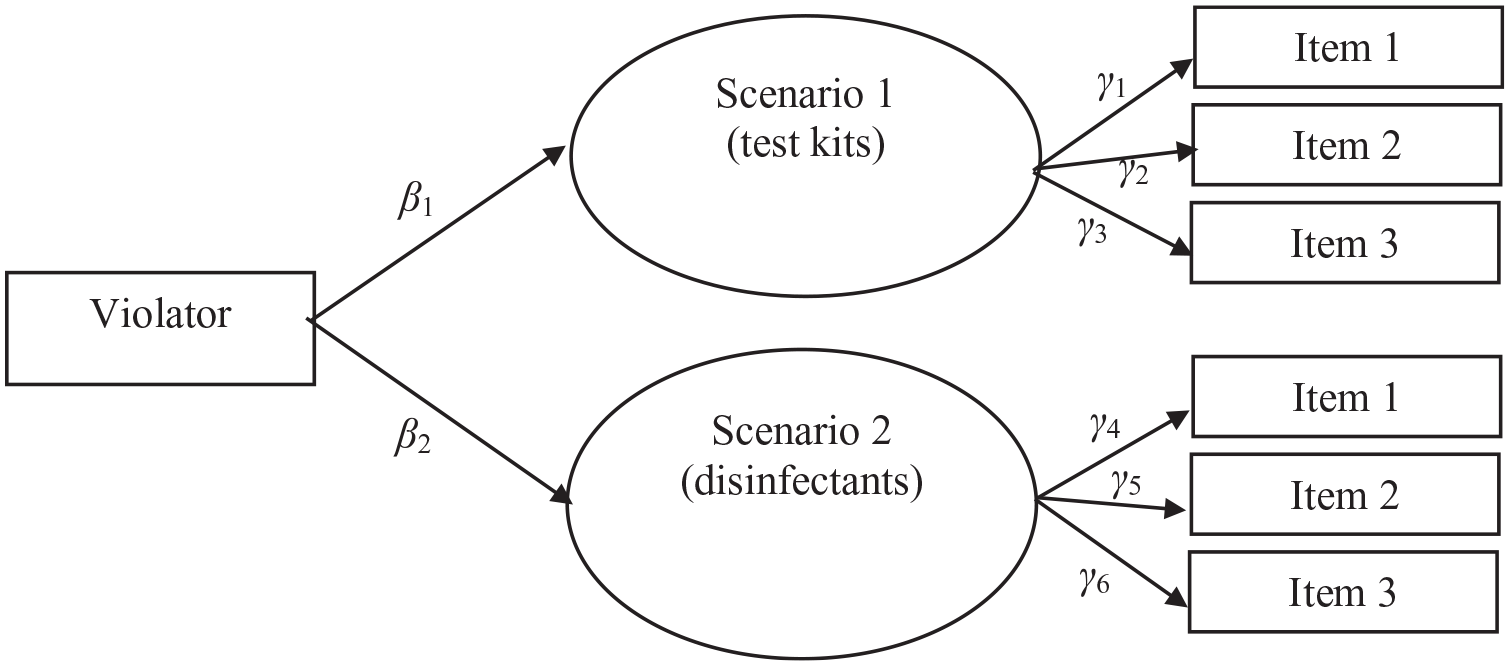
The SEM that was applied collapsing together the US and Chinese participants in Study 1.
In the last step, to test the robustness of the SEM findings, we conducted alternative ANOVAs, where country and violator were treated as between-subjects factors and scenario as a within-subjects factor. The results of these alternative analyses were reported in the Supplemental Materials.
Procedure
Participants from the United States were recruited in the context of an unrelated economic game study with economic incentives, in which they were asked whether they would be willing to answer some additional questions about the COVID-19 pandemic. Chinese participants answered our intended questions as part of a socio-psychological survey on various COVID-19-related topics. In both countries, participants were randomly assigned to either a self- or other-as-violator condition, evaluating two hypothetical scenarios in which they themselves or another person exploited COVID-19-related medical resources. We selected two resources that both were in short supply at the time of survey administration in the respective country, and described the situations where one’s own need of the resources conflicts with the need of others (see the Supplemental Materials for original materials). The two scenarios were presented in a randomized sequence, and the three questions in each scenario were adapted from a previous study on self-interest bias (Weiss et al., 2018). Participants’ answers in each scenario were aggregated and averaged for ANOVA.
In the first scenario, participants were asked to imagine the violator having mild symptoms like the coronavirus disease, and to evaluate the moral acceptability of using the test kits before others with similar symptoms (α = .50 across three items; on a 7-point Likert scale ranging from 1 = Completely disagree to 7 = Completely agree). The three items are:
Item 1: Under special circumstances, I [Jordan] should be able to use these test kits before others with similar symptoms.
Item 2: If I [Jordan] managed to obtain the test kits, I [Jordan] should have good reasons to use them before others with similar symptoms.
Item 3: Even if I [Jordan] had an opportunity to get the test kits through acquaintances or high prices, I [Jordan] should stick to standard protocols (reverse coded).
In the second scenario, participants were asked to imagine the violator finding a few disinfectant products in stock at a grocery store, and to evaluate the moral acceptability of buying up all the available disinfectants (α = .71 across three items; on the same 7-point scale as in the first scenario). The three items are:
Item 1: Under special circumstances, I [Riley] could have good reasons to buy up all the available disinfectants.
Item 2: Given my [Riley’s] capacity to find the disinfectants, I [Riley] should be eligible to buy as many as desired.
Item 3: Even if I [Riley] had an opportunity to stock up for the next few months, I [Riley] should leave some items for others who might have needs (reverse coded).
Results
Descriptive information
In Figure 2, we plotted participants’ moral acceptability judgments of COVID-19-related self-serving behaviors (regarding test kits and disinfectants respectively), enacted by themselves versus strange others. It seemed that people from the United States demonstrated more self-interest bias than participants from China, for their exploitation of both test kits and disinfectants.
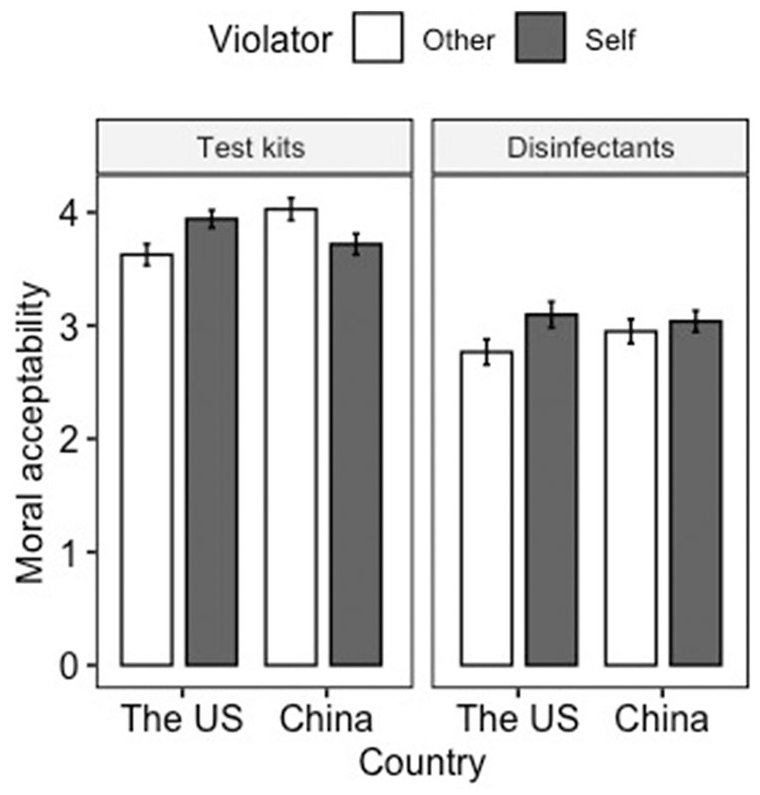
Moral acceptability judgments as a function of country and violator in Study 1.
Measurement models
We employed multi-group CFA to examine measurement invariance only with the measurement part of the SEM. Following the recommended procedures in previous research (Putnick & Bornstein, 2016; Vandenberg & Lance, 2000; Widaman & Reise, 1997), we first examined whether configural invariance holds across the two countries, that is, whether the latent constructs had the same pattern of fixed and free loadings across the two countries. To do so, a multi-group CFA model without any constraints of equal loadings across the two countries (i.e., the baseline measurement model) yielded a satisfactory fit (CFI = .99, TLI = .98, RMSEA = .05, SRMR = .03). After establishing configural invariance, we then evaluated the full metric invariance model, which implies that identical items contribute to the latent construct to an equivalent extent across the two countries. The full metric invariance model, however, was significantly worse than the baseline measurement model (CFI = .96, TLI = .93, RMSEA = .08, SRMR = .05; Δχ2 = 33.24, df = 4, p < .001). Since the cross-cultural data did not achieve full metric invariance, we proceed to identify items with non-invariant loadings by inspecting modification indices (MI; Bentler, 2010). A total of three items—the first and second items in the test kits scenario and the second item in the disinfectants scenario—were identified as invariant and constrained to be equal across the two countries. The other items were identified as non-invariant and allowed to have freely estimated loadings. By applying these settings to the multi-group CFA model, the final partial invariance model yielded an equivalently good fit as compared to the baseline measurement model (CFI = .99, TLI = .98, RMSEA = .04, SRMR = .03; Δχ2 = 3.33, df = 3, p = .344).
Hypotheses testing
To test our hypotheses, we further considered the structural part of the SEM in addition to the partial invariance measurement model. This baseline structural model, where both β1 and β2 were allowed to be freely estimated in both countries, yielded an acceptable model fit (CFI = .97, TLI = .95, RMSEA = .05, SRMR = .03). While the US participants displayed self-insterest bias in both the test kits scenario (β1_us = 0.09, SE = 0.04, z = 2.19, p = .029) and disinfectants scenario (β2_us = 0.23, SE = 0.09, z = 2.47, p = .014), Chinese people judged own (vs. others) self-serving acts more harshly regarding test kits (β1_ch = −0.26, SE = 0.09, z = 2.85, p = .004) and equivalently regarding disinfectants exploitation (β2_ch = 0.06, SE = 0.08, z = 0.75, p = .451). These findings supported our theorizing by showing the COVID-19-related self-interest bias in the United States but not China.
To formally examine whether these cultural differences were statistically substantive, we then tested two alternative models—the first fixing β1 to be identical across the two countries and the second with fixed β2—and compared their model fits with the baseline structural model. Results indicated that while forcing β1 to be equal led to a significant change (CFI = .95, TLI = .93, RMSEA = .06, SRMR = .05; Δχ2 = 12.13, df = 1, p < .001), an equivalent constraint on β2 did not worsen the model fit (CFI = .96, TLI = .94, RMSEA = .05, SRMR = .04; Δχ2 = 1.74, df = 1, p = .187). In other words, the cultural difference on self-interest bias was robust in the test kits but not the disinfectants scenario.
Discussion
Study 1 examined self-interest bias in the exploitation of COVID-19-related medical resources among people from the United States and from China. We hypothesized that people would judge their own exploitation as more acceptable than that of others, and the above self-interest bias should be more pronounced in the United States than in China. Study 1 findings partially supported our hypotheses by showing that only participants from the United States (but not from China) evaluated their self-serving acts of exploiting test kits as more acceptable than identical deeds of others.
However, the findings should be interpreted with caution, given three major limitations. First, despite the identical pattern of stronger self-interest bias in the United States than in China, the cultural difference on self-interest bias was robust only in the exploitation of test kits but not disinfectants. Second, the reliability of our moral acceptability measures was relatively low, especially for the test kits scenario. Both of these limitations may relate to the fact that the conflicts between self-interest and public welfare were not strongly implied in these two scenarios, and that the moral (un)acceptability of the two exploitative behaviors was relatively equivocal (test kits: M = 3.83, SD = 1.26; disinfectants: M = 2.97, SD = 1.42; averaged across the scenarios: M = 3.40, SD = 1.41). Therefore, the two scenarios did not strongly prompt the cultural differences on self-interest bias, and the reversed (Item 3) and non-reversed (Items 1 and 2) questions did not converge well in capturing people’s absolute moral attitudes. Third, the experimental conditions in the respective countries were not perfectly balanced (i.e., participants’ number and age, administered incentives, and preceding survey contents).
Study 2
Aim of the Study
Study 2 was designed to replicate Study 1 findings of the cultural differences on COVID-19-related self-interest bias. To address the limitations of Study 1, we implemented two main changes. First, we examined self-interest bias in a different domain, that is, own versus others’ violations of COVID-19 regulations that were discouraged in both countries at the time of survey administration (i.e., social gathering and sneeze without covering the mouth in public). These two behaviors pose more salient conflicts between self-interest and others’ welfare, are more unambiguously condemned during the COVID-19 pandemic, and thus should be likely to elicit the cultural difference on self-interest bias. Second, we recruited a larger number of participants from the United States and from China in a more balanced condition (concerning participants’ number and age, administered incentives, and preceding survey contents).
Method
Participants
Based on the achieved country by violator interaction effect size in Study 1 (
In both countries, participants were recruited from crowdsourcing platforms with monetary incentives since May 15th, 2020 in two consecutive days. At the time, cumulatively, China saw 84,469 confirmed cases and 4,644 deaths, while the United States witnessed 1,382,362 infections and 83,819 deaths (World Health Organization, 2020). Overall, 489 Chinese (256 males; Mage = 28.3 years, SD = 5.6) and 489 US participants (204 males; Mage = 29.4 years, SD = 7.1) completed the survey through the survey platform Credamo and the crowdsourcing platform Prolific (Peer et al., 2017), respectively.
As in Study 1, we conducted post-hoc power analyses to estimate the achieved power of our SEM. The results showed that a total of 978 participants was associated with a power larger than 99.99% to reject a wrong model, with df = 104, RMSEA = .04 on an alpha level of 0.05. The parameters were extracted from our established baseline structural model (see the Results for specifics), and were identical in the alternative models forcing β1 or β2 to be equal across the participant pools.
Data analysis
As in Study 1, we employed a 2 (violator: self vs. other) by 2 (country: the United States vs. China) by 2 (scenario: social gathering vs. sneeze without covering the mouth in public) mixed factorial design, with violator and country as between-subjects factors and scenario as a within-subjects factor. The identical three-step modeling strategy was implemented. Different from Study 1, we conducted additional analyses with power distance belief as a covariate. These latter analyses were again appended in the Supplemental Materials.
Procedure
Participants were asked to evaluate two scenarios about COVID-19 norm violations, either enacted by themselves or an unknown person with a gender-neutral name. The two scenarios made explicit that the violators were aware of the existing social norms against the focal behavior, were presented in a randomized order, and were followed by similar moral judgment questions as in Study 1 (see the Supplemental Materials for original materials). 1 Responses to the items in each scenario were aggregated and averaged for ANOVA.
The first scenario described attending an annual party among a few close friends, which was a rare opportunity to catch up but against the COVID-19 rule of no social gathering. Participants were asked to evaluate the moral acceptability of attending the party (α = .84 across four items; on a 7-point Likert scale ranging from 1 = Completely disagree to 7 = Completely agree). The four items are:
Item 1: The circumstances would justify that I [Jordan] attend the party with some close friends.
Item 2: It would reflect poorly on me [Jordan] if I [Jordan] attend the party with some close friends (reverse coded).
Item 3: Concerning the exceptional circumstance, I [Jordan] would have good reasons to attend the party with some close friends.
Item 4: Despite the exceptional chance to see some close friends, I [Jordan] should follow the restrictions and stay out of any social gatherings (reverse coded).
The second scenario described a violator who did not sneeze into the elbow given concerns that the droplets might stain a new jacket. Participants evaluated the moral acceptability of such behavior against instructions to cover the mouth while sneezing in public (α = .81 across four items; on the same 7-point Likert scale as in the first scenario). The four items are:
Item 1: The circumstances would justify that I [Riley] sneezed in public places without covering the mouth.
Item 2: It would reflect poorly on me [Riley] if I [Riley] sneezed in public places without covering the mouth (reverse coded).
Item 3: Since I [Riley] know it is just hay fever, it should be fine to sneeze in public places without covering the mouth.
Item 4: Even though I [Riley] know it is just hay fever, I [Riley] should sneeze into the elbow (reverse coded).
Results
Descriptive information
In Figure 3, we plotted the US and Chinese participants’ moral acceptability judgments of COVID-19-related self-serving behaviors (regarding social gathering and sneeze without covering the mouth in public respectively), enacted by themselves versus strange others. It seemed that people from the United States than China demonstrated more self-interest bias, which was more pronounced for social gathering.
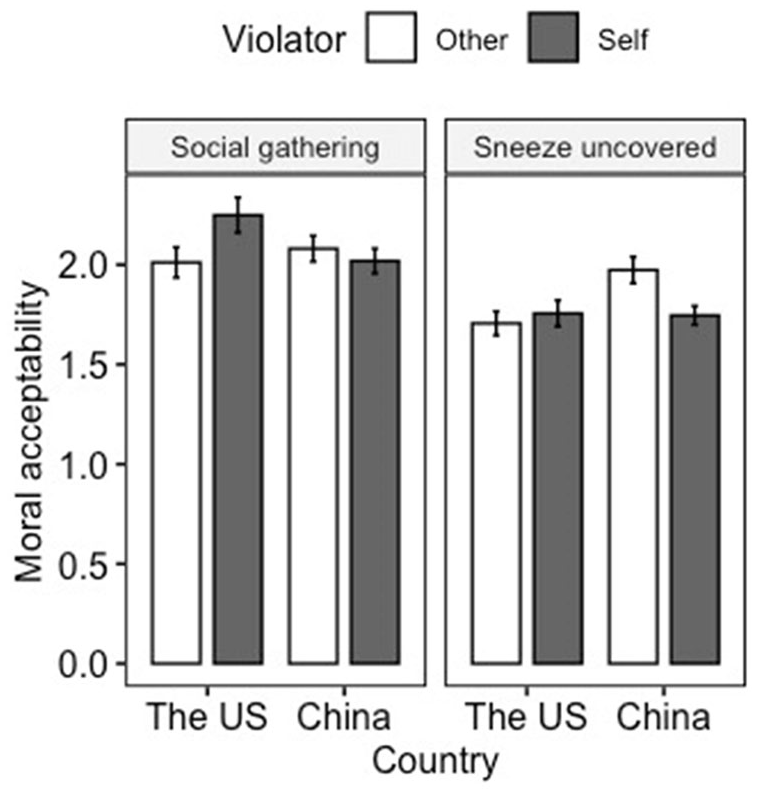
Moral acceptability judgments as a function of country and violator in Study 2.
Measurement models
As in Study 1, we checked respectively the configural invariance, full metric invariance, and partial metric invariance models (in case the full metric invariance was not achieved). We first tested the baseline model, which suggested relatively satisfactory configural invariance across the two countries (CFI = .99, TLI = .98, RMSEA = .05, SRMR = .02). We then tested the full metric invariance model, in which loadings for identical items were constrained to be the same across the two countries. The model fit of the full metric invariance model was significantly worse than the baseline measurement model (CFI = .99, TLI = .98, RMSEA = .05, SRMR = .04; Δχ2 = 20.10, df = 6, p = .002). Therefore, we detected the non-invariant items (i.e., Items 3 and 4 in both scenarios) with modification indices and allowed the four non-invariant items to be freely estimated. This final partial invariance model yielded a similar fit as compared to the baseline measurement model (CFI = .99, TLI = .98, RMSEA = .05, SRMR = .03; Δχ2 = 6.70, df = 4, p = .153).
Hypotheses testing
After establishing the partial invariance of the measurement model, we further tested our hypotheses by considering the structural part of the model. The baseline structural model imposed no constraints on both β1 and β2, and yielded an excellent model fit (CFI = .98, TLI = .98, RMSEA = .04, SRMR = .04). Participants from the United States displayed self-interest bias only for social gathering (β1_us = 0.22, SE = 0.10, z = 2.10, p = .035) but not sneezing without covering the mouth (β2_us = 0.08, SE = 0.09, z = 0.93, p = .351). In contrast, the Chinese participants did not show self-interest bias for social gathering ((β1_ch = −0.05, SE = 0.08, z = −0.60, p = .549), and even judged their own transgression more harshly than others’ in the uncovered sneeze scenario (β2_ch = −0.22, SE = 0.08, z = −2.68, p = .007). The above findings supported our proposition by showing that the COVID-19-related self-interest bias manifested among the US but not Chinese people.
The alternative models, where either β1 or β2 were set to be identical across the two countries revealed that both the model with equal β1 (CFI = .98, TLI = .98, RMSEA = .04, SRMR = .04; Δχ2 = 4.04, df = 1, p = .045) and the model with equal β2 (CFI = .98, TLI = .98, RMSEA = .04, SRMR = .04; Δχ2 = 6.25, df = 1, p = .012) worsened the model fit. In other words, the cultural difference on self-interest bias was robust in both scenarios in Study 2.
Discussion
Study 2 was designed to replicate the cultural difference on self-interest bias in the United States versus China. We investigated the behaviors of social gathering and sneezing without covering the mouth, which were explicitly against COVID-19-related social norms and threatening to the public welfare. As intended, the scenarios in Study 2 were generally perceived as absolutely unacceptable (social gathering: M = 2.09, SD = 1.15; sneeze uncovered: M = 1.79, SD = 0.94; averaged across the scenarios: M = 1.94, SD = 1.06). And with these two relatively severe transgressions against public welfare, we found support for our proposed cultural difference on self-interest bias. More specifically, people judged COVID-19-related norm violations more leniently for themselves than for others, and such self-interest bias only manifested among participants from the United States but not from China.
General Discussion
Since the early outbreak of the coronavirus pandemic, social and behavioral scientists have endeavored to figure out effective ways to improve public awareness and endorsement of COVID-19 preventative recommendations (Van Bavel et al., 2020). However, it is not well explained (1) why many people seem to acknowledge the COVID-19 preventative measures but often act against them when self-interest is at stake, and (2) how the above self-interest bias varies across different cultures. To address these questions, we examined people’s self-interest bias in evaluations of their own COVID-19-related self-serving behaviors, as compared to identical behaviors of others, in a cross-cultural context.
While judgments of others largely represent people’s knowledge of existing social norms (Haidt, 2001), we found that judgments of the self deviate from such knowledge in many COVID-19-related self-serving behaviors. More importantly, a cultural difference emerged across three out of four COVID-19-related self-serving behaviors (exploiting test kits in Study 1, social gathering and sneeze without covering the mouth in Study 2, but not exploiting disinfectants in Study 1), such that self-interest bias was more pronounced among participants from the United States than from China. The transgressive scenarios we examined differed on the severity and moral acceptability evaluations. Though we did not find a moderation effect of scenario within the respective studies (see the Supplemental Materials), the cultural difference on self-interest bias seemed to be more robust when the self-serving behaviors severely and unambiguously (as in Study 2; vs. unseverely and ambiguously, as in Study 1) violated social norms and public welfare. We speculate that interdependent self-construal and interpersonal dynamics promote cooperative and compliant behaviors against the spread of the coronavirus, which further explains the cultural differences on curbing the pandemic.
Theoretical and Practical Implications
Our findings provide at least two main theoretical contributions. First, we add to previous insights suggesting the existence of self-interest bias. Individuals often judge their own self-serving acts or norm violations as more acceptable than identical misdeeds of others (e.g., Graham et al., 2015), and judge others’ misdeeds more leniently when they can (vs. cannot) benefit from such misdeeds (e.g., Bocian & Wojciszke, 2014). Beyond daily-life misconducts with moral underpinnings, our findings show people’s judgment bias when health-related self-interest bias is at stake, that is, in the COVID-19-related behavioral contexts. Second, more importantly, we investigate self-interest bias from a cross-cultural perspective and demonstrate meaningful cultural differences on self-interest bias. Research in samples from the United States, Australia, and Japan suggests a strong tendency to evaluate the self more favorably than others (Haslam et al., 2005; Sedikides et al., 2003; Valdesolo & DeSteno, 2008); here, we highlight that cultural dynamics, especially how people understand themselves in relation to social others, might influence the magnitude of self-interest bias and mitigate self-favorable judgments in normative behavioral domains. The findings may help illuminate factors that influence the magnitudes of self-other discrepancies (e.g., Haslam et al., 2005; Sedikides et al., 2003) and attitude-behavior gaps (e.g., Dong et al., 2020; Elster & Gelfand, 2020) in self-interest-related judgments.
Practically, the current research suggests a cultural dynamic perspective to interpret cross-cultural differences on compliance with COVID-19-related mitigation measures. Jordan and colleagues (2020) found evidence supporting that emphasizing prosocial (interdependent) than proself (independent) benefits is more effective in stimulating COVID-19 prevention intentions within Western countries (see also Christner et al., 2020). And Lu and colleagues (2021) found that cultural collectivism (vs. individualism), both within the United States and across the world, predicts mask usage after controlling for other political and socio-economic predictors. Together, the above empirical evidence highlights the importance of fostering interdependent (vs. independent) social dynamics in fighting against the pandemic. In countries and regions fostering an interdependent (vs. independent; e.g., China vs. the United States) self-construal, people may be less likely to license their own COVID-19-related self-serving behaviors—in deviation from identical deeds of others or social norms.
Limitations and Future Directions
The current research examined self-interest bias of COVID-19-related self-serving behaviors in the United States versus China. At least three limitations should be mentioned and worth future research.
First, simply comparing the United States and China could not provide a definite test of the mechanisms underlying the cultural differences on self-interest bias. The two countries differ in not only independent versus interdependent self-construal but in numerous other ways as well (e.g., average income or education levels; Human Development Report, 2020). Our two-countries comparison strategy may have suggested that self-interest bias is not universal across different cultures; however, it is insufficient to reveal the exact sociocultural variable that is at play in the cultural difference (Norenzayan & Heine, 2005). Even though our hypotheses (and the involvement of these two countries in particular) were derived based on previous research (e.g., Boucher, 2011; Buchtel et al., 2015; English & Chen, 2007; Markus & Kitayama, 1991, 2010), future research may include more countries to replicate our findings and elucidate the cultural antecedents to self-interest bias.
Second, and relatedly, although we reasoned that self-construal in relation to others and the collective might have reduced self-interest bias in China more than in the United States, we did not directly measure independent versus interdependent self-construal at the individual level. Our propositions were built upon previous studies, which widely employed the United States and China as representatives of independent versus interdependent cultures (e.g., Aaker & Schmitt, 2001; Dong et al., 2021; Markus & Kitayama, 1991, 2010). However, our proposed explanations do not preclude other possible cultural mechanisms. For example, as a function of stronger power distance beliefs in China than in the United States (Hofstede, 2011), people may feel compelled to conform judgments of their own transgressions to those of others and authoritative instructions—even though they believe that they are more entitled to transgress than others (Dong et al., 2021; Kim et al., 2010; Zou et al., 2009). Moreover, the stronger interdependent self-construal may induce Chinese people’s lower self-interest bias but not necessarily their harsher judgments for the self than others. The latter pattern of findings (e.g., in judging test kits exploitation in Study 1 and sneeze without covering the mouth in Study 2) may have implied other alternative cultural mechanisms. These results that contradicted self-interest bias among Chinese participants could have been induced by their stronger cultural norms of modesty (Cai et al., 2011) and external sanctions (Feinberg et al., 2018), or related vigilance in explicit expressions of self-serving attitudes (Kim et al., 2010).
Lastly, in one out of the four examined scenarios (i.e., regarding exploiting disinfectants in Study 1), we did not find the predicted cultural difference on self-interest bias. Although previous studies showed the prevalence of self-interest bias across various unethical behaviors and normative misconducts (e.g., Bocian & Wojciszke, 2014; Weiss et al., 2018), self-interest bias may not be a “one-fits-all” rule for all COVID-19-related self-serving acts. And different COVID-19-related self-serving behaviors (e.g., resisting mask usage, Lu et al., 2021; hoarding, Columbus, 2021) may be scrutinized given their unique socio-psychological implications. Therefore, future research may (1) examine the cultural differences on self-interest bias in other morally relevant domains and more countries, and (2) directly investigate the mechanisms underlying these differences.
Concluding Remarks
The current research investigates self-interest bias of COVID-19-related self-serving behaviors in a cross-cultural context. Two studies reveal that in the time of the COVID-19 pandemic, people judge their own self-serving acts more leniently than identical deeds of others, while such self-interest bias only manifests in the United States but not China. Our findings add to previous insights suggesting the existence of self-interest bias, and innovatively put self-interest bias into a cross-cultural perspective. In the face of the global crisis of the COVID-19 pandemic, our research also suggests the importance of collectivism and interdependent self-other dynamics to contain the coronavirus. Aligning people’s day-to-day behaviors with the COVID-19 regulations is contingent on people’s awareness of how their behavior is important—to not only themselves, but also to social others and the collective good.
Supplemental Material
sj-doc-1-jcc-10.1177_00220221211025739 – Supplemental material for Self-Interest Bias in the COVID-19 Pandemic: A Cross-Cultural Comparison between the United States and China
Supplemental material, sj-doc-1-jcc-10.1177_00220221211025739 for Self-Interest Bias in the COVID-19 Pandemic: A Cross-Cultural Comparison between the United States and China by Mengchen Dong, Giuliana Spadaro, Shuai Yuan, Yue Song, Zi Ye and Xin Ren in Journal of Cross-Cultural Psychology
Footnotes
Declaration of Conflicting Interests
The author(s) declared no potential conflicts of interest with respect to the research, authorship, and/or publication of this article.
Funding
The author(s) received no financial support for the research, authorship, and/or publication of this article.
Open Science Practices

Supplemental Material
Supplemental material for this article is available online.
Notes
References
Supplementary Material
Please find the following supplemental material available below.
For Open Access articles published under a Creative Commons License, all supplemental material carries the same license as the article it is associated with.
For non-Open Access articles published, all supplemental material carries a non-exclusive license, and permission requests for re-use of supplemental material or any part of supplemental material shall be sent directly to the copyright owner as specified in the copyright notice associated with the article.
