



Abstract
Research has found that people are much more likely to agree to help requests made in-person than those made via text-based media, but that help-seekers underestimate the relative advantage of asking for help face-to-face. It remains unknown what help-seekers’ intuitions about the effectiveness of richer media channels incorporating audio and video features might be, or how these intuitions would compare with the actual effectiveness of face-to-face or email versus rich media requests. In two behavioral and two supplemental vignette experiments, participants expected differences in the effectiveness of seeking help through various communication channels to be quite small, or nonexistent. However, when participants actually made requests, the differences were substantial. Ultimately, help-seekers underestimated the relative advantage of asking for help face-to-face compared with asking through any mediated channel. Help-seekers also underestimated the relative advantage of asking through richer media channels compared with email.
Imagine you need to ask a friend or colleague for a small favor. Would you simply call them up, or would you schedule a time to get together in-person? How likely do you think they would be to say “yes” to your request in-person? What about over video call? Over the phone? Or over email? In the current research, we examine how accurate people’s intuitions are about the effectiveness of asking for help through various communication channels.
People ask for help nearly every day, most often from friends, family, and coworkers (Bar-Tal et al., 1977; Deri et al., 2019). Previous research has shown that people are much more likely to say “yes” to requests made in-person than to those made via email and other text-based media platforms (Constant et al., 1996; Dabbish et al., 2005; Gerber & Green, 2000; Ling et al., 2005; Roghanizad & Bohns, 2017; Zhu et al., 2016). However, help-seekers fail to anticipate how much more effective asking for help face-to-face is likely to be than asking over email. In one study, help-seekers assumed making a request via email would be equally as effective as making a request in-person; in actuality, asking for help in-person was approximately 34 times more effective (Roghanizad & Bohns, 2017). Altogether, this research suggests that people may use computer-mediated channels rather than asking in-person when seeking help, in part because they fail to recognize such channels as suboptimal.
Thus far, however, this research has focused solely on help-seekers’ miscalibrations of the effectiveness of text-based communication channels compared with in-person requests. It therefore remains unknown whether help-seekers’ intuitions about other types of media channels, particularly richer media channels that incorporate audio and video elements, might be better calibrated with reality, as well as how requests made via such channels might actually compare with those made in-person or via text-based media.
The current experiments aim to fill these gaps in the literature by comparing help-seekers’ predictions of the effectiveness of asking for help via video, audio, email, and Face-to-Face (FtF) channels to the actual effectiveness of seeking help through each of these channels. In two naturalistic help-seeking experiments and two supplemental vignette experiments, we varied critical features of these help-seeking channels—most notably, the help-seeker’s actual physical colocation with a potential helper, the ability to see the help-seeker’s face (presence or absence of video), and real-time interaction (presence or absence of synchronous communication). This design allowed us to examine which features of the different communication channels were most important for securing compliance with a help request, as well as which features help-seekers believed to be most important, and therefore whether help-seekers were aware of which communication channels would be most effective for seeking help.
Actual Compliance Across Communication Channels
People agree to help requests for a variety of reasons. An individual may agree to help someone because they empathize with their plight (Batson et al., 1981, 1987), want to look like a good person (Grant & Mayer, 2009), want to feel like a good person (Grant & Gino, 2010), hope to secure reciprocation from that person in the future (Deckop et al., 2003), hope to garner standing in their group or organization (Flynn et al., 2006), or want to avoid the awkwardness of saying “no” (Bohns, 2016; Deri et al., 2019).
The intensity of each of these factors is likely to depend on how a request is made, and may be mitigated when requests are made through mediated channels, although this is likely to depend on the specific features of a given communication channel. For example, it is less awkward to reject someone when one has the time and space to find the right words to say “no” and when one does not have to say “no” to the other person’s face. In line with this argument, Flynn and Lake (2008) found that people felt more comfortable rejecting help requests when these requests were written out on a piece of paper and handed to targets. Similarly, other research has found that people are much more likely to refuse emailed help requests than those made in-person (Constant et al., 1996; Dabbish et al., 2005; Gerber & Green, 2000; Ling et al., 2005; Roghanizad & Bohns, 2017; Zhu et al., 2016).
Yet despite research in support of the superiority of seeking help in-person in contrast to seeking help over email, questions remain about whether any mediated help request is likely to be inferior to an in-person request, or whether requests made via richer media channels might fare better. The ineffectiveness of help requests made via email could be the result of the inherent asynchronicity of email or a result of the fact that replying via email means a target does not have to say “no” to a help-seeker’s face, both of which could be remedied by using richer, synchronous media channels that incorporate audio and video components. However, it could be that a help-seeker’s colocation with a potential helper is critical to the superiority of in-person requests, in which case even the richest media channels would not be able to compare with the effectiveness of a face-to-face request.
Some research suggests that richer communication channels should be able to create the same psychological conditions that make it difficult for someone to say “no” to a help request. For example, the synchronicity of video and phone calls means a target must respond to a request for help on the spot, making it more difficult to say “no.” Indeed, research finds that people tend to default to saying “yes” when they do not have the mental time and space to respond mindfully (Langer et al., 1978). This research would suggest that synchronous phone and video calls, but not voice and video messages, may be as effective as in-person requests.
However, several studies suggest the presence of a human face in mediated communication may encourage prosocial behavior and promote trust (Riedl et al., 2014; Todorov, 2008; Winston et al., 2002), alter interpersonal trait inferences (Knutson, 1996), facilitate the interpretation of one’s emotions (Ekman, 1982), and increase willingness to donate (Chang & Lee, 2009; Perrine & Heather, 2000). This body of literature suggests presence or absence of “face” may be the most important feature for determining actual compliance with a request. Thus, video calls and messages, but not audio calls and messages, may be as effective as in-person requests.
Still other research suggests that no mediated help request is likely to be as effective as a request for help made in-person. For example, construal level theory (Trope et al., 2007) suggests that the physical distance inherent to any type of mediated communication channel is likely to result in greater corresponding psychological distance, making it easier for a target to say “no” to a mediated request for help in contrast to an in-person request (Trope & Liberman, 2003, 2010). Similarly, media naturalness theory (Kock, 2004) posits that colocation is a critical feature of the “naturalness” of an interaction. The physical presence of the person seeking one’s help is likely to be more emotionally arousing—and thus more difficult to say “no” to (Bohns, 2016)—than video or audio of that same person asking for help.
Predicted Compliance With Help Requests Across Communication Channels
Research suggests that attempting to predict the relative effectiveness of different communication channels is a difficult task with which help-seekers are likely to struggle. Help-seekers trying to predict the outcome of their help requests must predict another person’s reaction to a situation that is very different from the one they are currently in (Epley et al., 2004; Kruger et al., 2005; Trope and Liberman, 2003; Van Boven et al., 2013). Indeed, previous research has found that help-seekers are grossly inaccurate when attempting to predict whether those they ask will agree to help them (Bohns, 2016; Flynn & Lake, 2008).
The limited work that has tackled the question of how the accuracy of these predictions vary by communication channel has specifically examined whether help-seekers recognize the differential effectiveness of text-based versus in-person communication channels when asking for help (Roghanizad & Bohns, 2017). This work has found that help-seekers fail to differentiate between communication channels that produce vastly different compliance rates (Roghanizad & Bohns, 2017). While in-person help requests were 34 times more effective than those sent via email in the study noted earlier, help-seekers thought the two communication channels would produce similar results. In the current research, we expect help-seekers to be similarly inaccurate at predicting how help requests made via other computer-mediated channels—namely, video and audio channels—are likely to stack up against in-person and text-based help requests.
The Current Research
In two behavioral experiments, we randomly assigned participants to a communication channel for seeking help. In Experiment 1, participants were assigned to either in-person, video call, video message, audio call, or audio message; in Experiment 2, participants were assigned to either video call, audio call, or email. In both experiments, participants were instructed to ask five friends for a small favor via their assigned communication channel after predicting how many of their friends would comply. We chose to have participants solicit help from friends rather than strangers because this most closely resembles the way help requests play out in the “real world” and organizational settings, as people are much more likely to seek help from people with whom they have an established relationship (Bar-Tal et al., 1977; Deri et al., 2019).
This experimental design, in which each help-seeker made requests of five targets, resulted in a sample of targets (who determine actual compliance) that was 5 times the sample of help-seekers (who determine predicted compliance). Thus, the behavioral studies reported below are well-powered to detect differences in actual compliance, but less well-powered to detect differences in—or to give us confidence in null effects for—predicted compliance. To remedy this issue, we report two additional vignette studies in the Supplemental Materials that provide higher powered replications of the patterns we observed for participants’predictions of compliance across these different communication channels. For these supplemental vignette studies, we recruited samples large enough to run equivalence tests to test for possible null effects (Lakens, 2017), as well as examining whether our findings were robust to conditions in which a help-seeker has all communication media available to them, or when they approach strangers versus friends.
Experiment 1: Predicted Versus Actual Compliance With a Request AcrossFace-to-Face, Audio, and Video Channels
Participants asked five friends for a small favor through one of the five communication channels that varied by physical presence, absence or presence of face/video, and synchronicity. Before making their requests, help-seekers first predicted how many of their friends would agree (predicted compliance). They then kept track and reported the number of friends who actually agreed (actual compliance). This design allowed us to look at both predicted and actual compliance by communication medium, as well as comparing differences in predicted versus actual compliance by communication medium, in a fairly naturalistic help-seeking setting.
Participants
A total of 888 participants (168 help-seekers, 94 female; 720 targets, 359 female) took part in the study. Twenty-four of the original 168 requesters did not complete the second phase of the study (i.e., did not report actual compliance), leaving 144 help-seekers who completed both phases of the study. A sensitivity power analysis conducted in G*Power reveals that this sample size enabled us to detect medium effect sizes (α = .05, 1 −β= 80%, Cohen’s f≥ 0.3). Attrition rates did not vary significantly by condition, χ2 (4, N = 168) = 1.97, p = .742).
Design and Procedure
The experiment used a 5 (Communication Channel: face-to-face, video call, audio call, video message, audio message) × 2 (Compliance: predicted, actual) mixed design where communication channel was a between-subjects factor and compliance was a within-subjects factor. Video call (VC) and audio call (AC) refer to synchronous communication utilizing video or audio features (e.g., Skype call, Phone call), respectively, while video message (VM) and audio message (AM) refer to asynchronous communication utilizing these features (e.g., WhatsApp, voice message).
Participants came into the lab, were randomly assigned to one of the five communication channels, and were informed that they would be asking five friends for help with a task through the assigned channel (e.g., in-person, phone call, video chat). The specific request they were instructed to make was to ask for help proofreading a half-page passage (see Supplemental Materials for study materials). Participants were instructed to make their requests using a specified script for consistency across communication channels. Participants assigned to the FtF condition were instructed to approach five friends and ask each of them in-person to proofread the provided passage. Participants in the computer-mediated conditions were instructed to use a communication application of their choosing that utilized their assigned communication mode (e.g., a participant assigned to video call could use Skype, FaceTime, or Google Meet) to contact each of their five friends. Because participants would not necessarily be able to connect with each of these friends at that moment in the lab, they were instructed to contact their friends within 2 days of completing the lab session and were given an additional 5 days to wait for Yes/No responses and the returned passages.
After reading these instructions, participants were asked to imagine making this help request of five friends, and to predict how many would agree to help them, that is, would agree to complete the proofreading task (predicted compliance). Requesters then answered a series of exploratory questions based on mechanisms examined in previous research (Deri et al., 2019; Roghanizad & Bohns, 2017) about why they thought helpers would be motivated to help (social norms, reciprocity, trust, awkwardness of saying no, empathy, self-image) and demographic questions. The complete list of items and the results of our analyses on these additional items are in the Supplemental Materials.
Finally, before they left the lab, participants were provided with a tally sheet to keep track of (a) whether each friend agreed to complete the task (promised to help), and (b) whether the friend actually completed the task (did help, that is, actual compliance). 1 Participants were asked to return the completed tally sheet 1 week after the lab session.
Results
Data and materials for all studies are available at Open Science Framework (https://osf.io/qa5v8/).
Our data consist of five helpers nested under each individual help-seeker and the key dependent variable of interest for each individual helper is dichotomous (Actual Compliance: Did they help, yes or no?). Due to the structure of the data, we used a multilevel analytic approach. Specifically, we used generalized linear mixed model (GLMM) with binary outcomes to represent each of the individual helpers’ behavior (did vs. did not help).
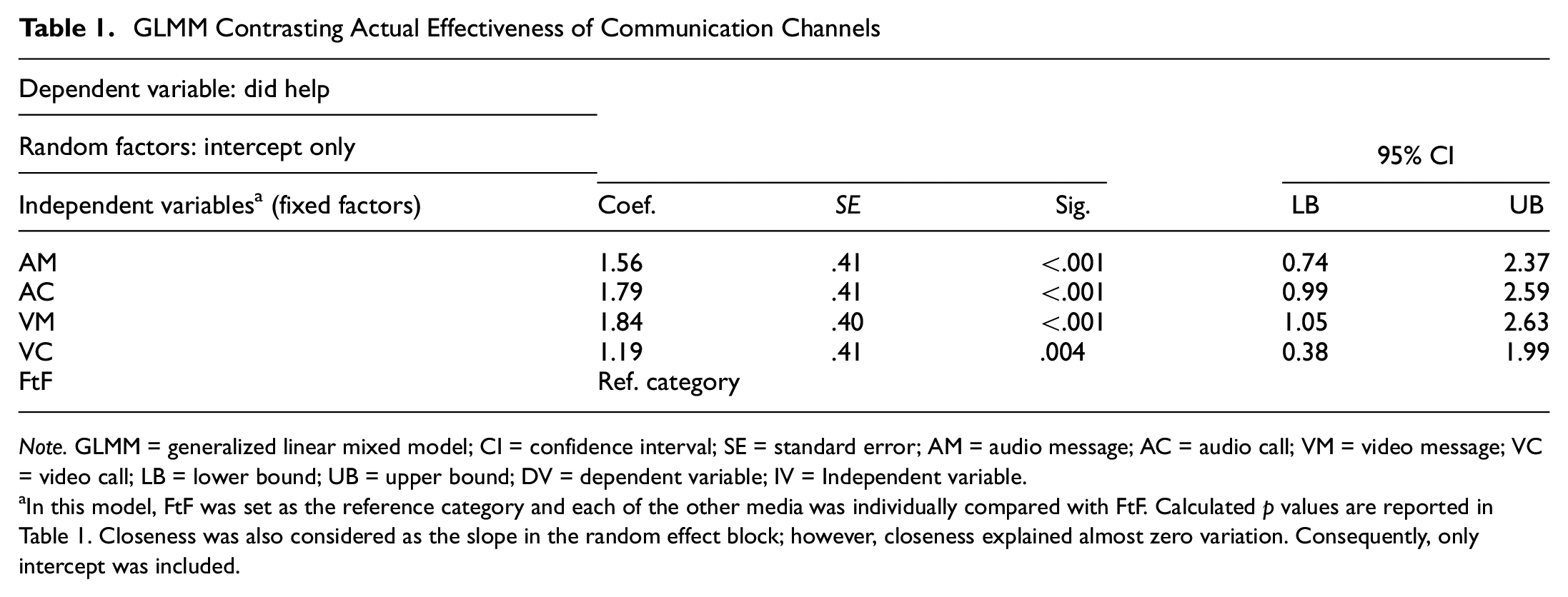
We first looked at actual compliance by communication medium. We conducted a GLMM with communication medium as the independent variable and actual compliance (yes or no) as a binary DV. As shown in Table 1, FtF was found to be significantly more effective than any of the other channels.
GLMM Contrasting Actual Effectiveness of Communication Channels
Note. GLMM = generalized linear mixed model; CI = confidence interval; SE = standard error; AM = audio message; AC = audio call; VM = video message; VC = video call; LB = lower bound; UB = upper bound; DV = dependent variable; IV = Independent variable.
In this model, FtF was set as the reference category and each of the other media was individually compared with FtF. Calculated p values are reported in Table 1. Closeness was also considered as the slope in the random effect block; however, closeness explained almost zero variation. Consequently, only intercept was included.
Next, we looked at the accuracy of help-seekers’ predictions of compliance by communication medium (Figure 1). Specifically, we examined whether help-seekers recognized the superiority of seeking help in-person compared with computer-mediated channels. We conducted a 5 (Communication Channel: FtF, VC, VM, AC, AM) × 2 (Compliance: predicted, actual) mixed-model analysis of variance (ANOVA) with repeated measures on the second factor. A significant interaction emerged between Communication Channel and Compliance F(4, 139) = 3.29, p = .013,
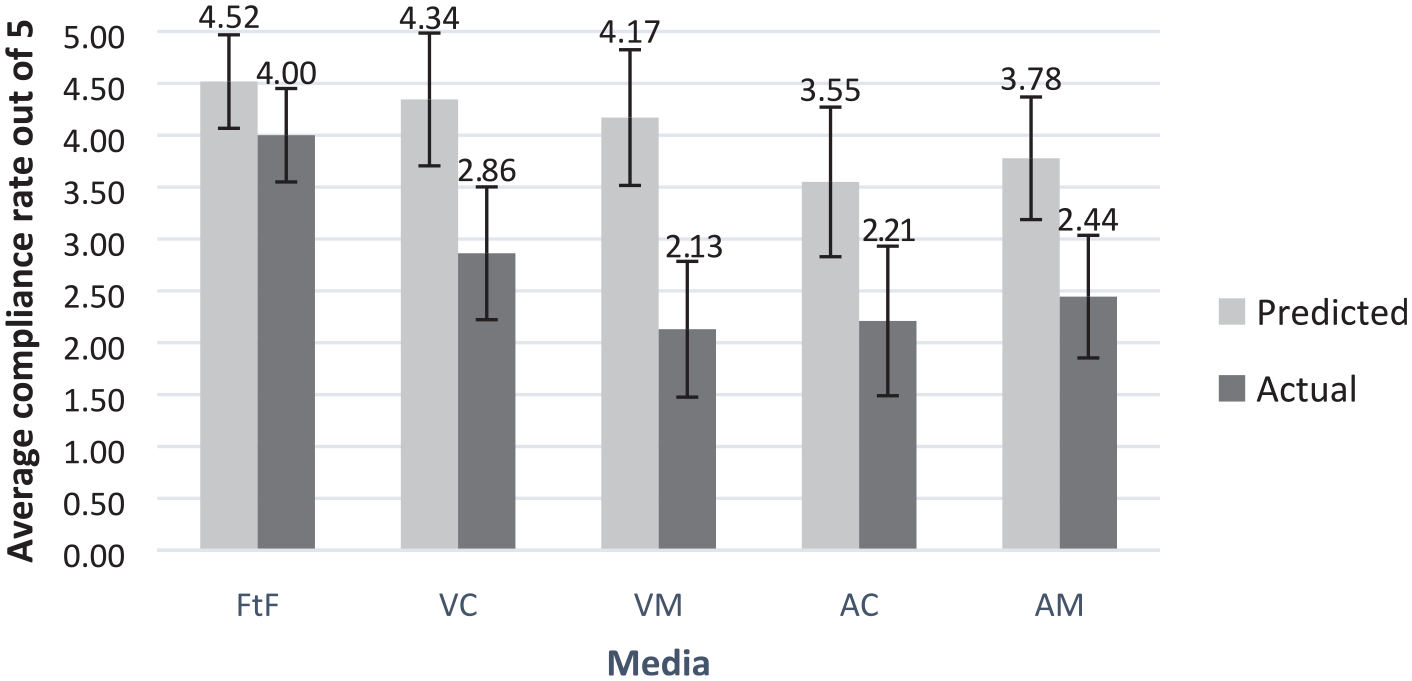
Experiment 1 Predicted and Actual Compliance With Help Requests by Communication Medium
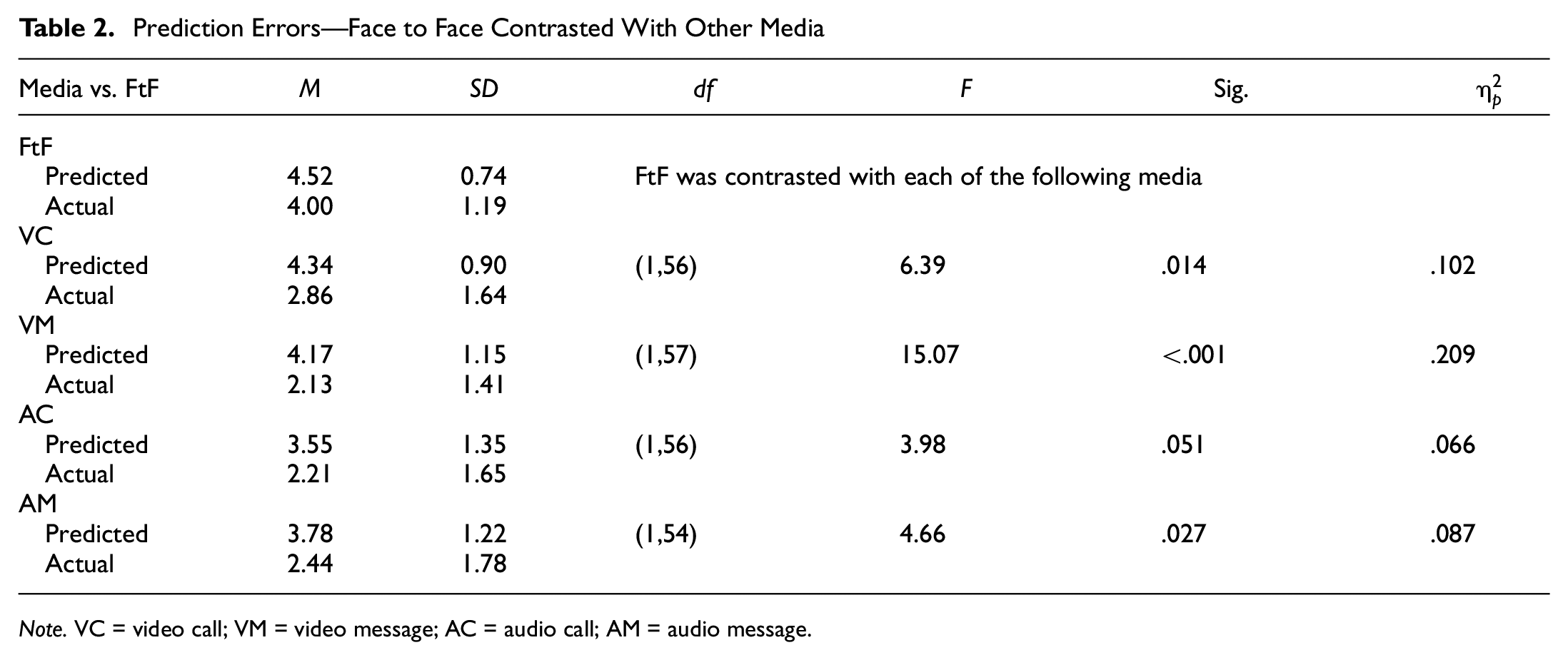
To unpack this interaction, we conducted four separate repeated-measure ANOVAs comparing FtF with each of the other channels on prediction accuracy (i.e., predicted vs. actual compliance rates). Help-seekers overestimated the likelihood of receiving help significantly more when asking via any of the mediated channels than when asking FtF (Table 2). The magnitude of error did not vary significantly between the various mediated channels F(3, 111) = 1.09, p = .357,
Prediction Errors—Face to Face Contrasted With Other Media
Note. VC = video call; VM = video message; AC = audio call; AM = audio message.
To examine help-seekers’ expectations of which communication channels would be most effective, we compared the mean number of friends out of five participants expected would comply with their help requests across the five conditions. We ran a one-way ANOVA with communication channel (FtF, VC, VM, AC, AM) as the independent variable and predicted compliance (0–5) as the dependent variable. Help-seekers did appear to recognize that some channels would be more effective than others for seeking help, F(4, 139) = 3.85, p = .005,
To unpack this result, we conducted separate t tests comparing predicted compliance for in-person help requests to each of the mediated channels. We found no difference between help-seekers’ predictions of the effectiveness of seeking help via video call (M = 4.34, SD = 0.90), t(56) = 0.80, p = .428, d = .21, 95% CI = [−0.26, 0.60] or video message (M = 4.17, SD = 1.15), t(57) = 1.39, p = .170, d = .36, 95% CI = [−0.15, 0.85] and seeking help in-person (M = 4.52, SD = 0.74). However, interestingly, help-seekers did anticipate a difference between seeking help via audio channels and seeking help in-person (although they still substantially overestimated the effectiveness of audio channels). There was a significant difference between help-seekers’ predictions of the effectiveness of in-person help-seeking as compared with an audio call (M = 3.55, SD = 1.35), t(56) = 3.38, p = .001, d = .87, 95% CI = [0.39, 1.54] and an audio message (M = 3.78, SD = 1.22), t(54) = 2.72, p = .008, d = .73, 95% CI = [0.20, 1.27]. After removing FtF data, overall, help-seekers predicted that with-face (video) channels (M = 4.25, SD = 1.03) would be more effective than no-face (audio only) channels, M = 3.66, SD = 1.28, F(1, 113)= 7.54, p = .007,
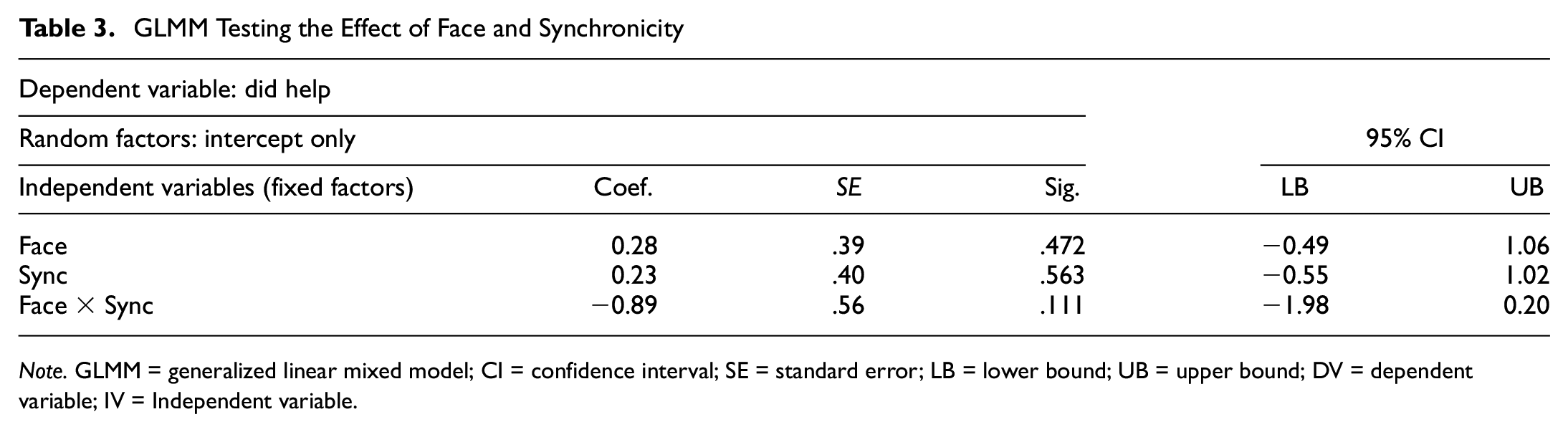
To examine the role of the presence or absence of face, and synchronous versus asynchronous media, on the effectiveness of mediated channels only, we removed the FtF data and employed two dummy variables called “Sync” and “Face.”“Sync” distinguished between synchronous media (i.e., the VC and AC conditions) and asynchronous media (i.e., the VM and AM conditions), while “Face” designated whether a given medium was with-face (i.e., the VC and VM conditions) or no-face (i.e., the AC and AM conditions). Incorporating these two dummy variables, a GLMM with a binary outcome (did help) was employed. As depicted in Table 3, there were no significant differences of either face or synchronicity.
GLMM Testing the Effect of Face and Synchronicity
Note. GLMM = generalized linear mixed model; CI = confidence interval; SE = standard error; LB = lower bound; UB = upper bound; DV = dependent variable; IV = Independent variable.
Discussion
The only difference we found for actual compliance between the different communication channels was a large difference between asking FtF and asking via any kind of computer-mediated channel (video call, video message, audio call, audio message). Regarding prediction accuracy, while help-seekers did expect a difference in the effectiveness of asking via audio-only channels versus asking in-person, the actual difference between these channels was larger than help-seekers expected, that is, asking in-person was even more effective than asking via audio channels than help-seekers expected. Finally, although help-seekers expected asking via video channels to be as effective as asking in-person, FtF requests were significantly more effective.
Experiment 2: Predicted Versus Actual Compliance With a Request Across Email, Audio, and Video Channels
Experiment 1 compared audio and video with in-person channels and found that FtF help requests were significantly more effective than requests made via rich media channels, and, further, that asking FtF was more effective than asking via mediated channels than participants had initially anticipated. Yet, despite their inferiority to in-person requests, requests made via rich media may nonetheless be superior to text-based requests. Experiment 2 tests this possibility, in addition to help-seekers’ expectations of how text-based requests are likely to fare compared with richer media requests. This study was preregistered at AsPredicted.org (https://aspredicted.org/w55mp.pdf).
Participants
A total of 1,979 participants (490 help-seekers, 323 female; 1,490 targets, 910 female) took part in the study. One hundred ninety-one of the original 489 requesters did not complete the second phase of the study (i.e., did not report actual compliance), leaving 298 help-seekers who completed both phases of the study. A power analysis conducted in G*Power indicated that this sample size was large enough to detect an effect of the same size we found in Experiment 1 for actual compliance between audio and video calls (d = .397). Attrition did not differ significantly by condition, χ2 (2, N = 490) = 1.64, p = .441.
Design and Procedure
Experiment 2 was identical to Experiment 1 with the following modifications: The FtF, audio message, and video message conditions were removed, and an email condition was added. Thus, there were three between-subjects conditions: email, video call, and audio call.
Results
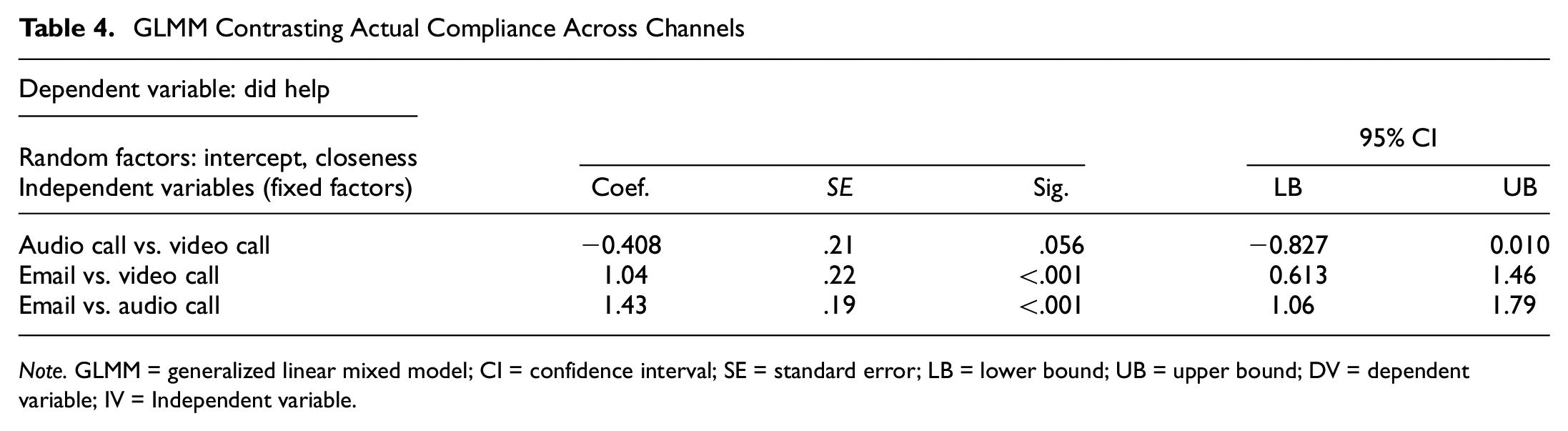
Since the data structure was identical to Experiment 1, we used the same analytic approach. We began by looking at actual compliance by communication medium and found that both audio calls and video calls were significantly more effective than email requests (Table 4).
GLMM Contrasting Actual Compliance Across Channels
Note. GLMM = generalized linear mixed model; CI = confidence interval; SE = standard error; LB = lower bound; UB = upper bound; DV = dependent variable; IV = Independent variable.
To test the accuracy of help-seekers’ predictions, we conducted a 3 Communication Channel (video call vs. audio call vs. email) × 2 Compliance (predicted, actual) mixed-model ANOVA with repeated measures on the second factor. A significant interaction between Communication Channel and Compliance emerged F(2, 588) = 3.324, p = .037,
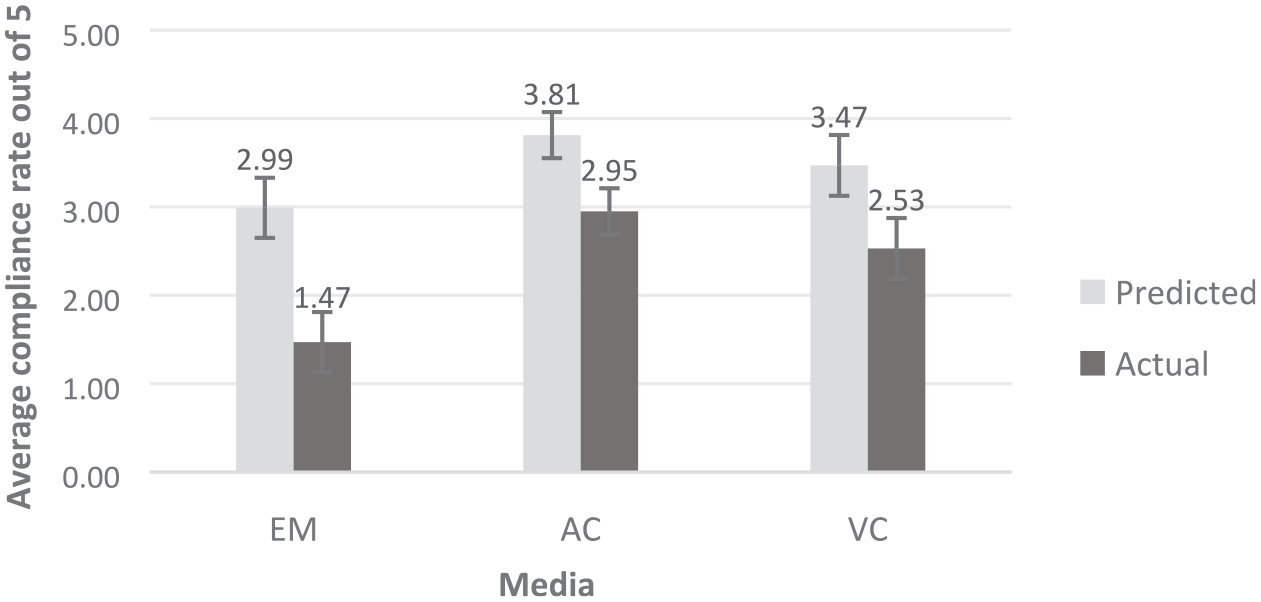
Experiment 2 Predicted and Actual Compliance With Help Requests by Communication Medium
Finally, paired t tests indicated that participants overestimated the effectiveness of their requests across each mediated communication medium (Table 5).
Experiment 2—Results of Paired T Tests Indicating Overestimation of Channel Effectiveness

Discussion
While Experiment 1 indicated that no mediated channel was as effective as a FtF request, Experiment 2 suggests that requests made via rich media communication channels are still more effective than requests made via email. However, participants once again underestimate how much more effective asking via richer media channels is.
General Discussion
In two behavioral help-seeking studies, help-seekers failed to appreciate the effectiveness of seeking help via increasingly more naturalistic, or richer, communication channels. In Experiment 1, face-to-face help requests were substantially more effective than audio or video requests, yet help-seekers failed to recognize the superiority of asking for help in-person. In Experiment 2, seeking help via video and audio communication channels was significantly more effective than seeking help through email, but help-seekers failed to fully appreciate how much more effective seeking help through these richer channels was likely to be.
Two additional vignette studies reported in the Supplemental Materials provided additional evidence for the inaccuracy of help-seekers’ predictions of compliance across different communication channels. In Supplemental Experiment A, a sample of 1,003 participants read a series of scenarios in which they imagined seeking help through a randomly assigned communication channel. Participants in this study perceived mediated channels to be as effective for seeking help as asking FtF. In Supplemental Experiment B (preregistered at: https://aspredicted.org/he9ee.pdf), a sample of 402 participants rated the effectiveness of seeking help either from a friend or from a stranger (between-subjects) through each of the four communication channels (FtF, video call, audio call, email) in a within-subjects design. No difference was found in the pattern of predictions across channels by closeness level (i.e., no interaction), nor was any main effect of closeness detected. Participants in this study predicted no differences between the effectiveness of video, audio, or email channels. Participants did expect a FtF request to be slightly more effective than any of the mediated requests—but only slightly.
Given the large differences we observed in the effectiveness of FtF compared with mediated requests, and rich media compared with email requests in our behavioral studies, these findings suggest that people fail to fully appreciate the value of asking for help in-person, or in lieu of this possibility, through a richer communication medium. These results corroborate previous research on mediated versus face-to-face help-seeking. Roghanizad and Bohns (2017) found a similar prediction error in which help-seekers expected making requests over email to be as effective as making requests in-person, despite large differences in actual compliance between the two modes of help-seeking.
The current findings also corroborate previous work that has looked at the actual effectiveness of persuasion across different media channels—primarily text-based versus in-person communication channels (Berry & McArthur, 1986; Brownlow, 1992; Burgoon, 1990; McGinley et al., 1975; Scharlemann et al., 2001; Sproull & Kiesler, 1986; Willis & Todorov, 2006). While this work has also shown that in-person influence is superior to almost any kind of mediated influence attempt, fairly little prior research has examined people’s intuitions about the best way to persuade. Yet it is people’s beliefs about which communication channel is likely to be most effective—not the actual effectiveness of these communication channels—that drives behavior, for example, how someone decides to go about asking for help.
Notably, while previous research has found that participants underestimate compliance with in-person requests (Bohns, 2016; Flynn & Lake, 2008), in Experiment 1, we found that help-seekers were mostly accurate about the likelihood the people they asked would comply with their requests. This may be because we specifically instructed participants to ask friends, and help-seekers’ predictions of friends’ compliance rates have been shown to be more accurate (Deri et al., 2019).
Taken together with the Roghanizad and Bohns (2017) studies on help-seekers’ misperceptions of the value of asking for help in-person versus over email, the current findings paint a more complete picture of the ways in which help-seekers discount the value of seeking help in-person. Similar to the convenience of email, the convenience of other mediated channels may lead help-seekers to ask for help by making a quick phone or video call, rather than walking down to a potential helper’s office. Our findings suggest such a preference could deprive them of needed help.
Of course, there are situations in which meeting up with a potential helper is simply too costly or inconvenient, and requesters may therefore choose to communicate with colleagues and friends through mediated channels, regardless of the advantages of FtF communication. Our studies suggest that in these cases, there are benefits to using richer communication media, such as video and audio channels. Interestingly, our findings do not indicate a clear advantage of video over audio-only channels.
Finally, our research dovetails with recent research examining people’s mispredictions about the best communication channel to use to reconnect with old friends (Kumar & Epley, 2020). Together, these complementary lines of work suggest that people may regularly choose suboptimal communication channels to connect with others.
Conclusion
Not receiving needed help is costly. It therefore stands to reason that help-seekers would want to maximize their chances of getting a “yes.” In two experiments, we found that seeking help in-person was far superior to seeking help through any form of mediated communication channel—including seeking help over synchronous, with- face video channels. Nonetheless, we found that richer media channels do still offer an advantage over text-based channels. Yet, importantly, help-seekers appear largely unaware of both these facts. These findings suggest that people may miss out on receiving needed help by asking for it in suboptimal ways.
Supplemental Material
sj-docx-1-spp-10.1177_19485506211063259 – Supplemental material for Should I Ask Over Zoom, Phone, Email, or In-Person? Communication Channel and Predicted Versus Actual Compliance
Supplemental material, sj-docx-1-spp-10.1177_19485506211063259 for Should I Ask Over Zoom, Phone, Email, or In-Person? Communication Channel and Predicted Versus Actual Compliance by M. Mahdi Roghanizad and Vanessa K. Bohns in Social Psychological and Personality Science
Footnotes
Declaration of Conflicting Interests
The author(s) declared no potential conflicts of interest with respect to the research, authorship, and/or publication of this article.
Funding
The author(s) received no financial support for the research, authorship, and/or publication of this article.

Supplemental Material
The supplemental material is available in the online version of the article.
Notes
Handling Editor: Robyn Mallett
Author Biographies
References
Supplementary Material
Please find the following supplemental material available below.
For Open Access articles published under a Creative Commons License, all supplemental material carries the same license as the article it is associated with.
For non-Open Access articles published, all supplemental material carries a non-exclusive license, and permission requests for re-use of supplemental material or any part of supplemental material shall be sent directly to the copyright owner as specified in the copyright notice associated with the article.
