



Abstract
Power pervades interpersonal relationships and can impact relationship-related outcomes (e.g., forgiveness). Here, we expected a positive association between power and forgiveness in two studies involving German and Israeli couples (N = 149/174 couples). Actor–partner interdependence mediator models showed the expected positive associations of actor’s power with both actor’s forgiveness and partner’s forgiveness. Independent self-esteem partially mediated and interdependent self-esteem completely mediated the power–forgiveness link for actors. Also, high experienced power was associated with high self-esteem, which in turn was positively related to benevolence motivation and negatively related to revenge and avoidance motivation. The implications of these findings are relevant for couple’s therapy and advance our understanding of associations between power and relationship variables. Future research may distinguish between authentic and instrumental forgiveness and use experimental settings.
The weak can never forgive. Forgiveness is the attribute of the strong.
Does Gandhi’s statement hold when tested in close relationships? We conceptualized the strong as the powerful and investigated whether power was associated with forgiving in romantic relationships. Romantic relationships are very personally important (Clark & Mills, 2011) and are characterized by interdependence and support (Griskevicius et al., 2015) but also conflict. Thus, forgiveness plays a vital role in ensuring a couple’s functioning. Does experienced power correlate with the willingness to forgive? Is power also related to a partner’s tendency to forgive? Finally, what is a possible link between power and forgiveness in couples?
Power and Forgiveness
Power is understood as social influence (Anderson et al., 2012; Dahl, 1957) and is grounded in control over resources (Keltner et al., 2003). Whereas the actual possession of power as based on resources can be understood as structural or positional power, the experience of power is a subjective assessment. We refer to subjective power in the following because this type of power is most important in romantic relationships (Körner & Schütz, 2021). In the relationship literature, power is typically defined as the capacity to change a partner’s thoughts, feelings, and behavior and to resist counterinfluence attempts (Simpson et al., 2015). Thus, influence is central to the possession of power. In measuring power, some researchers focus on absolute levels (e.g., personal sense of power), whereas others measure power in dyadic terms where relative power is understood as the extent to which one person has more power than the other (Righetti et al., 2015). We are concerned with the personal sense of power (Anderson et al., 2012) in the relationship (i.e., the perceived ability to influence one’s romantic partner). For example, a high personal sense of power in intimate relationships can be experienced when someone feels they have an influence in joint decisions that matter to them. In romantic relationships, an actor’s experienced power is associated with relationship quality, authenticity, and subjective well-being (Kifer et al., 2013; Neff & Suizzo, 2006) but also with lower commitment (Sprecher et al., 2006), and the links to aggression and other forms of destructive behavior are not yet clear (Alonso-Ferres et al., 2021; Pietromonaco et al., 2021; Ronfeldt et al., 1998). Forgiveness is a way to de-escalate conflicts and is thus important to a couple’s functioning.
Forgiveness can be defined as a prosocial response “whereby one becomes decreasingly motivated to retaliate against an offending relationship partner, decreasingly motivated to maintain estrangement from the offender, and increasingly motivated by conciliation and goodwill for the offender” (McCullough et al., 1997, pp. 321–322). In most definitions, the motivational component of forgiveness is central, but emotion and behavior are relevant, too (Worthington, 2019). Moreover, forgiving others can occur at three levels: offense-specific, relationship-specific (across offenses), and trait forgiveness as a general tendency (tending to forgive multiple others across several situations; Worthington, 2019). We focused on offense-specific forgiveness (i.e., forgiving a specific transgression) because this type of forgiveness is fundamentally dyadic. It should be affected by both relationship partners’ power characteristics and should thus be especially important in couples. Offense-specific forgiveness is characterized by both an increase in benevolence (i.e., a conciliatory motivation) and decreases in both resentment (i.e., vengeance motivation) and avoidance of the partner (Haversath et al., 2017; Paleari et al., 2009). Forgiveness has several positive consequences for relationship quality (Wallace et al., 2008; Webb & Toussaint, 2019). Thus, it is important to understand who forgives in a relationship and why.
Power is fundamental in everyday life and has a prosocial but also an antisocial nature (Guinote, 2017; Kipnis, 1972). In intimate relationships, power is related to relationship satisfaction but also to less emotional involvement (Kim et al., 2019). Past research has found that power has both positive and negative relationships with constructs that may be related to forgiveness. First, power in romantic couples has shown negative correlations with sacrificing and accommodating behavior (Righetti et al., 2015; Rusbult et al., 1991). Both sacrificing and accommodating tendencies may be related to forgiveness, which is why a negative power–forgiveness relation may be expected—and this would be in line with the antisocial consequences of power found in the early literature (Kipnis, 1972).
However, on the basis of theories and findings that have shown that power increases positive emotions, action orientation, and goal-related approach motivation (Galinsky et al., 2003; Keltner et al., 2003), researchers have reported that power can increase prosocial behavior when the goal is having an intact and good relationship (Chen et al., 2001; Gordon & Chen, 2013). Furthermore, from a philosophical stance, forgiveness can be understood as taking control and abandoning the role of a victim (Derrida, 2001). Thus, partners who feel powerful may forgive more easily. This reasoning is in line with observations regarding revenge: Situational power increased revenge among chronically powerless students but decreased revenge among chronically powerful ones (Strelan et al., 2014). Moreover, personal sense of power was positively related to forgiveness among close acquaintances, and in a sample of students in romantic relationships, power was again positively associated with offense-specific forgiveness (Karremans & Smith, 2010).
We built upon these findings and investigated whether power was associated with forgiveness in couples. As the study by Karremans and Smith (2010) was the first to measure forgiveness directly, we based our hypotheses on their results and expected a positive association between power and forgiveness. Yet, we obtained much larger sample sizes, used data from two countries, and employed a dyadic approach. Furthermore, we analyzed the underlying process more closely and tested self-esteem as a mediator.
Self-Esteem as a Mediating Process
Power has been found to be positively associated with trait self-esteem (Anderson et al., 2012) and increased state self-esteem (Körner, Petersen, & Schütz, 2021; Wojciszke & Struzynska–Kujalowicz, 2007). Recently, we suggested a power-self-esteem hypothesis (Körner & Schütz, 2022): The relation between the two constructs may be so close (Guinote, 2017) that many downstream consequences of power may be explained by a mediating effect of self-esteem. In this proposition, self-esteem is considered a consequence of power because self-esteem is malleable (Anusic & Schimmack, 2016) and can be affected by interpersonal experiences (Leary & Baumeister, 2000). Similarly, the approach/inhibition theory of power (Keltner et al., 2003) suggests that power increases positive emotions and approach behavior, which in turn are linked to high self-esteem. Finally, because self-esteem converges over time in romantic couples (Schafer & Keith, 1992), it seems plausible to assume that self-esteem is the consequence rather than the cause (see also Baumeister et al., 2003) of power experienced in romantic relationships. Thus, we expected that experienced power would affect self-esteem.
Self-esteem has been found to be positively related to forgiveness (Eaton et al., 2006; Riek & Mania, 2012; but see Neto & Mullet, 2004). It can protect people from taking transgressions personally and can help them avoid or leave the victim role (Semmer et al., 2020). By contrast, people low in self-esteem assume that their partners also perceive them negatively (Murray et al., 2000; Schütz & Tice, 1997), which can in turn erode trust between partners and increase destructive relationship behavior (e.g., Murray et al., 2015), such as not forgiving transgressions. Moreover, positive experiences are shared less with low self-esteem partners (MacGregor & Holmes, 2011) than with others, thereby potentially inhibiting pro-relationship behavior among people with low self-esteem. We thus expected that self-esteem would mediate the power–forgiveness link.
A Dyadic Perspective
Concepts such as power and interpersonal forgiveness can only be understood in a social context. Dyadic power theories (e.g., interdependence theory, Kelley et al., 2003; dyadic power-social-influence model, Simpson et al., 2015) imply that the interdependence of the two relationship partners must be taken into account to fully understand the consequences of power. This perspective seems essential as an individual’s power can affect the outcomes of both partners.
Personal sense of power is moderately positively associated between relationship partners (Körner & Schütz, 2021). Besides social acceptance and approval (see sociometer theory; Leary & Baumeister, 2000), power has been identified as another important source of self-esteem (Wilson & Wilson, 1976). As couples in well-functioning relationships are closely intertwined (Johnson et al., 2020), the experience of power should affect not only one’s own but also one’s partner’s self-esteem. For example, a high-power actor may be more approving of their partner, thus bolstering their partner’s self-esteem.
With respect to forgiveness, we also expected the actor’s power to be positively related to the partner’s forgiveness: Power affords goal-related motivation and behavior (Guinote, 2007) and can thus strengthen responsibility and pro-relationship behavior in happy romantic couples. Such behavior is in turn likely to facilitate pro-relationship behavior in the partner (Kelley et al., 2003). Thus, if a transgression has been committed but people see that their partners are interested in maintaining a good relationship, they may also be more willing to forgive to support the quality of the relationship.
Overview
We conducted two studies with other-sex couples in different cultures. We considered power to be a stable trait in the relationship (Anderson et al., 2012). Furthermore, we focused on experienced power in terms of social influence in the relationship because experienced power has been shown to have a stronger impact on relationship variables than positional power (i.e., possession of resources; Körner & Schütz, 2021; Tichenor, 2005). As argued previously (Karremans & Smith, 2010; Riek & Mania, 2012), we hypothesized that experienced power would be positively associated with offense-specific forgiveness and that self-esteem would mediate this link. Furthermore, we assessed two different types of self-esteem that mapped onto the different levels of individualism and collectivism in the countries we studied: independent self-esteem in Germany and both independent and interdependent self-esteem in Israel.
We took into account the interdependence of partners’ relationship characteristics (Kim et al., 2019; Zverling, 2019). Previous research on power or self-esteem and forgiveness has neglected to consider interdependence when examining the associations of these constructs in interpersonal contexts. However, when both partners provide assessments of their own power and forgiveness, a more complete picture can be drawn (Kenny & Ledermann, 2010). In line with dyadic power theories, we aimed to test dyadic effects and expected that one partner’s power would also affect the other partner’s experience. We hypothesized that power would be positively associated with the self-esteem and forgiveness of both partners. Because of the interdependence of the relationship partners, the actor affects may also generalize to the partner. We also tested for indirect effects for both actors and partners.
Study 1: German Sample
Study 1 was conducted with German couples. Germany is an individualistic country with gender roles largely adapted to equality (Athenstaedt & Alfermann, 2011; Siffert & Bodenmann, 2010). Personal sense of power was expected to be positively correlated with both actor’s and partner’s forgiveness. We also expected that this process would be mediated by the experience of high self-esteem and tested for indirect effects for both actors and partners. Hypotheses and analyses were preregistered (https://aspredicted.org/blind.php?x=em3xx8).
Method
Participants
We collected data from 436 individuals. For 74 individuals, partner data were missing or could not be matched, leaving 181 couples. On the basis of responses to a control item and in line with our preregistration, we excluded 32 couples in which at least one partner could not remember a conflict. The final sample comprised 149 other-sex couples (men: Mage = 31.65, SDage = 12.95, 19–73; women: Mage = 29.77, SDage = 13.17, 18–72). The average relationship duration was 8.32 years (Mdn = 3.33, SD = 10.94, 2 months to nearly 52 years). Our sample size allowed us to detect effects of βActor/Partner = .20/.15 with a power of .95/.77 (α = .05, error correlations = .03, correlation between actor and partner variables = .25; Ackerman et al., 2020). Please refer the Online Supplement for the procedure.
Measures
Power was measured with the German Personal Sense of Power Scale (PSPS; Anderson et al., 2012; Körner, Heydasch & Schütz, 2021). The scale addresses social influence and perceived decision-making ability (six items; for example, “I can get him or her to listen to what I say”). The item stem reads: “In my relationship with my partner . . .”
To assess self-esteem, we used the self-regard subscale from the German Multidimensional Self-Concept Scale (MSCS; Fleming & Courtney, 1984; Schütz et al., 2016). 1 Self-regard represents a person’s global perception of self-worth (seven items; for example, “Do you doubt yourself?”).
Two forgiveness dimensions were assessed with the German Marital Offence-Specific Forgiveness Scale (Haversath et al., 2017; Paleari et al., 2009): Benevolence is characterized by a conciliatory motivation after transgressions (four items). Resentment-avoidance is defined by retaliation and avoidant and vengeful motivation (six items). In the following, we use forgiveness as an umbrella term for both dimensions (i.e., high benevolence, low resentment-avoidance). Items were adapted for unmarried couples. Participants were instructed to remember a situation involving a conflict with their partner as accurately as possible. Reponses were given on a scale ranging from 1 to 6. A control item followed (“How intensively could you remember a situation involving conflict with your partner?”). Participants who ticked “not at all” were removed from the analyses because they would not be able to answer the offense-specific items.
Analytic Strategy
After excluding couples who were not able to remember a conflict with their partner, we calculated paired-samples t-tests and Pearson correlations to test for differences and similarity. The main analyses involved Actor–Partner Interdependence Mediator Models (APIMeM; Ledermann et al., 2011). Actor effects are associations between the predictor, mediator, and outcome for only the respondent (see Figure 1). Partner effects are associations between the respondent’s predictor and the partner’s mediator or outcome. Partner effects are typically smaller than actor effects (Dyrenforth et al., 2010). Note that we used APIM terminology (i.e., effect), which does not refer to causality but instead indicates the direction of an association. Analyses were based on structural equation modeling (ML estimation) in Mplus 7. We report bootstrapped 95%-Confidence Intervals (k = 5,000 samples). For direct effects, we computed effect sizes (see Brauer et al., 2021) separately for men and women (ΔF/M = b/SDF/M). Δ is the change in the outcome in SDs when the predictor changes by 1 point. For each APIMeM, a saturated model (all effects freely estimated; distinguishable dyads) was tested against an equal-actor-equal-partner effects model (absence of gender effects; that is, indistinguishable dyads). When the likelihood-ratio test was nonsignificant (p < .20; Kenny & Ledermann, 2010), we chose the equal effects model. Data, material, and analysis code are available online (https://osf.io/zndau/).
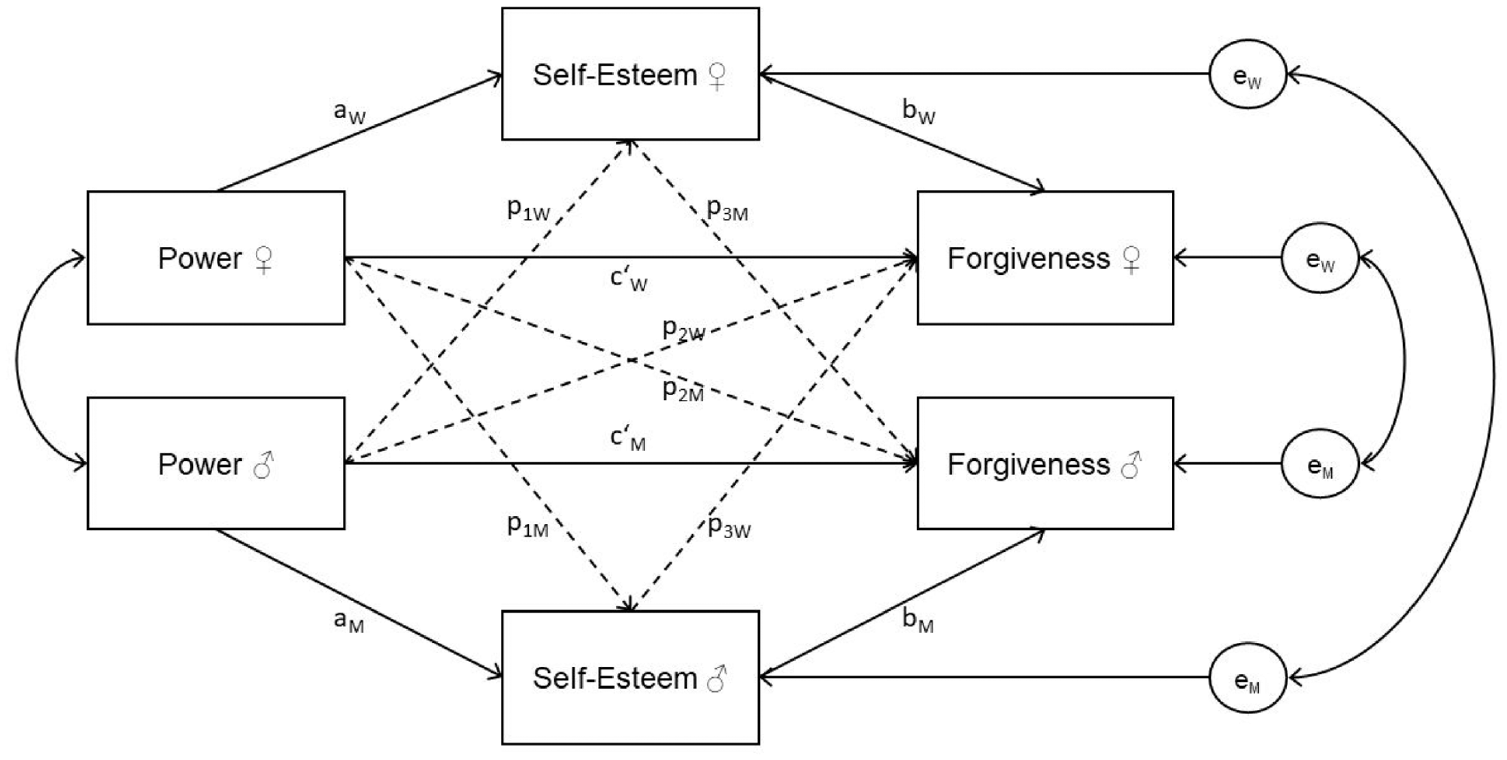
Model Specification for the APIMeMs Estimating the Effect of Power on Forgiveness With Self-Esteem as a Mediator.
Results
Preliminary Analyses
Cronbach’s alpha was acceptable for all scales (see Table 1). Men and women did not differ in experienced power. Men reported higher self-esteem and forgiveness, but the differences did not have large effect sizes (ds ≤ 0.40). Partners were similar in power and forgiveness, rs(147) ≥ .26, indicating interdependence between men and women. Only self-esteem was somewhat unrelated between partners, r(147) = .06.
German Sample: Descriptive Statistics, Cronbach’s Alphas, Partner Differences (Paired-Samples t Tests With Cohen’s d), and Bivariate Zero-Order Correlations Within and Between Partners for Power, Self-Esteem, and Forgiveness.
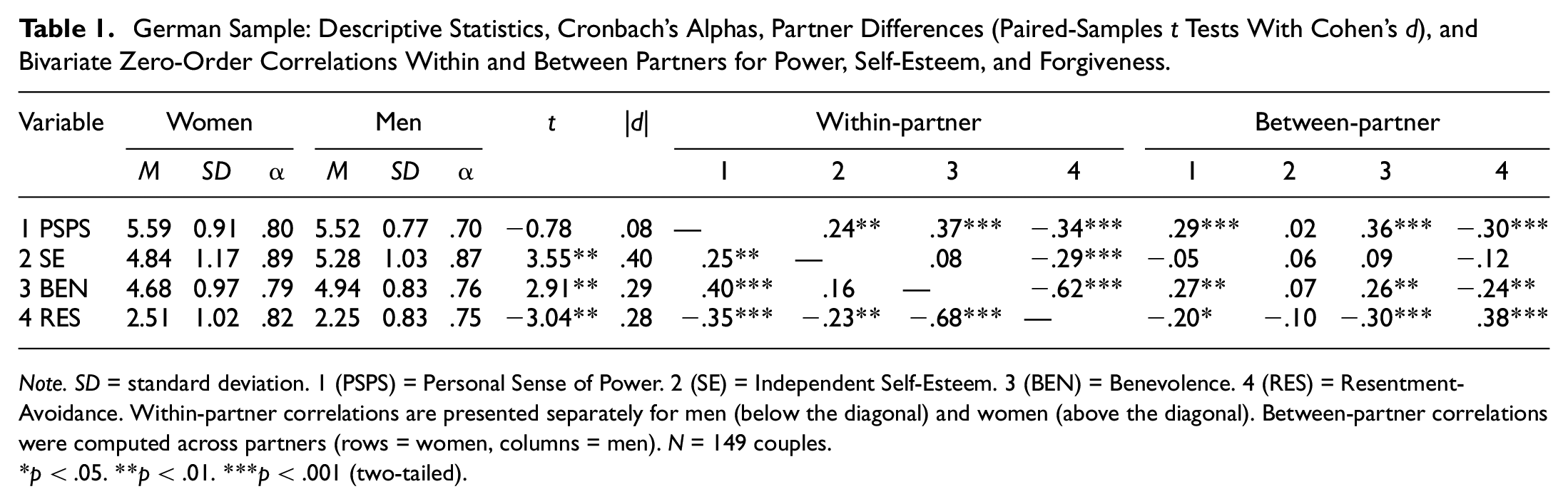
Note. SD = standard deviation. 1 (PSPS) = Personal Sense of Power. 2 (SE) = Independent Self-Esteem. 3 (BEN) = Benevolence. 4 (RES) = Resentment-Avoidance. Within-partner correlations are presented separately for men (below the diagonal) and women (above the diagonal). Between-partner correlations were computed across partners (rows = women, columns = men). N = 149 couples.
p < .05. **p < .01. ***p < .001 (two-tailed).
Main Analyses
Likelihood-ratio tests indicated that associations were independent of gender, χ2(6) < 2.468, p ≥ .872. Regarding the APIMeM with benevolence as the outcome, we found two significant actor effects (see Table 2): Power was positively associated with self-esteem (b = .39, 95% CI = [0.24, 0.54]) and benevolence (b = .36, 95% CI = [0.23, 0.50]), but self-esteem was unrelated to benevolence (b = .02, 95% CI [−0.06, 0.11]). There was one significant partner effect: Actor’s power was positively associated with partner’s benevolence (b = .19, 95% CI = [0.07, 0.31]).
German Sample: APIMeMs With Personal Sense of Power (PSPS) as the Independent Variable, Independent Self-Esteem (SE) as the Mediator, and Benevolence and Resentment-Avoidance (FO) as Outcomes.
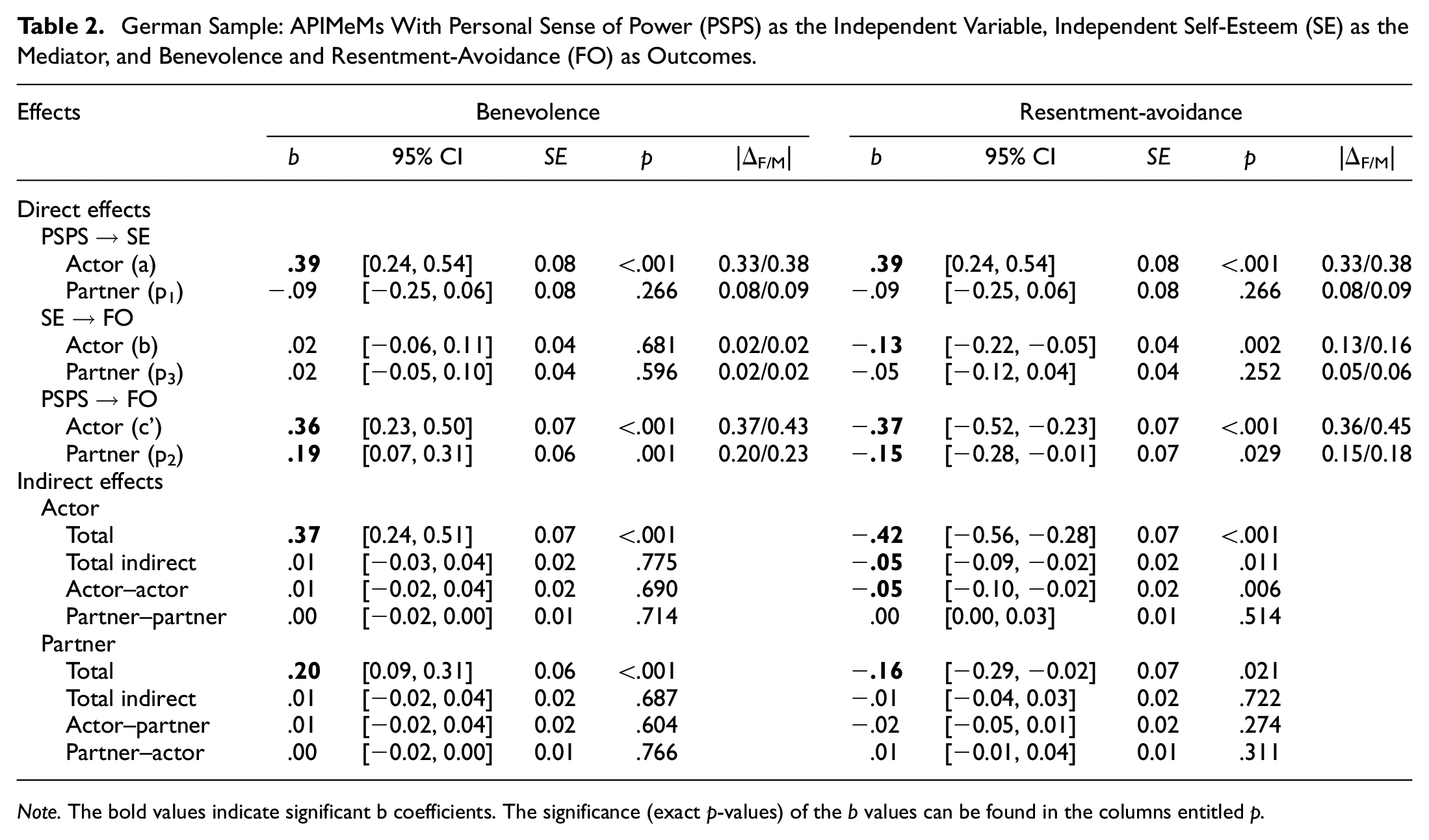
Note. The bold values indicate significant b coefficients. The significance (exact p-values) of the b values can be found in the columns entitled p.
For the APIMeM with resentment-avoidance as the outcome, for actor’s, we found positive associations between power and self-esteem and negative associations between self-esteem and resentment-avoidance (b = −.13, 95% CI = [−0.22, −0.05]) and power and resentment-avoidance (b = −.37, 95% CI = [−0.52, −0.23]; see Table 2). Self-esteem partially mediated the power–forgiveness relation for actors because the total indirect effect was negative and significant (b = −.05, 95% CI = [−0.09, −0.02]) as the direct effect was too. Regarding partner effects, there was a negative association between actor’s power and partner’s resentment-avoidance (b = −.15, 95% CI = [−0.28, −0.01]).
Discussion
In line with theoretical reasoning (Chen et al., 2001) and empirical research (Karremans & Smith, 2010), the hypothesis regarding a positive association between power and forgiveness was supported. The associations were independent of gender. Furthermore, for the first time, we found that actor’s power was also positively related to partner’s forgiveness. Partners seemed to be more willing to behave in a conciliatory fashion and to avoid revenge when a powerful partner made a transgression. Thus, high subjective power in a relationship offers a double benefit for relationship functioning: One can more easily forgive and continue after conflicts, and the partner is likewise more willing to forgive. In line with the reasoning that experienced power in a relationship should affect both partners (Simpson et al., 2015), we found that power was associated with both partners’ forgiveness, which underscores the relevance of considering interdependence in relationships and a focus on both partners’ traits. Furthermore, the positive association between power and forgiveness was partially mediated by self-esteem. Thus, power seems to bolster self-esteem, which in turn promotes forgiveness. We found no indirect partner effects: Actor’s power did not affect partner’s self-esteem, and actor’s self-esteem was not correlated with partner’s forgiveness. The effects were found in Germany and might only generalize to individualistic cultures because concepts of power differ between cultures (Torelli et al., 2020) and may thereby have different consequences. Thus, we aimed to replicate these findings in a more collectivistic context.
Study 2: Israeli Sample
Israel is an industrial nation characterized by the presence of both individualistic and collectivistic elements (Hofstede, 2001). As self-esteem with traditional measures (Rosenberg, 1965) taps into the self-worth of people with an independent self-concept, people from collectivistic countries may have low explicit self-esteem on these measures but may still be happy with themselves. Especially in collectivistic contexts, self-esteem might not be construed as individual achievement and standing out from others but as relatedness (Sedikides et al., 2003). Interdependent self-esteem can thus be defined as self-worth derived from experiencing connectedness with others, identifying with social groups, and building strong social ties (Singelis, 1994). In addition to the measures employed in Study 1, we added a self-esteem scale that assesses self-esteem in an interdependent fashion so we could compare the relevance of the two conceptualizations of self-esteem in a more collectivistic context. Furthermore, and in contrast to the MSCS, interdependent self-esteem is by definition more relationship-specific and may thus be an even more important mediator of the power–forgiveness link in highly committed relationships (e.g., romantic couples). The study was preregistered (https://aspredicted.org/blind.php?x=uw7xc5).
Method
Participants and Procedure
Data were collected from 520 participants. We excluded individuals when partner data were missing or could not be matched (n = 86) or when participants reported only extreme values (i.e., always ticking “1”; n = 38). Of the remaining 198 couples, we excluded 24 couples because they were unable to remember a conflict with their partner. Thus, the final sample comprised 174 other-sex couples (men: Mage = 35.73, SDage = 10.15, 19–77; women: Mage = 33.03, SDage = 9.55, 18–73). The average relationship duration was 9.53 years (Mdn = 7.00 SD = 8.98, 1 month to 55 years). With this sample size, we were able to detect effects of βActor/Partner = .20/.15 with a power of .97/.83 (α = .05, error correlations = .03; Ackerman et al., 2020). Procedure was the same as in Study 1. We also used the same measures and the same control item as in Study 1. In addition, we used the interdependent self-esteem subscale from the Social-Autonomous Self-Esteem Scale (SAS; Pöhlmann et al., 2002). The SAS referred to interdependent self-esteem experienced in the relationship.
Analytic Strategy
As preregistered, we first examined the psychometric properties of the PSPS and the SAS. Please refer the Online Supplement for the rationale and results of these analyses. Altogether, both scales showed acceptable item characteristics and good fit in a CFA and were thus used in the following analyses.
Paired-samples t-tests and Pearson correlations were computed to test for differences and similarity. Analyses of APIMeM (Ledermann et al., 2011) were conducted as in Study 1. Data, materials, and code are available online (https://osf.io/zndau/?view_only=50a235d6999e4ac88020ec9f28aef803).
Results
Preliminary Analyses
Cronbach’s alphas of all scales separated for men and women were acceptable (see Table 3). There was no difference between partners in experienced power but small-to-medium differences for self-esteem and forgiveness (ds ≤ .48). Partners were similar on all measures, rs(172) ≥ .13, with the highest similarity for interdependent self-esteem, r(172) = .56. Thus, there was robust interdependence between partners.
Israeli Sample: Descriptive Statistics, Cronbach’s Alphas, and Partner Differences (Paired-Samples t-Tests with Cohen’s d).
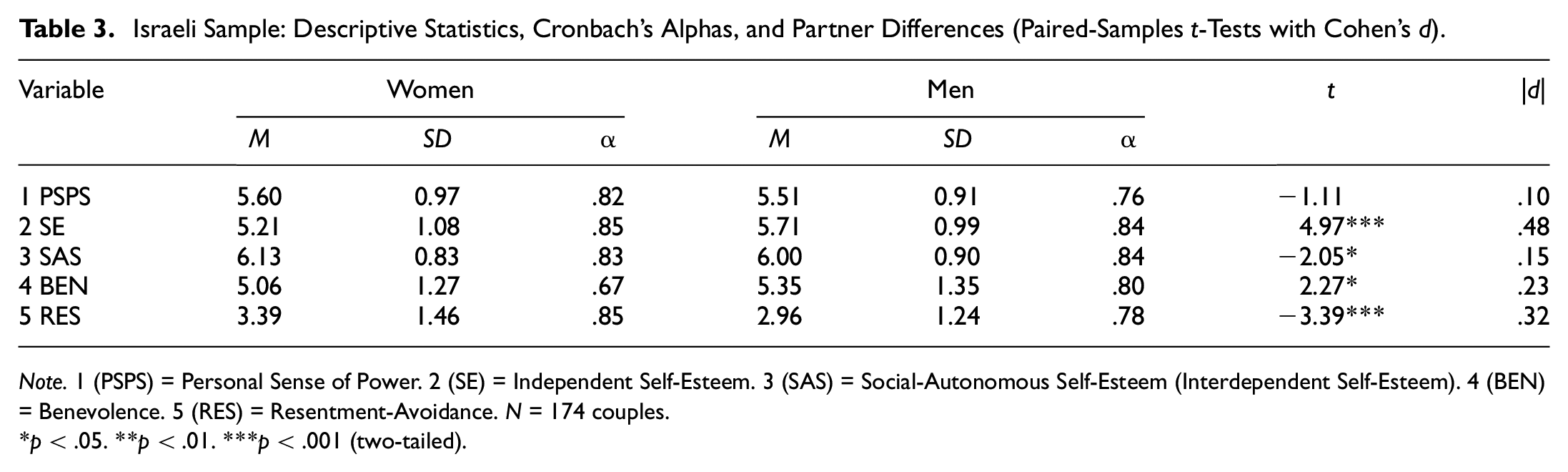
Note. 1 (PSPS) = Personal Sense of Power. 2 (SE) = Independent Self-Esteem. 3 (SAS) = Social-Autonomous Self-Esteem (Interdependent Self-Esteem). 4 (BEN) = Benevolence. 5 (RES) = Resentment-Avoidance. N = 174 couples.
p < .05. **p < .01. ***p < .001 (two-tailed).
Main Analyses
Likelihood-ratio tests indicated that associations were independent of gender, χ2(6) < 6.501, p ≥ .370. For actors, the model with independent self-esteem (MSCS) as the mediator showed positive associations between power and self-esteem (b = .49, 95% CI = [0.36, 0.61]), self-esteem and benevolence (b = .29, 95% CI = [0.14, 0.44]), and power and benevolence (b = .24, 95% CI = [0.05, 0.44]). Like the direct effect, the total indirect effect was significant (b = .13, 95% CI = [0.05, 0.23]), and the 95% CI did not include zero, thus indicating partial mediation (see Table 4). Actor’s power was also positively associated with partner’s benevolence (b = .19, 95% CI = [0.01, 0.38]), but the effect was rather small in size.
Israeli Sample: Bivariate Zero-Order Correlations Within and Between Partners for Power, Self-Esteem, and Forgiveness.
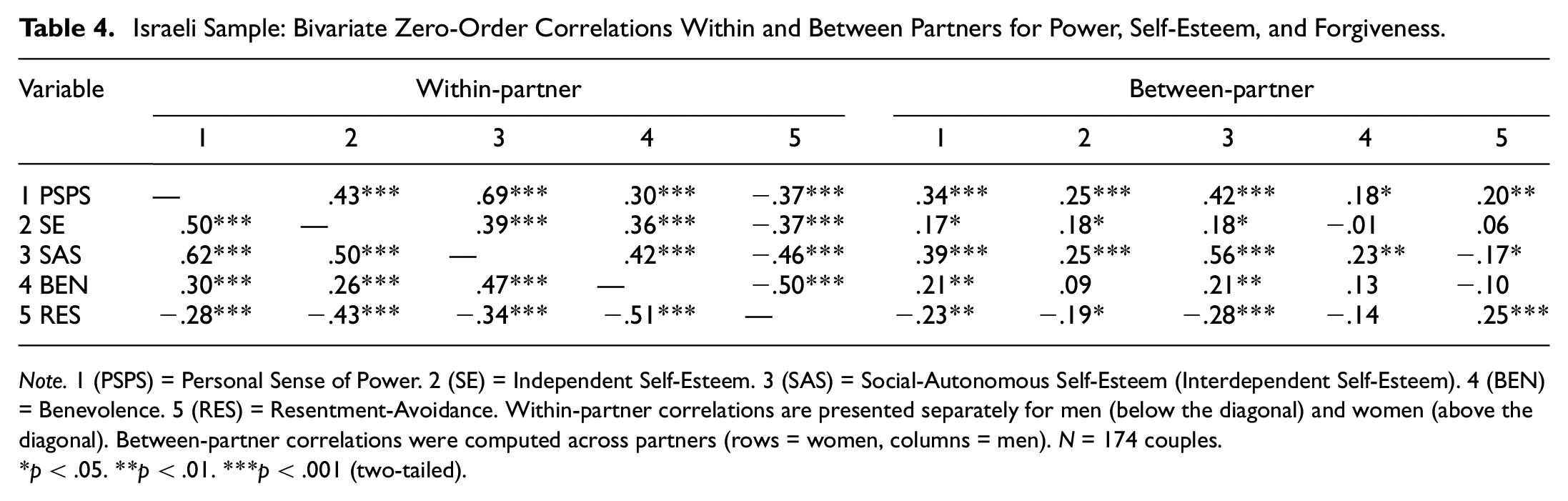
Note. 1 (PSPS) = Personal Sense of Power. 2 (SE) = Independent Self-Esteem. 3 (SAS) = Social-Autonomous Self-Esteem (Interdependent Self-Esteem). 4 (BEN) = Benevolence. 5 (RES) = Resentment-Avoidance. Within-partner correlations are presented separately for men (below the diagonal) and women (above the diagonal). Between-partner correlations were computed across partners (rows = women, columns = men). N = 174 couples.
p < .05. **p < .01. ***p < .001 (two-tailed).
In actors, in the model with independent self-esteem as the mediator and resentment-avoidance as the outcome, we found a positive association between power and self-esteem and negative associations between self-esteem and resentment-avoidance (b = −.41, 95% CI = [−0.56, −0.24]) and power and resentment-avoidance (b = −.21, 95% CI = [−0.40, −0.01]). The direct and the total indirect (b = −.20, 95% CI = [−0.31, −0.10]) effects were significant, indicating partial mediation. There was no significant partner effect (see Table 5).
Israeli Sample: APIMeMs With Personal Sense of Power (PSPS) as the Independent Variable, Independent Self-Esteem (SE) as the Mediator, and Benevolence and Resentment-Avoidance (FO) as Outcomes.
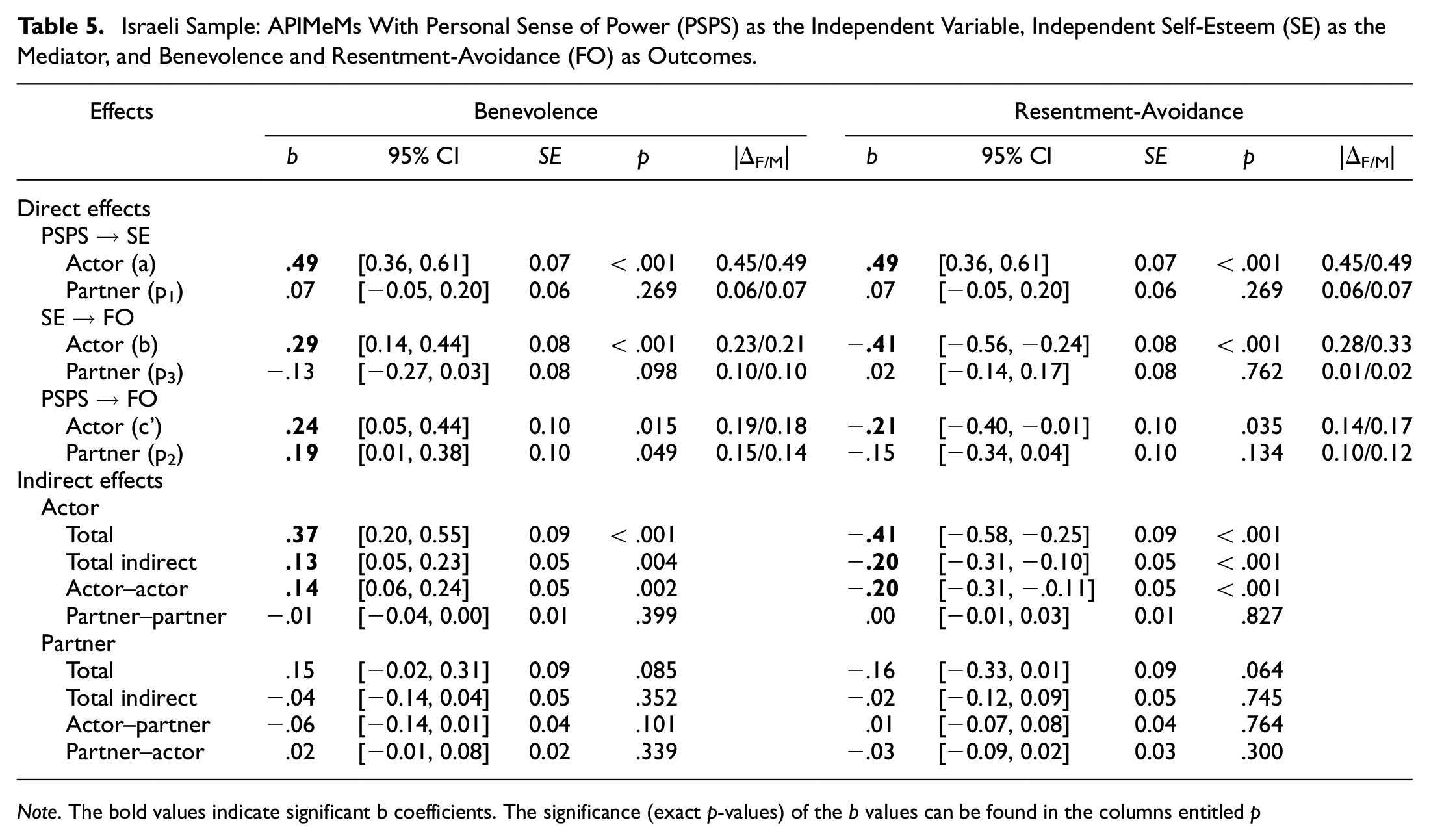
Note. The bold values indicate significant b coefficients. The significance (exact p-values) of the b values can be found in the columns entitled p
The APIMeM with interdependent self-esteem (SAS) as the mediator and benevolence as the outcome showed positive associations between actor’s power and actor’s self-esteem (b = .54, 95% CI = [0.45, 0.64]) and actor’s self-esteem and actor’s benevolence (b = .70, 95% CI = [0.45, 0.92]; see Table 6). The direct effect of power on benevolence was nonsignificant for actors, but the total indirect effect was positive and significant (b = .35, 95% CI = [0.21, 0.50]). Thus, interdependent self-esteem completely mediated the power–benevolence link. Regarding partner effects, there was a positive association between actor’s power and partner’s self-esteem (b = .19, 95% CI = [0.11, 0.27]). There was also a significant indirect effect from actors’ power to partner’s benevolence through partner’s self-esteem (b = .13, 95% CI = [0.07, 0.21]).
Israeli Sample: APIMeMs With Personal Sense of Power (PSPS) as the Independent Variable, Interdependent Self-Esteem (SAS) as the Mediator, and Benevolence and Resentment-Avoidance (FO) as Outcomes.
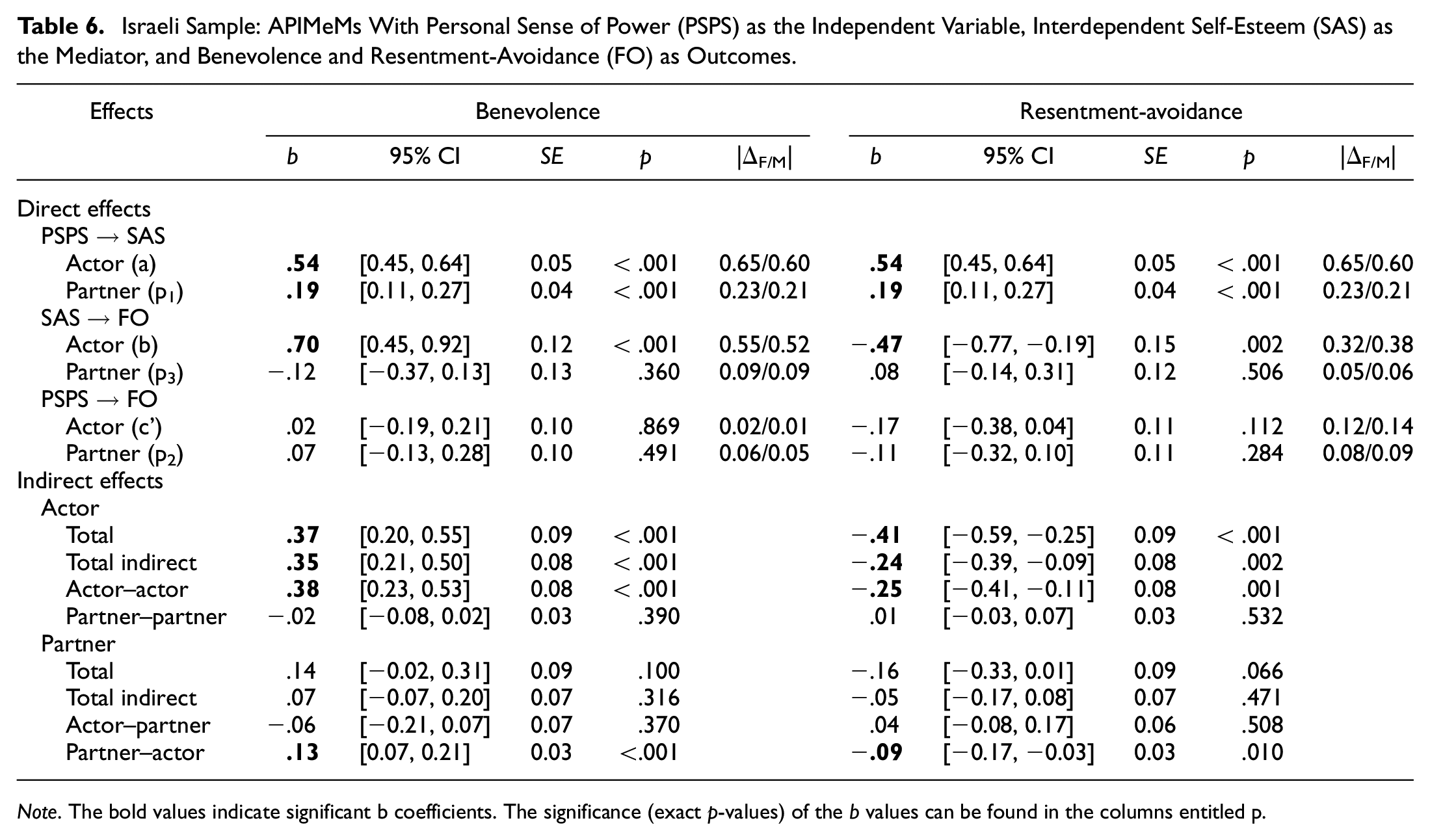
Note. The bold values indicate significant b coefficients. The significance (exact p-values) of the b values can be found in the columns entitled p.
The same pattern of associations emerged in the model with interdependent self-esteem as the mediator and resentment-avoidance as the outcome (see Table 6). Actor’s power was positively associated with actor’s self-esteem, and actor’s self-esteem was negatively associated with actor’s resentment-avoidance (b = −.47, 95% CI = [−0.77, −0.19]). Full mediation was found because the direct actor effect was nonsignificant, but the total indirect effect was significant (b = −.24, 95% CI = [−0.39, −0.09]). Actor’s power was positively associated with partner’s self-esteem (b = .19, 95% CI = [0.11, 0.27]), and a significant indirect effect from actor’s power to partner’s resentment-avoidance through partner’s self-esteem was found (b = −.09, 95% CI = [−0.17, −0.03]).
Discussion
The second study was conducted in a more collectivistic context and tested independent and interdependent self-esteem as potential mediators. When we measured independent self-esteem, we found a positive association between power and forgiveness as in Study 1. For benevolence, there was a significant partner effect. Furthermore, for actors, power was positively related to independent self-esteem, which in turn was positively related to forgiveness. The partial mediation by self-esteem is in line with the results found in Study 1. Gender did not moderate any association. Interdependent self-esteem completely mediated the power–forgiveness relation, underscoring the relevance of this form of self-esteem for forgiveness. Furthermore, we found an indirect partner–actor effect, suggesting that interdependent self-esteem is higher in a relationship when one partner experiences high power. Interdependent self-esteem is in turn positively related to one’s own tendency to forgive one’s partner’s transgressions.
How might the difference in the magnitudes of the indirect effects of the two self-esteem measures be explained? In a recent meta-analysis, which supported a small positive association of self-esteem with forgiveness (Riek & Mania, 2012), most studies used independent self-esteem measures. However, a study distinguishing between construals of self-esteem in Portuguese students found that interdependent self-construals were positively associated with forgiveness, whereas independent self-construals were negatively related (Neto & Mullet, 2004). The latter finding is contrary to our results because independent self-esteem predicted forgiveness in our samples. Yet, we found that interdependent self-esteem was a stronger mediator than independent self-esteem, which is in line with Neto and Mullet (2004) because they suggested that interdependent self-construals are likely more predictive of forgiveness.
General Discussion
This research aimed to investigate associations of personal sense of power with self-esteem and offense-specific forgiveness in romantic relationships. A dyadic approach was used to also consider partner effects. The findings from couples from Germany and Israel were largely in line with our hypotheses. Power was positively related to one’s own forgiveness and largely also to one’s partner’s forgiveness. Independent self-esteem mediated this relation in both samples for both forgiveness dimensions: benevolence and resentment-avoidance. Interdependent self-esteem, which we tested in the Israeli sample, was actually such an important mediator that the direct effect of power on forgiveness became nonsignificant.
The results contribute to the literature as our analytic approach was dyadic (Ledermann & Kenny, 2017), our sample sizes were much larger than that of a previous study (Karremans & Smith, 2010), and we found the effect in two cultures (Germany and Israel). Moreover, we identified self-esteem as an important mediator. Especially self-esteem that is derived from close relationships (interdependent self-esteem) proved to be essential in the relation. We were able to replicate positive associations between power and self-esteem (Anderson et al., 2012), and for the first time tested this link in the context of romantic relationships. As in research that did not involve couples (Riek & Mania, 2012), self-esteem and forgiveness also showed a positive link. Finally, we replicated the positive effect of power on forgiveness (Karremans & Smith, 2010), but found this link for the first time in a dyadic setting. This research is therefore the second study to find a positive power–forgiveness relation and thus provides further evidence of the positive effect of power on forgiveness-related variables on which past theories (Keltner et al., 2003; Kipnis, 1972) and research did not yield a clear picture (e.g., Rusbult et al., 1991). Furthermore, in using couple’s data, we showed the relevance of considering interdependence in close intimate relationships because several partner effects were found.
The findings may benefit practitioners (e.g., in couples therapy). Empowering clients may have positive effects in highly committed relationships because power may lead to higher self-esteem, and self-esteem in turn may positively influence forgiveness, which is important for healthy and happy relationships (Webb & Toussaint, 2019).
Although our design has strong external validity, we cannot make claims about causality. Thus, future research may benefit from experimental methods and manipulate power in relationship partners to test effects on state forgiveness. It may be important to control for trait power in such an experiment (cf. Strelan et al., 2014). Furthermore, this points to the equivalence of different structural equation models: The direction of the association of power with forgiveness may actually be the reverse. However, as several experiments have demonstrated that power increases self-esteem (e.g., Wojciszke & Struzynska–Kujalowicz, 2007), and as we measured power as a stable property of the relationship and self-esteem as a personality variable, it seemed reasonable to use offense-specific forgiveness as the outcome. Nevertheless, using experimental or longitudinal designs would be helpful for establishing true mediation effects. Furthermore, we did not measure commitment in our samples because we considered it high in romantic couples. Nevertheless, a commitment measure could be used in future research as a potential moderator. A final limitation pertains to the use of the interdependent self-esteem measure in only the Israeli sample. Upcoming research could test it in another clearly individualistic culture like Germany and in another even more clearly collectivistic culture.
Future research may also benefit from using additional relationship measures. The forgiveness scale we used was specifically designed for close intimate relationships and measured offense-specific forgiveness. Whether effects will be similar with more global forgiveness measures still needs to be addressed. Furthermore, the philosopher Derrida (2001) distinguished between instrumental and authentic forgiveness. Are individuals being conciliatory by forgiving, or are they aiming to achieve some instrumental goals by forgiving? Different power variants could also be studied. We aimed to use a broad, psychometrically sound, well-established power scale, but distinguishing between power domains (e.g., Farrell et al., 2015) or measuring the need for power and dominance in the couple may provide additional insights. Partner’s perceptions of power (i.e., how the partner perceives the influence of the other in the relationship) might also be studied as a predictor of forgiveness.
Altogether, experienced power was found to be an important variable for experiencing forgiveness—for both actors and partners. This relation was explained by the higher self-esteem of partners with social influence in their romantic relationship. Thus, as already noted by Gandhi 90 years ago, the strong and the powerful possess the attribute to forgive. Experiencing power may thus be important for a healthy relationship.
Supplemental Material
sj-docx-1-spp-10.1177_19485506211056516 – Supplemental material for Revisiting the Power to Forgive: A Dyadic Approach for Determining the Relations Between Power, Self-Esteem, and Forgiveness in Romantic Relationships
Supplemental material, sj-docx-1-spp-10.1177_19485506211056516 for Revisiting the Power to Forgive: A Dyadic Approach for Determining the Relations Between Power, Self-Esteem, and Forgiveness in Romantic Relationships by Robert Körner, Astrid Schütz, Erez Zverling and Ami Sha’ked in Social Psychological and Personality Science
Footnotes
Acknowledgements

Handling Editor: Jennifer K. Bosson
Ethical Approval
All procedures performed in studies involving human participants were in accordance with the ethical standards of the national research committee and with the 1964 Helsinki declaration and its later amendments or comparable ethical standards. This article does not contain any studies with animals performed by any of the authors.
Informed Consent
Informed consent was obtained from all participants who were included in the study.
Declaration of Conflicting Interests
The author(s) declared no potential conflicts of interest with respect to the research, authorship, and/or publication of this article.
Funding
The author(s) disclosed receipt of the following financial support for the research, authorship, and/or publication of this article: This research was partly funded by a graduate scholarship granted by the state of Saxony-Anhalt, Germany, to Robert Körner. The source of funding had no involvement in the study design, data analysis, interpretation of data, writing, or decision to submit.
Supplemental Material
The supplemental material is available in the online version of the article.
Notes
Author Biographies
References
Supplementary Material
Please find the following supplemental material available below.
For Open Access articles published under a Creative Commons License, all supplemental material carries the same license as the article it is associated with.
For non-Open Access articles published, all supplemental material carries a non-exclusive license, and permission requests for re-use of supplemental material or any part of supplemental material shall be sent directly to the copyright owner as specified in the copyright notice associated with the article.
