



Abstract
Imposing and enforcing lockdown rules are effective means to decelerate the spread of SARS-CoV-2. That said, the effectiveness of these rules strongly depends on citizens’ compliance. Here, we investigate the extent to which lockdown compliance varies as a function of (a) time-variant factors (i.e., infection wave), (b) rule-related factors (i.e., length, intensity, and flexibility of lockdown), and/or (c) stable individual differences. Using latent-state trait modeling with panel data from 1,098 German individuals who reported on their willingness to comply with five lockdown scenarios at two time points (April and November, 2020), we show that a substantial amount of variance can be attributed to a latent trait. Using data from a third time point (January 2021; N = 834), we show that this latent trait is associated with honesty/humility and conscientiousness above and beyond social desirability. We discuss the theoretical and practical implications of these findings.
After the World Health Organization declared COVID-19 a pandemic on March 11, 2020, most countries implemented a range of nonpharmaceutical interventions such as the closure of educational institutions as well as large parts of the economy, mobility restrictions, social distancing regulations, isolation of suspect cases, and so forth. To date, scientists agree that many of these interventions effectively contributed to a decrease in infection rates (Brauner et al., 2021; Haug et al., 2020). In Germany, for instance, the federal government started implementing a national lockdown on March 9, 2020, which was gradually intensified and extended in late March and relaxed again in early May 2020. This strategy prevented a collapse of the health care system due to an overdemand of intensive care beds (Buchholz et al., 2020). However, infection rates reincreased in the fall of 2020, starting a “second wave” of COVID-19 infections and reinstated lockdown measures.
The effectiveness of state-enforced lockdown policies critically depends on citizens’ willingness to comply with them (Schmelz, 2021). Therefore, it is not surprising that psychologists and social scientists around the world were interested in compliance rates in their respective countries and the factors that contribute most strongly to the maintenance of compliance. Gollwitzer, Platzer et al. (2021), for instance, investigated compliance at the peak of the first infection wave in Germany (early April, 2020) and found that a large majority of respondents (i.e., 89%) indicated a willingness to comply with the distancing rules that were in force at that time and that a slightly lower, yet still large number of respondents (i.e., 71%) said they would comply with even stricter rules (i.e., a curfew). Similar compliance rates were found in other countries (e.g., Mækelæ et al., 2020), which may explain why state-imposed lockdown policies were, by and large, effective.
That said, compliance is not a given: It is contingent on a number of macro- and meso-level factors. For instance, compliance requires trust in the government (Dohle et al., 2020; Han et al., 2021; Twardawski et al., 2021), and trust erodes if citizens presume that their political leaders have lost control over the pandemic, act unreliably, or put their self-interest over the nation’s collective interest (Fancourt et al., 2020). Second, people may become weary of complying with lockdown rules over time: Survey data from the Netherlands (Reinders Folmer et al., 2020a, 2020b) and Germany (Rosman et al., 2021) show that compliance rates plummeted during early summer 2020; and Gollwitzer, Platzer et al.’s (2021) findings suggest that the same respondents who endorsed the current lockdown policies would not accept a potential long-term lockdown. Complying with rules and accepting restrictions of one’s fundamental rights is burdensome; lockdown compliance may thus decrease simply as a matter of time.
At the same time, a growing body of research suggests that lockdown compliance can be reliably predicted by stable personality characteristics, such as self-control (Nivette et al., 2021), the “dark factor” of personality (Zettler et al., 2021), empathy (Pfattheicher et al., 2020), or justice sensitivity (Gollwitzer, Platzer et al., 2021). Recently, Twardawski and colleagues (2021) suggested that physical distancing can be reliably predicted by the HEXACO traits honesty/humility, conscientiousness, and, to a lesser degree, emotionality. Together, these findings show that lockdown compliance reflects both a trait and a state (see also Zajenkowski et al., 2020). To date, it is unknown to what extent variability in lockdown compliance reflects trait-level compared to state-level variance and whether substantive personality dispositions predict this latent trait above and beyond response sets, such as impression management concerns or self-deception (e.g., Daoust et al., 2020; Larsen et al., 2020). Importantly, the effectiveness of political strategies to maintain a high level of compliance in the public likely depends on whether compliance is a latent trait or a volatile phenomenon: If compliance indeed was a person characteristic, political strategies should be more person-centered, for instance, by framing lockdown compliance as an individual duty (Zettler et al., 2021) or as an act of altruism (Pfattheicher et al., 2020). However, if compliance rates varied more strongly across time than between individuals, context-oriented political measures (e.g., nudges, local norms, social sanctions) might be a more effective strategy to maintain it.
In this study, we used latent-state trait (LST) modeling (Geiser & Lockhart, 2012; Steyer et al., 1999) to decompose the true-score variance in lockdown compliance. LST theory was developed to estimate the consistency (i.e., true-score variance accounted for by stable individual differences; a “latent trait”) vis-à-vis the occasion specificity of individual differences (i.e., true-score variance accounted for by “latent state residuals”). If more than one measure of assessment is used, a third component, true-score variance accounted for by systematic differences between measures (method specificity) can be estimated by the model. Here, we apply LST theory to quantify the consistency, occasion specificity, and method specificity in people’s self-reported compliance with different lockdown scenarios. Occasions were, in our case, two time windows: April 1–6, 2020 (“Time 1”) and November 3–10, 2020 (“Time 2”)—right at the beginning of the first and the second German lockdown, which were roughly comparable in intensity and coverage (Warren et al., 2021).
At both measurement occasions, participants reported their willingness to comply with the lockdown/distancing rules that were in force at that time (henceforth referred to as “status quo”) as well as with four alternative lockdown scenarios that had been discussed among epidemiologists (e.g., An der Heiden & Buchholz, 2020; Neher et al., 2020) during the first lockdown in April, 2020: The “status-quo extension” scenario envisaged a long-term extension of the lockdown rules (i.e., up to 9 months). The “short-term curfew” scenario considered a brief, but very strict and intensive measure: A rigorous curfew would be imposed for no more than 3 weeks; citizens would only be allowed to leave their homes with an official permission, and violations would be severely punished. The “intensified extension” scenario represented both an extension and an intensification of the current lockdown rules, yet not as rigorous as the curfew scenario. Finally, the “adaptive triggering” scenario envisaged a more flexible strategy, according to which lockdown/distancing rules would be alternately enforced and relaxed, depending on the number of infections and health care system demands. Together, these scenarios varied in length, intensity, and/or flexibility. Analyses of data collected during the first lockdown suggest that compliance is most strongly predicted by length and only to a much smaller degree by intensity or flexibility (Gollwitzer, Platzer et al., 2021).
In LST terms, compliance with the five different lockdown scenarios reflects five different “methods” indicating the same latent state (at each occasion) or latent trait (across occasions). Notably, in most applications of LST theory, “methods” denote different methodological approaches (e.g., self-reports, peer reports, behavioral measures; see Eid et al., 2008) reflecting the same trait. In our application, we use the term “methods” to denote different lockdown scenarios. Thus, the extent to which compliance varies across the five lockdown scenarios described above reflects “method specificity.” In the present study, we were interested in comparing this method specificity to the two other variance components defined by LST theory, that is, consistency (i.e., stable individual differences) and occasion specificity (i.e., differences between April/Time 1 and November/Time 2).
Besides quantifying these three variance components, we analyzed the correlations between respondents’ compliance ratings across scenarios and measurement occasions to explore how respondents’ pattern of compliance changed over time. In addition, we aimed to replicate Twardawski et al.’s (2021) findings and tested whether the HEXACO traits honesty/humility, conscientiousness, and emotionality would predict the latent trait variable above and beyond social desirability. To probe the convergent validity of this latent trait, we also investigated its relation to six specific distancing behaviors (i.e., avoiding bodily contact, keeping physical distance to others, reducing contacts to a minimum, canceling private meetings and activities, getting out of other people’s way on the street, social distancing). HEXACO traits, distancing behaviors, and social desirability were collected at a third time point (January 13–21, 2021; “Time 3”) to reduce artificial carryover/consistency effects.
Method
Sample and Recruitment
Participants were recruited from a German online access panel (www.wisopanel.net; for a description of this sampling source, see Göritz et al., 2021) comprising German-speaking people from a wide variety of sociodemographic and educational backgrounds. At Time 1, all members of the online panel were invited to participate. Of these, 2,511 respondents gave their informed consent. Of all people who started the survey, 2,353 finished it (94%). Careless responding was defined as giving the same response to all questions within one scenario (zero-variance responding; see Meade & Craig, 2012). Based on this criterion, 429 cases were discarded, leaving a final sample of 1,924. At Time 2, to which again all panel members were invited, 2,300 respondents gave their consent to participate, and 1,976 finished the survey (86%). After filtering cases with zero-variance responding (as for Time 1 data), the final sample consisted of 1,938 cases. Of these, 1,098 cases could be matched with their data from Time 1 (54% female, 46% male). Ages ranged between 20 and 95 years (M = 54.67, SD = 13.75). Regarding education level, 0.4% had no school degree, 11% had a basic school qualification (Hauptschulabschluss), 28% had a secondary school certificate (Realschulabschluss), 23% had a university entrance degree (Abitur), and 38% had a higher education degree (e.g., bachelor, master, or doctoral degree).
At Time 3, all respondents who had completed Time 2 were invited to participate. Of these, 900 gave their informed consent, 881 finished the survey, and 834 passed the attention check (i.e., a prompt to click “5” between two regular HEXACO items) and confirmed a “use-me” item at the end of the survey. These two items were only included at Time 3 to secure a high data quality. LST analyses are based on all 1,098 cases with complete data at Time 1 and Time 2; analyses that involve Time 3 data (i.e., HEXACO traits, distancing behaviors, and social desirability) are based on 834 cases with complete and valid data at all three time points.
Materials and Measures
Materials were the same as in the Gollwitzer, Platzer et al. (2021) study. 1 At Time 1 and Time 2, participants read a brief description of the five lockdown scenarios and reported their willingness to comply with the distancing rules implied by each scenario (1 = rather not comply to 6 = certainly comply). Participants could alternatively choose a response labeled “I do not or cannot give an answer to this question.” The scenarios were the same at both time points; only the time-specific wording was adapted (e.g., the 9-month extension in the “status-quo extension” scenario was said to be relieved “…on January 31, 2020” at Time 1 and “…on August 31, 2021” at Time 2). To avoid order effects, the order in which scenarios were presented to participants was counterbalanced.
At Time 3, the six HEXACO traits were assessed using the German 60-item version of the HEXACO Personality Inventory-Revised (Ashton & Lee, 2009; 1 = strongly disagree to 5 = strongly agree). Scales showed sufficient reliabilities: Ω t = .77 (emotionality), Ω t = .72 (honesty/humility), Ω t = .72 (conscientiousness), Ω t = .78 (extraversion), Ω t = .74 (openness to experience), and Ω t = .70 (agreeableness). In addition, socially desirable responding was measured with the Balanced Inventory of Desirable Responding (BIDR; Paulhus, 1991; German version: Musch et al., 2002), which consists of two subscales (Self-Deceptive Enhancement/Self-Deception and Impression Management/Other-Deception) with 10 items each (1 = completely reject to 7 = completely agree; both Ω t s = .70). Subsequently, participants indicated their compliance with six specific social distancing behaviors (e.g., “I have canceled private meetings and activities…”; 1 = does not apply at all to 6 = applies completely; Ω t = .89) taken from Twardawski et al. (2021).
Results
Means, standard deviations, and intercorrelations are reported in Table 1. We specified a confirmatory factor analysis model based on LST theory (Steyer et al., 1999). More precisely, we specified an LST model with M − 1 correlated “method” factors (Eid et al., 2008; Geiser & Lockhart, 2012), which is preferable because all latent variables are algebraically well-defined in this case. Recall that, in our study, “methods” reflect the five lockdown scenarios. The M − 1 approach requires the selection of a reference method, which, in our case, was participants’ compliance with status quo lockdown/distancing rules. The resulting four “method” factors can be defined as linear regression residuals of participants’ compliance with each of the remaining lockdown scenarios (i.e., status-quo extension, intensified extension, short-term curfew, and adaptive triggering) that cannot be explained by “status quo” compliance (Geiser & Lockhart, 2012).
Descriptive Statistics and Intercorrelations.
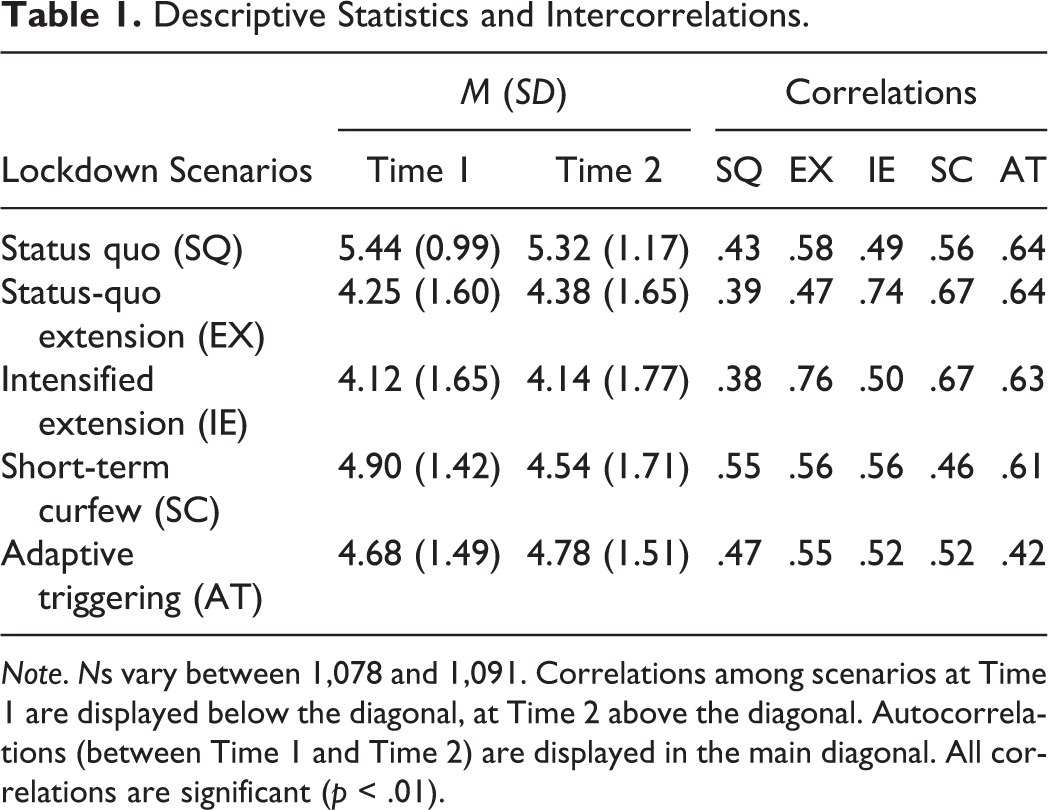
Note. Ns vary between 1,078 and 1,091. Correlations among scenarios at Time 1 are displayed below the diagonal, at Time 2 above the diagonal. Autocorrelations (between Time 1 and Time 2) are displayed in the main diagonal. All correlations are significant (p < .01).
A graphical representation of this model is provided in Figure 1. To secure identifiability and measurement invariance, factor loadings of compliance ratings for all lockdown measures on each latent state factor were restricted to be equal, and loadings of the two latent state factors on the latent trait factor were also restricted to be equal. Method (i.e., scenario) factors were allowed to correlate with one another (Eid et al., 2008; Geiser & Lockhart, 2012), but not with the latent state or latent trait factors. No other restrictions were imposed. Analyses were conducted with Mplus Version 8.1 (Muthén & Muthén, 1998–2017). Model parameters were estimated via maximum likelihood with robust standard errors. The model fit was acceptable according to common standards (Schermelleh-Engel et al., 2003): χ2(32) = 224.68, p < .01, comparative fit index (CFI) = .95, Tucker–Lewis index (TLI) = .93, root mean square error of approximation (RMSEA) = .074, standardized root mean square residual = .063. Fit indices for two alternative models, one assuming no latent trait factor (i.e., uncorrelated latent states) and one assuming no method factors (i.e., no systematic variation in compliance between lockdown scenarios), were comparably lower (CFIs = .93 and .79; TLIs = .88 and .78; RMSEAs = .097 and .133, respectively).
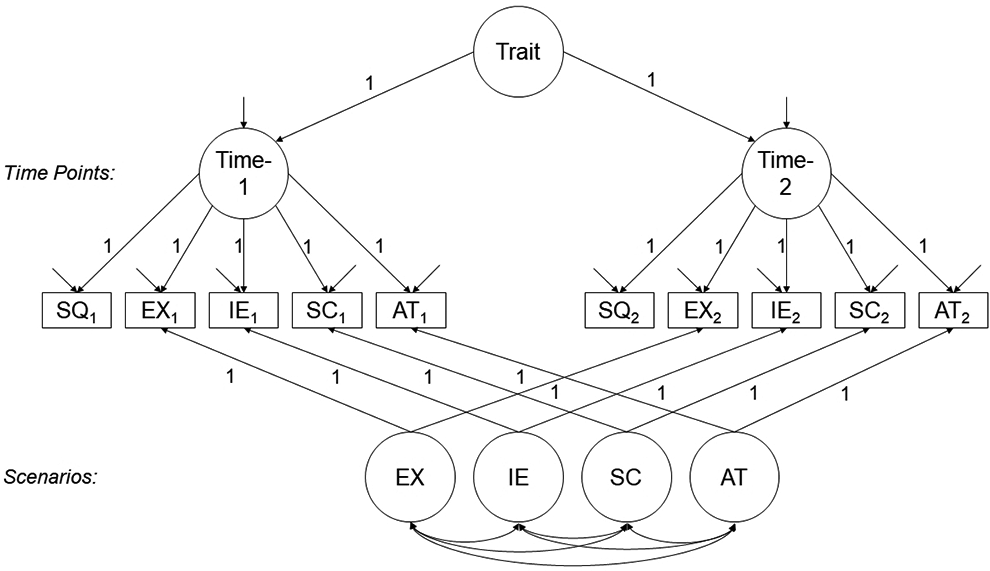
Latent-state trait model with M − 1 correlated method (i.e., scenario) factors. Compliance with “status quo” rules (SQ) served as the reference method. EX = status-quo extension; IE = intensified extension; SC = short-term curfew; AT = adaptive triggering.
Consistency, Occasion Specificity, and Method Specificity
Modeling results are reported in Table 2. Averaged across scenarios and time points, 38.7% of the true-score variance can be attributed to stable individual differences in lockdown compliance. The consistency coefficient varied between .16 (i.e., 24% of the true-score variance) for the IE scenario at Time 2 and .471 (i.e., 71%) for the SQ scenario at Time 1. By contrast, only 28.7% of the true-score variance can, on average, be attributed to differences between Time 1 and Time 2. The occasion specificity coefficient varied between .078 (i.e., 12% of the true-score variance) for the IE scenario at Time 1 and .405 (i.e., 54%) for the SQ scenario at Time 2. Finally, 32.6% of the true-score variance can be attributed to differences between the five scenarios. The method specificity coefficient varied between 0 (since “SQ” as the reference method cannot produce any variability) and .383 (i.e., 59% of the true-score variance) for the IE scenario at Time 1. Method specificity coefficients were highest for the two long-term scenarios (SQ extension and IE) at both time points, which replicates Gollwitzer, Platzer et al.’s (2021) findings that respondents are least willing to comply with these two scenarios. For completeness, reliability estimates (i.e., the extent to which the observed variance of each variable does not reflect measurement error) are also reported in Table 2.
Latent-State Trait (LST) Modeling Results: Variance Estimates, LST Coefficients, and Relative Amount of the True-Score Variance Attributable to Trait, State (i.e., Time Point), and Method (i.e., Scenario) Effects.
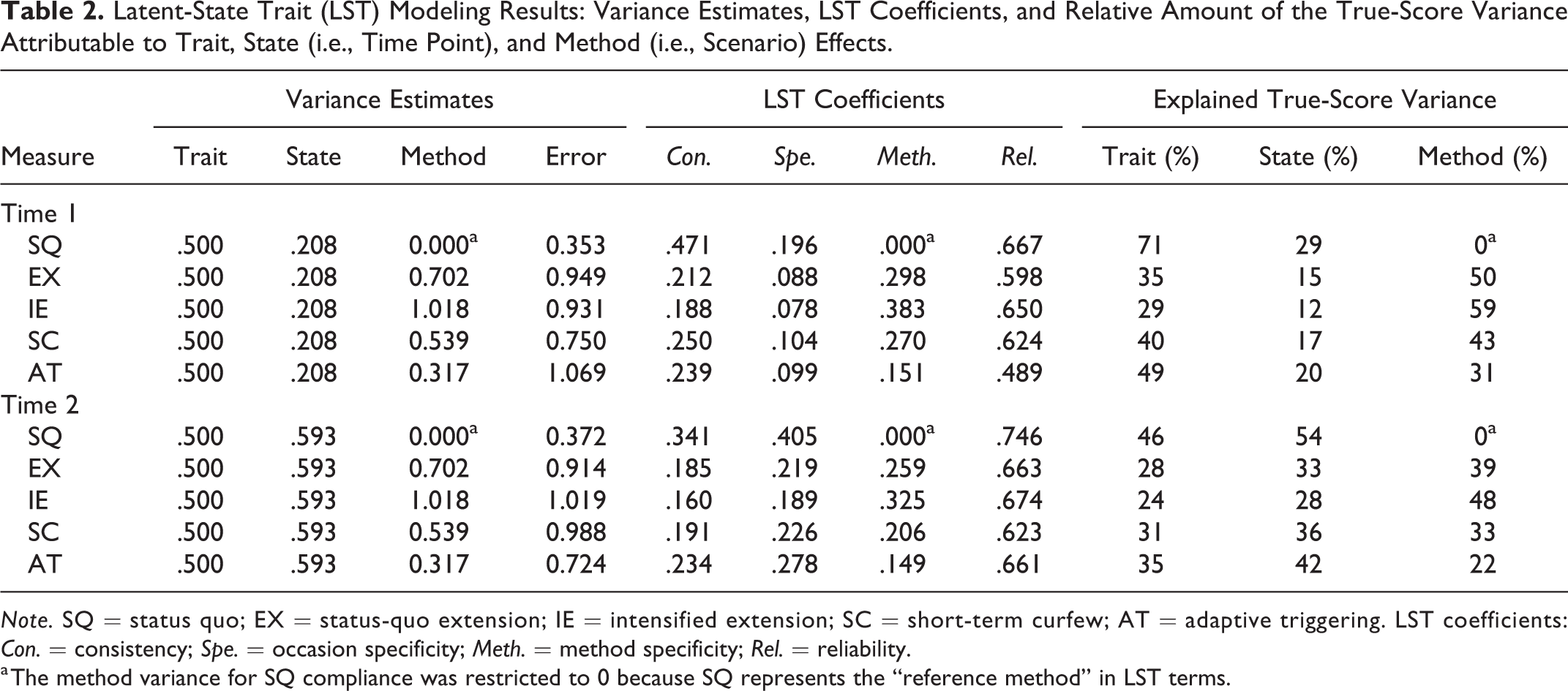
Note. SQ = status quo; EX = status-quo extension; IE = intensified extension; SC = short-term curfew; AT = adaptive triggering. LST coefficients: Con. = consistency; Spe. = occasion specificity; Meth. = method specificity; Rel. = reliability.
a The method variance for SQ compliance was restricted to 0 because SQ represents the “reference method” in LST terms.
Relations With HEXACO and BIDR
Regressing the latent trait for lockdown compliance on HEXACO traits as well as the two BIDR scales measured at Time 3, we find unique positive effects of conscientiousness, B = .146, SE(B) = .054, p = .007, and honesty/humility, B = .097, SE(B) = .049, p = .047, but not emotionality, B = .026, SE(B) = .045, p = .555, above and beyond the two BIDR subscales Impression Management, B = .102, SE(B) = .029, p = .001, and Self-Deception, B = −.112, SE(B) = .036, p = .002.
Distancing Behavior
In addition, we scrutinized the convergent validity of our latent compliance trait by inspecting its correlation with self-reported distancing behavior measured at Time 3. Specifically, engagement in the six distancing behaviors that were recommended to reduce the spread of SARS-CoV-2 (e.g., canceling joint activities, reducing contacts to a minimum) loaded on a latent factor (with loadings ranging between .675 and .911, all ps < .001), and this latent factor was correlated with the latent compliance trait. As expected, the correlation between these two latent variables was positive and significant, r = .816, p < .001. This underscores the convergent validity of our latent compliance trait.
Exploratory Analyses
The notion of a latent compliance trait should also imply high correlations between compliance with different lockdown rules across different measurement occasions. These correlations, which are not displayed in Table 1 to save space, are indeed positive (ranging between .28 and .49) and significant (all p < .01). The lowest correlation was found for compliance with the SQ at Time 2 and the IE scenario at Time 1 (r = .279). This is surprising given that people who had resented the idea of a long-term lockdown in April 2020 should be particularly dissatisfied with the fact that, even 7 months later, most of these measures were still (or, again) in place. In other words, a higher positive correlation between these two measures would have been plausible. Exploring the scatterplot (see Figure 2) helps explain the relatively modest correlation: While respondents indicating a high compliance with the IE scenario at Time 1 also indicated a high compliance with the status quo at Time 2 (upper right area), respondents indicating a low willingness to comply with the IE scenario (at Time 1) are nevertheless compliant when this scenario becomes reality (upper left area). Gollwitzer, Platzer et al. (2021) speculated that respondents resent the idea of a long-term lockdown because they underestimate their capability to adapt to it (Gilbert, 1991; Wilson & Gilbert, 2003). This could explain what we see in our data: People hate the idea of a long-term and intensified lockdown, but when it comes, they adapt to and comply with it.
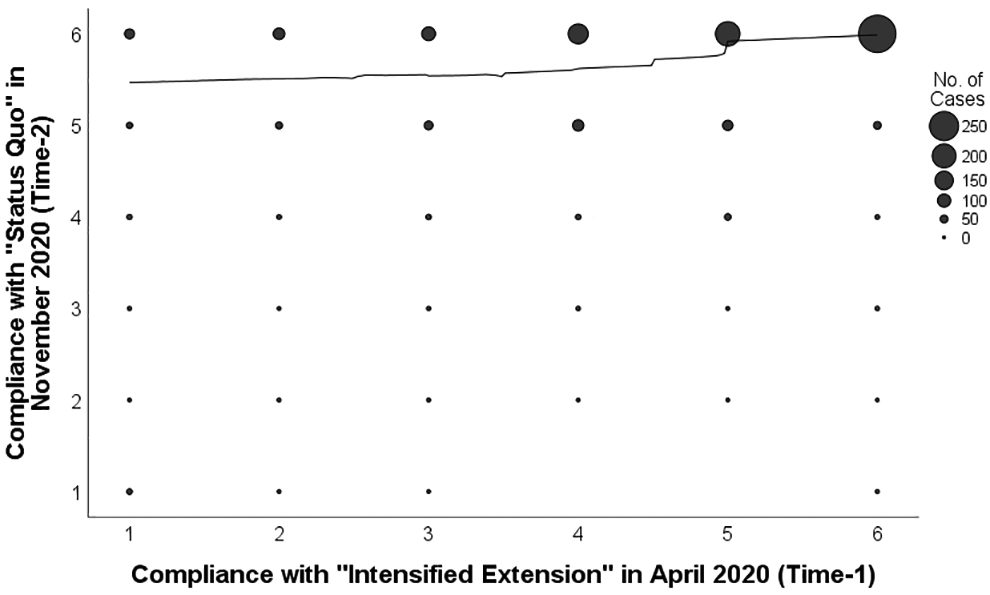
Scatterplot displaying the relation between compliance with the intensified extension scenario (Time 1) and compliance with the status quo (Time 2) based on a LOESS (locally estimated scatterplot smoothing) function. The size of each circle reflects the observed frequency of cases.
Discussion
Compliance with lockdown rules is, to a considerable extent, a latent trait: About 39% of the true-score variance in lockdown compliance can be explained by stable individual differences. This latent trait is meaningfully related to self-reported distancing behavior, which underscores its convergent validity. Moreover, this latent trait is related to conscientiousness and honesty/humility above and beyond impression management and self-deceptive enhancement (i.e., ruling out social desirability-related response sets as an alternative explanation). Notably, this effect cannot be explained by artificial carryover/consistency effects given a lag of 2 months between Time 2 and Time 3. Thus, we consider our test of the unique effects of conscientiousness and honesty/humility on compliance to be conservative, although it led to a loss of statistical power due to dropouts.
Furthermore, only 29% of the true-score variance was explained by time-related changes in compliance ratings (in LST terms, “latent state residuals”), which may reflect a general weariness to comply with lockdown rules (e.g., Rosman et al., 2021), and 33% of the true-score variance was explained by differences in compliance reactions toward different scenarios varying in length, intensity, and flexibility. Replicating previous findings (Gollwitzer, Platzer et al., 2021), it is particularly the prospect of a long-term lockdown that makes people unwilling to comply with the respective restrictions. That said, our exploratory analyses suggest that this unwillingness may dissolve over time (see Figure 2): A majority of those who resented a long-term lockdown in April were willing to comply with it when it actually came in November (albeit in a less intensive fashion than the IE scenario had depicted). This suggests that, when thinking about aversive future events, people overestimate the negative impact of these events while underestimating their capability to adapt to them (Gilbert, 1991; Wilson & Gilbert, 2003).
Together, our findings contribute to a better understanding of why and when people comply with state-imposed restrictions to their basic citizen rights in the fight against the COVID-19 pandemic. Our research suggests that, at least in Germany, compliance is relatively high and stable. This may have something to do with the fact that, overall, Germans have a relatively high trust in their political institutions (e.g., Twardawski et al., 2021), which is an important predictor of compliance (Dohle et al., 2020; Han et al., 2021). Thus, the high amount of variance that can be attributed to a latent compliance trait may be smaller in countries in which institutional trust is lower.
This discussion implies that our results may not be generalizable to other populations. Therefore, researchers who have access to similar data collected in other countries may hopefully be encouraged to apply the modeling strategy described here to replicate our results. We do believe, however, that our data are generalizable to the German population given our sampling strategy and the high quality of the panel we used here in terms of heterogeneity and resemblance to the general population (Göritz et al., 2021).
In addition, it should be noted that compliance was exclusively measured via self-reports, not via actual behavior. While self-reports are the most common assessment strategy for measuring compliance, more objective behavioral measures (such as reduced mobility via smartphone tracing apps; see Sun et al., 2020) would be informative and would also provide the opportunity to explore “method” effects as conceptualized in standard LST approaches. That said, we still have confidence in the validity of our self-report data given that (a) we found that associations between lockdown compliance and personality traits persisted even after controlling for social desirability, (b) lockdown compliance was highly correlated with self-reported distancing behavior, and (c) the extent to which self-reported compliance is biased appears to be small (see A. Gollwitzer, McLoughlin et al., 2021; Larsen et al., 2020).
Conclusion
Compliance with lockdown rules is burdensome and challenging; yet, lockdowns are important means to flatten the curve of COVID-19 infection rates. That said, lockdown rules can only be effective if a majority of citizens comply with them. Our research suggests that this compliance has both trait- and state-like features and that a considerable amount of variance in compliance can be attributed to a stable latent trait, which is meaningfully associated with other personality traits, especially conscientiousness and honesty/humility. This suggests that person-centered political strategies (i.e., appealing to citizens’ conscientiousness by framing compliance as a duty or appealing to their prosociality by framing compliance as an act of altruism; see Pfattheicher et al., 2020; Zettler et al., 2021) should be just as effective as context-centered strategies, such as nudges, incentives, or sanctions (Schmelz, 2021). Thus, there is hope that lockdown rules and other nonpharmaceutical interventions continue to be effective, at least until a pharmaceutical weapon against COVID-19 is available.
Footnotes
Authors’ Note

Acknowledgment
We thank Michael Eid for helpful advice on latent-state trait modeling and model specification.
Declaration of Conflicting Interests
The author(s) declared no potential conflicts of interest with respect to the research, authorship, and/or publication of this article.
Funding
The author(s) received no financial support for the research, authorship, and/or publication of this article.
Compliance With Ethical Standards
Informed Consent
Informed consent was obtained from all participants included in the study.